They Offered $2,500 to Anyone Who Could Control the Retired K9 — The Old Farmer Did It With One Word
PART3:
At least one other person did.
Later, I learned her name was Sergeant Maria Flores. K9 handler. Lackland Air Force Base. On leave. She had come to the fair for funnel cake and quiet, and instead found herself watching a man turn fear into public entertainment.
At that moment, though, she was just another still point in a crowd leaning toward cruelty without realizing it.
Keltner was sweating now.
The dog was making him look bad.
That was dangerous.
Not for Keltner.
For Havoc.
Men like Keltner could tolerate a difficult animal. What they could not tolerate was humiliation. When their methods failed, they did not question the methods. They blamed the dog.
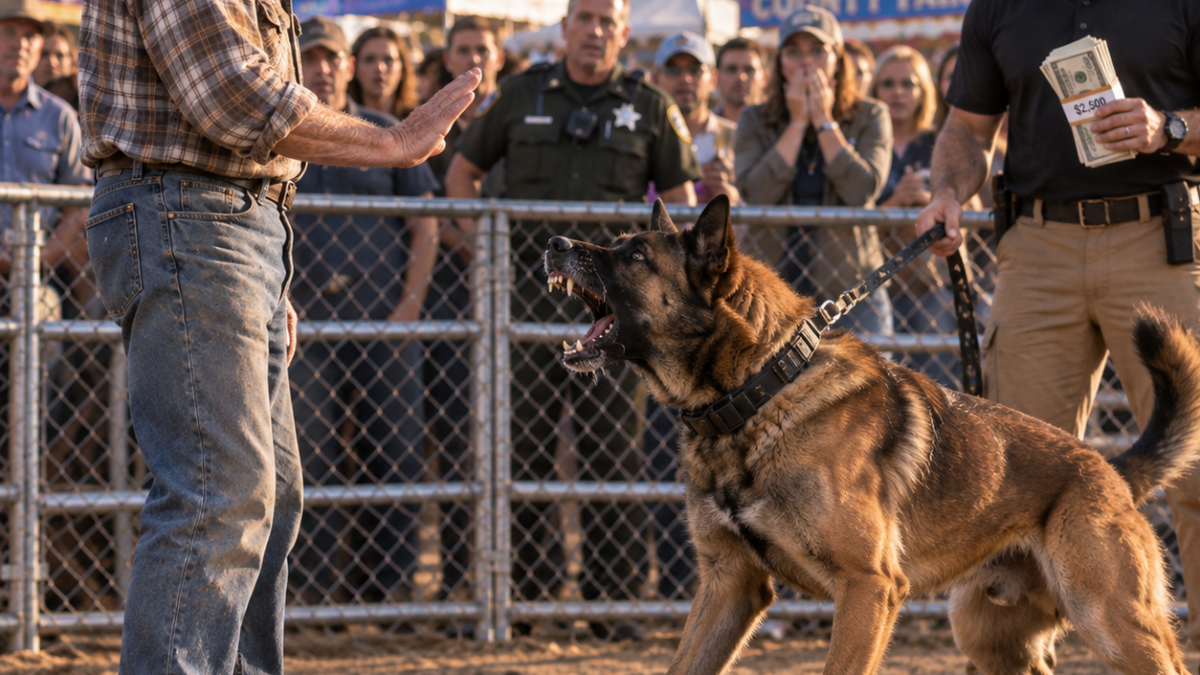
He hauled Havoc backward and slammed the gate to a smaller holding pen inside the enclosure. Havoc retreated to the far corner, breathing hard, a low growl rolling in his chest like distant thunder. His body was pressed partly sideways, ready to spring if anything came too close.
Keltner turned to the crowd with a smile that did not reach his eyes.
“As you can see,” he announced, “this is a highly specialized animal. Decommissioned due to handler aggression issues. Takes a firm hand. An experienced hand.”
I felt my fingers dig into the fence rail.
Handler aggression.
Maybe.
Or maybe someone had failed him so badly that the only human language he trusted had disappeared.
Keltner reached into his back pocket and pulled out a thick envelope.
“But Apex Canine Solutions believes in community education,” he said. “So let’s make this interesting.”
The crowd shifted.
Money has a sound even before it moves.
Keltner waved the envelope high enough for everyone to see.
“There’s $2,500 cash right here. A donation, let’s call it. It goes to anyone who can walk into that pen and get this dog to sit and stay for ten seconds.”
The murmurs rose immediately.
“Anyone,” Keltner repeated. “Anyone who thinks they know better than a certified professional.”
A few young men in the front row laughed too loudly and nudged each other, but none stepped forward. Havoc’s teeth were visible. That was enough to remind courage of its limits.
Keltner knew nobody would try.
That was the point.
The challenge was not generosity. It was theater. If no one moved, he won. If some fool tried and failed, he won bigger. Either way, the crowd would leave believing Havoc was uncontrollable and Keltner was the only thing standing between them and disaster.
I pushed myself off the fence.
The old deputy saw me first.
His chewing slowed.
I walked toward the enclosure.
Not fast.
Not slow.
Just steady.
People moved aside before they knew why. That happens when a person walks with purpose and no need to announce it.
The woman with the K9 eyes—Flores—watched me approach. Her attention sharpened. I could feel her studying the way I moved, the way my head turned, the way I kept the dog in view without staring at him. She recognized habits. People who have lived by certain rules can spot those same rules in strangers.
Keltner saw me and laughed.
“Can I help you, old-timer?” he called. “Petting zoo’s over by the Ferris wheel.”
A few people chuckled.
I ignored them.
My eyes stayed on Havoc.
The dog was trembling.
Not visibly enough for the crowd, maybe, but enough for me. A tiny shiver through the haunches. His breathing came too fast. His pupils were wide. His weight kept loading forward, then back, then forward again.
A soldier scanning his sector.
No landmark.
No anchor.
“I’ll try,” I said.
My voice was quiet.
It still carried.
Keltner’s smirk widened.
“You’ll try?”
“Yes.”
“With all due respect, sir, you have no idea what you’re dealing with. This isn’t some farm collie you can whistle at. This is a military-grade animal trained to neutralize threats. You walk in there, you become the threat.”
I finally looked at him.
Not long.
Just enough.
He was younger than he sounded. Maybe thirty-five. Fit. Confident. Afraid of being exposed. His posture told me more than his words did.
“The dog isn’t a threat,” I said.
Keltner blinked.
“He’s lost.”
A ripple moved through the crowd.
“He needs a landmark.”
Keltner stared like I had spoken a foreign language.
“A landmark?”
I nodded once.
“What he needs,” Keltner snapped, “is structure and dominance. You cannot sweet-talk an animal like this.”
“I know.”
The answer seemed to bother him more than argument would have.
He stepped closer to the fence.
“Grandpa, I’m not going to be responsible when he takes your arm off.”
The sheriff came over then.
Sheriff Dale Granger knew me, at least as much as anyone in town knew me. He had bought hay from me twice, waved at me on county roads, and once helped pull a calf from a drainage ditch during a storm. He was a slow-talking man with tired eyes and a habit of appearing less intelligent than he was.
He looked at me.
Then at Havoc.
Then at Keltner.
“Let him have a go,” the sheriff said.
Keltner turned on him.
“Sheriff, this is an extreme liability situation.”
“Then have him sign your paper.”
“I strongly advise against—”
“He’s a grown man.”
Keltner’s jaw worked.
The crowd began chanting in uneven bursts.
“Let him try.”
“Give him a shot.”
“Let the old guy do it.”
I did not like the excitement in their voices.
They still thought this was entertainment.
But if entertainment opened the gate, I would take it.
Keltner thrust a clipboard at me.
“Fine. Sign here. Releases Apex Canine Solutions of all liability when you get mauled.”
I took the pen.
My handwriting came out neat. It always did. Some habits survive everything.
Samuel Finch.
I handed the clipboard back.
“Open the pen,” I said. “Then step away.”
Keltner scoffed.
“I’ll stay close in case—”
“All the way back.”
For the first time, his expression flickered.
Men like him hate being given clear instructions by someone they have already dismissed.
The sheriff said, “Do it.”
Keltner opened the main gate.
I stepped inside and closed it behind me without letting it clang.
That mattered.
Everything mattered.
The crowd went still.
Havoc’s growl deepened.
He shifted forward onto the balls of his feet. His body coiled. He was ready to launch, but not at me specifically. At anything. At pressure. At threat. At the next wrong move.
I did not walk toward him.
That surprised the crowd.
It surprised Keltner too.
I moved parallel to the holding pen, about twenty feet away. I angled my body slightly sideways, hands in my pockets, shoulders loose. No direct eye contact. No raised voice. No reaching. No leash. No command.
Just breathing.
Slow.
Even.
I walked the perimeter once.
Dust shifted under my boots.
Carousel music drifted faintly behind me.
A child whispered and was hushed.
Havoc watched.
Good.
Watching was better than reacting.
I walked the perimeter a second time.
Same pace.
Same breath.
Same distance.
Predictability is kindness to a mind trapped in chaos.
I made myself part of the environment.
A tree.
A fence post.
A rock in a field.
Something that did not demand anything from him.
Behind the fence, Keltner muttered, “This is ridiculous.”
Maybe it looked that way to him.
Force always thinks patience looks like weakness.
But Havoc’s growl began to change.
Not vanish.
Change.
The jagged edge came off it. His breathing slowed by a fraction. His ears shifted, still tight but no longer flattened all the way back. He stopped pacing. His eyes followed me with focused curiosity instead of blind panic.
Who are you?
Why aren’t you yelling?
Why don’t you hurt?
Why don’t you stare?
I completed the second circuit and stopped in front of the smaller holding pen, about fifteen feet from the gate.
Still no direct eye contact.
I looked at his chest.
Soft gaze.
Open posture.
I took one breath and let it out in a quiet sigh.
Then I took one step forward.
Havoc tensed.
A low warning rolled through him.
I stopped.
Not because I was afraid.
Because he had spoken.
He said, Too much.
So I answered, All right.
I waited.
The crowd held its breath.
That was the first real conversation Havoc and I had.
No words.
Just pressure and release.
He warned.
I listened.
He learned I listened.
After a while, the growl faded.
I took another step.
Then stopped.
Another.
Then stopped.
I closed the distance with the kind of patience people mistake for doing nothing. But inside that nothing, everything was happening. Havoc’s nose twitched. His body tracked the air. He was collecting information.
Old denim.
Sun.
Soil.
Hay.
Leather.
Gun oil buried too deep in memory for most humans to notice but not too deep for him.
And dogs.
Always dogs.
Dogs leave themselves on a man if he has loved them long enough.
At the holding pen gate, I rested my weathered hands lightly on the chain link.
Havoc whined.
Not loudly.
A high, questioning sound.
My chest tightened.
There you are, I thought.
Not the monster.
Not the loaded weapon.
The dog beneath all that noise.
I unlatched the gate slowly.
I did not swing it open.
I let it drift a few inches.
An invitation.
Then I knelt.
My knees did not appreciate it, but they obeyed.
I made myself smaller than him. Lower. Less imposing. Still angled away. Still quiet.
Havoc stared at the opening.
His nose worked.
One paw moved.
Stopped.
Another.
He crept forward like a reconnaissance scout entering uncertain ground.
The crowd saw danger.
I saw courage.
He reached the gate and pushed his head through the narrow gap. His nose touched my knee. I did not move. He sniffed my jeans, my sleeve, my hand.
Still I waited.
Too many people try to take trust the moment it appears.
They ruin it that way.
Havoc nudged my fingers.
Then licked them once.
A quick test.
Salt.
Sun.
Old scars.
No correction.
No pain.
Only then did I slowly lift my head.
Our eyes met.
Just for a second.
Long enough.
I let him see me.
Not the farmer. Not the old man. Not the stranger in plaid.
Me.
The part I usually kept behind locked doors.
The handler.
The soldier.
The man who had once spoken to dogs in places where one wrong sound could kill everyone.
Something shifted in Havoc’s eyes.
Recognition is not always memory.
Sometimes it is the body remembering a language the mind has not heard in years.
I took one slow breath.
And I spoke.
“Vriend.”
The word was barely more than a vibration in my chest.
Not shouted.
Not performed.
Not thrown like a command.
Given.
Friend.
Havoc’s entire body changed.
I felt it before the crowd saw it.
The tension left him so quickly it seemed like someone had cut invisible wires. His ears came forward. His mouth softened. The hard line of his back eased. His eyes fixed on my face, no longer frantic, no longer searching every corner for threat.
He sat.
Perfectly.
Crisp.
Military-clean.
A sit that came from training buried deeper than fear.
His tail touched the dirt.
Thump.
Thump.
Thump.
The crowd gasped.
I heard a woman whisper, “Oh my God.”
Keltner said nothing.
Havoc looked at me like the world had finally translated itself.
I lifted my hand and touched the side of his face.
He leaned into me so hard I had to steady myself against the fence.
“There you are,” I murmured.
I spoke to him softly in Dutch after that. Not much. Just enough. Old words. Warm words. The kind of words that told a dog the shooting had stopped, the mission was over, the handler had him, the world had edges again.
Havoc closed his eyes.
Ten seconds passed.
Then twenty.
Then a full minute.
He did not break position except to press closer into my palm.
Applause began somewhere in the back.
Small at first.
Then louder.
Soon the whole crowd was cheering.
I hated the noise, but Havoc did not flinch this time. My hand was on him. My voice was low near his ear. He had a landmark now.
The challenge was over.
But the real lesson had barely begun.
I stood slowly.
Havoc rose with me and moved naturally to my left side.
Heel position.
No leash.
No prong collar.
No force.
Just trust returning to a body that had almost forgotten where to put it.
Keltner stared at us.
His face had gone pale.
The envelope hung from one hand.
He looked younger now. Smaller. Not because I wanted him humiliated, but because arrogance had left him and there was not much underneath yet.
I walked toward the gate.
Havoc walked beside me.
The crowd parted on the other side of the fence as the sheriff opened it.
That was when Sergeant Maria Flores stepped forward.
“Excuse me, sir.”
I looked at her.
Her voice held respect, but her eyes held questions.
“That was incredible.”
“Dog needed a familiar voice,” I said.
She studied me.
“Vriend.”
I said nothing.
“That’s Dutch,” she continued. “Friend.”
I nodded slightly.
“But not just any word,” she said. “That was a marker. A release. KNPV lineage, maybe. Old fail-safe language. The kind used in certain military working dog programs.”
Behind her, Keltner stepped closer, still stunned.
“What did you do?” he asked. “What was that word?”
I looked at Havoc.
He sat beside my leg, calm now, tongue barely visible, eyes lifted to me with an expression that still had the power to break my heart.
The old rule rose inside me.
Stay quiet.
Stay unknown.
But there was another rule older than that.
Protect the dog.
So I turned to Keltner.
“That word told him he was safe.”
Keltner swallowed.
“I don’t understand.”
“No,” I said. “You don’t.”
The crowd quieted again.
I did not raise my voice. I was not interested in making a speech. But sometimes the truth needs witnesses, especially when a lie has been sold loudly.
“You were treating him like a machine that needed calibration,” I said. “A hard correction here. A louder command there. More pressure. More dominance. But he is not a machine.”
Keltner looked at the ground.
“He’s a soldier,” I continued. “And he is scared.”
Some people in the crowd shifted uncomfortably.
I pointed gently toward the fairgrounds around us.
“To you, this is a fair. Music. Food. Children. Noise. To him, this is a chaotic environment with no mission, no handler, no clear rules, and threats pressing from every side. He was trained for a world of black and white. Threat or safe. Mission or stand-down. Handler or stranger. You threw him into gray and then punished him for not understanding it.”
Havoc leaned lightly against my leg.
I rested a hand on his head.
“You called that aggression. It wasn’t. He was trying to create distance. Trying to make the noise go away. Trying to survive a world that stopped making sense.”
Keltner’s face tightened.
The old defensiveness tried to come back.
“But dogs like this need strong leadership.”
“Yes,” I said. “They do.”
He looked relieved for half a second.
Then I added, “But strength is not the same as force.”
The relief vanished.
“A dog like this does not follow you because you hurt him better than someone else can. He follows because you become the one stable point in the storm. You become the voice that tells him what matters. You earn the place in his mind that says, When this human speaks, I can breathe.”
I looked down at the prong collar.
“That cannot be yanked into existence.”
Sergeant Flores nodded once.
Keltner saw it.
That seemed to hurt him more than my words.
I went on, because Havoc deserved the room to understand.
“His first working language is Dutch. That is not an accident. It keeps commands clear. Keeps the wrong people from controlling him easily. Those words are keys. You were trying to kick down a door that needed to be unlocked.”
Keltner’s eyes moved to Havoc.
For the first time, I saw him look not at the teeth, not at the muscle, not at the danger, but at the dog.
Really look.
The shame came slowly.
That was better.
Fast shame often becomes anger.
Slow shame can become change.
“I thought…” Keltner began.
Then stopped.
He looked at the envelope in his hand.
“I thought I knew what I was doing.”
I did not soften the truth.
“You knew methods. Not this dog.”
His jaw tightened, but he nodded.
The sheriff cleared his throat.
“What happens to him now?”
That was the question.
The only one that mattered.
I looked at Havoc.
He had been retired, they said. Decommissioned. Such cold words for a living creature who had likely spent years doing everything humans asked of him. Years searching, protecting, tracking, standing between danger and people who would later call him surplus.
“He gets out of here,” I said.
Keltner looked up.
“The demonstration is over.”
He nodded quickly.
“Yes. Of course.”
“The money,” I said.
He blinked.
“The prize?”
“I don’t want it.”
The crowd murmured.
I held his gaze.
“But he needs it.”
Keltner looked at the envelope.
“He needs a quiet place to decompress. A handler who understands where he came from. A real transition plan. Not crowds. Not collars. Not a carnival ring where people can pay fear with applause.”
The envelope lowered.
“This should be the start of a fund,” I said. “For dogs like him. Retired working dogs. Military. Police. Search dogs. Any dog trained for pressure and then expected to become ordinary overnight. They are not broken tools. They are veterans. They have earned peace.”
Keltner’s mouth worked.
“I’m sorry,” he said.
It was barely audible.
Not enough.
But a beginning.
He looked at me again.
“Can you show me?”
I did not answer immediately.
I had no interest in becoming anyone’s mentor. I had crops waiting. Fences needing repair. Chickens with more opinions than sense. A life I had built carefully away from old programs, old names, old work.
But Havoc pressed against my leg.
And Keltner, for all his arrogance, looked like a man whose world had cracked open enough to let light in.
“Learning starts with listening,” I said.
He nodded.
“First,” I added, “we get him out of here. He’s had enough excitement for one day.”
I clicked my tongue softly.
Havoc fell into position at my left.
Not because I owned him.
Not because I dominated him.
Because, for that moment, I was the only landmark he had.
We walked away from the ring together.
The applause faded behind us.
So did the fair music.
So did Keltner’s pride.
Sergeant Flores fell into step a few paces back, then the sheriff. Keltner followed after a hesitation, carrying the envelope like it had become heavier than cash.
I led Havoc past the livestock barns and toward a quieter strip of grass beyond the maintenance sheds. The farther we moved from the crowd, the more his body settled. His breathing deepened. His head lowered. His stride evened out.
There he is, I thought again.
The old soldier beneath the panic.
At my truck, I opened the passenger door.
Havoc hesitated.
Vehicles can carry memories. Good and bad. Deployment. Transport. Separation. Return. Loss.
I placed one hand on the seat and spoke softly.
“Vriend.”
His ears lifted.
He climbed in.
I gave him water from the bottle I kept in the cab, poured into the bottom of a clean feed scoop because life on a farm teaches you that almost anything can become a bowl if needed.
He drank slowly at first, then more deeply.
Keltner stood nearby, quiet now.
Flores watched with her arms folded, but the disgust in her face had been replaced by something more complicated.
“Where will you take him?” she asked.
“My place for now.”
The sheriff raised an eyebrow.
“You sure about that, Sam?”
“No.”
He almost smiled.
“But he needs quiet,” I said. “I have quiet.”
That much was true.
My farm sat five miles outside town where the road narrowed and the mailboxes leaned. I had a barn with an empty tack room, shaded pasture, a fenced yard, and no crowds unless you counted chickens, which Havoc would absolutely count if introduced too soon.
More importantly, I had patience.
And old guilt.
Sometimes the second can be shaped into the first if you live long enough.
Keltner stepped forward.
“I’ll sign whatever release you need,” he said.
“This is not about paperwork.”
“I know.”
“Do you?”
He looked at Havoc, then at the prong collar still hanging loose around the dog’s neck.
“Maybe I’m starting to.”
I removed the collar myself.
Slowly.
Havoc stood still while I unfastened it. When it came away, the fur beneath was flattened. The skin looked irritated.
I placed the collar in Keltner’s hand.
He stared at it like he had never seen it before.
Good.
Tools should sometimes shame the hand that misused them.
The sheriff helped make calls. Flores contacted people who knew people. Keltner, to his credit, did not argue when arrangements began shifting around him. By evening, the money had been handed over not to me, but into a temporary fund through a local animal welfare nonprofit willing to coordinate care for retired working dogs. It was rough, imperfect, and born in the dust of a county fair, but many good things start ugly before they become useful.
Havoc rode home in my truck with his head resting against the seat.
For the first ten minutes, he did not sleep.
He watched everything.
Road signs.
Passing cars.
My hands on the wheel.
The mirrors.
The fields.
The ditches.
The world moving too fast beyond glass.
I did not turn on the radio.
Did not call anyone.
Did not fill the silence because silence was what he needed most.
After a while, he lowered his head.
His eyes stayed open.
Then, mile by mile, they closed.
When we reached the farm, the sun was beginning to fall behind the tree line.
The chickens complained about my arrival as if I had been gone for several years instead of one afternoon. My old barn cat, Ruth, watched from the porch railing with narrow suspicion. I looked at Havoc and said, “You and Ruth will come to an understanding later. For now, assume she outranks both of us.”
He glanced at me.
His tail moved once.
Maybe I imagined it.
I brought him to the tack room I had prepared in my mind during the drive. Clean straw. Water. A thick blanket from the house. Door open to the fenced run. Quiet on all sides.
He inspected the space carefully.
Not frantically.
Carefully.
A professional doing a sweep.
He checked corners. Sniffed the door. Listened to the barn. Looked back at me after each small investigation as if confirming I was still part of the room.
I sat on an overturned bucket and let him work.
After ten minutes, he came to me.
Pressed his head into my knee.
And sighed.
That sigh told me more than any test could have.
The first night, I slept in the barn.
My back punished me for it, and my knees filed formal complaints, but I stayed. Havoc did not need to wake alone in another unfamiliar place. He had already been passed through too many hands, too many noises, too many misunderstandings.
Around two in the morning, he dreamed.
His paws twitched.
A low sound rose in his throat.
Not a growl.
Something smaller.
I opened my eyes and spoke before he could wake fully inside the dream.
“Vriend.”
His body settled.
The moonlight cut through the barn boards in thin silver lines. Hay dust drifted in the air. Somewhere outside, an owl called once. Havoc slept again.
I stayed awake longer.
Old memories have their own weather, and that word had brought a storm.
I had not spoken Dutch commands in years.
Not since the program.
Not since the dogs we trained for men whose names never appeared in newspapers, for missions that became rumors at most, for places I still smelled in nightmares. People liked to talk about elite dogs as if they were equipment. Assets. Tools. Force multipliers.
They were not.
They were partners born into a contract they never signed and honored more faithfully than many men honored vows.
I had left that world after losing a dog named Bram.
That is the simplest version.
The true version is longer and not useful here.
Bram had been black-masked, stubborn, brilliant, and too brave for any living thing. He saved three men on a night nobody would ever officially describe. He died with my hand on his chest and his eyes searching mine for a command I could not give.
After that, the program kept moving because programs do.
I did not.
I came home.
Bought land.
Grew hay.
Let my hair gray.
Let people think I was only a farmer.
Most days, I was.
Then Havoc appeared at a county fair, wearing terror like aggression, and the past stood up inside me before I could tell it to sit back down.
By morning, Havoc had eaten half his food and ignored the other half, which was better than I expected. He followed me at a distance while I did chores, always watching, always calculating. I kept the world small.
No visitors.
No sudden introductions.
No pressure.
Ruth the barn cat slapped him once through the fence when he sniffed too closely. Havoc backed up immediately and looked at me as if requesting clarification about the chain of command.
“Ruth runs intelligence,” I told him. “Best not to challenge her.”
His ears tilted.
Maybe that was the first time he made me smile.
Sergeant Flores came by the next afternoon.
She wore civilian clothes again, but everything about her remained ordered. She brought files, contacts, and questions she tried to hold back out of respect.
Havoc saw her from the run and stiffened.
Not with panic.
Assessment.
Flores stopped twenty feet away without being told.
Good handler.
“May I?” she asked.
I nodded.
She turned slightly sideways, softened her gaze, and waited.
Havoc sniffed the air.
I said one quiet word.
He relaxed enough to approach.
Flores’s eyes shone when he touched her hand.
“He’s magnificent,” she whispered.
“Yes.”
“He should never have been in that fair ring.”
“No.”
She looked at me.
“Neither should you, I suspect.”
I said nothing.
She accepted that.
For the next hour, we talked about Havoc, not me. That was easier. She had tracked down partial background. Retired military working dog. Several deployments. Handler injured, then separated. Dog moved through contractors, temporary facilities, evaluation programs, and finally Apex Canine Solutions, where Keltner thought he could turn him into a demonstration case.
No wonder the dog was lost.
His world had been reduced to strangers with clipboards.
Flores crouched near the fence.
“He needs one person,” she said.
“He needs the right one.”
Her gaze lifted.
“Is that you?”
I looked toward the pasture.
The question settled between us.
I had not planned to keep him.
Plans are funny things.
“I’m old,” I said.
“He doesn’t need young. He needs steady.”
“I run a farm.”
“He needs work.”
“I have nightmares.”
She did not look away.
“So does he.”
Havoc stood near the fence, listening to us as if he understood the shape of the conversation.
Maybe he did.
Dogs know when their lives are being decided.
I sighed.
“I can start him.”
Flores nodded slowly.
“And after that?”
I looked at Havoc.
He looked back.
There are some animals you meet and help.
There are others who arrive carrying a question only your life can answer.
“We’ll see,” I said.
Flores smiled faintly.
“Old soldier answer.”
“Farmer answer.”
“Sure.”
Recovery was not dramatic.
That is important.
People want one-word miracles. They want the old farmer to whisper “friend” and the retired K9 to become healed forever. That makes for a clean story, but dogs are not clean stories.
Havoc improved in inches.
The first week, we walked the fence line at dawn and dusk. Same route. Same pace. Same words. I let him learn the property the way he needed to learn it: boundaries, smells, sounds, animals, safe zones, shade, water, gates.
He learned the tractor was loud but predictable.
He learned Ruth was not prey, not enemy, but a weather system.
He learned chickens were beneath his professional dignity unless they ran, in which case we had several conversations about impulse control.
He learned that when I went into the house, I came back.
That was the hardest lesson.
Not because he failed it.
Because he needed it so badly.
For a while, every time I left his sight, he stood alert, body tight, ears forward, waiting for the world to change badly. I would return and find him exactly where I had left him, eyes fixed on the door.
So I made departures small.
Step out.
Return.
Close door.
Open door.
Walk to pump.
Come back.
Leave for five minutes.
Return.
No drama.
No apology.
Just pattern.
Trust is built through repetition, not speeches.
By the third week, Havoc slept through me going to the house for coffee.
By the fifth, he chose a sunny patch near the barn and napped while I mended a gate.
That was a victory no crowd would cheer for.
It mattered more than the fair.
Keltner came to the farm at the end of the first month.
I had not invited him for my sake.
I invited him for Havoc’s.
And maybe a little for the dogs Keltner had not yet ruined but might, if nobody turned him around.
He arrived in a clean truck with his company logo on the side, wearing plain clothes instead of tactical costume. That was a good sign.
Havoc watched him from beside me.
No growl.
No panic.
But no trust either.
Fair.
Keltner looked at the dog, then at me.
“He looks different.”
“He is different here.”
“Because of you?”
“Because of quiet.”
Keltner accepted the correction.
For two hours, I made him watch.
Not handle.
Watch.
I showed him how Havoc responded to breath, posture, distance, and timing. I showed him how pressure could be applied without force and released before fear became defense. I showed him how a dog’s ear could tell you what his mouth had not said yet. How a tail carried more truth than a bark. How stillness could be active. How waiting could be work.
Keltner struggled.
He wanted techniques.
Steps.
A system he could sell.
I gave him responsibility instead.
At one point, he asked, “When do I correct him?”
“When you’ve earned the right to be heard.”
He frowned.
“How do I know when that is?”
“When you no longer need to ask that question.”
He did not enjoy that.
Learning rarely feels good at first.
Before leaving, Keltner stood by his truck and looked back at Havoc.
“I hurt him,” he said.
“Yes.”
His face tightened.
“I thought I was helping.”
“I know.”
“That doesn’t make it better.”
“No.”
He swallowed.
“I started the fund.”
“I heard.”
“Not just the envelope. More. Apex is matching donations.”
I studied him.
“Good.”
“I also canceled the demonstrations.”
“Better.”
He looked at me then.
“Do you think I can learn this?”
I thought about lying kindly.
Then decided against it.
“Only if you stop needing to be impressive.”
That landed.
He nodded once.
“I’ll try.”
“Trying is noisy,” I said. “Listen instead.”
A month after that, the fund had a name.
The Landmark Fund.
Flores hated the name at first, said it sounded like a real estate project. Then she admitted it fit. The money went toward evaluating retired working dogs properly, placing them with experienced handlers, and educating departments and contractors who had forgotten that retirement was not the same as disposal.
Keltner used his company platform to promote it. I did not care why at first. Guilt, reputation repair, genuine change—motives are often tangled. What mattered was whether dogs were helped.
They were.
One old patrol dog with noise sensitivity went to a retired handler on ten acres.
A search-and-rescue dog with arthritis found a home with a widow who needed a reason to walk slowly every morning.
A former detection dog who panicked in kennels went to a quiet family with no children and a couch he claimed within six hours.
Havoc, without meaning to, had become a door for others.
That seemed right.
As for Havoc himself, he became part of the farm.
Not all at once.
Piece by piece.
He learned to ride in the truck without scanning every ditch for danger.
He learned the mail carrier was not an intruder, just a woman with biscuits in her pocket.
He learned storms were easier if he lay under the kitchen table with my hand resting against his shoulder.
He learned that a man could drop a metal bucket in the barn and apologize immediately.
He learned that work could be gentle.
I gave him jobs.
Carry this glove.
Walk this fence.
Wait at this gate.
Find Ruth, though Ruth objected to being the subject of any mission and once hid in the rafters for spite.
Havoc needed purpose.
Not pressure.
There is a difference.
Purpose gave his mind a road to walk.
Pressure shoved him into walls.
By winter, he slept inside most nights.
At first, I told myself it was because of the cold.
Then spring came and he was still on the rug beside my bed.
Ruth slept on the chair above him, victorious.
Flores visited often enough that the neighbors began asking questions. She helped with training plans and fund cases. Sometimes she sat on the porch after sessions and talked about her own dogs, her own frustrations, the way institutions praised K9s publicly while mishandling their endings quietly.
One evening, she asked about Bram.
I do not know how she knew the name.
Maybe I had said it in my sleep in the barn.
Maybe old handlers can hear ghosts around each other.
I told her some of it.
Not all.
Enough.
She listened.
Did not interrupt.
When I finished, Havoc laid his head on my boot.
Flores looked at him and said, “Maybe he needed someone who understood losing the mission.”
I looked toward the darkening pasture.
“Maybe we both did.”
The county fair returned the next year.
I had no intention of going.
Then the sheriff called.
“We’re doing a proper working dog education booth,” he said. “No stunts. No challenges. Flores is speaking. Keltner too, if you can believe it. Thought maybe you and Havoc might come by.”
“No.”
“That was quick.”
“I have hay.”
“You always have hay.”
“Then you understand.”
He sighed.
“Kids have been asking about the dog.”
That gave me pause.
Not the adults.
The kids.
Children needed better stories before men like Keltner sold them worse ones.
So I went.
Havoc rode beside me in the truck, calm as sunrise.
The fairgrounds smelled the same: fried dough, livestock, dust, lemonade, cut grass. The old chain-link enclosure was gone. In its place stood a shaded booth with water bowls, educational posters, and chairs arranged in a semicircle. No roar of crowd. No prize envelope waved in the air. No animal trapped as spectacle.
Keltner was there in plain clothes again.
He looked nervous when he saw me.
Good.
Nervous can keep a man honest.
Flores greeted Havoc first, which showed proper priorities.
The demonstration that day was not really a demonstration.
It was a conversation.
Flores explained stress signals. Whale eye. pinned ears. displacement behavior. threshold. decompression. Handler trust.
Keltner stood in front of the crowd and admitted he had been wrong.
Not dramatically.
Not with excuses.
Just wrong.
People respect that more than pride believes they will.
Then the sheriff asked if I wanted to say anything.
I did not.
Havoc looked up at me.
That was unfair.
I stood.
The crowd quieted.
A year earlier, they had gathered hoping to see a monster controlled.
Now children sat cross-legged in the dirt, watching the same dog lean calmly against my leg.
“This dog was never a monster,” I said.
My voice sounded rough in the microphone, so I moved it away and spoke without it.
“He was confused. Afraid. Misunderstood. That can look dangerous if you don’t know what you’re seeing.”
A little boy raised his hand.
“Did you really stop him with one word?”
I looked at Havoc.
“No.”
The boy frowned.
“But my dad said you did.”
“The word helped,” I said. “But the word only worked because it meant something to him. It came with patience before it. Listening before it. Space before it. A word without trust is just noise.”
The boy thought about that.
“What did it mean?”
I rested my hand on Havoc’s head.
“It meant friend.”
Havoc’s tail thumped once.
The crowd made a soft sound.
Not applause.
Something better.
Understanding.
Afterward, children came forward one at a time to meet Havoc under careful supervision. He accepted their gentle hands with quiet dignity. One little girl whispered “friend” to him, and though the pronunciation was terrible, Havoc gave her a slow blink.
Keltner watched from the edge of the booth.
At one point, he said, “He forgave people faster than I deserved.”
“Dogs often do.”
“Does that make it easier?”
“No,” I said. “It makes us more responsible.”
That evening, when we drove home, Havoc rested his head against the window and watched the fields pass.
The sun lowered behind the barns.
The world turned gold.
I thought about the man I had tried to become when I left the old life behind. Quiet. Useful. Unknown. I still wanted those things. But Havoc had taught me that hiding from the past and being healed from it were not the same.
Some histories are not meant to be displayed.
But some knowledge is meant to be used.
Especially when a dog is screaming and everyone else calls it aggression.
At the farm, Havoc jumped down from the truck and waited for me by the gate.
Ruth appeared on the porch, tail high, pretending she had not been waiting.
The chickens complained.
The evening wind moved through the hayfield.
Everything was ordinary.
Beautifully ordinary.
I opened the gate.
Havoc stepped through, then turned back to make sure I was coming.
That was his habit now.
Not panic.
Partnership.
I followed him in.
The old soldier had found his quiet acre.
A warm place to sleep.
Work that did not hurt.
A name no longer used to frighten crowds.
And I had found, in him, a reminder that peace is not always the absence of the past.
Sometimes peace is what happens when the past is finally given somewhere gentle to stand.
People still tell the fair story wrong.
I hear it sometimes at the feed store or diner.
They say an old farmer controlled a retired K9 with one word.
They say I walked into a pen with a vicious dog and made him obey.
They say it like the miracle was power.
It was not.
The miracle was recognition.
I saw a terrified dog where others saw a threat.
He smelled a handler where others offered force.
I gave him a word from the life he understood.
He gave me his trust.
That is all.
That is everything.
They offered $2,500 to anyone who could control Havoc.
But control was never what he needed.
He needed an anchor.
A landmark.
A friend.
And when I whispered the one word that told him the mission was over, he finally believed the war around him had ended.
Now, most mornings, Havoc walks the eastern fence line with me before the sun clears the trees.
He moves a little slower than he once did. So do I.
We stop at the same rise near the pasture where the land opens wide and quiet. He stands at my left side, ears forward, watching birds lift out of the grass.
No crowd.
No leash.
No shouting.
No challenge.
Just an old farmer, an old soldier dog, and a world calm enough for both of us to breathe.
Sometimes I look down and say it again, softly, because I like the way his tail answers.
“Vriend.”
Friend.
And Havoc leans against my leg like he knew it all along.








