They Mocked the Quiet Nurse for Years—Then Six Navy SEALs Stormed the ER Demanding “Angel Six,” and She Rolled Up Her Sleeve
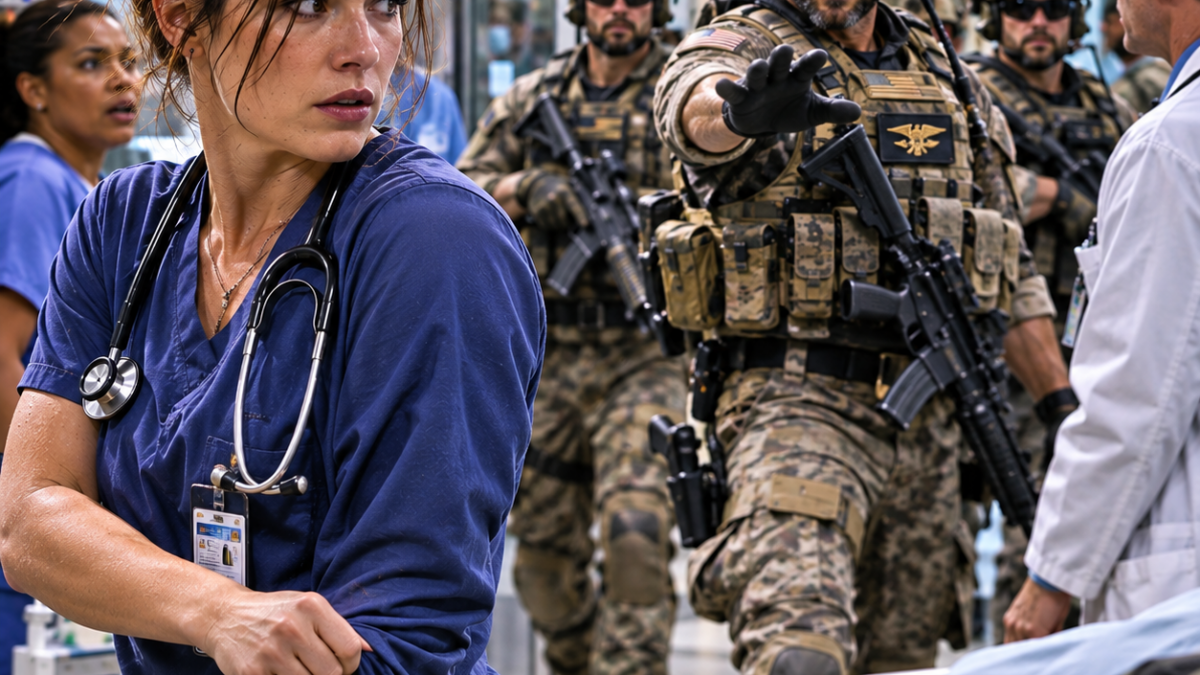
They Mocked the Quiet Nurse for Years—Then Six Navy SEALs Stormed the ER Demanding “Angel Six,” and She Rolled Up Her Sleeve.
For three years, Nora Callahan had kept her sleeves pulled over the tattoo on her forearm while a famous ER doctor mocked her shaking hands, filmed her humiliation for his millions of followers, and treated the quiet nurse like she was barely qualified to fold towels.
Then six armed Navy SEALs stormed through the doors of Mercy General carrying a dying Senior Chief, and their Master Chief ignored every doctor in the room long enough to shout one question that made Nora’s entire body react before she could stop it: “Where is Angel Six?”
Minutes later, the wounded SEAL rasped that same call sign while his oxygen crashed—and when Nora finally pushed her sleeve above the elbow, exposing an anchor wrapped in rope and six tiny stars, the hardest men in the emergency room went silent because they had spent six years believing the woman standing in front of them had vanished forever.
Nora Callahan had perfected the art of looking harmless.
It was not the same thing as being harmless.
That distinction had once kept people alive.
Now it mostly kept people from asking questions.
At thirty-seven, Nora worked the afternoon and evening rotation at Mercy General, a busy community hospital less than half an hour from Naval Station Norfolk.
Three years.
No disciplinary history.
No patient complaints.
No dramatic career goals.
She arrived early.
Stayed when asked.
Remembered which elderly patients needed hearing aids before the doctor began talking.
Knew which frightened children wanted the blood-pressure cuff placed on a stuffed animal first.
And never, under any circumstances, rolled her left sleeve higher than necessary.
There was a reason.
An anchor.
A length of rope curling around its shaft.
Six small stars hidden between the coils.
Nobody at Mercy General had seen it.
Not Denise Okafor, who had supervised nurses there for eleven years.
Not Nora’s mother.
PART2:
Not the man she dated for five months before deciding intimacy required questions she was not prepared to answer.
Not even the counselor she stopped seeing after two appointments.
Six stars.
Six men.
No seventh.
Nora did not talk about why.
She barely allowed herself to think about it.
“Callahan.”
Nora looked up.
Dr. Julian Reeves stood across the emergency department with a small camera crew following him.
“Fix your sleeve.”
His eyes never left the monitor reflection he was using to check his hair.
“You’re in my shot.”
Nora immediately pulled her cuff lower.
“Yes, Doctor.”
The camera operator, Tyler, adjusted a gimbal.
“Rolling.”
Julian Reeves smiled.
Instantly different.
That was one of his talents.
Off camera, he could turn a correction into a small execution.
On camera, he became the country’s favorite fearless emergency physician.
Author of Steel Nerves.
Host of Code Reeves.
More than two million followers.
PART3:
He filmed short hospital segments about calm under pressure, medical myths, emergency preparedness, and what he called “battle-tested decision making.”
His white coat carried his name in gold thread.
The stitching probably cost more than Nora’s shoes.
“Gather around,” Reeves said.
Residents and nurses formed a half circle.
Nora stayed at the edge.
Without thinking, she chose a place where she could see both main exits.
Three visitors near the entrance.
One man reaching into his jacket.
Nora’s breathing stopped.
His hand came back out holding a phone.
She breathed again.
She hated that her body still did that.
Grocery store.
Church.
Restaurant.
Parking garage.
Her own kitchen when a car door slammed too hard outside.
Always:
Hands.
Exits.
Waistbands.
Distances.
Angles.
Threats that usually were not threats.
Reeves faced the camera.
“When I served downrange, I learned one lesson above all others.”
Nora had heard this introduction at least forty times.
“Panic is a choice.”
He paused.
Tyler zoomed slightly.
Reeves had never explained where “downrange” was.
Once, months earlier, Nora had asked him casually.
“What unit?”
Reeves laughed.
“Classified, sweetheart.”
She never asked again.
Letting things go had become one of Nora’s most polished skills.
A tray crashed somewhere near Bay Seven.
Metal against tile.
Nora flinched.
Shoulders jumped.
Her right hand automatically covered her left forearm.
Reeves saw it.
Of course he did.
“Look at that.”
The camera turned.
“Nurse Callahan.”
Nora went still.
“Hands shaking since the day we hired her.”
A resident laughed.
Then realized nobody else had.
Reeves continued anyway.
“Some people are built for pressure.”
His smile widened.
“Others are built for bedpans.”
The red recording light stayed on Nora’s face.
Heat climbed her neck.
“Would you like me to check Bay Nine, Doctor?”
A child had been crying in there for several minutes.
Reeves waved her away.
“Yes, please.”
Then to Tyler:
“Cut that last part.”
Nora walked away.
Every step felt like surrender.
She stopped first at Bay Four.
Mr. Whitcomb.
Eighty-one.
Retired Army sergeant.
Weak heart.
Sharp mind.
He watched Nora adjust his blanket.
“You look tired, kiddo.”
“I’m fine.”
“No.”
He held out one weathered hand.
Nora gave him hers.
“You’re not fine.”
His thumb touched her knuckles gently.
“But you’re the only person in this building who sits down when you talk to me.”
Nora pulled a chair close.
Ten seconds.
That was all she gave herself.
Whitcomb smiled.
“That matters more than doctors think.”
Denise caught Nora near the linen cart afterward.
“You let him talk to you like that?”
“He’s the attending.”
“He’s a man with a ring light.”
Nora almost smiled.
Denise folded a towel unnecessarily hard.
“You’re the best nurse on this floor.”
“Everyone knows it except him.”
Nora looked away.
“Quiet is safer.”
Denise stopped folding.
“Safer from what?”
Nora said nothing.
The radio at the nurses’ station crackled.
“Mercy trauma, Naval Station security.”
Every muscle in Nora’s body changed.
Not visibly.
But completely.
“Training accident.”
“Blast injury.”
“Male, forties.”
“Conscious, deteriorating.”
“Transporting directly.”
“ETA four minutes.”
Reeves nearly bounced.
“Military?”
He turned to Tyler.
“Get the ambulance doors.”
Then to staff:
“Clear the lane.”
Denise said:
“We should open Trauma One now.”
“We’ll see what they bring us.”
Nora stared at the double doors.
Her hands had stopped shaking.
That frightened her more than shaking.
Heavy engines outside.
Doors slamming.
Then boots.
Several.
Fast.
Synchronized.
The sound hit Nora like memory.
She lowered her eyes.
“Sleeve down.”
It was already down.
She pulled it farther anyway.
Reeves moved toward ambulance doors.
“No rifles inside my emergency department.”
His voice cracked slightly.
The doors exploded inward.
Six men entered in desert camouflage.
Body armor.
Helmets.
Rifles slung with muzzles down.
Dust across boots.
Two carrying a litter.
One at the front.
One rear security.
One younger operator walking beside the patient with blood on both gloves.
Their movement changed the entire room.
People stepped aside without being told.
At the front was a broad, bearded man in his forties.
Master Chief Ray Hollis.
Nora did not know his name yet.
But she knew what command looked like.
He scanned:
Left.
Right.
Ceiling line.
Nursing station.
Doors.
Faces.
Then he raised his voice.
“I need Angel Six.”
Nora’s fingers closed around her sleeve.
Nobody else reacted.
Hollis shouted again.
“Which one of you is Angel Six?”
A monitor beeped.
A baby cried behind a curtain.
Nora took one involuntary step forward.
Then locked her knees.
Not here.
Not that name.
For half a second, Mercy General disappeared.
Rotor wash.
Black mountain.
Radio static.
Gunfire farther down the ridge.
A voice in her headset:
Angel Six, we’re taking fire.
She blinked.
Hospital returned.
Reeves stepped forward.
“Nobody here uses that name.”
“I’m Dr. Julian Reeves.”
“I’m the attending physician.”
Hollis looked at him.
“I don’t care.”
Then:
“Where’s your best trauma bay?”
Denise pointed.
“Trauma One.”
The litter moved immediately.
The patient was Senior Chief Marcus Doyle.
Forty-one.
His face had turned gray.
Shirt cut away.
A field dressing sealed over the left side of his chest.
Lips blue.
Breathing fast and shallow.
Hollis spoke while they moved.
“Breaching charge detonated early.”
“Our corpsman took fragmentation to the leg.”
“He’s still outside.”
“Doyle treated himself, then went down.”
The youngest SEAL could not have been more than twenty-four.
His eyes looked cracked open from the inside.
Reeves positioned himself at the head of the bed.
The camera followed.
“Everyone remain calm.”
“I have this.”
Nora stayed in the doorway.
She watched.
Reeves listened briefly to the wrong side first.
“Lungs clear.”
Denise looked up.
“The left side.”
“Lungs are clear.”
Hollis leaned closer.
“Something’s wrong with his left chest.”
“Master Chief, with respect, I have handled worse.”
Hollis’s eyes narrowed.
“Where?”
“Overseas.”
Nora watched Doyle.
Left chest barely moving.
Neck veins beginning to stand.
His breathing worsening.
The line of his airway looked wrong.
His blood pressure was collapsing.
Oxygen falling.
Nora knew exactly what she was seeing.
She had seen it in helicopters.
Vehicles.
Dust.
Darkness.
Places where nobody had imaging.
Places where “wait and see” meant somebody stopped breathing.
Reeves called for CT.
Denise looked at monitor.
“He’s unstable.”
“I decide who’s unstable.”
Nora spoke.
“Doctor—”
Reeves spun.
“Nobody asked you, Callahan.”
She stopped.
“Stay in your lane.”
His eyes flicked toward camera.
Then:
“Go fold towels.”
Nora stepped backward.
Her heel hit wall.
Fold towels.
Stay quiet.
Safe.
Six years of hiding screamed one thing.
Twelve years of training screamed another.
The youngest SEAL looked around.
“Sir.”
“We need somebody who knows chest trauma.”
“Anybody.”
Reeves smiled toward camera.
“You’re looking at the best.”
Doyle’s oxygen fell again.
Blood pressure dropped.
Denise brought the crash cart closer.
Reeves prepared medication.
Nora knew medication would not solve the mechanical problem killing him.
Doyle’s eyes opened.
Glassy.
Searching.
His gaze moved across ceiling.
Reeves.
Hollis.
Denise.
Then Nora.
His lips moved.
No sound.
Then:
“Six…”
Hollis froze.
Doyle rasped again.
“Angel Six.”
Nora’s chest tightened.
“Please.”
Hollis’s voice broke.
The Master Chief turned toward the room.
“He’s dying.”
Nobody moved.
Reeves ordered medication.
Denise hesitated.
“Doctor, that won’t solve what’s happening in his chest.”
“Give it.”
Nora looked at Doyle.
Something inside her finally gave way.
Not courage.
The opposite.
The part of her that had spent six years pretending she could become someone else.
She stood straighter.
Shoulders back.
Chin lifted.
Her voice came out low and hard.
“Left chest.”
Everyone stopped.
“Pressure injury.”
“He needs immediate decompression.”
Reeves turned.
“Callahan, step back.”
Nora looked directly at him.
For the first time in three years.
No lowered eyes.
No apology.
“Then treat him.”
Reeves said nothing.
“Or move.”
His hand trembled slightly.
He did neither.
Nora crossed the room.
Reeves reached toward her arm.
A SEAL intercepted his wrist.
Not violently.
Just absolutely.
“Sir.”
The operator looked at him.
“Let her work.”
Nora pushed her left sleeve above the elbow.
On purpose.
The tattoo appeared.
Anchor.
Rope.
Six tiny stars.
Hollis saw it.
The breath left him.
He whispered:
“Oh my God.”
Nora did not look up.
“Denise.”
“Yes?”
“Prepare trauma supplies.”
Denise moved.
No hesitation.
Nora worked with the speed of someone who had done this under conditions far worse than fluorescent light and clean floors.
She relieved the pressure in Doyle’s chest.
His body reacted almost immediately.
A sudden intake of air.
His chest began moving more effectively.
Monitor numbers improved.
Not enough.
But in the right direction.
Nora continued.
The emergency intervention bought him time.
Then the trauma team arrived to complete definitive treatment.
Dr. Amara Nwosu rushed into the bay.
One look at Doyle.
One look at what Nora had done.
Then:
“Who recognized this?”
Hollis pointed.
“She did.”
Nwosu looked at Nora.
Then at the tattoo.
“Good call.”
Reeves found his voice.
“She performed an unauthorized invasive procedure.”
Nwosu looked at the monitor.
“He’s alive.”
Reeves stiffened.
“That doesn’t erase policy.”
“No.”
Nwosu’s voice remained calm.
“But don’t pretend the clinical judgment was wrong.”
Doyle’s eyes opened again.
He found Nora.
“Angel.”
“Rest.”
A faint smile.
“Knew it.”
Nora stared.
“What?”
“Saw you.”
“When?”
“Parking lot.”
His breathing remained weak.
“Six weeks ago.”
“Wasn’t sure.”
“Told Master Chief.”
Hollis stood at foot of bed.
His eyes were wet.
He did not hide it.
“Ma’am.”
Nora looked at him.
“I’ve been looking for you for six years.”
The entire trauma bay had gone silent.
Tyler’s camera was still running.
Denise stared.
“Nora…”
“Who are you?”
Before Nora could answer, Chief Medical Officer Kathleen Morrow entered with two security officers.
“Ms. Callahan.”
Nora turned.
“You are relieved of duty effective immediately.”
Reeves stood beside her.
He had clearly made the call.
Morrow continued.
“You performed an invasive procedure outside your hospital privileges and without physician authorization.”
Denise said:
“She saved him.”
“That may be true.”
Morrow’s expression was not cruel.
“It may also be outside policy.”
Dr. Nwosu looked up from Doyle.
“The intervention was clinically appropriate.”
Morrow nodded.
“That will be part of review.”
Hollis stepped forward.
“This woman is not leaving because your doctor froze.”
Morrow met his eyes.
“Master Chief, this is a civilian hospital.”
“You and your team entered armed.”
“I am already choosing to solve one emergency at a time.”
Hollis held her gaze.
Then nodded.
“Our corpsman is still outside.”
“Bring him.”
Three SEALs moved immediately.
Morrow held out her hand.
“Nora.”
“Badge.”
Denise looked horrified.
Nora unclipped it.
Three years of shifts.
Overtime.
Patients.
Quiet.
Plastic card with bad photograph.
She placed it in Morrow’s palm.
“You’re just accepting that?” Denise whispered.
“Rules exist for a reason.”
Nora looked down.
“I crossed one.”
“That’s mine to answer for.”
Reeves turned toward Tyler’s camera.
His confidence returned.
“This is what happens when staff overstep training—”
Denise muttered something that made Tyler lower the camera slightly.
Nora turned to leave.
For two minutes she had been Angel Six again.
Now the old weight returned.
Doyle reached weakly from gurney as he was rolled toward surgery.
His fingers caught Nora’s sleeve.
“Don’t go.”
“I’m here.”
His grip slipped.
The gurney disappeared.
Security walked with Nora toward staff corridor.
She did not pull her sleeve back down.
She could not.
The side door opened.
A man in a gray polo and khakis entered.
Mid-forties.
Visitor badge.
Clipboard.
“Excuse me.”
Friendly smile.
“Warren Pike.”
“Naval Sea Systems liaison.”
“Here regarding Senior Chief Doyle.”
Reeves brightened.
“The Navy is sending people.”
He started walking Pike toward trauma area.
Nora stopped.
Something was wrong.
Not name.
Movement.
Boots.
Not office shoes.
Right arm barely swinging.
A weight beneath right side of shirt.
Badge turned backward.
Eyes checking doors instead of faces.
One.
Two.
Three.
Nora had seen that walk before.
Different country.
Different man.
Same intention.
“Dr. Morrow.”
Morrow kept typing.
“That man isn’t Navy.”
“Nora, you are no longer on duty.”
“Look at his right hip.”
Morrow did not.
Pike turned toward the corridor leading to trauma operating rooms.
The SEALs were still near ambulance bay bringing in their wounded corpsman.
Nora had no badge.
No weapon.
No authority.
Only training.
She stepped forward.
“Sir.”
Pike stopped.
“Visitors check in at front.”
He smiled.
“And you are?”
Nora softened her voice.
“Just the nurse.”
“Then step aside, honey.”
His right hand moved toward his shirt.
Nora did not wait.
A fire extinguisher hung on wall.
She pulled it free and discharged it into his face.
White cloud exploded.
Pike shouted.
A handgun appeared.
The first shot went into ceiling.
“DOWN!”
Nora’s voice filled the ER.
Everybody dropped.
Denise covered the child in Bay Nine.
Nora closed the distance.
Fast.
Controlled.
She redirected the weapon away from people.
Struck.
Twisted his wrist.
The handgun fell.
She cleared it and moved it away.
Pike swung blindly.
Nora avoided it.
Took him down.
Pinned him.
Arm controlled behind his back.
Two seconds.
Then:
“Don’t move.”
Pike gasped.
“You don’t know what you’re doing.”
Nora’s voice became quiet again.
“Yes.”
“I do.”
Boots thundered.
Hollis and three SEALs came around the corner.
They saw:
Hospital staff on floor.
Plaster dust.
An armed intruder pinned beneath a nurse in blue scrubs.
Hollis lowered his rifle slowly.
“Ma’am…”
He looked at Pike.
Then Nora.
“Did you just—”
“He isn’t Navy.”
“Check the badge.”
“Check his waistband.”
One SEAL searched.
Extra magazine.
Zip ties.
Burner phone.
Hollis flipped identification.
His expression changed.
“Warren Pike.”
He looked at Nora.
“Halberd Munitions.”
Nora frowned.
Hollis’s jaw tightened.
“They manufactured the breaching charge.”
“The batch Doyle flagged three days ago.”
He stared at Pike.
“You came here because he survived.”
Pike said nothing.
Nora stood.
Passed cleared weapon to operator.
For a moment nobody knew who should speak.
Then Hollis looked at her.
Not demanding now.
“Angel Six.”
Two words.
A request for orders.
Nora inhaled.
Her shoulders settled.
“Two men on the doors.”
“One man stays outside Doyle’s OR.”
“Nobody enters without hospital or police clearance.”
She looked at Denise.
“Check every patient.”
“Anyone hit?”
“Anyone injured by debris?”
Denise was half crying and half laughing.
“Yes, ma’am.”
The youngest SEAL was already moving.
“Yes, ma’am.”
Nora crouched beside the little girl from Bay Nine.
Six years old.
Stuffed rabbit.
Huge eyes.
“It’s over.”
Nora softened instantly.
“You’re safe.”
The girl stared at tattoo.
“Are you a soldier?”
“I was.”
“Are you a nurse?”
“I am now.”
The girl nodded.
As if no contradiction existed.
Behind the nurses’ station, Dr. Julian Reeves crouched with both hands over his head.
His white coat was covered in ceiling dust.
Above him, Tyler’s camera lay on its side.
Still recording.
The red light pointed directly at the man who told two million people that panic was a choice.
The wounded corpsman arrived next.
Petty Officer Eli Park.
Twenty-six.
Fragmentation injury to leg.
Tourniquet in place.
Nora reached him.
“Time?”
“Sixteen fifty-two.”
“Good.”
“Don’t loosen it.”
She checked what could safely be checked and handed him into trauma care.
Park looked at her tattoo.
His eyes widened.
“You’re her.”
“No.”
“The stories.”
“There are no stories.”
“There are a lot of stories.”
Nora almost smiled.
Police sirens arrived.
Officers entered.
Stopped.
Six SEALs.
Half the ER on floor.
A nurse calmly directing the scene.
Nora raised one hand.
“The suspect is restrained.”
“Weapon is cleared.”
“Multiple witnesses.”
“And a camera recorded the entire event.”
Police took Pike.
No ambiguity.
No hero speech.
Evidence.
Then Hollis approached.
“Ma’am.”
Nora looked at him.
“May I say something?”
She knew what was coming.
For six years, she had feared it.
Maybe she was too tired to stop him.
Maybe she finally didn’t want to.
She nodded.
Hollis stood at attention.
The entire emergency room quieted.
“Hospital Corpsman First Class Nora Callahan.”
“Special Operations Combat Medic.”
“Naval Special Warfare.”
“Twelve years.”
“Four combat deployments.”
“Call sign Angel Six.”
Nobody moved.
Reeves slowly stood.
Hollis continued.
“Seven years ago, a helicopter carrying seven of ours went down on a ridgeline in Kunar Province.”
Nora closed her eyes.
“Night.”
“Weather.”
“Enemy movement.”
“Our medic was injured.”
“Angel Six was closest.”
“She climbed to the wreck alone.”
Nora’s fingers touched the six stars.
“She pulled six men out.”
“Lowered them from the ridge.”
“Treated them until rescue arrived.”
“She took shrapnel herself.”
“She kept going.”
Hollis’s voice changed.
“Senior Chief Doyle was one of them.”
Denise covered her mouth.
Hollis looked at Nora.
“She was awarded the Silver Star.”
“She never came to the ceremony.”
“She left the Navy.”
“She disappeared.”
Nora whispered:
“There were seven.”
Hollis’s expression softened.
“I know.”
“I got six.”
Her voice fractured.
“Lieutenant Cole Ramsey was on the far side.”
“I went back.”
She stopped.
The ER disappeared again.
Smoke.
Metal.
Snow.
Blood.
Silence where a voice had been.
“I was too late.”
The six stars beneath the rope seemed darker.
“I could put six on my arm.”
“I couldn’t put the seventh.”
“I couldn’t look at it.”
“So I hid all of them.”
The trauma elevator opened.
Doyle emerged from surgery transfer.
Pale.
Sedated.
Alive.
Dr. Nwosu walked beside him.
Doyle’s eyes opened enough to find Nora.
“Six.”
She stepped closer.
“Look at me.”
He breathed slowly.
“Cole didn’t die because you failed.”
Nora’s face tightened.
“He died because the mountain won.”
Doyle swallowed.
“He told me.”
“What?”
“Before he went.”
Nora stopped breathing.
Doyle’s voice was barely there.
“Tell Six she saved the rest of us.”
Nora stared.
“You carried six.”
“Nobody could carry seven.”
His eyes glistened.
“He made peace with it.”
“You should too.”
Something broke inside Nora.
Not violently.
More like a door finally giving way.
A sound left her.
Half laugh.
Half sob.
She covered her mouth.
Tears followed.
Six years.
She had not cried once about that mountain.
Not properly.
Denise wrapped one arm around her.
One of the SEALs looked very intently at ceiling.
Dr. Morrow approached.
Nora wiped her face.
The chief medical officer held Nora’s badge.
“Corpsman Callahan.”
Nora looked at her.
“I owe you an apology.”
Morrow extended the badge.
“Your suspension is lifted pending full review.”
She hesitated.
“What you did tonight was outside our policy.”
Then:
“And inside every value this hospital claims to hold.”
“We are reviewing that policy.”
“I would like you involved.”
Nora took badge.
Her hand did not shake.
Then Hollis turned.
“Dr. Reeves.”
Julian stood against wall.
White coat ruined.
Hair full of plaster.
Hollis looked directly at him.
“You talk a lot about serving downrange.”
Reeves swallowed.
“I do.”
“What unit?”
Silence.
“Which role?”
“The details are classified.”
Hollis almost smiled.
“What year?”
Reeves opened his mouth.
Nothing.
Denise crossed her arms.
Finally:
“Kuwait.”
Hollis waited.
“Reserve rotation.”
“How long?”
“Three weeks.”
“Doing what?”
Reeves’s face flushed.
“Administrative clinic support.”
Silence.
Hollis nodded once.
“So two million people think you were a combat trauma physician.”
“I never said that.”
“You let them believe it.”
Dr. Morrow closed her eyes briefly.
Then:
“Julian.”
Reeves looked at her.
“Your privileges are suspended pending review.”
“What?”
“The filming stops today.”
“You can’t—”
“I just did.”
For once, Reeves looked around the room and found no audience willing to save him.
He walked out.
Nobody followed.
Hours later, after police statements, Hollis found Nora in the staff lounge washing her hands.
Her sleeve was still rolled above elbow.
The tattoo fully visible.
“The Navy would take you back.”
Nora looked at him through mirror.
“Instructor billet.”
“Train the next generation.”
She smiled.
Tired.
Real.
“Angel Six did her work.”
Hollis leaned against counter.
“And Nora Callahan?”
She dried her hands.
“Mr. Whitcomb in Bay Four needs someone who sits down when she talks to him.”
Hollis laughed softly.
“There are a lot of Mr. Whitcombs.”
“Yes.”
She looked at her hands.
“I want to do this.”
“Here?”
“Here.”
He nodded.
“Yes, ma’am.”
The next shift, the schedule showed:
NORA CALLAHAN, RN.
Nothing else.
No medal.
No call sign.
No apology.
Nora arrived early.
Denise looked at her sleeve.
Still rolled.
“You know people are going to ask.”
“I know.”
“You ready?”
“No.”
Denise smiled.
“Good enough.”
Mr. Whitcomb was awake.
He looked at tattoo.
Then at Nora.
“Well.”
She sat beside him.
“You’re going to ask?”
“Nope.”
He squeezed her fingers.
“I told you that you looked tired.”
She laughed.
“That you did.”
Mercy General changed slowly.
Not magically.
Dr. Reeves’s review became broader than one night.
The hospital examined filming practices.
Staff complaints.
Emergency authority.
Escalation policy.
Training.
Dr. Morrow kept her word.
Nora helped revise emergency procedures.
Not so nurses could perform whatever intervention they wanted.
That was not the lesson.
The lesson was that people needed clear pathways to escalate when someone was deteriorating and hierarchy was failing.
Trauma training expanded.
Mass-casualty drills became regular.
Nursing concerns could be documented and escalated without retaliation.
Denise helped build it.
So did Dr. Nwosu.
Nora refused a management title.
She wanted bedside work.
But she agreed to become trauma-readiness instructor for the department.
Her first class began with a sentence nobody expected.
“I am not teaching you to be heroes.”
The room went quiet.
“Heroes are unreliable.”
A resident smiled.
Nora continued.
“I’m teaching you to notice.”
“To speak.”
“To prepare.”
“And to act within a system designed to hear you before somebody dies.”
That became her real legacy at Mercy.
Not the viral video.
Tyler’s footage had captured everything.
Reeves mocking Nora.
The SEALs arriving.
The demand for Angel Six.
Reeves freezing.
The first gunshot.
Nora directing people to cover.
Eventually clips leaked.
The hospital wanted lawyers involved.
The Navy wanted operational details protected.
Nora wanted none of it.
She refused interviews.
No talk shows.
No documentary.
No “hero nurse” sponsorships.
One reporter caught her leaving after shift.
“Ms. Callahan!”
She kept walking.
“Are you Angel Six?”
Nora stopped.
Turned.
“I’m a nurse.”
Then walked away.
It became the quote everybody repeated.
She hated that too.
Doyle recovered.
Months later he returned to Mercy walking with a cane.
No emergency.
No blood.
He carried a small box.
Nora met him near cafeteria.
“What is that?”
“Yours.”
Inside was a folded patch.
Old.
Scuffed.
CALL SIGN: ANGEL 6.
Nora stared.
“I thought these were gone.”
“I kept one.”
“Why?”
Doyle shrugged.
“Somebody had to.”
Nora turned it over.
Then noticed something else.
A seventh tiny star had been stitched onto the back.
Her breath caught.
Doyle looked away.
“You don’t have to put it on your arm.”
“I know.”
“But he belongs somewhere.”
Nora closed her hand around patch.
That evening, she drove home.
Sat at kitchen table.
The same kitchen where she had spent six years flinching at passing headlights.
She placed patch down.
Looked at her forearm.
Six stars.
Then she did something she had not done in years.
She said Lieutenant Cole Ramsey’s name aloud.
No mountain appeared.
No helicopter.
No judgment.
Just the name.
She said it again.
The next month, she returned to the tattoo artist who had done the original piece.
The man recognized the work.
“You want touch-up?”
“No.”
Nora pointed beneath six stars.
“One more.”
He waited.
“Same size?”
Nora nodded.
“For somebody you lost?”
“Yes.”
The seventh star did not erase anything.
It did not forgive her.
It did not need to.
It simply acknowledged that Cole had existed.
And that love was not the same thing as blame.
When Nora returned to Mercy, Denise noticed immediately.
She counted.
“Seven?”
Nora nodded.
Denise did not ask.
That was friendship.
Hollis came through the hospital a few weeks later with another SEAL for a routine follow-up.
He saw the new star.
Stopped.
Then stood slightly straighter.
No salute.
No speech.
Just:
“Ma’am.”
Nora nodded.
“Master Chief.”
He smiled.
“Looks right.”
For the first time, she agreed.
Years passed.
Mercy General never became perfect.
No hospital does.
New doctors arrived.
New nurses.
New arguments.
New mistakes.
But people stopped laughing when Nora spoke.
More importantly, they learned not to laugh when quieter nurses spoke either.
One evening, a first-year nurse named Emma noticed a patient deteriorating.
A physician dismissed concern.
Emma froze.
Nora was nearby.
She could have taken over.
Instead she asked:
“What do you see?”
Emma described it.
“What do you think is happening?”
She answered.
“What do you need?”
Emma swallowed.
Then spoke louder.
“I need the physician to reassess now.”
Nora looked at doctor.
“So do I.”
The doctor reassessed.
Treatment changed.
Patient improved.
Afterward Emma said:
“I thought I was going to throw up.”
Nora smiled.
“Courage doesn’t feel impressive from inside.”
Emma looked at tattoo.
“Were you scared that night?”
“Which one?”
“The SEALs.”
Nora laughed.
“Yes.”
“You didn’t look scared.”
“That’s not the same thing.”
Nora pulled sleeve slightly higher.
Seven stars.
“I spent six years being scared.”
“Of what?”
“Being seen.”
Emma frowned.
“Why?”
Nora thought.
“Because once people know what you can carry, sometimes they keep handing you more.”
Emma looked at the stars.
“So why stop hiding?”
“Because hiding was carrying something too.”
That answer stayed with Emma.
It stayed with Nora too.
The strangest thing about Angel Six was that the name everyone else treated as proof of greatness had never felt heroic to Nora.
It was the name shouted when people were bleeding.
The name used when helicopters were late.
The name associated with the worst night of her life.
When Hollis stormed into Mercy asking for Angel Six, Nora’s first instinct had not been pride.
It had been terror.
She thought the past had found her.
In a way, it had.
But it brought something with it she had not expected.
Six men who remembered being saved.
One dying man who remembered the seventh.
A Master Chief who never blamed her.
A room full of witnesses who finally saw that the woman Reeves called a “bedpan nurse” had once held an entire team together on a mountain.
None of that changed the dead.
It changed what Nora believed the dead demanded from her.
For years she thought the only way to honor Cole was to keep punishing herself.
To hide the tattoo.
Hide the call sign.
Hide the medal.
Hide the person who had lived when he did not.
Eventually she understood something simpler.
Cole did not need her disappearance.
The living did not honor the dead by joining them early in spirit.
They honored them by continuing.
Nora stayed at Mercy General.
She sat beside frightened old men.
Helped children understand IV lines.
Taught new nurses to speak before a crisis became a code.
And whenever aircraft from the naval station passed overhead, she still noticed.
She probably always would.
But she stopped reaching automatically for her sleeve.
The tattoo remained visible.
Anchor.
Rope.
Seven stars now.
Sometimes patients asked.
Sometimes Nora answered.
Sometimes she said:
“Long story.”
That was enough.
On the anniversary of the Kunar crash, she worked night shift.
At 2:13 a.m., the ER was unusually quiet.
Denise brought two coffees.
They stood outside ambulance doors.
“You okay?”
“No.”
Nora took cup.
“But I’m here.”
Denise nodded.
“Good.”
A helicopter crossed somewhere in the dark.
Nora looked up.
For six years she had believed survival meant hiding.
Then Navy SEALs stormed her emergency room demanding a call sign she thought she had buried forever.
They came looking for Angel Six.
What they found was Nora Callahan.
Still alive.
Still a nurse.
Still carrying seven names.
And finally strong enough not to hide any of them.








