They Mocked the Quiet Cemetery Groundskeeper—Then a Retired K9 Broke Free, Ran Straight to Him, and Exposed a Secret Buried Beneath Row Nine for 34 Years
PART3:
The first time I saw Radcliffe mock him, it was not loud enough to be called cruelty by people who like technicalities.
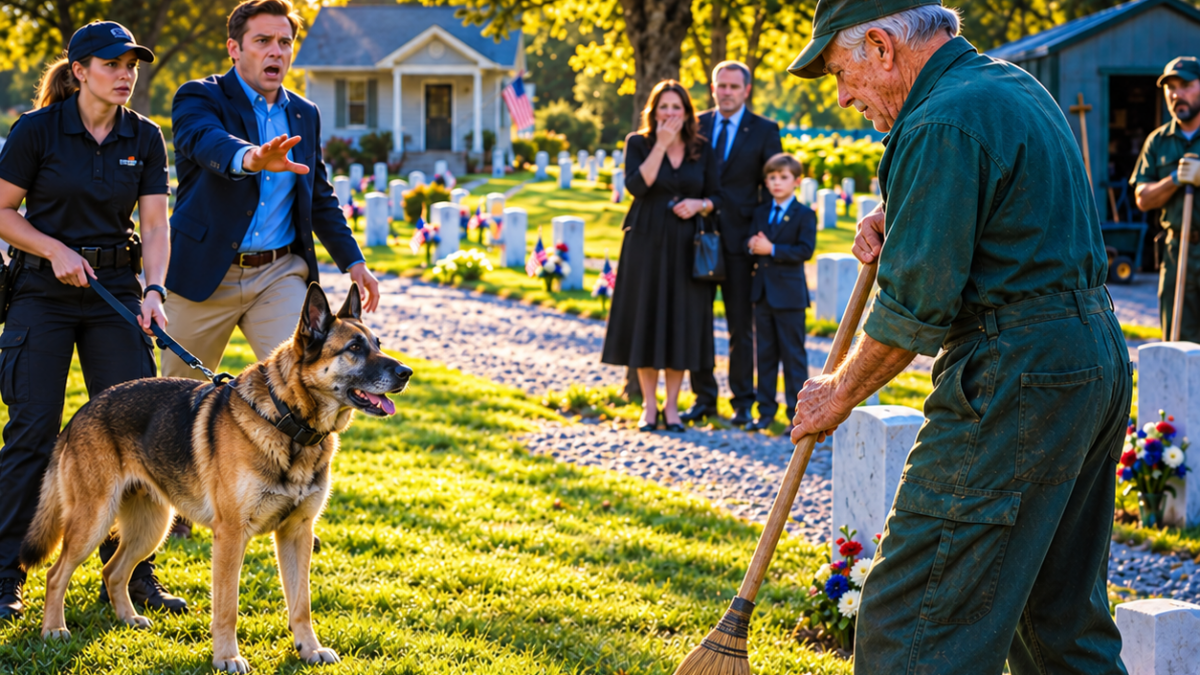
It happened on a clear afternoon near the gravel path. A family of four stood behind Radcliffe in funeral clothes: a mother, a father, a teenage son, and an older woman holding a folded handkerchief. They had come to confirm the location of a grandfather’s plot before a headstone delivery.
Otis was edging row nine.
He had a rake angled against his hip, and his body turned squarely toward Radcliffe because that was how his shoulder allowed him to face a man.
From the equipment shed, Dwayne Kesler saw the whole thing unfolding and did not like the shape of it.
“He’s going to make him move,” Dwayne said.
Foss, the wiry kid from the mowing crew, squinted across the lawn.
“Move where?”
“That’s the old man’s row.”
“Been his row since before either of us had a driver’s license?”
“Longer.”
Radcliffe stood with his boots set wide on the gravel path, a folded run sheet in his hand.
“Sir, I understand you’ve been here a long time,” he said loudly enough that half the crew could hear, “but I need you off this row while I walk these folks through the section. You’re not on today’s schedule, and frankly, you’re a liability in a borrowed uniform standing where a grieving family can see you.”
I felt my face get hot.
Borrowed uniform.
That was what he called Otis’s coveralls.
Otis did not answer right away.
He looked at the family first.
Not Radcliffe.
The family.
As if their discomfort mattered more to him than the insult.
Then he said, “I’ll finish the edging tomorrow.”
Five words.
Quiet.
Flat.
He turned to leave.
Radcliffe was already turning back to the family with the satisfaction of a man who believed he had solved something.
That was when Sage made the sound.
She was chained in the yard by the cottage as she was every afternoon during working hours, lying in her usual spot with her chin on her paws and her eyes toward the tree line that hid row nine from her sight.
Then she was not lying down.
She was on her feet.
From somewhere low in her chest came a sound I had never heard from an animal.
Not a bark.
Not a growl.
A long, rising, broken note that carried across the grounds and made the family turn before Radcliffe did.
Sage pulled once against the chain.
The metal snapped tight.
Her body shook.
Otis stopped walking.
No one moved.
For one strange second, the entire cemetery seemed to hold its breath.
Then Sage lowered her head and stared toward row nine.
Radcliffe looked annoyed.
Dwayne looked afraid.
Otis looked like a man hearing a voice from a room he had locked decades ago.
He turned back slowly.
But he did not speak.
Not then.
That night, as usual, Otis called his wife Geneva from the cottage phone at quarter to eight.
I only know because later I was bringing back a fuel can to the shed, and the cottage window was open. I heard his voice, low and steady.
“I’ll bring the tomatoes tomorrow,” he told her. “The Cherokee purples are coming in heavy.”
A pause.
Then, softer, “It is news. Every year it surprises me.”
I remember standing there with the fuel can in my hand, suddenly embarrassed by the tenderness in his voice.
He did not tell Geneva about Radcliffe.
He did not tell her about Sage.
Men like Otis did not carry their pain into the house if they could leave it outside with the tools.
The next morning, Radcliffe came after the paper.
“Per the consolidation schedule,” he told Dwayne and Purdy, the assistant supervisor who mostly nodded at whatever Radcliffe said, “row nine and row ten get surveyed for foundation pour readiness this week. I want the old paper out of the shed before the crew arrives. It’s clutter, and it’s a fire code issue.”
Otis was standing behind them with the sod knife in his hand.
He had come up from the tool shed quietly enough that none of them noticed until he spoke.
“Those are burial cards.”
Radcliffe turned.
“Original interment cards,” Otis said. “Some go back to when the section was laid.”
“We have a digitized database, Mr. Mosier,” Radcliffe replied. “Every plot, every name, cross-referenced, and current as of last year’s audit.”
He said it the way men recite facts they have never had to test.
Otis set the sod knife carefully on the bench before speaking further.
The way another man might set down a glass before saying something that mattered.
“Cross-referenced against what?”
Radcliffe did not answer.
Because at that moment, the family from the day before returned.
Same funeral clothes.
Same uneasy faces.
They wanted to confirm the grandfather’s plot before the headstone delivery.
Radcliffe pulled the number from his run sheet and read it aloud with confidence.
Otis did not step closer.
Did not raise his voice.
He only said, “That plot’s one row over. Nine, not eight. Your grandfather’s near the maple, ma’am. Third stone in.”
The family looked at Radcliffe’s run sheet.
Then at Otis.
And believed the man in the worn coveralls.
Radcliffe’s ears went red before the rest of his face caught up.
“You’re contradicting our records in front of a client,” he said, each word clipped. “Over a hunch.”
“It’s not a hunch.”
“It’s clutter and insubordination. And until I understand which, you’re off the gate list starting tomorrow morning. Turn in your badge to Purdy before you leave tonight.”
The air went thin.
Otis picked up the sod knife.
Turned his whole body toward the shed.
And walked away without another word.
Radcliffe looked almost pleased.
For half a second, I think he believed he had won an argument.
He had not yet understood that Otis had not been arguing.
He had been warning him.
At dusk, I saw Otis walking the fence line without his badge clipped to his coveralls.
The lanyard was coiled on the pegboard inside the shed.
“You’re not supposed to be out here,” I said.
Not as a warning.
More like I was checking whether the sentence was still true.
Otis stopped at the northeast corner and knelt to reset the loose edging iron.
Two taps.
“I’m not doing anything the gate cares about,” he said. “Just walking.”
His voice was calm.
That somehow made me sadder.
Sage was tied at the cottage step with Dilly, a nervous nineteen-year-old grounds assistant, holding the end of her line. Dilly had drawn K9 watch duty that week and took it as punishment, which told me he was too young to understand honor when it dragged him through wet grass.
That evening, Sage broke her lead.
Not slipped it.
Not pulled loose.
Broke it.
One moment she stood at the cottage step.
The next she launched forward with such force Dilly was dragged four strides across the lawn before letting go to keep from being pulled flat.
“Sage! Heel!” he shouted.
She ignored him.
The old dog ran straight toward row nine faster than I believed her body still could.
Dilly scrambled up.
“Sage! Heel!”
She reached the near corner and stopped as if she had struck glass.
Sat hard.
Would not move.
“She’s spooked,” I said, already walking toward her. “Maybe she heard the mower cut off wrong, or—”
I stopped.
Otis was already moving toward the row.
Not fast.
Not alarmed.
Certain.
Something in his face told me I had guessed wrong before I had even finished guessing.
He knelt at the third stone from the corner.
Placed two fingers flat against the grass beside it.
Sat like that for a long moment, reading something in the color and give of the ground that I could not see.
Then he took a small notebook from his coverall pocket.
The pages were soft and rounded from years of being carried there.
He wrote three lines without looking up.
“What is it?” I asked.
“Not yet,” Otis said.
Not unkindly.
Then he closed the notebook.
Radcliffe found us there ten minutes later, Purdy trailing behind him with the particular walk of a man asked to witness something he would rather not.
“You’re on suspended access, Mr. Mosier,” Radcliffe said, “and you’re standing on a row I specifically asked cleared for survey.”
“I know exactly what row I’m standing on,” Otis replied. “Better than your database does.”
“Explain that.”
Otis looked at the three stones in front of him.
Then at Radcliffe.
Then he set the canvas roll on the grass and unbuckled it with the same patient care he gave the edging iron every night.
“Thirty-four years ago, there was a reburial in this row,” he said. “Contractor job. Cheap. Fast. Three markers got swapped with the row behind them when the ground crew reset stones after moving caskets for a drainage line.”
Radcliffe’s face tightened.
“I know,” Otis continued, “because I laid this section by hand the year before it happened. And I reset every stone in it myself the year after when nobody else wanted the job of fixing another man’s mistake.”
He lifted the bone-handled sod knife.
Turned it so the small stamped mark near the haft caught what was left of the light.
“I filed this mark the year I came home. Every tool in this roll carries it. I used this knife on every stone reset in this row, including the wrong ones I couldn’t fix back then because nobody would listen to a groundskeeper. I kept the paper on it for nineteen years, hoping somebody eventually would.”
No one spoke.
Purdy looked at his boots.
Dilly looked at Sage.
I looked at Otis and understood that for six weeks I had been working beside something I had not known how to name.
Not stubbornness.
Not habit.
Witness.
Radcliffe laughed.
Short.
Unconvincing.
“That’s a hell of a story for a man who can’t legally be on this property right now.”
Otis did not answer.
“The pour crew comes in six days regardless,” Radcliffe said. “I’m not rescheduling a foundation job on the word of a groundskeeper and a spooked dog.”
He folded his run sheet and put it in his jacket pocket.
But as he walked away, his stride lost its confidence for two steps.
Only two.
But I saw it.
The next morning, Otis stood outside the records room door because his suspended badge would no longer open it.
He did not knock.
Did not curse.
Did not ask anyone to bend the rule for him.
He simply stood there with the stillness of a man measuring a wall he could not climb and refusing to waste breath complaining about its height.
“I can get in,” I said.
He turned.
“I’m still on the list.”
He looked at me for a long time.
Then said, “Basement archive. Box marked Section C Originals. Burial cards. There’s a loose ledger page tucked behind the C-14 through C-40 run. That’s the only place the reburial ever got written down.”
“What exactly am I looking for?”
“Three plot numbers. Contractor foreman’s initials. Thirty-four years ago.”
The basement archive had not been visited by anyone but Otis in years.
It showed.
The room sat beneath the maintenance building, low-ceilinged and damp, with a sump pump in one corner that sounded like it resented its own purpose. Cardboard boxes sat on old wooden pallets, which had once kept them dry and now only kept them slightly less wet. The air smelled like mildew, dust, and paperwork no one had loved enough to save properly.
I found Section C Originals wedged between two boxes of payroll records from years before I was born.
I found the run of cards.
And in my hurry to beat the end of my lunch break, I knocked the sump pump’s extension cord loose from the outlet with my knee and did not notice.
That mistake nearly cost everything.
Forty minutes later, Purdy asked where I had disappeared to.
I came back with a flashlight and found an inch of standing water across the floor.
The box marked Section C Originals sat directly in it.
“No,” I whispered.
I stepped into the water, lifted the box onto a pallet, and began peeling wet cards apart one at a time with the particular horror of someone watching evidence dissolve in her hands.
Most of the cards survived.
The old paper was cheap but stubborn.
The loose ledger page did not look as lucky.
One corner had gone soft.
The pencil notation there smeared into a gray bruise.
Radcliffe found me sitting on the pallet with the ruined page in my lap.
He did not bother softening what came next.
“You flooded a records room and damaged the one piece of paper the old man has been waving around.”
My throat tightened.
“I didn’t mean—”
“I don’t know if that’s incompetence or sabotage,” he said, “and at this point, I’m not sure it matters which.”
“It’s not ruined.”
My voice did not sound sure enough.
“It’s just wet.”
“The pour is confirmed for six days from today,” Radcliffe said. “I’d start hoping that page dries into something legible. Because right now, what you’re holding looks like nothing to me at all.”
That night, I went home and cried in my car before going inside.
Not because Radcliffe yelled.
I had been yelled at before.
Because Otis had trusted me with the one thing he could not access himself, and I had nearly destroyed it with my own careless knee.
The paper conservator came through the county historical society.
Her name was Dr. Elaine Mercer. She was a professor I had taken one semester from, and I called in a favor I had no right to ask for.
She arrived on Saturday for free, carrying cases of tools and a face that said she was already annoyed by every person who had ever stored paper in a basement.
She worked under a humidity tent for six careful hours.
Otis stood nearby with his hands folded in front of him.
I stood behind him, afraid to breathe.
Finally, Dr. Mercer leaned closer.
Then said the words that changed everything.
“This isn’t just legible.”
Otis’s head lifted.
“What?”
“It’s dated. Look here. Thirty-four years ago. Initialed by the contractor’s foreman. Three plot numbers cross-referenced to their original stones before relocation.”
She pointed with a gloved finger.
“Whoever built your digital database pulled from the corrected paperwork after the reburial, not from this page. This page is the only surviving record of what the ground looked like before somebody moved it.”
I looked at Otis.
He closed his eyes for one second.
Only one.
Then opened them.
An hour later, we stood in the cemetery office with Radcliffe, Purdy, and Dr. Mercer’s sealed documentation.
Otis said it plainly.
“The database was built from the error.”
Radcliffe held the recovered ledger page in gloved hands and stared as if it might explain how a clean system could be wrong from the root.
“No algorithm,” Otis said quietly, “knows to doubt itself.”
That was the moment a plain sedan pulled up outside.
Government plates, though the car itself looked civilian.
Purdy glanced through the blinds and went pale.
“That’s General Sinclair.”
Radcliffe looked up.
“Who?”
“Blake Sinclair. Board chairman.”
The man who stepped from the car was broad-shouldered, late sixties, upright in a way that had nothing to do with youth. He did not look toward the office. He walked straight toward row nine.
No one had told him to come.
Later, I learned he had spent eleven years trying to locate his father’s true grave, chasing a plot number that never matched family memory. When the interment board’s quiet inquiry reached his desk, he did not wait for a scheduled visit.
He came.
We followed.
General Sinclair stood at the third stone from the corner of row nine.
He read the name on the marker.
For a long moment, his face did not move.
Then Otis came around the hedge line.
Sinclair turned.
Something changed in his face before either man spoke.
He looked back at the stone.
Then his knees gave way.
He sat down hard in the grass at the foot of row nine like a much younger man struck in the chest.
“That’s not my father’s name,” he said.
His voice cracked.
“It’s not supposed to be there. I have known that for eleven years and never once had a piece of paper that could prove it.”
Otis knelt beside him slowly, the way his shoulder made him kneel for anything.
“You have one now.”
He set the canvas roll in the grass between them without opening it.
Sinclair looked at the roll.
Then at Otis.
Recognition widened.
“You taught me how to set a marker,” he said.
Otis looked at him.
“Engineer battalion,” Sinclair continued. “I was nineteen. You made me kneel exactly like that. Gauge flat to the sod line. Plumb bob hung in red. You made me say the steps back until I had them without thinking.”
His mouth trembled.
“I still say them. I said them to my own son when he asked why I always straighten headstones in cemeteries.”
“Say them now,” Otis said.
Quiet.
Sinclair did not hesitate.
“Gauge to the sod line. Plumb bob hung in red. Tap the base three times before you ever set the stone. Check the neighbor row for level before you trust your own.”
Radcliffe stood near the hedge with the wet ledger page still in his hand.
For the first time since I had met him, he had no sentence ready.
No policy.
No schedule.
No clean corporate phrase.
Just a man realizing the groundskeeper he had dismissed as a liability had trained the board chairman decades earlier, had preserved the only surviving evidence of a buried mistake, and had been right while every official record was wrong.
“Sir,” Radcliffe started.
Then stopped.
He did not know what word came next.
Later, I learned something else.
That morning, Radcliffe had received a portfolio review from his superiors. Buried three subclauses deep was a pending acreage sale contingent on the veteran section being freed by consolidation. A bid no one had mentioned to him directly because they had not needed to. They knew he would push the timeline hard enough on his own if they gave him the right efficiency language.
He had been used.
Not innocently.
But effectively.
Radcliffe took the folded run sheet from his jacket pocket.
Looked at the circled pour date.
Did not fold it back up.
“I need to make a call about the acreage bid,” he said.
Not to anyone exactly.
Then he turned to Otis.
His voice had lost the performance it carried six days earlier.
“Just tell me what the ground says. I’ll write it down myself this time.”
Six weeks later, evening came down gold over row nine.
Three corrected markers stood where they belonged.
The foundation pour had been rescheduled, redesigned, and set around them rather than over them. The acreage sale had been struck from every future portfolio review, with Radcliffe’s signature beneath the line removing it. A new clause in the grounds maintenance contract named Otis Mosier as records custodian of the veteran section.
A title.
A small stipend.
Official authority.
He had not asked for any of it.
Radcliffe insisted anyway.
Geneva came that evening.
It was the first time in nineteen years Otis had brought his wife into the section he had walked every day.
She was small, steady, and sharper than I expected, with her arm threaded through his good side as they moved along the gravel path.
“You never brought me back here,” she said.
Not as an accusation.
An observation forty-six years in the making.
Otis looked down the row.
“Didn’t want you carrying what I carry.”
Geneva smiled.
“Wanted me to have the tomatoes instead?”
“Yes.”
“I’ll take both now.”
He did not argue.
Sage came without a lead.
No one stopped her.
She had earned the right years ago and had never been given the chance to use it.
At the third stone from the corner, everyone slowed.
I was there.
So was Dwayne.
Foss.
Purdy.
Radcliffe, standing apart with his hands folded in front of him.
General Sinclair stood beside his father’s corrected marker, hat in hand.
Sage approached row nine.
For eight years, she had stopped at that invisible line.
This time, she did not stop.
She walked the full row beside Otis and Geneva, calm through every step.
When Otis knelt to reset the marker by hand, he opened the canvas roll. The bone-handled sod knife. The stamped irons. The tools that had carried truth longer than any database.
He worked slowly.
Gauge to the sod line.
Plumb bob hung in red.
Tap the base three times.
Check the neighbor row for level.
Sage lay down across his boots.
She did not lift her head.
The evening went quiet around them.
Otis pressed the base with the heel of his palm.
Two taps.
The same two taps he had given every night of his working life.
When the stone sat true at last, he rolled the canvas closed and buckled it with the same care.
I looked at Radcliffe.
His face was unreadable.
Not ashamed exactly.
Changed.
There is a difference.
Some men apologize with words.
Some with policy.
Some with corrected records, canceled bids, and the humility to write down what the ground says.
Otis never asked Sage to remember for him.
She simply never stopped.
And that was the part I carried home.
Not the ledger.
Not the corporate mistake.
Not even the corrected stones.
The dog.
For eight years, Sage had refused to cross a row where the ground did not match the names above it. Maybe she remembered a scent. Maybe she had been there during the reburial. Maybe some old training, some old grief, some buried association told her the row was wrong. I do not know.
No one knows.
But animals sometimes keep faith with things people explain away.
Old men too.
After that evening, people treated Otis differently.
That would be the simple version.
The truer version is that some people finally saw the man who had been there all along.
He still wore the old coveralls.
Still walked the boundary fence.
Still called Geneva about tomatoes like every harvest was a surprise.
Still moved with that careful turn of the whole body when his shoulder would not let him do otherwise.
But when he spoke now, people wrote things down.
When he stopped at a stone, crews stopped with him.
When he said a row needed checking, Radcliffe himself came out with the corrected map, pencil ready.
As for me, I stayed at Fenway Crossing longer than I planned.
Temporary jobs become permanent in quiet ways.
One day you are mowing grass for summer money.
Then you are learning how to read old cards, how to reset stones, how to talk to families who arrive angry because grief has nowhere else to put its hands.
Otis taught me.
Not formally.
He was not a man of lectures.
He taught by handing me the plumb bob and waiting until I understood that the string had to settle before I trusted it. He taught by making me redo a flag line three times because “almost straight” was a phrase for people who did not care. He taught by telling me never to move a marker without checking the neighbor row, the original card, and the ground itself.
“Paper lies when people teach it wrong,” he told me once.
“What about people?”
“People lie when they’re afraid of being wrong.”
I thought of Radcliffe.
Then myself in the flooded records room.
Then the families who had spent decades visiting stones that did not belong to their dead.
“Does the ground ever lie?” I asked.
Otis looked across the veteran section.
“No,” he said. “But it makes you learn its language.”
Sage lived two more years.
She slowed.
Slept more.
Barked less.
But she crossed row nine after the correction.
Every time.
Not proudly.
Not dramatically.
Just normally.
That was the victory.
The extraordinary becoming ordinary again.
On her last autumn, Otis brought her to the row at sunset. I was closing the shed when I saw them. Geneva stood nearby with a shawl around her shoulders. Sage walked to the third stone, sniffed once, then lay down beside Otis’s boots.
Otis did not call for help.
He did not need it.
He lowered himself carefully beside her and placed one hand on her neck.
I looked away.
Some grief deserves privacy.
The next morning, there was fresh earth beneath a young maple near the cottage, not in the veteran section, but close enough to see row nine through the trees.
No marker at first.
A week later, Otis placed one there himself.
Small.
Plain.
SAGE
She Remembered
That was all.
Years later, when people ask why I still work at Fenway Crossing, I tell them it is honest work.
That is true.
But not the whole truth.
I stay because of row nine.
Because of an old groundskeeper mocked by a man with a database.
Because of a retired K9 who broke her lead when the living finally needed to hear what she had been saying for eight years.
Because of three corrected stones and a general sitting in the grass, finally able to prove where his father belonged.
Because of the day I learned that memory is not just something families carry in photo albums and stories.
Sometimes memory lives in tools.
In scars.
In dogs.
In ground.
In the two taps of an old man’s palm against stone.
And sometimes, when the world tries to pave over the truth in the name of progress, the quietest person on the grounds is the only one who knows where everyone is really buried.








