They Mocked the Old Farmer at the Air Force Base Gate—Then the Base’s Top K9 Lay at His Boots and Refused to Move
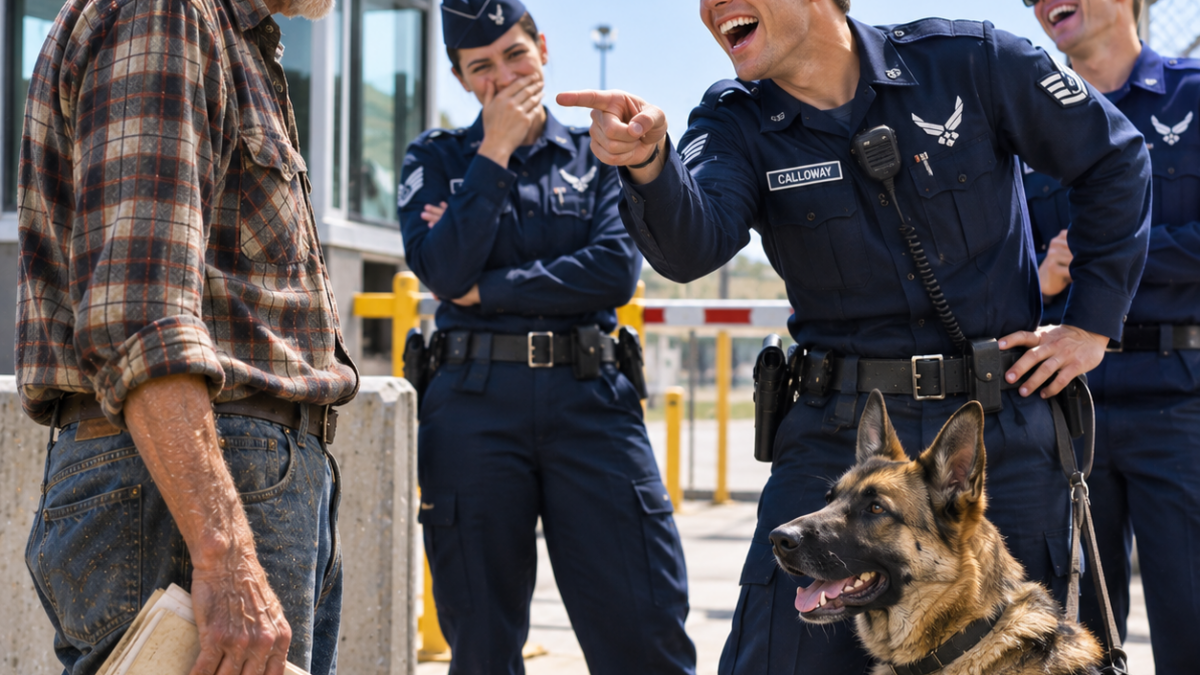
They Mocked the Old Farmer at the Air Force Base Gate—Then the Base’s Top K9 Lay at His Boots and Refused to Move.
The young airman looked at my rusted pickup, my work boots, and the hay in the truck bed, then laughed when I told him I had driven all the way to Vandenberg to visit a military K9 memorial.
He ordered me to turn around, called for a security dog when I refused to leave, and clearly expected the search to scare an old farmer back onto the highway.
But the moment that Belgian Malinois reached my driver’s window, he stopped searching the truck, pressed his head against my shoulder, and refused every command his handler gave him—and suddenly the gate went quiet enough for fifty years of buried history to come back.
My name is Samuel Crow.
I was seventy-eight years old when I drove my old Ford pickup to Vandenberg Air Force Base.
The truck was almost as stubborn as I was.
Faded blue paint.
Rust around the wheel wells.
Cracked dashboard.
Bench seat repaired with gray tape.
The bed usually carried feed sacks, fencing wire, seed, or whatever else a small California farm requires.
That morning it carried almost nothing.
A few pieces of hay.
Some dry dirt.
One old thermos.
And a promise I had waited more than half a century to keep.
The main gate looked different from the military installations I remembered.
Concrete barriers.
Cameras.
Sensors.
Steel.
Everything clean.
Everything deliberate.
Young men and women in uniforms moving with practiced purpose.
My Ford coughed as I rolled toward the checkpoint.
The airman at my window couldn’t have been more than twenty.
His nameplate read:
CALLOWAY.
He leaned slightly toward the truck.
“Sir, pull over to the inspection area and shut down the engine.”
I nodded.
“Of course, son.”
My truck complained when I turned the key.
Then silence.
Prairie wind moved across the barriers.
Calloway looked over my truck as if I had brought livestock through the gate.
He noticed the hay.
The dust.
My plaid shirt.
The worn denim.
My hands.
Farm hands tell stories whether you want them to or not.
Old cuts.
Thick nails.
Calluses along the fingers.
Skin dried by sun, soil, wire, and weather.
That was all Calloway saw.
A farmer.
Probably lost.
Maybe confused.
Possibly irritating.
PART2:
“License and registration.”
I handed them over.
He read.
“Samuel Crow.”
“Yes.”
“Seventy-eight?”
“Last time I checked.”
He didn’t smile.
“Address east of Lompoc.”
“That’s right.”
“What’s your business at Vandenberg?”
I looked past him.
The base stretched farther than I could see.
There were buildings now where open ground used to be.
Different roads.
Different vehicles.
Different generation.
But somewhere inside those fences was the reason I had come.
“The memorial.”
“What memorial?”
PART3:
“The K9 memorial.”
That almost got a laugh.
“The dog memorial?”
“Yes.”
“Sir, that’s on the far side of the installation.”
“I know.”
“It isn’t a public tourist site.”
“I know that too.”
He looked at his screen.
“Do you have authorization?”
“I was told to check in here.”
“Name on the access list?”
“Should be Crow.”
He typed.
Then typed again.
Nothing.
Another airman approached.
Woman.
Clipboard.
Sharp haircut.
“Problem?”
Calloway said:
“Farmer says he wants to visit the dog cemetery.”
Then, a little quieter:
“Maybe he’s got a prize pig buried there.”
I heard him.
Of course I did.
When you become old, younger people often assume your hearing disappears before your dignity.
The woman didn’t laugh.
“Authorization?”
“Nothing.”
Calloway handed my documents back.
“Sorry, Mr. Crow. Restricted access. You’ll have to turn around.”
I accepted the papers.
Placed them in the leather pouch I had carried for years.
“I understand.”
Then put my hands on the wheel.
But I didn’t start the engine.
Calloway waited.
I breathed slowly.
He shifted his weight.
“Sir?”
I looked at him.
“Yes?”
“You need to leave.”
“I heard you.”
“Then start the truck.”
I kept both hands on the wheel.
“The problem is, son, I can’t leave yet.”
His posture changed.
The ease disappeared.
“Is that a threat?”
“No.”
I looked toward the base again.
“It’s a promise.”
He frowned.
“I made it a long time ago.”
That sentence irritated him more than if I had shouted.
Young men with new authority sometimes expect the world to respond quickly.
Yes, sir.
No, sir.
Move.
Stop.
Leave.
I had once been young enough to believe control was the same thing as command.
Life corrected me.
Calloway tapped the roof of my truck.
“Sir, this is a secure military installation. If you refuse to leave, you’ll be escorted.”
“I understand.”
“Then why are you refusing?”
“I’m not refusing you.”
“That is exactly what you’re doing.”
“No.”
I looked at him.
“I’m trying to keep my word.”
That was when he reached for his radio.
“Century Two to gate control. Non-compliant civilian refusing to vacate. Request K9 support for vehicle sweep.”
I watched him.
The request was unnecessary.
We both knew it.
A seventy-eight-year-old farmer in a dying Ford did not require a military working dog because he sat too long at a gate.
He wanted pressure.
Wanted me embarrassed.
Wanted fear to accomplish what his authority hadn’t.
That didn’t anger me.
Not much.
I had been frightened by better men in worse places.
I sat quietly.
Waited.
A few minutes later, a specialized patrol vehicle arrived.
A sergeant stepped out.
Late thirties maybe.
Calm posture.
No unnecessary movement.
Experience.
Beside him came a Belgian Malinois.
Sable coat.
Black mask.
Lean body built for speed.
The dog vibrated with contained energy.
Every step controlled.
Every muscle ready.
I forgot Calloway.
Forgot the gate.
Forgot the years.
I looked only at the dog.
Something inside my chest tightened.
The sergeant introduced himself.
“Sergeant Reyes.”
Then to Calloway:
“What’s going on?”
Calloway straightened.
“Civilian won’t leave. Evasive. Requesting sweep of vehicle.”
Reyes looked at me.
Not dismissively.
Assessing.
Different thing.
“All right, sir. My partner is going to perform a standard external search around the truck. Keep your hands visible.”
I nodded.
The dog began at the front bumper.
Professional.
Nose working.
Tail neutral.
Focused.
He moved along the passenger side.
Rear wheel.
Tailgate.
Then around the driver’s side.
I watched.
There are things you forget after fifty years.
Names.
Dates.
Faces around briefings.
Road numbers.
Some things never leave.
The way a working dog moves is one of them.
Weight forward.
Nose reading air and ground at once.
Ears receiving information the handler never notices.
The communication between animal and human carried in inches of leash.
I knew that dance.
Too well.
The dog reached my window.
Stopped.
Completely.
Reyes frowned.
“Search.”
Nothing.
The Malinois lifted his head.
His eyes found mine.
Then came a sound.
A low whine.
My hands tightened on the wheel.
That sound.
God.
I had heard it in another century.
Another country.
Another life.
The dog stepped closer.
His nose entered through the open window.
He smelled my jacket.
My hand.
My neck.
His tail moved once.
Slowly.
Then again.
Reyes stared.
“Thor.”
So that was his name.
Thor.
The dog pushed his head farther into the cab.
Pressed against my shoulder.
My eyes closed.
For one second, I could smell wet jungle instead of California wind.
Mud.
Cordite.
Smoke.
Dog fur.
Blood.
Striker.
I opened my eyes.
Reyes gave the leash a gentle pull.
“Thor. Off scent. Search.”
Thor ignored him.
Reyes pulled again.
“Heel.”
The command sharpened.
Thor braced.
Would not move.
Calloway stepped closer.
“There. I told you something’s wrong.”
Reyes shot him a look.
“That is not an explosives alert.”
“Then what is it?”
“I don’t know.”
Neither did I.
Not exactly.
But somewhere beneath the years, a theory had already started forming.
Thor whined again.
Pressed harder against me.
Reyes knelt.
“Buddy.”
Thor briefly looked at him.
Licked his face once.
Then immediately turned back to me.
Reyes whispered:
“What are you smelling?”
I lifted my right hand.
Slowly.
Palm up.
Not toward Thor.
Just available.
The dog pulled back from the window.
Then began pacing beside the door.
Whining.
Pawing the faded blue paint.
Trying to get closer.
Calloway’s hand went toward his weapon again.
“Sergeant, secure him.”
Reyes snapped:
“Back off.”
Then looked at me.
“Sir, do you know this dog?”
“No.”
“You’ve met him?”
“Never.”
“How is he acting like this?”
I looked at Thor.
“He’s a good dog.”
Reyes almost laughed from disbelief.
“I know he’s a good dog.”
“You trained him well.”
“That isn’t what I asked.”
“No.”
Thor scratched once more at the door.
I said:
“It’s not your training.”
Reyes looked at me.
“What then?”
I should have kept my mouth shut.
Instead, fifty years of memory spoke.
“His blood remembers.”
Silence.
Calloway scoffed.
Reyes didn’t.
He was too busy watching Thor.
I asked:
“May I step out?”
Calloway immediately said:
“No.”
Reyes kept his eyes on the dog.
Then on me.
“Slowly.”
Calloway turned.
“Sergeant—”
“Hold your position.”
Reyes looked at me.
“Both hands visible.”
I opened the door.
The hinges groaned.
I swung my legs down.
My knees were not what they had been.
Neither was the rest of me.
But old training has a strange way of remaining under age.
Balance.
Controlled movement.
No wasted motion.
I stood.
Thor stopped whining.
Went completely still.
He pulled forward once.
Reyes loosened the leash slightly.
The dog walked toward me.
No rush.
No bark.
No aggression.
Stopped directly in front of my boots.
Sat.
Looked into my face.
Then gave one soft woof.
Not warning.
Greeting.
My throat tightened.
Thor lowered himself.
Placed his head across the toes of my dusty work boots.
Closed his eyes.
The gate fell silent.
Radios.
Wind.
Engines.
Men watching.
All of it seemed far away.
I bent slowly.
My joints complained.
Placed one hand on Thor’s head.
His ear moved beneath my thumb.
I stroked it once.
Then again.
Same place I used to touch Striker.
Behind the left ear.
He had a scar there.
Small one.
Knife cut from concertina wire.
Thor didn’t.
But my hand remembered anyway.
Reyes said quietly:
“Sir?”
I looked up.
“Belgian Malinois.”
He nodded.
“Dutch line?”
His eyes narrowed.
“Mostly.”
“High prey drive.”
“Yes.”
“Needs work or he starts inventing his own.”
Reyes stared.
“How did you know?”
I looked down at Thor.
“He smells home.”
Reyes didn’t understand.
Not yet.
I made two soft tongue clicks.
Then a low whistle from the back of my throat.
Thor’s ears snapped forward.
His eyes opened.
He lifted his head.
Then licked my chin.
Reyes went pale.
I knew immediately I had made another mistake.
He whispered:
“That command.”
I stopped.
“What?”
“I’ve read about that.”
My hand froze.
“Where?”
“At Lackland.”
“What did you read?”
“An old historical study.”
My voice changed before I intended it to.
“What study?”
He stood straighter.
“Project Water Shadow.”
The name hit me harder than Thor’s recognition had.
For half a century, I had heard that name spoken by almost nobody.
Most of the men who knew it were dead.
Records had been sealed.
Operations denied.
Some places we went officially did not exist.
I looked at Reyes.
Hard.
“Where did you hear that?”
He straightened as though I had outranked him.
“In an academy monograph, sir.”
“What did it say?”
“Not much. Most was redacted.”
“What did it say?”
“Late 1960s.”
“Yes.”
“Special handler teams.”
I waited.
“Silent tracking.”
“Yes.”
“Reconnaissance.”
“Yes.”
“Laos. Cambodia.”
His voice lowered.
“Most teams listed as lost or dissolved.”
I looked back at Thor.
“They wrote books about us.”
“Only a few pages.”
“We were ghosts.”
Reyes said nothing.
“We were supposed to stay that way.”
Calloway’s expression had changed.
He still didn’t understand all of it.
But he understood enough to know the old farmer at his gate was no longer simply the old farmer at his gate.
Reyes asked:
“The memorial.”
I looked toward the base.
“You’re here because of Water Shadow.”
I nodded once.
“My partner’s name is on that wall.”
Thor raised his head.
“Striker.”
The name came out harder than I expected.
A half century and I still felt it.
Reyes asked:
“Malinois?”
“Yes.”
“Like Thor?”
I looked at the dog.
“Almost exactly.”
That was not literally true.
No two dogs are exact.
Striker had darker shoulders.
A scar along his muzzle.
One ear that never stood quite straight after an injury.
But in the way that mattered, Thor carried something familiar.
The intensity.
The eyes.
The complete concentration.
The way his body became still when his mind was working.
“We spent four years together.”
I rested both hands on my knees.
“Most of them in places nobody put on maps.”
Reyes listened.
Calloway did too.
I could have stopped there.
Maybe I should have.
But once a door opens after fifty years, sometimes everything behind it pushes through.
“Striker saved my life more times than I can count.”
I smiled.
“I saved his once or twice.”
“How did he die?”
Reyes asked it softly.
I looked beyond the gate.
Not at Vandenberg anymore.
At a riverbank.
Rain.
Rounds cracking through vegetation.
Men shouting.
Striker pulling against my hand.
“We got hit hard.”
My voice sounded distant to me.
“I was wounded.”
“Couldn’t move.”
“Striker stayed.”
I swallowed.
“He laid over me.”
Reyes’s eyes shifted toward Thor.
“He took two rounds that were meant for me.”
No one spoke.
“He died on top of me.”
The wind moved through the gate.
Somewhere a truck idled.
“They couldn’t recover him.”
“At least, that’s what I was told.”
I put one hand inside my shirt pocket.
Pulled out a folded paper.
Creased.
Soft from being opened and closed.
General’s letterhead.
Five years old.
I handed it to Reyes.
“An old friend found me.”
“Someone from the program?”
I nodded.
“He stayed in.”
“Made general.”
“Somehow survived the politics.”
I almost smiled.
“He wrote that remains had eventually been recovered from several old mission sites.”
Reyes looked down.
“Striker?”
“Yes.”
“He said the identification was confirmed from service records.”
“And the memorial?”
“His name is there.”
Reyes read the letter.
Standing invitation.
Clearance authorized subject to normal verification.
A phone number.
Signature.
Calloway looked ill.
I folded the letter again.
“It took me five years to drive here.”
Reyes looked surprised.
“Why?”
“Because knowing his name was there and standing in front of it are two different things.”
That was the truth.
Every year I told myself:
Next spring.
After planting.
After harvest.
After Ruth’s surgery.
After the roof is fixed.
After I feel ready.
You can spend a lifetime waiting to feel ready for grief.
Eventually age removes the luxury.
My wife, Ruth, died two years before that morning.
Cancer.
Forty-nine years married.
She knew about Striker.
Not all of it.
Enough.
Three weeks before she died, she said:
“You need to go see him.”
I told her:
“I will.”
She looked at me the way wives look at husbands when they know they are hearing nonsense.
“When?”
“Soon.”
“No.”
She took my hand.
“Promise me.”
So I did.
That was the promise I referred to at the gate.
Not only to Striker.
To her.
I had promised two ghosts.
And I was too old to break another promise.
The gate shift commander arrived while Reyes was still reading.
Captain.
Young.
Annoyed.
“Sergeant, what the hell is going on?”
Reyes stood.
“Sir, we have a situation.”
“No kidding.”
Then Reyes explained.
Quietly.
Not everything.
Enough.
Water Shadow.
The training signal.
The letter.
Striker.
The captain’s expression moved from irritation to skepticism.
Then disbelief.
Then recognition.
Military history is strange.
Some stories live in official records.
Others survive in footnotes.
Whispers.
Training schools.
The captain knew the name.
He stepped toward me.
Looked at my clothes.
My truck.
My hands.
Then snapped to attention.
Saluted.
Sharp.
Respectful.
“Mr. Crow.”
I had not been saluted in decades.
“Sir.”
The word felt uncomfortable.
“It is an honor to have you at Vandenberg.”
I returned a small nod.
“Thank you, Captain.”
“I’d like to escort you personally to the memorial.”
“You don’t need to.”
“I would like to.”
I looked at my Ford.
He followed my eyes.
“We can provide transportation.”
“No.”
“Sir?”
“I’d rather drive my truck.”
He smiled.
“Of course.”
Then to Reyes:
“You and your partner escort him.”
“Yes, sir.”
Thor stood immediately.
Moved to my left side.
Natural heel position.
Reyes stared.
I looked down at the dog.
“You’re going to get your handler in trouble.”
Thor looked up.
Reyes laughed for the first time.
“Wouldn’t be the first time.”
Calloway stood near the booth.
Silent.
His earlier smile gone.
I could have said something.
I could have embarrassed him.
Would have been easy.
Old men know exactly where to cut when we want to.
But I remembered being twenty.
Remembered believing uniforms made you wiser than the people outside them.
Remembered my first months handling dogs.
Mistakes.
Arrogance.
Fear disguised as authority.
So I said nothing.
I climbed back into my truck.
Reyes got in on the passenger side.
Thor rode with us rather than walking beside the truck, because Reyes finally decided regulations still mattered even on strange mornings.
I appreciated that.
The captain led us.
We passed through the base.
Satellite equipment.
Operations buildings.
Security zones.
Missile infrastructure.
A modern military world built over layers of older ones.
Reyes looked at the dashboard.
“Sir?”
“Samuel.”
“Samuel.”
“Yes?”
“Can I ask you something?”
“Probably.”
“Was Water Shadow really what the books say?”
“What do the books say?”
He hesitated.
“Handlers and dogs used for missions nobody wanted traced back.”
“That’s one way of saying it.”
“Silent command system?”
“Yes.”
“Why?”
“Radios fail.”
I looked through the windshield.
“Voices travel.”
“Dogs hear better than men.”
“And enemy soldiers understand English.”
“So clicks and whistles?”
“Some.”
“Hand signals?”
“Some.”
“Breathing patterns.”
He looked at me.
“Breathing?”
“Dogs notice everything.”
“Handlers learned to use it.”
“You could calm a dog by changing how you breathed?”
“Sometimes.”
“Signal?”
“Sometimes.”
He looked at Thor.
“So when he reacted at the gate…”
“I don’t know.”
I wanted that clear.
Reyes looked surprised.
“You said his blood remembers.”
“Old men say dramatic things when a dog puts his head on their boots.”
He laughed.
“So you don’t actually think it’s genetic memory?”
“No.”
I scratched Thor’s head.
“Not in the way people mean when they tell stories.”
“Then what?”
I looked at the dog.
“Could be scent.”
“Something on my jacket.”
“Old leather.”
“Farm chemicals.”
“Who knows.”
“Could be a training cue that survived in some line of handlers.”
“Could be coincidence.”
“Could be Thor noticed something in me before either of us did.”
I paused.
“But whatever made him stop, I’m grateful.”
Reyes nodded.
That answer seemed to satisfy him more than mythology would have.
The memorial sat in a quiet area.
Oak trees.
Grass.
Simple granite markers.
No dramatic monument.
No giant bronze statue.
Good.
Working dogs deserve dignity more than spectacle.
I got out.
Thor jumped down with Reyes.
Then came beside me.
I walked slowly.
Age makes you honest about distance.
There were names from more recent wars.
Afghanistan.
Iraq.
Earlier conflicts.
Dogs who detected explosives.
Dogs who found weapons.
Dogs who guarded bases.
Dogs who walked into places humans feared entering first.
I read several names.
Rex.
Bella.
Diesel.
Names people give animals because we always begin by pretending they are pets.
Then we ask them to do impossible work.
I kept moving.
Until I saw it.
STRIKER.
My body stopped before my mind did.
Gray stone.
Weathered slightly by California sun and sea air.
Service:
1968–1972.
Below:
SEMPER FIDELIS CANIS
ALWAYS A FAITHFUL DOG
I stared.
Fifty years disappeared.
Striker was nineteen months old when they handed him to me.
Too much energy.
Would bite the leash if bored.
Hated helicopters at first.
Loved canned peaches.
Would not sleep unless he could see me.
Terrible habit of stealing socks.
Best tracker I ever knew.
Fearless except around thunder.
I touched the letters.
S.
T.
R.
I.
K.
E.
R.
My fingers shook then.
Not at the gate.
Not with Calloway.
Not while telling Reyes how he died.
At the stone.
That was where age finally took me.
I bowed my head.
Didn’t cry.
Not because I was too tough.
Because sometimes grief goes beyond tears.
Thor leaned against my leg.
Solid.
Warm.
Alive.
A soft whine came from him.
I put my hand on his head.
“Hello, partner.”
I meant Striker.
Maybe Thor too.
We stood there a long time.
No one rushed me.
That was the greatest kindness of the day.
Eventually, Reyes stepped closer.
“What was he like?”
I smiled.
“Difficult.”
Thor looked up.
Reyes laughed.
“Sounds familiar.”
“Smart.”
“Too smart.”
“Mean when he needed to be.”
“Gentle when nobody was watching.”
“He saved me.”
I looked at the stone.
“And I never got to bring him home.”
Reyes said:
“You’re here now.”
“Not the same.”
“No.”
Good answer.
I crouched beside Thor.
Pain shot through one knee.
Worth it.
I put both hands around the dog’s neck.
He leaned into me.
For one minute, I let my face rest against his fur.
I smelled warm dog.
Dust.
Leather harness.
Sun.
Not jungle.
Not blood.
Not fifty years ago.
Now.
That mattered.
When I stood, something inside me felt lighter.
Not healed.
I dislike that word when people use it around old wounds.
Some things don’t heal.
They settle.
Become part of the body.
You learn how to carry them differently.
Striker’s name on stone did not give me back the dog.
It gave the loss a place to stand.
That was enough.
I told Reyes:
“These dogs give everything.”
He nodded.
“They don’t ask for medals.”
“No.”
“Don’t understand memorials.”
“No.”
“They ask for trust.”
I looked at Thor.
“And work.”
Reyes smiled.
“Definitely work.”
“You have a good partner.”
“I know.”
“Honor him while he’s here.”
His smile disappeared.
He understood.
“I will.”
I looked at Striker one last time.
“Good.”
We drove back to the gate.
The trip felt shorter.
They always do after you finally reach the place you spent years avoiding.
As we approached, I saw Calloway standing at the checkpoint.
Straight.
Waiting.
My Ford stopped beside him.
He stepped forward.
Saluted.
No smirk.
“Mr. Crow.”
I rolled down the window.
“Yes, son?”
“I owe you an apology.”
Reyes looked toward me.
I waited.
Calloway swallowed.
“I was disrespectful.”
“Yes.”
His face reddened.
“I made assumptions.”
“Yes.”
“I shouldn’t have.”
“No.”
He looked surprised that I wasn’t helping him.
Apologies matter more when the person making them has to finish.
He continued.
“I treated you like you didn’t belong before I knew why you were here.”
I nodded.
“That happens.”
“It shouldn’t.”
“No.”
He kept his salute.
I said:
“You can put your hand down.”
He did.
Then I asked:
“How long have you been at the gate?”
“Eight months.”
“How long in uniform?”
“Fourteen months.”
I nodded.
“Good.”
He seemed confused.
“Good?”
“You learned this one early.”
“What lesson?”
I looked toward my truck.
“Rust doesn’t tell you what an engine has done.”
Then at him.
“Clothes don’t tell you what a man has done.”
“Uniforms don’t tell you what a man will do.”
His eyes dropped.
“Ask before you decide.”
“Yes, sir.”
“And stop calling every old farmer sir because you feel guilty.”
Reyes laughed.
Calloway nearly did too.
I nodded toward him.
“You were doing your job.”
He started to respond.
I raised a finger.
“You were also enjoying it.”
That silenced him.
“Learn the difference.”
His expression changed.
“Yes.”
“That’ll make you better.”
I turned toward Reyes.
Thor stood beside him.
The dog looked from his handler to me.
Uncertain.
I leaned toward the window.
“It’s all right, boy.”
Thor’s ears lifted.
“You stay with your man.”
Reyes put a hand on Thor’s shoulder.
“He’s good.”
“I know.”
I looked at the sergeant.
“You take care of him.”
“I will.”
“And when he retires?”
“Sir?”
“Take care of him then too.”
Reyes nodded.
“I promise.”
That word.
Promise.
I believed him.
“Thank you for understanding.”
Reyes shook his head.
“No.”
His voice tightened.
“Thank you.”
I put the truck in gear.
The engine rattled.
Calloway stepped back.
Reyes did too.
Thor stayed seated.
Watching.
I drove through the gate.
Into California afternoon.
Fields.
Road.
Open country.
In the mirror, the base became smaller.
Thor stayed visible longest.
Sable body.
Black mask.
Sitting beside Reyes.
Then they disappeared.
I drove home.
The farm looked exactly as I had left it.
Fence needed repair near the south pasture.
Water trough leaking.
Mail in the box.
Chickens had somehow escaped the side enclosure again.
Ordinary problems.
Bless them.
I parked.
Sat in the truck.
Then took Ruth’s old photograph from the visor.
She hated that picture.
Said her hair looked terrible.
It did.
I loved it anyway.
“I went.”
Silence.
“I know.”
I looked toward the house.
“You were right.”
She usually was.
That evening, I took the general’s letter out of my shirt pocket.
Placed it in the drawer beside my service papers.
Then I added something new.
A photograph Reyes had printed for me before I left.
Striker’s marker.
Thor sitting beside it.
Me standing behind him.
I did not look heroic.
Good.
I looked like a farmer.
Plaid shirt.
Worn jeans.
Old boots.
Hands at my sides.
That was who I had become.
For decades, I worked hard to make Samuel Crow the farmer more real than whoever I had been before.
I married.
Raised two children.
Lost one.
Buried my parents.
Built fences.
Raised cattle.
Watched droughts come.
Watched rains return.
Held Ruth’s hand through chemotherapy.
Learned that heroism is a word strangers use when they don’t know what else to call survival.
The military part of my life became smaller.
Not gone.
Just folded away.
Sometimes younger veterans ask why men like me don’t tell stories.
There are many reasons.
Some stories are classified.
Some are painful.
Some would sound unbelievable.
Some belong partly to people who never came home.
And some veterans simply get tired of being the most dramatic thing that ever happened to them.
I wanted to be more than a war.
So I became a farmer.
A husband.
A father.
A neighbor who repaired tractors badly but fences well.
A man who complained about feed prices.
A man who drove an old Ford because buying a new one felt like admitting defeat.
That life was real.
So was Water Shadow.
So was Striker.
One did not erase the other.
Calloway’s mistake was believing only one version could be true.
Old farmer.
Or former military handler.
Rusty truck.
Or classified history.
Weakness.
Or discipline.
People contain more than one life.
Age simply makes the layers harder to see.
A month after my visit, Reyes wrote.
Real letter.
Not email.
I appreciated that.
He told me Thor had gone back to normal the next day.
Focused.
Obedient.
No mysterious behavior.
Except one thing.
Whenever an old blue pickup came near the gate, Thor looked up.
I laughed when I read that.
Reyes also asked whether I would be willing to speak with the base K9 handlers.
I almost declined.
Public speaking never appealed to me.
Then I remembered Calloway.
I wrote back:
Only if nobody calls me a legend.
Reyes replied:
No promises.
So two months later, I returned.
This time my name was on the access roster.
Calloway was working.
He checked my identification seriously.
Then said:
“Welcome back, Mr. Crow.”
No salute.
No embarrassment.
Professional.
Better.
Thor arrived before the session.
Reyes brought him into the training room.
The dog saw me.
Stopped.
Tail wagged.
Then he walked over.
Not frantic this time.
No whining.
He sat at my boots.
Reyes smiled.
“Apparently you’re approved now.”
I scratched Thor behind the ear.
“Good taste.”
The handlers gathered.
Young.
Old.
Men.
Women.
Different eras.
Different wars.
Same leash habits.
I did not tell them battle stories.
Not many.
I told them about partnership.
“Your dog does not care what your rank is.”
They listened.
“He cares whether you’re consistent.”
“Whether your hands tell the same truth as your voice.”
“Whether you notice when he’s tired.”
“Whether you know the difference between disobedience and confusion.”
Reyes looked at Thor.
I continued.
“Do not mistake obedience for absence of thought.”
A young handler asked:
“What do you mean?”
“Your dog is always processing.”
“Scent.”
“Sound.”
“Body.”
“You.”
“If you assume every refusal is defiance, eventually you’ll punish good judgment.”
Another handler asked:
“Did Striker ever refuse a command?”
I smiled.
“Yes.”
“What happened?”
“He saved my life.”
The room quieted.
I told them one story.
Not the riverbank.
An earlier mission.
I ordered Striker forward.
He stopped.
Would not move.
I thought he was distracted.
Then I noticed the ground ahead.
Tripwire.
Almost invisible.
Striker had scented something wrong.
Maybe explosive residue.
Maybe disturbed soil.
Maybe danger I never understood.
He refused.
We rerouted.
Later found the device.
“If I had cared more about being obeyed than understanding the dog, I wouldn’t be here.”
Reyes looked toward the back of the room.
Calloway had slipped in.
Off duty.
Listening.
I continued.
“Authority is useful.”
“Ego is not.”
Calloway lowered his head slightly.
I did not look directly at him.
He heard.
That was enough.
Afterward, Reyes walked with me to the memorial.
Thor came.
No ceremony.
No captain.
No crowd.
Better.
We stopped at Striker’s stone.
Thor sat.
I looked at the marker.
Then at the dog.
“Still here.”
Reyes asked:
“Do you think Thor really recognized something from Striker?”
I thought about it.
“I think people want inheritance to be simple.”
“Blood.”
“Genes.”
“Instinct.”
“But working dogs are shaped by breeding, training, handlers, environment, and more things than we understand.”
“So what happened?”
“I don’t know.”
He smiled.
“You’re comfortable with that?”
“At seventy-eight?”
I laughed.
“You’d better become comfortable with not knowing.”
We stood there.
Then I added:
“But I know what it felt like.”
“What?”
“Like Striker sent somebody to meet me at the gate.”
Reyes smiled.
“That sounds like the version I prefer.”
“Me too.”
I died years later.
Not at Vandenberg.
Not dramatically.
That is how I hope the story would be told if someone cared to tell it.
Old farmer.
Home.
Life finished in the place he chose.
But before that day came, I visited Striker every year.
Sometimes with Reyes.
Sometimes alone.
Thor eventually retired.
Reyes kept his promise.
He took him home.
I visited once.
Thor had gone gray around the muzzle.
Slower.
Still sharp.
He slept near Reyes’s back door in the California sun.
When I arrived, he stood.
Walked toward me.
No frantic recognition.
No mystery.
He simply pressed his head against my leg.
Old friend greeting old friend.
I sat beside him.
Reyes brought coffee.
We talked about nothing important.
Weather.
Feed prices.
Thor’s arthritis.
His daughter’s college plans.
That afternoon may have meant more to me than the first gate encounter.
Because the gate had been about the past.
That day was about what came after.
The world did not stop at Striker’s death.
It did not stop at Water Shadow.
It did not stop when Ruth died.
It did not stop when I finally stood before the memorial.
Life is rude that way.
It keeps going.
The only question is whether you go with it.
Thor did.
Reyes did.
I did.
Even Calloway did.
Years after our first meeting, he wrote me.
He had made staff sergeant.
He said he was training younger airmen at a gate somewhere overseas.
Near the end of the letter, he wrote:
I still tell them about the farmer in the old Ford.
I smiled.
Then kept reading.
I tell them that security requires suspicion, but professionalism requires humility. You can investigate someone without humiliating them.
That was a lesson worth carrying.
He ended:
I hope I learned it well enough.
I wrote back:
You did if you’re still asking.
That was all.
My old Ford eventually died for good.
Transmission.
The mechanic gave me a repair estimate high enough that even sentiment surrendered.
Before the tow truck took it, I sat behind the wheel one last time.
Same cracked steering wheel.
Same faded dash.
I thought about that morning at Vandenberg.
Calloway outside.
Reyes arriving.
Thor stopping at the window.
That first whine.
My hand on the dog’s head.
“His blood remembers.”
I smiled at myself.
Dramatic old fool.
Maybe Thor didn’t remember anything older than his own training.
Maybe I was the one who remembered.
Maybe that was enough.
Because the truth is, Thor didn’t need to be Striker’s descendant.
He didn’t need mystical memory.
He only needed to stop.
To notice.
To refuse to move when every human at the gate expected him to move.
That interruption gave us time.
Time for Reyes to ask another question.
Time for me to open an old door.
Time for a young airman to see a man instead of a stereotype.
Time for me to finally keep a promise.
Sometimes that is what dogs do best.
Not magic.
Attention.
They notice what we miss.
And on that morning, Thor noticed an old farmer sitting in a rusted truck.
Everyone else saw inconvenience.
Thor saw something worth stopping for.
Because of him, I reached Striker.
I placed my hand on the stone.
I said goodbye.
And after fifty years of carrying a promise I was afraid to keep, I finally drove home lighter than I had arrived.
The people at the gate thought I had come to visit a dead dog.
They were wrong.
I had come to finish a conversation with my oldest partner.
Thor simply refused to let me leave before I did.








