They Mocked the Mail-Order Bride’s Fatherless Daughter—Then the Quiet Cowboy in the Back Pew Stood Up
PART3:
She laughed.
Effie still laughed easily then.
That matters.
People who met her later thought she had always been timid.
She hadn’t.
Children do not come into the world afraid of rooms.
Rooms teach them.
When the train finally pulled into Silver Bend, I stepped down in a brown traveling dress with my hand around Effie’s and looked for a man holding a white handkerchief.
Samuel had written that he would.
No one was waiting.
I stood on the platform until the conductor began checking his watch.
A man from the depot approached.
“Mrs. Whitfield?”
I almost smiled with relief.
“Yes.”
His face told me before his mouth did.
He removed his hat.
Samuel had died eleven days earlier.
Miner’s cough, they called it.
His lungs had been bad for months, apparently.
He had hidden the severity in his letters.
By the time fever took him, my train had already left Missouri.
There had been no way to stop me.
I remember gripping Effie’s hand.
Not because I feared falling.
Because she was the only solid thing left.
“Is Mr. Whitfield sick?” she asked.
The depot man looked at me.
I said:
“He died, baby.”
Effie stared.
“But he was going to be my new papa.”
People talk about disappointment as if it arrives gradually.
Sometimes it is a door slamming.
The depot man helped us find a room above the general store for two nights.
Samuel’s property had gone into a mess of debt claims and probate.
I had no legal right to most of it.
No marriage.
No signed final papers.
No family.
The money I had left would last perhaps ten days.
I could have taken the next eastbound train if I sold nearly everything.
But go where?
Back to Missouri?
Back to the woman with a fatherless child?
I had crossed a continent hoping distance might finally outrun contempt.
It turned out contempt owned good horses.
Silver Bend discovered my circumstances quickly.
Towns always do.
First I was the widow who arrived too late.
That bought sympathy.
Then someone asked when my first husband died.
I had never had one.
Sympathy became curiosity.
Then arithmetic.
Effie was six.
I was twenty-seven.
No marriage certificate.
No dead husband.
Within a week, the word had begun moving behind us.
Fatherless.
At first.
Then less gentle ones.
I found work washing for miners and shopkeepers.
Hard work.
Hot water.
Lye soap.
Hands cracked until they bled.
I rented a one-room cottage behind a widow’s boardinghouse.
Effie slept beside me on a narrow mattress.
At night, she asked whether Samuel would have liked her.
“I think so.”
“How?”
“He wrote about you.”
“What did he say?”
“That you could have his name.”
“Can I still?”
I turned toward the wall because I did not want her to see my face.
“I don’t know.”
She whispered:
“I liked Effie Whitfield.”
“So do I.”
“Can we keep it?”
“Yes.”
Technically I had no right.
I kept it anyway.
Let somebody fight a six-year-old over a dead man’s surname.
Three weeks after arriving, I took Effie to church.
That decision nearly changed everything.
I went because I had always gone.
Not every Sunday.
Not perfectly.
But often.
I also went because I refused to teach my child that people who whispered about her had a greater claim to God than she did.
The church was whitewashed pine.
Simple.
Two rows of windows.
A bell that sounded slightly cracked.
Everyone knew we were coming before we entered.
I felt it.
Heads turning.
Conversations changing shape.
Effie wore her best dress.
Blue.
I had repaired the hem twice.
Her hair was tied with a white ribbon.
She held my hand.
We sat near the front because those were the only open places.
That was probably what offended Vera Skell most.
Vera was the deacon’s wife.
Late forties.
Tall.
Always perfectly arranged.
Her clothes had no wrinkles.
Her voice had no warmth.
She had spent years becoming the woman Silver Bend consulted whenever it wanted to know what proper people were supposed to think.
There are women who build kindness into influence.
Vera had built judgment.
She watched us through the first hymn.
Through the prayer.
Through the sermon.
I tried not to notice.
Effie swung her feet.
Whispered:
“The pastor talks slow.”
“Shh.”
“Maybe he forgot what comes next.”
I nearly smiled.
Then service ended.
People stood.
That was when Vera approached.
I saw her coming.
Some part of me had been expecting it from the moment we entered.
She stopped beside our pew.
“Mrs. Whitfield.”
“Mrs. Skell.”
Her eyes went to Effie.
“May I ask a question?”
People nearby slowed.
Of course she could.
Women like Vera never ask questions unless the audience is already assembled.
I stood.
“You may.”
She lowered her voice slightly.
Not enough.
“I’ve heard conflicting accounts regarding the child.”
Effie looked up at me.
“What accounts?”
“Her parentage.”
My body went cold.
“There is nothing concerning my daughter that requires discussion in church.”
Vera smiled.
“Then perhaps you should not have brought the matter into church.”
“I brought a child to worship.”
“You brought scandal.”
Someone behind Vera inhaled.
Nobody intervened.
That silence told me everything.
I took Effie’s hand.
“We’re leaving.”
Vera should have won there.
I would have walked away.
She wanted more.
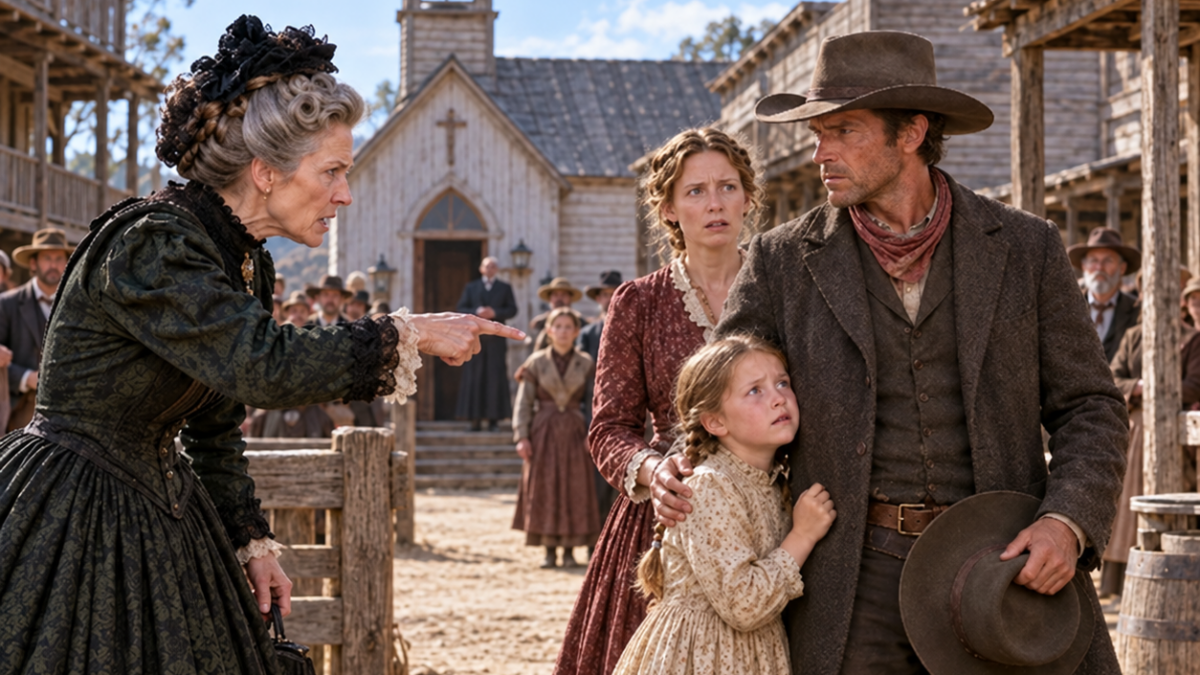
She pointed at my daughter.
Actually pointed.
“What is a bastard child doing in the front pew of a decent church?”
The room died.
No rustle.
No cough.
No floorboard.
Nothing.
Effie knew the word.
I wish she hadn’t.
She had heard it before.
She flinched as if Vera had struck her.
Then she looked at me.
That was the part that broke me.
Not the insult.
The question in my daughter’s face.
Is it true?
Not about her father.
About her worth.
Her fingers tightened around mine.
Her mouth folded.
She began crying without sound.
That silent cry children learn when loud grief has been punished too often.
I put my arm around her.
My entire body went steady.
That happens sometimes when humiliation becomes too familiar.
The first insults burn.
Eventually, you learn to freeze.
I looked at Vera.
I wanted to say something clever.
Something devastating.
Something that would make every person in that church remember my courage instead of her cruelty.
Nothing came.
I was tired.
Too tired.
I gathered Effie.
My shawl.
My dignity.
What remained of it.
Then a bench creaked behind us.
Someone stood.
The entire church turned.
Isaiah Penn.
I knew his name because everyone did.
Silver Bend called him the cold man from the hills.
Thirty-three.
Cattle rancher.
Owned land north of town.
Came in twice a week for supplies.
Attended church most Sundays.
Always sat in the back.
Always left before anyone could speak to him.
No wife.
No sweetheart anyone knew.
No gambling.
Barely drank.
Paid bills exactly.
Spoke so little that people had turned his silence into arrogance.
Isaiah stood.
Tall.
Lean rather than broad.
Dark hair.
Sun-browned face.
Gray eyes.
A scar beneath one jaw I had never noticed until he came closer.
He wore a plain black coat over a clean work shirt.
Hat in hand.
He walked down the aisle.
Not fast.
That made it heavier.
Every step seemed to ask whether someone else wanted to speak first.
Nobody did.
He passed the blacksmith.
The mayor’s brother.
The doctor.
The deacon.
Men who had spent their lives telling everyone else what duty looked like.
Not one had stood.
Isaiah stopped beside us.
He did not look at Vera.
He looked at Effie.
Then he crouched.
A grown man lowering himself until his eyes were level with a crying child.
“Miss Effie?”
She pressed against me.
He spoke gently.
“You know me?”
She shook her head.
“My name’s Isaiah Penn.”
Her breathing hitched.
“You haven’t done anything wrong.”
Vera shifted.
Isaiah ignored her.
“Do you hear me?”
Effie nodded a little.
“You have every right to sit in this church.”
Another nod.
“And you don’t need to cry because of something ugly somebody else chose to say.”
Effie stared at him.
Isaiah’s voice carried.
Not loud.
Every person heard.
“No one’s going to speak to you that way again.”
Then he stood.
Turned.
Finally looked at Vera.
She had lowered her hand.
Isaiah said:
“I was a fatherless boy.”
That alone surprised everyone.
No one knew anything about his past.
He continued.
“My mother raised me alone in Pennsylvania.”
His jaw tightened.
“People had names for her too.”
Vera opened her mouth.
Isaiah raised one hand.
Not threatening.
Final.
“I remember what those names cost.”
Nobody moved.
“I remember shopkeepers saying them.”
His eyes moved across the pews.
“Church women.”
More faces lowered.
“Schoolboys repeating what they heard at home.”
Then back to Vera.
“I watched a good woman spend her whole life standing straight while decent people chipped pieces off her because they enjoyed feeling cleaner beside somebody they had dirtied.”
Vera’s cheeks colored.
Isaiah’s voice remained level.
“She died before forty.”
He paused.
“So I know exactly what kind of person that word shames.”
Vera lifted her chin.
“I will not be lectured—”
“You’re right.”
Isaiah cut her off.
A ripple moved through the room.
He said:
“There’s no lecture needed.”
Then:
“Any grown soul who throws that word at a crying six-year-old has already testified about their own character.”
That was the first silence.
Then came the sentence people repeated for years.
Isaiah looked at Effie.
Then me.
Then back at the town.
“This child has no father in Silver Bend.”
My breath caught.
“So I’ll be one.”
Vera actually stepped backward.
Isaiah continued:
“Anybody who has something to say about Effie Whitfield can say it to me from now on.”
His eyes swept the church.
“And we’ll see how brave those words sound then.”
No one spoke.
Not the deacon.
Not the pastor.
Not Vera.
Effie stopped crying.
Completely.
She stared at Isaiah.
Then asked:
“You’re going to be my father?”
My heart stopped.
Every person heard.
Isaiah’s face changed.
For the first time, uncertainty.
He had made a moral declaration.
A six-year-old heard a promise.
He crouched again.
“I’m going to make sure nobody hurts you for something that isn’t your fault.”
“That’s not what you said.”
Someone behind us coughed to hide a laugh.
Isaiah looked almost alarmed.
Effie wiped her face.
“You said you’d be my father.”
“I said—”
“You did.”
He looked at me.
I should have rescued him.
I did not.
Something petty in me enjoyed watching the quietest man in Nevada discover the danger of speaking around children.
Finally he said:
“I suppose I did say that.”
Effie considered.
“All right.”
As if the matter had been settled legally.
Then she took his hand.
Isaiah froze.
She did not care.
I wanted to pull her away.
Not because I distrusted him.
Because I did not want my daughter clinging to another promise before I knew whether the man who made it understood what promises did to children.
Isaiah seemed to understand that without me speaking.
He did not close his hand around hers.
Just let her hold one finger.
Then he turned toward me.
“Mrs. Whitfield.”
“Yes?”
“May I walk you out?”
I looked at Vera.
Her face was rigid.
Then at every decent person who had remained seated.
“Yes.”
Isaiah offered his arm.
Not casually.
Formally.
Like I was a lady leaving a dance.
Not a washerwoman being shamed from church.
I placed my hand on his sleeve.
He walked Effie and me down the aisle.
Nobody breathed.
Outside, Nevada sunlight hit us so hard I blinked.
We reached the church steps.
Effie still held Isaiah’s finger.
He looked down.
“You planning on giving that back?”
“No.”
“That presents a problem.”
“You have nine more.”
He looked at me.
I laughed.
I could not help it.
First time I laughed in Silver Bend.
Isaiah’s mouth moved.
Almost a smile.
Then the church doors opened behind us.
People began emerging.
Isaiah’s expression closed again.
“Do you have a wagon?”
“No.”
“I’ll take you home.”
“That isn’t necessary.”
“I know.”
“I can walk.”
“I know.”
“I don’t require charity.”
His eyes met mine.
“I did not say you did.”
I stiffened.
He continued:
“I’m offering a ride because it’s hot and your girl has been crying.”
Effie tugged his finger.
“And because you’re my father.”
Isaiah shut his eyes briefly.
I almost laughed again.
He drove us home.
His wagon was clean.
Well maintained.
Everything about Isaiah Penn appeared deliberate.
Even the reins sat in neat loops.
Effie asked questions the entire way.
“How many cows?”
“Seventy-eight.”
“Why not eighty?”
“Two died.”
“Why?”
“One lightning.”
“One snake.”
“Cows can get bit by snakes?”
“Yes.”
“Do snakes bite horses?”
“Yes.”
“Do they bite people?”
“Yes.”
“Have you been bitten?”
“No.”
“Why?”
“They don’t like me.”
“That’s because you don’t talk.”
I covered my mouth.
Isaiah looked at me.
There it was again.
Almost smile.
Our cottage embarrassed me when we arrived.
One room.
Roof patched.
Laundry hanging outside because washing was my work and my work had taken over the yard.
Isaiah saw everything.
Said nothing.
I braced for pity.
There was none.
He helped Effie down.
Then turned to me.
“Mrs. Whitfield.”
“Nan.”
He hesitated.
“Nan.”
That first use of my name did something strange to me.
“I want to explain what I said.”
“You don’t owe me an explanation.”
“I do.”
Effie wandered toward the steps but remained close enough to hear if she wanted.
Isaiah removed his hat.
“I spoke because of my own history.”
“I understood.”
“I did not speak to claim anything from you.”
That surprised me.
He continued:
“You owe me nothing because I defended your child.”
My throat tightened.
“I would never assume—”
“People assume things for women in difficult positions.”
His voice remained quiet.
“I don’t intend to be one of them.”
I studied him.
“I said I would look out for Effie.”
“Yes.”
“I meant it.”
Effie called from the porch:
“I heard.”
Isaiah glanced at her.
Then back to me.
“But I will not use that promise to make you dependent on me.”
I had no answer.
He said:
“If you wish me gone, say so.”
“Do you always speak this directly?”
“Usually I don’t speak.”
“That might be easier.”
“It generally is.”
I smiled before I could stop myself.
He looked almost startled.
Then he told me he owned an empty line rider’s cottage on the south edge of his ranch.
Two rooms.
Stove.
Pump nearby.
No rent.
I immediately refused.
“No.”
“Why?”
“Because people are already talking.”
“They already were.”
“They’ll say I attached myself to you.”
“People who want to talk do not require evidence.”
“I do.”
He looked at the cottage.
“Your roof leaks.”
“It’s mine.”
“It belongs to Mrs. Yates.”
“I rent it.”
“You know what I mean.”
“I can pay my own way.”
“I’m not questioning that.”
“It sounds like you are.”
Isaiah went quiet.
His silence was not punishment.
He was thinking.
Then:
“Would you take the cottage if you paid rent?”
“What rent?”
He named an amount low enough to be kind but high enough not to humiliate me.
I calculated.
Possible.
Barely.
“Why?”
“Because it’s empty.”
“That is not why.”
“No.”
“What is?”
His eyes went toward Effie.
“Because I know what it is to be six and hear adults decide you are less.”
That ended my argument.
We moved three days later.
I paid rent.
Isaiah accepted every cent.
That mattered more than anyone understood.
A man trying to buy gratitude would have refused.
Isaiah understood that sometimes charity can feel like a chain to someone who has spent years paying hidden prices.
He gave me keys.
Showed me the pump.
Where firewood was stacked.
Which fence separated the cottage from cattle.
Then left.
No lingering.
No invitation into his house.
No expectation.
That first night, Effie stood at the window.
“Can I call him Papa?”
“No.”
“Why?”
“Because he is not your father.”
“He said.”
“He said something in church because Mrs. Skell was cruel.”
“So he lied?”
“No.”
I sat beside her.
“No.”
That mattered.
“He meant he would protect you.”
“Fathers protect.”
“Good ones do.”
“Then?”
“Effie.”
She sighed like an exhausted widow.
“How long until you marry him?”
I nearly choked.
“Excuse me?”
“You have to marry if he’s my father.”
“Who told you that?”
“Mrs. Bryant said fathers and mothers are married.”
“Mrs. Bryant also thinks vinegar cures fever.”
“Doesn’t it?”
“Go to bed.”
Isaiah kept his word.
Not romantically.
Not dramatically.
He simply appeared in the edges of our life.
A loose shutter fixed.
A bundle of venison left on the porch.
A note telling me which days the wagon went to town if I wanted a ride.
When Effie’s shoe split, Isaiah noticed before I did.
He said nothing.
The next morning, a pair of children’s boots sat outside.
I marched to his house.
He was repairing a saddle.
“What is this?”
He looked at the boots.
“Boots.”
“I know.”
“Then why ask?”
“Isaiah.”
He put down the awl.
“Her shoe is open.”
“I can buy shoes.”
“When?”
“When I’m paid.”
“Three days?”
“Yes.”
“She walks to school tomorrow.”
“She can wear the old pair.”
“They let water through.”
“It isn’t raining.”
He looked at the sky.
Clouds gathering.
I hated him slightly.
“I will pay you.”
“Fine.”
“How much?”
He named the exact store price.
Not a penny less.
I relaxed.
He noticed.
That bothered me.
“You do that deliberately.”
“What?”
“You make it possible for me to accept things.”
His eyes returned to the saddle.
“Seems easier.”
“No. It isn’t.”
He looked up.
“For you or me?”
I did not know.
Effie loved him almost immediately.
Isaiah did not know what to do with her.
That made their friendship funnier.
He would be checking fence posts.
Effie followed.
“Why is wire sharp?”
“Keep cows in.”
“Why do cows leave?”
“Grass.”
“There’s grass inside.”
“They disagree.”
“Cows are stupid.”
“Sometimes.”
“Are horses smarter?”
“Usually.”
“Are people?”
“Less often.”
She laughed so hard she nearly fell off the rail.
Isaiah caught her.
His face went pale.
“You stay on the ground.”
“I’m fine.”
“You almost fell.”
“But you caught me.”
“That is not a plan.”
“You worry like a papa.”
He put her down.
Walked away.
I saw his ears turn red.
Isaiah taught her to ride on an elderly mare named Daisy.
Daisy had one speed.
Philosophical.
Effie adored her.
The first time Isaiah lifted Effie into the saddle, she stiffened.
“Don’t let go.”
“I won’t.”
“You promise?”
His face changed.
“Until you tell me.”
That became his kind of promise.
Specific.
No forever unless he knew forever could be kept.
For a man everyone called silent, he chose words carefully.
I began to understand why.
Silver Bend did not stop talking after the church.
It got worse before it got better.
Vera Skell had been embarrassed publicly.
People who build power from being obeyed rarely forgive anyone who reveals that obedience was optional.
She started politely.
A washing customer told me she no longer required my services.
Then another.
Mrs. Yates suddenly heard that I was “living under Mr. Penn’s protection.”
A woman at the mercantile asked if I planned to become his housekeeper.
I answered:
“No.”
She smiled.
“Of course.”
That of course carried filth.
Vera hinted that I had trapped a lonely rancher.
That Isaiah defended Effie because I had enticed him.
That I was repeating my old sin.
The remarkable thing about gossip is how quickly people become experts in bedrooms they have never entered.
Isaiah and I had barely been alone together.
That did not matter.
My laundry work dropped by almost half.
I started sewing late at night.
Took mending.
Cooked for two miners on Sundays.
Isaiah noticed exhaustion.
I lied.
“I’m fine.”
He looked at the pile of mending.
“No.”
“You don’t get to decide.”
“No.”
“You agree?”
“I agree you decide.”
That irritated me more.
“What are you going to do?”
“Nothing unless you ask.”
“Why?”
“Because you hate people deciding for you.”
I stared.
“That is irritatingly considerate.”
“So I’ve been told.”
“No one has told you that.”
“No.”
There.
A joke.
Isaiah had humor hidden so deep people thought the mine had closed.
Then the decent people started moving.
Slowly.
The blacksmith’s wife, Mary Cole, brought three baskets of washing.
“Need them Thursday.”
“This is two weeks’ work.”
“Friday then.”
“I can’t charge you for all—”
“You will.”
“Mrs. Cole.”
“My husband wears shirts.”
“Not this many.”
“He may start.”
She paid double.
I tried to return half.
She refused.
An old miner named Amos Reed tipped his hat to Effie outside the store.
Loud enough for everyone:
“Morning, Miss Whitfield.”
Vera stood ten feet away.
Effie smiled.
“Morning.”
A teacher invited Effie to sit beside her daughter at lunch.
The pastor—who had said nothing in the church—came to apologize.
That conversation was harder.
“I failed you.”
He stood on our porch.
Hat crushed in both hands.
“Yes.”
He looked surprised.
Maybe he expected me to rescue him from his guilt.
I did not.
“I should have spoken before Mr. Penn.”
“Yes.”
“I was shocked.”
“So was my six-year-old.”
He swallowed.
“I am sorry.”
I believed him.
I did not make forgiveness easy.
“I will not bring Effie back to church yet.”
“I understand.”
“When she wants to.”
“Of course.”
“If Vera Skell remains allowed to speak to children that way—”
“She has been removed from the women’s committee.”
I looked at him.
“That is a beginning.”
People sometimes think forgiveness means pretending damage did not happen.
It does not.
It means damage stops owning every future decision.
Sometimes slowly.
Isaiah never pressured us to return.
He kept attending.
Back pew.
But something had changed.
People spoke to him now.
Worse for him, he sometimes answered.
I teased him.
“You’ve doubled your annual word count.”
“This is your fault.”
“Mine?”
“Your daughter.”
Effie corrected:
“Your daughter.”
Isaiah nearly dropped a water bucket.
“Effie.”
“You said.”
“That church day has become legally complicated.”
I laughed.
He stared.
Then laughed too.
I had never heard it.
Low.
Short.
Almost rusty.
It did something dangerous to my heart.
That frightened me.
I had survived by treating affection like weather.
Possible.
Beautiful sometimes.
Never build your house where it can reach you.
Isaiah was becoming a climate.
I began waiting for the sound of his wagon.
Not deliberately.
That was worse.
I knew which mornings he rode the east fence because I could see him from the wash line.
I knew he drank coffee without sugar.
Knew he rubbed his left thumb when thinking.
Knew he disliked boiled carrots.
Knew he kept a photograph of his mother in the front room.
I discovered that accidentally.
Effie asked.
Of course.
“Who’s the lady?”
Isaiah froze.
“Mother.”
“She pretty.”
“Yes.”
“Where is she?”
“Dead.”
Effie’s questions softened.
“Like Mr. Whitfield?”
“Yes.”
“Like Mommy’s mother?”
“Yes.”
“Do you miss her?”
Isaiah looked at the photograph.
“Every day.”
Effie nodded.
“I miss people I barely know too.”
That sentence broke my heart.
Samuel.
A father she had imagined.
The grandparents she never met.
Children can grieve possibilities.
Isaiah crouched beside her.
“Nothing wrong with that.”
“Do you talk to your mother?”
“Sometimes.”
“Does she answer?”
“No.”
“Mine doesn’t either.”
I stared at Effie.
“What mother?”
She pointed at me.
“When you’re washing.”
Isaiah turned away to hide a smile.
I threw a cloth at him.
That summer, our life began forming routines.
Effie rode Daisy twice a week.
I washed.
Isaiah worked.
Sometimes he ate supper at our cottage.
At first, standing.
As if sitting would imply intimacy.
Then chair.
Then regular place.
Effie insisted.
“You sit there.”
“Why?”
“Because that is where fathers sit.”
Isaiah looked at me.
I said:
“You created this.”
He sighed.
Sat.
He never touched me without reason.
Never cornered.
Never claimed.
That restraint drew me more than pursuit would have.
Men had wanted things from me for years.
Isaiah seemed interested in what I wanted.
One evening, I cut my palm opening a tin.
Isaiah was there.
Blood.
He took my wrist.
Gentle.
Washed.
Bandaged.
His fingers were warm.
I watched his face.
Concentrated.
Not possessive.
Something shifted.
He noticed me watching.
Stopped.
“Too tight?”
“No.”
He released my hand immediately.
That made me want him to take it again.
I hated the contradiction.
Later that night, Effie slept.
Isaiah stood to leave.
I walked him out.
“Isaiah.”
He turned.
“Why haven’t you married?”
No reason to ask.
I asked anyway.
He looked toward the dark hills.
“Didn’t want anyone close.”
“Why?”
“You know some.”
“Not all.”
He was quiet.
Then:
“My father left before I remember him.”
I waited.
“Mother took sewing.”
My breath caught.
Like me.
“Town knew she’d had me unmarried.”
His jaw tightened.
“They made sure she knew they knew.”
“What happened?”
“Years.”
One word containing a childhood.
“School?”
“Bad.”
“Church?”
“Worse sometimes.”
I leaned against the porch.
“Why church?”
“Children repeat what adults teach.”
“Yes.”
“Adults know better.”
That was all.
“Your mother?”
“Worked until she got sick.”
“How old?”
“Thirty-nine.”
Almost my age.
“She died thinking she had failed me.”
Isaiah’s voice changed.
“She hadn’t.”
“I’m sorry.”
He nodded.
“I left east.”
“Why Nevada?”
“Far.”
I understood.
“You came here to get away from people.”
“Yes.”
“And now Effie follows you everywhere.”
“Yes.”
“That must be terrible.”
“Unbearable.”
His mouth twitched.
I smiled.
He looked at me for too long.
Then left.
Autumn arrived.
The hills turned gold.
Effie became braver in town.
Not fearless.
Different.
She walked beside me without gripping my skirt.
People greeted her.
Some still whispered.
But now whispers had competition.
Respect.
Isaiah’s public stand had not magically changed Silver Bend.
It forced people to reveal themselves.
That mattered.
Vera’s circle remained.
Smaller.
Sharper.
She told anyone who listened that morality was collapsing.
Apparently morality depended heavily on humiliating children.
One evening Isaiah stayed for stew.
Effie had ridden Daisy that afternoon and could barely keep her eyes open.
She still talked.
“The mare likes apples better than carrots.”
“Yes.”
“You like apples better too.”
“Yes.”
“Mommy likes peaches.”
“Yes.”
“You don’t have a wife.”
I dropped my spoon.
Isaiah stared.
Effie continued.
“So who makes your stew?”
“Myself.”
“Bad?”
“Usually.”
“Mommy’s is good.”
“It is.”
“Then you should marry Mommy.”
“Effie.”
“What?”
I felt my face burning.
Isaiah was staring at the table.
“Eat.”
She took one bite.
Then:
“In church you said you’d be my father.”
He looked up.
Here it came.
“So are you?”
“I look after you.”
“That’s not what I asked.”
Isaiah glanced at me.
I considered rescuing him.
Again, I did not.
Effie set down her fork.
“Are you my father for real and for keeps, or was it only church?”
The room became absolutely still.
Isaiah put down his spoon.
He looked at her for a long moment.
“Effie.”
“Yes?”
“I would like to be.”
I forgot how to breathe.
Effie smiled.
“Good.”
“Wait.”
Her smile faded.
He continued carefully.
“Being your father for real is something your mother has to agree to.”
“Why?”
“Because your mother and I would have to decide something together.”
“What?”
I almost stood.
Isaiah was trapped now.
Deserved it.
He looked at me.
“Nan.”
I could see fear.
Isaiah Penn.
The man who had stood before an entire church without trembling.
Afraid of one woman across a stew pot.
“What are you asking?”
He swallowed.
Then looked back at Effie.
“Would you give me a few minutes to talk to your mother?”
“No.”
I laughed.
Effie folded her arms.
“I asked first.”
Isaiah stared at her.
“Fair.”
Then the man who had used fewer words than most people spend ordering breakfast began speaking.
“I came to Silver Bend six years ago because I wanted nobody.”
I listened.
“I thought that made life simple.”
His eyes went to Effie.
“Then you started following me.”
She smiled.
“Everywhere.”
“Yes.”
“You ask more questions before breakfast than I used to hear in a month.”
“That’s because you don’t know things.”
He nodded solemnly.
“Apparently.”
Then he looked at me.
“And your mother…”
He stopped.
Tried again.
“Nan, I did not speak in church to win you.”
“I know.”
“I need you to know.”
“I do.”
“I would have said it if you hated me afterward.”
“I know.”
“But somewhere after…”
He rubbed his thumb.
The thinking gesture.
“After the fence.”
“What fence?”
“The west fence.”
I frowned.
“You fixed that in June.”
“Yes.”
“You’ve loved me since June?”
Isaiah looked offended.
“I did not say love.”
Effie giggled.
He closed his eyes.
“Maybe I should have planned this.”
“Probably.”
He exhaled.
“Somewhere after the fence and the boots and Daisy and suppers, I realized the life I go back to after leaving here does not feel like the life I want.”
My heart hammered.
He continued.
“I want this.”
He gestured.
Small cottage.
Stew.
Child.
Me.
“This?”
“This noise.”
Effie said:
“We’re not noisy.”
We both looked at her.
She grinned.
Isaiah continued.
“I want to be Effie’s father.”
Then:
“And I want to be your husband.”
My throat closed.
“Not because I promised in church.”
His voice strengthened.
“Not because you need protection.”
He looked at me directly.
“You do not need me to rescue you.”
Tears came anyway.
“I want to marry you because I love you.”
Effie gasped theatrically.
“I knew.”
“Please be quiet.”
“I knew first.”
Isaiah turned red.
I was crying and laughing.
He looked terrified.
“Nan?”
I reached across the table.
Took his hand.
His fingers closed around mine.
That was the first time he held my hand because he wanted to.
“Yes.”
He stared.
“Yes what?”
“You are very bad at this.”
“Nan.”
“Yes.”
Effie screamed.
Actually screamed.
Then climbed across the table into Isaiah’s lap.
Stew spilled.
He caught her.
I laughed harder than I had laughed in years.
For one perfect minute, I believed the worst was behind us.
That was when Vera Skell made her final move.
Cruel people become most dangerous when ordinary cruelty stops working.
Gossip had failed.
People still hired me.
Isaiah still respected us.
The town was turning.
Vera needed something official.
Something that could not be solved by people simply deciding to ignore her.
She went to county authorities.
She claimed I was an unfit mother.
A woman of immoral history.
A mother who had borne a child outside marriage.
A woman living on a bachelor rancher’s land.
She suggested my relationship with Isaiah was improper.
She questioned Effie’s education.
Our home.
My income.
She asked whether the child should be placed with a decent family.
Or sent to the county home.
The county home.
Those words reached me through the pastor.
He came to our cottage pale.
“Nan.”
I knew.
Maybe mothers know when the danger has finally found the most vulnerable point.
“What?”
“A complaint was filed.”
My hand went cold.
“Against me?”
“Regarding Effie.”
I sat.
The room tilted.
Effie was at Isaiah’s barn.
Thank God.
“Who?”
He did not have to answer.
“Vera.”
He nodded.
“What can she do?”
“Maybe nothing.”
“Maybe?”
“She has connections.”
“How much?”
The pastor sat across from me.
“There could be an inquiry.”
“They can take her?”
“I don’t know.”
Wrong answer.
I stood.
Started packing.
Immediately.
Dress.
Effie’s clothes.
Photograph.
Money.
The old instinct.
Run before hands arrive.
The pastor stood.
“Nan.”
“I need the noon stage.”
“Wait.”
“No.”
“Talk to Isaiah.”
“No.”
“Why?”
“Because I will not let anyone take my child.”
“Running may make the complaint look worse.”
That stopped me.
He was right.
I hated him for being right.
“Then what?”
“I don’t know.”
I waited until he left.
Then I vomited behind the cottage.
Fear can make the body primitive.
That evening, Effie returned laughing beside Isaiah.
One look at me.
He knew.
“What happened?”
I handed him the notice.
He read.
Silence.
Long.
Dangerous.
For the first time since knowing him, I saw what the town might once have mistaken for coldness.
It was rage under discipline.
His hands tightened.
“Isaiah.”
He looked up.
“I’m leaving.”
“No.”
I stiffened.
“I am.”
“No.”
“You don’t decide.”
He closed his eyes.
Corrected.
“You’re right.”
Then:
“Please don’t leave tonight.”
“Why?”
“Because fear is deciding.”
“Fear has kept her safe six years.”
“It has kept you moving.”
“Same thing.”
“No.”
His voice was gentle.
“Not anymore.”
I wanted to slap him.
Instead I cried.
“I cannot lose her.”
He crossed the room.
Stopped before touching me.
“May I?”
I nodded.
He held me.
First time.
Not romantic.
Not even tender at first.
Solid.
I gripped his shirt.
“I will kill anyone who takes her.”
He whispered:
“I know.”
“They will call me unfit for saying that.”
“I won’t.”
“I should have left town after church.”
“No.”
“I should never have come.”
“No.”
“I should have lied about Thomas.”
Isaiah moved back enough to look at me.
“No.”
I could barely breathe.
“You have nothing to be ashamed of.”
“The board may disagree.”
“Then we give them less room.”
“What does that mean?”
Isaiah thought.
Then:
“Marry me.”
I stared.
“We already agreed.”
“Tomorrow.”
“What?”
“Tomorrow.”
“Isaiah.”
“If you still want me.”
“Don’t do this because of Vera.”
“I’m not.”
“It looks like it.”
“I was going to marry you.”
“Yes.”
“In October.”
“Yes.”
“I would prefer October.”
Despite terror, I almost laughed.
“So romantic.”
“I’m trying.”
“Try harder.”
He took my hands.
“If we marry tomorrow, you and Effie move into my house legally.”
He continued.
“I file adoption papers immediately.”
My breath stopped.
“She becomes your daughter?”
“If you allow.”
Tears again.
“She already thinks she is.”
“I know.”
“Can it happen that fast?”
“The adoption may take time.”
“Then—”
“But marriage establishes household.”
His mind was working.
“I own the ranch free and clear.”
“Yes.”
“I have income.”
“Yes.”
“School records are good.”
“Yes.”
“Pastor can testify.”
I saw it.
Not a trick.
A wall.
Vera had built her attack around my vulnerability.
Poor unmarried mother.
Fatherless child.
No standing.
Isaiah intended to change the facts she was using as weapons.
I hated that society made such facts matter.
I also wanted my daughter safe.
“Are you sure?”
“Yes.”
“About me?”
“Yes.”
“Effie?”
His face softened.
“That question is insulting.”
I laughed through tears.
We married two days later.
Not the next.
Because even Isaiah Penn could not make Nevada paperwork move that fast.
The church was small.
I almost refused to marry there.
Then Effie said:
“I want Mrs. Skell to know it’s ours too.”
My six-year-old had more courage than I did.
So we went.
Vera did not attend.
Most of Silver Bend did.
The pastor stood where he had stood silent months earlier.
This time his voice did not shake.
Isaiah wore a dark suit.
I wore cream.
Not white.
I was not interested in pretending purity had anything to do with color.
Effie stood between us.
When the pastor asked who presented me, Effie raised her hand.
“I do.”
People laughed softly.
Then the pastor asked for rings.
Isaiah had one for me.
Effie frowned.
“Where’s mine?”
Isaiah reached into his pocket.
Pulled out a small silver band on a chain.
“For you.”
Effie’s face transformed.
“What is it?”
“My mother’s ring.”
I looked at him.
He had never told me.
He knelt.
“I can’t put this on your finger because it’s too big.”
Effie held perfectly still.
“So until you’re grown, you wear it here.”
He fastened the chain around her neck.
“My mother wore this.”
Effie touched the ring.
“What was her name?”
“Sarah.”
“Was she nice?”
“The best.”
“Then I’ll keep it safe.”
Isaiah’s eyes filled.
“I know.”
We married.
Effie moved into the ranch house that evening as if she had owned it from birth.
Isaiah carried her trunk.
She directed furniture placement.
“No, Papa. There.”
He stopped.
Papa.
First time.
He set down the trunk.
“Where?”
She pointed.
“There.”
He obeyed.
Later I found him behind the barn crying.
Quietly.
I did not embarrass him by pretending not to know.
I stood beside him.
He said:
“She called me Papa.”
“I heard.”
“I wasn’t ready.”
“She rarely schedules emotional events.”
He laughed through tears.
Adoption moved faster than expected because Isaiah had standing.
Witnesses.
No competing legal father.
Thomas Avery had vanished years ago.
Not easy.
But possible.
Isaiah attended every hearing.
Read every paper.
Asked questions.
When the judge finally asked whether he understood adoption created the same legal obligations as biological parenthood, Isaiah said:
“Yes.”
The judge asked:
“Why do you wish to adopt this child?”
Effie sat beside me swinging her feet.
Isaiah looked at her.
Then:
“Because she is my daughter.”
The judge smiled slightly.
“That is what the adoption establishes, Mr. Penn.”
Isaiah shook his head.
“No, sir.”
He looked back at the judge.
“The paper establishes what the law calls it.”
Silence.
“She became my daughter before the law caught up.”
I cried so hard the clerk handed me a cloth.
Effie became Effie Penn.
Legally.
Completely.
Isaiah put her name into his will the same day.
Equal heir.
No distinctions.
Then came the county board.
Vera’s complaint had not disappeared just because we married.
She had pushed too far.
The board summoned us.
Three men.
One clerk.
Vera present.
Of course.
She wore black.
Looked triumphant.
Until Isaiah placed the adoption papers on the table.
The board chairman adjusted his spectacles.
“Mr. Penn.”
“Yes.”
“You have legally adopted the minor?”
“Yes.”
“And Mrs. Penn is your lawful wife?”
“Yes.”
“Child resides at your ranch?”
“Yes.”
“Attends school?”
“Yes.”
“Medical condition?”
“Healthy.”
“Income?”
Isaiah gave the figures.
The chairman’s eyebrows rose.
Ranch did better than people knew.
Vera interrupted.
“Money does not erase immorality.”
The chairman frowned.
“Mrs. Skell, you will wait.”
She did not.
“This woman bore a child—”
Isaiah turned.
He had been calm.
Still was.
That was worse.
“The child has a name.”
Vera blinked.
“Excuse me?”
“Effie.”
His voice remained level.
“If you refer to my daughter in this room, use her name.”
One board member looked down to hide approval.
Vera’s mouth tightened.
“I am concerned for the moral welfare—”
Isaiah looked at the board.
“Is Mrs. Skell’s complaint based on current neglect?”
Silence.
“Abuse?”
No.
“Lack of schooling?”
No.
“Lack of shelter?”
No.
“Lack of food?”
No.
He placed his palm on the papers.
“Then are we discussing a child’s safety or punishing her mother for something that happened seven years ago?”
The chairman leaned back.
Vera said:
“Character matters.”
Isaiah nodded.
“Yes.”
He looked directly at her.
“That is why we’re all seeing yours.”
The room went dead.
I almost kicked him under the table.
Almost.
The board dismissed the complaint.
Officially.
No action.
No basis.
Vera had overreached.
And overreach does something gossip cannot.
It forces neutral people to look directly at cruelty.
Silver Bend changed after that.
Not overnight.
I will never romanticize towns that become decent only after someone suffers enough publicly to embarrass them into it.
But it changed.
People stopped treating Vera’s approval like a law.
Women who had laughed at her jokes stopped.
The mercantile owner corrected her once in front of customers.
The pastor invited Effie to read a verse at Christmas.
The schoolteacher reprimanded a boy for repeating the old word.
His mother apologized.
Not to me.
To Effie.
That mattered.
Vera remained.
Cruel people do not always receive dramatic punishment.
Sometimes they simply lose the audience that made cruelty powerful.
That was her punishment.
People stopped leaning closer.
Stopped laughing.
Stopped asking what she thought.
She became what she had always feared:
unimportant.
Our marriage grew.
Slowly.
People imagine gratitude turns easily into love.
It doesn’t.
I loved Isaiah before marrying him.
But being safe with him still required practice.
If he came home late, some part of me prepared for abandonment.
If money grew tight, I expected accusation.
If we argued, I waited for him to remind me what he had done for us.
He never did.
Once, six months into marriage, I became angry over something stupid.
He had purchased a new saddle without discussing cost.
I said:
“You think because it’s your ranch—”
He stopped.
“Ours.”
“That is not the point.”
“It is one.”
“I am trying to argue.”
“All right.”
“Stop agreeing.”
He stared.
“How?”
That made me angrier.
Then I said the ugly thing.
“You think I owe you.”
Isaiah went still.
I wished it back instantly.
He asked:
“For what?”
“Everything.”
His face changed.
Not rage.
Pain.
I turned away.
He said:
“Nan.”
“I’m sorry.”
“No.”
He came around so I had to see him.
“If I ever make you feel that, tell me.”
“I did.”
“Yes.”
His voice softened.
“Now listen.”
I did.
“You owed me nothing the first day.”
My eyes burned.
“You owe me nothing now.”
“We’re married.”
“That is not debt.”
“I know.”
“Do you?”
I did not.
Not completely.
Isaiah took my hand.
“I did not marry you because I bought boots.”
I laughed despite tears.
“I did not adopt Effie because I gave you a cottage.”
“I know.”
“I married you because I want to wake beside you when we are both eighty and angry about weather.”
That was Isaiah’s romance.
Extremely specific.
“I love you.”
Then:
“That is not a loan.”
Something in me relaxed.
Not all at once.
Enough.
Effie flourished.
That is the word.
Not changed.
The child she had been before shame began returned.
Loud.
Curious.
Opinionated.
She brought injured birds into the kitchen.
Named calves.
Climbed fences.
Asked questions during sermons loudly enough for the pastor to hear.
At eight, she told a visiting woman:
“My papa picked me.”
The woman smiled.
“That’s lovely.”
Effie corrected:
“No. He really picked me. In church.”
Isaiah covered his face.
The story belonged to Effie.
She told it whenever possible.
Usually inaccurately.
By age ten, according to her version, Vera had shouted from a balcony, Isaiah had kicked open the church doors, and twenty men fainted.
“I did not kick anything.”
“You could have.”
“There were no balconies.”
“That’s not important.”
“Truth is important.”
“Mama?”
I said:
“Let the child have one balcony.”
Isaiah betrayed.
“Nan.”
We had more children.
Two sons.
One daughter.
Isaiah was terrified before each birth.
Worse than me.
During our first son’s delivery, he paced until the midwife threatened to throw him outside.
Effie, twelve, said:
“Papa, sit.”
He sat.
Immediately.
The midwife stared.
“How did you do that?”
Effie shrugged.
“I’m his first daughter.”
When our son arrived, Isaiah held him.
Then Effie.
Then looked between them.
He never allowed anyone to say half sister.
Not because the term was always wrong.
Because in our family it was unnecessary.
Once a relative from the east visited and said:
“So Effie is not actually yours.”
Isaiah was carving roast.
He stopped.
“Actually?”
“You know what I mean.”
“No.”
“By blood.”
Isaiah looked at Effie.
Then at our younger children.
“My blood has done nothing to earn special treatment.”
The relative did not ask again.
Years later, Effie told me that sentence mattered.
Children listen when adults rank belonging.
They hear every qualifier.
Real.
Half.
Adopted.
Step.
Sometimes those words are useful.
Sometimes they quietly tell a child where the border is.
Isaiah refused borders inside our house.
He fathered all of them.
Not equally in identical ways.
Equally in certainty.
He attended school exhibitions even when cattle needed moving.
He taught each child to ride.
He apologized when wrong.
That last one came hardest.
Once he shouted at our son Daniel for damaging a gate.
Too harshly.
Daniel cried.
Isaiah went silent.
Old wound.
Anger frightened him because of what it had done to his mother and childhood.
He almost withdrew.
I stopped him.
“No.”
He looked at me.
“You do not disappear because you failed.”
“I scared him.”
“Then repair it.”
He went to Daniel.
Knelt.
Apologized.
No excuse.
That was fatherhood too.
Not never hurting.
Making it safe to name hurt.
When Effie was thirteen, a boy at school used the old word.
Not even with full understanding.
He had heard his grandfather.
Effie punched him.
Hard.
Isaiah was called.
The teacher expected anger.
He listened.
Then asked:
“Did he hit you?”
“No.”
“Threaten?”
“No.”
“Then you should not have hit him.”
Effie’s face fell.
“But he—”
“I know.”
“He called Mama—”
“I know.”
“You punched a boy?”
Isaiah nodded.
“At your age?”
“Yes.”
“For saying things about Grandma Sarah?”
“Yes.”
“Then?”
“I was wrong too.”
Effie stared.
Isaiah said:
“Words can be cruel.”
“Yes.”
“That does not give us permission to become cruel with our hands.”
Effie looked at his scars.
He understood.
“My anger never protected my mother.”
His voice softened.
“Standing in church for you did more than every fistfight I ever had.”
She cried.
Apologized to the boy.
The boy apologized too.
That was how good gets carried.
Not by becoming flawless.
By giving the next person tools you did not have.
Silver Bend eventually became proud of our story.
That annoyed me.
Towns love claiming moral victories after resisting them.
People said:
“Remember when Isaiah stood up for little Effie?”
As if they had all stood too.
They had not.
Some had.
Later.
That mattered.
But I remembered the first silence.
So did Isaiah.
He never allowed the story to become flattering.
At a town anniversary celebration, a speaker praised Silver Bend as “a community that always protects its children.”
Isaiah leaned toward me.
“No.”
I whispered:
“Behave.”
“It didn’t.”
“I know.”
He stood.
I grabbed his sleeve.
“Isaiah.”
Too late.
He said:
“Excuse me.”
The speaker stopped.
Everyone turned.
Even at fifty, Isaiah speaking publicly still got attention.
He said:
“Silver Bend did not always protect its children.”
The crowd shifted.
He continued:
“It learned.”
Silence.
“That’s better than pretending.”
Then sat.
I smiled.
“Still making friends.”
“Trying.”
Effie married at twenty-three.
A schoolteacher named Nathan Cole.
Kind.
Funny.
Terrified of Isaiah.
Reasonably.
Before asking for Effie’s hand, Nathan came to the ranch.
Isaiah listened.
Then:
“You asking me?”
Nathan swallowed.
“Yes, sir.”
“Why?”
“For your blessing.”
“Effie’s decision.”
“I know.”
“Then ask her.”
Nathan blinked.
“That’s all?”
“No.”
He leaned forward.
“If she says yes and you ever make her afraid to come home, we’ll discuss it.”
Nathan went pale.
I kicked Isaiah’s boot.
He looked at me.
“What?”
Effie married him anyway.
Happily.
Their first son was named Isaiah.
Our Isaiah pretended irritation.
“This is confusing.”
Effie said:
“You survived thirty years being the only one.”
At the christening, the pastor told the old church story.
Not Vera’s name.
Just the principle.
Young Isaiah slept through it.
Our Isaiah held him afterward.
Grandfather now.
He looked at me.
“This keeps happening.”
“What?”
“Children.”
“You participated.”
“Poor judgment.”
At night, years into marriage, Isaiah finally told me every detail about Sarah.
His mother.
He had never said all of it.
How boys threw mud.
How church women made Sarah enter through side doors when she took sewing.
How one employer withheld pay because “women like her” had no standing.
How Isaiah stole food once.
How Sarah caught him.
Made him return it.
Even hungry.
How she told him:
“Do not let their sin choose yours.”
I cried.
“She sounds like you.”
He shook his head.
“I’m what remained.”
“No.”
He looked at me.
“You’re what she built.”
That broke him.
At sixty, Isaiah still carried the fatherless boy.
We do not outgrow every child we were.
Some remain inside, waiting for a moment that finally answers them.
Isaiah said:
“That church day…”
“What?”
“I thought I was speaking to Vera.”
I waited.
“I wasn’t.”
“Who?”
“All of them.”
His eyes closed.
“Every person who called my mother that.”
My throat tightened.
“I was thirty-three.”
He smiled sadly.
“Took twenty-five years to answer.”
“You answered.”
“Yes.”
He looked toward the hallway where our grandchildren slept during a visit.
“And somehow walked out with a family.”
That was true.
He went up the aisle to stop one cruelty.
Came back down as Effie’s chosen father before any of us understood what that would mean.
Years later, a young woman came to our ranch.
Her name was Clara.
Nineteen.
Baby boy.
No husband.
She stood on our porch crying.
I was old by then.
Gray hair.
Hands twisted from years of washing and work.
Isaiah was in the barn.
Clara said people in town were talking.
Not Silver Bend.
Another place.
She had heard my story from her aunt.
“I don’t know what to do.”
I invited her in.
She held the baby like I had once held Effie against the world.
“I thought if I came west nobody would know.”
I almost laughed.
Kindly.
“Child, gossip traveled west before the railroad.”
She cried harder.
“I’ve ruined him.”
“No.”
“But he has no father.”
“That can hurt.”
She looked shocked.
I did not lie.
“Children feel absences.”
“Yes.”
“But lack of a father does not make your child shameful.”
She looked down.
“What if people say—”
“They will.”
“How do you live with it?”
I thought of Vera.
Church.
Isaiah standing.
“First, stop letting cruel people define the question.”
She looked at me.
I took her hands.
“I came west a widow who was not really a widow yet, with a fatherless daughter and almost no money.”
Clara listened.
“A woman pointed at my child inside a church and used a word meant to break both of us.”
Tears ran down Clara’s face.
“What did you do?”
“I was going to leave.”
“Then?”
“A man stood.”
I smiled.
“Quietest man I ever knew.”
From the doorway Isaiah said:
“I am standing here.”
I turned.
“Exactly.”
Clara laughed through tears.
Isaiah walked in.
Old.
Bent slightly now.
Still quiet.
I continued:
“He said he would be my daughter’s father.”
Clara stared at him.
“Just like that?”
Isaiah sat.
“No.”
I looked at him.
He said:
“It took paperwork.”
I laughed.
Clara did too.
Then I told her the truth I had learned.
“The cruel ones are loud.”
She nodded.
“They sound larger than they are.”
“Yes.”
“But usually there is someone decent in the room who is afraid to stand first.”
I squeezed her hand.
“Sometimes you have to be that person yourself.”
Isaiah looked at me.
Proud.
That still warmed me after decades.
When he was seventy-one, Isaiah became ill.
Not suddenly.
Heart.
Weakness.
Doctor warned us.
He slowed.
Hated it.
He had spent his life working before sunrise.
Now walking to the barn required rest.
Effie came often.
Our other children too.
Grandchildren filled the house.
One evening, Isaiah sat on the porch with Effie.
I watched from inside.
She was nearly forty-four.
He still looked at her like the six-year-old in the church.
She held Sarah’s ring.
Still wore it sometimes.
Isaiah said:
“Do you remember?”
“Church?”
“Yes.”
“Some.”
“What?”
“The floor.”
He listened.
“Your face.”
His hand tightened.
“You crouched.”
“That all?”
“No.”
She smiled.
“I remember thinking you were very tall until you got down to me.”
Isaiah laughed.
Effie’s voice softened.
“I remember believing you.”
He looked at her.
“When I said what?”
“No one would talk to me that way again.”
Isaiah looked pained.
“They did.”
“Sometimes.”
“I couldn’t stop everyone.”
“No.”
She took his hand.
“But I knew it wasn’t true.”
“What?”
“What they said.”
Tears filled his eyes.
Effie continued.
“That’s what you changed.”
Isaiah looked away.
She said:
“You couldn’t keep every cruel word from reaching me.”
Pause.
“You made sure it didn’t get inside.”
That was fatherhood.
Maybe the clearest definition I ever heard.
You cannot keep every wound away.
You help a child understand wounds are not identity.
Isaiah died the following winter.
At home.
Not dramatically.
Family around.
Effie on one side.
Me on the other.
Before he lost the strength to speak, he looked at Effie.
“My girl.”
She cried.
“Always.”
Then he looked at me.
He had spent so many words since we met.
Thousands.
Arguments.
Jokes.
Prayers.
Instructions.
Stories.
But in the end, Isaiah Penn returned to simplicity.
“Good life.”
I held his hand.
“Yes.”
He breathed.
Then:
“Worth speaking.”
Those were his last clear words.
Worth speaking.
The man who spent six years almost silent.
The man Silver Bend mistook for cold.
The fatherless boy who learned words could wound so deeply he decided silence was safer.
One crying child brought him back to language.
We buried him on the hill above the ranch.
Effie spoke at the funeral.
Not the pastor.
Her.
She stood before almost the entire county.
Children.
Grandchildren.
Men Isaiah had helped.
Women he had defended.
People who remembered Vera Skell.
People who did not.
Effie said:
“My father chose me before he loved my mother.”
People smiled.
“It was terribly improper.”
Laughter.
She continued.
“He announced it in church without asking either of us.”
More laughter.
I cried.
“He spent the rest of his life proving he meant it.”
Silence.
Effie looked toward his coffin.
“The first thing my father ever gave me was not a home.”
She touched Sarah’s ring around her neck.
“Not a name.”
She shook her head.
“He gave me a different explanation for myself.”
People listened.
“When I was six, I thought the cruelest adult in the room must know something true about me.”
Her voice shook.
“My father stood up and told me she didn’t.”
Then:
“Everything else grew from that.”
She ended with the words he had once said.
“This child has no father in this town, so I’ll be one.”
Then added:
“He was.”
That was all.
Isaiah would have approved.
Few words.
Each meant.
I lived twelve years after him.
The ranch went to our children.
Effie and Nathan lived nearby.
Young Isaiah took over cattle management.
I watched generations grow.
People still told the church story.
It became cleaner with time.
Stories do.
In some versions, everyone applauded Isaiah.
They didn’t.
In some, Vera fled town.
She didn’t.
In some, Isaiah proposed that same day.
Absolutely not.
He could barely survive Effie’s questions.
But the heart remained true.
A town watched cruelty.
Most decent people froze.
One wounded man recognized the weapon because it had been used on him.
He stood.
And once he stood, others discovered standing was possible.
That matters.
We like to imagine courage is contagious because people are good.
Sometimes courage is contagious because people are embarrassed to remain seated after someone else rises.
I will take either.
The result still matters.
Mary Cole brought washing.
Amos tipped his hat.
Pastor apologized.
Teachers intervened.
Board dismissed cruelty.
A town improved.
Not because Isaiah was perfect.
Because he moved first.
There are rooms like that everywhere.
Churches.
Schools.
Dining tables.
Workplaces.
Streets.
Someone says the cruel thing.
Everybody knows.
You can feel the wrongness.
Then comes the dangerous pause.
People look around.
Waiting.
Who will risk being first?
Who will make decency socially possible?
Most of us think we would.
I once believed that too.
Then I stood in a church with my daughter crying against me while dozens of good people looked at their shoes.
Do not flatter yourself about courage until you have used it.
That is one lesson.
The other is kinder.
You do not need to be naturally brave.
Isaiah wasn’t.
People later made him into a fearless cowboy.
I knew better.
He was afraid of closeness.
Afraid of speaking.
Afraid of repeating his mother’s pain.
Afraid of loving me.
Afraid of fatherhood because he had never been given a model.
He stood anyway.
Courage is often a wounded person deciding someone else should not have to receive the same wound.
That is what Isaiah did.
He did not heal because Effie needed rescuing.
He healed because protecting her allowed him to answer the boy inside himself.
The boy who had watched Sarah Penn walk past whispers.
The boy who had heard the word.
The boy who could not stop adults from wearing his mother down.
At thirty-three, he finally stood between that word and a child.
Not his child yet.
That is important.
He had no obligation to Effie.
No blood.
No contract.
No reward.
He stood because wrong was happening where he could see it.
Later, love came.
Family came.
Marriage.
Adoption.
A ranch full of grandchildren.
But morality came first.
That was why I trusted the love later.
He defended Effie before he had anything to gain from us.
There was no hidden bargain.
No rescue in exchange for obedience.
No debt.
When people ask what made Isaiah different from the men who had offered me protection before, that is my answer.
He did not confuse protection with possession.
He gave help and left choice intact.
Cottage.
Rent.
Food at fair prices.
Space.
Time.
When he loved me, he said so.
When he wanted marriage, he asked.
When he wanted Effie as daughter, he asked both of us.
That is what safe love felt like after a lifetime of bargaining.
Not being carried.
Being allowed to stand without someone kicking the ground from beneath you.
Effie understood later.
She once said:
“Papa didn’t make us less helpless.”
I asked:
“What?”
She laughed.
“I mean, he didn’t marry you so we could become helpless.”
I smiled.
“No.”
“He made it safe enough that we didn’t have to fight every minute.”
Exactly.
That may be the deepest gift love gives a hunted person.
Not rescue.
Rest.
The right to stop bracing.
For years, I slept lightly.
Every sound woke me.
After marrying Isaiah, that changed so slowly I did not notice.
One morning I woke after sunrise.
Isaiah had already fed animals.
Effie was eating bread in the kitchen.
I had slept.
Truly slept.
Not listening for trouble.
I sat on the bed and cried.
Isaiah found me.
“What?”
“I slept.”
He looked confused.
“Yes.”
“Past sunrise.”
“Yes.”
“I didn’t hear you leave.”
“No.”
He thought something was wrong.
I laughed.
Then explained.
His face softened.
He sat beside me.
No grand declaration.
Just his shoulder against mine.
That was healing.
The world often praises dramatic protection.
Man stands.
Man fights.
Man rescues.
But the best part came later.
A woman slept.
A child laughed.
A home became ordinary.
That is what Isaiah’s courage purchased.
Not heroism.
Ordinary life.
Effie never forgot that.
When she became the older woman young mothers came to, she never told them:
Wait for a man to save you.
Never.
She told them:
Hold your child’s head up.
Do not borrow the shame of cruel people.
Know your rights.
Earn what independence you can.
Accept decent help without mistaking it for ownership.
And when cruelty happens in front of you, do not assume someone else will stand.
Effie became the one who stood.
At school meetings.
Church.
Stores.
Once at fifty, she confronted a wealthy rancher who insulted a Chinese laborer in front of his son.
Nathan whispered:
“Effie.”
She said:
“My father did not raise me to sit through this.”
Isaiah was gone by then.
Still teaching.
That is how goodness survives death.
Not through monuments.
Through habits passed forward.
Isaiah became father because he once needed one.
Effie became defender because one had defended her.
I became safe harbor to younger women because someone once gave me one without a price.
That is inheritance too.
Not land.
Not money.
Behavior.
Years after everyone involved was gone, Silver Bend’s church replaced its old pews.
One carpenter found initials carved into the back bench.
I.P.
Probably Isaiah.
Maybe not.
The church decided to preserve that section of wood.
They mounted it inside the vestibule.
Underneath they placed a brass line:
SOMETIMES THE QUIET SOUL IN THE BACK MUST STAND FIRST.
I would have teased Isaiah mercilessly.
He hated plaques.
Still, the words were right.
Sometimes the quiet soul.
Sometimes the wounded one.
Sometimes the person everyone misjudged.
Sometimes the one who knows exactly what the cruelty costs.
That Sunday in 1890, I thought my daughter and I were walking out of church in defeat.
I had my shawl.
My carpetbag mentality.
My old plan.
Leave before shame settles.
Then a bench creaked.
One man stood.
That sound changed my life.
Not thunder.
Not a gunshot.
Wood.
Boots.
Footsteps down an aisle.
I have remembered those footsteps longer than Vera’s insult.
That matters too.
Pain shouts.
Goodness is often quieter.
But quiet does not mean weak.
Isaiah reached Effie.
Crouched.
Spoke.
Thirty years later, she still remembered his face at her level.
Not towering.
Level.
That may have been the first way he fathered her.
He did not speak down.
He came down.
Then he stood up for her.
Both.
A child needs both.
Someone willing to meet them where they are.
Someone willing to rise when the world threatens them.
Isaiah did that before he knew he was becoming a father.
Maybe fathers are often made in moments before titles catch up.
Mothers too.
Families.
People become ours through repetition.
Choice.
Presence.
Promise kept after promise.
Blood can begin a family.
It cannot guarantee one.
Choice can begin one too.
Effie always said:
“Papa didn’t father me because I was his.”
Then she would smile.
“I was his because he fathered me.”
That sentence followed her children.
Then grandchildren.
Even now, if some version of our story survives, I hope that is the part that remains.
Not that a cowboy rescued a fallen woman.
I was never fallen.
I was tired.
Not that a fatherless child needed a man to become worthy.
Effie was worthy in the church before Isaiah moved.
Not that Silver Bend was transformed by romance.
Love helped.
But conscience came first.
The story is that a cruel woman named something she thought would make a child smaller.
A wounded man recognized the weapon.
He stood.
Then other people remembered their own decency.
And two people who had spent their lives bracing eventually learned to build a home where a child never again had to wonder whether the circumstances of her birth determined the size of her place in the world.
That is what Isaiah gave us.
Place.
Not charity.
Place.
At the table.
In his name.
On his land.
Inside his heart.
In the church.
In the town.
In the future.
Effie became a Penn legally.
But she had belonged long before the judge signed.
The law only caught up.
Just as Silver Bend’s respect eventually caught up to the truth that had existed all along.
Effie had done nothing wrong.
Neither had I by loving badly once.
My daughter did not need forgiveness for being born.
I did not need forgiveness for surviving.
Isaiah understood that because Sarah had needed somebody to understand it too.
No one stood for Sarah.
So her son stood for Effie.
And in doing so, answered his mother twenty-five years late.
I think that was what he meant on his deathbed.
Good life.
Worth speaking.
For six years, silence had kept Isaiah safe.
One sentence made him vulnerable.
Then another.
Then enough words for marriage vows.
Bedtime stories.
Arguments.
Apologies.
Fatherly advice.
Grandchildren.
A whole life came through the door he opened when he decided silence would cost more than speech.
That is the question I leave with you.
Not whether you would have liked Isaiah Penn.
Everyone eventually did.
Not whether Vera was cruel.
Obviously.
The question is what you do during the pause.
When somebody says the thing that should not be said.
When the child shrinks.
When the room knows.
Before courage becomes popular.
Before someone else makes it safe.
That is where character lives.
In the pause.
I know because I was there.
I watched good people freeze.
I watched one wounded man stand.
And I watched an entire future follow him down the aisle.
He stopped beside my daughter.
Took off his hat.
Crouched.
And before he had my love, before he had my hand, before he had any right to call himself family, Isaiah Penn gave my six-year-old girl the first thing Silver Bend had tried to take from her.
The certainty that she belonged.
Everything else came after.








