They Mocked a Stuttering Nurse as an Outsider—Then 12 Federal K9s Broke Formation and Ran Straight to Her
PART2:
“Twelve German Shepherds.”
A whistle.
Someone else said:
“Twelve?”
Brianna Shaw glanced toward the back of the room just as Hannah slipped inside.
“Oh, good.”
A few heads turned.
“The silent one made it.”
Two nurses laughed.
Hannah looked down at her clipboard.
Elise continued.
“The handlers will brief everyone on interaction restrictions.”
Brianna smiled.
“Let’s hope Hannah isn’t doing introductions.”
Another nurse added:
“We’d still be here by lunch.”
More laughter.
The joke was not original.
That was perhaps what made it worse.
Hannah had heard versions of it since she was eight.
Maybe by dinner.
Spit it out.
Take your time—we’ve got all day.
Does your brain stutter too?
PART3:
People tended to believe mockery became harmless if the person hearing it had heard it before.
Hannah no longer argued.
She had spent too many years explaining the obvious.
A speech disorder did not reduce intelligence.
It did not change clinical judgment.
It did not make her frightened.
It did not mean she had forgotten the word.
Sometimes the path between thought and voice simply took longer.
Dr. Monroe looked directly at Brianna.
“That’s enough.”
The room quieted.
Assignments continued.
When the meeting ended, Hannah gathered her charts before anyone could make another comment.
Room twelve called.
She answered immediately.
Mr. Dalton was seventy-eight, a retired Army mechanic recovering after hip surgery.
He smiled when Hannah entered.
“There you are.”
She checked his IV.
“You were h-hoping for somebody else?”
“No.”
He pointed toward her.
“You.”
“Dangerous choice.”
“I like you.”
“Your j-judgment may be impaired by medication.”
He laughed.
Mr. Dalton liked Hannah because she did not rush silence.
He was the kind of patient who sometimes needed twenty seconds before telling you where the pain really was.
Most people filled those twenty seconds.
Hannah did not.
She checked his blood pressure.
“How’s the hip?”
“Still belongs to somebody else.”
“That’s n-not ideal.”
“No.”
He smiled.
“But talking to you helps.”
Hannah looked up.
“I d-don’t say that much.”
“That’s why.”
He opened the drawer beside his bed.
Inside was an old photograph.
A younger Mr. Dalton sat beside a black Labrador wearing a service-dog harness.
“That was Boone.”
Hannah took the photograph carefully.
“He looks h-happy.”
“He was.”
“When?”
“Long time ago.”
Mr. Dalton’s smile softened.
“Lost him five years back.”
“I’m sorry.”
“He always knew.”
Hannah looked at him.
“Knew what?”
“When I was having a bad day.”
The answer came more easily than she expected.
“Dogs usually do.”
Mr. Dalton studied her.
“You said that like you know.”
For half a second:
concrete floors.
Bandaged paws.
Kennel doors.
A folding chair.
A dog growling in darkness while she read aloud because silence made him more frightened.
Hannah handed the photograph back.
“I’ve m-met a few.”
Outside the room, Brianna was speaking to another nurse.
“She talks more to dogs than people.”
The other woman laughed.
“Maybe dogs don’t interrupt.”
Neither realized Hannah had heard.
She kept walking.
At 9:55, the black SUVs arrived.
Hospital staff began drifting toward the lobby windows.
The federal transport vehicle pulled behind them.
Rear compartments opened.
One German Shepherd stepped down.
Then another.
Then another.
Twelve total.
Powerful.
Disciplined.
Harnesses fitted precisely.
Each dog beside a handler.
Absolute control.
At the front stood Agent Cole Mercer.
Early forties.
Straight-backed.
The sort of man who appeared as though someone had drawn a ruler down the center of his uniform.
He addressed hospital leadership.
“Today’s exercise simulates a security breach involving the protected witness wing.”
Handlers adjusted position.
“The dogs remain under direct handler control at all times. Please do not call to them, touch them, or interfere with working behavior.”
Hannah stood behind several coworkers.
She almost did not look.
Then she saw the harnesses.
Her breathing changed.
Not because of the agency patch.
Because she remembered buckling some of them years earlier.
Different straps.
Older hardware.
But same configuration.
Same program.
Then one dog near the center raised his head.
Gray beginning around muzzle.
Heavy black along shoulders.
Hannah stopped breathing.
Atlas.
Older.
But Atlas.
She had assumed—
No.
She had never known.
Federal dogs moved constantly between assignments.
Some retired.
Some died.
Some were transferred.
After she left the program, she had deliberately stopped asking.
Atlas was alive.
Brianna whispered nearby:
“God, they’re huge.”
Another nurse laughed.
“Probably smarter than half this staff.”
Hannah barely heard them.
Dr. Monroe noticed her expression.
“You all right?”
Hannah nodded.
“J-just watching.”
Outside, Cole finished the briefing.
“Handlers.”
The twelve teams aligned.
“Ready positions.”
Every dog faced forward.
Atlas did too.
Then his eyes changed.
Hannah saw it through the glass.
His nose rose.
Once.
Again.
His ears moved.
Cole noticed.
“Atlas.”
No response.
The shepherd inhaled.
Hospital disinfectant.
Wet concrete.
Coffee.
Soap.
Lavender hand cream Hannah had used for years because the hospital sanitizer cracked her skin.
And beneath all of it, perhaps something older.
Atlas turned his head.
Toward the entrance.
Toward the glass.
Toward Hannah.
He stared.
His tail moved once.
Slowly.
Cole tightened the leash.
“Atlas. Heel.”
The dog stepped forward.
“Atlas.”
Another German Shepherd turned.
Then another.
Ranger.
Nova.
Chief.
Luna.
Echo.
Hannah recognized them almost as quickly as they recognized something about her.
One by one:
heads turning.
Noses lifting.
Bodies changing.
Cole looked down the line.
“Hold formation.”
Too late.
Atlas surged forward.
The leash ripped through his handler’s gloved hand.
“Atlas!”
The dog ran.
Another followed.
Then a third.
Handlers shouted.
“Heel!”
“Down!”
“Stay!”
A fourth leash slipped.
Then a fifth.
Within seconds the formation collapsed.
Hospital staff screamed and backed away from the entrance.
Security grabbed radios.
Administrators moved behind vehicles.
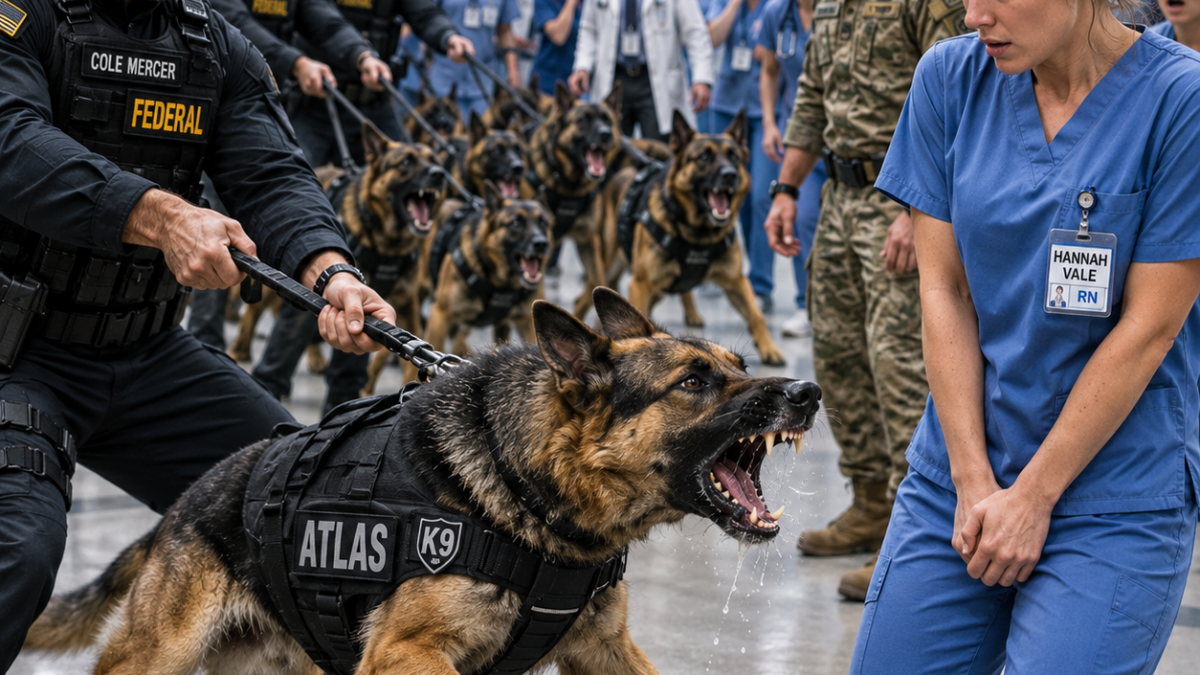
Twelve German Shepherds were running toward the hospital.
Not twelve pets.
Twelve federal working dogs trained for controlled response.
Brianna stumbled backward.
“Oh my God.”
Someone shouted:
“Close the doors!”
But they were automatic.
Atlas reached them first.
Glass panels opened.
He entered the lobby at full speed.
Polished floor beneath his paws.
Hannah stood exactly where she had been.
Brianna grabbed her arm.
“Run!”
Hannah pulled free.
“No.”
The word came cleanly.
Atlas was twenty feet away.
Ten.
Five.
He slowed.
Three.
Stopped.
Directly in front of Hannah.
The lobby had become almost completely silent.
Atlas stared up.
Hannah stared down.
Years collapsed.
She saw him at five.
Muscular.
Refusing food.
Growling at anyone who approached his kennel.
She saw the first night he finally slept while she read beside the bars.
She saw him pushing a battered blue training ball toward her shoe.
Now gray touched his muzzle.
Her eyes filled.
“H-hello.”
Atlas’s tail moved.
Once.
Then again.
Hannah swallowed.
“E-easy.”
The dog sat.
Perfectly.
The second shepherd arrived.
Then third.
Fourth.
None collided with her.
None jumped.
Each slowed.
Circled.
Sat.
Nova lowered herself across Hannah’s shoes.
Chief settled at her left side.
Ranger pressed shoulder near her leg.
Within seconds, twelve German Shepherds formed a loose circle around her.
Heads up.
Bodies calm.
Every handler stopped at the entrance.
Cole Mercer came through last.
Breathing hard.
He stared.
His dogs had ignored simultaneous recall commands.
Broken formation.
Crossed the courtyard.
And now sat around one nurse as though nothing unusual had happened.
Cole looked at Hannah.
“Who are you?”
Hannah’s throat tightened.
She looked down at Atlas.
A tear slipped before she could stop it.
“G-good boys.”
Twelve tails responded.
Not wild.
Small movements.
Recognition.
Cole looked from dog to dog.
Then back at Hannah.
Dr. Monroe approached carefully.
“Hannah?”
“I’m okay.”
“That isn’t what I was going to ask.”
Cole stepped closer.
“What did you say to them?”
“N-nothing.”
“That was not nothing.”
Brianna gave an uncertain laugh.
“She probably panicked and made some noise they remember.”
Atlas turned toward Brianna.
Not aggression.
Just a sharp, focused look.
She stopped speaking.
Cole crouched near him.
“These dogs aren’t reacting to panic.”
One handler nodded.
“They’re relaxed.”
Another said quietly:
“Trust behavior.”
Nova rested her chin against Hannah’s shoe.
Cole looked up.
“They know you.”
Hannah tried to answer.
Twelve handlers.
Doctors.
Nurses.
Security officers.
Every face watching.
Pressure tightened around her throat.
“I…”
Brianna interrupted.
“Maybe she used to work at a kennel or—”
“Brianna.”
Dr. Monroe’s tone cut through the lobby.
“What?”
“You’re interrupting her.”
Silence.
It was such a simple statement.
Hannah looked at Elise.
The doctor nodded.
“Take your time.”
No one laughed.
No one finished her sentence.
No one checked a watch.
Hannah took one breath.
Then another.
“I w-worked with them.”
Cole’s expression changed.
“Where?”
“Recovery.”
“With federal dogs?”
“Yes.”
Another breath.
“After injuries.”
She looked down.
“After handlers d-died.”
One federal handler muttered something under his breath.
Cole straightened.
“All twelve?”
Hannah looked around the circle.
Atlas.
Ranger.
Nova.
Chief.
Luna.
Echo.
Others she remembered by posture before name.
“Yes.”
Her voice became quieter.
“I knew them when they were s-scared.”
Atlas leaned against her thigh.
No one spoke.
That was when the room began understanding that the dogs had not performed some random act of disobedience.
They had remembered.
Years earlier, outside Quantico, there had been a facility most people never heard about.
Two fences.
Windowless exterior sections.
No public tours.
No ceremonial photographs.
Federal K9 Trauma Recovery Facility.
The official terminology was clinical.
Operational stabilization.
Post-injury evaluation.
Return-to-service assessment.
Asset recovery.
Inside the kennels, those words sounded different.
Whining at night.
Claws scraping concrete.
Dogs that refused food after handlers died.
Dogs recovering from blast injuries.
Working animals who snapped at anyone touching the wrong side of their body.
Handlers waking from surgery asking about dogs before asking about themselves.
Hannah had been twenty-six when she arrived.
New to federal trauma work.
Young enough to believe somebody must have made an administrative mistake hiring her.
On her first morning, two agents walked past while she studied a medical chart.
One nodded toward her.
“That’s the nurse?”
The other heard Hannah introduce herself.
Then smiled.
“Hope the dogs are patient.”
They laughed.
Hannah pretended she had not heard.
The first dog she met was Atlas.
His handler had died during a federal raid.
Atlas survived with injuries that eventually healed.
The rest did not heal as easily.
Three days without eating.
Five days barely sleeping.
He paced until his paws became raw.
Any attempt at direct handling produced a warning snap.
A trainer described him as unstable.
Hannah read the report.
Then looked through the kennel window.
Atlas was not pacing when no one approached.
He paced when unfamiliar people entered.
He stopped when they left.
He watched the doorway.
Always.
She asked:
“Where did his handler usually stand?”
Nobody knew.
So Hannah did not enter the kennel.
She brought a folding chair.
Placed it outside.
Sat.
Opened a paperback.
Read.
Her stutter was worse when she read aloud.
Especially then.
Atlas growled through the first twenty minutes.
Hannah kept reading.
No eye contact.
No reaching through bars.
No food offered from hand.
Next day:
same chair.
Same book.
Fifteen minutes of growling.
Third day:
ten.
Second week:
he no longer growled at the sound of Hannah’s voice.
Third:
he ate while she sat nearby.
Fourth:
Hannah arrived and found Atlas standing at the front of the kennel holding an old training ball.
She sat.
He dropped it.
The ball rolled beneath the bars.
Stopped beside her shoe.
Hannah stared.
Then smiled.
“Th-thank you.”
Atlas lay down.
That was how it started.
Nova arrived after surgery.
Ranger after his handler’s suicide.
Chief after a vehicle explosion.
Luna following a failed extraction that left her with physical wounds and severe stress reactions.
Some dogs were outwardly aggressive.
Others became motionless.
Some stopped eating.
One slept only if someone sat outside the kennel.
Hannah learned them.
Not because she believed she understood dogs better than professional handlers.
She did not.
She worked alongside veterinary and behavioral staff.
But nursing had taught her something useful.
The body speaks before people do.
Breathing.
Muscle tension.
Eyes.
Movement.
Pain.
Hannah applied the same attention to dogs.
A fear bark was not always the same as territorial barking.
A frozen dog could be more distressed than a noisy one.
Tail movement without loose body posture did not necessarily mean happiness.
A dog staring at a doorway might not be refusing interaction.
He might be waiting.
Hannah’s stutter never bothered any of them.
A word could take five seconds.
Atlas did not finish it for her.
Ranger did not laugh.
Nova did not look impatient.
The dogs listened to tone.
Consistency.
Movement.
And whether Hannah returned tomorrow.
She changed bandages.
Recorded temperatures.
Cleaned wounds.
Sat through long nights.
Read aloud.
Filled medical charts with observations.
She worked there nearly four years.
Eventually, new recovery procedures incorporated several things she had repeatedly documented.
Predictable entry routines.
Reduced forced contact after handler loss.
Attention to environmental triggers.
Waiting for physiological settling before escalating handling.
Her notes mattered.
Sometimes.
Then Bravo arrived.
A raid dog.
Severe mission stress.
Physically stable.
Hannah noticed three things within two days.
Metallic impacts produced immediate startle.
His breathing changed when one particular replacement handler entered.
And just before freezing, Bravo stopped moving his tail completely.
At a readiness meeting, Hannah tried to explain.
“He’s n-not ready.”
The supervisor glanced at her notes.
“We have the assessment.”
“No, I m-mean—”
“We understand.”
They did not.
A senior agent sighed.
“Can someone summarize what she’s trying to say?”
A few people chuckled.
Hannah’s throat tightened.
She tried again.
“B-Bravo will b-break if you send him.”
The word break came out eventually.
By then, several people had moved to the next agenda item.
Bravo deployed two days later.
During the operation, a sharp metallic noise triggered a freeze response.
His replacement handler had to physically move him from an exposed position and was seriously injured during the withdrawal.
No civilians died.
Bravo survived.
But his behavioral condition worsened dramatically afterward.
Hannah knew the incident was not her fault.
The deployment decision had not been hers.
She had documented everything.
She had spoken.
But emotionally, none of that mattered.
Her warning had been correct.
And the room had stopped listening because waiting for her words felt inconvenient.
Three weeks later, Hannah resigned.
Facility director Marcus Vale tried to stop her.
“You’re one of the best observers I have.”
Hannah looked at him.
“Observation only m-matters if somebody l-listens.”
“We can change that.”
“They didn’t hear me u-until something broke.”
She left.
Hospital nursing felt safer afterward.
Patients did not need her to brief command staff.
They needed medications on time.
Wounds cleaned.
Pain taken seriously.
Someone willing to sit beside them.
She never told Riverside about Quantico.
Why would she?
By the time people learned she stuttered, many had already decided what it meant.
So she became Hannah.
Quiet nurse.
The one who did not speak much.
The easy joke.
Back in the Riverside lobby, Cole Mercer listened as fragments of that history emerged.
Hannah did not tell everything.
Only enough.
“I w-worked recovery.”
“With these dogs.”
“Yes.”
Cole looked around.
“These twelve all passed through your facility?”
Hannah nodded.
Ranger had settled near his handler again but kept looking toward her.
“I knew them b-before they were ready.”
Atlas leaned into her.
Brianna stood near the desk.
Pale.
Her own words from that morning had apparently returned.
We’d still be here by lunch.
Dr. Monroe asked:
“Why didn’t you ever tell me?”
Hannah smiled.
Not bitterly.
Just tired.
“People here had already d-decided what my voice m-meant.”
Nobody defended themselves.
Because there was nothing useful to say.
Cole glanced toward the handlers.
“I’ve commanded this unit for two years.”
He looked at Hannah.
“And I didn’t know the person who helped put half of them back together.”
“That’s n-not your fault.”
Cole’s expression tightened.
“Maybe not before today.”
Before Hannah could answer, Atlas stood.
Instantly.
The other dogs shifted.
Hannah saw it.
So did Cole.
But they understood it differently.
Seconds earlier, Atlas had been loose.
Tail moving.
Eyes soft.
Now:
stillness.
Tail stopped.
Head high.
Ears fixed.
One low bark.
Then silence.
The other shepherds began aligning toward the same corridor.
Not reunion behavior.
Working behavior.
Cole turned.
“What is it?”
Hannah followed Atlas’s gaze.
Federal witness wing.
A man in gray maintenance coveralls pushed a supply cart toward the secured entrance.
At first glance, nothing obvious.
Maintenance employees moved through Riverside constantly.
Then Hannah noticed what Atlas had already noticed.
The cart leaned slightly to one side.
Too much weight concentrated underneath a stack of folded linens.
The man’s gloves looked new.
His hospital ID badge faced inward.
And when Atlas barked—
He did not startle.
Most innocent people near twelve federal German Shepherds reacted when one suddenly barked.
This man turned his head.
Angry.
Not surprised.
Hannah’s throat locked.
“L…”
Cole looked at her.
“What?”
“L…”
Brianna stepped forward automatically.
“Hannah, calm down.”
Hannah turned.
For perhaps the first time Brianna had ever seen, anger overrode embarrassment.
“No.”
Clean.
Sharp.
The room froze.
Hannah forced the next words out one by one.
“L-lock the witness wing.”
Cole did not ask her to repeat it.
“Why?”
She pointed.
“The c-cart.”
Atlas barked again.
“Now.”
Cole turned.
“Lock it down.”
Federal agents moved instantly.
Security doors began closing.
The man abandoned the cart.
Ran.
That removed the last uncertainty.
Handlers released Atlas and three other K9s under command.
The dogs surged down the corridor.
Agents followed.
Seconds later, the suspect was stopped near the secured wing.
A concealed firearm slid across the floor during the arrest.
Stolen access credentials fell from beneath his jacket.
Inside the supply cart, investigators found materials inconsistent with any legitimate hospital maintenance assignment.
Riverside went into full security lockdown.
Patients were moved.
Hallways closed.
Federal investigators took over.
Nobody laughed anymore.
Cole returned to the lobby several minutes later.
His face had changed.
“He was headed toward the protected witness suite.”
Dr. Monroe covered her mouth.
Hannah looked down at Atlas, who had returned with his handler and was now sitting calmly.
Cole said:
“You saw him before we did.”
Hannah shook her head.
“A-Atlas told us.”
Cole looked around.
“He told everyone.”
Then looked back at her.
“You listened.”
That distinction stayed in the room.
The dogs had not suddenly become brilliant because Hannah arrived.
They had already communicated.
Posture.
Scent detection.
Focus.
The human question was who recognized the difference between excitement and warning.
Later, while security teams processed the scene, Cole stood beside Hannah.
The twelve K9s rested nearby with handlers.
“They knew.”
Hannah nodded.
“They probably s-smelled something before we saw anything.”
“My handlers thought they were still distracted by you.”
“They were.”
Cole frowned.
Hannah smiled faintly.
“Then they went b-back to work.”
Dr. Monroe joined them.
“I couldn’t see the difference.”
Hannah looked toward Atlas.
“When he recognized me, his eyes were s-soft.”
She demonstrated gently.
“Breathing faster.”
“Tail loose.”
Then pointed toward the secured hallway.
“When he detected the man?”
“Still.”
“Tail stopped.”
“Breathing changed.”
“Focus narrowed.”
Cole repeated:
“They weren’t excited.”
“No.”
“They were focused.”
One younger federal handler approached.
“I owe you an apology.”
Hannah looked surprised.
“For what?”
“I thought they were ignoring commands because they lost discipline.”
He glanced toward his dog.
“They weren’t.”
“No.”
The handler gave an embarrassed smile.
“We were ignoring them.”
Hannah returned it.
“Dogs f-forgive faster.”
That afternoon, Riverside’s executive conference room filled with people.
Hospital leadership.
Federal investigators.
K9 handlers.
Security officers.
Dr. Monroe.
Cole.
Hannah sat at the far end out of habit.
Then the door opened.
An older man entered carrying a gray archive box.
Silver hair.
Retired federal credentials.
Hannah stood.
“Marcus.”
Director Marcus Vale smiled.
“Hannah.”
Cole knew the name.
“Director Vale.”
Marcus nodded.
Then looked around.
“So.”
He glanced at the twelve handlers.
“You found her.”
Brianna frowned.
“You know Hannah?”
Marcus laughed.
“I hired her.”
The room quieted.
He placed the archive box on the table.
Opened it.
Binders.
Photographs.
Behavior charts.
Medical recovery notes.
Training journals.
He lifted one photograph.
Twenty-six-year-old Hannah sitting cross-legged outside a kennel with a paperback open.
Atlas lay inside.
Another:
Hannah changing Ranger’s bandages.
Another:
Nova asleep with her head resting on Hannah’s boot.
Marcus placed them down.
“These dogs were not simply treated at our facility.”
He looked toward Cole.
“They relearned human predictability there.”
He opened a journal.
Read:
“Respiratory rate decreased after Nurse Vale entered.”
Another:
“Patient accepted food only with Nurse Vale seated outside kennel.”
Another.
“Handling tolerance improved after reducing forced engagement per nursing observation.”
He turned several pages.
Then stopped.
“This one.”
Hannah looked away.
Bravo.
Marcus closed the binder.
“The recommendation we should have listened to.”
No one spoke.
Cole studied the documents.
“My unit’s current trauma-transition procedures use these principles.”
Marcus nodded.
“Many of them began in observations Hannah repeatedly documented.”
Dr. Monroe looked toward Hannah.
“You never told us any of this.”
Hannah gave a small smile.
“I came here to b-be a nurse.”
“Not a story.”
Across the table, Brianna stared down.
Eventually she stood.
“Hannah.”
Hannah looked at her.
“I was wrong.”
Silence.
“I judged you because of how you speak.”
Hannah waited.
Brianna swallowed.
“I treated you like you were less capable.”
No joke now.
No defensive smile.
“I’m sorry.”
Hannah nodded.
“I know.”
The answer hurt more than Brianna expected.
Then Hannah added:
“S-so am I.”
Not revenge.
Not instant forgiveness.
Honesty.
The following week, Riverside held a joint clinical and operational review.
This time, Hannah did not sit in the back.
A chair waited at the front.
Marcus introduced her.
Then stepped away from the podium.
“I think the next words should belong to Hannah.”
Her hands began trembling.
Crowd.
Doctors.
Nurses.
Federal agents.
Handlers.
Hospital administrators.
Every condition that made her stutter worse.
Cole stood near the side aisle.
Quietly:
“Take your time.”
Hannah looked at him.
Then at Elise.
Then toward Atlas, resting beside his handler.
She walked to the microphone.
One breath.
“My…”
The word stopped.
No one moved.
“My w…”
Still nothing.
No one finished it.
No one looked away.
She smiled nervously.
“My words…”
Pause.
“They t-take longer.”
Several people nodded.
“That doesn’t mean…”
Another pause.
“My thoughts are s-slow.”
Silence.
“When people hurry me…”
She breathed.
“They stop h-hearing me.”
Her eyes moved toward the K9 handlers.
“The dogs never did.”
A few smiles.
“They watched.”
“They listened.”
“They noticed breathing.”
“Eyes.”
“Fear.”
She looked down at Atlas.
“They taught me something before I understood it myself.”
The room waited.
“Trauma doesn’t always shout.”
Her voice became softer.
“Sometimes it whispers.”
Pause.
“And sometimes the person who notices it…”
Her throat tightened.
“…takes longer to say why.”
No one interrupted.
“The dogs people called broken…”
Hannah looked across the room.
“They weren’t broken.”
“They were unheard.”
Then, barely above a whisper:
“So was I.”
No applause came immediately.
Not because the speech failed.
Because people were still absorbing it.
Then someone stood.
Mr. Dalton.
He had been brought down in a wheelchair by a physical therapist after asking permission to attend.
He clapped.
Slowly.
Then Dr. Monroe stood.
Cole.
Handlers.
Nurses.
Eventually almost everyone.
Brianna stood too.
Hannah covered her face with one hand.
Cole leaned closer.
“They’re listening now.”
Six weeks later, Riverside and the federal K9 program announced a formalized recovery framework based partly on years of accumulated observations from the Quantico facility, including Hannah’s archived documentation.
Hannah hated having her name attached to anything.
Marcus insisted.
Not because he wanted to manufacture a hero.
Because attribution mattered.
For years, ideas had been implemented without anyone asking where they originated.
The ceremony took place near a national working-dog memorial.
Federal handlers stood beside their K9 partners.
Families of fallen officers and agents attended.
Hannah wore blue scrubs beneath a light jacket because she had come directly from a hospital shift.
Cole stepped onto the training area.
“Twelve-dog formation.”
Atlas moved first.
Ranger beside him.
Nova.
Chief.
Luna.
Echo.
The others aligned.
Perfect.
The audience watched.
Cole raised his hand.
“Release.”
Handlers unclipped leashes.
The dogs remained in place.
One second.
Two.
Three.
Then Atlas turned his head.
Saw Hannah.
Walked toward her.
Not running this time.
No chaos.
No broken formation caused by surprise.
Just choice.
Ranger followed.
Then Nova.
One by one.
All twelve crossed the grass.
Hannah laughed.
“Seriously?”
Atlas sat.
Then Ranger.
Then the others.
Same circle.
Same quiet attention.
Crowd applauded.
Hannah crouched.
“G-good dogs.”
Twelve tails moved.
After the ceremony, most people left.
One young nursing student remained.
Early twenties.
She approached carefully.
“Ms. Vale?”
“Hannah.”
The student nodded.
“I…”
She stopped.
Hannah waited.
The young woman tried again.
“I h-have a speech disorder too.”
Hannah’s expression softened.
The student looked embarrassed.
“I almost quit nursing.”
“Why?”
“People don’t wait.”
Hannah understood.
The student looked toward the dogs resting beside their handlers.
“How did you keep going?”
Hannah thought.
Not because she needed a perfect answer.
Because she did not want to give a false one.
She had quit once.
She had left federal work because not being heard had consequences.
There was no inspirational version that erased that.
Finally:
“I stopped trying to s-speak faster.”
The student watched.
“And started believing…”
Pause.
“…what I had to say was worth waiting for.”
The young woman’s eyes filled.
“I think I needed that.”
Hannah smiled.
“So did I.”
Atlas approached from beside Cole.
He rested his head under Hannah’s hand.
She scratched gently behind his ear.
Years earlier, people at the recovery facility had laughed because they assumed her stutter would make working with traumatized K9s harder.
It had not.
She could sit through a growl without forcing progress.
Wait through silence.
Let nervous systems settle.
Notice what happened between obvious events.
Dogs did not reward speed.
They rewarded consistency.
At Riverside, people had mistaken Hannah’s quietness for absence.
The dogs did the opposite.
They remembered the woman who stayed.
They remembered a voice that sometimes took longer to arrive but never became impatient when they needed longer too.
And the most important thing that happened that week was not that twelve federal K9s ran across a courtyard.
It was what happened afterward.
People began waiting.
During briefings, when Hannah’s first syllable caught, no one finished the word.
When she paused during a trauma report, colleagues did not assume uncertainty.
Brianna changed most noticeably.
Not overnight.
Apologies do not rewrite habits instantly.
One morning, a resident interrupted Hannah twice during handoff.
Brianna spoke before Elise could.
“She isn’t finished.”
Hannah looked at her.
Brianna looked slightly embarrassed.
Then waited.
Hannah completed the report.
Later, in medication room, Brianna said:
“I’m trying.”
“I know.”
“Do you hate me?”
Hannah thought about lying.
“No.”
Brianna exhaled.
Then Hannah added:
“But I d-didn’t like you very much.”
Brianna laughed despite herself.
“Fair.”
Their relationship never became sentimental.
That made it more believable.
Respect came first.
Friendship, slowly, after.
Atlas and the other federal K9s returned periodically for medical and security exercises.
They did not break formation every time.
That would have meant poor discipline, not devotion.
But when released after work, several still looked for Hannah.
Atlas always did.
Sometimes he found her in the lobby.
Sometimes outside the emergency department.
Once he located her beside Mr. Dalton’s wheelchair.
The veteran looked down.
“Friend of yours?”
Hannah smiled.
“Old c-coworker.”
Mr. Dalton studied Atlas.
“Looks serious.”
“He is.”
Atlas sniffed his hand.
Mr. Dalton’s expression changed.
For a moment Hannah saw the younger man from the photograph with Boone.
He touched Atlas’s shoulder.
“Dogs usually know, huh?”
Hannah nodded.
“They usually do.”
Years later, people who heard the story liked the simplest version.
Twelve K9s broke formation for a stuttering nurse.
It sounded perfect.
Viral.
Almost unbelievable.
But Hannah always thought the more important story was less dramatic.
It was about a young nurse who sat outside a kennel while a grieving German Shepherd growled for twenty minutes.
Then returned the next day.
And the next.
It was about notes nobody valued until they became protocols.
Warnings people dismissed because listening required patience.
A dog named Bravo who paid part of the price when humans hurried past something they should have heard.
A nurse who left because being correct was not enough if nobody allowed her to finish.
And twelve dogs who remembered her years later because she had never treated silence as wasted time.
Atlas had not run toward Hannah because she spoke perfectly.
He ran toward the person who had been there when he could barely eat.
Nova remembered the nurse who sat beside her after surgery.
Ranger remembered nights when familiar footsteps mattered more than commands.
Chief remembered quiet handling after an explosion.
The dogs had never cared how quickly Hannah reached the end of a sentence.
They cared that she reached them.
That was why, whenever someone later asked Hannah whether the twelve K9s had somehow “proved” she was extraordinary, she usually shook her head.
“No.”
“What did they prove?”
Hannah would smile.
“That people were wrong about what they were m-measuring.”
Speed was easy to notice.
Patience was not.
Fluency was easy to notice.
Judgment was not.
A loud voice was easy to notice.
Listening was not.
And on one rainy morning at Riverside Federal Medical Center, twelve highly trained German Shepherds ignored every expectation in the courtyard and ran toward the quietest nurse in the building.
Not because she needed them to defend her.
Not because they understood that people had mocked her.
Not because animals deliver justice.
They ran because somewhere beneath years of new handlers, commands, deployments and training, they still remembered the woman who had sat beside them when fear was louder than anything else.
The woman who never hurried them.
The woman everyone else kept interrupting.
The woman whose words took longer—
but whose presence had never once been late.








