They Locked a Decorated Retired K9 Alone in a Cold Cage—Then His Navy SEAL Handler Returned, Spoke One Command, and the Entire Base Fell Silent
PART2:
They were fifty yards from the compound when Havoc froze.
Not paused.
Froze.
His body locked. His tail lowered. His nose pointed toward a narrow patch of disturbed soil along the footpath.
Jack raised a clenched fist.
Every man behind him stopped.
No one questioned the dog.
Jack moved forward slowly, eyes fixed on Havoc’s line of attention.
There, beneath loose dirt and scattered leaves, was the edge of a pressure plate.
An IED.
Wired to two buried 155-millimeter artillery shells.
Two more steps and the patrol would have vanished in fire.
Jack lowered himself beside Havoc and whispered into his radio, “IED. Marking now.”
Then, even though no one but the dog could hear it, he whispered, “Good boy.”
Havoc did not move.
The bomb tech crawled forward.
The team adjusted.
They bypassed the device and continued toward the target compound.
That was when the night erupted.
Machine gun fire tore from the compound’s upper windows. Rocket-propelled grenades streaked over the orchard wall. Dust leapt from the earth. The valley that had seemed empty filled with muzzle flashes, shouts, and chaos.
There were not five fighters inside.
There were more than twenty.
The team breached anyway.
That was what they did.
Room by room.
Door by door.
PART3:
Flashbangs.
Gunfire.
Dust.
Cordite.
Blood.
Havoc moved with Jack through it like a dark missile, silent until silence was no longer useful. He cleared corners, drove one fighter backward through a doorway, and tracked movement through walls before any human ear caught it.
The final room was supposed to be clear.
It was not.
Jack entered first, rifle rising.
An insurgent stepped from behind a heavy wooden door, AK-47 already aimed at Jack’s chest.
Jack did not have time.
Havoc did.
With a guttural roar, the dog launched.
Eighty-five pounds of muscle hit the man square in the chest as the weapon fired. The burst went wild, rounds sparking off stone walls.
One round struck Havoc.
At the same instant, an RPG slammed into the exterior wall.
The blast tore the room apart.
Jack flew backward into the courtyard.
For several seconds, there was nothing but white light, ringing, and the taste of dirt.
When Jack came back to himself, his left leg was wrong.
Not hurt.
Wrong.
Pain pulsed so violently through his body that the world tilted. Smoke rolled through the compound. Men shouted. Someone called for a medic. A wall burned near the breach point.
Jack tried to move.
His leg did not answer.
Then he heard it.
A whimper.
Havoc.
Jack dragged himself through rubble with his elbows, leaving a dark smear behind him. His helmet was cracked. His ears rang. His vision pulsed at the edges.
He found Havoc in the corner of the room.
The dog was bleeding heavily from the shoulder. Shrapnel had opened lines across his ribs. Dust coated his muzzle. His breathing came in sharp bursts.
But when Jack crawled close, Havoc moved.
The dog dragged himself forward and placed his heavy head across Jack’s armored chest.
Even then.
Even wounded.
Even bleeding.
He was trying to cover his handler.
Jack pressed both hands against Havoc’s shoulder wound.
“I got you, buddy,” he choked out. “I got you.”
Havoc licked blood and dirt from Jack’s face.
That was how the medics found them.
A SEAL with a mangled leg.
A K9 with a gunshot wound.
Both refusing to let go.
The medevac flight out of Kandahar became a blur of rotor wash, red lights, shouted vitals, and the violent thump of helicopter blades. Jack and Havoc were loaded side by side. Jack refused morphine until he saw an IV line placed in Havoc’s leg.
“Dog first,” he rasped.
The flight medic looked like he wanted to argue.
Then he looked at Jack’s eyes and did not.
That was the last time Jack saw Havoc for eight months.
When Jack woke three days later in the sterile white glare of Landstuhl Regional Medical Center in Germany, his leg was pinned together with titanium rods and his skull felt filled with wet sand.
A nurse leaned over him.
“Chief Sullivan, you’re safe.”
Jack’s first words were not about his leg.
Not his team.
Not the mission.
“My dog.”
The nurse placed a steady hand on his shoulder.
“He’s alive.”
Jack tried to sit up.
Pain turned the room black at the edges.
“He’s alive,” she repeated. “He was stabilized and transferred to Lackland. They have the best military veterinary surgeons. He made it.”
Relief washed through Jack so hard it nearly pulled him under again.
“He’s mine,” Jack whispered. “When he retires.”
The nurse did not know what he meant.
Jack did.
There was protocol.
Dogs wounded in combat received treatment. If they could return to duty, they returned. If they could not, they were medically retired. The primary handler had the first right of adoption.
Havoc had saved Jack’s life.
Jack would recover.
He would retire if he had to.
Then he would bring his dog home.
That belief carried him through eight months at Walter Reed.
Physical therapy was war of another kind.
No explosions.
No gunfire.
No night vision.
Just parallel bars, scar tissue, sweat, shame, pain, and the brutal humiliation of teaching a leg to obey again.
Jack had been a man who could fast-rope from a helicopter, run miles in body armor, kick doors, clear rooms, swim cold black water, and carry another man across broken terrain.
Now he celebrated bending his knee three degrees farther than yesterday.
He hated it.
He did it anyway.
Every step became a promise.
To Havoc.
He bought a small house in the hills outside San Diego before his discharge was finalized. It had a fenced yard and a shaded porch. He ordered a memory foam dog bed large enough for Havoc’s frame. He bought high-protein food Havoc had loved during training. He kept one of Havoc’s old rubber reward toys on his nightstand like a relic.
He filled out the adoption paperwork.
DD Form 2807.
Primary handler request.
Medical retirement pending.
MWD-7392 Havoc.
He submitted it through his chain of command.
A boilerplate email confirmed receipt.
Then silence.
At first, Jack told himself bureaucracy was slow.
Everything military was slow until it suddenly became urgent.
He called Lackland.
Voicemail.
He emailed the kennel office.
No response.
He called Coronado.
A clerk said the file was in review.
He called again.
Transferred.
Hold music.
Disconnected.
He sent another email.
Then another.
Weeks became months.
No one answered clearly.
No one said yes.
No one said no.
No one said the truth.
While Jack was learning to walk again, Havoc was fighting a different kind of war.
He had survived surgery.
The bullet had missed vital organs. Shrapnel had been removed from his ribs. The wound in his shoulder closed slowly, leaving scar tissue that pulled tight in cold weather. Physically, he lived.
But Havoc had never been trained for abandonment.
He had been raised in purpose. Every part of his life had structure: handler, command, mission, reward, rest, repeat. His world had always smelled like Jack’s sweat, rifle oil, canvas, desert dust, and the faint leather of the leash Jack wrapped twice around his hand before a raid.
Now he was alone.
After Lackland, he was transferred back to Naval Base Coronado for processing. A simple paperwork error during transfer flagged his file incorrectly.
Instead of:
MEDICAL RETIREMENT — HANDLER ADOPTION PENDING
someone checked:
BEHAVIORAL HOLD
That one mark changed everything.
Errors are never just ink when no one cares enough to correct them.
At Coronado, the previous kennel master had retired — a seasoned combat veteran who understood that a working dog could grieve, that trauma did not always look like aggression, that a dog waiting for a handler might seem unresponsive because his whole world had narrowed to one missing person.
His replacement was Chief Petty Officer Derek Miller.
Miller loved rules more than he loved dogs.
He had spent most of his career stateside, guarding gates, writing reports, enforcing procedures, and mistaking obedience for respect. He saw military working dogs as government property with teeth. Useful property, certainly. Expensive property. But property all the same.
To him, Havoc was not a decorated combat veteran.
He was a malfunctioning asset.
The first week, Havoc refused several commands from handlers he did not know.
Miller called it defiance.
The second week, Havoc paced in tight circles whenever steel kennel doors slammed or jets roared overhead.
Miller called it instability.
The third week, Havoc stopped eating regularly.
Miller called it stubbornness.
No one called Jack.
No one checked the adoption file.
No one asked why a dog who had once moved through gunfire with perfect discipline now lay facing a wall, ears low, eyes empty.
One afternoon, Miller entered Havoc’s run carrying a heavy choke chain and a rigid training whip.
Havoc was curled in the corner of the concrete enclosure.
Waiting.
Always waiting.
Miller snapped the chain.
“Up!”
Havoc did not move.
“Up!”
Still nothing.
Miller’s face flushed.
“You think you don’t have to listen?”
He stepped into the run.
Havoc’s eyes shifted.
The dog did not growl.
Did not bark.
Did not advance.
He simply watched.
Miller moved closer, anger making him careless. He attempted to force the slip collar over Havoc’s head while pinning him toward the chain-link wall.
Havoc reacted the way he had been trained to react when cornered by an aggressive threat.
Fast.
Precise.
Controlled.
He snapped once.
Not to kill.
Not even to maim.
If Havoc had wanted Miller’s arm, Miller would have lost it.
Instead, his teeth tore through fabric and opened a deep gash along Miller’s forearm.
Miller stumbled backward, cursing, slamming the gate shut.
Havoc retreated to the corner.
Shaking.
Not from guilt.
From memory.
That afternoon, Miller marched into Captain Arthur Pendleton’s office with his arm bandaged and his pride bleeding harder than the wound.
Pendleton was a career officer with perfect uniforms, polished shoes, and an eye always fixed on the next promotion. He liked clean reports, low incident rates, and problems that disappeared before they reached anyone above him.
“The dog is unstable,” Miller said. “Aggressive. Unpredictable. Unadoptable.”
Pendleton barely looked up from his computer.
“Which dog?”
“MWD-7392. Havoc.”
Miller slid the report onto his desk.
“He attacked me unprovoked. I recommend Level Four aggression classification.”
Level Four.
In the military working dog world, that was not a label.
It was a death sentence.
A dog classified Level Four aggression could not be adopted, could not be rehabilitated into civilian placement, and could be euthanized as a danger to personnel and public safety.
Pendleton skimmed the first paragraph.
He did not pull Havoc’s combat record.
He did not review the handler adoption request.
He did not ask why a decorated dog had been cornered with a choke chain.
He saw liability.
He saw paperwork.
He saw a promotion path free of complications.
“Process it,” he said.
Miller nodded.
“And schedule?”
Pendleton clicked his mouse.
“This Friday. I don’t want liabilities in my kennels.”
For the next three weeks, Havoc was moved to Sector Four.
Quarantine.
It sat at the far end of the K9 compound, a damp concrete row used for sick animals, bite holds, and dogs no one wanted visible. The air smelled of bleach, rust, wet cement, and fear. Fluorescent lights flickered overhead. The cages were colder there. Darker.
Havoc was given minimal food.
He was not exercised.
He was not spoken to except when someone shoved a dish through the gate.
He stopped pacing.
Then he stopped standing when people passed.
Then he stopped eating.
The mighty dog who had once detected the IED that would have killed six SEALs lay on a stained concrete floor with his chin on his paws, staring through steel bars.
Waiting for a ghost.
Three days before Havoc’s scheduled euthanasia, a matte black pickup rolled through the main gate of Naval Base Coronado.
Jack Sullivan stepped out.
He wore faded jeans, a black T-shirt, and a baseball cap pulled low over his eyes. His left leg moved stiffly beneath denim, rebuilt but not forgiving. He leaned on a custom tactical cane, each step landing with a hard click against pavement.
He had been discharged from Walter Reed forty-eight hours earlier.
He had driven nearly three thousand miles across the country fueled by black coffee, pain, and a rising dread he could no longer quiet.
Something was wrong.
He knew it.
He felt it in his bones the way he used to feel Havoc’s leash tighten in the dark.
Jack walked into the MWD administration building.
The air conditioning hit him first.
Then floor wax.
Stale coffee.
A young petty officer sat behind the front desk, typing lazily.
He looked up.
Then looked again.
Scars crossed the left side of Jack’s face, pale against weathered skin. His eyes were flat and cold with the kind of exhaustion that made men step carefully.
“I’m here for my dog,” Jack said.
The petty officer blinked.
“Sir?”
“MWD-7392. Havoc. I submitted handler adoption paperwork six months ago. I’m taking him home today.”
The young sailor typed quickly.
Jack watched his face.
Confusion.
Then hesitation.
Then fear.
“Sir,” the clerk said carefully, “I don’t think that’s possible.”
The room seemed to shrink.
“Explain.”
The sailor swallowed and turned the monitor slightly.
Red text flashed across the screen.
LEVEL FOUR AGGRESSION
SECTOR FOUR QUARANTINE
EUTHANASIA ORDER PENDING
For a moment, Jack heard nothing.
Not the air conditioner.
Not the keyboard.
Not the distant barking from the kennels.
Only blood roaring in his ears.
“Where is he?” Jack asked.
“Sir, you can’t—”
“Where is he?”
The clerk’s mouth trembled.
“Sector Four.”
Jack turned and walked out.
The limp did not slow him.
If anything, the cane struck the pavement with more precision, each click sharp as a command.
By the time he reached the chain-link gate of the K9 facility, word had begun to move across the compound.
Chief Sullivan was back.
Havoc’s handler.
The SEAL from Arandab.
Two junior handlers stood near the gate looking nervous.
One stepped forward.
“Chief Sullivan, sir, you need clearance to—”
Jack stopped.
He looked at the young sailor.
Not with anger.
With something worse.
Certainty.
“Step aside, son,” he said quietly, “or I will put you through this fence.”
The sailor looked into Jack’s eyes and stepped aside.
Jack pushed through the gate.
Dogs barked from the active runs.
Handlers shouted from behind him.
Someone called his name.
He ignored all of it.
He headed for the rusted building at the back of the lot.
Sector Four.
The isolation corridor swallowed the noise behind him.
The air inside was damp and cold. Fluorescent bulbs buzzed overhead. Water dripped somewhere from a cracked pipe. Empty runs lined the narrow aisle.
Jack moved down the corridor.
Boot.
Cane.
Boot.
Cane.
The rhythm echoed off concrete.
At the last cage, he stopped.
For half a second, his mind refused to accept what his eyes saw.
Havoc lay motionless in the back corner on bare concrete.
He looked smaller.
Impossible, but true.
The dog Jack remembered as eighty-five pounds of muscle and drive had lost weight. His coat was dull and matted. His ribs showed beneath fur. His shoulder scar stood out harsh and pale. His golden eyes stared blankly at the wall.
No fire.
No recognition.
No Havoc.
Jack gripped the chain-link door so hard the metal bit into his palms.
“Havoc,” he whispered.
The dog’s ear twitched.
That was all.
Jack swallowed the sound rising in his throat.
“Havoc.”
Still nothing.
Maybe the dog thought it was another memory.
Maybe after so many weeks of waiting, he no longer trusted hope.
Jack lowered himself slowly, his rebuilt leg screaming.
Then he used the voice.
Not loud.
Not emotional.
The operational command tone that had carried through smoke, dust, and gunfire.
“Havoc. Here.”
The dog’s head snapped up.
For one breath, he stared.
Ears forward.
Eyes wide.
Then realization hit him like a physical force.
Havoc scrambled to his feet, slipping on the damp concrete, claws scraping. A sound tore from his chest that Jack had never heard in all their years together.
Half whine.
Half scream.
Pure heartbreak.
Havoc threw himself against the chain-link, front paws high, nose pressed through the gaps, licking frantically at Jack’s fingers.
Jack dropped to one knee.
Pain shot through his leg, bright and savage.
He did not care.
He pressed his forehead against the cold wire.
“I know, buddy,” he choked out. “I know. I told you I’d come back.”
Havoc whined harder, body shaking, trying to push through steel.
Jack reached for the latch.
A heavy brass padlock held it shut.
His expression changed.
Behind him, the metal door at the far end of the corridor slammed open.
Footsteps thundered in.
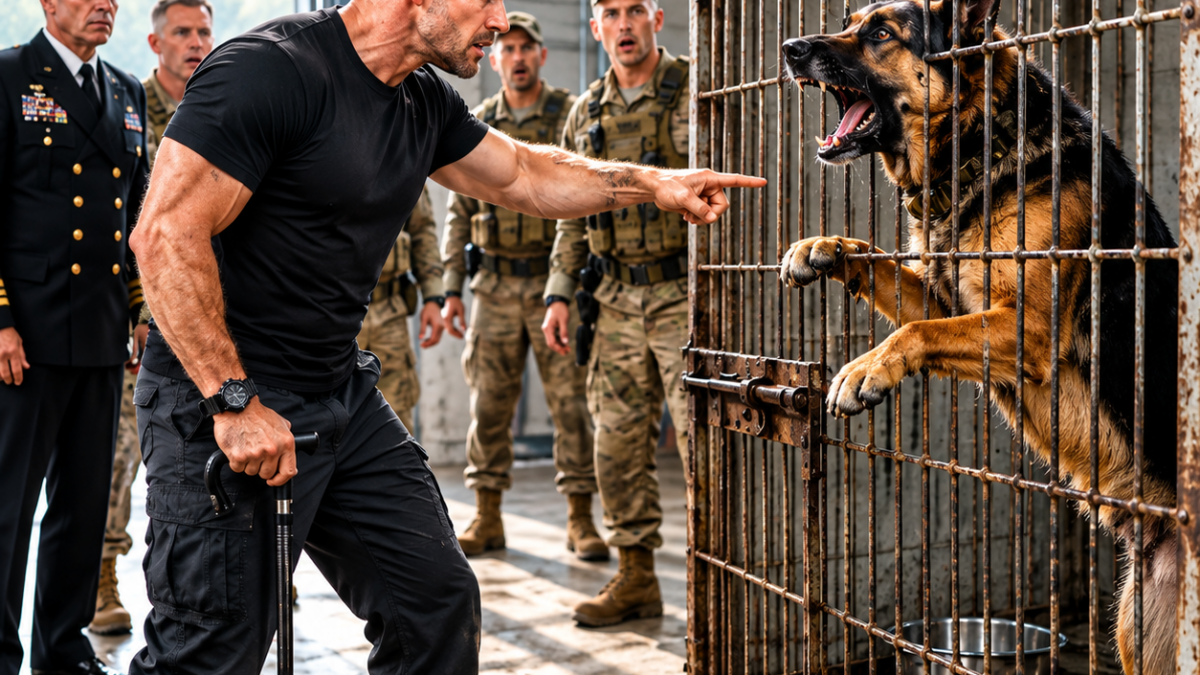
“Sullivan!” a voice barked. “Step away from that cage right now.”
Jack stood slowly.
He did not step away.
Chief Derek Miller stormed down the aisle, red-faced and furious. Two armed Master-at-Arms officers flanked him, hands hovering near sidearms. Behind them came Captain Arthur Pendleton, looking more irritated than concerned, as if Jack were an inconvenient scheduling conflict.
Jack turned.
“You’re Miller.”
Not a question.
Miller stopped ten feet away.
“And you are trespassing in a restricted area, Chief Sullivan.”
Jack’s voice stayed low.
“You locked my dog in a death cage.”
“That animal is classified Level Four aggressive.”
“That animal saved my life.”
“He attacked me unprovoked.”
Jack’s gaze dropped to Miller’s bandaged arm.
“You cornered him.”
Miller’s face tightened.
“He is government property.”
The temperature in the corridor seemed to fall.
Havoc growled behind the fence.
Not at Jack.
At Miller.
Jack lifted one hand without looking back.
“Stand down.”
Havoc went silent instantly.
The two Master-at-Arms officers noticed.
So did Pendleton.
Jack stepped toward Miller.
“This dog took an AK round to the shoulder for me. He found an IED that would have vaporized half my patrol. He has more operational discipline in one tooth than you have in your entire service record.”
Miller’s jaw clenched.
Pendleton pushed forward.
“Enough. Chief Sullivan, I respect your service, but you are out of line. The dog is a liability. My signature is on that euthanasia order, and it is final.”
Jack looked at him.
Really looked.
A career officer in clean khakis, standing in a damp corridor, defending a death order he had signed without reading the file.
“You didn’t even know his name until I walked in here,” Jack said.
Pendleton flushed.
“That is irrelevant.”
“No,” Jack said. “That is the whole problem.”
Pendleton straightened.
“If you do not leave immediately, I will have you arrested for trespassing, disorderly conduct, and insubordination.”
Jack’s hand tightened around his cane.
He knew the math.
Bad leg.
Two armed base police.
One kennel master itching for payback.
A captain with authority and ego.
A locked cage.
A dying dog.
He might end up in military prison.
He might lose everything he had left.
Behind him, Havoc pressed his body against the fence, whining softly.
Jack made peace with the consequences.
“Captain,” he said, almost gently, “with all due respect, you can try to arrest me.”
He shifted his weight.
The cane angled slightly in his hand.
“But you better bring more men.”
The two young officers unsnapped their holsters.
Neither wanted to draw.
Both looked terrified of what might happen if they did.
Pendleton’s voice shook.
“Take him into custody.”
“I would not do that, Captain.”
The new voice came from the far end of the corridor.
It was not loud.
It did not need to be.
Everyone turned.
A man in pristine service khakis stood in the doorway, framed by the cold gray light behind him. Two silver stars gleamed on his collar.
Rear Admiral Richard Croft.
Commander of Naval Special Warfare Command.
The corridor went silent so abruptly that even the dogs in the outer runs seemed to stop barking.
The Master-at-Arms officers snapped to attention.
Miller’s face emptied of color.
Pendleton saluted so fast his hand nearly struck his own eyebrow.
“Admiral Croft,” he stammered. “Sir, we were not expecting—”
“No,” Croft said. “I imagine not.”
He walked down the corridor slowly.
He did not return the salutes immediately.
He passed Miller.
Passed Pendleton.
Stopped in front of Jack.
For one fraction of a second, the admiral’s eyes softened.
He looked at Jack’s cane.
Then at the scarred dog behind the wire.
Jack straightened and saluted.
Croft returned it.
“At ease, Chief Sullivan,” he said. “I got your message.”
Before entering the base, Jack had made one call.
Not to a clerk.
Not to a kennel office.
To his old platoon commander.
That man had made another call.
And another.
Some chains of command were slow.
Some were lightning when the right men pulled them.
Croft turned toward Pendleton.
The softness vanished.
“Captain Pendleton,” he said, voice echoing off the damp cinder block walls. “Explain why one of my most highly decorated multi-purpose canines is locked in a quarantine cage, underfed, denied handler adoption, and scheduled for execution.”
Pendleton swallowed.
“Sir, the dog was classified Level Four after an attack on Chief Miller. We followed DoD aggression protocol.”
Croft turned his gaze to Miller.
“Chief Miller.”
Miller stiffened.
“Yes, Admiral.”
“Is it true you entered that run with a choke chain and attempted to force a slip collar onto a wounded combat dog while he was cornered and exhibiting clear trauma symptoms?”
Miller opened his mouth.
Nothing came out.
Croft waited.
Miller nodded once.
Weakly.
“You provoked a defensive response from a decorated combat animal,” Croft said. “Then used your own incompetence to justify a death sentence.”
Miller’s face went red, then pale.
“Sir, with respect—”
“You will not use that word while standing outside that cage.”
Miller shut his mouth.
Croft turned back to Pendleton.
“Did you review MWD-7392’s full record before signing the euthanasia order?”
Pendleton hesitated.
That hesitation ended him.
Croft’s voice dropped.
“Did you review Chief Sullivan’s pending adoption paperwork?”
No answer.
“Did you verify the Level Four classification with a combat canine behavioral specialist?”
Silence.
“Did you contact the primary handler?”
Pendleton’s mouth moved.
“No, sir.”
Croft removed a folded document from his breast pocket and shoved it into Pendleton’s chest.
Pendleton grabbed it reflexively.
“What is this, sir?”
“That,” Croft said, loud enough for every man in the corridor to hear, “is a direct fleet directive from Naval Special Warfare Command. Effective immediately, MWD-7392 Havoc is reinstated to active duty under my operational authority for the sole purpose of honorable discharge.”
Pendleton stared at the paper.
“Sir, base regulations—”
“I just overrode them.”
“Admiral, the liability—”
“The liability is not the dog,” Croft snapped. “The liability is a command structure that lets a clerk’s error, a kennel master’s ego, and a captain’s negligence nearly execute a war hero.”
No one moved.
No one breathed loudly.
Croft leaned closer to Pendleton.
“The euthanasia order is nullified. MWD-7392 will be honorably discharged from the United States Navy within the hour and transferred directly into the custody of Chief Petty Officer Jack Sullivan.”
Pendleton’s hands trembled around the paper.
“Yes, Admiral.”
“If anyone in this facility delays that transfer by so much as one second,” Croft said, “I will end careers from this kennel to your command office. Do we understand each other?”
“Yes, Admiral.”
Croft turned toward the nearest Master-at-Arms officer.
“Open the cage.”
The young sailor fumbled for the master keys so quickly they nearly fell from his hand.
Miller stared at the floor.
The key slid into the brass padlock.
Metal clicked.
The lock opened.
The cage door swung wide.
For one heartbeat, Havoc did not move.
Maybe he could not believe it.
Maybe freedom, after waiting so long, had to be identified before it could be trusted.
Jack lowered his cane.
“Havoc,” he said softly. “Come.”
The dog surged forward.
Eighty-five pounds of scarred, starved, unrestrained love collided with him.
Jack’s bad leg nearly buckled, but he caught the dog with both arms, dropping awkwardly to the concrete. Havoc buried his massive head into Jack’s neck, whining, shaking, breathing him in as if scent alone could stitch the world back together.
Jack held him.
The tears came before he could stop them.
He had not cried in the medevac.
Not at Landstuhl.
Not through surgery.
Not when physical therapy broke him open day after day.
Not even when he thought Havoc was lost in a system too cold to care.
But there on the damp floor of Sector Four, with Havoc trembling against him, Jack wept into the dog’s matted fur.
“I’m here,” he whispered. “I’m here. I’m sorry it took so long.”
Havoc pressed closer.
Admiral Croft turned away slightly, giving them what privacy a corridor full of sailors could allow.
Even the young officers lowered their eyes.
Miller said nothing.
Pendleton said nothing.
The base itself seemed to hold its breath.
Ten minutes later, Jack and Havoc walked out.
Not through a side gate.
Not hidden.
Not quietly removed to avoid embarrassment.
Straight through the center of the K9 compound.
Havoc leaned heavily against Jack’s good leg. Jack leaned on his cane. Their pace was uneven, but matched. Scarred handler and scarred dog, both limping, both alive.
By the time they reached the administration building, word had spread.
Sailors lined the walkway.
Handlers.
Kennel staff.
Administrative clerks.
Security personnel.
Men and women who had heard versions of the story in whispers and fragments now stood in silent formation.
No one cheered.
No one clapped.
That would have been too small.
As Jack and Havoc passed, the first sailor snapped to attention and saluted.
Then another.
Then another.
Down the line, uniforms straightened.
Hands rose.
A silent salute followed them all the way to Jack’s truck.
They were not saluting rank.
They were saluting loyalty.
The kind that survives gunfire.
Bureaucracy.
Pain.
Distance.
And a locked cage.
Jack opened the passenger door of the truck.
Havoc paused, looking up at him.
For years, he had jumped into helicopters, trucks, boats, and aircraft on command.
Now his body was weaker.
His shoulder hurt.
His ribs showed.
Jack patted the seat.
“Up.”
Havoc tried.
His front paws reached the floorboard, but his back legs failed.
Before anyone could move to help, Jack tossed his cane aside, bent with a grunt of pain, and lifted him.
The effort nearly dropped him.
A handler from the crowd rushed forward.
Jack shot him one look.
The man stopped.
Jack loaded Havoc into the truck himself.
Not because help was shameful.
Because this moment belonged to them.
When Havoc was settled, Jack retrieved his cane and climbed into the driver’s seat.
He looked once at Admiral Croft, who stood near the walkway.
Croft saluted.
Jack returned it.
Then he drove out of Naval Base Coronado with his dog beside him.
For the first hour, Havoc did not lie down.
He sat upright in the passenger seat, pressed against Jack’s shoulder, eyes fixed on him as if afraid that looking away might make him vanish again.
Jack kept one hand on the wheel and one hand buried in Havoc’s fur.
“You’re going home,” he said.
Havoc’s ear flicked.
“Yeah. Home. I bought you a bed.”
The dog stared.
“Don’t give me that look. It’s a good bed.”
Havoc let out a quiet breath and lowered his head onto Jack’s thigh.
Jack drove the rest of the way with tears drying on his face.
Home was a small house outside San Diego with a fenced backyard, a porch facing west, and boxes Jack had not unpacked because he had been waiting for the one living thing that made the place matter.
Havoc entered cautiously.
He sniffed the doorway.
The walls.
The kitchen.
The hall.
The bed Jack had placed in the living room.
He ignored the bed and followed Jack instead.
Everywhere.
Bathroom door.
Kitchen sink.
Bedroom.
Back porch.
If Jack stopped, Havoc pressed against him.
If Jack sat, Havoc lay across his feet.
That first night, Jack tried to sleep in bed.
Havoc would not enter the room.
He sat in the hallway staring at the front door.
Guarding.
Waiting.
Jack understood.
So he dragged a blanket into the hallway and lay down beside him.
Havoc lowered himself slowly.
For a long time, neither slept.
Then Jack placed one hand on Havoc’s scarred shoulder.
“We’re not going back,” he whispered.
Havoc breathed.
In.
Out.
In.
Out.
Eventually, the dog slept.
So did Jack.
Healing was not quick.
People liked happy endings because they imagined rescue as a door swinging open and all the pain staying behind it.
That was not how it worked.
Havoc woke screaming from dreams, claws scraping hardwood, teeth bared at enemies long gone.
Jack woke too.
Sometimes because of Havoc.
Sometimes because his own nightmares had already found him.
On bad nights, they ended up on the living room floor together, Jack’s back against the couch, Havoc’s head on his thigh, both of them breathing until the room became California again instead of Afghanistan.
Havoc’s weight returned slowly.
So did his coat.
The matted patches brushed out. The dullness lifted. His ribs disappeared beneath muscle. His eyes regained light, though never the same carefree brightness he had before war. War does not give everything back.
Jack took him to a civilian veterinarian who had once treated police dogs and knew enough not to touch a working dog too quickly.
The vet examined Havoc’s shoulder, ribs, hips, teeth, scar tissue, and bloodwork.
“He was neglected,” she said quietly.
Jack’s jaw tightened.
“I know.”
“I mean recently.”
“I know.”
She looked up.
“He can recover physically. Emotionally…”
Jack waited.
“He needs time.”
Jack gave a tired smile.
“Good. That’s all we have now.”
In the beginning, Havoc refused the backyard unless Jack came with him. The open space seemed to make him nervous, as if danger could approach from too many directions.
So Jack walked the fence line with him every morning.
Slowly, because of his leg.
Havoc adjusted his pace to match.
That broke Jack in ways he could not explain.
A dog bred for speed, trained for violence, once able to clear walls and sprint through compounds, now walking slowly because his handler could not go faster.
Loyalty had changed shape.
It was still loyalty.
Three months after the rescue, a package arrived from Admiral Croft.
Inside was Havoc’s official discharge documentation, a framed commendation, and a handwritten note.
Chief Sullivan,
No paperwork can repair what was nearly done. No directive can fully account for what Havoc gave or what you both endured. But the record now shows what every man who served with you already knew: MWD-7392 is a decorated combat veteran, honorably discharged, permanently transferred to your custody.
Take care of each other.
R. Croft
Jack read the note twice.
Then he placed it beside Havoc’s bed.
Havoc sniffed it.
Sneezed.
Jack laughed for the first time in months.
Real laughter.
Rusty.
Brief.
But real.
By the sixth month, Havoc chased a tennis ball.
Not far.
Not gracefully.
But with fierce intensity.
Jack sat on the porch in a rocking chair, cane beside him, and threw the ball across the yard.
Havoc took off like the mission depended on it.
For five seconds, he was the dog from before.
Powerful.
Focused.
Alive with purpose.
He snatched the ball, trotted back, and dropped it at Jack’s feet.
Then he rested his chin on Jack’s knee.
Jack scratched behind his favorite ear.
“Good boy.”
Havoc closed his eyes.
The California sun dipped behind the hills, painting the sky gold and purple.
For the first time since Afghanistan, Jack let himself believe they were both truly home.
But the story did not end there.
Stories like theirs never do.
Because once a man has seen how easily a hero can be discarded, he cannot unsee it.
Jack began answering calls.
At first, only from men he knew.
A handler whose dog was nearing retirement and whose paperwork had stalled.
A Marine whose K9 had been mislabeled after a bite incident during pain treatment.
A former Army medic trying to adopt a bomb detection dog but drowning in forms.
Jack did not intend to become an advocate.
He hated meetings.
Hated offices.
Hated polite conversations with people who used acronyms to hide apathy.
But every time he thought about ignoring a call, he remembered Havoc behind chain-link in Sector Four.
So he answered.
Sometimes he gave advice.
Sometimes he made calls.
Sometimes he showed up.
The first time Jack returned to a base kennel after bringing Havoc home, his leg shook the entire drive.
Havoc sat beside him, older and heavier now, wearing a vest that read RETIRED — DO NOT PET.
A young kennel handler met them at the gate.
“Chief Sullivan?”
“Yes.”
The handler looked at Havoc and swallowed.
“Is that him?”
Jack followed his gaze.
Havoc stood calm, scarred, steady.
“Yes,” Jack said. “That’s him.”
The handler whispered, “I heard about Sector Four.”
Jack did not answer.
“Sir,” the young man said, “we have a dog here. Not like Havoc, but… he’s not doing well. His handler died last month. They’re talking about behavioral review.”
Jack looked at Havoc.
Havoc looked toward the kennel building, ears forward.
Jack gripped his cane.
“Show me.”
That became the work.
One dog at a time.
One file at a time.
One handler at a time.
Jack did not save them all.
That truth mattered.
Some dogs were too medically fragile. Some had histories that required careful placement. Some needed specialized facilities. Some systems moved too slowly no matter how loudly he pushed.
But he saved enough.
Enough that whispers became respect.
Enough that commanders began reviewing files before signing disposal orders.
Enough that kennel masters thought twice before treating trauma as defiance.
Enough that Admiral Croft eventually called and said, “Sullivan, if you’re going to keep terrorizing administrative staff, we might as well make it official.”
Jack became a civilian advisor for retired military working dog transition protocols.
He wore no uniform.
He carried no weapon.
He walked with a cane.
But when he entered a room, people listened.
Not because of rank.
Because everyone knew the story of the cage.
Havoc came with him whenever possible.
He would lie beside Jack’s chair during policy meetings, scarred head resting on his paws, golden eyes tracking every speaker. More than one officer found it difficult to recommend “asset disposition” while a retired war dog stared at him with visible judgment.
Jack enjoyed that more than he admitted.
Years passed.
Havoc grew gray around the muzzle.
Jack’s leg worsened in cold weather.
The backyard grass developed worn paths where they walked together morning and evening. The memory foam dog bed eventually became three dog beds: one in the living room, one in Jack’s bedroom, and one on the porch because Havoc had strong opinions about sunset.
On the anniversary of the day Jack opened the cage, he drove back to Coronado.
Not to the kennels.
Not inside the base.
Just to the beach outside the perimeter, where the Pacific wind moved cold and clean off the water.
Havoc came with him.
The dog moved slower now, but he still stepped from the truck with dignity.
They walked across the sand.
Jack’s cane sank slightly with each step.
Havoc stayed beside him.
At the waterline, Jack stopped.
For a long time, he said nothing.
Then he looked down.
“You waited for me,” he said.
Havoc leaned against his leg.
“I should’ve gotten there sooner.”
The dog looked up at him.
Jack smiled sadly.
“I know. You don’t care.”
Havoc huffed.
“You never cared about apologies. Just action.”
The waves rolled in.
Out.
In.
Out.
Jack reached into his jacket and pulled out a small brass tag.
Not a dog tag.
A cage tag.
He had kept it from Sector Four, though he had never told anyone. It bore Havoc’s number and the red mark that had nearly condemned him.
MWD-7392
L4 HOLD
Jack held it in his palm.
Then he threw it into the ocean.
It vanished beneath the water without ceremony.
Havoc watched the waves.
Jack breathed easier.
“You are not that file,” he said.
Maybe to Havoc.
Maybe to himself.
Maybe to every man and animal ever reduced to paperwork by someone who did not know their name.
When Havoc died, he was old, loved, and lying in the sun.
That was years later.
Years of porch sunsets.
Tennis balls.
Slow walks.
Handler visits.
Young dogs learning calm from him.
Veterans kneeling to bury their faces in his fur.
Years of Jack waking from nightmares and finding Havoc there.
Years of Havoc sleeping without cages.
On his final morning, Havoc refused breakfast.
Jack knew.
You always think you will not know, and then you do.
The veterinarian came to the house.
Havoc lay on his bed near the open porch door. Warm California air moved through the screen. The yard shimmered with afternoon light.
Jack sat beside him on the floor.
His leg cramped.
He ignored it.
Havoc’s head rested in his lap.
“You saved me first,” Jack whispered.
The dog’s eyes moved toward him.
“I tried to return the favor.”
Havoc’s tail shifted once.
Barely.
Enough.
Jack pressed his forehead to Havoc’s.
“I told you I’d come back.”
He could not say more.
The veterinarian waited quietly.
When it was time, Jack kept both hands in Havoc’s fur.
No steel bars.
No cold concrete.
No strangers.
No orders except the last one, whispered with all the love and mercy a warrior could give another.
“Rest.”
Havoc did.
Afterward, Jack buried him beneath the old oak tree in the backyard.
The one Havoc had liked to sleep under during summer heat.
A week later, Admiral Croft came in civilian clothes and stood beside the grave with Jack.
He said nothing for a long time.
Then he placed a folded flag on the marker.
“Unofficial,” he said.
Jack nodded.
“Understood.”
On the marker, Jack had carved the words himself.
HAVOC
MWD-7392
SEAL TEAM THREE
HE WAS NEVER PROPERTY
HE WAS MY BROTHER
Croft read it.
His jaw tightened.
“Good,” he said.
Jack looked toward the house.
The porch looked empty.
The yard sounded wrong.
Croft placed a hand on his shoulder.
“He changed policy, Jack.”
“No,” Jack said. “He survived policy.”
Croft accepted that correction.
A month later, Jack received a call from a young handler.
Her dog had been injured.
The paperwork was tangled.
The command was impatient.
The handler’s voice shook as she said, “Chief Sullivan, I don’t know what else to do.”
Jack looked at Havoc’s empty bed.
Then at the cane leaning beside the door.
Then at the photograph on the wall: him and Havoc at sunset, both scarred, both home.
“What’s your dog’s name?” Jack asked.
The handler breathed in sharply, like the question alone mattered.
“Rex, sir.”
“Tell me everything.”
He listened.
He took notes.
He made calls.
He drove three hours the next morning.
Because loyalty does not end at a grave.
Because brotherhood does not expire with age, retirement, injury, or death.
Because somewhere, in every system large enough to forget names, there will always be another cage.
And someone must be willing to walk in and open it.
Years after Sector Four, young sailors still told the story.
Not always accurately.
Stories grow teeth.
Some said Jack Sullivan kicked down the kennel door.
He did not.
Some said Havoc broke the lock with his jaws.
He did not.
Some said Admiral Croft fired half the base on the spot.
He did not, though several careers did quietly collapse afterward.
But the heart of the story remained true.
A decorated K9 was locked in a cage.
A bureaucrat signed his death order.
A Navy SEAL came back for his partner.
And one command silenced the base.
Not because it was shouted.
Not because it carried rank.
But because when Jack Sullivan stood outside that cage and said, “Havoc, here,” the dog everyone had called broken rose from the concrete and remembered he was loved.
That was the sound that stopped them all.
Not the admiral’s authority.
Not Pendleton’s fear.
Not Miller’s shame.
The sound of a dying dog coming back to life because his handler had returned.
In the end, that was the lesson no regulation could contain.
War dogs are not equipment.
Handlers are not interchangeable.
Trauma is not disobedience.
Fear is not aggression.
And loyalty — real loyalty — is not a line item that can be misplaced in a file.
Jack knew that.
Havoc knew it.
Every sailor who saluted them on that sidewalk knew it.
And if the men who locked Havoc away had forgotten, then the old dog taught them one final lesson before he ever left the base:
A hero does not become disposable because he is wounded.
A teammate does not become property because paperwork says so.
And no cage, no order, no signature from a coward behind a desk can erase the bond between a warrior and the one who came back for him.








