They Had Everything Except a Child—Then a Basket on the Porch Exposed the Secret Their Mansion Had Been Hiding
PART3:
That was all it took.
I began to cry.
Not quietly.
Not gracefully.
I had cried so many years with discipline, pressing handkerchiefs to my mouth, keeping my grief from staining the wallpaper. But that morning, on my own front step, with a child’s fingers wrapped around mine, something in me broke so cleanly I think it must have been waiting for permission.
“No one?” I called across the drive.
My voice shook.
“Is anyone there?”
No answer.
I looked toward the hedges, the gardens, the road beyond the gate.
“Please,” I called, though I did not know whether I was begging someone to appear or begging heaven not to take her back.
The baby squirmed.
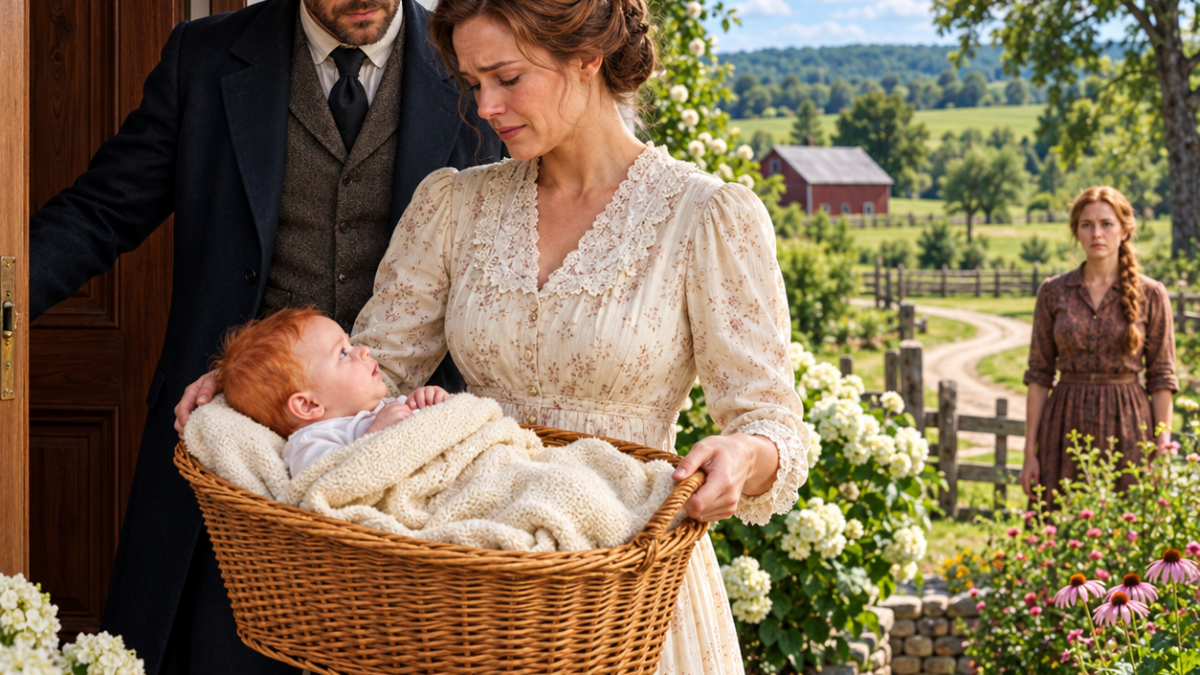
I lifted her from the basket and held her against my chest.
She was warm.
Real.
Heavy enough to be impossible.
Julian found me there moments later.
He came into the hall quickly, alarmed by my call, and stopped at the door as if struck. I have never forgotten his face. My husband, who had stood calmly in blizzards, disputes, market crashes, and cattle scares, simply stared.
At me.
At the baby.
At the empty drive.
Then back at me.
“Beatrice?”
“Someone left a baby at our door.”
The sentence sounded foolish.
A thing from a tale told by old women near a fire.
But she moved in my arms, and Julian’s eyes filled before he could stop them.
He stepped closer slowly, as though sudden movement might wake him from the only dream he had wanted for seventeen years.
“May I?”
I should have handed her over.
Instead, my arms tightened.
Julian saw it.
Pain crossed his face, but he did not reach again.
“Of course,” he said softly. “Keep holding her.”
That was my first shame.
That I loved her before I knew her name.
That I feared losing her before I knew whether I was allowed to keep her.
Julian searched the property himself that morning. He rode every stretch of road within a mile before the sun cleared the ridge. He sent hands toward town, north road, creek path, and the old crossing. He asked at neighboring farms whether anyone had seen a wagon, a rider, a woman, anything. He reported the matter properly to Sheriff Dade and sent for Dr. Pritchard.
The doctor examined the baby in our parlor while I stood so close he finally looked over his spectacles and said, “Mrs. Harroway, she will not vanish if you sit down.”
He meant kindness.
I did not sit.
He pronounced her healthy, though small, and guessed she was around four months old. No signs of violence. No fever. Well enough fed until recently, perhaps, though not plump. Her clothes were plain. Her blanket old. In the basket we found only three things besides her.
A folded cloth diaper.
A tiny knitted cap.
And a cheap little metal locket wrapped carefully in a strip of blue fabric.
No note.
No name.
No explanation.
The locket opened after some effort. Inside was not a portrait, but a pressed curl of red hair tied with thread and a sliver of paper too small to hold more than initials.
E. D.
That was all.
Dr. Pritchard warned us not to grow attached too quickly.
Those were his exact words.
Not grow attached.
As though attachment were a vine a woman could keep trimmed by good sense.
“The child may have family,” he said. “Someone may come forward. There are procedures.”
Procedures.
That day introduced me to one of life’s great cruelties: the cold language people use when your heart is already on fire.
Sheriff Dade made inquiries. Notices were sent. Julian placed word discreetly in town but did not advertise in a way that would invite every false claim in Colorado. Weeks passed.
No one came.
That first night, Julian found me in the parlor with the baby asleep against my chest. I had fed her goat’s milk from a cloth dropper under the doctor’s instructions. She had cried for nearly an hour and then collapsed into sleep with one hand pressed against my bodice.
Julian stood in the doorway.
His voice was gentle.
“Where shall we put her tonight?”
We both thought of the same room at the same time.
The nursery.
Neither of us said the word.
Julian went upstairs first.
I heard the door open. The faint protest of hinges unused too long. The movement of furniture. A drawer sliding. Cloth shaken. Then silence.
When he called down, his voice was rough.
“It’s ready.”
I carried her upstairs.
The room smelled of cedar, dust, and old hope.
Julian had wiped down the crib himself. The small wooden horse stood on the shelf. The rocking chair waited by the window. Moonlight lay across the floorboards in pale bars. For years, that room had been a wound. That night, with the baby in my arms, it became a room again.
We laid her in the crib.
She stirred, made a small sound, and slept.
Julian and I stood together in the doorway, hands touching but not fully clasped.
“Do you suppose we’re allowed this?” I whispered.
“Allowed what?”
“To be this happy. After so many years telling ourselves not to hope.”
Julian took my hand.
“I don’t believe happiness generally asks permission,” he said. “I intend to let it stay regardless.”
We named her Emmeline.
I called her Emmy before the ink dried on the first document.
What began as temporary changed the household before any court could declare it permanent.
Julian became ridiculous first.
That is the truth.
My dignified, disciplined husband, a man who could silence a row of ranch hands by lifting one eyebrow, began abandoning ledgers mid-sum the moment Emmy cried. He walked the halls at night with her tucked along his forearm, murmuring nonsense about horses, weather, and interest rates because those were the subjects he knew best. More than once, I woke to find him standing by the nursery window, Emmy asleep against his shoulder, both of them silvered by moonlight.
“She was fussing,” he would say.
“She is asleep.”
“She might fuss again.”
“You are spoiling her.”
“I am observing her condition.”
“You are standing in a nursery at two in the morning explaining irrigation rights to an infant.”
“She seemed interested.”
Mrs. Kimmel disapproved of the disruption.
Mrs. Kimmel disapproved of most disruptions.
She had been with us nine years by then, a severe woman with iron-gray hair, narrow hands, and a talent for making order feel like judgment. She had run my household efficiently during my weakest years, and for that I had been grateful. But efficiency, I would later learn, can become cruelty when placed above mercy.
At first, I mistook her stiffness around Emmy for concern.
“It is not wise to let staff become too attached before the legal matter is settled,” she said one morning as I sat in the breakfast room with Emmy in my lap.
I looked up.
“The staff?”
Her eyes flicked to the baby.
“And others.”
“You mean me.”
“I mean only that uncertainty is best handled with restraint.”
Emmy chose that moment to spit milk down the front of my dress.
I laughed.
A real laugh.
One I had not heard from myself in years.
Mrs. Kimmel’s mouth tightened.
But I was beyond caring.
That autumn, when no one had come forward and the county proceedings were complete, Emmeline Harroway became our daughter fully and legally. Julian came home from town holding the papers like holy writ. He found us in the orchard, Emmy on a blanket beneath the apple trees, trying with grave concentration to put a fallen leaf into her own mouth.
“It’s done,” he said.
I stood too fast and nearly stepped on my hem.
“Done?”
He nodded, eyes bright.
“Our daughter.”
I took the papers.
Then I took Emmy.
Then I cried into her red hair while Julian put both arms around us and held on as though the law itself might change its mind.
After that, the house did not simply fill.
It bloomed.
Emmy was not a quiet child. She narrated life from the moment words found her. She had strong opinions about buttons, soup, horses, clouds, the moon, and whether God could see through ceilings. She hid toys in absurd places. A wooden horse appeared inside the good china cabinet. A rag doll was once found tucked into Julian’s account ledger with a scrap of paper over its face because, Emmy explained, “She was tired of numbers.”
Julian claimed he did not spoil her.
He lied.
“Papa says horses do not belong in the house,” Emmy told me one afternoon, standing beside the china cabinet where the wooden horse sat proudly among silver and porcelain.
“And where is your father now?”
“Working.”
“Did you ask him?”
“Yes.”
“What did he say?”
“He said a horse in the cabinet was better than a horse in his boot.”
When I confronted Julian, he did not look up from his papers.
“I promised I would not spoil her.”
“You promised to consider not spoiling her. I remember the conversation. It was not the same promise.”
The corner of his mouth trembled.
“Precision is important.”
“She is three.”
“She appreciates nuance.”
Emmy began sitting in a small chair beside Julian’s desk while he worked. Quietly, in theory. In practice, she reported every beetle crossing the windowsill, every bird in the garden, every interesting dust mote, and any thought that entered her head with the urgency of breaking news. Julian learned to keep one ear on ledgers and one on her commentary, though more often than not, he gave the better half of himself to her.
I walked with her through the orchard in the afternoons. She learned to steady herself on her own feet beneath those trees. I caught her a dozen times an hour in those early days, both of us laughing at every tumble that did not end in tears.
“Why do horses sleep standing up?” she once asked.
“I don’t rightly know. You’ll have to ask your father. He knows more about horses than sense allows.”
“Papa said the same thing about you and flowers.”
“Did he?”
That evening, I informed Julian he had begun teaching our daughter slander.
“She asked why flowers lean toward light,” he said.
“And?”
“I said your mother knows more about flowers than sense allows.”
“That is not better.”
“It was affectionate.”
“Most insults become affectionate only after apology.”
He apologized to me with a kiss and to Emmy by letting her place daisies in his hatband at supper.
There were quiet evenings too.
Emmy asleep against Julian’s chest in the parlor while he pretended to read aloud long after she had stopped hearing him. I mended tiny dresses that seemed always to tear at the hem because she ran as if walking were an insult. The fire burned low. Julian read slower on the pages where he felt her drifting.
“Why do you keep reading after she sleeps?” I asked once.
“Because once she is properly asleep, I have to carry her upstairs.”
“And?”
“I find I don’t much care to end the evening that quickly.”
I reached across and rested my hand on his knee.
For several years, I believed this was the whole shape of our miracle.
A child had come.
We loved her.
The empty room was empty no longer.
I did not ask why the road had brought her. Perhaps I was afraid that asking too loudly might summon an answer I could not survive.
But answers come whether we invite them or not.
Emmy was nearly four the first time I saw the woman clearly.
I had noticed shadows before.
Not often. Not enough to accuse anyone of anything. A figure near the road where the property line ran close to the creek. A movement among cottonwoods. Once, laughter from beyond the orchard after Julian’s hat blew off and landed over Emmy’s face while she sat on his shoulders, both of them helpless with amusement. I turned, saw nothing, and dismissed it as a ranch hand passing.
But that spring afternoon, there was no dismissing her.
The gardens were in bloom, and Emmy was running ahead of me near the creek with a fistful of wildflowers she intended to press inside every book Julian owned. I carried a basket and watched her red hair flash in the sun. She had grown vivid, my daughter. Red-haired, bright-eyed, impossible to overlook. Neither Julian nor I had red hair in our families, and I used to say whatever blood gave it to her clearly meant to be seen.
Then I saw the same color among the cottonwoods.
A woman stood beyond the fence line.
Mid-twenties, perhaps. Plain dress worn thin. Shoes dusty. Hands clasped so tightly in front of her that even from a distance I could see the strain. She stood very still, but not like a practiced spy. More like a person whose longing had carried her somewhere her courage had not prepared her to be.
Her hair was red.
Nearly Emmy’s exact shade.
My heart began to pound.
“Emmy,” I called.
She turned, startled by my tone.
“Come here.”
She came, questions already forming. I drew her against my skirts and faced the woman.
“Who are you?”
The woman did not answer.
Her eyes remained fixed on Emmy.
Tears ran silently down her cheeks.
“I asked you a question,” I said, colder now because fear had taken me by the throat. “What are you doing on this property?”
The woman took one step forward.
Then stopped, as if an invisible line held her.
“I only wanted to see her.”
My arms tightened around Emmy.
“See who?”
Her mouth trembled.
“What do you mean?”
The woman looked at me then.
Not boldly.
Not defiantly.
With a grief I recognized so instantly it frightened me.
“I’m her mother.”
There are sentences that divide a life.
Before.
After.
That one did.
I wanted to deny it.
I wanted to call for help.
I wanted to tell her she was mistaken, wicked, mad, cruel, anything that would make the resemblance disappear. But Emmy stood pressed against me, red hair bright in the sun, and this stranger’s face held no triumph. No calculation. No claim sharpened into a weapon.
Only pain.
“Emmy,” I said, voice unsteady, “go to the house.”
“But Mama—”
“Now, sweetheart. Tell Nora to stay with you in the kitchen.”
Emmy looked between us, confused, then obeyed.
She ran across the grass toward the house.
The woman watched her go like every step carried flesh away from bone.
When Emmy vanished around the garden wall, I turned back.
“If you are who you say you are,” I said, “you had better begin speaking carefully.”
Her name was Maeve Donnelly.
She told me first that she had not come to take Emmy.
I did not believe her.
She did not seem surprised.
“I know she is your daughter,” Maeve said.
“You say that very easily.”
“I have said it to myself for four years.”
Her voice was rough, low, unused to confession.
We stood there by the fence line like enemies separated by wood and wire, except the true enemy was the truth neither of us yet knew how to hold.
She had been twenty-one when she became pregnant. The man who had promised to marry her left for California before the baby was born and was never heard from again. She had no family nearby. No property. No husband. No reputation left intact once people began counting months and whispering.
After Emmy was born, Maeve survived on washing, sewing, cleaning rooms, mending shirts, sleeping where she could. Some weeks she could feed herself. Some weeks she could feed the baby. Rarely both well.
“I couldn’t keep milk in me,” she said. “Couldn’t keep work long enough either. Women would let me wash clothes outside, maybe sew if they trusted my stitches, but not come inside. Not with a baby. Not unmarried. Not with people talking.”
She had passed our property often walking between odd jobs in town and the smaller settlements beyond. She had seen Julian pay a hand full wages when other ranchers docked pay for broken tools. She had seen me carry food to the Miller family when influenza took hold, rather than sending a servant. Those scraps of observation had become, in her desperation, evidence.
So one day, before dawn, she came to our back entrance with Emmy in her arms, looking for work.
I felt the first crack of something cold move through me.
“You came here?”
Maeve nodded.
“To the house?”
“To the service door. I asked to speak with Mrs. Harroway if there was washing, sewing, anything.”
“Who answered?”
She looked down.
“The housekeeper.”
Mrs. Kimmel.
The name formed in my mind before she said it.
“She looked at me,” Maeve continued, “and I suppose she saw everything people see first. My dress. My shoes. The baby. No ring. She told me there was no place for me there.”
My hands went numb.
“She never told me.”
Maeve gave a faint smile without humor.
“I expect women like me were not something she troubled you with.”
Women like me.
The words landed with a shame I had not yet earned but soon would.
That night, Maeve had slept with her daughter in a crude shelter along the creek, not knowing then that the same water ran through Harroway land. Emmy cried most of the night from hunger. Maeve walked until dawn with the baby in her arms.
“I came back,” she said. “Not for work that time.”
Her voice broke.
“I left her where I knew someone would open the door.”
I felt the air go thin.
“You left her on my porch.”
“Yes.”
“How could you?”
The question tore out of me before I could stop it.
Maeve flinched as if struck.
Then she answered.
“Because if I looked at her one more minute, I would have carried her away and watched her starve with me.”
I had no answer to that.
She had been watching from the fence for years.
Not every day, she said. Sometimes months passed. She would swear never to return, then hear some rumor in town of the little Harroway girl with red hair and break her own promise. She watched Emmy toddle after chickens. Watched Julian carry her through the orchard. Watched me kneel to wipe mud from her face. Watched birthday guests arrive with ribbons and gifts. Watched from beyond the fence as the child she had left became loved in ways she could not provide.
“I told myself I came to be certain she was happy,” Maeve said. “Some days that was true. Other days, I think part of me wanted her to somehow know I was there, even if she never could. I am not proud of that.”
“You frightened me.”
“I know.”
“She is my daughter.”
“I know.”
Nothing more.
No argument.
No correction.
No bitter claim of blood.
Just those two words.
I know.
They landed harder than any accusation.
Because in her face I saw myself.
Not as I was now, mistress of a grand house with my daughter’s handprints on my skirts. But myself in the empty years. Myself outside nurseries, outside conversations, outside the easy belonging of mothers. That raw, helpless longing in Maeve’s eyes was one I knew better than I wished to admit.
For four years, she had stood where I once stood.
Looking at a child she could not hold.
I began to cry.
“No mother should ever have to do that,” I said.
Maeve covered her mouth.
That evening, I brought her to the house.
Not through the back door.
Through the front.
Mrs. Kimmel saw us in the hall and went pale.
I looked at her only once.
“Have tea sent to the parlor.”
Her lips pressed thin.
“Yes, ma’am.”
Julian was in his study when I told him he needed to come.
He entered the parlor and stopped when he saw Maeve. She stood immediately, hands clasped, face pale but steady.
I told him the truth as well as I could.
Julian did not interrupt.
My husband’s first instinct was protection. I saw it in the way his shoulders squared, in the way his eyes moved toward the hallway where Emmy played under Nora’s supervision.
“You understand what you are asking us to accept,” he said to Maeve.
His voice was not unkind.
It was careful.
“I am not asking you to accept anything, Mr. Harroway. I am not here to take her. She is your daughter. I know that.”
Julian’s jaw tightened.
“Why didn’t you tell us the truth that first morning?”
Maeve’s eyes filled again, but she did not look away.
“Because if I had looked at her one more time, I would not have been able to leave her.”
The room went silent.
I saw judgment leave my husband’s face.
Not concern.
Not pain.
But judgment.
“What troubles me,” Julian said slowly, “is that you came here first looking for honest work, and Mrs. Kimmel turned you away without either of us ever knowing.”
Maeve lowered her eyes.
“She was doing what she believed her position required.”
Julian’s expression hardened.
“She was doing what I apparently allowed her to believe her position required. That is a different matter.”
The next morning, Julian ordered the household ledgers, gate logs, and service records brought to his study.
Mrs. Kimmel claimed there was no need.
Julian disagreed.
I had rarely seen my husband angry. He was not a man given to shouting. His anger became quieter, more precise, and far more dangerous.
He questioned staff one by one.
Stable hands.
Kitchen maids.
Gardeners.
Former footmen still in town.
At first, the answers were cautious. No one wanted to accuse a housekeeper who had controlled their wages, references, and daily peace for years. But Julian had a way of letting silence become heavier than lies.
By the third day, we understood what our wealth had hidden from us.
Maeve was not the only one turned away.
Men seeking day labor had been dismissed before reaching Julian. A widow with two children had been told the mistress did not handle “charity cases.” A young man with a lame hand had asked for stable work and been denied because Mrs. Kimmel thought him unsightly near the main house. Women had come for sewing, washing, kitchen work, temporary shelter, references, help.
Some deserved refusal, perhaps.
Many deserved to be heard.
We had been known throughout the county for kindness, and yet our own door had been guarded by a woman who believed need itself was disorder.
I confronted Mrs. Kimmel in the parlor on the fourth afternoon.
Julian stood beside the mantel. Maeve was not present. I would not make her sit through that.
Mrs. Kimmel stood straight, hands folded, black dress severe as judgment.
“Did you turn Maeve Donnelly away?” I asked.
“I do not know the names of every vagrant who comes to a service entrance.”
Julian’s eyes sharpened.
“Answer my wife properly.”
Mrs. Kimmel inhaled.
“A young woman came with an infant. Yes.”
“She asked for work.”
“She was not suitable.”
“Suitable?” I repeated.
“She was unmarried, Mrs. Harroway. Anyone could see what she was. I protected the household from scandal.”
I stepped closer.
“You protected me from my daughter.”
Mrs. Kimmel’s face did not change, but something flickered in her eyes.
“You cannot know that. There is no guarantee you would have taken them in.”
“No,” I said. “There is no guarantee. Because you stole the question from me.”
Her mouth tightened.
“I made the decision a housekeeper must make when a mistress is too tender-hearted to see danger clearly.”
Julian’s voice dropped.
“You decided my wife’s compassion was a weakness you had authority to manage.”
“I maintained the standards of this household.”
“You mistook standards for locked doors.”
A long silence followed.
For the first time, Mrs. Kimmel looked uncertain.
Not repentant.
Uncertain.
That was worse somehow.
She still believed order might defend her.
I thought of Maeve sleeping by the creek. Emmy hungry. The basket on the porch. Four years of fence lines.
“You will no longer answer the door to anyone seeking work or help,” I said. “No one will be turned away without my knowledge. Ever.”
Mrs. Kimmel’s nostrils flared.
“Am I dismissed?”
I wanted to say yes.
Part of me still wonders whether I should have.
But justice and punishment are not always identical, and I had not yet learned which one the house needed more.
“You are corrected,” Julian said. “Severely. Whether you remain depends on whether you can learn the difference between guarding a household and hardening it.”
Mrs. Kimmel dipped her head.
But I knew the matter was not finished.
Secrets do not end when exposed privately.
They wait for an audience.
The town learned of Maeve within a week.
Not the whole story at first. Stories rarely travel whole. They travel broken and sharpened.
A red-haired woman had been seen entering the Harroway house.
She looked like little Emmy.
She had lived in poverty.
She claimed something.
Maybe money.
Maybe the child.
Maybe Julian had known her before.
By Sunday, the whispers had grown legs and teeth.
At church, Mrs. Alcott, wife of the bank president and self-appointed guardian of everyone else’s morality, greeted me with the warm cruelty of a woman who had mistaken social power for virtue.
“Mrs. Harroway,” she said, loud enough for three pews to hear, “we are all praying for you during this unsettling business.”
I smiled politely.
“How kind.”
“One cannot be too careful when strangers appear after years with claims. Especially women of uncertain character.”
My hand tightened around my gloves.
“Maeve Donnelly’s character has survived more hardship than most people’s charity would.”
Several heads turned.
Mrs. Alcott’s smile sharpened.
“You are generous. But generosity must be guided by wisdom. A child’s welfare is not a sentimental matter.”
“No,” I said. “It is not.”
She leaned closer.
“A girl with that origin will face enough whispers. You would be wise not to invite the source of them into your home.”
The source.
Not mother.
Not woman.
Source.
I felt anger rise so cleanly it steadied me.
“You are speaking of a woman who gave my daughter life.”
Mrs. Alcott’s eyes widened, pleased to have drawn blood.
“And you are comfortable saying that publicly?”
I looked at the faces turned toward us. Neighbors. Friends. Women who had brought casseroles after my losses but also stopped inviting me when children filled the room. Men who had praised Julian’s fairness while trusting servants to keep need from interrupting supper.
“Yes,” I said. “I am.”
The church vestibule went quiet.
Mrs. Alcott flushed.
“How modern of you.”
“How Christian, I hope.”
Julian appeared at my side then, Emmy holding his hand.
“Is there a difficulty?” he asked.
Mrs. Alcott adjusted her hat.
“No difficulty. Only concern.”
“My wife and I will decide what concerns our family.”
“Of course.”
But her humiliation did not soften her. It hardened her.
Two days later, Sheriff Dade came to our house.
Not as a friend.
With papers.
A petition had been filed questioning Emmy’s placement on grounds that the circumstances of abandonment had not been fully disclosed and that the biological mother had reappeared. It did not seek immediate removal, but it requested review.
The petitioner was not named publicly at first.
It did not need to be.
Mrs. Alcott’s husband knew the judge. Her cousin worked in the county clerk’s office. Her parlor was where reputations went to be tried before facts arrived.
I remember Julian reading the notice in the hall.
His face went white with contained fury.
Emmy was upstairs with her tutor. Maeve was in the greenhouse.
“Can they take her?” I asked.
Julian did not answer quickly enough.
That was answer enough.
“They can make us defend what is already settled,” he said.
“Because Maeve came forward?”
“Because someone wishes to punish us for not hiding her.”
The hearing was set for ten days later.
Those ten days taught me how fear ages a person.
I slept little. Ate less. Watched Emmy constantly. She knew something was wrong. Children always know. She asked why people in town looked at us differently. I told her adults sometimes made confusion louder than kindness. She considered this, then asked if confusion could be sent to bed without supper.
“I wish it could,” I said.
Maeve offered to leave.
She came to me in the greenhouse where the air smelled of damp earth and seedlings. She stood among rows of young plants, hands trembling.
“If I go before the hearing, perhaps they’ll stop.”
I was tying twine around a tomato stem.
I broke it.
“Do you think they object because you are here?”
“Yes.”
“They object because we refused to be ashamed of you.”
Her eyes filled.
“Mrs. Harroway—”
“Beatrice.”
She stopped.
I had not asked her to use my first name before.
“You leaving would teach my daughter that love must retreat when cruelty raises its voice. I will not teach her that.”
“What if they take her?”
The question hollowed me.
I set down the twine.
“If they try, they will have to explain why a child loved, sheltered, legally adopted, and thriving should be torn from her home because adults prefer shame to truth.”
Maeve looked toward the glass panes, where Emmy was outside chasing a butterfly in the garden with Nora close behind.
“She looks so happy,” Maeve whispered.
“She is.”
“I thought that would make it easier.”
“Does it?”
“No.”
“No,” I said softly. “I don’t suppose love becomes easier because someone else has done right by the person you love.”
Maeve pressed both hands over her mouth.
I wanted to comfort her.
I also wanted, selfishly and terribly, to keep every piece of Emmy for myself.
Both things were true.
That was the hardest lesson of those days.
Love does not make a person pure.
It shows her where she is not.
The hearing took place in the county courthouse, a square brick building with tall windows, bad ventilation, and benches hard enough to feel designed for moral correction.
Half the town came.
Not because they cared about law.
Because they wanted to witness pain dressed as procedure.
Julian sat beside me. Maeve sat behind us, hands folded, face pale but lifted. Emmy remained at home with Nora and two ranch hands posted discreetly outside, because Julian trusted law in principle and people much less in practice.
Mrs. Alcott sat across the aisle in a lavender dress, looking solemn in the way people look when they are enjoying themselves but want credit for restraint. Mrs. Kimmel sat near the back, stiff and colorless.
Judge Harland presided. He was not unkind, but he loved order, and order had never been the same as justice.
The petition argued that Emmy’s adoption had been based on incomplete information, that the birth mother’s identity had been unknown, that questions remained as to whether abandonment was voluntary, coerced, or misunderstood, and that the child’s welfare required review.
Our attorney, Mr. Voss, argued the adoption was lawful, stable, and in Emmy’s best interest.
Then Maeve was called.
I felt every muscle in my body tighten as she stood.
She walked to the front with plain dignity. No fine dress. No jewels. Only a dark gown I knew she had mended herself and red hair braided tightly down her back.
Judge Harland looked at her over his spectacles.
“You are Maeve Donnelly?”
“Yes, sir.”
“You claim to be the biological mother of the child now known as Emmeline Harroway?”
“I am her mother by birth, yes.”
A murmur moved through the room.
By birth.
Even in that first answer, she had made room for me.
The petitioner’s attorney, a thin man named Mr. Vale, rose.
“You left an infant on a doorstep?”
“Yes.”
“Without identifying yourself?”
“Yes.”
“Without knowing whether she would be discovered in time?”
“She was left at the front door of a house where staff rose early. I waited near the road until I saw Mrs. Harroway bring her inside.”
I turned.
I had not known that.
Maeve’s eyes flicked to mine for the briefest second.
“I did not leave until I knew she was held.”
My breath caught.
Mr. Vale pressed.
“You now appear after four years, having watched the child from a distance.”
“Yes.”
“Some might call that unnatural.”
Maeve’s hands tightened once.
Then steadied.
“Some have never had to love someone from the wrong side of a fence.”
The courtroom went silent.
Mr. Vale’s mouth thinned.
“Do you seek custody?”
“No.”
“Money?”
“No.”
“Position?”
“No.”
“Then what do you seek?”
Maeve looked toward me.
Then Julian.
Then the judge.
“The truth to stop being treated like a threat.”
I closed my eyes.
Mr. Vale attempted to paint her as unstable, improper, opportunistic. But Maeve did not embellish. She did not perform grief. She answered each question plainly. She had been poor. She had been unmarried. She had been desperate. She had left her child because the alternative, in her judgment, was starvation and exposure. She had returned only to see that child, not to disrupt her life.
Then Mrs. Kimmel was called.
I had not expected that.
Julian had.
He did not look surprised.
Mrs. Kimmel walked forward like a woman approaching a scaffold built from her own standards.
Mr. Voss asked the questions.
“Mrs. Kimmel, were you housekeeper at the Harroway estate four years ago?”
“Yes.”
“Did a young woman with an infant come to the service entrance seeking work?”
Mrs. Kimmel’s eyes moved once toward me.
“Yes.”
“Did you inform Mr. or Mrs. Harroway?”
“No.”
“Why?”
“She was not suitable for the household.”
A sound moved through the room. Not shock. Recognition. Many had heard such words from someone, somewhere.
“What made her unsuitable?”
Mrs. Kimmel lifted her chin.
“She appeared unmarried. Destitute. The child was clearly hers. I believed allowing her inside would invite scandal and manipulation.”
Mr. Voss’s voice sharpened.
“So you made that decision yourself.”
“I did.”
“Did Mrs. Harroway instruct you to turn away women seeking honest work?”
“No.”
“Did Mr. Harroway?”
“No.”
“Did you consider that refusing her access might leave the infant in danger?”
Mrs. Kimmel’s face twitched.
“I considered the household first.”
There it was.
Clear.
Cold.
Undeniable.
Julian’s hand closed around mine.
Mr. Voss let the silence sit.
Then he asked, “Do you now understand that the infant later left at the Harroway door was the same child?”
Mrs. Kimmel’s voice was lower.
“Yes.”
“And had you allowed Maeve Donnelly to speak to your employers, this matter might never have occurred as it did?”
“Yes.”
Mrs. Alcott shifted in her seat.
For the first time, she looked less certain of the performance.
But cruelty rarely retreats without one final attempt.
Mr. Vale stood again.
“Mrs. Kimmel, in your years of service, did you consider Mrs. Harroway emotionally vulnerable regarding children?”
Julian half rose.
Our attorney objected.
Judge Harland allowed a narrowed question.
Mrs. Kimmel hesitated.
Then said, “Mrs. Harroway had suffered greatly. It was my belief that any woman carrying an infant might exploit that grief.”
The words struck me publicly.
There was the humiliation.
Not that I had grieved. Everyone knew that.
But to hear my sorrow described as weakness in a room full of watchers, to know my empty years had been used as justification for denying another woman help—it burned.
Mr. Vale turned to the judge.
“My point, Your Honor, is that decisions were made in a household clouded by grief, filtered by servants, and later resolved in favor of adoption by adults desperate for a child. It raises concern as to whether emotion overrode prudence.”
I stood.
Julian whispered my name, but I was already on my feet.
Judge Harland frowned.
“Mrs. Harroway, sit down unless called.”
“No.”
Gasps.
A judge does not enjoy no from a woman in a crowded courtroom.
But seventeen years of empty rooms, four years of motherhood, and ten days of fear had burned through whatever remained of my obedience to cruel order.
“Your Honor,” I said, voice shaking but loud enough, “if my grief is to be used as evidence, then I request the dignity of speaking to it myself.”
The room stilled.
Judge Harland studied me.
Perhaps he saw I would not sit quietly.
Perhaps he was curious.
“Very well. Briefly.”
I walked to the front.
My knees trembled.
I did not hide it.
“I wanted a child,” I said. “Everyone here knows that. Some of you pitied me for it. Some avoided me because of it. Some thanked God privately that my sorrow was not yours. I will not pretend otherwise to make this room more comfortable.”
No one moved.
“When Emmy was left at my door, I loved her before I knew whether I was allowed to keep her. That is true. But my grief did not make me careless. It made me reverent. We reported her properly. We sought a doctor. We followed the law. We waited through every required proceeding. We did not steal her. We did not hide her. We did not know Maeve Donnelly’s name because someone in my own house decided a poor woman’s need was too inconvenient to reach me.”
Mrs. Kimmel lowered her eyes.
I looked toward Maeve.
“And Maeve did not return to destroy my family. She returned because no mother should have to spend her life watching her child from behind a fence.”
My voice broke.
I steadied it.
“I am Emmy’s mother. Maeve is the woman who gave her life. If this court believes love must be made smaller to be lawful, then say so plainly. But do not call cruelty prudence. Do not call secrecy protection. And do not punish a child because the adults around her are finally telling the truth.”
When I finished, the room was utterly silent.
Julian’s eyes shone.
Maeve was crying openly.
Even Judge Harland sat back slowly, as if something in the room had shifted beyond procedure.
The petition was denied.
The adoption stood.
No further review.
Judge Harland stated that while the circumstances revealed failures of household judgment and social conscience, the child’s welfare was stable, lawful, and not served by disruption. He also noted, with a look sharp enough to cut paper, that poverty and unmarried motherhood did not by themselves constitute evidence of present danger.
Mrs. Alcott left before the room fully emptied.
Cowardice often wears good gloves.
Outside the courthouse, townspeople lingered, unsure whether to congratulate us, apologize, or pretend they had never whispered.
Maeve stood at the bottom of the steps, sunlight catching her red hair.
I approached her.
For a moment, neither of us spoke.
Then she said, “Thank you for not letting them make me only one thing.”
I took her hands.
“I am sorry it took me so long to see all of you.”
Julian came down beside us.
“We have another matter to settle,” he said.
Maeve stiffened.
“Mr. Harroway—”
“You came to our door looking for work years ago. You were not heard.”
She looked between us.
“I am not asking—”
“I know,” he said. “This is not payment for a child. I would consider it an insult if you treated it that way, and I suspect you would too.”
Despite herself, Maeve almost smiled.
“There is a groundskeeper’s cottage near the creek,” Julian continued. “Two rooms. Plain, but sound. It has stood empty since Mr. Bell’s uncle retired. Beatrice tells me you sew well. She also says you know seedlings better than our current gardener, who believes roses respond favorably to neglect.”
I added, “They do not.”
Maeve stared.
“We can offer wages entered properly in the ledger, as with any employee. Work in the greenhouse and sewing as needed. You may stay in the cottage while you save. If you choose.”
Her face changed with each sentence, hope rising and retreating, rising again like something afraid of being struck.
“I don’t want anyone thinking I left my daughter hoping for some reward.”
“I know,” I said. “I am offering a woman a chance to work and rebuild a life that was taken from her through no fault of her own.”
Maeve pressed one hand to her mouth.
“I don’t know how to stand near her and not want too much.”
That honesty nearly undid me.
“Then we will learn slowly,” I said. “All of us.”
Emmy met Maeve properly the following week in the greenhouse.
We did not tell her the truth then. She was too young. But Julian and I had agreed on one condition that mattered more than comfort: when she was old enough, she would know her story. No lies. No invented dead mother. No shame hidden under pretty words.
That day, Emmy marched into the greenhouse with a child’s complete lack of awareness that the adults around her were holding their breath.
Maeve knelt beside a tray of seedlings, hands deep in soil.
Emmy looked at her red hair.
Maeve looked at Emmy’s.
The moment stretched.
Then Emmy asked, with grave seriousness, “Do you know horses?”
Maeve blinked.
“A little.”
“Papa says a horse can tell when you’re afraid of it. Are you afraid of horses?”
“I don’t believe I’ve had the chance to find out.”
“I can introduce you to Daisy. She is not the tallest, but she has opinions.”
Maeve laughed.
It came out broken, but real.
“I would like that.”
By the second month, Emmy sought Maeve out most afternoons after lessons. She followed her through the greenhouse asking questions about every plant. Maeve answered each one as though no subject in the world mattered more than whether lavender preferred dry soil.
At first, I watched from doorways.
Jealousy is an ugly word, so I gave it prettier names.
Caution.
Adjustment.
Concern.
But it was jealousy.
When Emmy laughed at something Maeve said, something inside me tightened. When Maeve knew how to braid Emmy’s red hair so it held better through running, I felt irrationally wounded. When Emmy brought Maeve a flower and said, “This one is for you because it looks like your hair,” I turned away before anyone saw my face.
That evening, Julian found me in the nursery, though Emmy had outgrown the crib and slept now in a small bed with carved posts.
“You are allowed to find this hard,” he said.
“I hate that I find it hard.”
“That is not the same thing.”
I touched the old crib rail.
“What if loving her never feels secure again?”
Julian stood beside me.
“Then we make it secure by telling the truth each time fear asks us to lie.”
“Very wise.”
“I married well.”
“Do not become smug.”
“I will consider not becoming smug.”
I laughed despite myself.
The year Emmy turned seven, we told her.
Not all at once. Not dramatically. We sat in the orchard beneath the trees where she had learned to walk. Julian on one side, me on the other. Maeve waited in the greenhouse, because we had decided Emmy should hear it first from us, the parents she knew as parents, and then ask Maeve whatever she needed.
I told her about the basket.
The porch.
The blanket.
The locket.
Julian told her the legal truth, gently.
Then I told her Maeve had given birth to her.
Emmy listened with terrible stillness.
Children who talk constantly can frighten you most when they go quiet.
When we finished, she asked only one question.
“Why did she leave me?”
I had prepared answers.
Kind answers.
Careful answers.
None were good enough.
So I said, “That question belongs to Maeve.”
Emmy went to the greenhouse alone.
I stood at the window, hands clenched so tightly my nails marked my palms.
Julian stood behind me.
Inside, Maeve knelt so she and Emmy were eye to eye.
I could not hear every word through the glass, but later Emmy told me.
“Because I loved you before I had anything to give you,” Maeve said.
That evening, Emmy came to my room while I brushed my hair.
“Why did you let Maeve stay?”
I set the brush down.
“Because loving you never had to mean someone else had to stop.”
Emmy considered this with her usual gravity.
“Do I have to call her something?”
“No.”
“Is she Mama too?”
My throat tightened.
“You may call her whatever feels true to you. That is not mine to decide for you.”
She thought about it for nearly a week.
In the end, she called her Maeve.
No title.
No claim.
Just Maeve.
And somehow, that was enough.
Years softened what truth had once made sharp.
Maeve never tried to take my place.
That was one of her gifts to me.
I learned not to guard every moment like a miser. That was one of mine to her.
She moved a little closer to the family table each year. At first, she came for Emmy’s birthdays and left before cake. Then she stayed through cake. Then she baked the cake herself, a recipe from her own mother back east, and no one at the table thought to question why.
With wages saved and a small loan from Julian that she insisted on treating as a debt, Maeve opened a modest sewing shop in town. Her name was painted plainly above the door.
MAEVE DONNELLY, SEAMSTRESS
I went with her the morning the sign was hung.
She stood on the sidewalk looking up at it, lips parted.
“It looks too grand,” she said.
“It looks accurate.”
“I still owe your husband eighty dollars.”
“You owe my husband because you insisted on owing him.”
“Yes.”
“Then enjoy your debt.”
She laughed.
When she made the final payment two years later, she delivered it to Julian’s study herself. He tried once to refuse. She gave him a look so severe he accepted the envelope without another word.
After she left, he said, “That woman has more pride than half the ranchers in this county combined.”
“She earned it honestly.”
“Yes,” he said. “She did.”
Mrs. Kimmel remained with us.
Some people will disagree with that decision.
I have disagreed with it myself on lonely nights.
But the woman who had turned Maeve away did not remain unchanged. She lost authority over the door. That was posted plainly in the service hall and at the entrance gate: No person seeking work or assistance is to be turned away without first being heard by Mr. or Mrs. Harroway.
Julian enforced it.
So did I.
Over time, Mrs. Kimmel became the first to greet Maeve with tea when she came to the main house. At first, stiffly. Then more naturally. Years later, I once saw her press an extra slice of cake into Maeve’s hands “for the walk back,” though Maeve’s shop was not far enough to justify the excuse.
Perhaps repentance often begins as duty before it becomes feeling.
I do not know.
I only know one small kindness at a time cannot undo harm, but it can prove a person has stopped defending it.
Mrs. Alcott never forgave us for embarrassing her by being happy after she predicted ruin.
That, too, was a kind of justice.
Emmy grew into the sort of young woman people noticed before she spoke and remembered after she left. Red hair, bright mind, quick laugh, and a stubborn insistence that questions deserved honest answers even when adults wished they did not. She rode better than I ever had. She read in windowsills. She could identify roses by scent, stitch a hem well enough to satisfy Maeve, and persuade Julian into almost anything by placing one hand on his sleeve and saying, “Papa, be reasonable.”
He rarely was.
Not where she was concerned.
One Sunday when Emmy was sixteen, she came down the grand staircase dressed for an evening gathering in town. Her red hair was pinned up properly for the first time, though several curls had already escaped. The dress she wore was pale blue, sewn by Maeve, the hem exact, the seams invisible.
I stood in the hall and could not speak.
Julian stood beside me, one hand resting lightly at my back.
“She looks like herself,” he whispered.
That was exactly it.
Not like me.
Not like Maeve.
Not like some imagined child from the locked nursery.
Herself.
Outside, Maeve came along the road for her usual Sunday visit, waving before she reached the gate.
No fence line left between her and the house.
Emmy saw her through the open door and ran down the last steps too quickly for the dignity of her dress.
“Careful!” I called.
She ignored me, of course.
She ran across the lawn toward Maeve, then turned back halfway as if remembering me, then laughed because she could not choose which woman to embrace first.
So she did not choose.
She pulled Maeve by the hand toward the porch and threw her other arm around me when she reached the steps, catching us both in one awkward, laughing embrace.
Julian watched us with tears in his eyes.
He did not wipe them.
My husband had learned, by then, that joy deserved witnesses too.
I looked at Maeve over Emmy’s shoulder.
Her face was wet.
So was mine.
For a moment, I saw all of it at once: the empty nursery, the basket, the locket, the courthouse, the greenhouse, the first birthday Maeve stayed for cake, the sign above her shop, Emmy’s small hand in mine, Emmy’s hand in hers.
I had once believed motherhood was a door that remained closed to me.
Then a child arrived on my porch.
For years, I thought that was the miracle.
I was wrong.
The miracle was larger and far more demanding.
The basket carried a daughter for two people who had given up waiting.
It carried a second chance for a mother who believed she deserved none.
It carried a reckoning for a house that had mistaken locked doors for dignity.
It carried humiliation, truth, fear, mercy, and the painful education of learning that love does not become smaller when shared with honesty.
Some families begin with blood.
Some with law.
Some with a knock before dawn.
Some with a woman on one side of a fence and another woman on the other, both loving the same child enough to suffer for her.
Years after that first morning, people still liked to say someone had left a baby at our door.
I never corrected them in public.
But in my heart, I knew the truth.
No one had simply left her.
Maeve had carried her as far as love and desperation allowed.
Julian and I had opened the door.
And Emmy, without knowing it, had opened every locked room in the house.
Including the ones inside us.








