They Gave This Loving Cat Back for Wanting to Stay Close—Now Oliver Waits in Silence, Still Hoping Someone Will Finally See His Gentle Heart and Never Leave Him Again
PART3:
She pressed her small fingers through the carrier grate, and Oliver rubbed his cheek against them instantly. His whole body pushed forward. His purr began so quickly and so loudly that even from across the lobby, I heard it.
“Oh, Ollie,” Emma whispered. “I’m sorry. I tried.”
Oliver rubbed harder.
He did not understand the paperwork.
He did not understand the sighs.
He did not understand that the house he had memorized, the bed he slept beside, the child he comforted, and the people he followed from room to room had already decided his love was a burden.
All he knew was that his girl was there.
So he gave her everything he had.
His cheek.
His purr.
His trust.
Brianna put a hand on Emma’s shoulder.
“That’s enough.”
“No.”
“Emma.”
“No!”
The word burst out of her so suddenly that the dogs in the back kennels began barking.
Derek stepped forward.
“Come on, Em.”
The girl began sobbing.
“You said he was forever.”
Her mother’s face hardened, not with grief, but with embarrassment.
“We tried.”
“No, you didn’t.”
That sentence was small, cracked, and devastating.
For the first time, Brianna had no answer.
Derek lifted Emma gently but firmly. She fought him at first, reaching back toward the carrier, crying Oliver’s name. Oliver stood inside, paws against the door, meowing now with a frantic, rising sound that made every volunteer in the lobby go still.
“Ollie!” Emma cried as her father carried her toward the exit.
Brianna did not look at the carrier again.
She only looked at Marisol.
“I hope you find him someone who has the time for this,” she said.
Then they left.
The door closed behind them.
Oliver kept meowing.
Not for long.
That was the worst part.
He called for them until the sound of the car outside faded.
Then he stopped.
Completely.
Marisol and I stood in the lobby with the carrier between us.
Inside, Oliver slowly lowered himself to the floor.
His purr was gone.
His paws slid down from the door.
He turned once, pressed his face into the towel, and became silent.
I had been working at the shelter for eleven years by then.
My name is Grace Holloway, and by that point I thought I had learned how to keep my heart useful without letting it break beyond repair. You cannot survive rescue work otherwise. You learn to cry in your car. You learn to laugh in the laundry room. You learn that anger can be fuel if you do not let it become poison.
Still, Oliver broke through something in me.
Maybe because he was not wild with terror.
Maybe because he was not angry.
Maybe because he had been returned for the one thing every abandoned animal has to risk in order to belong.
Love.
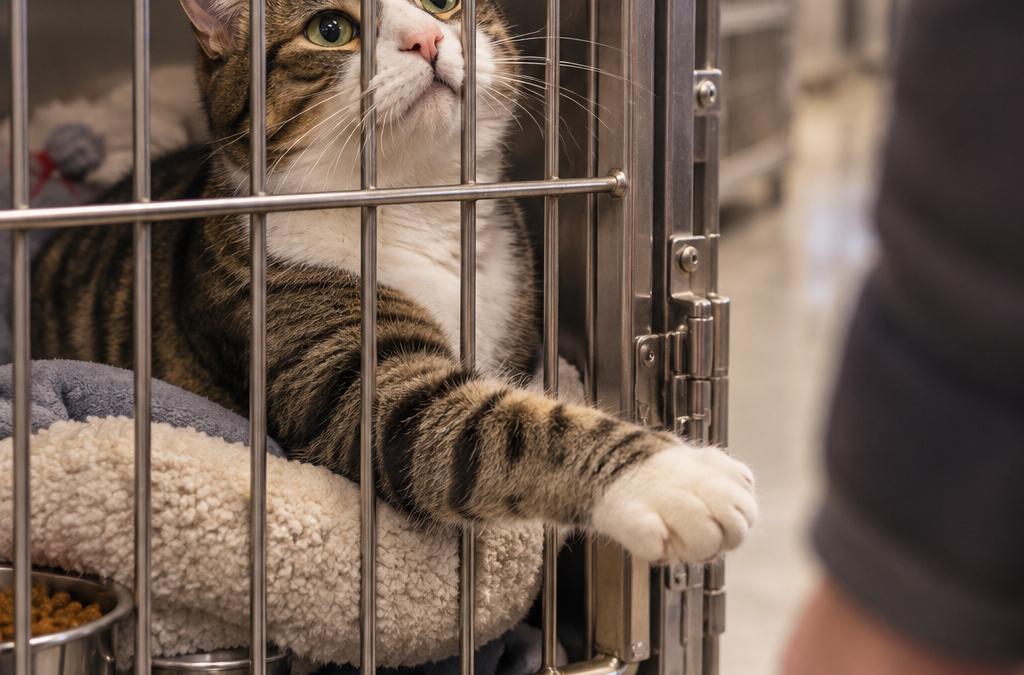
We moved him to Cat Room Three, the quieter room near the back of the building where we kept older cats, shy cats, and cats who needed time before the world got too close.
He stepped out of the carrier slowly.
He was beautiful in an ordinary, heartbreaking way. A medium-sized orange-and-white cat with soft amber eyes, a pink nose, white paws, and a little orange patch under his chin like he had leaned into sunlight and kept a piece of it. His fur was clean. His nails were trimmed. His body was healthy.
Nothing about him looked neglected.
And somehow that made the wound worse.
He had not been unloved from the beginning.
He had been loved almost enough.
Almost is a cruel place to leave a heart.
At first, Oliver walked around the kennel sniffing everything. The bed. The water bowl. The litter box. The blanket. The wire door. He moved carefully, as if trying to understand the new rules before he broke them.
Then he heard footsteps in the hallway.
His head lifted.
His ears came forward.
He moved to the door.
Marisol walked past with towels.
Oliver pressed himself against the bars.
She stopped.
“Oh, sweetheart.”
He chirped.
She slipped one finger through the bars, and he rubbed his cheek against it with such desperate tenderness that her eyes filled instantly.
“I know,” she whispered. “I know.”
That was how Oliver spent his first evening back.
Waiting.
Every time someone passed his kennel, he stood up.
Every time the front door opened, he listened.
Every voice mattered until it wasn’t theirs.
Then his hope folded back down into his little bed.
By closing time, he had not eaten.
The next morning, he still had not eaten.
That did not panic us immediately. Cats often stop eating after a return. Stress sits in their stomachs. Grief takes up physical space. You offer different foods, warm them slightly, sit nearby, speak softly, wait.
Oliver sniffed the wet food and turned away.
He accepted one treat from my palm, then seemed to remember he was sad and let the second fall beside his paw.
When I opened his kennel to clean, he did not run out.
He stepped directly into my lap.
I was crouched on the floor with a trash bag and a spray bottle, entirely unprepared, and suddenly there he was, both front paws on my knees, face tucked against my uniform shirt.
He began to purr.
Not loudly like he had for Emma.
This purr was smaller.
Questioning.
As if he was asking whether closeness was still allowed.
“Oh, Oliver,” I whispered.
He pushed his head beneath my chin.
I sat down fully on the floor and let him climb into my lap.
Across the room, Marisol watched from the doorway.
“He really does just want to be held,” she said.
I looked down at him.
His eyes were closed now, one paw resting against my wrist.
“No,” I said quietly. “He wants to know the person holding him won’t disappear.”
For three days, Oliver stayed soft.
That was the miracle and the tragedy of him.
He did not become mean.
He did not hiss at visitors.
He did not punish the world for what one family had done.
Whenever someone approached, he rose, slow but hopeful. If they opened the kennel, he leaned forward. If they sat in the visiting room, he climbed into their lap and pressed his entire body against them like he could transfer his heart through fur.
And people loved him for about thirty seconds.
“Oh, he’s so sweet.”
“What a cuddly boy.”
“He’s adorable.”
Then we told them his story.
“He likes to be close.”
“He may follow you around.”
“He needs someone who appreciates an affectionate cat.”
And I watched the hesitation appear.
Some people smiled politely and said they wanted to keep looking.
Some said they needed a cat that was “a little more independent.”
One man laughed and said, “I already have a wife. I don’t need a cat with separation anxiety.”
I wanted to throw his keys into the parking lot.
Instead, I said, “Oliver isn’t anxious because he’s broken. He’s anxious because someone taught him love might leave.”
The man looked uncomfortable.
Good.
By the end of the week, someone had placed a small note on Oliver’s kennel card.
VERY AFFECTIONATE. NEEDS PATIENT HOME.
I stared at it for a long time.
It was accurate.
It was also not enough.
Words matter in shelters. A word can save an animal or sentence them to being misunderstood. Shy sounds gentler than fearful. Energetic lands better than wild. Selective is kinder than difficult. Bonded makes love official. Senior asks for dignity. Special needs asks for someone brave enough to care.
Very affectionate sounded sweet.
But for Oliver, it carried the same danger as the word that had brought him back.
Too much.
So I took the card down and rewrote it.
OLIVER
5 years old. Gentle. Loyal. Deeply loving.
Oliver is happiest near his person. He will follow you, sit beside you, wait outside closed doors, and sleep close if allowed. He is not “too needy.” He is a cat who bonds deeply and trusts with his whole heart. He needs someone who understands that his love is a gift, not a burden.
Marisol read it and smiled.
“Our director may say that’s too long.”
“Then our director can fight me.”
She laughed.
But she left it up.
Three days later, Brianna Whitcomb called.
I answered the phone because Marisol was helping with a dog intake.
“Willow Creek Animal Shelter, this is Grace.”
“Yes, this is Brianna Whitcomb. We returned a cat there last week.”
My hand tightened around the receiver.
“Oliver.”
“Yes. I saw your post online.”
I glanced toward the adoption room, where our volunteer photographer had taken Oliver’s picture that morning. In the photo, he was sitting in his bed with his paws tucked under him, eyes lifted toward the camera, blue collar still around his neck.
We had posted his kennel card text as the caption.
Apparently, it had begun spreading.
“I wanted to say,” Brianna continued, her voice clipped, “that I don’t appreciate being made to look like a villain.”
I took one slow breath.
“We did not name you.”
“You didn’t have to. People know we returned him.”
“I’m sorry you feel exposed by an accurate description of his needs.”
“That is not what happened.”
“What part is inaccurate?”
She was quiet.
Then, sharper, “He was obsessive.”
“He loved being near you.”
“He disrupted our life.”
“He slept outside your daughter’s door when she had nightmares.”
Another silence.
“She told you that?”
“I was in the lobby.”
Brianna exhaled sharply.
“You have no idea what it was like.”
I looked through the office window.
Oliver was in the visiting room with a teenage volunteer named Sophie. He had curled against her side, one paw resting on her leg while she read a history textbook aloud to him. His eyes were half closed.
“You’re right,” I said. “I don’t know what it was like in your home. I only know what it looked like when you left him here.”
Her voice lowered.
“You people are so judgmental.”
“Sometimes judgment is just what accountability feels like from the other side.”
She hung up.
My hands were shaking.
Not because I regretted what I said.
Because rescue work gives you countless chances to be polite to people who have broken something vulnerable and still expect comfort from the person cleaning up the pieces.
I was tired of that.
The post continued to spread.
Not wildly at first.
A few hundred shares.
Then a few thousand.
Comments came in from people who understood Oliver immediately.
My cat follows me into every room. It means I am his safe place.
I would give anything to have my old girl waiting outside the bathroom again.
Some people don’t deserve affectionate animals.
He isn’t needy. He’s loyal.
Then came the other comments.
You never know someone’s situation.
Maybe the cat really was too much.
Not everyone wants a clingy animal.
Shelters guilt-trip people too much.
I read them until Marisol gently took my phone from my hand.
“Stop feeding your blood pressure,” she said.
“I’m fine.”
“You look like you’re about to fistfight the internet.”
“I might.”
“Oliver needs you employed, not arrested.”
That made me laugh.
Oliver looked up from his bed when he heard the sound.
He always looked up when someone laughed.
Like he was trying to decide whether happiness was an invitation.
A week after his return, Oliver began losing hope.
Not all at once.
That would have been easier to explain.
It happened in small ways.
He stopped standing every time footsteps passed.
He stopped eating unless someone sat directly beside his kennel.
He still leaned into hands, still purred when held, still tried to be brave for visitors. But when they left, he curled tighter than before, nose tucked under his paw.
The blue collar with stars began to bother me.
It had come from his old life.
Maybe Emma had chosen it. Maybe that was why I could not remove it at first. It felt like the one piece of proof that someone in that family had loved him properly.
But it also seemed cruel.
A souvenir from a home that decided his heart was inconvenient.
One evening after closing, I opened his kennel and sat beside him.
“Can I check this, buddy?”
Oliver lifted his head.
I unclipped the collar gently.
His fur beneath it was slightly flattened. I ran my fingers around his neck, checking for irritation.
He leaned into my hand.
I turned the collar over.
That was when I saw the writing.
Not on the tag.
Inside the fabric, in tiny black marker, almost worn away.
I love you Ollie. — Emma
I stared at it until the letters blurred.
Marisol found me ten minutes later sitting on the floor of Cat Room Three, crying into Oliver’s fur.
“What happened?”
I showed her the collar.
Her face changed.
“Oh.”
“He was loved,” I said.
“Yes.”
“But not protected.”
That was the wound.
Love without protection is a warm room with an unlocked door.
Emma had loved him.
But Emma was a child.
She could not drive him back home.
She could not refuse to sign the surrender form.
She could not make adults understand what they did not want to understand.
I did not put the collar back on him.
Instead, I folded it carefully and placed it in his file.
The next morning, I brought a new collar from home.
Green.
Soft.
No stars.
Not because stars were bad.
Because Oliver deserved something that belonged to the life ahead, not only the one behind.
I attached a small tag shaped like a heart.
Oliver.
Underneath: Loved, not too much.
Marisol rolled her eyes when she saw it.
“You’re impossible.”
“I’m correct.”
“You’re emotionally dangerous.”
“Also correct.”
That afternoon, a man named Henry Cole came into the shelter.
At first, I did not think he was there to adopt.
He stood in the lobby for several minutes without approaching the desk, looking at the photos on the wall. He was in his late sixties, tall and thin, with a neatly trimmed gray beard, a navy coat, and the careful posture of someone who had learned to carry pain without letting it spill.
I noticed his hands.
They trembled slightly.
Not much.
Enough.
Marisol greeted him.
“Can I help you?”
He turned, as if coming back from somewhere far away.
“I’m here about the orange cat.”
My heart did something foolish.
“Oliver?”
“Yes.” He cleared his throat. “I saw his story.”
Marisol glanced at me.
I stepped forward.
“I’m Grace. I work mostly with the cats.”
“Henry Cole.”
We shook hands.
His grip was warm, careful.
“Have you had cats before?” I asked.
“One.”
His eyes moved toward Oliver’s photo on the wall.
“Her name was Mabel. She died last year. She was nineteen.”
“I’m sorry.”
He nodded once.
“She followed my wife around for fourteen years. Then after Linda died, she followed me.”
There it was.
The room seemed to quiet around him.
“My wife passed three years ago,” Henry continued. “Cancer. Mabel stayed after. I used to complain that she was always underfoot. Truth is, I talked to that cat more than I talked to anyone.”
He smiled, but it broke before it fully formed.
“When Mabel died, the house went very still.”
I understood that kind of stillness.
Not because my husband had died.
I had never married.
But I had worked with enough grieving animals and grieving people to know that silence can have weight.
“Oliver likes to be close,” I said.
“I read that.”
“He may follow you room to room.”
“I hope so.”
“He may wait outside the bathroom.”
Henry’s mouth twitched.
“At my age, that would be the least embarrassing part of my day.”
I laughed.
Oliver, in Cat Room Three, lifted his head.
Henry turned toward the sound.
“May I meet him?”
We brought Henry into the visiting room and carried Oliver in.
Oliver had been curled in his bed, and when I picked him up, he pressed his face briefly under my chin the way he had started doing when he needed reassurance. I whispered, “Someone’s here to see you.”
Henry sat in the armchair.
He did not reach for Oliver immediately.
That mattered.
Some people try to take affection like it is owed to them. Henry waited.
I set Oliver on the floor a few feet away.
Oliver stood still.
He looked at me.
Then at Henry.
Then toward the door.
My chest tightened.
For a second, I thought he would retreat.
Henry leaned forward slightly, elbows on his knees.
“Hello, Oliver,” he said softly.
Oliver’s ears moved.
Henry’s voice was low and warm, worn smooth by age and loneliness.
“I hear you’re a cat who prefers company.”
Oliver took one step.
Henry did not move.
“I do too,” he said.
Oliver took another step.
Then another.
He reached Henry’s shoes and sniffed them carefully. Henry waited, hands relaxed.
Oliver looked up.
For a long second, they simply studied each other.
Then Oliver did what Oliver did.
He chose hope again.
He placed one white paw on Henry’s pant leg.
Henry inhaled sharply.
Oliver placed the second paw beside it, stretched upward, and gave a soft, questioning chirp.
Henry’s hand trembled as he lowered it.
“May I?”
Oliver answered by pushing his head into Henry’s palm.
Henry closed his eyes.
The room went very still.
Oliver climbed into his lap slowly, as if some part of him feared being removed. Henry made a small sound—not a sob exactly, but close—and gathered him carefully against his chest.
Oliver tucked his face beneath Henry’s chin.
Then the purr began.
Full.
Deep.
Unmistakable.
Marisol turned away.
I pretended not to see her wiping her face.
Henry did not speak for several minutes.
He just held Oliver.
When he finally opened his eyes, they were wet.
“My wife used to say some creatures love in a language most people are too busy to learn.”
I swallowed hard.
“She sounds like she was wise.”
“She was. And bossy.”
Oliver kneaded Henry’s coat.
Henry laughed, a small surprised laugh that seemed to startle him as much as us.
“There you are,” he whispered to Oliver.
Not, there he is.
There you are.
As if he had been missing too.
The adoption was not immediate.
We did a home visit because Oliver had already been failed once, and I had become unreasonable in the best possible way. Henry welcomed it.
His house was a small blue bungalow on a quiet street lined with maple trees. There was a screened porch, a sunny front window, and a wide armchair with a folded quilt beside it.
Mabel’s old cat bed was still near the fireplace.
“I didn’t have the heart to put it away,” Henry admitted.
I looked at the bed, faded pink with flattened sides.
“Maybe don’t.”
He nodded.
In the kitchen, two mugs sat on the counter.
One used.
One clean, with faded blue flowers.
Henry noticed me noticing.
“That was Linda’s.”
“You still keep it out?”
He looked embarrassed.
“I know it’s foolish.”
“No,” I said. “It’s not.”
The house was quiet, but not cold.
Lonely, yes.
Waiting, maybe.
But gentle.
A good place for a cat who wanted to be near someone.
A good place for a man who had forgotten that being needed could be a gift instead of a burden.
On adoption day, Emma came back.
I did not know she was coming.
Her father brought her.
Not Brianna.
Derek stood in the lobby looking uncomfortable, holding his daughter’s hand. Emma clutched a small envelope.
When I saw them, my first instinct was protectiveness so fierce I nearly stepped between them and Cat Room Three.
Derek raised one hand.
“We’re not here to cause trouble.”
I said nothing.
Emma looked smaller than I remembered.
“Is Oliver still here?” she asked.
“He’s being adopted today,” I said gently.
Her eyes filled instantly, but she smiled.
“Good.”
Derek looked at the floor.
“I owe you an apology,” he said.
That surprised me.
“You owe Oliver one.”
He nodded.
“You’re right.”
Emma held out the envelope.
“Can you give this to his new person?”
I took it carefully.
“What is it?”
“A note. And a picture.”
Her lower lip trembled.
“I want them to know he likes when you say good morning before you touch him if he’s asleep. And he doesn’t like thunder unless you sit with him. And he likes the green crinkle ball better than the red one. And he pretends he doesn’t want belly rubs, but sometimes he does, only for a second.”
Derek closed his eyes.
I felt my anger shift.
Not leave.
Just make room for the child standing in front of me with instructions for loving the cat she could not keep.
“Would you like to say goodbye?” I asked.
She looked at her father.
Derek nodded.
“If that’s okay.”
It was not easy.
But it was right.
We brought Oliver into the visiting room.
The moment he saw Emma, he froze.
Then he made a soft sound.
Emma dropped to her knees.
“Ollie.”
Oliver went to her.
Not with the frantic panic of the day he was returned.
With recognition.
He pushed his head against her chest, and she wrapped her arms around him carefully, crying into his fur.
“I’m sorry,” she whispered. “I’m sorry I couldn’t make them keep you.”
Derek’s face crumpled.
I looked away, because some shame deserves privacy when it finally becomes remorse.
Oliver purred for her.
Of course he did.
That was the ache of him.
He still had love for people who had hurt him because love was what he knew how to give.
Henry arrived while Emma was sitting with Oliver.
I stepped into the lobby to explain.
He listened quietly.
Then he said, “May I meet her?”
I brought him in.
Emma wiped her face quickly when she saw him, embarrassed.
Henry sat in the chair across from her.
“You must be Emma.”
She nodded.
“I’m Henry.”
“You’re adopting him?”
“If he’ll have me.”
Emma looked down at Oliver.
“He’ll have you. He likes everyone.”
Henry smiled sadly.
“That isn’t a flaw.”
“No,” she whispered. “It isn’t.”
She handed him the envelope.
“These are things he likes.”
Henry accepted it with both hands, like it was something valuable.
“Thank you. I’ll read it carefully.”
“He gets sad if you close too many doors.”
“I don’t much like closed doors either.”
“He likes to sleep close.”
“That sounds nice.”
Emma studied him then, searching his face with the seriousness only children can manage.
“My mom said he was too much.”
Henry leaned forward.
“Your mom was wrong.”
Derek made a small sound behind them.
Emma’s tears spilled over again.
Henry’s voice remained gentle.
“Some people want love to come only when called and leave when inconvenient. But that isn’t how real love works. Oliver loves with his whole heart. That means he needs someone who won’t make him ashamed of it.”
Emma nodded.
“Will you send pictures?”
Henry looked at me.
I said, “If everyone agrees, we can help with that.”
“I would be happy to,” Henry said.
Emma hugged Oliver one last time.
This time, when she let go, she did it herself.
“I love you, Ollie,” she whispered. “Be happy.”
Oliver touched her cheek with his nose.
Then he turned.
And walked to Henry.
That was the moment the room broke open.
Not because Oliver forgot Emma.
He didn’t.
Not because grief vanished.
It never does that.
But because love, when given somewhere safe to land, knows how to move forward without erasing where it has been.
Henry bent down.
Oliver climbed into his arms.
And Emma smiled through tears.
The adoption photo was taken by the front window of the shelter lobby.
Henry held Oliver against his chest. Oliver’s green collar showed clearly, heart tag shining. Emma stood beside them with permission from her father, one hand resting gently on Oliver’s back. Derek stood behind his daughter, looking like a man who had finally understood something too late and would spend a long time living with it.
We did not post Emma’s face.
But later, with Henry’s permission, we posted a cropped photo of Oliver tucked against his new father’s shoulder.
The caption was simple.
Oliver is home.
This time, he is loved exactly as he is.
The post went farther than any post our shelter had ever made.
People shared it with stories of animals they had once thought were too clingy until they realized they were simply afraid. Widows and widowers wrote about pets who kept them alive after loss. People admitted they had misunderstood animals in their care. Some apologized to pets long gone.
Then something beautiful happened.
Oliver’s story began changing how people asked for cats.
Not everyone.
Never everyone.
But enough.
A woman came in and said, “I saw Oliver. Do you have any cats who like to sit close?”
A college student asked, “Who’s been overlooked because they’re shy or too affectionate?”
An older man said, “I live alone. I wouldn’t mind being followed around.”
A mother with two teenagers adopted a bonded pair because, in her words, “We don’t want to separate love just because it takes up more room.”
Oliver did not know any of this.
He was busy becoming Henry’s shadow.
Henry sent the first update three days after adoption.
The photo showed Oliver on the arm of Henry’s recliner, one paw resting on Henry’s sleeve while Henry read the newspaper.
Caption: He supervises current events.
The next photo came a week later.
Oliver sitting outside the bathroom door.
Caption: Privacy is apparently no longer part of my life.
Then one of Oliver asleep against Henry’s chest in the blue-flowered mug chair.
Caption: Linda would have adored him.
That one made me cry in the office.
A month later, Henry invited me and Marisol to visit.
I do not usually visit adopted animals after placement unless there is a reason. Attachment can be dangerous in rescue work. You have to let them go.
But Oliver was different.
Or maybe I was just human.
Henry’s house looked warmer with Oliver in it.
There is no other way to say it.
The curtains were open. A cat tree stood by the front window. There were toy mice under the coffee table, a scratcher near the fireplace, and Oliver’s green crinkle ball in the middle of the hallway like a tiny trophy.
Henry answered the door with Oliver directly behind him.
“I see you have security,” Marisol said.
Henry looked down.
“He checks everyone.”
Oliver recognized us and came forward, tail high.
He greeted Marisol first, then me, rubbing against my legs with happy confidence.
Not desperation.
Confidence.
That difference nearly took my knees out.
He was still affectionate. Still close. Still Oliver. But he no longer asked every touch whether it would be the last.
Henry made coffee.
Oliver followed him.
Henry carried mugs to the living room.
Oliver followed him.
Henry sat.
Oliver jumped into his lap.
Henry stroked his back with the absent ease of someone who had accepted being loved as part of the furniture of his life.
“I hope he isn’t too much,” I said lightly.
Henry looked genuinely confused.
“Too much?”
Then he looked down at Oliver.
“No. He is exactly the right amount.”
Oliver stretched one paw across Henry’s wrist.
Henry smiled.
“I talk more now,” he admitted.
“So does Oliver,” Marisol said.
“He answers. Especially when I tell him Linda would have shared her toast with him. He seems to believe that is legally binding.”
We laughed.
Then Henry grew quiet.
“You know,” he said, looking toward the mantel.
There were two photographs there.
One of a woman with bright eyes and silver hair—Linda, I assumed.
One of Mabel, the cat who had stayed after Linda died.
“I thought adopting again would feel like replacing them.”
I nodded.
“It doesn’t,” he said. “It feels more like… opening a window in a room I had sealed shut.”
Oliver purred.
Henry’s hand rested on his back.
“I still miss them. Every day. But now I tell Oliver about them, and somehow the memories don’t echo as much.”
That was the part I wished Brianna could understand.
Oliver had never been too much.
He had been an answer to a kind of loneliness some people were lucky enough not to understand yet.
Two months after Oliver’s adoption, Emma sent him a drawing through the shelter.
It showed Oliver wearing a crown, sitting beside an older man in a chair. Above them, she had written:
OLIVER FOUND SOMEONE WHO LIKES CLOSE LOVE.
Henry framed it.
He sent us a photo of the drawing on his mantel beside Linda and Mabel.
I stared at that picture for a long time.
There are many kinds of justice.
Some are loud.
Some involve consequences, apologies, changed policies, names spoken in rooms where people hoped they would be forgotten.
And some justice looks like a cat sleeping safely on the lap of someone who treasures the exact thing others rejected.
Brianna never apologized.
Derek did, once, in an email.
He wrote that Oliver’s story had forced hard conversations in their home. He wrote that Emma had started volunteering at a shelter reading program for shy cats. He wrote that he regretted not standing up sooner.
I believed him.
Mostly.
Regret is not repair, but it can be the first honest brick.
Brianna, according to him, still felt attacked.
I was not surprised.
Some people will call it cruelty only if they are the ones bleeding.
But I hoped, for Emma’s sake, that one day her mother might understand what her daughter had known from the beginning.
Oliver had not failed them.
They had failed him.
A year passed.
Then another.
Oliver grew rounder.
Henry grew softer.
The two became minor celebrities in our shelter community. Every few months, Henry stopped by with donations: food, towels, toys, sometimes a check tucked quietly into an envelope. Oliver came once for a holiday photo fundraiser and behaved as if the entire shelter had been built in his honor.
He remembered Cat Room Three.
I could tell.
When Henry carried him past the room, Oliver lifted his head and looked toward the kennel where he had once waited behind bars.
For a second, his body stilled.
Then Henry said, “I’ve got you, boy.”
Oliver relaxed immediately and tucked his face into Henry’s coat.
I had to walk into the storage closet and pretend to organize paper towels for five minutes.
On Oliver’s second adoption anniversary, Henry sent a video.
In it, snow fell outside the front window. Henry sat in the recliner with a blanket over his knees. Oliver lay across his chest, purring so loudly the phone microphone caught it.
Henry’s voice came from behind the camera.
“Two years ago today, I went looking for a cat who needed me. Turns out I was the one who needed him.”
Oliver opened one eye, reached up, and placed one paw against Henry’s chin.
The video ended with Henry laughing.
I watched it four times.
Then I posted it with his permission.
The caption read:
They returned Oliver because he loved too much. Henry adopted him because he understood that love like Oliver’s is rare.
That post brought in seventeen adoption applications for affectionate adult cats.
Seventeen.
Not kittens.
Not perfect little social media cats.
Adult cats.
Lap cats.
Shadow cats.
Cats who wanted to sleep on pillows and follow people into kitchens and wait outside bathroom doors like tiny emotional support gargoyles.
Oliver’s love had made room for others like him.
That is the kind of ending rescue workers dream of and almost never get.
But life, even when kind, keeps moving.
Four years after Oliver’s adoption, Henry called me on a Tuesday morning.
His voice sounded wrong.
Not panicked.
Too calm.
“Grace,” he said. “I’m going into the hospital.”
I sat down.
“What happened?”
“Heart trouble. My doctor says I need surgery.”
“How long will you be gone?”
“Not sure.”
The silence between us filled with the same fear.
Oliver.
Henry cleared his throat.
“I know the shelter doesn’t usually board adopted animals.”
“We’ll take him.”
The answer came out before he finished.
“I’ll pay whatever—”
“Henry. We’ll take him.”
“No,” he said, and his voice broke. “Not the shelter.”
I understood then.
Cat Room Three.
Bars.
Disinfectant.
Waiting.
Oliver had survived it once, but Henry could not bear the thought of making him think it was happening again.
“I’ll take him home with me,” I said.
The words surprised both of us.
“You would?”
“Yes.”
And that is how, four years after I first held Oliver on the shelter floor, he came to my house for temporary care while Henry fought his way back through surgery.
Oliver arrived with two bags of food, medication instructions, his green crinkle ball, Emma’s framed drawing, and one of Henry’s sweaters.
Henry insisted the sweater come.
“He sleeps on it when I’m not home,” he said.
Oliver did not cry in my house the way he had cried in the shelter.
He searched, yes.
He inspected rooms.
He sat by the front door.
He slept on Henry’s sweater with one paw tucked into the sleeve.
But he ate.
He accepted my company.
He let me tell him every morning, “Henry is coming back.”
For nine days, Oliver stayed with me.
Every evening, we video-called Henry in the hospital.
The first time Oliver heard his voice through the phone, he shot upright so fast he nearly fell off the sofa.
“Ollie,” Henry said from the screen, pale and tired but alive. “There’s my boy.”
Oliver pressed his nose to the phone.
Then he began to purr.
The sound was loud enough that Henry’s nurse laughed.
“Is that him?” she asked.
Henry smiled weakly.
“That’s him.”
On the tenth day, Henry came home.
I drove Oliver back myself.
When Henry opened the door, he was thinner, moving slowly, one hand braced against the frame.
Oliver froze at the bottom of the porch steps.
Henry crouched as much as he safely could.
“Come here, close-love,” he whispered.
Close-love.
That was what Emma had called him in her drawing, and Henry had turned it into a nickname.
Oliver ran.
Not gracefully.
Not with dignity.
He launched his entire orange-and-white body at Henry, who laughed and cried and nearly toppled backward before I grabbed his elbow.
Oliver climbed him like a mountain, pressed his face into Henry’s neck, and made the same frantic, relieved chirps he had once made when he realized love had returned.
Henry held him carefully, one arm around the cat, one hand against the doorframe.
“I told you,” he whispered. “I came back.”
Oliver’s purr shook them both.
Standing there on the porch, I understood something I had not fully understood before.
The right home does not make a loving animal need less love.
It teaches him that love can return.
Henry lived six more years.
Good years.
Not easy, all of them.
There were hospital visits, medications, a cane eventually, and one fall that scared everyone. But there were also mornings in the garden, naps in the recliner, toast shared illegally, and countless photographs of Oliver occupying whatever space Henry had planned to use.
When Henry died, he was eighty-one.
His niece called me because Henry had written my name in his folder under Oliver’s care plan.
That was Henry.
Of course he had a care plan.
Oliver was eleven by then.
Older.
Whiter around the muzzle.
Still wearing his green collar.
Still loving close.
Henry had arranged everything.
Oliver would come to me first. If I could not keep him, the shelter would help place him through a private network. Under no circumstances, Henry wrote in firm block letters, was Oliver to be placed in a kennel unless medically necessary.
At the bottom of the page, he had added:
He has already been returned once. Do not make him think love left him twice.
I sat in my car outside Henry’s house and cried for ten minutes before I went in.
Oliver was on the recliner.
Henry’s recliner.
Their recliner.
He lifted his head when I entered.
For one heartbreaking second, hope flashed across his face.
Then he saw it was me.
Not Henry.
He lowered his head again.
I sat on the floor beside the chair.
“Oh, Ollie,” I whispered.
He looked at me.
“I’m so sorry.”
I expected him to turn away.
Instead, slowly, carefully, he climbed down from the chair and stepped into my lap.
He was heavier now than the day he first climbed onto me at the shelter. Warmer. Softer. A little stiff in the back legs.
He tucked his face under my chin.
Just like before.
But this time, his purr did not ask whether he was allowed to love.
It told me he already knew.
I brought him home.
Not to the shelter.
Home.
My home.
Maybe that was always where this story had been going.
Maybe some animals pass through our lives once to teach us how to protect them, then return later to teach us how to receive what we once defended.
Oliver grieved Henry.
Of course he did.
For weeks, he slept on Henry’s sweater.
He sat by the front door at dusk.
He perked up at the sound of older men’s voices outside.
But he did not stop eating.
He did not fold into the corner of a kennel.
He did not believe he had been thrown away.
Henry had given him that.
Six years of being treasured had healed something Brianna broke.
Not erased it.
Healing is not erasure.
But Oliver knew now that love could be safe.
So when I sat down, he climbed beside me.
When I went to the kitchen, he followed.
When I cried, he pressed his whole body against my side, offering the same enormous heart that had once been called too much.
I understood Henry better then.
Close love changes the architecture of a home.
It makes every room feel witnessed.
It turns small routines into promises.
Morning coffee.
A paw on the knee.
A cat outside the bathroom.
A warm weight against your ribs at night.
These are not interruptions.
They are reminders.
You are not alone.
Something gentle knows your footsteps.
Something living waits for you.
Oliver is sixteen now.
Old.
Opinionated.
Still affectionate beyond reason.
His orange fur has faded in places, and his white paws look thinner. He takes medication hidden in chicken paste and has learned to detect betrayal approximately thirty percent of the time. He sleeps more than he used to. He no longer jumps onto counters, though I suspect he believes this is a personal choice rather than arthritis.
Every night, he sleeps close.
Sometimes against my legs.
Sometimes beside my pillow.
Sometimes half on my chest, breathing his warm old-cat breath into my face as if checking that I am still there.
I let him.
Of course I let him.
The blue collar with silver stars is still in his file at the shelter.
Emma’s childhood handwriting remains inside.
I love you Ollie.
The green collar he wears now is soft from years of use.
The heart tag is scratched, but the words are still readable.
Loved, not too much.
People sometimes ask why Oliver’s story stayed with so many of us.
After all, animals are returned every day.
Shelters are full of heartbreak.
The world is full of worse things.
Maybe that is exactly why.
Because Oliver’s story is not only about a cat.
It is about every tender thing the world has called inconvenient.
Every child told they feel too deeply.
Every elderly person made to feel like a burden.
Every grieving spouse whose loneliness made others uncomfortable.
Every animal who followed someone from room to room because closeness was the only language they had.
Every heart that offered love and was told to offer less.
Oliver did nothing wrong.
That is the truth I wish I could place into every kennel, every home, every family, every person who has ever been made ashamed of the way they love.
He was not too clingy.
He was not too needy.
He was not too much.
He was loyal in a world that prefers convenience.
He was affectionate in a home that wanted decoration.
He was trusting in the hands of people who had not earned such trust.
And somehow, after all of that, he kept loving.
That is not weakness.
That is courage.
The last time Emma visited, she was eighteen.
She came to the shelter first, asking if I still worked there. Then she came to my house with a small gift bag and nervous hands.
Oliver was asleep on the sofa.
When he heard her voice, his ears moved.
Emma froze.
“He won’t remember me,” she whispered.
But Oliver opened his eyes.
He looked at her for a long moment.
Then he rose, slowly, old bones protesting, and stepped down from the sofa.
Emma covered her mouth.
He walked to her.
Sniffed her shoes.
Looked up.
Then pressed his head against her shin.
Emma sank to the floor and cried like the little girl in the lobby had finally been allowed to finish saying goodbye.
“I’m so sorry,” she whispered. “I never forgot you.”
Oliver climbed into her lap.
Because that was who he was.
Not foolish.
Not forgetful.
Not unaware of pain.
Just generous beyond what people deserve.
Emma stayed for an hour.
She told me she was studying veterinary technology.
She told me Oliver was the reason.
Before she left, she handed me the gift bag.
Inside was a new drawing.
Not a child’s drawing this time.
A careful portrait of Oliver sitting in Henry’s recliner, green collar visible, amber eyes bright, one paw resting on the arm as if he owned both the chair and the heart of everyone who had ever truly seen him.
At the bottom, Emma had written:
Thank you for choosing the ones who love too much.
I framed it.
It hangs in my hallway now.
Oliver walks past it every day without caring, because cats are wonderfully unimpressed by legacy.
But I care.
Henry would have cared.
Emma cares.
And somewhere, I hope even the people who failed Oliver have learned something from the love they rejected.
Tonight, Oliver is asleep beside me as I write this.
One paw rests on my arm.
Every so often, he wakes just enough to make sure I am still here.
I always am.
I whisper his name.
He purrs.
The house is quiet, but not empty.
Never empty with Oliver in it.
And if there is one thing I want people to understand from his life, it is this:
Do not shame a creature for loving you closely.
Do not call devotion a burden just because you do not know how to receive it.
Do not mistake a loyal heart for a problem to solve.
Because one day, if you are lucky, you may be lonely enough, grieving enough, human enough to understand that the very thing you once pushed away was the thing someone else was praying to find.
They returned Oliver because he loved too much.
But Henry kept him because he knew better.
Emma remembered him because a child’s heart recognized the truth before the adults did.
And I hold him now because Oliver, after everything, still believes people are worth loving.
That is his miracle.
Not that he found a home.
Not even that he survived being unwanted.
The miracle is that he never let rejection teach him to love less.
And for the rest of his life, however long that gentle old heart keeps beating, I will make sure he never has to.








