They Gave His Mother Only Water at a $900 Dinner—Then the Chef Revealed the Name She Had Hidden for 18 Years
PART3:
Good waiters in expensive restaurants were trained not to react to cruelty unless it stained the tablecloth.
“Ma’am?” he asked carefully, looking at Eleanor.
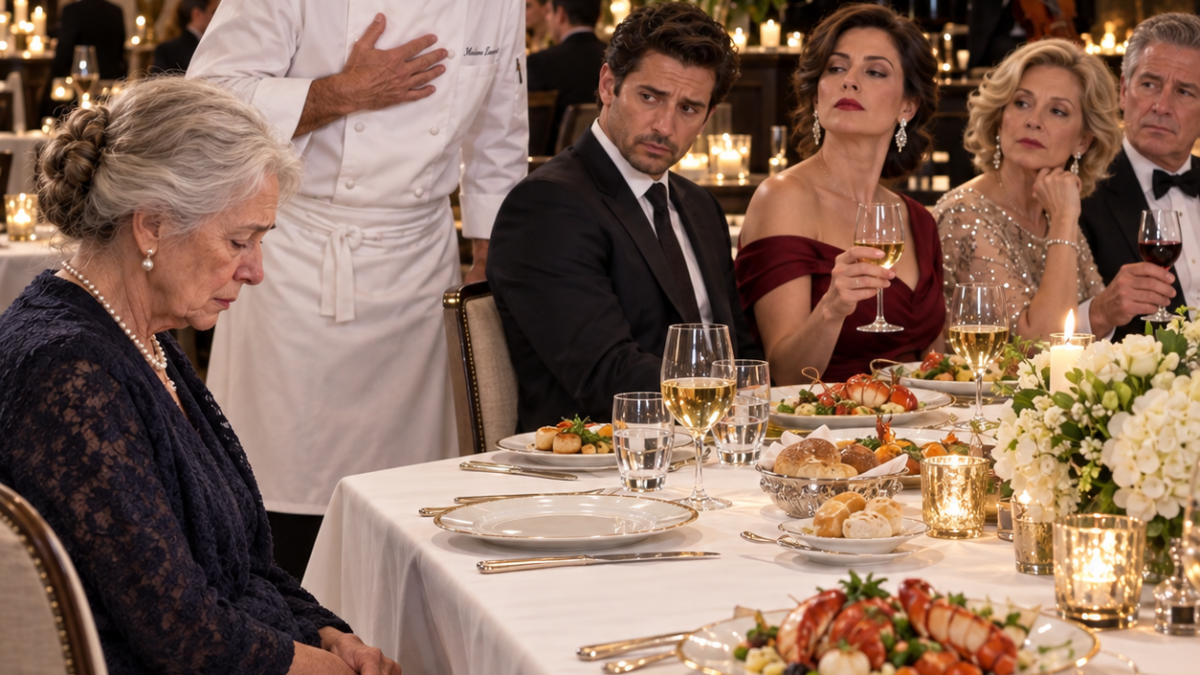
Claire slid Eleanor’s water glass closer to her seat.
“That will be enough for her.”
Eleanor looked at Ethan.
For twenty-five years, she had done everything she could for that boy.
His father disappeared when Ethan was six. Not died. Not tragically taken. Simply left, with two bags, a tired apology, and a promise to call that became less frequent until it became nothing. Eleanor never told Ethan the ugliest parts. She let him remember his father as a complicated man instead of a selfish one because she believed children deserved at least one parent who protected the soft places.
She worked early mornings cleaning offices downtown, afternoons in a school cafeteria, and nights wherever commercial kitchens needed extra hands. Some months, she ate toast for dinner and told Ethan she had eaten at work. When his shoes wore through, she bought him new ones and patched her own. When he needed a science fair display, she stayed up until two in the morning cutting cardboard with a dull knife. When he was accepted into college, she cried in the bathroom where he could not see because pride and terror had arrived together.
Now he sat across from her in a suit that cost more than her first car.
“Ethan?” she said softly.
He kept his eyes down.
“Mom, please.”
“Please what?”
He finally looked at her.
There was discomfort in his face.
Not outrage.
Not shame strong enough to become action.
Just discomfort, as if she had placed him in an awkward position by existing where Claire could see her.
“Don’t embarrass us,” he muttered. “Just accept it. Remember your place.”
Something inside Eleanor went very still.
Not angry.
Anger moved.
This did not.
This was a door closing deep in her chest.
She nodded once.
“Understood.”
Claire smiled.
She thought she had won.
For the next few minutes, conversation continued around Eleanor as if she had become part of the décor. Claire talked about “family image.” Patricia agreed that certain relationships required boundaries. Richard mentioned that success demanded “curation,” as if people were paintings to be hung or removed depending on the room.
Eleanor kept both hands folded in her lap.
Beside her chair, the little strawberry cake waited in its white box.
Claire glanced at it again.
Then at Eleanor.
“You know,” she said, setting down her wineglass, “I hope you don’t take this personally.”
Eleanor looked at her.
“That is rarely a good beginning to a kind sentence.”
Ethan’s head lifted.
Claire’s smile sharpened.
“I only mean, Ethan and I are entering a different phase of life. We’re meeting more influential people now. There are expectations. Certain relatives no longer fit every setting.”
“Claire,” Ethan said weakly.
But his voice had no spine in it.
Claire touched his sleeve without looking at him.
“It’s important to be realistic about what everyone brings to the family.”
Patricia nodded.
“Every family has to adapt as circumstances change.”
Eleanor looked from one face to another.
Claire’s parents did not appear embarrassed.
That was the saddest part.
Cruelty had always shocked Eleanor less than the comfort some people felt while witnessing it.
Claire leaned back.
“What exactly do you think you contribute, Eleanor?”
Eleanor could have answered.
She could have told Claire about the mornings she rose at four to clean law offices where men in suits left coffee rings on desks and spoke to her only when something was missing.
She could have told her about cafeteria steam burns, unpaid bills, and the winter Ethan needed antibiotics when she had thirty-two dollars in the bank.
She could have told her about the night she walked six miles home because the bus stopped running and she had used her last cash to buy Ethan a graphing calculator.
She could have told her she contributed the man Claire married.
But Eleanor said nothing.
Because at that exact moment, the kitchen doors opened.
The executive chef stepped into the dining room.
He was an older man with silver hair, a white chef’s coat, and the composed authority of someone whose presence changed the temperature of a room. He was speaking quietly to the restaurant manager while scanning the dining room, likely checking service.
Then his eyes landed on Eleanor.
He stopped walking.
The manager took two more steps before realizing he was alone.
The chef stared.
Not politely.
Not vaguely, the way one recognizes a customer from a previous evening.
He stared as if the past had risen from a chair at the far end of the room.
“Mrs. Hayes?”
Claire turned.
Ethan turned.
Eleanor’s lips parted slightly.
For one moment, she saw not the silver-haired executive chef in the perfect white coat, but a young man in a stained apron standing in the back of a hot kitchen with panic in his eyes and flour on his cheek.
“Daniel,” she said.
The chef came toward the table.
His expression changed with every step, surprise giving way to something almost emotional. He ignored Claire. Ignored Richard and Patricia. Ignored the half-poured wine, the silver, the quiet rules of a dining room where people paid to feel important.
He stopped beside Eleanor’s chair.
“Ma’am,” he said quietly, “why didn’t anyone tell me you were here?”
The entire table went silent.
Claire forced a laugh.
“You know Eleanor?”
Daniel Mercer slowly looked at her.
Then he noticed the empty place setting in front of Eleanor.
Only a glass of water.
His face hardened.
“Yes,” he said. “I know exactly who she is.”
The waiter stood a few feet away, pale with the expression of a man hoping he was not about to be blamed for obeying instructions.
Daniel turned to him.
“Who told the staff not to serve Mrs. Hayes?”
No one answered.
Claire set her fork down.
“It was a family decision.”
Daniel stared at her for a moment.
Family.
The word seemed to offend him more than the insult itself.
Then he turned back to Eleanor.
“Mrs. Hayes, Mr. Laurent is upstairs.”
Eleanor’s heart skipped.
The room shifted beneath her.
That name belonged to a life she had folded away nearly eighteen years earlier.
A life Ethan had never asked about because she had never offered it.
Daniel continued, more gently, “He’s been trying to find you for a very long time.”
Ethan finally looked at his mother.
“Mom,” he said, his voice uncertain now, “who is Mr. Laurent?”
Before Eleanor could answer, the restaurant manager hurried toward the table carrying an old photograph in a protective sleeve. Daniel took it from him with both hands and placed it carefully beside Eleanor’s untouched glass of water.
Claire leaned forward.
Ethan did too.
The photograph showed a younger Eleanor standing in a restaurant kitchen beside three people.
Daniel was one of them.
He could not have been more than twenty-two then, thin and exhausted, with dark hair falling into his eyes and a cook’s jacket too large for him.
But it was the man standing on Eleanor’s other side who made Ethan go completely silent.
August Laurent.
Even people who could not afford his restaurants knew the name. He was the owner of Laurent House, founder of one of the most respected restaurant groups in the country, a man whose face had appeared in business magazines, culinary documentaries, and charity event programs Claire collected as if proximity to greatness could be preserved in paper.
In the photograph, August Laurent was younger, his arm around Eleanor’s shoulders, his other hand resting on Daniel’s back.
Beneath the photograph, written in faded ink, were the words:
To Eleanor Hayes, who saved the boy, the kitchen, and the future we had not yet earned.
Ethan stared at the sentence.
Claire’s face lost color.
“What does that mean?” she asked.
Daniel did not answer her.
He looked at Eleanor.
“May I?”
Eleanor’s throat tightened.
For years, she had believed the story did not matter. Not because it was small, but because speaking of it felt like claiming something she had never done for credit. She had helped because someone needed help. She had walked away because Ethan needed school shoes, rent was due, and life had no patience for dramatic endings.
Now the table waited.
Her son waited.
The woman who had just asked what she contributed waited.
Eleanor looked at Daniel and gave the smallest nod.
Daniel pulled out the chair beside her and sat.
It was not something executive chefs did in the middle of dinner service.
Managers glanced over.
Waiters slowed.
A few nearby diners noticed.
Daniel did not care.
“Almost twenty years ago,” he began, “before this restaurant existed, before Laurent House meant anything to anyone, Mr. Laurent owned a failing kitchen on West Ninth Street. It was called Le Marché. Not fancy. Not successful. Mostly held together with debt, stubbornness, and people working too many hours.”
Eleanor looked down at her hands.
They were older now.
Veins raised.
Knuckles slightly swollen.
But she remembered the heat of that kitchen, the clang of pans, the sharp smell of onions hitting oil, the endless wet towels, the sting of soap cracked into her fingers.
Daniel continued.
“I was a line cook there. Barely. I was young, broke, angry, and sure the world owed me a chance I kept trying to ruin. Mrs. Hayes worked nights in that kitchen after spending all day at another job.”
Ethan’s eyes moved to his mother.
“You worked there?”
Eleanor nodded.
“You were in high school. Then college. I worked a lot of places.”
The words were simple.
Too simple for what they contained.
Daniel’s voice lowered.
“One night, I made a mistake that could have killed people.”
The dining room seemed to grow quieter around them.
Claire shifted in her seat.
Daniel looked at the photograph.
“We had a gas issue in the kitchen. Old equipment. Bad valve. I smelled something, but I was behind on orders, overwhelmed, and afraid of getting fired. I told myself I’d mention it after service. Then a towel caught near the burner. Fire climbed faster than anything I had ever seen.”
Eleanor remembered the sound first.
Not the flames.
The sound.
A deep whoosh, like the whole room inhaling terror.
She had been in the dish area, hands submerged in hot water. Daniel had been near the line. Another dishwasher, Rosa, was carrying crates near the back. August Laurent had been in the office arguing with a creditor on the phone.
“For a few seconds,” Daniel said, “everyone froze. I froze. The young cook who thought he was tough froze like a child.”
“You were in shock,” Eleanor said quietly.
“I was useless,” Daniel replied. “There’s a difference.”
Eleanor looked at him sharply.
“No, Daniel. There isn’t always.”
He swallowed.
The old argument lived between them for a moment, softened by time but not gone.
“Mrs. Hayes moved first,” he said. “She hit the gas shutoff. She shoved me away from the flare. She pulled Rosa out from behind the crates when smoke filled the back hall. Then she went back because Mr. Laurent was still in the office and the door had jammed.”
Ethan’s face changed.
“You went back into a fire?”
Eleanor did not look at him.
“It was a small kitchen.”
Daniel let out a short, humorless laugh.
“It was an old building filling with smoke.”
Claire’s lips parted, but no words came.
Daniel kept going.
“She got Mr. Laurent out. Burned both her hands. Cut her arm on the office door glass. Breathed in enough smoke that the paramedics wanted to take her to the hospital.”
Ethan looked down at Eleanor’s hands as if seeing them for the first time.
There were scars there.
Faint now.
Thin pale lines across the back of her right hand and wrist. He had seen those scars his whole life and never asked about them. Eleanor had told him once she burned herself at work. That had been true. Not complete, but true.
“What happened after?” Ethan asked.
Daniel’s jaw tightened.
“The fire department investigated. The insurance company got involved. The building owner tried to blame the kitchen staff. Mr. Laurent almost lost everything. I was terrified because I had smelled gas earlier and said nothing. I thought if anyone knew, my life was over.”
He turned toward Eleanor.
“She knew.”
Eleanor closed her eyes briefly.
“She heard me tell another cook I smelled something near the burner,” Daniel said. “She could have said I ignored it. She could have let them blame me. Honestly, she probably should have.”
“No,” Eleanor said.
“Mrs. Hayes,” Daniel said softly, “I was reckless.”
“You were young and scared.”
“People could have died.”
“But they didn’t.”
“Because of you.”
She looked at him then.
“Because after that night, you became a man who never ignored danger again.”
Daniel’s eyes shone.
He looked back at the table.
“The investigators asked Mrs. Hayes what happened. She told the truth, but she told the whole truth. Not just the part that would have destroyed me. She said the equipment had been failing for weeks. She said staff had complained. She said the building owner had delayed repairs. She said I had smelled something, yes, but she also said the kitchen culture punished people for slowing service, for speaking up, for making problems expensive.”
Richard shifted uncomfortably.
Daniel’s voice grew steadier.
“Her statement saved me from being turned into a scapegoat. It helped Mr. Laurent hold the building owner accountable. The insurance settlement kept him from bankruptcy. He rebuilt. He kept several of us on payroll while the kitchen was closed. He paid for my culinary school application fee because Mrs. Hayes told him I was worth saving.”
Ethan turned to his mother.
“You never told me any of this.”
Eleanor’s smile was faint.
“You were applying to college. You had enough to carry.”
“I had enough to carry?” His voice cracked slightly. “Mom, you were burned in a fire.”
“And you had finals.”
The simplicity of that answer struck him harder than any accusation could have.
Claire cleared her throat.
“This is very moving,” she said, though her voice had stiffened, “but I’m not sure what it has to do with tonight.”
Daniel looked at her.
“It has everything to do with tonight.”
Before Claire could respond, another presence approached the table.
The restaurant manager stepped aside.
An elderly man in a dark suit walked slowly toward them with one hand resting lightly on a cane. His hair was white now, his face lined, but his eyes were unmistakable.
August Laurent.
The owner of Laurent House.
The man whose name Claire had spoken about for years as if being invited to one of his charity dinners would prove she had arrived somewhere important.
He stopped beside Eleanor.
For a moment, neither of them spoke.
Then August Laurent bowed his head.
“Eleanor.”
She stood slowly.
“August.”
He took both her hands with surprising gentleness.
Around the table, everyone watched.
Claire looked stunned. Patricia looked as if her pearls had tightened around her throat. Richard sat very still. Ethan appeared lost, as though the mother he had known had suddenly opened into rooms he had never bothered to enter.
August looked down at Eleanor’s hands.
“I looked for you.”
“I moved,” Eleanor said.
“I know. Daniel told me later. By then, the number was gone.”
“Life was busy.”
“You disappeared.”
“I had a son to raise.”
August’s eyes moved to Ethan.
There was no warmth in the glance.
Not cruelty.
Assessment.
“So this is Ethan.”
Ethan stood awkwardly.
“Yes, sir.”
August did not offer his hand.
Instead, he turned toward the table.
“I came downstairs because Daniel sent word that Eleanor Hayes was in my dining room.” He looked at the empty place in front of her. “I did not expect to find her being refused dinner.”
Claire’s mouth opened.
“Mr. Laurent, this is a misunderstanding.”
“Is it?”
Her voice shook just a little.
“We invited her. We wanted to include her.”
August looked at the water glass.
“Include her in what? Thirst?”
A nearby waiter looked down quickly, but not before Eleanor saw his mouth twitch.
Claire flushed.
“She said water was fine.”
Eleanor spoke quietly.
“No. I accepted water after you ordered food for everyone else.”
The sentence landed cleanly.
No drama.
No raised voice.
Just truth.
That had always been Eleanor’s most dangerous quality.
Claire looked at Ethan, expecting rescue.
Ethan did not move.
For once, he had nothing polished to say.
August turned to the waiter.
“Please clear Mrs. Hayes’s empty setting and reset this place properly. Daniel, send whatever she wants. And bring the strawberry cake to the kitchen.”
Claire blinked.
“The cake?”
Daniel looked at the box beside Eleanor’s chair.
“For Lily?” he asked.
Eleanor nodded.
He smiled.
“We’ll plate it properly for the family to take home. With Mrs. Hayes’s permission.”
“Of course.”
Claire found her voice.
“That’s really not necessary. We ordered dessert from the restaurant.”
August looked at her.
“Did you?”
Claire faltered.
“Well, we planned to.”
“Then perhaps tonight you will discover that something made with love does not become lesser because it came in a bakery box.”
Eleanor lowered her eyes.
She did not want Claire destroyed.
That was the difficult thing about people like Eleanor. Humiliation did not make her hungry for someone else’s humiliation. Pain did not make her cruel. She wanted truth to stand up, yes. But she did not need it to kick anyone once it rose.
August gestured gently toward her chair.
“Please sit, Eleanor.”
She sat.
But Ethan remained standing.
He looked at the photograph.
Then at his mother’s hands.
Then at the water glass.
Something was happening inside him, and he did not yet know whether to resist it or let it break him open.
“Mom,” he said.
Eleanor looked up.
He swallowed.
“I didn’t know.”
She held his gaze.
“You didn’t ask.”
That was all.
No accusation.
No tears.
Just five words with twenty-five years inside them.
Ethan sat slowly.
The waiter reset Eleanor’s place with fresh silver, a warm plate, and a folded napkin. Daniel asked her what she wanted. She tried to choose something modest, but August interrupted.
“Eleanor, for once in your life, do not order as if you are trying not to cost anyone anything.”
Her lips trembled.
The room blurred for a second.
“Then I’ll have whatever Daniel thinks is best.”
Daniel’s face softened.
“Yes, ma’am.”
He disappeared toward the kitchen.
The table remained in a silence so tense even the crystal seemed careful.
Claire reached for her wine, then seemed to think better of it.
Patricia attempted a small smile.
“Well,” she said, “this is certainly unexpected.”
August, who had pulled a chair from a nearby empty table and seated himself beside Eleanor without asking permission from anyone, looked at Patricia.
“Kindness often is, to people who don’t practice it.”
Patricia’s smile died.
Richard cleared his throat.
“Mr. Laurent, surely you understand family dynamics can be complicated.”
“I understand many things,” August said. “I understand debt. Hunger. Pride. Fear. I understand young men who become ashamed of where they came from because the world rewards them for pretending they arrived alone.”
Ethan flinched.
August continued, not loudly, which somehow made it worse.
“I also understand the difference between refinement and character. They are often confused in rooms like this.”
Claire’s cheeks burned.
Eleanor placed one hand on the table.
“August.”
He looked at her.
Her eyes were gentle, but firm.
“Enough.”
The old man studied her for a moment.
Then he nodded.
“Of course.”
That, more than anything, unsettled the table.
August Laurent, a man who owned half the building and commanded the room without lifting his voice, stopped because Eleanor Hayes said enough.
Ethan saw it.
Claire saw it too.
Daniel returned first with a small bowl of soup.
Not ordinary soup.
A delicate lobster bisque, rich and fragrant, with a swirl of cream and herbs so finely cut they seemed painted onto the surface. He placed it before Eleanor himself.
“Do you remember this?” he asked.
Eleanor leaned closer.
Her expression changed.
“You kept it?”
“I fixed it,” Daniel said. “You were right. Too much sherry.”
Eleanor gave a soft laugh.
The sound was small, but it startled Ethan.
He could not remember the last time he heard his mother laugh like that in public. Not politely. Not to soothe someone else. Truly.
Daniel smiled.
“The first soup I ever made that didn’t get sent back was because Mrs. Hayes tasted it from the dish station and told me I was hiding behind alcohol.”
“I said no such thing.”
“You said, ‘Baby, if you burn the onions, sherry won’t save you.’”
August laughed then, a warm low sound.
“That sounds exactly like Eleanor.”
Ethan stared.
His mother had a history here.
Not as a guest.
Not as someone tolerated.
As someone remembered.
Respected.
Loved.
The lobster dinners arrived for the rest of the table, but no one ate with the same confidence now. Claire cut small pieces she barely tasted. Patricia kept adjusting her napkin. Richard drank too quickly. Ethan watched every interaction between his mother, Daniel, and August as if trying to assemble a portrait from fragments he had thrown away years ago.
Daniel brought Eleanor roasted fish after the soup, then handmade pasta with mushrooms because, he said, “You always worked too hard to eat properly during staff meal.”
Eleanor protested that it was too much.
August told her, “Good.”
Between courses, the story unfolded.
Not all at once.
Eleanor would never have allowed that.
It came in pieces.
Daniel told Ethan how Eleanor used to bring leftovers home not for herself but for “a growing boy who needed real food.”
August told him how she refused extra cash after the fire but accepted more shifts because “charity embarrassed her and work did not.”
Daniel told him she once spent half her break teaching him how to make rice pudding because he missed his grandmother.
August revealed that after Le Marché reopened, he had offered Eleanor a permanent position managing kitchen operations.
Ethan turned to her.
“You never told me that either.”
Eleanor took a sip of water.
“I didn’t take it.”
“Why not?”
“You had just been accepted into the summer program before college. The hours would have changed. I needed something predictable.”
August looked at Ethan.
“She chose your future over her own advancement.”
The sentence struck the table.
Eleanor set down her spoon.
“August.”
“It is true.”
“It was my choice.”
“Yes,” August said. “And choices deserve witnesses.”
Ethan’s face had gone pale.
He looked down at the table as though his mother’s entire life had been laid before him, course by course, and he had no appetite left for his own success.
Claire, however, had begun to recover enough to protect herself.
“I think everyone is making this sound much harsher than it was,” she said. “Eleanor never asked for dinner. She didn’t object.”
Daniel turned slightly.
“She shouldn’t have had to.”
Claire’s eyes flashed.
“With respect, Chef, this is a private family matter.”
Daniel’s voice stayed calm.
“You made it public when you humiliated her in my dining room.”
Claire looked toward August.
“I didn’t humiliate her.”
“No,” Eleanor said softly.
Everyone turned.
Eleanor looked at Claire.
“You tried to.”
The distinction silenced the table.
Claire’s mouth tightened.
“I was trying to help Ethan set boundaries.”
Eleanor nodded.
“I know.”
“You’ve always made him feel guilty.”
Ethan’s head snapped up.
“Claire.”
“No, Ethan. This is exactly the problem.” Claire’s voice trembled now, not from remorse but from the panic of losing control of a room she had expected to own. “Your mother uses sacrifice like a leash. She sits there looking wounded, and everyone acts like we’re monsters for wanting our own life.”
Eleanor looked at her son.
For once, she did not answer Claire.
She wanted to know whether Ethan would.
He stared at his wife, then at his mother.
Years seemed to pass across his face.
The boy who once cried because he could not buy her a birthday gift.
The teenager who hugged her after graduation and whispered, “We did it.”
The young man who called every Sunday from college.
The husband who slowly stopped visiting because Claire found his mother “draining.”
The son who, twenty minutes earlier, had told Eleanor to remember her place.
He put down his fork.
“No,” he said.
Claire blinked.
“What?”
“No,” Ethan repeated, voice stronger this time. “She didn’t use sacrifice like a leash. I used it like a ladder and then acted offended when I didn’t want people seeing where it started.”
Eleanor’s eyes filled, but she did not look away.
Claire stared at him.
“You’re really doing this here?”
Ethan let out a broken laugh.
“That’s what I should’ve said to you when you told the waiter not to serve my mother.”
Claire recoiled as if slapped.
Patricia leaned forward.
“Ethan, emotions are high. Perhaps this conversation should happen privately.”
Ethan looked at his mother-in-law.
“I agree. A lot of things should’ve happened privately. Like my wife deciding my mother was too embarrassing to feed.”
Richard muttered, “This is getting out of hand.”
August said, “No. It is finally in hand.”
Eleanor almost smiled despite herself.
The waiter returned with another plate for Eleanor, something Daniel had sent “because he says you need to taste the sauce and tell him the truth.”
Eleanor looked toward the kitchen doors, shaking her head.
“He always was impossible.”
“He says you made him that way,” the waiter replied.
This time, Eleanor laughed.
The sound softened something at the table, but not enough to erase what had happened.
Some damage did not vanish just because truth arrived.
It simply became visible.
After the entrées, Daniel returned carrying the strawberry cake.
But it was no longer in the white bakery box.
The kitchen had placed it on a white porcelain platter. Fresh strawberries circled it like red jewels. A small ribbon of cream had been piped around the edge, and beside it, in chocolate, someone had written:
For Lily, from Grandma Eleanor.
Eleanor pressed one hand to her chest.
“Oh, Daniel.”
He looked almost shy.
“She should know who made it.”
Claire stared at the cake.
Her expression was impossible to read now. Anger, embarrassment, confusion, maybe something like shame moving too far beneath the surface to name.
Ethan looked at the words.
Grandma Eleanor.
Not Eleanor.
Not “your mother.”
Not an inconvenience.
Not a woman to be managed at the end of a table.
Grandma.
The woman who had made a cake because a little girl liked strawberries.
Daniel set a smaller plate in front of Eleanor.
“This piece is yours.”
“I made it for Lily.”
“And Lily can share.”
Eleanor smiled.
For the first time that evening, she picked up a fork to eat food that had not been granted to her by someone else’s permission.
The cake was not perfect.
She knew that at once.
The sponge was a little denser than she wanted. The frosting had softened during the drive. The strawberries had released too much juice near one edge.
But when she took a bite, she tasted her small kitchen, the morning light over the counter, Lily’s bright voice asking for “the smiling cake,” and all the love Claire had tried to make look cheap.
It tasted wonderful.
Ethan watched her.
Then he said, very quietly, “Can I have a piece?”
Eleanor looked at him.
The question was not about cake.
Everyone knew it.
For a moment, Eleanor could see him at eight years old, standing in their old kitchen with frosting on his nose. At seventeen, too proud to admit he was scared of leaving for college. At twenty-two, calling her after his first job offer. At thirty-eight, sitting across from her in an expensive restaurant, finally realizing that success without gratitude had made him smaller, not larger.
She nodded.
“Yes.”
Daniel cut him a slice.
Ethan took one bite and closed his eyes.
The table waited.
He looked down at the plate.
“You made this every year for me.”
“Until you said you were too old for it.”
“I was fourteen.”
“You were trying to impress a girl from debate club.”
He laughed once, and the sound broke.
“I was horrible.”
“You were fourteen.”
“I mean tonight.”
Eleanor’s hand stilled.
Ethan looked at her fully then.
“I’m sorry, Mom.”
Claire’s face hardened at the apology, but Ethan did not look at her.
“I’m sorry I let her speak to you like that. I’m sorry I said what I said. I’m sorry I made you feel like you had to earn a seat at my table when you built the whole table under me.”
Eleanor’s tears finally fell.
She did not sob.
She had spent too many years mastering the art of quiet pain.
One tear slipped down, then another.
“I never wanted you to feel indebted to me,” she said.
“I know.”
“I wanted you to be free.”
“I know.” His voice shook. “But I think I confused being free with acting like I came from nowhere.”
Claire pushed back her chair.
“I can’t listen to this.”
Ethan looked at her.
“Then don’t.”
The room stilled.
Claire stood.
Patricia reached for her daughter’s arm, but Claire pulled away.
“You’re choosing this?” Claire demanded.
Ethan looked tired suddenly.
Not weak.
Tired of the wrong life.
“I’m choosing not to let you humiliate my mother again.”
Claire’s laugh was sharp.
“You’re going to regret embarrassing me in front of my parents and August Laurent.”
Ethan stood too.
“No, Claire. I regret embarrassing my mother in front of a waiter.”
That sentence changed Eleanor’s face.
Something inside her softened, but not all the way.
Forgiveness was not a door that opened simply because someone finally found the right words. It was slower than that. It had locks. Hinges rusted by years. Rooms behind it that needed cleaning before anyone could live there again.
But the sentence mattered.
Claire grabbed her purse.
Patricia stood with her.
Richard followed, muttering something about “unnecessary theatrics.”
Before leaving, Claire looked at Eleanor one last time.
There was hate in her face.
But beneath it, something else.
Fear.
Not fear of Eleanor.
Fear that the world she had built by ranking people had turned and ranked her.
“You must be very pleased,” Claire said.
Eleanor wiped her cheek with her napkin.
“No,” she said. “I’m very tired.”
Claire had no answer for that.
She left with her parents.
The table felt larger after she was gone.
Not happier exactly.
Just less crowded by cruelty.
Ethan remained standing, uncertain what to do with himself.
August rose slowly.
“I’ll leave you two.”
Daniel nodded and signaled to the staff to give them privacy.
When they were alone at the table, Ethan sat beside his mother instead of across from her.
That small movement nearly undid her.
“Mom,” he said.
Eleanor looked at the photograph still lying beside the water glass.
“You know,” she said softly, “I always wondered whether keeping things from you was kindness or pride.”
“What things?”
“All of it. The worst shifts. The hunger. The fire. The offers I didn’t take. The people who helped me. The people I helped. I thought if you knew too much, you would feel guilty.”
“I should have known.”
“You were a child.”
“I’m not a child now.”
“No,” she said. “You’re not.”
The words were gentle.
They were also firm.
Ethan lowered his head.
“I don’t know how to fix this.”
Eleanor looked at him for a long time.
The easy answer would have been to comfort him. To say, You already have. To smooth the moment over, protect him from shame, and make herself responsible for his feelings the way she had done all his life.
But she was sixty-five now.
She had sat at the end of a table with water while her son looked away.
Love did not require her to lie.
“You don’t fix it tonight,” she said.
He swallowed.
“Okay.”
“You start by asking Lily what kind of cake she likes instead of letting Claire decide which parts of her family are presentable.”
His mouth trembled.
“Okay.”
“You come see my apartment without making me feel like it embarrasses you.”
“I will.”
“You stop letting anyone speak of me as if I’m a problem to manage.”
“I promise.”
She looked at him carefully.
“Do not promise quickly. Promise only what you intend to practice.”
Ethan nodded slowly.
“I’ll practice.”
That answer was better.
Outside the restaurant, snow had begun to fall lightly. Not enough to cover the city. Just enough to soften the edges of the streetlights.
Ethan insisted on driving Eleanor home.
She let him.
He carried the cake carefully in both hands while she held the old photograph August had told her to keep.
In the car, they sat for a while without moving.
The city lights blurred across the windshield.
Ethan touched the steering wheel but did not start the engine.
“Did Dad know?” he asked.
“About the fire?”
“About any of it. About what you did for me.”
Eleanor looked out the window.
“Your father knew enough.”
“Did he ever come back?”
The question was quiet.
Old.
Still wounded after all these years.
“He called once when you were sixteen.”
Ethan turned.
“What?”
“He was in Arizona. He asked if you wanted to see him.”
“You never told me.”
“I asked if he was sober. He said mostly. I asked if he was staying. He said he didn’t know. So I told him when he knew, he could call again.”
“Did he?”
“No.”
Ethan sat back.
“Why didn’t you tell me?”
“Because you were finally sleeping through the night without waiting for him.”
His eyes filled.
Eleanor reached over and touched his hand.
“That was my choice, Ethan. Maybe not perfect. But mine.”
He turned his hand and held hers.
The scars on her skin looked pale beneath the dashboard light.
“I don’t deserve you,” he whispered.
“No,” she said.
He looked startled.
Then Eleanor continued.
“Children don’t deserve parents. Parents don’t deserve children. Love isn’t wages. But we are responsible for how we treat what we’ve been given.”
He nodded, tears slipping down his face now.
For once, Eleanor did not wipe them away.
He needed to feel them.
The drive to her apartment was quiet.
When they reached the old brick building, Ethan stepped out and looked up. Eleanor saw it through his eyes suddenly: the chipped front steps, the narrow entrance, the flickering hallway light, the mailboxes with peeling labels.
For years, she had dreaded that look.
Tonight, he did not turn away from it.
He carried the cake upstairs.
Her apartment was small but warm. A knitted throw lay over the couch. Framed pictures of Ethan as a boy lined one shelf. Lily’s crayon drawing of a purple cat hung on the refrigerator. A stack of library books sat on the table beside a jar of tea bags.
Ethan stood in the living room, taking in the home he had visited too rarely.
“I forgot this place smelled like cinnamon,” he said.
“I made tea before I left.”
“I forgot you always do that.”
“You forgot many small things.”
He looked at her.
“I did.”
Eleanor put the kettle on anyway.
Because even when a heart was bruised, habits of care remained.
But this time, as she prepared cups, Ethan moved beside her.
“What can I do?”
She handed him two mugs.
“Start there.”
He smiled weakly.
“Yes, ma’am.”
They sat at the small kitchen table and ate another slice of cake.
This one without crystal glasses.
Without lobster.
Without Claire’s cold eyes.
Ethan asked about Le Marché. About Daniel. About August. About the fire. About the jobs. Not all at once. Carefully. Like a man learning that his mother’s life was not a hallway leading to his own, but a house full of rooms he had never entered.
Eleanor answered some questions.
Others she saved.
Not to punish him.
Because trust rebuilt too quickly was just performance.
Near midnight, Ethan’s phone buzzed again and again.
Claire.
He looked at the screen.
Then turned it face down.
Eleanor noticed.
“You will have to speak with her.”
“I know.”
“Do not be cruel.”
He laughed softly, bitterly.
“After tonight, I’m not sure I know the difference between cruel and honest.”
“You do,” she said. “Cruelty tries to make someone smaller. Honesty gives them a chance to stand in the truth. Even if they don’t take it.”
Ethan absorbed that.
“She won’t apologize.”
“Maybe not.”
“I don’t know what that means for my marriage.”
“Neither do I.”
“You’re not going to tell me what to do?”
“No.”
He looked almost hurt.
Then she smiled sadly.
“You are a grown man. I raised you so I would not have to make your choices forever.”
He nodded.
For the first time in years, he looked like her son without looking like a boy.
The next morning, Ethan came back.
Not with flowers.
Not with a dramatic speech.
With groceries.
Eleanor opened the door and found him holding two paper bags, looking embarrassed.
“I didn’t know what you needed,” he said. “So I bought too much.”
She looked into the bags.
Milk.
Eggs.
Tea.
Strawberries.
A package of the butter cookies she liked but never bought because they cost more than she thought cookies had any right to cost.
Her throat tightened.
“You remembered these?”
“I remembered last night after forgetting for ten years.”
She let him in.
That became the beginning.
Not a perfect reconciliation.
Not a movie ending.
A beginning.
Ethan visited twice that week. Then again the next. He brought Lily on Saturday without asking Claire’s permission as if family required approval from the most polished person in the room.
Lily ran into Eleanor’s apartment carrying a stuffed rabbit and shouted, “Grandma! Daddy said you made me a fancy cake at the fancy place!”
Eleanor laughed so hard she had to sit down.
“I made you a regular cake that visited a fancy place.”
“Can we make another one?”
“Yes.”
Ethan stood in the doorway watching them, and Eleanor saw his face change when Lily climbed onto the kitchen chair and Eleanor tied an apron around her small waist.
He was seeing it now.
The inheritance he had almost thrown away.
Not money.
Not status.
This.
Flour on a child’s hands.
A grandmother’s voice.
A small apartment warm with cinnamon.
A love that did not need to impress anyone to be real.
Claire did not come.
For several weeks, she refused to speak to Eleanor directly. She sent messages through Ethan that sounded like statements drafted by a lawyer and a wounded ego working together. Ethan did not repeat the worst of them. Eleanor knew because his face changed sometimes when he looked at his phone.
Eventually, Claire agreed to counseling.
Not because she had transformed overnight.
Because Ethan told her their marriage could not continue if contempt remained the language of the house.
At the first session, Claire said Eleanor had always made her feel judged.
When Ethan told his mother that later, Eleanor considered it longer than he expected.
“Did I?” he asked.
“I don’t know,” Eleanor said. “Maybe by existing.”
“That’s not your fault.”
“No. But sometimes people feel accused by what they haven’t learned to value.”
Claire’s apology, when it came, was stiff and imperfect.
She stood in Eleanor’s apartment doorway one rainy afternoon, expensive coat damp at the shoulders, hands clasped too tightly.
“I was cruel at dinner,” she said.
Eleanor waited.
Claire looked down.
“I embarrassed you intentionally.”
“Yes.”
The honesty of Eleanor’s answer made Claire flinch.
“I’m sorry.”
Eleanor studied her.
There were many things she could have said.
She could have demanded explanations. She could have listed every slight Claire had offered over the years, every holiday rearranged, every invitation withheld, every time Lily’s visits became shorter because Claire had “plans.”
Instead, Eleanor said, “Thank you for saying it plainly.”
Claire looked up, surprised.
“I don’t expect you to forgive me immediately.”
“That is wise.”
A small, unwilling laugh escaped Claire.
Then she looked around the apartment.
For once, Eleanor did not feel ashamed of what Claire saw. The worn couch. The old table. The tea towels. The family photos. Lily’s drawings on the refrigerator. The life that had seemed small only to people who measured rooms instead of what happened inside them.
Claire’s eyes stopped on a framed copy of the old photograph from Laurent House.
“To Eleanor Hayes, who saved the boy, the kitchen, and the future we had not yet earned.”
“I didn’t know,” Claire said.
“No,” Eleanor replied. “You didn’t.”
Claire swallowed.
“I think I assumed Ethan became who he was because he escaped this.”
Eleanor’s expression did not change.
Claire’s eyes filled, not dramatically, but with the discomfort of a person hearing her own ugliness aloud.
“But he became who he was because you kept this safe enough for him to leave.”
Eleanor looked toward the window.
“That is closer to the truth.”
Claire wiped quickly at one eye.
“I don’t know how to undo what I did.”
“You don’t undo humiliation,” Eleanor said. “You stop practicing it.”
Claire nodded.
For the first time, she looked less like an enemy and more like a woman standing at the edge of herself, unsure whether she wanted to turn back or become better.
Eleanor did not embrace her.
She did not invite her fully inside that day.
But she did offer tea.
Claire accepted.
That was enough for one afternoon.
Months later, Laurent House hosted a charity dinner for a culinary scholarship fund in Daniel Mercer’s name.
August Laurent insisted Eleanor attend as his guest of honor.
She refused three times.
He called on the fourth and said, “Eleanor, I am too old to argue with you forever, but not too old to win once.”
She attended.
This time, she wore the same navy dress.
Not because she had nothing better.
Because she had decided it was not the dress that had been wrong the first time.
Ethan came with Lily.
Claire came too.
She was quieter now. Still polished. Still careful. But something in her had loosened. She held Lily’s coat while the child ran to Eleanor, and when the waiter came around with drinks, Claire did not speak for anyone else.
Eleanor noticed.
She said nothing.
Daniel gave a speech that night.
He stood beneath warm lights in a dining room filled with donors, young cooks, restaurant staff, and people who had paid a great deal of money to feel generous. But Daniel did not flatter them. He did not make the story shiny.
He spoke of kitchens.
Of heat.
Of pressure.
Of young workers one mistake away from being discarded.
Of the people who notice who is struggling before that struggle becomes ruin.
Then he looked at Eleanor.
“I became a chef because someone who had every reason to protect herself chose to protect the truth instead,” he said. “She did not excuse my mistake. She made sure it did not become the only thing anyone ever knew about me. That distinction gave me a life.”
The room stood.
Applause filled the air.
Eleanor did not stand at first.
She sat with both hands folded, overwhelmed by being seen so openly after years of being treated as someone best kept small.
Then Lily tugged her sleeve.
“Grandma, they’re clapping for you.”
Eleanor looked at her granddaughter.
Lily’s face was bright with uncomplicated pride.
That was when Eleanor stood.
Not for Daniel.
Not for August.
Not for Claire or Ethan.
For Lily.
So the child would remember that a grandmother in an old navy dress could be honored in a room full of chandeliers.
So she would never believe kindness was weakness.
So she would never let anyone push water toward a woman who deserved a feast.
After the dinner, Ethan walked Eleanor to the entrance.
Snow was falling again, light and slow, softening the city outside the brass doors.
He helped her with her coat.
For years, she had helped him into jackets. Pulled mittens over small fingers. Tucked scarves beneath his chin. Brushed snow from his hair.
Now he held her coat carefully, as if care could travel backward and forward at once.
“Mom,” he said.
She looked at him.
“I know I said sorry.”
“You did.”
“I’m still sorry.”
“I know.”
“I think I’ll be sorry for a long time.”
Eleanor adjusted one sleeve.
“That may be useful.”
He gave a soft laugh.
“You don’t make anything easy.”
“I made many things easy for you. Perhaps too many.”
He nodded, accepting it.
Through the glass, Claire stood with Lily near the hostess stand. Lily was showing her mother the tiny chocolate Daniel had given her in a white paper bag. Claire listened, really listened, bending slightly so Lily did not have to speak upward.
Eleanor watched them.
“Will you be all right?” Ethan asked.
She turned back to him.
“Yes.”
“You sure?”
“No. But I am learning not to answer that question just to make other people comfortable.”
His eyes softened.
“Good.”
A black car waited outside for August. Daniel was being pulled into conversation by two young cooks. The restaurant glowed behind them, full of voices, silverware, heat, memory.
Eleanor looked at the dining room once more.
The first time she had sat there, she had been given water and told to remember her place.
Now she understood something Claire had not.
A person’s place was not assigned by the cruelest voice at the table.
Not by wealth.
Not by embarrassment.
Not by a son’s silence.
Not by a daughter-in-law’s contempt.
A person’s place was built from what they had survived, what they had given, who they had loved, and whether they could still sit upright after the world tried to make them small.
Eleanor Hayes had cleaned offices.
Served lunches.
Washed dishes.
Raised a son.
Saved a young cook.
Pulled men from smoke.
Fed children from kitchens where no one knew her name.
Made strawberry cakes in a small apartment.
Carried pain quietly enough that people mistook her silence for emptiness.
But silence was not emptiness.
And humility was not absence.
That night, when she stepped out under the soft falling snow, Ethan walked beside her.
Not ahead.
Not embarrassed.
Beside her.
Lily ran forward and took Eleanor’s hand.
“Grandma,” she said, “next time can we make the cake with extra strawberries?”
Eleanor smiled.
“Of course.”
Claire opened her mouth as if to say something, then stopped herself.
A small thing.
But Eleanor saw it.
She saw Ethan see it too.
Not every wound closed.
Not every apology healed.
Not every cruel person became kind because one evening exposed them.
But some nights became turning points.
Some tables became mirrors.
Some glasses of water became evidence.
And sometimes, the woman placed at the far end of the table turned out to be the reason anyone at that table had anything worth keeping.
Eleanor squeezed Lily’s hand.
Behind them, Laurent House shone warmly against the winter dark.
Ahead of them, the sidewalk glittered with new snow.
For the first time in a long time, Eleanor did not feel like she was leaving a place where she did not belong.
She felt like she was walking out of a room that had finally remembered who she was.








