They Gave Her 72 Hours to Save a Military Dog Nobody Could Approach—Then She Used a Hand Signal No Handler on the Base Recognized
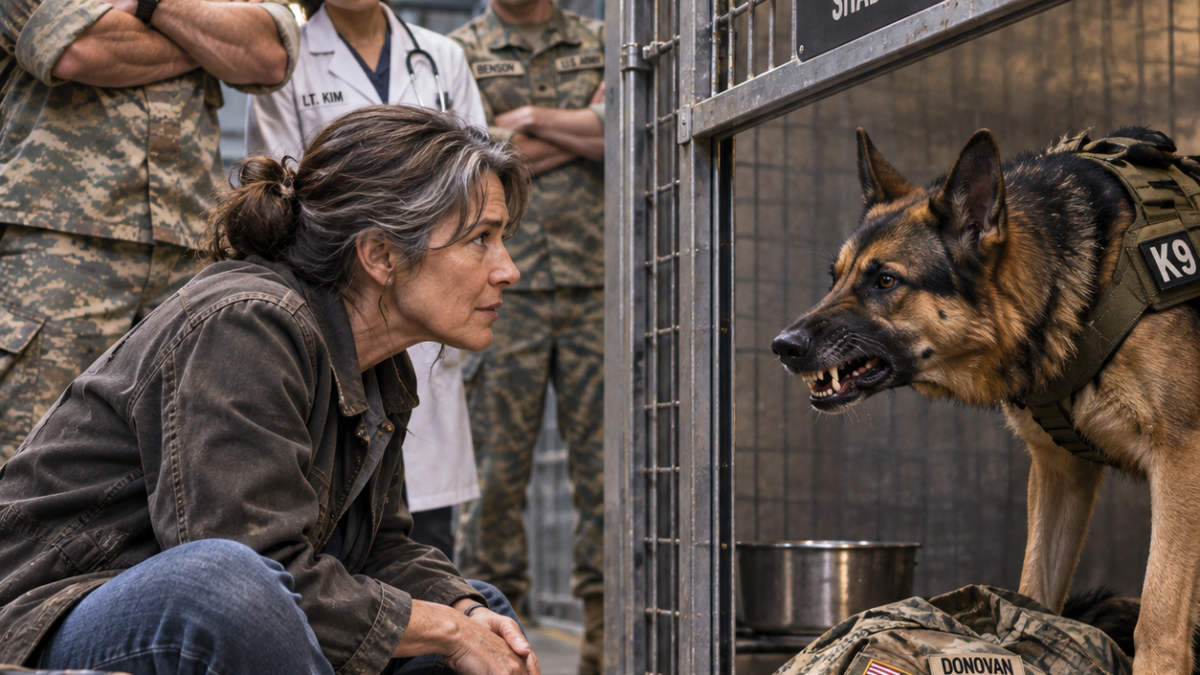
They Gave Her 72 Hours to Save a Military Dog Nobody Could Approach—Then She Used a Hand Signal No Handler on the Base Recognized.
They gave Evelyn Carter seventy-two hours to prove that a ninety-pound military German Shepherd named Shadow was still reachable before command signed the order nobody in the kennel wanted to discuss.
Every handler on the base believed Shadow had become dangerous after losing Staff Sergeant Michael Donovan—until Evelyn raised two fingers, turned her palm toward the floor, and made a small motion no one there recognized, and the dog everyone feared lowered his head and walked straight to her.
But the signal did more than save Shadow, because hidden inside his old harness was a note from Michael connecting two disaster-response incidents eleven months apart—and proving the dog had been trying to warn people long before anyone understood what he was saying.
“Seventy-two hours.”
Colonel Nathan Caldwell slid the medical report across the conference table.
Nobody touched it.
“After that, I’m signing the order.”
Through the glass wall of the working-dog facility, a German Shepherd stood inside Kennel Nine.
His name was Shadow.
Ninety pounds.
Black saddle.
Dark face.
Thirteen successful search certifications.
Two overseas deployments.
Three major domestic disaster-response exercises.
Until three weeks earlier, his personnel file contained almost nothing but praise.
Reliable.
Focused.
Environmentally stable.
Exceptional obedience under stress.
Excellent recovery after helicopter transport.
Strong independent search drive.
Then Staff Sergeant Michael Donovan died.
And Shadow stopped being the dog everyone knew.
He had eaten almost nothing for three days.
He slept in short, shallow stretches.
He refused toys.
He ignored commands from handlers he had previously worked beside.
The only object he consistently approached was Michael’s old field jacket.
It lay folded against the rear wall of Kennel Nine.
Nobody could remove it.
Whenever a handler reached toward it, Shadow’s body changed.
Head low.
Weight forward.
Eyes fixed.
Not frantic.
Not wild.
Worse.
Controlled.
Captain Ryan Mercer sat across from Caldwell.
“He injured one handler.”
Lieutenant Sarah Kim shook her head.
“Two incidents.”
Mercer looked at her.
“The second wasn’t a documented bite.”
“The handler withdrew before contact.”
“So no bite.”
PART2:
“So the dog communicated clearly enough that the handler thought contact was coming.”
Mercer leaned back.
“That distinction doesn’t make him safer.”
Sarah did not answer.
Colonel Caldwell looked through the glass.
Shadow had not moved.
His head was angled slightly toward the kennel door.
“He was medically cleared after Louisiana?”
Sarah hesitated.
“Initial receiving exam only.”
Caldwell turned.
“What does that mean?”
“He had bruising. Dehydration. General exhaustion. Bloodwork was consistent with stress.”
“And now?”
“He’s lost weight. He’s mildly dehydrated again.”
“Disease?”
“Nothing obvious.”
“Pain?”
“We can’t complete a full oral exam or advanced ear exam safely.”
Mercer folded his arms.
PART3:
“Because he won’t let anyone near his head.”
Sarah glanced at him.
“That may be important.”
Mercer sighed.
“We have tried food pairing. Familiar handlers. Muzzle conditioning. Quiet approach. Two civilian behavior consultants.”
Sarah replied:
“You repeated standard handling with different people.”
“We followed protocol.”
“Yes.”
“And?”
“It failed.”
Mercer’s jaw tightened.
Caldwell raised his hand.
“Enough.”
He opened the report.
The first fourteen pages documented four years of operational performance.
The last three pages documented collapse.
Refused meals.
Growled during handling.
Snapped when a technician attempted to remove the jacket.
Struck the kennel gate when Mercer tried to attach a lead.
One unsuccessful sedation attempt.
Then the recommendation:
If adequate handling, nutrition, and medical assessment could not be established, quality of life and safety would have to be considered.
Nobody in that room needed the final line explained.
Shadow could not remain indefinitely in a state where he was starving, distressed, and unsafe to treat.
Caldwell looked at Sarah.
“You asked for one more specialist.”
“Yes, sir.”
“Who?”
“Someone who knows this dog.”
Mercer gave a humorless laugh.
“We’ve had people who know military working dogs.”
“That isn’t what I said.”
He looked at her.
Sarah continued.
“I said someone who knows Shadow.”
Caldwell closed the file.
“Seventy-two hours.”
Sarah nodded.
“Thank you.”
“No promises.”
“I understand.”
“If she cannot establish a viable treatment plan, we make the humane decision.”
He stood.
Mercer followed him out.
Sarah remained seated.
On the other side of the glass, Shadow slowly lowered himself onto Michael Donovan’s jacket.
His chin rested across one sleeve.
Sarah took out her phone.
She searched a number she had not called in years.
When the woman answered, Sarah said:
“It’s Michael’s dog.”
Silence.
Then:
“How bad?”
“Command gave us three days.”
Another silence.
Longer.
“I’ll be there tomorrow.”
The next morning, a gray pickup stopped outside Camp Marlowe’s working-dog facility.
A woman climbed out.
Fifty-one.
Medium height.
Dark hair streaked with silver.
Faded blue jacket.
Plain boots.
Canvas bag.
No uniform.
No expensive equipment.
No assistant.
No attempt to look impressive.
Her visitor badge read:
EVELYN CARTER
TEMPORARY CIVILIAN CANINE REHABILITATION ASSISTANT
Sergeant Kyle Benson was stationed at the entrance.
He read it twice.
“Assistant?”
“That’s what the paperwork says.”
He looked toward the truck.
“You bring anything else?”
“My bag.”
“No bite equipment?”
“No.”
“Protective sleeve?”
“No.”
“Muzzle?”
“No.”
Benson studied her.
“You understand this is a military working dog.”
“Yes.”
“Not a shelter animal.”
Evelyn looked at him.
“I understand he’s a dog.”
“That’s not what I mean.”
“I know.”
Benson opened the door.
“You’ll understand the difference when he takes your hand off.”
She walked past him without answering.
Captain Mercer met them inside.
He examined her authorization.
“Evelyn Carter.”
“Yes.”
“Civilian rehabilitation assistant.”
“Yes.”
“What military working-dog experience do you have?”
“Enough for this assessment.”
Mercer frowned.
“That isn’t an answer.”
“Then ask Lieutenant Kim why I’m here.”
Sarah appeared at the end of the corridor.
“I requested her.”
Mercer turned.
“Lieutenant—”
“Her access is cleared.”
“For direct contact?”
“Not yet.”
Mercer looked back at Evelyn.
“Good. Shadow stays behind the barrier until I authorize otherwise.”
Evelyn nodded.
“Agreed.”
That surprised him.
He had expected an argument.
She walked down the kennel corridor.
Kennel One.
Two.
Three.
Each dog reacted differently.
Barking.
Whining.
Standing at gates.
Shadow remained invisible until she reached Nine.
Then he raised his head.
Evelyn stopped six feet from the door.
Shadow stared.
His ears came forward.
Nose lifted.
A low growl formed.
Benson stood behind Evelyn.
“Told you.”
She ignored him.
Shadow came closer.
One step.
Another.
He sniffed.
Then the ventilation fan above the corridor changed speed.
A faint high tone came from the motor.
Shadow flinched.
Not backward.
Sideways.
His left ear dropped.
Evelyn noticed.
He returned to Michael’s jacket.
Lay down.
Pressed the left side of his face against the fabric.
Evelyn set her bag on the floor.
Sat.
No reach toward the gate.
No food.
No command.
No eye contact challenge.
Nothing.
For nearly a minute, she simply sat.
Then:
“Hello, Shadow.”
The growling stopped.
Sarah looked at her.
Evelyn’s eyes had filled.
“I know.”
Mercer frowned.
“What does that mean?”
She did not answer.
Shadow stared at her.
Something had changed.
Not much.
But enough.
Evelyn spent the first four hours doing almost nothing.
Captain Mercer hated every minute of it.
She read logs.
Watched footsteps.
Noted noises.
Recorded the exact times Shadow raised his head.
Asked when food had been offered.
Asked which bowl.
Asked who entered.
Asked what equipment they wore.
At noon, she requested a feeding dish.
Wide.
Shallow.
Ceramic.
“No stainless steel.”
Benson asked:
“You think he hates metal bowls now?”
“I think we don’t know yet.”
Soft veterinary food went into the dish.
Evelyn placed it inside.
Withdrew.
Shadow approached.
Sniffed.
Then backed away.
No eating.
Evelyn wrote:
Approached voluntarily. Investigated. Withdrawal before oral contact.
Benson glanced at the notes.
“That counts as progress?”
“It counts as information.”
At two, maintenance switched on an overhead ventilation unit.
A warning tone sounded.
Shadow launched to his feet.
Growled.
Then stumbled sideways.
Evelyn stood immediately.
“Turn it off.”
The technician looked confused.
“What?”
“The alarm.”
He shut it down.
Shadow retreated.
Head shook twice.
Left ear low.
He rubbed the same side of his face against Michael’s jacket.
Evelyn looked at Sarah.
“That’s pain.”
“You’re sure?”
“No.”
Sarah frowned.
“You just said—”
“I said what I think.”
Evelyn pointed toward the dog.
“Left ear. Mouth too.”
“Why mouth?”
“He approaches food. Sniffs. Withdraws before chewing.”
“Could be grief.”
“Yes.”
“Could be anxiety.”
“Yes.”
“Could be nausea.”
“Yes.”
“Could be dental pain.”
“Yes.”
Sarah stared at her.
Evelyn continued.
“Behavior isn’t a diagnosis.”
That afternoon Sarah finally obtained the missing Louisiana field veterinary packet.
The document had been attached to disaster-response records rather than Shadow’s ordinary working-dog file.
The field veterinarian had noted blunt trauma to the head after the walkway collapse.
Bleeding from the left ear.
Possible middle-ear injury.
Recommendation:
Further evaluation after transport.
There was no documented follow-up.
Sarah found Evelyn sitting outside Kennel Nine.
She handed her the file.
Evelyn read.
Her jaw tightened.
“Where’s the follow-up?”
“There isn’t one.”
“Why?”
“It got separated during transfer.”
Evelyn closed the folder.
Sarah watched her.
“You expected something like this.”
“I expected pain to be considered.”
“That’s not what I asked.”
Evelyn looked through the kennel gate.
Shadow slept with one ear slightly lower.
Sarah lowered her voice.
“Michael told me about you.”
Evelyn looked at her sharply.
“What?”
“Not your name.”
Sarah sat beside her.
“He said there was one person who understood Shadow’s original training better than anyone.”
Evelyn said nothing.
Sarah continued.
“He said if Shadow ever reached a point where everybody thought he was impossible…”
She paused.
“…find the woman who taught him to trust people before he learned to follow orders.”
Evelyn swallowed.
The corridor felt suddenly too quiet.
Sarah asked:
“You were Shadow’s first trainer?”
“Yes.”
“And Michael?”
Evelyn looked down.
“He was one of mine.”
That evening, Mercer found Evelyn alone near the kennel.
He had watched her all day.
Mostly sitting.
Writing.
Waiting.
He was no longer openly mocking her.
But he was not convinced.
“You haven’t touched the dog.”
“No.”
“We have less than sixty hours.”
“Yes.”
“We need something measurable.”
Evelyn stood.
Shadow watched her.
She stepped toward the gate.
Not close enough to touch.
She raised her right hand.
Two fingers together.
Palm inward.
Then slowly rotated the hand toward the floor and drew it slightly toward her knee.
Mercer frowned.
“What cue is that?”
Evelyn did not answer.
Shadow froze.
His eyes locked onto her fingers.
Benson came closer.
“I’ve never seen that signal.”
No one had.
It was not part of the current base handling manual.
Not a sit.
Not down.
Not heel.
Not recall.
Evelyn repeated it once.
Two fingers.
Palm down.
Small inward sweep.
Shadow stood.
Benson’s hand moved toward his radio.
Mercer raised one arm to stop him.
Shadow walked forward.
Slowly.
No growl.
No barking.
He stopped at the kennel door.
Then lowered his head.
Evelyn crouched.
Did not reach.
Shadow lowered himself until his chest touched the floor.
Head between his paws.
Facing her.
Mercer whispered:
“What did you just tell him?”
Evelyn’s voice stayed quiet.
“Safe ground.”
Benson looked confused.
“That isn’t a military cue.”
“No.”
“What is it?”
“An old disaster-recovery cue.”
She kept watching Shadow.
“I used it with dogs working unstable environments. It means stop searching. Come out of task drive. Find the person giving the cue and settle.”
“Why does he know it?”
“I taught it to him before he met Michael.”
Sarah had come up behind them.
Shadow remained down.
His body was not relaxed.
But it was no longer defensive.
Evelyn placed one hand flat on her own thigh.
Nothing more.
Shadow’s nose moved toward the gap beneath the door.
Then rested against the metal.
Sarah whispered:
“He remembers you.”
Evelyn shook her head.
“He remembers the signal.”
“That’s different?”
“Yes.”
She looked at Shadow.
“Memory is easier than trust.”
The examination happened the next morning.
No force.
No group of observers.
No rattling cart.
No overhead alarm.
Evelyn used the old cue.
Shadow left Kennel Nine voluntarily.
Slowly.
Every step watched.
Sarah and a veterinary anesthesiologist had prepared an individualized sedation plan.
Imaging confirmed what Evelyn suspected.
Severe middle-ear disease associated with the earlier trauma.
And a fractured upper molar.
Two sources of substantial pain.
One affecting sound, balance, and touch around the head.
The other making eating painful.
Sarah stared at the images.
“Oh, Shadow.”
Evelyn stood beside her.
For the first time since arriving, her controlled expression cracked.
“He’s been hurting the whole time.”
The damaged tooth was treated.
The ear required specialist care.
Fluids.
Nutrition.
Pain control.
Careful monitoring.
Nobody pretended that fixing the medical problems would instantly restore him.
Michael was still dead.
Pain and grief had become tangled together.
But the team now understood something fundamental:
Many of Shadow’s worst behavioral assessments had been performed while he was suffering from significant untreated physical pain.
Colonel Caldwell read the findings that afternoon.
Then looked at Mercer.
“Why wasn’t this identified?”
Mercer answered:
“The transfer summary did not include the original trauma recommendation.”
“And nobody requested the full packet?”
Sarah met Caldwell’s eyes.
“We should have.”
Silence.
Evelyn spoke.
“The priority is treatment.”
Caldwell turned.
“You identified this?”
“The veterinary team confirmed it.”
“That isn’t what I asked.”
Evelyn paused.
“I noticed signs consistent with pain.”
He nodded.
“What do you recommend?”
“Withdraw the deadline.”
Mercer shifted.
“Colonel—”
Evelyn continued.
“The behavioral findings are compromised.”
“How?”
“They were collected while he had significant untreated pain.”
Caldwell looked at Sarah.
“Agree?”
“Yes, sir.”
He closed the folder.
“The deadline is suspended.”
Evelyn exhaled slowly.
Shadow had time.
That should have been enough.
It wasn’t.
That evening, Evelyn examined Shadow’s old working harness.
Not because she expected a secret.
Because the interior stitching near one reinforcement panel looked newer than the rest.
She pressed the lining.
Something crackled.
A small pocket.
Hand-sewn.
Inside sat a waterproof card.
Folded twice.
Four words written in Michael Donovan’s handwriting.
NOT THE FIRST WARNING.
Below:
A date.
A report number.
Evelyn recognized the date immediately.
Eleven months before Louisiana.
Her face went pale.
Sarah found her still holding the card.
“What is it?”
“North Carolina.”
“What happened in North Carolina?”
Evelyn stared at the writing.
“Something Michael called me about.”
“Operational?”
“Training.”
She sat.
“A joint coastal rescue exercise.”
Sarah waited.
“Flooded structures. Helicopters. Evacuation drills. Elevated walkways.”
That word changed Sarah’s expression.
“Walkways?”
Evelyn nodded.
During the exercise, several dogs had become reluctant to cross one elevated maintenance route.
Handlers assumed distraction.
Rotor wash.
Wet surfaces.
Unfamiliar structure.
Michael disagreed.
“He told me Shadow wasn’t distracted.”
“What did he think?”
“That the dogs were responding to movement.”
“What kind?”
“Vibration.”
“Was the walkway damaged?”
“No collapse.”
“Injuries?”
“No.”
“Then what happened?”
“Michael requested another inspection.”
“And?”
“Brief visual check. Exercise continued.”
Sarah frowned.
“Did he file anything?”
“He drafted a recommendation.”
“For what?”
Evelyn looked at the card.
“For connecting canine avoidance behavior with structural hazard review.”
Sarah sat opposite her.
“Dogs predicting building failures?”
“No.”
Evelyn’s response came immediately.
“That’s exactly the story Michael did not want people telling.”
“Then explain.”
“Dogs notice things we sometimes don’t.”
“Vibration?”
“Movement. Odor changes. Sound. Surface instability. Human tension. Mechanical noise. Any number of variables.”
“But they don’t know a walkway is going to collapse.”
“No.”
“Michael knew that.”
“Very well.”
Evelyn tapped the card.
“He wasn’t proposing that dogs become engineers.”
“Then what?”
“He thought repeated refusal from trained dogs during disaster operations should trigger a structured reassessment instead of automatically being treated as disobedience.”
Sarah looked toward Shadow’s treatment room.
“And eleven months later…”
“Another elevated walkway.”
“Another avoidance response.”
“And Michael died.”
Sarah leaned back.
“You think somebody ignored the warning.”
Evelyn shook her head.
“I think we do not know enough to say that.”
“But—”
“Similarity is not proof.”
The next morning Captain Mercer received Evelyn’s expanded background check.
He expected to see civilian dog work.
Instead:
Twenty-seven years of military and federal service.
Army Veterinary Corps.
Joint disaster-response programs.
Working-dog rehabilitation research.
University appointments.
Multiple deployments.
Development of post-injury rehabilitation procedures for military dogs.
Director of a joint canine disaster-readiness initiative.
Former rank:
Lieutenant Colonel.
Resigned six years earlier.
No discipline.
No scandal.
No adverse finding.
Mercer read the file twice.
Then carried it to Caldwell.
“Did you know?”
“No.”
“Why would she hide this?”
Caldwell looked at him.
“Did she hide it?”
“She listed herself as civilian rehabilitation assistant.”
“That’s her current role.”
“She was a lieutenant colonel.”
“Did you ask?”
Mercer said nothing.
Caldwell leaned back.
“That answer bothers you.”
“Yes, sir.”
“Good.”
Benson found out later that morning.
His embarrassment was obvious.
He waited until Evelyn left Shadow’s treatment room.
“Can I ask something?”
“Yes.”
“Why didn’t you tell us who you were?”
Evelyn stopped.
“Would it have changed how you treated me?”
He hesitated.
“Yes.”
“Then think about that.”
Benson looked down.
“I had reason to question your qualifications.”
“Yes.”
“You agree?”
“Of course.”
“But I also assumed you were incompetent because the badge said civilian assistant.”
“Yes.”
“I was wrong.”
Evelyn held his gaze.
“Then treat the next person differently.”
She walked away.
Shadow’s recovery was slow.
That was the hardest part for people who wanted a dramatic turnaround.
Pain medication helped.
The dental procedure helped.
Ear treatment helped.
His appetite returned in pieces.
First a few mouthfuls.
Then half a meal.
Then a full bowl eaten slowly.
He drank normally.
He slept longer.
Still guarded Michael’s jacket.
Still stiffened around unfamiliar handlers.
Still reacted to sudden tones.
But the dog everyone had described as unreachable began showing choice.
That mattered.
One afternoon, Evelyn sat outside the open kennel.
No barrier between them.
Shadow stood ten feet away.
She did not call him.
He looked at her.
Then at Michael’s jacket.
Then back.
Evelyn made the old hand cue.
Two fingers.
Palm down.
Safe ground.
Shadow approached.
One step.
Another.
He stopped in front of her.
Then pressed his muzzle against her knee.
Evelyn closed her eyes.
“Hello, old friend.”
Benson watched from the corridor.
For once, he said nothing.
The Louisiana files arrived three days later.
Sarah and Evelyn reviewed them together.
The official summary described sudden structural failure during rapidly rising floodwater.
Walkway inspected earlier.
Conditions changing.
Failure occurred.
Michael died assisting two rescuers.
No misconduct established.
Nothing sensational.
Then Sarah found an audio attachment.
Radio traffic.
Final twenty minutes.
They listened.
Routine calls at first.
Water levels.
Evacuation sectors.
Search assignments.
Then Michael’s voice.
“Control, Donovan. Shadow isn’t accepting the eastern walkway.”
Response:
“Repeat.”
“Multiple avoidance responses. Request alternate route.”
“Copy. Route assessment underway.”
Five minutes later:
“Walkway’s moving. I can feel vibration through the support section.”
Then:
“Request structural reassessment.”
Response:
“Engineering reports no visible damage. Continue if conditions remain acceptable.”
Evelyn paused the recording.
Sarah looked at her.
“What?”
“That sentence.”
“What about it?”
“Continue if conditions remain acceptable.”
“That sounds reasonable.”
“It is.”
“Then why are you upset?”
“Because it leaves the decision at the field level without defining what observations justify a stop.”
Sarah thought.
Evelyn continued.
“Michael was not saying ‘Shadow predicts collapse.’”
“He reported movement.”
“Yes.”
“Dog refusal.”
“Yes.”
“Rising water.”
“Yes.”
“And asked for reassessment.”
“Yes.”
Sarah looked at the waveform on the screen.
They resumed.
More radio traffic.
Michael requested a shift toward higher ground.
Permission was granted.
Then another rescuer called from the walkway.
Evacuees had become stranded.
Michael turned back.
Helped two rescue workers.
Minutes later, the structure failed.
Recording ended.
Sarah sat very still.
“He knew.”
Evelyn shook her head.
“He knew there were warning signs.”
“Isn’t that the same thing?”
“No.”
Evelyn turned toward her.
“He could not know precisely when the structure would fail.”
“What about Shadow?”
“Same.”
She continued softly.
“A dog refusing a surface is information.”
“Not proof.”
“Exactly.”
The Louisiana report made no connection to North Carolina.
The earlier near-miss was absent.
The two incidents lived in separate administrative worlds.
Training record.
Operational incident.
Different databases.
Different reviewers.
Different chains.
Michael’s card said:
NOT THE FIRST WARNING.
Sarah whispered:
“He wanted someone to connect them.”
Evelyn nodded.
“But why hide the card in Shadow’s harness?”
“I don’t know.”
That question bothered her more than almost anything.
Michael had called her after North Carolina.
He had sent a draft recommendation.
Then stopped discussing it.
Now he was dead after a superficially similar event.
But Evelyn refused the easy story.
No secret villain.
No sinister command cover-up.
No officer deliberately sending Michael onto a collapsing bridge.
That explanation would have been emotionally satisfying.
It was not supported.
Systems fail differently.
Fragmented records.
Competing priorities.
Ambiguous warnings.
People making reasonable decisions with incomplete information.
Near-misses that never get connected.
That was more frightening because it was ordinary.
Then the administrative office called.
Michael Donovan’s personal effects included one item that had not yet been transferred to his family.
A sealed envelope.
Addressed:
EVELYN CARTER.
It had sat in storage for nineteen days.
The envelope arrived the next morning.
Three pages.
Professional memorandum.
Not farewell.
Not confession.
Michael had written:
If anything happens during this rotation, please make sure the North Carolina near-miss and our current route assessments are reviewed together.
He explained that he did not believe the dogs were predicting structural collapse.
He believed trained avoidance behavior could be one more data point indicating a changing environment and that repeated responses should sometimes justify stopping for reassessment.
Then:
Please don’t let Shadow become the story.
The system is the story.
At the bottom:
And if I don’t come home, please don’t let them decide what kind of life he deserves before they find out what he’s actually dealing with.
Evelyn read the last sentence twice.
Then put the letter down.
And cried.
Not quietly enough to hide it.
Sarah moved toward her.
Evelyn lifted one hand.
She needed a moment.
For three weeks, people had been trying to decide whether Shadow deserved to live.
Michael had known that possibility existed.
Not because he expected Shadow to become vicious.
Because he understood what trauma could look like from the outside.
Pain can look like aggression.
Fear can look like refusal.
Grief can look like disobedience.
A dog protecting the jacket of a dead handler can look like resource guarding if you remove every piece of context that made the behavior meaningful.
Evelyn wiped her face.
Sarah asked:
“What are you going to do?”
“What Michael asked.”
“Which part?”
“All of it.”
Colonel Caldwell called a formal review.
Not disciplinary.
Operational.
Veterinary.
Engineering.
Canine.
Disaster-response personnel.
Captain Mercer attended.
Sarah.
Evelyn.
Two structural engineers.
A safety officer.
Representatives from the North Carolina exercise.
They placed both timelines side by side.
North Carolina:
Multiple canine avoidance responses near elevated structure.
Handler reports vibration.
Brief visual inspection.
No failure.
Exercise completed.
Incident categorized as minor interruption.
Louisiana:
Shadow avoids eastern walkway.
Michael reports movement.
Engineering sees no visible damage.
Conditions worsen.
Alternate route approved.
Rescue call occurs.
Michael returns to assist.
Walkway fails.
Caldwell looked at Evelyn.
“What conclusion are you asking this board to make?”
“None beyond the evidence.”
“That isn’t why we’re here.”
“Yes, sir, it is.”
Several people looked at her.
Evelyn continued.
“If we decide Shadow predicted the collapse, we learn the wrong lesson.”
The structural engineer nodded.
“Agreed.”
“If we decide Michael could have known exactly what would happen, wrong lesson.”
Caldwell leaned forward.
“Then what is the right lesson?”
“We had multiple observations that did not enter one shared decision process.”
She pointed toward North Carolina.
“Dog behavior.”
Then Louisiana.
“Handler-reported vibration.”
Then another line.
“Changing water.”
Another.
“Visual engineering check.”
“Individually, none necessarily means stop everything.”
She drew the documents together.
“But together they may justify a higher level of reassessment.”
Mercer asked:
“You’re suggesting dog refusal becomes a safety trigger?”
“No.”
“Then what?”
“A reporting trigger.”
“For every hesitation?”
“No.”
“For trained, repeated, contextually unusual avoidance in a dog with established environmental stability.”
The engineer added:
“That could be treated like any anomalous field observation.”
Evelyn nodded.
“Exactly.”
“Cracking sound.”
“Yes.”
“Unexpected vibration.”
“Yes.”
“Surface deflection.”
“Yes.”
“Animal refusal?”
“If the animal is trained, experienced, and behaving outside baseline—yes, as one observation.”
Mercer leaned back.
“That is not what our handlers are trained to report.”
Evelyn looked at him.
“That is the gap Michael identified.”
For the first time, Mercer did not argue.
The review lasted six hours.
Nobody was found criminally responsible.
No conspiracy discovered.
No hidden sabotage.
The Louisiana walkway had been exposed to rapidly changing flood conditions.
The earlier visual assessment had not identified visible structural failure.
Michael had received permission to use another route.
Then he voluntarily returned when people needed help.
The system had not murdered him.
But the system had failed to connect lessons.
That was enough to change.
Caldwell ordered a pilot protocol.
Working-dog anomaly reporting during disaster-response operations.
Not mystical.
Not dramatic.
Handlers would record unexpected avoidance behavior when it occurred in trained dogs under conditions where the response differed significantly from baseline.
Those reports would join other field observations.
Engineering.
Weather.
Structural movement.
Access.
Water.
Sound.
Nothing more.
Nothing less.
Michael’s memo became part of the training review.
His name was not used for propaganda.
Evelyn insisted.
“He didn’t want Shadow to become the story.”
Caldwell asked:
“Then what do we call the protocol?”
Evelyn thought.
“Nothing.”
Mercer looked surprised.
“No name?”
“Give it a number.”
Sarah almost smiled.
“Michael would like that.”
Shadow remained on medical restriction.
Weeks passed.
He gained weight.
Ear inflammation decreased.
Balance improved.
The fractured tooth no longer hurt.
He began taking food from Sarah.
Then Benson.
Then one other handler.
Mercer stayed away at first.
One morning Evelyn found him outside Kennel Nine.
Shadow watched from inside.
Mercer said:
“I made him worse.”
Evelyn did not answer immediately.
“I kept pushing.”
“Yes.”
“I thought if we got him back into routine…”
“You thought structure would help.”
“It usually does.”
“Yes.”
“But not when the routine hurts.”
“No.”
Mercer looked at the dog.
“You don’t have to make this easy for me.”
“I’m not.”
He almost smiled.
“What do I do?”
“Sit.”
“That’s it?”
“That’s where I started.”
Mercer sat on the corridor floor.
Shadow watched.
Ten minutes.
Nothing.
Twenty.
Nothing.
Thirty.
Shadow lay down.
Mercer looked at Evelyn.
She shook her head.
Do not turn it into a victory.
He understood.
Stayed.
Days later, Shadow approached him.
Not close enough to touch.
But close enough to choose.
That mattered.
Benson changed too.
His change was less dramatic.
And maybe more important.
A new civilian veterinary technician arrived one afternoon.
Young.
Nervous.
Temporary badge.
Benson met her at the entrance.
He checked credentials.
Asked specific questions.
Explained procedures.
No jokes about losing fingers.
No assumptions.
Evelyn noticed.
He noticed her noticing.
Neither said anything.
Michael’s memorial took place six weeks after Evelyn arrived.
Shadow was not originally scheduled to attend.
Too many people.
Too much noise.
Evelyn asked Sarah:
“Does he need to?”
“No.”
“Then don’t make him perform grief for us.”
Sarah nodded.
The ceremony went on without him.
Marines stood in dress uniform.
Michael’s mother received his folded flag.
Stories were told.
Not about his death first.
About his life.
His terrible coffee.
His habit of labeling every piece of gear.
His ability to sleep on aircraft nobody else could sleep on.
His refusal to stop talking to Shadow like the dog understood sarcasm.
Afterward, Michael’s mother asked to meet Evelyn.
Her name was Diane Donovan.
She held Evelyn’s hands.
“He talked about you.”
Evelyn looked down.
“I know.”
“He said you terrified him.”
That surprised a laugh out of Evelyn.
“Good.”
Diane smiled through tears.
“He said you could stand twenty feet away from a dog and tell what the handler was doing wrong.”
“That sounds exaggerated.”
“He exaggerated everything.”
They were quiet.
Then Diane asked:
“Can I see Shadow?”
Evelyn hesitated.
“Maybe.”
“Not touch him.”
“No.”
“Just see him.”
They went to the facility.
Diane stopped outside Kennel Nine.
Shadow stood.
His nose lifted.
He smelled her.
Then moved closer.
Diane’s face crumpled.
“He knows.”
Evelyn spoke carefully.
“He knows something familiar.”
Diane nodded.
That was enough.
She placed Michael’s old unit cap on the floor outside the barrier.
Shadow sniffed.
Then lay down.
No miracle.
No dramatic reunion.
Just recognition.
Sometimes that was more honest.
Months later, the formal decision about Shadow’s future came due.
Return to operational service?
Retirement?
Transfer?
Mercer asked Evelyn what she wanted.
“Not my decision.”
“What do you think?”
“He should not return to high-intensity disaster-response work.”
“Because of the ear?”
“Partly.”
“Trauma?”
“Yes.”
“Grief?”
“Yes.”
Mercer nodded.
“Retirement?”
“If he continues improving.”
“Adoption?”
“With someone who understands him.”
Mercer looked at her.
“You?”
Evelyn went quiet.
Shadow had been her dog before Michael.
Not legally.
Not personally.
But she had shaped his first trust.
She had introduced him to unstable surfaces.
Recovery cues.
Environmental search.
The strange little hand signal nobody on base recognized.
Safe ground.
She had handed him to Michael years earlier.
She remembered that day.
Michael had been younger.
Still carrying too much tension in his shoulders.
Shadow had tested him immediately.
Ignored the first recall.
Watched him.
Michael tried again.
Evelyn stopped him.
“What did you learn?”
“That he didn’t listen.”
“No.”
She pointed at Shadow.
“You gave the same cue twice without changing anything.”
Michael frowned.
“So?”
“So now he knows your words are cheaper than your decisions.”
Michael stared at her.
Then laughed.
“I’m going to hate training with you.”
“You already do.”
He became one of her best students.
Not because he obeyed everything.
Because he learned to observe.
That was why the letter hurt so much.
Michael had died doing exactly what she had trained him to do.
See the whole environment.
Protect people.
Question anomalies.
And when someone needed help, go.
Shadow was eventually retired.
No ceremony.
No parade.
No photo opportunity.
Evelyn signed the adoption paperwork.
Mercer handed her the folder.
“I never thought I’d say this.”
“What?”
“I’m glad Sarah called you.”
“So am I.”
Benson carried Shadow’s things to the truck.
Food.
Medical records.
Harness.
Michael’s jacket.
When he picked up the harness, he stopped.
“You keeping this?”
“Yes.”
“The pocket too?”
Evelyn looked at him.
“Yes.”
He nodded.
Then:
“Can you show me the signal?”
“What signal?”
“You know what signal.”
She smiled faintly.
Two fingers.
Palm inward.
Rotate down.
Small inward sweep.
“Safe ground.”
Benson copied it.
Shadow watched from beside the truck.
No response.
Benson laughed.
“He doesn’t care when I do it.”
“Because it isn’t magic.”
“What makes it work?”
“History.”
“That’s disappointing.”
“It should be.”
He looked at Shadow.
“Thought maybe I learned the secret.”
Evelyn opened the truck door.
“There usually isn’t one.”
Shadow climbed in.
Slowly.
Turned.
Settled beside Michael’s jacket.
Before Evelyn closed the door, Mercer approached.
He held a small envelope.
“This came from Caldwell.”
Inside was a copy of the approved disaster-response review.
New field guidance.
Anomaly integration procedures.
Canine behavioral deviation reporting.
No Michael Donovan Memorial Protocol.
No Shadow Rule.
Just numbered guidance.
Exactly what Evelyn wanted.
At the bottom of the cover page:
Lessons incorporated from North Carolina and Louisiana incident reviews.
She folded it.
Put it into her bag.
Mercer asked:
“Enough?”
“No.”
He looked surprised.
“What else?”
“Training.”
“Already scheduled.”
“Follow-through.”
“We’ll audit it.”
“Record linkage.”
“Caldwell ordered it.”
She nodded.
“Then maybe.”
Mercer smiled.
“Closest thing to optimism I’ve heard from you.”
Evelyn looked at Shadow.
“I’m optimistic about dogs.”
“Not people?”
“People need more supervision.”
He laughed.
Evelyn drove away from Camp Marlowe in late afternoon.
Shadow remained quiet for the first hour.
At a rest stop, she opened the rear door.
He stepped down.
Sniffed the grass.
Wind moved through eucalyptus trees.
A truck downshifted on the highway.
Shadow’s left ear flicked.
No flinch.
Better.
He walked toward Evelyn.
Stopped.
Looked around.
For the first time since Michael’s death, he seemed interested in something beyond survival.
A bird moved through the grass.
Shadow watched it.
Evelyn sat on a low concrete wall.
He approached.
Then looked back toward the truck.
Michael’s jacket lay inside.
Shadow stood between the jacket and Evelyn.
For months afterward, he would continue doing that.
Back and forth.
Memory.
Present.
Memory.
Present.
Healing was not leaving one behind.
It was learning to live while carrying both.
At home, Evelyn gave Shadow his own room.
No kennel.
Door open.
Michael’s jacket stayed on a low bed.
Shadow slept there the first week.
Second week, halfway between that room and Evelyn’s bedroom.
Third week, outside her door.
One morning she woke to find him beside the bed.
He stared at her.
She raised two fingers.
Palm down.
Safe ground.
Shadow lowered his head.
Then ignored the cue completely and nudged her hand.
Evelyn laughed.
It was the first real laugh she had managed in months.
“Fine.”
She scratched his neck.
“Retirement has made you insubordinate.”
Shadow closed his eyes.
The ear healed.
The molar was gone.
His appetite returned.
He gained back the weight he had lost.
He never became exactly the dog he had been before Louisiana.
Nobody should have expected him to.
People change after loss.
Dogs do too.
He remained sensitive to certain high electronic tones.
He disliked rattling metal carts.
During storms, he sometimes carried Michael’s jacket into the hallway and slept beside it.
Evelyn never took it away.
A year after Louisiana, Camp Marlowe invited her back.
Not for Shadow.
For a disaster-response workshop.
Mercer led the session.
That surprised her.
He stood before forty handlers.
On a screen:
UNUSUAL BEHAVIOR IS INFORMATION, NOT AUTOMATICALLY DISOBEDIENCE.
Mercer talked about baseline behavior.
Context.
Medical causes.
Environmental change.
Reporting.
He did not tell a dramatic story about a heroic dog predicting collapse.
He specifically warned against it.
“No animal replaces engineering judgment.”
He said.
“But trained animals experience the environment differently from us. When a stable dog repeatedly changes behavior, we document it. We ask why. We do not automatically force compliance and call the problem solved.”
Evelyn sat in the back.
Benson was now an instructor.
He demonstrated a scenario.
Dog stops at unstable flooring.
Handler reassesses.
Checks paws.
Checks surface.
Reports observation.
Calls engineer.
Simple.
Boring.
Useful.
During lunch Caldwell approached Evelyn.
“Michael’s mother approved us using portions of his memorandum in training.”
“I heard.”
“She had one condition.”
“What?”
“That we don’t turn him into someone who predicted his own death.”
Evelyn smiled sadly.
“She understood him.”
“Yes.”
Caldwell looked toward the training field.
“We found three other near-miss reports after the database review.”
Evelyn turned.
“What kind?”
“Different causes.”
“Anything comparable?”
“Not directly.”
“Good.”
He looked confused.
“Good?”
“If we found a secret pattern everywhere, people would stop thinking carefully.”
Caldwell laughed.
“You really dislike dramatic conclusions.”
“I like conclusions that survive scrutiny.”
He nodded.
“So did Donovan.”
That afternoon, Evelyn visited Kennel Nine.
Empty now.
Fresh disinfectant smell.
New dog assigned elsewhere.
No jacket.
No Shadow.
She stood outside the door.
Remembered the first day.
His face pressed against Michael’s sleeve.
Everyone calling grief dangerous.
Everyone looking for a behavioral answer while pain lived inside his head.
Sarah joined her.
“You know what bothers me most?”
“What?”
“We almost made a permanent decision based on an incomplete medical picture.”
Evelyn nodded.
Sarah continued.
“We had his bloodwork.”
“Mm-hmm.”
“Transfer exam.”
“Yes.”
“Behavioral logs.”
“Yes.”
“Consultants.”
“Yes.”
“And the one note that mattered was sitting in another packet.”
Evelyn looked at her.
“That’s why Michael wrote what he wrote.”
“The system is the story.”
“Yes.”
Sarah leaned against the wall.
“Shadow saved himself.”
“No.”
“You did?”
“No.”
“Michael?”
“No.”
Sarah frowned.
“Then who?”
Evelyn looked into the empty kennel.
“Everybody who finally stopped trying to make one explanation fit.”
Pain.
Grief.
Medical transfer failure.
Training history.
Operational lessons.
Structural risk.
Records.
Each mattered.
None explained everything alone.
That was the real lesson.
People love singular explanations because they feel clean.
Dangerous dog.
Bad handler.
Negligent commander.
Heroic trainer.
Psychic animal.
Hidden conspiracy.
Every one of those would have made the story easier.
Every one would have made it less true.
Shadow had not become dangerous because Michael died.
He had become a grieving, injured animal in severe pain whose behavior was being interpreted through incomplete information.
Michael had not died because somebody knowingly sent him onto a doomed walkway.
He had encountered warning signs in a fast-changing rescue environment, asked for reassessment, shifted routes, then returned when people needed help.
The system had not hidden a secret.
It had failed to connect ordinary pieces of information across ordinary bureaucratic boundaries.
North Carolina.
Louisiana.
Canine reports.
Engineering.
Veterinary records.
Training lessons.
The tragedy lived in the gaps.
That was harder to dramatize.
So Evelyn refused to dramatize it.
Six months later, Michael Donovan’s mother visited Evelyn’s home.
Shadow was in the yard.
Diane stopped at the fence.
Shadow saw her.
Walked closer.
No rush.
No barking.
He sniffed the air.
Then sat.
Diane looked at Evelyn.
“Can I?”
Evelyn nodded.
Diane entered.
She did not reach over Shadow’s head.
Evelyn had shown her how.
She stood sideways.
Waited.
Shadow approached.
Sniffed her hand.
Then pressed his shoulder against her leg.
Diane cried silently.
Shadow remained there.
Afterward, they sat on the porch.
Diane held Michael’s old unit cap.
“I used to think saving Shadow meant bringing him back to how he was.”
Evelyn looked toward the dog.
“So did everyone.”
“He isn’t the same.”
“No.”
“Is that sad?”
“Sometimes.”
Diane thought.
“Michael wouldn’t be the same either.”
“No.”
Shadow lay beneath the porch railing.
His left ear turned toward them.
Diane smiled.
“He looks happy.”
“He has good days.”
“And bad?”
“Yes.”
“Like people.”
“Very much like people.”
Before Diane left, she asked:
“Show me the signal.”
Evelyn raised two fingers.
Turned her palm.
Small motion down and in.
Diane copied her.
Shadow looked up.
Nothing happened.
Diane laughed through her tears.
“He ignored me.”
“It belongs to a very old memory.”
“What did it mean again?”
“Safe ground.”
Diane looked at Shadow.
Then Evelyn.
“I like that.”
So did Michael.
Years earlier, when he first learned the cue, he had teased Evelyn.
“What’s wrong with ‘down’?”
“Down is a position.”
“And safe ground?”
“A state change.”
“That sounds like something an academic invented.”
“I did.”
Michael laughed.
Shadow had been young.
Restless.
Brilliant.
Evelyn showed him the cue.
He dropped.
Michael whistled.
“Okay.”
Then he tried.
Shadow stared at him.
Nothing.
Michael looked offended.
“He likes you better.”
“No.”
“Then why won’t he do it?”
“Because you haven’t built meaning into it.”
“How?”
Evelyn pointed toward the training field.
“Work.”
Four years later, Michael could give the signal in darkness.
During storms.
From twenty feet away.
Shadow understood.
It meant:
Search ends.
Threat is over.
Return to your person.
Safe ground.
After Louisiana, Shadow had lost his person.
That was why Evelyn’s hand signal stopped an entire kennel corridor.
It was not a trick no handler had discovered.
It was a doorway to a relationship built before any of them knew him.
And when Shadow responded, Evelyn understood something the others did not.
He was not unreachable.
He was searching for a place that no longer existed.
The task was not to force him back into obedience.
It was to help him build a new safe ground.
That took months.
Not seventy-two hours.
The deadline was what brought Evelyn to the base.
The signal opened the first door.
The medical exam changed the case.
Michael’s hidden card changed the investigation.
His letter changed the system.
But Shadow’s recovery happened slowly, in ordinary moments nobody filmed.
Eating breakfast.
Sleeping through ventilation noise.
Allowing an ear examination.
Walking beside Evelyn.
Leaving Michael’s jacket in another room for an hour.
Then two.
Then overnight.
The first night he slept without it, Evelyn found the jacket untouched in the spare room.
Shadow was lying outside her bedroom.
She sat beside him.
No signal.
No command.
Just her hand resting on the floor.
Shadow moved closer.
Placed one paw over her wrist.
Evelyn looked toward the dark hallway where Michael’s jacket remained.
Then at the dog.
“Yeah.”
Her voice broke.
“I know.”
Shadow closed his eyes.
The military had once given her seventy-two hours to prove he deserved more time.
In the end, seventy-two hours were enough to discover that the thing threatening Shadow’s life had never been one simple problem.
He was grieving.
He was injured.
He was in pain.
His records were incomplete.
His oldest training history had been forgotten.
And the man he had lost had left behind one final request asking people not to judge the dog before understanding what he was actually dealing with.
Michael Donovan had been right about something else too.
Shadow was never supposed to become the story.
The system was.
But years later, whenever someone at Camp Marlowe told the story anyway, they remembered one image.
A civilian woman in a faded blue jacket standing outside Kennel Nine.
A German Shepherd every handler had learned not to approach staring through the bars.
Two fingers raised.
One quiet turn of the hand.
A cue nobody on the base recognized.
And Shadow, after days of refusing everyone, slowly lowering his head and walking toward the first person who had ever taught him what those words meant without speaking them.
Safe ground.








