They Found Armando Collapsed With a Rope Buried in His Neck—Then the Dog Everyone Thought Was Dying Lifted His Head for One Person
PART3:
The skin had grown around part of the rope.
The wound was swollen, infected, and alive with movement.
Rafael turned his face away.
His stomach lurched.
He breathed through his mouth.
“Jesus.”
The dog watched him.
Did not lift his head.
Did not make a sound.
Rafael pulled out his phone.
There were moments later when he would blame himself for not understanding sooner.
Why the dog was inside the warehouse.
Why the rope was still attached.
Why there were scratches near the broken loading door.
Why an empty plastic water bucket sat forty feet away.
But in that first moment there was only urgency.
Rafael called the city animal emergency line.
The recorded message told him hold times were unusually long.
He hung up.
Called a rescue organization his sister supported.
No answer.
Called again.
Then searched emergency animal rescue San Antonio.
The first number that appeared belonged to Second Chance Animal Recovery.
A woman answered on the second ring.
“Second Chance. This is Elena.”
“I found a dog.”
“Okay. Is he injured?”
Rafael looked at him.
“Yes.”
“How badly?”
He could not immediately answer.
“Sir?”
“The rope is in his neck.”
Silence.
Then Elena’s voice changed.
“Send me the location right now.”
Rafael did.
“Can he stand?”
“No.”
“Is he conscious?”
“Yes.”
“Do not pull the rope.”
“I won’t.”
“Do not offer a large amount of food.”
“Okay.”
“Water?”
“There’s none near him.”
“Give him small amounts only if he can swallow.”
Rafael took his water bottle.
He poured a little into the cap.
Moved closer.
The dog’s eyes followed his hand.
“Easy.”
No growl.
That worried him.
He placed the cap beneath the dog’s nose.
Nothing.
Then the dog’s tongue moved.
Once.
Again.
He drank.
Barely.
Rafael felt his throat tighten.
“Good boy.”
The dog’s eyes shifted toward him.
That tiny reaction nearly broke Rafael.
He stayed on the concrete beside him until help arrived.
Twenty-three minutes later, a white van turned into the parking lot so fast its tires struck the curb.
A woman jumped out before the engine fully stopped.
She was thirty-seven, maybe thirty-eight, dark hair tied behind her head, gray rescue shirt, jeans, no makeup.
Behind her came a younger man carrying a medical kit and folding stretcher.
“I’m Elena.”
“Rafael.”
“Show me.”
They entered the warehouse.
Elena smelled the wound before she saw the dog.
Her pace slowed.
Rafael watched her face.
Professional control.
Then shock.
Then anger.
Then control again.
“Oh, sweetheart.”
For the first time, the dog moved.
Not much.
His eyes shifted toward her voice.
Elena crouched several feet away.
“Hi.”
The dog stared.
“My name is Elena.”
Rafael almost asked why she introduced herself to a dog.
Then stopped himself.
The dog deserved at least that much.
Elena looked toward the younger rescuer.
“Mateo, call Bennett Veterinary. Tell them critical embedded tether injury, severe dehydration, probable anemia, severe cachexia.”
Mateo was already dialing.
Elena examined the dog without touching the neck.
Gums.
Eyes.
Breathing.
Abdomen.
Paws.
The dog tolerated everything.
Too easily.
“Can we move him?”
Rafael asked.
“We have to.”
“What happened to him?”
Elena looked at the rope.
“Months.”
“You can tell?”
“You don’t get a wound like that in days.”
Rafael’s jaw clenched.
“Someone did this?”
“Someone allowed it.”
There was a difference.
Sometimes a worse one.
They slid the stretcher beneath the dog.
When Mateo touched his hindquarters, the animal flinched.
That was the first sign of resistance.
Elena whispered, “I know.”
They lifted.
The dog’s head rolled toward her.
She supported it.
“You’re okay.”
He was not okay.
They all knew that.
But people say things like that in emergencies because the alternative is silence.
Rafael helped carry the stretcher outside.
Sunlight struck the dog’s face.
He shut his eyes.
Elena noticed.
“When was the last time he saw sunlight?”
Nobody could answer.
At Bennett Veterinary Emergency Center, everything moved quickly.
A technician opened the rear door.
Another brought oxygen.
Dr. Caroline Bennett met them inside.
She was in her early fifties, silver beginning at her temples, glasses pushed onto her head.
The dog was placed on an exam table.
His temperature was low despite the heat outside.
His pulse was weak.
Blood pressure dangerously low.
Weight far below what his frame suggested it should be.
Caroline examined the neck.
Her face tightened.
“Prepare sedation. CBC, chemistry, packed cell volume, type and crossmatch. Start fluids carefully. Broad-spectrum antibiotics. Pain management.”
Elena stood near the wall.
“What are his chances?”
Caroline did not answer immediately.
That was answer enough.
“Caroline.”
“I don’t know.”
“Percentage?”
“No.”
Elena hated that.
“I need something.”
Caroline looked at her.
“He’s alive.”
“That’s not a percentage.”
“It’s what I have.”
They sedated him.
Then shaved the fur around his neck.
The full wound emerged.
Several technicians stopped talking.
The rope had cut deep around the lower neck.
Skin and scar tissue had grown around sections.
Infected tissue surrounded it.
Maggots filled parts of the wound.
Hundreds.
Caroline had seen worse injuries.
That did not make this one easier.
She began removing them.
One by one.
Then clusters.
Cleaning.
Flushing.
Cutting away dead tissue.
Assessing whether deeper structures had been damaged.
It took hours.
Elena remained in the clinic.
She had work waiting.
Three dogs needed transport.
A foster family was expecting paperwork.
Her phone rang eleven times.
She ignored most of it.
At 1:47 p.m., Caroline stepped into the hallway.
Elena stood immediately.
“He’s severely anemic.”
“How severe?”
“Severe enough that I want transfusion now.”
“Do it.”
“Elena.”
“What?”
“This is going to be expensive.”
“Do it.”
“I’m not asking whether you care. I know you do.”
“Then do it.”
Caroline sighed.
“Elena, the rescue already owes us—”
“Put it on my personal account.”
“Absolutely not.”
“Then the rescue.”
“We’ll figure it out.”
“Caroline.”
“Stop.”
The veterinarian touched her arm.
“We’re treating him.”
Elena sat.
“Okay.”
Caroline continued.
“His kidney values are concerning. Liver too. Could be dehydration. Could be longer-term damage. We won’t know yet.”
“What about the wound?”
“Bad.”
“Can you close it?”
“Not fully. Too much contamination and tissue loss. We need drainage and repeated cleaning.”
“Pain?”
“Controlled.”
Elena nodded.
“Does he know what’s happening?”
Caroline looked through the glass.
The dog lay motionless beneath blankets.
“I hope not right now.”
By evening, the first transfusion was running.
Elena finally went home at eleven.
She showered.
Changed clothes.
Lay down.
At 1:16 a.m., she woke and checked her phone.
No call.
At 2:08, again.
At 3:40.
At 5:12, Caroline texted.
Still with us.
Elena cried.
Not because he was safe.
He was nowhere near safe.
Because three words had become enough.
Still with us.
The next morning, Second Chance posted a short update asking for emergency donations.
No graphic images.
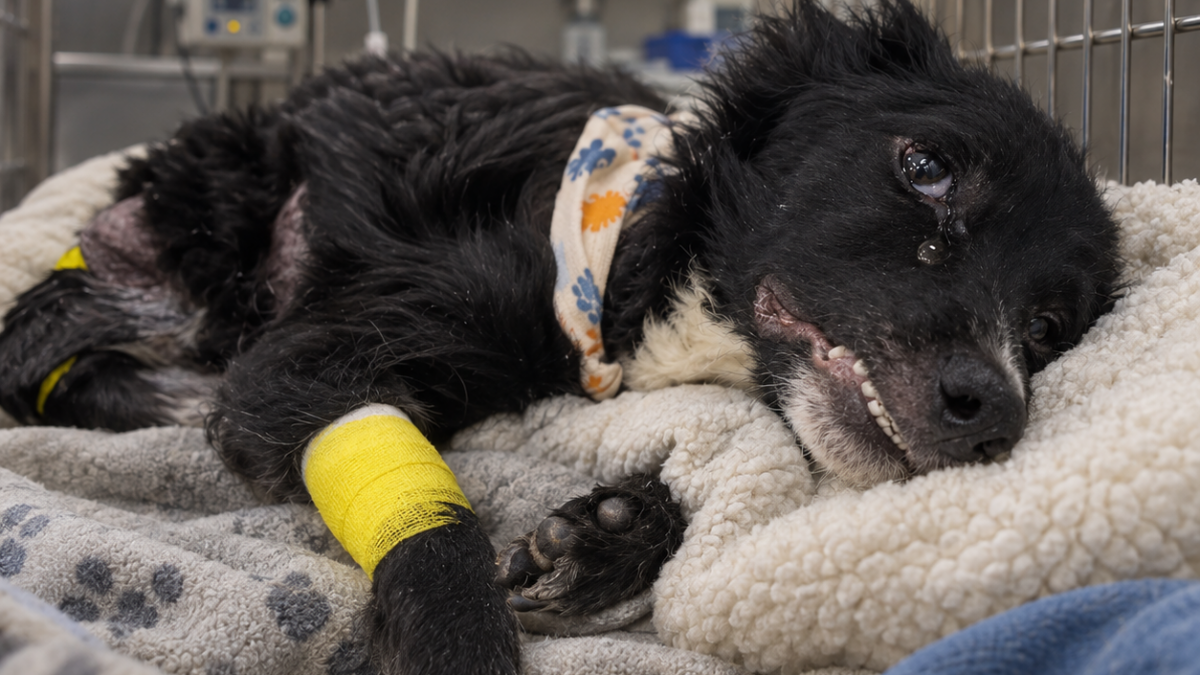
Only the dog’s face.
Eyes half-open.
Bandage around his neck.
They needed a name.
Mateo suggested Samson.
Another volunteer suggested Phoenix.
Elena rejected both.
“Too dramatic.”
Rafael, who had come by the clinic before work, asked, “What about Armando?”
Elena looked at him.
“Why Armando?”
“My grandfather.”
“Was he a dog?”
Rafael laughed.
“No.”
“Good start.”
“He survived everything.”
“What kind of everything?”
“War. Cancer. My grandmother.”
Elena smiled despite herself.
Rafael looked through the glass.
“Armando means a man ready for battle.”
Elena watched the dog.
He did not look ready for battle.
He looked ready to disappear.
“That’s too much pressure.”
Rafael shrugged.
“Then maybe it means he doesn’t have to fight alone.”
That decided it.
Armando.
The name went onto his chart.
No owner.
No address.
No history.
Just Armando.
Day two was not dramatic.
That became important later.
People prefer recovery stories with visible turning points.
The first meal.
First steps.
Tail wag.
Armando’s first twenty-four hours were mostly numbers.
Temperature.
Blood pressure.
Red blood cell counts.
Fluid output.
Respiratory rate.
Medication doses.
The second transfusion became necessary after his packed cell volume remained critically low.
Caroline worried about internal blood loss.
Ultrasound showed no major abdominal hemorrhage.
That was good.
His body was simply depleted.
Starvation.
Parasites.
Chronic wound.
Blood loss over time.
Everything had taken something.
Elena visited that afternoon.
She sat beside the cage.
Armando’s eyes opened.
“Hi.”
Nothing.
“It’s me.”
His gaze moved toward her.
She placed one hand outside the bars.
Not inside.
He had endured enough hands deciding things for him.
“You don’t have to do anything.”
His eyes stayed on her.
“You don’t have to be brave.”
That sentence surprised Elena.
Rescue culture loved bravery.
Fighter.
Warrior.
Survivor.
Words intended to honor animals.
But sometimes Elena wondered whether they became another demand.
Fight.
Survive.
Make this worth it.
She leaned closer.
“You can just rest.”
Armando closed his eyes.
On the third day, Elena entered the treatment room carrying paperwork.
Armando was awake.
He lifted his head.
Only three inches.
But lifted it.
Elena froze.
“Hey.”
His tail moved.
One weak sweep against the blanket.
She stared.
“No.”
Another sweep.
The technician beside him smiled.
“He’s been doing that.”
“For who?”
“You.”
“Don’t lie.”
“I’m not.”
Elena approached.
Armando’s tail moved again.
She covered her mouth.
“Oh, buddy.”
That tiny movement traveled through the rescue faster than any dramatic medical update.
Rafael came after work.
Mateo filmed six seconds.
Armando lying beneath a blanket.
Elena crouched beside him.
Tail moving.
The video was viewed thousands of times.
People donated.
Sent messages.
Offered foster homes.
One woman mailed a blue blanket.
A child sent five dollars and a drawing.
Armando became visible.
For perhaps the first time in months.
Elena drove home that evening allowing herself one dangerous thought.
He might make it.
At 6:12 the next morning, Caroline called.
Elena knew from the time.
“What happened?”
“Bloody diarrhea.”
Her heart dropped.
“How bad?”
“Bad.”
“Parvo?”
“Initial test negative. Repeating. Could be severe intestinal injury, parasites, stress, clotting issue.”
“Is he crashing?”
“He’s weaker.”
“I’m coming.”
“Elena, drive normally.”
She did not.
Armando looked different when she arrived.
Twenty-four hours earlier, he had lifted his head.
Now he could not.
His gums were pale again.
His eyes were dull.
Blood stained the pad beneath him.
Elena stood outside the treatment area.
“What do we do?”
Caroline listed options.
Diagnostics.
Plasma.
Blood.
GI support.
Medication adjustment.
Close monitoring.
Elena heard only pieces.
“Do it.”
“We are.”
“Everything.”
“We are.”
Armando’s blood pressure dropped before noon.
The team moved around him.
Elena stood in the hallway because there was nowhere useful for her to be.
That helplessness was familiar.
She hated it every time.
At thirteen, she had stood outside an ICU while doctors treated her father after a heart attack.
At twenty-nine, she had stood beside a freeway after a driver struck her first rescue dog.
At thirty-five, she had watched her marriage end across a dining table while her husband explained that he was tired of sharing their house with foster animals and emergency phone calls.
There were moments when caring deeply created no power.
Only witness.
Elena had built much of her adult life around trying to change that.
Find the animal.
Make the call.
Pay the bill.
Drive faster.
Stay longer.
Do something.
Armando reduced her to waiting.
At 3:00 p.m., Caroline found her near the vending machines.
“He’s stabilized.”
Elena stood.
“For how long?”
“No idea.”
“Can I see him?”
“Yes.”
Armando’s breathing was slow.
Elena sat on the floor beside him.
The clinic lights dimmed toward evening.
She talked.
Not motivational speeches.
Ordinary things.
“You know Rafael asked about you.”
Armando did not move.
“He claims naming rights.”
Nothing.
“I’m not giving him that much authority.”
She rested her hand near his paw.
“Mateo says when you’re better, he’s taking you hiking.”
His eyes shifted.
“Do not trust Mateo. He thinks six miles is a casual walk.”
Another tiny eye movement.
Elena smiled.
“I have a yard.”
She did not know why she said that.
“Not big.”
Armando breathed.
“Two trees.”
She looked at him.
“And a window that gets sun around three.”
The words came slowly.
“I think you’d like that.”
She went home after midnight.
Armando survived the night.
Then the next.
The bloody diarrhea decreased.
Blood values stabilized.
His kidneys improved.
He began eating tiny amounts.
Not enthusiastically.
But voluntarily.
The first time he licked food from Caroline’s fingers, a technician applauded.
Caroline told her to stop embarrassing the patient.
Day six.
Armando lifted his head.
Day seven.
He drank from a bowl.
Day eight.
He tried to sit up and failed.
Day nine.
He tried again.
His front legs shook violently.
Elena placed one hand near his shoulder.
Not pushing.
Just there.
Armando remained upright four seconds.
Then collapsed.
She cried afterward in the parking lot.
She told herself it was happiness.
It was partly fear.
Because recovery created something dangerous.
Attachment.
If Armando died now, he would no longer be a dog Elena tried to save.
He would be Armando.
That is different.
Rafael kept visiting.
He never entered without asking.
Armando learned his voice.
One afternoon Rafael appeared carrying a small stuffed turtle.
Elena looked at him.
“What is that?”
“Gift.”
“For a critically ill dog?”
“He needs possessions.”
“He has three blankets.”
“Those belong to the clinic.”
“He does not understand property law.”
Rafael placed the turtle near Armando.
Armando sniffed it.
Then rested his chin on it.
Rafael looked smug.
Elena sighed.
“You’re unbearable.”
“His first personal asset.”
The turtle became Armando’s.
He slept against it.
Two days later, Caroline began discussing discharge.
Elena stared at her.
“He can’t stand.”
“He doesn’t need hospital-level care every hour anymore.”
“He can’t walk.”
“He needs rehabilitation.”
“Here.”
“He hates it here.”
Elena looked through the window.
Armando’s ears flattened whenever carts rattled past.
She knew.
Caroline continued.
“He needs quiet. Nutrition. Range-of-motion exercises. Assisted standing. Sunlight. Routine.”
“Foster?”
“Yes.”
Elena already knew the answer.
“No foster is equipped.”
“I can train one.”
“No.”
Caroline smiled slightly.
“What?”
Elena frowned.
“Don’t.”
“I didn’t say anything.”
“Your face did.”
“You have the yard.”
Elena stared.
“I have three foster cats.”
“They’re in a separate room.”
“I work.”
“You own a rescue. Technically you never stop working.”
“That is not persuasive.”
“You said he’d like your window.”
Elena looked away.
Caroline smiled.
“Temporary.”
Elena laughed.
“That word has ruined my life.”
Armando left the clinic after seventeen days.
He was carried out on a padded stretcher.
Rafael came.
Mateo came.
Three technicians came outside even though they were working.
Caroline stood beside the van.
Elena loaded Armando carefully.
He wore a wide soft medical collar that avoided pressure on the healing wound.
The stuffed turtle went beside him.
Rafael said, “See you, warrior.”
Elena looked at him.
“He’s going to my house, not war.”
Rafael smiled.
“Same thing if he meets your cats.”
The first night was hard.
Armando panicked when the lights went out.
Not violently.
Worse.
He froze.
Eyes wide.
Breathing fast.
Elena turned them back on.
His breathing slowed.
She left a lamp on.
He slept.
At 3:00 a.m., she checked.
At 4:30.
At 5:15.
At six, she gave up pretending she was sleeping.
Armando watched her from the bed she had built near the living room window.
Memory foam.
Washable cover.
Three blankets.
Turtle.
Morning sunlight had not reached him yet.
“Good morning.”
His tail moved.
Elena smiled.
“Okay.”
That became their routine.
Breakfast.
Medication.
Wound care.
Massage.
Range-of-motion exercises.
Supported standing.
Rest.
Lunch.
Sunlight.
More exercises.
More rest.
Progress happened in measurements too small for most people to notice.
Day one at Elena’s house, Armando could support his front half for eight seconds.
Day three, fifteen.
Day five, thirty-two.
His rear legs lagged.
Muscle loss had been severe.
His paws sometimes folded incorrectly.
Elena repositioned them.
Massaged his thighs.
Supported his hips with a sling.
“Come on.”
Armando tried.
Legs shook.
Collapsed.
She caught him.
“That counts.”
The next day he lasted less time.
Elena felt devastated.
Caroline did not.
“Recovery isn’t a staircase.”
“It should be.”
“It isn’t.”
“He was better yesterday.”
“So?”
“So today is worse.”
“Today is today.”
Elena hated sensible people.
Armando loved the sun.
That was discovered accidentally.
At three in the afternoon, a rectangle of light crossed the living room floor.
Armando dragged himself toward it.
Only six inches.
Elena stopped what she was doing.
He pulled again.
Front legs doing nearly all the work.
Another four inches.
She nearly intervened.
Then didn’t.
Armando reached the light.
Lowered his head.
Closed his eyes.
Elena sat beside him.
For twenty minutes, neither moved.
The next day she shifted his bed into the sun before three.
Armando looked toward her.
Tail wag.
“That’s your thing?”
Tail wag.
“All right.”
Sunlight became therapy.
Not medical.
Something else.
Armando changed in it.
His face softened.
His breathing slowed.
He stretched.
Sometimes rolled slightly onto one side.
After months chained outside or trapped somewhere dark, warmth without danger seemed to confuse him.
Then comfort him.
Every afternoon Elena sat near the window while Armando slept.
She began answering rescue emails there.
People noticed her slower responses.
Mateo teased her.
“You’re becoming domestic.”
“Say that again and I’ll assign you litter boxes.”
He stopped.
At week three, Armando stood.
Not with the sling.
Not fully.
Elena was carrying laundry.
She heard nails scrape.
Turned.
Armando had pushed himself upright.
Four legs.
Trembling.
Head low.
Elena dropped every towel she was holding.
“Oh my God.”
Armando looked at her.
Tail moved.
That nearly knocked him over.
“Don’t celebrate yourself yet.”
He took one step.
Collapsed.
Elena ran.
But she was laughing.
“You did it.”
She hugged him gently, avoiding his neck.
“You did it.”
Armando licked her chin.
That was the first time.
Elena sat on the floor and cried into his shoulder.
The man who had chained Armando was found because Rafael returned to the warehouse.
He had not been able to stop thinking about the rope.
The building owner knew nothing about the dog.
The property had changed hands after the furniture company failed.
Several storage units behind the warehouse had been leased month-to-month by unrelated businesses.
Rafael inspected the back lot.
There, behind a damaged fence, he found a chain anchored to a concrete post.
Same type of rope.
An overturned food dish.
A plastic barrel cut open for shelter.
And old feces.
A dog had lived there.
Not temporarily.
For months.
Rafael called Elena.
She arrived forty minutes later.
Armando stayed home with Mateo.
Elena stared at the post.
The rope remnant was stiff with dirt.
Around the base were scratch marks.
Deep.
Repeated.
She imagined Armando circling.
Pulling.
Trying to reach shade.
Water.
Anything.
Her stomach turned.
Rafael pointed toward the warehouse wall.
“There.”
A small security camera.
Old.
The furniture company’s system had been disconnected.
But the adjoining auto parts business had cameras too.
Rafael walked over.
The owner was reluctant.
Then Elena showed him Armando’s photograph.
He changed his mind.
Recordings went back only ninety days.
Enough.
The footage showed a man arriving at dawn several mornings a week.
Gray pickup.
Baseball cap.
He approached the chained dog.
Sometimes food.
Sometimes water.
Sometimes nothing.
Once he kicked the bowl toward him.
Another time Armando tried to approach.
The man struck him with the end of the rope.
Elena had to stop watching.
“Who is he?”
The auto parts owner knew.
“Luis Varela.”
“Works here?”
“Used to work for Martinez Furniture.”
“Address?”
“I don’t have it.”
Rafael said, “I do.”
Elena looked at him.
“How?”
“He serviced my cousin’s apartment building.”
Small world.
Too small.
Animal cruelty investigators became involved.
Luis Varela denied owning Armando.
Then admitted the dog had belonged to his brother.
Then claimed the dog was aggressive.
Then said he had intended to surrender him.
The stories shifted.
The video did not.
Neither did the witnesses.
A former warehouse employee named Samuel Ruiz finally told investigators what happened.
Samuel was nineteen.
He had worked part-time loading furniture.
Armando had first appeared as a healthy young dog nearly a year earlier.
Luis brought him.
Called him Bruno.
Kept him behind the warehouse because his landlord would not allow dogs.
At first Luis fed him regularly.
Then less.
After the company began failing, employees disappeared.
Luis stopped coming every day.
Samuel sometimes gave the dog food.
Sometimes water.
He wanted to report it.
Didn’t.
“Why?”
The investigator asked.
Samuel stared at the floor.
“Luis was my uncle’s friend.”
“That stopped you?”
“He said if I caused trouble, I’d lose the job.”
“Did you?”
“No.”
Samuel’s eyes filled.
“I quit.”
“When?”
“Four months before the warehouse closed.”
“You knew the dog was still there?”
“Yes.”
“Did you tell anyone?”
“No.”
That answer haunted Samuel.
He eventually asked to meet Elena.
She almost refused.
Then agreed.
They met outside the rescue.
Samuel was thin.
Nervous.
He held his baseball cap in both hands.
“I’m sorry.”
Elena looked at him.
“For what?”
“I saw him.”
She waited.
“I saw his neck getting bad.”
“When?”
“Before I quit.”
“How bad?”
“Red. Missing fur.”
“Embedded?”
“No.”
“Did he have food?”
“Sometimes.”
“Water?”
“I gave him some.”
“When you were there.”
“Yes.”
“What about when you weren’t?”
Samuel looked down.
“I don’t know.”
Elena felt anger rise.
Fast.
Easy.
The kind that can become cruelty if you enjoy it too much.
She thought of Armando at her window.
She said, “Why didn’t you call?”
Samuel cried.
“I was scared.”
“Of Luis?”
“Yes.”
“You were nineteen.”
“My mom was cleaning houses. I was helping rent. Luis got me the job.”
Elena said nothing.
Samuel wiped his face.
“I thought somebody else would do it.”
There it was.
A sentence responsible for more suffering than most deliberate cruelty.
Somebody else.
Someone will notice.
Someone will report.
Someone knows better.
Someone is coming.
Elena hated the sentence.
But she also recognized the boy inside it.
Not innocent.
Not evil.
Afraid.
“What do you want from me?”
Samuel looked shocked.
“Nothing.”
“Forgiveness?”
“No.”
“Then why are you here?”
He swallowed.
“I wanted to see if he lived.”
Elena stared.
“You don’t get to make him feel anything for you.”
“I know.”
“If he’s afraid, you leave.”
“I know.”
“You do not touch him unless he asks.”
“I know.”
She brought him inside.
Armando was lying in the sunlight.
His neck wound had closed significantly.
Fur had begun growing around the edges.
He was fifteen pounds heavier.
Still thin.
Still weak.
But unmistakably alive.
Samuel stopped at the doorway.
His face collapsed.
“Oh.”
Armando lifted his head.
Saw him.
His body stiffened.
Elena noticed instantly.
“Stay there.”
Samuel froze.
Armando sniffed.
Ears back.
Then something strange happened.
His tail moved once.
Samuel covered his mouth.
“He remembers me.”
Elena did not answer.
Samuel crouched from a distance.
“Bruno.”
Armando’s ears lifted.
The old name.
Elena felt something move through her.
Armando pushed himself upright.
Samuel cried harder.
“I’m sorry.”
The dog took one slow step.
Then another.
Elena held her breath.
Armando approached.
Stopped five feet away.
Samuel did not reach.
Good.
Armando sniffed the air.
Then sat.
Samuel whispered, “I gave you hot dogs.”
Elena looked at him.
Samuel laughed through tears.
“When there wasn’t food.”
Armando’s tail moved.
Once.
Twice.
Samuel lowered his face.
“I should’ve helped you.”
Armando did not absolve him.
Dogs do not perform moral judgments for human comfort.
He simply remained there.
Alive.
That was enough.
Samuel later testified.
So did two former employees.
So did the auto parts owner.
Luis Varela was charged with felony animal cruelty and neglect-related offenses.
The case took months.
People online wanted a dramatic punishment.
Maximum sentence.
Never allowed near animals.
Some wanted worse.
Elena mostly wanted Armando never to know his name again.
The evidence showed neglect beginning gradually.
That mattered.
Luis had not set out one morning intending to torture a dog for months.
He had been irresponsible.
Then overwhelmed.
Then avoidant.
Then cruel.
He stopped feeding regularly.
Stopped checking the rope.
Stopped providing veterinary care.
When the wound appeared, he avoided looking at it.
When the smell worsened, he moved Armando farther behind the warehouse.
When the business closed, he left him.
Neglect grew one decision at a time.
That made it more frightening to Elena than a monster story.
Monsters are easy to identify.
Ordinary people making increasingly selfish choices are everywhere.
Luis eventually pleaded guilty to a serious cruelty charge.
The judge prohibited him from owning animals for years and imposed jail time, probation, financial restitution, and mandatory counseling.
During sentencing, the prosecutor showed photographs.
The first.
Armando on the warehouse floor.
The second.
The embedded rope.
The third.
Armando standing in Elena’s yard months later.
Luis looked away.
Elena did not.
She wanted him to see.
Not suffering.
Recovery.
What he had nearly erased.
Armando did not attend court.
Elena refused every request.
“He doesn’t care about justice,” she told a reporter.
“What does he care about?”
“Breakfast.”
She almost smiled.
“Sunlight. His turtle. Knowing where I am.”
That answer became the headline.
Armando’s rehabilitation took nearly eight months.
Not days.
Not weeks.
Months.
He learned to walk short distances.
Then around the living room.
Then into the yard.
His first attempt at grass was unexpectedly emotional.
Elena opened the back door.
Armando stood at the threshold.
He had likely known grass before.
But after months of confinement, he seemed uncertain.
She stepped outside.
“Come on.”
He looked at her.
Then at the yard.
One step.
Second.
Third.
His front paw touched grass.
He froze.
Sniffed.
Then lowered his nose.
A long breath.
Another.
He walked farther.
Slow.
Unsteady.
The sun was warm.
Wind moved through pecan leaves.
Armando stood in the middle of the yard.
Nothing attached to him.
No rope.
No chain.
No post.
He looked behind himself.
Elena saw it.
She would never know what he was checking.
Maybe sound.
Maybe danger.
Maybe habit.
Then he walked forward.
Five feet.
Ten.
Fifteen.
No one stopped him.
At twenty feet, he began moving faster.
Not running.
Almost.
His legs could not manage more.
He stumbled.
Recovered.
Tail rising.
Elena laughed.
“Easy!”
Armando continued.
Reached the fence.
Sniffed.
Turned.
Walked back toward her.
Then leaned his whole body against her legs.
Elena put both hands over her face.
Mateo filmed from the porch.
He lowered the phone.
Some moments did not need evidence.
By spring, Armando could walk around the block.
Slowly.
He wore a harness.
Never a neck collar.
Elena did not think she would ever place anything around his neck again.
At first, ordinary sounds frightened him.
Chain links clinking.
Metal bowls.
A rope dragged across concrete.
Men shouting.
Pickup trucks idling.
But fear softened with repetition.
Nothing bad happened.
Again.
Nothing bad happened.
Again.
Nothing bad happened.
That is how trust grew.
Not through one grand moment.
Through hundreds of ordinary ones.
Meal appears.
Hand touches gently.
Door opens.
Person returns.
Bed remains.
Water stays.
No pain.
Repeat.
Repeat.
Repeat.
Armando’s happiest time remained three in the afternoon.
Sun through the window.
Even after he could go outside, he preferred that patch of living-room light.
Elena eventually bought a larger bed and placed it exactly there.
He ignored the first expensive orthopedic bed.
She returned it.
Bought another.
Ignored.
Finally she put his original clinic blanket over the second.
Armando climbed in immediately.
“Unbelievable.”
Tail wag.
“You are financially irresponsible.”
Armando yawned.
When adoption inquiries began, Elena avoided answering them.
At first she had reasons.
Medical needs.
Not ready.
Needs evaluation.
Too weak.
Then the reasons disappeared.
Armando could walk.
His bloodwork stabilized.
His wound healed.
Weight improved.
Temperament evaluation showed a gentle, cautious dog who preferred calm adults and other quiet animals.
Caroline asked one afternoon, “When are you posting him?”
Elena pretended not to understand.
“Posting what?”
“Adoption profile.”
“He’s not ready.”
Caroline looked at the dog asleep in the sun.
“He chased a squirrel yesterday.”
“He overexerted himself.”
“He stole half your sandwich.”
“Food insecurity.”
“He barked at the mailman.”
“Protective instincts.”
Caroline folded her arms.
“Elena.”
“What?”
“You’re keeping him.”
“No.”
Armando lifted his head.
Caroline pointed.
“Tell him.”
Elena stared at the dog.
“You are available for adoption.”
Armando wagged.
Caroline laughed.
“Very convincing.”
Elena sat.
The truth was more complicated than attachment.
Elena had fostered seventy-three animals.
She knew how to let go.
That was part of rescue.
Love them.
Heal them.
Place them.
Make room for another.
But Armando had rearranged the house.
Her schedule.
Her sleep.
Her sense of quiet.
He waited beside the bathroom door every morning.
Followed her from room to room.
Watched the driveway when she left.
Slept with the stuffed turtle between his paws.
Whenever Elena sat on the floor, Armando leaned against her until half his body was in her lap.
She told herself someone else could give him more.
A bigger yard.
A couple.
A family.
Children maybe.
Then one afternoon, a seemingly perfect adopter came.
Large property.
Retired.
Experience with shepherds.
Financially stable.
Patient.
Kind.
Armando met him in the yard.
The man sat.
Armando approached.
Sniffed.
Accepted a treat.
Everything went well.
Too well.
Elena felt physically sick.
The adopter looked toward her.
“He’s special.”
“Yes.”
“I’d like to take the next step.”
Elena smiled.
Professional.
“Of course.”
That night she sat beside Armando’s bed.
He was asleep.
She cried.
“You’re supposed to leave.”
Armando woke.
Lifted his head.
“You know that?”
He moved closer.
“You were temporary.”
Tail wag.
“I have rules.”
He pressed his face against her chest.
Elena laughed through tears.
“You’re manipulating me.”
Armando sighed.
She wrapped both arms around him.
The following morning she called the adopter.
“I’m sorry.”
The man paused.
Then laughed.
“You’re keeping him.”
Elena closed her eyes.
“Yes.”
“I knew before you did.”
“How?”
“He watched you the entire time I was there.”
She looked across the room.
Armando was watching her now.
Of course.
“He liked you.”
“No.”
The man’s voice softened.
“He trusted me.”
There was a difference.
“But he belongs with you.”
After the call, Elena sat at the kitchen table.
Armando came over.
She looked at him.
“You live here.”
Tail wag.
“Officially.”
Bigger wag.
“For the rest of your life.”
Armando leaned against her knee.
Elena signed the adoption papers that afternoon.
Owner:
Elena Saldivar.
Animal:
Armando.
Permanent placement.
She stared at those words.
Permanent.
After everything in Armando’s life that had been temporary—
food,
care,
safety,
attention—
that word felt sacred.
Rafael came over that evening carrying a cake.
“For a dog?”
“For us.”
“You didn’t bake this.”
“No.”
“Good.”
Mateo brought Armando a new stuffed turtle.
Caroline brought nothing because, as she said, “I have already contributed approximately eighty hours of veterinary labor to this celebration.”
Samuel came later.
He stood at the gate until Elena invited him in.
Armando recognized him.
Walked over.
Samuel scratched his chest.
Not his neck.
Never his neck.
“I’m graduating,” Samuel said.
Elena looked up.
“From?”
“Community college.”
“Congratulations.”
“I’m applying to vet tech programs.”
That surprised her.
“Why?”
Samuel looked at Armando.
“Because I never want to be the person who sees something and does nothing again.”
Elena did not know whether one career could redeem a failure.
Probably not.
Maybe redemption did not work like math.
Subtract wrong.
Add good.
Reach zero.
Maybe you simply carried the wrong thing honestly and allowed it to change your next decision.
“Good,” she said.
Samuel nodded.
Armando sat on his shoe.
Two years later, Samuel began working part-time at Bennett Veterinary.
Caroline claimed she hired him because he was competent.
Elena suspected Armando had something to do with it.
Rafael visited often.
Armando adored him.
Every time Rafael entered, the dog’s tail struck furniture hard enough to be heard in the next room.
“You see?” Rafael said.
“He knows I saved him.”
Elena rolled her eyes.
“You found him.”
“Exactly.”
“I saved him.”
“Caroline saved him.”
“Elena fed him.”
“Mateo carried him.”
Armando looked between them.
Rafael said, “Team effort.”
That was closer to truth.
Years passed.
Armando never became the kind of dog people described as completely transformed.
Elena disliked that phrase.
It suggested the dog found in the warehouse had disappeared.
He had not.
Pieces remained.
He still flinched occasionally when something tightened near his shoulders.
He still disliked closed storage rooms.
If a door slammed, he looked for Elena.
During thunderstorms, he slept beside her bed.
He never liked chain-link fencing.
His neck scar remained.
A pale uneven band beneath fur.
Recovery did not erase evidence.
It taught Armando he could live around it.
That distinction mattered.
At age nine, arthritis developed in his hips.
At ten, his muzzle grayed.
At eleven, the long walks shortened.
Three in the afternoon remained his favorite hour.
Sunlight.
Bed.
Turtle.
Elena.
Sometimes Rafael.
Sometimes Samuel.
The house that had once seemed too small for another foster became organized around an old dog.
Ramps.
Medication.
Water bowls in two rooms.
Blankets everywhere.
Elena complained constantly.
Nobody believed her.
One afternoon, a local journalism student asked to interview her about Armando.
His story had circulated for years.
The student wanted a hopeful ending.
“What do you think saved him?”
Elena frowned.
“Veterinary medicine.”
The student laughed nervously.
“I mean emotionally.”
“Food.”
“Elena.”
“What answer do you want?”
The young woman hesitated.
“Love?”
Elena looked toward Armando.
He was asleep in the sun.
“Love didn’t remove the rope.”
The student became quiet.
“Love didn’t give the transfusions.”
Elena continued.
“Love without action is just feeling.”
She looked back.
“Rafael stopped.”
“Stopped?”
“He noticed something was wrong and stopped.”
She pointed toward Armando.
“Then he made a call.”
The student nodded.
“Caroline treated him. Donors paid bills. Volunteers transported him. Samuel testified. Investigators did their jobs.”
“So what saved him?”
“People doing the next useful thing.”
That became Elena’s favorite explanation.
Not heroism.
Not miracles.
The next useful thing.
Stop.
Look.
Call.
Carry.
Clean.
Donate.
Testify.
Feed.
Wait.
Try again tomorrow.
Armando’s life was built from those things.
Near his twelfth year, his health declined quickly.
Cancer.
Spleen.
Advanced.
Caroline showed Elena the ultrasound.
She did not soften it.
“How long?”
“Maybe weeks.”
Elena stared at the image.
“No surgery?”
“Technically possible.”
“Would it help?”
“Probably not enough.”
“Chemotherapy?”
“Not with his overall condition.”
Elena nodded.
Professional again.
Then went into the parking lot and screamed inside her car.
She had saved him once.
That was the dangerous belief.
Saved.
As though rescue created ownership over endings.
As though enough care should guarantee more time.
It didn’t.
Armando remained comfortable for seventeen days.
Elena canceled everything unnecessary.
Meetings.
Fundraisers.
Transport runs someone else could handle.
She moved his bed onto the porch when afternoons were warm.
Rafael came.
Samuel came.
Mateo.
Caroline.
Even the old auto parts owner who had provided the security footage.
Armando greeted each person differently.
Rafael got tail thumps.
Samuel got his head leaned against a knee.
Mateo got a tired attempt to steal food.
Caroline received suspicion because veterinarians apparently remained unforgiven.
On the fifteenth day, Armando stopped eating.
Elena knew.
Caroline came to the house the next morning.
Armando lay in his sun patch.
Same window.
Same light.
Much older dog.
The stuffed turtle was beneath his chin.
Elena sat beside him.
She ran her fingers through the fur on his shoulder.
Not neck.
Never needed to.
Rafael sat across the room.
Samuel stood near the kitchen, crying openly.
Caroline prepared the medication.
Elena whispered, “Remember when you couldn’t stand?”
Armando breathed.
“You were terrible at it.”
His tail moved once.
Rafael laughed through tears.
Elena smiled.
“You took forever.”
Another tiny movement.
“You ruined my floors.”
Nothing.
“You cost more than my car.”
Rafael said, “That’s probably true.”
“It is.”
Elena leaned closer.
Armando opened his eyes.
Brown.
Cloudy now.
Still him.
“You don’t have to fight anymore.”
The sentence came from years before.
Clinic floor.
Bandages.
Blood transfusions.
You don’t have to be brave.
You can just rest.
Elena finally understood why she had needed to say it then.
Survival was never a debt.
Armando did not owe them an inspiring ending.
He had already lived.
Sunlight.
Grass.
Meals.
Turtle.
Friends.
Home.
That was enough.
She put her forehead against his.
“You were never what they did to you.”
His breathing slowed.
“You hear me?”
Her voice broke.
“You were never that rope.”
Armando blinked.
“You were Armando.”
Caroline administered the sedative.
The old dog relaxed.
For the first time in nearly twelve years, maybe longer, every muscle in his body seemed completely free of effort.
Elena held him.
Rafael placed one hand against his back.
Samuel whispered goodbye.
Then Caroline gave the final medication.
Armando died in the sunlight.
No chain.
No concrete floor.
No wound.
No darkness.
His head in Elena’s lap.
His toy beneath his paw.
His people around him.
For several minutes nobody moved.
Then Rafael said something so quietly Elena almost missed it.
“He got out.”
She looked at him.
“What?”
Rafael was crying.
“That morning.”
He stared at Armando.
“When I found him, I thought I was getting him out of the warehouse.”
He shook his head.
“But he got all the way out.”
Elena understood.
Not simply through the door.
Out of the life someone had reduced him to.
Out of fear being his only expectation.
Out of pain being normal.
Out of invisibility.
They buried Armando beneath the tree in Elena’s backyard where afternoon sunlight lasted longest.
Not because Elena believed he needed the sun anymore.
Because she did.
Rafael built the marker himself.
No dramatic inscription.
No warrior.
No survivor.
No story about suffering.
Just:
ARMANDO
HE WAS LOVED HERE.
Elena stood before it the evening they placed it.
She thought about changing the wording.
He was loved here sounded too simple.
Then she decided simple was right.
The suffering belonged to somewhere else.
This place could be about love.
Years later, Second Chance Animal Recovery moved into a larger building.
They created a small rehabilitation room for severely neglected dogs.
Large windows.
Quiet flooring.
Adjustable beds.
No chain-link kennels.
At three every afternoon, sunlight crossed the room.
A small plaque near the door carried one name.
ARMANDO ROOM.
Most visitors assumed he had belonged to a donor.
Elena never corrected them unless they asked.
Sometimes a frightened dog would arrive.
Thin.
Silent.
Too tired to react.
A volunteer might become discouraged.
“He doesn’t seem to care.”
Elena always answered the same way.
“You don’t know that.”
“He won’t look at me.”
“That’s okay.”
“He won’t wag.”
“That’s okay too.”
“What do I do?”
“The next useful thing.”
Water.
Blanket.
Medicine.
Quiet.
Time.
There are stories people love because the animal transforms visibly.
Bones disappear beneath healthy weight.
Fur shines.
Dog runs.
Tail wags.
Before-and-after photographs fit beside each other perfectly.
Armando had those photographs too.
The first was terrible.
The last was beautiful.
But Elena came to believe the transformation between them was not the most important part.
The important part was the morning Rafael stopped.
One man.
One unlocked door.
One smell he could have ignored.
One hidden dog who did not bark.
Did not cry.
Did not ask.
Armando had reached a point where he no longer expected anybody to come.
Then somebody did.
That was the beginning.
Not the rescue van.
Not the transfusion.
Not the first tail wag.
A stranger noticed silence and chose to investigate it.
Sometimes suffering screams.
Sometimes it scratches at a door.
Sometimes it stands beside a road.
And sometimes it curls itself into the darkest corner it can find and stops asking the world for anything.
Those are the ones we have to look harder for.
Armando never became famous to himself.
He did not know people shared his photographs.
He did not know donations arrived in his name.
He did not know Samuel changed careers partly because of him.
He did not know Rafael kept the first photograph on his phone for years.
He did not know Elena eventually helped hundreds more animals partly because losing him reminded her why she had started.
Armando knew simpler things.
The sound of Elena’s car.
The smell of chicken.
The soft turtle beneath his chin.
Grass under paws.
Rafael’s laugh.
Samuel’s hand against his shoulder.
A bed beside a window.
Three o’clock sunlight.
And the fact that when he opened his eyes, someone was usually there.
For a dog who had once been chained where almost nobody looked, that may have been the greatest transformation of all.
He went from being invisible to being expected.
From forgotten to waited for.
From something somebody left behind to someone whose absence changed a house.
And perhaps that is what rescue really means.
Not turning a broken animal into a perfect one.
Not pretending the scars disappear.
Not calling suffering beautiful because the ending became kind.
There was nothing beautiful about what happened to Armando behind that warehouse.
Nothing inspiring about starvation.
Nothing meaningful about a rope cutting through skin.
The beauty came afterward.
In Rafael stopping.
In Elena staying.
In Caroline refusing to give up when his blood values crashed.
In volunteers carrying him.
In Samuel finally telling the truth.
In a frightened dog learning that hands could touch without hurting.
In sunlight becoming something he could sleep beneath instead of something he endured while chained.
In a bed remaining in the same place every night.
In a woman eventually signing a piece of paper that said permanent.
That was the miracle, if anyone insisted on using the word.
Not that Armando survived something terrible.
That after surviving it, he was given enough time and enough kindness to discover life could be something other than endurance.
And in the end, when his body finally became tired for reasons nobody had caused and nobody could fix, he did not crawl away to hide.
He did not search for a dark corner.
He stayed in the middle of the room.
In the sunlight.
Beside the woman he trusted.
Because somewhere between the warehouse and that final afternoon, Armando had learned the lesson cruelty had spent months trying to erase.
He mattered.
Someone would notice if he hurt.
Someone would come if he was afraid.
Someone would stay when he became weak.
He was not alone anymore.
And this time, when Armando finally stopped fighting, it was not because he had lost hope.
It was because he had made it home.








