They Fired a Nurse for Saving an Injured Military K9—Then Three Military Vehicles Pulled Up Outside the Hospital.
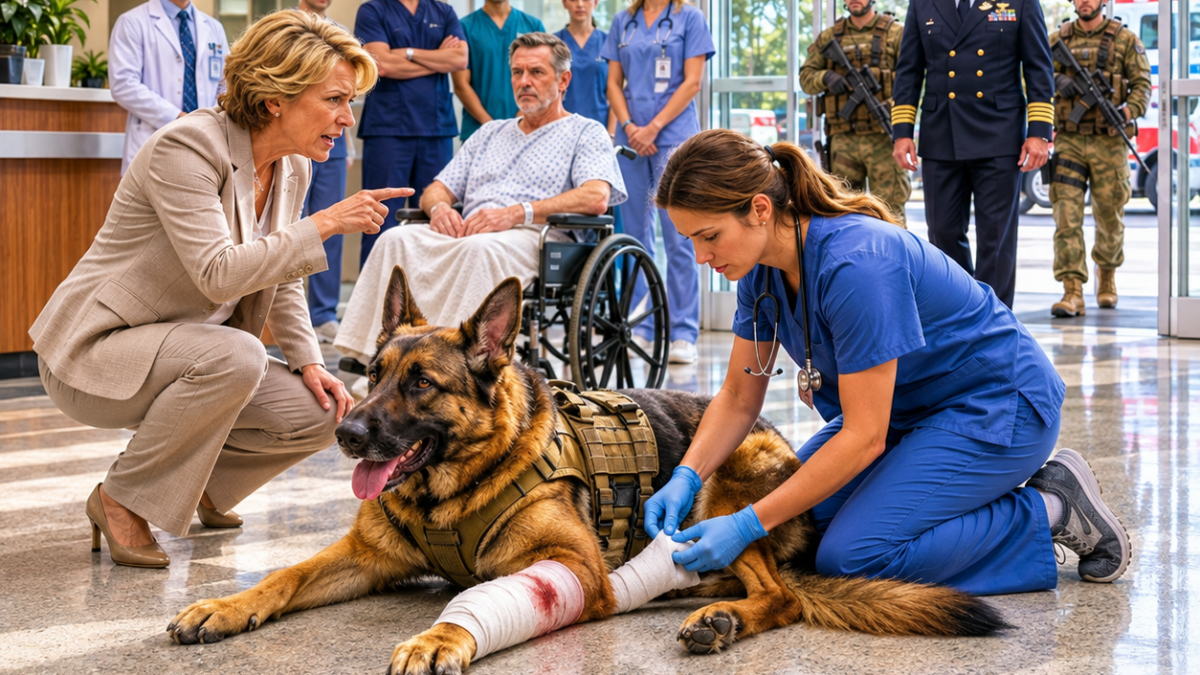
They Fired a Nurse for Saving an Injured Military K9—Then Three Military Vehicles Pulled Up Outside the Hospital.
The 110-pound military K9 collapsed on the emergency-room floor, and when Olivia Marsh ignored her supervisor’s order to leave him there, the hospital took her badge and fired her in front of everyone.
She walked into the Wyoming night knowing she had just destroyed the quiet civilian career she had spent three years building—but before she reached the parking garage, three government vehicles turned into the hospital entrance in formation.
Then the ranking officer stepped out, looked at the empty place where Olivia’s badge had been, and asked only one question: “Are you the nurse?”
Bravo hit the floor at 9:40 on a Tuesday night.
Not fell.
Hit.
His front legs folded first.
Then the rear.
One hundred ten pounds of dark-saddled German Shepherd collapsed beneath fluorescent lights while a sound came from somewhere deep inside his chest.
Not a bark.
Not a whimper.
Something lower.
Older.
Pain trying not to become panic.
The emergency room at Harrove Regional Medical Center went quiet.
That alone told Olivia Marsh how bad it was.
Emergency rooms did not become quiet.
They layered noise.
Monitors.
Phones.
Shoes.
Curtains.
Oxygen carts.
Coughing.
Arguments.
A television nobody watched.
Someone asking where the bathroom was while somebody else was trying not to die.
But when Bravo went down, the room stopped around him.
A man in a worn Army jacket dropped to one knee.
Mid-thirties.
Hard build.
Prosthetic left hand.
Not cosmetic.
Functional hook-style device.
His right hand pressed against Bravo’s ribs.
“Easy.”
The dog tried to rise.
Failed.
Olivia was already looking at the left rear leg.
Wrong angle.
No weight-bearing.
Hip, maybe.
PART2:
The man looked toward the desk.
“I need help.”
Karen Puit, Olivia’s supervisor, was standing behind reception.
She looked at the dog.
Then at the man.
Then back at the dog.
“Sir, this is a human emergency room.”
“I understand.”
“We don’t treat animals.”
“He’s a military working dog.”
“There’s an emergency veterinary clinic on Route Nine.”
“How far?”
“Forty minutes.”
The man’s expression changed.
“He may not have forty minutes.”
Puit’s face did not.
“I’m sorry.”
The dog groaned again.
Olivia moved.
She did not decide to.
Not in the clean way decisions happen when there is time.
Her body simply recognized information and responded.
She stepped from behind triage.
Puit said:
“Nurse Marsh.”
Olivia kept moving.
PART3:
She stopped four feet from Bravo.
Crouched.
Did not touch him.
Did not stare directly.
Turned one shoulder slightly.
The man beside the dog noticed.
His attention shifted from panic to assessment.
Military.
Definitely.
Olivia could see it now.
The way his eyes kept mapping the room despite everything happening directly in front of him.
“What’s his name?”
“Bravo.”
“How long ago was he injured?”
“Forty minutes.”
“How?”
The man hesitated.
“Vehicle impact.”
“Head strike?”
“Not that I saw.”
“Chest?”
“He stayed upright afterward.”
“Weight on the leg?”
“None.”
Bravo’s ears moved toward Olivia.
There was a low rumble.
Warning.
Puit’s voice sharpened.
“Olivia. Step away.”
Olivia remained still.
Bravo watched her.
She extended one hand toward the floor.
Not toward him.
Palm down.
Neutral.
Something available for examination.
The dog smelled the air.
Pain did not erase training.
Not completely.
A properly trained working dog did not simply categorize the world into friend and enemy.
He assessed.
Olivia waited for him to finish.
Bravo touched her knuckles with his nose.
Once.
The rumbling stopped.
Olivia moved closer.
“Good.”
Her hand traveled slowly along his side.
Ribs.
Abdomen.
Pelvis.
She reached the left hip.
Bravo flinched so hard his claws scraped the tile.
Olivia stopped.
“Sorry.”
The handler said:
“Bad?”
“Likely dislocated.”
“Broken?”
“I don’t think so, but he needs imaging.”
Puit came around the desk.
“You are not ordering imaging on a dog.”
Olivia looked at Bravo.
“He needs pain control and stabilization.”
“This hospital is not licensed to provide veterinary care.”
“I’m aware.”
“Then step away.”
Olivia looked up.
“Do we have an orthopedic consult in-house?”
Puit’s face tightened.
“You’re done.”
“No, I’m asking—”
“I said step away.”
Olivia had been employed at Harrove Regional for eight months.
Still probationary.
That mattered.
No union protection yet.
No accumulated institutional weight.
No seniority.
She had a lease.
Student loans.
Car payment.
Professional license.
A small apartment twelve minutes away.
One plant she kept forgetting to water.
She knew exactly what refusing Karen Puit could cost.
She also knew exactly what she was touching.
Bravo’s breathing.
Muscle guarding.
Hip instability.
The particular way the dog kept scanning the room while pain rolled through him.
She had seen military working dogs hurt before.
A long time ago.
In places nobody at Harrove knew about.
She looked at Puit.
“Call security.”
The room changed.
Not loudly.
The air changed.
Puit stared at her.
“What did you say?”
“I’m not leaving him on the floor untreated.”
“You’re violating a direct order.”
“Yes.”
“And hospital policy.”
“Yes.”
“You understand what that means?”
Olivia looked at Bravo.
“Yes.”
Puit picked up the phone.
Olivia turned to the nearest open supply cart.
“I need elastic bandage.”
Nobody moved.
“Rolled gauze too.”
Four seconds.
Then Tanya, another nurse, reached onto the cart.
Placed both on the counter.
Did not look at Puit.
Olivia said:
“Thank you.”
She wrapped Bravo’s hip and upper leg as safely as she could for temporary stabilization.
Not a cure.
Not treatment of the dislocation itself.
Something to reduce uncontrolled movement while they found someone who could do more.
The handler watched her hands.
“Where did you learn that?”
“Later.”
He nodded.
Fair answer.
“What’s your name?”
“Olivia.”
“Garrett Hail.”
She finished.
Bravo exhaled heavily.
Some tension left his body.
“Keep him still,” Olivia said.
“I will.”
Two security officers entered.
Behind them came Douglas Cole.
Evening administrator.
Tie at ten o’clock at night.
Olivia had always thought the tie was less clothing than philosophy.
Procedure.
Control.
The appearance of seriousness.
Cole looked around.
“What happened?”
Puit answered before Olivia could.
“She ignored a direct order and began treating an animal inside the emergency department.”
Cole turned to Olivia.
“Is that accurate?”
“Partly.”
Puit’s jaw moved.
Olivia continued.
“He’s a military working dog with an acute hip injury. He cannot safely tolerate another forty minutes of transport without stabilization. I provided first-line support and requested imaging.”
“We are not a veterinary hospital.”
“I know.”
“Then you understand why this cannot happen.”
“The dog is already here.”
“That does not change our liability.”
“It changes our responsibility.”
Cole adjusted his tie.
There.
Conversation finished.
“Security.”
Olivia unclipped her badge before he asked.
That surprised him.
She held it out.
Cole took it.
“You are terminated effective immediately pending formal HR processing.”
Garrett stood.
“Wait.”
Olivia looked at him.
“No.”
His face hardened.
“They’re firing you because of my dog.”
“They’re firing me because I made a decision they didn’t authorize.”
“Same thing.”
“Not tonight.”
She crouched once more beside Bravo.
“The wrap is temporary.”
Garrett nodded.
“Keep him still.”
“I will.”
“Don’t let anyone make him walk.”
“I won’t.”
“And if his breathing changes—”
“I’ll find you.”
Olivia looked at him.
“I may not be here.”
“You will be.”
She almost laughed.
Then she walked out between security officers.
They did not touch her.
The civilized version of being removed.
The automatic doors opened.
Wyoming October hit her face.
Cold.
Dry.
Open.
She stood beneath the hospital lights with no badge.
Her pale green scrubs were too thin for the temperature.
The stubby pen she had borrowed at the start of the shift was still in her pocket.
She had been fifteen minutes late that evening because one parking-garage elevator was broken and she had taken the wrong stairs.
Now she was unemployed.
She expected panic.
Instead came the old clarity.
Flat.
Cold.
Useful.
She had felt it under worse skies.
In darker places.
When everything unnecessary vanished and the world became:
What is true?
What happens next?
Truth:
Bravo still needed help.
Next:
Find someone capable of giving it.
She was thinking through options when she heard engines.
Not one.
Several.
Olivia turned.
Headlights came around the hospital entrance road.
Evenly spaced.
Controlled formation.
Three vehicles.
Two black government SUVs.
One military transport.
No markings needed.
They stopped beneath the emergency canopy.
Doors opened.
Men stepped out.
The first officer was in his forties.
Silver beginning at the temples.
Uniform carried with the kind of ease that came only after years of no longer needing the uniform to create authority.
His eyes found Olivia immediately.
Scrubs.
Empty collar.
Hospital behind her.
He stopped.
“Are you the nurse?”
Olivia looked at him.
“I was.”
He held her gaze.
Three seconds.
Then turned to the man beside him.
“Get the director.”
They went inside.
Olivia stayed outside for one minute.
Then followed.
That was technically trespassing after termination.
Probably.
She decided she would deal with technicalities after Bravo.
Nobody stopped her.
The ER had a new center of gravity.
Karen Puit stood in front of the lead officer trying to explain policy.
“Our liability guidelines prohibit—”
“Your liability guidelines are not my immediate concern.”
Puit stopped.
“I need the condition of Sergeant Hail.”
“He’s stable.”
“And the military working dog.”
“We’re attempting to arrange—”
“And the nurse who stabilized him.”
Puit glanced toward the entrance.
Saw Olivia.
“She appears to have returned.”
The officer turned.
Walked directly to Olivia.
“I’m Colonel Darren Voss.”
“Olivia Marsh.”
“You stabilized Bravo?”
“Temporary compression support. Likely left hip dislocation. Needs imaging.”
“You can assess military working-dog trauma?”
Olivia heard the real question.
“Yes.”
“How?”
“Experience.”
“What kind?”
She looked at him.
“The useful kind.”
Something almost changed in his expression.
“Stay here.”
The next twelve minutes reorganized the hospital.
Colonel Voss spoke to Douglas Cole.
Olivia could not hear everything.
She did not need to.
She watched Cole’s shoulders.
First resistance.
Then explanation.
Then listening.
Then the tie adjustment stopped.
Then nodding.
Dr. Amelia Ren, orthopedic surgeon, was called from home.
Regional medical director Patricia Engel was contacted.
A veterinary surgical consultant was arranged through the military system.
Garrett stayed beside Bravo.
Olivia returned to them.
“You came back,” he said.
“I said I wasn’t finished.”
“I don’t think you said that.”
“I thought it.”
Bravo’s wrap remained intact.
His eyes followed her.
Garrett said:
“Voss called me after the crash.”
“You contacted him?”
“I contacted someone who contacted him.”
“From Fort Caroway?”
He nodded.
“Ninety minutes.”
Olivia looked toward the government vehicles.
“They were not ninety minutes away.”
“No.”
“Why?”
Garrett said nothing.
She did not push.
Dr. Ren arrived thirty-one minutes later.
Hair pulled back badly.
Coat over clothes she had clearly thrown on in a hurry.
She took forty-five seconds to understand the basics.
Then examined Bravo.
Asked Olivia exactly three questions.
“Initial range?”
“Minimal.”
“Crepitus?”
“None.”
“Neuro response below the joint?”
“Present.”
Ren nodded.
“Imaging.”
Olivia began stepping away.
Ren looked at her.
“Where are you going?”
“I’m not staff.”
“I’m aware.”
“No badge.”
“I have one.”
Olivia paused.
Ren pointed toward the corridor.
“Come on.”
Bravo was moved using a rigid military transport platform.
He hated it.
Made that clear.
Garrett’s hand stayed on him.
That was enough.
Imaging confirmed the hip was dislocated.
No fracture.
Soft tissue injury.
Manual reduction under sedation.
Ren looked at Olivia.
“Comfortable monitoring?”
“Yes.”
“You veterinary trained?”
“No.”
Ren stared.
“Military?”
Olivia looked at her.
“Yes.”
“Good enough for tonight.”
Bravo fought sedation longer than most animals would.
Training resisted loss of awareness.
Olivia stayed near his head.
Low voice.
No sudden movements.
“Easy.”
His eyes grew heavy.
Garrett stood against the wall.
Prosthetic hand motionless.
Right hand clenched.
When Bravo finally relaxed, Garrett exhaled.
The reduction took eleven minutes.
The joint seated.
Ren checked alignment.
“Good.”
Garrett’s eyes closed briefly.
That should have been the end of the immediate crisis.
It wasn’t.
Regional medical director Patricia Engel entered the imaging bay.
Gray hair.
Suit.
No patience for wasted explanations.
Douglas Cole behind her.
Engel looked at Olivia.
“You were terminated tonight?”
“Yes.”
“By?”
“Mr. Cole and Supervisor Puit.”
Cole began:
“The termination occurred because—”
Engel cut him off.
“She stabilized an active military working dog.”
“She violated hospital policy.”
“She made a clinical judgment.”
“On an animal.”
“And that decision is now part of a formal request for review from Special Operations Command.”
Cole went silent.
Engel continued:
“I have also spoken with the Deputy Surgeon General’s office.”
That changed him.
Olivia watched it happen.
Cole looked less angry.
More frightened.
Engel said:
“The hospital will provide necessary care to Sergeant Hail and Bravo.”
Then to Olivia:
“Do not leave yet.”
Cole shifted.
Engel looked at him.
“And you will remain available.”
He nodded.
Forty minutes later, Cole disappeared.
Not left the room.
Left the hospital.
Through the staff exit.
Car gone.
Voss received the report while Olivia sat in a conference room giving her statement.
He stood.
“Cole was told to remain.”
“Yes, sir,” one of his men said.
“How long?”
“Six minutes.”
Voss started giving orders.
Olivia stayed seated.
That bothered her.
People who left when the questions began usually knew why the questions were dangerous.
Her phone rang.
Unknown number.
She answered.
“Marsh.”
A woman’s voice.
Older.
Precise.
“I heard you had an interesting evening.”
Olivia went still.
“Colonel Hartwell.”
“Retired Colonel Hartwell.”
Olivia had not spoken to her in three years.
Not since leaving the service.
Hartwell continued:
“You need information Colonel Voss cannot give you yet.”
“About?”
“Bravo.”
Olivia looked through the conference-room glass.
Garrett was still in imaging.
“What about him?”
“The impact tonight was deliberate.”
Olivia straightened.
“What?”
“Garrett’s truck was struck from the side three miles from Harrove.”
“Hit-and-run?”
“Targeted contact.”
“Why?”
“He was coming here.”
“To bring Bravo?”
“No.”
Pause.
“To meet Douglas Cole.”
Everything slowed.
Hartwell explained.
Garrett had spent six months investigating problems with protective equipment issued to military working dogs.
Ballistic vests.
Rated to a standard they were not actually meeting.
Bravo knew the failure personally.
Thirteen months earlier, on a classified operation, his vest had failed to provide the ballistic protection represented in procurement documents.
Bravo had taken shrapnel.
Still completed the mission.
Located a device that could have killed six operators.
Garrett had started asking why the vest failed.
Those questions became documents.
Those documents became a pattern.
Dunore Logistics.
Government contracts.
Substandard specifications.
Test results that did not match claims.
And Douglas Cole?
Hospital administrator by night.
Civilian advisory-board member connected to the oversight pathway Garrett had been trying to use.
He had offered to help.
Instead, Hartwell said, he had been tracking Garrett’s complaint.
Tonight Garrett had been bringing physical copies.
Someone hit his truck before he reached the meeting.
Bravo went down.
Garrett drove to the nearest place he thought might help.
Harrove.
Olivia said:
“And Cole found him in his own emergency room.”
“Yes.”
“And fired the first nurse who got close.”
Silence.
Hartwell said:
“Now you understand why he left.”
Olivia stood.
“What happened to the documentation?”
“Recovered from the crash site by Voss’s team.”
“Then why run?”
“Because Cole didn’t know that.”
Hartwell had more.
A former Dunore procurement analyst named Warren Selby had arrived at Harrove twenty minutes earlier.
Chest pain.
Forty-three.
Terrified.
He had his own records.
He had spent fourteen months trying to figure out how to release them safely.
Tonight he believed Garrett would finally force the issue open.
Instead, Garrett’s truck was hit.
Selby came to the hospital anyway.
Hartwell said:
“Voss is going to ask you to sit with him.”
“Why me?”
“Because he needs someone who doesn’t look like another investigator.”
“I’m technically unemployed.”
“That may be your most useful credential tonight.”
The call ended.
Olivia found Voss.
He confirmed everything he could.
Selby was in bed seven.
Cardiac workup ongoing.
Stable for now.
“Sit with him,” Voss said.
“Interrogate?”
“No.”
“Interview?”
“No.”
“Then what?”
“Let him talk.”
Olivia entered bed seven.
Selby looked like a man whose nervous system had forgotten how to turn off.
Pale.
Sweating.
Eyes on the curtain.
“Who are you?”
“Olivia.”
“You a nurse?”
“Complicated question.”
That almost made him smile.
She sat.
Not standing over him.
Chair below eye level.
“How’s the chest?”
“Better.”
“Good.”
Silence.
Then:
“Did Garrett Hail come here?”
“Yes.”
“Alive?”
“Yes.”
“The dog?”
“Stable.”
Selby closed his eyes.
Relief moved through his face so visibly that Olivia did not need a monitor to see his heart rate change.
“I have documents.”
“I know.”
His eyes opened.
“How?”
“Enough people have started comparing notes.”
Selby stared at the blanket.
Then began.
He had been procurement analysis at Dunore Logistics.
Working-dog protective equipment.
His job was cost and specification modeling.
Eighteen months earlier he found ballistic test results showing an eighteen-percent shortfall in penetration resistance at the threat velocities the vest contract claimed to meet.
He reported it.
Twice.
His supervisor, Paul Rereath, told him his analysis was wrong.
Three weeks later Selby lost system access.
His position was “restructured.”
So he made copies.
Physical documents.
Encrypted drives.
Redundant backups.
Garrett had found him months later.
Garrett had the field evidence.
Bravo’s failed vest.
Selby had the procurement evidence.
Together, they could show the gap between what the military paid for and what working dogs actually received.
“What about Cole?”
Olivia asked.
Selby rubbed his chest.
“He knew I existed.”
“How?”
“I don’t know.”
“Did Garrett trust him?”
“For about three weeks.”
“What changed?”
“Cole knew details Garrett had never told him.”
Olivia thought of a sentence Garrett had said earlier.
He knows too much.
She was about to ask more when one of Voss’s soldiers appeared outside the curtain.
Olivia stepped out.
“Cole’s vehicle was located,” he said.
“Where?”
“Property four miles north.”
“His?”
“Holding company connected to Dunore.”
Then:
“Selby’s car was broken into.”
Olivia looked toward bed seven.
“Anything taken?”
“Encrypted drive.”
Someone knew Selby was here.
Someone knew which car was his.
Not a broad conspiracy anymore.
A live one.
Voss received the same information.
Then Tanya added something.
“Dr. Albright went out through the ambulance bay.”
“When?”
“Maybe twenty minutes after Cole left.”
“How long?”
“Eight minutes.”
Voss’s team pulled access logs.
Albright had entered the restricted imaging corridor during Bravo’s procedure.
Made two parking-lot calls.
One connected through shell-company routing to a Dunore-associated security number.
Now they had another problem.
And then Olivia noticed a man in the corridor who did not belong.
Civilian clothes.
Phone in hand.
Moving slowly.
Too slowly.
Looking casual too deliberately.
He saw Olivia.
Recognition.
Not surprise.
Recognition.
Olivia turned back toward Selby.
“Your backup file. Can you access it remotely?”
“Yes.”
“Do it.”
He opened the encrypted email.
Download began.
42%.
51%.
Olivia heard another door.
Ambulance bay.
Two more men entered.
Not staff.
Not patients.
Purposeful.
Olivia stepped into the corridor.
“Voss!”
Her voice carried.
Old voice.
The one she had not used in three years.
One of the men moved toward bed seven.
Olivia put herself between them.
He raised his hands.
She did not perform anything cinematic.
No spinning kick.
No elegant takedown.
She blocked.
Used his momentum.
Put him hard into the wall.
Bought four seconds.
That was all she needed.
Voss’s people filled the corridor.
First man contained.
Second contained.
Third stopped before he reached the room.
Olivia stepped backward.
Shoulder burning.
Voss looked at it.
“You okay?”
“Yes.”
“Sure?”
“Not structural.”
His eyes narrowed.
“You were supposed to stay away from Albright.”
“That wasn’t Albright.”
“I know.”
He looked at the men.
“Dunore security contractors.”
Olivia went still.
“They came for Selby.”
“Yes.”
Behind the curtain, the laptop chimed.
Download complete.
Selby forwarded everything.
Voss received it.
Authenticated.
Duplicated.
Secured.
For the first time in fourteen months, Warren Selby no longer held the only accessible copy of the evidence that terrified him.
His heart rate dropped.
Not normal.
Better.
Then Dr. Ren called Olivia back to imaging.
“There’s something in Bravo’s flank.”
The contrast scan showed a small regular object embedded beneath old scar tissue.
Not shrapnel.
Too smooth.
Too precise.
Garrett stared.
“What is that?”
Ren said:
“I need to extract it.”
Olivia already knew what it looked like.
“A tracker.”
Garrett’s face went blank.
Not calm.
Worse.
“If that’s what it is…”
“They knew where you were,” Olivia said.
“All the time.”
“When was Bravo last away from you?”
Garrett thought.
“Base veterinary clearance.”
“When?”
“Eight weeks.”
“Contract personnel?”
“Yes.”
Ren contacted Voss.
The device was removed.
Commercial GPS tracker.
Modified.
Placed deliberately.
That meant whoever hit Garrett’s truck did not need to intercept a phone.
Did not need a compromised meeting calendar.
They had been tracking Bravo.
Eight weeks.
Restaurant.
Sister’s house.
Training routes.
Home.
Everything.
Voss said four words into his radio.
“Lock down Caroway Clinic.”
The contractor who had examined Bravo eight weeks earlier was Felix Orr.
His financial records connected through shell companies to Dunore Logistics.
Three wire transfers.
By the time agents reached his address, Orr was already driving south.
They stopped him before New Mexico.
At 3:15 in the morning, Douglas Cole was arrested at the Dunore-linked property.
Laptop.
Phones.
Records.
Messages investigators later described as unusually helpful to the prosecution.
Mostly because Cole had apparently believed deleting things was more urgent than deleting them well.
Paul Rereath’s government advisory appointment was suspended before dawn.
Dr. Albright was suspended from Harrove.
Karen Puit hired a lawyer.
Her role was less clear.
She had followed policy.
But investigators were also examining whether she had been guided toward certain decisions by Cole over the previous six weeks.
Had she knowingly assisted him?
Or had he simply known exactly how to use her obsession with procedure?
That would take longer.
At 4:40, Deputy Inspector General Carla Mott arrived.
Department of Defense.
Olivia saw the federal identification before she saw the woman’s face.
Mott sat with her in a side waiting area.
“My office opened a preliminary Dunore inquiry four months ago.”
“So tonight wasn’t the beginning.”
“No.”
“Garrett?”
“His complaint accelerated things.”
“Selby?”
“Confirmed a pattern.”
“Cole?”
“One of several administrative contact points capable of interfering with review.”
Mott looked directly at Olivia.
“Your termination matters.”
“I figured it had become embarrassing.”
“Not embarrassing.”
Mott leaned forward slightly.
“Material.”
Olivia waited.
“Cole removed you from the building at the exact point Garrett arrived with evidence, Selby was approaching the hospital, and our inquiry was moving toward coordinated action.”
“I didn’t know any of that.”
“We know.”
“He probably didn’t know I knew anything either.”
“He knew you had military background after Hail mentioned the way you handled Bravo.”
Olivia frowned.
“He heard that?”
“Apparently.”
Mott continued.
“A military-trained nurse recognizing unusual wounds, unusual behavior, unusual equipment failure—that is not a witness Cole wanted wandering through his timeline.”
“He fired me for helping a dog.”
“Yes.”
Mott paused.
“And because helping the dog put you in the wrong place for him.”
Olivia sat with that.
She did not feel vindicated.
Mostly tired.
Mott said:
“The termination will be rescinded.”
“That’s Harrove’s decision.”
“It will be Harrove’s decision very soon.”
At 6:00, an exhausted HR administrator found Olivia.
Termination rescinded.
Written regret.
Badge privileges restored.
Olivia signed acknowledgment of receipt.
She left the box asking whether she intended to continue employment blank.
The HR administrator pointed.
“We need—”
“I know.”
“You have to indicate—”
“No.”
The woman stopped.
Olivia handed back the clipboard.
“I’ll decide later.”
At 6:17, sunlight started entering the lobby.
Thin Wyoming gold.
Tanya poured coffee.
“Fresh.”
“That seems suspicious.”
“I made it myself.”
“That’s what worries me.”
Tanya almost smiled.
Then said:
“I was watching the door.”
Olivia looked at her.
“When they threw you out.”
Tanya continued:
“I kept watching.”
“Why?”
“I don’t know.”
She thought.
“In case you came back.”
Olivia looked down at the cup.
“I did.”
“Yeah.”
At seven, Garrett found her outside with two cups of hot chocolate.
He sat beside her.
Bravo would be transferred in two days.
Hip prognosis good.
Four to six weeks restriction.
Tracker removed.
Garrett stared toward the parking lot.
“I took him everywhere.”
Olivia said nothing.
“My sister’s house.”
Silence.
“The park.”
Silence.
“Outside a restaurant.”
His prosthetic hand rested on one knee.
“They always knew.”
Olivia looked at him.
“And now?”
He turned.
“They don’t.”
“No.”
They sat.
Then Garrett asked:
“What are you going to do?”
Olivia stared into the cup.
“Army Surgeon General’s office called.”
That got his attention.
“They want me as clinical liaison during the investigation.”
He smiled slightly.
“You’re taking it.”
“I didn’t say that.”
“You didn’t need to.”
“I have a job.”
“You got fired from it.”
“Rescinded.”
“Even worse.”
She looked at him.
Garrett shrugged.
“You walked into this hospital wanting a normal shift.”
“I was fifteen minutes late.”
“Historic detail.”
“I borrowed a terrible pen.”
“Critical.”
“You brought a 110-pound problem into my ER.”
“Bravo brought himself.”
“That is not how vehicles work.”
Garrett looked down.
Then became serious.
“You knew what he needed.”
“Yes.”
“You knew what it might cost.”
“Yes.”
“And you did it.”
“The dog was in pain.”
“Exactly.”
Olivia disliked the reverence people tried to add to ordinary decisions after those decisions turned out well.
At 9:40, she had not known Bravo was connected to a procurement case.
Had not known special operations personnel were coming.
Had not known the IG’s office already had an investigation.
Had not known Douglas Cole was anything more than an administrator with an expensive tie.
She had known one thing.
Bravo hurt.
She could help.
That was all.
Six days later, the offer arrived.
Formal clinical liaison.
Military working-dog medical knowledge.
Combat-medic experience.
Civilian hospital operations.
Federal investigative support.
Credentials restored under civilian contract status.
Olivia read the document twice.
Then signed.
Her former commander, Colonel Hartwell, answered on the second ring.
“I took it.”
“Good.”
“You sound unsurprised.”
“I am completely unsurprised.”
“I spent three years trying not to go back.”
“You’re not going back.”
Olivia was quiet.
Hartwell said:
“You’re going forward with things you learned there.”
That difference mattered.
Olivia returned to Harrove long enough to finish what she needed to finish.
Not because she owed the hospital loyalty.
Because her patients existed independently of administration.
Dr. Patricia Engel requested she remain as a consultant while the emergency-response policies were rewritten.
Olivia agreed temporarily.
One condition.
“Nursing staff help draft them.”
Engel nodded.
“Already planned.”
“Actual nurses.”
“Yes.”
“Not administrators asking one nurse for comments and ignoring them.”
Engel almost smiled.
“I understand the distinction.”
Karen Puit did not return to supervisory duty.
Her investigation continued.
Douglas Cole was charged.
Albright cooperated after investigators confronted him with call logs.
Paul Rereath’s advisory role disappeared.
Dunore Logistics lost access to government contracting while federal audits expanded across multiple programs.
The vest contract became the center of fourteen separate investigative counts.
Not because Bravo had been injured once.
Because evidence suggested the same protection standards had been misrepresented across multiple equipment lots.
Nobody knew how many dogs had worn them.
That part made Olivia angrier than anything Cole had done to her.
A fired job could be replaced.
A dog sent into an explosive environment wearing protection that existed only on paper could not replace the second after the vest failed.
The investigations took months.
The public wanted a neat ending immediately.
There wasn’t one.
News headlines arrived.
QUIET NURSE FIRED FOR SAVING MILITARY DOG.
SPECIAL OPERATIONS TEAM DESCENDS ON WYOMING HOSPITAL.
MILITARY K9 EXPOSES PROCUREMENT SCANDAL.
Some were technically true.
Almost all were incomplete.
Olivia stopped reading them.
She read evidence.
Selby’s spreadsheets.
Garrett’s incident reports.
Ballistic testing.
Procurement emails.
Bravo’s surgical record.
Tracker analysis.
Contract specifications.
Those mattered.
A headline could disappear tomorrow.
A documented chain could survive court.
Selby eventually testified.
Garrett did too.
Olivia spent hours in federal conference rooms explaining why Bravo’s condition that night had been clinically inconsistent with simple delay and why her decision to stabilize him had been based on immediate presentation rather than his military status.
One attorney asked:
“If Bravo had been an ordinary civilian dog, would you have acted the same way?”
Olivia looked at him.
“Yes.”
“Even knowing hospital policy?”
“If the same immediate risk existed and I could safely stabilize the animal pending proper transfer, yes.”
“Then his military status was irrelevant?”
“To my first decision.”
“What became relevant later?”
“Everything everyone else was hiding.”
The deposition room went quiet.
That line appeared in three reports afterward.
She wished it hadn’t.
People liked memorable sentences.
Olivia liked accurate ones.
Bravo recovered.
Slowly.
The hip healed.
Restricted movement drove him insane.
Garrett sent Olivia videos.
Bravo staring through a baby gate with the offended expression of a soldier imprisoned by incompetent leadership.
Another video:
Bravo attempting to escape a rehabilitation exercise.
Caption:
YOUR PATIENT IS NONCOMPLIANT.
Olivia replied:
YOUR HANDLING IS SUSPECT.
Eight weeks later, Bravo returned to controlled work.
Not full operational deployment.
That decision came later.
The shrapnel injury from thirteen months earlier remained visible on imaging.
The tracker incision healed.
Garrett never stopped checking him afterward.
Not compulsively.
Deliberately.
Collar.
Skin.
Equipment.
Nothing went unquestioned again.
Olivia understood.
The hardest betrayal is sometimes not an enemy crossing a perimeter.
It is discovering the perimeter never protected you from the people already inside.
Her new liaison position became larger than originally intended.
Working-dog medical oversight during investigations.
Civilian-military hospital coordination.
Review of emergency protocols involving service animals and handlers.
Protection for clinical staff who raised equipment or treatment concerns.
She kept expanding the documentation requirements.
Colonel Voss complained.
“You added eleven fields to the incident template.”
“Twelve.”
“I counted eleven.”
“You missed the equipment provenance field.”
He looked at the form.
“Why do we need equipment provenance on every medical incident?”
“Because a dog once arrived with a vest that lied.”
Voss stared at her.
Then signed the revision.
Garrett attended the first program review with Bravo.
The dog entered the room.
Saw Olivia.
Crossed directly toward her.
No hesitation.
She crouched.
Bravo put his nose against her hand.
Same as the first night.
Brief.
Assessment.
Approval.
Garrett said:
“He remembers.”
“Dogs remember useful people.”
“He likes you.”
“He tolerates me.”
Bravo leaned his full shoulder against her.
Garrett raised an eyebrow.
“Tolerates.”
Olivia scratched behind the dog’s ear.
“I refuse to encourage him.”
Bravo sat on her foot.
Voss walked past.
“Strong position.”
“Go away.”
Months later, Harrove Regional completed its internal review.
Patricia Engel called Olivia.
“We changed the policy.”
“Which one?”
“The one that got you fired.”
“That narrows it poorly.”
“Emergency presentation involving service and working animals.”
Olivia listened.
Harrove still would not become a veterinary hospital.
That was sensible.
But the new policy allowed immediate temporary stabilization when failure to act created imminent danger and a qualified clinician could intervene without compromising human patients.
Automatic consultation procedures.
Transfer pathways.
Military and law-enforcement service contacts.
No one had to improvise what to do with the next Bravo.
Engel said:
“You should know the board approved it unanimously.”
“Boards enjoy unanimity after embarrassment.”
“Yes.”
“Still useful.”
“Yes.”
Olivia thanked her.
That was enough.
Karen Puit eventually left Harrove.
Whether she knowingly participated in Cole’s larger network remained disputed longer than the stories online suggested.
Investigators did establish that she had repeatedly allowed Cole to influence staff decisions.
She maintained that she believed she was enforcing policy.
Olivia believed both things could be true.
A person could think they were enforcing rules and still become useful to someone with worse intentions.
That was why judgment mattered.
That was why “policy” could never be the final answer when reality changed.
Dr. Albright’s role was clearer.
He admitted passing information to Cole and a Dunore contact.
He claimed he had not understood the full criminal context.
The prosecutors decided how much that mattered.
Olivia did not.
Douglas Cole eventually pleaded on several counts.
Not all.
Federal cases rarely gave people the satisfying cinematic list the public expected.
Paul Rereath fought longer.
Corporate lawyers fought longer still.
Dunore tried to characterize the ballistic discrepancy as a technical interpretation issue.
Selby’s original models made that argument difficult.
Actual field failures made it harder.
Bravo made it human.
Or canine.
Depending on the form.
One year after the night at Harrove, Olivia visited Fort Caroway.
Bravo had retired.
Garrett had not expected him to.
Neither had Bravo.
The ceremony lasted twenty-three minutes.
Bravo spent most of it looking annoyed by applause.
At the end, Garrett removed the working collar.
For the first time in six years, Bravo stood without it.
His posture changed.
Very slightly.
Garrett crouched.
“You’re done.”
Bravo looked at him.
Garrett repeated:
“You’re done, buddy.”
The dog leaned forward.
Pressed his forehead into Garrett’s chest.
Olivia looked away.
Some moments did not improve with witnesses.
Later, Garrett found her outside.
“You disappeared.”
“You had enough people staring.”
He held Bravo’s old collar.
“Want to know where he’s going?”
“Home with you.”
“Obviously.”
“Then no.”
Garrett smiled.
“You’re terrible at ceremonies.”
“I’m excellent at avoiding them.”
“You know there’s another one.”
Olivia narrowed her eyes.
“No.”
“You don’t know what it is yet.”
“I’m preemptively declining.”
Colonel Voss stepped outside carrying a folder.
Olivia swore under her breath.
Garrett laughed.
“See?”
Voss handed her the folder.
Final implementation report.
The new military working-dog protective standard.
Every ballistic vest contract reviewed.
Independent testing required.
Manufacturer data no longer accepted without external verification.
Serial-level traceability.
Whistleblower escalation.
Medical-field feedback integrated into procurement review.
Olivia flipped through.
At the bottom of page forty-seven was Bravo’s case.
Not his name.
Case identification number.
Equipment failure.
Operational injury.
Evidence chain.
Policy change.
That was better.
No sentimental paragraph.
No heroic photograph.
Just the record showing what happened and what changed because someone finally proved it.
Olivia closed the folder.
“That’s worth a ceremony.”
Voss looked at Garrett.
“I told you.”
“Don’t get excited.”
Years later, people still sometimes recognized Olivia from the story.
Not often.
Enough.
A nurse at a conference once approached her.
“You’re the woman the SEAL team came for.”
Olivia nearly corrected her.
The story had mutated, as stories do.
Navy SEALs.
Army Rangers.
Special Forces.
Depending on which version someone read.
The actual truth was less tidy.
Special operations personnel had arrived because Garrett Hail and Bravo were part of a protected military network and because evidence connected to a serious procurement investigation had suddenly converged at a civilian hospital.
Olivia had merely been standing in the middle of it.
The nurse said:
“They came because you saved the dog.”
Olivia answered:
“They came because people had been trying to expose something for months.”
“But you were fired.”
“Yes.”
“And then they showed up.”
“Yes.”
“That must have felt amazing.”
Olivia thought about the cold sidewalk.
The empty place on her scrub collar.
The convoy turning in.
The fear that she had destroyed her career.
Bravo still lying inside in pain.
“No.”
The nurse looked surprised.
“It felt unfinished.”
That was the truth.
Recognition is only satisfying after the work is done.
That night the work was not done.
Bravo still needed his hip reduced.
Garrett needed protection.
Selby needed someone to listen.
A tracker needed finding.
A contractor needed tracing.
Evidence needed duplicating.
The story people remembered was the black vehicles arriving.
Olivia remembered the small moments.
Tanya putting an elastic bandage on the counter without saying anything.
Bravo touching her knuckles.
Garrett refusing to leave the imaging room.
Selby saying, “I’ve been scared so long I forgot what it felt like not to be.”
Ren looking at the small bright shape on the scan.
Voss saying:
“Lock down Caroway Clinic.”
Hartwell telling her:
“You’re not going back.”
The bad pen.
Especially the bad pen.
Tanya had returned it before Olivia left Harrove the morning after everything happened.
“You can keep it.”
“It’s hospital property.”
“Nobody wants it.”
“It barely works.”
“Exactly.”
Olivia kept it.
Years later, it sat in her desk drawer beside a copy of Bravo’s equipment-failure report.
Cracked grip.
Ink stains.
Worthless.
Perfect.
Whenever somebody asked why she kept it, she said:
“It reminds me to bring my own.”
That was partly true.
The other reason was harder to explain.
The pen belonged to the last shift Olivia Marsh entered believing the safest life was the one where nobody knew who she had been.
For three years after leaving service, quiet had been medicine.
No rank.
No deployment history.
No people asking what happened.
No people using the word hero.
No ceremonial closure she did not want.
Just nursing.
Twelve-hour shifts.
Cold coffee.
Ordinary emergencies.
She needed that life.
Until she didn’t.
The night Bravo arrived, she used skills she had spent three years placing behind a locked door.
Animal trauma familiarity.
Combat assessment.
Room awareness.
Operational reporting.
Reading frightened people.
Moving toward a problem everyone else wanted to move around.
It turned out those skills had not belonged only to the life she left.
They belonged to her.
The Army had trained some of them.
Experience sharpened others.
Civilian nursing gave them new meaning.
Her new work existed because those pieces finally occupied the same room.
That did not make the old separation a mistake.
Olivia hated narratives where every painful choice had secretly been wrong because a better ending appeared later.
Leaving had been right then.
Returning differently was right now.
People change.
Needs change.
Context changes.
What matters is whether you remain honest enough to notice.
Bravo lived another six years after retirement.
Garrett sent photographs occasionally.
Bravo in snow.
Bravo asleep across a doorway.
Bravo stealing half a sandwich.
Bravo wearing a ridiculous birthday hat with the expression of an animal considering prosecution.
Then one winter morning, Garrett called.
Olivia knew from the silence before he spoke.
“Today?”
“Yeah.”
She drove to his house.
Bravo lay near a window.
Older.
Thin.
Gray-faced.
Still huge somehow.
Garrett sat beside him.
His prosthetic hand resting on the blanket.
Olivia knelt.
Bravo’s eyes opened.
His nose moved toward her hand.
Slowly.
Touched her knuckles.
Same test.
Same answer.
She put her palm on his side.
His breathing was tired.
No emergency this time.
No one trying to make him stand.
No hospital policy.
No procurement file.
No tracker.
Nothing to fix.
Garrett said:
“He hates this.”
“Being old?”
“Not having a job.”
Olivia smiled.
“Relatable.”
Garrett looked down.
“He changed everything.”
Olivia shook her head.
“He exposed something.”
“That changed everything.”
“People did the rest.”
“He got hit.”
“He didn’t choose that.”
“He walked into your ER.”
“Technically Garrett, you dragged him.”
“Details.”
Bravo exhaled.
Olivia touched the old flank scar.
Where shrapnel had gone in.
Where later someone had placed the tracker.
Two different injuries.
One from an enemy.
One from people pretending to serve the same mission.
Maybe that was why Bravo’s story mattered beyond procurement numbers.
Threats outside the perimeter were expected.
Threats inside depended on trust.
Bravo had survived both.
So had Garrett.
So had Olivia, in her own way.
When Bravo died, Garrett did not hold a public memorial.
He invited six people.
Olivia came.
Voss came.
Hartwell sent a letter.
Dr. Ren sent a photograph of Bravo asleep on the imaging tray after the successful hip reduction.
Garrett laughed when he saw it.
“He looks terrible.”
“He looked sedated,” Ren said.
“Same thing.”
Olivia stood near the back.
No speech planned.
Garrett eventually looked at her.
“You’re saying something.”
“No.”
“You are.”
“No.”
Everyone waited.
Olivia sighed.
She looked at Bravo’s retired collar lying on the table.
Then said:
“The first time I met him, everyone in the room had an opinion about what should happen.”
Garrett smiled faintly.
“Supervisor had one.”
“Yes.”
“Administrator.”
“Yes.”
“Security.”
“Yes.”
Olivia continued.
“Bravo didn’t care about any of them.”
A few quiet laughs.
“He was hurt. I knew something that could help. He decided I was safe enough to touch him.”
She paused.
“That was the whole beginning.”
She looked around.
“Everything after was documentation.”
Garrett looked down.
That was Olivia’s speech.
Twenty-seven seconds.
Longest she wanted.
Years later, the protective-equipment standard created after the Dunore investigation became routine.
People entering service had no idea why specific external testing clauses existed.
Good.
That was how successful reform worked.
Eventually the reason disappeared into procedure.
Someone new would receive a vest.
Scan the serial number.
Trust the rating.
Go to work.
No story.
No scandal.
No Olivia Marsh.
No Bravo.
Just equipment doing what it promised.
That was enough.
Olivia eventually became director of a joint clinical oversight program connecting military working-dog medicine, civilian emergency systems, and veteran medical transition.
She still disliked the title.
Voss enjoyed introducing her with it because it irritated her.
At one conference, he said:
“Director Marsh will now speak about cross-system emergency coordination.”
Olivia whispered:
“I hate you.”
He replied:
“Documented.”
She walked to the podium.
Behind her appeared a photograph she had not approved.
Bravo.
Young.
Working harness.
Alert eyes.
Olivia turned toward Voss.
He looked innocent.
She looked at the audience.
Hundreds of clinicians.
Military veterinarians.
Emergency nurses.
Procurement officers.
Handlers.
She had planned to begin with policy.
Instead she said:
“The dog on that screen once got me fired.”
The room laughed.
“Temporarily.”
More laughter.
Then:
“And what happened afterward is why all of you are sitting in the same room.”
Silence.
She explained the case.
Not the dramatic version.
The useful version.
A military working dog entered a human hospital.
A policy had no pathway for the situation.
A nurse improvised.
An administrator responded rigidly.
Hidden conflicts amplified the failure.
Evidence emerged.
Systems collided.
People who should have been communicating were not.
People who should not have had access did.
A procurement failure became a clinical failure.
A clinical decision became evidence.
A tracker embedded in a dog became proof of operational compromise.
She ended with one sentence.
“Systems fail first at the gaps between what everyone thinks belongs to somebody else.”
That line stayed.
Later, she regretted making it memorable.
But it was accurate.
Afterward, a young emergency nurse approached.
“What would you do differently that night?”
Olivia thought.
“Bring my own pen.”
The nurse laughed.
“No, seriously.”
“I am serious.”
Then Olivia added:
“I’d still help Bravo.”
“Even knowing you’d be fired?”
“Yes.”
“How could you know it would work out?”
“I couldn’t.”
That answer surprised her.
Olivia continued:
“It might not have.”
The nurse became quiet.
“Then why?”
“Because you don’t make the right decision based only on whether the future rewards you for it.”
The nurse looked at her.
Olivia did not elaborate.
She had learned not every truth needed ten paragraphs.
That evening she returned to her hotel room.
Placed her badge on the desk.
New badge.
Federal clinical credential.
Her name.
Her title.
Everything the woman she had been at Harrove never expected to carry.
She opened her travel bag.
Inside the front pocket was the old cracked pen.
Olivia stared at it.
Smiled once.
Then watered the hotel plant beside the window.
It was not her plant.
Still.
Some habits could change.
The story people told about her always started the same way.
They fired a nurse for saving a military K9.
Then special operations arrived.
Good headline.
Not wrong.
But Olivia knew the truth was quieter.
The real story began when Bravo put his nose against her hand.
He was in pain.
He did not know her name.
Did not know her service record.
Did not know she had been a combat medic.
Did not know she was probationary.
Did not know Karen Puit could fire her.
He assessed the person in front of him.
Then trusted her.
Olivia had spent years believing trust was something institutions earned through titles, procedures, credentials, and policies.
Bravo reminded her it could be simpler.
Look at what someone does when helping costs them something.
That tells you more.
On that Tuesday night in Wyoming, one military dog looked at Olivia Marsh and made his assessment before anyone else in the building did.
Turns out the dog had read the room correctly.








