They Called the Scarred Rancher a Monster—Then I Married Him and Learned I Had Helped Create the Lie
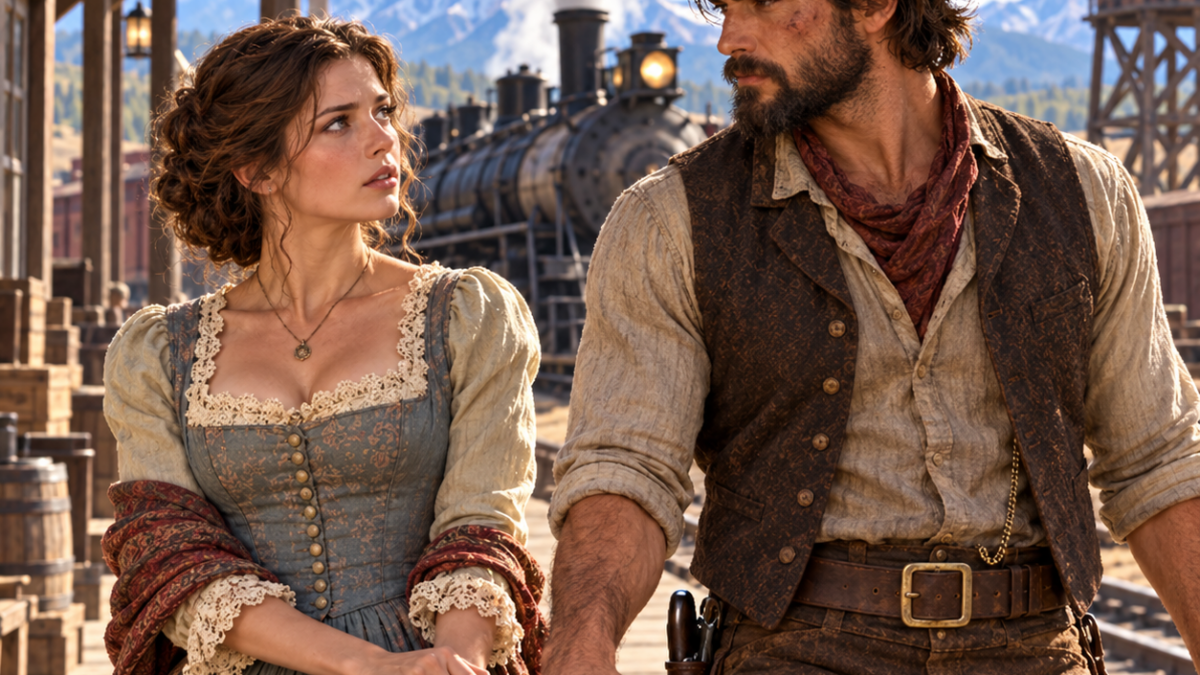
They Called the Scarred Rancher a Monster—Then I Married Him and Learned I Had Helped Create the Lie
Everyone in Rollins warned me not to marry Caleb Mercer, the scarred rancher they said had nearly beaten a man to death.
I married him anyway, believing I was brave enough to learn the truth for myself.
But the longer I lived beside him, the more I realized the cruelest story ever told about my husband had not begun in his house—it had begun with my own pen.
My name is Eleanor Bishop, and the first time I heard my future husband called a monster, I was standing beside my travel case at the Rollins depot with dust on my hem, ink stains on two fingers, and enough pride in my heart to mistake uncertainty for courage.
The man who warned me sold tobacco, newspapers, and railway coffee so burned it seemed less brewed than punished. He had a red face, white whiskers, and the careful voice of someone who wanted to enjoy telling a frightening tale while still being able to call it Christian concern.
“Mercer,” he said, lowering his voice. “Caleb Mercer. That who you’re marrying?”
I told him it was.
He looked past me toward the freight yard, where wagons stood in pale Wyoming dust and men loaded crates beneath a sky so wide it made every human rumor feel both tiny and unavoidable.
“Scarred up the left side of his face,” he said. “Temper on him, they say. Nearly killed a man once out past the Sweetwater. Some folks call him a monster.”
A monster.
The word should have frightened me.
Instead, it opened an old drawer in my mind.
Not a memory exactly.
A sentence.
A line from a story I had written years earlier, before Wyoming was anything more to me than a name on maps and before Caleb Mercer’s handwriting had become familiar enough that I could recognize his letters before breaking the seal.
The Scarred Stockman of Sweetwater.
That had not been the title I wanted. Editors love titles that remove all doubt from a reader’s imagination. I had called it The Man at the South Gate, which Thomas Pruitt said sounded like a sermon and would sell like one. He changed it. The story sold. I accepted the money and the praise with the pleased discomfort of a young woman discovering that ugliness, arranged neatly, could pay rent.
I had written the piece from fragments.
A driver passing through Cheyenne mentioned a scarred rancher who had nearly killed a hired man. A newspaperman supplied a darker motive because he had heard one somewhere. A publishing acquaintance leaned across a coffee table and told me there was a story in it if I had the sense to make the pieces fit.
So I made them fit.
That is what writers do, though I used to say it with more pride.
No one had given me a full name.
No exact ranch.
No complete chronology.
No true shape of the scar.
Where the facts ended, I continued. I sharpened the violence. Clarified motives no one truly knew. Made the scar dramatic enough that a reader could see it from the other side of a printed page. I gave the man silence and made that silence evidence. I gave him strength and made strength danger. I gave him one terrible act and allowed it to explain his whole soul.
At the time, I thought of the unnamed man as distant material.
Raw ore.
A figure.
A shadow useful to fiction.
I never imagined that a story born from secondhand voices might one day stand up, put on a coat, and walk toward me across a depot yard.
But Caleb Mercer was doing exactly that.
I saw him before the depot man finished pretending not to stare.
Caleb crossed the yard from the freight house with my last letter folded in one hand and his hat pulled low against the hard afternoon sun. He was tall enough to make the building behind him seem poorly designed. Broad through the shoulders, narrow at the hips, built by labor rather than vanity. He moved with the contained economy of a man who disliked attracting notice and had learned long ago that notice came anyway.
Then I saw the scar.
It began at his left temple, crossed the outer edge of his eyebrow, ran diagonally over the high curve of his cheekbone, and broke into a shorter pale mark toward his ear. The left eyebrow thinned where the old injury crossed it. Scar tissue pulled faintly at the corner of the same eye, leaving it narrower than the right even while his face was still.
That small asymmetry gave his neutral expression the suggestion of a glare.
I knew at once why careless people feared him.
I also knew, though I was not ready to admit it, why careless writers had loved him.
Two men loading a freight wagon quieted when he passed.
Caleb did not look angry.
That made the warning harder to sort.
He looked tired in a guarded, practiced way, as though he had spent years entering rooms already occupied by somebody else’s opinion of him.
“Miss Bishop,” he said.
Not a question.
“Mr. Mercer.”
His pale gray-blue eyes rested on my face for a moment. He did not smile. He did not search me anxiously to see whether I had heard the stories. He simply bent, took hold of my travel case, and lifted it from beside my boots.
I reached for the handle at the same time.
His hand already carried the weight.
I let go.
Only then did I realize I had been staring at his scar.
He noticed.
“You can ask,” he said.
Five months of letters had taught me that Caleb rarely offered a door twice.
I could have asked what happened.
I could have asked whether the depot man had told the truth.
I could have asked if he had nearly killed a man, if he regretted it, if monsters answered matrimonial advertisements with precise handwriting and enclosed pressed sage between pages because they thought an Eastern woman might like to know what Wyoming smelled like after rain.
Instead, I heard myself say, “Does it hurt?”
PART2:
Something behind his expression changed.
Not softness.
Not surprise.
Something smaller and more private.
“In the cold,” he said. “Some.”
He carried my case to the wagon.
The answer was small.
So was the act of taking my luggage.
Neither proved anything.
I knew better than most people that a few details could be arranged into nearly any story a person wanted.
For once, I decided not to arrange them.
I married him two days later.
The ceremony took place in a plain county room with a clerk, two witnesses, a Bible no one opened, and a window that rattled whenever the wind pressed hard enough against the building. I wore a traveling dress of dark blue wool because white would have felt dishonest, impractical, and easy to stain. Caleb wore a black coat brushed clean at the shoulders, though dust had already found the cuffs.
I still had money of my own.
Not much, but enough.
My return ticket remained folded inside the travel case Caleb had carried from the depot. My editor in Boston did not know exactly where I had gone, only that I had answered a letter from a Wyoming rancher and might or might not have lost my senses. If I changed my mind, I could leave.
Caleb reminded me of that on the morning of the wedding.
We stood outside the clerk’s office beneath a sky the color of tin. Wind moved dust across the street in long pale ribbons. He held his hat in one hand and looked toward the hitching post instead of directly at me.
“You don’t have to stay,” he said.
His voice was flat, almost formal.
I looked at him.
“I know.”
“I mean it. You get out there and decide you don’t like the look of it, I’ll see you back to Rollins. Fare east too, if you need it.”
“I know.”
His eyes came to mine then.
“No debt in this.”
“I know that too.”
He held my gaze for another moment, then nodded.
He never argued with the warning I had heard.
Never told me the depot man lied.
Never asked me to trust him over people who had known his name longer than I had.
Never told me what I ought to think.
That, more than any defense he could have made, was why I signed my name beside his.
Caleb’s ranch lay roughly two hours from Rollins, where dry hills opened into long reaches of grass and sky. In the East, land had edges. Fences. Streets. Walls. Here, distance seemed to stretch past the eye and enter the bones. The road to his place bent through sagebrush, shallow draws, and grass gone silver at the tips. Antelope lifted their heads and vanished like thoughts a person was too slow to catch.
I sat beside him on the wagon bench, feeling every rut through my spine, trying not to watch the scar too often.
Caleb noticed anyway.
He noticed everything, though he often responded to nothing.
“Dust bothers you?” he asked after half an hour.
“No.”
“You keep breathing like you regret it.”
“That is because the road keeps trying to rearrange my organs.”
The corner of his mouth moved.
Barely.
“We can stop.”
PART3:
“I didn’t say I was dying.”
“No.”
“Do you always offer escape so quickly?”
He glanced at me.
“Do you always hear practical concern as insult?”
That was the first time I laughed in his presence.
It startled us both.
His hands tightened briefly on the reins, and the horses flicked their ears as if the sound were another new thing to be measured.
The house was timber and stone, low against the wind, with a south-facing wall that caught afternoon sun. A red-brown barn stood beyond the corral. Smoke curled from a chimney. The porch sagged slightly near the left corner, and one board by the step looked as if it had opinions about the future. Beyond the house, one section of fence and gate appeared newer than the rest, fresh wood pale against the weathered rails.
I noticed it on the first day.
Then forgot it almost immediately.
There were too many other things to learn.
Caleb carried my trunk into the house and showed me the rooms without ceremony. Kitchen. Pantry. Front room. His room, which he called “the larger bedroom” as if the previous ownership of it were irrelevant. A second room off the kitchen had a wobbling desk beneath the window and shelves empty enough to look expectant.
“For your writing,” he said.
I turned to him.
“You remembered.”
His eyes shifted away.
“You wrote that you work mornings best if the light’s decent.”
I had written that in my third letter.
I did not know what to do with the fact that he remembered.
“The desk legs are bad,” he said.
“I noticed.”
“I’ll fix it.”
“You don’t have to.”
“You’ll be using it.”
That was all.
Two days later, while unpacking books, I found the desk standing square and solid. Caleb never mentioned the repair.
That became one of the first things I understood about him.
He did kindness as if it embarrassed him to be caught in the act.
He did not treat my writing as a pastime he had graciously allowed into his house. He treated it as work because I did. When a letter needed to go to Rollins, it went with the ranch mail. When I shut the writing room door, he did not interrupt except once, when smoke began curling from a pan I had forgotten on the stove.
“You improving reality in there?” he asked through the door.
“Trying.”
“Reality says supper’s burning.”
I laughed before I could stop myself.
During the first weeks, Caleb remained difficult to read.
He was not cold exactly.
He was reliable.
There was a difference.
Coldness withholds to punish. Caleb withheld because speech seemed to cost him more than work did. He told me where the water froze first. Which horse pulled badly to the left. When Nate Brooks would come by for payroll figures. Which boards on the porch ought not to be trusted after rain. He left wood stacked by the kitchen door before I noticed the bin was low. He sharpened my small knife after seeing me struggle with twine. He placed a cup of coffee beside my elbow each morning and never asked whether I wanted it after the first day.
He did not volunteer anything that sounded like confession.
I told myself I did not need one.
Then hated that I had to tell myself.
Nate Brooks was the first ranch hand I trusted.
He had ridden Caleb’s roundups for eight years and looked older than his forty-five years in the way men do when weather, horses, and other people’s mistakes have taken turns using their bodies. He had steady eyes, a short gray beard, and the gift of speaking only when silence would be less useful.
One afternoon, I watched Caleb discover that Nate had ordered the wrong amount of feed and cost the ranch money.
I was carrying folded towels past the kitchen doorway when Caleb came in with a ledger, Nate behind him. The air in the room changed before either spoke. Not with shouting. With numbers. Money was thin on the Mercer ranch in ways I was beginning to understand. One mistake could echo through winter.
Caleb laid the ledger on the table.
Nate removed his hat.
I braced without meaning to.
That was when I learned something about myself I did not like.
Some part of me was still waiting for the depot warning to prove itself.
Caleb looked over the figures. Rubbed one thumb against the edge of the ledger.
“Can we use the extra before winter?”
Nate nodded. “Most of it.”
“Then next time ask me before you decide we own twice as many horses.”
Nate grinned slightly. “That all?”
“That’s enough.”
The matter ended there.
No slammed hand.
No curse.
No threat.
Only a correction, dry as sagebrush.
Relief moved through me so sharply I had to turn away.
That evening, Caleb found me at the stove.
“You’ve been quiet.”
“I am often quiet.”
“No.”
I stirred beans that did not require stirring.
He leaned one shoulder against the door frame. The scar drew his face toward severity even while his voice stayed level.
“Something scared you today.”
I hated that he was right.
“Nate made a costly mistake,” I said.
“He did.”
“And you were calm.”
His expression closed slightly.
“Should I apologize for that?”
“No.”
“Then what are we saying?”
I set down the spoon.
“I am ashamed that I expected otherwise.”
For a long moment, he said nothing.
Then he nodded once, not as if forgiving me, but as if I had told him something true enough to keep.
“Folks told you to expect otherwise.”
“Yes.”
“Folks like being useful.”
“It wasn’t only them,” I said.
His gaze sharpened.
But I did not yet have the courage to explain.
The past stayed where I had packed it, folded inside notebooks and old pages.
For a while, the marriage grew around that silence.
Not beautifully at first.
Real things rarely do.
It grew like a fence repaired section by section, a rail here, a post there, weather still testing the whole line.
Caleb handed me the ranch ledger one evening after supper.
“Accounts are ugly.”
“I’ve seen ugly.”
“Not like my arithmetic.”
He was right.
His figures wandered downhill across the pages. Calf tallies appeared on the backs of receipts. Expenses sat in margins because apparently Caleb believed paper should make room if a man asked firmly enough. I reorganized three months of entries at the kitchen table while he repaired a bridle nearby and pretended not to watch.
When I finished, he studied the clean columns.
“Better hand than mine.”
“That is praise?”
“It’s the amount I had available.”
“Then I’ll ration it.”
This time the corner of his mouth almost lifted.
That nearly smile became something I noticed too often.
So did his hands when he rolled his sleeves before work.
So did the way he paused before entering my writing room, even when the door was open, as if imagination required privacy like prayer.
So did the fact that he listened when I talked about plots he claimed not to understand.
One evening, he picked up a page of my manuscript before I could stop him.
I reached across the table.
“That is not finished.”
“I can tell.”
“Caleb.”
He read another line.
“The man in your story talks a great deal for someone dying of a lung wound.”
“He has important things to say.”
“He’s lost half a lung.”
“Readers want the words.”
“A dying man wants air.”
I snatched the page back.
“Fiction is allowed to improve reality, Mr. Mercer.”
“Reality might have something to say about that.”
“Reality rarely has an editor.”
That time the smile came farther.
The irony of that conversation would not reach me until later.
At the time, it was simply flirtation.
One Saturday, Caleb hitched the wagon and told me to wear something not meant for dust.
“Why?”
“Fiddle player in Rollins.”
I waited.
“There’s supper with it.”
“That sounds dangerously like courtship.”
“We already did the wedding.”
“That is not a defense.”
“It’s the one I’ve got.”
The gathering was held in a hall above the mercantile. Lanterns hung from rafters. Someone had pushed tables against the wall and set pies, coffee, biscuits, and whiskey in varying degrees of concealment depending on who was looking. A fiddle and banjo tuned near the far corner. Women in calico dresses talked behind fans. Men with sun-browned necks pretended not to be nervous about dancing.
Caleb nearly turned around at the bottom of the stairs.
I felt it before I understood it.
He had gone quieter.
His shoulders tightened.
Two men coming down greeted him politely and too quickly. Inside, conversations did not stop, but some changed direction. A few faces turned toward us. Eyes touched Caleb’s scar and moved away.
He offered me his hand.
Not because he wanted to dance.
Because retreat would be worse with a witness.
So we danced.
Badly.
Not charmingly badly.
Truly badly.
“You’re counting,” I whispered.
“I am surviving.”
“You are better with a fence post.”
“Fence post doesn’t move its feet.”
I laughed into his shoulder.
For the first time since meeting him, I felt him laugh too.
Not much.
A small motion through his chest.
Enough.
On the walk back to the wagon, he did not let go of my hand.
Neither of us mentioned it.
A few evenings later, we walked the south fence before supper. The sky was wide and pale over the dry grass, and Rollins seemed very far away.
“Why here?” I asked.
Caleb glanced toward me.
“This far out?”
“Yes.”
He understood.
For a while, he said nothing.
Then, “After the fight that left my face this way, people I’d known ten years started finding reasons not to be where I was.”
The wind moved through the grass.
“They’d look at the scar and bring the story with it,” he said. “After a while, a man gets tired of watching people decide who he is before he opens his mouth.”
“So you moved farther out.”
“Was practical.”
“It sounds lonely.”
“Practical things can be.”
We walked another twenty yards.
I looked toward the south wall of the house.
“That side gets sun most of the day.”
“Near enough.”
“Lilacs might do well there in spring.”
Caleb’s gaze followed mine to the empty ground. He said lightly, “Spring’s a long way off yet.”
But I heard what he did not say.
Not no.
Not yes.
Only a man unwilling to assume I would still be there when the ground softened.
By late August, the marriage had begun to change shape.
It was not one grand moment.
It was me reading a paragraph aloud while Caleb cleaned a saddle and Caleb saying the villain sounded like a man who had never been cold. It was him leaving a cup beside my elbow without asking. It was me learning that his silence meant different things—anger, concentration, fatigue, or simply peace. It was the two of us riding into a shallow draw one evening to check a lame heifer and Caleb asking, without looking at me, whether I missed the East.
“Sometimes,” I said.
He nodded as if he had expected worse.
“I miss people,” I added. “Streets. A bakery that knew what sugar was. Rain that did not arrive sideways. But I don’t spend my days wishing I had made a different choice.”
Something in his face closed and opened too quickly to name.
“Good,” he said.
The kiss came several days later while we were mending wire near sundown. My hand slipped on the pliers. His closed around mine. Neither of us moved away.
Caleb looked at me as if asking a question he did not trust himself to put into words.
I answered by leaning closer.
He kissed me carefully at first.
Then less carefully.
After that, the marriage ceased being only a legal fact or an experiment in shared rooms. Our closeness became as ordinary as boots beside the bed and my books accumulating on his shelves. Nothing about it made Caleb suddenly easy to read. If anything, I began to understand how much tenderness could exist inside a man who still did not know how to show it in public.
By early September, I no longer thought of the ranch as somewhere I was staying.
It was home.
That was when Thomas Pruitt’s letter arrived.
I knew his handwriting before I broke the seal. Sharp, slanted, impatient, ink pressed too deep into the paper as if even correspondence had failed to keep pace with him. Thomas had edited my work for six years. He had taken my earliest sketches and told me where they dragged, where they lied, where they nearly lived. I owed him much of my small literary career, though not always my gratitude.
The letter said one of my old sensational stories was being revived by a story paper farther west.
Readers remembered the scarred monster.
They wanted a sequel.
The offer was generous.
Roughly three months of my ordinary income.
I read the number twice.
Money on a ranch is not theoretical. It is fence wire, winter feed, a new stove door, medicine, wages, freight, salt, flour, repairs, seed. Three months’ income could give Caleb breathing room he would never ask from me and pride would hardly allow him to take.
The old story embarrassed me now.
Not enough, apparently, to keep me from remembering how well it had sold.
I told myself the real man behind the original rumor was nameless, distant, unreachable.
Half the piece had been invention anyway.
That old defense.
Invention.
As if making a lie prettier changes its weight.
I accepted before supper.
The unease began in fragments.
Caleb mentioned Hiram Ror once, a foreman he had employed years before. The name was familiar enough to tug at memory but not enough to stop me.
Another evening, while searching for a voice I might use in the sequel, I read a sentence from the old monster story aloud without thinking.
“A scarred man who never explained himself to anyone.”
Caleb went still over his coffee.
“What?”
“Nothing.”
“That’s rarely true when someone says it.”
“Coffee is hot.”
“It’s been sitting there half an hour.”
He picked up the cup anyway.
I let the moment go.
Then, two days later, I found an old research scrap tucked inside the notebook I had brought west.
The driver who first told me the rumor had mentioned a gray gelding with one white stocking on the off foreleg. I had kept the detail because it was too specific to invent and because specific details make readers believe everything around them.
At supper the next night, I almost asked Caleb whether Ror had owned such a horse.
I stopped myself.
One coincidence was not truth.
Two days later, we walked past the south gate.
“Why is this section newer?” I asked.
His expression changed so slightly another person might have missed it.
“There was a fight here.”
I stopped.
Caleb looked toward the gate rather than at me.
“Iron fitting off a harness caught me across the face. Tore part of the gate loose in the middle of it.”
My skin went cold.
“What kind of horse was in the yard?”
Now he looked at me.
“Why?”
“I don’t know yet.”
A long pause.
“Gray gelding. One white stocking off fore. Ror’s.”
The pieces did not merely resemble the old story anymore.
They locked.
Ror.
The gray horse.
The damaged gate.
The iron fitting.
The year.
The scar already written across Caleb’s face before I had ever seen it.
I heard the sentence inside me before I was willing to think it clearly.
Oh God.
I wrote him.
That night, after Caleb slept, I lit the small lamp in my writing room and pulled every old scrap from the notebook. The depot rumor. The newspaper clipping. Thomas’s early comments. My draft notes. There was no full name, no ranch location, no exact scar. Enough had been changed by rumor and then changed again by me that I understood how I had failed to recognize him at first.
But there was no longer room for doubt.
Caleb Mercer was the unnamed monster I had made famous enough for strangers to fear him.
I slept badly beside him for two nights.
That is not accurate.
I lay beside him.
Sleep barely came.
He would turn in the dark, one arm resting across his chest, scar invisible except when moonlight touched the left side of his face. I stared at the ceiling and felt guilt gather like weather. Every kind thing he had done became harder to bear. The repaired desk. The coffee. The way he never argued with the depot warning. The way he gave me the choice to leave before marrying him.
He had been giving me freedom while I carried a published prison with my name on it.
On the third evening, I set down my fork before either of us had eaten much.
“There’s something I have to tell you.”
Caleb waited.
That was one of his hardest habits.
He did not rescue a person from their own opening.
I had rehearsed better beginnings.
None survived his silence.
“You know that old story I told you my editor wants to reprint.”
“Yes.”
“I know who it was about.”
His brow tightened.
“Who?”
My throat closed.
“You.”
He stared at me.
The room seemed to change shape around that single word.
I forced myself on.
“I wrote it.”
At first, I thought he had not understood.
Then his face went very still.
Not the guarded stillness strangers caused.
Something deeper.
A door closing inside a house I had just begun to call home.
I told him the rest in plain pieces because I had forfeited the right to arrange them beautifully.
Years ago, I had heard a rumor about a scarred rancher and a violent fight. I had never known the man’s name, never known the young worker, never known why the fight began. I had taken a few specific details and invented the spaces between because fiction rewarded certainty. I had made the scar worse. Made the motive uglier. Made silence look like guilt. Made violence look like appetite. Then I sold it.
Caleb did not raise his voice.
That was worse.
“You took a life you didn’t understand,” he said, “and made it useful to you.”
“Yes.”
His left eye looked narrower when he was tired. Tonight it made him appear angry even though his voice remained controlled.
“That’s what they all did.”
I looked at him.
“They saw this face and decided they knew the rest. You had paper instead of a street corner.”
There was no answer that did not sound like defense.
So I gave him none.
“I didn’t know it was you.”
“I know.”
“I would never have—”
“Not knowing doesn’t change what it did.”
“No.”
He pushed his chair back and stood.
Panic rose in me.
Not fear of him.
Fear of loss.
“I can write the correction. I can tell what really happened.”
For the first time, his expression hardened fully.
“No.”
I stopped.
He looked at the wall beyond me, jaw set.
“Hiram Ror was my foreman,” he said. “Good at keeping the place moving. Too good, maybe.”
I said nothing.
“Men complained he was hard on the younger hands. I let too much slide because the work got done.”
His hand closed once at his side.
“One of the hands was nineteen. Took a ranch horse without permission because somebody in his family was in trouble and he thought he could get there faster than explaining first. Ror called it theft. Insubordination. Started on him with a leather trace before the young man had a chance to say much of anything.”
I could see it now, though I had no right to.
The yard.
The horse.
The trace.
The young hand.
Caleb younger too, unscarred, angry, arriving too late and too fast.
“I stepped between them,” he said. “Ror swung the trace. Metal fitting caught me here.”
His fingers touched the scar without quite pressing.
“I put him down.”
He stopped.
“That should have been the end.”
“But it wasn’t,” I said softly.
“No.”
The word came flat.
“I kept hitting him after he wasn’t a threat anymore.”
The room seemed smaller.
I understood then why Caleb had never spent years proclaiming innocence.
The rumor was wrong.
It was not entirely false.
That made it harder.
Truth almost always does.
“The young hand left the district,” Caleb continued. “Wanted nothing made public. I don’t know where he is now, and I’m not giving his name to a paper because strangers have decided they deserve an ending.”
“I wouldn’t.”
“You were about to.”
I looked at the blank page I had already imagined. Caleb stepping between brutality and youth. Caleb scarred for protecting a boy. Caleb misunderstood. Caleb redeemed in print by the woman who wronged him. A clean story. A better story. Still a theft.
He was right.
“Correct what you invented, Eleanor,” he said. “The rest is mine.”
I nodded.
He slept that night on the narrow cot in the writing room, the one he kept for long calving nights when a man came in too filthy and exhausted to cross the whole house.
The next night he did the same.
A week later, I sent Thomas Pruitt a telegram from Rollins.
Do not print sequel. Letter follows.
I knew before his reply arrived what it would cost me.
The commission was gone.
Three months of ordinary income with it.
Thomas had no legal power to force another story from me, but six years of easy professional trust became something less certain. He wrote back with irritation dressed as advice.
My dear Eleanor,
A writer cannot afford sentiment toward material. If every source of inspiration must approve its own use, we shall all be reduced to weather reports and wedding notices.
You are becoming provincial.
T.P.
I read the letter twice.
Then burned it in the stove.
Stopping the sequel prevented another injury.
It did not repair the first.
The reprint was already moving through the region.
At the ranch, Nate brought the practical consequence to Caleb before breakfast.
“Three outside men are out.”
Caleb looked up from the tack he was repairing.
“All three?”
“Two sent word. Third told the livery he’d rather not ride under a man who gets pleasure out of beating hired hands.”
Caleb’s jaw tightened.
“Then I don’t want him.”
Nate did not move.
“What?”
“You want the seventy-two head in Rollins?”
“You know I do.”
“Then you want enough hands to move them.”
Caleb set the leather strap down.
“Men who believe a story over a ranch they’ve never worked can stay home.”
“That’s pride talking.”
“Maybe pride can push cattle.”
Nate looked at him.
“Never seen it done.”
The sale memorandum required the steers in Rollins that fall. Missing the date would not mean ruin, but it meant worse terms and a season’s loss the ranch would feel through winter. I heard enough of the exchange from the kitchen doorway to understand that my story had finally reached beyond reputation.
Now it had a price.
My first instinct returned almost immediately.
Write the truth.
I sat in the writing room and began with Hiram Ror’s name.
Then the nineteen-year-old hand.
Then the family emergency.
Then Caleb stepping between them.
I stopped.
The page in front of me was accurate in a way the first monster story had never been.
That did not make it mine.
I tore it once.
Then again.
I could confess what I had invented.
I could not turn Caleb’s confidence or the young man’s private history into a cleaner second version of the same theft.
Caleb chose differently.
The following morning, he rode into Rollins on purpose.
Not to defend himself before the whole town.
Not to ask anyone for absolution.
He went to the livery because two of the outside drivers who had not yet withdrawn were expected before noon, and their decision mattered. Nate went with him and, according to Nate later, said almost nothing, which in Nate’s case was either moral support or indigestion.
Caleb found the men checking gear.
“You’ll have heard a story about me,” he said.
One looked uncomfortable.
The other said, “We have.”
“Most of it is crooked. Some of it isn’t. I’d rather you heard that part from me before you decide whether to ride.”
He told them Ror had been his foreman.
He told them complaints had reached him about how Ror treated younger workers and that he had ignored too much because Ror kept the operation running.
He told them a nineteen-year-old hand had taken a ranch horse without permission for a family emergency.
Ror called it theft and struck the young man with a heavy leather trace.
Caleb intervened.
The harness fitting scarred his face.
Then Caleb said the part he least wanted to say.
“The danger was over before my hands were.”
Neither driver interrupted.
“I kept hitting him after I should have stopped. I won’t rename that justice because I happened to have a good reason to step in at the start.”
The first man shifted his weight.
“What happened to the hand?”
“Left the district. His name isn’t mine to give you.”
Caleb looked from one man to the other.
“You work my ranch, no foreman lays hands on you. And the man who owns the place doesn’t get to excuse losing control because he was angry for the right reason.”
The older driver exhaled slowly.
“I don’t care for what you did.”
“Neither do I.”
“But I’d rather hear it plain from you than guess at it from a paper.”
He still declined the job.
The second man stayed.
With Nate’s core crew and two additional men found through people who actually knew the ranch, there would be enough hands to make the drive safely, though not comfortably.
Caleb returned home after dark.
He did not tell me he had spoken in town.
Nate did.
That mattered to me more than Caleb could have known.
He had not spoken because I pushed him.
He had chosen on his own to stop letting silence make every decision.
I went back to my desk.
This time, I did not write Caleb’s story.
I wrote mine.
Under my real name, beside the pen name that had sold the original sensation, I admitted that I had built a popular story from incomplete rumor and secondhand fragments. I admitted that I had described a scar I had never seen, sharpening its shape and severity because a frightening face made better copy. I admitted that one real loss of control had become, in my hands, proof of a permanent appetite for cruelty.
I had assigned motives to a real man I had never met.
Most of all, I admitted that I had written certainty where the truth contained gaps.
I did not name the young hand.
I did not publish the family emergency.
I did not repeat Caleb’s private account of the fight.
Near the end, I wrote one sentence that made me put the pen down for nearly an hour.
A scar can prove a person has been wounded and nothing more; everything beyond that requires evidence, patience, or the humility to admit the story is unfinished.
Thomas printed it.
Not out of sudden moral conversion.
It was good copy.
The author of a successful sensation publicly challenging her own work was something readers would notice. Other papers noticed too. A column here, a reprint there, a summary in a regional sheet. It did not erase the old story. Some readers preferred the monster. Some people in Carbon County thought Caleb’s own admission proved he was exactly as dangerous as they had always believed.
Others became less certain.
That was all.
Sometimes mercy begins as uncertainty.
The seventy-two steers reached Rollins four days late. The smaller crew cost Caleb time. The delayed delivery cost him money. The buyer accepted the cattle at a lower price than Caleb had hoped for. The ranch would feel it through winter.
It would survive.
That was the word Nate used.
“Survive.”
Caleb hated that word when applied to anything he loved because it sounded too close to barely.
For three weeks after the drive, he moved around the ranch like a man carrying weather under his ribs. We spoke of accounts, repairs, meals, weather, cattle, and mail. We did not speak of the cot. We did not speak of my article unless necessary. We did not speak of trust.
That silence was not peaceful.
It was not punishment exactly either.
It was the space after a broken beam is found, when everyone in the house walks carefully until someone decides whether to repair or abandon it.
Then one afternoon Caleb rode into Rollins for ordinary business and came home slower than usual.
I was in the writing room when he entered. The repaired desk stood firm beneath my hands. A new page sat before me, blank except for one line I had crossed out three times.
Caleb stood in the doorway holding a folded newspaper.
I stopped moving.
“People spoke to me today,” he said.
I waited.
“Like they were waiting to hear what I said before they decided what I meant.”
My throat tightened.
“Was that what you were hoping for?”
“Didn’t know I was hoping for anything.”
He remained in the doorway.
“Was that what you meant to do?”
“Yes.”
My voice did not shake, though I wanted it to.
“I couldn’t undo what I wrote. I could give them a reason to look twice before believing it.”
Caleb looked at the newspaper.
“You didn’t tell them the rest.”
“It wasn’t mine.”
“No.”
Silence settled between us.
Not the comfortable silence we had once shared.
Not the punishing silence of the previous weeks either.
Something unfinished.
I said, “I’m not asking one article to make this right between us.”
“I know.”
“I’m not asking you to forgive me because strangers were kinder in town.”
“I know that too.”
For the first time, the answer almost sounded like an echo of our wedding morning.
Caleb stepped into the room.
“I’ve been using silence like it doesn’t make choices,” he said.
“It does.”
He looked at me.
“I don’t know how quickly all this gets better.”
“Neither do I.”
“But I’m tired of letting not knowing decide for me.”
He stopped beside the desk.
“I want to come back to our room tonight.”
Not forgiveness declared complete.
Not the old marriage restored in one sentence.
A choice.
I nodded.
“I want that too.”
Trust returned unevenly.
Some nights we talked.
Some nights we did not.
There were moments Caleb still went quiet too long and moments I caught myself turning a missing answer into a complete explanation before I had asked the next question.
But now we noticed.
That was new.
One night, while rain struck the roof hard enough to make sleep impossible, Caleb told me more of what happened after Ror.
Not the young hand’s name.
Never that.
He told me about the months when men avoided his eye. About a woman in church who moved her son behind her skirts when he entered. About the first time someone crossed the street rather than pass him. About how the scar healed faster than the story because flesh at least knows when to close.
I listened.
I did not write.
That was harder for me than I expected.
Writers are greedy creatures by training. We want to save every good line, every image, every wound that shines with meaning. I had to learn that listening is not the same as gathering. A confession is not material. A husband is not a character. Silence can be respect or cowardice, and the difference lies in whose safety it serves.
Caleb asked me once, “Do you miss writing the way you did before?”
I thought carefully.
“Yes.”
His face closed.
I touched his hand.
“But I don’t miss who I had to become to do it easily.”
He looked at me for a long moment.
Then turned his hand beneath mine.
“Harder way to make a living.”
“Yes.”
“Most honest things are.”
In winter, money tightened.
We ate beans more often than either of us preferred. Caleb repaired harness that should have been replaced. I sold two essays under my real name and earned less than I would have from one lurid sequel, but the money bought flour, lamp oil, and pride enough to keep both of us stubborn.
Thomas Pruitt wrote three more letters.
The first scolded.
The second tempted.
The third praised the “moral turn” in my public confession and proposed a serialized account of my marriage to the monster I had redeemed.
I showed that one to Caleb.
He read it by the stove, expression flat.
“What did you tell him?”
“I haven’t yet.”
“You asking me?”
“I am showing you because refusing him concerns you too.”
Caleb folded the letter carefully.
“Man thinks every locked door is a chapter.”
“Yes.”
“What will you say?”
I took a sheet of paper and dipped my pen.
Dear Thomas,
You seem to have misunderstood both the article and me. My husband’s life is not a sequel, and my shame is not a fresh market. I will send fiction when I have fiction to send. If you require monsters, I suggest you look somewhere other than my home.
Eleanor Bishop Mercer
Caleb read it once.
Then again.
“Bishop Mercer?”
I felt heat rise in my face.
“That is my name now.”
His nearly smile came slowly.
“Paper’s lucky to have it.”
It was the most extravagant praise he had ever given me.
I kept the letter copied in my journal.
By early spring, green began showing where winter had loosened its grip. The south wall of the house caught sun again. Mud claimed every hem I owned. Calves arrived damp, confused, and offended by existence. Caleb slept badly during calving season, coming in at dawn smelling of hay, cold, and life.
One morning, I found him outside the south wall with a shovel, a coil of wire, and a bundle of thin, bare-root plants wrapped in burlap.
“What are you building?”
“Thought we’d need something,” he said, “to keep cattle off the lilacs.”
For a moment, I could not speak.
I looked at the empty strip of earth I had pointed to weeks after our wedding. The place where I had said lilacs might do well. The moment when he had answered that spring was a long way off because he had not dared assume I would stay.
“We,” I repeated.
Caleb straightened.
The smile came slowly, the same way it always had, as though he still did not quite trust it until it was already there.
“Spring’s not so far off now,” he said.
No vow could have meant more.
We planted them together.
The soil was stubborn. So were we.
My hands blistered. Caleb pretended not to notice and then left salve beside my washbasin that night. The lilacs looked unimpressive when planted—thin sticks with faith attached—but Caleb built the wire guard carefully, measuring each post twice.
“They look dead,” Nate observed when he rode by.
“So do you most mornings,” I replied.
Nate laughed so hard his horse startled.
Caleb looked at me with open admiration, which was rarer than any flower.
The lilacs bloomed two springs later.
Not much.
A handful of pale purple clusters against the stone wall.
But the scent traveled farther than seemed possible.
By then, Caleb and I had learned the shape of a marriage rebuilt after truth. It was not softer than before. In some ways, it was stronger because it no longer depended on ignorance. I knew what he had done. He knew what I had done. Neither of us could make ourselves innocent, and so we had to practice something better than innocence.
Responsibility.
Patience.
Humility.
The willingness to ask the next question before writing the ending.
My work changed too.
I still wrote stories.
I still invented.
I still improved reality when reality had something dull to say.
But I stopped treating rumor as ore. I stopped mistaking a scar for a map. I stopped believing that a satisfying motive was proof of truth. When my characters did wrong, I let them do it for reasons that did not excuse them. When they were misunderstood, I did not make misunderstanding proof of sainthood. People are seldom so simple. Caleb had taught me that. So had my own shame.
Years later, a young journalist came to the ranch wanting to write about us.
By then, Caleb’s story had settled into a different shape across the region. Not clean. Never clean. Some still called him dangerous. Some called him honorable. Some called him unlucky. More simply called him Caleb.
That was enough.
The journalist was eager, bright-eyed, and too hungry for meaning.
“I want to tell the real story,” she said, sitting at our kitchen table with a pencil poised over a notebook.
I poured coffee.
Caleb stood by the stove, arms folded, expression unreadable.
“The real story,” I said, “belongs to several people. Some of whom are not here to consent to your appetite.”
She blinked.
“I only meant—”
“I know what you meant. I used to mean it too.”
Her cheeks colored.
Caleb looked at me, and the corner of his mouth moved.
I sat across from her.
“You may write about what I published and what I corrected. You may write about how stories grow teeth when writers feed them certainty. You may write that my husband was neither monster nor saint, and that both versions were too small. But you may not make a spectacle of a nineteen-year-old boy’s worst day, and you may not turn Caleb’s confession into entertainment.”
She looked down at her notebook.
After a long moment, she set the pencil aside.
“Then what should I ask?”
That was the right question.
Caleb surprised us both by answering.
“Ask what the story leaves out.”
She looked up.
He did not elaborate.
He rarely did when he had already given the best part.
The article she eventually wrote was imperfect.
All articles are.
But it did not harm us.
That felt like progress for the whole human race.
On our tenth anniversary, Caleb took me to the depot in Rollins.
I did not know that was where we were going until the wagon turned onto the familiar street. The depot looked smaller than memory, though the sky remained enormous. The tobacco man was gone, replaced by a younger clerk with spectacles and an expression suggesting he had not yet learned how much damage could be done by leaning over a counter and lowering one’s voice.
Caleb stopped near the place where I had stood with my travel case.
“Why here?” I asked.
He looked toward the freight yard.
“Thought you might want to see where you made your worst decision.”
I stared at him.
Then saw the smile hiding at the corner of his mouth.
“My worst?”
“Marrying a monster, wasn’t it?”
I swatted his arm.
He caught my hand.
The scar pulled slightly when he smiled fully now. I loved that. I loved the asymmetry, the history, the proof that flesh can heal imperfectly and still belong entirely to a beloved face.
“I made several worse decisions before that,” I said.
“Name one.”
“Writing a monster from gossip.”
His thumb moved over my knuckles.
“That one brought you here.”
“Not all roads are justified by arriving.”
“No.”
We stood there in the dusty light.
Then he said, “I was angry when you told me.”
“I remember.”
“I wanted to make you leave.”
My breath caught.
“You never said that.”
“Wouldn’t have been fair.”
“What stopped you?”
He looked at the depot, at the rails stretching east and west.
“You didn’t ask me to become innocent so you could love me.”
Tears stung my eyes.
“I couldn’t.”
“No. But you didn’t try.”
He turned toward me.
“And when you wrote, you took your own part back. Not mine.”
I swallowed.
“I nearly didn’t know how.”
“I know.”
A train whistle sounded far off, thin and lonely across the plain.
Caleb lifted my hand and kissed my knuckles.
“I’m glad you stayed.”
I leaned my forehead against his shoulder.
“So am I.”
That evening, back at the ranch, the lilacs moved in soft wind along the south wall. The house smelled of coffee, dust, bread, and Caleb’s soap. My desk still stood under the writing room window, repaired years earlier by a man who had no reason yet to trust the woman who would wound him with a truth she should have told sooner.
I sat there after supper and opened a blank page.
For once, I knew exactly how to begin.
They called him a monster before I knew his name.
I paused.
Then crossed it out.
Too easy.
Too familiar.
Too certain.
I began again.
The first story I heard about my husband was not entirely false, and that was what made it dangerous.
Better.
I wrote until the lamp burned low.
Caleb came to the doorway near midnight.
“You improving reality again?”
“Trying not to.”
“Harder work?”
“Much.”
He stepped inside and placed a cup of coffee beside my elbow.
I looked up at him.
His scar was silver in lamplight. His eyes tired. His mouth softer than the world usually deserved.
“Does it still hurt?” I asked.
He knew what I meant.
The scar.
The story.
The old fight.
My part in it.
All of it.
“In the cold,” he said. “Some.”
I took his hand.
Outside, Wyoming wind moved over the grass and rattled the new leaves on the lilacs. Somewhere in the barn, a horse shifted. The house settled around us, not perfect, not unbroken, but chosen.
That is the truth I learned after marrying the man they warned me against.
A monster is often a story told too early.
A saint is often a story told by someone seeking forgiveness too quickly.
A person is what remains when the story slows down enough to make room for evidence, patience, harm, change, and the parts no one has the right to steal.
Caleb Mercer was not the monster they sold me at the depot.
He was not the innocent hero I wanted to write after guilt found me.
He was a man who had stepped between cruelty and a boy, then failed to stop his own rage in time. A man who carried that failure honestly when silence would have been easier. A man who had been scarred by iron, rumor, pride, and my pen. A man who still fixed my desk before he trusted me, still planted lilacs before he knew whether spring would forgive winter, still chose to come back to our room before either of us knew how forgiveness would work.
And I was not the brave woman who married a monster despite the town’s warning.
I was not the pure-hearted wife who redeemed him.
I was a writer who learned too late that stories can injure real flesh. A woman who loved a man after helping make the lie that followed him. A wife who had to discover that confession is only the first payment on a debt truth creates.
We paid it slowly.
Some debts are paid that way.
In cups of coffee.
In articles that refuse easy redemption.
In names not printed.
In questions asked before conclusions.
In lilacs guarded from cattle.
In choosing, again and again, not to let old stories have the last word.
If you had been me at that depot, with every warning telling you to turn back, perhaps you think you would have left.
I used to think life was that simple too.
But the truth is, we are all standing at some depot, holding a case, hearing rumors about someone approaching across the dust.
Sometimes the warning is mercy.
Sometimes it is gossip wearing mercy’s coat.
And sometimes the person you most need to question is not the stranger walking toward you, but the storyteller already living in your own mind.
I married Caleb Mercer.
They called him a monster.
I learned the truth.
Then I learned that truth is not the opposite of a story.
It is the discipline a story owes the living.
And every spring, when the lilacs bloom against the south wall, I remember the day he looked at bare ground and chose to believe I might still be there when it softened.








