They Called 8 Military Dogs “Uncontrollable”—Then an Old Farmer Whistled Once and Every One of Them Went Silent
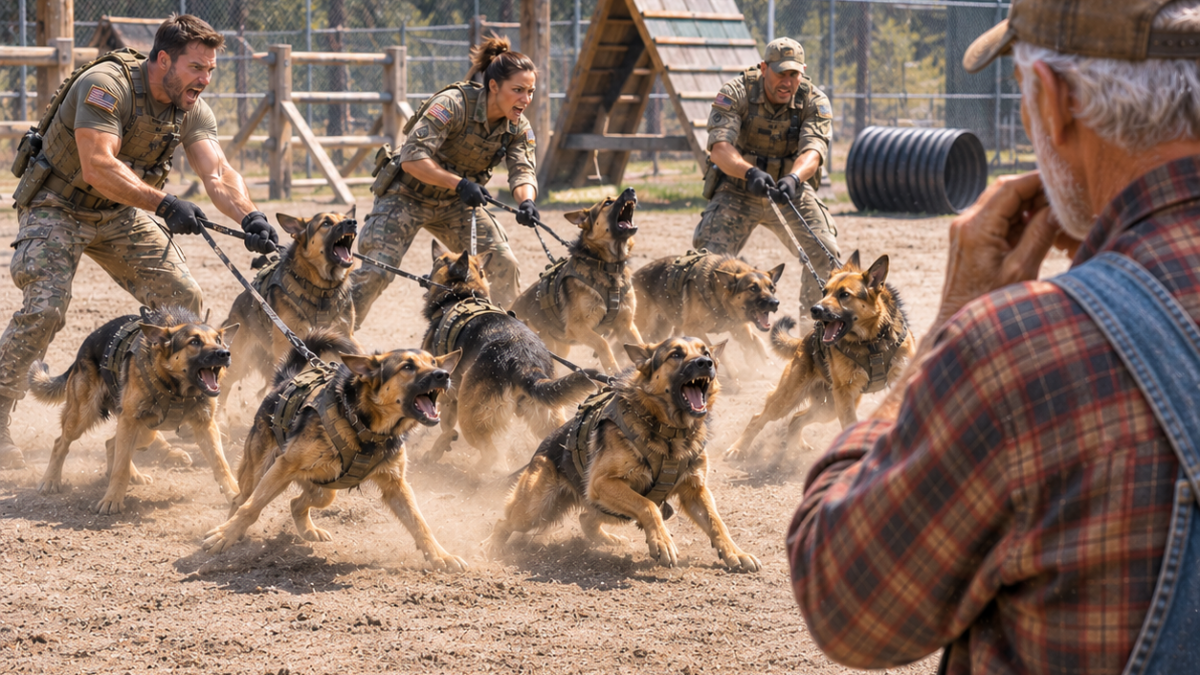
They Called 8 Military Dogs “Uncontrollable”—Then an Old Farmer Whistled Once and Every One of Them Went Silent
“These dogs are uncontrollable,” Rick Jennings snapped after three straight weeks of failed drills, just as eight rejected Shepherds and Malinois erupted against the chain-link fence behind him.
At the edge of the training compound, an old farmer in faded overalls watched the chaos without saying a word until the biggest Malinois finally paused long enough to take a breath—and the farmer whistled once.
Five seconds later, every dog in the kennel was silent, facing the same man, and Sergeant Ava Rostova realized the stranger beside the fence understood something about those animals none of their training manuals had taught them.
The noise inside the main run had become unbearable.
Barking crashed against barking.
Claws scraped concrete.
Metal fencing rattled every time one of the dogs slammed against it.
A sable Belgian Malinois named Ares paced the front of the enclosure with enough nervous energy to power the entire installation.
Every few seconds, he launched himself upward, front paws striking the fence as he barked toward the handlers.
Behind him, Juno, a smaller German Shepherd, had clamped her teeth around one of the plastic-coated fence ties and was chewing compulsively.
Pax, a dark brindled Dutch Shepherd, stalked a younger dog named Echo from one end of the run to the other.
The remaining dogs circled, barked, spun, or retreated into corners.
Eight animals.
Eight histories.
Eight failures according to the paperwork stacked inside the training office.
Rick Jennings stood outside the fence gripping a red rubber focus ball.
He was thirty-two, academically gifted, physically fit, and by every formal measure exceptionally qualified for the job he had been given.
Master’s degree in animal behavior.
Specialized postgraduate work in working-dog cognition.
Certifications in operant conditioning.
Hundreds of supervised training hours.
He knew reinforcement schedules.
Thresholds.
Drive development.
Behavior modification.
Marker systems.
Everything the program said a modern canine specialist should know.
And none of it seemed to matter.
“Ares.”
The Malinois barked.
“Ares. Focus.”
Another bark.
Jennings raised the red ball.
Ares saw it.
So did Pax.
So did two of the Shepherds.
Within seconds, the entire group’s excitement surged.
Pax rushed toward the ball.
Ares wheeled on him.
The younger dog Echo backed into a corner.
Juno abandoned the fence tie and began barking.
Jennings cursed under his breath.
“Enough!”
The word cracked through the enclosure.
For half a second, the dogs hesitated.
Jennings saw the opening.
“Down!”
Nothing.
“Ares, DOWN!”
The Malinois answered with another explosion of barking.
Jennings lowered the ball.
His face flushed.
PART2:
Sweat darkened the collar of his training shirt.
Three weeks.
Three weeks of plans.
Three weeks of evaluations.
Three weeks of changing reward timing, rotation schedules, exercise periods, feeding routines, enrichment tools, individual drills, group drills.
Every adjustment seemed to buy him an hour before the kennel fell apart again.
The rescue-to-readiness program had sounded excellent on paper.
Military and law-enforcement units discarded hundreds of dogs every year for behavioral reasons that did not necessarily mean the animal had no working potential.
Some were too reactive.
Some too independent.
Some had failed to bond with previous handlers.
Some had washed out of private security programs.
Others had simply been placed with people who did not understand them.
The project would take dogs sitting on the edge of permanent retirement—or worse—and determine whether disciplined retraining could give them another useful path.
Friday was the evaluation deadline.
If there was no measurable improvement, command would suspend the project.
Jennings knew exactly what that meant.
The dogs would be reassigned wherever placement could be found.
Some would enter long-term rehabilitation.
Some would spend months in institutional kennels.
A few might never leave.
He looked at them and felt the pressure tightening across his chest.
Then Ares slammed the fence again.
Jennings snapped.
PART3:
“These dogs are uncontrollable.”
His voice sliced through the compound.
Ava Rostova heard it from the far end of the kennel row.
She was scrubbing a stainless-steel feeding trough.
She stopped.
Did not look up immediately.
She had heard variations of that sentence every day for the past week.
Monday:
“They have no consistency.”
Tuesday:
“They’re sabotaging every progression.”
Wednesday:
“There is no reliable focus.”
Yesterday:
“I don’t know what else to do.”
Today:
Uncontrollable.
Rostova rinsed the brush.
Cold water splashed against her camouflage trousers.
She respected Jennings.
That was what made watching him fail so frustrating.
He was not lazy.
He was not cruel.
He genuinely wanted the program to succeed.
But he was becoming desperate.
And desperate handlers changed.
Their shoulders tightened.
Their breathing shortened.
Their voice sharpened.
Their movements became faster.
Dogs noticed all of it.
Jennings kept trying to solve the animals with more technique.
More drills.
More structure.
More control.
Rostova was beginning to think the problem had nothing to do with a lack of control.
These dogs had already experienced too much of it.
She looked toward Juno.
The Shepherd had been surrendered after three failed placements.
First handler called her timid.
Second called her stubborn.
Third called her unstable.
The file barely mentioned that each placement used a different command system.
Ares had bitten a former handler during an apprehension drill.
The paperwork described “handler-directed aggression.”
Pax had developed resource-guarding behavior after spending almost eleven months rotated through kennel facilities.
Echo had been bullied by larger dogs before entering the program.
Jennings read those histories.
But sometimes Rostova thought he only saw them as variables.
Behavior A.
Stimulus B.
Correction C.
Outcome D.
These dogs were not equations.
They remembered.
That was the problem.
Rostova stood.
Wiped her hands against her trousers.
And that was when she noticed the old man.
He stood outside the public viewing fence near the dusty access road.
Civilian.
Probably seventy.
Maybe older.
Faded denim overalls.
Red-and-black flannel shirt.
Leather boots coated with dried mud.
A baseball cap so sun-bleached the logo was nearly gone.
His pickup sat twenty yards away.
Old Ford.
Dented tailgate.
Wooden produce crates in the bed.
Painted lettering on the door:
CALDER’S FARM
FRESH PRODUCE — HAY — SEASONAL EGGS
Rostova knew why local farmers occasionally came to the base.
Old blankets.
Worn towels.
Discarded bedding.
Anything no longer suitable for military use sometimes went to farms and shelters instead of being thrown away.
The man was probably waiting for a pickup.
But he was not looking toward the supply building.
He was watching the dogs.
Perfectly still.
That caught Rostova’s attention.
Most visitors watched working dogs like entertainment.
They leaned against fences.
Pointed.
Talked.
Made clicking sounds.
Sometimes tried calling them.
This man did none of those things.
His weight sat evenly over both boots.
Hands relaxed.
Shoulders low.
Head tilted slightly.
His eyes moved.
Ares.
Juno.
Pax.
Echo.
Then back to Ares.
Not random.
Rostova stopped walking.
The old man was reading the enclosure.
Ares barked.
His eyes followed the Malinois.
Juno began chewing the fence.
His eyes moved to her.
Pax used Ares’s distraction to crowd Echo against a wall.
The old man saw that too.
His expression never changed.
Jennings grabbed another focus toy.
The farmer’s mouth tightened slightly.
Rick tossed the toy into the run.
Ares lunged.
Pax intercepted.
Their shoulders collided.
Growling erupted.
Juno barked.
Echo fled.
Jennings shouted:
“Leave it!”
Nobody left anything.
Rostova glanced toward the old man.
He watched.
No judgment.
No amusement.
Just observation.
Ten minutes passed.
Jennings tried another reset.
Failed.
Finally, he kicked a loose stone.
“Forget it.”
He turned toward the office.
The red focus ball hung uselessly from his hand.
His shoulders had collapsed.
Rostova knew that walk.
He was done.
Not just with the drill.
Possibly with the dogs.
The kennel remained loud behind him.
Ares had both paws against the fence.
Barking at Jennings’s retreating back.
That was when the old farmer moved.
One step.
That was all.
He approached the outside fence.
Rested both hands lightly against the top rail.
Rostova saw his knuckles.
Scarred.
Callused.
Old rope burns.
Working hands.
But there was no tension in them.
He did not lean forward.
Did not square himself toward Ares.
Did not stare the dog down.
He simply waited.
The Malinois barked.
Again.
Again.
Again.
The farmer did nothing.
Ares’s barking became more frantic.
Still nothing.
Then—
a pause.
Barely half a second.
The dog needed air.
The old man pursed his lips.
And whistled.
Once.
Rostova’s head snapped toward him.
It was unlike any ordinary recall whistle she had heard.
The opening note was clean and sharp.
It cut through the kennel noise.
But underneath it came something lower and rolling, almost as if the sound changed shape while still hanging in the air.
Not especially loud.
Yet every dog seemed to hear it differently from the barking and shouting that had filled the compound all afternoon.
Ares froze.
Mid-bark.
His mouth remained partly open.
His ears rotated forward.
His head turned toward the old man.
A low questioning sound replaced the bark.
Juno stopped chewing.
Pax stopped stalking Echo.
A Shepherd at the rear stopped circling.
Another dog who had been whining fell silent.
Five seconds.
That was all.
Within five seconds, eight dogs stood completely still.
Every head turned toward the farmer.
Jennings had reached the office steps.
He stopped.
Looked back.
Rostova felt the hair rise along her arms.
She had worked near canine units for two years.
She had watched elite military handlers.
Detection teams.
Patrol dogs.
Search dogs.
She had seen discipline so precise that a handler could direct an animal with nearly invisible movements.
She had never seen eight agitated washouts give their attention simultaneously to a civilian stranger.
Jennings walked back slowly.
The farmer did not look at him.
His focus remained on Ares.
The Malinois’s chest rose and fell.
The farmer blinked slowly.
Deliberately.
Then made a soft click with his tongue.
Ares stepped backward.
Sat.
His tail touched the concrete once.
Thump.
Another click.
Juno lowered herself.
Her chin went onto her paws.
Pax remained standing.
The farmer hummed softly.
Barely audible.
Pax’s shoulders lowered.
He moved away from Echo.
Then crouched.
Jennings stared through the fence.
“What did you just do?”
The farmer finally looked toward him.
His eyes were pale blue.
Weathered face.
Sun lines.
No triumph.
No smile at having embarrassed the younger man.
He said:
“They’re not uncontrollable.”
His voice was quiet and rough.
Jennings looked at the eight silent dogs.
“Then what are they?”
“Loud.”
Rick frowned.
The old man nodded toward the kennel.
“They’re shouting.”
He looked back at Jennings.
“And nobody’s listening to what they’re saying.”
Rostova stepped closer.
Jennings opened his mouth.
Closed it.
The farmer continued.
“You keep trying to be louder than them.”
“I’m giving clear commands.”
“I know.”
“They need structure.”
“They do.”
“Then what exactly am I doing wrong?”
The farmer considered him.
“You think structure means pressure.”
Jennings’s jaw tightened.
“I think structure means predictability.”
“Good.”
The old man nodded.
“But you aren’t predictable right now.”
Rick stared.
“I use the same commands every time.”
“Your mouth does.”
The farmer tapped his chest.
“This doesn’t.”
Jennings looked annoyed despite himself.
“What is that supposed to mean?”
“You’re frustrated before you open the gate.”
Silence.
“You’re expecting failure before the first dog moves.”
Jennings’s expression changed.
The farmer nodded toward Ares.
“He knows.”
“No, he doesn’t.”
“He knows your breathing.”
Jennings said nothing.
“Your shoulders.”
Nothing.
“The leash pressure before you even ask for anything.”
The farmer looked toward the dogs.
“They know you don’t trust them.”
Jennings’s face reddened.
“I’m responsible for eight dogs that could end this entire project if somebody gets hurt.”
“I know.”
“You don’t.”
The first edge entered the farmer’s voice.
Not anger.
Certainty.
“I know exactly what it feels like when a dog’s mistake can cost somebody more than a training score.”
That silenced Rick.
Rostova heard something beneath the sentence.
History.
She stepped closer.
“Sir?”
The farmer turned.
“Sergeant Ava Rostova.”
She gestured toward the kennel.
“That whistle.”
He waited.
“I’ve worked around military dogs.”
“I figured.”
“I’ve never heard that signal.”
The farmer looked back at Ares.
“It’s old.”
“What does it mean?”
He thought for a second.
Then said:
“It’s not really a command.”
Jennings looked confused.
“Then why did they obey it?”
“They didn’t.”
Rick glanced toward the dogs.
“They all stopped.”
“That’s not obedience.”
“What is it?”
“Orientation.”
The farmer rested his hands on the fence again.
“A pack under stress is always looking for a center.”
Rostova listened.
“If nobody gives them one, they make one.”
His eyes moved toward Ares.
“That fellow tried.”
The Malinois watched him.
“He’s young.”
“He’s scared.”
“He’s strong enough that everyone else started following his energy.”
Jennings said:
“He’s dominant.”
“Maybe.”
The farmer shrugged.
“Or maybe he’s the dog most willing to stand in front when nobody else knows what to do.”
That interpretation hit Rostova immediately.
The old man continued.
“The whistle asks one question.”
Jennings leaned slightly forward.
“What?”
“Where’s the center?”
He touched his chest.
“And it answers it.”
“Here.”
Jennings stared.
“Specific frequency?”
The farmer smiled faintly.
“There it is.”
“What?”
“The textbook.”
Rick looked almost offended.
“I’m trying to understand.”
“That’s good.”
The farmer nodded.
“But if you turn it into a button, it won’t help you.”
“Frequency still matters.”
“Of course it does.”
“Then could we measure—”
“You can measure anything you want.”
The old man interrupted gently.
“But you can’t measure your way around the part where the dog has to believe you.”
Silence.
Rostova almost smiled.
Jennings did not.
Not yet.
The farmer looked at him.
“You believe these dogs are broken.”
Rick started to answer.
Stopped.
“Don’t you?”
Jennings glanced toward the enclosure.
“They’re here because eight other programs couldn’t use them.”
“That wasn’t my question.”
Rick swallowed.
The farmer waited.
Finally:
“I think they have serious problems.”
“Yes.”
“And I think some of those problems may not be fixable.”
“Fair.”
“But?”
Jennings almost laughed.
“But I guess I stopped expecting them to surprise me.”
The farmer nodded.
“There you go.”
Rick looked at him.
“Dogs can hear a lie in your heartbeat.”
“That’s poetic.”
“It’s also practical.”
The old man shrugged.
“You walk into that run telling yourself you’re calm while every muscle says you’re waiting for a fight.”
He nodded toward Ares.
“That dog believes your body before he believes your command.”
Rostova thought of the last three weeks.
Jennings entering with jaw set.
Leash already shortened.
Correction expected before the dog moved.
The animals escalating.
Jennings increasing pressure.
Feedback loop.
Rick looked toward Ares.
“What would you do?”
The farmer pushed away from the fence.
“Nothing yet.”
Jennings frowned.
“What?”
“First, stop trying to make all eight dogs prove something at the same time.”
“They need group stability.”
“They need individual trust before group stability.”
The old man looked toward Rostova.
“Sergeant.”
“Yes?”
“Would you open the run?”
Jennings immediately said:
“Wait.”
The farmer looked at him.
“These dogs have bite histories.”
“I know.”
“You’re not wearing protection.”
“Don’t need it.”
“You cannot know that.”
The old man smiled slightly.
“You’re right.”
That answer surprised Jennings.
“I can’t know.”
He gestured toward the enclosure.
“But I’ve been watching them for fifteen minutes.”
“Watching isn’t the same as—”
“It’s exactly where handling starts.”
The farmer turned toward Rostova.
“Standard six-foot leash.”
“No prong.”
“No choke chain.”
“No e-collar.”
“Just leather if you have it.”
Rostova looked at Jennings.
For several seconds, nobody moved.
Then Rick exhaled.
“Get it.”
Rostova retrieved a worn leather leash.
When she returned, the eight dogs were still quieter than she had seen them in weeks.
She unlatched the run.
Normally, that sound triggered a surge.
Dogs pushing toward the opening.
Handlers bracing.
Today—
nothing.
The animals watched the farmer.
He entered.
Slowly.
No treats.
No toy.
No protective sleeve.
No stick.
Only the leash loosely folded in one hand.
Ares stood.
Low rumble in his chest.
Jennings stiffened outside the fence.
The farmer did not approach the Malinois.
He walked the perimeter.
One slow circle.
Eyes mostly down.
Body relaxed.
He gave each dog space.
Juno watched him.
Pax watched him.
Echo remained near the rear.
Ares tracked every step.
The farmer completed the circle.
Then stopped several yards from Ares.
Turned sideways.
Lowered himself into a crouch.
No eye contact.
No command.
He exhaled.
Long.
Slow.
Ares remained rigid.
The farmer breathed again.
The dog’s mouth opened.
Pant.
Then another breath.
Something loosened.
Ares exhaled.
His shoulders dropped slightly.
Rostova saw Jennings notice it.
The farmer extended one hand.
Palm down.
Still.
No movement toward the dog.
Ares leaned forward.
Stopped.
The old man waited.
Twenty seconds.
Thirty.
Almost a minute.
Ares stretched his neck.
Sniffed the farmer’s fingers.
Quick contact.
Retreated half an inch.
Then sniffed again.
The farmer whispered:
“Good boy.”
Almost nothing.
Ares’s ears twitched.
The farmer did not pet him.
Jennings whispered:
“Why not touch him?”
“Because he gave me a sniff.”
The farmer answered without looking away from the dog.
“Not permission to grab his head.”
Ares approached again.
This time his nose touched the man’s hand.
One quick lick.
The farmer slowly withdrew.
Then reached into the front pocket of his overalls.
Jennings tensed.
The man pulled out a piece of frayed rope.
Old.
Small enough to fit in his palm.
He dropped it between them.
Ares stared at the rope.
Then at the farmer.
Nothing happened.
Jennings waited.
Ten seconds.
Twenty.
Thirty.
“What are you waiting for?”
The farmer answered:
“Him.”
“For what?”
“To decide whether this is another fight.”
Jennings looked at the rope.
“He loves tug.”
“I know.”
“You’ve never met him.”
“I watched him when you threw the red ball.”
The farmer nodded toward Ares.
“He didn’t want the ball.”
“He wanted control of what happened next.”
Rick frowned.
The farmer continued.
“You make every game something he can win or lose against you.”
Ares sniffed the rope.
The farmer clicked softly.
The dog touched it with his nose.
Another quiet click.
Ares picked it up.
Jennings leaned toward the fence.
The dog took one step.
Then another.
He approached the farmer.
Held the rope toward him.
Rick inhaled sharply.
“No way.”
The farmer accepted the rope without tugging.
“Thank you.”
Jennings looked at Rostova.
“That’s a retrieve to hand.”
She nodded.
“We’ve been working on that for a month.”
Rick looked back into the run.
“He always turns it into tug.”
The farmer said:
“Because you turn tug into combat.”
Rick bristled.
“It is a drive exercise.”
“To you.”
The farmer handed the rope back.
“To him, you pull.”
“He pulls harder.”
“You pull harder.”
“He has to win.”
“You have to control.”
He shook his head.
“Everybody leaves angry.”
The old man took the rope again.
Applied the lightest tension.
Ares pulled.
Immediately, the farmer released.
Ares stumbled backward half a step from the sudden absence of resistance.
He looked surprised.
The farmer waited.
Ares brought the rope back.
Again.
Light tension.
Dog pulled.
Farmer yielded.
Third time, Ares’s movement changed.
Less frantic.
Fourth time, his tail moved.
Not tucked.
Not rigid.
Wagging.
The hard expression disappeared from his face.
He looked younger.
Jennings stared.
“What are you teaching?”
“That I’m not his opponent.”
The farmer accepted the rope.
“The game is not me versus him.”
He returned it.
“The game is us doing something together.”
Jennings looked toward Ares.
“What about obedience?”
“Useful.”
“But?”
“Not the destination.”
The farmer stood slowly.
“Obedience is what happens when communication becomes reliable.”
He looked at Rick.
“You’ve been chasing the symptom.”
The other dogs remained quiet.
Watching.
Even Pax.
Rostova studied the man’s hands.
The leash rested across his fingers loosely.
Exactly the way her grandfather used to hold one.
That memory hit suddenly.
Her grandfather, Nikolai Rostov, had kept a box of photographs from Vietnam.
Most were faded.
Men standing beside helicopters.
Jungle camps.
Rain.
Dogs.
One photograph showed him beside a German Shepherd named Sabre.
The leash hung loose.
Nikolai used to tell her:
“You don’t command the dog.”
“You command the space around the dog.”
She had been twelve the first time she heard it.
She thought it was old-man philosophy.
Now she watched Jacob Calder use the exact same body position.
The same relaxed hand.
The same invisible control.
“Mr. Calder.”
The farmer looked toward her.
“Did you serve?”
The kennel seemed to become quieter.
Ares remained beside him.
Jacob’s face changed.
Not much.
Enough.
“A long time ago.”
Rostova’s mind raced.
“My grandfather worked dogs in Vietnam.”
Jacob did not respond.
“MACV-SOG.”
Jennings looked toward her.
Jacob’s eyes met hers.
She continued.
“He talked about handlers who used whistles instead of shouted commands when they couldn’t make noise.”
Jacob looked away.
Rostova felt her pulse quicken.
“My grandfather’s name was Nikolai Rostov.”
Nothing.
Then Jacob looked back at her.
“Nicky?”
Her breath caught.
Only family called him that.
“Yes.”
A shadow crossed Jacob’s expression.
Something old.
Painful.
“He had Sabre.”
Rostova nodded.
“You knew him.”
Jacob stared at the concrete for several seconds.
Then:
“He saved my life once.”
Jennings did not move.
Rostova’s voice softened.
“My grandfather said somebody taught their unit that dogs should never be treated like equipment.”
Jacob gave a small smile.
“Your grandfather already knew that.”
“He said his trainer made him understand it.”
Jacob stroked Ares once along the shoulder.
The dog leaned into his hand.
“Different time.”
Rostova studied him.
“You were a handler?”
He nodded once.
“Among other things.”
“Your dog?”
Jacob’s hand stopped.
“Storm.”
That single word carried decades.
Jennings’s expression changed.
For the first time since the farmer arrived, Rick stopped looking like a scientist trying to decode a phenomenon.
He looked like a man recognizing grief.
Jacob continued quietly.
“Storm knew more about keeping me alive than I knew about keeping myself alive.”
He looked at Ares.
“We worked places where a wrong sound mattered.”
“Where the dog smelled things before you saw them.”
“Where he heard something change and you trusted him enough to stop.”
Jennings said:
“You trusted instinct.”
“I trusted communication.”
Jacob corrected him.
“Instinct without understanding can get you killed too.”
He pointed toward Ares.
“My job wasn’t to turn Storm into a robot.”
“It was to learn his language well enough that when he changed, I knew why.”
Rostova remembered her grandfather saying something similar.
Jacob looked around the kennel.
“These dogs have been trained by people who keep asking them to stop being who they are.”
He nodded toward Juno.
“That one’s sensitive.”
“Everybody probably calls her weak.”
Rostova said:
“Fearful.”
“She watches everything.”
Jacob corrected.
“That can become a gift with the right work.”
He pointed toward Pax.
“That one keeps testing everybody.”
“Resource guarding and bullying,” Jennings said.
“Or insecurity.”
Jacob replied.
“Same behavior can come from different places.”
Then Echo.
“Young one avoids conflict.”
Jennings nodded.
“Low confidence.”
“Maybe.”
Jacob looked at Rick.
“Or maybe he’s smart enough not to challenge dogs twice his emotional size.”
Jennings almost smiled.
Jacob turned back to Ares.
“And this fellow.”
“Handler aggression,” Rick said.
“A file wrote that.”
“He bit his last handler.”
“During what?”
“Apprehension training.”
“After what?”
Jennings hesitated.
“I’d have to check.”
“Exactly.”
Jacob looked at him.
“A bite is an event.”
“Not an explanation.”
Jennings slowly nodded.
Jacob took the leash.
Clipped it to Ares’s collar.
The dog stood.
No command.
He simply moved closer to Jacob’s left leg.
Shoulder almost touching the denim overalls.
Jennings stared.
“That’s heel position.”
“No.”
Jacob said.
“That’s where he chose to stand.”
He began walking.
Ares followed.
Loose leash.
No pulling.
No command.
One lap.
Then another.
Jacob stopped at the gate.
Ares stopped.
He handed the leash toward Jennings.
Rick did not immediately take it.
“What do I do?”
“Walk.”
“What command?”
“None.”
“Then how does he know?”
“He’ll know you’re walking.”
Jennings looked skeptical.
Jacob kept holding out the leash.
“Take it.”
Rick did.
His hand closed too tightly.
Ares immediately noticed.
His shoulders rose.
Jacob touched Rick’s wrist.
“Loosen.”
“If he lunges—”
“He might.”
“That’s your advice?”
“My advice is don’t create the thing you’re preparing to punish.”
Rick looked at the leash.
Slowly relaxed his grip.
Jacob said:
“Breathe.”
Jennings inhaled.
Exhaled.
Ares watched him.
“Walk.”
Rick moved.
The Malinois stayed still for one second.
Then followed.
The leash tightened briefly.
Rick’s hand moved automatically toward correction.
Jacob said:
“No.”
Rick stopped himself.
Continued walking.
Ares accelerated.
Then slowed.
Matched pace.
Not perfect.
Not even close.
But different.
Jennings completed ten yards.
Turned.
Ares turned with him.
Rick looked down.
The dog looked up.
Something passed between them.
Small.
Fragile.
Real.
Jennings walked another ten yards.
When he returned, his face looked completely different.
Not victorious.
Humbled.
Jacob nodded.
“There.”
“What?”
“You finally walked with the dog you have.”
Jennings swallowed.
“Instead of the dog I wanted.”
Jacob smiled.
“Now you’re learning.”
Rostova looked at the other seven dogs.
Calm.
Not magically transformed.
Juno still watched nervously.
Pax still tracked Ares.
Echo remained near the rear.
But the emotional temperature of the enclosure had changed.
Nobody was screaming.
Nobody was chewing metal.
Nobody was scrambling over another dog.
They were waiting.
Jacob unclipped the leash.
Ares stayed beside Jennings for several seconds.
Then walked toward the others.
No eruption.
No challenge.
He lay down.
Pax settled ten feet away.
Juno lowered her chin.
Rick stared.
“I’ve been trying to fix eight dogs.”
Jacob nodded.
“That’s your problem.”
“What do you mean?”
“You don’t have eight problems.”
Jennings waited.
“You have a group with no trustworthy center.”
Jacob looked toward Ares.
“He tried to become one.”
“Your pressure made him louder.”
“The rest followed.”
Rick looked around.
“So I become the center.”
“If they trust you.”
“How?”
Jacob looked almost amused.
“You’re still looking for the shortcut.”
Rick rubbed his forehead.
“Fair.”
“Consistency.”
“Calm.”
“Fairness.”
“Knowing each dog.”
“Knowing when not to push.”
“Knowing when not to touch.”
“Knowing when your own ego is making the decision.”
Jennings looked at him.
“That last one isn’t in many training manuals.”
“Should be.”
Jacob pushed through the gate.
Rostova followed.
Rick came behind them.
The dogs remained calm.
Outside the enclosure, Jacob wiped dust from his palms.
“Well.”
He looked toward the supply shed.
“I came here for blankets.”
Rostova laughed.
It escaped before she could stop it.
Jacob glanced toward her.
“What?”
“Nothing, sir.”
“I’ve been called here for worse reasons.”
He started toward his pickup.
Jennings remained beside the fence.
Ares lay inside.
Watching him.
Rick looked toward Jacob.
Then back at the dog.
“Sergeant.”
Rostova already knew.
“We need to stop him.”
She started walking.
Jennings followed.
Jacob reached his truck.
Opened the driver’s door.
“Mr. Calder.”
He turned.
Jennings stopped several feet away.
For the first time all afternoon, the younger man seemed unable to find precise language.
“Thank you.”
Jacob nodded.
Jennings shook his head.
“No.”
“That’s not enough.”
“For what?”
“You just did in thirty minutes what I couldn’t do in three weeks.”
Jacob leaned against the truck door.
“The dogs did it.”
“With respect, sir, they weren’t doing it before you got here.”
“They were.”
Jennings frowned.
“They were telling you exactly what was wrong.”
“You didn’t know how to hear it yet.”
Rick looked toward the kennel.
Then at Jacob.
“I need to learn.”
“You will.”
“From who?”
Jacob smiled.
“The dogs.”
Jennings shook his head.
“I mean it.”
“So do I.”
Rick stepped closer.
“Come back.”
Jacob’s smile disappeared.
“I have a farm.”
“One hour.”
“No.”
“Two mornings a week.”
“No.”
“We can hire you as a civilian consultant.”
“I don’t need employment.”
“We can pay whatever—”
“I don’t need your money.”
Jennings stopped.
Rostova remained silent.
She understood something Rick did not.
Jacob was not bargaining.
The old man looked back toward the kennel.
Eight dogs.
Ares had lifted his head.
Watching.
Juno lay beside him.
Pax had moved away from Echo.
For the first time since Jacob arrived, his expression softened openly.
Rostova said:
“They may shut the program down Friday.”
Jacob did not look at her.
“I heard.”
“If they do, those dogs scatter.”
“I know.”
“Some will get another chance.”
“Some won’t.”
Jacob’s jaw tightened.
Jennings said:
“I’ve been doing this wrong.”
No defense.
No qualification.
“I see that now.”
Jacob finally looked at him.
Rick continued.
“I treated every reaction like something I needed to defeat.”
“I thought control was proof they trusted me.”
“I was wrong.”
Jacob remained silent.
Jennings swallowed.
“Give me a chance to learn before my mistakes become their last chance.”
That sentence changed something.
Rostova saw it.
Jacob looked toward the dogs again.
Maybe he saw Ares.
Maybe he saw Storm.
Maybe he saw a jungle fifty years gone.
Whatever he saw made the old farmer stay still for a long time.
Finally:
“Six.”
Jennings blinked.
“What?”
“Tomorrow morning.”
“Six.”
“Not six-fifteen.”
“No, sir.”
“And leave the fancy toys inside.”
“Okay.”
“Simple leads.”
“Yes.”
“Comfortable shoes.”
Jennings almost laughed.
“Yes.”
Jacob pointed at him.
“And the first lesson isn’t for those dogs.”
Rick’s smile disappeared.
“It’s for me.”
Jacob nodded.
“What lesson?”
The farmer opened his truck door.
“How to listen.”
He climbed inside.
Rostova stepped closer before he shut the door.
“Mr. Calder.”
He looked at her.
“My grandfather died six years ago.”
Jacob became still.
“I’m sorry.”
“He talked about Sabre until the end.”
Jacob nodded slowly.
Rostova’s throat tightened.
“You said you remembered him.”
“I do.”
“Anything you want me to know?”
Jacob looked through the windshield.
For several seconds, his eyes seemed fixed somewhere much farther away than the dusty military compound.
Then he smiled faintly.
“Tell him Storm and I said hello.”
Rostova’s eyes burned.
She knew what he meant.
“Maybe he already knows.”
Jacob looked at her.
“Maybe.”
The old Ford started.
Rattled.
Coughed once.
Then settled into a rough idle.
Jacob pulled away.
Dust rose behind the tires.
Jennings and Rostova stood watching until the truck disappeared past the access gate.
Neither spoke.
Behind them, the kennels remained quiet.
Not perfectly.
One Shepherd gave a short bark.
Another shifted.
Ares stood.
But the chaos did not return.
Jennings walked back to the enclosure.
Stopped outside.
Ares approached.
Rick’s body stiffened automatically.
Then he caught himself.
Shoulders down.
Breath out.
Hands relaxed.
Ares watched.
Jennings did not speak.
The Malinois came closer.
Sat.
Rick laughed once.
Softly.
Rostova stepped beside him.
“Don’t ruin it.”
“I wasn’t going to.”
“You were about to say something.”
“I was.”
“What?”
Rick looked embarrassed.
“Good boy.”
Rostova smiled.
“That one probably would’ve been fine.”
Ares’s tail tapped the concrete.
Rick crouched.
He did not reach through the fence.
He simply sat there.
For the first time since the program began, he looked at Ares without mentally scoring him.
No performance chart.
No success rate.
No threshold.
Just a dog.
Rick said quietly:
“I’m sorry.”
Ares tilted his head.
Rostova heard.
She pretended she had not.
At 5:47 the following morning, Rick Jennings was already outside the kennel.
No tablet.
No red ball.
No training vest full of tools.
A plain leather leash hung over his shoulder.
Rostova arrived carrying coffee.
“You’re early.”
“I didn’t sleep.”
“Excited?”
“Terrified.”
“Good.”
“Why is that good?”
“Means yesterday penetrated the academic armor.”
Rick accepted the coffee.
“Very funny.”
At exactly six, an old Ford appeared at the access gate.
Jacob parked.
Got out.
Same faded overalls.
Different flannel.
Same boots.
He carried nothing.
Jennings looked behind him.
“No equipment?”
Jacob glanced at the leash on Rick’s shoulder.
“You brought enough.”
They walked toward the kennel.
Ares saw Jacob first.
The Malinois stood.
Tail moved.
Jacob stopped outside.
Did not whistle.
Did not call.
Ares watched him.
Then looked toward Jennings.
Jacob noticed.
“Good.”
Rick frowned.
“What?”
“He checked you.”
Jennings looked at Ares.
“He looked at me.”
“Exactly.”
Jacob pointed.
“Yesterday, you barely existed to him except as pressure.”
“Today he’s asking what you think.”
Rick’s expression softened.
The old farmer turned toward the other dogs.
“Today we don’t train eight dogs.”
“What do we do?”
“Meet eight dogs.”
For the next hour, Jacob barely issued a command.
He watched.
Showed Jennings where Juno’s threshold changed.
Explained why Pax crowded weaker dogs when human tension rose.
Pointed out that Echo became more confident when given distance instead of encouragement.
Taught Rick to observe breathing.
Weight distribution.
Ear position.
Mouth tension.
Tail carriage.
The difference between arousal and aggression.
The difference between defiance and confusion.
Some things Jennings already knew intellectually.
That frustrated him the most.
“I know these signs.”
Jacob nodded.
“Then why aren’t you using them?”
“I am.”
“No.”
Jacob looked at him.
“You’re labeling them after the dog reacts.”
“Learn to see them before.”
That sentence became the entire morning.
Before.
Before the bark.
Before the lunge.
Before the bite.
Before the shutdown.
Before the handler lost patience.
Jacob did not reject science.
That surprised Jennings.
When Rick explained reinforcement timing, Jacob listened.
When he discussed conditioned responses, Jacob agreed.
When he described newer research on stress and cognition, the farmer asked questions.
Finally Rick said:
“I thought you hated textbooks.”
Jacob laughed.
“No.”
“You made it sound like—”
“I hate people using books as an excuse not to look at what’s standing in front of them.”
Rostova smiled into her coffee.
Rick nodded.
“Fair.”
Jacob continued.
“Theory tells you what can happen.”
“The dog tells you what is happening.”
“Use both.”
By Thursday, the kennel was not transformed.
That would have been dishonest.
Ares still had difficult moments.
Juno still became overwhelmed by sudden noise.
Pax still tested boundaries.
Echo still needed space.
But the chaos had changed.
Jennings stopped demanding group obedience before individual dogs were ready.
He separated exercises.
Reduced unnecessary pressure.
He learned to end sessions before frustration became failure.
Most importantly, he began treating every problem as communication before treating it as defiance.
The dogs responded.
Friday morning, command staff arrived for evaluation.
Rostova watched Jennings’s face.
Old Rick would have been vibrating with pressure.
This Rick stood quietly.
Ares beside him.
Loose leash.
One evaluator looked at the Malinois.
“This is the bite-history dog?”
“Yes, sir.”
“Stable?”
“Improving.”
“Reliable?”
“Not yet.”
The honesty surprised the evaluator.
Jennings continued:
“But he’s communicating clearly.”
“We finally are too.”
The evaluator looked toward the other seven dogs.
No frantic fence chewing.
No pack-wide barking.
No constant pacing.
Not perfect.
But workable.
“Who changed the protocol?”
Jennings glanced toward the fence.
Jacob stood near the same place he had stood on the first day.
Overalls.
Hands resting lightly against the rail.
Jennings smiled.
“We did.”
Then added:
“After somebody taught us the dogs weren’t the first thing that needed fixing.”
Jacob heard.
He said nothing.
Ares looked toward him.
The old farmer gave one soft click.
The Malinois’s tail moved once.
And that was all.
No performance.
No impossible miracle.
No magic whistle solving eight damaged lives.
Just the beginning of eight dogs being heard correctly for the first time in a long while.
Months later, Rostova would remember the first whistle.
Everybody did.
The way eight dogs stopped.
The silence.
The disbelief on Jennings’s face.
But Jacob always corrected anyone who focused too much on that moment.
“The whistle didn’t train them.”
He would say.
“It just gave everybody enough quiet to notice what was already there.”
And Rick Jennings eventually understood.
The old farmer had not arrived with a secret command stronger than anything in the manuals.
He brought something much harder to teach.
Patience without passivity.
Authority without anger.
Confidence without force.
He did not dominate the room.
He became the calmest point inside it.
The dogs chose to orient toward him.
Then, slowly, Jennings learned how to become that point himself.
The first morning Jacob Calder walked onto the base, Rick Jennings believed he had eight uncontrollable dogs.
By the time the old farmer returned to his pickup, Rick knew better.
He had eight frightened, frustrated animals shouting in eight different ways.
And the real failure had never been that they refused to listen.
It was that nobody had learned how to listen back.








