These Proud Mama Cats Wouldn’t Stop Bringing Their Babies to the Humans They Trusted—And the Reason Is Heart-Melting
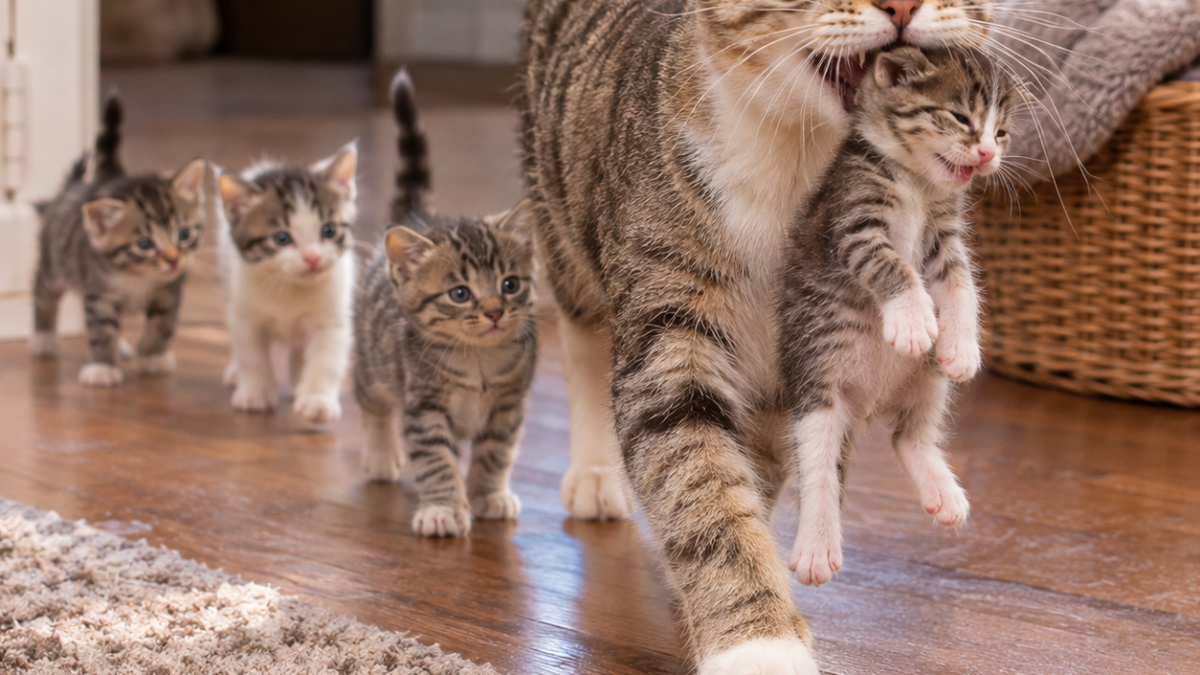
These Proud Mama Cats Wouldn’t Stop Bringing Their Babies to the Humans They Trusted—And the Reason Is Heart-Melting
One by one, the mother cats began carrying their newborn kittens out of hiding and placing them beside the humans they trusted most, sometimes directly onto a bed, a lap, or even a pillow in the middle of the night.
Some proudly demanded that every person—and occasionally the family dog—come admire the babies, while others cried outside closed doors until someone followed them back to the nest.
But behind all the funny interruptions, 5 a.m. kitten deliveries, exhausted mothers asking humans to babysit, and tiny orange faces appearing where no kitten was supposed to be, there was something much deeper happening: each mother had decided that these people were safe enough to trust with the most precious thing she had.
At first, I thought she wanted food.
That was usually what it meant when one of the cats appeared beside me and refused to leave.
A bowl.
A treat.
Fresh water.
Maybe attention.
This time, she stood in the doorway and meowed.
I looked at her.
“What?”
Meow.
She turned around.
Walked several steps.
Stopped.
Looked back.
Then meowed again.
I knew that behavior.
“Are you trying to show me something?”
She walked away.
I followed.
She made sure I was coming.
Every few feet, she stopped and looked over her shoulder.
Apparently my walking speed was unacceptable.
“I’m coming.”
Another meow.
Then she disappeared into the room where she had been spending most of her time.
I stepped inside.
She hurried toward a blanket tucked into a quiet corner.
Then turned to face me.
Her expression almost seemed impatient.
Come look.
So I crouched.
And there they were.
Tiny kittens.
Warm little bodies pressed together.
Eyes still closed or only beginning to open.
Some barely looked like cats yet.
PART2:
They looked more like fuzzy beans with ears.
Mama stepped into the nest and began sniffing them.
Then she looked at me.
I smiled.
“Oh.”
She meowed.
“Let me see them.”
I reached carefully.
She did not pull away.
Did not cover them.
Did not hiss.
Instead, she shifted her body aside.
Almost presenting them.
One kitten stretched.
Another opened a tiny mouth.
A third remained completely asleep.
I whispered:
“They’re beautiful.”
Mama looked at me.
“Thank you.”
I knew she had no idea what those words meant.
Still, it felt right to say them.
“Thank you for showing me.”
She began purring.
PART3:
That was the first time I realized some mother cats did not simply tolerate humans looking at their kittens.
They actively wanted certain people there.
They came to get us.
They cried outside doors.
They carried kittens from one room to another.
They climbed onto beds with babies in their mouths.
They presented them to dogs.
They seemed to insist that everybody important in their world receive a proper introduction.
And every mother did it differently.
Some were quiet.
Some were dramatic.
Some acted like exhausted parents dropping children at Grandma’s house.
Others seemed so proud of what they had created that keeping the babies hidden felt impossible.
Come look.
Look what I made.
Aren’t they perfect?
One mother was especially social.
She had always liked people.
Even before the kittens arrived, she was the type of cat who wanted to know what everyone was doing.
Someone came through the front door?
She needed to inspect them.
Someone sat down?
She appeared beside them.
Someone opened a cabinet?
Apparently that required feline supervision.
Motherhood did not make her less social.
It gave her more things to socialize about.
The first time I checked on her litter, I expected the usual scene.
Mama curled around babies.
Quiet room.
Everyone sleeping.
Instead, she came toward me immediately.
Talking.
Meow.
Meow.
Then back toward the kittens.
“Oh, you want me to look?”
She meowed louder.
I crouched beside the nest.
The babies were piled together.
Orange.
Orange.
More orange.
I started counting.
“One.”
Mama watched.
“Two.”
Tiny head moved.
“Three.”
Another kitten underneath.
“Four.”
I paused.
Something moved behind Mama’s tail.
“Five?”
I looked at her.
“Mama, you surprised me.”
For a second, I genuinely thought I had forgotten how to count.
Five little babies.
Mama seemed completely satisfied with herself.
And why shouldn’t she?
Growing a litter is work before the kittens ever arrive.
Then birth.
Then feeding.
Cleaning.
Warming.
Protecting.
Checking every squeak.
Sleeping in fragments.
Eating whenever there is time.
A mother cat with newborn kittens is on call twenty-four hours a day.
There is no:
I’m tired, someone else can take tonight.
No weekend.
No lunch break.
No closed office door.
A kitten cries.
Mama responds.
One crawls away.
Mama pulls it back.
Another gets buried underneath siblings.
Mama adjusts.
One cannot find milk.
Mama shifts again.
Then everybody finally falls asleep.
And inevitably, someone wakes up.
Watching it made the proud behavior even sweeter.
She was exhausted.
Yet when I appeared, she still seemed eager to show them.
Look.
Five.
All mine.
One morning, I opened a door and found another mother waiting outside.
She walked in immediately.
No hesitation.
“Back again?”
Meow.
“Fine. Door’s open.”
She hurried toward the room where her babies were.
“Good morning.”
Tiny kittens shifted inside the bed.
“Look at all your babies.”
Mama climbed in among them.
One squeaked.
Another began searching for milk.
She started licking a tiny head.
There was something almost ceremonial about the routine.
Every morning:
Check kittens.
Check Mama.
Fresh food.
Water.
Clean bedding if needed.
Make sure everyone was warm.
Make sure the little bellies looked full.
Then spend far too long simply staring at them because newborn kittens make reasonable adults lose all sense of time.
There was always one kitten positioned strangely.
One upside down.
One lying across everybody else.
One somehow under Mama’s leg.
And inevitably one whose face looked offended despite having been alive only a few days.
I would crouch there saying things no normal adult should say with such sincerity.
“Look at that face.”
“Who made you this cute?”
“Why are your ears so tiny?”
Mama never objected.
If anything, she seemed pleased.
Then there were the mothers who believed introductions needed to extend beyond humans.
One of them decided the dog had not properly met the kittens.
The dog had been around the house the entire time.
He knew kittens existed.
Mama apparently did not consider that sufficient.
She walked up to him.
Meowed.
Turned toward the kitten room.
The dog stared at her.
She looked back.
Come on.
I laughed.
“Are you taking him to see the babies?”
Apparently yes.
She walked.
The dog followed.
Slowly.
Mama continued checking behind her.
Do not get lost.
This meeting is important.
When they reached the nest, the dog lowered his head carefully.
Mama remained close.
Watching.
Not panicking.
Not attacking.
Just supervising.
The dog sniffed one baby.
Then another.
Mama relaxed.
Introduction complete.
Family is family.
The dog had earned access.
In another home, the relationship went even further.
A mama cat walked directly toward the family dog while carrying a kitten.
At first, everybody became nervous.
“Where are you going?”
Mama kept walking.
“Okay. Into your babies.”
She placed herself near the dog and kittens.
The dog remained perfectly still.
Nobody wanted to make sudden movements.
Mama sniffed.
Dog sniffed.
Baby squeaked.
Nothing bad happened.
Eventually this became normal.
The dog was not a threat.
He was another safe body in the household.
Another creature Mama believed belonged near her babies.
That kind of trust cannot be forced.
You cannot tell a mother cat:
This dog is nice.
Please believe me.
She decides.
She watches.
She smells.
She remembers behavior.
And if she eventually brings a kitten close voluntarily, that means something.
One of the funniest mothers became almost offended whenever her human did not immediately follow.
She appeared in the hallway.
Meow.
“What?”
Walk away.
Stop.
Meow.
“I’m coming.”
She led her person directly to the kittens.
“Where are you showing me?”
Mama kept going.
“What is it?”
Then the human saw the nest.
“Oh.”
Mama stepped beside it.
“Did you do that?”
Of course she did that.
“Aren’t they cute?”
Mama looked proud enough to answer.
Yes.
Obviously.
That was the feeling so many of these cats gave me.
They were not simply guarding newborns.
They seemed astonished by them too.
I made these.
Look.
This one has tiny ears.
This one has orange paws.
This one sleeps upside down.
This one screams for absolutely no reason.
Perfect.
All perfect.
Stray mothers made those moments feel different.
Because for a cat who had survived outside, safety was not theoretical.
She knew what cold felt like.
She knew what hunger meant.
She knew what it was like to sleep somewhere without knowing whether a dog, car, storm, or human would appear.
She knew how hard life could be for a kitten.
Then she gave birth somewhere warm.
Blankets.
Food.
Water.
Hands that did not hurt her.
Doors that kept danger outside.
The difference was visible.
One former stray would look at the nest and then at the person who had taken her in.
There was no way to know exactly what she thought.
Animals do not narrate their memories for us.
But behavior told us enough.
She stayed relaxed.
She allowed handling.
She brought people close.
Her kittens would never know the cold she knew.
They would not grow up searching trash for food.
They would not spend their first nights beneath cars.
They would not learn that every approaching foot might be dangerous.
Their first world was warmth.
And Mama seemed determined to share that world with the people who had made it possible.
Sometimes she would stand beside the nest and wait.
“Can you show me?”
She stepped closer.
“They’re in there?”
A little kitten moved.
“There they are.”
Mama began purring.
Trust does not always look dramatic.
Sometimes it looks like a mother cat simply not leaving when a human leans close to her newborns.
That is enough.
Then there were the mothers who decided the designated nursery was unacceptable.
They had their own real-estate plans.
One morning someone woke up because something moved beside their head.
At first:
Confusion.
Blanket.
Pillow.
Then:
Kitten.
“Girl.”
Mama appeared.
“Why did you bring your kid to my bed?”
Another tiny kitten was tucked nearby.
The human stared.
Mama stared back.
Apparently the answer was obvious.
Because this bed is safe.
Because you are here.
Because I have decided this is now the nursery.
“Seriously?”
Mama began settling in.
That was it.
Grandma duty had started.
The human did not remember applying for the position.
Mama had made the appointment herself.
There was something profoundly sweet beneath the inconvenience.
A mother cat will not casually relocate newborn kittens to a place she considers dangerous.
If she carries them into your bed, under your blanket, beside your pillow, she is making a statement with behavior.
Here.
You.
Safe.
Help me.
One mama went even further.
After placing the babies near the human, she left.
Not forever.
Just long enough to rest elsewhere.
I laughed.
“Oh, so this is babysitting?”
Apparently.
Mama had figured out the system.
Babies safe with Grandma.
Mother gets a break.
In another house, two adult cats behaved almost like parents sneaking out for date night after making sure the kittens had a sitter.
The babies were comfortable.
Humans present.
Everybody safe.
Then the adult cats disappeared together for some quiet time.
I could not even blame them.
Parenthood is exhausting.
If someone trustworthy offers free childcare, take it.
The funniest version was when Mama delivered one kitten directly to a person and then seemed ready to fall asleep.
“Oh, hi.”
Kitten placed down.
“You came to give me your cat?”
Mama looked exhausted.
“Oh my God.”
Baby already settling.
Within minutes:
Sleeping.
Mama:
Also ready to sleep.
Fine.
Babysitting accepted.
People often talk about cats as independent.
They are.
But independence and trust are not opposites.
A cat can be perfectly capable of caring for her babies and still choose support.
That choice makes it meaningful.
One mother had such strong protective instincts that anytime someone touched a kitten, she immediately approached.
Not aggressive.
Just:
What are you doing?
Where are you taking that?
She followed hands.
Sniffed the baby.
Checked.
The instant the kitten was returned:
Relaxation.
Someone joked:
“What happens if I take one?”
Mama’s entire body answered.
Please don’t.
That mother was willing to introduce her babies.
But introductions had rules.
Look.
Sniff.
Gentle.
Then baby comes back.
Fair.
Even the dog had to earn trust more than once.
First meeting went well.
Then another day Mama allowed a second introduction.
The dog approached carefully again.
No assumption that yesterday’s permission applied forever.
That was something humans could learn from cats.
Trust is ongoing.
Respect it each time.
When Mama insisted everyone meet the babies, the house became a receiving line.
Humans.
Dog.
Another cat.
Possibly anybody willing to sit still and behave.
Come look.
Come smell.
Look what I made.
The proud mother would move from person to person as if hosting a tiny family reunion.
It was hilarious.
It was also touching.
She had decided her world was safe enough to expand her babies’ world.
Not all proud-mama moments were about showing off.
Some were about reassurance.
One mother slipped out of the kitten room unexpectedly.
Her human found her in the hall.
“What the heck?”
Mama meowed.
“Did you sneak out?”
She seemed restless.
A mother cat can become anxious too.
People focus so much on kittens that sometimes we forget Mama is recovering.
Birth is exhausting.
Hormones shift.
Her body is producing milk.
Her senses are constantly monitoring babies.
A crying kitten can send her instantly back into the nest.
A closed door can make her nervous.
A new smell can change her entire mood.
So sometimes she needed comfort.
A hand along the head.
Slow strokes.
Soft voice.
“You’re okay.”
Her eyes would narrow.
Body loosen.
Purring begin.
The worry seemed to melt through the palm.
Mothers need care too.
There was one moment where a cat was clearly trying to get her human to take over while she left for a basic necessity.
The human joked:
“Ready? I’m going to take a turn to the bathroom. Watch.”
The roles had somehow reversed.
Human babysitting while Mama rested.
Mama babysitting while human escaped.
Everybody was on duty.
That was life with newborn kittens.
There was always somebody who needed something.
Milk.
Cleaning.
Warmth.
Attention.
A bathroom break.
Food.
Reassurance.
Sleep.
When a mother cat trusts you enough to include you, you become part of that system whether you planned to or not.
Sometimes that happened literally through clothing.
One cat became fascinated with a person’s hoodie.
Warm.
Soft.
Close to a human body.
Perfect nursery material.
Mama tried placing herself or a kitten there.
I laughed.
Of course.
Why use the expensive cat bed when a sweatshirt exists?
Cats have always been interior designers with questionable priorities.
But again, the location mattered less than the reason.
Warmth.
Smell.
Safety.
If a kitten smelled like the person Mama trusted, perhaps that made the space even more comforting.
Some mothers introduced Dad next.
Mama would walk ahead.
Human father followed.
“Slowly.”
She led him toward the nest.
Stopped.
Looked back.
Keep coming.
Then the babies appeared.
Tiny bodies.
Mama watched the man’s face.
He crouched.
“Oh my gosh.”
Pride radiated from her.
You have now been shown.
Act appropriately.
The adult male cat sometimes became part of the childcare too.
Someone would walk into the room and find him sitting beside kittens.
“Hoby, are you babysitting?”
He looked up.
No explanation.
Apparently yes.
That image always made me smile.
Cats do not need our human labels.
Father.
Uncle.
Big brother.
Babysitter.
Sometimes an adult animal simply chooses to stay beside vulnerable babies.
Whatever name we use, the result is the same.
They are not alone.
One family had a cat everyone simply called Kitty.
Kitty had one baby.
And apparently one baby was enough to turn the entire household upside down.
“So our cat Kitty has a baby.”
Then:
“She brought us her baby.”
The sentence itself was simple.
The meaning was enormous.
Mama could have hidden the newborn somewhere inaccessible.
Instead she carried the kitten directly to her people.
We are back.
We are coming.
She trusted them.
That happened again and again across different homes.
A person helped one stray cat.
Suddenly there was an entire feline family.
One bowl of food turned into a nursery.
One quiet chair became Mama’s favorite nursing location.
One human lap became the safest place in the house.
You think you are feeding one cat.
Then:
Pregnant.
Then:
Babies.
Then:
Congratulations, you now operate a kitten daycare.
There is no application process.
Mama decides.
I once watched someone ask repeatedly:
“Can I see your baby?”
Mama did not hide.
“Can I see your baby?”
She moved closer.
“Can I see your baby?”
Eventually the kitten was visible.
Tiny.
Perfect.
Mama relaxed.
When a cat feels that safe, affection seems to overflow.
Toward kittens.
Toward people.
Toward the whole little household she has decided belongs to her.
That is one of the most moving parts of fostering a mother.
She arrives uncertain.
Maybe frightened.
Maybe defensive.
Maybe exhausted.
Then slowly:
Eat near human.
Sleep near human.
Accept petting.
Give birth.
Allow human close.
Then one day:
Bring baby.
That last step feels like an honor.
Not because a human is entitled to it.
Because the cat chose it.
And cats are very clear about choice.
Then came the 5 a.m. mothers.
Those deserved their own category.
Imagine sleeping peacefully.
Dark room.
Warm pillow.
Then:
Movement.
Something tiny beside your face.
You open one eye.
Kitten.
You wake fully.
Another kitten.
Mama standing nearby.
“What?”
She looks completely calm.
You look at the clock.
5:00 a.m.
“Girl.”
Mama steps onto the bed.
“Why are you putting kittens in my pillow?”
No answer.
“This is my pillow.”
Mama begins arranging babies.
Apparently not anymore.
The human protests.
Mama continues.
“What the hell is this?”
Tiny kitten squeaks.
“Come get your kitten.”
Mama has no intention of doing that.
She has already selected the new nursery.
There is something uniquely catlike about moving an entire family into someone else’s bed without consultation.
No discussion.
No lease.
No notice.
Just:
We live here now.
And because newborn kittens are involved, the human loses immediately.
You cannot argue with a kitten asleep beside your face.
So Grandma duty begins.
Again.
That phrase kept returning.
Grandma.
Not biologically, obviously.
Emotionally.
A trusted caregiver.
A safe second pair of hands.
Someone Mama can leave her most vulnerable babies beside without panic.
There were homes where the cat would literally bring a kitten, place it down, and walk away for a while.
Imagine earning that level of confidence from an animal.
That is not about dominance.
Not training.
Not ownership.
Trust.
One cat bringing you one newborn says more than a hundred forced cuddles ever could.
Another person left a single bowl of food outside for a stray.
That was all.
No plan.
No rescue operation.
Just:
You look hungry.
Here.
Eat.
Then Mama returned.
Then again.
Then one day:
Kittens.
Congratulations.
The person who thought they were feeding one hungry animal was suddenly buying kitten food, setting up blankets, cleaning bedding, counting babies, checking Mama’s appetite and operating a small unofficial nursery.
That is how animal rescue often begins.
Not with a grand plan.
With one bowl.
One door left open.
One decision:
I can help this one.
Then “this one” brings family.
You help them too.
Before long your home looks completely different.
Food bowls.
Blankets.
Carriers.
Tiny toys.
Laundry.
Kittens sleeping in places nobody approved.
And somewhere in the middle of all that, Mama sits on a chair looking completely satisfied.
Right where she belongs.
One quiet chair.
One warm lap.
Babies safe.
For her, maybe that is enough.
Motherhood in cats is powerful partly because it is so physical.
A newborn kitten cannot survive independently.
Mama provides almost everything.
Heat.
Milk.
Cleaning.
Stimulation.
Protection.
Movement.
When kittens are born, their world is largely their mother’s body.
Her smell means safety.
Her warmth means survival.
Her absence is immediately noticeable.
That is why it means so much when Mama extends the circle of safety to include someone else.
The human does not replace her.
That is not the point.
Mama is saying:
You may come close to what I protect.
For a cat, that can be an enormous statement.
Of course, not every mother behaves this way.
Some need privacy.
Some become very defensive.
Some want the room quiet.
Some become stressed if kittens are handled too much.
Their boundaries matter just as much.
A proud mama showing babies is beautiful because it is voluntary.
You should never force access because you saw another cat do it online.
Every mother decides differently.
The funny clips work because these cats are making the choice themselves.
Come look.
Follow me.
Hold this one.
Stay here.
Watch them.
And perhaps:
Please let me sleep for twenty minutes.
There is another side to these moments too.
Sometimes Mama does not bring the kitten because she wants applause.
She may be relocating.
She may believe another location is safer.
Maybe the nest is too warm.
Too exposed.
Too noisy.
Maybe the human’s bed smells reassuring.
Maybe she wants help.
We cannot assume every behavior carries the same emotional meaning.
But when you watch the whole pattern—the relaxed body, the purring, the repeated invitations, the willingness to leave kittens beside a person—it becomes difficult not to see trust.
The cat who once survived alone now places her entire future beside you.
One litter especially stayed with me.
Mama had been a stray.
Outside life had marked her.
She remained cautious around unfamiliar people.
Fast movements bothered her.
Loud noises brought her instantly alert.
Yet around the person who rescued her, she transformed.
She gave birth somewhere warm.
Then began bringing that person toward the kittens repeatedly.
Almost as if she needed confirmation.
Still here?
Still safe?
Yes.
One day the human whispered:
“She knows stray life breaks your heart.”
I thought about that sentence for a long time.
We do not know whether cats frame memories the way humans do.
But they absolutely learn from experience.
Cold teaches.
Hunger teaches.
Danger teaches.
Safety teaches too.
Her kittens were learning the second lesson first.
Warm room.
Full belly.
Gentle voices.
No rain.
No traffic.
No searching for shelter.
Their mother had crossed from one kind of life into another.
Her babies were born on the safer side.
Maybe that was why she seemed so proud.
She had made them.
But she had also gotten them here.
One human looked down at a kitten and said:
“I made this little one. Isn’t she perfect?”
Obviously speaking for Mama.
But it fit.
Mama hovered nearby.
Yes.
Perfect.
Every little one.
Even the kitten who cried constantly.
Even the one always sleeping.
Even the dirty one.
Even the orange one who somehow escaped.
Especially the escape artist.
There was always an escape artist.
Someone walked into the hallway.
Small kitten sitting there.
“What the heck, baby?”
The kitten looked up.
“Did you get out of the room?”
Yes.
“Did you sneak out?”
Also yes.
Mama appeared shortly afterward.
Probably equally confused.
Newborns become mobile faster than people expect.
One day they are helpless beans.
Then suddenly somebody discovers the edge of the nest.
That creates an entirely new chapter of chaos.
Mama has to keep track of them.
Humans have to kitten-proof everything.
Dogs need supervision.
Doors matter.
Furniture becomes a climbing challenge.
The proud showing-off phase slowly transforms into:
Where did that child go?
One orange kitten seemed especially committed to disappearing into places where only orange fur was visible.
Someone entered the kitten room.
Looked down.
“Aw.”
Pause.
“Why am I only seeing orange?”
More searching.
Orange baby.
Another.
Then another.
A litter of tiny mandarins.
It became a joke.
Again, oranges?
Oh my God.
Every litter develops its own language inside the household.
Nicknames.
Jokes.
The loud one.
The sleepy one.
The climber.
The orange army.
The tiny boss.
Mama understands none of the words.
She understands the tone.
Soft.
Happy.
Safe.
That is enough.
The dogs learned too.
One dog received repeated baby introductions.
At first:
Very still.
Mama watching.
Human watching.
Nobody breathing normally.
Later:
Routine.
Dog lies down.
Mama passes.
Kitten nearby.
No emergency.
That is one of the beautiful things about animals sharing a home responsibly.
Trust becomes boring.
And boring is wonderful.
No dramatic reaction.
No viral moment.
Just:
These babies belong here.
I know.
Mama knows.
Dog knows.
Good.
Some mothers took trust farther and began using people for emotional support.
After feeding kittens, Mama would come out.
Climb onto a lap.
Press her head into a hand.
Purr.
Her entire body would loosen.
Then back to work.
Feed.
Clean.
Count.
Sleep.
Repeat.
I started thinking about how often people praise mothers for being endlessly selfless without remembering that exhausted caregivers still need care.
Cats too.
Food near the nest.
Water close.
Clean litter box.
Quiet room.
Gentle affection if she wants it.
Rest.
Medical support when needed.
Caring for kittens means caring for Mama.
Sometimes the best thing you can do for newborns is help their mother feel safe enough to do what she naturally knows how to do.
A calm mother nurses better.
Rests more.
Moves kittens less frantically.
Keeps herself healthy.
That is why the human relationship matters.
She does not have to spend energy defending the nest from you.
She can use that energy on her babies.
One gentle hand.
All that worry melting.
I saw it repeatedly.
Mama’s eyes half closing beneath slow strokes.
Her purr growing.
Then she returned to the nest calmer.
That may be the most beautiful version of “helping” an animal.
Not taking over.
Creating enough safety that she can take care of her own family.
Still, the cats were very happy to delegate occasionally.
Especially at inconvenient hours.
One mother discovered the human pillow.
Another discovered the human lap.
Another apparently believed a hoodie pocket qualified as premium childcare.
Every time:
Surprise.
Then laughter.
“You brought me another one?”
Mama:
Yes.
“Again?”
Yes.
“Do I have a choice?”
No.
The kitten would already be asleep.
Case closed.
Humans adapt quickly when tiny animals are involved.
A pillow becomes a nest.
A chair becomes a maternity ward.
A bedroom becomes a nursery.
The dog becomes an uncle.
The resident cat becomes a babysitter.
The human becomes Grandma.
Nobody votes.
Mama assigns positions.
What fascinated me most was how normal she considered all of it.
No ceremony.
She simply treated trusted people as part of the family structure.
That is perhaps the highest compliment a cat can give.
You are no longer outside the circle.
One mother brought her baby to the same person repeatedly.
Not once.
Again.
And again.
At first everyone laughed.
Then they realized it was a pattern.
Wherever the human sat, Mama eventually appeared with the kitten.
She wanted the baby close to that person.
Maybe warmth.
Maybe scent.
Maybe because that particular location felt protected.
Whatever the exact reason, the choice was consistent.
The human became part of the safe zone.
There is something powerful about being chosen that way.
Especially by an animal who owes you nothing.
Cats do not care about titles.
Money.
Social status.
How impressive you are.
They care about what you do around them.
Are your hands gentle?
Do you respect distance?
Does food appear?
Do you frighten them?
Do you listen when they say no?
Do bad things happen when you are near?
Or do they relax?
That is how trust is built.
Behavior by behavior.
Which means when Mama places a kitten beside you, she is giving you the accumulated result of every gentle interaction that came before.
That is why I never laughed at the trust itself.
The situations?
Absolutely.
A kitten on a pillow at five in the morning is funny.
A mother cat dragging someone out of bed to admire babies is funny.
A dog receiving a formal kitten introduction is funny.
A human unexpectedly becoming babysitter while Mama leaves is very funny.
But underneath the comedy:
Honor.
The mother has decided:
You are safe.
One person reacted exactly how I would have.
Mama brought a baby.
“Oh my God.”
Then softer:
“Thank you.”
That word again.
Thank you.
Not because Mama gave the kitten away.
She had not.
Thank you for trusting me enough to show me.
That felt right.
People sometimes describe cats as cold.
Anyone who has lived closely with them knows how incomplete that description is.
Cat affection often requires attention.
A dog may run toward you so clearly that nobody misunderstands.
A cat might sit two feet closer than yesterday.
Sleep facing away from you.
Blink slowly.
Bring you to the kittens.
Leave a baby on your bed.
To someone who is not paying attention, those gestures might seem small.
To the person who earned them, they are enormous.
One evening, I watched a mother lie near her babies while her human sat quietly beside the nest.
No petting.
No lifting kittens.
No talking.
Just presence.
Mama rested.
Kittens nursed.
The human sat there.
I thought:
This is probably what trust looks like at its most mature.
Nothing needs to happen.
Nobody needs to prove anything.
One creature is vulnerable.
Another could interfere.
But does not.
So everyone rests.
That kind of safety is built through restraint as much as action.
Knowing when not to touch.
When not to pick up.
When not to move a kitten because the photo would be cuter.
When not to crowd Mama.
Respect creates the trust that later produces the adorable moments people want to film.
The proud mothers were funny partly because they destroyed our expectations.
We assume cats hide kittens.
Many do.
Then one mother comes walking into a bedroom at dawn carrying a baby like:
Here.
Your turn.
We assume a dog will be kept far away.
Mama leads the dog to the nest.
We assume she wants privacy.
She cries until you follow her.
We assume one kitten bed is enough.
Mama decides your pillow is better.
Cats have always been good at reminding humans that our plans are suggestions.
The house becomes organized around motherhood.
Quiet rooms.
Closed doors.
Food stations.
Warm blankets.
Then Mama changes the plan herself.
Everyone follows.
Perhaps the funniest mother was one who seemed determined that every visitor admire the litter.
A person entered.
Mama appeared.
Meow.
Follow.
Another visitor.
Same process.
At some point I imagined her keeping a mental checklist.
Human one:
Met kittens.
Human two:
Not yet.
Dog:
Met them twice.
Neighbor:
Pending.
Delivery driver:
Absolutely not.
She knew her standards.
There was also something deeply social about it.
Her babies were not simply hidden possessions.
They were becoming part of her community.
That is different from saying she understood “community” like a person would.
But cats absolutely distinguish familiar from unfamiliar.
Safe from unsafe.
Their kittens gradually learn the household through those interactions.
Mama’s calm behavior teaches something too.
If she is relaxed around the human, the kittens encounter that human in a context of safety.
Early experience matters.
Gentle handling at appropriate ages can help kittens become comfortable around people later.
So the proud-mama introductions were not only adorable.
They were the beginning of social life.
Human scent.
Voice.
Touch.
Other animals.
Household sounds.
All introduced while Mama remained nearby.
The babies learned:
This is our world.
One kitten was so relaxed that after being delivered to a human, he immediately fell asleep.
No concern.
No investigation.
Mama trusted the person.
Apparently the kitten trusted Mama’s judgment.
Sleep.
The human whispered:
“Fast asleep already.”
Mama looked exhausted too.
Two generations completely comfortable.
I loved that.
The most vulnerable state an animal can enter is sleep.
A kitten sleeping in your hand means it does not currently expect harm.
That is extraordinary when you think about it.
Then there were the moments where pride and exhaustion existed together.
Mama showing babies proudly.
Then collapsing beside them.
Look what I made.
Please admire them.
Also, I have not slept properly in days.
Human motherhood jokes suddenly became very easy.
When people laughed and called themselves Grandma, it was not entirely a joke.
They were bringing food.
Cleaning.
Watching babies while Mama stretched.
Checking weights.
Changing bedding.
Helping during medical concerns.
Sometimes bottle-feeding when needed.
That is a real support role.
One person had helped one cat.
Now an entire family depended partly on that decision.
Animal rescue grows like that.
You think:
I’ll leave food.
Then:
I’ll let her sleep inside tonight.
Then:
She’s pregnant.
Then:
Where did these five kittens come from?
Then suddenly you know far more about kitten weight gain and nursing schedules than you ever planned.
Life has changed.
And somehow you are delighted.
Not every moment is cute.
There is cleaning.
Lots of it.
Newborn kittens create mess.
Mama creates mess.
Bedding gets dirty.
Food spills.
Litter eventually appears everywhere.
Someone inevitably steps in something unpleasant.
There are worries.
Is this kitten gaining?
Why is that one crying?
Does Mama have enough milk?
Is everybody warm?
Why is one kitten separated from the pile?
Should the vet see this?
Rescue motherhood is responsibility.
The funny videos show the reward.
They do not always show the worry before the camera started.
That is why Mama’s trust feels even more significant.
Sometimes the person filming had already spent days making sure she and the babies were okay.
Mama knew those hands.
Those footsteps.
That voice.
So when she appeared carrying a kitten, it was not random.
A relationship already existed.
And there was a point where the relationship became reciprocal.
Human:
I’ll keep you safe.
Mama:
Then I’ll trust you with this.
That is beautiful.
One morning, the house was quiet.
Mama sat on a chair.
Babies nearby.
Sunlight through a window.
No dramatic kitten delivery.
No dog introduction.
No 5 a.m. pillow invasion.
Just a cat resting while her babies slept.
The human sat nearby.
Mama’s eyes slowly closed.
That image stayed with me as much as the funny ones.
Because motherhood is pure joy sometimes.
But also fatigue.
Fear.
Protection.
Constant work.
The pride we see when Mama shows her babies exists alongside all of that.
She knows those tiny creatures need her completely.
And somehow she does it.
Cats have been doing it long before humans built nurseries for them.
But when a stray mother decides to raise her litter inside our homes, we get the privilege of watching up close.
The tiny licks.
The repositioning.
The way she responds instantly to a cry.
The way she counts them through smell and touch.
The way she sometimes carries one back to the nest when it crawls too far.
Then the way she looks at us.
You saw that?
Good.
Come closer.
My favorite scenes were always the ones where Mama seemed almost unable to contain herself.
She would walk toward her person.
Meow.
Come.
The person followed.
Then Mama arrived at the babies and immediately looked back.
Well?
Say something.
The human reacted.
“Oh my gosh.”
Mama relaxed.
Exactly.
That is the correct response.
Admire my work.
I imagined her saying:
I made these little ones and my heart is too full to keep them to myself.
Maybe that is projecting.
Probably.
But sometimes projection begins because behavior evokes something familiar in us.
Parents everywhere know the urge.
Look at my baby.
Look at this picture.
Did you see what she did?
Isn’t he perfect?
Cats may not narrate pride as humans do.
But watching Mama repeatedly invite someone toward her kittens makes the comparison irresistible.
One kitten could be filthy.
One screaming.
One nursing upside down.
One buried under siblings.
Mama still sees her litter.
Perfect.
Humans react similarly.
“Oh, they’re so pretty.”
“We love them so much.”
Mama purrs.
Agreement.
There were times a mother carried a baby to someone almost ceremonially.
Baby in mouth.
Careful steps.
Human freezes.
You do not grab.
You wait.
Mama approaches.
Places kitten.
Looks up.
That moment deserves respect.
When a mother brings you her baby, the biggest honor is not getting to hold the kitten.
It is being trusted enough that she made the choice.
That is what always moved me.
She chose you.
Not because you demanded it.
Because your behavior told her:
Safe.
Some people spend months earning a cat’s trust.
Maybe longer.
Then a mother cat offers the ultimate proof.
My baby can be near you.
That is worth more than any forced affection.
One day, Mama moved a kitten to a person’s bed again.
The human complained dramatically.
“Girl, what is this?”
Mama ignored the complaint.
Kitten settled into the pillow.
“You cannot just put babies in my bed.”
Mama began grooming.
Apparently she could.
The clock said some awful early hour.
Human eventually surrendered.
Of course.
I laughed because the scene summarized the entire relationship.
Human believes home belongs to human.
Cat disagrees.
Motherhood settles the argument.
But there was also that deeper message.
She selected the place with the strongest human scent.
The place where her trusted person slept.
If she wanted kittens there, perhaps it was because she believed nothing dangerous would happen close to that person.
Imagine being trusted enough that an animal views your sleeping space as the safest nursery she can find.
Annoying?
Yes.
Also incredibly sweet.
As weeks pass, proud-mama behavior changes.
Kittens grow.
Eyes open.
Legs strengthen.
They begin leaving the nest on their own.
Mama no longer has to bring the world to them.
They go find it.
Then she has an entirely different problem.
Keeping track.
Five kittens can scatter impressively fast.
The nest that once held a quiet pile becomes empty because everyone is under furniture.
The proud introductions become:
Please collect my children.
One person joked that the mother looked relieved whenever humans helped.
I believed it.
She would sit.
Watch.
Let people entertain the babies.
Free childcare.
Motherhood has advantages once the kittens become social.
Eventually Mama gets more independence back.
She eats away from them.
Sleeps farther away.
Sets limits on nursing.
Corrects rough play.
Her job slowly changes from keeping them alive every second to teaching them how to be cats.
The human caregivers change too.
At first:
Do not touch too much.
Then:
Gentle handling.
Then:
Socialization.
Then:
Play.
Then eventually:
Preparing these babies for lives beyond the nursery.
That part is bittersweet.
A foster mother showed her kittens proudly because this was their safe home.
Eventually some kittens may go to new homes.
The goal of rescue is not always keeping every animal forever.
It is giving them enough safety that they can move forward.
Mama does that too.
She raises them toward independence.
There is a lesson there.
Love does not always mean keeping close forever.
Sometimes it means creating enough security that separation is possible later.
Still, while they are tiny, nobody wants to think about that.
You look at five little orange heads and think:
Stay exactly like this.
But they will not.
Tomorrow they are larger.
Then larger again.
Soon they run.
Climb.
Attack feet.
Destroy curtains.
And everybody wonders what happened to the tiny beans Mama once insisted on showing us.
That is why people film these moments.
The pride.
The deliveries.
The strange nursery choices.
The dog introductions.
The 5 a.m. surprises.
Because kittenhood disappears before anyone is ready.
One day, Mama is carrying a newborn in her mouth.
Not long afterward, the kitten is racing through the hallway ignoring her completely.
Parenthood.
Same across many species in at least that respect.
The children need you entirely.
Then suddenly they have somewhere else to be.
Perhaps that is why the proud introductions matter so much.
For a brief period, Mama’s whole world is concentrated into those tiny bodies.
And she sometimes chooses to share that world with us.
There was one former stray I kept thinking about.
She had once lived outside.
Now she sat in a quiet room.
Babies nursing.
Dog nearby.
Human nearby.
No one threatening her.
Nothing she needed to run from.
Her entire body looked different from when she first arrived.
Shoulders relaxed.
Eyes soft.
Purr steady.
The kittens would never remember the street.
They were born after safety.
That feels like one of the greatest successes in rescue.
Not simply saving one animal from hardship.
Ending hardship before it reaches the next generation.
Mama knew hunger.
Babies know full stomachs.
Mama knew cold.
Babies know blankets.
Mama knew strangers.
Babies know gentle hands.
Mama knew uncertainty.
Babies sleep.
Maybe she cannot articulate the difference.
She lives it.
That is enough.
Sometimes I think that is why certain rescued mothers appear so attached to their foster humans.
The person is not just someone who feeds them.
The person represents the place where the survival equation changed.
Outside:
Constant calculation.
Inside:
Food arrives.
Doors close.
Predators stay out.
Babies survive.
That association is powerful.
So she comes to get you.
Look.
They are okay.
See?
They are here.
Maybe that interpretation is too sentimental.
But even stripped of human emotion, the behavioral fact remains.
She views the person as safe around offspring.
That alone is significant.
One bowl of food can start it.
One gentle hand can deepen it.
One respected boundary can reinforce it.
Trust builds.
Then one morning:
Kitten on your pillow.
Congratulations.
You have been promoted.
Some people joked they had accidentally become nannies.
True.
Others called themselves Grandma.
Also fair.
The labels were playful.
The responsibility was real.
A mother cat may be capable, but newborn kittens can require intervention when something goes wrong.
A human noticing early can matter.
A kitten not gaining weight.
Mama not eating.
Milk supply problems.
A kitten getting cold.
Illness.
Having trusted people nearby gives the whole family another layer of protection.
That is why I liked seeing humans treat the trust seriously.
They laughed.
But they also checked.
Handled gently.
Returned kittens.
Kept the room warm.
Fed Mama.
Let her rest.
The best response to being trusted is becoming worthy of it.
And these mothers seemed to know who was worthy.
One cat had a whole house full of people.
Yet she repeatedly chose one person.
That person’s room.
That person’s bed.
That person’s lap.
Why?
Maybe scent.
Routine.
Past care.
Whatever it was, Mama had decided.
Cats are good at making humans feel both incredibly special and slightly inconvenienced.
You are my chosen person.
Also, here are three kittens in your blanket at 5:00 a.m.
Enjoy.
That might be the purest form of feline love.
By the time the kittens became more mobile, even the dog seemed resigned.
A baby might climb near him.
Mama nearby.
Dog stays still.
Human laughs.
No one treats the scene like a miracle anymore.
It has become household routine.
That is beautiful too.
Something once requiring careful introduction becomes ordinary.
Trust has matured.
One mother eventually allowed the dog to lie almost beside the nest.
Not touching.
Just present.
The human whispered that the dog had “earned it twice.”
Exactly.
Trust earned.
Then maintained.
That is how families expand.
Not because species stop mattering.
Because behavior matters more.
I watched all these mothers and kept returning to the same thought.
The funniest moments only work because the underlying relationship is serious.
A cat dropping a kitten on your pillow is hilarious if the cat is relaxed and the kitten is safe.
A mother leading the dog to babies is adorable because the dog behaves gently.
A cat crying until you follow her is sweet because she trusts you.
Remove safety, and the same scenes would not be funny.
Trust makes them funny.
That is why the laughter never felt cruel.
We were laughing because Mama had completely taken over the house.
Not at her fear.
Not at her vulnerability.
We were laughing because she felt safe enough to be demanding.
That is a wonderful problem.
One evening, a mother climbed into a human’s lap after feeding her litter.
No babies brought.
No dramatic show.
She simply curled up.
The person stroked her.
Mama closed her eyes.
For once, she was not on duty.
Someone else was awake.
Someone else could listen for tiny cries.
She rested.
That scene may have been the most important of all.
Because motherhood is not only what a mother gives.
It is also what she needs in order to keep giving.
Food.
Rest.
Safety.
Comfort.
Trust.
Humans sometimes say:
Look how much she loves her babies.
True.
But love is easier to sustain when someone is caring for Mama too.
Maybe that is what she was really showing us when she brought babies close.
Not simply:
Admire them.
Maybe also:
These belong to my safe place.
And you are part of my safe place.
That is enough to make anyone emotional.
Eventually the kittens grew.
The nests became emptier.
Mama spent more time outside the nursery.
The proud processions happened less often.
No more carrying babies into bed because the babies could climb there themselves if they wanted.
No more formal dog introductions.
Everyone already knew everyone.
The house got louder before it eventually became quieter.
Running kittens.
Toys.
Tiny fights.
Bowls.
Then, depending on the family, adoption.
New homes.
Change.
But those earliest moments stayed special.
A mother cat standing in a doorway.
Calling.
Waiting.
Come.
A human following.
Mama checking over her shoulder.
Hurry.
Then a blanket.
Several tiny bodies.
Purring.
The human whispering:
“Oh my goodness.”
Mama settling down as if she had been waiting specifically for that reaction.
That is the image I remember.
Not because it proves cats experience pride exactly the way we do.
We do not need to claim that.
The behavior itself is enough.
A mother cat felt safe.
Her kittens were safe.
She willingly invited someone into that circle.
Sometimes she even expanded it.
Human.
Dog.
Another cat.
Grandma.
Dad.
Anyone who had proven gentle enough.
Her world got larger without becoming more dangerous.
That is an incredible thing for an animal.
Especially one who once lived outside.
The source of the humor was always simple.
Humans thought we were in charge.
Mama had different plans.
We chose the nursery.
She chose the pillow.
We bought the cat bed.
She chose a hoodie.
We planned quiet time.
She arrived with a kitten.
We assumed the dog did not need an introduction.
She summoned him.
We left one bowl of food outside.
She brought an entire family.
We tried to sleep.
She started Grandma’s shift at five in the morning.
And somehow nobody really minded.
Because every inconvenience carried the same hidden compliment.
I trust you.
I trust this room.
I trust this bed.
I trust this dog.
I trust your hands.
I trust you near my babies.
For a mother animal, there may not be many gifts bigger than that.
So whenever a mama cat marches down the hallway meowing until someone follows, I smile.
Whenever she proudly stands beside her babies as if asking for applause, I understand.
Whenever someone wakes up with a kitten beside their head and complains while secretly melting inside, I understand that too.
And whenever Mama finally lies down, closes her eyes, and lets someone else watch the babies for a few minutes, I think that might be the sweetest moment of all.
She does not have to guard everything alone.
She found people she can trust.
Her babies are warm.
Her belly is full.
Her family is safe.
For one tired mother cat, that may be everything she ever wanted.








