The Vet Said This Blind, Toothless Cat Might Not Survive the Week—Then He Reached for My Hand and Refused to Let Go
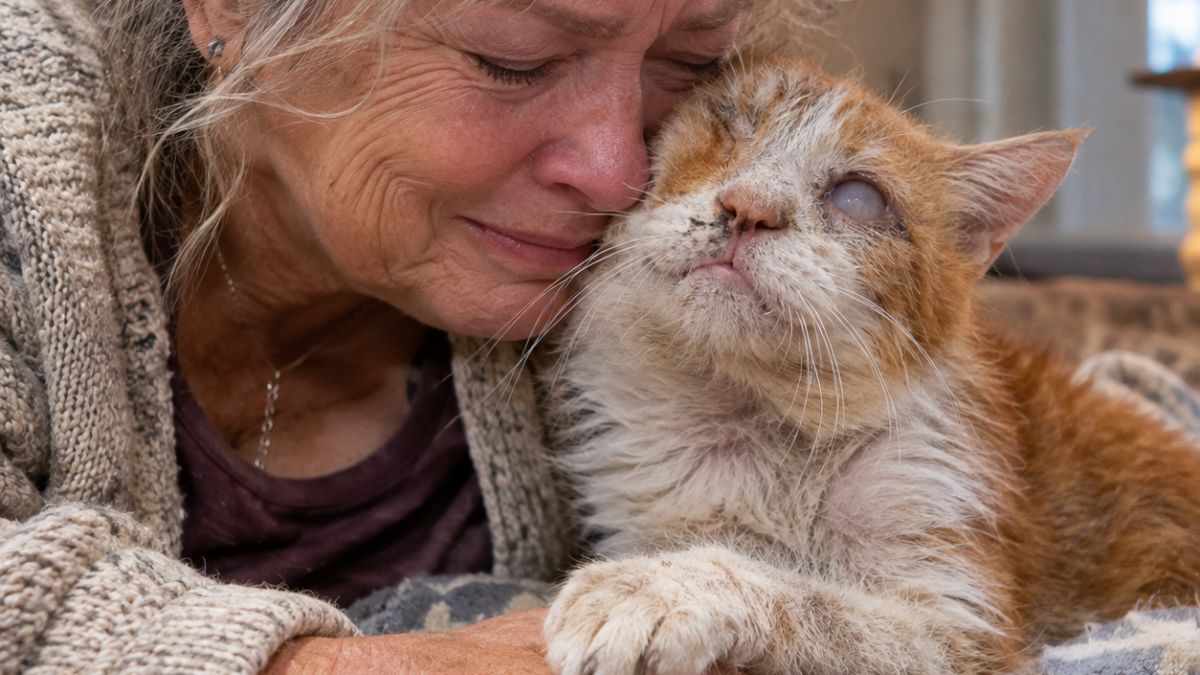
The Vet Said This Blind, Toothless Cat Might Not Survive the Week—Then He Reached for My Hand and Refused to Let Go.
The veterinarian warned me that Chester was blind, toothless, diabetic, fighting several infections, and fragile enough that there was a real possibility he might not survive the week.
I was sixty-seven, widowed, and had gone to the rescue only to donate the blankets my husband had left behind—but when I put one finger through Chester’s cage, that filthy old orange-and-white cat wrapped his skinny paw around my hand and cried every time I tried to pull away.
Two months later, I was sitting in another medical waiting room clutching Chester’s blanket and shaking exactly the way I had on the night my husband died, when I finally understood why losing a cat I had barely known for weeks felt terrifying: Chester had not replaced Robert, but somewhere between insulin injections, ruined sleep, and an old armchair I had kept empty for three years, he had taught me that grief and love did not have to take turns living in the same house.
My name is Margaret Ellis.
I was sixty-seven when I met Chester.
I lived alone in a small white house outside Asheville, North Carolina, on a road that curved through enough trees that people often drove past my driveway the first time they visited.
Robert and I had bought the house thirty-four years earlier.
Back then there had been ugly brown carpet in the living room, avocado-green counters in the kitchen, and a front porch that leaned far enough to make Robert announce that the house was “either charming or structurally philosophical.”
He fixed the porch.
Eventually.
We raised our daughter there.
We argued there.
We celebrated there.
We refinished floors, replaced windows, planted two dogwoods, lost one during a storm, planted another.
Robert grew tomatoes badly and insisted every summer that the problem was the soil rather than his complete refusal to follow instructions.
I learned exactly how much coffee to put in the machine so there would be enough for two mugs and one small refill.
Then Robert died.
Cancer.
Pancreatic.
Fast enough to feel cruel and slow enough to make every day before it happen frightening.
For thirty-one years, I had slept beside the same man.
Then one evening I came home from the hospital carrying a plastic bag containing his wallet, glasses, phone charger, and wedding ring.
I set the bag on the kitchen counter.
And for the first time in my adult life, there was nobody else in the house.
People came at first.
Our daughter, Emily, stayed nearly two weeks.
My sister drove down from Virginia.
Neighbors brought chicken casseroles, lasagna, ham, cookies, soup, flowers.
People hugged me in the grocery store.
They called.
They asked whether I was sleeping.
Whether I was eating.
Whether I needed anything.
Then life did what it always does.
It continued.
Emily went home to Charlotte.
My sister went back to Virginia.
Neighbors stopped leaving food because eventually a widow has to become a person again rather than a community project.
I returned to routines.
Laundry.
Bills.
Church sometimes.
Grocery shopping on Tuesday mornings.
A little gardening.
Coffee.
Television.
PART2:
More television than I admitted.
My house did not become peaceful.
It became quiet.
There is a difference.
Peace has warmth in it.
Quiet can feel like a room waiting for somebody who never arrives.
For almost three years, I still reached for two coffee mugs some mornings.
Not every day.
Just enough to hurt.
I would open the cupboard, take mine down, then reach automatically for the blue mug Robert used.
Sometimes my fingers touched the handle before I remembered.
Then I would stand there feeling foolish.
Sixty-seven years old.
Talking to myself in an empty kitchen.
“You only need one, Margaret.”
As if my hands were the part of me that had forgotten.
Robert’s clothes were mostly gone by then.
Emily helped me donate them after the first year.
His workbench remained.
His fishing tackle.
A drawer full of screws, washers, bits of string, batteries of uncertain age, and three tape measures because apparently one man required three separate systems for measuring the same twelve feet.
And his chair.
That chair became ridiculous.
Brown leather.
Wide arms.
PART3:
A worn patch on the right side where his elbow had rested.
It sat beside the living-room window.
Robert had read there.
Napped there.
Watched football there.
Complained about politics there.
Fallen asleep with glasses crooked on his face there.
After he died, I could not sit in it.
I could not move it either.
So it remained.
Empty.
For three years.
Then one Thursday morning I decided to donate his blankets.
There were six folded in the linen closet.
Robert was always cold during his final months.
People had given us blankets.
Fleece.
Wool.
One electric throw I never trusted.
After he died, I washed them and stacked them away.
Three years later, I still could not use them.
But I also hated knowing they were sitting in darkness while animals somewhere slept on concrete.
So I called a small rescue outside Asheville.
Blue Ridge Second Chance.
They said yes, they could use clean blankets.
That was the whole plan.
Drive over.
Donate blankets.
Leave.
I did not go looking for a cat.
I need that understood because Emily later accused me of being “emotionally ambushed by an animal.”
She was not entirely wrong.
Blue Ridge Second Chance occupied an old veterinary building that had been expanded badly over the years.
Nothing matched.
One hallway was newer than the others.
The reception desk looked handmade.
There were photographs covering almost every wall.
Dogs with families.
Cats sleeping on children.
Handwritten notes.
THANK YOU FOR SAVING MOLLY.
WE LOVE OUR NEW BEST FRIEND.
Old animals.
Three-legged animals.
One blind dog wearing sunglasses.
A volunteer named Janet took Robert’s blankets.
“These are lovely.”
“My husband barely used most of them.”
I hated how easily I said husband.
Present tense almost came with it.
She did not correct me.
“Thank you.”
“That’s all.”
I should have left.
Then somewhere behind me a cat meowed.
I turned.
There was a small adoption room along the back wall.
“I’m not adopting anything,” I told Janet.
She smiled.
“I didn’t ask.”
“I’m just looking.”
“Of course.”
That is how shelters get you.
No one says adopt this animal.
They let you walk past cages until your own heart becomes the salesperson.
Most of the cats were younger.
A black kitten climbed its door like prison bars.
A calico reached one paw toward my purse.
A large tabby was asleep upside down.
Then I reached the last enclosure.
There was an old towel inside.
At first, I thought the towel was empty.
Then it moved.
Chester lifted his head.
I had never seen a cat look so tired.
Orange-and-white fur.
Or what should have been orange-and-white.
It was dirty and thin in patches.
His cheeks looked hollow.
One eye was gone entirely.
The lid had healed closed.
His remaining eye was cloudy, pale, useless.
His ears were ragged at the edges.
His body trembled continuously, not violently, but enough that the towel shifted under him.
A white card was clipped to the cage.
CHESTER
MALE
APPROX. 12 YEARS
FOUND AS STRAY
MEDICAL HOLD
Below that someone had written:
VERY SWEET.
I crouched.
“Hello, Chester.”
His head turned toward my voice.
Not toward my face.
Toward the sound.
I looked at his cloudy eye.
“Can you see anything?”
A woman behind me said:
“No.”
I turned.
She wore navy veterinary scrubs beneath a white coat.
Dark hair pulled back.
Early forties.
“Completely blind?”
“Yes.”
“What happened to the other eye?”
“Old injury, we think. It had already been removed before he came to us.”
“Poor thing.”
She crouched beside me.
“I’m Hannah Brooks. I’m the veterinarian working with him.”
“Margaret.”
“Nice to meet you.”
I looked back at Chester.
“Does he have teeth?”
Hannah smiled sadly.
“Almost none.”
“Almost?”
“Two small ones in back. Neither useful.”
“Good grief.”
“He’s had a hard life.”
We could not actually know that.
I learned later not to turn medical evidence automatically into a biography.
Maybe Chester had once belonged to someone who loved him.
Maybe he had been cared for until circumstances changed.
Maybe his decline had been gradual.
Maybe somebody failed him.
We never found out.
But in that moment, looking at him shaking beneath an old towel, “hard life” felt fair.
I put one finger through the cage.
Not far.
Just enough for him to smell.
Chester lifted his head.
His nose moved.
Then one paw came forward.
Skinny leg.
Dirty white toes.
He pushed it through the bars.
His paw touched my finger.
Then curled.
Not enough to grip like a human hand.
Cats cannot do that.
But he hooked his paw against me and held.
I smiled.
“Well, hello.”
I waited.
Then tried pulling my hand back.
Chester made a sound.
Tiny.
Raspy.
Almost a cry.
His paw reached again.
So I put my hand back.
He pressed against it.
Hannah looked at me.
“He hasn’t done that with me.”
“Maybe he likes old women.”
“I’m hoping you mean yourself.”
I laughed.
It surprised me.
The sound felt strange coming out of my own chest.
I had not realized how little I laughed alone.
I stayed twenty minutes.
Maybe thirty.
Every time I tried to leave, Chester reached.
Finally I said:
“I have to go.”
His ears moved.
“You don’t know me.”
He pushed his paw through again.
“I came here to donate blankets.”
Hannah smiled.
“That’s how they get you.”
“You sound like you work for him.”
“Most days I do.”
I left.
I drove halfway home before realizing I had forgotten to ask whether Chester was available for adoption.
I did not turn around.
I told myself that was proof of discipline.
For three days, I thought about his paw.
Not continuously.
That would sound obsessive.
But enough.
While making coffee.
While folding towels.
While standing in the grocery-store pharmacy.
While watching television.
I would suddenly see that narrow orange-and-white leg reaching through metal.
On Monday, I called.
“This is Margaret Ellis.”
A receptionist said:
“How can I help?”
“There’s an old cat there.”
“We have several.”
“Chester.”
Pause.
“Oh.”
The way she said oh did not reassure me.
“Is he alive?”
“Yes.”
My stomach loosened.
“Good.”
“He’s still on medical hold.”
“Can I visit?”
“Yes.”
So I did.
Chester looked worse.
Hannah took me into a consultation room.
She did not use soft words.
I appreciated that later.
At the time, I hated every sentence.
“He has diabetes.”
I knew enough to understand what that meant.
“Cats get diabetes?”
“Yes.”
“What does he need?”
“Insulin every twelve hours, consistently.”
“For life?”
“Possibly. Some cats can go into remission with treatment and diet, but I would not make that promise with Chester.”
I nodded.
“What else?”
“Skin infection. Ear infection. He was badly dehydrated when he came in.”
My hands tightened.
“Kidneys?”
“Not as bad as I feared.”
“That’s good.”
“It is.”
“But?”
Hannah paused.
“He’s medically fragile.”
“How fragile?”
“Margaret…”
“I want an answer.”
She gave me one.
“I would not be shocked if he deteriorated suddenly.”
I stared.
“Days?”
“I don’t know.”
“Week?”
“I don’t know.”
“Months?”
“Maybe.”
“Years?”
“Possible.”
“You’re not helping.”
“I don’t want to lie.”
That was fair.
She continued.
“He’s old. Blind. Toothless. Diabetic. He has several active medical problems. We are treating what we can treat.”
“Is he suffering?”
“Right now?”
“Yes.”
“He’s uncomfortable. But he’s eating, responding to touch, and improving in some measures.”
I looked through the little window toward the medical ward.
“Has anyone asked to adopt him?”
Hannah shook her head.
“Not seriously.”
“Why?”
She gave me a look.
I understood.
Of course.
People came looking for companionship.
Chester came with needles.
Blood glucose monitoring.
Veterinary bills.
Special food.
Medication.
Blindness.
Possibly a very short future.
I asked:
“What happens to him?”
“For now, he stays with us.”
“And after?”
“If he stabilizes, we’ll look for a medical foster or adopter.”
“And if he doesn’t?”
Hannah did not answer immediately.
She did not have to.
Animal rescue is not magic.
Resources are finite.
Bodies fail.
Sometimes humane decisions have to be made.
I said:
“I’ve never given insulin.”
“We can teach you.”
That sentence came out before either of us acknowledged what I was asking.
Hannah studied me.
“You’re considering him.”
“No.”
“You asked about insulin.”
“Curiosity.”
“Of course.”
“I’m sixty-seven.”
“That isn’t disqualifying.”
“I live alone.”
“That matters more.”
“I’ve never had a diabetic cat.”
“Most first-time diabetic-cat owners haven’t.”
“I’m not adopting a dying cat.”
Hannah said nothing.
I hated her for saying nothing.
Because silence gave me room to hear myself.
I left again.
That night, I ate soup alone.
I sat at the kitchen table this time because standing at the sink felt especially pathetic after meeting Chester.
Halfway through, I said out loud:
“This is ridiculous.”
The refrigerator did not disagree.
“What happens if I bring him home and he dies?”
Nothing.
“What happens if I do something wrong?”
Nothing.
“What happens if I can’t sleep because I’m worried about him?”
Nothing.
Then another question came.
“What happens if nobody takes him?”
That was the one that stayed.
I called Emily.
She answered on the fourth ring.
“Hi, Mom.”
“What are you doing?”
“Making lunches.”
I could hear my grandchildren in the background.
Cabinet doors.
A television.
Her husband asking where the sandwich bags were.
Life.
“Nothing important,” I said.
That was my reflex.
I had become very skilled at minimizing myself around people with busier houses.
“What’s up?”
“There’s a cat.”
Pause.
“A cat?”
“At the rescue.”
“Okay.”
“He’s old.”
“Okay.”
“Blind.”
Longer pause.
“Okay.”
“Toothless.”
“Mom.”
“Diabetic.”
“Mom.”
“I haven’t done anything.”
“What are you thinking about doing?”
“Nothing.”
“Mom.”
I sighed.
“Maybe fostering.”
Emily was quiet.
Then:
“Why this cat?”
I almost said because he held my hand.
It sounded foolish.
Instead:
“Because nobody else wants him.”
“That isn’t a good enough reason.”
I bristled.
“Excuse me?”
“You cannot take responsibility for every sad thing because nobody else did.”
“That isn’t what I’m doing.”
“Are you sure?”
I almost ended the call.
Then she softened.
“Mom, I’m not trying to be mean.”
“I know.”
“You’re alone there.”
“I am aware.”
“If he needs medical care all night—”
“I can learn.”
“What if he gets worse?”
I stared toward Robert’s empty chair.
“I don’t know.”
“That’s what worries me.”
“I haven’t said yes.”
“Okay.”
But after hanging up, I kept hearing:
What if he gets worse?
What if he died in my house?
Could I survive that?
Three years after Robert, I had built my life around avoiding another thing I could lose.
I called it independence.
Sometimes it was fear wearing sensible shoes.
Two days later, Hannah called me.
Chester had improved enough to leave intensive medical boarding.
They needed foster placement.
I drove over.
Hannah spent nearly two hours teaching me.
Insulin vial.
Syringe.
Dose.
Timing.
Food first.
Never casually double-dose because I was unsure.
Signs of low blood sugar.
Signs of high blood sugar.
Emergency numbers.
How to monitor his intake.
How to keep his environment predictable because of his blindness.
Where to place litter box.
Water.
Food.
Do not rearrange furniture constantly.
Use texture cues.
Rugs.
Mats.
Voice.
Let him map the house.
Then she handed me the syringe.
My hands shook.
“I can’t.”
“You can.”
“I’ll hurt him.”
“The needle is tiny.”
“He’ll move.”
“He might.”
“What if I miss?”
“You learn.”
I stared at Chester.
He was wrapped in one of Robert’s old blankets.
I had donated it without noticing.
Blue fleece.
The realization nearly undid me.
“That blanket…”
Hannah looked down.
“What?”
“It was my husband’s.”
“Oh.”
I touched the edge.
Chester lifted his paw.
Of course he did.
I laughed.
“This is emotional blackmail.”
Hannah said:
“He’s very advanced.”
I gave the injection.
Chester barely reacted.
“You’re kidding.”
“No.”
“I’ve spent two days panicking about that?”
“Most people do.”
I signed the foster agreement.
Then, before I left, I asked:
“If he makes it through the foster period, what happens?”
“We evaluate.”
“And if I wanted to keep him?”
Hannah smiled.
“Then we evaluate you too.”
“Very funny.”
“You started this.”
Chester came home that afternoon.
He hated it.
That surprised me.
I had imagined gratitude because humans are foolish.
I thought I would place him in a soft bed, speak gently, and he would somehow understand that the frightening part was over.
Instead, Chester walked directly into a chair leg.
Then the wall.
Then the edge of the coffee table.
He cried.
I cried.
He tried finding the litter box and went the wrong direction.
I carried him.
That frightened him more.
He twisted.
I nearly dropped him.
By seven that night, I was convinced I had made an enormous mistake.
I called Hannah.
“He hates me.”
“He doesn’t know where he is.”
“He keeps crying.”
“Talk to him.”
“I am.”
“Keep talking.”
“I don’t know what to say.”
“Anything.”
So I narrated my house like a tour guide with no guests.
“This is the kitchen.”
Chester bumped the cabinet.
“Those are cabinets.”
He meowed.
“Yes, I agree. Terrible design.”
I carried his food bowl only after tapping the floor beside it.
“Food here.”
I placed a textured mat beneath it.
The litter box went on a rubber runner.
A narrow rug led from his bed toward the kitchen.
I rubbed small amounts of cat-safe scent on certain furniture legs only after Hannah approved the idea.
Mostly, I used consistency.
Nothing moved.
Not a chair.
Not a basket.
Not even the little table near the hallway.
For a woman who had spent three years preserving a dead man’s chair exactly where he left it, I was unexpectedly qualified.
The insulin schedule controlled us both.
Seven in the morning.
Seven at night.
Every twelve hours.
I set three alarms.
6:45.
6:55.
7:00.
Emily laughed when she saw my phone.
“You have three alarms?”
“What if one fails?”
“Phones don’t usually forget.”
“People do.”
“Mom.”
“I am sixty-seven.”
“You are sixty-seven, not a hundred and seven.”
I slept badly.
If Chester moved, I woke.
If he didn’t move, I woke and checked whether he was breathing.
One night at 2:40, I turned on the lamp just to watch his chest.
He lifted his head.
Meowed angrily.
“Fine.”
I turned it off.
“You’re alive.”
By week two, Chester knew the path from his bed to his food.
He followed the rug with his paws.
He learned where the wall turned.
He learned the kitchen tile sounded different under his nails.
He learned my voice.
That part happened quickly.
If he woke confused and cried, I could call:
“I’m here.”
He would stop.
Then turn toward the sound.
Sometimes he came.
Sometimes he waited for me.
The first time he crossed the living room directly toward my voice without hitting anything, I applauded.
Chester froze.
I realized clapping near a blind cat was perhaps rude.
“Sorry.”
He meowed.
“Yes.”
He became bossy.
That was his first real personality trait.
Breakfast at seven meant breakfast at seven.
Not seven-oh-three.
Not after brushing my teeth.
Seven.
At 6:52 one morning, he began screaming from the kitchen.
“Your clock is fast.”
He screamed again.
“You cannot tell time.”
Another scream.
“That is scientifically impossible.”
He did not care.
The toothless problem turned out to be less tragic than I expected.
Soft food.
Pâté.
Small portions.
He ate like a tiny orange vacuum.
His coat improved.
Skin infection cleared.
Ear infection settled.
The trembling lessened.
His body filled out enough that his spine stopped feeling like a row of buttons beneath fur.
I began seeing white fur that had been yellowed by dirt.
Orange patches brightened.
He started grooming himself again.
Then one Tuesday afternoon, Chester discovered Robert’s chair.
I was folding laundry.
I heard claws against leather.
I turned.
Chester had climbed onto the footrest somehow.
Then hauled himself onto the seat.
I froze.
Nobody had sat there in three years.
Not Emily.
Not my grandchildren.
Not me.
Once, Rachel tried during a visit.
I said:
“Not that chair.”
She immediately stood.
I had never explained why.
It was simply Robert’s.
Now a blind, toothless diabetic cat was circling three times on it.
“No.”
Chester lowered himself.
“Chester.”
He tucked his paws.
“Absolutely not.”
His head dropped.
Then he started snoring.
A horrible little whistle.
I stared.
Then I laughed.
I laughed so suddenly I dropped one of my towels.
Chester’s ear twitched.
The snore continued.
I sat on the couch.
Looked at Robert’s chair.
And laughed until my eyes watered.
Not because Chester was especially funny.
Though he was.
Because that chair had become sacred by accident.
An empty shrine to absence.
I had protected it as if keeping the leather untouched somehow kept Robert closer.
Then Chester climbed into it without permission and went to sleep.
The world did not end.
Robert did not become more dead.
I did not love him less.
The chair was simply occupied.
That realization was so obvious it felt revolutionary.
That evening, I sent Emily a photograph.
CHESTER HAS COMMITTED A CRIME.
She called.
“Mom.”
“What?”
“That’s Dad’s chair.”
“I know.”
“You let him sit there?”
“I did not let him do anything.”
“He’s asleep.”
“I have lost control of the household.”
She laughed.
Then became quiet.
“You sound good.”
The words irritated me.
People had been telling me I sounded good whenever I managed to go five minutes without grief.
“I’m fine.”
“That’s not what I said.”
I knew.
Chester remained on the chair.
One paw stretched toward the arm where Robert’s hand used to rest.
Emily said:
“You never let anybody sit there.”
“I know.”
“Why him?”
I looked at Chester.
“I guess I finally realized keeping it empty wasn’t bringing your father back.”
There was a silence so long I thought the call had dropped.
Then Emily said:
“Mom.”
I started crying.
I hated that.
Every serious conversation with my daughter eventually ended with one of us crying.
“Have you really been that lonely?”
The honest answer came before I could stop it.
“Yes.”
Emily inhaled sharply.
That hurt her.
I could hear it.
I immediately tried repairing.
“But I’m okay.”
“Mom.”
“I am.”
“Why didn’t you tell me?”
“You have children.”
“So?”
“A husband.”
“So?”
“A job.”
“So?”
“A life.”
She said:
“You’re part of my life.”
That sentence should have comforted me.
Instead, it made me cry harder.
Because loneliness had convinced me that needing someone was the same as burdening them.
I had been protecting Emily from a problem she never asked me to hide.
That Saturday she drove from Charlotte.
Not because Chester was sick.
Not because I had fallen.
Just to come.
She brought bagels.
We sat on the couch.
Chester slept between us.
Not in Robert’s chair that day.
Apparently he liked creating symbolism but refused to perform it on demand.
Emily stroked his back.
“He feels better.”
“He is.”
“You’re doing injections?”
“Twice a day.”
“Look at you.”
“I hate them.”
“Still scared?”
“Every time.”
“You don’t look scared.”
“I have a cat who screams at me if breakfast is late. Fear is relative.”
She laughed.
We talked for four hours.
Not all about Robert.
That mattered.
There is a stage of grief where everyone assumes the dead person is the only subject you can discuss.
Then another stage where nobody mentions them because they are afraid of making you sad.
Both are lonely.
Emily and I talked about Robert.
And her son’s terrible algebra grade.
And my neighbor’s new fence.
And Chester’s diabetes.
And whether I should repaint the kitchen.
Life mixed itself together again.
About two months after Chester came home, I woke one morning and knew immediately something was wrong.
No screaming.
It was 6:58.
Silence.
I sat up.
“Chester?”
Nothing.
I found him in the kitchen.
Crouched.
Weak.
Food untouched.
His head lifted when I spoke, then dropped again.
Every instruction Hannah had given me disappeared from my brain at once.
I checked the emergency sheet.
Called.
Do not give normal insulin dose until instructed.
Bring him in.
I wrapped him in his blue blanket.
Robert’s blanket.
Drove too fast.
At Blue Ridge Second Chance, Hannah took him immediately.
“Margaret, let us work.”
“What happened?”
“I don’t know yet.”
“Is it the diabetes?”
“Could be.”
“Is he dying?”
“I don’t know.”
That answer again.
I hated medicine for refusing promises.
Someone guided me to the waiting room.
I sat holding the empty blanket.
And suddenly I was not at the rescue.
I was in Mission Hospital three years earlier.
Same plastic chair feeling.
Different walls.
Robert behind double doors.
A nurse had said:
“We’re doing everything we can.”
I had held his sweater.
Dark blue.
One sleeve hanging toward the floor.
I remember staring at a coffee machine.
A man bought crackers.
Someone laughed at the television.
People continued behaving normally while my entire life was happening behind a door.
Now I was holding Chester’s blanket.
My hands started shaking.
I knew this was a cat.
I knew.
I knew Robert was my husband of thirty-one years.
Chester had lived with me for two months.
Those facts did not stop my body from recognizing the waiting.
That was what frightened me most.
Not losing Chester.
Realizing I had let myself become capable of losing something again.
For three years, I thought numbness was safer.
It wasn’t.
Numbness just makes the room empty before anything is actually gone.
I called Emily.
She answered:
“Mom?”
“Chester is sick.”
“I’m coming.”
“No.”
“I’m coming.”
“You’re two hours away.”
“Then I’ll be there in two hours.”
“You have work.”
“I said I’m coming.”
I cried.
“Okay.”
Twenty minutes later, Hannah appeared.
I stood too fast.
“Well?”
“He responded.”
“To what?”
“Fluids. Glucose management. Medication.”
“Is he okay?”
“He’s stable.”
Stable.
The most beautiful word in English that day.
“What happened?”
“His blood glucose dropped dangerously low.”
My stomach twisted.
“Did I give too much insulin?”
“We don’t know yet.”
“I did this.”
“Margaret.”
“I must have—”
“Stop.”
Hannah rarely spoke sharply.
I did.
She continued:
“His intake had decreased. His insulin needs may be changing. We’ll review everything.”
“But—”
“You followed the instructions you were given.”
“Did I hurt him?”
“We are not going to decide that out of guilt before we have data.”
That sentence followed me for years.
Do not decide out of guilt before you have data.
Useful for medicine.
Useful for grief.
Useful for motherhood.
Probably useful for most things.
Hannah let me see Chester.
He lay on a clean blanket.
IV catheter taped to one leg.
He looked unbearably small.
“Hey, buddy.”
His ears moved.
I sat.
“It’s me.”
His head turned.
Then one paw lifted.
Slowly.
Searching.
I put my hand beside it.
He touched my wrist.
Rested there.
That was all.
Exactly what he had done the first day.
I bent over him.
“I’m here.”
His paw remained.
“I’m not going anywhere.”
I knew technically that was a promise no person can guarantee.
But sometimes we promise the moment, not eternity.
I was there.
That was what I could give.
Chester came home two days later with adjusted insulin instructions and more monitoring.
Emily stayed the first night.
She slept on the couch.
At three in the morning, I found her awake beside Chester.
“You don’t have to watch him.”
She smiled.
“Apparently this is hereditary.”
I sat beside her.
For years, I had worried about becoming dependent on my daughter.
I had not considered that allowing someone to help could be a gift to them too.
Emily wanted to show up.
I had been denying her because I thought strength meant requiring nothing.
Chester changed that accidentally.
He required everything.
Schedules.
Medicine.
Money.
Attention.
Patience.
And somehow, caring for him made me less ashamed of needing other people.
Weeks passed.
Then months.
His diabetes stabilized.
Not cured.
Managed.
The vet never promised otherwise.
His blindness remained.
His teeth did not magically grow back.
He still had arthritis.
Still needed regular blood work.
Still occasionally frightened me by sleeping so deeply I would touch him to make sure he was breathing.
He also became increasingly obnoxious.
He discovered he could locate me by yelling.
If I went upstairs:
“MRAAAAAOW.”
“I’m changing clothes.”
“MRAAAAAOW.”
“I have not abandoned you.”
“MRAAAAAOW.”
“Chester, I am fourteen feet away.”
He screamed anyway.
He learned the sound of the refrigerator.
He learned Emily’s voice over speakerphone.
He learned the vibration of the garage door.
When I came home from errands, he waited near the kitchen threshold.
Not at the exact door because navigating there was harder.
But close enough.
Something alive noticed when I came home.
That was what I had been missing without naming it.
Not constant conversation.
Witness.
Presence.
A creature whose day changed because I walked through a door.
And mine changed because he was there.
Robert’s chair became Chester’s.
I stopped calling it Robert’s chair out loud.
Not intentionally.
One day Emily said:
“Chester’s in his chair.”
I realized I had said the same thing the week before.
For a moment, that felt like betrayal.
Then I looked at the brown leather.
The worn elbow patch was still there.
Robert had existed.
Chester sitting in the chair did not erase him.
Love is not a room with one chair.
I wish I had understood that earlier.
A year after Chester’s adoption, Emily gave me a framed photograph for Christmas.
Robert in the chair.
Taken maybe five years before his diagnosis.
Coffee in one hand.
Newspaper.
He was looking over the top of it with that expression he used when I said something he considered ridiculous.
Beside the frame, she put another photograph.
Chester in the same chair.
Asleep.
Mouth open slightly.
One white paw hanging over the arm.
I laughed.
Then cried.
Then laughed again.
Emily said:
“I almost Photoshopped them together.”
“Absolutely not.”
“I knew you’d hate that.”
“Your father had standards.”
“He wore socks with sandals.”
“Selective standards.”
The photographs stayed side by side.
That became the truth of the house.
Not before and after.
Both.
Robert and Chester.
Grief and affection.
Memory and current life.
I began volunteering at Blue Ridge Second Chance once a week.
Nothing complicated.
Laundry.
Folding blankets.
Cleaning dishes.
Sitting with old cats.
Hannah joked:
“This is how we get you.”
“You already got me.”
Chester sometimes became the example staff used when talking with potential senior-cat adopters.
I disliked when people romanticized him.
“He’s not inspirational before breakfast.”
They laughed.
But I meant something more serious.
I did not want Chester’s story to become:
Poor blind cat saved widow.
That is neat.
Life wasn’t.
There were nights I resented the schedule.
Trips I did not take because arranging insulin care was complicated.
Veterinary bills that hurt.
A rug ruined by vomit.
A mattress incident we will not discuss.
Fear.
Exhaustion.
Once, during a particularly difficult week, I sat in my kitchen and said:
“I cannot do this forever.”
Chester was sleeping.
He did not answer.
The next morning I did it again anyway.
Care is not meaningful because you never resent it.
Sometimes care is meaningful because you continue responsibly even when it is inconvenient, expensive, frightening, and very far from inspirational.
Emily learned his insulin routine.
So did Rachel.
A neighbor named Susan learned too.
I built backup.
That was another change.
I stopped arranging my life as if independence meant nobody else should know how to help me.
At sixty-nine, I took my first overnight trip since Robert died.
One night.
A bed-and-breakfast with Emily near Boone.
Susan stayed with Chester.
I called four times.
Emily confiscated my phone during dinner.
“He’s fine.”
“What if—”
“Mom.”
“He’s blind.”
“He has been blind every other day too.”
“He needs—”
“Susan knows.”
I stared.
Emily smiled.
“You’re allowed to leave the house.”
That sentence had once applied to grief.
Now to Chester.
I went.
When I returned, Chester was asleep in his chair.
He did not even wake immediately.
I was offended.
“This is the gratitude I get?”
Susan said:
“He screamed for you at seven.”
“Good.”
That felt embarrassingly wonderful.
Years passed.
Not many at first.
Then more than Hannah had dared predict.
At my seventieth birthday, Chester was still there.
Thinner.
Older.
Still diabetic.
Still blind.
Still toothless.
Still rude.
I put a tiny paper birthday hat beside him for a photograph.
Not on his head.
He would have murdered me in spirit.
At seventy-one, I remodeled the kitchen.
Remember the avocado counters?
They had been replaced decades earlier, but now I finally changed the cabinets too.
The contractor asked whether he could move the dining table into the living room.
“No.”
He looked confused.
“Why?”
“The cat.”
He looked at Chester.
“The blind one?”
“Yes.”
“He needs the table?”
“He needs the route around it.”
So we renovated in sections, keeping pathways consistent.
The contractor thought I was crazy.
By the end of the week, he was bringing Chester tiny portions of plain chicken.
People adapt.
Chester aged.
His kidney values became less ideal.
Hannah watched them.
His arthritis increased.
We adjusted.
A heated bed.
Low-entry litter box.
More rugs.
Shorter routes.
One morning he failed to jump onto the chair.
He tried.
Front paws up.
Back legs did not follow.
I lifted him.
That became our new routine.
Eventually I bought a small ottoman as a step.
He learned it by touch.
Up.
Chair.
Circle.
Snore.
Every change reminded me we were moving toward something I did not want.
But I had learned not to grieve the ending so early that I missed the middle.
That was what I had done after Robert’s diagnosis.
Once we learned how serious it was, I began losing him before he died.
Every good dinner became possibly one of the last.
Every holiday became maybe the last Christmas.
Every morning I looked for decline.
I could not change that past.
With Chester, I tried differently.
Monitor honestly.
Prepare.
But when he screamed for breakfast, be annoyed.
When he stole my blanket, pull the other end.
When he snored in the chair, laugh.
Let an ordinary day be ordinary.
At thirteen—at least according to our best estimate—Chester had another medical scare.
Then recovered.
At fourteen, another.
Recovered more slowly.
Hannah once said:
“He keeps renegotiating.”
“What?”
“His timeline.”
I smiled.
“He’s manipulative.”
“Clearly.”
People began asking:
“How old is that cat?”
“Approximately fourteen.”
“Approximately?”
“He arrived without paperwork.”
“Wow. They thought he wouldn’t survive?”
“Yes.”
“Miracle.”
I always corrected:
“No.”
They looked disappointed.
“He had good veterinary care.”
“Oh.”
“Consistent insulin.”
“Yes.”
“Monitoring.”
“Right.”
“And luck.”
People preferred miracle.
Miracle is cleaner.
But Hannah did not save Chester through faith.
She diagnosed.
Adjusted.
Treated infections.
Reviewed blood glucose.
Changed doses.
Watched kidneys.
I gave medicine at inconvenient hours.
Other people covered when I couldn’t.
Chester survived because biology sometimes responds to care.
And sometimes, eventually, it doesn’t.
That truth did not make his extra years less extraordinary.
It made them more precious.
At seventy-three, I became the one hospitalized.
Nothing dramatic.
Gallbladder.
Surgery.
Three nights.
The first night, I panicked more about Chester than myself.
Emily stayed at my house.
She sent video.
Chester in his chair.
She said:
“Your mother is fine.”
Chester screamed.
Emily laughed.
“He disagrees.”
When I came home, I walked slowly with a pillow pressed to my abdomen.
Chester heard me.
He stood in his chair.
His head turned.
Then he climbed down using the ottoman.
Walked toward me.
Slowly.
He found my feet.
Then sat.
I crouched as far as I could.
“Hey.”
He put his paw on my shoe.
I started crying.
Emily said:
“Do you two do anything except make each other cry?”
“Apparently not.”
By then she had stopped worrying that Chester would break me if he died.
Not because death would not hurt.
Because she had watched what caring for him had done.
I had friends again.
A volunteer shift.
Lunch with Susan.
Trips to Charlotte.
A gardening club I joined despite hating organized gardening.
I still missed Robert.
I would always miss Robert.
But missing him was no longer the only emotional activity in my house.
That was Chester’s gift.
Not replacement.
Expansion.
At fifteen, Chester began losing weight despite adjustments.
Blood work changed.
Kidneys.
Then heart.
His body was doing what old bodies do.
Hannah and I had the conversation I had feared since the first day.
Quality of life.
I hated those words.
She did not tell me when.
She gave me categories.
Eating.
Hydration.
Comfort.
Mobility.
Interest.
Rest.
Bad days versus good.
I made a calendar.
Green dot.
Yellow dot.
Red dot.
It felt clinical and cruel.
It also kept me honest.
Love can lie when it is afraid.
We tell ourselves:
He ate a little.
He walked once.
He purred yesterday.
Maybe tomorrow.
The calendar did not make the decision for me.
It stopped me from pretending.
For months there were more green dots.
Then yellow.
One red.
Green again.
Then several yellows.
Chester still screamed for breakfast, though less loudly.
Still wanted the chair.
Still leaned into my hand.
One Thursday morning, he did not get up.
Thursday again.
I sat beside his bed.
“Chester.”
His ears moved.
He tried raising his head.
Could not hold it long.
I called Hannah.
She came to the house that afternoon.
I had asked years earlier whether she would.
She remembered.
Emily drove from Charlotte.
Susan came for ten minutes and left after kissing Chester’s head.
I put Robert’s blue blanket on the chair.
Chester could no longer climb.
So I lifted him.
He settled into the place he had claimed years before.
One paw over the arm.
Exactly as in the photograph.
I sat on the floor beside him.
Emily sat behind me.
Hannah examined him.
Quietly.
Then looked at me.
I knew.
“Is it time?”
She did not say yes immediately.
That was one reason I trusted her.
She explained what she saw.
Weakness.
Dehydration despite support.
Breathing effort.
Declining responsiveness.
Little interest in food.
Very little reserve.
Then she said:
“I think letting him go today would be a kind decision.”
Kind.
I had hated that word when Robert died.
People said death was a kindness because his suffering ended.
Nothing felt kind.
Now I understood what they had meant.
Kindness can hurt the person giving it.
I put my hand beside Chester.
His paw moved.
Barely.
I slid my fingers underneath.
“Remember this?”
He could not.
Not the way I did.
But I could.
Metal bars.
Old towel.
One cloudy eye.
Tiny paw.
I had thought I was doing something brave when I took him home.
I wasn’t.
I was terrified.
I just signed the form anyway.
“I’m here.”
His paw rested on my hand.
Emily started crying.
So did I.
Hannah gave the first medication.
Chester relaxed.
His breathing eased.
I stroked the fur between his ears.
“You were so much trouble.”
Emily laughed through tears.
I continued:
“You cost me a fortune.”
His ear moved.
“You ruined two rugs.”
Another breath.
“You stole my blanket.”
Another.
“And your chair wasn’t even yours.”
I looked at Robert’s photograph on the shelf.
“Though I think he would’ve let you have it.”
That was true.
Robert had loved impossible animals.
He would have adored Chester.
The final medication was given.
Chester’s breathing slowed.
Then stopped.
His paw remained on my hand because I was still holding it.
For a long time, none of us moved.
Then Emily put her arms around me from behind.
I thought:
Here it is.
The thing I was afraid of.
Another loss.
Another quiet house.
And I was devastated.
But I was not destroyed.
There is a difference.
The house was quiet that night.
Painfully.
No screaming at seven.
No nails on kitchen tile.
No snoring from Robert’s chair.
I made coffee the next morning.
One mug.
I did not accidentally reach for the second.
Then I sat in Chester’s chair.
For the first time.
The leather creaked.
I leaned back.
Closed my eyes.
It smelled faintly like old leather and the blanket Emily had placed there.
I thought about Robert.
I thought about Chester.
I cried.
Then eventually I drank my coffee.
That was what life looked like afterward.
Not moving on.
Moving with.
I kept the chair.
Of course.
But it stopped belonging exclusively to the dead.
Sometimes Emily sits there.
Sometimes my grandson.
Sometimes I do.
Nobody asks permission anymore.
A year after Chester died, Blue Ridge Second Chance held a senior-animal adoption weekend.
Hannah asked whether I would speak for five minutes.
I said no.
She said:
“That’s fine.”
Two days later, I called back.
“Five.”
“Five what?”
“Minutes.”
She laughed.
I stood in front of maybe thirty people.
I told them the practical truth.
Senior animals can be expensive.
Medical animals are work.
Blind animals need consistency.
Diabetic cats require schedules.
Love does not pay veterinary bills.
Compassion is not a substitute for preparation.
Have backup.
Ask questions.
Learn the medication.
Know your limits.
Then I told them about Chester.
Not to guilt anyone.
No one should adopt an animal whose needs they cannot responsibly meet because an old widow told a sad story.
I said:
“When I met him, I thought the question was whether I could survive losing him.”
The room became quiet.
“I had already lost my husband. I thought another loss might be too much.”
I paused.
“What I should have asked was whether avoiding loss was worth avoiding everything that might happen before it.”
That was the whole story.
Chester lived several years longer than anyone predicted.
But even if he had lived one week, the decision would not have become meaningless.
Harder.
Yes.
More painful.
Probably.
But worth cannot be measured only by duration.
Robert taught me that too.
Thirty-one years felt both enormous and terribly short.
Chester’s years felt borrowed.
Every relationship is borrowed time if you look at it honestly.
We simply do not like admitting it while everyone is healthy.
I am older now.
My hands shake slightly when I pour coffee.
Emily says I need brighter lights over the stairs.
She is probably right.
The house is still mine.
The dogwoods are taller.
Robert’s workbench remains in the garage.
His three tape measures are still in the drawer.
I have no explanation for why I kept all three.
The blue blanket is folded over the back of the chair.
Not hidden.
Used.
Sometimes by me.
Sometimes by visitors.
Sometimes by another animal.
Because yes, I eventually adopted again.
Not immediately.
Two years after Chester, a thirteen-year-old black cat named Louise came into Blue Ridge Second Chance after her owner entered memory care.
Louise could see.
Had most of her teeth.
No diabetes.
She hated everyone.
Especially me.
Hannah said:
“You have a type.”
“I absolutely do not.”
Louise hissed.
I adopted her three weeks later.
Emily said:
“This is becoming a problem.”
Maybe.
Louise never placed a paw on my hand.
Never slept in Robert’s chair for almost a year.
She had her own habits.
Her own history.
Her own way of being loved.
That mattered.
Chester was not a template.
He was Chester.
Sometimes people ask whether I think he knew he saved me.
No.
I don’t.
He was a cat.
A very demanding old cat.
I don’t need him to have understood widowhood.
Or Robert.
Or loneliness.
Or second chances.
He understood warmth.
Food.
Voice.
Routine.
Touch.
Safety.
And somewhere along the way, those simple needs pulled me back into a life I had been keeping at a distance.
That was enough.
The day I met Chester, he was blind.
He had almost no teeth.
His fur was filthy.
His body shook.
His medical chart frightened everyone sensible.
Hannah warned me clearly.
No promises.
I appreciated that.
Because if someone had promised me a happy ending, they would have been lying.
Chester got sick again.
I was afraid again.
He aged.
His body failed.
I eventually lost him.
That is not the opposite of a happy ending.
That is what loving something mortal looks like.
The ending is built in.
What matters is what happens before it.
For Chester, there was soft food.
Insulin twice a day.
Warm rugs.
A house he learned without seeing.
An old leather chair.
A woman who talked too much because she had spent three years talking too little.
For me, there was noise again.
Responsibility.
Laughter.
Fear.
Emily at my kitchen table.
Volunteer shifts.
A reason to come home.
A reason to ask for help.
A reason to stop treating Robert’s empty chair like proof of devotion.
I used to think loving Robert meant preserving everything exactly as he left it.
The chair.
The blankets.
The coffee mug.
The silence.
Chester taught me otherwise without knowing he was teaching anything.
Love does not need an empty chair.
Grief does not become smaller because somebody else sits down.
And letting something new into your life does not push the person you lost farther away.
Sometimes it brings them back differently.
When Chester first climbed into Robert’s chair, I laughed because it seemed almost disrespectful.
Years later, I realized Robert would probably have laughed first.
He would have looked at that half-blind-looking, fully blind, toothless orange wreck of a cat sleeping in his chair and said:
“Well, I guess that’s his now.”
I can hear him saying it.
Not literally.
Memory is enough.
Last night Louise finally slept on the blue blanket.
I sat beside her.
For a moment I remembered Chester’s paw sliding through cage bars.
Then his paw on my wrist in the kitchen.
Then in the veterinary hospital.
Then on the final afternoon.
Same little gesture.
Different moments.
I used to think Chester reached for me because he needed someone.
Maybe he did.
But I needed someone too.
Neither of us knew that when we met.
I thought I was giving a sick old stray somewhere comfortable to spend whatever time he had left.
Instead, Chester walked blindly through a house I had turned into a museum of my marriage and, one room at a time, made it a home again.
He never saw my face.
He never saw Robert’s photograph.
He never saw the chair he stole from a dead man.
He never saw me cry when he placed his paw on my hand.
But sight was never what mattered between us.
He heard me.
He found me.
And when I was finally brave enough to hold on, I found my way back too.








