The Vet Had the Euthanasia Syringe in Her Hand—Then the Dying Pit Bull Dropped a House Key From His Mouth
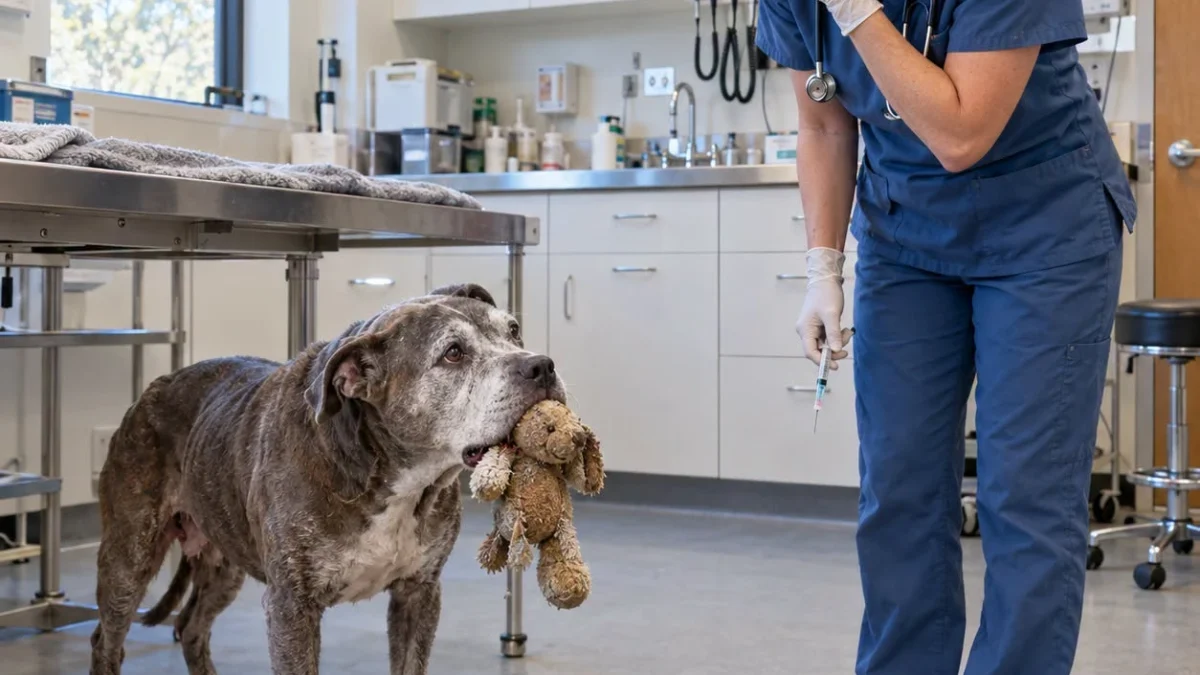
The Vet Had the Euthanasia Syringe in Her Hand—Then the Dying Pit Bull Dropped a House Key From His Mouth
The old Pit Bull had no collar, no microchip, a shattered leg, frostbitten ears, and so little chance of surviving the morning that Dr. Laura Hadley had already prepared the injection that would end his suffering.
Then the dog weakly growled when she tried to remove something clenched between his teeth, and a house key fell onto the treatment table with four faded words still visible on its soaked paper tag: “In case I forget.”
That key led thirty miles through a snowstorm to a farmhouse, a seventy-nine-year-old man disappearing inside dementia, and a final reunion that gave an old dog and the person he had spent six frozen weeks searching for exactly 212 more days together.
The snowplow driver almost killed him.
Ray Mercer would spend the next three years saying that sentence differently every time he told the story.
Sometimes he said:
“I nearly ran him over.”
Sometimes:
“If his ear hadn’t moved, I never would’ve seen him.”
And on the anniversary of that morning, after enough time had passed that he could speak about it without his voice immediately breaking, he would simply say:
“That old dog had about three seconds left before the whole story ended.”
It was January 2023.
Before sunrise.
A rural road in eastern Washington had disappeared beneath blowing snow.
Ray was fifty-six years old, had driven county plows for nineteen winters, and understood the peculiar loneliness of roads at four-thirty in the morning.
No traffic.
No porch lights.
No movement except snow crossing his headlights sideways.
The blade scraped frozen pavement.
The heater blew against his boots.
A thermos of coffee rattled beside the seat.
Ray was thinking about absolutely nothing important when something dark appeared near the shoulder.
Garbage bag.
That was his first thought.
Black plastic caught in a drift.
Then one triangular shape lifted.
An ear.
Ray hit the brakes.
The plow shuddered.
The blade stopped less than ten feet away.
For a moment, Ray remained behind the wheel.
His hands tightened around it.
“What the hell?”
He pulled on gloves.
Climbed down.
The snow reached almost to his knees.
At the edge of the shoulder lay a dog.
Gray-and-white Pit Bull.
Old.
Large frame, but terribly thin.
Stretched on one side.
Snow had already begun gathering against his ribs.
He didn’t move when Ray approached.
That scared him more than growling would have.
“Hey.”
Nothing.
Ray crouched.
“Hey, buddy.”
One cloudy brown eye opened.
That was all.
Ray touched the dog’s neck.
Cold.
Not cool.
Cold.
He removed one glove and pressed his bare fingers beneath the dog’s front leg, searching for a heartbeat.
Weak.
Irregular.
There.
“Jesus.”
The dog’s left hind leg was wrong.
Ray saw the angle beneath the snow first.
Then blood.
Frozen against fur.
He didn’t know enough about veterinary medicine to identify what he was seeing.
He knew enough to understand the leg was destroyed.
Ray looked toward the empty road.
No houses nearby.
No tracks he could identify through new snowfall.
No collar visible.
“Where’d you come from?”
The dog closed his eye.
Ray stripped off his heavy insulated county coat.
He wrapped it around him.
The Pit Bull made a faint sound.
Not a growl.
More like air leaving.
“I know.”
Ray slid his arms beneath the dog.
The weight shocked him.
Or the lack of it did.
A dog built like this should have been heavy.
Solid.
Instead Ray lifted him easily.
“Come on.”
The dog’s head sagged against his forearm.
Ray carried him into the plow cab.
Placed him across the passenger seat.
Turned the heat to maximum.
Then called dispatch.
He was supposed to keep clearing Route 16 until seven.
Instead he told them he was taking an injured dog to Hadley Veterinary Clinic.
The dispatcher said:
“They open at seven-thirty.”
“Then somebody better answer the damn phone.”
Ray drove eleven miles on roads he had not finished clearing.
One hand on the wheel.
One hand resting on the coat.
“You hang on.”
The dog didn’t respond.
“You hear me?”
Nothing.
“You don’t die after making me leave half the county unplowed.”
The dog’s ear twitched.
Ray swallowed.
“That’s better.”
At 6:41, he called the clinic emergency number.
Dr. Laura Hadley answered from her kitchen.
She had been awake seventeen minutes.
Coffee hadn’t finished brewing.
Her twelve-year-old daughter was still asleep upstairs.
Her husband Mark was making toast.
Laura listened while Ray described the dog.
Cold.
Old.
Possible open fracture.
Barely conscious.
She put down her coffee.
“Bring him.”
“I’m eight minutes out.”
“Drive carefully.”
“He’s dying.”
“So don’t make two patients.”
Ray arrived at 6:47.
Forty-three minutes before regular opening.
Dr. Hadley and her veterinary technician Marissa were waiting.
The treatment room lights came on.
Warm blankets.
Thermometer.
IV catheter.
Oxygen.
Assessment.
The dog’s temperature was dangerously low.
His body was failing.
Severely dehydrated.
Pale gums.
Weak pulse.
Irregular heartbeat.
Thirty-eight pounds.
Dr. Hadley looked at his frame.
He should have weighed at least fifteen, maybe twenty pounds more.
The rear leg was worse than Ray realized.
Two fractures.
One relatively clean.
The second displaced and open.
Bone through damaged skin.
Infection beginning.
Frostbite on both ear tips.
Tail end dark.
Old abrasions.
Cracked nails.
Cloudy eyes.
Age somewhere around thirteen.
Dr. Hadley checked for a chip.
Nothing.
Collar?
None.
Tattoo?
None.
Identification?
Nothing.
But something bothered her.
Not the injuries.
Something else.
This was not a lifelong stray.
There were old pressure marks around his neck.
A collar had rested there for years.
His nails, though now long and damaged, showed evidence of repeated trimming.
His teeth were aged but not destroyed the way she often saw in dogs forced to live by scavenging.
Someone had once fed him.
Touched him.
Trimmed nails.
Fastened a collar.
Maybe brushed him.
Loved him.
Whatever that life had been, it was gone now.
Ray remained in the waiting room.
Sweatshirt only.
His coat still wrapped around the dog.
When Dr. Hadley came out, he stood immediately.
“Well?”
She did not use false optimism.
“The leg is unsalvageable.”
Ray looked toward the treatment-room door.
“What does that mean?”
“If he survives stabilization, he’ll need amputation.”
“He can live on three legs?”
“Possibly.”
“Then do it.”
“It’s more complicated than that.”
She explained.
Age.
Shock.
Hypothermia.
Dehydration.
Possible infection.
Anesthesia risk.
Aftercare.
No owner.
No rescue placement.
No foster.
No legal guardian to authorize major treatment.
No guarantee he would survive surgery.
No guarantee he would survive the next several hours.
Ray stared.
“So what happens?”
Dr. Hadley hated that question.
Because she knew the answer she was supposed to give.
“We keep him warm.”
She paused.
“We manage pain.”
Another pause.
“And if his condition doesn’t improve enough to make treatment humane and realistic—”
Ray understood.
“You put him down.”
“We prevent further suffering.”
Ray looked at his hands.
For years, Laura had watched people react differently to that sentence.
Anger.
Guilt.
Relief.
Denial.
Ray simply looked tired.
“He was lying in the snow.”
“I know.”
“He didn’t even try to bite me.”
“I know.”
“I don’t want him scared.”
“He won’t be.”
“You promise?”
Laura looked directly at him.
“I promise he won’t be alone.”
Ray nodded.
Then sat down.
Twenty minutes later, the dog’s heart rhythm worsened.
His blood pressure remained dangerously low.
The warming measures helped only slightly.
Laura stood beside him.
She had made this decision before.
Hundreds of times.
Not casually.
Never casually.
But veterinary medicine sometimes requires knowing when treatment becomes an extension of suffering.
An old unclaimed dog.
Catastrophic injury.
No stable owner.
No identified home.
Critically hypothermic.
Severe shock.
Laura prepared the medication.
Marissa turned away for a second.
Laura placed the syringe on the stainless table.
Then rested her hand on the dog’s scarred forehead.
“It’s okay, old man.”
His eye opened.
“You don’t have to fight anymore.”
His jaw looked strange.
Laura leaned closer.
Tightly clenched.
Something behind the front teeth.
Dark.
She frowned.
“What’s that?”
Marissa looked.
“Food?”
“Maybe.”
Laura reached for forceps.
The moment the metal touched his lip, the dog made a faint sound.
Growl.
Barely audible.
But unmistakable.
Laura stopped.
“Easy.”
The dog’s jaw tightened.
Protective.
Whatever was there mattered to him.
Laura changed approach.
Hand under muzzle.
Gentle pressure.
“I’m not taking anything from you.”
Another faint growl.
“You’re barely alive and you’re arguing with me.”
Marissa said:
“That seems encouraging.”
Laura carefully opened the mouth.
Something metallic slipped free.
Hit the towel.
Small click.
They both stared.
A key.
House key.
Old.
Scratched.
Broken brass ring still attached.
And a tiny paper tag.
Soaked.
Chewed.
Nearly destroyed.
Laura picked it up.
“Don’t touch the writing.”
Marissa leaned under the examination lamp.
Most ink had bled into gray-blue stains.
But several words remained.
Laura turned the tag.
Four words.
Then an address.
IN CASE I FORGET.
4418 LINDEN.
Laura stared at it.
Marissa said:
“What does that mean?”
Laura looked at the dog.
Then the syringe.
A key.
Not evidence of recovery.
Not evidence he could survive surgery.
Not a medical reason to reverse a humane decision.
She knew that.
But it was evidence of something else.
A history.
A possible owner.
A reason this dog had been where he was.
Maybe someone was searching.
Maybe an elderly owner had died.
Maybe someone had abandoned him.
Maybe the address was years old.
Maybe it meant nothing now.
But suddenly Laura no longer knew enough.
And if there was one thing fourteen years of medicine had taught her, it was that irreversible decisions should not be made while important questions remain answerable.
She picked up the syringe.
Marissa watched.
Laura placed it back in the cabinet.
“Not yet.”
The dog’s cloudy eye opened.
Laura looked at him.
“You bought yourself some time.”
The dog exhaled.
Dr. Hadley began with the one thing she could control.
The patient in front of her.
Warmed IV fluids.
Pain medication.
Antibiotics.
Protected fracture.
Continuous temperature monitoring.
Marissa placed the key in a specimen cup so nobody would lose it.
“Are we doing surgery?”
“I don’t know.”
“But we’re not euthanizing?”
Laura looked through the glass.
“No.”
“Because of the key?”
“Because I don’t know what the key means.”
She checked the address.
County records listed 4418 Linden Road.
Owner:
Elliot Warren.
Seventy-nine.
No second owner.
No obvious emergency contact.
Listed phone disconnected.
7:26 a.m.
Patients would start arriving soon.
Laura should have stayed.
Should have handed the address to animal control.
Or sheriff.
Should have treated her scheduled patients.
Instead she removed her lab coat.
“Marissa.”
“Yes?”
“Call if pressure drops.”
“You’re going?”
“Yes.”
“Laura.”
She turned.
Marissa held up the specimen cup.
“The key?”
Laura took it.
“Right.”
Outside, snow fell in thin dry sheets.
The farther she drove, the worse the roads became.
Fields vanished.
Telephone wires sagged under ice.
The world looked colorless.
For thirty-five minutes, Laura thought about the key.
Dogs carried objects.
Sticks.
Toys.
Shoes.
Things that smelled interesting.
But an old starving dog had carried this piece of metal tightly enough to defend it with the last energy he had.
That was different.
The mailbox appeared first.
Overflowing.
Letters on the ground.
Laura slowed.
Farmhouse set far back.
Weathered white siding.
Porch sagging.
No vehicle.
No smoke.
No tracks.
No dog barking.
Nothing.
She parked.
The silence bothered her.
Country houses usually make noise.
Generator.
Wind chime.
Animals.
Machinery.
This house felt abandoned.
Laura climbed the porch.
Knocked.
“Mr. Warren?”
No answer.
Again.
Nothing.
Then she noticed a paper taped to the front door.
WELFARE CHECK COMPLETED.
FOR INFORMATION CONTACT COUNTY SHERIFF.
Laura read it twice.
Called.
Dispatcher asked:
“Family?”
“No.”
“Neighbor?”
“No.”
“What is your connection to Mr. Warren?”
Laura looked at the key.
“I’m a veterinarian.”
Pause.
“I think I have his dog.”
Twenty-two minutes later, Deputy Daniel Ruiz arrived.
Late thirties.
Broad shoulders.
Tired eyes.
He listened.
Dog in snow.
Key.
Address.
He looked at the broken ring.
“Where’d they find him?”
“About eleven miles north of my clinic.”
Ruiz looked toward the farmhouse.
“That’s more than thirty miles from here.”
“I know.”
“And he was carrying this?”
“In his mouth.”
Ruiz removed his gloves.
“Mr. Warren hasn’t been here for six weeks.”
Laura felt the cold differently.
“Dead?”
“No.”
“Where?”
“Memory-care facility outside Millbrook.”
Laura stared.
“What happened?”
Six weeks earlier, Ruiz said, someone called 911 about an elderly man wandering along County Route Nine at two in the morning.
Pajamas.
Twelve degrees.
Confused.
Didn’t know his name.
Didn’t know his address.
Kept saying:
“I have to get home. Somebody’s waiting for dinner.”
Hospital evaluation revealed advanced cognitive decline.
Elliot could not safely return alone.
Social services arranged placement while trying to locate his niece.
Laura asked:
“Did anyone know about the dog?”
Ruiz looked uncomfortable.
“No.”
“No one?”
“We checked the property.”
“You personally?”
“Yes.”
“Where was the dog?”
“Not here.”
“Did you check everywhere?”
“Yes.”
Laura’s anger rose.
“He is thirteen.”
She heard her own voice.
“He has a shattered leg.”
Ruiz didn’t argue.
“He was almost dead.”
“I know.”
“No, you don’t.”
Ruiz accepted that.
Then said quietly:
“Back door was open when we arrived.”
Laura stopped.
“How open?”
“Maybe six inches.”
“Food?”
“Some scattered.”
“Water?”
“Don’t remember.”
“If the dog was here—”
“He could’ve left before we came.”
“Or after Elliot wandered?”
“Yes.”
Laura looked at the key.
“Can we go inside?”
Ruiz hesitated.
Then took it.
The key fit.
The door opened.
Cold air.
Power disconnected.
Dark hallway.
Photographs.
Laura turned on her phone light.
First picture:
Young Elliot.
Woman in yellow dress.
Wedding maybe.
Next:
Same woman older.
Christmas.
Then years passed.
Woman disappeared.
Elliot aged.
And a dog appeared.
Gray Pit Bull puppy.
Huge ears.
White blaze.
Elliot kneeling beside him.
Another:
Dog asleep across Elliot’s feet.
Another:
Elliot in recliner.
Glasses slipping down nose.
One hand resting on the dog’s back.
Laura stopped.
Ruiz looked.
“That him?”
“Yes.”
Same face.
Same notch in ear.
Younger.
Strong.
Healthy.
Loved.
“He has a name.”
Laura whispered it as though that alone mattered.
Kitchen.
Dry water bowl.
Empty food bowl.
Leash hanging beside door.
Scratch marks below it.
Fleece blanket on sofa with gray hairs.
Cracked rubber ball beneath table.
Laura picked it up.
For the first time, the animal in her clinic stopped being “the old Pit Bull.”
He had occupied a room.
Waited at a bowl.
Slept beside a man.
Knew this floor.
This door.
This sofa.
Ruiz called:
“Doctor.”
Notebook near toaster.
Shaky handwriting.
MONDAY—PILLS AFTER BREAKFAST.
TRASH THURSDAY.
CALL ANNE?
MILK.
Then darker lines.
Written over repeatedly.
WALTER — 13.
FOOD MORNING + NIGHT.
KEY ON COLLAR — IN CASE I FORGET.
Laura read that again.
KEY ON COLLAR.
The broken brass ring.
Another line:
BACK DOOR OPEN FOR WALTER IF I GET LOST.
Laura covered her mouth.
Ruiz stared.
“His name is Walter.”
“Yes.”
“He wore the key.”
“Apparently.”
Laura touched the metal.
Not in case Walter gets lost.
In case I forget.
Elliot knew.
Somewhere inside a mind slowly betraying him, he understood what was coming.
He had tied a spare house key to the dog’s collar.
Address attached.
A safeguard.
Not for Walter.
For himself.
If Elliot wandered, perhaps someone could bring him home.
Or perhaps Walter could stay near him long enough that someone would understand.
But Elliot disappeared first.
And Walter waited.
Six weeks.
Laura imagined it despite knowing she could never know the truth.
First night.
Open back door.
No Elliot.
Food running out.
Water gone.
Walter sleeping on the sofa because it smelled like him.
Waiting at five.
Then next morning.
Next night.
Maybe snow for water.
Maybe scraps.
Then hunger.
He left.
Possibly followed roads.
Smells.
Truck tracks.
Human footprints.
Searched.
Collar eventually broke.
Caught on branch.
Fence.
Old leather tearing.
The key fell.
Walter picked it up.
He could not read.
Could not understand an address.
But he knew the object.
It had hung beneath his chin.
Smelled of leather.
Metal.
House.
Elliot’s hands.
So he carried it.
Laura called the clinic.
“How is he?”
Marissa answered:
“Still here.”
“Temperature?”
“Ninety-six point eight.”
“Pressure?”
“Low. Better.”
Laura closed her eyes.
“Good.”
“Did you find anything?”
“Yes.”
“What?”
“His name.”
Pause.
“What is it?”
“Walter.”
That evening, Walter remained alive.
Temperature climbing.
Heart steadier.
Blood tests better than feared.
Kidney stress.
Severe dehydration.
But potentially reversible.
The leg remained deadly.
Infection.
Open bone.
Necrotic tissue.
Wait too long, sepsis.
Operate too soon, anesthesia could kill him.
Laura sat outside his kennel after closing.
IV taped to front leg.
Key on shelf.
“I had a plan this morning.”
Walter opened an eye.
“It was a bad plan.”
He breathed.
“But it was still a plan.”
She rubbed his forehead.
“You had to make this complicated.”
Walter touched her glove with his tongue.
Laura laughed.
Tears came.
“All right.”
She stood.
Made calls.
Surgical specialist.
Emergency hospital.
Practice manager.
Charitable fund.
Then opened her banking app.
The clinic fund could not cover everything.
No rescue had stepped in.
Walter had no legal owner presently available to pay.
Laura paid the difference.
When she got home after midnight, Mark sat at the kitchen table.
“How much?”
She told him.
He blinked.
“That is not a small number.”
“I know.”
“For a dog you met today.”
“I know.”
“Thirteen.”
“Yes.”
“Who might still die.”
“Yes.”
Mark stared.
Then:
“What aren’t you telling me?”
Laura placed the key on the table.
She told him everything.
Farmhouse.
Elliot.
Notebook.
Six weeks.
The key.
Mark picked it up.
“So he carried this thirty miles?”
“We don’t know that.”
“Thirty miles sounds better.”
Laura smiled despite herself.
Mark put the key down.
“Save the dog.”
The next morning Walter went to surgery.
Laura had amputated legs before.
Muscle.
Vessels.
Nerves.
Bone.
Closure.
She knew the procedure.
But every time she looked at him under surgical light, she saw Elliot’s handwriting.
WALTER — 13.
Pressure dropped.
Marissa:
“Blood pressure falling.”
“Fluids up.”
“Heart rate ninety-eight.”
“Keep talking.”
“Ninety-four.”
Laura worked.
“Come on, Walter.”
No response.
“You carried the key this far.”
Pressure steadied.
“Don’t quit here.”
Three hours.
Damaged leg removed.
Dead tissue trimmed from tail.
Ear tissue protected.
Walter remained alive.
Barely.
Recovery was another battle.
Minutes.
Hour.
Then eyelids moved.
Walter tried to rise.
Three-legged balance failed.
Laura caught his shoulders.
“Easy.”
He panicked.
“Walter.”
He froze.
First time she used his name while he was fully conscious.
One ear moved.
“Walter.”
His eyes found her.
“That’s you.”
Tail moved beneath blanket.
One thump.
Marissa covered her mouth.
Laura smiled.
“Well.”
Another tiny tail movement.
“I guess that settles it.”
Two days later, Walter ate from Laura’s hand.
Three days later, stood for four seconds.
Fifth day, took one step and fell into Marissa.
She caught him.
“Sir.”
Walter licked her chin.
“You’re supposed to walk.”
By then the clinic had adopted him emotionally.
One technician bought an orthopedic bed.
Receptionist brought boiled chicken.
Someone wrote WALTER on his kennel card in blue marker and added:
VERY IMPORTANT MAN.
Ray Mercer returned with his county coat.
Washed.
“Thought maybe he wants it.”
Walter sniffed the fabric.
Long.
Then Ray crouched.
Walter leaned his head against Ray’s chest.
Ray’s hands closed around his neck.
He stopped talking.
“That’s all right.”
His voice failed.
“That’s all right, old boy.”
Then Ray asked:
“Does Elliot know?”
No.
Not yet.
Pine Hollow Memory Care Center was sixty-four miles away.
Elliot’s cognition changed day to day.
Sometimes coherent.
Sometimes didn’t know his room.
Sometimes didn’t recognize his niece Anne.
Laura worried showing him Walter could distress him.
But she also knew something else.
People kept telling her Elliot asked about dinner.
Asked about home.
Asked whether somebody fed “him.”
Sunday morning, first day off in almost two weeks, Laura drove to Pine Hollow.
Not with Walter.
He wasn’t ready.
Just a photograph.
A nurse named Rebecca met her.
“How is Elliot today?”
Rebecca gave a sad smile.
“An in-between day.”
“Meaning?”
“He knows Elliot.”
“Okay.”
“He knows he lived on a farm.”
“Good.”
“He thinks it’s 1998.”
Laura nodded.
“Does he mention a dog?”
Rebecca stopped.
“Sometimes.”
“What does he ask?”
“If someone fed him.”
Laura swallowed.
“What name?”
Rebecca thought.
“Walter.”
Elliot sat by a window.
White hair.
Plaid blanket.
Thin hands.
Watching snow.
Rebecca said:
“Elliot, visitor.”
He turned.
“Anne?”
“No.”
Laura sat.
“My name is Laura.”
“Laura.”
“I’m a veterinarian.”
No reaction.
“I want to show you something.”
She opened her phone.
Walter after surgery.
Heated pad.
Bandage.
One ear wrapped.
Face unmistakable.
At first, Elliot glanced and looked away.
Then looked back.
His face changed.
Slowly.
Hand rose.
Trembling finger touched the screen.
“Walter.”
Laura could not speak.
“My Walter.”
“Yes.”
“Where is he?”
“We found him.”
“Is he alive?”
“Yes.”
“Is he hurt?”
“He was.”
“Is he alive?”
“Yes.”
Elliot began crying.
Shoulders shaking.
Rebecca stepped closer.
Laura signaled wait.
“I left him.”
“You were sick.”
“I left him.”
“You didn’t choose to.”
“He waits.”
“I know.”
“I told him stay.”
Laura moved closer.
“He survived.”
Elliot stroked the screen.
Then whispered.
Laura leaned in.
“What?”
“He found me.”
“He hasn’t seen you yet.”
Elliot shook his head.
“You don’t understand.”
Finger on Walter’s face.
“He found me.”
Then the clarity faded.
Elliot looked out the window.
“Is Margaret making supper?”
Margaret had been dead nine years.
Laura left fifteen minutes later.
But before going, she asked:
“Could Walter visit?”
“Maybe.”
“Could he live here?”
Rebecca hesitated.
“That’s complicated.”
Laura looked into Elliot’s room.
He still held her dark phone even though the screen was off.
“Can complicated become possible?”
Rebecca smiled.
“I’ll ask.”
Walter needed nine weeks to recover enough.
Rehabilitation was undignified.
He hated the sling.
Refused to move.
Laura stood behind him.
“You walked half a county in a snowstorm.”
Walter sat.
“Twelve feet.”
Yawn.
“Twelve.”
Nothing.
Marissa laughed.
“He knows you paid for him.”
“That doesn’t give him leverage.”
Walter looked over his shoulder.
It absolutely did.
Chicken accomplished what professional encouragement did not.
One piece.
One step.
Then three.
Six.
Within weeks:
Across room.
Low rubber step.
Awkward trot toward cheese.
Weight returned.
Coat improved.
Tail shortened from frostbite.
Part of one ear lost.
He looked battle-worn.
Old.
Stubborn.
Alive.
But every evening at five, Walter paced to the clinic door.
Sniffed.
Whined.
Looked toward parking lot.
Laura tried sitting with him.
Didn’t help.
Then she remembered the farmhouse notebook.
FOOD MORNING + NIGHT.
Five o’clock.
Elliot probably fed him then.
Walter wasn’t restless.
He was waiting for dinner with a man who never came.
“Soon.”
Laura sat beside him.
“I hope.”
Pine Hollow called Monday.
Visit approved.
And something more.
If visits went well and Anne signed responsibility paperwork, the facility would make an exception allowing Walter to become Elliot’s permanent companion.
Laura read the email twice.
Called Anne.
Elliot’s niece lived three states away.
Her guilt came quickly.
“I should’ve known.”
Laura said:
“Your uncle was hiding how bad things were.”
“That doesn’t make me feel better.”
“No.”
Anne explained she had begged Elliot for years to move near family.
He refused.
The farm.
His memories.
Walter.
“He’d tell me Walter was asleep.”
Anne cried.
“Then sometimes he’d tell me he didn’t have a dog.”
She asked:
“Do you think Walter remembers him?”
Laura looked under her desk.
Walter asleep.
“Oh, yes.”
“How do you know?”
“Every night at five, he waits for someone who doesn’t walk through my door.”
Anne signed.
Tuesday.
Carrier.
Walter hated it.
“You survived amputation.”
Whine.
“Sixty-four miles with heated seats won’t kill you.”
Louder whine.
At first stoplight Laura opened top.
Walter put his head out.
Immediately fell asleep.
At Pine Hollow, half the staff waited.
Rebecca.
Two nurses.
Therapist.
Administrator.
Laura raised an eyebrow.
Rebecca shrugged.
“People heard.”
“How is Elliot?”
“Bad morning.”
Laura’s heart sank.
“Agitated.”
“Asking?”
“To go home.”
Walter stopped panting inside carrier.
Nose lifted.
Twenty feet down hallway he began trembling.
Laura stopped.
“What?”
Walter sniffed frantically.
Then made a sound Laura had never heard.
Broken cry.
Half bark.
Half whine.
From a room farther down:
“Walter?”
Everyone froze.
Again:
“Walter?”
The Pit Bull slammed against carrier door.
Laura lowered it.
“Easy.”
Hands shaking.
Unzip.
Walter pushed out.
Three-legged gait still awkward.
Normally careful on slick floors.
Not then.
He ran.
Slipped.
Recovered.
Ran.
Reached doorway.
Stopped.
Elliot sat on edge of bed.
Face toward hall.
For one second they stared.
Old man.
Old dog.
Then Elliot whispered:
“There you are.”
Walter crossed the room.
Pressed his head into Elliot’s knees hard enough to rock him.
The dog cried.
Elliot grabbed his neck.
“My boy.”
Walter licked him.
“I’m sorry.”
Another lick.
“I’m sorry I took so long.”
Laura turned away.
Rebecca openly cried.
Walter tried climbing into Elliot’s lap.
Three legs made it difficult.
Laura moved to help.
Elliot shook his head.
“I got him.”
Thin arms.
Trembling hands.
Elliot pulled.
Walter pushed.
Somehow forty pounds of dog ended across his legs.
Too much dog.
Neither cared.
Elliot buried his hand in Walter’s neck.
His breathing slowed.
Agitation disappeared.
Rebecca looked at the clock.
“He’s been asking to leave since six.”
Elliot looked at her.
“Why would I leave?”
He scratched Walter.
“My dog’s here.”
First visit:
Two hours.
Second:
Four.
Third:
Six.
Every departure became a negotiation.
Walter planted himself beside bed.
Turned face to wall.
Once flattened himself on carpet like a sack of cement.
Laura tried lifting.
“This is emotional manipulation.”
Elliot laughed.
First laugh Rebecca remembered since his arrival.
“Leave him.”
“I can’t yet.”
“He belongs here.”
“I know.”
Elliot’s expression sharpened.
“You’ll bring him back?”
“Yes.”
“You promise?”
“Yes.”
“People say that.”
Laura understood.
People said tomorrow.
People promised visits.
Then work.
Distance.
Life.
Fear.
Death.
Laura crouched.
“I will bring him back.”
Elliot studied her.
Then nodded.
“You saved him?”
Laura almost said yes.
Instead:
“I almost didn’t.”
She told him.
Snow.
Injuries.
Syringe.
Key.
Elliot looked at Walter sleeping across his knee.
“I put that key on him.”
“I know.”
“I started forgetting doors.”
Laura waited.
“I’d go outside.”
Elliot touched his temple.
“Then not know what key did what.”
“So you put a spare on Walter?”
“If I got confused, somebody could use the address.”
He smiled faintly.
“Or Walter could bring me home.”
Laura’s throat tightened.
“He carried it after his collar broke.”
“In his mouth?”
“Yes.”
“How long?”
“We don’t know.”
Elliot closed his eyes.
“I forgot him.”
“No.”
“I forgot him.”
“Your illness took you away.”
“I left the door open.”
“We saw the note.”
“I knew someday I might leave and not remember how to come back.”
He looked at Walter.
“He never liked being shut out.”
Pause.
“He’d wait.”
Another pause.
“Hours.”
Walter slept.
“He always believed I was coming back.”
Elliot touched his head.
“I guess this time he got tired of waiting.”
The permanent move happened the next week.
Orthopedic bed.
Bowls.
Medication.
Leash.
Rubber toy.
Cracked old ball from farmhouse.
When Elliot saw the ball:
“That thing’s older than half your nurses.”
Rebecca pretended outrage.
Walter carried it to Elliot’s slippers.
Dropped it.
Then their life began again.
Not the farmhouse.
Not before dementia.
Something smaller.
Morning.
Walter beside bed.
Elliot’s hand reaching down before eyes opened.
Meals.
Walks.
Courtyard.
Naps.
Walter anchored him.
On bad days, when Pine Hollow became a train station or hotel or stranger’s house, Walter made sense.
One afternoon Elliot paced the hall demanding the train schedule.
Staff redirected.
No effect.
Then Walter limped around the corner.
Sat.
Elliot stared at him.
“Can’t take you on the train.”
Then turned and went back to his room.
Another night Elliot woke screaming:
“Margaret!”
Rebecca found him sobbing.
Walter was already trying to climb onto bed.
She lifted him.
Walter lay against Elliot.
Ten minutes later Elliot slept.
Walter stayed awake.
Chin on his chest.
Watching.
Laura visited.
Officially for Walter.
Incision.
Weight.
Nails.
Mobility.
Unofficially for both.
Sometimes Elliot knew her.
Sometimes called her Margaret.
Once:
“The key lady.”
She liked that.
One clear afternoon in the courtyard, Elliot told Laura how Walter entered his life.
Margaret hated Pit Bulls.
Dangerous, she said.
Then they found a puppy under a feed-store loading dock.
Eight weeks.
Huge head.
Skinny legs.
“Built out of spare parts.”
Margaret insisted shelter.
They drove there.
Walter threw up on her purse.
Laura laughed.
“That made her keep him?”
“No.”
Elliot laughed too.
“Made her furious.”
At the shelter, puppy crawled under Margaret’s seat.
Wouldn’t move.
“She said one night.”
Elliot watched Walter asleep in winter sun.
“One night lasted thirteen years.”
Laura smiled.
“Sounds familiar.”
“What?”
“Nothing.”
After Margaret died, Walter slept on her side of the bed for months.
“I told him she wasn’t coming back.”
Elliot scratched the dog’s ear.
“He never believed me.”
Walter opened one eye.
“Stubborn dog.”
Spring.
Grass.
Warm sun.
Elliot in courtyard.
Walter at feet.
A nurse took photograph.
Elliot’s eyes closed.
Smile.
Hand on dog’s back.
Laura framed it.
Then Elliot’s body began failing.
Not dramatic.
Heart weaker.
Kidneys.
Appetite.
Sleep.
Road narrowing.
Anne visited more.
Walter smelled her.
Pressed his head into her thigh.
She cried.
“Maybe I smell like family.”
Elliot looked up.
“You are family.”
Anne froze.
“Uncle Elliot?”
His eyes were clear.
“Your mother talked too much.”
Anne laughed.
“Still does.”
“No.”
Elliot’s face changed.
“She doesn’t.”
Her mother had been dead four years.
Clarity vanished.
Later Anne told Laura she had been angry at Elliot for years.
“When Mom got sick, I begged him to move.”
“He refused?”
“Because of Walter.”
Anne looked through glass.
“I thought dog was excuse.”
Laura watched Elliot asleep with Walter.
“Maybe he was.”
Pause.
“Or maybe Walter was the last piece of a life he still recognized.”
Anne nodded.
“I know that now.”
The end came seven months after Walter moved to Pine Hollow.
3:18 a.m.
Rebecca called.
Laura answered second ring.
Mark turned on lamp.
“It’s Elliot.”
Laura sat up.
“What?”
“Breathing changed.”
Hospice nurse believed hours.
“Walter?”
“With him.”
“Anne?”
“Driving.”
“I’m coming.”
Dark halls.
Dim lights.
No television.
Elliot beneath white blanket.
Face smaller.
Walter on bed.
Someone had lifted him.
The three-legged Pit Bull lay across Elliot’s chest.
Head beneath chin.
Elliot’s hand rested on his shoulder.
Even unconscious, fingers curved into fur.
Walter looked at Laura.
No wag.
Just watched.
She sat.
“Hey, old man.”
He did not move.
Laura touched Elliot’s wrist.
Weak pulse.
Irregular.
She was not his physician.
There was nothing for her to treat.
Only witness.
Anne arrived.
Kissed forehead.
Sat opposite.
Held Elliot’s hand.
Two hours.
Little conversation.
Morning entered slowly.
At 6:51, Elliot opened his eyes.
Rebecca leaned.
“Elliot?”
His gaze moved.
Anne.
Rebecca.
Laura.
Then Walter.
The dog lifted his head.
Elliot’s lips moved.
Anne bent closer.
“What?”
Barely breath:
“Good boy.”
Walter licked his chin.
Elliot exhaled.
Relaxed.
Did not breathe again.
Nobody moved.
Walter waited.
Then nudged beneath Elliot’s jaw.
Once.
Again.
Licked cheek.
Pushed.
Nothing.
Walter stood on trembling three-legged balance.
Sniffed mouth.
Nose.
Hands.
Then lowered himself across Elliot’s chest again.
A long sound left him.
Low.
Not bark.
Not howl.
Recognition.
Veterinarians are often warned against anthropomorphism.
Animals may not understand death as humans do.
Laura knew that.
But Walter understood absence.
He had already survived it once.
He knew the difference between waiting and no one returning.
Laura pressed her forehead to his.
“You found him.”
Walter closed his eyes.
“You did what you had to do.”
Her tears fell into his fur.
“You don’t have to look anymore.”
Walter remained until funeral attendants arrived.
Nobody forced him away.
When they needed to move Elliot, Laura lifted Walter.
He fought.
For first time since surgery.
Twisted.
Reached.
“I know.”
His paws moved toward the stretcher.
“I know.”
The door closed.
Walter stared.
Then returned to empty bed.
Elliot’s slippers remained beside chair.
Walter lay down.
Nose on one slipper.
Laura sat on floor beside him until sunrise.
Anne came carrying a box.
Records.
Medication.
Toy.
Leash.
Cracked ball.
“What happens now?”
They had discussed it.
Anne’s apartment prohibited large dogs.
Pine Hollow could not keep Walter without Elliot.
Rescue.
Foster.
Options existed.
But Laura and Mark had already decided.
“He’s coming home with me.”
Anne closed her eyes.
“Thank you.”
“You don’t need to.”
“Yes.”
Anne knelt.
Kissed Walter’s forehead.
“You brought Uncle Elliot back to us.”
Walter looked at her.
“And you brought that stubborn old man back to himself.”
Laura arrived late to work.
No one complained.
Walter slept beneath her desk.
That evening she drove him home.
New kitchen.
New smells.
Mark crouched.
“So you’re Walter.”
Walter stared.
“I’ve heard things.”
Nothing.
“Apparently you’re expensive.”
Laura glared.
Mark held chicken.
Walter immediately crossed kitchen.
Laura shook her head.
“Traitor.”
Mark scratched him.
“I think we’ll be fine.”
First night, bed beside theirs.
2 a.m.
Nails clicking.
Laura woke.
Walter in doorway.
Looking down hallway.
Waiting.
Laura sat beside him.
“He’s not here.”
Walter looked at her.
“I know.”
She put her arm around him.
“I wish he was.”
Ten minutes later Walter turned back.
Did not use dog bed.
Slept at foot of hers.
He slept there afterward.
Years passed gently.
Walter slowed.
Muzzle turned white.
Remaining rear leg arthritic.
Mark built ramp from back porch.
Walter hated rain.
Loved scrambled eggs.
Distrusted vacuum.
Learned exactly when Laura came home after a terrible day.
Those evenings, he waited near front door.
Pressed head against her legs.
Never trained.
Just knew.
The key remained.
Laura bought a small wooden bowl.
Placed it on dresser beside her keys.
Walter’s key in center.
She did not polish it.
Scratches stayed.
Paper tag became too fragile.
She sealed it in protective sleeve.
IN CASE I FORGET — 4418 LINDEN.
Every morning before work she saw it.
It changed her practice.
Not into fantasy.
Laura still euthanized animals.
Still told families the truth.
Still faced cases where medicine could not save.
Still cried in her car sometimes.
Walter had not taught her that every hopeless case contained a miracle.
That would be dangerous.
He taught her something narrower.
And more useful.
Pause when the story is incomplete.
A scar has history.
A worn collar mark says something.
A dog staring at a door may not be restless.
He may be waiting.
An object in a mouth may not be trash.
It may be the last remaining piece of home.
Ray Mercer visited every winter.
Anniversary cheeseburger.
No onions.
“Medically necessary.”
Laura objected.
Walter sided with Ray.
Deputy Ruiz visited.
Second visit brought framed copy of farmhouse photograph.
Young Elliot.
Young Walter.
Both looking into camera as if separation was unimaginable.
Laura hung it in office.
Small brass plaque underneath:
HE FOUND ME.
Clients asked.
“What does that mean?”
Usually:
“Long story.”
Sometimes waiting room quiet.
Laura told it.
Snowplow.
Fracture.
Key.
Farmhouse.
Old man losing memory but remembering dog.
Walter running down hallway on three legs.
Elliot calling his name before seeing him.
Two hundred twelve days together.
People assumed Walter saved Elliot.
Laura never corrected them.
He did.
But Elliot saved Walter first.
Thirteen years earlier:
Found puppy.
Fed him.
Named him.
Made him home.
When memory began failing, Elliot placed spare key on collar.
One small safeguard against a mind he no longer trusted.
He did not know the key would one day keep Walter alive.
He did not know a veterinarian would see it seconds before euthanasia.
He did not know it would reopen their final months.
No one could have.
By sixteen, Walter’s world became small.
No room-to-room following.
Long naps in sun.
Hearing faded.
Laura sometimes had to touch him so he knew she was home.
But his nose remained.
He smelled her hands.
Then pushed his head beneath them.
Three years after that frozen morning, snow covered Laura’s yard.
Walter slept with his chin over her ankle.
Mark stood in doorway.
“You know, I still don’t believe he carried that key.”
Laura looked at the wooden bowl.
“Neither do I.”
“Do you think he knew?”
“Knew what?”
“That it was a key.”
Laura considered.
“No.”
Mark leaned against frame.
“Then why hold it?”
Laura looked at Walter.
Old chest rising.
Falling.
“I don’t think he knew it opened a door.”
She stroked his gray head.
“I think he knew it belonged to Elliot.”
Pause.
“And that was enough.”
Mark left.
Laura took the key.
Cold metal.
Small.
Ordinary.
People lose keys every day.
She thought of how close everything came to disappearing.
Seconds.
One missed movement.
One distracted glance.
Syringe.
Walter asleep under her hand.
Ray driving away believing mercy was all that remained.
Elliot spending his final months asking about a dog no one knew existed.
Key thrown away with wet paper.
No reunion.
No 212 days.
No “good boy.”
No final morning.
Laura closed her fist around it.
“I almost killed you.”
Walter slept.
“I had the syringe.”
Ear twitch.
“You were frozen.”
No response.
“Starving.”
Cloudy eye opened.
“Broken.”
Walter looked at her.
“And you still wouldn’t let go.”
His short tail tapped the rug once.
Laura laughed.
“You stubborn old dog.”
She returned the key to the bowl.
Sat beside him.
Walter rested his head against her knee.
Outside, snow fell.
Inside, warm.
No road waited.
No empty farmhouse.
No five o’clock pacing toward a clinic door.
Walter had carried the message far enough.
Delivered it.
And for years, Laura thought the miracle was that she noticed the key.
Later she understood something else.
The key itself had done nothing extraordinary.
It was metal.
Cut teeth.
Old brass ring.
A ruined paper tag.
It had opened the Warren farmhouse.
Yes.
But that was the smallest door it opened.
The key reopened a life Laura had been seconds away from closing.
It reopened a relationship dementia had interrupted.
It gave a confused old man proof that one piece of his past was not imagined.
It gave a dog the one thing he had spent six weeks searching for.
Elliot.
It gave them two hundred and twelve mornings.
Two hundred and twelve evenings.
Meals.
Courtyard sun.
Confused nights.
Chicken stolen from plates.
A cracked rubber ball.
A dog beside a bed.
A hand falling into fur before eyes were fully open.
And eventually, one final sunrise.
Laura would sometimes take that photograph from her office wall after closing.
Young Elliot.
Young Walter.
Before gray hair.
Before dementia.
Before snow.
Before amputation.
She would look at the plaque.
HE FOUND ME.
For a long time, she thought Elliot meant Walter had physically found him.
That the dog had crossed roads and snow because some instinct was pulling him toward the man.
Maybe.
No one would ever know Walter’s exact path.
But with time, she heard Elliot’s words differently.
“He found me.”
Dementia had taken names.
Years.
Places.
His wife.
His home.
His own identity on certain mornings.
Then Walter entered that hallway.
And for a moment Elliot was no longer lost.
He was the man who belonged to that dog.
The man who knew his name.
The man who fed him.
The man whose hand fit into the skin around his neck.
The man who had spent thirteen years being waited for.
Walter found that man again.
And Walter?
Walter had been nameless at the clinic.
A stray.
An injured old Pit Bull.
Case.
No chip.
No owner.
Poor prognosis.
The key gave him back a name too.
Walter.
Thirteen.
Food morning and night.
Sleeps on sofa.
Likes cracked rubber ball.
Waits at five.
Belongs to Elliot.
Medicine needs diagnoses.
Shelter records need descriptions.
County reports need facts.
But life is larger than those categories.
Laura learned that from an old dog who refused to surrender a key.
One winter morning years later, a young veterinarian working with Laura faced a difficult case.
An elderly shepherd.
No chip.
Very sick.
Possible cancer.
Owner unknown.
The younger doctor asked:
“How do you know when you’ve looked hard enough?”
Laura did not give her a sentimental answer.
“You don’t always.”
She explained medical reality.
Pain.
Prognosis.
Resources.
Urgency.
Ethics.
Then the younger doctor glanced at Walter’s photograph on the wall.
“The key dog?”
“Yes.”
“So you always wait now?”
“No.”
That answer surprised her.
Laura continued.
“Waiting can be cruel too.”
She pointed toward the treatment room.
“Our job isn’t to delay every death.”
Then to the photograph.
“Our job is to know what we know.”
Pause.
“And notice what we don’t.”
That was Walter’s lesson.
Not:
Never euthanize.
Not:
Every animal can be saved.
Not:
Hope harder.
Something more disciplined.
Don’t mistake incomplete information for certainty.
That had become part of Laura’s hands.
The same hands that once prepared Walter’s final injection.
The same hands that later amputated his leg.
The same hands that helped carry him from Elliot’s deathbed.
The same hands Walter smelled every night before pushing his head beneath them.
Eventually Walter reached the end of his own road.
Not in snow.
Not anonymous.
Not afraid.
He was seventeen.
The final decline came slowly.
His remaining rear leg weakened.
Kidneys began failing.
Appetite faded.
There were still good mornings.
Eggs.
Sun.
Ray’s visits.
Walks no farther than the mailbox.
Then more bad than good.
Laura knew the pattern.
She had guided hundreds of families through it.
Knowing did not make her own turn easier.
One evening Walter refused scrambled egg.
Mark looked at Laura.
Neither spoke.
Next morning he did not stand when she opened the front door.
He lifted his head.
Tail tapped once.
Laura sat beside him.
“Not today?”
Walter put his head on her leg.
She called the clinic.
Not to make an appointment.
To tell them she would not come in.
Marissa, still working with her after all those years, understood immediately.
“Do you want me there?”
Laura closed her eyes.
“Yes.”
Ray came.
Deputy Ruiz.
Anne joined by video from three states away.
Mark sat on the floor.
Walter lay on his favorite blanket.
The cracked rubber ball beside one paw.
Laura placed the old key near his nose.
Walter smelled it.
For several seconds.
Then relaxed.
Did he remember Elliot?
Nobody could know.
Laura believed scent lived in animals differently than memory lived in humans.
Maybe metal still carried trace of old leather.
Old house.
Old hands.
Maybe nothing remained except Laura’s own meaning.
It did not matter.
Walter had no road left to travel.
No one left to find.
He was home.
Laura stroked his forehead.
“You did enough.”
Walter breathed.
“More than enough.”
She cried before starting.
Professionalism had no purpose there.
“You found him.”
Walter looked at her.
“And somehow you found me too.”
Mark placed one hand on her shoulder.
Laura administered sedation first.
Walter relaxed deeply.
His head became heavy in her lap.
She waited.
No rush.
Then, when he was fully asleep, she gave the final medication.
The same kind of medicine she had prepared years earlier.
Only everything was different.
The first time, Walter had been a nameless dog in a clinic.
Cold.
Alone except for strangers.
Story unfinished.
This time:
Walter.
Seventeen.
Loved.
Ray’s snow dog.
Elliot’s boy.
Laura’s stubborn old man.
He died with his head in her lap.
Mark’s hand on his side.
His key beside him.
No fear.
No search.
No unfinished question.
Afterward, Laura sat for nearly an hour.
The room quiet.
Snow began outside.
Of course it did.
Ray picked up the cracked rubber ball.
“Should this go with him?”
Laura looked.
“No.”
She took it.
“The key and ball stay.”
Ray nodded.
No one asked why.
Walter’s ashes eventually sat beneath Elliot’s photograph in Laura’s office.
Small wooden box.
Name:
WALTER WARREN-HADLEY.
Mark had insisted on both surnames.
Laura laughed when she saw it.
Then cried.
The key remained in the wooden bowl at home for a while.
Eventually she moved it to the office.
Placed it beneath the photograph.
Not inside a glass case.
She disliked that.
Too much like a museum.
Just the key.
The worn metal on a small piece of dark wood.
Underneath the plaque:
HE FOUND ME.
Years later, people still asked.
And if Laura had time, she told them.
She always started the same way.
Not with the euthanasia syringe.
Not with the farmhouse.
Not with dementia.
She started with Ray.
A snowplow.
A dark shape on a road.
One ear moving.
Because that was the first small moment on which everything depended.
Someone noticed.
Ray noticed an ear.
Laura noticed a jaw clenched too tightly.
Ruiz noticed the key.
Rebecca remembered a name.
Anne signed the papers.
Pine Hollow made an exception.
Mark said:
“Save the dog.”
Hundreds of small choices.
None sufficient alone.
Together they made two hundred and twelve days possible.
That was what Laura came to believe rescue often was.
Not one hero.
A chain of people refusing to look away at the exact moment looking away would have been easier.
Ray could have kept plowing.
Laura could have completed the euthanasia.
Ruiz could have dismissed the address.
The facility could have said rules were rules.
Anne could have let distance win.
Mark could have said the surgery cost too much.
Any one of those things would have been understandable.
Instead:
One more question.
One more phone call.
One more drive.
One exception.
One chance.
And at the center of it all—
an old Pit Bull who had no idea what an address was.
Who couldn’t understand handwriting.
Who certainly did not know that brass teeth fit a lock.
But who knew the object under his collar belonged to the person he loved.
When the collar was gone, he carried it anyway.
Maybe that is all loyalty is at its purest.
Not understanding every reason.
Just refusing to let go of what still smells like home.
Dr. Laura Hadley had been seconds away from ending Walter’s suffering that winter morning.
Years later, she no longer tortured herself over that.
She had been making a medically defensible decision with the information she had.
Then the information changed.
So she changed with it.
That mattered too.
Compassion is not always knowing the right answer immediately.
Sometimes it is being willing to set the syringe down when the story changes.
Walter’s did.
Because of one scratched house key.
Because of four fading words.
In case I forget.
Elliot had written them because he feared losing himself.
In the end, the key did exactly what he hoped.
It brought someone home.
Just not in the way he imagined.
It brought Walter back to Elliot.
It brought Elliot back to himself.
It brought an old dog’s name back from anonymity.
And it changed the veterinarian who nearly believed she already knew how his story had to end.
Long after both Elliot and Walter were gone, the photograph still hung in Laura’s office.
Young man.
Young dog.
One hand on the other’s shoulder.
Underneath:
HE FOUND ME.
And beneath that photograph lay the small scratched key that Walter carried through snow after everything else had fallen away.
Visitors often assumed the key opened 4418 Linden Road.
They were right.
But Laura knew better.
That wasn’t the door that mattered most.
The key opened two hundred and twelve days.
It opened one last summer.
One last winter.
One final “good boy.”
And, for a dying old Pit Bull who had spent six frozen weeks searching for the person he loved, it opened the only door he had been trying to find all along.
Home.








