The Two-Month-Old Kitten Dragged Himself Beside a Busy Road—Then One Tiny Movement Changed Everything
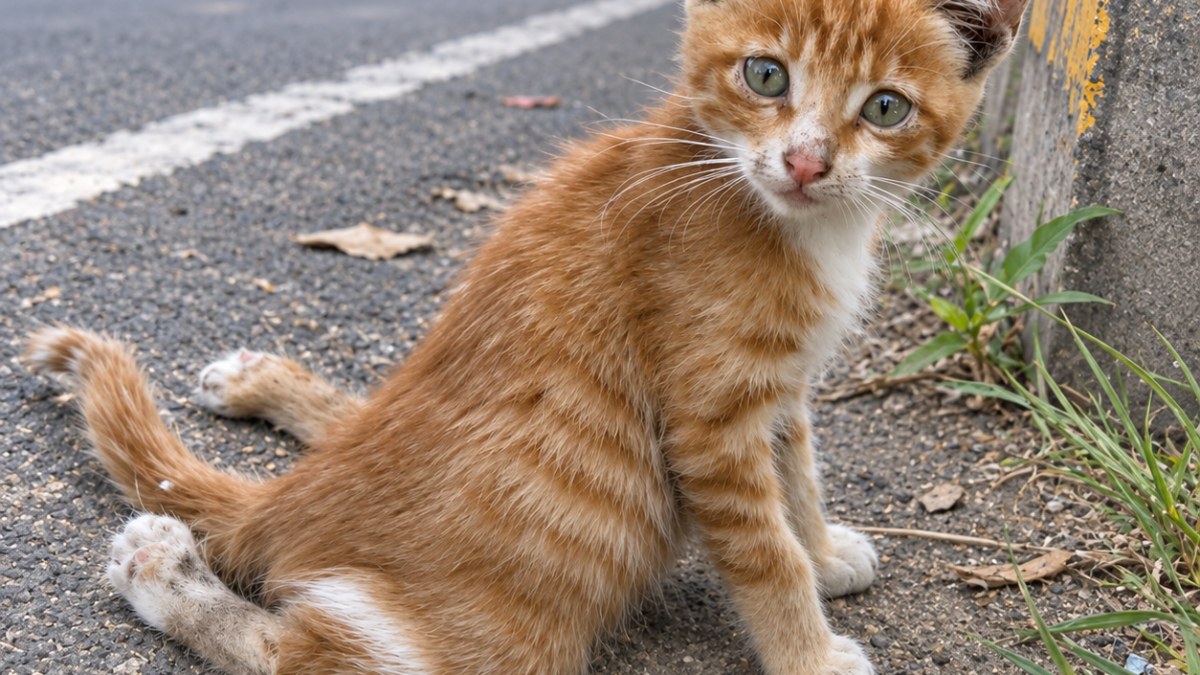
PART3:
I slid one hand under his chest.
The other beneath his hips.
The back legs hung loose.
Too loose.
That frightened me.
He weighed almost nothing.
When I lifted him, his head turned toward my wrist.
Not biting.
Just confused.
I wrapped him in a towel.
“You’re coming with me.”
He did not object.
At the clinic, the veterinarian examined him immediately.
Dr. Samir.
He had treated rescue cats for years and had the habit of becoming quieter when something was serious.
That day, he became very quiet.
He checked Wasim’s front legs.
Strong enough.
Back legs.
No purposeful movement.
Pinch response.
Reflexes.
Tail.
Bladder.
He frowned.
“How long has he been like this?”
“I don’t know.”
“Did anyone see an accident?”
“No.”
“Could be trauma.”
“Spine?”
“Possibly.”
“Will he walk?”
He looked at me.
“Let’s not answer that yet.”
I hated that answer.
X-rays did not reveal a simple broken leg.
There was no cast to apply.
No clean injury that could be repaired and forgotten.
The problem appeared neurological.
Both hind limbs were paralyzed.
And then Dr. Samir showed me something I had not even known to look for.
Wasim’s bladder was too full.
“He isn’t emptying it.”
“He hasn’t peed?”
“Not properly.”
“What happens?”
“If urine stays there, we risk infection, damage, worse complications.”
“What do we do?”
“We help him.”
“How?”
Dr. Samir demonstrated.
Manual bladder expression.
Gentle.
Controlled.
Careful.
It looked simple when he did it.
It did not feel simple when I understood I might have to do it several times a day.
“Every day?”
“For now.”
“How long?”
“We don’t know.”
There it was again.
We don’t know.
That became the first language of Wasim’s rescue.
Will he walk?
We don’t know.
Will his bladder recover?
We don’t know.
Is the paralysis permanent?
We don’t know.
What caused it?
Probably neurological trauma.
Exactly how severe?
We don’t know.
I looked down at the kitten.
He was trying to lick one front paw.
Completely unconcerned with the future everyone else was discussing.
“What does he need tonight?”
Dr. Samir answered immediately.
“Safety.”
So that became our starting point.
Warm blanket.
Food.
Medication.
Bladder care.
Quiet.
Wasim slept most of that first evening.
He curled awkwardly because the back half of his body would not cooperate.
Every time he shifted, the hind legs remained behind him.
I repositioned them gently.
He watched my hands.
Tense.
Not aggressive.
Just unsure.
When I touched his hip, he stiffened.
I stopped.
Waited.
Then tried again.
He had probably spent days moving through the world with no idea what would happen next.
I did not want my hands to become another unpredictable thing.
So I started talking.
“Wasim.”
I had given him the name before sunset.
“Wasim, I’m going to move your leg.”
No response.
Of course.
Still, I spoke.
“Now the other one.”
I moved it.
“Good.”
He blinked.
That was our beginning.
The treatment plan was not dramatic.
Medication.
Nutritional support.
Vitamin B12 injections.
Gentle massage.
Range-of-motion exercises.
Frequent bladder care.
Monitoring.
The kind of work that produces no heroic photograph.
Just repetition.
Morning.
Afternoon.
Night.
Again.
During meals, we used a soft support harness beneath Wasim’s hips.
Without it, he collapsed sideways.
With it, he could keep his chest upright and eat more comfortably.
The first time I lifted his hips, he froze.
Then smelled the food.
His priorities changed immediately.
He ate.
Fast.
Very fast.
I laughed.
“Apparently paralysis has not affected your appetite.”
Dr. Samir smiled.
“That’s useful.”
It was.
Food became one of Wasim’s strongest motivations.
Injection?
Food afterward.
Massage?
Food.
Bladder care?
Food.
Something uncomfortable?
Definitely food.
A kitten who wanted dinner was a kitten interested in tomorrow.
I learned to celebrate things like that.
For the first few weeks, nothing happened in his legs.
Nothing I could see.
I massaged them carefully.
Warm towel first.
Then gentle pressure.
Hip.
Thigh.
Lower leg.
Paw.
Again.
His muscles felt too soft at first.
Later, some areas became stiff.
That frightened me.
“Is this worse?”
I asked.
Dr. Samir examined him.
“Not necessarily.”
“But they’re tighter.”
“Neurologic injuries can change muscle tone.”
“Does that mean nerves are coming back?”
“It means we keep monitoring.”
Not an answer.
Again.
We don’t know.
The bladder care was harder.
The first time I tried to express it myself, I was terrified.
“What if I hurt him?”
“You’ll learn the pressure.”
“What if I don’t empty enough?”
“You check again.”
“What if I can’t do this?”
Dr. Samir looked at me.
“You already brought him off the road.”
“That doesn’t qualify me.”
“No.”
He smiled.
“Practice will.”
So I practiced.
Badly at first.
Then less badly.
Eventually, my hands learned what my mind could not understand from explanation alone.
Where to press.
How much.
When to stop.
Wasim hated the process initially.
He squirmed with his front legs.
Tried to crawl away.
Sometimes I apologized the entire time.
“I know.”
Push.
“I’m sorry.”
Adjust.
“I know you hate me.”
Wasim would later eat from my hand five minutes after the supposed betrayal.
Apparently hatred was temporary.
The diapers came next.
Necessary because he began leaking small amounts.
Protective.
Clean.
Frequent changes.
At first, the whole thing felt heartbreaking.
A kitten in a diaper.
Unable to use his back legs.
Dependent.
Then Wasim ruined the tragedy by trying to attack the diaper package.
He grabbed the plastic with both front paws.
Bit it.
Pulled.
Nearly rolled himself over.
I laughed so hard I had to sit down.
That moment taught me something.
Disabled animals do not always cooperate with the sad story humans write for them.
Wasim was injured.
He was not solemn.
He wanted to bite things.
He wanted food.
He wanted to investigate my shoelaces.
He wanted to know why every object in the room had not been provided specifically for his entertainment.
The paralysis remained.
His personality did not care.
Still, I watched his legs constantly.
Every massage became an examination.
Did that toe move?
Was that reflex stronger?
Did the hip shift?
Was it voluntary?
Some days I convinced myself something had changed.
Then Dr. Samir tested him.
“No meaningful improvement yet.”
Yet.
I hated that word.
Loved it too.
Because yet leaves a door open.
Weeks passed.
Then something changed with his bladder.
At first, I thought I had made a mistake.
I reached for him at the usual time.
His bladder felt less full.
I frowned.
Checked again.
“Did you go?”
Wasim looked at me.
The pad beneath him was wet.
Not leakage only.
More than usual.
I brought him in.
Dr. Samir examined him.
“He may be emptying part of it himself.”
I stared.
“Really?”
“Partly.”
“So the nerves—”
“Maybe.”
“Is this good?”
“Yes.”
A clear answer.
Finally.
Yes.
He still needed help.
Still needed monitoring.
Still wore protection.
But his body was doing something it had not done before.
Something automatic was returning.
The smallest sign.
We celebrated like he had run a marathon.
Wasim ate afterward.
He did not understand why everyone was smiling.
Good.
He did not need to carry our hope.
Then came the paw.
I remember exactly where we were.
Late afternoon.
Warm towel around Wasim.
I was massaging the right hind leg.
He had relaxed.
Eyes half closed.
Then his paw moved.
One twitch.
I stopped.
Looked.
Nothing.
My heart pounded.
“Wasim?”
I touched the paw again.
No movement.
Maybe I imagined it.
I continued.
Two minutes later:
Twitch.
Tiny.
Barely visible.
I shouted for Noor, one of the shelter volunteers.
“Come here.”
She rushed in.
“What?”
“Watch.”
We waited.
Nothing.
Of course.
Noor looked at me.
“What am I watching?”
“His foot moved.”
“Voluntarily?”
“I don’t know.”
She crouched.
I massaged the pad.
A toe flexed.
Noor gasped.
There.
Not walking.
Not standing.
Not even lifting the leg.
A toe.
But after weeks of handling legs that felt disconnected from the rest of him, that movement was enormous.
I called Dr. Samir.
He was less dramatic.
Good veterinarians usually are.
“It may be reflex.”
My excitement dropped.
“So it means nothing?”
“I didn’t say that.”
“Then what?”
“It means there is response.”
“Will he walk?”
“Mariam.”
“I know.”
He smiled.
“We don’t know.”
I went home that night happier than I had been in weeks.
Not because Wasim was cured.
Because his body had answered.
Something was still communicating.
After that, progress remained slow.
Painfully slow.
His legs began reacting more when touched.
Sometimes a paw withdrew slightly.
Sometimes muscles tightened.
He shifted his hips.
Not far.
Enough.
After meals, while supported upright, he began staying balanced for a second after I loosened the harness.
One second.
Then two.
Then collapse.
I caught him every time.
“Again?”
He looked annoyed.
We tried again.
Front legs planted.
Hips supported.
Release.
One.
Two.
Three.
Down.
Three seconds.
I called Noor.
She laughed.
“You call me for everything.”
“Yes.”
“You know normal people send messages.”
“Three seconds.”
She came.
We did it again.
Wasim made it two.
Still good.
The purring began around then.
The first time I heard it, I thought something was wrong with his breathing.
Low vibration.
I leaned closer.
Purr.
Wasim was wrapped in a warm towel during massage.
Eyes closed.
His whole body relaxed.
I looked at Dr. Samir.
“He’s purring.”
“Yes.”
“During massage.”
“Yes.”
“Doesn’t that mean he likes it?”
“Or self-soothing.”
“Let me have this.”
He laughed.
“Fine. He loves your massage.”
From then on, purring became part of the routine.
Warm towel.
Purr.
Massage.
Purr.
Diaper change.
Sometimes purr.
That one surprised me most.
The procedure he once fought had become something he tolerated because the hands themselves were familiar.
That was trust.
Not loving the diaper.
Trusting the person changing it.
I began noticing how much Wasim had changed emotionally.
At first, every approach made him freeze.
Later, when I entered, his ears moved.
Then his head.
Then his whole upper body started pulling toward me.
He learned my footsteps.
My voice.
Food container.
The sound of the towel drawer opening.
He knew routines.
He knew what came next.
Predictability had become safety.
The kitten who once dragged himself beside roaring traffic now fell asleep during care.
That might have been the greatest change of all.
His physical progress was measurable.
Bladder function.
Reflexes.
Weight.
Muscle response.
His emotional progress was softer.
He stopped expecting every touch to be dangerous.
That mattered just as much.
Months passed.
Wasim grew.
His front body became strong from moving for the rest of him.
Broad shoulders.
Powerful little forelegs.
He developed his own way of crossing the floor.
Plant.
Pull.
Slide.
Repeat.
Fast.
Much faster than anyone expected.
I stopped carrying him everywhere.
At first that felt cruel.
Then I understood independence was also care.
If Wasim could move safely by himself, he should.
I made the environment easier.
Low obstacles.
Soft surfaces.
Clear paths.
No sharp edges.
He moved.
I watched.
The first time he crossed an entire room alone, I felt the same emotion I imagine parents feel watching first steps.
Except Wasim did not step.
He pulled.
That did not make the achievement smaller.
One afternoon, a visitor said:
“Poor thing. He can’t walk.”
Wasim immediately dragged himself across the room, climbed halfway into a cardboard box, and began attacking a piece of paper.
I smiled.
“He can move.”
The visitor looked embarrassed.
That distinction became important to me.
Wasim could not walk normally.
That did not mean he was motionless.
Could not use the world.
Could not play.
Could not choose.
We had to stop defining movement by the one form his body could not perform.
He found his own.
The bladder remained inconsistent.
Some days better.
Some worse.
He still needed help.
Diapers.
Cleaning.
Checks.
There was one urinary infection that terrified me.
He became quiet.
Stopped eating normally.
I knew immediately something was wrong.
Clinic.
Test.
Treatment.
He recovered.
After that, I became even more obsessive.
Dr. Samir said:
“You are allowed to sleep.”
“No.”
“Mariam.”
“No.”
“Wasim is stable.”
“He was stable yesterday.”
“Stable does not mean invincible.”
“Exactly.”
He sighed.
“You are impossible.”
Wasim purred in my lap.
We were both impossible.
Around six months after rescue, we tried a mobility cart designed for small animals.
I was excited.
Wasim was not.
The first fitting was a disaster.
Harness on.
Rear supported.
Tiny wheels.
We put him down.
He froze.
Looked at me.
Then attempted to reverse out of the device.
“You cannot reverse out.”
He tried harder.
The technician laughed.
“Give him time.”
We did.
No force.
Short sessions.
Treats.
First day:
Nothing.
Second:
One forward movement.
Third:
Three steps with front paws while the wheels followed.
Wasim stopped.
Looked around.
Then moved again.
I almost cried.
Not because the cart meant he was finally normal.
It meant range.
Choice.
Distance.
A new way to explore without dragging his skin across the floor.
Eventually, he learned.
Not perfectly.
He sometimes turned too fast.
Hit furniture.
Got annoyed.
But outdoors on smooth surfaces or longer hallways, he could move farther.
His world became larger.
Still, he often preferred his old method indoors.
His body.
His rules.
Almost eleven months after I found him, Wasim returned for another neurologic examination.
He was no longer tiny.
Still small compared with some cats.
But healthy.
Bright eyes.
Good appetite.
Strong upper body.
The doctor tested him.
Paw response.
Muscle tone.
Sensation.
Position.
Bladder.
There had been improvement.
Not a miracle.
Partial sensation.
Some motor response.
Better bladder control.
Still no normal walking.
I felt two emotions at once.
Gratitude.
And grief.
That surprised me.
I had prepared myself.
Thought I had accepted everything.
Still, part of me had secretly kept waiting for the doctor to say:
He’s going to walk.
He didn’t.
Instead:
“He has made meaningful neurological progress.”
I nodded.
“But?”
“He may remain significantly disabled.”
“Forever.”
“Possibly.”
I looked at Wasim.
He was chewing the edge of the exam table paper.
Dr. Samir smiled.
“He seems devastated.”
I laughed.
That broke something loose.
I realized Wasim did not know he had failed my imaginary finish line.
He was alive.
Fed.
Curious.
Loved.
He had learned to move.
His bladder function had improved.
His legs responded.
He purred.
Played.
Followed me.
And I was standing there grieving because he could not perform one movement I had decided would make the story complete.
That was unfair.
To him.
To us.
From that day forward, I still hoped.
Still did therapy.
Still massaged.
Still watched for improvement.
But I stopped treating walking as the ending.
Wasim’s life had already started.
There was another question by then.
Where would he live permanently?
Technically, he was a rescue awaiting adoption.
That sentence had become ridiculous.
Wasim slept beside my bed.
Knew my schedule.
Followed me to the kitchen.
Purred when I touched his head.
Waited outside the bathroom door.
Had opinions about my furniture.
The paperwork said foster.
Wasim disagreed.
So did everyone else.
Noor asked one morning:
“When are you going to admit he’s yours?”
“He needs a home.”
“Yes.”
“That’s why we’re looking.”
She stared at me.
I kept preparing food.
“Mariam.”
“What?”
“He has a home.”
I looked down.
Wasim was beside my feet.
Diaper crooked.
One front paw on my slipper.
“You think?”
Noor laughed.
“I think the only creature who doesn’t know is you.”
The adoption application lasted approximately one minute.
Name of adopter:
Mariam Hassan.
Animal:
Wasim.
Special needs:
Yes.
Expected lifelong care:
Yes.
I signed.
That night, nothing changed.
Same food.
Same medication.
Same massage.
Same warm towel.
Wasim purred.
But I felt different.
No more waiting for somebody else to choose him.
No more wondering whether another home could manage the routine.
He was staying.
I whispered:
“You live here.”
Purr.
“Officially.”
More purring.
“Could show some gratitude.”
Wasim bit the towel.
Home.
Nearly a year after he had been found dragging himself beside the road, his days had become wonderfully boring.
Breakfast.
Medication.
Play.
Massage.
Nap.
Bladder care.
Follow me.
Get into something forbidden.
Dinner.
Sleep.
Repeat.
Boring is an underrated miracle.
People love dramatic rescue moments.
The roadside.
The clinic.
The first paw twitch.
The cart.
But the part that mattered most came afterward.
Ordinary Tuesday.
Ordinary Wednesday.
No crisis.
No ambulance.
No strangers.
Just a disabled cat living his life.
Wasim developed favorite places.
Morning sunlight near the window.
Soft gray blanket.
A low shelf he somehow climbed onto despite having no legitimate physical explanation for how he got there.
He hated closed doors.
If I shut one between us, he scratched at it with his front paw until I opened it.
One evening I took a shower.
Came out.
Wasim was waiting.
“You know I’m allowed privacy.”
He followed me toward the bedroom.
“Apparently not.”
He slept beside me.
The same kitten who could not empty his bladder without someone’s hands now trusted those hands enough to fall asleep against them.
That transformation could not be measured by X-ray.
But it was real.
Years later, people still asked:
“Did Wasim ever walk?”
I understood why.
The question contains hope.
But eventually I answered differently.
“He lived.”
Sometimes they looked confused.
So I explained.
He gained partial function.
Some sensation.
Some bladder control.
Movement in the back legs.
No normal walking.
Then:
“He lived.”
Because that was the larger answer.
He explored.
Played.
Ate too much.
Developed preferences.
Got annoyed.
Made friends.
Learned the house.
Learned me.
Wasim’s story did not need a different ending to become worthwhile.
I wish more people understood that.
Disabled animals are often judged against a fantasy version of recovery.
Will they walk?
Will they be “normal”?
Will they become independent enough to look easy?
Those are human questions.
The animal asks different ones.
Does it hurt?
Am I safe?
Can I eat?
Can I move somehow?
Can I rest?
Does someone come when I need help?
Can I enjoy anything?
Wasim’s answers became yes.
That mattered.
The leg massages never stopped entirely.
As Wasim grew older, they changed.
More about comfort.
Flexibility.
Circulation.
He still purred.
Sometimes I massaged his right paw and remembered the first twitch.
That tiny movement had once felt like the whole world.
Now his paw responded more clearly.
Not enough for walking.
Enough to remind me how far he had come.
I would touch the pad.
Small flex.
“Show-off.”
Purr.
The diapers remained part of life.
Not always.
But often.
We became experts.
Different sizes.
Different methods.
Skin care.
Washable pads.
Laundry.
So much laundry.
Rescue stories never mention laundry enough.
There should be awards.
Wasim did not care.
If the diaper was clean and dinner arrived on time, civilization was functioning.
One day, while changing him, I noticed something.
My hands no longer shook.
In the beginning, every care task scared me.
What if I hurt him?
What if I did it wrong?
What if I caused an infection?
What if I missed something?
Years later, the routine lived in my hands.
Lift.
Support.
Clean.
Check.
Adjust.
Done.
Wasim purred.
I realized caregiving had changed both of us.
He had learned to trust the hands.
I had learned I could become the hands he needed.
That is one part of rescue nobody talks about enough.
The animal adapts.
The human does too.
We become capable because someone depends on us long enough that fear has to make room for skill.
Wasim gave me that.
There were difficult years too.
Another urinary infection.
One skin irritation.
A period when his front shoulders became sore because they did so much work.
We adjusted.
More cart time.
Better surfaces.
Veterinary therapy.
Weight control.
Wasim hated weight control.
Deeply.
He would sit by his bowl looking betrayed.
“You are not starving.”
Stare.
“You ate forty minutes ago.”
Stare.
“Medical science supports me.”
Stare.
He remained unconvinced.
I sometimes thought about the road.
Where would he have gone if no one stopped?
He could not run.
Could not climb away.
Could not empty his bladder.
Could barely drag himself.
The answer was obvious.
I tried not to think about it.
Wasim did not live in that answer.
He lived here.
One evening, several years after rescue, I found an old video.
The first day.
Tiny Wasim dragging himself along pavement.
Front paws trembling.
Back legs trailing.
I had not watched it in years.
I almost turned it off.
Then adult Wasim, lying beside me, heard the sound from my phone.
He lifted his head.
Crawled over.
Put one paw on the screen.
I laughed.
“That’s you.”
He tried to bite the phone case.
“No emotional awareness whatsoever.”
He leaned against me.
I watched the video again.
This time, I did not see only tragedy.
I saw determination.
Every pull with the front paws.
Every inch.
He had been trying before I found him.
Trying to move somewhere.
Maybe toward shade.
Maybe away from traffic.
Maybe nowhere in particular.
But moving.
That mattered.
I used to say I saved Wasim.
I stopped.
I found him.
I helped.
Doctors helped.
Volunteers helped.
People who donated helped.
But Wasim had already started the rescue before any of us arrived.
He kept moving.
That was his contribution.
Maybe the most important one.
The final years softened him.
He remained clingy.
Still followed me.
But slower.
The powerful front legs aged.
Shoulders stiffened.
The cart became harder to use for long periods.
We adjusted again.
More soft bedding.
Shorter movement.
More carrying.
Wasim accepted some changes better than others.
He hated being carried everywhere.
Independence had always mattered to him.
So whenever safe, I put him down and let him move himself.
Slow.
Pull.
Rest.
Pull.
His choice.
One afternoon, he made his way from the bedroom to my desk.
It took several minutes.
I watched without helping.
Every instinct wanted to pick him up.
But he was not distressed.
He was determined.
He reached my chair.
Touched my foot.
Then lay down.
I looked at him.
“You could have waited.”
He closed his eyes.
That was Wasim.
He wanted proximity on his terms.
Even when it took effort.
Especially then.
When people asked what courage looked like, I never thought of dramatic things anymore.
I thought of that.
An old disabled cat crossing one room because the person he loved was in the next.
No audience.
No applause.
Just choice.
Eventually, Wasim’s body became tired in ways we could no longer fix.
Kidney values changed.
Appetite fluctuated.
Front shoulders became arthritic.
We managed what we could.
Medication.
Fluids.
Comfort.
He still purred.
Until almost the end.
The final decision came quietly.
Not after an emergency.
I was grateful for that.
Dr. Samir had known him nearly his entire life.
He sat on my floor.
Wasim rested on his gray blanket.
The same kind of blanket he had loved when young.
“He’s tired.”
I knew.
“Pain?”
“Manageable now.”
“And later?”
Dr. Samir looked at me.
“You know.”
I did.
That did not make saying it easier.
I lay beside Wasim.
Massaged his right hind paw.
The one that had twitched all those years ago.
His toes moved faintly.
Reflex.
Maybe response.
I did not care which anymore.
“You remember?”
He purred.
Very softly.
I cried.
“I do.”
No hospital room.
No bright lights.
Home.
My hand on him.
His blanket.
His familiar smells.
His familiar sounds.
Dr. Samir gave the medication.
Wasim relaxed.
I kept one hand beneath his chin.
The other on his paw.
“You don’t have to move anymore.”
His breathing slowed.
“Thank you for trying so hard.”
One breath.
Then another.
Then stillness.
I had always imagined that when the day came, I would think about the rescue.
The roadside.
The paralysis.
The bladder.
The years of work.
Instead, I thought about breakfast.
Wasim waiting for food.
The bathroom door.
The cabinet.
The diapers.
The purring.
Ordinary things.
That was proof of what we had built.
Not one dramatic survival story.
A life.
A long one.
A messy one.
A disabled one.
A loved one.
Afterward, I kept one of his old harnesses.
Not the first.
That one had worn out years earlier.
A later one.
Small.
Soft.
I could not throw it away.
Noor suggested we donate the wheelchair.
I did.
A rescue had another paralyzed kitten.
Different injury.
Different prognosis.
They asked if I was sure.
“Yes.”
Wasim did not need it anymore.
Someone else did.
Weeks later they sent a video.
Tiny kitten in the cart.
Front paws running.
Wheels following.
I cried.
Again.
Not because it was Wasim.
Because it wasn’t.
That mattered.
His care did not have to end with him.
We started a small fund in his name for disabled rescue cats.
Nothing enormous.
Bladder supplies.
Diapers.
Therapy.
Mobility equipment.
The things people do not think about when they donate to emergency surgery but that determine whether a disabled animal can actually live afterward.
I called it the Wasim Fund.
No inspirational slogan.
Just his name.
Enough.
Sometimes people still sent me the original roadside video.
“Is this your Wasim?”
Yes.
Always yes.
But eventually, when they asked what happened to him, I stopped sending a long explanation.
I sent one photograph.
Wasim asleep beside my desk.
Adult.
Round.
Comfortable.
Front paw stretched toward my shoe.
Then I wrote:
He came home.
Because that was the part I wanted remembered.
Not that his back legs remained weak.
Not that recovery was incomplete.
Not that care was difficult.
He came home.
The kitten who once dragged himself beside a road became the cat who knew exactly which door I would walk through.
The kitten whose body could not empty its own bladder grew into a cat whose routine shaped my entire day.
The kitten who froze when people touched him learned to purr through massages, towels, and diaper changes.
The kitten we kept waiting to see walk taught us that walking was never the only way forward.
If I could return to the roadside and kneel beside that tiny two-month-old again, I would not promise him his legs would heal completely.
They wouldn’t.
I would not promise him care would become easy.
It never did.
I would not tell him every medical problem would disappear.
Some stayed for life.
I would tell him something better.
Someone is about to pick you up.
You will never drag yourself beside traffic alone again.
There will be warm towels.
Food.
A ridiculous number of diapers.
Needles you hate.
Massages you eventually love.
A harness.
A wheelchair.
A house you will learn better than anyone.
A woman you will follow into every room whether she wants privacy or not.
You will make people laugh.
Worry.
Spend money.
Lose sleep.
Learn patience.
And love you beyond reason.
One day, you will be old.
Your front paws will no longer pull as quickly.
And the same hands that lifted you from the edge of the road will still be there.
Not because you learned to walk.
Not because you became easy.
Not because your body returned to what it should have been.
Because you were Wasim.
And that was always enough.
For years, I thought the most important moment in his story was the day his paw first twitched.
I was wrong.
The most important moment happened before that.
On the roadside.
Before the medicine.
Before the massage.
Before the first purr.
Someone saw a kitten who could not run away.
And stopped.
Everything else became possible because of that.
Wasim never walked through life the way other cats did.
But he moved through it anyway.
And in the end, he went farther than any of us imagined that first day.








