The Toughest Biker on Our Street Borrowed a Pony for My 6-Year-Old—Then the Pony Recognized Him After 17 Years and His Hands Started Shaking
PART3:
“No,” I said immediately.
Wade’s mouth twitched beneath his beard.
“Borrowed.”
Noah looked disappointed.
“Like a library book?”
“Exactly.”
Wade looked at Biscuit.
“Except library books usually don’t kick.”
Noah froze.
“Does she kick?”
“Not if you listen when she’s telling you to move.”
And that became lesson one.
Never approach directly from behind.
Let her see you.
Flat palm.
Respect the ears.
Respect the body.
Don’t assume an animal owes you cooperation just because you’re excited.
There was no cowboy speech.
No performance.
Just rules.
Wade moved around the pony with old familiarity.
Saddle pad.
Cinch.
Stirrups.
Buckles.
He checked every strap twice.
Then came the reins.
Wade stopped.
Not paused.
Stopped.
His hands went completely still.
Lila saw it.
I did too.
She picked up the lead rope.
Held it toward him.
“You brought her.”
Wade kept his eyes on Biscuit’s mane.
“You lead.”
“No.”
“I said the boy needed a ride.”
“He does.”
“Then lead her.”
Lila didn’t move.
“You called me after eleven years.”
Wade’s jaw tightened.
“That doesn’t make this therapy.”
“No.”
She held out the rope farther.
“It makes it Saturday.”
Noah looked between them.
“Did Biscuit do something bad?”
Wade answered immediately.
“No.”
His voice changed.
“She never did anything bad.”
That was when I understood.
The pony wasn’t what scared him.
Whatever had happened was attached to her.
Lila placed the rope in Wade’s hand.
He didn’t close his fingers at first.
Then slowly—
He did.
Biscuit lifted her head.
Turned toward him.
Sniffed his scarred knuckles.
Then pressed her forehead into Wade’s chest.
Wade closed his eyes.
His shoulders dropped.
The giant man beside us suddenly looked as though somebody had taken seventeen years off his face and replaced them with seventeen years of grief.
“Hey, girl.”
That was all he said.
Lila turned away.
Another older biker named Earl became intensely interested in the trailer latch.
I pretended Noah’s helmet needed adjusting.
Sometimes kindness means looking away.
Wade took one rough breath.
Then opened his eyes.
“Ready, little man?”
Noah nodded so hard his helmet dropped over his eyebrows.
Wade fixed it.
Lifted him into the saddle.
Adjusted his feet.
Showed him where to hold.
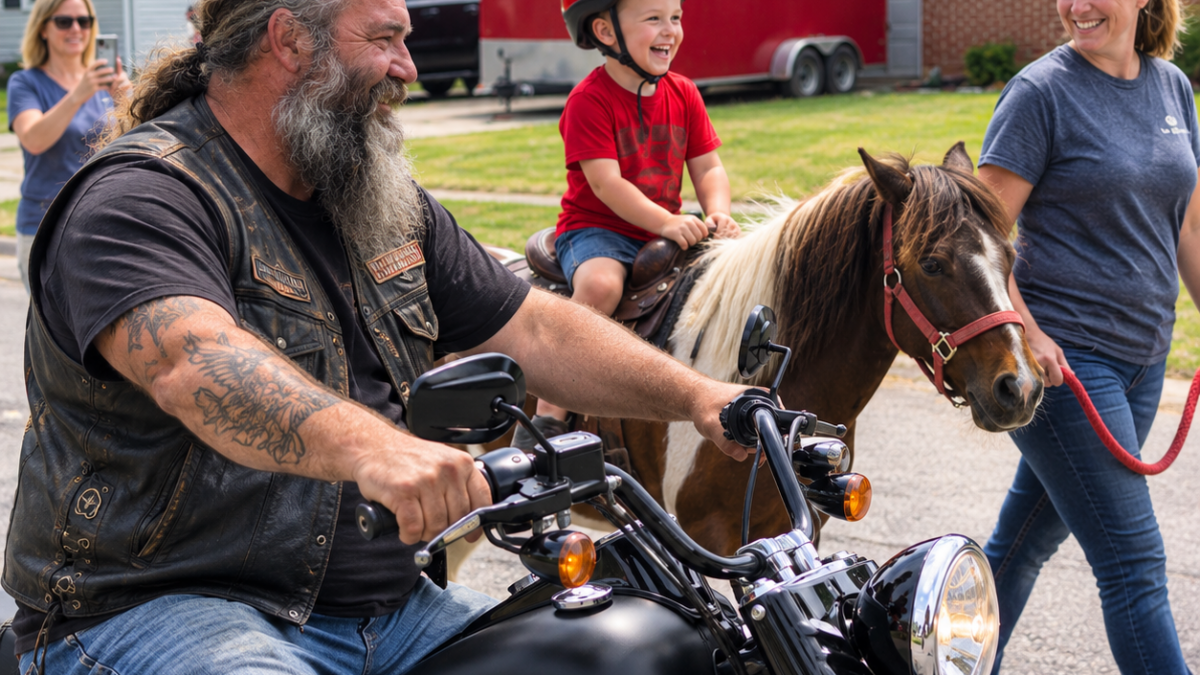
Then walked beside his left knee while Lila guided Biscuit around four orange cones.
The first lap was slow.
Noah sat rigid.
Both hands around the saddle horn.
Wade never touched him.
His hand hovered close enough to catch him if necessary.
Second cone.
Noah laughed.
It started as a squeak.
Then exploded.
Biscuit’s ears flicked backward toward him.
Wade lowered his face.
His jaw trembled beneath the beard.
“She’s soft!”
Noah shouted.
Wade nodded.
“Yeah.”
He swallowed.
“She is.”
By the third lap, half the street had gathered.
Mrs. Hanley stood on her porch in slippers.
Two teenagers filmed from the sidewalk.
A delivery driver slowed long enough for someone behind him to honk.
People had seen Wade with motorcycles.
Nobody had seen Wade with a horse.
Then Noah asked the question that started everything.
“Can Biscuit race your Harley?”
“No,” I said.
“No,” Lila said.
Wade looked suspiciously interested.
“No racing.”
Then he glanced toward his garage.
“But we can ride together.”
He rolled the Road King into the grass.
Black steel.
Chrome.
Hard edges.
Biscuit stood beside it.
Warm hide.
Soft mane.
Breathing animal.
For a moment, Wade’s two lives stood six feet apart.
He climbed onto the motorcycle.
Started it.
The Harley settled into a low rumble.
Biscuit barely reacted.
Apparently, she had already survived enough strange humans to find motorcycles unremarkable.
Wade eased forward at walking speed.
Lila led Biscuit beside him.
Noah laughed every time four hoofbeats landed between the Harley’s exhaust notes.
One machine rumbled.
One pony walked.
One child thought he had discovered the greatest experiment in transportation history.
I took out my phone.
The video was terrible.
Tilted.
Wind noise.
My thumb partly covering one corner.
Overexposed Oklahoma sky.
Perfect.
At the final cone, Noah shouted toward Wade:
“Mine is softer!”
Wade nodded solemnly.
“Yours is softer.”
“But yours has music!”
“Fair trade.”
The neighbors laughed.
Then Biscuit stumbled.
Her front hoof caught the edge of a shallow sprinkler trench.
Noah pitched sideways.
One foot slipped from the stirrup.
I screamed.
Wade shut off the Harley.
Dropped it.
Not parked.
Dropped it.
The motorcycle hit the grass on its crash bar.
Wade reached Noah before the engine finished falling.
One arm caught him around the waist.
The other steadied the saddle.
Lila pulled Biscuit’s head up.
Everything stopped.
Noah stared.
Wade looked him over.
“You hurt?”
“No.”
“Anything twisted?”
“No.”
“Scared?”
Noah hesitated.
Then nodded.
Wade lowered him.
“Good.”
Noah frowned.
“Good?”
“Means your brain works.”
I ran across the grass and inspected my son.
He was fine.
Wade wasn’t.
His left palm had torn against part of the saddle hardware.
Blood ran toward his wrist.
His Harley lay on its side.
Mirror buried in grass.
Noah pointed.
“Your motorcycle fell.”
Wade never looked at it.
“Motorcycles can be fixed.”
“Did I break it?”
“No.”
“Did Biscuit?”
Wade finally glanced toward Biscuit.
She was eating again.
“She doesn’t look sorry.”
Noah laughed.
That was the moment people online would later love most.
The enormous biker sitting in grass.
One bleeding hand.
A laughing six-year-old leaning against him.
A pony chewing peacefully.
A fallen Harley ticking as it cooled.
But then Noah noticed something.
The horsehair braid beneath Wade’s mirror had come loose.
He picked it up.
Held it toward Biscuit.
“Is this her hair?”
The yard became quiet.
Wade looked at the braid.
“Yes.”
“Why do you keep Biscuit’s hair on your motorcycle?”
Wade could have dodged the question.
He had done that for years.
Instead, he sat on the Harley’s footboard.
Lila wrapped gauze around his palm.
Wade stared at the braid.
Then said:
“Because Biscuit belonged to my daughter.”
Noah looked around.
“What’s her name?”
“Annie.”
“Is she grown up?”
Wade’s eyes shifted toward the pony.
“She would be twenty-five.”
Would be.
I pulled Noah closer.
Wade shook his head.
He wasn’t asking me to silence him.
Maybe after seventeen years of talking only to adults who knew when not to ask questions, he needed a child who didn’t.
Noah asked:
“Where is she?”
Wade looked at Biscuit.
Then began.
Annie had been five when Wade and his wife Jenny bought the pony from a family near Muskogee.
Biscuit was stubborn.
Food obsessed.
Patient.
Annie tied ribbons into her mane.
Hid peppermints in every coat pocket.
Rode before school.
Rode after school.
Sometimes rode after sunset while Wade walked beside them carrying a flashlight.
At seven, Annie began bruising.
Wade blamed the saddle.
Then came fevers.
Nosebleeds.
Exhaustion.
One morning, Annie didn’t have enough strength to climb three porch steps.
Leukemia.
After that, ranch calendars became hospital calendars.
Rodeos became blood counts.
Wade learned words he never wanted to know.
Platelets.
Ports.
Remission.
Relapse.
Biscuit waited in the barn.
On good days, Annie still rode.
Wade led the pony around the smallest pasture.
Jenny walked beside them carrying water and blankets.
The final ride came on Annie’s eighth birthday.
She was too weak for the saddle.
Wade laid a thick pad across Biscuit’s back.
Lifted his daughter.
Annie rested both arms around the pony’s neck.
They walked once around the barn at sunset.
Before Wade carried her inside, Annie asked him to cut one small lock from Biscuit’s mane.
“Why?”
Wade had asked.
“So you’ll remember soft things.”
Annie died eleven days later.
Nobody spoke.
Even Noah.
Jenny left the ranch the following spring.
Every fence post hurt.
Every bucket.
Every stall.
Every road.
She eventually moved to Colorado to live near family.
Wade stayed.
He didn’t know where else a man went when the only person who called him Daddy was gone.
He tried returning to work.
The first time another child mounted Biscuit, Wade vomited behind the tack room.
The second time, he walked to his truck.
Never came back.
He sold almost everything.
Lila bought Biscuit for one dollar.
Not because Biscuit was worth one dollar.
Because Wade refused to give her away and couldn’t tolerate accepting a real price.
Earl sold him an old Harley Electra Glide.
Cheap.
Too cheap.
Wade rode.
Then rode farther.
An engine was different from a horse.
A horse breathed.
Remembered.
Responded.
A motorcycle was fuel.
Spark.
Steel.
Pressure.
If an engine failed, Wade could open it.
Find the broken part.
Replace it.
No grief required.
He learned motorcycle repair.
Bought a shop.
Built another life.
And tied one braid from Biscuit’s mane beneath the Harley mirror.
The only piece of the ranch he allowed onto the road.
Noah listened.
Then asked:
“Did Annie like motorcycles?”
Wade rubbed his bandaged hand.
“She never saw me ride one.”
Noah looked at the Harley.
Then Biscuit.
“She would’ve liked yours.”
Wade turned.
“You think?”
“It has good music.”
Wade looked away.
That was when I finally understood the morning.
Wade believed he had brought Biscuit for Noah.
In reality, Noah had been leading Wade somewhere.
Children do that sometimes.
They walk into locked rooms because nobody told them the door was supposed to stay closed.
Noah asked:
“Can I ride again?”
I almost said no.
Wade crouched.
“You got scared.”
“Yes.”
“You still want up?”
“Yes.”
“Why?”
Noah touched Biscuit’s mane.
“Because she didn’t mean it.”
Wade studied him.
Then lifted him back into the saddle.
This time, Wade left the Harley lying where it was.
He took Biscuit’s lead rope.
Walked beside Noah.
One lap.
Then another.
At the far end of the grass, Lila brought something from the trailer.
An adult saddle.
Wade stopped.
His saddle.
Seventeen years old.
Stored at Lila’s ranch beneath canvas.
Cleaned the night before.
“You planned this.”
Lila shook her head.
“Prepared.”
“Difference?”
“A few pounds of leather.”
Earl smiled.
Wade didn’t.
He stared at the saddle like it belonged to a dead man.
Technically, it did.
Lila said:
“Get on.”
“No.”
“You already held the rope.”
“I came for the boy.”
Lila looked toward Noah.
“No.”
Then:
“The boy came for you.”
Wade didn’t mount.
Not that morning.
But he walked to the saddle.
Touched the horn.
There was a tiny crooked A scratched into it.
Annie had carved it years earlier with a horseshoe nail.
Wade ran his thumb across the mark.
Then picked up the saddle.
Carried it into his garage.
Placed it beside the Harley.
Not beneath canvas.
For Wade, that counted.
For Noah, it was lunchtime.
We ate peanut-butter sandwiches on my porch while Biscuit grazed beneath the maple.
Noah handed Wade the braid.
“You should put it back on your motorcycle.”
Wade looked at the Harley.
Then the braid.
“No.”
“Why?”
He closed his fingers around it.
“Think I’ll keep it somewhere softer.”
That afternoon, Wade stitched the horsehair inside the left chest of his leather vest.
Directly over his heart.
I posted the video Sunday evening.
Only after asking Wade.
He didn’t understand why anyone would care.
“It’s a kid on a pony.”
“And a biker.”
“People have seen bikers.”
“Not like this.”
Wade narrowed his eyes.
“Does your video show the Harley falling?”
“Yes.”
“Cut that.”
“Noah says it’s his favorite part.”
“Kid has poor judgment.”
I posted forty-three seconds.
Caption:
My son asked our biker neighbor why he rode a Harley instead of a horse. Wade decided he deserved to compare them.
By bedtime:
Eleven thousand views.
By breakfast:
Three hundred thousand.
Then everything became stupid.
News pages copied it.
Cowboy accounts reposted it.
Motorcycle groups shared it.
Parents asked children whether they’d choose horse or Harley.
People loved the imperfect parts.
Noah’s crooked helmet.
Biscuit chewing.
The tilted camera.
Wade dropping a very expensive motorcycle to grab my son.
Many viewers expected the big tattooed biker to save the chrome.
He chose the kid.
One comment spread everywhere:
Cowboy meets biker. Generation meets generation.
Wade read it at my kitchen table while Noah ate cereal.
“What am I supposed to say?”
“Whatever you want.”
“I don’t want anything.”
Noah leaned over.
“Tell them I was right.”
Wade looked at him.
Then typed:
THE KID WAS RIGHT. HORSES ARE SOFTER.
That reply went viral too.
By Wednesday:
Nine million views.
Morning television wanted to fly us to New York.
A motorcycle company offered gear.
A feed company wanted Biscuit in advertising.
Wade rejected everything.
“No circus.”
Lila agreed.
Then one invitation came from Tulsa.
The Children’s Rehabilitation Center operated a therapeutic riding program for children with physical disabilities, trauma histories, and developmental differences.
They didn’t ask Wade to speak.
They didn’t ask him to recreate the video.
They asked if he could fix a broken mounting ramp.
Wade went after closing.
Measured it.
Said:
“Saturday.”
He returned with twelve bikers.
Earl welded.
Others replaced damaged boards.
An electrician fixed arena lights.
Lila inspected tack.
Wade worked with his back toward the horses whenever possible.
Until a nine-year-old girl rolled in early.
Her name was Kayla.
Spina bifida.
Purple wheelchair covered in stars.
She stared at Wade.
Then pointed.
“You’re the horse-is-softer man.”
Twelve bikers stopped working.
Earl laughed so hard he sat down.
Wade sighed.
“Apparently.”
Kayla asked:
“Do you ride horses?”
Wade gave his seventeen-year answer.
“Not anymore.”
“Why?”
“Long story.”
Kayla folded her arms.
“I have time.”
Her mother turned away to hide a smile.
Kayla rode a broad sorrel gelding named Jasper.
When the ramp was repaired, instructors helped her mount.
Wade stood beside the gate pretending to inspect his weld.
Kayla rode past.
Once.
Twice.
Third time, she stopped.
Held out one hand.
“Walk with me.”
Wade looked behind himself.
Nobody.
Kayla kept her hand extended.
Wade entered the arena.
For fifteen minutes, he walked beside Jasper.
Exactly as he had once walked beside Annie.
Kayla talked the entire time.
School.
Braces.
Her mother’s terrible singing.
Her plan to become a veterinarian who refused to treat snakes.
Wade barely spoke.
At the end:
“Come next Saturday.”
“I work.”
“All day?”
“Half.”
“Then come after.”
Wade scratched the scar beneath his ear.
“We’ll see.”
I later learned biker language.
We’ll see means yes.
Wade returned.
Then again.
He fixed gates.
Saddle racks.
Latches.
Wheelchair ramps.
Learned the names of every therapy horse.
Insisted he was only there because their equipment maintenance was terrible.
The children accepted the excuse.
They simply assigned him jobs.
Hold my helmet.
Check this strap.
Walk beside me.
Tell my mom I’m ready.
Stand where I can see you.
Every job brought Wade closer.
Three months after Noah asked his original question, Lila brought Wade’s saddle to the center.
Placed it on Jasper.
Wade arrived.
Saw it.
“So this is an ambush.”
Earl said:
“Intervention.”
“You welders ruin perfectly good words.”
Noah and I were standing beyond the fence.
Wade hadn’t known we’d been invited.
Kayla sat beside us looking suspiciously innocent.
Wade could have left.
Instead, he walked toward Jasper.
Placed his foot in the stirrup.
Tried to mount.
His damaged left shoulder failed.
He stepped down.
Breathing hard.
Nobody applauded.
Nobody encouraged him.
That mattered.
An audience would have turned it into performance.
Wade had spent seventeen years avoiding other people’s expectations.
He adjusted the stirrup.
Used the mounting block.
Tried again.
This time—
He swung his leg over.
The old cowboy sat in the saddle.
Jasper shifted.
Wade’s face lost color.
His hands tightened on the reins.
Lila kept one hand near his boot.
Wade didn’t ask to come down.
Then Noah rode Biscuit beside him.
“Mine’s still softer.”
Wade looked at him.
“Mine’s bigger.”
“That isn’t the same.”
“No.”
Wade almost smiled.
“No, it isn’t.”
They walked one lap.
Slow.
Wade’s Harley stayed outside.
For once—
He didn’t need the music.
The viral video became something strangers thought they understood.
Funny child.
Tough biker.
Pony.
Harley.
Happy ending.
That version was true.
It wasn’t complete.
The video never showed Wade calling Lila after eleven years.
It didn’t show her sitting on the tack-room floor afterward holding the saddle she’d kept for him.
It didn’t explain the horsehair braid.
And it didn’t show what happened after the internet found another story.
Wade kept going to the rehabilitation center.
Every Saturday.
He never called himself a volunteer.
The kids called him:
Mr. Music.
The bikers started coming too.
Earl welded.
A rider named Denise helped with grant applications.
Marcus “Hawk” Bell organized a parts auction.
Eventually, a local event promoter offered the club $5,000 to recreate the viral horse-and-Harley ride at a motorcycle festival.
Wade wanted the money for the center.
Lila said no.
Too much noise.
Too many cameras.
Children’s therapy wasn’t entertainment.
The club argued for three days.
Finally, Wade pulled the horsehair braid from inside his vest.
Placed it on the table.
“This belonged to my daughter.”
The room quieted.
“She wasn’t content.”
Then:
“Neither are those kids.”
They rejected the offer.
The Black Lanterns contributed the same amount from their own emergency fund.
Then held a private parts auction.
No children used in advertisements.
No therapy sessions filmed.
No recreated viral ride.
They raised nineteen thousand dollars.
Wade cared more about that than nine million views.
Because work after the cameras disappear is usually the work that matters.
Noah began riding lessons at Lila’s ranch.
Wade attended every one.
He stood beside the fence pretending to inspect my tires.
When Noah fell for the first time, he landed in soft dirt.
Cried.
Said:
“I want to go home.”
Wade crouched nearby.
“You hurt?”
“My bottom.”
“That heals.”
“I’m scared.”
“Brain’s working.”
Noah glared.
“You always say that.”
“Still true.”
“Were you scared when you got back on?”
Wade looked toward Jasper.
“Yes.”
“Did your brain work?”
Wade rubbed his beard.
“Too much.”
Noah thought.
Then asked Biscuit to stand near the mounting block again.
Wade didn’t tell him to ride.
Didn’t say:
Be brave.
Didn’t say:
Get back on.
He stood nearby.
Let Noah choose.
By autumn, Wade rode once a week.
Never competed.
Never returned to the old ranch where Annie had lived.
Some doors don’t need to be kicked open.
He rode Jasper at the therapy center.
Sometimes Biscuit at Lila’s.
His old posture returned slowly.
Quiet hands.
Deep seat.
Subtle shifts of weight.
Skills no motorcycle could imitate.
He still rode the Harley every day.
The horse didn’t replace the machine.
The machine didn’t have to replace the horse anymore.
One November morning, I saw Wade leave for the center.
His old saddle was strapped across the passenger seat of the Road King.
Leather and chrome.
Cowboy and biker.
Nothing hidden.
Inside his vest, he had sewn a small patch.
A pony beside a touring motorcycle.
One name beneath them.
ANNIE.
A year after the original video, Noah turned seven.
Wade arrived late to the party.
Arena dust on his boots.
He had spent the morning helping Kayla ride independently.
He carried a narrow cardboard box.
Noah opened it.
Inside:
A child-sized leather riding vest.
No skull.
No club patch.
No wings.
Just a cream-colored pony beside a black touring motorcycle.
Underneath:
SOFT THUNDER.
Noah wore it immediately.
Biscuit came to the party wearing one blue ribbon.
Wade parked the Harley beside the fence.
No reporters.
No cameras.
No sponsorships.
Only neighbors.
Paper plates.
Melting ice cream.
My phone facedown on the porch.
Noah rode first.
Around the same four orange cones.
Wade walking nearby.
Then Noah asked:
“Your turn.”
Lila had brought Jasper.
A year earlier, being watched would have stopped Wade.
Not anymore.
He mounted.
Noah and Wade rode side by side.
Biscuit’s little hooves pressed quietly into the grass.
Jasper moved with slow patience.
The Harley stood silent nearby.
At the final cone, Noah pointed at it.
“Does your motorcycle feel bad nobody is riding it?”
Wade looked toward the bike.
“Machines don’t get jealous.”
“Are you sure?”
Wade considered that.
“No.”
He dismounted.
Tied Jasper near the trailer.
Walked to the Harley.
The engine turned twice.
Then caught.
Deep V-twin music rolled through the yard.
Noah rode Biscuit beside him.
They made one final lap.
A seven-year-old boy.
An old cowboy.
A cream-colored pony.
A black Harley.
Moving slowly enough that nothing in that field had to be left behind.
When they stopped near the porch, Noah leaned toward Wade.
“Which one do you like better now?”
Wade shut off the engine.
The last exhaust note disappeared beneath the cottonwoods.
He rested one scarred hand on the Harley’s fuel tank.
The other against Biscuit’s warm neck.
Then said:
“Depends what needs carrying.”
Biscuit immediately began searching his vest for peppermints.
Wade laughed.
And that was the answer nine million strangers never heard.
The Harley had carried Wade away from a place he couldn’t survive.
Biscuit had carried him back when he was finally ready.
Noah hadn’t healed him.
The internet certainly hadn’t.
A six-year-old simply asked why a cowboy stopped riding horses.
And for the first time in seventeen years—
Wade stopped running from the answer.
The kid had been right all along.
Harleys had better music.
But horses were softer.








