The Tattooed Biker Held His 6-Year-Old Daughter’s Hand for 38 Hours—Then One ICU Photo Forced Us to Change Everything
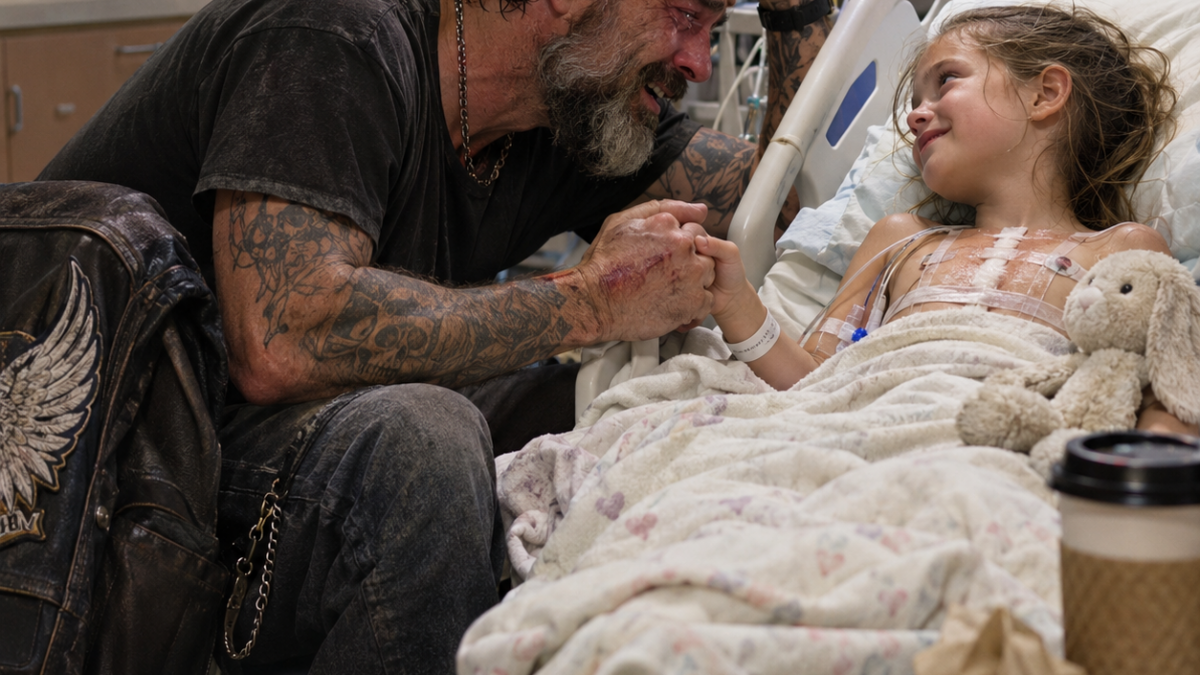
The Tattooed Biker Held His 6-Year-Old Daughter’s Hand for 38 Hours—Then One ICU Photo Forced Us to Change Everything.
The tattooed biker beside Bed 4 had not eaten a full meal, taken a shower, or released his six-year-old daughter’s hand in thirty-eight hours, because the last thing Lily Morgan had whispered before an eleven-hour heart operation was, “Dad, don’t go home before I wake up.”
Half the staff had been nervous when Caleb Morgan first walked into our pediatric intensive-care unit in black leather and heavy boots, but by the second night nurses were bringing him coffee in silence because everyone understood that the huge man folded into that tiny chair was keeping a promise nobody wanted to interrupt.
When Lily’s eyelids finally fluttered at 3:04 in the morning and she asked him one question, I thought the hardest part of their story was over—I had no idea the photograph taken minutes later would expose something our hospital had been doing to frightened children for years without ever realizing what it cost them.
My name is Nora Callahan.
I had managed pediatric intensive-care units for twenty years by the night Caleb Morgan entered mine.
Twenty years is long enough to stop being impressed by machines.
Ventilators.
Infusion pumps.
Arterial lines.
Dialysis systems.
Cardiac monitors that can change the temperature of a room with one alarm.
You learn them.
You respect them.
You understand what each number means and which numbers matter first.
People are harder.
Especially parents.
There is no monitor telling you when a mother has reached the point where one more piece of bad news will break something inside her.
There is no alarm for the father who says he is fine for the sixth time and then walks into an empty stairwell because he cannot let his child see him cry.
There is no graph for guilt.
No laboratory test for terror.
No medication that makes waiting humane.
You simply learn to watch.
I had watched thousands of families by the time Lily Morgan arrived.
I had never watched a father wait like Caleb.
He was forty-six.
Six-foot-four.
Probably two hundred sixty pounds.
Broad enough that the folding chair beside Lily’s hospital bed looked designed for somebody else.
Dark beard streaked heavily with gray.
Faded tattoos from his shoulders to his knuckles.
A scar along the back of his right hand.
Another at his jaw.
Black T-shirt.
Heavy motorcycle boots.
Leather vest hanging over the back of the chair.
The vest carried a large winged patch belonging to a local riding club called Iron Valley Riders.
The club had a reputation around Tucson for charity runs, toy drives, funeral escorts and looking intimidating enough that strangers occasionally crossed grocery-store aisles unnecessarily.
The first time our young unit clerk saw seven of them step off the elevator together, she called security.
Not because they had done anything.
Because they looked like men people called security about.
I remember seeing the officers arrive and thinking:
We are about to make this family’s worst week worse.
PART2:
I intercepted them before they entered Lily’s room.
“They’re family support.”
One officer glanced through the glass.
“You sure?”
“Yes.”
Inside, six bikers stood against the far wall.
Not speaking.
Not blocking staff.
Not approaching equipment.
One held a stuffed purple horse under his arm.
Another carried a grocery bag.
Caleb sat at Lily’s bedside.
His right hand enclosed hers.
Rachel Morgan, Lily’s mother, stood by the window speaking quietly with the cardiologist.
The security officer looked again.
Then nodded.
“Call if you need us.”
“We will.”
We never did.
Lily had been born with a complex congenital heart defect.
Her parents learned before she was born that the center of their family life would include cardiology appointments, medication schedules, oxygen readings and words nobody expects to use while decorating a nursery.
Rachel told me later that she had been twenty-nine weeks pregnant when a maternal-fetal specialist pointed at a gray shape on an ultrasound screen and began explaining blood flow.
She remembered almost none of the explanation.
She remembered Caleb asking:
“Can it be fixed?”
The doctor had paused.
That pause became the first moment of their new life.
Not cured.
Managed.
Possibly repaired in stages.
Monitored.
Watched.
Waited on.
Lily survived infancy.
Then toddlerhood.
Then preschool.
Every birthday felt slightly stolen from statistics.
By six, she had a missing front tooth, chest scars she called “my zipper roads,” and an obsession with horses she had never actually ridden because her doctors were still cautious about strenuous activity.
She loved purple.
Despised orange medicine.
Wanted to become either a veterinarian, a rodeo rider or “a person who owns twenty-seven ponies.”
Rachel was practical.
Medication organizer.
Appointments.
Insurance calls.
School plans.
She understood exactly which pharmacy stayed open latest and which emergency-room entrance had the shortest walk from parking.
Caleb handled fear differently.
He disguised it as preparation.
He installed backup power at home in case Lily ever needed medical equipment during an outage.
He kept copies of her medication list in his truck, motorcycle vest and phone.
He memorized the fastest routes to three hospitals.
There was an emergency bag in his garage containing chargers, a sweatshirt for Lily, cash, bottled water and a stuffed purple horse named Maisie.
He called all of that being ready.
Rachel called it anxiety with tools.
Caleb denied this.
Lily called him Big Bear.
He called her Little Bird.
Those names had started during one of her hospital admissions at age four.
Lily had been frightened by anyone wearing gloves.
Every nurse.
Every respiratory therapist.
Every person entering the room seemed to bring needles, tape or another request to sit still.
One night she refused to sleep.
Caleb sat beside the bed.
Lily asked:
“What if something happens when I close my eyes?”
Caleb placed her tiny hand inside his.
“Little birds sleep in trees.”
“So?”
“They sleep because the big bear stays underneath.”
Lily frowned.
“Bears don’t live under trees.”
“This one does.”
“You’re too big.”
“Exactly.”
“What if the bear falls asleep?”
“Bears hear everything.”
Rachel had laughed from the couch.
Lily had finally closed her eyes.
From then on, whenever she was frightened, she asked one question.
“Bear staying?”
Caleb always answered:
“Bear’s staying.”
For years, that promise had been easy enough to keep.
Clinic appointment?
Stay.
Blood draw?
Stay.
Emergency room?
Stay.
Overnight observation?
Stay.
The surgery changed everything.
For six months before it, Lily’s numbers had been worsening.
Pressure inside her heart rising.
Episodes of breathlessness.
Fatigue she tried hiding because she hated watching her parents become afraid.
She would stop halfway up the stairs, then pretend she had forgotten something downstairs.
Her cardiologist noticed before Rachel did.
Children are clever about protecting adults.
Eventually the surgical team sat with the Morgans and explained the decision.
Without surgery, Lily’s condition would almost certainly continue deteriorating.
With surgery, there were serious risks.
Bleeding.
Arrhythmia.
Neurological complications.
Infection.
Failure.
Death.
Doctors learn to say those words carefully.
Parents hear only the last one.
The night before surgery, Caleb slept on the floor beside Lily’s hospital bed because she had refused to let him leave for the family lounge.
At 4:40 the next morning, a nurse came to prepare her.
Purple socks.
Hospital gown.
Hair tucked under a surgical cap.
Lily tried joking.
“Dad.”
“Yeah?”
“You look terrible.”
“I always look terrible.”
“No. More terrible.”
“Thank you.”
Rachel laughed once and immediately cried.
Lily looked toward her.
“Mom.”
“I’m okay.”
“You’re doing the crying thing.”
“I know.”
“Don’t.”
“I’ll try.”
The transport team arrived.
That is when children often become frightened.
The room changes.
People begin moving.
Parents realize preparation has ended.
Lily’s bravado disappeared.
She reached from beneath the heated blanket.
“Dad.”
Caleb stepped beside her.
She wrapped one hand around his index finger.
“Don’t go home before I wake up.”
His expression changed.
Not visibly to everyone.
I saw it later on video taken by Rachel.
A tiny collapse around the eyes.
He bent low enough that his beard touched the edge of Lily’s surgical cap.
“I’m not going anywhere.”
“You’ll hold my hand?”
“As long as they let me.”
“Promise?”
“Promise.”
The transport team wheeled her away.
Caleb remained standing in the hallway long after the doors closed.
The operation lasted eleven hours.
People imagine surgery waiting rooms as dramatic.
Mostly they are boring in a cruel way.
Coffee.
Phones.
Television nobody watches.
Someone walking every twenty minutes.
Every person looking up when the door opens.
The Iron Valley Riders came in shifts.
Not all at once.
Two at a time.
Food.
Coffee.
Silence.
They sat with Caleb without demanding conversation.
One of them, a man called Briggs, tried giving him a sandwich.
Caleb held it for forty minutes without eating.
Rachel finally said:
“If you pass out, I’m leaving you on the floor.”
He ate three bites.
Then the surgeon came.
Every parent recognizes the surgeon walk.
You read the face before hearing anything.
The operation had gone as planned.
There had been bleeding.
Controlled.
One arrhythmia episode.
Corrected.
Heart function looked promising.
But Lily would remain sedated and ventilated overnight.
The next twenty-four hours mattered.
Caleb asked:
“Can I see her?”
Soon.
When Lily entered our PICU shortly after midnight, she looked nothing like the child who had left.
That is one of the cruelest moments in pediatric critical care.
Parents understand intellectually that equipment is keeping their child alive.
Emotionally, tubing looks like violence.
Ventilator.
Central line.
Arterial line.
Chest drainage.
Temporary pacing wires.
IV pumps.
Monitors.
Adhesive everywhere.
Lily’s face looked pale beneath hospital light.
Rachel stopped at the doorway.
Caleb walked two steps in.
Then stopped too.
His hands remained at his sides.
He did not touch.
That impressed me.
Some parents rush immediately, driven by instinct.
Caleb looked at the tubes.
Then at me.
“Where can I put my hand without hurting anything?”
That was the first thing he asked.
Not:
Is she going to live?
Not:
What are those numbers?
Not:
Can you remove anything?
Where can I touch her?
I guided him to Lily’s left side.
“Here.”
I lifted her hand carefully.
“You can hold this one.”
His palm opened.
Lily’s tiny fingers rested inside it.
Caleb closed his hand lightly.
That was the beginning of the thirty-eight hours.
At hour two, he stared at the monitor.
I told him not to chase every number.
“I’m not.”
“You are.”
He looked at me.
“How can you tell?”
“Everybody does.”
“What number matters?”
“All of them together.”
“That’s a terrible answer.”
“It’s the honest one.”
He nodded.
I liked him.
At hour six, Nurse Jenna Morales brought coffee.
“Black?”
Caleb nodded.
She placed it near his left hand.
He drank while holding Lily with his right.
At hour eight, Rachel tried persuading him to eat.
“At least a protein bar.”
“Not hungry.”
“You haven’t eaten since yesterday.”
“I ate.”
“Three bites of turkey does not count.”
“Depends on turkey size.”
She stared.
He took the bar.
At hour ten, she returned from the cafeteria with a sandwich.
Caleb ate two bites.
His eyes never left Lily’s chest.
By hour fourteen, his posture looked painful.
I brought a recliner.
“Switch chairs.”
“I’m good.”
“You’re in a folding chair.”
“I noticed.”
“This reclines.”
“I’m fine.”
“You are visibly not fine.”
He glanced at Lily.
“The chair fits here.”
“We can move the recliner.”
“It’ll put me farther away.”
“Six inches.”
“Still farther.”
I remember thinking:
Stubborn.
Then I saw his thumb move slowly across Lily’s knuckles.
Promise.
At hour eighteen, a deep red line had formed on his wrist where it rested against the bed rail.
His shoulder had stiffened.
Every time he shifted, pain crossed his face.
“You need to stand.”
“I stand.”
“When?”
“Sometimes.”
“You have not moved in three hours.”
Rachel looked at me.
“Thank you.”
He frowned.
“Both of you stop.”
“You need the restroom,” I said.
“I can wait.”
“You need food.”
“I’m not hungry.”
“You need circulation.”
“I have circulation.”
“You’re forty-six, Caleb, not indestructible.”
He looked down at Lily.
“I’ll walk when she wakes up.”
That was when I understood.
He was not trying to appear tough.
There were no cameras.
Nobody from his club was in the room at that moment.
No audience.
No performance.
He was simply obeying the last instruction his daughter remembered giving him.
At hour twenty-one, Briggs returned.
He was almost as large as Caleb.
Gray beard.
Club vest.
He stood quietly at the doorway until Caleb noticed.
“You need ten minutes?”
“No.”
“I’ll sit.”
“No.”
“I can hold her hand.”
Caleb finally looked at him.
“She didn’t ask you.”
Briggs absorbed that.
Then nodded.
No offense.
“Fair.”
He put a fresh coffee on the counter and left.
That sentence spread through the club.
Not as a joke.
As an instruction.
She didn’t ask you.
Nobody offered again.
They brought what Caleb might need and left him alone with the promise.
At hour twenty-four, Lily developed a rhythm change.
Nothing catastrophic.
Common after major cardiac surgery.
But the monitor alarm changed pitch.
Caleb’s entire body tightened.
Three nurses entered.
Cardiology fellow.
Medication.
Adjustment.
Caleb stood because we needed access.
His hand separated from Lily’s.
His face changed immediately.
Not anger.
Panic.
“Caleb.”
I pointed.
“Stand at the head.”
He moved.
Jenna repositioned Lily’s left arm.
Caleb took her fingers again from above.
He calmed almost as quickly as the rhythm did.
Later he said:
“Sorry.”
“For what?”
“Being in the way.”
“You weren’t.”
“I felt useless.”
“You’re not.”
“I’m holding a hand.”
“Yes.”
He looked at me.
“That’s not medicine.”
“No.”
I thought about it.
“Doesn’t mean it isn’t care.”
He nodded.
I did not know then that those words would come back to me months later.
By hour thirty, Lily’s ventilator came out.
Caleb stood behind Rachel during extubation.
Rachel gripped his forearm.
Once the breathing tube was removed, Lily coughed.
A weak, miserable sound.
Caleb’s eyes filled.
People think parents cry when children become worse.
Sometimes they cry hardest at small signs of improvement.
A cough can sound like resurrection.
Lily remained heavily medicated.
She did not fully wake.
But her oxygen levels remained good.
Her heart rhythm strengthened.
The danger had not disappeared.
But the room loosened.
That was when I tried again.
“Caleb.”
“No.”
“I haven’t said anything yet.”
“You’re going to tell me to go shower.”
“I was going to tell you that you smell bad.”
He almost smiled.
“Same thing.”
“She may sleep several more hours.”
“I know.”
“Her hand will still be here.”
“I know.”
“Then why won’t you move?”
That question finally made him look at me.
He was quiet for several seconds.
Then he looked down at Lily.
“When she wakes up, she won’t know what time it is.”
I waited.
“She won’t understand these machines.”
His tattooed thumb brushed her knuckles.
“She might not remember where she is.”
His voice lowered.
“But she’ll know somebody stayed.”
I had worked critical care twenty years.
I had taught nurses.
Written protocols.
Managed disasters.
Sat with parents through deaths.
And that sentence rearranged something in me.
She’ll know somebody stayed.
At 3:04 the following morning, hour thirty-eight, I was standing at the central desk reviewing staffing assignments.
Jenna was inside Lily’s room.
I heard the chair scrape.
Not loud.
Sharp.
I looked through the glass.
Caleb had leaned forward.
Lily’s eyelids fluttered.
Once.
Twice.
Her fingers moved.
Jenna stepped toward the bed.
I entered behind her.
Lily’s lips parted.
No sound first.
Then:
“Dad?”
Caleb’s entire body folded toward her.
“I’m here, baby.”
Her eyes opened halfway.
Unfocused.
She searched.
The monitor reflected green across her face.
Her gaze moved past Jenna.
Past me.
Then found the beard.
Found him.
“Dad.”
“Right here.”
Her brow tightened.
“Did you wait?”
Caleb swallowed.
“For what?”
“For me to wake up.”
He lifted her tiny hand carefully against his beard.
That was when the tears came.
The man looked almost angry about them.
Like his own eyes had betrayed him.
“I’d wait forever.”
Lily gave the smallest smile.
Barely there.
Then whispered:
“Okay.”
Her eyes closed again.
She fell asleep.
Rachel, who had been sleeping in the family room, arrived approximately three minutes later because Jenna called her.
She walked in and saw Caleb still holding Lily’s hand.
“What happened?”
“She woke.”
Rachel covered her mouth.
“She talked?”
Caleb nodded.
“What did she say?”
He looked down.
“Asked if I waited.”
Rachel started crying.
Then laughed.
“Of course she did.”
Caleb finally stopped fighting exhaustion.
His head lowered beside the mattress.
His shoulders folded.
One arm remained awkwardly stretched across the bed rail.
Lily’s hand stayed inside his.
He fell asleep sitting upright.
It happened instantly.
One moment awake.
Next gone.
I brought a hospital blanket.
Covered his shoulders.
His right wrist was bent badly.
I considered moving it.
Jenna looked at me.
I looked at her.
Neither of us touched him.
Rachel stood at the doorway.
She whispered:
“Leave them.”
So we did.
A respiratory therapist named Marcus happened to be documenting equipment in the room doorway.
He had a camera because our communications team had been gathering staff photographs for a hospital project.
He saw them.
Caleb asleep.
Lily asleep.
Tattooed hand over tiny fingers.
Vest hanging from chair.
Hospital blanket across his shoulders.
He lowered the camera.
Then looked at Rachel.
“May I?”
Rachel stared at the scene.
Then nodded.
“One.”
Marcus took one photograph.
No flash.
No posing.
No second attempt.
One.
That photograph changed our hospital.
But first, Caleb woke.
The morning after Lily opened her eyes, he lifted his head with one side of his face pressed into the blanket.
His neck had stiffened so badly he could barely turn.
His fingers were swollen.
His right hand had gone numb.
He looked at Lily before checking himself.
Always Lily first.
She was sleeping.
Breathing on her own.
Heart rhythm stable.
When she shifted, her fingers tightened weakly around his.
Caleb smiled.
Rachel stood behind him.
“You really didn’t let go.”
“Told her I wouldn’t.”
“She was unconscious.”
He flexed his numb fingers.
“She still had a hand.”
Rachel laughed and cried simultaneously.
Then Caleb tried standing.
His knees almost failed.
I caught his elbow.
Rachel caught the other side.
He looked offended.
“I’m fine.”
“You just nearly became a second patient.”
“Chair moved.”
“The chair did not move.”
“It felt like it.”
Jenna stepped in.
“I’ll hold her hand.”
Caleb looked at Lily.
Then Jenna.
“You sure?”
“Yes.”
Only then did he let go.
After thirty-eight hours.
He went to the restroom.
Washed his face.
Returned in three minutes and forty-eight seconds.
Jenna timed him.
We teased him about it later.
For the next several days, Lily recovered slowly.
Recovery after major pediatric heart surgery is not cinematic.
It is breathing exercises children hate.
Walking six feet.
Then twelve.
Pain medication.
Drain removal.
Bandages.
Nausea.
Fear of coughing.
Refusing food.
Celebrating urine output.
Lily hated the incentive spirometer.
“You’re trying to kill me.”
Rachel said:
“It makes you breathe.”
“I already breathe.”
“You need deeper breaths.”
“I don’t want deeper breaths.”
Caleb held the device.
“Five good ones.”
“No.”
“Three.”
“Two.”
“Four.”
“That’s going the wrong way.”
“Three.”
“Purple Jell-O after.”
Lily considered.
“Three.”
Negotiation succeeded.
She called her chest incision a zipper.
“Is it ugly?”
Caleb looked.
“No.”
“You have to say that.”
“I don’t.”
“You’re my dad.”
“Exactly. I’m allowed to tell you when you look terrible.”
She smiled.
“Do I?”
“You look like you fought a robot.”
“Did I win?”
“Obviously.”
Those complaints delighted us.
In intensive care, ordinary irritation can sound like healing.
Caleb started eating real meals.
Showered.
Walked.
Slept in short stretches.
But every frightening procedure still involved one thing.
Lily’s hand.
Dressing change?
Caleb.
Line removal?
Caleb.
Chest tube?
Both parents.
Nightmare?
Hand.
The desperate vigil became something else.
A bridge back toward normal.
The photograph stayed inside Marcus’s camera for two days.
Rachel saw it first.
Marcus had printed several images from the hospital project.
He brought hers privately.
Rachel stared.
The picture showed almost none of our equipment.
That was what made it powerful.
No dramatic machinery.
No tubes dominating the frame.
Just Caleb in that tiny chair.
Head lowered beside the mattress.
Black vest over the backrest.
One enormous tattooed hand crossing the white blanket.
Only Lily’s fingertips visible.
Hospital blanket covering Caleb’s shoulders.
His other arm hanging toward the floor.
One boot untied.
Beard tangled.
Exhaustion everywhere.
Rachel cried.
Then she laughed.
“He looks terrible.”
Marcus smiled.
“He does.”
She carried the print into Lily’s room.
Caleb looked.
“No.”
Rachel had not asked anything.
“No what?”
“You’re thinking about posting it.”
“I wasn’t.”
“You are now.”
She studied the photograph.
“Maybe.”
“No.”
“Why?”
“I don’t want people thinking I did something special.”
Rachel stared at his swollen hand.
“You stayed thirty-eight hours.”
“I’m her dad.”
“That’s why it matters.”
Caleb shook his head.
“No.”
Rachel did not push.
Not then.
Two days later, Lily transferred out of intensive care.
That was our definition of victory.
No balloons.
No television music.
A wheelchair.
Several bags.
Medication list.
One terrified father pretending he was not terrified anymore.
Before they left the unit, Lily held her arms toward me.
I bent down.
She hugged my neck carefully.
“You made Dad eat.”
“I tried.”
“He’s difficult.”
“I noticed.”
Caleb said:
“I’m standing right here.”
Lily whispered loudly:
“He doesn’t listen.”
“I noticed that too.”
They left.
The room felt empty.
Three days later, Rachel called.
She had been thinking about the photograph.
So had Caleb.
He had changed his mind.
With conditions.
The hospital could share it once Lily was clearly recovering.
The post had to mention congenital heart disease and the work of pediatric cardiac teams.
It could not call Caleb a hero.
He hated that word.
The communications team drafted a caption.
Caleb rejected the first.
Too sentimental.
Rejected second.
Too much about him.
Finally they used something simple:
This is a father’s love: thirty-eight hours without releasing the hand his daughter asked him to hold.
Below it:
Six-year-old Lily Morgan underwent eleven hours of complex heart surgery. Her father, Caleb, promised before anesthesia that he would stay until she woke. When medically safe, he held her hand through thirty-eight hours of recovery.
Caleb added one sentence himself:
The nurses saved her life. I just kept my promise.
The photograph went online.
By dinner, twenty thousand views.
Next morning, two hundred thousand.
By the end of the first day, more than a million.
Then national pages started sharing it.
Parent groups.
Heart foundations.
Veteran groups mistakenly assuming Caleb was military.
Motorcycle pages.
Hospitals.
People wrote:
This was my dad.
This was my mom.
I wish someone had done this for me.
I held my son’s foot for nine days.
My husband slept standing against a NICU wall.
My daughter died while holding my finger.
That last kind of comment made the popularity difficult.
Viral stories flatten pain into numbers.
Fifteen million views sounds exciting until you realize fifteen million people include families reopening the worst night of their lives.
Caleb hated the attention.
Lily loved one part.
“Are my fingers famous?”
Rachel said:
“Apparently.”
“How famous?”
“Very.”
“More famous than Dad?”
“Yes.”
“Good.”
Caleb complained whenever someone recognized him at a gas station.
Lily announced:
“That’s my hand in the picture.”
At first, we treated the photograph as a beautiful story.
Then the letters started arriving.
Not letters about Caleb.
Letters about us.
Our hospital.
Our policies.
Our habits.
One mother wrote:
I love your photo, but when my son woke after abdominal surgery, I was in the hall because a nurse asked all parents to leave during shift change. He woke surrounded by strangers and screamed until I was allowed back in.
Another:
I was told not to touch my daughter’s foot because “we need room,” even though the staff member was charting on the opposite side.
Another:
Please ask your ICU whether family separation is always medically necessary or sometimes just convenient.
That one bothered me.
Because I knew the answer.
Sometimes necessary.
Sometimes convenient.
I had always believed our PICU was family-centered.
Compared with units I trained in twenty years earlier, it was.
Parents could stay overnight.
Participate in rounds.
Ask questions.
Hold children when safe.
But institutions carry old habits long after the original reason disappears.
Shift change?
Some nurses automatically asked families to step out.
Equipment adjustment?
“Give us a minute.”
Routine line check?
“Mom, can you move over there?”
Bath?
“We’ll call you when we’re done.”
Sometimes those separations were medically necessary.
Sterile procedure.
Emergency.
Imaging.
Resuscitation.
But not always.
Often we moved parents because moving parents was easier.
The viral photograph forced me to see something I had not wanted to see.
We had spent years treating family touch like an optional comfort rather than something with real clinical and emotional value.
One Tuesday morning, I brought the letters to our medical director, Dr. Julian Reeves.
He read three.
Then removed his glasses.
“What are you asking?”
“I don’t know yet.”
“That’s unlike you.”
“I think our routines are separating children from parents more often than necessary.”
He leaned back.
“We already have one of the most open units in the state.”
“That doesn’t mean every habit is good.”
“Parents can interfere.”
“Yes.”
“Touch can disrupt lines.”
“Yes.”
“Some procedures require space.”
“Yes.”
“So?”
“So why is our default sometimes move instead of assess?”
He was quiet.
I put the photograph on his desk.
“Caleb held Lily’s hand through a rhythm intervention.”
“Because staff accommodated him.”
“Exactly.”
“We can’t guarantee that.”
“I’m not asking us to.”
“What are you asking?”
I heard Caleb in my head.
She’ll know somebody stayed.
“I’m asking whether we can teach staff to preserve safe contact whenever possible instead of interrupting it automatically.”
Julian looked at the photograph.
“This is going to become a committee.”
“Probably.”
“I hate committees.”
“So do I.”
“Fine.”
It became a committee.
Of course.
Nurses.
Physicians.
Child-life specialists.
Infection control.
Risk management.
Family advisory council.
Physical therapy.
Social work.
The first meeting nearly killed the idea.
One physician said:
“We cannot practice medicine based on a viral photograph.”
I agreed.
“Good. Let’s practice based on evidence and experience.”
Risk management worried parents would interpret access as the right to refuse staff entry.
Nobody proposed that.
Infection control raised legitimate concerns.
We addressed them.
A senior nurse said:
“I’ve been doing this twenty-five years. Sometimes parents need to move.”
“Yes.”
“So why make a rule?”
“Because sometimes they don’t.”
The room went quiet.
I continued.
“We’re not removing clinical judgment.”
“We’re changing the question.”
“What question?”
“Instead of saying ‘move,’ ask first: can contact continue safely?”
That became the center.
We invited Rachel and Caleb to one meeting.
Caleb refused initially.
“I’m not a hospital-policy guy.”
Rachel said:
“You complain about everything.”
“That’s different.”
“You’re professionally qualified.”
He eventually came.
Leather vest.
Black shirt.
He looked deeply uncomfortable in the conference room.
Administrators introduced themselves.
Caleb nodded.
When it was his turn, he said:
“Caleb.”
Then nothing else.
I asked:
“What did holding Lily’s hand do for you?”
He thought.
“It gave me something not useless to do.”
“What do you mean?”
“You people had the medicine.”
“The machines.”
“The training.”
“I had one job.”
“Stay.”
He looked toward the hospital attorney.
“If staying gets in the way, move me.”
“No argument.”
“But if it doesn’t?”
He shrugged.
“Why make the kid lose another thing?”
That sentence ended several weeks of debate.
Why make the kid lose another thing?
Children in intensive care lose control constantly.
Clothes.
Privacy.
Food choices.
Sleep.
Mobility.
Familiar spaces.
Normal voices.
Sometimes consciousness.
If the hand of a trusted adult could remain without compromising treatment, why were we treating that connection as disposable?
The policy draft became three pages.
Then five.
Then seven.
I hated it.
Finally a child-life specialist said:
“Can we please write this like something humans can understand?”
We reduced it.
The core language became:
Whenever medically safe, a parent or trusted caregiver may maintain continuous physical contact with a pediatric patient for as long as the patient and family wish.
Before interrupting safe contact, staff should determine whether the clinical task can be completed while touch continues.
When separation is medically necessary, staff should explain the reason whenever circumstances permit and restore contact as soon as safely possible.
It did not allow families to interfere with emergency care.
It did not promise touch during sterile procedures.
It did not turn parents into medical staff.
It simply changed the default from automatic separation to intentional assessment.
The nurses started calling it Lily’s Hand Rule before administration approved the name.
Administration hated naming policies after patients.
Then the family advisory council loved it.
Administration surrendered.
Lily’s Hand Rule.
Rachel cried when I told her.
Caleb rubbed his beard.
“Sounds dramatic.”
“It was Lily’s hand.”
“Fair.”
Lily learned about it several weeks after returning home.
She sat at the kitchen table in purple pajamas eating cereal.
The printed photograph lay beside her bowl.
Her incision had healed into a bright pink line.
She was still restricted from rough activity, which offended her deeply.
She stared at the picture.
“Dad.”
“What?”
“Your head looks funny.”
Caleb looked over his coffee.
“I had been awake awhile.”
“Why didn’t you sleep in a bed?”
“Your hand was over there.”
“You could move me.”
“No.”
“Why?”
“You told me not to.”
“I was asleep.”
“I noticed.”
She studied the photograph.
“Did your hand hurt?”
“A little.”
“Did you get hungry?”
“Yep.”
“Did you have to pee?”
Rachel laughed from the sink.
Caleb rubbed his beard.
“That question has become very popular.”
Lily traced their joined hands with one fingertip.
Then looked up.
“Would you really wait forever?”
Caleb’s face softened.
“Forever is a long time.”
“You said it.”
“I did.”
“So?”
He put the coffee down.
“I meant it.”
Lily thought.
Then pushed away from the table and climbed carefully into his lap.
“You don’t have to wait forever now.”
“No?”
“I woke up.”
Caleb wrapped both arms around her.
“That you did, Little Bird.”
She rested her head under his beard.
“Bear stayed.”
“Always.”
The rule started quietly.
No press conference.
No big announcement.
Training updates.
Posters in staff rooms.
Family handouts.
Nurses encouraged to ask:
Where is it safe for you to touch?
Rather than:
Please step away.
A toddler could hold a mother’s finger during blood-pressure checks.
A father could keep his hand on a son’s foot during many routine line assessments.
Parents could stand near the head of the bed during certain procedures when space allowed.
Child-life specialists taught families ways to provide calming touch without pulling on equipment.
The most surprising change was not family satisfaction.
It was staff behavior.
Nurses began explaining more.
“I need to move her arm for thirty seconds.”
“I’m going to change this dressing.”
“You can keep your hand on his shoulder.”
“Let me show you where the tubing is.”
Communication improved because the rule required thought.
The first time I saw it matter was three months later.
A four-year-old boy named Mateo had undergone abdominal surgery.
He woke confused.
His mother, Sofia, stood beside him.
A nurse needed to reposition an arterial line.
Old habit:
“Mom, step out for a minute.”
The nurse stopped herself.
Looked at the line.
Then said:
“Keep holding his left hand. I need the right.”
Sofia stayed.
Mateo cried.
But he did not wake alone.
That was the whole point.
Caleb never knew about Mateo.
No reason he should.
Then more departments adopted versions.
Pediatric surgery recovery.
Cardiac step-down.
Eventually parts of emergency medicine.
Not identical.
Different safety needs.
Same principle.
Comfort is part of care.
There was criticism.
Some online.
People said the original photograph encouraged unhealthy martyrdom.
One doctor wrote publicly that parents should not be praised for neglecting their own basic needs.
He was not wrong.
I sent the article to Caleb.
He called me.
“Am I in trouble?”
“No.”
“What do you want?”
“Read the part about parents needing rest.”
“I know parents need rest.”
“You refused rest.”
“My kid asked.”
“She would also have wanted you alive.”
“Probably.”
We talked.
That criticism changed our educational materials too.
Lily’s Hand Rule was not Caleb’s Thirty-Eight-Hour Chair Rule.
We explicitly told families:
You do not have to destroy yourself to prove love.
You can switch caregivers.
Sleep.
Eat.
Shower.
Ask staff to stay near your child.
Continuous connection does not require one person to suffer.
When I told Caleb, he approved.
“Good.”
“I don’t want some dad giving himself a blood clot because of me.”
“You nearly did.”
“I did not.”
“Your hand was numb.”
“Hand’s fine.”
He remained impossible.
Lily recovered.
That was the part everyone wanted to hear.
Not instantly.
There were setbacks.
One episode of palpitations sent the Morgans back to the emergency department six weeks after discharge.
Caleb arrived carrying the old emergency bag.
Rachel later told me he had rebuilt it twice.
Lily complained:
“Dad packed three chargers and no purple socks.”
He corrected the error.
Cardiology appointments continued.
Medication decreased gradually.
Her stamina improved.
At seven, she finally rode a horse.
Not a motorcycle.
Caleb had hoped for motorcycle.
Lily chose horse.
A therapy stable outside Tucson had a gentle mare named Rosie.
The first time Lily sat in the saddle, Caleb walked beside her holding the stirrup leather.
Lily said:
“Dad.”
“Yeah?”
“You can let go.”
He looked up.
“You sure?”
“Yes.”
He released.
One step.
Two.
Rosie walked.
Lily laughed.
Caleb walked next to them with both hands hovering uselessly in the air.
Rachel filmed it.
In the video she says:
“Caleb.”
“What?”
“Hands.”
“I’m not touching.”
“You’re trying to touch with your mind.”
Lily shouted:
“Bear, go away.”
He did not.
He moved three feet farther.
That counted.
The motorcycle club became part of Lily’s recovery too.
Iron Valley Riders organized a fundraiser for the pediatric heart foundation.
Caleb objected to using Lily’s photograph.
Lily overruled him.
“My fingers are famous.”
He lost.
They raised enough to fund hotel nights for several out-of-town cardiac families.
That mattered to Caleb more than the viral numbers.
He began visiting the hospital occasionally.
Not formally.
If a biker family or someone connected to the club had a child admitted, Caleb came.
Coffee.
Food.
Sometimes simply sat.
He never gave medical advice.
He had one sentence:
“Ask where you can put your hand.”
I heard it first when Lily was ten.
Four years after the surgery.
By then, Lily’s Hand Rule had been revised twice.
Training expanded.
The language changed slightly.
The photograph did not.
It hung framed near the family resource area.
Caleb hated that.
Lily loved it.
Every annual cardiology visit, she demanded to see.
“Dad.”
“No.”
“Yes.”
“I know what I look like.”
“You look extremely tired.”
“I was.”
“And old.”
“I was forty-six.”
“That’s old.”
“Your mother is older now than I was then.”
Rachel said:
“Do not involve me.”
Lily had grown.
Long brown hair.
Permanent teeth.
Still loved purple.
Still loved horses.
Still called him Big Bear when she wanted something.
She also drew pictures for children in the ICU.
Horses mostly.
Purple hearts.
One year she wrote beneath a drawing:
You can be scared and brave at the same time.
I taped it beside my desk.
The encounter I remember most happened during her ten-year appointment.
A young father stood outside Room 6.
Maybe twenty-eight.
Work uniform.
Grease under his nails.
His toddler had undergone emergency surgery.
The father looked through the glass but would not enter.
I was walking toward him when Caleb and Lily came from the opposite direction.
Caleb recognized the expression.
Fear disguised as distance.
He stopped.
“You his dad?”
The man nodded.
“Yeah.”
“You going in?”
“I don’t know where I can touch him.”
Caleb looked at me.
I stayed quiet.
The father continued.
“There’s stuff everywhere.”
“Yeah.”
“I don’t want to mess anything up.”
Caleb nodded.
“You can ask.”
“Ask what?”
“Where it’s safe.”
The man looked at Caleb’s tattoos.
Then toward the bed.
“What if he doesn’t know I’m there?”
Caleb glanced at Lily.
Lily answered.
“He knows.”
The father looked at her.
She pointed toward the framed photograph down the hallway.
“That’s us.”
The man stared.
Recognition.
“Oh.”
Lily shrugged.
“My dad looked worse then.”
Caleb sighed.
I entered the room with them.
The nurse showed the father where he could place his hand.
He wrapped his fingers around his son’s.
The toddler did not wake.
The father stood there anyway.
Caleb and Lily left.
No photograph.
No post.
No millions of views.
That was when I knew the rule mattered.
Not because it went viral.
Because eventually it became ordinary.
The best improvements in medicine should become boring.
A nurse explains before moving a parent.
A mother remains touching a child.
A father asks where his hand can safely go.
Nobody photographs it.
Nobody congratulates anyone.
It simply happens because we learned.
I think about my first impression of Caleb sometimes.
The vest.
Boots.
Tattoos.
Size.
I was not as nervous as the unit clerk.
But I noticed.
Everybody noticed.
We pretend professionals do not carry assumptions into hospitals.
We do.
Appearance.
Accent.
Education.
Job.
Age.
Race.
Money.
People bring themselves into rooms.
Good clinicians learn to notice the assumptions before acting on them.
Caleb had looked like the sort of man strangers might fear.
Lily looked at exactly the same man and saw the safest place in the world.
That difference stayed with me.
His tattoos were not symbols to her.
They were coloring pages.
His beard was not intimidating.
It was somewhere to hide.
His motorcycle vest did not mean danger.
It meant Dad had arrived.
Context changes everything.
Years later, I asked Caleb why he had stayed in that particular folding chair instead of moving the recliner.
He said:
“Honestly?”
“Yes.”
“I was scared if I got comfortable I’d fall asleep.”
“You did fall asleep.”
“After she woke.”
“You thought sleeping before that would break the promise?”
He rubbed his beard.
“I know that doesn’t make sense.”
“It makes emotional sense.”
“That sounds like nurse language.”
“It is.”
He looked at Lily across the room.
“She was born sick.”
I waited.
“There’s a lot you can’t do.”
“Can’t fix the heart.”
“Can’t take the needle.”
“Can’t trade places.”
He looked at his hands.
“But if she says stay?”
He shrugged.
“That I can do.”
That was Caleb.
Machines obey causes.
He understood engines.
Steel.
Electrical systems.
Motorcycles.
A bearing makes a particular vibration before failure.
A weld cracks for a reason.
A child’s heart offered no such certainty.
So he controlled what he could.
Emergency bag.
Routes.
Medication lists.
Backup generator.
And finally:
One hand.
Thirty-eight hours.
Not because holding it repaired Lily’s heart.
It repaired something else.
Fear creates distance.
Touch closed some of it.
Rachel told me later that after Lily’s surgery, Caleb struggled.
Parents can experience trauma even when the child survives.
Nightmares.
Hypervigilance.
Checking Lily’s breathing after she had recovered.
Standing outside her room at two in the morning.
Calling cardiology over symptoms that turned out to be normal.
He resisted counseling.
Of course.
Rachel threatened him.
Of course.
Eventually he went.
The counselor asked what he feared most.
Caleb said:
“Not being there.”
That was the center.
His entire personality after Lily’s diagnosis had been built around presence.
Be ready.
Stay close.
Know the route.
Carry the medicine.
Hold the hand.
Therapy did not teach him to stop caring.
It taught him something harder.
Presence does not require control.
Lily could go to school.
Ride horses.
Sleep at a friend’s house.
Eventually drive someday.
He could still be her father without standing under every tree.
The Big Bear had to learn the Little Bird would fly.
At ten, she already reminded him.
During one ICU visit, Lily walked ahead toward the elevator.
Caleb followed.
She turned.
“You don’t have to follow me everywhere.”
“I’m going to the same elevator.”
“Coincidence?”
“Yes.”
“Suspicious.”
She slipped her hand into his anyway.
His tattoos had faded.
Her fingers were larger.
They no longer disappeared inside his palm.
He closed his hand carefully around hers.
Same motion.
Different child.
That image stays with me more than the photograph that went viral.
Because the photograph captured survival.
The elevator captured life afterward.
Four years after surgery, Lily’s heart was not “fixed” in the simple way strangers wanted.
Congenital heart disease does not always offer simple endings.
She still had cardiology.
Still needed monitoring.
Still had restrictions physicians adjusted over time.
Still carried scars.
But she was living.
School.
Horses.
Friends.
Annoying her parents.
Embarrassing Caleb publicly whenever possible.
That was enough.
More than enough.
The original photograph still hangs in our unit.
I pass it every morning.
Sometimes I barely see it.
That is what happens with familiar things.
Then a new nurse stops.
Reads the plaque.
Looks at me.
“Is that the family?”
“Yes.”
“Did he really sit there thirty-eight hours?”
“Yes.”
“Without letting go?”
“Almost.”
“How?”
“Stubbornness.”
Usually they laugh.
Then I tell them the important part.
“The rule isn’t about copying him.”
“What’s it about?”
“Before you separate a frightened child from the person making them feel safe, ask whether you actually need to.”
That is the lesson.
Not heroic suffering.
Not biker toughness.
Not viral photographs.
Intentional care.
Medicine is full of necessary discomfort.
Needles hurt.
Incisions hurt.
Parents sometimes have to leave.
Children sometimes have to be restrained.
Emergency care sometimes has no room for negotiation.
But necessity should be necessity.
Not habit.
That distinction matters.
One winter night, years after Lily’s surgery, I walked through the unit at 2:45 a.m.
Most lights low.
Monitors glowing.
A mother slept beside one bed with her hand through the crib rail.
A grandfather sat beside another child with his palm on her ankle.
A nurse repositioned tubing without waking either of them.
Down the hall, a father stood holding his teenage son’s fingers while respiratory therapy adjusted equipment on the other side.
No one mentioned Lily.
No one needed to.
The rule had become culture.
I stood there thinking about 3:04 in the morning.
Lily’s eyelids.
Caleb’s chair scraping.
“Dad?”
“I’m here, baby.”
“Did you wait?”
“I’d wait forever.”
At the time, I thought the miracle was that Lily woke.
And medically, yes.
Her surgeons had done extraordinary work.
Her nurses had watched every number.
Her body had survived something enormous.
But years later, I understand why the moment mattered beyond one family.
A six-year-old woke in a frightening room and found the one thing she had asked not to lose.
Her father’s hand.
That was all.
A hand.
The smallest intervention in the room.
No electricity.
No medication.
No sterile package.
No billing code.
Just skin.
Warmth.
Familiarity.
Promise.
Medicine kept Lily alive.
Her father reminded her what she was waking up for.
There is room for both truths.
Caleb never became comfortable with being called inspirational.
Once, during a hospital anniversary event, somebody introduced him as:
“The father whose devotion inspired Lily’s Hand Rule.”
He leaned toward me afterward.
“I hate that.”
“I know.”
“I held my kid’s hand.”
“I know.”
“People keep making it bigger.”
I looked at Lily across the room.
She was showing another child how to draw a horse.
“It became bigger.”
“That’s not the same thing.”
“No.”
He was right.
Meaning can grow beyond intention.
Caleb did not sit in that chair trying to change hospital policy.
He was not making a statement about family-centered care.
He was not trying to go viral.
He was terrified.
His daughter had asked him not to leave.
He stayed.
Everything else came afterward.
That is why the photograph worked.
No performance.
The truth showed.
Exhausted father.
Sleeping child.
Joined hands.
People recognized something inside it.
Maybe the universal terror of loving someone you cannot protect from everything.
Maybe the hope that when we finally wake in whatever frightening place life puts us, someone familiar will still be there.
Rachel once said something at a family advisory meeting that silenced the room.
“We couldn’t go into surgery with Lily.”
She looked around the table.
“We couldn’t take her pain.”
“We couldn’t make the surgeon’s hands steadier.”
“We couldn’t make the heart do what we wanted.”
“So when Caleb held her hand, that wasn’t him pretending he could save her.”
“It was him accepting the only job he actually had.”
“Be her dad.”
That stayed with me too.
Parents inside ICUs often feel useless.
Professionals take over.
We tell them when to move.
When to sit.
When to sleep.
When to leave.
What not to touch.
For good reasons sometimes.
But in doing so, we can accidentally strip away the identity that brought them there.
Mother.
Father.
Grandmother.
Brother.
Trusted person.
Lily’s Hand Rule became a reminder that family roles do not disappear because medical roles become urgent.
A parent may not adjust the ventilator.
But they can say:
I’m here.
They may not titrate medication.
But they can stroke hair.
They may not interpret an arterial waveform.
But they know which song calms their child.
They know the nickname.
The favorite blanket.
The fear of gloves.
The joke that gets a smile.
That knowledge is not lesser because it is not clinical.
It is different.
And sometimes different is exactly what a child needs.
The last time I saw Caleb and Lily together, she was eleven.
Another cardiology visit.
She had grown almost to Rachel’s shoulder.
Caleb’s beard was grayer.
His vest looked smaller somehow, though obviously it was not.
Lily entered the ICU carrying a stack of drawings.
Purple horses.
Of course.
She gave one to a seven-year-old recovering from surgery.
The boy looked at the picture.
“Why is the horse purple?”
Lily stared at him like the answer was self-evident.
“Because brown is boring.”
Caleb stood behind her.
The boy’s mother looked up.
Then recognized him.
“Oh my God.”
Caleb visibly regretted being famous again.
She pointed toward the photograph.
“That’s you.”
Lily said:
“That’s us.”
The mother smiled.
“My daughter was here two years ago.”
She pointed toward another room.
“We used your rule.”
Caleb looked uncomfortable.
Lily did not.
“Did it help?”
The mother nodded.
“I think so.”
Lily smiled.
“Good.”
That was all she needed.
On the way out, Caleb paused by the framed photograph.
For once, he looked at it longer than two seconds.
I stood beside him.
“You still hate it?”
“Yes.”
“Liar.”
He rubbed his beard.
“I hate looking at myself.”
“Reasonable.”
“Look like hell.”
“You did.”
He smiled.
Then his expression changed.
“She was so small.”
“Yes.”
“I forget.”
“Parents do.”
He looked toward Lily, who was talking with Rachel near the elevator.
“When you’re in it, everything feels huge.”
“The machines.”
“The surgery.”
“The waiting.”
“Then years pass.”
He touched the edge of the frame.
“And all I remember is her hand.”
Lily yelled:
“Dad!”
He turned instantly.
“What?”
“Elevator.”
“I’m coming.”
She held out her hand impatiently.
He walked toward her.
At the elevator, Lily slipped her fingers into his.
His hand closed.
The doors opened.
Little Bird stepped inside.
Big Bear followed.
The doors closed.
No cameras.
No applause.
No one standing around to call it extraordinary.
Just a father holding his daughter’s hand.
Exactly the way it should have been.
And every time I walk past that framed photograph now, I remember the lesson Caleb Morgan never intended to teach us.
The most important thing in an intensive-care room is not always the loudest machine.
Sometimes it is the quietest promise.
I’m not going anywhere.








