The Surgeon Said the Cat Couldn’t Be in the Room—Then My Four-Year-Old Son Refused the Operation
PART3:
Something with a boot, a sticker chart, and six weeks of caution he would ignore.
The doctor came back into the room with a different face.
That is how a life changes.
Not always with screaming.
Sometimes with a doctor entering quietly, closing the door fully behind him, and sitting down before he speaks.
“We found something on the X-ray,” he said.
Something.
The most terrifying word in medicine.
Further scans followed.
A referral.
A children’s oncology center two hours away.
A biopsy.
Waiting.
No one tells you that waiting can make time physical, that it can sit on your chest and press until breathing becomes a task.
When the diagnosis came, I heard only pieces at first.
Bone tumor.
Left femur.
Caught relatively early.
Aggressive treatment but good prognosis.
Chemotherapy.
Surgery.
Resection.
Bone graft.
Long recovery.
My mind latched onto the word good.
Good prognosis.
Good prognosis.
Good prognosis.
I repeated it silently while the doctor explained things no mother should have to learn in a room decorated with cartoon sea turtles.
Milo sat beside me eating crackers from a plastic bag, completely unaware that the adults around him were trying not to collapse.
Daniel held my hand under the table.
His grip hurt.
I was grateful.
On the drive home, Milo asked whether he could have pancakes for dinner.
I said yes.
Then he asked if the doctor was going to fix his leg.
I looked out the window at the fields sliding past.
“Yes, baby.”
“With a tool?”
Daniel made a sound that was almost a laugh and almost a sob.
“Kind of,” I said.
“Will it hurt?”
There are questions that punish you no matter how you answer.
“A little,” I said.
That was a lie.
A necessary one, maybe.
But still a lie.
Chemotherapy began the next week.
Milo understood needles.
He understood nausea.
He understood that medicine could make him feel worse before it made him better, though he complained loudly that this seemed like a bad system.
He understood that his hair might fall out because I told him before it happened. I thought preparation would make it less frightening.
I was wrong about that too.
He was brave in the way children are brave when they have no choice.
Not noble.
Not quiet.
Not like movie children who smile weakly and teach adults lessons.
Milo cried.
Screamed.
Refused medicine.
Begged to go home.
Asked if he had been bad.
Threw up into pink hospital basins.
Fell asleep mid-sentence.
Woke up furious that he had missed cartoons.
He was four.
He was sick.
He was terrified.
And Ink came downstairs.
It happened after the first chemotherapy cycle.
Milo was on the living room couch, gray-faced and limp with exhaustion, a towel under his chin, a plastic basin on the floor. He had been too nauseous to eat more than two bites of applesauce. Daniel had gone to the pharmacy. I sat on the edge of the coffee table, counting minutes until the next anti-nausea dose.
Then I heard the soft thud of paws on the stairs.
Ink appeared in the doorway.
I remember staring at her because for a moment the sight felt almost absurd.
She had not spent more than five voluntary minutes in the living room in years.
She paused near the rug.
Looked at Milo.
Looked at me.
Then jumped onto the couch.
“Careful,” I whispered automatically.
Ink ignored me.
She stepped over the blanket, sniffed Milo’s arm once, then moved to his left side and lay down against his leg.
The bad leg.
Milo opened his eyes.
“Ink?”
She tucked her paws beneath her body.
He placed one weak hand on her back.
Her purr started.
Not loud.
Ink was not dramatic.
But steady.
A low, rumbling vibration against his thin pajama pants.
Milo’s face changed.
Not happy exactly.
Relieved.
“Ink came,” he whispered.
“She did.”
“Why?”
I swallowed hard.
“I think she knows you don’t feel good.”
He closed his eyes.
“She’s warm.”
Ink stayed there seven hours.
When Milo vomited, she did not run.
When I shifted the basin and wiped his mouth, she watched me with sharp suspicion but did not move.
When he cried because his stomach hurt, she pressed closer.
When he finally slept, she stretched along the length of his body, her back against his belly, her head near his ribs, and stayed there until he woke.
I took a photograph.
Then another the next day.
Then another.
Same couch.
Same blanket.
Same black cat who had spent twelve years avoiding human need and suddenly decided she had a job.
Every day of treatment, Ink came down.
Not sometimes.
Every day.
If Milo was on the couch, she was on the couch.
If he moved to the recliner, she followed.
If he lay on a mat on the floor with a pillow because sitting up made him dizzy, Ink lay against his side.
She stopped eating upstairs.
Stopped using the hallway windowsill.
Stopped sleeping in her basket near our bedroom.
She moved her entire life to wherever Milo was.
When he had clinic days, she followed him to the front door.
At first, I thought she simply disliked the disruption.
Then I noticed the pattern.
Daniel would lift Milo carefully because some mornings he was too weak to walk to the car. Ink would rise onto her hind legs and place both front paws on Milo’s chest.
Not clawing.
Not trying to stop him.
Checking.
That was the only word for it.
She sniffed his shirt.
His chin.
His cheek.
Sometimes she pressed her nose to his mouth as if counting breaths.
“She’s searching him,” Daniel whispered one morning.
I nodded.
Milo, bundled in a blanket in Daniel’s arms, smiled faintly.
“Ink says I can go.”
When we returned from the clinic, she was always at the door.
Not in the hallway.
Not upstairs.
At the door.
Daniel once set up a camera because we couldn’t believe she waited the whole time. The recording showed that less than ten minutes after we left, Ink walked to the entrance mat, sat down, and stayed there.
For hours.
She rose only once to drink water.
Then returned.
When the car pulled into the driveway, her ears lifted before the engine stopped.
She knew.
During the second round of chemo, Milo’s hair fell out.
We had prepared.
We had books.
We had soft hats.
We had told him medicine might make his hair go away for a while and that it would come back.
Preparation did not matter when he woke with hair on his pillow.
He stared at it.
Then touched his head.
Then looked at me with a face I still cannot describe without wanting to go back in time and tear the whole world apart.
“Mommy?”
I sat beside him.
“It’s the medicine, baby.”
He pulled at another loose strand.
His eyes filled.
“I don’t want it.”
“I know.”
“Put it back.”
“I can’t.”
“Put it back!”
I reached for him.
He shoved my hand away, not hard, but enough to break me.
He ran to the bathroom mirror, saw himself, and screamed.
Then he pulled a blanket over his head and crawled under the dining table.
He stayed there forty minutes.
I sat on the floor nearby.
I did not try to pull the blanket away.
Daniel stood in the kitchen doorway, crying silently.
Ink came down from the couch.
She walked to the blanket.
Sniffed.
Then pushed under it.
For several minutes, there was no sound.
Then I heard Milo whispering.
“It’s okay.”
I leaned closer, one hand over my mouth.
“It’s still me,” he whispered.
Silence.
Then again, softer.
“It’s still me.”
I do not know whether he was talking to Ink or to himself.
I think both.
After that day, Ink slept under his blanket whenever he asked.
He told people she was his “hair guard.”
When relatives visited and made too much fuss about his bald head, Ink positioned herself between them and the couch, tail flicking, eyes narrowed.
My sister said, “That cat hates me.”
I said, “She’s just triaging.”
My sister did not laugh.
I did not care.
Four months passed like that.
Treatment.
Recovery days.
Clinic days.
Weight loss.
Fever scares.
Blood counts.
Hand sanitizer.
Medication charts taped to the refrigerator.
Milo’s toys piled near the couch because the living room became the center of our lives.
Ink in the middle of all of it.
Always.
By the time surgery approached, Milo had learned enough to be afraid in more specific ways.
He knew doctors could hurt him even while helping.
He knew masks smelled strange.
He knew waking up after anesthesia felt confusing.
He knew his leg already hurt and would hurt more before it got better.
But he also knew Ink would be there afterward.
That belief carried him through more than we realized.
The surgery was scheduled for a Monday morning in late summer.
They would remove the affected section of femur and replace it with graft material and stabilization hardware. The surgeon, Dr. Randall Price, was experienced, calm, and direct. I liked him because he did not pretend the procedure was small. I feared him because he would be the person cutting into my child.
At the pre-op meeting, he explained the plan carefully.
Milo sat on Daniel’s lap, holding a plastic dinosaur in one hand and the sleeve of my sweater in the other.
Dr. Price used a model bone to show us.
Milo watched.
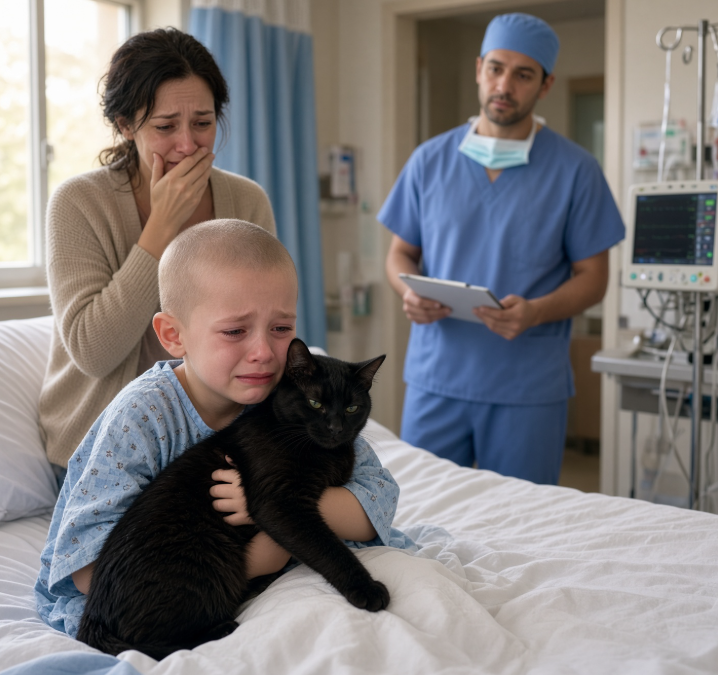
Then asked, “Will Ink come?”
The room paused.
Dr. Price looked at me.
I looked at Daniel.
A child life specialist named Nora leaned forward gently.
“Sweetheart, Ink can’t go into the operating room.”
Milo frowned.
“She can wait.”
“She can’t come to the hospital like that,” Nora said.
“She’s my cat.”
“I know.”
“She comes when I hurt.”
“I know.”
Milo’s lower lip trembled.
Daniel placed a hand on his back.
“Buddy—”
“No.”
“Milo.”
“No surgery.”
The words were quiet at first.
Then louder.
“No surgery.”
Dr. Price set down the model bone.
“Milo, I know this is scary.”
“No.”
“We need to fix your leg.”
“No Ink, no fix.”
My heart stopped.
Daniel closed his eyes.
Nora tried to redirect him, but he spiraled fast.
Four years old.
Exhausted.
Poisoned by medicine meant to save him.
Bald.
Sore.
Asked now to hand his body to strangers without the one creature who had been unchanged through everything.
He screamed until his face turned red.
“I want Ink! I want Ink! I want Ink!”
I held him while he fought against me, kicking weakly with his good leg, sobbing so hard he hiccupped.
Dr. Price stepped back.
Not offended.
Thinking.
When Milo finally exhausted himself against my chest, Dr. Price spoke quietly.
“I cannot operate with a cat in the room.”
“I understand,” I said.
His eyes moved to Milo.
“But let us speak with the hospital’s therapy animal coordinator.”
I looked up.
“What?”
“I’m not promising anything. The operating room is impossible. But recovery may be different under strict controls.”
Nora nodded.
“I can start the process.”
The process took two days.
Ink needed veterinary clearance.
Vaccination proof.
Behavior assessment.
Clean carrier.
Restricted route.
No contact with other patients.
She had to remain contained unless authorized.
She had to be watched constantly.
She had to be removed at the first sign of stress or aggression.
“Has she ever bitten anyone?” the coordinator asked.
Daniel and I looked at each other.
“Yes,” I said.
The coordinator’s pen stopped.
“A guest tried to pick her up without permission,” Daniel added quickly.
“Did the bite break skin?”
“Yes,” I said.
Daniel gave me a look.
“What? It did.”
The coordinator sighed.
“That complicates things.”
“She doesn’t bite Milo,” I said.
“That matters, but not enough by itself.”
Ink passed the veterinary exam.
She passed the behavioral assessment only because the evaluator was smart enough not to try picking her up. Ink sat in her carrier, watched everyone with cold disdain, and allowed Milo to place one finger through the door so she could press her face against it.
The evaluator wrote: Cat is selectively bonded to child. Low tolerance for unfamiliar handling. Calm in carrier. No stress vocalization. Recommend only if direct handling by staff is avoided.
The hospital approved one exception.
Post-operative recovery room.
Limited time.
Strict supervision.
Ink in carrier unless medically cleared at bedside.
No operating room.
No pre-op sterile areas.
No contact with surgical site.
Milo accepted that.
Barely.
The morning of surgery, he cried when they wheeled him away.
Not dramatically like before.
Worse.
Quietly.
“Tell Ink,” he whispered.
I walked beside the bed until the doors where parents stop.
“What should I tell her?”
He clutched his dinosaur.
“Tell her I’m still me.”
I bent over him.
“I will.”
The surgery lasted five hours and twenty-two minutes.
I counted every minute.
Daniel and I sat in the waiting room surrounded by people living their own worst days. Coffee cooled untouched. The television played a cooking show no one watched. A woman across from us prayed with a rosary. A man in scrubs came out twice for other families, and every time my stomach dropped.
Finally, Dr. Price appeared.
Mask around his neck.
Hair flattened from the surgical cap.
Tired eyes.
“It went well,” he said.
My body folded.
Daniel caught me.
Dr. Price explained that they removed the tumor with clean margins, placed the graft, stabilized the leg, and saw no immediate complications.
I heard pieces.
Enough.
Alive.
Successful.
Recovery.
Then Nora appeared with a small smile.
“We’re ready for Ink.”
Daniel left to get her from the car.
Ink had been waiting in her carrier in the parking lot with my mother, who reported that the cat had spent the entire morning glaring through the mesh as if she planned to file a complaint.
When they brought her in, she was silent.
That worried me.
Ink was usually opinionated about travel.
Now she was focused.
The recovery room was dimmer than I expected.
Machines beeped softly.
Milo lay in the bed, pale and swollen from fluids, still groggy from anesthesia. His left leg was immobilized in a brace from hip to ankle. Tubes ran from his arm. A pulse oximeter glowed red on his finger.
He looked impossibly small.
I nearly forgot to breathe.
“Mommy?” he slurred.
“I’m here.”
“My leg is big.”
“Yes, baby.”
“Ink?”
Nora looked at the nurse.
The nurse looked at the coordinator.
The coordinator looked at Ink.
Ink stared back like she was unimpressed by committee-based decision-making.
“Open the carrier,” the nurse said quietly.
I did.
Ink stepped out.
She did not dart.
Did not sniff the room.
Did not panic at the monitors.
She jumped onto the bed with the careful lightness of an animal who understood the landscape mattered.
I reached instinctively to stop her.
The nurse touched my arm.
“Wait.”
Ink walked along the right side of Milo’s body.
The side that had not been operated on.
She did not go near the brace.
Did not step across his legs.
Did not touch the surgical side.
She lay down along his right ribs and placed her head on his chest.
Then she went still.
Milo’s hand moved weakly toward her.
“Ink.”
Her purr began.
The nurse, a woman named Theresa who had worked pediatrics for sixteen years, watched with tears in her eyes.
I whispered, “Is this okay?”
Theresa nodded slowly.
“That cat knows exactly where she needs to be.”
Ink did not move for six hours.
Not when the blood pressure cuff inflated.
Not when nurses came and went.
Not when Milo whimpered.
Not when alarms sounded in another room.
Not when Daniel cried into both hands in the corner because the relief finally found him.
She stayed on the safe side.
Head on his chest.
Body warm against him.
Purring.
At one point, Theresa leaned close to me and said, “She is not comforting herself.”
I looked at her.
“She’s on a mission.”
I believed her.
Milo recovered slowly.
The first days were pain.
Real pain.
Pain that made him furious.
Pain medicine helped but did not erase everything.
He woke confused.
He cried when anyone moved the brace.
He asked if his leg was still there.
He asked if the bad bone was gone.
He asked if the doctor had put in a robot leg.
Daniel told him not exactly.
Milo asked if it was a dinosaur bone.
I said no.
He looked disappointed.
Ink visited when allowed and waited at home when not. Hospital rules were still rules, and the exception remained narrow. But the promise of her helped.
“After vitals, Ink comes.”
“After medicine, Ink comes.”
“After you drink, Ink comes.”
She became the marker he trusted.
The surgery was successful.
The graft took.
The pathology report brought the first breath we had taken in months.
Then came physical therapy.
I was not ready for that part.
No one had warned me that healing could look so much like cruelty.
Three weeks after surgery, Milo began gentle rehabilitation.
At first, even small movements made him cry.
His physical therapist, Dana, was kind but firm, which meant Milo considered her suspicious.
“I don’t like you,” he told her during the first session.
Dana nodded.
“That’s okay. You don’t have to like me. You just have to bend your knee a little.”
“No.”
“A tiny bit.”
“No.”
Ink sat on the couch nearby, watching.
Dana glanced at her.
“Is she always present?”
“Yes.”
“Does she motivate him?”
“She judges us.”
Dana smiled.
“Can we use that?”
So we did.
At home, Ink became Coach Ink.
Milo invented the title after she headbutted his hand following a successful ankle movement.
“She says good job,” he announced.
Dana ran with it.
“Coach Ink wants five more toe wiggles.”
Milo narrowed his eyes.
“Ink said two.”
Dana looked at the cat.
Ink stared back.
“Coach Ink drives a hard bargain,” Dana said. “Three.”
He did three.
When he cried, Ink moved closer.
When he finished a set, she bumped his hand.
When he refused, she sat on the exercise mat as if claiming it for herself until he laughed and agreed to try again.
Progress came in millimeters.
Then inches.
Then steps.
The first time Milo stood with assistance, Daniel turned away so our son would not see him cry.
The first time Milo took a step with the walker, Ink walked beside him.
Not underfoot.
Not in front.
Beside.
Like she was escorting him back into his life.
Six months later, Milo’s gait was nearly normal.
His hair came back darker at first, soft and strange like baby hair.
He loved rubbing it.
“I have hedgehog hair,” he told people.
His scans showed no evidence of disease.
Those words became the new good prognosis.
No evidence.
Not promise.
Not guarantee.
But evidence.
Enough.
At five, Milo ran again.
Not fast at first.
But he ran.
At six, he started kindergarten, wearing a backpack almost bigger than his torso and a hat he no longer needed but liked because it had rockets on it.
Ink walked to the front door every morning.
Old now.
Slower.
But still, when Daniel lifted Milo’s backpack or I zipped his coat, Ink rose onto her hind legs and placed both front paws on his chest.
Checking.
Milo stood still for it.
Always.
Other kids might have complained.
Milo did not.
He lowered his chin so she could sniff him.
“I’m okay, Ink,” he would say.
She checked anyway.
At seven, he understood more.
Not everything.
But enough.
He knew he had been sick.
He knew doctors removed bad cells from his leg.
He knew chemotherapy made his hair fall out.
He knew Ink had stayed.
Children remember in fragments.
A smell.
A blanket.
A cat’s warmth.
A basin.
A hospital bracelet.
A mother crying when she thinks the child is asleep.
One evening, he asked me why Ink was so old.
I was washing dishes.
He sat at the table doing a puzzle while Ink slept on a cushion nearby because she could no longer jump onto the chair without help.
“She’s old because she’s been with us a long time,” I said.
“Will she get better old?”
I turned off the water.
“What do you mean?”
“Like I got better sick.”
I dried my hands slowly.
“No, sweetheart. Old is different.”
He looked at her.
“She’s going to die?”
There are questions that turn a kitchen into holy ground.
I sat beside him.
“Someday, yes.”
His eyes filled immediately.
“I don’t want her to.”
“I know.”
“She helped me.”
“Yes.”
“So we have to help her.”
“We will.”
After that, Milo began caring for Ink with a tenderness that seemed too mature for seven and exactly right for him.
Every morning before school, he lifted her carefully with both arms and placed her on the couch cushion beside him.
He learned to support her hips because of arthritis.
He brushed the parts of her back she could no longer reach.
He refilled her water bowl without being asked.
He counted her pills with me.
He spoke to her in the same soft voice she had earned by showing up when pain made the world unrecognizable.
“You’re still you,” I heard him tell her once.
She was lying on his lap, thin now, whiskers white.
“You’re still you, Ink.”
I stood in the hallway and cried silently into a dish towel.
People ask about Milo all the time.
“How is he doing?”
“How are his scans?”
“Is his leg okay?”
“Is he in remission?”
“Can he play sports?”
They ask with good hearts.
I answer.
He is doing well.
His scans are clear.
His leg is strong.
He wears a lift in one shoe sometimes.
He hates broccoli.
He loves dinosaurs.
He is reading above grade level.
He is here.
I am grateful every time I get to answer.
But people rarely ask about Ink.
Maybe because she is a cat.
Maybe because people think of her as part of the background.
Maybe because medical stories have categories, and old black cats do not fit neatly beside surgery, chemotherapy, oncology, physical therapy, and prognosis.
But when I tell the truth about how my son survived, Ink belongs in the center.
Not instead of medicine.
Never that.
Doctors saved my son’s life.
Nurses carried us through the hours we could not carry ourselves.
Chemotherapy did what poison sometimes must do.
The surgeon’s hands removed what could have taken Milo from us.
Physical therapy gave him back his leg.
Science saved him.
But Ink helped him keep wanting tomorrow.
That matters.
When everything in his world changed, Ink stayed the same.
Same black fur.
Same yellow eyes.
Same warm weight against his side.
Same purr when he cried.
Same body by the door.
Same paws on his chest every morning, checking whether the boy she loved was still there.
For four months of treatment, she did not miss a day.
Not one.
When he vomited, she stayed.
When his hair fell out, she crawled under the blanket.
When he woke from surgery, she chose the safe side of his body and lay there like a promise.
When physical therapy hurt, she sat beside the mat until he tried again.
To adults, these things may sound small.
They were not small to a four-year-old whose body had become a place of fear.
Ink was proof that something could touch him and not hurt him.
Something could stay without asking him to be brave.
Something could recognize him with hair or without it, walking or carried, laughing or vomiting into a basin.
That recognition saved parts of him medicine could not reach.
Ink is fifteen now.
She has slowed so much that some days I think each movement is a decision.
Her hips ache.
Her spine is sharper under my hand.
Her coat, once sleek and black, has dulled with age.
White whiskers flare from her face.
She sleeps more.
Eats less.
Complains when Daniel moves her blanket.
Still herself, then.
She no longer jumps onto the couch.
Milo lifts her.
Every morning.
He is careful in a way that silences adults who see it.
He bends his knees, slides one hand under her chest and one beneath her hips, and raises her slowly.
“Ready, Ink?”
She usually complains.
He smiles.
“I know, I know.”
Then he places her on the cushion beside him while he eats breakfast.
She sits there like an elderly queen while he tells her about school.
Spelling test.
Recess.
The kid who eats glue.
A science lesson about bones that made him touch his left thigh thoughtfully.
Ink listens with half-closed eyes.
When it is time to leave, Daniel brings Milo’s backpack to the door.
And Ink, old as she is, rises.
Slowly.
Every morning, we think maybe this will be the day she no longer does it.
Every morning, she proves us wrong.
She walks to the entryway.
Milo waits.
She gathers herself, arthritic hips trembling slightly, and lifts onto her hind legs.
Not as high as before.
Not as steady.
Sometimes I brace her lightly with one hand.
But she places both front paws against Milo’s chest.
Always.
She sniffs his shirt.
His chin.
His cheek.
Milo lowers his face to her.
“I’m okay,” he whispers.
Ink checks anyway.
Then she drops back down, tired from the effort, and lets him kiss the top of her head.
Only then does he leave for school.
I used to think she was making sure he was still there.
Now I think maybe they are checking each other.
He lets her confirm he is alive.
She lets him confirm she is still with him.
There will come a morning when she cannot make it to the door.
I know that.
Daniel knows that.
Milo knows it too, though he pretends not to.
Love does not become smaller because it has an ending.
Sometimes it becomes more careful.
More present.
More willing to notice the ordinary rituals that were never ordinary at all.
A cat walking to a door.
A boy standing still.
Two paws on a chest.
A mother watching, trying not to cry before breakfast.
Recently, a friend asked me how we got through it.
I gave the usual answer first because it is true.
Good doctors.
Early detection.
Treatment.
Support.
Luck.
Faith, maybe, though mine looked more like begging than believing for a long time.
Then I thought of Ink on the couch.
Ink under the blanket.
Ink in the recovery room.
Ink beside the physical therapy mat.
Ink at the door.
So I said the part people forget.
“My son got through it because every morning, when he woke up, she was still there.”
My friend did not speak.
I continued because once I started, I could not stop.
“He was four. He didn’t understand cancer. He didn’t understand grafts or margins or blood counts. He didn’t understand why his leg hurt, why his hair was gone, or why everyone smiled too hard around him. But he understood Ink. He understood that she came when he hurt. He understood that she did not care what he looked like. He understood that she stayed.”
I looked toward the living room, where Milo was brushing her back with the soft blue brush we bought because her spine had become too tender for the old one.
“She was his landmark,” I said. “Everything else moved. She didn’t.”
That is still what I believe.
Ink was not affectionate in the way people expect.
She did not become a different cat.
She did not suddenly love everyone.
She still bites if someone ignores her warnings.
She still judges guests.
She still refuses cheap wet food and somehow knows if I try to hide medicine in it.
She remains Ink.
That may be the most beautiful part.
She did not have to become soft to become sacred.
She only had to stay.
And she did.
For a boy whose body betrayed him.
For a mother who could not take the pain away.
For a father who cried in hospital corners.
For a family whose world shrank to medicine schedules, scans, and hope measured in lab results.
Ink stayed.
She is sleeping beside Milo now as I write this.
He is on the couch reading a book about space, one hand resting lightly on her side. Every few minutes, he checks whether she is comfortable. Every few minutes, she opens one eye as if annoyed by his concern, then closes it again.
Her breathing is slower than it used to be.
A little rougher.
Her whiskers are white.
Her body is thin.
But when Milo shifts, she shifts with him.
Still keeping contact.
Still on duty.
One day, we will have to help her go.
I hate that sentence.
I hate knowing it.
But when that day comes, Milo will be there if it is right for him to be. He will hold her the way she held him through sickness. He will tell her what he has been telling her since he lost his hair under that blanket years ago.
It’s okay.
It’s still you.
And I will tell her what I have never found words big enough to say.
Thank you for seeing my son when cancer made him hard to recognize.
Thank you for lying on the side of his body that hurt least.
Thank you for becoming his coach, his guard, his anchor, his proof of tomorrow.
Thank you for checking him every morning.
Thank you for staying.
Until then, each school day begins the same way.
Backpack.
Shoes.
Lunchbox.
Door.
Ink walking slowly across the floor.
Milo waiting.
The old black cat rising on trembling legs.
Two paws pressed against the chest of the boy she helped bring back to childhood.
A small inspection.
A daily blessing.
A promise neither of them needs to explain.
He is still here.
So is she.








