The Stray Cat Slept Outside My Door Watching My Indoor Cats—Then I Realized He Wasn’t Looking for Food Anymore
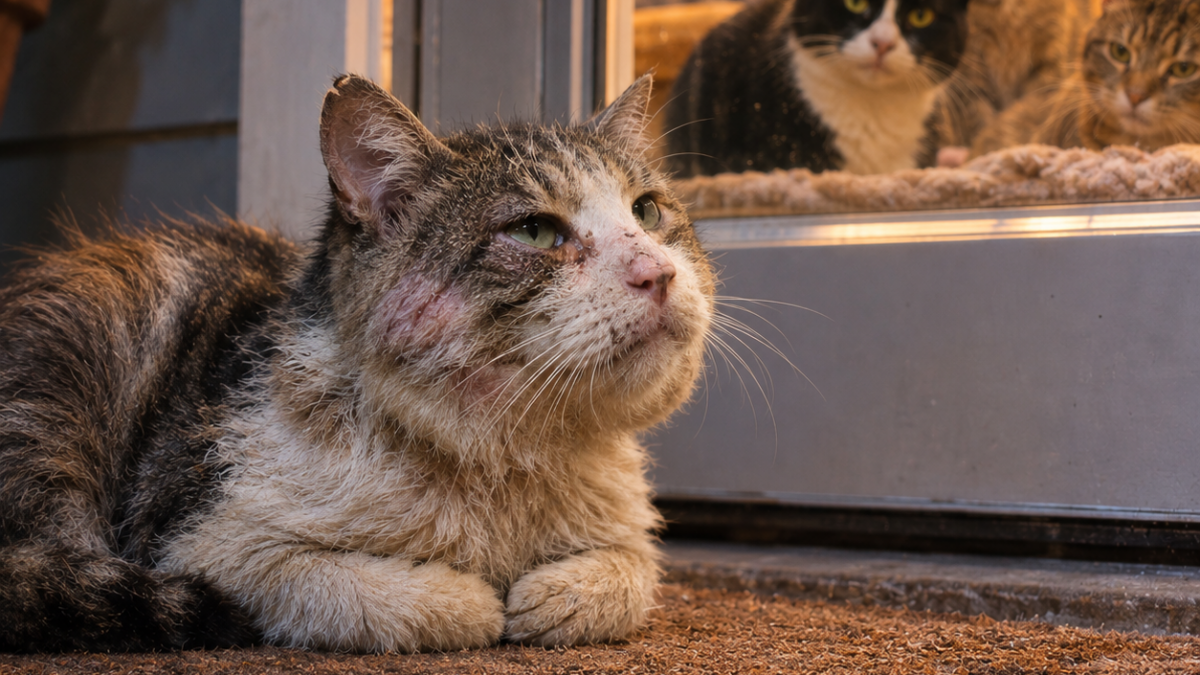
The Stray Cat Slept Outside My Door Watching My Indoor Cats—Then I Realized He Wasn’t Looking for Food Anymore.
For four cold nights, an old stray named Charles slept on the concrete outside my front door while my rescued tuxedo cat Dennis slept only inches away on the warm side of the glass, and every morning I found Charles staring inside at a life he seemed to understand he did not have.
His swollen cheeks, scarred face, respiratory infection, broken tooth, and exhausted body told me he had survived years outdoors—but the thing that finally broke me was watching him ignore food long enough to look through the door at Dennis as if he were asking one impossible question: Could a cat like me ever belong in there too?
Three months after I set the trap that changed his life, I opened Charles’s bedroom door and watched Dennis walk straight toward the frightened old tomcat, touch noses with him, and lie down beside him—and that was the moment I understood Charles had not been haunting my doorstep because he wanted another meal; he had been waiting for someone to let him come home.
Charles first appeared on my security camera in early May.
I almost missed him.
That sounds strange now because, once I knew him, Charles became impossible for me not to notice.
But at the time he was just another shape moving through the grainy black-and-white footage outside my house.
A cat.
Low to the ground.
Slow.
Tired.
There were plenty of stray cats in my neighborhood, so seeing one cross my porch after dark was not unusual.
I fed several of them.
Some came every evening.
Others disappeared for weeks and then returned as if they had simply been away on business.
Raccoons visited too.
Possums.
Once, a fox.
My outdoor camera recorded a small parade of hungry creatures every night.
But Charles was different.
I noticed that the second time I watched the clip.
I backed it up.
Paused.
Zoomed.
His head looked enormous.
At first I wondered if the camera angle was distorting him.
Then I realized it was his cheeks.
Huge tomcat cheeks.
The kind intact male cats sometimes develop after years of hormones, fighting, and surviving outside.
His body, though, did not match them.
He looked thin beneath the fur.
His coat seemed rough.
His eyes were partly closed.
He moved like an animal who was tired in a way that sleep alone could not fix.
I watched him approach the porch.
He sniffed around the food bowl I had left for the neighborhood strays.
He ate a little.
Then something happened that caught my attention.
He did not leave.
PART2:
Charles walked to the front door.
Turned around once.
Lowered himself onto the concrete.
And went to sleep.
I checked the timestamp.
11:42 p.m.
He was still there at midnight.
12:15.
12:31.
At 12:47, he lifted his head when a raccoon appeared near the steps.
The raccoon climbed onto the porch.
Charles stood reluctantly.
He stared at it.
The raccoon stared back.
Then Charles walked away.
Not ran.
Walked.
As though he hated surrendering the spot.
The next morning, I found a small patch of flattened dust where he had slept.
I remember standing there in my pajamas with coffee in my hand.
“Who are you?”
Of course, Charles was gone.
I did not know his name then.
I did not know anything about him.
That night he returned.
PART3:
Same route.
Same food bowl.
Same door.
Same place to sleep.
This time I watched live through the camera app.
My cat Dennis was inside.
Dennis was a black-and-white tuxedo cat I had rescued from the neighborhood months earlier.
His story had not been simple either.
For a long time Dennis would come for food but refused to come close.
He learned my schedule before he learned to trust me.
If I fed my indoor cats at six, Dennis would appear outside at five fifty-five.
At first I thought it was coincidence.
Then five fifty.
Then five forty-five.
Eventually he began waiting beneath the porch chair before I even opened the food container.
It took three or four months before we managed to trap him.
Even after I brought him inside, he did not suddenly become a pet.
Trust does not work that way.
For weeks, Dennis hid.
For months, he watched.
Then, little by little, he joined the household.
Donna, my confident tabby, tolerated him first.
Doris, smaller and shyer, took longer.
Eventually the three of them found their own arrangement.
Donna controlled the living room.
Doris controlled the bedroom windows.
Dennis seemed happy simply to have walls around him.
That second night Charles came, Dennis was sleeping just inside the front door.
I noticed him before I noticed Charles.
Dennis had chosen the small rug near the glass panel.
Outside, Charles lowered himself onto the concrete.
Inside, Dennis raised his head.
They looked at each other.
No hissing.
No swatting at the glass.
Nothing dramatic.
Just two cats on opposite sides of a door.
I watched through the camera for almost five minutes.
Dennis eventually lay his head down.
Charles did the same.
The door between them might as well have been the entire world.
I wondered if they knew each other.
They had both lived in the same neighborhood.
They could have crossed paths before.
Shared hiding places.
Fought over food.
Avoided the same aggressive tomcats.
Waited under the same parked cars during storms.
Maybe Dennis recognized Charles.
Maybe Charles recognized Dennis’s scent through the bottom of the door.
Or maybe I was inventing a story because humans are good at doing that when two animals look at each other long enough.
I told myself not to romanticize it.
Then Charles came back the third night.
And the fourth.
Each time, he slept outside my door.
Not under the bushes.
Not beneath the porch furniture.
Right against the entrance.
That was unusual.
Stray cats choose cover.
They choose escape routes.
They sleep beneath decks, inside crawl spaces, under cars, in brush.
They do not usually stretch themselves out in one of the most exposed places possible unless that place means something to them.
By the fourth night, the temperature dropped.
Not dangerously low.
But cold enough that the concrete had to feel miserable.
I woke around two and checked the camera.
Charles was there.
Curled tightly.
His paws tucked beneath him.
His face turned toward the door.
Inside, Dennis was sleeping on the rug again.
Warm.
Safe.
Fed.
Charles was perhaps six inches away.
On the other side.
I started crying.
There was no dramatic reason.
Nothing new had happened.
Charles was not bleeding.
Nobody had hurt him in front of me.
He was simply sleeping.
But suddenly I could not stop thinking about the difference between those six inches.
Inside:
Heat.
Food.
Water.
Soft places.
Veterinary care.
No raccoons.
No traffic.
No freezing rain.
No waking up because another animal wanted your sleeping spot.
Outside:
Everything Charles had survived for years.
I sat on the edge of my bed with the phone in my hand.
“Okay.”
I said it out loud.
“Okay, Charles.”
I had started calling him Charles by then.
I do not know why.
He looked like a Charles.
Old-fashioned.
Serious.
A little battered.
Maybe the name made him feel less like “the stray” and more like someone whose life I was responsible for noticing.
The next day, I put a humane trap on the porch.
Not armed.
Door secured open.
Just there.
I wanted Charles used to seeing it.
Stray cats can be suspicious of anything new.
The neighborhood cats certainly were.
Dennis had taken months to trap.
One female cat once stole the bait from the back of a trap without touching the trigger plate, and I still do not know how she did it.
Charles sniffed the trap that night.
Walked around it.
Ignored it.
Slept beside my door again.
The following evening, I placed food near the entrance.
Then a little farther inside.
Charles arrived approximately ten minutes later.
I watched through the window.
He sniffed.
Looked around.
Took one step.
Then another.
I held my breath.
“Come on.”
He entered the trap.
Calmly.
No hesitation.
No long battle.
He walked all the way to the back for the food.
The door dropped.
Charles spun.
For half a second his entire body exploded with panic.
He hit the sides once.
Then froze.
My heart hurt.
“I know.”
I went outside slowly.
“It’s okay.”
Charles stared at me.
His eyes looked watery.
His nose was congested.
Up close, he looked worse than the camera had shown.
Crusted discharge near his nostrils.
Rough coat.
Old scars.
One ear damaged.
Cheeks enormous.
He hissed when I approached.
Not aggressive.
Terrified.
“I’m sorry.”
I covered the trap with a blanket.
His movement stopped almost immediately.
I crouched beside him.
“You don’t know this yet.”
I touched the blanket lightly.
“But tonight is your last night out here.”
The next morning we went to the veterinarian.
Charles hated the carrier.
Hated the car.
Hated the exam room.
Probably hated me.
I could not blame him.
Everything that had happened since the trap closed involved people deciding where he would go and what would happen to his body.
The veterinarian, Dr. Elaine Foster, moved carefully.
She estimated Charles was somewhere around seven to nine years old.
Older than most of the strays I had rescued.
His oversized cheeks suggested he had spent much of his life unneutered.
He had an upper respiratory infection.
Parasites.
A chipped tooth.
His coat showed the wear of an animal that had spent years exposed to weather, stress, fights, and inconsistent nutrition.
But there was good news.
No obvious severe injury.
He was eating.
He was drinking.
And despite his intimidating face, Charles never tried to attack anyone.
He hissed.
He pulled away.
He flattened himself.
But there was no lunging.
No deliberate biting.
Elaine looked at him.
“He’s scared.”
“I know.”
“Probably been scared for a long time.”
I nodded.
“We’ll go slowly.”
He received his rabies vaccination.
Antibiotics.
Deworming medication.
Other basic care.
Neutering would wait until he was healthier and more stable.
When I brought him home, I did not introduce him to Dennis.
Or Donna.
Or Doris.
That would come much later.
Charles went into the bathroom.
It was small.
Quiet.
Easy to clean.
No large furniture to disappear behind.
I put down a soft bed.
Blanket.
Litter box.
Food.
Water.
A cardboard hide.
When I opened the carrier, Charles did not come out.
I left.
An hour later, the food was gone.
Charles was hidden.
For the next several days, that was our relationship.
I brought food.
Food disappeared.
I cleaned.
Charles hid.
Sometimes I saw him eating.
Usually, he waited until I left.
If I stepped too close, he hissed.
“Hi, Charles.”
Hiss.
“Good morning.”
Hiss.
“Very friendly.”
He stared.
I learned not to take it personally.
A hiss is communication.
It does not mean hatred.
Usually it means:
You are too close.
I am afraid.
Please stop.
So I stopped.
Every time.
That mattered.
I wanted Charles to learn that he could ask for space and the human would listen.
You cannot force trust into an animal.
You can only create enough predictable moments that fear stops being necessary every second.
Weeks passed.
Then months.
Charles gained weight.
His respiratory infection improved.
His coat looked better.
He was neutered once Elaine decided he was ready.
The huge cheeks softened slightly with time, though he always kept a wonderfully round face.
I began seeing more of him.
Not much.
But enough.
He would sit outside his hiding spot while I changed the litter.
Sometimes he watched me refill his water.
If I brought breakfast, he no longer disappeared instantly.
One morning I walked in and said:
“Hi, Charles.”
He stayed where he was.
That felt enormous.
Another day I sat on the bathroom floor and read for forty minutes.
Charles emerged.
Walked along the opposite wall.
Drank water.
Looked at me.
Then returned to hiding.
I texted a friend:
HE DRANK WATER WHILE I WAS IN THE ROOM.
She replied:
You realize normal people won’t understand why that’s exciting.
I did.
I did not care.
Progress with frightened animals is measured differently.
Sometimes success is not being touched.
Sometimes success is eating while somebody watches.
Sometimes it is sleeping with your body exposed.
Sometimes it is no longer believing every movement means danger.
Once Charles had stabilized medically, I moved him into a spare bedroom.
Bigger.
Window.
More enrichment.
Still quiet.
I worried the larger space might overwhelm him.
Instead, Charles found one hiding spot immediately.
Under an exercise chair.
The chair had a wide base and enough space beneath it for him to tuck himself completely away.
I draped a blanket over the seat.
Instant tent.
Charles approved.
He slept there constantly.
I called it his apartment.
“Good morning, Mr. Charles.”
Two green eyes appeared beneath the blanket.
“Rent is due.”
No response.
“Typical.”
He ate well.
Drank.
Used the litter box.
Physically, he improved.
Emotionally, progress was slower.
There were days I wondered whether I had done the right thing.
I need to say that because rescue stories often skip this part.
They show the street.
Then the trap.
Then three minutes later the cat is purring on a couch.
Sometimes that happens.
Often it does not.
Charles had lived outside for most, maybe all, of his adult life.
I had no idea what people had done to him.
Maybe nothing terrible.
Living outdoors itself can teach an animal caution.
Maybe someone had once been kind.
Maybe someone had chased him away.
Maybe both.
His history did not come with paperwork.
There were weeks when he seemed stuck.
Same hiding place.
Same distance.
Same hiss if my hand moved too quickly.
I worried.
Was he unhappy indoors?
Had I taken a cat who understood outdoor life and trapped him inside a room he hated?
That question matters.
Not every unsocialized outdoor cat wants to become an indoor companion.
Some do better in managed outdoor environments.
Barn programs.
Colonies.
Places where their needs and temperament can be respected.
I watched Charles closely.
Did he search for exits?
Throw himself at windows?
Pace?
Yowl at doors?
Try desperately to get outside?
No.
He watched the window.
But calmly.
He slept.
He ate.
He stretched out.
He played sometimes when he thought I was not looking.
He showed no desire to return to the street.
What he showed was fear of me.
Those are different problems.
So I kept going slowly.
Then Dennis changed everything.
At first, I did not intentionally use Dennis as a social bridge.
It happened by accident.
Charles’s bedroom door had a small gap underneath.
One afternoon I heard scratching.
I assumed Charles was playing.
Then another sound came from the hallway.
I opened my camera app.
Dennis was lying outside the door.
One paw stretched beneath it.
Inside, Charles sat several inches away.
He reached forward.
Tapped Dennis’s paw.
Dennis pulled back.
Then pushed his paw underneath again.
Charles tapped it.
I almost screamed.
Instead, I crouched at the far end of the hall like a burglar in my own house and watched.
The two cats played through the gap for several minutes.
No hissing.
No growling.
Charles’s posture was different.
Loose.
Curious.
Interested.
Dennis rolled onto his side.
Charles chirped.
A small sound.
I had never heard Charles make anything except meows and hisses.
It was light.
Almost questioning.
Dennis chirped back.
That became their routine.
Charles came to the door.
Dennis appeared outside.
Paws beneath the gap.
Sniffing.
Little noises.
Sometimes they simply sat there.
One on each side.
Exactly as they had months earlier at my front door.
Except now Charles was the one inside.
That realization stopped me.
I remembered the security footage.
Dennis sleeping behind the front door.
Charles outside.
Now Dennis still waited beside a door.
But Charles had crossed the line.
Warm side.
Safe side.
The door between them was temporary now.
Not the boundary between survival and home.
I sat on the hallway floor and cried.
Dennis looked at me as if I were embarrassing.
Maybe I was.
After that, Charles changed faster.
Not instantly.
But noticeably.
He came out more often when Dennis was nearby.
If Dennis sat outside the door, Charles approached.
He played.
He yawned.
He stretched.
He began sitting in the open instead of under his chair tent.
Sometimes I entered and found him near the window.
He still retreated if I moved too quickly.
But he no longer disappeared at the sound of my footsteps.
His hissing decreased.
Then one afternoon, I reached to adjust his blanket.
Charles hissed.
I stopped.
“Sorry.”
I backed away.
A few seconds later, Charles stepped out.
He looked at me.
Then at the blanket.
Almost as though he understood the exchange.
You said stop.
She stopped.
It seems tiny.
It is not.
Control creates safety.
For an animal whose entire life may have involved reacting to things bigger and stronger than him, discovering that a hiss can successfully create space changes the relationship.
Charles did not need to escalate.
I listened.
So he needed the hiss less.
Months into his indoor life, he began playing with toys in front of me.
The first time was a feather wand.
I moved it slowly.
Charles watched.
No reaction.
I dragged it behind the leg of the exercise chair.
His eyes widened.
I moved it again.
One paw shot out.
Then disappeared.
I froze.
“Was that you?”
Two eyes beneath the blanket.
I moved the feather.
Paw.
“Charles.”
Paw.
I laughed.
“You fraud.”
Within minutes he was batting at the toy from beneath his tent.
The next day, he chased it into the open.
I barely breathed.
That old stray cat ran three feet across the carpet after a feather.
Then stopped.
Looked at me.
As if embarrassed.
“Don’t worry.”
I whispered.
“Your reputation is safe.”
Dennis became impatient to meet him.
Dennis had always been confident once he settled indoors.
He would sit outside Charles’s room for long periods.
Donna occasionally passed by.
Doris watched from farther down the hallway.
We did scent exchanges.
Bedding.
Rooms.
Careful feeding near the door.
No rushing.
Charles never reacted aggressively to the other cats’ smell.
If anything, he became more animated.
That gave me hope.
Still, I waited.
I wanted his health stable.
I wanted him comfortable enough that an introduction would not overwhelm him.
Then came the day I finally opened the door.
Not completely.
At first, I sat nearby.
Dennis was waiting.
Of course he was.
I opened it several inches.
Dennis pushed his nose through.
“Dennis.”
He ignored me.
Charles was under his chair.
Dennis walked in.
No hesitation.
He sniffed the floor.
Then spotted Charles.
Charles lifted his head.
And chirped.
Not hissed.
Chirped.
Again.
A sound I had never heard from him before Dennis.
Dennis approached.
Slow enough.
Confident.
Charles remained in place.
I watched every muscle.
No flattened ears.
No puffed tail.
No growling.
Dennis reached him.
Nose to nose.
One touch.
That was it.
No fight.
No dramatic reunion.
Two neighborhood cats meeting indoors as though perhaps they had been waiting to finish a conversation.
Dennis turned away.
Inspected the room.
Charles followed him with his eyes.
Then stood.
Dennis walked toward the window.
Charles came out from under the chair.
My heart was pounding.
“Good boys.”
Neither cared.
Donna entered next.
Donna believed every room belonged to her.
She walked in.
Sniffed Charles’s bed.
Sniffed his food station.
Inspected his litter box with the invasive confidence of a building inspector.
Charles chirped.
Donna ignored him.
He chirped again.
Donna turned her head.
Looked.
Then continued walking.
Perfect.
Indifference is underrated in cat introductions.
People want instant cuddling.
Sometimes the best first meeting is one cat deciding the other is not worth making a problem about.
Doris took longer.
She stayed in the doorway.
Charles saw her.
Chirped.
Then yawned.
Doris moved one step closer.
No hiss.
No growl.
Eventually she entered.
Sniffed.
Retreated.
Enough.
The biggest surprise remained Dennis.
He did not want to leave.
After exploring the room, he lay down beside Charles.
Not touching.
Close.
Charles looked at him.
Then lowered himself too.
Two bodies.
Same direction.
Calm.
I sat against the wall.
I remembered the doorstep.
The first night.
Charles outside.
Dennis inside.
The glass between them.
Now there was no glass.
No locked door.
No raccoon approaching.
No cold concrete.
Dennis slept.
Charles slept.
And I finally let myself believe:
He wanted this.
Charles had not been waiting outside my house only because there was food.
He had been searching for safety.
Maybe he had seen Dennis inside.
Maybe recognized him.
Maybe simply saw another cat who once lived outdoors now sleeping peacefully behind glass.
I will never know what Charles thought.
But I know what I saw.
Every night, he chose my doorstep.
Every night, he stayed near the place where warmth, cats, and human voices existed just beyond him.
Then when he was finally allowed inside, he never once tried to return to the life he had left.
That told me enough.
After the introductions, I began leaving Charles’s bedroom door open while I was home.
At first he did not cross the threshold.
Dennis came in.
Donna came in.
Doris occasionally came in.
Charles stayed.
That was okay.
One afternoon I walked past and saw him standing in the doorway.
Half his body inside the room.
Half in the hall.
I kept walking.
Did not make a big deal of it.
Two minutes later, I peeked from the kitchen.
Charles had taken three steps into the hallway.
Dennis stood ahead of him.
Charles followed.
They reached the living room.
Charles stopped.
The room was huge compared with his bedroom.
Windows.
Furniture.
Television.
Cat trees.
He looked overwhelmed.
Dennis jumped onto the couch.
Charles watched.
Then retreated to his room.
That was progress.
The next day he came farther.
Then farther.
Within weeks, Charles began taking slow tours of the house.
Never alone at first.
Usually behind Dennis.
Dennis became his guide.
Kitchen.
Living room.
Hallway.
Window seat.
Cat tree.
Charles watched everything Dennis did.
If Dennis relaxed, Charles relaxed.
If Dennis ate, Charles approached.
If Dennis slept in a room, Charles might stay too.
Donna continued acting unimpressed.
Doris became quietly friendly.
I realized that Charles trusted cats before he trusted me.
That did not hurt my feelings.
It helped me understand him.
Perhaps cats had been his only stable relationships outdoors.
People came and went.
Cats followed rules he understood.
Body language.
Distance.
Scent.
Dennis spoke Charles’s first language.
I was learning it.
Then one morning, something happened I had stopped expecting.
I was sitting on the floor of Charles’s room.
Not reaching.
Just reading messages.
Dennis was beside the window.
Charles walked toward me.
I did not look directly at him.
He stopped near my knee.
Sniffed.
I stayed still.
He leaned forward.
His cheek touched my pant leg.
Barely.
Then again.
I stopped breathing.
Charles rubbed one side of his face against my knee.
I wanted to touch him.
I did not.
He walked away.
I waited until he disappeared beneath his chair tent.
Then I cried.
The next day, he did it again.
This time I lowered one finger.
Charles sniffed.
Then rubbed his cheek against it.
I stroked his cheek once.
He flinched.
I stopped.
He stayed.
I touched him again.
One second.
Two.
Then Charles walked away.
That was how affection started.
Not suddenly.
Permission by permission.
Weeks later, he allowed me to scratch the side of his face.
Then beneath his chin.
Then his shoulder.
Never from above at first.
A hand descending over his head frightened him.
So I approached from the side.
If his body stiffened, I stopped.
Charles learned he controlled the interaction.
Eventually, he began asking.
One day I stopped petting him after several seconds.
Charles leaned forward.
Head against my hand.
I laughed.
“Oh.”
“You want more?”
He pushed again.
That was the first time Charles demanded affection.
Dennis sat nearby.
Watching.
I pointed at him.
“This is your fault.”
Dennis blinked.
Charles rubbed against my wrist.
Something in me changed too.
For months, I had been measuring Charles against an imaginary ideal.
Would he become affectionate?
Would he sit in my lap?
Would he become “normal”?
That was unfair.
Charles did not owe me a lap-cat transformation.
Safety was enough.
A life indoors was enough.
Friendships with other cats were enough.
If he spent the next ten years sleeping near Dennis and never once climbed onto me, he would still have a successful rescue story.
I stopped asking what Charles might become.
I started appreciating what he already was.
Shy.
Observant.
Gentle.
Quiet.
Much funnier than I expected.
He loved cardboard.
Not boxes.
Flat cardboard.
If a package arrived, I could place the shipping box in front of him.
Nothing.
Put one flattened piece of cardboard on the floor?
Charles sat on it immediately.
Every time.
He loved a small green ball with a bell.
He never chased it more than a few feet.
He simply tapped it at night.
Around 2:00 a.m.
Repeatedly.
I discovered this after wondering for several nights why I kept hearing:
ting.
Pause.
ting.
Pause.
ting.
I checked the camera.
Charles.
Sitting alone.
Tapping the ball once every thirty seconds.
“Why?”
No answer.
He began grooming more.
That was another sign.
Outdoor stress and illness had left his coat rough.
Now Charles sat in sunlight and cleaned himself thoroughly.
His face remained broad.
His broken tooth eventually required additional dental attention.
He recovered well.
His eyes looked brighter.
His coat became soft.
Visitors who saw old photographs could hardly believe it.
“That’s Charles?”
“Yes.”
“He looked ancient.”
“He felt ancient.”
“How old is he?”
“Probably eight.”
Maybe nine.
Nobody knew exactly.
That uncertainty made me angry sometimes.
Not at anyone specific.
At how many years of his life existed without witness.
Where had he slept?
How many winters?
How many fights?
Had anybody ever owned him?
Did anyone miss him?
Was he born outside?
Did his giant cheeks once intimidate every cat on the block?
Had he always been shy with people?
I could invent answers.
I chose not to.
Charles’s life before me belonged to him.
I did not need tragedy to justify loving him.
One evening, months after rescue, I checked the old security footage.
I had not watched it in a long time.
There he was.
Charles.
First night.
Thin.
Rough.
Sleeping outside my door.
Then Dennis appeared behind the glass.
I paused the frame.
Two cats.
One inside.
One outside.
That image looked different now.
At the time, I thought Dennis had what Charles wanted.
Warmth.
Food.
Safety.
Maybe that was true.
But now I understood something else.
Dennis represented proof.
He had been outside too.
He had been scared too.
He had lived in that same neighborhood.
And somehow he had crossed the door.
Maybe Charles did not know how.
But he saw that it was possible.
That thought broke me all over again.
I found Dennis in the living room.
He was asleep.
Charles was beside him.
I sat on the couch.
“You know you saved him.”
Dennis continued sleeping.
“I’m serious.”
Nothing.
“You were basically an advertisement for indoor life.”
One eye opened.
“Very effective marketing.”
Eye closed.
Charles lifted his head.
I scratched beneath his chin.
He allowed it.
Then leaned into my hand.
By the end of his third month indoors, Charles had changed more than I had dared hope.
Not into a different cat.
Into a safer version of himself.
That distinction mattered.
He still startled at loud noises.
Still hid when unfamiliar people entered.
Still preferred Dennis to everyone else.
Still sometimes hissed if surprised.
But now he played.
He chirped.
He slept in the open.
He explored the hallway.
He accepted touch.
He watched birds through the window.
And sometimes, late at night, I would walk into the living room and find Charles stretched out on the rug.
Not curled tightly.
Not ready to flee.
On his side.
Belly partly exposed.
A vulnerable position.
The first time I saw it, I backed out quietly.
I did not want to wake him.
That sleeping position meant more to me than if he had climbed into my lap.
A frightened animal does not expose his body in a place he believes is dangerous.
Charles was telling us something.
This house is safe enough to sleep deeply.
Months passed.
Summer turned toward fall.
Charles became part of the household rhythm.
Breakfast.
Windows.
Nap.
Dennis.
Dinner.
Green ball at two in the morning.
He never tried to go outside.
One day I opened the front door while carrying groceries.
Charles was in the hallway.
I froze.
He could have slipped out.
Instead, he looked through the doorway.
At the porch.
The exact place where he had once slept night after night.
Then he turned around.
Walked toward the living room.
I stood there holding grocery bags.
The door open.
My eyes filling.
“Charles.”
He did not look back.
I closed the door.
That moment stayed with me.
Maybe because it answered a question I had carried since trapping him.
Had I taken something from him?
No.
Charles knew what was out there.
He had chosen differently.
Or at least he had no interest in returning.
That was enough.
We developed routines of our own.
If I sat quietly beside the window in the afternoon, Charles would come near.
Not on my lap.
Usually beside my chair.
Sometimes close enough that his body touched my ankle.
I learned not to make a big deal about those moments.
Trust can retreat when celebrated too loudly.
So I pretended to read.
Charles pretended not to be affectionate.
We both understood.
Donna eventually accepted Charles completely.
Which, for Donna, meant ignoring him with professional consistency.
Doris surprised me.
The shyest of the group started sleeping near Charles.
Not as closely as Dennis.
But enough.
One afternoon, I found Charles between Dennis and Doris on the bed.
Donna at the foot.
Four former street or rescue cats sleeping in one room.
I took a photograph.
No one moved.
I sent it to a friend.
She replied:
Charles got his gang.
I looked at the picture.
Maybe.
But I thought of something else.
He got his family.
I did not post that sentence publicly.
It felt too sentimental.
I am saying it now because it is true.
Family for Charles did not begin with me touching him.
It began when he stopped sleeping outside a door.
Everything afterward grew from that.
People sometimes asked whether I planned to put Charles up for adoption.
At first, I had assumed I would.
That is what rescuers do.
Stabilize.
Socialize.
Find the right home.
But Charles complicated that plan.
He was older.
Shy.
Bonded strongly with Dennis.
Comfortable with Donna and Doris.
Moving him again might have been possible.
But the question became:
Why?
He had spent months learning this house.
These cats.
These routines.
His safety was tied to them.
A good adopter might eventually earn his trust.
But Charles already had a home.
I was just slow to call it that.
One evening, I filled out the paperwork.
No ceremony.
No social media announcement.
Just an adoption form on my kitchen table.
Charles was sleeping nearby.
Dennis beside him.
I wrote his name.
Charles.
Estimated age.
Eight years.
Color.
Brown tabby with white.
Medical notes.
Behavioral notes.
Then:
ADOPTER.
My name.
I stopped.
Laughed quietly.
“Apparently this is happening.”
Dennis looked up.
Charles did not.
The next morning, I called the rescue coordinator.
“You knew.”
She laughed.
“Knew what?”
“That I’d keep him.”
“I suspected.”
“Why?”
“Because you stopped saying ‘when Charles gets adopted’ about two months ago.”
I thought back.
She was right.
Somewhere along the way, my language had changed.
From:
When he finds a home.
To:
When he feels comfortable in the rest of the house.
From:
His future adopter will need patience.
To:
I’m going to move his food station.
I had already included him in the future.
The paperwork simply caught up.
I officially adopted Charles.
Dennis had already done it months earlier.
Charles’s first winter indoors arrived quietly.
Snow outside.
He sat near the front window.
Watched flakes.
I wondered whether he recognized the cold.
Whether his body remembered sleeping beneath cars, porches, bushes.
One evening temperatures dropped into the teens.
I checked the security camera out of habit.
Several neighborhood strays still came for food.
I maintained insulated shelters outside.
Heated water.
Feeding stations.
Charles sat inside near the door.
A black cat approached the bowl.
Charles watched.
Dennis joined him.
Two indoor cats looking outward.
I remembered Charles on the other side.
The contrast hurt.
Not because Charles was sad now.
Because other cats were still out there.
You cannot save all of them.
People say that to rescuers as if it is comforting.
It is not.
But it is true.
We did what we could.
Trap-neuter-return for appropriate community cats.
Rescue those who could transition.
Medical care when possible.
Shelters.
Food.
Charles did not solve the problem of outdoor cats in my neighborhood.
He became one life changed.
That mattered.
One cold night, a gray cat entered one of the insulated shelters.
Charles watched from the window.
I said:
“You know that life.”
His ears moved.
“You got lucky.”
Then I corrected myself.
“No.”
“You got noticed.”
Luck sounds passive.
Charles worked for survival.
Neighbors fed him.
Dennis drew my attention.
The camera captured him.
I cried.
The trap worked.
So many small things had to align.
I think about that often.
What if I had not checked the footage?
What if Charles slept on another porch?
What if Dennis had not been inside the door?
What if I convinced myself Charles was “just another stray”?
He might have survived another season.
Maybe years.
Maybe not.
Instead, he spent that winter on a heated bed.
He discovered blankets.
Really discovered them.
He had used the blanket tent for security.
Now he learned blankets could also be luxurious.
If I left a fleece throw on the couch, Charles climbed onto it.
He kneaded.
Slowly.
Front paws alternating.
The first time I saw that, I almost cried again.
I cried a lot that year.
Charles seemed determined to reveal one soft behavior at a time until I had no emotional stability left.
Kneading.
Chirping.
Playing.
Stretching.
Allowing chin scratches.
Sleeping near my feet.
Then, almost a year after rescue, the milestone I had stopped waiting for happened.
I was on the couch.
Dennis beside me.
Charles approached.
He looked at Dennis.
Looked at me.
Placed one paw on the couch.
Then another.
He climbed up.
I stayed absolutely still.
Charles walked across the cushion.
Sniffed my leg.
Turned.
And sat beside me.
Not on me.
Beside.
His body touched my thigh.
My heart started pounding.
I did not touch him.
Five minutes.
Ten.
Dennis left.
Charles stayed.
Eventually, I lowered my hand.
One stroke along his cheek.
He leaned.
Then Charles lay down.
Against me.
I stared at the television without seeing any of it.
After nearly a year, the cat who once hissed if I entered his bathroom had chosen physical contact he could easily leave.
That choice meant everything.
Later someone asked:
“Did he finally become a lap cat?”
“No.”
He never really did.
Not in the classic way.
Charles did not climb onto my chest.
Did not demand to be held.
Did not sleep on my pillow.
He remained Charles.
Affection on his terms.
Beside me.
Near me.
Sometimes touching.
Sometimes not.
And that was perfect.
I think people sometimes measure rescue success by how closely an animal eventually behaves like the pet they expected.
That is unfair.
Charles did not owe anyone transformation into an outgoing house cat.
His victory was not becoming fearless.
His victory was having enough control that fear no longer ran every moment.
He could choose.
Hide.
Come out.
Play.
Approach.
Retreat.
Sleep.
Be with cats.
Be near me.
Choice was the life I wanted for him.
Years passed.
Charles aged.
His already mature face became truly old.
The giant tomcat cheeks softened.
White hairs appeared.
He developed dental problems.
Then early arthritis.
Nothing unusual for an older cat who had lived a hard life.
We adjusted.
Low-entry litter boxes.
Steps.
Soft beds.
More veterinary visits.
Charles hated carriers less over time.
Not because he liked them.
Because he learned that every trip ended with him returning home.
That pattern changed him.
The first few vet visits, he flattened himself against the carrier.
Years later, he complained loudly.
That was progress.
Fear had become irritation.
I preferred irritation.
One afternoon, Elaine examined him and laughed.
“He’s opinionated now.”
“He’s always been opinionated.”
“No.”
“He used to be terrified.”
“Now he’s mad.”
Charles hissed.
Elaine smiled.
“See?”
I scratched his cheek.
“Good boy.”
She looked at me.
“He hissed at me.”
“Yes.”
“He communicated clearly.”
Elaine shook her head.
“Rescue people are strange.”
True.
Dennis and Charles remained close.
As Dennis aged, Charles followed him less.
They became equals.
Two old neighborhood cats who had somehow ended up on the same couch.
Sometimes I wondered whether they truly had known each other outside.
There was no way to prove it.
Then one day Margaret, a neighbor who had fed strays for years, visited.
She looked through the window.
Dennis and Charles were asleep together.
She stared.
“What?”
I asked.
“I’ve seen those two together before.”
My whole body went still.
“Where?”
“Years ago.”
“Outside?”
“Yes.”
“Behind the old pharmacy.”
“You’re sure?”
She moved closer to the glass.
“That tuxedo cat used to stay near the dumpsters.”
“And that big-cheeked tabby…”
She pointed toward Charles.
“He would lie under the loading ramp.”
“They weren’t always together.”
“But I’ve seen them eat near each other.”
“How long ago?”
“Before you trapped Dennis.”
I felt something tighten in my throat.
“So they knew each other.”
“I’d say so.”
That did not prove Charles had come to my door because of Dennis.
But it made the idea less imaginary.
Perhaps Charles recognized him.
Through scent.
Sound.
Sight through the glass.
Maybe he watched another outdoor cat disappear inside and later found him warm behind that door.
Maybe Charles had followed.
Maybe that was why my doorstep felt safe.
Not only because of food.
Because someone he knew had made it through.
I never got to ask Charles.
I just looked at the two of them.
Dennis asleep.
Charles pressed against his side.
And thought:
You found each other twice.
That felt like enough.
Dennis died first.
Kidney disease.
He was old.
We never knew exactly how old.
His decline was slow.
Then quick.
Charles noticed.
During Dennis’s final week, Charles stayed near him constantly.
Not dramatic.
He simply chose the same rooms.
Dennis slept.
Charles slept nearby.
When the veterinarian came to the house, Charles watched from the doorway.
After Dennis died, I let the other cats see him.
Donna sniffed and walked away.
Doris stayed several minutes.
Charles approached last.
He sniffed Dennis’s face.
Then sat.
He remained there longer than anyone else.
After we took Dennis away, Charles searched.
Door.
Couch.
Hallway.
He chirped.
That sound broke me.
The same sound he had made during their first indoor meeting.
But Dennis did not answer.
For almost two weeks, Charles slept near the front door.
The place where Dennis used to sleep.
The place where Charles himself once slept outside.
I wondered whether memory had folded back on itself.
I placed a soft bed there.
Charles used it.
Every morning, I found him facing the glass.
I sat beside him.
No words.
What could I say?
Some losses cannot be explained to animals.
Only accompanied.
Charles became closer to me after Dennis died.
Not because I replaced Dennis.
I could not.
But perhaps the shape of his social world changed.
He began sitting beside me more often.
Following me into the kitchen.
Sleeping near my chair.
One evening he climbed onto the couch.
Then, for the first and only time I can remember, Charles placed both front paws across my leg and rested his head on my thigh.
I did not move.
He slept twenty minutes.
I cried silently the entire time.
Maybe that was a gift.
Maybe simply comfort.
I did not need to name it.
Donna died the following year.
Doris lived another two.
Charles became the last of that original group.
The old stray who had once been newest became the keeper of the house.
He slowed.
Slept more.
Still liked his window.
Still loved flat cardboard for reasons that remained incomprehensible.
Still tapped the green bell ball occasionally at night.
ting.
Pause.
ting.
I came to love that sound.
One spring, nearly seven years after Charles first appeared on my camera, I found him sleeping by the front door.
Same position.
Head toward the glass.
Sunlight across his back.
For one terrifying second, I saw the old footage.
Cold porch.
Thin body.
Raccoon.
Then Charles rolled over.
Warm.
Safe.
Soft fur.
I sat beside him.
“You really wanted in.”
He opened one eye.
“I’m sorry it took me four nights.”
Eye closed.
I touched his cheek.
He leaned into my hand.
That old question returned.
What had he been thinking on the porch?
Hungry?
Exhausted?
Following Dennis?
Looking for shelter?
Maybe nothing as complex as longing for “indoor life.”
Animals do not narrate themselves the way we do.
Still, I believe Charles understood something.
He knew the door separated danger from safety.
He knew cats lived inside.
He knew food came from there.
He knew nobody chased him away.
And night after night, he chose to sleep as close to that boundary as he could.
That is a kind of asking.
Quiet.
Patient.
Persistent.
Charles developed kidney disease in his later years.
We managed it.
Special diet.
Fluids.
Medication.
He hated the fluids.
I bribed him with treats.
He pretended the entire process violated international law.
But he recovered after each session quickly enough to demand dinner.
Then came the winter when his numbers worsened.
He lost weight.
His appetite became inconsistent.
Elaine and I adjusted everything we could.
Some days good.
Some not.
I knew where we were heading.
Knowing never helps as much as people think.
One evening, Charles went to the front door.
Lay down.
I sat beside him.
Snow outside.
He watched it.
His breathing was slower than normal.
I touched his back.
“Cold.”
He looked toward me.
“Remember?”
He could not answer.
I kept talking.
“You used to sleep right there.”
I pointed beyond the glass.
“Outside.”
“Can you believe that?”
Charles closed his eyes.
I scratched beneath his chin.
“I can’t.”
The next morning, he refused food.
Even the good stuff.
Chicken.
Nothing.
He drank a little.
Then returned to his bed.
Elaine came that afternoon.
Examined him.
Listened.
Looked at me.
The look.
Every person who has loved an old animal eventually learns it.
“We can hospitalize.”
“What does that buy him?”
“Maybe stabilization.”
“For how long?”
“I don’t know.”
“Would he hate it?”
Elaine looked at Charles.
“Yes.”
That answered me.
Charles had spent enough of his life afraid in unfamiliar places.
I would not make his last experience another cage if the goal was only to delay what his body had already decided.
We scheduled euthanasia at home the next morning.
I slept on the couch beside him.
Or tried.
Around three, I woke.
Charles was not in his bed.
Panic.
I found him near the front door.
Same place.
He was sitting.
Weakly.
Looking through the glass.
I sat down beside him.
He leaned against my leg.
For a while, neither of us moved.
Outside, the porch light illuminated the exact patch of concrete where he had slept years before.
I could see him there in my mind.
Rough fur.
Huge cheeks.
Eyes half-closed.
Waiting.
I whispered:
“You made it.”
Charles’s eyes remained on the porch.
“You got inside.”
His head lowered.
I stroked him.
“You never had to sleep out there again.”
That was the promise I suddenly realized mattered most.
Not that he became affectionate.
Not that he learned to play.
Not even that he found Dennis again.
He never had to return to survival.
For seven years.
Maybe the first seven or eight years of his life had been hard.
I could not change those.
But the final seven were soft.
Warm beds.
Reliable meals.
Windows.
Dennis.
Donna.
Doris.
Green bell ball.
Blanket tent.
Me.
The morning came.
Elaine arrived.
Charles was on his favorite blanket near the door.
I had moved the bed there because it seemed right.
She gave him a sedative first.
His body relaxed.
The tension left his face.
I sat on the floor.
Exactly as I had during those first weeks.
Only now I could touch him.
I scratched his cheek.
Under his chin.
Charles’s eyes closed.
He leaned.
Even then.
I whispered:
“Good boy.”
Elaine waited.
No rush.
I looked through the glass.
The porch.
The place where the story began.
Then down at Charles.
The cat who had once been outside looking in was now inside, surrounded by everything he had spent those nights sleeping beside.
I said:
“You don’t have to wait at the door anymore.”
Elaine gave the final medication.
Charles exhaled.
His body softened against my hand.
Then he was gone.
I stayed on the floor for a long time.
I expected the house to feel empty.
It did.
But not in the way I feared.
There was grief everywhere.
His bed.
The flat cardboard beside the wall.
Green ball.
Food dish.
But also evidence.
Seven years of evidence.
Charles had lived here.
Not visited.
Not temporarily sheltered.
Lived.
Belonged.
I went back through the security footage later.
I had saved the earliest clips.
Charles on the porch.
First night.
Second night.
Third.
Fourth.
I watched the one with Dennis inside.
Paused.
Two cats.
One door.
Then I found a photograph taken years later.
Dennis and Charles asleep side by side on the couch.
I put the images together.
Not for social media.
For myself.
Before.
After.
Outside.
Inside.
Waiting.
Belonging.
I cried.
Of course.
Then I laughed because in the second picture Charles had one paw directly on Dennis’s face.
Perfect.
People later asked what I thought Charles’s story was about.
Patience?
Rescue?
Friendship?
Second chances?
All of those.
But I think mostly it was about doors.
Not literal doors exactly.
Though there was one.
It was about the invisible line between being seen and being passed by.
Between food left outside and someone asking why you keep coming back.
Between surviving near a home and being invited into one.
Charles crossed that line slowly.
Trap.
Bathroom.
Bedroom.
Hallway.
Living room.
Couch.
My hand.
Every stage was another door.
And at every stage, we let him decide how far he could go.
That was why it worked.
We did not drag Charles into the life Dennis had.
We created the possibility.
Dennis showed him.
Charles chose.
That matters.
I still feed neighborhood strays.
There are fewer now because of years of spay-and-neuter work.
But they come.
I still check the security camera.
Sometimes a new face appears.
Whenever one stays on the porch longer than expected, I pay attention.
Charles taught me that.
Not every cat sleeping near a door wants to come inside.
Not every outdoor cat can or should become a house cat.
But sometimes behavior is a question.
And sometimes the least we can do is listen long enough to understand what is being asked.
A few months after Charles died, another older tomcat appeared.
Gray.
Torn ear.
Suspicious.
He ate and left.
I did not immediately decide he needed rescue.
I watched.
We monitored.
Eventually we discovered he belonged to someone three streets away and had a habit of making neighborhood rounds.
His family was very embarrassed.
I laughed.
Not every mystery is Charles.
That is important too.
Still, every time I see an animal sleeping by my door, I think of him.
The first night.
The raccoon.
Dennis behind the glass.
The cold concrete.
I think about how close I came to telling myself:
He’s just another stray.
There are plenty of cats.
I already feed them.
I cannot take everyone.
All true.
But sometimes truth can become an excuse not to look closer.
Charles needed someone to look closer.
That is all.
One extra question.
Why does this particular cat keep sleeping here?
That question changed his life.
It changed mine too.
I used to believe rescue began when the trap closed.
Now I think it begins earlier.
It begins when an animal stops being part of the background.
When “a stray” becomes Charles.
When you learn the shape of his face.
His schedule.
Where he sleeps.
What scares him.
Who he watches through the door.
Names create responsibility.
Once I called him Charles, it became harder to ignore that he was cold.
Harder to say someone else would help.
Harder to walk past.
Maybe that is why people avoid naming strays.
Names make them real.
Charles became very real.
He was never the easiest cat I rescued.
Never the most affectionate.
Never the youngest.
Never the one who would have drawn a crowd at an adoption event.
He had scars.
A damaged tooth.
Years of habits built around fear.
And yet I think of him more than many animals who adjusted immediately.
Because every small piece of trust had weight.
The first time he ate while I watched.
The first toy.
The first chirp.
First touch.
First open door.
First time beside me on the couch.
Nothing was automatic.
Everything was chosen.
That made it precious.
I am glad I never forced him to become the cat I imagined he should be.
Charles never became a cat who greeted strangers.
He never loved being held.
Never slept on my chest.
He never needed to.
By the end, he slept with his side exposed in the middle of the living room while I walked past him.
That was his version of trust.
The frightened stray who once woke at every noise learned that he could sleep deeply while a human moved nearby.
I cannot imagine a greater success.
Dennis gave him something I could not.
Proof that the door could open.
I gave him something Dennis could not.
The hand that opened it.
Charles gave himself the rest.
Courage.
Time.
Another chance.
That is the story I carry.
Not that I “saved” Charles.
Not that he transformed into some perfect pet.
That word perfect has hurt enough animals already.
Charles was afraid.
Then less afraid.
He was alone.
Then he had cats.
He was outside.
Then inside.
He was surviving.
Then living.
That was enough.
More than enough.
Sometimes I still imagine the fourth night differently.
I see Charles sleeping outside.
I see Dennis inside.
I imagine opening the door then.
Charles walking straight in.
Everything easy.
But that is not what would have happened.
He probably would have run.
Trust had to be built in the order he could tolerate.
The trap.
The bathroom.
The tent.
The door gap.
Dennis.
The hallway.
The house.
Me.
There was no shortcut.
Maybe that is the final thing Charles taught me.
Wanting safety for someone does not mean they are ready to feel safe.
You can offer warmth.
Food.
A room.
Love.
The nervous system may still remember winter.
Fear has its own calendar.
Recovery does too.
Charles needed months.
Then years.
I am grateful we gave them to him.
Seven years after a worn-out stray first fell asleep on cold concrete outside my house, he died on a soft blanket only a few feet away.
Same door.
Different side.
That difference was his whole second life.
And whenever I think about the security footage now—the broad-faced old tomcat lying outside while Dennis slept peacefully inside—I no longer see a cat begging for what another cat had.
I see a cat waiting at the edge of a life he had not yet learned was possible.
Eventually, we opened the door.
And Charles, in his own careful time, walked through.








