The Starving Stray Ignored the Food and Sat at Their Front Door—Then the Vet Scanned His Microchip
The Starving Stray Ignored the Food and Sat at Their Front Door—Then the Vet Scanned His Microchip
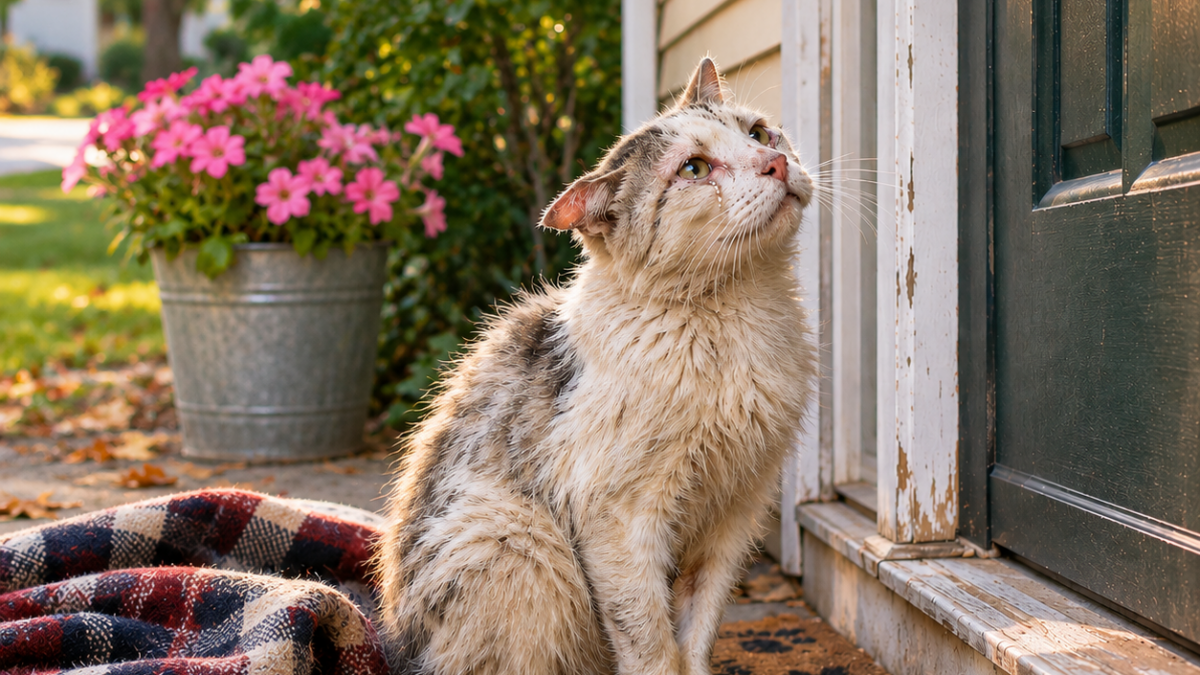
The little gray cat was thin enough that his ribs showed through his dusty coat, yet when the Lawson family placed a bowl of food in the yard, he barely looked at it and walked straight to their front door instead, sitting beneath the porch light as though hunger was not the thing he had come there to solve.
For three nights he returned to the same spot, refusing to leave even after storms rolled across the Indiana neighborhood, and when eight-year-old Sophie finally whispered, “I think he’s waiting for someone to let him belong somewhere,” her father began wondering whether the cat had once known exactly what a home felt like.
Then a veterinarian scanned the stray’s microchip and found the name of an owner who had been dead for eleven months, along with an address only six blocks away—and a shelter intake record proving somebody had promised to care for the cat after the funeral but had quietly left him behind instead.
The first time Daniel Lawson saw the cat, he thought it was dead.
That was not a dramatic exaggeration.
The animal was lying beneath the hydrangea bush at the edge of the backyard, half hidden by leaves, so thin and still that Daniel almost stepped past him while carrying a bag of grass seed toward the shed.
Then one gray ear moved.
Daniel stopped.
“Hey.”
Nothing.
He set the bag down.
The cat lifted his head.
Slowly.
A narrow gray face appeared beneath dusty fur.
Yellow eyes.
White chin.
One tiny notch in the left ear.
Daniel crouched.
“You alive?”
The cat stared.
Daniel immediately felt stupid.
“Great question.”
The cat lowered his head again.
It was the first Saturday in April, and the Lawson backyard looked like every suburban Indiana yard after winter finally began losing its grip.
Patchy grass.
Mud near the fence.
A trampoline Daniel had promised to take apart and move three months earlier.
A plastic soccer goal leaning sideways.
The hydrangeas had not bloomed yet.
His wife Claire was inside making grilled-cheese sandwiches.
Their daughter Sophie was supposed to be cleaning her room, which meant she was probably sitting on the floor reading something she had found while pretending to clean.
Daniel looked toward the house.
Then back at the cat.
He was painfully thin.
Not simply lean.
Thin in the way that made every movement look expensive.
Hip bones visible.
Shoulders sharp.
Fur dull.
His right front paw looked slightly swollen.
There was dirt around his nose.
Daniel stood carefully.
“Stay.”
The cat blinked.
PART2:
Daniel went inside.
Claire was at the stove.
“Do we own cat food?”
She looked at him.
“What?”
“Cat food.”
“We do not own a cat.”
“I’m aware.”
“Then no.”
“Do we have tuna?”
“Why?”
“There’s a cat.”
Claire turned.
“Where?”
“Backyard.”
“Whose?”
“Probably the cat’s.”
She gave him the look.
Daniel clarified.
“I don’t know.”
Claire turned off the burner.
“How bad?”
That was why he had married her.
She understood there were different kinds of “there’s a cat.”
He said:
“Thin.”
Claire immediately opened a cabinet.
“Tuna.”
They found one can.
PART3:
Sophie appeared as if summoned by the word cat.
“Did somebody say cat?”
“No.”
Daniel opened the can.
Claire looked at him.
“You literally said cat.”
“I meant no to whatever she’s about to ask.”
“I haven’t asked anything.”
Sophie was eight.
Brown hair.
Freckles.
Front tooth slightly crooked.
The ability to hear an adult whisper from three rooms away if the subject involved animals, dessert, or school cancellation.
“Where is it?”
“Outside.”
“Can I see?”
“Yes.”
“Can we keep it?”
“No.”
“You didn’t even see if I was going to ask.”
“You always ask.”
Sophie followed them out.
The cat had not moved.
Claire stopped six feet away.
“Oh.”
The single sound carried enough.
Sophie whispered:
“He looks hungry.”
Daniel placed tuna onto an old saucer.
He slid it forward.
The smell reached the cat.
His nose moved.
Daniel expected him to rush.
Anything that thin should have eaten like instinct itself.
Instead the cat looked at the food.
Then at Daniel.
Then stood.
His legs shook slightly.
He walked past the saucer.
Straight toward the house.
Sophie frowned.
“He missed it.”
“No.”
Claire watched.
“He knows where it is.”
The cat continued.
Across the patio.
Up two shallow porch steps.
Then stopped directly in front of the sliding glass door.
He sat.
Daniel looked at Claire.
Claire looked at Daniel.
Sophie whispered:
“He wants inside.”
“No.”
Daniel answered immediately.
Sophie looked at him.
“You didn’t even think.”
“I thought.”
“For zero seconds.”
“He could have fleas.”
Claire said it more gently.
“Or worms.”
“Or a disease.”
“He could belong to someone.”
Sophie looked at the cat.
The cat looked through the glass into the kitchen.
Not at them.
Inside.
That detail bothered Daniel.
He was not scanning the yard for food.
Not looking for an escape route.
Not moving toward bushes.
He sat at the door with the posture of an animal waiting for a human to perform the obvious next step.
Open it.
Sophie crouched beside him.
Not too close.
“Hey.”
The cat turned his head.
She extended one finger.
Daniel almost stopped her.
Claire touched his arm.
Wait.
The cat sniffed Sophie’s finger.
Then leaned forward.
Pressed his forehead into her hand.
Sophie’s face changed.
“He’s soft.”
Daniel looked at the dusty coat.
“Debatable.”
“He’s trying.”
The cat pushed harder into her palm.
Sophie scratched behind his ear.
His eyes closed.
Purr.
Barely audible.
Claire looked away.
Daniel knew that move.
His wife had already lost.
“Food first.”
Claire said.
Sophie brightened.
“Yes.”
They brought the tuna closer.
The cat ate.
Slowly.
That surprised Daniel too.
He expected desperation.
Instead the cat took small bites.
Paused.
Looked at the door.
Ate more.
When the plate was empty, he licked it once.
Then returned to the glass.
Sat.
Sophie folded her arms.
“He still wants inside.”
Daniel sighed.
“We are not bringing a strange cat directly into the house.”
“What if he has no house?”
“That’s what we need to figure out.”
“Can he stay on the porch?”
“For now.”
Sophie ran inside.
Daniel called:
“What are you doing?”
“Getting a blanket.”
“Not your good blanket.”
No answer.
“Sophie.”
She returned with her favorite fleece blanket.
Yellow.
Covered in little white stars.
Daniel closed his eyes.
“That is exactly the blanket I meant.”
“He’s cold.”
“It’s sixty-one degrees.”
“He’s thin.”
Claire whispered:
“Let her.”
Daniel looked at his wife.
“You’re supposed to help me remain rational.”
“I never agreed to that.”
Sophie folded the blanket beside the door.
The cat sniffed it.
Walked onto it.
Turned once.
Then sat again.
Facing the glass.
That became the image Daniel remembered.
Not starving cat eating tuna.
Not scared stray hiding beneath a bush.
A skinny gray cat sitting on a child’s blanket, staring through the back door at a kitchen table.
As if he remembered tables.
As if he remembered houses.
As if he had not come for food.
He had come for admission.
They spent the afternoon trying to find his owner.
Daniel posted a picture to the neighborhood Facebook group.
FOUND GRAY MALE CAT — MAPLE RIDGE AREA. VERY THIN. FRIENDLY. DOES ANYONE RECOGNIZE HIM?
Claire posted to a local lost-pet page.
Sophie made a sign in purple marker.
FOUND CAT.
HE IS NICE.
PLEASE CALL MY DAD.
Daniel removed the phone number before she taped it to the mailbox.
“No.”
“But how will people call?”
“Adults have methods.”
“That sounds suspicious.”
They walked the neighborhood.
Three streets.
Nobody knew him.
One woman said she had seen a gray cat near the drainage pond two weeks earlier.
A man thought he belonged to a family on Cedar Court.
He did not.
A teenage boy said:
“Yeah, that cat’s always around.”
“Always?”
Daniel asked.
“Like lately.”
“How lately?”
The boy shrugged.
“Month maybe.”
That mattered.
A month outdoors.
Maybe longer.
By evening, the cat had eaten twice.
Drunk water.
Used the blanket.
Still sat at the door.
When darkness came, Daniel tried moving the blanket beneath the covered porch table.
The cat returned to the glass.
“Buddy.”
Daniel crouched.
“You’re making this difficult.”
Purr.
“Don’t manipulate me.”
Purr.
Claire came outside carrying a cardboard box.
Daniel looked at her.
“No.”
“What?”
“You’re building him a house.”
“I’m giving him shelter for one night.”
“That’s how houses begin.”
She cut a doorway.
Put another towel inside.
Sophie added a stuffed animal.
Daniel removed it.
“He does not need your rabbit.”
“He might be lonely.”
“The rabbit is twenty dollars.”
“You bought it.”
“Exactly.”
The cat went into the box.
Five minutes later he came out.
Sat at the door.
Daniel laughed despite himself.
“You’re very bad at being stray.”
That night, rain began at 1:20.
Daniel knew because he was awake.
He had been thinking about the cat.
Ridiculous.
He went downstairs.
Turned on the porch light.
The cat was still there.
Wet.
The cardboard shelter stood three feet away.
Empty.
The gray cat sat pressed against the sliding glass door, soaked along one side where the wind pushed rain beneath the porch roof.
Daniel stared.
“Come on.”
The cat looked at him through the glass.
“You have a shelter.”
Meow.
First sound.
Tiny.
Daniel opened the door two inches.
The cat immediately stood.
“No.”
Daniel placed his hand in the gap.
“Not inside.”
The cat pressed his nose to his fingers.
Daniel felt how cold it was.
That ended the argument.
He opened the door.
The cat walked in.
Not rushed.
Not frightened.
Walked.
Across the kitchen tile.
Past Daniel.
Then stopped.
Looked around.
The room was dark except for the stove clock.
He sniffed.
Walked to the dining room.
Daniel followed.
The cat found the rug beneath the table.
Lay down.
Exhaled.
Daniel stared.
“You’ve done this before.”
The cat closed his eyes.
He did not pace.
Did not hide.
Did not panic.
He went to sleep in less than a minute.
Daniel stood there in pajama pants watching a stray cat sleep under his table at 1:34 in the morning.
Then Sophie’s voice came from behind him.
“You let him in.”
Daniel turned.
His daughter stood in the hallway holding her stuffed rabbit.
“Why are you awake?”
“I heard the door.”
“You hear gravity.”
Sophie looked under the table.
The cat slept.
“He knew where to go.”
Daniel nodded.
“Yeah.”
“He had a house before.”
Probably.
Sophie sat on the floor.
Daniel almost told her to go back to bed.
Instead he sat too.
The rain tapped the windows.
Sophie whispered:
“Can he sleep here?”
“One night.”
“You say that a lot.”
“Go to bed.”
The next morning, the cat was waiting at the kitchen doorway.
Not for food.
For Daniel.
When Daniel entered, the cat stood.
Walked to him.
Rubbed against his ankle.
Then followed him to the counter.
Breakfast happened afterward.
That pattern continued.
Food was important.
Company came first.
Sophie noticed.
“He says hi before he eats.”
Claire poured coffee.
“Very polite.”
Daniel opened canned food.
“Or manipulative.”
The cat meowed.
Sophie smiled.
“He likes you.”
“Poor judgment.”
By Monday, nobody had claimed him.
Claire called a veterinary clinic.
Maple Grove Animal Hospital.
Appointment that afternoon.
The cat hated the carrier.
That was the first thing he hated.
The second was the car.
He cried from the driveway to the clinic.
Sophie sat beside the carrier.
“It’s okay.”
Meow.
“You’re going to the doctor.”
LOUDER meow.
“He does not appreciate information.”
Daniel said.
The veterinarian, Dr. Nora Callahan, was in her forties with practical shoes and a habit of talking directly to animals before people.
“Well.”
She looked into the carrier.
“Who are you?”
The cat came out willingly.
“Friendly.”
Claire said.
“Very.”
Nora examined him.
“Male.”
“Neutered.”
“Probably six or seven.”
Daniel was surprised.
“He looks older.”
“He looks neglected.”
That word landed differently.
Nora continued.
“Underweight.”
“Moderate muscle loss.”
“Dehydration, mild.”
“Fleas.”
“Ear mites.”
“Some dental disease.”
“Paw abrasion.”
“Nothing immediately catastrophic.”
Sophie asked:
“Is he dying?”
Every adult turned.
Nora smiled gently.
“No.”
Sophie’s shoulders dropped.
“He needs food.”
“Parasite treatment.”
“Vaccines.”
“And somebody should probably tell him he’s not supposed to be this skinny.”
Sophie nodded seriously.
“I already did.”
Nora laughed.
Then:
“Let’s scan him.”
Daniel had almost forgotten microchips existed.
The scanner passed over the shoulders.
Nothing.
Again.
Beep.
Everyone stopped.
Nora looked at the display.
“Well.”
“He has a chip.”
Claire leaned forward.
“Registered?”
“Let’s see.”
The technician entered the number.
The database loaded.
Owner:
Margaret Ellis.
Address:
418 Cedar Grove Lane.
Daniel frowned.
“That’s here.”
Claire asked:
“How close?”
“Six blocks.”
Sophie brightened.
“We found his mom.”
Nora’s expression did not brighten.
She looked at the record.
“Phone disconnected.”
“Last update eleven months ago.”
“Cat name…”
She leaned closer.
“Jasper.”
Sophie looked at the cat.
“Jasper?”
His ears moved.
Claire whispered:
“Do that again.”
“Jasper.”
The cat looked directly at Sophie.
Her mouth opened.
“He knows it.”
Daniel felt something tighten.
Nora said:
“That is probably his name.”
Sophie touched his head.
“Hi, Jasper.”
Purr.
They drove to 418 Cedar Grove Lane that evening.
Jasper came too.
Daniel did not know whether that was wise.
But if someone claimed him, they would need proof.
The house was small.
Blue siding.
White trim.
Front yard overgrown.
Mailbox stuffed with flyers.
A realtor lockbox hung from the front door.
FOR SALE sign.
Daniel looked at Claire.
“This doesn’t look good.”
They knocked anyway.
No answer.
Neighbor across the street watched them.
Older man.
Sweater vest.
He walked over.
“You looking for Margaret?”
Daniel hesitated.
“We’re looking for information about her cat.”
The man stopped.
“Jasper?”
Sophie looked down at the carrier.
The cat had stood.
The neighbor stared.
“Oh my God.”
He approached.
“That’s him.”
“You know him?”
“Everyone knew Jasper.”
“What happened?”
The man removed his glasses.
“My name’s Henry.”
“Margaret died last May.”
Sophie’s expression changed.
“Oh.”
Henry looked at her.
“I’m sorry.”
“She was seventy-eight.”
“Cancer.”
“Stayed home almost until the end.”
Jasper meowed from the carrier.
Henry knelt.
“Hey, buddy.”
Jasper sniffed.
No immediate reaction.
Henry continued.
“He disappeared after she died.”
“How long after?”
“Few weeks.”
“Who had him?”
Henry looked toward the empty house.
“Her nephew.”
“What name?”
“Ryan Ellis.”
“Lived here?”
“For a while.”
“Came up from Kentucky to clear the place.”
Claire asked:
“Did he keep Jasper?”
Henry’s mouth tightened.
“He said he would.”
That answer carried trouble.
Daniel felt it.
“What does that mean?”
Henry lowered his voice even though nobody else was nearby.
“Margaret worried about that cat more than herself.”
“She asked everybody.”
“Me.”
“My wife.”
“Her niece.”
“Even the hospice nurse.”
“She wanted someone to promise Jasper wouldn’t go to a shelter.”
“Did Ryan promise?”
“Yes.”
“What happened?”
Henry looked at the carrier.
“He stopped letting him inside.”
Sophie’s head came up.
“What?”
Daniel touched her shoulder.
Henry continued.
“Ryan said Jasper shed too much.”
“Scratched a couch.”
“Kept waking him up.”
“So he put food on the porch.”
“How long?”
“Month maybe.”
“Then house got listed.”
“Ryan left.”
“And Jasper?”
Henry shook his head.
“He was still around.”
Claire’s face hardened.
“Did anyone feed him?”
“A few people.”
“My wife.”
“Lady two houses down.”
“But he disappeared after winter started.”
“Everybody assumed somebody had taken him.”
Daniel looked at Jasper.
Eleven months.
Owner died.
House emptied.
Doors closed.
People fed him sometimes.
Then even that stopped.
Sophie whispered:
“He waited at our door because his door stopped opening.”
Nobody answered.
They returned home with Jasper.
He walked out of the carrier.
Went straight to the sliding glass door.
Sat inside this time.
Looked out.
Daniel understood something that made his chest hurt.
The door mattered.
Not because Jasper wanted outdoors.
Because he wanted to know which side he belonged on.
Claire called the microchip company.
Updated status:
FOUND.
They gave contact information for a secondary email attached to Margaret’s account.
The email belonged to someone named Emily Hart.
Daniel sent a message.
Hello. We found a gray male cat whose microchip is registered to Margaret Ellis. His name appears to be Jasper. We understand Margaret passed away last year. If you are family or know what arrangements were made for him, please contact us.
The reply came three hours later.
CALL ME PLEASE.
Emily was Margaret’s daughter.
She lived in Oregon.
Her voice shook.
“You have Jasper?”
“Yes.”
“Alive?”
“Yes.”
“Oh my God.”
She started crying.
Daniel looked at Claire.
“Are you his owner?”
“No.”
“I mean…”
She inhaled.
“He was Mom’s.”
“After she died?”
“My cousin Ryan said he would take him.”
“Ryan is your cousin?”
“Yes.”
“I paid him.”
Daniel went still.
“What?”
“To stay at the house while probate was sorted.”
“And to care for Jasper.”
“How much?”
“That doesn’t matter.”
“It might.”
Emily hesitated.
“Eight hundred a month for six months.”
“That included cat care?”
“Yes.”
“Food.”
“Litter.”
“Vet.”
“I sent extra.”
Daniel looked at Jasper.
The cat was asleep near Sophie’s feet.
“Did Ryan tell you Jasper disappeared?”
“Yes.”
“When?”
“December.”
“That’s not what neighbors say.”
Silence.
“What do neighbors say?”
“He stopped letting Jasper inside months earlier.”
Emily did not answer.
Daniel heard breathing.
Then:
“No.”
“Henry across the street said—”
“No.”
Emily’s voice broke.
“Mom made him promise.”
Claire took the phone.
“Emily.”
“I asked him every week.”
“He sent pictures.”
Daniel frowned.
“Pictures?”
“Yes.”
“Jasper on the couch.”
“Jasper in the kitchen.”
“Sleeping on Mom’s bed.”
“How recent?”
“The last one was November.”
Henry said Jasper had been outdoors before that.
Claire asked:
“Can you send them?”
“I will.”
The first picture looked normal.
Jasper on a blue sofa.
The second:
Kitchen chair.
Third:
Bed.
Then Daniel noticed something.
Christmas decoration visible in the background.
Same tiny ceramic pumpkin.
Same folded newspaper.
Same position of a lamp cord.
Claire noticed too.
“They’re old.”
“What?”
“These weren’t taken weekly.”
“Same day maybe.”
Emily went silent.
Daniel checked image metadata.
The files had been re-saved.
No original date.
But visual details were unmistakable.
Ryan had been sending old photographs to make it appear Jasper remained inside while Emily kept paying him to care for the cat.
That changed the story.
It was no longer:
Overwhelmed relative fails to care for cat.
It became deception.
Emily called Ryan that night.
She did not tell Daniel beforehand.
Later, she sent a recording.
Indiana law on recording? Don’t need legal intricacy. Better she relayed content, not record.
Ryan initially claimed Jasper ran away in November.
Emily said neighbors saw him outside before that.
Ryan changed story.
Said Jasper kept escaping.
Then:
“It’s a cat, Em.”
Those words.
Emily repeated them to Daniel.
“It’s a cat.”
As if that explained the lie.
She asked what happened to the money.
Ryan told her he had expenses.
House repairs.
Gas.
Time.
“Did he buy food?”
“Some.”
“Veterinary care?”
“No.”
“He said Jasper didn’t need it.”
Daniel looked at the thin cat.
Needed it.
Emily cried.
“I live two thousand miles away.”
“I believed him.”
Claire said:
“You believed someone who promised you.”
“That’s different from abandoning Jasper.”
Emily did not sound convinced.
“Mom asked me.”
“What?”
“Before she died.”
“She asked if I would take him.”
“I said no.”
Daniel waited.
“My husband is allergic.”
“My apartment then did not allow pets.”
“I had reasons.”
“I told her Ryan would.”
“She said…”
Emily stopped.
“What?”
“She said Jasper doesn’t need reasons.”
“He needs a person.”
Sophie was listening from the doorway.
Daniel saw her face.
Claire saw too.
Later, after the call, Sophie sat beside Jasper.
“He came to us because he needed a person.”
Daniel nodded.
“Maybe.”
“No.”
She stroked him.
“He came to our door.”
“Yeah.”
“He already picked.”
Daniel almost said:
We need to find out legally what happens.
He stopped.
Children sometimes understand emotional facts before adults finish paperwork.
Two days later, Ryan called Daniel.
Not friendly.
“You have my aunt’s cat?”
“Margaret’s cat.”
“Whatever.”
Daniel’s jaw tightened.
“What do you want?”
“I hear Emily is making me sound like some animal abuser.”
“Did you keep Jasper outside?”
“He went outside.”
“Different sentence.”
“Look, man.”
Ryan sighed.
“You don’t understand.”
“Then explain.”
“My aunt’s house was disgusting after hospice.”
“Medical equipment.”
“Trash.”
“Cat hair everywhere.”
“I spent months cleaning.”
“Jasper peed in the basement.”
“He tore up carpet.”
“He howled every night.”
Daniel looked at the cat.
Jasper sat beside the front door.
Ryan continued.
“I tried.”
“For how long?”
“A while.”
“Then?”
“I put a heated box on the porch.”
“Food.”
“Water.”
“He was fine.”
“Then why lie to Emily?”
Silence.
“Why send old pictures?”
Ryan became defensive.
“Because she was calling constantly.”
“She lives across the country and suddenly she’s an expert.”
“So you lied to stop her asking questions.”
“I was doing the work.”
“You were being paid.”
“That barely covered anything.”
“Did you leave before Jasper disappeared?”
Silence.
“Ryan?”
“I had to go back to Kentucky.”
“And the cat?”
“Neighbors fed him.”
Daniel’s anger sharpened.
“You left an indoor cat outside in December.”
“He was fine outside.”
“He weighs seven pounds.”
“He probably lost weight after.”
“You were supposed to care for him.”
“I’m not arguing with you.”
“Good.”
Then Ryan said the thing that settled Daniel completely.
“If you want him, keep him.”
Like Jasper was a chair.
Like the problem had transferred.
Daniel replied:
“We plan to.”
Pause.
“I want no part of this.”
Daniel laughed once.
“You already had your part.”
He hung up.
Emily contacted an attorney handling Margaret’s estate.
There was no large trust.
No dramatic inheritance clause.
But there was a written note in Margaret’s personal papers.
Simple.
If Jasper cannot stay with family, please make sure he goes directly to a home. He is frightened by shelters and has never lived in a cage. I have set aside $2,500 for his veterinary care.
Ryan had known.
He had received the money as part of expenses.
What remained was unclear.
Emily pursued it.
Daniel told her:
“That’s between you and him.”
But the legal and family conflict mattered because the money was never the point.
Promise was.
Ryan eventually repaid $1,600 after Emily threatened civil action over funds specifically documented for Jasper’s care.
No courtroom.
No arrest.
No dramatic justice.
A reimbursement.
A written apology Emily requested.
And one family relationship permanently changed.
Sometimes consequences are ordinary.
They still matter.
Emily sent the money directly to Maple Grove Animal Hospital.
“Use it for Jasper.”
Daniel said:
“We can pay.”
“I know.”
“This was Mom’s.”
He stopped arguing.
Jasper’s first full month inside changed him visibly.
Weight returned.
Not fast.
Nora insisted gradual.
His coat became soft.
Fleas disappeared.
The paw healed.
His eyes brightened.
But food remained strangely secondary.
Every morning:
Greeting first.
Meal second.
Daniel would enter the kitchen.
Jasper would walk to him.
Rub.
Purr.
Then go to the bowl.
When Claire came home from work:
Door.
Rub.
Purr.
Food later.
When Sophie returned from school:
Jasper waited at the front window.
Then ran—if his dignified trot could be called running—to the door.
Sophie dropped her backpack.
Sat.
Jasper climbed partly into her lap.
One afternoon Daniel asked:
“Do you think he thinks we’ll leave?”
Sophie looked at him.
“Everybody leaves the house.”
“I mean leave him.”
She considered.
“Maybe.”
“What do we do about that?”
“Come back.”
Simple.
That became the family rule.
When they traveled, a pet sitter stayed at the house.
Not drop-in only.
Stayed.
Daniel thought it was excessive.
Then remembered Jasper sitting at the glass in the rain.
He stopped arguing.
Emily visited in June.
She flew from Portland.
Nervous.
“She may not know me.”
Daniel smiled.
“He.”
She laughed.
“Sorry.”
“Bad start.”
Emily stood outside the front door for a long moment.
Jasper was inside.
When Daniel opened it, he came.
Saw Emily.
Stopped.
She crouched.
“Hey, Jazz.”
That nickname did something.
Jasper’s ears lifted.
He stared.
Emily began crying.
“Oh my God.”
Jasper approached.
Slowly.
Sniffed her.
Then rubbed against her knee.
Emily sat on the floor.
Cried harder.
Sophie whispered:
“He remembers.”
Daniel did not correct her.
Maybe scent.
Maybe voice.
Maybe nickname.
Maybe not memory in the human sense.
Enough.
Emily stayed two days.
She told stories about Margaret.
Jasper slept on Margaret’s lap while she read mystery novels.
Jasper hated the vacuum.
Jasper once stole an entire rotisserie chicken breast from the counter.
Jasper slept beneath the Christmas tree every December.
Jasper waited outside the bathroom for Margaret.
Sophie smiled.
“He still does that.”
Emily’s face changed.
“What?”
“He waits outside ours.”
She laughed through tears.
“Mom used to say he had abandonment issues.”
The sentence landed differently now.
Everyone heard it.
That evening, Emily gave Sophie a small box.
Inside was a green collar.
Old.
Frayed.
Tiny brass tag:
JASPER
MARGARET ELLIS
418 CEDAR GROVE LN.
Sophie touched it.
“This was his?”
“Yes.”
“Why didn’t he have it when he came?”
“Ryan took it off.”
Daniel’s jaw tightened.
Emily continued quickly.
“I found it in Mom’s kitchen drawer.”
Sophie looked at Jasper.
“Can he wear it?”
Daniel asked Nora later.
Safe breakaway collar.
Yes.
They transferred the old tag to a new green collar.
Jasper did not care.
Sophie did.
“He has his name back.”
Daniel asked:
“Did he lose it?”
She thought.
“No.”
“We did.”
He understood.
Jasper became part of the family so gradually that Daniel could not remember the exact day he stopped thinking of him as temporary.
Maybe when he bought the automatic feeder.
Maybe when Claire ordered a heated cat bed.
Maybe when Sophie wrote JASPER LAWSON on a school family-tree assignment and her teacher did not object.
Maybe when Daniel called the vet and said:
“My cat.”
That one surprised him.
“My cat’s thyroid?”
“My cat needs a refill.”
My cat.
A small phrase.
Huge difference.
The neighborhood learned Jasper’s story.
Henry from Cedar Grove visited once.
Jasper recognized him enough to approach.
Henry cried.
“Margaret would lose her mind.”
“Good or bad?”
“Both.”
He sat with Jasper on the porch.
“She used to walk him.”
Daniel stared.
“On a leash?”
“Absolutely.”
“Why did nobody tell me?”
Henry smiled.
“You haven’t tried?”
“No.”
Two days later Sophie had a harness.
Daniel objected.
Jasper objected more.
After five minutes, both lost.
Eventually Jasper walked down the sidewalk.
Slowly.
Stopped at every shrub.
Neighbors watched.
Sophie looked proud.
“He remembers.”
Maybe.
The direction he chose led toward Cedar Grove Lane.
Daniel’s chest tightened.
Six blocks.
They followed.
Not all the way at first.
Halfway.
Then home.
The second week, Jasper reached the old street.
The house had new owners.
Painted door red.
Landscaping cleaned.
Jasper stopped across the road.
Stared.
Sophie looked at Daniel.
“Does he know?”
“I don’t know.”
Jasper sat.
Watched the house.
Not pulling.
Not crying.
After two minutes, he turned.
Walked back toward Sophie.
That mattered more.
Daniel did not need to make it mystical.
Old smells might remain.
Visual memory might matter.
Maybe Jasper recognized nothing.
But he turned away from the old house and followed them home.
Sophie talked about it for weeks.
“He picked again.”
Daniel smiled.
“Maybe.”
“You always say maybe.”
“Because I am emotionally responsible.”
“You are annoying.”
Claire agreed.
Fall came.
Jasper gained three pounds.
Nora finally said:
“Stop trying to make him round.”
Sophie looked offended.
“He was starving.”
“He is no longer starving.”
“But he likes food now.”
“That is how obesity begins.”
Daniel laughed.
Jasper’s favorite part of the day remained company.
He slept beside Sophie during homework.
Followed Claire into the laundry room.
Waited in the garage when Daniel worked.
At first, power-tool noise scared him.
Daniel built a little bed near the door.
Jasper learned.
Soon the sound of a drill barely made an ear move.
Daniel found himself talking to the cat.
Not baby talk.
Mostly complaints.
“Who designed this cabinet?”
Purr.
“Exactly.”
“Quarter-inch off.”
Purr.
“Unacceptable.”
The cat became a witness to ordinary life.
That was what Margaret had been to Jasper too.
Not grand events.
Breakfast.
Laundry.
Reading.
Sleep.
People misunderstand home when they reduce it to walls.
Home is repeated small things becoming safe through repetition.
Jasper learned the Lawson repetitions.
Bus at 3:18.
Claire’s car at 5:40.
Daniel making coffee at 6:05.
Sunday pancakes.
Friday movie night.
The vacuum on Saturday morning, which remained unacceptable.
A year passed.
Then another.
Jasper turned nine.
At least according to the chip record.
Emily mailed birthday cards.
Not for Daniel.
For Jasper.
One card contained:
Mom would be very offended that he likes your house.
Daniel framed it.
Sophie became ten.
Then eleven.
Jasper aged beside her.
Not old yet.
Middle-aged.
Still affectionate.
Still quiet.
Then one winter night, something happened that brought the old fear back.
Daniel was late.
Snowstorm.
Traffic stopped on I-465.
Phone battery died.
He normally arrived at 5:30.
6:00.
7:00.
Claire texted:
Drive safe.
At 8:15, Daniel finally came through the door.
Jasper was sitting directly behind it.
Sophie on the floor beside him.
“What are you doing?”
She looked up.
“He’s been here since six.”
Jasper stood.
Walked to Daniel.
Pressed both front paws against his leg.
Meowed.
Not loud.
But longer than usual.
Daniel crouched.
“Sorry.”
Jasper pushed his forehead into Daniel’s chest.
Daniel’s eyes burned unexpectedly.
Claire whispered:
“He doesn’t like people being late.”
Daniel understood.
Come back.
That family promise mattered because somebody once had not.
They changed nothing dramatic.
Just kept returning.
At twelve, Jasper developed kidney disease.
Early.
Manageable.
Nora explained.
Food.
Blood work.
Monitoring.
Sophie listened.
“Will it kill him?”
“Not today.”
“When?”
Nora smiled sadly.
“Hopefully many years.”
Sophie crossed her arms.
“Adults hate numbers.”
“Bodies hate schedules.”
Jasper remained well.
Emily visited every summer.
One year she brought Margaret’s old recipe book.
Sophie asked why.
Emily said:
“Because your mom feeds everybody.”
Claire laughed.
Daniel looked through it.
Handwriting.
Notes.
Pasta sauce.
Cookies.
Chicken soup.
On the back page:
JASPER — HALF CAN AM, HALF CAN PM. NO FISH. WILL LIE ABOUT BEING FED.
The family laughed.
Daniel looked at Jasper.
“You have committed fraud across multiple households.”
Jasper yawned.
Margaret remained present through these fragments.
Not as a ghost.
As history.
Her care had shaped the cat.
The Lawson family did not replace her.
They continued something she began.
That distinction mattered to Emily.
Once, she told Daniel:
“I felt guilty the first time I saw him happy here.”
“Why?”
“It felt like he forgot Mom.”
Daniel shook his head.
“Being happy again isn’t betrayal.”
Emily looked at him.
“That sounds like something people tell widows.”
“Probably.”
“You believe it?”
Daniel thought of his own father.
Of losses.
Of how guilt sometimes pretends loyalty requires permanent sadness.
“Yes.”
He did.
Jasper’s life did not stop at Margaret’s death.
That did not diminish Margaret.
It honored what she had given him.
Safety taught once can sometimes be relearned.
Sophie grew into a teenager.
Thirteen.
Then fourteen.
Jasper became slower.
Kidneys worse.
Arthritis mild.
Hearing fading.
Still front-door ritual.
At fourteen, Sophie came home crying one afternoon.
Friend drama.
The kind adults call small because they forget how large friendship feels at fourteen.
She went straight to her room.
Jasper followed.
Daniel checked later.
Sophie lay on the floor.
Jasper pressed against her chest.
She stroked him.
“I hate everybody.”
Daniel leaned against the door.
“Strong position.”
“Dad.”
“Leaving.”
As he turned, he heard Sophie whisper:
“You can stay.”
He looked back.
“Me?”
“No.”
Jasper purred.
Daniel left.
That night Sophie said:
“He’s good at not fixing things.”
“What?”
“He doesn’t try to make you feel better.”
“He just sits there.”
Daniel smiled.
“That’s sometimes the same thing.”
Sophie thought.
“Maybe.”
Jasper had come to their door because perhaps he too had needed someone who would not fix the past.
Just sit.
Stay.
Feed.
Return.
At fifteen, Jasper’s kidneys worsened enough for fluids.
Claire learned first.
Then Sophie.
Daniel was worst at it.
Hands too tense.
Nora said:
“Relax.”
“I am relaxed.”
“You look like you’re defusing a bomb.”
Jasper glared.
Daniel whispered:
“He agrees.”
They managed.
Good months.
One hospitalization.
Recovery.
Weight loss.
Gain.
Routine bending but not breaking.
At sixteen, Jasper became mostly deaf.
He no longer heard the front door.
But he felt vibrations.
Daniel would tap the floor twice before approaching from behind.
Sophie invented the signal.
Two taps.
Jasper looked up.
No startle.
At seventeen, exactly the age many people might call “too old,” Jasper developed serious renal decline.
The irony was not lost on Daniel.
He had once wondered whether an older cat was worth taking home.
Not Jasper specifically.
But the thought existed.
Now he would have traded almost anything for another year.
Nora looked at blood work.
“Not today.”
“Good.”
“But we’re closer.”
“Define closer.”
“No.”
Daniel hated that answer.
Sophie was sixteen.
Old enough to understand fully.
Young enough that it did not help.
Jasper slept more.
Still greeted everyone when awake.
Food became less important again.
That detail terrified them.
The whole story had begun with a cat ignoring food.
Now he did it for another reason.
One morning Claire opened chicken.
Jasper sniffed.
Turned away.
Then walked to Sophie.
Sat against her.
Sophie looked at Daniel.
“He’s doing it again.”
“What?”
“Choosing people over food.”
Daniel’s throat tightened.
The first time had meant:
Let me in.
Now maybe it meant:
Stay with me.
They did.
The final week was quiet.
Quality-of-life calendar.
Good.
Okay.
Bad.
Good.
Bad.
Bad.
Nora came to the house on Thursday.
Jasper lay on the yellow star blanket.
The same blanket Sophie had placed outside the first day.
She had kept it.
Faded now.
One corner chewed by a washing machine agitator.
Jasper’s green collar remained.
Margaret’s old brass tag.
JASPER.
Different address.
Still the name.
Emily joined by video from Oregon.
Henry from Cedar Grove had died two years earlier.
His wife sent a message:
Tell Jasper Margaret would be proud he found another good door.
Sophie read it aloud.
Claire cried.
Daniel did too.
No one pretended otherwise.
Jasper’s breathing was comfortable.
Body tired.
Nora said:
“We don’t have to rush.”
Sophie sat beside him.
“I’m not ready.”
Nora nodded.
“I know.”
“That doesn’t help.”
“No.”
Jasper lifted his head.
Pressed his nose against Sophie’s fingers.
Same gesture.
Years earlier.
Backyard.
Door.
Finger.
Forehead.
Connection.
Sophie cried.
“You chose us.”
Daniel almost corrected.
Maybe.
He did not.
Some uncertainty is respectful.
Some moments do not require it.
Sophie whispered:
“We kept opening the door.”
Jasper purred.
Faint.
Claire sat behind her.
Daniel on the other side.
Emily’s face on the tablet.
Sophie continued:
“You don’t have to wait at one anymore.”
Daniel broke.
Full tears.
No defense.
Nora gave the sedative.
Jasper relaxed.
His head settled onto the yellow blanket.
Emily said:
“Mom loved you first, Jazz.”
Claire whispered:
“And we loved you after.”
Daniel touched the green collar.
“You got a lot of people, buddy.”
Sophie placed one hand on his chest.
“Come home.”
Not Margaret’s phrase.
Not inherited.
Hers.
Jasper exhaled.
Nora waited.
Then final medication.
One breath.
Second.
Still.
The front door stayed open for a few minutes afterward because spring air moved through the house.
Nobody planned that.
Daniel noticed.
The same door Jasper once sat outside was now behind them.
Open.
No waiting.
No glass between.
His ashes were divided.
A small portion went to Emily.
She scattered them beneath a tree in Margaret’s old church cemetery.
Not on Margaret’s grave without permission.
Near it.
The rest stayed with the Lawsons.
Sophie chose the urn inscription:
JASPER
HE DIDN’T WANT FOOD.
HE WANTED IN.
Daniel objected.
“That sounds like he never ate.”
Sophie smiled through tears.
“He ate plenty.”
True.
They changed it.
JASPER
HE FOUND THE RIGHT DOOR.
Better.
The $1,600 Ryan repaid had never been fully spent.
Emily had added money over the years.
When Jasper died, $940 remained in a veterinary credit account.
Emily asked:
“What do we do?”
Sophie answered immediately:
“Help another one.”
The clinic transferred the funds through a local rescue arrangement.
First recipient:
A gray stray with dental disease.
Daniel laughed when Nora told him.
“Of course gray.”
“Universe lacks subtlety.”
The family did not adopt another cat immediately.
The house needed time.
Front door felt different.
Kitchen doorway empty.
Sophie still looked at the window at 3:18 during summer without realizing.
Months later, a young orange cat appeared on the rescue website.
Then another.
Then a senior black cat.
Sophie looked.
No rush.
At seventeen, she volunteered at the shelter.
Daniel drove her.
One Saturday he picked her up.
She got into the car.
“Dad.”
“No.”
“I didn’t say anything.”
“You have a face.”
“There’s a cat.”
“No.”
“Eleven.”
“No.”
“Her owner moved into memory care.”
Daniel stared ahead.
“Absolutely not.”
“She’s really quiet.”
“No.”
“She ignores food when people come in.”
He turned.
Sophie smiled.
“That was manipulative.”
“I learned from Jasper.”
They did not adopt that day.
A month later they did.
Her name was Millie.
Eleven.
Brown tabby.
Not a replacement.
No animal should have to be.
Millie had her own habits.
Loved food first.
People second.
Hated laps.
Slept alone.
Daniel loved that about her.
Different cat.
Different life.
Jasper remained Jasper.
People sometimes tell stories about strays as if hunger explains everything.
Food matters.
Water matters.
Veterinary care matters.
Shelter matters.
Those are necessities.
But animals who have lived with humans can lose something else when abandoned.
Pattern.
Belonging.
Expectation.
A door that opens when they approach.
A voice that answers.
A body in the next room.
Routine is invisible until it disappears.
Jasper had spent months with bowls appearing outside.
People left food.
Neighbors helped.
They were kind.
That probably kept him alive.
But he kept wandering.
Six blocks.
More.
Then one Saturday he entered the Lawson yard.
Thin.
Dusty.
Tired.
Daniel placed food in front of him.
Jasper looked at it.
Then walked to the house.
That choice became the story everyone remembered.
Not because cats understand houses like humans do.
Not because Jasper was making a speech.
Because behavior is sometimes clearer than language.
He ate.
But first he sat at the door.
He accepted food.
But what changed him was being allowed to cross the threshold.
Sophie was right from the beginning.
His loudest cry for help made no sound.
It was simply a cat sitting on the wrong side of a piece of glass, staring at people who still had the power to open it.
The Lawsons opened the door.
Then they kept opening it.
Every return.
Every morning.
Every late shift.
Every trip.
Every difficult year.
Until Jasper no longer needed to wait.
And years later, when Daniel thought about that first Saturday, he never remembered the tuna.
He remembered the cat walking past it.
Straight to the house.
As if he had already survived enough meals without belonging.
As if food could keep his body alive, but only kindness could convince him that life was safe again.
Jasper had once lost the woman who loved him, the house he knew, the person who promised to care for him, and finally the certainty that any door would open.
Then one did.
That was all.
No miracle.
No grand rescue.
Just a family willing to look at a silent animal and understand that sometimes the thing being asked for is not something you can put in a bowl.
Sometimes the greatest hunger is to be wanted somewhere.
And sometimes home begins when somebody finally opens the door.








