The Starving Orange Cat Ran After My Car in the Freezing Rain—Then Led Me Back to the One He Refused to Leave Behind
PART3:
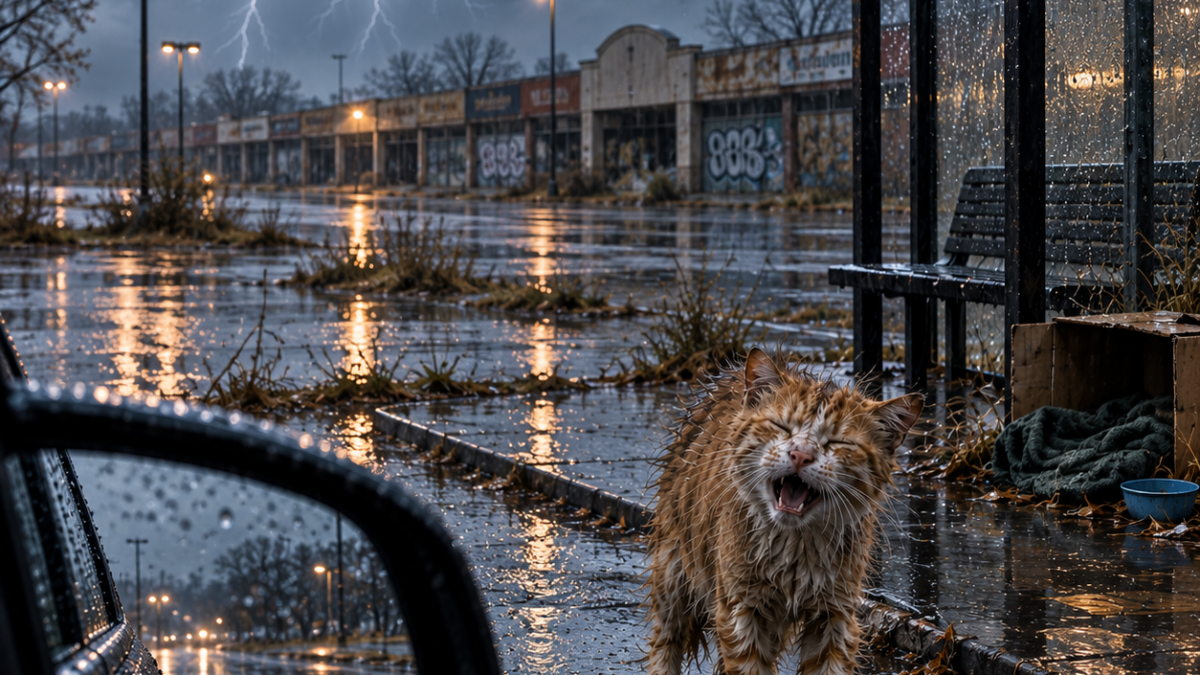
He stopped about twenty feet behind my car, standing in the rain with his head lowered and his sides heaving. Water dripped from his whiskers. His eyes were enormous and green, too bright in that thin, starving face.
I opened my door.
Cold rain hit my cheek.
The cat lifted his head and made a rough, broken sound.
It barely sounded like a meow.
It sounded like a voice that had been used too much for too long with nobody answering.
“All right,” I whispered. “I’m listening.”
He turned away.
That surprised me.
I thought he would come toward me, desperate for food or warmth or whatever he thought my car meant. Instead, he limped toward the old bus stop near the edge of the plaza.
Then he looked back.
Checking.
Waiting.
I stepped out of the car.
The rain soaked through my work shoes almost immediately.
The cat continued toward the bus stop, stopping every few feet to look back and make sure I followed.
Under the metal bench was a soaked cardboard box.
The box had once held canned tomatoes. The label had peeled away in pieces. One side had collapsed from rain, and the bottom looked soft enough to fall apart if lifted. Inside were an old blue towel, an empty plastic bowl, and a few pieces of spoiled cat food turned gray and swollen from the weather.
The cat climbed into the box and sat down.
Not comfortably.
Not like it was shelter.
Like it was all he had.
That was when I noticed the collar.
It was dark blue, almost black from rain, hanging far too loose around his neck. He had lost so much weight that the collar looked like it belonged to a different cat. Attached to it was a tiny piece of paper sealed beneath clear plastic. Most of the writing had been destroyed by water.
But one sentence was still readable.
He is a good cat. I’m sorry.
I read it once.
Then again.
The rain kept falling.
I looked around the empty parking lot.
No one was coming back for him.
No headlights turning in.
No person hurrying across the pavement with an umbrella, calling his name, saying this had been a mistake.
Only freezing rain.
Distant traffic.
A starving orange cat staring at me from a cardboard box as if he already understood what it meant to be left behind.
I wish I could say I picked him up immediately.
I didn’t.
I stood there thinking about money.
Food.
Vet bills.
Medicine.
Flea treatment.
Worm treatment.
Whatever else a cat that thin and wet and abandoned might need.
Then I thought about my house.
Not big, but too large for one person since Tom died.
My husband had been gone two years.
Two years, three months, and eleven days, though I never said the exact count out loud because people became uncomfortable when grief kept accurate records.
Tom had been a school bus mechanic. He smelled like metal, coffee, and the lemon soap he used in the garage sink. He could fix almost anything except his own heart, which betrayed him one ordinary Tuesday morning while he was standing in our kitchen buttering toast.
He was sixty-one.
No warning that mattered.
No dramatic goodbye.
Just a coffee mug breaking on the tile and my whole life splitting open with it.
Our daughter, Allison, flew in from Arizona with her husband and our two grandsons. She stayed for ten days, organizing papers, answering calls, holding my hand in rooms full of casseroles and people saying Tom was “in a better place” when the only place I wanted him was beside me at the kitchen table.
Then she went home.
Of course she did.
She had a job.
Children.
A life.
Phoenix was a long way from Ohio, and grief does not grant anyone unlimited leave.
She called when she could.
I told her I was fine.
I became very good at that word.
Fine.
Fine meant I had paid the electric bill.
Fine meant I had eaten something with protein twice that week.
Fine meant I had not cried at work.
Fine meant the television stayed on until I fell asleep because silence had become a room I did not know how to enter.
Most nights, I came home from the laundromat, heated something from a can, and watched old crime shows without remembering the plots.
My house had once been full of people.
Tom laughing at the radio.
Allison leaving shoes in the hallway no matter how many times I complained.
Grandchildren visiting in summer, spilling cereal, slamming screen doors, turning every quiet corner into a place where something could be sticky.
Now the house stayed clean.
That was supposed to be a blessing.
It felt like punishment.
The orange cat stepped out of the box.
Slowly.
Carefully.
He came toward me.
I held still.
He reached my shoe, lowered his head, and gently rubbed his face against it.
That was it.
The whole decision.
Not noble.
Not planned.
Not affordable.
Just one starving animal pressing what little strength he had left against the toe of my wet work shoe.
“I can’t promise you much,” I whispered. “But you’re not staying here.”
He would not let me pick him up.
Every time I reached toward him, he backed away and hissed.
Not a fierce hiss.
A scared one.
The kind that says, I want help, but I remember hands.
So I opened the rear door of my car and waited.
Rain ran down the back of my neck.
Cars passed on the main road, headlights blurred by water.
The cat stood beside the box, shivering.
“You have to choose,” I said softly. “I’m too old to chase you through a parking lot.”
He stared at me.
“I mean it.”
Ten minutes passed.
Maybe more.
Then, slowly, with the caution of an animal who had learned that every safe thing could change shape, he climbed into the back seat by himself.
I shut the door gently.
On the drive home, he did not make a sound.
That frightened me more than crying would have.
At home, I set up the laundry room.
It was the warmest small room in the house, with a door I could close, an old rug near the dryer, and a window over the back steps. I placed a folded blanket on the floor, filled a shallow dish with water, and opened a can of tuna because it was the only cat-adjacent food I had.
He came out of the car only when I backed away.
Inside, he hid beneath a small table where I kept detergent.
Only his eyes showed.
Enormous green eyes.
Exhausted.
Watchful.
I slid the tuna and water closer.
He did not move.
“You don’t have to eat while I’m here,” I said.
Nothing.
So I sat on the floor across the room.
My knees objected immediately.
I ignored them.
“You’re not the only one who doesn’t trust people anymore,” I whispered.
I don’t know why I said it.
Maybe because he couldn’t interrupt me.
Maybe because he looked just as tired as I felt.
I told him about Tom’s old radio in the kitchen, the one he used to turn on every Sunday morning while making pancakes. I told him how Allison used to leave her shoes in the hallway, right where I would trip over them, and how I would give anything to trip over them again.
Then I said something I had never said out loud.
“The house gets so loud when it’s quiet.”
The cat blinked.
Rain tapped against the laundry room window.
The dryer hummed softly behind me though there was nothing inside it. I had turned it on for warmth and noise.
When I finally stood to leave, one tiny orange paw slowly reached out from beneath the table.
Not far.
Just enough that I could see it.
Just enough to tell me he had heard.
That night, I slept badly.
I kept waking and listening.
At two in the morning, I heard a strange rattling sound downstairs.
At first, I thought it was the furnace.
Then the sound came again.
Metal.
Glass.
The laundry room.
I pulled on my robe and hurried downstairs.
The laundry room door was still closed.
But the window was partly open.
The cat was gone.
For a moment, I simply stood there staring at the empty room.
The food bowl was untouched.
The water had been drunk halfway.
The blanket was still folded.
I should have been annoyed.
After all that effort, he had left.
But the feeling that moved through me was not anger.
It was dread.
Because I already knew where he had gone.
I grabbed my coat, my keys, and the flashlight from the junk drawer.
The rain had not stopped.
It had turned harder, colder, almost icy by the time I drove back toward the shopping plaza. My wipers fought to keep up. My headlights showed only silver lines of rain, empty road, and black pavement shining like oil.
“You foolish cat,” I whispered.
But my hands were shaking.
The old bus stop appeared through the rain.
I pulled into the lot.
My headlights swept across the empty storefronts, the cracked pavement, the boarded windows, and finally the metal bench.
Two green eyes flashed beneath it.
He was there.
The orange cat was curled inside the same soaked cardboard box where I had found him earlier.
But he was not alone.
Beside him was another cat.
A tiny gray kitten.
The kitten was so small at first I thought it was part of the towel. Then it moved. Its whole body trembled with shivers. Its fur was soaked flat against its ribs. One little paw rested against the orange cat’s side.
I stopped the car and ran toward them.
The orange cat stood immediately.
He could barely stand.
Still starving.
Still weak.
Still shaking.
But he positioned himself between me and the kitten.
Not attacking.
Not fleeing.
Guarding.
As if saying, Please. Take the baby first.
I crouched down in the rain.
“Oh, buddy,” I whispered. “Is this why you came back?”
He did not move.
He simply looked at me.
Then glanced toward the kitten.
And I understood.
He had not escaped because he did not trust me.
He had gone back because he knew someone else needed him.
The tiny gray kitten made a sound so small it barely reached me through the rain.
That sound broke something open inside my chest.
“I’ve got you,” I said.
I took off my coat and wrapped the kitten in it. The little body was frighteningly cold. When I lifted it, the orange cat did not hiss.
He watched my hands.
Then, as if some decision inside him had been made, he allowed me to reach for him.
He weighed almost nothing.
A grown cat should not feel that light.
I carried them both to the car.
The orange cat did not fight.
He kept his eyes on the bundle in my coat until I placed the kitten beside him on the back seat.
Only then did he lower his head and press his nose gently against the kitten’s fur.
I sat in the driver’s seat with rain dripping from my hair and both hands on the wheel.
For a moment, I could not drive.
I kept thinking about that note.
He is a good cat. I’m sorry.
Whoever wrote it had known.
Known he was good.
Known they were leaving him.
Known enough to apologize, but not enough to stay.
At home, I carried them both into the laundry room.
This time, the orange cat did not hide beneath the table.
He watched while I made a nest with towels warmed from the dryer. I placed the kitten in the middle. The orange cat climbed in beside it immediately, curling his thin body around the tiny gray one.
The kitten pressed against his belly.
He rested his chin gently on its head.
I sat on the floor beside them for a long time.
The laundry room smelled like wet fur, tuna, detergent, and rain.
Somehow, it felt more alive than the rest of my house had in years.
The next morning, I called the veterinarian as soon as they opened.
“We have an emergency appointment at ten-forty,” the receptionist said.
“I’ll take it.”
The orange cat did not appreciate the carrier.
The kitten was too weak to protest.
I wrapped them both in towels and drove carefully, talking the whole way.
“You two are going to behave,” I said.
The orange cat glared through the carrier bars.
“That means you.”
Dr. Helen Navarro had been our family veterinarian years earlier when Allison had a guinea pig named Pancake and later a beagle mix named Daisy. I had not seen her since before Tom died.
She recognized me immediately.
“Elaine?”
I nodded.
Her face softened in that way people’s faces always do when they remember your dead husband before deciding whether to mention him.
“It’s good to see you.”
“You too.”
Then she looked at the carrier.
“What do we have?”
“A problem,” I said.
Dr. Navarro examined the orange cat first.
He was severely underweight.
Dehydrated.
Covered in fleas.
Ear infection.
Old scars.
Dental disease.
A healing wound near one hip.
His temperature was low but not dangerously so after the night indoors.
“He’s been struggling for a while,” she said.
“I found him at the old plaza.”
Her mouth tightened.
“Dumping spot.”
The words made my stomach turn.
She examined the kitten next.
Female.
Maybe six or seven weeks old.
Malnourished.
Dehydrated.
Upper respiratory infection starting.
Fleas too.
But alive.
Both had a chance.
That sentence became the first good thing I let myself believe.
“They’re bonded?” Dr. Navarro asked.
“I don’t know.”
The orange cat watched the kitten from inside the carrier, body tense until the technician placed her back beside him.
Dr. Navarro smiled faintly.
“He thinks they are.”
I named him Oliver because I had to put something on the clinic forms.
The little gray kitten became Rosie because Allison had once wanted to name every animal Rosie when she was four.
That afternoon, I spent more money than I should have.
Exam fees.
Medication.
Special food.
Flea treatment.
Dewormer.
Eye ointment for Rosie.
Antibiotics.
Follow-up appointment.
I handed over my debit card with a calm expression and quietly prayed nothing else broke before payday.
At home, Oliver and Rosie returned to the laundry room.
For the first few days, Oliver barely left Rosie’s side.
He waited until she ate before touching his own food.
If she cried, he immediately got up.
If she slept, he stayed close.
Once, I moved Rosie to clean the towel beneath her, and Oliver dragged himself forward despite his weakness, eyes wide, one paw reaching toward her.
“I’m not taking her,” I said. “Just changing the blanket.”
He did not believe me.
I respected that.
Trust is not owed.
Especially not by the abandoned.
I fed them small meals.
Often.
The first time Oliver ate while I sat in the room, I felt prouder than I had any right to feel. He crouched beside the bowl, watching me between bites, ready to flee if I became dangerous.
I stayed still.
“That’s right,” I whispered. “Eat.”
He did.
Rosie recovered faster because kittens are made partly of chaos and partly of hope. Once she had warmth and food, life returned to her little body in bright bursts. Within a week, she was wobbling across the laundry room, batting at towel corners, attacking Oliver’s tail, and falling asleep mid-play as if someone had removed her batteries.
Oliver improved more slowly.
His body had learned starvation too well.
He ate carefully at first, as though food might vanish if he trusted it too much. He slept lightly. Every loud noise made him flinch. When I entered the room carrying laundry, he watched my hands.
Always my hands.
One evening, I sat across from him and held out my fingers.
“You know, I’m not the one who left you.”
He stared.
“I know that doesn’t matter much.”
Rosie pounced on his tail.
He flicked it once, gently.
“I wouldn’t trust me either.”
He sniffed my fingers.
Then, very slowly, touched his cheek against them.
I cried so suddenly that Rosie stopped playing and stared at me like I had done something inappropriate.
“Sorry,” I said, wiping my face.
Oliver pulled back slightly.
“It’s fine. Humans leak sometimes.”
That was the beginning.
After that, he allowed small things.
Eating while I was there.
Sleeping without hiding.
Letting me apply medication without acting like betrayal was inevitable.
Weeks passed.
The laundry room door stayed open during the day now. Rosie discovered the hallway first. She crept out like an explorer entering forbidden territory, then sprinted back to Oliver as if reporting the findings.
Oliver waited.
He always let Rosie go first.
Eventually, he followed.
One room.
Then another.
The kitchen.
The living room.
The old hallway where Allison’s shoes once sat.
The house changed under their paws.
Rosie turned everything into a toy.
A bread tie.
A receipt.
The drawstring of my robe.
My shoelaces.
Oliver watched her with the patience of an old soul who had raised too many emergencies already.
The first time Rosie climbed onto the couch, she slipped, scrambled, and tumbled backward onto a pillow. Oliver immediately got up from the rug, limped over, and sniffed her head.
Rosie batted his nose.
He sat down as if satisfied she was fine.
I laughed.
The sound startled me.
Not because I never laughed.
I did.
At work sometimes.
On the phone with Allison.
At television shows when something was actually funny.
But laughter inside my own house had become rare enough that it sounded unfamiliar.
Oliver looked at me.
“What?” I asked.
He blinked slowly.
I laughed again.
That night, I left the television off.
The quiet remained.
But it was different now.
There was Rosie chasing invisible things down the hallway.
Oliver drinking from his bowl.
The faint jingle of the little bell Dr. Navarro had put on Rosie’s temporary collar.
The house was not loud.
It was inhabited.
Allison called every Sunday evening.
I had not told her right away.
Not because I wanted to hide Oliver and Rosie.
Because I knew what she would say.
Not judgment.
Concern.
“Mom, can you afford it?”
“Mom, are you taking on too much?”
“Mom, are you okay?”
Questions that carried love, yes, but also reminded me that I had become someone my own child worried about from across the country.
When I finally told her, she was silent for three seconds.
“Mom.”
“I know.”
“You adopted two cats?”
“I rescued two cats.”
“Are they staying?”
“That is a separate question.”
“Are they?”
Rosie chose that moment to sprint across the living room and slam into an empty laundry basket.
Allison heard the crash.
“What was that?”
“The small one.”
“There’s a small one?”
“I said two cats.”
“I thought maybe one was metaphorical.”
I laughed.
Then sent photos.
Oliver looked terrible in the first one. Thin, damp-looking even when dry, one ear ragged, eyes too big for his face.
Rosie looked like a gray dust bunny with ears.
Allison called back immediately.
“Oh, Mom.”
“I know.”
“No, I mean…” Her voice softened. “They’re sweet.”
“They’re work.”
“So were we.”
I remembered Evan from another life.
Another story.
No, not Evan.
Allison.
My daughter, small once, feverish in my arms at two in the morning, crying because her ear hurt and Tom could not find the children’s medicine.
So were we.
I sat down.
“Do you think I’m foolish?”
“For saving starving cats?”
“For spending money I don’t really have.”
She sighed.
“I think you sound more alive than you have in two years.”
I looked toward Oliver.
He was sitting near the hallway, Rosie asleep between his front paws.
“I don’t know what I’m doing.”
“None of us do.”
“You have children.”
“Exactly.”
I smiled.
Oliver gained weight slowly.
A pound.
Then another.
His fur filled in, no longer clinging to bone. The orange deepened from dull rust to warm copper. His spine stopped looking like a ridge beneath fabric. His tail lifted when he walked.
Rosie grew faster than seemed possible.
Her legs lengthened.
Her eyes brightened.
Her little gray body became sleek and quick, all mischief and confidence.
She adored Oliver.
Followed him everywhere.
Slept pressed against him.
Stole food from his bowl until I began feeding them separately, which offended her deeply.
Oliver tolerated everything.
Except when Rosie cried.
Any cry, any distressed sound, and he came running.
Even months later, once Rosie was healthy and dramatic for no reason, Oliver responded as if her life depended on him.
Sometimes I wondered whether she was his kitten.
Not biologically, probably.
He was male, and she was not likely related.
But biology is not the only thing that creates family.
He had stayed with her in a freezing cardboard box when he could barely keep himself alive.
That counted.
One evening in January, I was listening to Tom’s old radio in the kitchen.
I had not done that in a long time.
The radio sat on the counter near the breadbox, still set to the oldies station Tom liked. After he died, I avoided turning it on because the sound of those songs without him whistling badly along felt cruel.
But that night, I turned it on.
A scratchy song from the seventies filled the kitchen.
I stood there for a moment with one hand on the counter.
Then Oliver walked in.
He looked healthier by then, though still thin around the hips. Rosie was asleep in a cardboard box in the living room, her favorite place despite three beds I had foolishly bought.
Oliver jumped onto a chair.
Then the table.
“Absolutely not.”
He ignored me.
He stepped down onto my lap with careful, deliberate paws.
I froze.
He had never done that before.
He turned in a circle once, then curled into a small orange ball against me.
His purr started quietly.
Not loud like a machine.
Soft.
Worn.
Real.
I put one hand gently on his back.
The radio played.
Rain tapped at the kitchen window.
And for the first time in two years, I cried without trying to hide it.
Not because I was sad.
Because the house did not feel empty anymore.
Oliver did not move.
He stayed through the whole storm.
By spring, the old bus stop was gone.
The county finally removed it when they began work on the abandoned plaza. I drove past one morning on my way to the laundromat and saw a crew lifting the metal bench into a truck.
For a moment, I had to pull over.
That ugly little place had nearly been Oliver and Rosie’s grave.
Now it was only debris being hauled away.
I sat there with my hands on the wheel, remembering the cardboard box, the blue towel, the note.
He is a good cat. I’m sorry.
I still had the note.
The paper had dried warped and fragile. I kept it in a plastic bag inside a kitchen drawer with warranties, spare batteries, and a photograph of Tom holding Allison when she was five.
I do not know why I kept it.
Maybe anger.
Maybe proof.
Maybe because Oliver’s story had started before me, and I did not want to erase that part just because it hurt.
I never found out who left him.
I asked around quietly. Dr. Navarro posted a vague inquiry on a local lost-and-found page, though we both knew the collar note made “lost” unlikely. No one came forward.
At first, I imagined a villain.
Someone cold.
Someone cruel.
Someone who drove away without looking back.
Later, when my anger softened into something more complicated, I imagined a person in trouble.
Eviction.
Illness.
Debt.
A sudden move.
Someone who loved him enough to write he was good but not enough, or not able enough, to do the harder thing.
I still believe leaving him there was wrong.
Freezing rain.
An empty plaza.
No guarantee anyone would stop.
No guarantee Rosie would survive.
But I have lived long enough to know that some people fail not because they do not feel love, but because their fear is stronger than their responsibility.
That does not excuse it.
It only makes the world sadder.
Summer came.
Allison visited in July with her husband, Ben, and my grandsons, Caleb and Noah.
The boys burst through the front door like weather.
“Grandma!”
The house filled instantly.
Shoes in the hallway.
Backpacks on chairs.
Snack wrappers appearing in impossible places.
For one panicked second, Oliver disappeared under the couch.
Rosie, who feared almost nothing, stood in the middle of the living room with her tail puffed, then decided the boys were toys and began following them.
Caleb fell in love with her immediately.
Noah wanted Oliver.
“Why is he hiding?”
“He’s cautious.”
“Did somebody scare him?”
I sat on the floor beside the couch.
“Before he came here, yes.”
Noah, only seven, became very serious.
“We can be quiet.”
For ten minutes, both boys sat perfectly still on the rug.
This was so unusual that Allison took a photo.
Oliver eventually emerged.
Slowly.
He sniffed Noah’s fingers.
Noah did not grab.
Did not squeal.
Just whispered, “Hi, Oliver.”
Oliver touched his cheek to the boy’s knuckles.
Noah looked at me like he had been knighted.
That evening, after dinner, Allison stood in the hallway listening.
Rosie was chasing a crinkly toy.
Caleb and Noah were laughing.
Oliver sat on the couch beside me, not in my lap, but close.
Allison smiled.
“Mom,” she said, “the house sounds different.”
I looked around.
“It does.”
She sat beside me.
“Who rescued who?”
I laughed.
“I don’t know.”
Maybe that was the truth.
I thought I had rescued a starving cat from a freezing parking lot.
But that night, when I had been sitting alone in a quiet house, Oliver was the one who came back.
He brought me Rosie.
Then he brought me routine.
Noise.
Responsibility.
A reason to come home and turn on the lights.
A reason to cook actual meals because he liked sitting in the kitchen while I did.
A reason to leave the television off and let the house fill with real sounds.
Years have not passed since then.
Only months, really.
But sometimes healing begins so quietly you do not notice until you are already living differently.
I still work at the laundromat.
I still come home tired.
I still miss Tom so badly some mornings that I stand in the kitchen and touch the old radio before turning it on.
I still tell people I’m fine sometimes because there are days when explaining would take too much.
But when I open the door now, Rosie usually arrives first, skidding across the floor like a gray comet.
Oliver follows more slowly.
Dignified.
Orange tail high.
Eyes bright.
He sits in the hallway and waits for me to set down my bag.
Then he steps forward and rubs his face against my shoe.
The same way he did in the rain.
Every time, I remember.
Not the cold first.
Not the fear.
The choice.
His.
Mine.
Both of us deciding, in our own frightened ways, to trust one more time.
Sometimes, late at night, Oliver still climbs into my lap and rests his head against my chest.
His body is heavier now.
Warm.
Solid.
Alive.
Rosie often sleeps nearby, though sometimes she attacks the curtains at midnight for reasons known only to her and possibly demons.
When the house becomes too quiet, I put my hand on Oliver’s back and feel him breathing.
Rise.
Fall.
Rise.
Fall.
That is enough.
I still think about the note on his collar.
He is a good cat. I’m sorry.
I wish whoever wrote it could see him now.
Not because I want to shame them.
Maybe I did at first.
Now I think I want them to know that the good cat they left behind survived.
That he kept someone smaller alive.
That he found a house with warm towels, too many cardboard boxes, a widow who talks too much, and a kitten who thinks every curtain is a personal challenge.
I want them to know he is not waiting in the rain anymore.
He is not in the cardboard box.
He is not running after cars with the last of his strength.
He is asleep on my lap as I write this, one paw tucked beneath his chin, Rosie curled against his side.
And he is not just a good cat.
He is family.
People say rescue stories are about saving animals.
Sometimes they are.
But sometimes they are about being interrupted before you disappear completely into your own loneliness.
Sometimes they are about a starving orange cat chasing your car through freezing rain because he has one more life to protect.
Sometimes they are about returning to the place that hurt you because someone you love is still there.
And sometimes, the creature you think you are saving is the one who looks at your empty house, your canned soup, your television noise, your careful little routines, and decides you need rescuing too.
Oliver could not know any of that when he ran after my car.
He only knew Rosie was cold.
He only knew the box was failing.
He only knew the rain was getting worse and the person in the car had slowed down.
So he ran.
Weak.
Starving.
Soaked.
Terrified.
He ran anyway.
That is the part I carry with me.
Not the abandonment.
Not the note.
Not even the first night.
The running.
The impossible little body refusing to quit because love, in its purest form, does not always look gentle.
Sometimes it looks like a starving cat chasing taillights through freezing rain because someone smaller is waiting under a bus stop bench.
And thank God I looked in the mirror.
Thank God I stopped.
Because Oliver was not only asking for help.
He was offering me a way back to the living.
One wet pawstep at a time.