The Sheriff’s K9 Had Never Broken Heel—Then He Saw an Old Farmer in the Lobby and Sat Down Without a Command
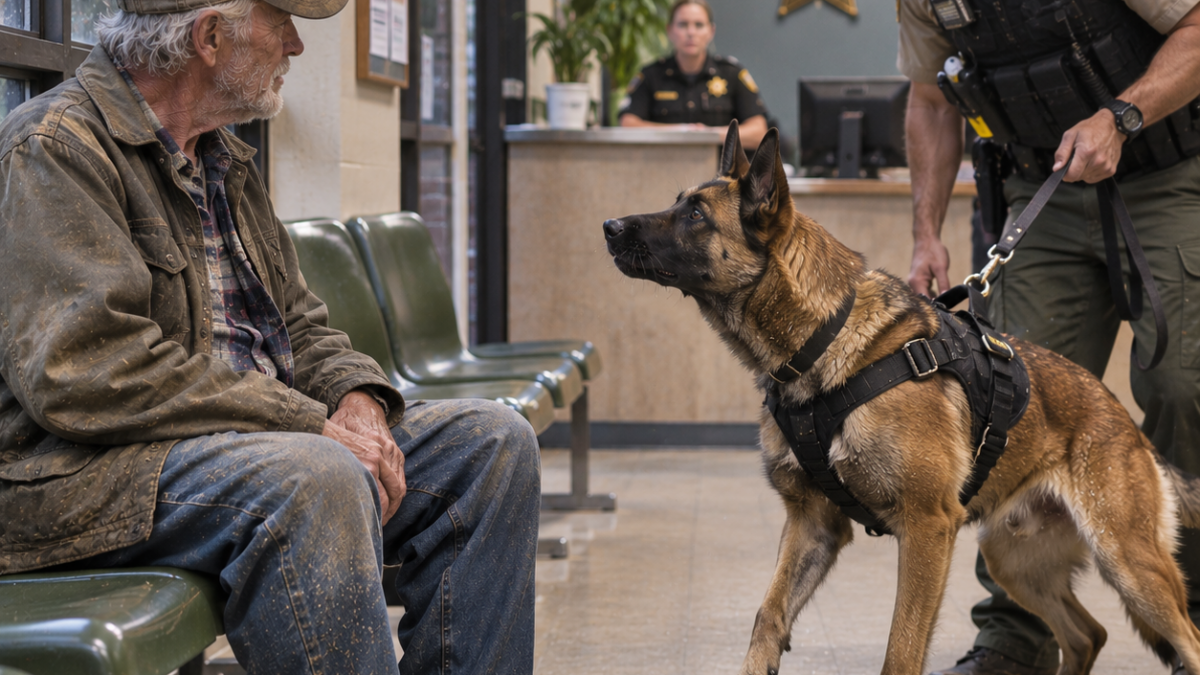
The Sheriff’s K9 Had Never Broken Heel—Then He Saw an Old Farmer in the Lobby and Sat Down Without a Command.
Officer Dale Pruitt had walked his Belgian Malinois through the Harlan County Sheriff’s Department lobby hundreds of times without the dog once breaking heel—until Atlas saw the weathered old farmer sitting alone in the third plastic chair and stopped so hard one paw hung in the air.
The old man never called the dog, never reached toward him, and never introduced himself, but one quiet “Good dog” made Atlas sit as if he had just recognized someone he had been trained years earlier never to forget.
Eleven days later, when Atlas spotted the same farmer thirty feet away and gave a response Pruitt had only seen when the dog had found something important, the officer finally started asking who Elias Calloway had been before he disappeared onto twelve acres outside Dunmore.
The fluorescent lights in the lobby of the Harlan County Sheriff’s Department had a low electric hum that Officer Dale Pruitt stopped hearing sometime during his first year.
After four years, most of the building had become invisible to him.
The check-in counter with peeling laminate.
The faded motivational poster over the water fountain.
The old avocado-green chairs bolted together in rows of four.
The gray tile.
The stale coffee smell.
The scuffed baseboards.
A place could become so familiar that the mind stopped spending attention on it.
People could too.
That Tuesday morning in late October, Pruitt came through the front entrance at 8:15 after a double shift that should have ended hours earlier.
A fender-bender on Route 9 had turned into a shouting match.
Two domestic calls had come in before sunrise.
Three reports still needed signatures.
His body armor felt twenty pounds heavier than when the night began, and thirty-two ounces of gas-station coffee were doing more to keep his heart moving than his brain.
Behind him walked Atlas.
Belgian Malinois.
Four years old.
Seventy-one pounds.
Certified in patrol work and explosive detection.
Pruitt had worked Atlas long enough that the dog’s movement felt almost connected to his own nervous system.
A slight change in leash tension meant something.
One ear rotating meant something.
A half-second pause meant something.
Atlas did not waste motion.
He walked at heel across the lobby with the mechanical precision of a working animal who had crossed the same floor hundreds of times and concluded nothing inside it deserved curiosity.
That morning, an old man was sitting in the third chair from the window.
Pruitt noticed him only peripherally.
Late sixties.
Maybe seventy.
Canvas work jacket faded from green to the color of old dust.
Worn blue jeans.
PART2:
Boots stained with field dirt and machine oil.
Cap pulled low.
Large hands folded in his lap.
Farmer.
That was the category Pruitt’s exhausted brain assigned.
Local farmer waiting to talk to someone about trespassing, fencing, equipment theft, maybe a neighbor dispute.
Nothing unusual.
The man wasn’t scrolling through a phone.
Wasn’t reading.
Wasn’t tapping his foot.
He simply sat.
There was something almost old-fashioned about how still he was.
Waiting seemed less like an inconvenience to him than something he had practiced.
Pruitt moved past.
Dropped his folder on the counter.
Started toward the hallway that led to the kennel room.
Atlas stopped.
Not slowed.
Stopped.
His left front paw remained suspended for the smallest fraction of a second before settling onto the tile.
His head turned.
Ears forward.
Weight shifted back.
Tail completely still.
PART3:
Pruitt took another step before the leash told him his partner had not followed.
He turned.
“Atlas. Heel.”
Nothing.
The dog stared at the old man.
Pruitt’s exhaustion lifted slightly.
Not because Atlas was disobeying.
Because he wasn’t behaving like a disobedient dog.
No leash pulling.
No growl.
No threat posture.
No curiosity sniff.
Just stillness.
Focused.
Deliberate.
Pruitt had seen that body language only a few times.
Lackland instructors had described it to him years earlier.
Recognition response.
Even the trainers had been careful with the term.
Dogs recognize patterns humans cannot identify.
Scent.
Movement.
Conditioning.
Associations.
Sometimes something in a person triggers a trained response nobody around the dog immediately understands.
The old man raised his eyes.
Looked at Atlas.
Then Pruitt.
His expression barely changed.
“Good dog.”
Atlas sat.
Pruitt stared.
The desk sergeant looked up from her monitor.
For three seconds, nobody said anything.
Then Pruitt said:
“He doesn’t do that.”
The old man looked at him.
“Do what?”
“Sit for strangers.”
There was a pause before the man answered.
Not hesitation.
Selection.
Like he had several possible responses and wanted the one that revealed the least.
“My dad thinks I’m a stranger too.”
Pruitt frowned.
It wasn’t exactly a joke.
If it was, the old man didn’t smile.
“You been in here before?”
“No.”
“You know working dogs?”
“Some.”
“What kind?”
Again the pause.
The old man’s pale eyes moved briefly toward a blank part of the wall.
“The kind that doesn’t come up in conversation much.”
Pruitt was too tired for riddles.
He gave Atlas another command.
This time the dog stood and returned to heel.
But as Pruitt led him toward the hallway, Atlas looked back once.
Only once.
The old man was watching him.
Pruitt put Atlas in the kennel.
Closed the gate.
Stood there longer than necessary.
“Good dog,” he muttered.
Atlas looked toward the hall.
Pruitt returned to the lobby.
The old man remained in the third chair.
The desk sergeant, Marcy, glanced at Pruitt.
Marcy had ten years in the department and almost no curiosity left for ordinary human nonsense.
Her expression now contained just enough curiosity to matter.
Pruitt asked the old man:
“You waiting for somebody?”
“Sergeant Wills.”
“He expecting you?”
“At eight-thirty.”
Pruitt checked the clock.
8:20.
“What name?”
“Elias Calloway.”
Pruitt gave Marcy the information.
She radioed upstairs.
“Wills, your eight-thirty is here.”
A pause.
Then Sergeant Warren Wills:
“I’ll be down at eight-thirty.”
Marcy looked at Atlas’s hallway.
Then the old man.
Then pressed the radio again.
“Might want to come down now.”
That made Pruitt look at her.
Marcy did not make suggestions.
Not casually.
Not to Wills.
Especially not about whether a scheduled appointment should start eight minutes early.
Wills appeared less than two minutes later.
Fifty-three.
Former Army MP.
Seventeen years with the department.
Thick build.
Face permanently arranged into the expression of a man who had watched too many people lie badly.
He came through the stairwell holding coffee.
Saw the old man.
Stopped.
“Mr. Calloway?”
The farmer looked up.
“Wills.”
Not Sergeant.
Not Officer.
Just Wills.
Something small shifted in the older sergeant’s face.
Pruitt noticed.
“Want to come upstairs?”
Elias Calloway stood.
The jacket had made him look smaller while seated.
Standing, he was nearly six feet.
Age had rounded his shoulders slightly, but underneath it was a posture Pruitt knew.
Not military exactly.
Something adjacent.
Balanced.
Hands relaxed.
Head level.
No unnecessary movement.
Calloway followed Wills upstairs.
Their meeting was scheduled for twenty minutes.
It lasted forty-three.
Pruitt finished two reports while occasionally looking toward the stairwell.
At 9:05, Elias came down.
Same expression.
Same jacket.
Same quiet pace.
Whatever happened upstairs had apparently changed nothing about him.
Pruitt looked up.
“All set?”
Calloway stopped.
Again that pause.
“For now.”
Then he walked outside.
Pruitt watched him cross the lot.
The vehicle waiting there matched the man almost too perfectly.
Early-nineties Ford F-150.
Faded red.
Rust over the rear quarter panel.
No decorative plates.
No political stickers.
Nothing saying veteran, farmer, retired anything.
Just a truck.
Calloway climbed in.
Started it.
Drove away.
Pruitt went upstairs.
Wills stood at his office window watching the truck leave.
“Who is he?”
Wills didn’t turn.
“Elias Calloway.”
“I got that part.”
“Farms outside Dunmore.”
“How long?”
“Twelve years, give or take.”
“What did he do before?”
Wills finally turned.
His face looked different.
Not frightened.
Recalibrated.
“Longer conversation.”
Pruitt leaned against the doorframe.
“Does the longer conversation explain why Atlas sat down when he saw him?”
Wills held Pruitt’s gaze for three seconds.
“Yeah.”
“What is it?”
Wills returned to his desk.
“Not today.”
That should have ended Pruitt’s interest.
It didn’t.
Driving home that morning, he kept seeing Atlas freeze in the lobby.
The old man’s hands.
The measured answers.
The phrase:
The kind that doesn’t come up in conversation much.
Pruitt had spent four years building mental categories for people.
Afraid.
Angry.
Drunk.
Manipulative.
Embarrassed.
Dangerous.
Lonely.
Innocent people often wanted to explain everything.
Guilty people sometimes explained too much.
Elias Calloway seemed to operate by a different rule.
Answer exactly what was asked.
Nothing more.
Nothing less.
Then stop.
Eleven days later, Calloway returned.
Pruitt was outside at 7:55 running Atlas through a scent exercise.
The dog was working a controlled circuit around several training containers when the faded red Ford entered the parking lot.
Pruitt noticed it first.
Atlas noticed something else.
The dog completed the current scent pass.
Stopped.
Raised his head.
Both ears came forward.
Calloway got out thirty feet away.
Same jacket.
Same boots.
Same cap.
He started toward the entrance without looking at Pruitt.
Atlas made a sound.
Pruitt had heard it only under high-intensity field conditions.
Not bark.
Not whine.
Something between.
A low vocalization used when the dog had located something important.
Found it.
That was what it meant to Pruitt.
Atlas walked forward.
Not pulling.
Not frantic.
Measured.
The leash reached full length.
Atlas stopped.
Sat.
Stared at Calloway.
The old man stopped walking.
Turned.
Looked at the dog.
“He’s well trained.”
Pruitt said:
“I didn’t train him.”
Calloway’s eyes moved toward him.
“Lachlan did.”
Pruitt felt the back of his neck tighten.
“How do you know that?”
Calloway looked at Atlas once more.
Then toward the sheriff’s department door.
He said nothing.
Walked inside.
Atlas stayed seated.
Watching the doorway.
Pruitt crouched.
“You know him.”
Atlas’s ears remained forward.
Pruitt repeated quietly:
“You know.”
That afternoon he found Wills in the break room.
Wills went there when he wanted people to believe he was somewhere else.
Pruitt came in without paperwork.
Wills saw him.
“Whatever you’re about to ask, no.”
“Tell me about Calloway.”
“No.”
“He knew Lachlan.”
Wills stopped pouring coffee.
“He said the name before I ever told him who conditioned Atlas.”
Nothing.
“And Atlas gave a find response.”
Wills took a drink.
“Not patrol alert.”
“Not scent alert.”
“Recognition.”
Wills stared into the cup.
Pruitt continued:
“You told me last time you knew why.”
Silence.
“So tell me.”
Wills sighed.
“You ever hear of CTAP?”
“No.”
“Counter-Terrorist Assessment Program.”
Pruitt waited.
“Department of Defense.”
“Specialized program. Some of it ran through Bragg, some through a Fort Huachuca annex.”
“When?”
“Long enough.”
“That’s not an answer.”
“It’s the one I’m giving.”
“What did Calloway do?”
Wills lowered his voice.
“Consulted.”
“On?”
“Working dog integration.”
Pruitt laughed once.
“That’s it?”
“Officially.”
“And unofficially?”
Wills looked directly at him.
“I called someone after his first visit.”
“Who?”
“Doesn’t matter.”
“What’d they say?”
Wills thought.
Then:
“They were careful.”
“What does careful mean?”
“It means the kind of careful people get when there’s still a locked file cabinet somewhere.”
Pruitt sat.
Wills continued.
“CTAP used contractors for parts of its dog program.”
“Breeding.”
“Early conditioning.”
“Selection.”
“Certain dogs that went into active service were conditioned to recognize more than their assigned handler.”
“What else?”
“Program contacts.”
Pruitt stared.
“People?”
“Small group.”
“How?”
“Scent association.”
“Command patterns.”
“Movement.”
“Depends on the cohort.”
Pruitt thought about Atlas.
“Atlas is 18B.”
“2021?”
“Yes.”
Wills nodded.
“Then that tracks.”
Pruitt felt almost annoyed.
“You’re saying my dog has been conditioned to recognize some retired farmer in Harlan County?”
“I’m saying Atlas reacted to Calloway the way a program dog can react to an authorized contact.”
“Is Calloway one?”
“I don’t know.”
“You just said—”
“I said that’s what the dog’s behavior resembles.”
Wills leaned closer.
“I am not telling you Elias Calloway’s service history because I do not have Elias Calloway’s service history.”
“Then what do you have?”
“A few verified pieces.”
“Which are?”
“Enough to know that farming outside Dunmore was not his first career.”
Pruitt sat back.
“What was?”
Wills picked up his coffee.
“That’s the longer conversation.”
Three weeks passed.
Calloway became an unanswered question Pruitt carried around without intending to.
The matter that brought Elias to the department was surprisingly ordinary.
A land dispute.
Not his property.
A neighboring parcel.
A development company from Louisville had been assembling acreage for a commercial project.
Boundary filings had started changing.
Old easement language had been interpreted creatively.
One owner had complained.
Then another.
Wills called some of the documents “interesting.”
That was Wills’s polite word for something he believed smelled bad.
Elias had apparently come in as a resource.
That was the word Wills used.
Resource.
Pruitt did not know what information he provided.
He noticed consequences.
The development company’s attorney, Beshear, visited the department repeatedly for several weeks.
Then stopped.
A regulatory review appeared in state records.
The disputed parcel remained untouched.
Pruitt had no evidence Elias caused any of that.
So he did not tell himself he had.
But the timing stayed with him.
The third time Elias came to the station was before sunrise on a cold November morning.
Pruitt was alone in the lobby.
Atlas wasn’t with him.
The building had the strange quiet institutional places have before everyone arrives.
Fluorescent lights.
Coffee machine.
Heat moving through old vents.
At 6:40, the front door opened.
Elias Calloway entered.
Same jacket.
Same cap.
Same boots.
He stopped.
Looked at Pruitt.
Performed that same measured visual sweep.
Boots.
Belt.
Hands.
Badge.
Face.
Done.
Pruitt had noticed it enough times now that he understood it wasn’t casual observation.
It was assessment.
Elias approached the counter.
Placed a large legal envelope on the laminate.
“For Wills.”
“He isn’t in yet.”
“I know.”
“You want me to put it in his office?”
“Yes.”
Pruitt looked at the envelope.
Unsealed.
Top folded closed.
No writing visible.
“What is it?”
Elias looked at him.
A pause.
“For Wills.”
Fair.
Pruitt nodded.
“I’ll make sure he gets it.”
Calloway looked toward the lobby.
The green chairs.
Then the third chair from the window.
The one he had occupied during his first visit.
He stared at it for two seconds.
Something unreadable passed over his face.
Then he turned and left.
Pruitt did not open the envelope.
He wanted to.
He was also a police officer and not twelve years old.
Twenty minutes later, he placed it squarely in the center of Wills’s desk.
Wills arrived at 7:55.
Pruitt could see his office through the glass.
Wills entered.
Set down coffee.
Saw the envelope.
Opened the fold.
Looked inside.
He did not remove whatever was there.
Just looked.
Then stopped moving.
Thirty seconds.
Maybe more.
Finally, he closed the envelope.
Placed it in his top drawer.
Locked the drawer.
Looked through the glass directly at Pruitt.
Held the look.
Then returned to work.
No explanation.
That afternoon, Pruitt took Atlas to the north field.
Half-mile conditioning circuit.
Brown winter grass.
Bare trees.
Low gray sky.
Atlas ran perfectly.
At the southeast fence line, the dog stopped.
Pruitt followed his gaze.
Faded red truck.
Moving along the access road.
One rust patch.
Calloway.
Too far away to see the driver clearly.
Atlas did not bark.
Did not pull.
He simply watched.
That same found-it stillness.
The truck reached Route 9.
Turned east.
Disappeared.
Atlas waited another second.
Then resumed the circuit.
Pruitt remained at the fence.
The dog knew him.
Whatever that meant.
That night Pruitt started reading.
CTAP existed.
Partially declassified.
Fragments appeared in old defense documents, training studies, archived contracting notices.
Nothing dramatic.
Nothing like the conspiracy websites that turned every redacted government program into assassins and aliens.
Mostly dry language.
Risk assessment.
Counterterrorism.
Canine cognition.
Environmental conditioning.
Handler interoperability.
Early-contact imprinting.
There were references to contractors.
Some names were visible.
Most were not.
One document mentioned a consultant named Lachlan Mercer.
That made Pruitt sit straighter.
Atlas’s early conditioning supervisor had been Dr. Owen Lachlan.
Different first name.
Could have been coincidence.
Pruitt searched more.
Found a professional paper.
Owen Lachlan.
Working-dog cognition specialist.
Previous affiliation partially redacted.
Pruitt stopped.
He had worked with Lachlan only during Atlas’s transition period.
Lachlan had been older.
Quiet.
Strange sense of humor.
Never discussed previous government work.
Once, during a training session, Atlas broke from a scent pattern and approached a visiting civilian standing outside the range.
Lachlan had watched the dog carefully.
Pruitt remembered asking:
“What was that?”
Lachlan replied:
“Sometimes dogs remember people they’ve never met.”
Pruitt assumed he was joking.
Now the sentence bothered him.
The next morning he cornered Wills.
“You knew Lachlan was connected to CTAP.”
Wills looked up.
“I suspected.”
“You could’ve mentioned that.”
“You could’ve gone home and slept instead of spending your night on government archives.”
“How do you know what I did?”
“You look terrible.”
Pruitt ignored him.
“Was Elias part of the dog program?”
“I told you what I know.”
“You know more.”
Wills looked at him for a long time.
Then closed his office door.
“Sit down.”
Pruitt did.
Wills remained standing.
“The call I made after Calloway’s first visit went to a retired federal liaison.”
“Name?”
“No.”
“Fine.”
“What did he say?”
“He asked why I was calling.”
“I told him a farmer named Elias Calloway had come in.”
Wills paused.
“He got quiet.”
“What then?”
“He asked me to confirm the spelling.”
“And?”
“I did.”
“What did he say?”
Wills looked uncomfortable.
“He said, ‘If Elias Calloway is sitting in your lobby asking politely, I suggest you listen before somebody gives him a reason to stop asking politely.’”
Pruitt stared.
“That sounds threatening.”
“It wasn’t said like a threat.”
“How was it said?”
“Like experience.”
Pruitt felt the room shrink slightly.
“What did Elias give you?”
Wills’s expression closed.
“That concerns an active matter.”
“The land case?”
“Yes.”
“What was in the envelope?”
“Same answer.”
“Was it classified?”
“No.”
“Illegal?”
“No.”
“Useful?”
Wills almost smiled.
“Very.”
“Where did he get it?”
“Pruitt.”
“Right.”
Pruitt stood.
At the door, he stopped.
“Does Calloway know Atlas recognizes him?”
Wills thought.
“I think Calloway knew before you did.”
That stayed with Pruitt.
Winter arrived.
Calloway did not return for almost two months.
The development project stalled.
State regulators opened a broader inquiry.
An older survey record surfaced showing easement language inconsistent with the developer’s filing.
Again, Pruitt had no proof Elias supplied it.
Again, timing suggested he might have.
One January afternoon, Pruitt drove Route 9 on a routine call.
On the return trip, he took the long road past Dunmore.
He told himself it was because the highway was icy.
That was only partly true.
He found Calloway’s property accidentally enough to preserve his conscience.
Faded red Ford beside a weathered barn.
Twelve acres.
Fencing.
Small farmhouse.
Equipment shed.
No security cameras visible.
No gate.
No signs warning trespassers about government secrets.
A man in a canvas jacket stood repairing a fence.
Farmer.
Completely.
Pruitt drove past.
Elias did not look up.
For some reason, that made the mystery stronger.
Pruitt had expected hidden compounds.
Something.
Instead:
Fence posts.
Mud.
Tractor.
Cattle feeder.
A life deliberately ordinary.
At the station the next morning, Wills asked:
“Enjoy your drive?”
Pruitt stared.
“What?”
“Dunmore.”
“How do you know?”
“You are a terrible investigator when the person you’re investigating spent decades being better at it.”
Pruitt sat down.
“He saw me.”
“Of course he saw you.”
“He didn’t look up.”
“That doesn’t mean he didn’t see you.”
Pruitt sighed.
“Who was he?”
Wills’s expression softened.
“Maybe you should ask him.”
“So he can tell me ‘the kind that doesn’t come up in conversation much’?”
“Maybe that’s the answer he wants you to have.”
“That doesn’t bother you?”
Wills considered it.
“No.”
“Why?”
“Because the things he’s done since I’ve known him are legal, useful, and mostly aimed at preventing people from getting hurt or cheated.”
“That’s a low standard.”
“It’s a surprisingly useful one.”
Spring came.
Atlas and Pruitt kept working.
Explosive sweeps.
School threats.
Searches.
Patrol calls.
One evening after a long training day, Pruitt sat beside Atlas’s kennel and thought about recognition.
Dogs build their world through scent in ways people barely understand.
To Atlas, Pruitt was not primarily a face.
He was thousands of chemical signals.
Soap.
Sweat.
Leather.
Coffee.
Stress.
Home.
Work.
Fear.
Calm.
Every person was an environment.
What did Elias smell like to Atlas?
Not simply farmer.
Something buried in the conditioning architecture of the dog.
A scent association from early breeding?
An odor profile connected to old training materials?
A pattern of posture?
Voice?
Command cadence?
Maybe Atlas had reacted to something not mystical at all.
Something technical.
Deeply conditioned.
That explanation made more sense.
It also made Elias more interesting.
Because if Atlas had been conditioned to recognize people like him, who exactly were people like him?
The answer came only partially.
And not from Wills.
It came from Elias himself.
Four months after the first lobby encounter, Pruitt was working the front desk when the farmer walked in again.
No appointment.
No envelope.
Atlas was beside Pruitt.
The dog saw Elias.
Froze.
Then sat.
Elias stopped.
“Still doing that.”
Pruitt smiled.
“Apparently.”
For the first time, Elias smiled too.
Barely.
Pruitt gestured toward the row of green chairs.
“This seat taken?”
Elias looked at the chair beside him.
“No.”
Pruitt sat.
Atlas settled between them.
For almost a minute nobody spoke.
Then Pruitt said:
“I looked up CTAP.”
“I figured.”
“How?”
“You drove past my farm.”
Pruitt laughed.
“You did see me.”
“Yes.”
“Could’ve waved.”
“You looked busy pretending you weren’t looking for me.”
Fair.
Pruitt rubbed Atlas’s neck.
“Why does he know you?”
Elias looked at the dog.
“Know is a big word.”
“He recognizes you.”
“Yes.”
“Why?”
Another pause.
Pruitt had learned to wait through them.
Finally:
“Before I farmed, I helped evaluate working-dog programs.”
“That’s the official answer.”
“It’s also true.”
“What did you evaluate?”
“Dogs.”
Pruitt laughed.
Elias did not.
“Specific dogs?”
“Specific programs.”
“CTAP?”
“Yes.”
“Lachlan?”
“Yes.”
“You knew him?”
“I knew a few Lachlans.”
“Owen.”
Elias’s face changed slightly.
“Yes.”
“How well?”
“Well enough.”
“Was Atlas bred from your program?”
“No.”
“Conditioned through one?”
“Descended from methodologies.”
“That sounds intentionally vague.”
“It is.”
Pruitt looked down at Atlas.
“What does he recognize?”
Elias was quiet for a long time.
Then he lifted one hand.
Not touching the dog.
Palm down.
Two fingers relaxed.
Atlas immediately lowered his head.
Pruitt stared.
He had never taught that response.
Elias removed the hand.
Atlas returned to neutral.
Pruitt whispered:
“What was that?”
“Old contact signal.”
“For what?”
“Stand down without losing attention.”
“How does Atlas know it?”
“He shouldn’t.”
That answer disturbed Pruitt more than if Elias claimed magic.
“You’re saying something from an old program survived into his conditioning.”
“Training systems survive people.”
“Sometimes nobody remembers why a step exists.”
“Dogs remember the step.”
Pruitt looked at him.
“So the first morning…”
“He saw something familiar.”
“You.”
“Maybe.”
“What exactly?”
“Stillness.”
“Hand position.”
“Scent.”
“Cadence.”
“Could be several things.”
Pruitt said:
“You knew when you saw him.”
“I suspected.”
“Why didn’t you tell me?”
Elias looked at him.
“Would you have believed me?”
Pruitt thought.
“No.”
“Then Atlas explained it better.”
They sat.
Pruitt finally asked:
“What did you do in CTAP?”
Elias stared toward the front doors.
“Assessment.”
“That’s the name.”
“Yes.”
“You know what I mean.”
Elias’s hands rested on his knees.
“I spent years going places where someone needed to decide whether the information in front of them was real.”
“People?”
“People.”
“Dogs.”
“Security systems.”
“Training failures.”
“Threats.”
“Sometimes all of them at once.”
“Military?”
“Sometimes.”
“Intelligence?”
Elias looked at him.
“That’s the kind that doesn’t come up in conversation much.”
Pruitt smiled.
There it was.
He let the question go.
After a moment Elias nodded toward Atlas.
“You’re good with him.”
“Thanks.”
“No.”
Elias looked directly at him.
“I mean you’re good for him.”
That landed differently.
“How can you tell?”
“He watches you before he watches the room.”
Pruitt looked down.
Atlas’s ears shifted.
“Is that good?”
“It means he trusts your judgment more than his anxiety.”
“He’s not anxious.”
“All working dogs are anxious about something.”
“That drive has to come from somewhere.”
Pruitt thought about the restless pacing Atlas sometimes did after difficult calls.
Elias continued:
“Don’t make the mistake of thinking discipline removes emotion.”
“It shapes it.”
“That’s different.”
Pruitt nodded slowly.
“Lachlan said something similar.”
“He learned it the hard way.”
“From you?”
“From dogs.”
The front door opened.
A woman came in carrying paperwork.
The moment ended.
Elias stood.
Pruitt did too.
“You leaving?”
“Yes.”
“Why’d you come?”
Elias looked toward Wills’s office.
“To tell him the state closed the parcel review.”
“And?”
“The developer withdrew.”
“So you won.”
Elias’s face remained neutral.
“Nobody should think of property disputes that way.”
Pruitt laughed.
“You’re definitely a farmer now.”
Elias looked at Atlas.
“Good dog.”
Atlas sat.
Again.
Then Elias walked out.
Pruitt watched through the window as the faded red Ford pulled away.
He did not follow.
Did not search databases.
Did not ask Wills for the locked envelope.
He had finally begun understanding the boundary.
Elias Calloway had lived another life.
A serious one.
One built around people and dogs trained to notice things before anyone else.
He had left it.
Now he repaired fences.
Managed twelve acres.
Drove an old truck.
Helped when somebody nearby was about to lose land through questionable paperwork.
That was enough.
Months later, Pruitt received a call from Owen Lachlan.
Not because he requested one.
Wills transferred it.
“Officer Pruitt?”
“Yes.”
“Owen Lachlan.”
Pruitt sat straighter.
“I know who you are.”
“I assumed.”
“Elias said something?”
“No.”
“Then why are you calling?”
“Because Warren Wills has the subtlety of a fire alarm.”
That sounded accurate.
Lachlan asked:
“Atlas healthy?”
“Yes.”
“Drive stable?”
“Yes.”
“Any avoidance?”
“No.”
“Any unexplained recognition events since Calloway?”
“Just Calloway.”
Lachlan was silent.
Then laughed quietly.
“I wondered if that survived.”
“What survived?”
“Contact imprinting.”
Pruitt leaned forward.
“Explain.”
“Early program dogs were sometimes conditioned around multiple authorized humans.”
“Not obedience to them.”
“Recognition.”
“Why?”
“Continuity.”
“If a handler went down, dog needed to transition quickly.”
“Some programs expanded that.”
“Certain human cues became generalized.”
“Voice?”
“Voice.”
“Posture.”
“Hand position.”
“Scent profiles during imprint windows.”
Pruitt thought about Elias’s two-finger signal.
“Could a dog generations later retain that?”
“Genetically?”
“No.”
“Training lineage?”
“Absolutely.”
“Handlers teach handlers.”
“Programs copy programs.”
“Breeders keep protocols that work.”
“Eventually nobody remembers the source.”
Pruitt smiled.
“Elias said almost exactly that.”
“Of course he did.”
“You know him well?”
Lachlan went quiet.
“Enough.”
“What did he do?”
“Ask him.”
“He won’t answer.”
“Then take the hint.”
Pruitt laughed.
“Everybody says that.”
“Everybody who knows Calloway learned the same lesson.”
Before hanging up, Lachlan said:
“Officer.”
“Yes?”
“When Atlas stopped for him, what did Calloway do?”
“Said ‘Good dog.’”
“And?”
“Nothing.”
“That’s why Atlas stayed calm.”
“What do you mean?”
“Most people try to capitalize on recognition.”
“Call the dog.”
“Touch him.”
“Prove the connection.”
“Elias never needed proof.”
The call ended.
That line stayed with Pruitt.
Never needed proof.
The next year passed quietly.
Elias came into the department twice.
Once to sign something.
Once because Wills requested a statement.
Atlas reacted less dramatically each time.
Recognition became familiarity.
The dog would stop.
Sit.
Watch.
Eventually, Elias could walk through the lobby and Atlas would simply turn his head.
That seemed significant too.
Mystery becoming ordinary.
One autumn morning almost exactly a year after their first meeting, Elias sat in the third chair again.
Pruitt came through the front door.
Atlas beside him.
The dog looked.
Ears forward.
Then continued heel.
Pruitt smiled.
Elias said:
“He’s learning.”
“So am I.”
Pruitt dropped his folder.
Walked over.
Pointed to the chair beside Elias.
“This seat taken?”
“No.”
He sat.
Atlas lay at their feet.
Outside, rain darkened the parking lot.
For several minutes, neither man spoke.
Eventually Pruitt asked:
“Why farming?”
Elias looked toward the window.
“Because dirt doesn’t lie.”
Pruitt waited.
“Bad year shows you.”
“Good year shows you.”
“Fence is broken or it isn’t.”
“Animal is sick or it isn’t.”
“Rain comes or it doesn’t.”
“No reports?”
“Some.”
“No classified annexes?”
“Not many.”
Pruitt smiled.
“You ever miss it?”
Elias considered the question carefully.
“Pieces.”
“Dogs?”
“Yes.”
“People?”
“Some.”
“Work?”
“No.”
That answer came fast.
Pruitt laughed.
Elias continued:
“You spend enough years looking for danger, eventually you start seeing it before it exists.”
“Farming teaches the opposite.”
“How?”
“You plant something and wait.”
“Can’t interrogate corn into growing.”
Pruitt laughed harder.
Atlas lifted his head.
Elias looked down.
“See?”
“See what?”
“He thinks you’re making too much noise.”
Atlas lowered his head again.
They sat another few minutes.
Then Wills came downstairs.
Saw them together.
Stopped.
“What is this?”
Pruitt said:
“Book club.”
Wills stared.
Elias almost smiled.
“Your appointment’s upstairs,” Wills said.
Elias stood.
Before leaving, he looked at Pruitt.
“You’re less curious.”
“That a compliment?”
“Yes.”
“Not sure I like it.”
“You will.”
Then he followed Wills upstairs.
Years later, Pruitt would remember Elias Calloway less as a mystery and more as a lesson.
Police work encourages categorization.
It has to.
Decisions happen fast.
Threat.
Not threat.
Victim.
Witness.
Suspect.
Safe.
Unsafe.
Useful.
Irrelevant.
Most days those categories protect people.
Sometimes they make you stop looking too early.
The first morning, Pruitt categorized Elias as an old farmer.
Atlas didn’t.
The dog stopped.
Not because Elias was dangerous.
Not because he carried contraband.
Not because some supernatural memory traveled through blood.
Atlas stopped because somewhere in layers of training older than his handler, something about Elias matched an instruction:
Pay attention to this person.
That was all.
But sometimes paying attention is enough to change how you see someone.
Pruitt eventually became a sergeant.
Atlas retired at eight.
Pruitt took him home.
The first month was harder than expected.
A working dog doesn’t understand retirement as a reward.
Atlas spent days waiting for gear.
Waiting for the vehicle.
Waiting for commands.
Pruitt called Elias.
He had never called him at home before.
“Calloway.”
“It’s Pruitt.”
“I know.”
Of course he knew.
“Atlas retired.”
“I heard.”
“He’s miserable.”
“He isn’t miserable.”
“He stands by the garage every morning.”
“He’s waiting for work.”
“That sounds miserable.”
“Give him work.”
“He’s retired.”
“So?”
Pruitt rubbed his forehead.
“What kind of work?”
“Anything with purpose.”
Elias suggested scent games around the property.
Search tasks.
Structured walks.
Simple jobs.
Nothing that demanded patrol intensity.
Enough to let Atlas use what decades of breeding and years of training had built into him.
It worked.
Several weeks later, Pruitt drove Atlas to Dunmore.
Elias was repairing a shed roof.
He climbed down slowly.
Older now.
More gray.
Same jacket, somehow.
Atlas got out.
Saw him.
Stopped.
That familiar stillness.
Then walked over.
No command.
No leash tension.
Sat beside Elias’s boot.
The farmer scratched behind his ear.
“Good dog.”
Pruitt smiled.
“You know, that used to scare the hell out of me.”
“What?”
“When he did that.”
Elias looked at Atlas.
“Why?”
“Because I didn’t understand it.”
“People are afraid of unexplained things.”
“You weren’t.”
“I had more practice.”
They walked the farm.
Atlas trotted ahead.
Elias showed Pruitt a section of fencing damaged by winter runoff.
A new equipment shed.
A field he planned to leave unused that season.
Nothing secret.
No government history.
Just a man showing another man his land.
Before Pruitt left, he asked:
“You ever think you’ll tell me the whole story?”
Elias stood beside the truck.
“What whole story?”
“Everything before Dunmore.”
“No.”
Pruitt expected that.
“Why?”
Elias thought.
Then:
“Because if I tell you everything, you’ll start remembering me for what I did instead of who I am.”
Pruitt looked around.
Farmhouse.
Fence.
Fields.
Rusty truck.
Elias continued:
“I spent enough years being useful to people who only cared what I could do.”
“Now I’m useful to cattle.”
“They’re less impressed.”
Pruitt laughed.
“That might be the most you’ve ever told me.”
“Then don’t get greedy.”
Pruitt opened the truck door.
Atlas climbed in.
Elias tapped the side once.
Pruitt started the engine.
As he drove away, he looked in the mirror.
Elias stood beside the fence.
One hand raised.
Not salute.
Just goodbye.
Atlas watched through the rear window until the farm disappeared.
The found-it stillness was gone.
He knew where Elias was now.
Maybe that was all recognition had ever wanted.
Years later, after Atlas was gone, Pruitt found himself thinking about the first morning again.
Not the secret program.
Not the locked envelope.
Not the development company.
The lobby.
Third chair.
Old farmer.
Working dog.
“Good dog.”
Atlas sitting.
At the time, Pruitt wanted an explanation immediately.
Years taught him explanations are sometimes less important than attention.
Elias Calloway never asked anyone to be impressed.
Never announced what he had done.
Never corrected people who assumed he was only a farmer.
Maybe “only” was the mistake.
He was a farmer.
That was true.
He had also lived a life buried beneath redactions, contractors, dog-conditioning programs, and things Warren Wills refused to discuss.
That was true too.
People do not become less complicated because they age.
They simply become better at carrying the old lives quietly.
One November afternoon, years after Atlas retired, Pruitt drove the access road east of the station.
A faded red Ford appeared ahead.
For one second, he thought Elias was driving it.
Then he got closer.
Different truck.
Different driver.
The memory made him smile anyway.
He thought about Atlas standing at that same fence line years earlier, ears forward, watching Elias’s Ford disappear toward Dunmore.
Found it.
That had been the dog’s response.
Not danger.
Not excitement.
Recognition.
Pruitt finally understood why that word had bothered him for so long.
Recognition does not always mean:
I know exactly who you are.
Sometimes it means:
Something about you matters.
Pay attention.
That morning in the lobby, Dale Pruitt had seen an old farmer sitting in a plastic chair.
Atlas had seen something else.
The dog stopped long enough for Pruitt to look again.
And in the years that followed, that became one of the most useful lessons he ever learned from a partner who could not speak:
The people carrying the deepest histories rarely announce them.
Sometimes they sit quietly.
Wait for their appointment.
Answer only what was asked.
Drive home in an old truck.
And leave everyone else to decide whether they are curious enough—or respectful enough—to understand that silence does not mean there is nothing there.








