The Shelter Stamped Him “HOSPICE FOSTER”—Three Weeks Later, the 15-Year-Old Cat Dragged a Toy Mouse Down Our Hallway Like He Had Decided Not to Die
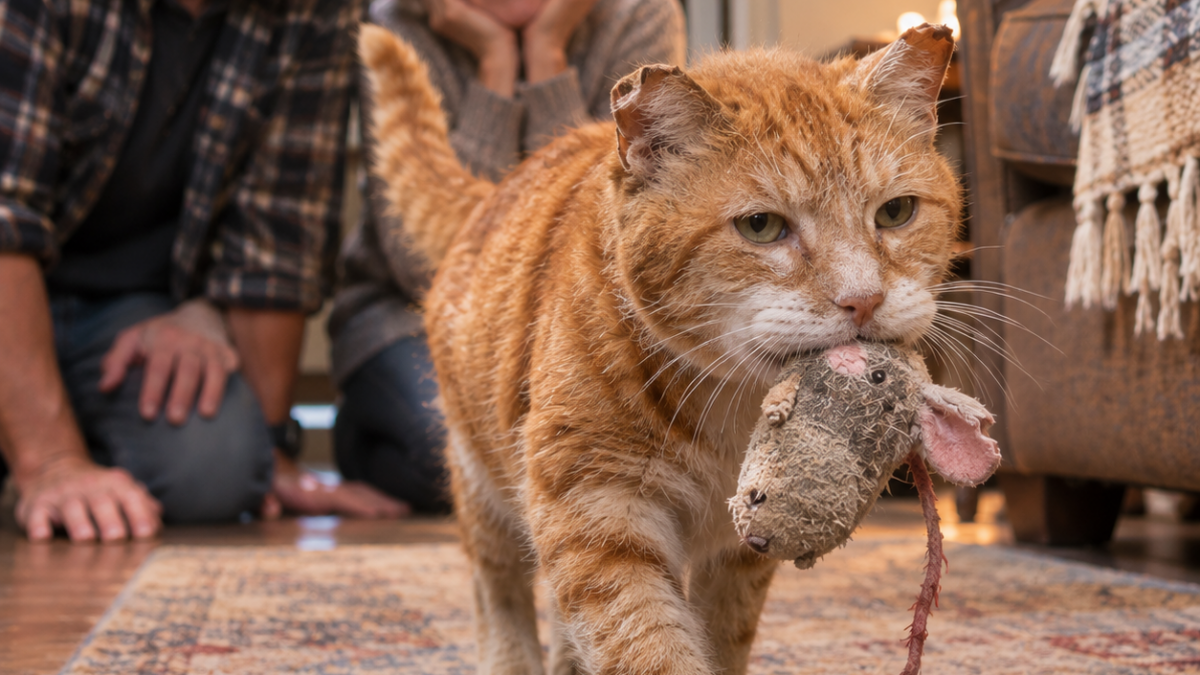
The Shelter Stamped Him “HOSPICE FOSTER”—Three Weeks Later, the 15-Year-Old Cat Dragged a Toy Mouse Down Our Hallway Like He Had Decided Not to D!e.
We brought Walter home believing we were giving an unwanted old cat a soft place to die, because every note in his shelter file said the same thing in different words: weak, withdrawn, barely moving, hospice.
Three weeks later, the cat who supposedly “wouldn’t get up” was carrying a mangy stuffed mouse through our hallway, stealing chicken from the kitchen, and waking us before sunrise because he had apparently decided mornings belonged to him again.
But when we finally learned what had happened in Walter’s last home—and why he had stopped standing long before his body truly failed—we realized the shelter had mistaken heartbreak for dying.
The county shelter called on a Thursday afternoon in February.
I remember because I was standing in our kitchen rinsing one coffee mug that did not need rinsing.
That had become one of my habits after our son moved across the country.
Rinse something.
Wipe a counter.
Straighten a towel.
Walk into a room.
Forget why.
Walk out.
Our house had grown too quiet over the previous two years.
Not tragic quiet.
Nobody had died.
There had been no catastrophe.
Our son, Nathan, had graduated, found a job in Seattle, fallen in love with a woman named Elise, and started building exactly the kind of life we had spent twenty-five years hoping he would build.
That was the problem.
We had succeeded.
And success had left his bedroom empty.
My wife, Laura, handled it better than I did.
At least outwardly.
She joined a gardening club.
Started volunteering twice a month at the library.
Took yoga.
Bought enough tomato plants one spring to suggest we were preparing for agricultural independence.
I developed relationships with household maintenance.
The dishwasher filter became extremely clean.
The garage had labels.
I sharpened tools that had not been used in a decade.
At night, Laura and I sat on opposite ends of the couch while the television made noise neither of us really listened to.
Then she would glance toward the hallway when the house creaked.
I knew what she was thinking.
Nathan used to come down those stairs like a herd of buffalo.
Even as a teenager.
Especially as a teenager.
We both missed that noise.
Neither of us said it often.
PART2:
You can be grateful for a grown child’s independence and still resent an empty bedroom.
Two truths can sit at the same table.
The shelter knew us because we had fostered animals before.
Not many.
Three dogs.
Two kittens.
One elderly beagle named Chester who stayed fourteen months because everybody kept saying they wanted a “younger dog with more energy,” which seemed absurd because Chester considered walking from the couch to the kitchen an athletic achievement.
When Chester finally got adopted by a retired schoolteacher, Laura cried for two days.
After that, we stopped fostering.
“Temporary love is emotionally irresponsible,” she told me.
“That sounds like a slogan.”
“It’s a diagnosis.”
So when my phone rang and I saw the shelter number, I nearly let it go to voicemail.
Laura was at the kitchen table paying bills.
She looked up.
“Who?”
“Shelter.”
“No.”
“I didn’t answer.”
“Good.”
The phone stopped.
Five seconds later, it rang again.
Laura stared at it.
“No.”
“You want me to decline?”
“Yes.”
I reached toward the screen.
Then she said, “Wait.”
PART2:
I looked at her.
She sighed.
“Answer it.”
I smiled.
“I thought temporary love was emotionally irresponsible.”
“Answer the phone before I become emotionally violent.”
I did.
“Hello?”
A woman named Melanie spoke.
We knew her.
She had coordinated foster placements for years.
Her voice was different that afternoon.
Not excited.
Usually when shelters called foster homes, there was urgency.
A litter.
A dog recovering from surgery.
A scared animal needing to get out of a kennel.
This time she sounded careful.
“Mark, I’m wondering if you and Laura might consider something.”
Laura mouthed, No.
I said, “What?”
Melanie paused.
“We have a senior cat.”
Laura’s expression softened despite herself.
“How senior?”
“Fifteen.”
I repeated it.
Laura closed her eyes.
That was already dangerous.
Melanie continued.
“His name is Walter.”
“What does he need?”
Another pause.
“Hospice foster.”
The kitchen became still.
Laura looked at me.
Not because she had heard Melanie.
Because she saw my face.
“What?”
she whispered.
I held up one finger.
Melanie said, “We’re not asking for anything heroic. We just want him out of the shelter.”
“What’s wrong?”
“Several things. Arthritis. Muscle wasting. Some kidney changes, although his numbers aren’t catastrophic. He barely gets up. He’s eating, but not much.”
“How long?”
“We don’t know.”
That is shelter language.
It means days.
Maybe weeks.
Do not build too much hope.
Melanie kept going.
“He’s not doing well in the kennel. We thought maybe somebody experienced could give him a quiet place. A bed. Sunlight. Just… somewhere gentle for the last stretch.”
The last stretch.
Laura was watching me.
I put the call on speaker.
Melanie repeated herself.
Laura did not ask questions.
Not immediately.
She looked around our kitchen.
At the spotless counters.
The silent hallway.
The two coffee mugs.
Then she looked at me.
I knew.
We were going to fail at saying no.
“How big?” Laura asked.
Melanie laughed softly.
“About thirteen pounds, though he should probably weigh more.”
“Good with people?”
“Mostly just tired.”
“Dogs?”
“Unknown.”
“We don’t have any.”
“I know.”
Laura looked at me.
We did not need to discuss it.
That happens after thirty-one years of marriage.
Some decisions take entire conversations.
Some take one look.
“When?” I asked.
“If you’re willing, today.”
An hour later, we were driving to the shelter.
Laura stared out the passenger window.
“You know this is stupid.”
“Yes.”
“We said we weren’t doing this again.”
“Yes.”
“We’re going to have him for ten days and then cry for six months.”
“Possibly.”
“I hate you.”
“You made me answer.”
“I hate myself too.”
We drove another mile.
Then she said quietly, “At least he shouldn’t die in a kennel.”
“No.”
“That’s the point.”
“Yes.”
We both knew it was not only the point.
The house had been aching for something alive.
We had simply chosen the most emotionally dangerous possible way to address that.
Walter was in the medical wing.
Melanie met us near the front desk carrying a clipboard.
She looked tired.
Shelter people often do.
There are only so many times you can watch animals arrive confused before the confusion begins to wear onto you.
“Thanks for coming.”
“Don’t thank us yet,” Laura said. “We may panic.”
Melanie smiled.
“You’re allowed.”
She handed us the foster form.
Across the top, in block letters, someone had stamped:
HOSPICE FOSTER.
I hated it immediately.
Not because it was inaccurate.
Because it looked like a verdict.
Walter’s file was clipped behind it.
Male neutered.
Domestic shorthair.
Orange-brown tabby.
Fifteen years.
Owner surrender.
Low energy.
Reluctant to stand.
Arthritis.
Decreased appetite.
Possible chronic kidney disease.
No aggression noted.
I turned the page.
“Why was he surrendered?”
Melanie hesitated.
“Owner said they couldn’t manage him anymore.”
“Because he was sick?”
“Partly.”
“What does partly mean?”
She looked toward the medical-room door.
“You should meet him first.”
That answer stayed with me.
We followed.
Walter was lying on a folded gray towel inside a large kennel.
He was bigger than I expected.
Or maybe he had once been big.
There was still the architecture of a powerful tomcat in him.
Broad head.
Heavy paws.
Thick shoulders now narrowed by age.
His coat was orange, but faded.
The muzzle had gone pale enough to look dusted with flour.
The fur above his eyes had thinned.
One ear carried an old tear.
His eyes were green-gold with a cloudy blue haze beginning at the edges.
He lifted his head when we entered.
That was all.
No meow.
No attempt to stand.
Laura crouched.
“Hi, Walter.”
His eyes shifted toward her.
Then toward me.
Back to the door.
Melanie opened the kennel.
Walter remained still.
“He’s been like this since intake.”
“How long?”
“Nine days.”
“Nine?”
“We were hoping he might settle.”
“And?”
“He didn’t.”
Laura extended one hand.
Walter sniffed from several inches away.
Then lowered his head.
“Has he walked?”
“Yes.”
Melanie’s answer came too quickly.
“How much?”
“To the litter box. Sometimes to food.”
“That’s it?”
“Mostly.”
Laura looked at me.
I knew that look too.
She had already decided we were bringing him home.
The only question was whether she would allow me to pretend we had a choice.
“What does the vet think?” I asked.
“She thinks he’s painful from arthritis. His kidney values are elevated but not end-stage. His heart sounds okay. Mild anemia.”
“Then why hospice?”
Melanie’s mouth tightened.
“Because he’s fifteen, declining, barely mobile, not thriving here, and the shelter doctor thinks putting him through aggressive diagnostics may cause more stress than benefit.”
I understood.
Shelters make decisions with limited money.
Limited space.
Limited time.
Medicine becomes triage.
That does not make the words easier.
Laura stroked Walter’s forehead.
He did not purr.
But he did not pull away.
“That okay?” she whispered.
His eyes closed.
Just briefly.
Melanie smiled.
“That’s more response than he gave me all morning.”
“Flattery won’t get him adopted.”
“This isn’t adoption.”
Laura looked at the hospice form.
“No.”
For some reason, that word hurt.
We signed.
The shelter sent us home with medication, food, a low-sided litter box, and instructions.
Keep him warm.
Do not force activity.
Watch for labored breathing.
Watch for complete loss of appetite.
Call if he cannot urinate.
Call if vomiting becomes persistent.
Call if he seems distressed.
The final instruction sat there without being printed.
Prepare to say goodbye.
Walter did not resist when Melanie lifted him into the carrier.
He weighed less than his size suggested.
When she set him down, he looked once toward the kennel he was leaving.
Then lowered his head.
The drive home took twenty-three minutes.
Laura kept one hand against the carrier door.
“You’re okay.”
Walter stared forward.
“You’re going somewhere quiet.”
His eyes closed.
“I know that might not sound exciting.”
I drove.
Laura continued talking.
“You’ll have a window.”
One ear moved.
“A very good window.”
I smiled.
“Sell the window harder.”
“Shut up.”
“To the cat?”
“To you.”
She turned back to Walter.
“Warm blankets. No dogs. He makes terrible coffee, but otherwise the staff is competent.”
Walter ignored us.
We had prepared the house before leaving.
Rugs over the hardwood.
One in the hallway.
One beside the couch.
One leading toward the kitchen.
A low orthopedic bed in the living room.
Another in our bedroom.
Food bowls elevated slightly.
Low litter box.
Night-light.
Water in three places.
It looked like we were preparing for a frail relative.
Maybe we were.
We opened the carrier in the living room.
Walter did not come out.
Five minutes.
Ten.
Laura sat on the floor.
I sat beside her.
Fifteen.
Eventually, Walter lifted his head.
He looked through the open carrier door.
Then put one paw forward.
Paused.
Second paw.
Paused.
He stood.
His back legs shook.
Not badly.
Enough.
He stepped onto the rug.
The shelter note came back to me.
Reluctant to stand.
Walter walked three feet.
Stopped.
Looked around.
Then continued to the orthopedic bed.
He sniffed it.
Turned once.
Collapsed onto it with a sigh so deep both of us looked at each other.
Laura whispered, “Oh.”
Walter closed his eyes.
Within two minutes, he was asleep.
Not cat sleep.
Not the light, alert doze where ears keep working.
His entire body dropped.
Chin sideways.
Front paws loose.
Breathing deep.
He slept for six hours.
At first, we kept checking him.
“Is he breathing?”
“Yes.”
Twenty minutes later:
“Still?”
“Yes.”
At one point, Laura stood above him long enough that I said, “You’re going to wake him.”
“I’m counting breaths.”
“He’s not in intensive care.”
“He has hospice paperwork.”
“Fair.”
Walter woke around nine.
He looked disoriented.
Then saw us.
Laura sat on the couch.
I was in the chair.
He watched us.
Did not move.
I brought water closer.
He drank.
Not much.
Then food.
He ate perhaps two teaspoons.
After that, he walked slowly to the litter box.
Used it.
Returned to the bed.
Laura and I celebrated every action like nervous parents.
“He peed.”
“I saw.”
“That’s good.”
“I know.”
“He ate.”
“I know.”
“He walked.”
“I watched the same cat you did.”
“You don’t seem appropriately excited.”
“I’m internally overwhelmed.”
“You look like you’re reading tax instructions.”
“This is my overwhelmed face.”
Walter stared at us as if reconsidering his housing decision.
That first week, he mostly slept.
And the more he slept, the more something bothered me.
It was the quality of it.
I have seen sick animals sleep.
This was different.
Walter slept like someone recovering from vigilance.
His body slowly uncurled as the days passed.
The first two nights, he slept tucked tightly, paws under chest, head lifted at every sound.
By night four, he was on his side.
By day six, belly partly exposed.
Once, Laura walked past and whispered, “Look.”
Walter’s rear foot twitched.
Then his whiskers.
Dreaming.
It sounds ridiculous to say we were relieved by a sleeping cat’s twitching paw.
We were.
Sometimes he woke and checked the room.
Always the same pattern.
Eyes open.
Find Laura.
Find me.
Pause.
Close again.
As if confirming the world remained where he had left it.
Laura noticed too.
“He’s checking.”
“For what?”
“That we’re here.”
“You don’t know that.”
“I do.”
“You’re projecting.”
“Yes.”
She stroked his head.
Walter closed his eyes.
“I’m projecting accurately.”
The house changed around him.
We lowered the television.
Stopped banging cabinets.
I began grinding coffee the night before because the machine startled him.
Laura wore slippers instead of hard-soled shoes.
We started speaking in ridiculous whispers.
One morning, our son called.
Video chat.
He watched us for a minute.
“Why are you whispering?”
“We have a hospice cat.”
Nathan stared.
“A what?”
Laura turned the phone toward Walter.
“His name is Walter.”
Walter slept.
Nathan looked at me.
“You guys got another cat?”
“Temporarily.”
Nathan laughed.
“That’s how you got me.”
“We did not foster you.”
“You’ve told me the story. You were not planning on having a baby that year.”
“Different.”
“Mom, how long?”
Laura’s expression changed.
“We don’t know.”
Nathan understood.
“Oh.”
“Could be weeks.”
“Does he hurt?”
“We have medicine.”
He looked at Walter again.
“Poor old guy.”
Laura stroked his back.
“He’s safe.”
Walter opened one eye.
Nathan smiled.
“Hi, Walter.”
For the first seven days, that was life.
Sleep.
Food.
Medication.
Litter box.
Water.
Sleep.
We did not push him.
We did not ask him to become inspirational.
We were not waiting for a miracle.
We were trying to make dying less frightening.
Then, on day nine, something happened.
I woke around six.
Laura was still asleep.
Walter’s bed in our room was empty.
My heart stopped.
That sounds dramatic.
It was immediate.
Empty hospice bed equals catastrophe.
I sat up.
“Walter?”
Nothing.
I got out of bed.
Hallway.
Empty.
Living room.
Empty.
Kitchen.
I heard:
Tap.
Tap.
Pause.
Tap.
I turned.
Walter appeared around the corner.
Walking.
Not well.
Not quickly.
But walking.
He had come from the living room on his own.
Maybe thirty feet.
He stopped when he saw me.
His tail gave a tiny flick.
“Where are you going?”
Walter stared.
“To the kitchen?”
Another flick.
I walked backward.
“Come on.”
He took two steps.
Stopped.
Two more.
Stopped.
I reached the counter.
Opened his food.
The sound of the can made his ears lift.
Then his tail moved again.
Not high.
Barely.
But it was unmistakable.
Interest.
Laura came into the kitchen.
Hair everywhere.
“What’s happening?”
“Look.”
Walter took another step.
She froze.
“He walked all the way?”
“From the living room.”
Walter reached his bowl.
He ate.
Not two teaspoons.
Almost half.
Laura sat on the floor and cried.
I laughed.
“Why are you crying?”
“I don’t know.”
Walter kept eating.
That was the first crack in the story we had been given.
The shelter file said he would not stand.
Walter could stand.
He simply had not wanted to.
Or had not felt able to want to.
There is a difference medicine cannot always measure.
We did not overinterpret it.
At least I tried not to.
Laura immediately began overinterpreting everything.
“He likes this food better.”
“Maybe.”
“He likes the kitchen.”
“Food is in the kitchen.”
“He likes us.”
“He’s known us nine days.”
“He likes me.”
“Obviously. I’m unbearable.”
Walter looked up.
“He agrees,” Laura said.
During week two, he began following us.
Not constantly.
He was fifteen.
Thirty feet qualified as travel.
But if I went from living room to kitchen, eventually I heard the slow tap of claws behind me.
If Laura sat in the sunroom, Walter appeared ten minutes later.
He would enter.
Look at her.
Then lie down.
That was it.
Presence.
One afternoon, I went to the garage.
When I returned, Walter was sitting by the interior door.
Laura pointed.
“He waited.”
“How long?”
“Three minutes.”
“For me?”
“No, for the furnace technician we don’t have.”
I crouched.
“Hey, old man.”
Walter pressed his forehead into my hand.
First time.
I stopped.
He did it again.
Then walked away.
Laura had seen.
Her eyes filled.
“Oh no.”
“What?”
“You’re in trouble.”
“I am not.”
“You love him.”
“I provide services.”
“You love him.”
“He’s a client.”
“You call him old man.”
“That is factually accurate.”
“You’re doomed.”
I was.
The strangest thing about Walter’s improvement was that it was not dramatic.
No miraculous leap.
No sudden kitten behavior.
Life came back in inches.
He ate a little more.
Walked a little farther.
Lifted his tail higher.
Sat by the window.
Groomed his chest.
Then one morning, I heard something from the hallway.
A chirp.
I looked at Laura.
“Did you hear that?”
“Hear what?”
Walter chirped again.
Tiny.
Rusty.
Like a door hinge discovering music.
Laura covered her mouth.
“He talked.”
Walter looked annoyed.
“Do it again,” she whispered.
He did not.
Cats understand manipulation.
By the end of the second week, Walter had established breakfast expectations.
Six fifteen.
If we were late, he stood beside the bed.
No yelling.
He simply stared.
That was somehow more effective.
One morning I opened my eyes.
Walter was six inches from my face.
“Jesus.”
He blinked.
Laura started laughing.
“He nearly killed me.”
“He wants breakfast.”
“He could announce himself.”
“He did. Telepathically.”
Walter placed one paw on my wrist.
Warm.
Heavy.
Alive.
“All right.”
I got up.
He followed.
The hallway had become his route.
Bedroom.
Rug.
Pause.
Hallway rug.
Pause.
Living room.
Pause.
Kitchen.
Food.
Every morning, a little stronger.
Then came the mouse.
The toy basket belonged to our niece Emily.
Technically, it had not belonged to her in fifteen years.
But Laura never threw things away if there was a theoretical chance a child might use them again.
Inside were cloth blocks.
A stuffed rabbit.
Two soft balls.
A faded fabric mouse that had once been part of some toddler animal set.
It was ugly.
Gray-brown.
One ear missing.
Threadbare tail.
One side flattened from years in storage.
Walter discovered the basket on day eighteen.
I was reading on the couch.
Laura was folding laundry.
Walter stopped beside the basket.
Sniffed.
“Don’t eat anything,” I said.
He ignored me.
Pushed his face inside.
Rummaged.
Laura looked over.
“What’s he doing?”
“Committing crimes.”
The basket tipped slightly.
Walter pulled back.
The stuffed mouse was in his mouth.
I laughed.
“No.”
He stood there.
Mouse hanging.
For the first time since we met him, Walter’s eyes looked bright.
Not young.
Bright.
He carried the mouse three feet.
Dropped it.
Looked at us.
Laura put one hand over her heart.
“Oh my God.”
Walter picked it up.
Walked again.
Slowly.
Carefully.
Dragging the tail.
He made it into the hallway.
Stopped.
Turned.
Looked back.
I swear there was pride in his face.
Maybe projection.
I do not care.
“Look at you,” I said.
Walter continued down the hallway.
The hospice cat.
The cat who barely stood.
The cat whose paperwork had prepared us for death.
Dragging a ridiculous stuffed mouse like a hunter returning from the wilderness.
Laura began crying.
I laughed at her.
Then realized I was crying too.
Walter disappeared into the bedroom.
We followed.
He had placed the mouse on his bed.
Then lay beside it.
Laura crouched.
“Where did you come from?”
Walter blinked.
She touched his cheek.
“Who were you before all this?”
That question changed everything.
Because until then, we had accepted the shelter file as biography.
Old.
Weak.
Low energy.
Reluctant to stand.
Hospice.
But those were observations made during nine days inside a shelter after surrender.
They were not Walter.
They were Walter in crisis.
There is a difference.
The next morning, the mouse appeared beside my hand.
I woke at 5:58.
Something touched my fingers.
Walter.
He stood beside the bed.
Mouse in mouth.
He dropped it.
Then pressed his head into my palm.
I looked at the clock.
“No.”
Walter blinked.
“It’s six.”
He touched my hand again.
Laura laughed into the pillow.
“Feed your client.”
“I hate this household.”
Walter sat.
The mouse lay between his paws.
I got up.
For the rest of that week, the mouse went everywhere.
Kitchen.
Living room.
Hallway.
Bedroom.
Sometimes Walter carried it ten feet for no reason.
Set it down.
Rested.
Picked it up again.
The first time Nathan saw him do it on video, he shouted, “That’s the dying cat?”
“Apparently.”
Nathan laughed.
Walter carried the mouse toward the phone.
“Look at him.”
“I see.”
“He’s hunting.”
“The prey is polyester.”
“He doesn’t know.”
“He absolutely knows.”
Laura joined the call.
“He brings it to bed.”
Nathan grinned.
“You guys are keeping him.”
“He’s hospice,” I said.
Nathan stared.
“You built him a ramp.”
“That is medically appropriate.”
“You have four water stations.”
“Hydration.”
“You named the toy.”
I looked at Laura.
“You told him?”
She shrugged.
Nathan laughed.
“You named the mouse?”
“Laura named him.”
“You called him Earl first.”
“That was exploratory.”
Walter sat beside Earl the Mouse.
Nathan shook his head.
“You’re both insane.”
Then the shelter called.
Melanie wanted an update.
I told her.
Silence.
“He’s doing what?”
“Carrying toys.”
“Walter?”
“Unless you sent us another fifteen-year-old orange hospice cat.”
“How much is he eating?”
“Almost full meals.”
“Walking?”
“Room to room.”
“Any falls?”
“Occasional slipping, but rugs help.”
“Litter box?”
“Perfect.”
Another silence.
“I want our vet to recheck him.”
Laura was beside me.
She heard.
Her expression changed.
Fear.
The improvement had made us forget the paperwork.
Hospice does not vanish because a cat finds a toy.
We brought him in the next afternoon.
Walter hated the carrier.
That, ironically, made me happy.
At intake, he had accepted everything.
Now he protested.
One low growl.
A hard stare.
A paw against the door.
“He’s angry,” Laura whispered.
“Good.”
The veterinarian, Dr. Patel, examined him.
Joint movement.
Heart.
Lungs.
Teeth.
Eyes.
Weight.
Blood.
Walter had gained eleven ounces.
His kidney values had improved slightly with hydration and regular food.
Not normal.
Improved.
The anemia was mild and stable.
His arthritis was significant but responded well to pain control.
His thyroid was normal.
Heart good for age.
Dr. Patel sat with us.
“I need to say something carefully.”
Laura gripped my hand.
“Okay.”
“I don’t think Walter is currently a hospice patient.”
We stared.
“What?”
“He’s old.”
“Yes.”
“He has chronic conditions.”
“Yes.”
“He could decline quickly because of age.”
“Yes.”
“But based on what I’m seeing today, I would classify him as a senior with manageable chronic disease.”
Laura began crying.
Again.
She cried a lot that month.
I asked, “Then why wouldn’t he stand?”
Dr. Patel looked at Walter.
“We can’t know.”
“Pain?”
“Partly.”
“Kidneys?”
“Possibly.”
“Shelter stress?”
“Almost certainly.”
Laura whispered, “Could depression do that?”
Dr. Patel chose her words.
“We have to be cautious applying human psychiatric labels to animals.”
“Right.”
“But animals absolutely respond behaviorally and physiologically to stress, loss, environmental change, fear, pain, and social disruption.”
She looked toward Walter.
“An older cat who has lost his home, routine, familiar people, smells, territory, and sense of safety can shut down dramatically.”
I thought of the first week.
Walter sleeping six hours at a time.
Checking whether we were there.
“He was exhausted.”
Dr. Patel nodded.
“That’s possible.”
“From being left?”
“From everything.”
That answer stayed with me.
Everything.
That night, Walter carried Earl the Mouse from the living room to the kitchen.
Dropped it beside his food.
Ate.
Then returned with the mouse.
Laura looked at me.
“They thought he was dying.”
“So did we.”
“He was grieving.”
“We don’t know that.”
She gave me the look.
I sighed.
“Fine. Probably.”
Walter began washing one paw.
Laura sat beside him.
“We need to know what happened.”
I knew what she meant.
The surrender.
I did not know if we had a right to know.
A week later, Melanie called.
“We found some additional information in his intake records.”
Laura put the phone on speaker.
“What?”
“The owner left veterinary records.”
I sat down.
Walter slept nearby.
“Anything relevant?”
Melanie hesitated.
“Yes.”
His previous owner was named Howard Mercer.
Seventy-eight.
Walter had lived with him for fourteen years.
Before that, Walter belonged to Howard’s wife, Jean.
She adopted him as a kitten.
Jean died when Walter was nine.
Howard kept him.
The veterinary notes after her death mentioned increased vocalization.
Sleeping in Jean’s chair.
Reduced appetite.
Then recovery.
Howard and Walter had apparently become inseparable.
“He slept in Howard’s room,” Melanie said.
“Every night.”
“What happened?”
“Howard fell last year.”
Broke a hip.
Rehabilitation.
Then another fall.
His daughter moved him into assisted living.
The facility did not accept pets.
Laura’s face changed.
“So Howard surrendered him?”
“No.”
“Who did?”
“The daughter.”
I felt anger rise.
Melanie continued.
“Her note says Walter stayed alone in the house for several weeks while arrangements were being made.”
“What?”
“Someone checked food and litter.”
“Someone checked?”
“That’s what it says.”
Laura stood.
Her voice sharpened.
“He was left alone?”
“Not completely unattended.”
“Don’t.”
Laura rarely sounded angry.
When she did, people listened.
“Do not make that sound better.”
“I’m not trying to.”
Walter opened one eye.
I lowered my voice.
“How long?”
“About five weeks.”
Five weeks.
An old cat.
In a house where his person had disappeared.
Someone coming in to put food down.
Then leaving.
No explanation.
No familiar footsteps.
No Howard.
My stomach turned.
“The daughter said he stopped meeting her at the door.”
Melanie’s voice was quiet.
“Eventually he mostly stayed under the bed.”
That was when I understood.
Reluctant to stand.
Low energy.
Wouldn’t get up.
Those observations had started before the shelter.
Walter had not simply deteriorated because he entered a kennel.
He had been disappearing for weeks.
“What about Howard?” Laura asked.
“Still alive.”
We both stared at the phone.
“Does he know Walter is at the shelter?”
Silence.
“Melanie?”
“I don’t know.”
That answer bothered me more than anything.
We asked if the shelter could contact the family.
Melanie said she would check what was legally and ethically appropriate.
We waited.
Walter improved.
The world narrowed around him in the best way.
He stole chicken.
His first theft happened at dinner.
I had left sliced chicken on the counter.
Walter had never jumped since coming home.
I turned away to get plates.
Laura said, “Mark.”
I turned.
Walter was standing with his front paws on a low kitchen stool we had placed nearby.
One paw stretched toward the counter.
“Sir.”
He froze.
His eyes moved toward me.
“Do not.”
His paw extended.
“Walter.”
He hooked a piece of chicken.
It fell.
Before either of us could react, he had it.
Laura doubled over laughing.
“He’s committing a felony.”
Walter chewed.
“Return the property.”
He swallowed.
No remorse.
The next week, we found him on the couch without using the ramp.
“How did you get up there?”
Walter stared.
Laura whispered, “He’s healing.”
“He’s trespassing.”
Walter went back to sleep.
He developed what we called zoomies, although that term was generous.
He would suddenly move with urgency across the living room.
Not fast by cat standards.
Fast by Walter standards.
Two laps around the coffee table.
Then dramatic collapse on the rug.
Panting slightly.
Earl the Mouse often accompanied the event.
The first time, we were terrified.
Then Dr. Patel said, “Congratulations. Your geriatric cat is playing.”
We celebrated.
The hospice form remained in a kitchen drawer.
I could not throw it away.
At the top:
HOSPICE FOSTER.
It had become almost funny.
Almost.
Because paperwork can be wrong without anyone being careless.
The shelter had recorded what it saw.
A cat who would not rise.
The problem was assuming behavior and ability were the same thing.
Then came the call about Howard.
Melanie said his daughter, Susan, had agreed to speak with us.
I expected anger.
I had already built her into a villain.
It is easy to do that when somebody else made a decision whose consequences you are now carrying.
Susan called that evening.
Her voice sounded exhausted.
“Is this Mark?”
“Yes.”
“I’m Walter’s… I guess former owner’s daughter.”
I hated the wording immediately.
“Howard’s daughter.”
“Yes.”
Laura sat beside me.
Walter slept on his bed, mouse beneath his chin.
Susan continued.
“Melanie said you wanted information.”
“We wanted to understand what happened.”
A long pause.
“I handled it badly.”
That disarmed me.
“Walter was my mother’s cat.”
“So we heard.”
“When Mom died, Dad acted like Walter was the only thing keeping the house from falling apart.”
She gave a small laugh.
“Dad used to say he hated cats.”
“Apparently that’s common.”
Susan laughed too.
Then became serious.
“They slept together every night.”
“What happened when your father fell?”
“He was in the hospital for eleven days.”
“Then rehab?”
“Seven weeks.”
“And Walter?”
“Home.”
“Alone.”
“I checked him.”
Her defensiveness appeared.
“I went every day.”
Laura leaned toward the phone.
“Every day?”
“Most days.”
That phrase.
Most days.
Susan heard herself.
“I know how it sounds.”
“How does it sound?”
I glanced at Laura.
“Mark.”
Susan sighed.
“I live forty minutes away. I have a job. Two kids. My husband was recovering from back surgery. Dad kept insisting he would come home. I believed him.”
“What happened?”
“He didn’t.”
Another fall during rehabilitation.
Confusion.
Then doctors said independent living was no longer safe.
Susan arranged assisted living.
“I asked three places about Walter.”
“None accepted cats?”
“One did.”
Hope rose.
“But Dad couldn’t afford that one.”
There it was.
Life.
Not clean.
Not simple.
“Could you take Walter?”
Susan was silent.
Then:
“No.”
“Why?”
“My son is severely allergic.”
Laura asked, “Other family?”
“My brother lives in Texas and has two dogs that attack cats.”
“Friends?”
“I asked.”
Her voice cracked.
“I asked everyone.”
I felt my anger losing its comfortable shape.
Susan continued.
“Walter stopped coming downstairs.”
“When?”
“Maybe three weeks after Dad left.”
“What did you do?”
“I brought food upstairs.”
“Did you take him to the vet?”
“No.”
“Why?”
“I thought he was old.”
That sentence made me grip the phone.
Susan heard the silence.
“I know.”
“He was hurting.”
“I know that now.”
“No.”
I tried to control myself.
“You don’t get to say you know now like that fixes it.”
Laura touched my arm.
Susan did not argue.
“You’re right.”
I breathed.
Then she said something that changed everything.
“Dad asked for him every day.”
Laura went still.
“What?”
“He still asks.”
“Howard doesn’t know?”
“No.”
I stood.
“Doesn’t know what?”
Susan began crying.
“I told him Walter went to live with a family.”
Laura looked at Walter.
“That’s technically true now.”
“No,” Susan said. “I told him before.”
The house became silent.
“You lied.”
“Yes.”
“Why?”
“Because he wouldn’t sign the assisted-living papers.”
I closed my eyes.
Susan continued through tears.
“He said he would go home to Walter. The doctors told him he couldn’t live alone. I was trying to keep him safe.”
“And the cat?”
“I know.”
“You left Walter waiting in an empty house while Howard thought he was safe with somebody?”
“I know.”
That was the cruelty.
Not intentional.
Not hatred.
A decision made for practical reasons.
A lie designed to solve one emergency.
And in the space between those two people who loved each other, an old cat simply stopped getting up.
Susan cried.
“I should have taken him to the shelter sooner.”
Maybe.
Or maybe the shelter would have been another shock sooner.
There was no perfect answer.
That is the infuriating thing about real life.
Sometimes there is only a least-bad choice, and people still make it badly.
Laura asked, “Can Howard receive visitors?”
“Yes.”
“Would seeing Walter upset him?”
Susan stopped.
“What?”
“Could Walter visit?”
I looked at her.
She looked at me.
Of course.
Susan began crying harder.
“I don’t know.”
“Ask.”
“I don’t know if the facility allows animals.”
“Ask.”
“What if Walter doesn’t remember him?”
Laura looked toward the old cat.
“He remembers a stuffed mouse he found three weeks ago.”
That made Susan laugh through tears.
“I’ll ask.”
The assisted-living facility said yes.
Therapy-animal policies did not technically cover Walter, but the administrator agreed to a private visit if we brought vaccination records and kept him in a carrier through common areas.
We scheduled Sunday.
I was more nervous than I expected.
What if Walter became distressed?
What if Howard did?
What if the reunion meant nothing?
People love animal-reunion stories because we want proof that love leaves permanent marks.
Reality does not owe us proof.
We put Earl the Mouse into the carrier.
Laura said it was necessary.
“Why?”
“He takes it everywhere.”
“He is going to a nursing facility, not college.”
“It’s emotional support.”
“For Walter or you?”
“Yes.”
The drive took thirty minutes.
Walter complained softly.
That was encouraging.
At the facility, Susan met us outside.
First time in person.
She looked about fifty.
Tired eyes.
Work clothes despite Sunday.
She stared at the carrier.
“Is that him?”
Walter looked out.
Susan knelt.
“Oh my God.”
Her face crumpled.
“He looks better.”
I did not know what to say.
She touched the carrier door.
“Hey, Walt.”
Walter sniffed her finger.
No dramatic reaction.
That seemed to hurt her.
Then she smiled sadly.
“He never liked me much.”
“Good judgment,” Laura said before thinking.
“Susan—”
But Susan laughed.
“I deserve that.”
We went inside.
Howard’s room was on the second floor.
Susan walked ahead.
“I haven’t told him.”
“Why?”
“I was afraid he’d get too excited.”
Laura whispered, “Good.”
We reached the doorway.
Howard sat in a recliner by the window.
Thin.
Gray-haired.
Blanket across his knees.
Television on low.
He turned when Susan entered.
“You’re early.”
“I brought someone.”
He saw us.
Confusion.
Then the carrier.
Howard stopped breathing.
I swear he did.
For one long second.
“Walter?”
The cat’s head rose.
Everything in him changed.
Ears forward.
Eyes wide.
Then he made a sound.
Not a meow.
A deep, broken yowl.
Howard began crying before we even opened the carrier.
“Oh, buddy.”
Walter clawed at the door.
Not aggressively.
Urgently.
I set the carrier down.
Opened it.
Walter stepped out.
No hesitation.
He walked.
Faster than I had ever seen him move.
Across the rug.
Toward Howard.
His back legs were stiff.
His gait uneven.
He did not care.
Howard leaned forward.
Walter reached the recliner.
Put both front paws on Howard’s knee.
Tried to climb.
Howard lifted him.
The old man buried his face in the cat’s neck.
Walter began purring.
Loud.
Not faint.
Not subtle.
The loudest sound I had heard from him.
Susan turned away.
Laura was crying.
I was crying.
Everybody was crying except Walter.
He kneaded Howard’s blanket.
Howard kept saying his name.
“Walter.”
Again.
“Walter.”
Again.
“My boy.”
The cat pressed against his chest.
Howard looked at Susan.
“I thought he was with a family.”
Nobody spoke.
Susan’s face collapsed.
“He is.”
Howard frowned.
She pointed toward us.
“With them.”
He looked at me.
Then Laura.
Then back at Walter.
“What happened?”
Susan began:
“Dad—”
He saw her expression.
Old people are not stupid.
Vulnerability does not erase perception.
“What happened?”
Susan sat.
She told him.
Not every excuse.
Just truth.
Hospital.
Rehab.
Walter alone.
Shelter.
Hospice label.
Us.
Howard did not interrupt.
He stroked Walter.
When she finished, he looked toward the window.
“You should’ve told me.”
“I know.”
“I would’ve—”
“What?”
Susan’s voice broke.
“What would you have done, Dad?”
He looked at her.
“You couldn’t stand without help.”
Tears filled her eyes.
“You kept trying to leave rehab. You fell twice. You told them you were going home.”
“For him.”
“I know.”
“I promised your mother.”
There it was.
The real wound.
Howard looked down at Walter.
“When Jean was dying, she told me not to dump her cat somewhere.”
Susan covered her mouth.
“I promised.”
Walter pushed his forehead beneath Howard’s chin.
The old man began crying again.
“I thought I broke my promise.”
Laura knelt beside him.
“You didn’t.”
Howard looked at her.
“You kept him?”
“Yes.”
“For how long?”
“Three weeks.”
Howard’s eyes widened.
“He was supposed to die.”
Walter chose that moment to climb halfway onto the arm of the recliner.
His back foot slipped.
He recovered.
Howard stared.
I laughed.
“He apparently disagreed.”
Laura reached into the carrier.
Pulled out Earl.
Walter immediately noticed.
His head lifted.
Howard blinked.
“What is that?”
“His mouse.”
“That ugly thing?”
“He loves it.”
We put it beside him.
Walter grabbed it.
Howard laughed.
Not polite laughter.
Real.
Full.
Sudden.
The kind that transforms an old face.
“He used to do that.”
We all looked.
“What?”
“With socks.”
Howard held Walter closer.
“When he was young, he stole Jean’s socks and carried them around.”
Laura covered her mouth.
The mouse was not new behavior.
It was old Walter returning.
The room felt charged.
Not supernatural.
Recognition.
The version of Walter that had gone silent was not gone.
He had been waiting beneath exhaustion.
Beneath pain.
Beneath an empty house.
Howard looked at us.
“He wasn’t lazy.”
“No.”
“He used to follow me everywhere.”
“He follows us.”
“Kitchen?”
“Especially kitchen.”
“Chicken?”
“Criminal behavior.”
Howard smiled.
“That’s him.”
Susan cried quietly.
Then Howard looked at her.
Anger remained.
But something else too.
“You should’ve told me.”
“Yes.”
“You should’ve gotten him help sooner.”
“Yes.”
Then his shoulders dropped.
“But you had a lot.”
Susan began sobbing.
“I’m sorry.”
Howard reached for her hand.
Walter sat between them.
It was not dramatic forgiveness.
No speech.
No instant healing.
A hand.
That was all.
Sometimes families repair themselves with smaller tools than they used to break.
Walter stayed on Howard’s lap for nearly two hours.
At one point, he fell asleep.
Howard refused to move.
“My leg is numb.”
“Want us to take him?”
“No.”
“Howard—”
“No.”
The old man smiled.
“I’ve waited longer than this.”
When it was time to leave, everyone became anxious.
Especially me.
Would Walter think we were taking him away again?
Would Howard?
We put the carrier beside the chair.
Walter opened his eyes.
Howard stroked him.
“Go on.”
Walter stayed.
Howard whispered, “You have a home.”
My throat tightened.
He looked at me.
“You bringing him back?”
“If you want.”
Howard’s face lit.
“Yes.”
“Then we’ll come.”
Walter eventually entered the carrier.
Howard put Earl inside with him.
“Take your mouse.”
On the drive home, Laura cried again.
“You’re exhausting,” I said.
“You cried too.”
“I had allergies.”
“In February?”
“Winter allergies.”
“Coward.”
Walter slept.
Mouse under one paw.
We changed the foster paperwork that week.
Not hospice.
Regular foster.
The shelter wanted to list Walter for adoption.
That created a problem.
Laura looked at me.
I looked at Laura.
Melanie smiled.
“No.”
I pointed.
“We are not discussing foster failure.”
“Okay.”
“We agreed temporary.”
“Sure.”
“We’re being rational.”
“Absolutely.”
“His medical expenses—”
“Shelter can cover some while fostered.”
I looked at Walter.
He sat on Melanie’s desk because somebody had lifted him there during his recheck.
Earl in front of him.
Laura scratched his chin.
“Temporary,” I said.
Melanie nodded.
“Of course.”
Two days later, I filled out the adoption application.
Laura found it on the counter.
She looked at me.
“You folded fast.”
“I am ending administrative inefficiency.”
“You’re adopting him.”
“This is a paperwork correction.”
“Mark.”
“He lives here.”
She smiled.
“Yeah.”
Walter became ours officially on March 14.
Howard cried when we told him.
Susan did too.
We began visiting every other Sunday.
Walter learned the routine.
Carrier.
Car.
Facility.
Howard.
By the third visit, he started chirping when we turned into the parking lot.
Howard kept treats in his dresser.
Probably too many.
Dr. Patel said moderation.
Howard interpreted moderation creatively.
Walter would walk from the carrier to his chair.
Mouse sometimes included.
He slept on Howard’s lap.
Then came home with us.
It became possible for Walter to belong to more than one life at once.
That mattered.
People often treat rescue as if love begins on adoption day.
It does not.
Animals arrive with history.
Walter had belonged to Jean.
Then Howard.
Then in a painful, confusing gap, to nobody he could understand.
Then us.
Our love did not replace theirs.
It continued the story.
Susan began joining the visits.
At first, Walter remained indifferent.
Then one afternoon, she brought something.
An old blue blanket.
“Dad asked me to find it.”
Howard looked excited.
Walter sniffed.
Then immediately stepped onto it.
Turned.
Lay down.
Howard smiled.
“Jean made that.”
Susan looked at us.
“Mom crocheted.”
Walter began kneading.
Laura whispered, “He remembers.”
Maybe.
Maybe scent.
Texture.
Association.
Again, I did not need magic.
Memory lives in bodies in ways we do not fully understand.
Walter slept on that blanket for the rest of the visit.
Susan watched him.
“I should have brought this to the shelter.”
Howard said quietly, “You didn’t know.”
She looked at him.
“You’re allowed to be angry.”
“I am.”
Then he took her hand.
“I’m also allowed to know you were scared.”
I remembered that.
Because Susan’s mistake had been serious.
An old animal had suffered.
But cruelty and overwhelmed love can sometimes create similar outcomes from very different intentions.
That distinction does not erase responsibility.
It changes what justice looks like.
For Susan, justice was not punishment.
It was facing Walter alive.
Facing her father.
Admitting what she did.
Then helping repair what could still be repaired.
She started volunteering at the assisted-living facility’s pet-visitation program.
I did not expect that.
Neither did she.
“Guilt career,” she called it once.
Laura smiled.
“Could be worse.”
Walter continued improving through spring.
He turned sixteen.
We held a birthday celebration he did not understand.
Howard insisted.
Cupcake for humans.
Chicken for Walter.
Susan brought a ridiculous paper crown.
Walter tolerated it for eleven seconds.
Long enough for a photograph.
Then knocked it off and sat on it.
Howard laughed so hard a nurse came to check on him.
The photo went on our refrigerator.
Walter.
Sixteen.
Cloudy eyes.
Silver muzzle.
Paper crown sideways.
Earl the Mouse beneath one paw.
That picture became the opposite of the hospice form.
One predicted ending.
The other recorded continuation.
Summer came.
Walter spent mornings in sunlight.
Afternoons sleeping.
Evenings supervising dinner.
He remained old.
That is important.
This did not become a fantasy where affection cured age.
His kidneys required monitoring.
Arthritis worsened during damp weather.
Sometimes he missed the litter box.
Sometimes he seemed confused at night.
Once he stood in the hallway staring at a wall for five minutes.
I sat beside him.
“Lost?”
He looked at me.
Then walked away.
No shame.
No drama.
Just adjustment.
We added another night-light.
Moved a water bowl.
Changed the litter setup.
Life bent around him.
That was all.
One morning, he tried to jump onto the counter after chicken.
Failed.
Laura nearly had a heart attack.
“We need to stop him.”
“How?”
“Remove the counters.”
“Practical.”
We bought a taller stool.
That accidentally improved his criminal access.
Our mistake.
The stuffed mouse deteriorated.
Earl lost the remaining ear.
The tail came off.
Laura stitched it twice.
“Why don’t we buy another one?”
I asked.
She looked offended.
“This is Earl.”
“He’s fabric.”
“So are your shirts. Should I replace you when one tears?”
“That argument is insane.”
Walter took Earl from her lap.
Conversation over.
The mouse became a symbol we never intended.
Howard asked about it every visit.
“Still carrying that ugly thing?”
“Yes.”
“Good.”
One rainy afternoon, Howard seemed tired.
More than usual.
Walter lay on his lap.
Howard stroked him.
“I’m glad he didn’t die.”
Laura smiled.
“So are we.”
“No.”
Howard looked toward us.
“I mean at the shelter.”
Silence.
“I would’ve died thinking he was alone.”
Susan looked down.
Howard touched Walter’s back.
“You don’t know what that does to an old person.”
I sat closer.
“What?”
“To think the things you love become problems after you can’t take care of them.”
His voice was quiet.
“People start talking around you.”
Facility.
Safety.
Placement.
Sell the house.
Take the keys.
Move the furniture.
Rehome the cat.
“You understand most of it. You know they’re trying to help.”
He looked at Susan.
“But sometimes it feels like everybody is dismantling your life while you’re still inside it.”
Susan’s face crumpled.
“Dad.”
“I’m not blaming you.”
He stroked Walter.
“I’m saying it scares you.”
Walter purred.
Howard smiled.
“That old fool probably felt the same thing.”
I never forgot that.
Because Walter had lost control of his world almost completely.
Howard disappeared.
House emptied.
Food arrived from people who left.
Then carrier.
Car.
Shelter.
Kennel.
Strangers.
Pain.
Every familiar thing stripped away.
The file said low energy.
Maybe Walter had simply discovered effort no longer changed anything.
Why walk to the door if Howard never came through it?
Why call if nobody familiar answered?
Why explore a kennel that was not home?
Then he reached our house.
At first, he slept.
Then he checked whether we stayed.
Then he followed.
Then he played.
Belonging restored effort.
That is not a medical diagnosis.
It is simply what we witnessed.
A year after we brought Walter home, Howard died.
Eighty years old.
Pneumonia.
Two hospitalizations.
Then a quiet decline.
Susan called us.
“Dad’s asking for Walter.”
We drove over the same day.
Howard was in bed.
Oxygen tubing beneath his nose.
Walter climbed onto the blanket.
Slower now.
Still determined.
Howard touched his head.
“Hey, buddy.”
Walter settled beside his hip.
Earl between his paws.
We stayed three hours.
At one point, Howard looked at me.
“You keeping him until the end?”
“Yes.”
“Promise?”
“Yes.”
He nodded.
“Good.”
Then he looked at Walter.
“I kept my promise, Jean.”
Susan turned away and cried.
Howard died two days later.
Walter never saw the room empty.
We did not take him back after Howard died.
I wondered whether he noticed the missing visits.
Every other Sunday, for several weeks, he became restless around the time we usually loaded the carrier.
Maybe projection.
Maybe routine.
We changed Sundays.
Long breakfast.
Extra chicken.
Window time.
Slowly, the pattern faded.
Earl remained.
Walter carried him.
Two months after Howard’s death, Susan came to our house.
She brought the blue blanket.
“Dad wanted Walter to have it.”
Laura took it.
Walter smelled it from across the room.
He walked over.
Lay down.
Susan began crying.
I made coffee.
Nobody tried to stop her.
We had all learned something about allowing grief to occupy space.
Walter lived another eighteen months.
He slowed.
The hallway parade became shorter.
Bedroom to living room.
Pause.
Mouse.
Kitchen.
The slow-motion zoomies disappeared.
Then occasionally returned in one glorious burst.
He slept more.
Needed more medication.
Dr. Patel never used the word hospice until near the end.
The second time we heard it, it felt different.
Not a verdict.
A description.
Walter had lived.
Fully.
Ridiculously.
Inconveniently.
Long enough to become woven into our routines.
Long enough for Nathan and Elise to get married.
Long enough for them to bring our first granddaughter home.
Her name was Ava.
When they visited, Walter was nearly eighteen.
We watched him carefully.
He sniffed the baby’s blanket.
Then walked away.
Nathan looked offended.
“He doesn’t care.”
“He’s eighteen,” I said. “He has seen things.”
Three days later, we found Walter sleeping beneath Ava’s bassinet.
Nathan took a photograph.
Old cat.
New baby.
Earl the Mouse beside him.
Life continuing in both directions.
When Walter finally declined, there was no mystery.
He stopped stealing chicken.
That was the first sign.
Then the mouse stayed untouched for two days.
That was worse.
Dr. Patel examined him.
Kidneys.
Weight loss.
Weakness.
She looked at us.
We knew.
This time, the hospice label belonged.
We brought him home.
Again.
Same house.
Same rugs.
Same bed.
Same hallway.
But nothing felt like the first time.
The first time, we had prepared for a stranger to die.
Now we were preparing to lose family.
Walter spent his final week in the living room.
Sunlight.
Blue blanket.
Earl beneath his chin.
Susan visited.
Melanie came.
Nathan called on video.
Laura fed Walter chicken from her fingers.
He ate three pieces.
Then refused more.
On the last morning, I woke before six.
Walter was not beside the bed.
He had stopped coming upstairs days earlier.
I went downstairs.
He lay on the orthopedic bed we had bought before meeting him.
The original one.
Somehow we had kept it through newer beds and blankets.
Earl rested beside his front paws.
I sat.
Walter opened his eyes.
“Morning, old man.”
His tail moved once.
Tiny.
The same almost-smile from week two.
Laura came down.
Sat beside me.
Neither of us spoke for a while.
Then she said, “Remember when we thought he had ten days?”
I laughed quietly.
“We were idiots.”
“Completely.”
Walter closed his eyes.
I stroked his head.
The veterinarian came that afternoon.
Home visit.
We had promised.
No shelter.
No frightening final drive.
No fluorescent room if we could prevent it.
Walter was on the blue blanket.
Earl tucked against him.
Dr. Patel sat on the floor.
“He’s ready.”
Laura began crying.
I had no cleverness left.
I placed one hand against Walter’s side.
His breathing was slow.
For a moment, I remembered the first night.
Us standing over him.
Counting breaths.
Afraid each one might be the last.
We had been afraid of death before we knew him.
Now we understood something different.
The goal had never been to defeat the ending.
It had been to fill the distance before it.
Walter opened his eyes.
Looked at Laura.
Then me.
I touched his forehead.
“You stayed longer than expected.”
His eyes closed.
Laura whispered, “Thank you.”
I nearly broke.
Because that was the right thing.
Not goodbye.
Thank you.
For the mornings.
The stolen chicken.
The rugs.
The medication.
The mouse.
The visits to Howard.
The laughter.
The inconvenience.
The evidence that our quiet house had not finished living.
Dr. Patel gave the first injection.
Walter relaxed.
His head lowered onto Earl.
Laura placed her hand beside mine.
I said the thing Howard had once said.
“You have a home.”
Walter’s breathing slowed.
Then stopped.
The house became silent.
But this time, silence did not mean emptiness.
It meant something had happened here.
Something had lived.
For months afterward, Earl stayed on the living-room shelf.
Dirty.
Stitched.
Ridiculous.
Laura tried once to wash him.
I stopped her.
“Absolutely not.”
“He smells terrible.”
“That is historical material.”
“He is disgusting.”
“Heritage object.”
She laughed.
Then cried.
We left him alone.
The original hospice form went into a frame.
That was Laura’s idea.
Across the top:
HOSPICE FOSTER.
Underneath, we placed the birthday photograph of Walter in his crooked paper crown.
Visitors never understood until we explained.
We brought him home to die.
He taught us not to mistake surrender for inability.
Not every animal that stops moving is waiting for death.
Sometimes pain is involved.
Sometimes disease.
Sometimes age.
Sometimes all three.
But sometimes there is another weight.
Loss.
Disorientation.
The disappearance of every reason that used to make getting up worthwhile.
Walter’s body was old.
That part was true.
His joints hurt.
His kidneys were imperfect.
His eyes were cloudy.
But old age had not emptied him.
Being left behind had.
For weeks, people had looked at his stillness and documented it accurately.
Low energy.
Won’t stand much.
Hospice.
Then we gave him nothing extraordinary.
Rugs.
Food.
Pain medicine.
A bed.
Quiet.
Two people who remained in the room when he opened his eyes.
That was enough for him to start asking questions of life again.
What is in the kitchen?
Where are you going?
Can I come?
What is inside that basket?
Can I steal this chicken?
Can I carry this mouse?
Is tomorrow happening too?
Three weeks after we brought him home, Walter answered that last question himself.
Every morning at six, with one paw against my hand.
Yes.
Tomorrow was happening.
And he wanted breakfast.
We thought our job was to soften his ending.
Walter had other plans.
He turned hospice into home.
He turned pity into commitment.
He reunited with the man who thought he had failed him.
He gave a frightened daughter the chance to admit a mistake and repair part of it.
He filled our empty hallway with slow footsteps.
He made us laugh over stolen chicken.
He made us whisper over sleeping breaths.
He carried one ruined stuffed mouse from room to room like evidence that joy does not have to be new to matter.
And for more than two years, an animal whose paperwork had already begun speaking about the end kept showing us the same thing.
Old is not finished.
Tired is not finished.
Brokenhearted is not finished.
Even hospice does not always mean today.
Sometimes a body only needs comfort.
Sometimes a heart needs proof that the next door will not close.
Sometimes love arrives too late to prevent every wound but early enough to change what happens afterward.
We were terrible hospice fosters.
Walter lived too long.
Played too much.
Stole too much chicken.
Demanded too many breakfasts.
Made too many memories.
And when his real ending finally came, it was not softened by strangers.
It was surrounded by a life he had reclaimed.
There is still a small scrape on our hallway baseboard from the time Walter dragged Earl around the corner and somehow caught the mouse’s loose tail under the trim.
I have repaired almost everything else in this house.
I leave that mark.
Laura knows why.
Sometimes, late in the afternoon, sunlight falls across the old rugs we never removed.
The hallway becomes warm and gold.
And for one second, if I am not paying attention, I expect to hear it.
Tap.
Tap.
Pause.
Tap.
An ancient orange cat coming around the corner.
A filthy stuffed mouse hanging from his mouth.
Tail lifted just high enough to announce to the world:
Look what I found.
Look what I can still do.
Look.
I’m still here.








