The Shelter Called Him Hopeless—But the Old Gray Cat Exposed the Cruel Secret Everyone Wanted Buried
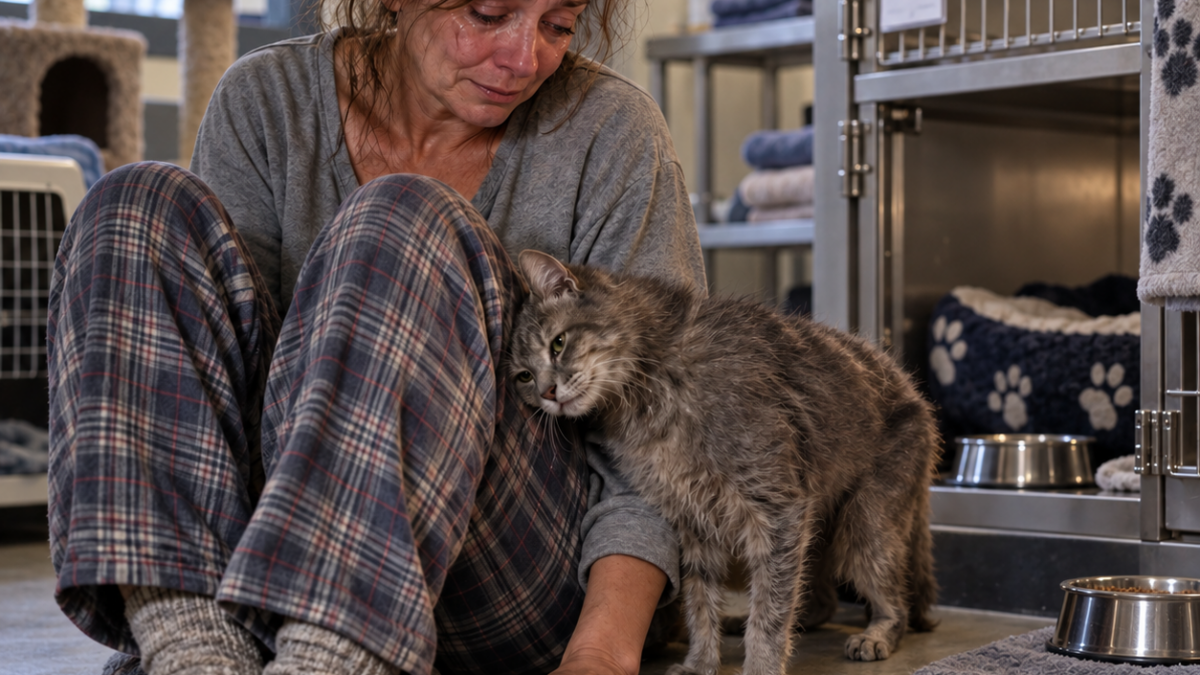
PART2:
“He’s been marked unadoptable. Space is tight. We have two emergency intakes coming tonight and nowhere to put them. I asked them for more time, but…” Her voice caught, and she straightened it quickly. “I’m sorry. I shouldn’t be telling you this much.”
“But you are.”
She swallowed.
“Yes.”
“Why?”
Her eyes stayed on Smokey.
“Because he hasn’t made a sound since he got here,” she said. “Not one. Cats like that break my heart the worst. The ones who stop asking.”
Somewhere behind us, a kitten cried in a high, scratchy voice. A dog barked from the other side of the building. The fluorescent lights hummed overhead.
I could have stood up.
I could have said what reasonable people say.
That’s sad.
I wish I could.
Someone else will help.
But no one else was standing in front of Smokey’s cage.
Only me.
A sixty-six-year-old woman with a quiet house, bad knees, a fixed income, and no business making emotional decisions in a shelter at six-thirty on a rainy Thursday evening.
I looked at Smokey again.
He looked through me like I was another weather pattern he could not control.
“If I take him,” I said, “what am I agreeing to?”
Avery’s face changed.
Hope is a dangerous thing in shelters. You can see people trying not to hold it too tightly.
“You’d need to keep him in one small room at first. Quiet. Low light. Food, water, litter. Don’t force touch. Don’t corner him. He needs a vet as soon as possible. He may need dental care. Pain management. Maybe antibiotics. I don’t want to mislead you.”
“Good,” I said. “Don’t.”
“He might never be cuddly.”
“I’m not very cuddly either.”
Avery gave a wet little laugh.
“He might hide for weeks.”
“I have closets.”
“He may not trust you.”
I looked at that old gray cat pressed into the back of a cage.
“Then I won’t ask him to right away.”
Avery held the clipboard out.
I signed the papers before I could talk myself out of it.
The drive home was silent except for the soft rattle of the carrier on the passenger seat and the rain ticking against the windshield. I kept glancing over, hoping to see Smokey lift his head, shift, show some sign that he understood he had been spared.
He did not.
He stayed buried in the farthest corner of the carrier, eyes wide, body locked tight.
At a red light, I rested one hand on the carrier’s handle.
“You and me both,” I said softly. “I don’t know what I’m doing either.”
He did not answer.
Of course he didn’t.
But the quiet between us felt different from the quiet I had known at home.
That scared me more than I expected.
When we got to the duplex, I carried him inside through the side door because the front steps were slippery. The house smelled faintly of lemon cleaner and the vegetable soup I had left cooling on the stove. Ordinary smells. Safe smells, I hoped.
I set Smokey up in the spare bathroom.
Fresh water.
Soft food.
A clean blanket.
A shallow litter pan.
The carrier door open.
Low light from the little night-light I kept plugged in for no reason except that the hallway felt too black at three in the morning.
Then I backed away.
“I won’t bother you,” I said.
He did not come out for two hours.
I sat in the kitchen pretending to read the newspaper while listening for every sound. A scrape. A step. A dish moving. Anything.
Nothing.
Finally, at almost ten, I heard one quick movement.
I crept down the hall and peeked in.
The carrier was empty.
My heart jumped.
Then I saw him.
He had bolted behind the toilet and wedged himself there, his gray body pressed against the wall, eyes huge in the dim light.
I stepped back immediately.
“Okay,” I whispered. “That’s fine. Behind the toilet is yours.”
That first week, I barely saw him.
I would wake up and find a little food missing, a few grains of litter kicked across the tile, and that was how I knew he was still trying. If I stepped into the bathroom, he froze. If I spoke, he flattened himself lower. Once, when I reached too quickly for the water bowl, he flinched so hard that I felt sick about it all day.
I started wondering if I had made a mistake.
Not because I regretted saving him.
Because saving and helping are not always the same thing.
Maybe I had taken him from one ending only to bring him into another kind of misery. Maybe some hurt goes too deep. Maybe some creatures become so scared they never find their way back.
On the sixth day, I called Maple Lane to ask for the name of the veterinarian who had done his intake exam.
Avery answered.
“How is he?”
“Hiding.”
“That’s expected.”
“Not eating much.”
“That’s also expected, but…”
“But not good.”
“No.”
I could hear papers moving on her end.
“There’s a clinic across town that works with us sometimes. Dr. Lena Morris. She’s patient with hard cases.”
“Hard cases,” I repeated.
Avery caught herself.
“I’m sorry.”
“No,” I said, looking down the hall toward the bathroom. “Maybe that’s what he is.”
I got him to the vet the next morning.
Getting him into the carrier took forty-five minutes, two towels, three whispered apologies, and every bit of restraint I possessed. He did not attack me, not really. He panicked. There is a difference. He scrambled and twisted and made one awful low sound that seemed to come from the bottom of a well. By the time I latched the carrier door, I was sweating and crying.
“I’m sorry,” I kept saying. “I’m sorry. I’m sorry.”
He faced the back of the carrier the whole drive.
Dr. Lena Morris was a small woman in her forties with silver beginning at her temples and the calmest hands I had ever seen. She entered the exam room slowly, sat on a stool instead of standing, and looked at Smokey through the carrier door.
“Hello, handsome,” she said.
Smokey did not appear moved by flattery.
Dr. Morris read the shelter paperwork. Her mouth tightened once, just slightly, but she said nothing.
“Has he eaten today?”
“A little.”
“Water?”
“Yes.”
“Any vomiting?”
“No.”
“Litter box?”
“Some.”
She nodded.
“We’re going to go slow.”
She did.
She dimmed the lights. She opened the carrier top instead of dragging him out. She used a towel gently, firmly, covering his head just enough to help him feel hidden while she examined him. Smokey trembled so hard the metal table vibrated beneath him.
I stood with one hand pressed to my mouth.
When Dr. Morris finished, she removed her gloves and looked at me.
“He’s terrified, yes,” she said. “But he’s also in pain.”
That landed hard.
Pain.
Not personality.
Not attitude.
Pain.
“Bad teeth,” she continued. “Severe gingivitis. At least one abscessed tooth. Joint pain in the hips and spine. Old ear infection that looks like it went untreated for a long time. He’s dehydrated. Underweight. His coat is in poor condition because grooming hurts.”
I gripped the edge of the counter.
“How long has he been like that?”
“I can’t say exactly.”
“But not six days.”
Her eyes met mine.
“No. Not six days.”
Something hot and sick moved through me.
People had looked at him. Lived with him. Owned him. Handed him over. And all this pain had been sitting inside his body like a second skeleton.
“Can it be treated?”
“Some of it. Enough to give him relief, I think. Dental surgery once he’s stronger. Antibiotics now. Pain medication. Fluids today. Better nutrition. Quiet. Time.”
“Will he ever be normal?”
Dr. Morris tilted her head.
“I don’t know what normal means for Smokey.”
That answer stayed with me.
On the drive home, I cried harder than I had in months.
Not just for Smokey.
For how easy it is to call someone difficult when they are really just hurting.
After that appointment, I stopped expecting progress to look sweet or obvious.
I stopped imagining he might suddenly crawl into my lap and purr like a movie ending. I stopped measuring love by how quickly it came back to me. I gave him what Dr. Morris said he needed and what I think most scared souls need.
Relief.
Quiet.
Room.
I moved him from the bathroom to my bedroom, where the light was softer and the house noises were less sharp. I made a hiding place in the corner of the closet with a blanket, a shallow bed, food, water, and another small night-light. Every evening, I sat on the floor a few feet away and read out loud.
At first, I read books.
Then I ran out of voice for books and read anything.
Grocery lists.
Junk mail.
Prescription instructions.
The back of a soup can.
“Contains celery,” I read one night, sitting cross-legged on the floor while Smokey’s eyes glowed from the closet. “I don’t know why they need to announce that like a threat, but there it is.”
He watched.
I let him learn my voice without asking anything from him.
Days passed.
Then weeks.
The first tiny change was not affection.
It was sleep.
One afternoon, I walked past the bedroom and saw him curled on the closet blanket with his head down and both eyes closed.
I stopped breathing.
Until then, he had always kept his eyes half-open, even when resting, as if sleep itself might betray him. But there he was, old gray body tucked into a careful comma, asleep.
I backed away without making a sound.
In the kitchen, I put both hands on the counter and cried.
That is how small healing can be.
A closed eye.
A missing flinch.
A bite of food taken while someone is watching.
A body deciding, for one moment, that nothing bad is happening right now.
A month after I brought him home, Smokey let me sit closer.
Not close.
Closer.
Three feet instead of five.
Then two.
One evening, after a day that had gone wrong in all the small ways life can go wrong, I sat on the bedroom floor and cried. Not loudly. Just tired crying. The kind that comes from carrying too much for too long with nobody around to notice.
The washing machine had flooded the mudroom.
Eli had cancelled his Sunday call because Sophie had a fever.
My left knee hurt badly enough that I had taken the stairs sideways.
The pharmacy had raised the price of one of my medications.
And Smokey had spent the entire day hidden in the closet after the plumber banged through the house with wet boots and apologies.
It was not tragedy.
That was the problem.
It was just life.
One little weight after another until I found myself sitting on the floor in the dark, wiping my eyes with the sleeve of a sweatshirt I had owned since the Clinton administration.
“I’m not going to force you,” I told the closet.
My voice shook.
“You don’t have to trust me tonight. You don’t have to be grateful. You don’t have to become some miracle story so I can feel good about myself. Just…”
I swallowed.
“Just don’t give up in this house.”
For a while, nothing happened.
Then I heard a soft sound.
Not scrambling.
Not panic.
One careful step.
Then another.
I looked up.
Smokey came out of the closet slowly, stiff and unsure. His head was low. His ears were angled back. He stopped twice like he might change his mind.
I held perfectly still.
He walked right over to me.
He did not jump into my lap.
He did not rub against me like we were suddenly best friends.
He simply leaned his side against my knee and stayed there.
That was all.
And somehow, it was everything.
I did not touch him at first.
I was afraid to ruin it.
So I sat in the dark with tears drying on my face while an old gray cat with bad teeth and frightened eyes pressed his thin body against my knee as if my sadness had called to something in his.
After a minute, I lowered my hand.
Not onto him.
Near him.
He stiffened.
I stopped.
He waited.
Then, slowly, he leaned harder against my knee until his fur brushed my fingers.
Permission.
Not much.
Enough.
I touched him with two fingers between the shoulders.
His skin twitched once.
Then settled.
“You’re all right,” I whispered.
I did not know whether I was talking to him or myself.
Three months after Smokey leaned his weight against my knee for the first time, I made the mistake of telling one person his story.
By the end of the week, half the town had an opinion about that old gray cat.
Some people called it heartwarming.
Some called it foolish.
And one woman looked me right in the eye at the shelter’s fall adoption weekend and said, “I’m sorry, but people like you make it harder for shelters to do what needs to be done.”
I wish I could say that did not get under my skin.
It did.
Because by then, Smokey was no longer the cat in the back of a metal cage.
He was the soft thud at the foot of my bed every night.
He was the quiet shape that appeared in the hallway when I opened a can in the kitchen.
He was the living proof that unadoptable does not always mean beyond saving.
Sometimes it means nobody waited long enough to understand the damage.
His healing stayed small.
That mattered to me.
People like big transformations because they are easier to photograph. Easier to post. Easier to point at and say, look, love fixed everything.
That is not what happened with Smokey.
He did not become brave all at once.
He still startled when I sneezed.
He still vanished if someone knocked on the door.
If a shoe got left in the wrong spot or I moved a chair too quickly, he stopped dead and watched the room like danger had just returned.
But he ate with his whole body relaxed now.
He stretched out in sleep instead of curling into that tight little knot.
He let me touch the top of his head without looking like he expected the touch to turn into pain.
Those were not dramatic changes.
They were holy ones.
The first time he purred, I almost missed it.
I was in bed reading with the lamp on low, and he had climbed up beside my ankles the way he sometimes did when he thought I was asleep. When I shifted, I felt the mattress vibrate.
I froze.
There it was again.
So faint I had to hold my breath to make sure I was not imagining it.
That rusty little motor, like his body was remembering something kind after years of not trusting it.
I cried, of course.
By then, crying in private over a cat who had no idea he was rebuilding me at the same time I was helping him heal had become one of my regular hobbies.
Maple Lane called in early October.
Not Avery, but Ellen, the shelter director. She had a cheerful voice and the careful manners of someone who had learned how to ask for things gently because asking too hard made people run.
“We’re doing a small fall adoption weekend,” she said, “and Avery told us about Smokey. Would you let us share a picture of him? Just a before and after. People need hope.”
I looked over at Smokey.
He was sitting under the dining table, watching a dust particle float through the morning light like it was the most serious business in the world.
His fur had come back soft.
His eyes looked clearer.
He was still cautious, still private, still very much Smokey, but he was alive in a way he had not been that first night.
“Yes,” I said.
Then, before I could think better of it, I added, “I can bring one by if that helps.”
Ellen sounded relieved.
I think shelters spend so much time asking people to care that they stop expecting yes.
The morning of the event, I printed two photos at the pharmacy down the road.
One was the intake picture Avery emailed me after I asked.
Smokey looked smaller in that photo than I remembered. Smaller and grayer and already halfway gone. His eyes were enormous. His body was folded behind the litter pan. The flash had caught the dull clumps in his coat and the raw fear in his face.
The second photo I took myself.
He was sitting on the windowsill in my bedroom, looking out at the bird feeder, his body loose, one paw tucked under, the October light warming the fur along his back.
He looked old.
He looked serious.
He looked like someone who had been hurt and had decided, very carefully, to remain in the world anyway.
When I walked back into Maple Lane Animal Haven, I thought I was prepared.
I was not.
The smell hit first.
Detergent.
Bleach.
Newspaper.
Wet fur.
The sour edge of fear under all of it.
Then the sounds.
Barking from the dog side.
Metal doors opening and closing.
A kitten crying somewhere in the back.
And that strange shelter quiet in between, the kind that feels less like peace and more like waiting.
The lobby had handmade paper leaves taped to the wall. Some volunteer had cut them from construction paper and written names on them in marker.
Adopted.
Fostered.
Found Home.
I stood there too long, staring at those leaves like they were prayer cards.
Avery came from behind the desk and hugged me before I had a chance to become awkward about it.
“You came.”
“I said I would.”
“People say a lot of things.”
Her eyes flicked to the envelope in my hand.
“Are those the photos?”
I gave them to her.
She looked at the intake photo first, and her expression tightened in a way that told me she had not forgotten that night either. Then she looked at the second photo.
“Oh,” she whispered.
“What?”
“He looks safe.”
That was exactly the word.
Not incredible.
Not transformed.
Safe.
She pinned the photos to a corkboard near the desk with a note card under them.
SMOKEY. AGE 9. LABELED UNADOPTABLE. NOW SLEEPING AT THE FOOT OF A BED EVERY NIGHT.
I stared at the words longer than I should have.
Labeled unadoptable.
The phrase bothered me.
Not because it was untrue.
Because it was true too often.
Avery noticed my face.
“We hate that word too,” she said quietly. “But sometimes if we soften it, people don’t understand how close they came.”
That sat with me.
I walked through the cat room after that.
I told myself I was only looking.
That was a lie so thin it barely deserved the name.
The kittens had a crowd around them, of course. Tiny paws. Big eyes. One orange little thing kept tumbling backward off a blanket and getting rescued by a laughing boy in a baseball cap. A pair of black-and-white kittens wrestled so enthusiastically that a woman near me pressed both hands to her chest and said, “I can’t, I just can’t,” which appeared to mean she absolutely could and probably would.
Two cages down, a striped young cat reached both paws through the bars toward every passing hand.
Farther back were the older ones.
The quiet ones.
The ones people read too quickly.
A black cat with a torn ear sleeping so hard he did not wake when a child tapped the sign.
A calico with cloudy eyes and a note that said she preferred women.
A large tabby whose paper read BONDED PAIR SEPARATED DUE TO HOUSING.
And in the bottom cage near the end, a twelve-year-old brown tom named Leonard looked so much like old heartbreak that I had to crouch down just to steady myself.
He did not come forward.
He did not beg.
He simply watched me with the exhausted dignity of someone who had already learned that attention was usually for the younger bodies nearby.
“Leonard’s sweet,” Avery said behind me. “Bad hips. Thyroid meds. Owner passed away.”
I nodded.
The room blurred for a second.
There is something especially cruel about how our culture treats age.
You see it in jobs.
You see it in mirrors.
You see it in the way people say still about a life, as if it is surprising that something old could remain worthy of tenderness.
And you definitely see it in shelters.
Everybody says they want to rescue.
Fewer people want a rescue that comes with medication, grief, fear, slowness, or a countdown.
It is easy to feel noble around a cute beginning.
It is harder to commit yourself to a difficult middle.
By noon, the lobby was busy.
Families came in with coffee cups and hopeful voices. Teenagers took selfies with kittens. A little girl in a glitter sweater cried because her mother said no to a rabbit. An elderly man stood in front of the senior dog pen with one hand pressed over his mouth for so long that a volunteer finally brought him a chair.
I stayed longer than I planned.
Long enough to answer questions about Smokey from three different people.
Long enough for one man in a hunting jacket to glance at the photo board and say, not to me exactly but not quietly either, “That’s nice and all, but most people don’t have money to throw at a broken old cat.”
I felt my whole body go cold.
Before I could answer, the woman beside him gave a short laugh.
“Exactly,” she said. “People romanticize this stuff online. Meanwhile shelters stay full because nobody wants to talk about hard choices.”
They moved on.
I did not.
I stood there with those words burning in me.
Broken old cat.
Hard choices.
There are phrases people use when they want to sound practical.
Sometimes those phrases are just softer clothes for cruelty.
I drove home angry.
Not the hot kind.
The deep kind.
The kind that feels old as soon as it arrives.
Smokey was under the bed when I got back, which was where he went whenever I came home smelling like outside places. I changed clothes, sat on the floor, and slid my hand palm-down across the rug near the edge of the bed.
After a while, I saw his nose.
Then his eyes.
Then his whole face, cautious as moonrise.
“I know,” I said. “People are exhausting.”
He blinked.
A long one.
Then he came forward and sat three inches from my fingers.
That was one of his versions of affection.
Being near the hand, not under it.
Letting it exist without punishment.
That evening, Eli called.
He always called on Sundays if life had not swallowed him whole. He had his daughter’s laugh in the background and a tiredness in his voice he tried to cover with cheer.
“Hey, Mom. How’s the famous cat?”
“Not famous.”
“Claire saw the shelter post. She cried.”
“Claire cries at insurance commercials.”
“True. But Sophie asked if Smokey can come to Christmas.”
“He cannot handle a knock at the door, Eli.”
“So that’s a no?”
“That is a no.”
He laughed.
I told him about the shelter event. I told him about Leonard. I told him, without meaning to, about the man in the hunting jacket and the woman with her hard choices.
There was a pause on the line.
Then Eli said carefully, “Can I say something without you taking it the wrong way?”
“No.”
He laughed again.
Then he said it anyway.
“I think what gets people worked up is that an old animal makes them feel trapped. They hear medicine, special food, anxiety, vet bills, and all they can see is obligation.”
I leaned back against the kitchen counter.
“That isn’t the wrong way,” I said. “That’s just true.”
Another pause.
Then he said, “You know what I think, though?”
“What?”
“I think most people aren’t afraid of the work. I think they’re afraid of getting attached to something they might lose soon.”
That hit closer.
Because yes.
That too.
Maybe especially that.
We do not live in a culture that handles loss well.
We treat grief like a scheduling problem. We give people three days off when someone dies and expect them to be normal by Monday. We tell each other to protect our peace, guard our energy, set boundaries, move forward, choose what serves us.
Some of that is wise.
Some of it becomes an excuse to never be inconvenienced by love.
There is a difference.
A week after the shelter event, Avery posted Smokey’s photos on Maple Lane’s rescue page.
I should probably say here that I am not a big internet person. I have a Facebook account because Eli made it for me after Sophie was born. My profile picture is three years old and slightly crooked. I still type with one finger when I am nervous. I once accidentally posted “Happy Birthday, casserole recipe” on my cousin’s timeline and did not notice for eight hours.
But when Maple Lane posted Smokey’s photos, tagged me, and thanked me for “taking a chance on a senior cat who only needed time, treatment, and safety,” my phone lit up like a small emergency.
First came the kind comments.
Hundreds of them.
People shared pictures of old dogs with cataracts and cats missing teeth.
People wrote, “This made me cry,” and “Seniors are the best,” and “Thank you for not giving up on him.”
A widower from Kentucky wrote that his twelve-year-old beagle had saved his life after his wife died.
A woman in Arizona said the cat nobody wanted turned out to be the one who slept on her chest through chemo.
A truck driver posted a photo of a one-eyed barn cat riding in the passenger seat of his rig with the caption, Best company I ever had.
I cried over strangers on the internet for two straight days.
Then the other comments started.
Easy to say when it’s not your money.
This kind of guilt posting is why shelters lie about behavior.
Sorry but some animals are unsafe and some are too far gone.
You spent all that on one old cat while healthy kittens die every day.
This is emotional manipulation.
It’s a cat, not a child.
You can’t save them all.
That last one appeared over and over.
You can’t save them all.
As if anyone had said otherwise.
As if the only way to defend choosing one life is to pretend it solves every life.
That phrase has always bothered me.
Of course I cannot save them all.
I cannot even save all the parts of myself I have lost over the years.
But what a cold excuse for doing less than you can for the one life directly in front of you.
The comment section turned into a fight.
People argued about shelters. Money. Emotional priorities. Whether old animals should be treated or simply “let go with dignity.” One man wrote that people cared more about pets than humans now. A woman replied that maybe humans should try being half as loyal. Someone else called that disgusting.
Then came the experts.
Self-appointed and otherwise.
People who had never met Smokey explained exactly what kind of cat he was, what his future looked like, what I should have done instead, what shelters should do, what grieving people should never do, what lonely women do with animals when they do not know what else to do with their love.
That one made my face burn.
Lonely women.
I had not realized until then how often kindness gets dismissed when it comes from a woman living alone.
If a man takes in a hard case, people call him decent.
If a woman does it, somebody somewhere asks what hole she is trying to fill.
Maybe a human being is the hole.
Maybe a marriage.
Maybe children grown and gone.
Maybe the whole long ache of being alive in a world where people leave.
But why does that make the act smaller?
Why are we so eager to mock the place where tenderness comes from?
Three nights into the comment storm, I turned my phone face down and left it in the kitchen.
I could feel the ugliness of it in my body.
Too much opinion.
Too much performance.
Too many people needing to prove that practicality was morally superior to mercy.
Smokey found me sitting on the bedroom floor.
I was not crying this time.
Just tired.
He stood in the doorway watching me with those solemn yellow-green eyes of his. Then he walked over, climbed very awkwardly into my lap for the first time in his entire life with me, circled once, and settled all eleven pounds of himself against my stomach like an old sack of warm flour.
I froze.
He froze too.
Like neither of us wanted to ruin it by acknowledging it.
Then he stayed.
For twenty full minutes.
His body was heavier than I expected and lighter than it should have been. I rested one hand on his back and felt the rise and fall of his breathing.
And all I could think was this:
There are people online arguing that some lives ask too much.
Meanwhile this old cat had spent months teaching himself that my lap was not a trap.
Tell me again which one of us had the harder job.
The next morning, I got a private message.
The sender’s name was Hannah Whitaker.
The message was short.
I think that used to be my mother’s cat. If this is the same Smokey, I don’t know if I should even be writing. But I’ve been crying since I saw that photo.
I stared at the screen for a long time.
There are moments when anger arrives before thought.
That was one of them.
My first feeling was sharp and ugly.
Your mother’s cat?
The cat who came into that shelter dehydrated, infected, in pain, curled into himself like he had already rehearsed dying?
That cat?
I almost deleted the message.
Instead, I wrote: What do you want to say?
She answered twenty minutes later.
Then again.
And again.
By the end of the afternoon, I had the story, or most of it.
Her mother’s name was Ruthanne Whitaker, though everyone called her Ruth. That made me pause, seeing my own name inside hers like a strange echo. Ruthanne had owned Smokey since he was a kitten. He had belonged to her husband first, a broad-shouldered mail carrier named George who found him under their porch during a thunderstorm and claimed not to like cats for the next nine years while feeding Smokey bits of chicken from his plate.
After George died, Smokey became Ruthanne’s shadow.
Then Ruthanne got sick.
Not all at once.
The slow kind.
Falls.
Hospital visits.
Medication mistakes.
Burned pans.
Unpaid bills hidden in drawers.
Memory issues nobody wanted to name until naming them became unavoidable.
Eventually Hannah and her brother, Mark, moved Ruthanne into a memory care facility that would not allow animals. They had six days to clear the house because Mark wanted it listed before winter. He was allergic, Hannah said. Hannah rented and already had two dogs. They tried neighbors, friends, social media, even the country vet outside town.
Nobody would take a nine-year-old cat who hid from strangers and needed dental work.
So they took him to Maple Lane.
“He was never mean,” Hannah wrote. “Just shy. My mom loved him. I know that won’t matter to you after how he arrived there, but it’s true.”
I read that sentence six times.
Because that is the hard thing, isn’t it?
Sometimes love is true and still not enough.
Sometimes people fail a life they care about because they are overwhelmed, under-resourced, scared, grieving, selfish, exhausted, or all of it at once.
I did not want a complicated answer.
Complicated answers are harder to be righteous about.
I called Hannah that evening.
I do not know why.
Maybe because I wanted to hear if remorse sounded different in a human voice.
It does.
She cried before I did.
She told me her mother had asked about Smokey for weeks after moving.
Then less often.
Then not at all.
She said the shelter staff had told them he was shutting down but not that night, not how close, not the full weight of what space was tight meant.
“I should have tried harder,” she said.
“Yes,” I said.
There was silence.
Then she whispered, “I know.”
I could have punished her.
Part of me wanted to.
Not because it would help Smokey.
Because anger loves an easy target.
But when she spoke about her mother, I heard that ragged guilt people carry when they have made one choice after another in a bad season and only later understand which one will haunt them.
That does not erase the harm.
It does not erase the cat pressed into the back of a cage.
But it does make the world less simple than the internet prefers.
Before we hung up, Hannah asked if I would send a photo.
“Only if that doesn’t upset him,” she said. “I just want to know he’s okay.”
I looked over at Smokey.
He was asleep in the basket by the heater vent with one paw hanging out.
So I took a picture.
Not posed.
Not pretty.
Just Smokey, old and breathing and safe.
I sent it.
Hannah replied with one line.
Thank you for doing what we didn’t.
That stayed with me for days.
Not because it made me feel noble.
Because it did not.
It made me feel sad.
For her.
For her mother.
For Smokey.
For all the ways this country is built around private struggle and public silence until something living falls through the cracks.
People love to say don’t judge when they do not want to answer for the outcome of their choices.
People also love to judge from a distance when compassion costs them nothing.
The truth sits in the middle where nobody likes to stand.
Sometimes people surrender animals because they are careless.
Sometimes because they are cruel.
Sometimes because life narrows so fast that they make a terrible choice while trying to survive something else.
And the animal pays either way.
That is the part I could not get past.
Smokey did not care about the reasons in some grand moral sense.
What happened to his body happened.
The pain happened.
The fear happened.
The waiting happened.
A good explanation is not the same thing as repair.
Two days after Hannah contacted me, the public fight became worse.
A local columnist picked up Smokey’s post and wrote an opinion piece titled “When Compassion Becomes Cruel.” He did not name me, but he did not have to. He used phrases from the comment section. He wrote that “well-meaning citizens” were pressuring shelters to prolong suffering. He wrote that “sentimental rescue narratives” made responsible euthanasia harder. He wrote that not every scared, sick, senior animal could be saved and that pretending otherwise was childish.
He included one sentence that made my hands go cold.
The old gray cat in the viral post was already deemed unadoptable by professionals, and yet the shelter was pressured into reversing course.
That was a lie.
No one pressured Maple Lane.
No one except Avery, quietly, desperately, giving me the truth because she could not bear to watch Smokey disappear behind procedure.
I called Ellen.
She answered with a voice that sounded as if she had been answering the phone all morning.
“I saw it,” I said.
“I’m sorry, Ruth.”
“Who told him that?”
Silence.
“Ellen.”
“We’re trying to handle it internally.”
That sentence told me everything.
“Who told him?”
She sighed.
“Dennis Harrow sits on our advisory board. He also plays golf with the columnist.”
Dennis Harrow.
I knew the name.
Everyone in Briar Falls knew the name.
He owned Harrow Development, which meant he had built half the new subdivisions that looked as if they had been dropped from the same beige box. He sponsored youth baseball. He donated to the library renovation. He had a smiling face on a billboard near the highway that said BUILDING TOMORROW, TODAY.
He was also, apparently, the man in the hunting jacket.
The broken old cat man.
My stomach tightened.
“What does he want?” I asked.
Ellen hesitated.
“He believes we need stricter euthanasia protocols. Faster turnover. Less spending on senior and medical cases.”
“Faster turnover,” I repeated.
As if Maple Lane were selling mattresses.
“He’s been pushing it for months. Smokey going viral made him angry.”
“Why?”
“Because people started donating specifically for senior animals. It weakened his argument that nobody wants to support them.”
I looked down the hall toward the bedroom, where Smokey was hidden under the quilt because the mail truck had been too loud.
“His argument deserves weakening.”
“I agree.”
“Then say that publicly.”
Another silence.
When Ellen spoke again, she sounded smaller.
“It’s complicated.”
That was the beginning of the investigation, though I did not call it that at first.
At first, I was only angry.
Anger makes you brave in sloppy ways. I wrote a response to the article that was too long, too sharp, and full of sentences I would have regretted. Then I deleted it. Then I wrote another. Deleted that too.
Finally, I called Eli.
He listened while I talked so fast I barely breathed.
When I finished, he said, “Mom, before you post anything, ask for records.”
“What records?”
“Smokey’s intake records. Board meeting minutes. Policies. Anything they’ll give you.”
“This isn’t court, Eli.”
“No, but facts still matter.”
“You sound like your father when he was pretending not to be wrong.”
“Rude, but continue.”
I almost smiled.
He was right.
Facts mattered.
So I emailed Ellen and asked for every record related to Smokey that I was legally allowed to have as his adopter.
She sent what she could.
Intake form.
Medical notes.
Behavior log.
Decision sheet.
The behavior log hurt to read.
Day 1: Hiding behind litter box. No aggression observed. Food untouched.
Day 2: Minimal food eaten overnight. Avoids eye contact. Trembling. No aggression observed.
Day 3: Attempted exam, cat retreated. Hissed once. No contact made.
Day 4: Volunteer reports cat allowed bowl change if approached slowly.
Day 5: Tech attempted handling without towel. Cat bit when cornered. Skin broken.
Day 6: Marked urgent review.
No aggression observed.
No aggression observed.
Allowed bowl change if approached slowly.
Bit when cornered.
I read those lines again and again until my eyes burned.
What struck me most was not that Smokey had bitten someone.
It was that the paper told a different story than the label.
He was not attacking.
He was surviving.
The decision sheet had three signatures.
Avery’s was not one of them.
One belonged to a veterinary technician.
One to Ellen.
One to Dennis Harrow.
Beside status, someone had checked: UNADOPTABLE — MEDICAL/BEHAVIORAL.
Beside action recommended: HUMANE EUTHANASIA IF NO PLACEMENT BY CLOSE OF BUSINESS.
Close of business.
That phrase nearly broke me.
As if Smokey’s life were a bank deposit.
I kept digging.
Hannah sent me the surrender paperwork after I asked. The form listed Smokey as “healthy to owner’s knowledge” and “shy but affectionate with familiar people.” Under reason for surrender, someone had written: OWNER INCAPACITATED; FAMILY UNABLE TO KEEP.
At the bottom was Mark Whitaker’s signature.
Not Hannah’s.
I called her.
“Did Mark fill this out?”
“Yes,” she said, guarded now.
“Did he know Smokey was in pain?”
“I don’t know.”
“Did your mother take him to a vet?”
“She used to. But near the end, I don’t think…” Her voice cracked. “I don’t think she remembered.”
“And Mark?”
“Mark wanted the house cleared.”
There it was again.
A terrible choice inside a practical sentence.
“Hannah,” I said, “why did he want it cleared so fast?”
She went quiet.
“Hannah.”
“He had already accepted an offer from a developer before Mom was fully moved out.”
I closed my eyes.
“Dennis Harrow?”
Another silence.
Then Hannah whispered, “How did you know?”
The room seemed to tilt.
Because sometimes cruelty is not one dramatic villain twisting a mustache in the dark.
Sometimes it is a line of practical men signing practical papers while old women, old houses, and old cats become obstacles.
Mark Whitaker had accepted a quick cash offer from Harrow Development for his mother’s property. Dennis Harrow, who wanted Maple Lane to stop spending money and space on senior animals, had also signed the urgent euthanasia recommendation for Smokey after Smokey was surrendered by the family selling land to his company.
Was that illegal?
I did not know.
Was it ugly?
Yes.
Ugly enough to smell.
Eli helped me organize everything.
He set up a video call that night, and I held papers up to the screen while he took notes. Smokey sat under the dresser, visible only as two suspicious eyes.
“Mom,” Eli said after a long pause, “you need to be careful.”
“I am always careful.”
“You once stood on a chair with wheels to change a lightbulb.”
“That chair betrayed me.”
“I’m serious. This man probably has lawyers.”
“I have a cat.”
“Not usually considered equal firepower.”
“He has claws.”
“Mom.”
I sighed.
“What do I do?”
“Do not accuse him of crimes. Stick to what the documents show. Ask questions. Let him explain himself.”
That sounded reasonable.
I hated it.
But he was right.
So I wrote a public comment under the columnist’s article.
Not long.
Not emotional.
At least not obviously.
My name is Ruth Mercer. I adopted Smokey. No one pressured Maple Lane to release him. His own behavior log says “no aggression observed” multiple times before the bite that occurred when he was cornered. His vet later found untreated dental infection, joint pain, and an old ear infection. The advisory board member quoted in this debate signed Smokey’s euthanasia recommendation and is also connected to the purchase of the former owner’s property. I believe our town deserves a public conversation about how “unadoptable” is being defined and who benefits when vulnerable lives are moved out quickly.
I read it ten times.
Then I posted it.
For five minutes, nothing happened.
Then everything did.
By morning, my comment had been shared hundreds of times.
By noon, two former volunteers had messaged me privately.
By evening, I had seven messages from people with stories about animals marked unadoptable too quickly after Dennis Harrow joined the advisory board.
A senior beagle with bladder issues.
A diabetic cat.
A frightened shepherd mix surrendered after its owner died.
A twelve-year-old Chihuahua whose foster application was denied because “resources should be prioritized for adoptable animals.”
Not every story had documents.
Some were memories.
Some were grief sharpened by suspicion.
But then Avery called.
Her voice shook.
“Can you meet me?”
“Where?”
“Not at the shelter.”
That was how I ended up sitting across from a twenty-three-year-old volunteer in a booth at Millie’s Diner while rain streaked the front window and Smokey’s story grew teeth.
Avery brought a folder.
“I copied these before they disappeared,” she said.
I stared at her.
“Before what disappeared?”
She opened the folder.
Meeting minutes.
Emails.
Draft policy proposals.
Internal memos.
I did not understand all of it at first. But Avery had highlighted key lines.
Reduce length of stay for senior owner-surrender animals.
Cap medical spending on animals over eight years old unless adopter or donor sponsorship is secured.
Prioritize visually adoptable animals during high-traffic events.
Avoid emotionally manipulative marketing of low-probability placements.
Low-probability placements.
That was what they called lives like Smokey’s.
“Dennis wrote that?” I asked.
“He proposed it,” Avery said. “Ellen fought it. Some board members pushed back. But he controls a lot of donations. He said if Maple Lane kept wasting resources, major donors would reconsider support.”
“Wasting resources,” I said.
My voice did not sound like mine.
Avery nodded, eyes wet.
“And Smokey?”
She looked down.
“Smokey became the example. Dennis said keeping him alive was exactly the kind of decision that made the shelter inefficient.”
I looked out at the wet street.
In the reflection of the diner window, I saw myself as an older woman with tired eyes and a folder full of ugly words.
I thought of Smokey behind the litter pan.
I thought of him leaning against my knee.
I thought of him climbing into my lap like trust was a mountain and he had made it to the top trembling.
“What do you want me to do with this?” I asked.
Avery’s hands closed around her coffee mug.
“I don’t know. But I can’t keep watching them call it mercy when it’s really convenience.”
The public board meeting happened the following Tuesday.
I had never attended a shelter board meeting before. I imagined folding chairs, coffee, maybe twelve people and a bored secretary.
Instead, the room was packed.
Smokey’s post had turned the whole thing into town theater. People stood along the walls. Local reporters hovered near the back. Volunteers wore Maple Lane shirts. Donors sat stiffly in the front rows. Dennis Harrow arrived in a navy jacket, open-collared shirt, and the relaxed confidence of a man accustomed to rooms arranging themselves around him.
He saw me.
Smiled.
That smile told me he had already decided what I was.
A lonely emotional woman.
A sentimental nuisance.
A temporary public relations issue.
Ellen sat at the front table, pale but steady. Avery stood near the side wall with her arms wrapped around herself. Dr. Morris sat two rows behind me. Eli had wanted to drive in, but I told him not to. Then he ignored me and appeared ten minutes before the meeting started, sliding into the seat beside me with a legal pad and a look I recognized from his teenage years.
“You are a stubborn man,” I whispered.
“Raised by experts.”
The meeting began with formalities.
Minutes.
Budget.
Volunteer updates.
A grant application.
Everyone waited through it with the strained patience of people sitting on a lit fuse.
Finally, Ellen cleared her throat.
“We have added time tonight for public comment regarding recent concerns about senior and medical-risk animals.”
Dennis leaned back in his chair.
Public comment began politely.
A retired teacher spoke about adopting a blind cat from Maple Lane four years earlier.
A man talked about his old dog, who needed medication but gave his family “two of the best years we ever had.”
A former volunteer described leaving because she felt senior animals were being quietly pushed aside.
Then Dennis asked to respond.
He stood slowly, buttoning his jacket.
He did not look angry.
That made him more dangerous.
“I appreciate the passion in this room,” he said. “No one here dislikes animals. Let’s be clear about that. But compassion without discipline becomes cruelty. Every dollar spent on a low-probability animal is a dollar not spent on an animal with a real chance. Every cage occupied for months by a fearful senior cat is a cage unavailable to kittens, puppies, healthy adoptable pets who could move quickly into homes.”
A few people nodded.
He continued.
“We cannot run shelters on feelings. Hard choices are not heartless. They are responsible.”
I felt Eli’s hand touch my arm lightly.
Wait.
Dennis turned slightly toward me.
“And while individual stories may be moving, policy cannot be dictated by viral posts or personal guilt.”
There it was.
Personal guilt.
Avery stared at the floor.
Ellen looked furious but controlled.
I stood.
My knees protested. My heart hammered. For one second, every eye in that room turned me back into a schoolgirl afraid of reading aloud.
Then I thought of Smokey.
Not the photo.
Not the post.
Smokey under my bed, slowly learning my hand would stop when he flinched.
“My name is Ruth Mercer,” I said.
The microphone made my voice sound too large.
“I adopted Smokey.”
A murmur moved through the room.
Dennis folded his hands.
“I did not come here to argue that every animal can be saved,” I continued. “That would be dishonest. Shelters face limits. Money matters. Space matters. Staff safety matters. Pain matters. I know that.”
Dennis nodded as if I had wandered onto his side by accident.
I looked directly at him.
“But I also know words matter.”
The room quieted.
“Unadoptable. Low-probability. Broken. Hard choice. Responsible. These words can tell the truth. They can also hide it.”
I lifted the papers in my hand.
“Smokey’s shelter behavior log states multiple times that no aggression was observed. It states he allowed bowl changes when approached slowly. It states he bit only after being cornered during handling. His veterinarian later found untreated dental infection, joint pain, and an old ear infection. Pain changes behavior. Fear changes behavior. Being cornered changes behavior.”
Dr. Morris nodded from behind me.
Dennis’s smile thinned.
“Mrs. Mercer,” he said, “no one disputes that the cat was unfortunate—”
“His name is Smokey.”
The interruption left my mouth before I could stop it.
A few people clapped once or twice before quieting.
Dennis’s jaw tightened.
I kept going.
“Smokey was surrendered because his owner went into memory care. The surrender form said he was shy but affectionate with familiar people. Six days later, he was marked unadoptable and scheduled for euthanasia by close of business if no placement was found.”
I turned slightly toward the room.
“Close of business. That is the phrase used on his decision sheet.”
Something shifted in the audience.
A woman whispered, “Oh my God.”
Dennis stood straighter.
“Again, these are painful operational realities—”
“You signed that sheet,” I said.
The room went still.
Dennis looked at me.
“Yes. As an advisory review. Along with shelter staff.”
“You also proposed a policy capping medical spending on animals over eight years old unless private sponsorship was secured.”
Murmurs.
Ellen closed her eyes briefly.
Dennis’s voice sharpened.
“That draft was part of a broader sustainability discussion.”
“You wrote that marketing senior medical animals was emotionally manipulative.”
“I wrote that exploiting sad stories can distort donor priorities.”
“And you wrote that long-stay seniors reduce shelter efficiency.”
His face changed now.
Not much.
Enough.
“I do not apologize for wanting this shelter to survive.”
“No one asked you to apologize for that.”
I looked at the audience.
“I am asking who gets erased when survival is defined only by speed.”
No one spoke.
I lifted another paper.
“I also learned that Smokey’s former owner’s house was being sold to Harrow Development at the time he was surrendered.”
Dennis’s expression went cold.
Eli whispered, “Careful.”
So I stayed with facts.
“I am not making legal accusations,” I said. “I am saying the same man who stood to benefit from clearing an elderly woman’s property quickly also signed off on the quick removal of her elderly cat from the shelter system.”
The room erupted.
Voices rose.
Dennis pointed at me.
“That is outrageous.”
“Is it untrue?” I asked.
He did not answer immediately.
That did more than any speech.
A reporter raised his phone higher.
Dennis looked toward Ellen.
“This is exactly what I mean by emotional recklessness.”
Avery stepped forward.
Her voice shook, but it carried.
“No.”
Everyone turned.
Avery’s face had gone white.
“No,” she repeated. “Emotional recklessness is cornering a terrified cat, getting bitten, and calling him dangerous. Emotional recklessness is pretending a cage is wasted if the animal inside doesn’t become adoptable fast enough. Emotional recklessness is telling staff not to post senior animals because they make people sad.”
Dennis snapped, “Young lady, you are a volunteer.”
“Yes,” Avery said. “Which means you can’t threaten my paycheck.”
The room gasped.
Ellen’s mouth twitched like she almost smiled.
Avery held up her own papers.
“I copied the emails. I sent them to the board this afternoon. All of them.”
Dennis stared at her.
For the first time since walking in, he looked uncertain.
That was the reveal.
Not that one man was evil in some simple storybook way.
The reveal was that his polished language had worked because people were tired, underfunded, afraid, and used to cruelty wearing practical shoes.
The reveal was that Smokey had not been hopeless.
He had been inconvenient.
And there is a terrible difference.
By the end of the meeting, the board voted to suspend the proposed policy pending external review. Dennis resigned from the advisory committee three days later, though his public statement claimed he was stepping away because “online harassment had made productive service impossible.”
People argued about that too.
Of course they did.
But something had already changed.
Donations poured in for senior and medical-risk animals.
Not enough to solve everything.
Nothing ever solves everything.
But enough to create a fund.
Ellen called me two weeks later.
“We’re naming it the Safe Place Fund,” she said.
I was standing in the kitchen, crushing Smokey’s medication into food he would absolutely detect and resent.
“The what?”
“The Safe Place Fund. For senior, scared, medical, and long-stay animals. Vet care, foster supplies, sponsorships, training. We want your permission to use Smokey’s story.”
I looked at him.
He sat by his bowl, suspicious of my pharmacy crimes.
“He would hate that,” I said.
“I know.”
“He hates attention.”
“Most legends do.”
I laughed.
Then cried.
Naturally.
The first animal helped by the Safe Place Fund was Leonard, the twelve-year-old brown tom from the bottom cage.
A retired man named Paul came in looking for “a cat who doesn’t need me to be exciting.” Leonard went home with thyroid medication, a heated bed, and a note from me that said: Thank you for choosing a life with history.
The second was a beagle named Maple whose bladder issues had scared adopters away. The fund paid for tests and medication. She went home with a widowed bus driver who said he did not mind accidents because “life’s full of them.”
The third was a black cat named Minnie who had hissed at me for six Thursdays while I read out loud in the senior room. She was adopted by a librarian who said she respected boundaries.
I started volunteering every Thursday.
I sat in a folding chair between cages and read whatever book I had.
Sometimes history.
Sometimes mystery novels.
Once, by accident, a very embarrassing romance because I grabbed the wrong paperback from my nightstand and did not realize until I was already reading aloud about a duke’s trembling hands.
Avery laughed so hard in the laundry room that she had to sit on a bucket.
I read anyway.
Steady voice.
No reaching.
No asking.
Just a sound in the room saying nothing bad is happening right now.
The first few weeks, nothing much changed.
Leonard watched.
June, a white-faced tortie, slept.
Minnie hissed every time I cleared my throat.
Then small things began.
June started eating while I was there.
Minnie stopped hissing.
Leonard came to the front of the cage and leaned one cheek against the bars while I read about a shipwreck in 1847.
A man came in one Thursday looking specifically for a kitten.
He left with Leonard.
I stood in the stock room afterward and cried into a bag of donated towels.
Avery found me there.
“Good crying?” she asked.
“The worst kind,” I said.
She nodded like she understood exactly.
Hannah visited Smokey in January.
I almost said no.
I had reasons.
He was easily frightened. She carried the smell of his old life. I did not know what seeing her would do to him, or to me. Part of me still blamed her, though less cleanly than before.
But Hannah asked gently.
She did not demand.
She said her mother, Ruthanne, had declined quickly and barely spoke now, but the memory care staff said she sometimes held her hands in her lap and made the motion of petting a cat.
“I don’t know if that means anything,” Hannah said on the phone.
“It means something.”
So I said yes.
She arrived on a cold Saturday wearing a gray coat and carrying a small paper bag.
She looked younger than I expected. Tired. Nervous. Her eyes were red before she even stepped inside.
“He may hide,” I warned.
“I understand.”
“I won’t force him out.”
“Please don’t.”
That helped.
She sat on the couch.
I opened the bedroom door.
Smokey was under the bed, of course.
Hannah looked toward the room and covered her mouth.
“Hi, Smoke,” she whispered.
He did not come out.
She cried anyway.
Not loudly.
Just tears sliding down her face while she stared at the shadow beneath my bed.
“I’m sorry,” she said. “I’m so sorry.”
Smokey’s eyes glowed in the dark.
Hannah reached into the paper bag and pulled out a small blue knitted mouse.
“My mom made this years ago,” she said. “He used to carry it around. I found it in a box Mark hadn’t thrown out yet.”
She placed it on the floor near the bedroom doorway.
Then she backed away.
We drank tea in the kitchen for nearly an hour.
She told me about Ruthanne before memory stole the sharp edges of her. How she sang while making biscuits. How she cheated at cards and denied it badly. How she called Smokey her gray gentleman. How, near the end, she forgot the stove but remembered to ask whether Smokey had eaten.
Hannah also told me about Mark.
Not to excuse him.
To explain the shape of the failure.
“He wanted everything done fast,” she said. “Mom’s house, her accounts, her furniture. He said dragging it out was cruel. Maybe he believed that. Maybe it was easier to believe that than admit he wanted the money.”
“Both can be true.”
She nodded.
“He says I’m making him the villain because I feel guilty.”
“And are you?”
“Yes,” she whispered. “A little.”
That honesty softened something in me.
Not forgiveness exactly.
But the beginning of understanding.
When Hannah stood to leave, Smokey appeared at the bedroom doorway.
We both froze.
He looked at her.
She pressed both hands over her mouth.
“Hi, baby,” she whispered.
Smokey did not go to her.
He did not run either.
He looked at the blue mouse on the floor.
Then he walked over, sniffed it, picked it up in his mouth, and carried it back under the bed.
Hannah made a sound like her heart had been touched and bruised at the same time.
“That’s enough,” I said softly.
She nodded, crying harder now.
“Yes. That’s enough.”
After she left, I sat near the bed.
Smokey came out after a while and dropped the blue mouse beside my slipper.
A gift.
Or a question.
Or maybe just an old cat deciding the past could enter the room without taking him back.
In February, Smokey got sick again.
It started small.
He left half his breakfast.
Then all of it.
By evening, he crouched under the dresser, eyes dull, not responding when I opened the treat bag.
Every cat owner knows that particular terror.
The way your mind sprints ahead of facts.
I wrapped him in a towel and drove to the emergency clinic across town with one hand on the carrier the whole way, as if I could hold him to earth by force.
The waiting room was fluorescent and too warm.
A teenage boy sat with a limping hound wrapped in a blanket. A couple in scrubs held a cardboard box with breathing holes poked into the top. A woman in pajama pants rocked back and forth with an empty leash in her lap.
No one looked at one another for long.
That place had the quiet of people bargaining privately with God.
The emergency vet said pancreatitis, maybe triggered by age, maybe stress, maybe one of those invisible internal shifts that come more often once a body has been hurt too long.
He needed fluids.
Monitoring.
Maybe overnight.
I signed whatever they put in front of me.
At two in the morning, I sat alone in my kitchen with the receipt and cried over the number at the bottom.
Not because I regretted it.
Because I did not know how many times I could keep saying yes and still act like the math did not matter.
That is the conversation people pretend is shameful.
It is not.
Money matters.
Vet care is expensive.
Medication is expensive.
Growing old in America is expensive whether you walk on two legs or four.
Love does not cancel the bill.
It just makes you pay it anyway if you can.
Smokey came home the next afternoon, tired but stable.
For two days, he wanted nothing except the heating pad, spoonfuls of watered-down food, and my hand resting against his side while he slept.
On the third night, he got up on his own, walked into the kitchen, and yelled at me for dinner with more feeling than I had ever heard from him in his life.
I laughed so hard I had to sit down.
That was when I understood something the internet misses completely.
People talk about rescue as if it is a single dramatic act.
It is not.
It is repetition.
Medicine again.
Laundry again.
Patience again.
The same reassurance given one hundred times in one hundred boring forms.
It is not glamorous.
It does not photograph well.
It will not always make sense to outsiders.
But that is what devotion looks like when you remove the performance.
By spring, peopl








