The Shelter Called Him Bishop—But the Police Officer Whispered a Name That Brought Him Back to Life
PART3:
Bishop’s head snapped up.
Not slowly.
Not lazily.
His whole body changed.
He pushed himself upright, ears forward, eyes locked toward the front of the building. His shoulders squared. His chest lifted. For the first time in months, maybe the first time since I had known him, the old dog looked suddenly alert.
Younger.
Awake.
The siren faded.
Bishop stayed sitting.
He stared in the direction of the sound like he was listening for something behind it.
Someone behind it.
Then his shoulders lowered.
He turned once in a small circle and lay back down.
I did not move.
It was not the first time I had seen him react to a police siren. A few weeks earlier, another patrol vehicle had passed nearby, and Bishop had done almost the same thing. At the time, I dismissed it. Lots of dogs reacted to sirens.
But this had not looked like ordinary noise sensitivity.
He had not barked.
He had not panicked.
He had listened.
“What were you before you came here?” I whispered.
Bishop offered no answer.
That afternoon, Patricia Harmon walked through the kennel corridor with a clipboard tucked under one arm.
Whenever Patricia carried that clipboard, my stomach tightened.
She was fifty-seven, strong, practical, and kind in the way only exhausted people can be kind after twenty years of making decisions nobody should have to make. She loved the animals. That was never in question. But loving them did not create more kennels. Love did not stop winter dumping. Love did not make cruelty cases arrive one at a time instead of three in one week.
At four o’clock, she called the staff into the break room.
The room went quiet before she spoke.
We already knew.
Too many dogs.
Too many new intakes.
No available space.
The words were always careful, but the meaning was never hidden for long.
“We need to review the long-term dogs with the lowest adoption prospects,” Patricia said.
My hands went cold.
She placed the list on the table.
The first name was Bishop.
I stared at it as if the letters had been arranged wrong.
“He’s healthy now,” I said.
“I know.”
“He’s never bitten anyone.”
“I know that too.”
“He’s just old.”
Patricia looked at me with tired eyes.
“He’s been here almost a year, Molly.”
“He needs more time.”
“I wish we had it.”
My throat closed.
“How long?”
Patricia hesitated.
That hesitation answered before her voice did.
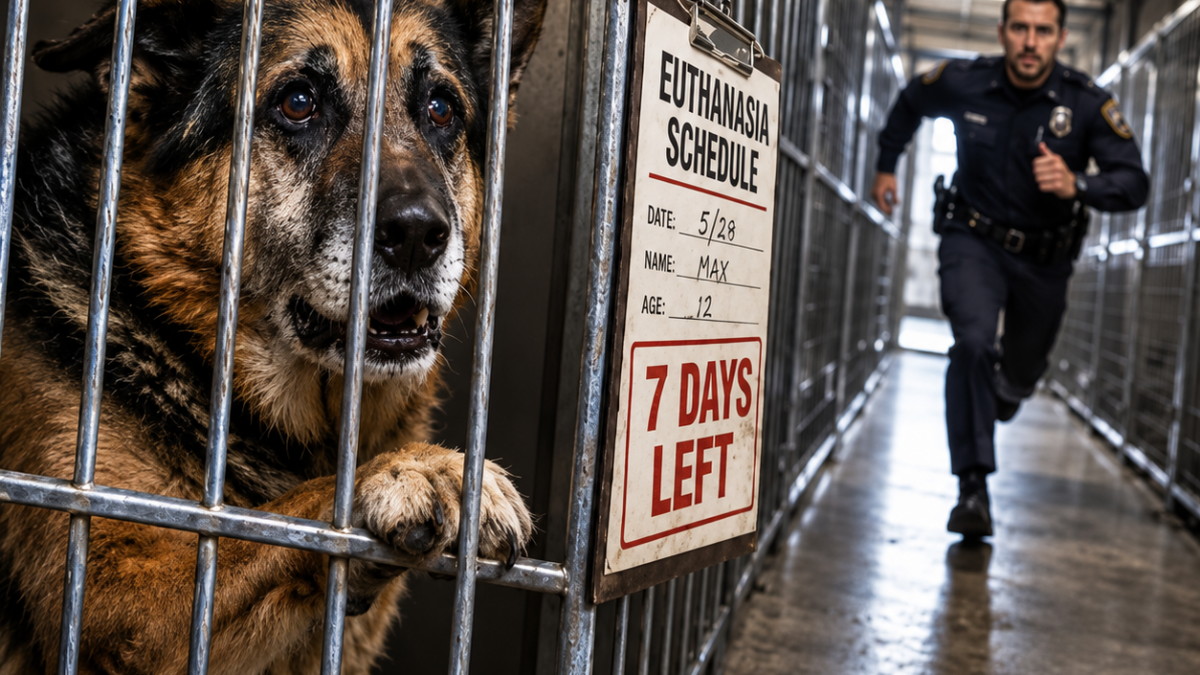
“Seven days.”
The number hit harder than I expected.
Seven days is nothing.
Seven days is a week of meals, cleaning, walks, laundry, phone calls, paperwork, and visitors passing by. Seven days disappears inside a shelter before anyone can catch it.
That evening, after the lights dimmed and most of the building settled into the restless quiet that comes after closing, I went back to the last row.
Bishop was curled on his blanket, facing the wall.
I sat outside his kennel without calling him.
For almost a year, I had believed Bishop was distant, stubborn, maybe too shut down to care who came or went.
But I kept seeing the way he had reacted to that siren.
Maybe he was not refusing everyone.
Maybe he was waiting for someone.
Someone who had once called him something other than Bishop.
And somewhere beyond the shelter walls, I wondered whether that person knew time was running out.
I barely slept that night.
Seven days followed me home. It sat with me through dinner. It stared from the ceiling above my bed. It came back with me before sunrise.
Seven days.
Not much.
But still seven chances.
I did not have a grand plan. Grand plans are for people with money, influence, and enough emotional distance to use phrases like “strategy.” I had a phone, a lunch break, and a dog who would not cooperate with being saved.
By noon, I took my phone into the kennel corridor and crouched outside Bishop’s gate.
Most shelter dogs are easy to photograph if you understand them. Hold a treat above the camera. Make a silly noise. Say their name in a high voice. Catch the bright eyes, raised ears, hopeful face.
Bishop seemed determined to make himself impossible.
“Bishop,” I called softly.
He turned toward the wall.
I held up chicken.
His nose moved.
His head did not.
I took several photos anyway.
In one, half his face was visible.
In another, he had turned so far away that it looked less like an adoption picture and more like photographic proof that a German Shepherd disapproved of social media.
“All right,” I muttered. “You win.”
I stopped trying.
I sat cross-legged on the concrete floor outside his gate. No calling. No treat. No cheerful shelter voice. Just silence.
After several minutes, Bishop lifted his head.
Maybe he wanted to see if I had finally left.
Maybe he was curious about why I had stopped trying to pull something from him.
Whatever the reason, he slowly turned toward me.
I raised the phone without making a sound.
The photo captured him before he could look away.
It was not a cheerful picture.
He was lying down, not sitting proudly. Silver showed around his muzzle. The missing notch in his right ear was visible. His eyes were tired, deep brown, and focused somewhere beyond me.
But he did not look hopeless.
He looked like he was waiting.
That difference mattered.
I opened the shelter’s social media page and started writing.
At first, I typed the usual phrases.
Sweet senior boy.
Looking for loving home.
Gentle soul.
Deserves comfort.
Then I deleted almost everything.
Trying to sell Bishop as something he was not had failed for nearly a year.
So I told the truth.
I wrote that Bishop was an older German Shepherd found injured near an illegal dumping site. I wrote that his body had healed but his heart seemed to be somewhere we could not reach. I admitted he did not run to the kennel door, did not perform tricks, did not beg visitors to choose him, and did not seem interested in convincing anyone of anything.
But I also wrote that he had never shown unnecessary aggression. He had tolerated every exam, every treatment, every bath, every day inside a place that was too loud for an old dog. I wrote that sometimes, when a police siren passed nearby, he sat up like he remembered something.
I did not put the seven-day deadline in the headline.
I was afraid panic would bring the wrong kind of offers.
Bishop did not need someone moved only by urgency. He needed someone who could handle the weight of whatever story he carried.
At the end, I wrote the sentence that had stayed with me all night.
Maybe Bishop is not refusing the idea of a family.
Maybe he still remembers the one he lost.
Then I posted the photo.
For the first hour, almost nothing happened.
Three reactions.
One comment: He looks sad.
Another asked whether he was good with cats.
I answered honestly that we did not know.
By midafternoon, someone shared it.
Then another.
Then a lost-pet group in Boise picked it up. Someone cross-posted it to Nampa. Someone else sent it to a Meridian community page. By evening, Bishop’s face had traveled farther than he ever did from his kennel.
He had no idea.
He lay on his blanket while the world, for once, moved toward him.
More than twenty miles away in Nampa, Officer Mason Ror was finishing a long shift.
I did not know Mason then.
I did not know he was forty-one, broad-shouldered, quiet in the way experienced officers become quiet after learning how much noise people make when they are afraid. I did not know he had short dark hair graying at the temples, a faint scar near his left eyebrow from an old line-of-duty injury, and a wife named Erin who had learned not to panic when his shifts ran late unless his voice told her to.
I did not know he had two sons asleep upstairs.
Eli, eight, restless and sandy-haired.
Sam, six, still round-faced, with a habit of sleeping surrounded by toys he had promised to put away.
I did not know Mason came home that night, loosened his uniform collar, reheated coffee that should have been poured out hours earlier, and sat at the kitchen table scrolling through his phone because a few minutes of ordinary nonsense helped his mind come down from patrol.
A high school football post.
Road construction.
A complaint about missing trash cans.
Then Bishop’s photo.
Mason’s thumb stopped.
At first, the name meant nothing.
Bishop.
He saw an old German Shepherd with silver around his muzzle and tired eyes.
Then he enlarged the photograph.
The right ear.
A small triangular notch near the tip.
Mason stopped breathing for a second.
He zoomed in again, studying the left shoulder beneath uneven fur.
There, faint but present, was the line of an old scar.
His coffee went cold beside him.
Mason stood and crossed the kitchen to a narrow cabinet near the refrigerator. Inside were things people keep because throwing them away would feel like denying a whole life: old photographs, school drawings, paperwork, badges, certificates, memories folded into envelopes.
He found a small packet near the back.
Inside were photographs from his years in the K9 unit.
In one, a younger Mason knelt beside a powerful German Shepherd, black-and-tan coat bright, ears sharp, eyes focused. In another, the same dog sat beside a patrol vehicle after a winter search, snow crusted along his chest. A third showed the dog in Mason’s backyard with two much smaller boys climbing over him like he was part dog, part mountain.
The dog in those pictures had never been called Bishop.
His name was Hawkeye.
Mason placed his phone beside the old photographs.
Age had changed the shelter dog. His muzzle was gray. His body thinner. His eyes tired in a way Mason hated before he even understood why.
But the notch matched.
The scar matched.
Even the markings around the eyes followed the same familiar pattern Mason had looked at thousands of times from the driver’s seat of a patrol car.
“No,” he whispered.
Reason tried to help him.
Old German Shepherds can resemble one another.
Scars happen.
Ears get damaged.
Wishful thinking is powerful when grief has unfinished business.
But somewhere below reason, instinct had already stood up.
That dog might not be Bishop at all.
That dog might be Hawkeye.
And if Mason was right, the partner he believed had spent retirement safe in another man’s care had somehow ended up injured near a garbage dump, nameless, alone, and days away from being put down.
Mason did not sleep that night.
Long after Erin came downstairs and asked whether he was coming to bed, he remained at the kitchen table under yellow light, shelter photo open on his phone, old K9 photographs spread around him like evidence in a case he was afraid to solve.
Every time he convinced himself he was imagining it, his eyes returned to the same details.
The ear.
The shoulder scar.
The dark mark above the eyes.
Eventually he went to the hall closet and pulled out a plastic storage box that had not been opened in years. The lid resisted, then gave way with a dry smell of canvas, dust, and leather. Inside were pieces of a life he rarely talked about anymore.
An old K9 unit badge.
A black leather leash polished smooth by years of use.
Training certificates.
A worn Velcro patch with white letters:
K9 HAWKEYE.
Mason ran his thumb over the name.
Three years earlier, Hawkeye had retired after years at his side. Arthritis had started whispering in the hips. Long shifts left him stiff. The department veterinarian warned that another hard season could turn manageable pain into permanent damage.
Mason had wanted to bring him home.
Under different circumstances, he would have.
But that year, life had narrowed brutally. Mason had undergone surgery after a line-of-duty injury and spent months in rehabilitation. Erin was managing two very young boys, medical bills, uncertainty, and a household already stretched thin. Bringing home a retired working dog with medical needs was not impossible, but Mason had let himself believe there was a better option.
Howard Keane stepped forward.
Howard was a retired K9 trainer in his early sixties. He had known Hawkeye from the dog’s early training days and understood his habits almost as well as Mason did. More importantly, Hawkeye trusted him.
Mason still remembered the day he brought Hawkeye to Howard’s property outside Nampa.
The German Shepherd stood between the two men, alert but confused, waiting for someone to explain why his routine had changed. Howard crouched, rubbed the fur beneath his collar, and promised Mason the old officer would spend retirement chasing tennis balls, sleeping in the sun, and pretending not to hear commands whenever it suited him.
For a while, the promise seemed real.
Howard sent pictures.
Hawkeye asleep beneath a porch swing.
Hawkeye standing beside a pond, mud up his legs.
Hawkeye resting in grass while Eli and Sam sat beside him during a visit, treating him less like a dog than a relative who happened to have paws.
Then Howard’s life changed.
His older sister became seriously ill. He moved farther into rural Idaho to help care for her. His phone number changed. The new property had bad reception. Visits became harder to arrange around Mason’s shifts.
Messages slowed.
Then stopped.
Mason tried to reach him a few times.
Not enough times.
That thought sat like a stone in his chest as the shelter photo glowed in front of him.
He had trusted Howard.
More painfully, he had trusted the idea that Hawkeye was safe.
By seven the next morning, Mason was dressed, phone in hand, waiting for the shelter to open.
At eight sharp, our front desk transferred his call to me.
I was sorting morning medication when the phone rang.
“This is Molly.”
The voice on the line was controlled, but strained beneath it.
“I’m calling about the German Shepherd you posted. Bishop.”
I glanced toward the kennel corridor.
“Yes?”
“Can you check his right ear?”
I went still.
“What?”
“The right ear. Near the upper edge. Is there a small piece missing?”
I looked through the glass toward the last row.
“Yes,” I said slowly. “There is.”
A breath moved across the line.
“And his left shoulder. If you part the fur, there should be a narrow scar running backward. Maybe three inches.”
My pulse quickened.
I carried the phone with me into the corridor. Bishop lifted his head when I opened his kennel but did not stand. I crouched, spoke softly, and parted the fur over his left shoulder.
The scar was there.
“Yes,” I said.
The man on the line made a sound I could not name.
“One more thing,” he said. “Rear left foot. One of the outside nails should curve slightly inward. It never grew right after an old injury.”
I waited until Bishop stretched his hind leg, then checked the paw.
The nail was exactly as he described.
For several seconds, neither of us spoke.
I looked at Bishop differently.
No.
Not Bishop.
Maybe not Bishop.
“Who are you?” I asked.
“My name is Mason Ror. I’m a police officer in Nampa.”
My grip tightened around the phone.
“I think that dog used to be my partner.”
My mouth went dry.
“What was his name?”
The man hesitated only a second.
“Hawkeye.”
I looked at the handwritten kennel card clipped to the door.
BISHOP.
Suddenly the name looked painfully small.
Within minutes, Mason arranged to take the morning off and drive to Boise. I went straight to Patricia’s office.
She listened without interrupting as I told her about the call.
The ear.
The scar.
The nail.
The name.
The former K9 partner.
“He knew things nobody could guess,” I said.
Patricia leaned back in her chair.
Years of rescue work had made her careful with miracles. People sincerely mistake similar dogs for lost pets. People convince themselves of connections that do not exist because they want a happy ending so badly. People arrive emotional and leave disappointed, and the animal pays the price for their certainty.
“We do this properly,” Patricia said.
“But what if he’s right?”
“Then we confirm it properly.”
Her voice softened.
“And if he’s wrong, Bishop does not need ten people standing around expecting him to become someone else’s dog.”
I knew she was right.
Still, I checked the front door every five minutes.
Late that morning, a patrol vehicle turned into the shelter lot.
Mason parked near the entrance and sat behind the wheel for several seconds after cutting the engine. I watched from the lobby window, my hands clenched together.
He stepped out slowly.
He wore uniform pants and a dark shirt, but no duty jacket. Even from a distance, I could see he was holding himself carefully, as if one sudden movement might make hope break in his hands.
When the front door opened, the kennel corridor erupted in barking.
At the far end of the last row, Bishop lay facing the rear wall.
He seemed asleep.
Then Mason spoke quietly to the receptionist.
Just a few words.
Too distant for me to make them out clearly over the barking.
But Bishop’s right ear moved.
His eyes opened.
For the first time in nearly a year, a voice had entered that building carrying something older than the name Bishop, older than the shelter, older than the injured dog found under trash.
The German Shepherd did not rise.
Not yet.
But he was listening.
I walked Mason down the corridor.
The hall seemed longer than usual. Dogs rushed to their gates, barking, jumping, spinning. A young hound slapped both paws against his door. A terrier behind us barked as if convinced the entire visit had been arranged for him.
Mason barely looked at them.
His attention was already fixed on the last kennel.
I slowed as we approached.
Bishop lay on his blanket with his back toward us. From this angle, I could see what the photograph had hidden: the hollow behind his ribs, the stiffness in one hind leg, the way age and shelter life had softened the powerful body he must once have had.
Mason stopped walking.
“You don’t have to rush,” I said quietly.
He nodded, but his throat seemed too tight for words.
Patricia followed several steps behind us, arms folded loosely, her expression careful.
“Bishop,” I called softly.
The German Shepherd’s ear moved.
He did not turn.
I tried again.
“Come here, boy.”
Nothing.
Ordinary.
Heartbreaking.
Patricia stepped closer.
“Bishop.”
This time he opened his eyes. He lifted his head perhaps an inch, then lowered it again.
Mason watched every movement.
Something settled in his face.
The name was wrong.
Of course it was wrong.
This dog had spent almost a year hearing strangers call him Bishop. That name meant food bowls, exams, kennel doors, people who came and went. But before Bishop, there had been another life.
Mason took one step forward.
Then another.
He stopped several feet from the gate.
He did not whistle.
Did not clap.
Did not use the sharp working commands that once sent his K9 across fields or brought him back in an instant.
Instead, Mason spoke in the voice people save for after the work is done, when the car is parked, the night is quiet, and only the ones who know you best remain.
“Hawkeye.”
The dog’s head snapped up.
I inhaled so sharply my chest hurt.
Patricia’s arms dropped to her sides.
For one long second, Bishop did not move anything except his eyes.
Then he turned his head.
Mason’s face broke.
The dog stared directly at him.
No barking.
No growling.
No cautious sniffing.
Just a silence so complete I was afraid to breathe inside it.
Mason took another small step.
“Hawkeye,” he said again, softer this time. “Hey, partner.”
The change was immediate.
The old German Shepherd surged to his feet so fast his hind paws slipped on the concrete. He caught himself, scrambled forward, and rushed to the metal gate with a sound I had never heard from him before.
Not a bark.
Not a whine.
A cry.
Deep and broken and frantic with recognition.
He pressed himself against the gate, tail striking metal so hard the whole panel rattled. His front paws lifted. He shoved his muzzle between the bars, desperate to reach the man kneeling on the other side.
Mason dropped to one knee.
“Yeah,” he whispered, voice breaking. “It’s me.”
Hawkeye pushed harder against the gate.
Mason slipped both hands through the bars and touched the sides of his face.
The dog froze for half a heartbeat when Mason’s palms settled against his cheeks.
Then he began licking Mason’s hands fast, frantic, almost disbelieving. His tail never stopped. His whole body trembled so violently that I thought his old legs might give way beneath him.
I covered my mouth with both hands.
For almost a year, I had watched children offer him toys, families speak gently, volunteers sit beside him, staff plead with him to show even one spark of wanting to be chosen.
Now there was so much life in him he could barely contain it.
Patricia moved to the latch.
“Are you ready?” she asked.
Mason nodded without looking away.
The gate opened.
Hawkeye came through before Patricia had moved it fully aside.
Nearly seventy pounds of aging German Shepherd crashed into Mason’s chest, and Mason made no attempt to protect himself. He braced one hand on the floor as Hawkeye shoved his head under Mason’s chin, pulled back only long enough to lick his face, then pushed against him again.
A trembling sound came from deep in the dog’s throat.
Mason wrapped both arms around him.
For several seconds, he said nothing.
His face disappeared into the fur along Hawkeye’s neck.
The smell had changed, I imagine. Shelter shampoo. Disinfectant. Age. Months of living as Bishop.
But underneath all that, Mason must have found something familiar, because his shoulders began to shake.
I looked away because seeing a police officer cry made it impossible to stop my own tears.
Patricia turned toward the wall and removed her glasses, pretending she needed to clean them.
One of the kennel techs at the corridor entrance covered her mouth.
Hawkeye did not care who was watching.
He climbed halfway into Mason’s lap, pawed at his chest, pressed his head against him again and again, as if trying to make certain the man would not disappear when he blinked.
Mason laughed once through tears.
“You’re still too big for this.”
The words meant nothing to Hawkeye.
The voice meant everything.
When Mason finally leaned back enough to look at him, Hawkeye’s brown eyes stayed fixed on his face. Mason ran his thumb along the missing notch in the right ear. Then his hand moved to the old shoulder scar beneath thinning fur.
There was no doubt now.
No resemblance could explain this.
No coincidence could explain the ear, the scar, the nail, the voice recognition, and the way an old dog everyone thought was unreachable had changed the instant one forgotten name returned to him.
“I’ve never seen him do anything like this,” I said.
Mason looked at me.
“Not with anyone?”
I shook my head.
“Not once.”
Hawkeye finally settled enough to sit, but one front paw remained firmly across Mason’s thigh.
As if touch had become necessary.
For almost a year, I had believed Bishop was a dog who could not connect anymore.
Now I understood how wrong I had been.
He had known exactly how.
He had simply been saving that part of himself for someone he still remembered.
In that corridor, Bishop disappeared for a moment.
Not because the shelter name had not mattered. It had given an unknown dog an identity when he had none.
But beneath it, Hawkeye had been there all along.
Waiting.
And after years of silence, someone had finally called him home.
Patricia suggested we move to her office so Mason could hear the full intake story without the barking echoing off concrete.
Hawkeye followed immediately.
No hesitation now.
He walked at Mason’s left side with a stiff but familiar discipline that made my breath catch. Until that morning, Bishop had walked wherever the leash allowed, polite but disconnected. Now he adjusted his pace every time Mason slowed. When Mason stopped outside Patricia’s office, Hawkeye stopped too, shoulder aligned with his leg.
The body was older.
The training remained.
Patricia’s office was small, crowded with files, vet invoices, framed adoption photos, and a coffee mug that had survived more emergencies than anyone wanted to count.
Hawkeye lowered himself beside Mason’s chair and rested his chin across the officer’s knee.
Patricia opened his file.
“This is everything we have from the day he came in,” she said. “Until this morning, we had no reason to believe Bishop had ever been a working dog.”
“Hawkeye,” Mason said softly.
The German Shepherd’s ear moved.
Patricia nodded.
“Hawkeye.”
She read through the intake report. The sanitation worker who found him was named Calvin Mercer. He had gone to the illegal dumping site expecting broken furniture and trash. Instead, he noticed movement beneath a collapsed wooden pallet near piles of old tires.
At first, Calvin thought it was a coyote.
Then the dog lifted his head.
“He didn’t try to run,” Patricia said, “but he couldn’t stand properly. He was dehydrated, underweight, one hind leg swollen, paw pads split, and the abdominal wound was badly infected.”
Mason’s hand stilled on Hawkeye’s head.
“There were no tags,” Patricia continued. “No collar. No readable tattoo. The scanner found no chip.”
“He was chipped when he worked,” Mason said.
“We checked repeatedly.”
That detail troubled him. It troubled all of us. But there was no explanation in the file. Maybe the chip had migrated beyond scanning range. Maybe it failed. Maybe records had been lost or not updated properly. Maybe someone had removed identification before he ended up there.
Some questions would remain cruelly unanswered.
“The strangest part,” Patricia said, turning a page, “was his behavior. Calvin approached with a catch pole because he was worried the dog might be defensive. Hawkeye watched him, tried to rise, failed, and dropped back. Then Calvin said, ‘Stay.’ He didn’t mean it as a command. Just said it. Hawkeye stopped struggling immediately. Lowered his head and stayed completely still.”
Mason looked down at the old dog.
“No,” he said quietly. “He understood.”
His voice changed when he explained.
“Hawkeye was trained to hold position under stress. Noise, pain, crowds, whatever was happening around him. If someone close enough gave that command, he would try to obey.”
I thought back to the day Bishop arrived.
The way he lowered himself to the ground.
The way we mistook training for exhaustion.
“What kind of work did he do?” I asked.
Mason was quiet for several seconds.
Then he began telling us.
Not the flashy stories first.
Not arrests.
Not takedowns.
Those might have been the stories other officers remembered, but Mason carried different ones.
He told us about a winter search six years earlier, when an eight-year-old girl named Clare Benton disappeared from her grandmother’s house after a family argument and wandered into freezing weather wearing pajamas and a light coat.
Search teams spread through nearby streets, fields, and drainage areas. Hawkeye caught her scent from a scarf and led Mason across an empty field, through a shallow ditch, and to a concrete drainage culvert half hidden under weeds.
Clare was inside, curled up and shaking so hard she could barely speak.
“Hawkeye crawled in first,” Mason said. “He didn’t bark at her. Didn’t paw. Just lay beside her until I could reach them.”
He looked down at Hawkeye.
“She wrapped both arms around his neck and wouldn’t let go until the paramedics arrived.”
I stared at the old dog sleeping with his head on Mason’s knee.
“He helped people get home,” I said.
Mason nodded.
“More than once.”
He told us about Walter Grady, seventy-eight, advanced dementia, missing from an assisted living facility during early summer. Officers had searched for hours before Hawkeye tracked him across a field behind an abandoned farmhouse. Walter was sitting beneath a cottonwood tree, confused but unharmed.
“He put both hands on Hawkeye’s face,” Mason said softly, “and asked if he’d been sent by his wife.”
No one spoke.
Then Mason’s hand moved unconsciously toward the scar under Hawkeye’s shoulder.
The last story was harder.
A nighttime pursuit.
An industrial storage yard.
Movement ahead.
A second threat Mason did not see.
Hawkeye reacted first.
He slammed into Mason’s legs hard enough to knock him behind a concrete barrier an instant before danger came from the side.
The shoulder wound came from that night.
The scar I had seen without understanding had been earned saving Mason’s life.
“He gave me seconds I didn’t know I needed,” Mason said.
The office stayed silent for a long time.
The dog lying beside him had found a missing child, guided an elderly man back to safety, protected his handler when danger came from the dark.
And somehow, when his own life fell apart, Hawkeye became the one nobody could find.
Patricia finally asked what had happened after retirement.
Mason told us about Howard Keane.
The retired trainer.
The trusted friend.
The porch swing pictures.
The pond.
The visits with the boys.
The messages that slowed after Howard moved farther into rural Idaho to care for his sister.
The silence Mason had mistaken for normal life continuing.
Patricia asked if Mason could contact his former unit for records.
He made the call from her office.
The man who answered was Lieutenant Daniel Cross, and at first he thought Mason was joking.
Then Mason sent the shelter photograph.
The reply came less than a minute later.
That’s Hawkeye.
Archived records confirmed the identification through old veterinary notes, photographs, the shoulder injury, the ear notch, and the abnormal rear nail.
But while reviewing Howard Keane’s information, Lieutenant Cross found something else.
Howard had died fourteen months earlier.
Mason said nothing when he heard it.
His face went still in a way that looked like pain had decided to stop moving.
The date aligned almost perfectly with the months before Hawkeye was found near the dumping site. Howard’s property had gone through estate handling. No one from the department had been notified that Hawkeye was missing. No report had connected him to Mason. No one had known.
For three years, Mason believed the dog was safe.
For fourteen months, Howard had been gone.
Somewhere in that gap, Hawkeye lost his home, his name, his health, and nearly his life.
Guilt entered the room quietly.
I could see it settle on Mason’s shoulders.
He lowered his hand to Hawkeye’s head.
The old dog leaned harder against his leg.
Hawkeye did not seem interested in blame.
He was simply there.
Still loyal.
Still close.
Behaving as though finding Mason again had solved the only mystery that mattered.
Mason wanted to take him home that same afternoon.
We all wanted it.
But Patricia had spent too many years running a shelter to let emotion replace procedure, even on a day when everyone in the building was desperate for the same ending.
“Hawkeye is still legally in shelter custody,” she explained gently. “We need to match the records, verify ownership transfer, and make sure the medical release is correct.”
Mason nodded.
He was a police officer. Rules had shaped his adult life, even when they hurt.
“I’m not going anywhere,” he said.
Hawkeye, with one paw resting across Mason’s boot, seemed to agree.
While Patricia worked through documents and waited for the final records, I suggested Mason take Hawkeye into the fenced exercise yard behind the shelter.
It was the same yard where volunteers had spent months trying to make Bishop show interest in anything.
That afternoon, the clouds had begun to break over Boise. Weak autumn sunlight fell across damp grass. Hawkeye stepped outside beside Mason and paused, sniffing the air.
Then he moved automatically to Mason’s left side.
I noticed first.
I stayed near the doorway pretending to sort leashes.
Mason walked toward the far fence.
Hawkeye stayed beside him.
Mason slowed.
The dog slowed.
Mason stopped.
Hawkeye stopped so precisely that his shoulder lined up with Mason’s leg.
Mason looked down, and a small smile moved across his face.
“You remember that too?”
Hawkeye looked up at him.
Mason changed direction without warning.
The old German Shepherd adjusted immediately, moving around and returning to the left side as naturally as if their last patrol had ended yesterday instead of years earlier.
A volunteer crossing the yard stopped to watch.
Patricia came to stand beside me.
Mason raised one hand, fingers arranged in a silent signal.
Hawkeye sat.
The movement was slower than it would have been years ago. His hips were stiff. The damp grass did him no favors.
But the response was immediate.
Mason tried another signal.
Hawkeye lowered himself to the grass, then lifted his head and stared at Mason like he was waiting for the next part.
That expression finally broke through the heaviness on Mason’s face.
He laughed.
Not the broken sound from the kennel corridor.
A real laugh.
Warm and surprised.
“You’re waiting for your reward, aren’t you?”
Hawkeye’s ears moved forward.
Mason reached into the treat pouch I had handed him earlier and offered chicken.
Hawkeye took it carefully.
I stared.
“He ignored that exact treat yesterday.”
Mason glanced at me.
“He always worked for praise first and food second.”
Hawkeye immediately nudged his hand.
Mason smiled.
“Most of the time.”
That small joke mattered more than I can explain.
For months, I had wondered whether something inside Bishop had shut down permanently. Now the dog in front of me was not simply obedient. He was engaged. Present. Interested in the world because the world had finally given him back his person.
Then Hawkeye noticed the red rubber ball near the fence.
The same kind of ball the little boy had rolled into his kennel the day before.
He walked to it.
Picked it up.
Not quickly.
Not with puppy excitement.
But he carried it back toward Mason and dropped it near his boot.
I pressed both hands to my mouth again.
“I’ve never seen him touch that.”
Mason bent down and rubbed Hawkeye’s neck.
“You were never much of a fetch dog anyway.”
The old German Shepherd leaned into him.
A short time later, Dr. Elena Walsh arrived for Hawkeye’s final examination. She had treated him during his recovery and looked visibly stunned when she entered the room and found him standing pressed against Mason’s leg.
“So this is what you were waiting for,” she said.
Hawkeye watched her but did not leave Mason.
The exam took nearly half an hour.
Heart.
Lungs.
Teeth.
Old injuries.
Range of motion.
Weight.
Hips.
Knees.
The infection that had nearly killed him after intake was gone. His weight had returned to a healthy range, though long shelter life and age had reduced muscle. His biggest long-term issue was arthritis.
“He doesn’t need to be treated like glass,” Dr. Walsh said. “But the days of long runs, hard work, and jumping in and out of vehicles are behind him. Short walks, warm bedding, joint support, regular checkups, and a healthy weight will help more than trying to make him feel young again.”
Mason looked down at Hawkeye.
“He’s retired.”
Dr. Walsh smiled.
“Then make sure he understands that.”
Mason almost laughed.
“That might be the hard part.”
By late afternoon, Patricia received the final documents from Mason’s former unit. There was no remaining doubt.
The dog our shelter had called Bishop was K9 Hawkeye.
Twenty-four hours earlier, his file had listed him among our longest-term dogs with seven days left.
Now the paper in front of Mason said something else.
Adoption agreement.
He read every page.
Name of adopter.
Address.
Veterinary responsibility.
Appropriate housing.
Medical care.
Lifelong protection.
Then he signed.
For the first time in years, Hawkeye legally belonged with him again.
I went back to the kennel one last time.
The small card still hung on the gate.
BISHOP.
I unclipped it carefully.
For nearly a year, that name had represented everything we knew about him. It had held him when his real name was lost. It had kept him from becoming just another unidentified dog in a file.
Mason approached quietly.
I handed him the card.
“You should keep it.”
He looked at the handwritten name.
“Why?”
“Because Bishop mattered too,” I said. “That’s who he was when nobody knew where he came from.”
Mason looked at the card for a long moment.
Then he slipped it carefully into his pocket.
At the front desk, Patricia completed the release. There were no speeches. No applause. Just signatures, medical records, medication instructions, and an old German Shepherd watching the front door as if he understood that this time he was leaving with someone.
Before Mason stepped outside, he turned toward me.
“I don’t know how to thank you.”
I glanced at Hawkeye.
“I only took a picture.”
Mason shook his head.
“Sometimes a picture is enough to bring someone home.”
I looked away fast because I had cried enough in front of this man for one day.
The front door opened.
Cold afternoon air moved into the lobby.
Hawkeye stepped outside beside Mason.
No one pulled him forward.
No leash tightened.
He simply walked at Mason’s left side, matching his pace with the same quiet precision that had once carried them through streets, search fields, patrol nights, and years of trust.
At the patrol vehicle, Mason opened the rear door, then hesitated.
Dr. Walsh’s warning about jumping came back to him.
He lowered the portable step from the cargo area.
Hawkeye examined it suspiciously.
“You’re ten now,” Mason told him. “You can complain, but you’re using the step.”
Hawkeye looked at him for another second.
Then climbed in.
Mason closed the door gently.
For the first time since arriving, he allowed himself to think about what came next.
Erin did not know.
Neither did Eli or Sam.
The last time the boys had seen Hawkeye, Eli had been five and Sam only three. Their faces had changed. Their voices had changed. Sam might not remember clearly at all.
Hawkeye remembered Mason after three years.
But would he remember the two small boys who once climbed over him in the yard, shared snacks when adults were not watching, and believed their father’s K9 was the greatest dog in Idaho?
The answer was waiting at home.
Mason did not call ahead.
By the time he turned onto his street in Nampa, the late afternoon light had softened into pale gold. Hawkeye sat upright in the back seat, watching through the window with quiet concentration. Mason noticed the change before they reached the driveway.
The ears lifted.
The nose moved rapidly against the cracked window.
Then Mason pulled in front of the house.
Hawkeye went completely still.
It was not Howard’s property.
Not the shelter.
It was the house where years earlier he had spent afternoons beneath the maple tree while two tiny boys dropped toys beside his paws and tried to feed him things they were absolutely not supposed to feed him.
Inside, Erin stood near the kitchen window folding a dish towel when she noticed the patrol vehicle.
At first, she saw only Mason.
Then movement behind the glass.
An old German Shepherd.
Silver muzzle.
One ear notched.
Erin stopped breathing.
The towel slipped from her hands.
Mason opened the rear door and unfolded the step.
Hawkeye climbed down carefully.
Erin opened the front door.
For a second, she froze beneath the porch light.
“Hawkeye?”
The dog turned at her voice.
Three years had changed her too. Her auburn hair was shorter. Fine lines near her eyes had deepened. But her voice had not changed nearly as much as children’s voices do.
“Hawkeye,” she said again.
His tail moved once.
Then faster.
He stepped toward her.
Erin crouched before she seemed to realize she was doing it.
Hawkeye crossed the distance and pressed his nose beneath her hand. A second later, his body leaned against her knees with enough force that she had to brace against the doorframe.
She laughed and cried at the same time.
“Oh, you old boy.”
Mason stood near the driveway and let them have the moment.
Hawkeye licked Erin’s wrist, then pushed his head beneath her palm the way he had done years earlier whenever she scratched behind his ears.
She looked up at Mason.
“How?”
“Long story.”
“You brought him home.”
Mason nodded.
Before he could explain more, footsteps thundered inside.
Eli appeared first.
At eight, he was much taller than the five-year-old Hawkeye had known, all long legs and sandy hair that refused to stay combed. Sam followed with a plastic dinosaur in one hand because apparently even an unexpected family miracle was not important enough to abandon it.
Both boys stopped on the porch.
Eli recognized him first.
His mouth opened.
“Dad?”
Mason smiled.
Eli looked from his father to the dog.
“Hawkeye?”
The German Shepherd turned.
This time, he did not rush forward immediately.
Mason understood why.
Three years is not very long to an adult.
To a child, it is almost another lifetime.
Eli’s face had changed. His scent was older. His voice deeper. Sam had barely been old enough to build complete memories of the dog.
Hawkeye stood between Erin and Mason, watching Eli’s careful approach.
Eli crouched a few feet away and held out one hand.
“Hey, buddy.”
Hawkeye’s nose lifted.
He walked forward one step.
Then another.
He sniffed Eli’s fingers. His sleeve. His shoulder. His face.
Eli stayed perfectly still.
For a moment, nothing happened.
Then Hawkeye gave a sudden explosive sneeze directly into the boy’s face.
Eli fell backward laughing.
Mason laughed too.
Erin covered her mouth, crying again and laughing through it.
“He sneezed on me!”
“He used to do that when you were little,” Mason said.
“I don’t remember that.”
“I do.”
Hawkeye’s tail wagged harder.
Eli threw both arms around his neck.
The old German Shepherd leaned into him.
Then Hawkeye noticed Sam.
Sam had not moved.
Unlike Eli, he had no clear memory to fill the gap. Most of what Sam knew about Hawkeye came from family photographs: a younger German Shepherd near his crib, in the yard, wearing a ridiculous paper birthday hat Erin had once insisted upon.
Sam looked at Mason.
“Does he know me?”
Mason did not answer immediately.
“I think you should let him decide.”
Sam slowly crouched.
Hawkeye approached.
He sniffed the boy’s hands.
His shirt.
Then paused at Sam’s chest.
Something changed.
The dog pressed his head firmly into Sam’s stomach.
Sam’s eyes widened.
The plastic dinosaur dropped onto the porch.
Then the boy wrapped both arms around Hawkeye’s neck.
Hawkeye closed his eyes.
Mason looked away.
He remembered Sam at three years old falling asleep against Hawkeye’s side during a visit to Howard’s property.
Maybe Hawkeye remembered too.
The rest of that afternoon became a strange mixture of reunion and inspection.
Once inside, Hawkeye moved through the house slowly, as if conducting a patrol. He sniffed the living room furniture. Paused at the stairs. Checked the kitchen. Walked the hallway toward the bedrooms.
Eli followed him everywhere.
Sam followed Eli.
Mason followed all three because someone needed to protect the retired police dog from two children who seemed to believe three lost years could be repaired before dinner.
In the family room, Hawkeye found a bin full of toys.
A tennis ball rolled out.
His ears lifted.
Eli grabbed it.
“Want it?”
Mason gave him a warning look.
“Gentle. No running him.”
Eli rolled the ball across the carpet.
Hawkeye followed it with more enthusiasm than speed, picked it up, turned, and then appeared to reconsider the entire distance back.
Halfway across the room, he lay down with the ball between his paws.
Sam laughed.
“He retired again.”
Even Mason had to admit that was accurate.
By dinner, Hawkeye found his favorite place: beside the table, directly between Eli and Sam.
Erin gave both boys strict orders not to feed him from their plates.
Hawkeye understood the rule perfectly and responded by staring at Eli’s roast beef with the unblinking seriousness of an investigator conducting a high-stakes interview.
Sam noticed first.
“Mom?”
“What?”
“He’s questioning Eli’s meat.”
Hawkeye remained motionless except for one raised eyebrow.
Mason smiled.
“He always was thorough.”
Eli shielded his plate.
“He’s not getting it.”
Hawkeye shifted his gaze to Sam.
Sam immediately covered his own food with both hands.
“No.”
Hawkeye sighed and lowered his head to the floor with such dramatic disappointment that the whole table laughed.
Later, Erin prepared a bed for him in the living room. She folded the thickest blanket in the house over an orthopedic dog cushion Mason had brought from the shelter and set a bowl of water nearby.
Hawkeye examined it.
Then lay down.
For a while, everyone believed that was where he would sleep.
Mason checked once before going upstairs.
Hawkeye was still there.
Sometime during the night, the old dog moved.
Morning light was just beginning to enter the upstairs windows when Erin noticed the empty bed.
She found Mason in the kitchen.
“Where’s Hawkeye?”
They went upstairs together.
Halfway down the hall, Mason stopped.
Hawkeye was lying on the floor between Eli’s bedroom and Sam’s.
Not inside either room.
Between them.
His body positioned so he could see both doors.
Mason remembered instantly.
Years earlier, whenever Hawkeye stayed with the family overnight, he had chosen the same place. A position where he could hear both boys. A position where anyone approaching either room would have to pass him first.
Erin stood beside Mason and looked down at the old German Shepherd.
“He remembers.”
Mason nodded.
Hawkeye opened one eye, saw them standing there, and closed it again.
His working years were over.
His badge was gone.
His patrols were finished.
But somewhere inside the old dog, one duty had apparently never retired.
He had found the boys again.
And just as he had years earlier, Hawkeye had chosen the place where he could watch over both of them.
The weeks that followed did not make Hawkeye young again.
No one expected them to.
Age still announced itself in small, undeniable ways. He rose slowly after long naps. On cold mornings, his back legs needed a few careful steps before they loosened. He slept longer in patches of sunlight that moved across the living room floor. His walks were short. His medicine came with breakfast. Joint supplements became part of the household routine.
But something far more important changed.
Hawkeye began expecting tomorrow.
Every morning when Mason came downstairs in uniform, Hawkeye appeared near the front door before Mason finished fastening his belt. He sat with ears forward, watching every familiar piece of equipment as though waiting for the command that would place them back on patrol together.
The first mornings were hard.
Mason would reach for the door, and Hawkeye would rise immediately.
“You’re retired,” Mason told him.
Hawkeye stared.
“Very retired.”
Hawkeye remained beside the door.
By the end of the first week, Mason found a compromise.
Before leaving for work, he crouched, rubbed Hawkeye beneath the collar, and said the same thing every morning.
“Watch the house for me.”
That seemed to satisfy him.
At least until the patrol vehicle disappeared.
Then Hawkeye shifted to his next responsibility.
Eli and Sam.
He learned the approximate time the school bus returned and began moving toward the front window several minutes early. Sometimes twenty minutes early. No one had the heart to criticize a retired K9 for excessive preparedness.
When the yellow bus stopped near the corner, his tail began moving before either boy appeared.
Eli usually reached the door first.
Sam usually shouted Hawkeye’s name before his shoes came off.
Those small routines slowly filled the empty places that had once made Bishop look like a dog who had stopped caring about the world.
One Saturday morning, after Hawkeye had been home several weeks, the weather turned unusually mild. The late autumn air was cool but not bitter, and dry leaves collected beneath the old maple tree in the backyard.
Eli sat at the kitchen table drawing.
Sam leaned over his shoulder.
Mason noticed the drawing included a roof, four walls, several windows, something resembling a porch, and a flagpole.
“What is that supposed to be?” Mason asked.
Eli looked offended.
“Hawkeye house.”
Mason studied it.
“That’s bigger than our garage.”
“It doesn’t have to be exactly that big.”
Sam pointed at the side.
“It needs a porch.”
“Dogs don’t need porches,” Eli said.
“Hawkeye does.”
Sam then proposed a window.
A second window.
A covered food area.
A storage space for tennis balls.
And something he called an emergency snack compartment.
Mason looked at Hawkeye, who was lying beside the refrigerator listening with his head on his paws.
“We’re building a doghouse,” Mason said. “Not a hotel.”
Sam considered this.
“A small hotel.”
By noon, Mason had surrendered.
He took the boys to buy lumber, roofing material, paint, and enough screws to survive several design revisions. Erin wisely stayed home, saying someone needed to be available when the construction crew discovered that enthusiasm and carpentry were not the same thing.
The project began beneath the maple tree.
Mason measured.
Eli measured again because he had recently learned to use a tape measure and considered himself qualified.
Sam held boards that did not need holding.
Hawkeye lay several feet away on a folded outdoor blanket, watching the operation.
Whenever hammering became enthusiastic, one ear lifted.
When Mason accidentally attached a side panel backward, Hawkeye raised his head and stared at him for several seconds.
Eli noticed.
“I think he knows.”
“He doesn’t know.”
Hawkeye continued staring.
Mason sighed and removed the screws.
“All right. Maybe he knows.”
The dog lowered his head again.
By midafternoon, the basic structure stood. It was larger than Mason intended, though smaller than Eli’s first architectural proposal. The roof sloped properly. The entrance was wide enough for Hawkeye to walk through without crouching too much. A small covered extension satisfied Sam’s insistence that every important building needed a porch.
Hawkeye inspected it before they finished.
He rose slowly, walked around the wooden structure, sniffed one corner, then another, and finally looked at Mason with an expression so serious that Sam whispered, “The inspector is here.”
Mason crossed his arms.
“Well?”
Hawkeye sneezed.
Eli laughed.
“I think we failed.”
Erin came outside carrying the part of the project she had quietly claimed: two thick blankets, an old but clean orthopedic cushion, and a waterproof cover for the floor.
She also carried a new stainless-steel water bowl that Sam declared looked official.
While Mason and the boys finished the roof, Erin arranged the bedding inside.
She knew from the beginning Hawkeye would probably sleep indoors most nights, especially in winter.
But that was not the point.
The little wooden structure was not being built because he needed somewhere else to sleep.
It was being built because the family wanted him to have something that unquestionably belonged to him.
Near sunset, the work was complete.
The doghouse stood beneath the maple tree, fresh wood catching amber light.
Eli carried out a small wooden sign he had painted earlier.
Across it, in careful uneven letters, was one word.
HAWKEYE.
Mason helped attach it above the entrance.
Sam stared at the sign.
“It needs another word.”
“What word?” Erin asked.
Sam disappeared inside and returned with a marker.
Mason crouched beside him and steadied a smaller wooden strip while Sam slowly formed four letters.
HOME.
They fixed it beneath Hawkeye’s name.
For a few seconds, no one said anything.
Mason looked at the two words.
Three years earlier, Hawkeye left his daily life as a working partner and disappeared into what Mason believed would be safe retirement. Then Howard died. Somewhere after that came the missing months, the dumping ground, the infection, the shelter, the name Bishop, and nearly a year of watching families choose other dogs.
For a while, Hawkeye possessed almost nothing that connected him to the life he once knew.
Now his name hung above a door again.
“Hawkeye,” Mason called.
The old German Shepherd came slowly across the yard.
He sniffed the entrance.
Then stepped inside.
The family waited.
Hawkeye turned once on the cushion.
Then again.
He lowered himself onto the blankets Erin had arranged and rested his head across his front paws.
Sam whispered as if they were observing wildlife.
“He likes it.”
Eli nodded solemnly.
For several minutes, Hawkeye remained inside.
Then he heard the family moving toward the porch.
His head appeared through the doorway.
A moment later, he walked back out, crossed the yard, and settled beside them.
Sam stared at the empty doghouse.
“We spent all day building that.”
Erin laughed.
Mason lowered himself onto the porch step.
“I think he likes us better.”
Eli sat on one side of him.
Sam squeezed onto the other.
Erin stood behind them, one hand resting on Mason’s shoulder.
Hawkeye lowered himself near Mason’s feet and eventually placed his silvered head across the officer’s leg.
For a while, they stayed there as evening cooled around them.
Mason ran one hand gently along Hawkeye’s neck.
Three years earlier, he had believed their story was finished.
Perhaps Hawkeye had believed something similar when familiar voices disappeared and the world became strange.
Yet love does not always vanish when people are separated.
Sometimes it simply has nowhere to go.
It waits in old habits.
In familiar voices.
In remembered scents.
In a quiet part of the heart that refuses to replace what once mattered.
Some lost things find their way back through careful plans.
Hawkeye found his through a shelter worker who refused to let a quiet old dog disappear without being seen, a photograph traveling farther than anyone expected, and one police officer who stopped scrolling long enough to recognize an old scar.
I visited Hawkeye several weeks after the adoption.
Mason brought him back to the shelter for a check-in with Dr. Walsh, and when I saw him step through the front door, I had to stop myself from crying again.
He looked older than the dog in Mason’s photographs.
He always would.
But he did not look like Bishop in the last kennel anymore.
His eyes were brighter.
His body still moved stiffly, but with purpose.
When he saw me, he did not explode forward the way he had for Mason. I had not earned that place in his heart, and I did not expect it.
But he walked to me.
Slowly.
Deliberately.
Then pressed his head against my leg.
I crouched and wrapped my arms around his neck.
“Hey, Bishop,” I whispered first.
His ear moved.
Then I smiled.
“Hey, Hawkeye.”
His tail gave one slow sweep.
Mason stood nearby, watching.
“He remembers you,” he said.
“I think he remembers the building,” I replied.
“Maybe.”
I scratched behind Hawkeye’s ear.
“For a while, I thought he didn’t care about any of us.”
Mason’s voice softened.
“He cared. He just didn’t know where his job had gone.”
I looked at the dog leaning against me, then at the man who had found him twice in one lifetime.
“I’m glad you saw the post.”
Mason nodded.
“Me too.”
After they left, I went back to the last row.
Bishop’s kennel held another dog now, a nervous shepherd mix who barked at visitors but secretly loved cheese. The faded blanket had been washed and moved. The kennel card said a different name.
Shelter life had continued.
It always does.
Dogs arrive.
Dogs leave.
Some stories end beautifully.
Some do not.
That is the part people outside rescue do not always understand. One miracle does not empty the building. One reunion does not erase the list of animals still waiting. One happy ending does not protect your heart from the next hard decision.
But it changes something.
It changed me.
Before Hawkeye, I thought quiet meant absence.
No interest.
No hope.
No bond left.
Now, when I see an animal lying still while the world passes by, I ask myself a different question.
Not, Why won’t you try?
But, Who are you waiting for?
Maybe no one.
Maybe everyone.
Maybe just the right voice.
Months later, Mason sent us a photograph.
Hawkeye lay on the floor between Eli’s and Sam’s bedroom doors, exactly where Mason had found him that first morning home. His muzzle was silver in the hallway light. His eyes were closed. One boy’s sock lay near his paw. Above him, two doors stood partly open.
On the back of the printed copy Mason brought later, he wrote:
Still on duty.
Patricia framed it and hung it near the front desk.
Underneath, she added a small copy of Bishop’s old kennel photo.
The one I took when I stopped trying to make him look adoptable and simply let him be what he was.
Waiting.
Visitors sometimes asked about the two photos.
We told them the story.
Not the online version with the easy miracle and the tearful ending.
The whole version.
The old dog who would not come forward.
The euthanasia list.
The seven days.
The siren.
The photograph.
The officer who recognized an ear notch, a scar, and a damaged nail.
The name Hawkeye.
The reunion.
The home.
And I always made sure to say one more thing.
“He was not nameless,” I would tell them. “We just didn’t know his name yet.”
That mattered.
Because animals come to shelters with histories we cannot see.
Scars we do not understand.
Habits that look strange without context.
Fear that seems stubborn.
Silence that seems empty.
Sometimes we rename them because we have to.
Sometimes those names carry them through the gap.
Bishop carried Hawkeye through the gap.
Then Hawkeye came back when the right person called.
One rainy afternoon, nearly a year after his adoption, Mason stopped by without warning.
He was off duty, wearing jeans and a jacket instead of uniform. Hawkeye climbed carefully from the vehicle using his step because Mason had become strict about that, no matter how offended the retired K9 looked.
This time, Eli and Sam came too.
They were taller.
Children do that quickly.
Hawkeye moved slower.
Dogs do that too.
But when Mason opened the shelter door, Hawkeye walked in with his head up.
No panic.
No shutdown.
No retreat to the last row.
He greeted Patricia.
Sniffed the front desk.
Accepted a treat from Dr. Walsh.
Then he pulled gently toward the kennel corridor.
Mason looked at me.
“Want to see something?”
We walked him to the last row.
The kennel that had once been his was empty that afternoon, freshly cleaned for a new arrival.
Hawkeye stopped outside it.
For a moment, no one spoke.
I wondered whether he remembered the loneliness.
The concrete.
The barking.
The families who passed by.
The name Bishop spoken by kind voices that were still not the voice he wanted most.
Hawkeye sniffed the gate.
Then looked up at Mason.
Mason crouched and placed one hand on his neck.
“You don’t have to wait here anymore,” he said softly.
Hawkeye leaned into him.
Then turned away from the kennel.
Just like that.
No drama.
No final farewell.
He walked back down the corridor at Mason’s side.
Eli and Sam followed.
I stood there watching until they reached the lobby.
That was when I understood the real ending of his story.
It was not the moment Mason called his name.
It was not the adoption papers.
It was not the doghouse sign.
It was this.
The old dog returning to the place where he had nearly disappeared and walking out again without fear, because this time, he knew exactly who was waiting on the other side of the door.
Outside, the rain had stopped.
Mason loaded him carefully into the vehicle.
Sam waved at me with both hands.
Eli called, “Bye, Molly!”
Hawkeye looked through the rear window.
His ears were up.
His eyes were calm.
Then the vehicle pulled away.
I went back inside and returned to work.
There were bowls to wash.
Medications to give.
A nervous terrier to coax into eating.
A new intake waiting for a name.
But as I moved through the kennels, the sound felt different to me.
The barking was still loud.
The metal doors still clanged.
The air still smelled of bleach, wet fur, and hope under pressure.
Yet somewhere in all that noise, I carried Hawkeye’s lesson.
Some dogs do not beg because they have forgotten how to want.
Some do not play because the toy is not what they are waiting for.
Some do not come forward because their heart is standing years behind them, listening for a voice everyone else stopped using.
For almost a year, Bishop waited quietly at the end of the last row.
He waited through visitors, medical checks, winter, spring, summer, and another autumn.
He waited until his name was almost lost under paperwork.
He waited until time narrowed to seven days.
Then one photograph found one man.
One man saw an old scar.
One man whispered, “Hawkeye.”
And the dog everyone thought was empty proved that love had been alive in him the entire time.
He had not forgotten.
He had not stopped caring.
He had only been waiting for the person who knew who he was.
Now Hawkeye sleeps between two boys’ bedroom doors, guards a home that finally belongs to him, and carries two names in the story of his life.
Bishop, the name that held him when he was lost.
Hawkeye, the name that brought him home.
And if you ask me which one mattered more, I will tell you both.
Because sometimes a lost soul needs one name to survive the waiting.
And another to remember the way back.








