The SEAL’s K9 Wouldn’t Let Anyone Near for Six Months—Until an Old Farmer Spoke One Word
PART2:
The Navy did not have endless space for a permanently unstable working dog.
No matter how heroic.
No matter how decorated.
No matter how many lives he may have saved overseas.
That was the sentence no one wanted to say out loud.
I had not signed the final recommendation yet, but it sat on my desk in a blue folder, my name typed neatly beneath language I hated.
Due to persistent severe aggression, failure to respond to treatment, and safety risk to personnel, humane euthanasia is recommended.
Humane.
A word that can mean mercy.
A word that can also feel like surrender wearing clean clothes.
The morning Jacob Brandt arrived, I had slept maybe three hours.
I remember standing outside Phalanx’s enclosure with a clipboard in my hand, pretending to review notes I already knew by heart. Petty Officer Davis stood beside me, young, tense, loyal in the way good handlers are loyal even to dogs that frighten them.
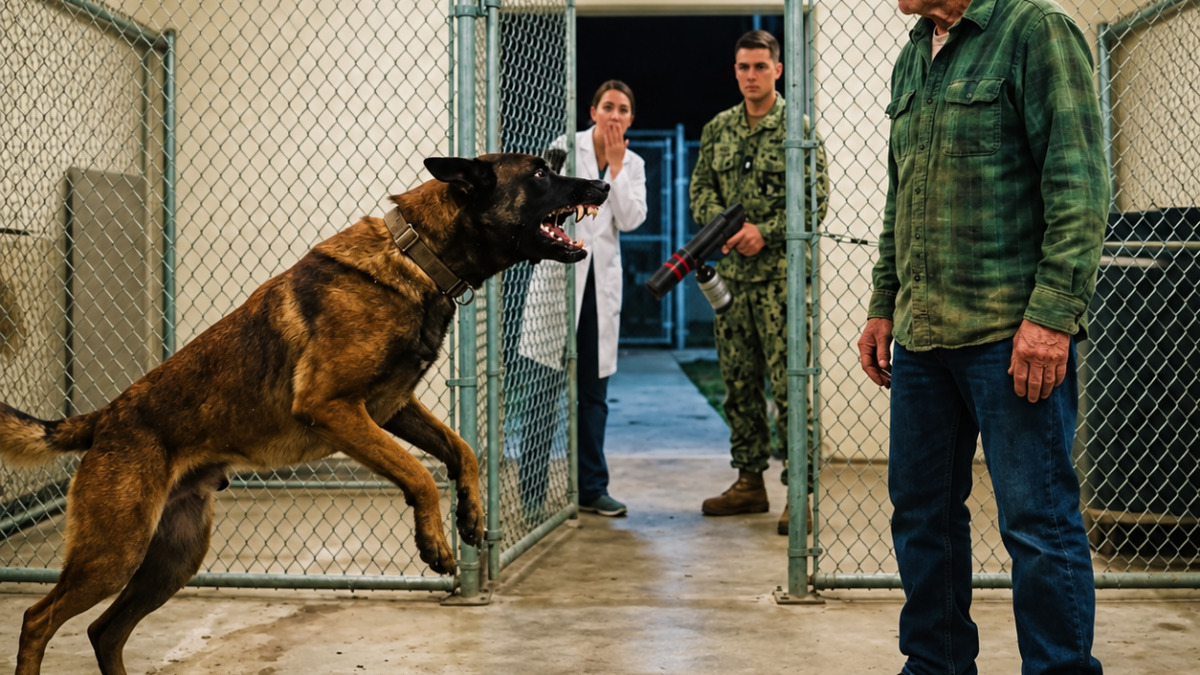
Phalanx paced on the other side of the fence.
Back and forth.
Back and forth.
His nails clicked against concrete.
His shoulders rolled beneath his coat.
A low growl vibrated from him so constantly that after a while it seemed part of the compound’s machinery.
Then a voice behind me said, “That’s a lot of fence for one dog.”
Quiet.
Raspy.
Dry as old dust.
I turned.
The man standing behind us did not look like anyone who belonged at Naval Base Coronado.
He looked like he had stepped out of a Montana field and wandered into a classified mistake.
Faded flannel shirt.
Jeans worn pale at the thighs.
Boots scuffed and dusty.
Weathered hands, thick with calluses.
A face mapped in deep lines.
Pale blue eyes that did not flicker away from Phalanx.
He was tall, though age had bent him slightly at the shoulders. Not weakly. Just weathered. His stillness bothered me before I knew why. Most civilians reacted to Phalanx immediately—fear, pity, nervous talking, stiff posture, backward steps.
Jacob Brandt did none of that.
He watched.
Only watched.
“He’s not just one dog,” I said.
My voice was sharper than I intended.
“That’s Phalanx. Former military working dog attached to SEAL Team 3. His handler was Petty Officer First Class Liam Olsen.”
I heard myself use the past tense.
Jacob’s jaw tightened.
“Liam was my grandson.”
My professional mask cracked.
Only for a second.
“Mr. Brandt,” I said, softer now. “I’m Dr. Elena Reed. We spoke on the phone.”
“I know who you are.”
His eyes stayed on the dog.
“You’re the one trying to fix him with charts and pills.”
Davis shifted beside me.
I felt my spine stiffen.
“With respect, Mr. Brandt, Phalanx is suffering from a severe trauma response. He’s been in a persistent state of hyperarousal since Liam’s death. We’ve tried desensitization, counter-conditioning, medication, scent transition, controlled handler exposure—”
“He’s guarding,” Jacob said.
The word cut through my explanation cleanly.
I stopped.
He nodded toward the enclosure.
“He’s not pacing because he’s crazy. He’s walking a perimeter. He thinks his boy is still in the fight, and he’s holding the line until Liam comes back.”
The growl continued.
Back and forth.
Back and forth.
I looked at Phalanx again despite myself.
A perimeter.
No.
That was too simple.
Too romantic.
Too much like a grieving grandfather making meaning out of an animal’s dangerous behavior because the alternative was unbearable.
“Mr. Brandt,” I said carefully, “I understand your emotional connection. But this dog is highly trained and currently highly dangerous. My responsibility is the safety of every person in this compound.”
Jacob finally looked at me.
His eyes were pale and steady.
“You’ve had six months.”
“I’m aware of the timeline.”
“And your way hasn’t reached him.”
“That does not mean—”
“He’s got a week left before someone signs a piece of paper and calls putting down a hero the only safe option.”
The words hit too close.
My face must have changed, because Davis looked at me.
Jacob saw it too.
“So I’m right.”
I hated that he was.
“The recommendation is not final,” I said.
“But written.”
I did not answer.
He turned back to Phalanx.
“I didn’t come from Montana to talk through a fence.”
“No.”
“Open the gate.”
Davis sucked in a breath.
I stared at Jacob.
“Absolutely not.”
He did not react.
“That is out of the question,” I continued. “You have no idea what he’s capable of. He put a trained master-at-arms in medical for three days.”
Jacob nodded once.
“Then he’s still got good bite pressure.”
“That is not funny.”
“Wasn’t meant to be.”
Phalanx stopped pacing.
His head lowered.
His growl deepened.
He was looking at Jacob now.
Not at me.
Not at Davis.
At Jacob.
I felt the air change.
Animals notice what humans hide.
And Phalanx had noticed something.
Jacob placed both hands loosely at his sides.
“I’m not asking you to stop being a doctor,” he said. “I’m asking you to admit your treatment is out of road.”
My fingers tightened around the clipboard.
Protocols existed for reasons.
Every safety rule in that compound had been written by someone who had seen what teeth could do faster than regret could form. Letting a civilian inside that enclosure was insane. Letting an elderly civilian inside was worse. Letting Liam Olsen’s grieving grandfather step into the kill zone of a traumatized SEAL dog could end my career, injure or kill the man, and confirm every commander’s worst fear about Phalanx.
But the blue folder sat on my desk.
And beyond the fence, Phalanx stared at Jacob like the old man had interrupted a nightmare.
“Davis,” I said quietly.
He looked at me.
“Ma’am?”
“Open the outer latch. Stay on tranquilizer.”
His eyes widened.
“Doctor—”
“Do it.”
The decision felt both reckless and inevitable.
Davis unhooked the tranquilizer pistol from his belt and moved toward the gate. His hand shook only slightly as he unlocked the heavy padlock. The chain slipped free. The gate groaned inward.
Phalanx went still.
The growl became something subterranean.
His lips peeled back.
White teeth.
Black gums.
A weapon system acquiring target lock.
Jacob stepped inside.
No raised hands.
No baby talk.
No treats.
No soothing nonsense.
He did not crouch immediately or turn sideways in exaggerated submission the way many civilians are taught to do around nervous dogs. His movements were controlled, economical, almost too smooth for a man his age. He stopped about fifteen feet from Phalanx, just beyond what we called the red zone.
Phalanx exploded forward.
Davis raised the pistol.
“Hold,” Jacob said.
The word was soft, but somehow it stopped Davis more effectively than a shout.
Phalanx slammed to a halt five feet from Jacob, barking with such force that saliva sprayed the concrete. His body was all rage and muscle, haunches coiled, ears pinned, eyes burning.
I had seen men with combat experience flinch from less.
Jacob did not move.
Not an inch.
He breathed slowly.
In through the nose.
Out through the mouth.
The kind of breath control I taught patients with panic, but in him it did not look practiced from therapy. It looked older. It looked like something learned where breathing wrong could get you killed.
Davis saw it too.
I could feel his attention sharpen beside me.
For a full minute, Phalanx raged.
Jacob let him.
That was the only way I can describe it.
He did not dominate him.
Did not challenge him.
Did not retreat.
He simply stood there like a post driven deep into the earth, allowing the storm to spend itself against something that would not break, strike back, or disappear.
Slowly, the sound of Phalanx’s barking changed.
Less certain.
More frantic.
Confused.
This man was not prey.
Not threat.
Not handler.
Not vet.
Not enemy.
Not anything Phalanx’s grief knew what to do with.
“All right,” Jacob murmured. “That’s enough of that.”
He took one step forward.
My hand flew to my mouth.
Phalanx barked again, but there was less weight behind it.
Jacob’s voice remained low.
“I know you’re waiting for him.”
Phalanx froze.
“I know.”
Jacob took another slow step.
“I miss him too.”
The words changed him.
Not the dog.
Jacob.
For the first time, grief entered his voice.
Not loudly.
Not theatrically.
Just a crack in the old wood.
“He was my boy long before he was yours.”
Phalanx’s mouth closed.
His chest still heaved.
His eyes stayed fixed on Jacob.
The old man lowered himself to one knee.
Smoothly.
Deliberately.
No groan, no wobble, no old-man stiffness.
Davis whispered something under his breath.
I did not catch it, but I knew what he meant.
That was not a farmer’s movement.
That was trained.
Jacob settled on the concrete, lowering himself beneath Phalanx’s eye line without surrendering control. It was one of the most dangerous and confident things I had ever seen a person do.
“He’s not coming back, Phalanx,” Jacob said.
The dog trembled.
The sound that came from him then was not a growl.
Not quite.
Something caught between refusal and pain.
“He stood his post,” Jacob continued. “He finished his watch. Now you’ve got to finish yours.”
Phalanx shifted his weight.
One step back.
One step forward.
I realized I was holding my breath.
Jacob did not look away from the dog.
“Dr. Reed,” he called.
“Yes?”
“I need something of Liam’s.”
My stomach tightened.
“We’ve used scent articles before.”
“No,” Jacob said. “You’ve presented them. I need his vest.”
I hesitated.
His plate carrier was stored in evidence inventory with the rest of his recovered kit. It had been sealed, documented, and used only under controlled conditions.
Jacob said, “Please.”
That was the first time he sounded less than certain.
Davis looked at me.
I nodded.
“Get it.”
He ran.
Phalanx did not move while we waited.
Neither did Jacob.
When Davis returned, he carried the plate carrier carefully, almost reverently. Dust stained the fabric. The MOLLE webbing was worn. There were old abrasions, desert grit in seams no cleaning ever fully removed, and the faint complicated smell of sweat, sand, metal, and a man who was not coming home.
Davis approached only as far as safety allowed, then laid the vest near the gate and backed away.
Jacob reached back without taking his eyes off Phalanx.
He hooked two fingers through the webbing and dragged the vest closer.
The scent reached Phalanx like a physical blow.
His whole body recoiled.
Then he whined.
A high, piercing sound unlike anything I had heard from him in six months.
Davis lowered the tranquilizer pistol slightly.
My eyes burned.
Jacob laid his palm flat on the vest.
“He told me about you,” he said.
Phalanx’s ears twitched.
“Said you were the best he’d ever seen. Said you could find a wire in a sandstorm. Said you had a lion’s heart and a thief’s brain.”
A faint movement came from Davis, almost a laugh swallowed before it could become sound.
Jacob stroked the worn fabric once.
“Said you were family.”
Phalanx stopped trembling.
His gaze locked on Jacob’s hand.
Then Jacob spoke one word.
Not English.
Short.
Guttural.
Low.
“Stoshi.”
The reaction was immediate.
Phalanx flinched as if struck by memory.
His body, held tight for half a year, went slack in pieces: ears first, then shoulders, then tail, then jaw. His head tilted. His amber eyes widened with complete bewilderment.
I looked at Davis.
His face had changed.
He knew.
Whatever that word was, it was not something Liam had written casually in a letter.
Jacob said it again, softer.
“Stoshi.”
At ease.
I did not know the translation then.
I knew only what I saw.
A dog who had spent six months fighting every living thing around him took one hesitant step forward.
Then another.
The growl was gone.
In its place came a low, shuddering whimper.
He approached Jacob as if approaching a ghost, nose working, body uncertain, every instinct rearranging itself around a voice that had somehow spoken from the world he understood.
He stopped inches from Jacob’s knee.
Sniffed.
Old cotton.
Hay.
Machine oil.
Leather.
And something else.
Something faint that I had not noticed until Davis later named it.
Gunpowder.
Phalanx nudged Jacob’s hand.
Jacob did not move.
The dog nudged again.
Harder.
A plea.
Slowly, Jacob lifted his hand and placed it on Phalanx’s head.
He did not pet him like a civilian pets a dog.
He checked him.
Ears.
Jaw.
Neck.
Shoulders.
Chest.
Legs.
A systematic field assessment disguised as touch.
Phalanx leaned into it.
Then the warrior dog collapsed.
Not from sedation.
Not exhaustion exactly.
Release.
His legs folded, and he lowered himself onto the concrete, placing his head across Jacob Brandt’s knee. His eyes closed. A long, mournful sound left him, then faded into a breath so deep I felt it through the fence.
For the first time in 182 days, Phalanx rested.
No growl.
No pacing.
No teeth.
Just a grieving dog with his head in the lap of an old man who had finally given him permission to stand down.
I cried.
I did not mean to.
I had not cried in the compound once through six months of failure. Not when Phalanx refused food. Not when Davis came back shaken after the master-at-arms was injured. Not when I typed the euthanasia recommendation with my office door locked.
But watching that dog close his eyes on Jacob’s knee undid me.
Davis looked away politely.
Jacob continued checking Phalanx’s body. Along the dog’s flank, half hidden in thick fur, his fingers found a matted knot. He worked it free gently.
A tiny dried burr.
Sharp.
Brown.
Foreign.
He held it between thumb and forefinger.
“High desert,” he murmured.
No one spoke.
It had been there six months.
A tiny piece of the battlefield embedded in fur. Not enough to explain everything. Not enough to excuse our failure. But enough to remind me how much modern equipment can miss when no one is allowed close enough to touch with understanding.
Jacob flicked the burr away.
I gripped the fence.
“How?” I whispered.
Jacob looked up.
His pale eyes met mine.
“How did you do that?”
He glanced at Davis before answering.
“Liam mentioned the word in a letter.”
Davis’s expression hardened—not with anger, but with recognition.
“With respect, sir,” he said quietly, “no, he didn’t.”
Jacob’s face gave nothing away.
Davis stepped closer to the fence.
“That stance. Your breath. The way you let him bluff without feeding it. The way you checked him. That wasn’t from a letter.”
Jacob lowered his hand to Phalanx’s shoulder.
The dog did not lift his head.
“Where did you serve?” Davis asked.
The compound went still.
For a moment, I thought Jacob would refuse to answer.
Instead, he looked down at Phalanx, then toward the open gate.
“A long time ago,” he said. “In places that don’t exist on maps.”
That was all.
He stood slowly.
Phalanx rose with him.
Calm.
Close.
Attached to his left leg like a shadow that had finally found direction.
Jacob walked toward the gate.
Phalanx followed at heel.
No leash.
No command.
Davis and I stepped back without being told.
The dog who had not allowed anyone within ten feet for six months walked out of the enclosure beside Liam Olsen’s grandfather as if the two of them had been partnered for years.
At the threshold, Jacob paused and looked at me.
“You were treating the symptoms,” he said.
I expected accusation.
Instead, his voice was tired.
“The bond is what got wounded.”
Then he walked away with Phalanx at his side.
I stood there long after they left.
The empty enclosure looked obscene.
All that concrete.
All that fence.
All that science.
All that failure.
Davis finally lowered the tranquilizer pistol completely.
“Ma’am,” he said.
I turned.
His eyes were still on the path where Jacob had disappeared.
“We need to know who that man is.”
I should have said it did not matter.
I should have said privacy mattered, family mattered, and the only relevant outcome was Phalanx no longer trying to tear through chain-link with his grief.
Instead, I nodded.
Because it did matter.
Not for gossip.
For understanding.
Later that afternoon, Davis requested a meeting with Captain Wallace, the base commander. I was not in the room, but Wallace called me in afterward.
Captain Thomas Wallace was not a man who wasted facial expressions. He had spent thirty years in uniform and seemed to have reduced human communication to only those parts necessary for mission success.
He sat behind his desk with Davis standing at parade rest.
A file was open on the secure terminal.
“Dr. Reed,” Wallace said, “Petty Officer Davis has given me an interesting account.”
“I imagine he has.”
“Do you agree with it?”
I looked at Davis.
Then back at Wallace.
“Yes.”
Wallace studied me.
“You let a civilian into an enclosure with a dangerous military working dog.”
“I did.”
“Against protocol.”
“Yes.”
“Why?”
I could have defended the decision clinically.
End-stage case.
Failure of all standard interventions.
Family-member exposure attempt under controlled observation.
Potential last effort before euthanasia.
Instead, I told him the truth.
“Because I was about to recommend killing that dog, and Jacob Brandt saw something I had missed.”
Wallace leaned back.
For a moment, his eyes softened.
Then he turned the monitor slightly toward me.
The file on screen was heavily redacted.
Most lines were black bars.
But the name at the top was visible.
BRANDT, JACOB T.
CPO, USN, Retired.
I stepped closer.
Below the name were dates stretching back into the late 1960s.
Operations blacked out.
Locations blacked out.
Unit designations blacked out.
Then one citation remained partially visible.
Navy Cross.
For extraordinary heroism while serving as lead scout and K9 handler during a clandestine cross-border operation, CPO Brandt and his K9 partner Major held position under overwhelming hostile pressure, enabling extraction of reconnaissance personnel.
My mouth went dry.
Wallace spoke quietly.
“Jacob Brandt is not just Liam Olsen’s grandfather.”
Davis said the words almost reverently.
“He’s one of the originals.”
Wallace nodded.
“Before the modern program. Before all this infrastructure. Before the doctrine was written in clean manuals and taught in clean classrooms. Men like Brandt were writing it in mud and jungle, with dogs beside them and no guarantee anyone would admit they’d been there.”
I looked back at the screen.
CPO Brandt.
Lead scout.
K9 handler.
Navy Cross.
Classified operations.
The flannel shirt.
The callused hands.
The old farmer from Montana.
“He disappeared after retirement,” Wallace said. “Requested his file sealed, went north, bought land, raised horses, kept to himself. Liam was his only grandson. As far as most of the Navy was concerned, Jacob Brandt had become a ghost.”
Davis’s voice was low.
“Until Phalanx.”
Wallace closed the file.
“Until Phalanx.”
The next morning, I found Jacob in a training field on the far side of the compound.
The sun had just cleared the low buildings. Marine layer haze softened the sky. The field was simple—short grass, a few cones, a rope toy, and a bench. Nothing like the sterile enclosure. No concrete path worn by pacing. No rattling fence. No observers with clipboards pretending not to fear the outcome.
Phalanx was with him.
I stopped at the edge of the grass.
The change was impossible.
He was not cured.
I knew better than to use that word.
But he was present.
His body was relaxed, though alert. His mouth slightly open. His ears forward. He tracked Jacob’s movements with focus instead of desperation. When Jacob tossed the rope toy a short distance, Phalanx bounded after it, seized it, shook it once, and brought it back.
Play.
For six months, we had tried to get that dog to engage with any toy.
Nothing.
Now he dropped the rope at Jacob’s feet and waited.
Jacob picked it up.
“Again?” he asked.
Phalanx’s tail moved once.
Jacob tossed it.
I pressed my lips together, suddenly overwhelmed.
The simple act of a dog chasing a rope should not have felt holy.
It did.
Jacob knew I was there before he looked at me.
“Doctor.”
“Mr. Brandt.”
“Come to tell me I broke regulations?”
“No.”
He turned fully then.
Phalanx moved with him.
Always at his side.
“I came to apologize.”
Jacob said nothing.
That made it harder.
“I was arrogant,” I said.
The words tasted like metal, but they were true.
“I saw a dangerous animal. A case. A risk profile. I saw symptoms and charts and failed interventions. I did not see the soldier clearly enough.”
Jacob’s face did not soften.
But it did not harden either.
“You saw what you were trained to see.”
“That is not an excuse.”
“No,” he said. “It’s a starting point.”
Phalanx nudged the rope against his boot.
Jacob looked down.
“In a minute.”
The dog waited.
Actually waited.
My throat tightened again.
“How did you know?” I asked. “That he was guarding?”
Jacob looked across the field.
“Because I’ve seen men do the same thing.”
“Men?”
“And dogs.”
He lowered himself onto the bench. Phalanx sat at his left knee.
“After my dog Major died, I stayed awake seventeen nights.”
I sat slowly on the far end of the bench, careful not to crowd Phalanx.
Jacob continued.
“Not because I wasn’t tired. Because I didn’t know who was watching the dark anymore.”
The field went quiet.
“I came home from places nobody wanted to talk about,” he said. “People told me I was safe. That it was over. They meant well. But they were speaking the wrong language. Safe didn’t mean anything. Over didn’t mean anything. My body was still listening for sounds that weren’t there.”
He rested one hand on Phalanx’s head.
“This one lost his handler in the middle of the war inside him. Then you put him in a box and waited for him to understand peace.”
The words hurt.
They were also correct.
“We tried to help him.”
“I know.”
“We weren’t careless.”
“I know that too.”
“Then why do I feel like I failed him?”
Jacob looked at me.
“Because you care.”
That was not comfort exactly.
It was worse.
It gave me no place to hide from myself.
“The science matters,” Jacob said. “Medicine matters. Behavior work matters. Don’t throw away tools because one old man had one you didn’t.”
“But?”
“But don’t confuse tools with understanding.”
Phalanx leaned against his knee.
Jacob continued, “That dog didn’t need someone to convince him nothing was wrong. He needed someone to tell him the mission changed.”
“The word,” I said. “Stoshi.”
Jacob’s eyes moved to mine.
“It means at ease. More or less.”
“Davis said it was Pashto.”
“Davis is sharp.”
“Liam used it?”
“Liam learned more from me than his mother appreciated.”
Despite myself, I smiled.
Jacob did not.
“He wrote me letters,” he said. “When he could. Never details. Just enough that I knew what he carried. He talked about Phalanx like some men talk about brothers. Said the dog knew when a room lied. Said he hated helicopters but loved the jump because Liam was on the other end of it. Said if anything ever happened, I should make sure no one mistook Phalanx’s loyalty for madness.”
His hand tightened slightly in the fur.
“Then Liam came home in a box.”
The morning seemed to still around us.
“I didn’t come sooner,” Jacob said.
I looked at him.
“Why?”
His jaw worked.
“Because I thought seeing the dog would kill me.”
Phalanx lifted his head.
Jacob looked down.
“Cowardice wears a lot of respectable coats when you’re old.”
“You came.”
“Almost too late.”
He said it without asking for absolution.
That made me respect him more.
“The Navy approved transfer to your custody,” I said.
Jacob nodded once.
“Wallace told me.”
“He’ll be yours.”
“He always was Liam’s.”
“Yes.”
“And now?”
Jacob looked at Phalanx.
“Now he needs work.”
“He’s retired.”
“So am I. Didn’t take.”
I almost laughed.
Jacob’s eyes sharpened.
“You need a program.”
“We have a program.”
“No,” he said. “You have a treatment plan.”
I sat straighter.
“There is a difference.”
“Big one.”
He picked up the rope toy and held it loosely.
“These dogs come home carrying more than obedience. They carry unfinished bonds. The handler dies, and everyone focuses on the animal’s behavior because that’s what scares people. Teeth. Growling. Refusal. But under that is a broken chain of command, broken trust, broken pack structure, broken purpose.”
I listened.
Really listened.
“The dog doesn’t just lose a person,” Jacob said. “He loses the voice that told him when to move, when to wait, when to fight, when to stop fighting, when to sleep. You can’t medicate that voice back into existence. You have to give him a new order that honors the old one.”
“How?”
Jacob tossed the rope lightly.
Phalanx caught it and returned.
“First, stop lying.”
I frowned.
“To the dog?”
“To yourself. To everyone. Don’t tell a grieving war dog everything is fine. Don’t treat loyalty like a symptom. Don’t call guarding ‘aggression’ without asking what he thinks he’s guarding.”
My fingers closed around the notebook I had brought without realizing I was holding it.
Jacob noticed.
For the first time, one corner of his mouth lifted.
“Good,” he said. “Class is in session.”
That was how the Phalanx Protocol began, though none of us called it that at first.
At first, it was simply Jacob Brandt standing in a field with a dog everyone had given up on, teaching a psychologist and a handful of handlers how much they did not know.
He was not gentle with us.
He was never cruel.
There is a difference.
He corrected posture, timing, tone, and assumptions. He stopped handlers mid-command if their bodies said fear while their mouths said control. He made us practice silence. He made us watch dogs without interpreting them too quickly.
“Name what you see,” he would say. “Not what you think it means.”
“Pacing.”
“Where?”
“Fence line.”
“Pattern?”
“Same route. Gate to corner, corner to water bowl, water bowl to gate.”
“What does that tell you?”
“He’s anxious.”
Jacob would glare.
“That’s a conclusion. Try again.”
“He’s checking the entry point, blind corner, resources, entry point again.”
“Now you’re seeing.”
We built new assessments.
Not replacing medicine.
Expanding it.
We added handler-loss mapping, scent-history work, mission-transition rituals, controlled grief exposure, veteran handler mentorship, and safe purpose reassignment. Dogs who could not return to duty were not simply retired into boredom. They were given structured roles: search training games, therapy support for veterans when appropriate, farm work, controlled patrol of safe spaces, scent tasks, anything ethical and safe that let the dog’s training become function instead of frustration.
Jacob insisted every file include the handler’s relationship with the dog, not just commands and performance.
“What did the handler say before feeding?”
“What hand did he leash with?”
“What word meant done?”
“What song did he hum in the truck?”
We laughed at that one.
Once.
Jacob’s stare ended it.
“You think the dog doesn’t know?”
We stopped laughing.
Phalanx became the center of the work.
He improved slowly, not magically.
The first week, he slept only near Jacob.
The second, he accepted food from Davis while Jacob stood nearby.
The third, he allowed me within five feet, then three, then close enough to place a bowl down without him stiffening.
The first time I touched him, I asked Jacob with my eyes.
He nodded.
I approached from the side, not head-on. I lowered my hand near his shoulder, not his face. Phalanx turned his amber eyes on me.
My heart hammered.
“I’m sorry,” I whispered.
Jacob said from behind me, “That’s for you, not him.”
He was right.
I tried again.
“Easy, Phalanx.”
The dog watched me.
Then allowed my fingers to brush his shoulder.
Only for a second.
Then he moved away.
Jacob nodded.
“That’s consent. Respect it.”
So I did.
A month later, Phalanx rested his head against my knee during a training review.
I did not move for eleven minutes.
Davis timed it.
He claimed it was for documentation.
He was smiling too much for that to be true.
Phalanx never became the dog he had been before Liam died.
That mattered too.
Healing is not restoration.
It is not returning to an untouched version of yourself.
Some losses alter the shape of the soul permanently. That is true for people. It is true for dogs. Phalanx remained watchful. He disliked strangers approaching too quickly. Thunder made him pace. The smell of certain fuels pulled him into alertness. He would never again be casual about doors.
But he learned to sleep.
He learned to play.
He learned to walk at Jacob’s side through open fields in Montana without searching every ridge for enemies.
He learned that Liam was gone and that love had not ended with him.
Before Jacob left the base, we held a small ceremony.
Not official enough for press.
Too official to pretend it meant nothing.
Captain Wallace attended.
Davis stood in dress uniform.
I stood beside him with Phalanx’s transfer folder in my hands.
Jacob wore the same flannel shirt from the first day, though someone had convinced him to put on a clean jacket. Phalanx sat at his left side, calm but alert.
Wallace said a few words about service.
About sacrifice.
About honoring both handler and dog.
Jacob stared at the horizon as if speeches were weather to be endured.
Then Wallace handed him Phalanx’s leash.
Jacob did not take it immediately.
He looked down at the dog.
“Your call,” he said.
Phalanx looked at the leash.
Then at Jacob.
Then leaned against the old man’s leg.
Jacob took the leash.
No one clapped.
It would have felt wrong.
Davis saluted.
Wallace did too.
After a second, I did as well.
Jacob looked uncomfortable.
Phalanx looked dignified.
Which, somehow, helped.
When Jacob loaded Phalanx into the back of his truck, the dog hesitated once. Not in fear. In recognition. He looked back toward the compound, toward the kennels, toward the place that had been prison and treatment and battlefield all at once.
Then Jacob said softly, “Stoshi.”
Phalanx turned and jumped in.
The truck pulled away toward the gate.
I stood beside Davis long after it disappeared.
“You okay, ma’am?” he asked.
“No.”
He nodded.
“Me neither.”
I returned to my office and took the blue folder from my desk.
The euthanasia recommendation.
I opened it.
Read every clinical sentence.
Every justified conclusion.
Every failure reduced to language.
Then I removed the signature page and fed it into the shredder.
The machine chewed slowly.
Not dramatically.
Just paper becoming strips.
But to me, it sounded like a gate opening.
The months after Jacob left changed my career more than any publication ever had.
The program grew.
At first quietly.
Then with command support.
Then with funding, because nothing in the military becomes real until someone assigns a budget code. We trained staff differently. We interviewed teammates and families after handler deaths. We created legacy scent kits and transition recordings when handlers deployed into high-risk environments. We built partnerships with retired handlers, veterans with K9 backgrounds, ranchers, search-and-rescue trainers, and behavioral specialists willing to admit dogs were not machines made of commands.
Jacob consulted from Montana by phone at first.
He hated video calls.
Said they made people talk too much because they could see themselves.
He mailed notes written in block letters on yellow legal paper.
One said:
Stop rewarding calm if the dog is frozen. Frozen is not calm.
Another:
If you do not know what job he thinks he has, you do not know what problem you are treating.
Another:
Trust is not obedience. Stop confusing the two.
I taped that one above my desk.
Six months later, I flew to Montana.
Not for official inspection, though I wrote it that way on the travel request. I went because Jacob had stopped answering calls for five days, and Davis, now transferred but still emotionally invested in every piece of this story, told me, “Ma’am, old wolves don’t go quiet for no reason.”
Jacob’s farm sat under a huge sky, surrounded by fields the color of late summer and mountains blue in the distance. The house was old, white paint peeling near the porch rail. A barn leaned slightly but stubbornly, as if held up by habit. Horses grazed behind a fence. Wind moved through tall grass with a sound like distant water.
Phalanx met my rental car halfway up the drive.
I stopped immediately.
He stood in front of the car, head high.
For one absurd second, I was back at the fence.
Then his tail moved.
Once.
Permission.
I opened the door slowly.
“Hello, Phalanx.”
He approached, sniffed my sleeve, then turned and trotted toward the barn.
I followed.
Jacob was inside, sitting on an overturned bucket, wrapping a bandage around his left hand.
“What happened?” I demanded.
He looked up.
“You always greet people with accusations?”
“You stopped answering.”
“Phone broke.”
“For five days?”
“Then I forgot to fix it.”
I took his hand before he could hide it.
The cut was shallow but ugly.
“Horse?”
“Gate latch.”
“Liar.”
His mouth twitched.
Phalanx sat beside him, watching me.
I cleaned and rewrapped the wound properly while Jacob tolerated me with visible resentment.
“You came all this way to fuss?”
“Yes.”
“Waste of government money.”
“I’m off duty.”
“Waste of your own money, then.”
I tied the bandage.
“Worth it.”
He looked away first.
That was how Jacob accepted affection.
Sideways.
Never named.
The farm had changed Phalanx.
Or maybe revealed him.
He moved with purpose there. Checked fences with Jacob every morning. Rode in the truck bed along pasture roads. Slept on a rug near the wood stove. Accompanied Jacob to the feed store, where no one approached without permission because the entire town apparently understood that Jacob Brandt and his dog were not tourist attractions.
In the evenings, Jacob sat on the porch with coffee, and Phalanx lay beside him, head on his paws, eyes on the tree line.
“Does he still wait for Liam?” I asked once.
Jacob was quiet for a long time.
“Yes.”
My chest tightened.
“But not like before,” he said. “Before, he waited like Liam was missing. Now he waits like Liam is part of the watch.”
I looked at Phalanx.
The dog’s ears flicked in the wind.
“That sounds peaceful.”
“It is some days.”
“And other days?”
Jacob sipped coffee.
“Other days are still days.”
That was the most honest description of grief I had ever heard.
Inside Jacob’s house, there were few photographs. A young Liam on horseback. Liam in uniform. A black-and-white photograph of Jacob much younger, standing beside a lean dark dog I knew must be Major. Another of a woman with dark hair and laughing eyes—Jacob’s late wife, Ruth.
On the mantel sat Liam’s folded flag.
Beside it, his collar tag from Phalanx’s working harness.
Not displayed for visitors.
Kept close.
I spent three days there.
We talked about dogs.
About trauma.
About command structures.
About guilt.
About how institutions often prefer clean labels because messy loyalty does not fit well in spreadsheets.
On the last night, Jacob handed me an old notebook.
The cover was cracked leather.
“What is this?”
“Things I should have written down forty years ago.”
I opened it.
Notes.
Diagrams.
Training observations.
Field lessons.
Not classified details.
Nothing operationally dangerous.
Just wisdom earned the hard way.
Dog reads breath before command.
Never ask for trust while standing like threat.
Handler grief transfers down leash.
Mission end must be marked or dog keeps searching.
I looked up.
“Jacob—”
“Use it.”
“I can’t take this.”
“Then copy it and give it back.”
“Why now?”
He looked toward Phalanx asleep by the stove.
“Because Liam asked me to make sure no one mistook loyalty for madness.”
My eyes burned.
“I won’t.”
“I know,” he said.
From Jacob, that was more than praise.
It was trust.
The program we built saved dogs.
Not all of them.
I will not lie.
Some wounds were too deep. Some bodies failed. Some risks remained too high. Some stories still ended with staff crying in rooms no one saw.
But fewer.
That is a word I learned to respect.
In medicine, in rescue, in war, in grief, you do not always get victory.
Sometimes you get fewer.
Fewer dogs euthanized because no one understood their behavior.
Fewer handlers feeling like their partner had been discarded.
Fewer families left out of transition.
Fewer staff mistaking a mission with no end for aggression without cause.
Fewer cages.
More fields.
More patience.
More listening before labeling.
Phalanx became the program’s proof.
Not a mascot.
Jacob would have burned the building down before allowing that.
But proof.
A living argument.
Years after the enclosure, I received a photograph in the mail. No note. Just a picture printed on glossy paper.
Phalanx stood in a Montana pasture under a wide evening sky, gray around the muzzle now, still powerful, still alert. Jacob stood beside him, one hand resting on the dog’s neck. In the background, an old horse grazed near the fence.
On the back, in Jacob’s block letters:
Still on watch. Sleeping better.
I kept it in my office beside the yellow note about trust and obedience.
Then one winter morning, Davis called.
His voice told me before his words did.
“Ma’am,” he said. “Jacob passed.”
I sat down.
Phalanx was still alive.
Older, slowing, but alive.
Jacob had died in his sleep, in his own bed, with Phalanx on the floor beside him and Liam’s flag on the mantel. A neighbor found them after Phalanx barked at the porch door until someone came.
For a few minutes, I could not speak.
Grief has a strange echo when it circles back through lives already shaped by loss.
“What happens to Phalanx?” I asked.
“Jacob left instructions.”
Of course he had.
The instructions were addressed to me.
Not lengthy.
Jacob did not waste words even at the end.
Elena,
If you are reading this, I finally managed to get somewhere before everyone made a fuss.
Phalanx knows this road. Do not put him back behind chain-link unless medically necessary. He has earned open sky.
Davis will bring him to you first. Let him see Liam’s vest if he needs it. Use the word only if he gets lost, not because you are scared.
He is not starting over. He is continuing.
Find him someone who understands watch duty.
Trust the dog.
Jacob
I read it three times.
Then I folded it and cried like a person, not a professional.
Davis drove Phalanx back to Coronado himself.
When the old dog stepped out of the vehicle, I saw time in his body. Gray muzzle. Stiffer hips. Slower movement. But his eyes were still amber and clear.
He looked at me.
Then at the compound.
For one terrible second, I feared memory would pull him backward.
Instead, I crouched carefully.
“Hello, Phalanx.”
He walked to me, pressed his head against my shoulder, and sighed.
Davis turned away.
I did not tease him for wiping his eyes.
We did not keep Phalanx on base long.
Jacob had been clear.
Open sky.
Someone who understood watch duty.
We found that someone in Frank Morales, a retired Navy corpsman living outside Flagstaff, widowed, steady, with ten acres, two old horses, and a history of working with difficult dogs. He had lost friends. Lost sleep. Lost enough to understand that not all vigilance is pathology.
When Frank met Phalanx, he did not kneel too fast or reach too eagerly.
He stood beside a fence, looked at the horizon, and said, “I could use a partner who doesn’t talk much.”
Phalanx sniffed him.
Walked away.
Came back.
Sat at his left side.
That was that.
I visited once the following year.
Phalanx was old then, white in the face, slower on the steps, but content. He followed Frank along fence lines each morning. Slept in a patch of sun by afternoon. Alerted when coyotes came near the goats. Accepted affection without needing to ask permission from ghosts.
Frank told me, “He still watches the east ridge at dusk.”
I nodded.
“Some watches never end.”
“No,” Frank said. “But they can get peaceful.”
Phalanx died two years later.
In his sleep.
Open window.
Desert air.
Frank nearby.
Liam’s old vest folded beneath his head.
When I received the call, I walked to the training field where Jacob had first thrown the rope toy and stood there until the sun lowered behind the buildings.
The compound had changed by then.
Less concrete.
More grass.
More transition yards.
Fewer dogs pacing without purpose.
On a bench near the field, a small plaque had been installed—not by me, officially, though I may have failed to discourage it.
It read:
Everything starts with trust.
No names.
Jacob would have hated names.
Or pretended to.
I sat on that bench and thought of the first day.
The growling dog.
The open gate.
My fear.
Jacob’s stillness.
The word.
Stoshi.
At ease.
Permission to stop fighting.
Permission to grieve.
Permission to belong to a new pack without betraying the old one.
That was the lesson I carry still.
Not every suffering creature needs to be fixed first.
Sometimes they need to be understood.
Not every growl means hatred.
Sometimes it means, I am holding the line alone.
Not every failure of treatment means the patient is unreachable.
Sometimes it means we are speaking the wrong language.
I had almost signed Phalanx’s death because I believed the evidence was complete.
It was not.
The missing evidence was buried in a bond no chart had measured.
A grandson’s letters.
An old command.
A farmer who was never just a farmer.
A dog who had not gone mad.
He had stayed loyal past the point where everyone else knew what to do with loyalty.
When people ask me about the hardest case of my career, I tell them about Phalanx.
I tell them a SEAL’s K9 would not let anyone near for six months.
I tell them the Navy had nearly run out of options.
I tell them an old man came from Montana in a faded flannel shirt and saw not a monster, not a case study, not a liability, but a soldier still guarding the last place his handler had left him.
And then I tell them the part that still humbles me.
The old man did not save him by overpowering him.
He saved him by speaking his language.
One word.
One scent.
One new order that honored the old love.
Stand down.
You did your job.
You are not alone.
Phalanx broke free that day.
Not from the enclosure.
From the war that had followed him home.
And I, with all my charts and training and certainty, began learning all over again.








