The Scariest Biker in Our Club Vanished Every Tuesday for 15 Years—Then I Followed Him and Found Him Feeding 30 Orphans in a Hello Kitty Apron
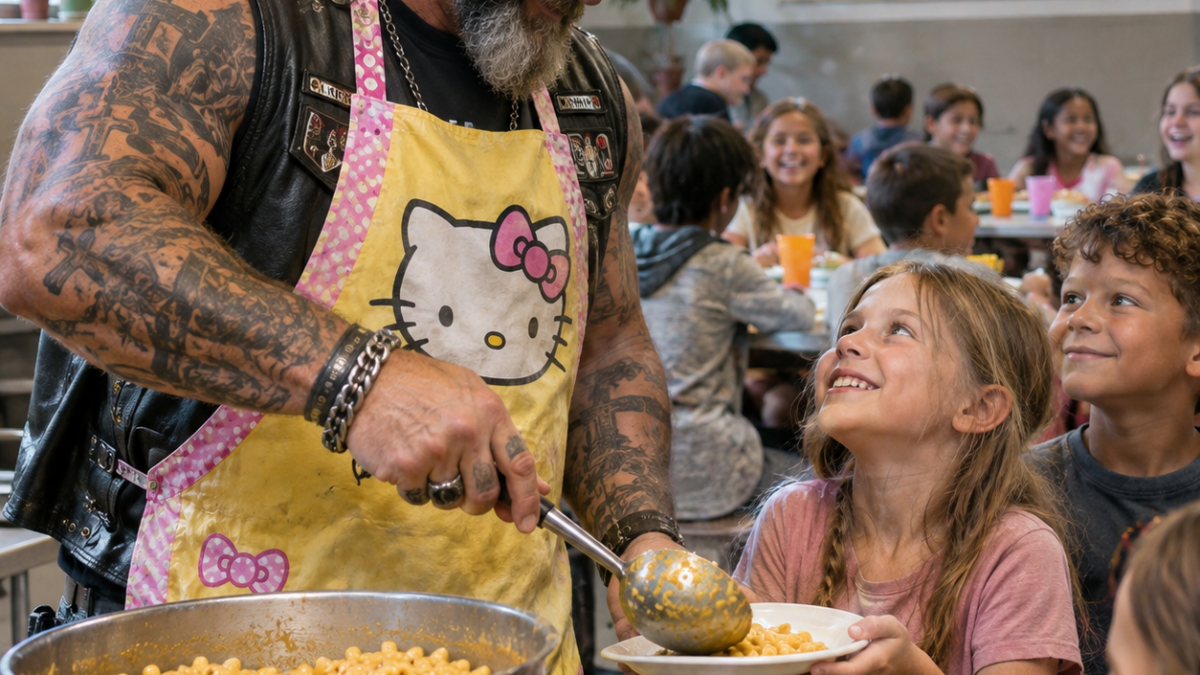
The Scariest Biker in Our Club Vanished Every Tuesday for 15 Years—Then I Followed Him and Found Him Feeding 30 Orphans in a Hello Kitty Apron.
For fifteen years, the most feared man in our motorcycle club disappeared every Tuesday night without explanation, and by the time the rumors turned ugly, some of us were convinced Reaper was hiding drugs, money, or a second life that could destroy the club.
I was the twenty-six-year-old prospect ordered to follow him, and instead of catching him doing something criminal, I watched a six-foot-three, 250-pound biker put on a yellow Hello Kitty apron, stir two giant pots of macaroni and cheese, and quietly feed thirty children who had nowhere else to go.
But when Reaper showed me the photograph hanging in the orphanage hallway—the one of a starving nine-year-old boy who had already learned never to ask anyone for food—I finally understood why he said, “I cook here because I know what hungry feels like,” and why our president walked out of that building with tears in his eyes and gave an order none of us would ever forget.
My name is Trevor Hollis.
I was twenty-six years old when this happened.
At the time, I was a prospect for the Cinder Hills Motorcycle Club out of Pueblo, Colorado.
And before anybody builds the wrong picture in their head, let me tell you something about being a prospect.
You don’t spend your days riding down highways with your arms spread wide while somebody plays guitar music behind you.
You clean bathrooms.
You haul trash.
You wash mugs nobody else wants to touch.
You stand outside in freezing rain while patched members sit inside a warm clubhouse debating things that have nothing to do with you.
You learn when to talk.
Mostly, you learn when not to.
And if a full-patch member tells you to pick up cigarette butts in a gravel parking lot at midnight, you don’t explain that nobody even smokes in that part of the lot.
You find cigarette butts.
I wanted that patch more than I admitted.
My father had been in and out of jail until I was twelve, then mostly out of my life.
My mother worked double shifts at a nursing home.
My older brother joined the Army at eighteen and stopped coming home except for Christmas.
By twenty-four, I had a decent welding job, a rented duplex, a used pickup, and absolutely no idea what I was building my life toward.
Cinder Hills gave me something I hadn’t realized I was looking for.
Structure.
Belonging.
Men who noticed when I didn’t show up.
People who would insult me for three hours and then drive seventy miles at two in the morning because my truck broke down.
It wasn’t perfect.
Neither were the men.
But it was something.
And nobody in Cinder Hills represented the weight of that patch more than Michael Garrison.
We called him Reaper.
Everybody did.
Even guys who’d known him twenty years.
Especially guys who’d known him twenty years.
Reaper was forty-seven then.
Six-foot-three.
Around two hundred and fifty pounds.
Shaved head.
Black goatee going silver around the chin.
Tattoo sleeves from shoulder to wrist.
Crosses.
Skulls.
Names.
A rosary wrapped around his left forearm in ink.
PART2:
On the right bicep was an old-fashioned fire truck surrounded by orange flames.
I didn’t know what that meant then.
I would later.
His black leather cut was heavy with age and road grime.
Cinder Hills across the shoulders.
Colorado on the bottom rocker.
Sergeant-at-Arms.
A 1% diamond.
An old Iron Cross.
Several memorial patches with names I didn’t know.
When Reaper walked into a loud room, men lowered their voices.
He never asked them to.
That was worse.
Some men intimidate you because they’re loud.
Reaper wasn’t.
He spoke quietly.
Almost always.
You leaned closer because you didn’t want to make him repeat himself.
I saw him stop a fight once without touching anybody.
Two drunk hang-arounds were screaming at each other in the clubhouse parking lot.
One had a tire iron.
The other had blood running from his nose.
Everyone was waiting for it to become a disaster.
Reaper walked outside.
He stood between them.
PART3:
Looked at the guy with the tire iron.
“Put it down.”
That was all.
The tire iron hit the gravel.
Reaper looked at the other man.
“Go home.”
He went home.
I remember asking another member, Roach, what Reaper would’ve done if they hadn’t listened.
Roach looked at me like I’d asked why water was wet.
“They listened.”
That was Reaper.
He’d been Sergeant-at-Arms for thirteen years by the time I became a prospect.
He’d been with Cinder Hills longer than I’d been old enough to drive.
There were stories about him.
Some true.
Some probably not.
People said he once rode four hundred miles through a snowstorm to bring a dead member’s son home from college.
People said he broke a man’s jaw in a bar in Durango.
Reaper denied that one.
The man had slipped, he said.
Nobody believed him.
People said Reaper once slept outside a hospital for two nights because a brother’s wife didn’t want bikers inside the waiting room but the brother didn’t want to be alone.
That one was true.
What nobody could explain were Tuesdays.
Every Tuesday, Reaper disappeared.
Not sometimes.
Not most Tuesdays.
Every Tuesday.
Around 4:30 in the afternoon, he vanished.
His phone went silent.
If club business fell on Tuesday evening, somebody else handled it.
If a meeting was moved to Tuesday, Reaper wouldn’t attend.
If there was a ride, he caught up afterward.
If you asked where he’d been, he’d give you a look that ended the conversation before it started.
The strange part wasn’t that he did it.
Men have lives.
Girlfriends.
Ex-wives.
Kids.
Probation officers.
AA meetings.
Poker games.
Medical treatments they don’t want anybody knowing about.
The strange part was the duration.
Fifteen years.
I only learned that later.
Fifteen years of Tuesdays.
The same missing window.
Approximately 4:30 to 8:00.
No exceptions anyone could remember.
The rumors started the way rumors usually do.
As jokes.
“Reaper’s got a Tuesday girlfriend.”
“Reaper’s taking ballet.”
“Reaper’s secretly Catholic.”
That one was particularly stupid considering the rosary tattooed around his forearm.
Then somebody said gambling.
Somebody else said pills.
Another guy claimed he’d seen Reaper talking to a dealer near Highway 96.
He hadn’t.
But accuracy has never been a requirement for a good rumor.
By early 2025, it wasn’t funny anymore.
We were dealing with tension with another club.
Nothing dramatic.
Nothing like television.
Just territory arguments, bad blood, a couple of stupid threats, and enough uncertainty that President Hatch wanted everyone accounted for.
Hatch’s real name was Warren Keller.
Nobody called him Warren except his wife.
He was sixty-one.
Retired ironworker.
Gray ponytail.
Hands like bent shovels.
Three grandchildren.
Two artificial knees.
The patience of a saint right up until the moment he didn’t.
One February night, Hatch called me into the small office behind the clubhouse bar.
Reaper wasn’t there.
Tuesday.
Of course.
Hatch closed the door.
“Sit down.”
Prospects usually don’t like sentences that begin that way.
I sat.
Hatch looked at me for several seconds.
“You know where Reaper goes Tuesdays?”
“No, sir.”
“You ever asked?”
“No, sir.”
“Smart.”
I waited.
Hatch rubbed his jaw.
“Something’s off.”
“With Reaper?”
“With everything.”
He looked toward the closed door.
“Fifteen years he’s gone Tuesdays.”
“Fifteen?”
Hatch nodded.
“Before he was Sergeant-at-Arms.”
I said nothing.
“He don’t answer. Won’t say where. Never caused us a problem before.”
“But?”
Hatch leaned back.
“But now we got people asking questions. I got brothers telling me they’ve seen vehicles around the shop. Other club watching us. Cops asking about certain names. I can’t have my Sergeant-at-Arms disappearing every week without knowing whether he’s walking into something that can come back on all of us.”
I understood.
At least I thought I did.
Then Hatch said, “I want you to follow him.”
My stomach tightened.
“Sir?”
“You heard me.”
I had.
I wished I hadn’t.
Hatch watched my face.
“You don’t like it.”
“No, sir.”
“Good.”
That surprised me.
“If you liked it, I’d send somebody else.”
He leaned forward.
“You follow. You don’t confront. You don’t interfere. You see where he goes. You come back and tell me.”
I swallowed.
“What if he catches me?”
Hatch almost smiled.
“He probably will.”
That didn’t help.
“You still want me to do it?”
“Wouldn’t have said it otherwise.”
So on Tuesday, March 5, I betrayed a man I respected because the president I was trying to impress told me it was club business.
I still don’t have a cleaner way to say it.
At 4:14 p.m., I parked my pickup across from Ortega Auto Body, where Reaper had worked since before I was in elementary school.
I knew his Road King.
Everybody did.
Black.
Minimal chrome.
Scratched right saddlebag.
Small Saint Michael medal wired near the speedometer.
At 4:31, the back gate opened.
Reaper rolled out.
He wasn’t wearing his cut.
That caught my attention immediately.
Black hoodie.
Jeans.
Work boots.
No patches.
He headed west.
I stayed several vehicles behind.
Fourteen miles on Highway 96.
Then a county road I had never used.
Then through an older neighborhood where the houses got farther apart.
I kept expecting a bar.
A trailer.
A motel.
Maybe a woman’s house.
Anything that made sense.
Instead, he turned into a parking lot in front of a squat two-story brick building with white trim and a faded playground fence.
I slowed as I passed.
The sign said:
SANGRE DE CRISTO CHILDREN’S HOME
EST. 1956.
I nearly hit the brakes.
I kept driving.
There was a Walgreens across the road and maybe two hundred yards down.
I parked where I could see the orphanage through the front windshield.
Reaper pulled two paper grocery bags from his saddlebags.
Walked inside.
And disappeared.
For twenty minutes, nothing happened.
I began convincing myself I’d misunderstood.
Maybe he was fixing somebody’s car.
Maybe the director owed him money.
Maybe he was dropping groceries off for a staff member.
Then at 5:14, I saw him through the lobby window.
I sat straight up.
He was wearing an apron.
Yellow.
Bright yellow.
On the chest was a white cartoon kitten with a pink bow.
Hello Kitty.
I stared.
Reaper.
The man who once made a six-foot-five drunk guy apologize to a jukebox because he’d kicked it.
Reaper.
Our Sergeant-at-Arms.
In a Hello Kitty apron.
I laughed.
I couldn’t help it.
One short, shocked laugh inside my truck.
Then I watched longer.
And stopped laughing.
Through the lobby windows, I could see part of a dining room attached to an open-counter kitchen.
Kids started coming in.
Little ones first.
Then older kids.
Maybe thirty total.
Five years old.
Six.
Ten.
Fourteen.
Some loud.
Some quiet.
Some fighting over chairs.
Some walking in like they’d done it a thousand times.
Reaper stood behind the counter stirring two enormous stainless-steel pots.
Mac and cheese.
I figured that out when he began scooping it onto plates.
He didn’t look awkward.
He didn’t look like someone doing charity work for a photograph.
He looked practiced.
Plate.
Scoop.
Side of vegetables.
Bread.
Next.
Plate.
Scoop.
Vegetables.
Bread.
Next.
A little girl came through twice.
He tapped the plate and pointed back toward a chair.
She argued.
He shook his head.
She made a face.
Then he added another scoop.
She smiled.
He pretended not to.
I sat there for two hours and forty-nine minutes.
I watched Reaper serve every kid in that room.
I watched him eat nothing.
I watched him refill milk.
Wipe a spill.
Carry dirty plates.
Scrub pans.
Sweep beneath a table.
And then I saw the moment that changed something in me.
A little boy sat alone near the end of one table.
Six, maybe.
Thin.
Dark hair.
Oversized gray hoodie.
Everybody else had finished eating.
The kid’s plate was barely touched.
His face was down.
Reaper walked past him twice.
Didn’t say anything.
Third time, he stopped.
He pulled out the chair beside the boy.
Sat down.
The chair looked tiny beneath him.
The boy didn’t look up.
Reaper didn’t talk.
He just put one enormous tattooed hand on the kid’s back.
Gently.
And left it there.
A minute.
Two.
Five.
Ten.
Eventually, the boy lifted his fork.
He ate one bite.
Then another.
Reaper stayed.
I remember thinking there was something strange about seeing those hands that way.
I had watched those hands remove a drunk from our clubhouse by the collar.
Watched them hold a grieving brother upright at a funeral.
Watched them fix a motorcycle chain on the shoulder of I-25.
Now one of them rested between the narrow shoulder blades of a six-year-old child who was quietly crying into macaroni and cheese.
At 7:51, Reaper walked out.
No apron.
Empty grocery bags folded beneath one arm.
He stopped on the front steps.
I sank slightly in my seat.
Stupid.
He turned his head.
Looked directly across the road.
Not generally toward Walgreens.
Directly at my truck.
I knew.
He knew.
He’d probably known the entire time.
He walked toward me.
No hurry.
That was worse.
I considered starting the truck.
That would’ve been even stupider.
So I rolled down the window.
Reaper reached the driver’s side.
Put one hand on the roof.
Looked at me.
“Trevor.”
“Yes, sir.”
“Did Hatch send you?”
There are lies you tell because you’re scared.
There are lies you tell because you’re stupid.
And then there are lies you know would make your life significantly worse.
I chose honesty.
“Yes, sir.”
Reaper nodded.
He didn’t look angry.
He looked tired.
“Get out.”
I got out.
“Walk.”
I walked.
We crossed the road.
Went around the side of the children’s home.
Behind the building was a fenced playground.
Two swings.
A little plastic climbing wall.
Slide.
One basketball hoop with no net.
The sun was dropping behind the mountains.
The sky had turned that Colorado orange that makes everything look cleaner than it is.
Reaper sat on a swing.
Chains creaked.
He looked ridiculous on it.
Huge man.
Tiny swing.
He pointed to the other one.
I sat.
For several seconds, neither of us spoke.
Then he said, “I’m not asking you to lie to Hatch.”
“Yes, sir.”
“You’re gonna tell him what you saw.”
“Yes.”
“All of it.”
“Yes.”
He looked toward the building.
“But you’re gonna know what you’re telling him before you do it.”
I waited.
Reaper took a breath.
“I grew up here.”
That was the first thing he said.
Not “I volunteer here.”
Not “I know the director.”
I grew up here.
I looked at the brick building.
“Here?”
“Three months old till sixteen.”
I didn’t know what to say.
He kept looking straight ahead.
“My mother was nineteen when she had me. Heroin addict. Father unknown.”
He said it like reading from a form.
“County took me before I knew what a mother was.”
He rubbed one hand against the swing chain.
“Spent three months in infant care. Then they put me here.”
“Was it bad?”
The second the question left my mouth, I wished I’d phrased it differently.
Reaper didn’t seem offended.
“Depends what you mean.”
He nodded toward the building.
“People here tried.”
That mattered to him.
I could hear it.
“Back then they didn’t have money. Still don’t have much. But in the eighties?”
He shook his head.
“Sometimes there’d be thirty-five kids and maybe four staff at night.”
He looked at his boots.
“We ate whatever they could afford.”
“Mac and cheese?”
A tiny smile.
“Mac and cheese was a good night.”
He let the smile disappear.
“Some nights it was bread. Peanut butter. Powdered milk.”
He paused.
“I remember being six and learning if I drank two glasses of water before bed, my stomach didn’t hurt quite as bad.”
I said nothing.
“I remember smelling food from houses nearby.”
He glanced at me.
“You ever been hungry hungry, Trevor?”
“I’ve skipped meals.”
“That ain’t what I’m asking.”
I knew.
“No.”
He nodded.
“Good.”
The swing chains creaked again.
“I cried myself to sleep in the room that’s the kitchen now.”
I looked toward the building.
“A hundred and seventeen times between six and twelve.”
I stared.
“You remember the number?”
“I counted.”
“Why?”
“Because I was a kid.”
His voice remained flat.
“And counting was something I could control.”
That sentence stayed inside my head.
I would hear it again months later while lying awake.
Counting was something I could control.
Reaper continued.
“My mother visited three times.”
Only three.
“In sixteen years?”
He nodded.
“Last time I was eight.”
He rubbed his thumb over the fire truck tattoo on his arm.
“She gave me a toy fire truck.”
Now I understood the tattoo.
“I kept that thing under my pillow until I was fifteen.”
“What happened to it?”
“Still got it.”
Something about that hit harder than I expected.
This man owned multiple motorcycles, half an auto-body business, guns, tools, leather, all the things you’d expect.
And somewhere in his house was a toy fire truck given to him by a mother who disappeared afterward.
“She died when I was eighteen,” he said.
“Overdose in Cheyenne.”
“Did you see her again before that?”
“No.”
“I’m sorry.”
He shrugged.
Not because it didn’t hurt.
Because it had hurt too long.
“At sixteen, they sent me to a temporary foster placement in Avondale. Lasted ten weeks.”
“What happened?”
“I was angry.”
He gave a humorless smile.
“They were decent people. I wasn’t a decent kid.”
“You were sixteen.”
“I was old enough to make bad decisions.”
He ran away.
Spent four years drifting.
Construction work.
Dishwashing.
Sleeping in cars.
Couches.
Sometimes nowhere.
Fights.
Then an assault conviction in 1996.
Eleven months in a state facility.
“I came out worse.”
He met Sam Ortega two years later.
Owner of a Pueblo auto-body shop.
Sam gave him a job.
Then another chance after Reaper didn’t show up three days straight.
Then another after he punched a hole through a shop wall.
“Sam never asked me to be grateful,” Reaper said.
“That was why I was.”
By 2002, Michael Garrison had become Reaper.
By 2010, he’d become Sergeant-at-Arms.
The same year, he returned to Sangre de Cristo.
“Why?”
Reaper looked toward the children’s home.
“I don’t know.”
He thought about it.
“That’s a lie.”
I waited.
“My shop was doing better. I’d just made Sergeant. Everybody kept congratulating me.”
He frowned.
“Couldn’t sleep.”
One Sunday afternoon, he drove back to the building where he’d spent most of his childhood.
He sat in the parking lot for an hour.
Then went inside.
The director asked if she could help him.
He said no.
Then changed his mind.
“Asked her if she needed anything.”
“What’d she say?”
Reaper finally smiled.
“She asked whether I could cook.”
I laughed.
“So could you?”
“Hell no.”
“What did you say?”
“I told her I could make macaroni and cheese.”
“That was it?”
“That was it.”
The director looked at this enormous tattooed man standing in her lobby and apparently said, “Tuesday dinners are hard for us.”
Reaper volunteered.
The first Tuesday, he burned one pot.
The second Tuesday, he forgot vegetables.
The third, one child asked him if he knew how to make grilled cheese.
He learned.
Then spaghetti.
Then chili.
Then baked chicken.
Then tacos.
“But mac and cheese stayed Tuesday food,” he told me.
“Why?”
“Kids like knowing something’s gonna be the same.”
Another sentence I never forgot.
Kids like knowing something’s gonna be the same.
“I haven’t missed a Tuesday in fifteen years.”
“Not once?”
“Not once.”
“You never got sick?”
“Cooked with the flu twice.”
“That’s probably a health-code violation.”
“Don’t tell Sister Beatrice.”
I smiled.
Then something occurred to me.
“Does the home know about the club?”
“No.”
“Nobody?”
“They know my name is Michael Garrison. Know I work at an auto shop.”
“That’s it?”
“That’s enough.”
“Why hide it?”
His expression changed.
Not angry.
Serious.
“The second I walk in there wearing that cut, I bring every opinion anybody has about Cinder Hills through that door with me.”
He looked toward the dining-room windows.
“Those kids got enough people deciding what they’re supposed to think.”
He turned back.
“In there, I’m Chef Mike.”
“Chef Mike?”
“Shut up.”
I laughed.
He didn’t.
Then he said the sentence.
The one I still hear.
“I cook here because I know what hungry feels like.”
He stared at the building.
“Not because I need those kids knowing anything about me.”
He stood.
“Understand?”
I nodded.
“Say it.”
“You don’t want this becoming about you.”
“No.”
“Or the club.”
“No.”
“You want it about the kids.”
“Closer.”
He looked down at me.
“I don’t want it to become about anything.”
I frowned.
He continued.
“Kindness doesn’t need an audience, Trevor.”
Then he started walking.
He made it five steps.
Stopped.
“There is something you should see.”
He turned.
“Back hallway. Black-and-white photo. 1985 boys’ wing.”
He pointed at his own chest.
“Front row. Third from left.”
“What is it?”
“Me.”
He started walking again.
“Look sometime.”
Then over his shoulder:
“You’ll understand why I don’t ask people for things.”
I drove back to Pueblo in silence.
The next morning, I went to Hatch.
He was sitting alone at the clubhouse table drinking coffee.
Reaper wasn’t there.
I told him everything.
Every detail.
Walgreens.
Hello Kitty.
Thirty kids.
Little boy crying.
Playground.
Hunger.
The hundred and seventeen nights.
When I finished, Hatch didn’t move.
He stared into his coffee.
Then he said, “Trevor.”
“Yes, sir?”
“Don’t ever do what I asked you to do again.”
I looked at him.
“To any brother.”
“Yes, sir.”
“You understand?”
“Yes.”
He rubbed both hands over his face.
“I should’ve asked Michael.”
I had never heard Hatch call him Michael.
“I should’ve trusted him.”
He stood.
Then looked at me.
“I owe you an apology too.”
“You don’t—”
“Don’t interrupt me.”
I stopped.
“I put you in a position a prospect shouldn’t have been put in.”
He poured me coffee.
We sat there nearly ten minutes without speaking.
Then Hatch stood.
“Come on.”
“Where?”
He picked up his keys.
“The children’s home.”
We rode two bikes.
No club formation.
No cuts hidden.
Forty minutes west.
When we reached Sangre de Cristo, Hatch didn’t walk through the front entrance.
Neither did I.
We circled to the playground.
There was a rear kitchen door.
Hatch knocked.
A woman around sixty-five opened it.
Gray hair.
Round glasses.
Blue cardigan.
She looked at two bikers standing behind an orphanage.
Didn’t flinch.
“Can I help you?”
Hatch removed his sunglasses.
“Ma’am, my name is Warren. I’m a friend of Mike Garrison.”
Her face softened.
“Chef Mike?”
I nearly smiled.
“Yes, ma’am.”
“Come in.”
That was Sister Beatrice.
Retired nun.
Still worked five days a week because retirement apparently meant nothing to her.
She walked us through the kitchen.
I recognized the huge pots.
The apron hung on a hook.
Bright yellow.
Hello Kitty.
Hatch stopped.
Looked at it.
Then at me.
I nodded.
He said nothing.
Sister Beatrice noticed.
“Oh, that awful thing.”
“His apron?”
“One of the girls gave it to him twelve years ago.”
Hatch looked at her.
“He’s worn that thing twelve years?”
“Every Tuesday.”
She smiled.
“He pretends to hate it.”
“Does he?”
“No.”
She led us through the dining room.
Then the back hallway.
Photographs covered the wall.
Year after year.
Children lined in rows.
We found 1985.
Twenty-something boys stood and sat in front of the building.
Different ages.
Some smiling.
Some not.
Front row.
Third from the left.
Michael Garrison.
Nine years old.
Skinny enough that his wrists looked too small for his hands.
Buzzed dark hair.
Shirt two sizes too big.
Eyes straight at the camera.
I knew immediately.
Not because he looked like Reaper.
He barely did.
Because of the eyes.
That same stillness.
Except it meant something different on a child.
Reaper’s expression made grown men cautious.
On nine-year-old Michael, it looked like surrender.
Not sadness.
Sadness expects comfort.
That boy looked like he had already learned not to expect anything.
Hatch put one leather-gloved hand against the glass.
He stood there for a long time.
Sister Beatrice quietly left us alone.
Hatch wiped his eyes with the back of his wrist.
I pretended not to notice.
Then he looked at the photograph again.
“Jesus Christ.”
We walked outside.
No conversation.
In the parking lot, Hatch stopped before getting on his bike.
“Trevor.”
“Yes?”
“We don’t tell the club.”
I nodded.
“Not a word.”
“No, sir.”
“Reaper does this his way.”
He looked back toward the building.
“We do not take it from him.”
That should have been the end.
It wasn’t.
Secrets have a way of surviving until somebody realizes they can turn them into attention.
Three weeks later, a photograph appeared online.
Reaper.
Yellow Hello Kitty apron.
Holding a tray of food.
One of the older kids visible in the background.
The caption said:
TOUGHEST OUTLAW IN PUEBLO PLAYS HOUSE MOM AT ORPHANAGE.
I saw it at 6:12 Wednesday morning.
My stomach dropped.
By 7:00, it had been shared three thousand times.
By noon, a local motorcycle page had reposted it.
Then a radio show.
Then a reporter called the children’s home.
I drove straight to the clubhouse.
Reaper was already there.
So was Hatch.
Reaper’s phone lay on the table.
It kept vibrating.
He ignored it.
Hatch looked furious.
“Who took the picture?”
Nobody knew.
“I didn’t,” I said.
Reaper looked at me.
“I know.”
That meant more than I expected.
Roach walked in.
“What the hell is going on?”
Hatch looked at Reaper.
Reaper closed his eyes briefly.
Then said, “Door.”
Hatch locked it.
For fifteen years, Reaper had kept his Tuesdays from the club.
Now twenty-three patched members learned the truth in less than ten minutes.
Nobody laughed about the apron.
Not once.
That surprised me.
Roach stared at the floor.
One member named Brick asked, “Why didn’t you tell us?”
Reaper looked at him.
“Why would I?”
Brick had no answer.
Another brother said, “We could’ve helped.”
Reaper’s expression hardened.
“They didn’t need twenty motorcycles showing up.”
“We could’ve donated.”
“They needed normal.”
That silenced everybody.
Hatch said, “Nobody goes out there.”
Several men protested.
Hatch slammed his palm against the table.
“Nobody.”
Silence.
“Anybody uses this for club publicity, I will personally remove your patch.”
No one doubted him.
Reaper finally spoke.
“The photograph’s bad enough.”
“Kids were visible,” I said.
He nodded.
“That is what matters.”
Not that he was exposed.
Not that people were mocking him online.
The children.
The next problem came from the orphanage board.
His name was Richard Colby.
Real-estate developer.
Big donor.
Chairman of fundraising.
He called Sangre de Cristo Wednesday afternoon and demanded an emergency board meeting.
By evening, Reaper had been asked not to return until the board “reviewed the situation.”
That was the first time I saw Reaper truly hurt.
He didn’t shout.
He didn’t threaten anybody.
He simply read the email twice.
Then folded his phone shut inside his palm.
Hatch said, “They fired you?”
“No.”
“Sounds like it.”
“They’re scared.”
“Of what?”
“Bad press.”
Hatch laughed bitterly.
“Guy feeds their kids fifteen years and they’re scared of his vest?”
Reaper looked at him.
“They got donors. Parents. State inspections. Reputation.”
“You defending them?”
“I’m understanding them.”
I couldn’t.
“That’s garbage.”
Reaper turned toward me.
“You know how many mistakes it takes for a place like that to lose funding?”
“No.”
“One.”
“That doesn’t make this right.”
“No.”
His voice stayed calm.
“But right and easy don’t always live in the same house.”
Tuesday came.
At 4:30, Reaper sat inside Ortega Auto Body.
For the first time in fifteen years, he didn’t ride west.
I was there.
I didn’t know what to say.
At 4:45, he checked the clock.
At 5:00, he stood.
Walked outside.
Came back.
At 5:12, he opened a drawer.
Inside was the Hello Kitty apron.
He’d taken it home to wash the previous week.
He ran his thumb over the pink bow.
Then put it back.
At 5:30, his phone rang.
Unknown number.
He answered.
“Yeah?”
Silence.
His face changed.
Not dramatically.
Just enough.
“Hey, buddy.”
I knew immediately it was a kid.
Reaper sat down.
“No. I’m not sick.”
He listened.
“I know.”
Another pause.
“No, Lewis. You didn’t do anything.”
That was the little boy I’d seen crying.
The one Reaper had sat beside.
Reaper’s jaw tightened.
“I’ll be back when I’m allowed.”
He listened.
Then closed his eyes.
“Promise.”
When the call ended, he put the phone down.
I said nothing.
He stayed in the chair for a long time.
Then whispered, mostly to himself:
“Kid thinks I left.”
That was the moment I stopped caring about club orders.
I stood.
“We should go.”
“No.”
“Reaper—”
“No.”
“You told him you’d be back.”
“When I’m allowed.”
“Hatch—”
“Don’t.”
His voice hardened.
I stopped.
Then he looked at me.
“Those kids have had enough adults make promises they couldn’t keep.”
“Then keep yours.”
His eyes sharpened.
I expected him to throw me out.
Instead he said, “You think I don’t know that?”
I did.
Of course he did.
The board meeting happened Thursday.
Sister Beatrice asked Reaper to attend.
He refused twice.
She called a third time.
Apparently even Reaper didn’t say no to Sister Beatrice three times.
I drove him.
He wouldn’t let me sit inside.
“Not your fight.”
So I waited in the hallway.
The voices carried.
Richard Colby was the loudest.
“We cannot have an admitted one-percenter affiliated with this facility.”
Reaper replied quietly.
“I ain’t affiliated.”
“You volunteer here.”
“That’s what volunteer means.”
“This isn’t funny.”
“No.”
“You represent an organization with a documented reputation.”
“I represent myself when I’m in that kitchen.”
“You wear their symbols.”
“Never here.”
“You have an assault conviction.”
“1996.”
“Still a conviction.”
“Yes.”
I heard Sister Beatrice.
“He has passed every background check required by this facility since 2010.”
Colby answered, “That is not the point.”
Reaper said, “Then tell me the point.”
Silence.
Colby finally said it.
“The point is appearance.”
I saw Reaper through the narrow glass panel in the meeting-room door.
He sat with both hands folded.
His face unreadable.
Colby continued.
“Parents see those tattoos. Donors see the motorcycle. Now they see this photograph.”
Reaper glanced toward the table.
“Funny.”
“What?”
“You didn’t have a problem with the picture until people knew who I was.”
Colby stiffened.
“My concern is the children.”
Reaper looked up.
“No.”
He said it gently.
That somehow made it devastating.
“Your concern is what rich people think when they write checks.”
Colby’s face reddened.
“You don’t know anything about fundraising.”
“True.”
“You don’t know what it takes to keep this place open.”
Reaper leaned forward.
“I know exactly what it takes to keep this place open.”
The room went silent.
“I know what happens when milk runs out on Thursday and the budget resets Monday.”
Sister Beatrice lowered her eyes.
“I know which freezer leaks.”
He pointed toward the floor.
“I know the west-wing furnace clicks six times before it lights.”
Another pause.
“I know Lewis won’t eat if peas touch his potatoes.”
Nobody moved.
“I know Hannah hides bread in her pillowcase because she spent two years in a house where dinner wasn’t guaranteed.”
Colby’s expression changed.
Reaper continued.
“I know Marcus sleeps with his shoes on because the last foster placement moved him without warning at six in the morning.”
His voice almost broke.
Almost.
“And I know what it feels like to lie in this building at nine years old with your stomach hurting so bad you promise God that if you ever get enough food, you’ll never complain about anything again.”
Colby stared.
Reaper stood.
“But you’re right about one thing.”
He picked up his jacket.
“It ain’t worth risking the home.”
Sister Beatrice said, “Michael.”
He shook his head.
“If me leaving protects the kids, I leave.”
And he did.
I followed him into the parking lot.
He was halfway to the truck when Richard Colby came outside.
“Mr. Garrison.”
Reaper stopped.
Colby approached.
“I hope you understand this isn’t personal.”
Reaper turned slowly.
“No.”
Colby looked confused.
“No?”
“I hope someday you understand it is.”
Then he got into my truck.
The next day, Sister Beatrice called Hatch.
Not Reaper.
Hatch called me.
“Get to the clubhouse.”
I arrived at noon.
Sister Beatrice was sitting at the long table surrounded by fifteen bikers.
She looked completely comfortable.
Reaper wasn’t there.
She had brought a folder.
Inside were fifteen years of volunteer logs.
Michael Garrison.
Every Tuesday.
There were receipts.
Groceries.
Kitchen repairs.
New stove.
Freezer compressor.
Winter coats.
School shoes.
Christmas gifts.
Anonymous cash donations marked only M.G.
Total over fifteen years?
Nobody knew exactly.
Sister Beatrice estimated more than eighty thousand dollars.
Roach whispered, “Jesus.”
Sister Beatrice shook her head.
“Money isn’t why I’m here.”
She placed another document on the table.
A complaint.
Richard Colby had contacted several donors claiming the home had “unknowingly exposed children to an outlaw motorcycle figure.”
Hatch’s jaw tightened.
Sister Beatrice continued.
“He knew.”
“What?”
“Mr. Colby knew Michael volunteered here.”
“For how long?”
“Six years.”
Silence.
“He attended Christmas dinners where Michael cooked.”
Hatch leaned forward.
“Then why now?”
“Because the photograph became public.”
There it was.
Appearance.
Colby wasn’t protecting children.
He was protecting a fundraising brand.
Then Sister Beatrice showed us something worse.
The leaked photograph had come from the orphanage’s own promotional archive.
It wasn’t taken by a stranger.
A volunteer photographer had captured it two months earlier.
Colby had approved dozens of photographs for an upcoming donor campaign.
One showed Reaper.
Someone on Colby’s fundraising staff sent it to a friend as a joke.
The friend posted it.
When the image went viral, Colby blamed Reaper.
Hatch stood so fast his chair fell backward.
“I’m gonna—”
Sister Beatrice pointed at him.
“You are going to sit down.”
Hatch sat.
I’ve seen cops fail to achieve that result.
Sister Beatrice folded her hands.
“Michael does not need revenge.”
Hatch exhaled.
“What does he need?”
“He needs men who understand why he never asked for anything.”
Nobody spoke.
The board held another meeting.
This time the entire staff came.
So did two former residents of Sangre de Cristo.
Adults now.
One was a paramedic.
The other owned a plumbing company.
Both knew Chef Mike.
One had known him as a child.
They told the board what Reaper refused to say about himself.
He had attended graduations.
Sat outside courtrooms during custody hearings.
Fixed first cars.
Helped teenagers find jobs.
Paid community-college application fees.
And every single time someone tried to thank him publicly, he disappeared.
Richard Colby resigned from the board before they could remove him.
His fundraising staffer was terminated for sharing the photograph.
The board issued an apology.
Reaper hated that.
“They didn’t need to do that.”
“Yes, they did,” Sister Beatrice told him.
“They embarrassed themselves.”
“They hurt you.”
“That ain’t the same thing.”
She took his face in both hands the way only an elderly nun could safely do to Reaper.
“Michael.”
He stopped talking.
“You do not get to decide that you are the only person whose pain does not matter.”
I watched his expression collapse.
Just slightly.
Sister Beatrice continued.
“You learned that as a child.”
She looked toward the hallway photographs.
“It was a lie then.”
Then she touched his chest.
“It is still a lie.”
Reaper looked away.
I realized something then.
You can feed thirty children every Tuesday for fifteen years and still remain the hungry boy in the photograph.
You can grow.
Get strong.
Earn respect.
Build a business.
Become the man people fear.
And some part of you can still believe asking for anything makes you weak.
Reaper returned the following Tuesday.
No motorcycles escorted him.
No photographers.
No club cuts.
No grand gesture.
He walked in carrying two paper grocery bags.
The yellow Hello Kitty apron waited on the hook.
Lewis saw him first.
The boy ran.
He hit Reaper around the waist so hard Reaper rocked backward.
“You came back.”
Reaper froze.
Then slowly put one hand on the boy’s head.
“Told you I would.”
“You promise every week?”
Reaper looked down.
“Buddy, I been coming here every Tuesday fifteen years.”
“That’s old.”
I laughed.
Reaper looked at me.
“You’re washing every pan tonight.”
Lewis smiled.
Then asked the question.
“Can Trevor stay too?”
Reaper looked at me.
I hadn’t expected that.
“Ask him.”
Lewis did.
So I stayed.
That became my first Tuesday.
After dinner, I told Reaper I wanted to come back.
“No.”
“Why?”
“Because guilt wears off.”
“I’m not guilty.”
“You followed me.”
“Okay. Some guilt.”
“No.”
“Give me a chance.”
He kept washing a pan.
I stood there.
Eventually he sighed.
“Three rules.”
I waited.
“No cut.”
“Okay.”
“No pictures.”
“Okay.”
“And when those kids look at you, they see a guy who came here to feed them.”
He pointed at my chest.
“Not Cinder Hills.”
“Understood.”
“Not a biker.”
“Understood.”
“Not a story.”
I nodded.
“A guy in an apron.”
“Yes.”
He handed me a plain black apron.
“Then wash dishes.”
So I did.
Week after week.
I began learning names.
Lewis hated peas.
Hannah hid bread.
Marcus really did sleep in his shoes.
Twelve-year-old Dana read three books a week and pretended not to care whether anybody noticed.
Nine-year-old Avery refused hugs but liked sitting close enough for your elbows to touch.
Fourteen-year-old Caleb ate fast.
Too fast.
The first time I told him there was plenty, Reaper pulled me aside afterward.
“Don’t do that.”
“What?”
“Don’t tell a hungry kid there’s plenty.”
“Why?”
“Because sometimes they’ve heard it before.”
I stared.
“What do I say?”
“Nothing.”
He pointed toward the serving trays.
“Just make sure there is.”
That was Reaper.
No speeches.
Evidence.
He didn’t tell Lewis people stayed.
He stayed.
Didn’t tell Hannah food would be available.
He stocked the pantry.
Didn’t tell Marcus the next morning would be predictable.
He was there every Tuesday at the same time.
One evening in October, I found Reaper sitting alone in the back hallway.
He was looking at the 1985 photograph.
I sat beside him.
“You ever talk to that kid?”
He glanced at me.
“What?”
I pointed at nine-year-old Michael.
“In your head.”
“No.”
“You should.”
“Why?”
“I don’t know.”
That was honest.
He stared at the photograph.
“What would I say?”
I thought about it.
“Maybe tell him he’s gonna eat.”
Reaper didn’t move.
Then he laughed once.
Not happy.
Not sad.
Both.
“You’re getting smarter.”
“Don’t tell Hatch.”
He leaned back.
After a minute, he said, “I’d tell him something else.”
“What?”
“That none of it was his fault.”
I looked at him.
He kept staring at the picture.
“I spent most of my life thinking if I’d been better, my mother would’ve come back.”
His voice was barely above a whisper.
“If I didn’t fight.”
“If I got good grades.”
“If I stopped crying.”
“If I didn’t ask for seconds.”
He shook his head.
“Kids will blame themselves for anything if it means they get to believe adults are in control.”
I didn’t know what to say.
So for once, I didn’t say anything.
We sat there beside a photograph of a nine-year-old boy until Reaper stood.
“Come on.”
“Where?”
“Lewis wants grilled cheese tomorrow.”
“Tomorrow’s Wednesday.”
“He asked.”
As if that explained everything.
Maybe it did.
My patch ceremony came in May.
Annual run.
Fifty-eight motorcycles.
Family.
Food.
Long speeches.
Hatch called me forward.
My hands shook.
I had spent years imagining that moment.
Full Cinder Hills patch.
Brotherhood.
Proof that I’d finally earned belonging somewhere.
Reaper stood behind Hatch.
Serious as always.
Hatch placed the cut in my hands.
“You know what this means?”
“Yes, sir.”
“No, you don’t.”
A few people laughed.
Hatch didn’t.
“You’ll spend the rest of your life learning.”
Then he looked toward Reaper.
I did too.
Hatch said, “A patch tells people what group you belong to.”
He tapped his own chest.
“It does not tell them what kind of man you are.”
Silence.
“That part is on you.”
He gave me the cut.
I put it on.
Brothers hugged me.
Some nearly broke ribs.
Reaper waited until the end.
He looked at my new patch.
“Congratulations.”
“Thank you.”
“Don’t become an idiot.”
“I’ll try.”
“No. Don’t.”
I laughed.
He held out his hand.
I shook it.
Then he pulled me into a hug.
Fast.
One arm.
Almost violent enough to pretend it wasn’t affection.
Inside the lining of my new cut, over my heart, was a patch nobody could see.
I had made it months earlier.
Yellow felt.
Pink ribbon.
Shaped badly like Hello Kitty’s bow.
My stitching was terrible.
I never told Reaper.
Not then.
Tuesday came three days later.
At 4:31, my motorcycle rolled beside his.
He looked at my cut.
“Rules.”
“I know.”
We stopped two blocks from Sangre de Cristo.
Removed our leather.
Locked both cuts in our saddlebags.
Then walked the rest of the way carrying groceries.
Chef Mike.
Chef Trevor.
Nothing else.
Lewis was waiting by the door.
“You came.”
Reaper looked offended.
“Course I came.”
Lewis looked at me.
“You too.”
“Yep.”
“Every week?”
I hesitated.
Reaper noticed.
He didn’t answer for me.
That mattered.
I looked at Lewis.
“As long as they’ll have me.”
Lewis thought about it.
Then nodded.
“Okay.”
Dinner that night was macaroni and cheese.
Three huge pans.
Green beans.
Bread.
Chocolate pudding because Dana had gotten an A in math and refused to admit she cared.
Afterward, Lewis ate three plates.
Reaper sat beside him.
“You gonna explode?”
“No.”
“Scientific answer?”
“Yes.”
Lewis ate another bite.
Then asked, “Were you here when you were little?”
My hand stopped inside the sink.
Reaper went still.
Sister Beatrice stood across the room.
Nobody spoke.
Lewis looked at him innocently.
“You know where everything is.”
Reaper considered lying.
I saw it.
Then he said, “Yeah.”
“You lived here?”
“Yeah.”
“For how long?”
“Long time.”
“Did you have a mom?”
Reaper stared at the table.
“Somewhere.”
“Did she come get you?”
“No.”
Lewis looked down.
“My mom’s in prison.”
“I know.”
“She said she’s coming when she gets out.”
Reaper’s eyes moved toward him.
Lewis whispered:
“What if she doesn’t?”
I will never forget Reaper’s face.
There was no Sergeant-at-Arms.
No Reaper.
No feared biker.
Just Michael.
He pulled his chair closer.
“I don’t know if she will.”
Lewis’s mouth tightened.
Reaper continued before the boy could shut down.
“But listen to me.”
Lewis looked at him.
“If she doesn’t come, that does not mean you weren’t worth coming back for.”
Lewis blinked.
Reaper swallowed.
“That part’s important.”
The boy stared at him.
“Were you worth coming back for?”
Nobody in that kitchen breathed.
Reaper looked toward the hallway.
Toward the photograph.
Then back at Lewis.
“Yeah.”
His voice cracked.
“Yeah, buddy.”
He nodded.
“I was.”
Lewis reached out.
Touched the skull tattoo on Reaper’s forearm.
“You look scary.”
I nearly dropped a plate.
Sister Beatrice covered her mouth.
Reaper looked at me.
I tried not to laugh.
Failed.
Lewis continued.
“But you’re not.”
Reaper leaned closer.
“Don’t spread that around.”
Lewis smiled.
That night, after the kids went upstairs, Reaper stood alone by the kitchen sink.
I approached him.
“You okay?”
“Fine.”
“You’re terrible at lying.”
He washed the same plate twice.
“Kid asks hard questions.”
“Kids do that.”
He looked at the Hello Kitty apron.
Then at me.
“Trevor.”
“Yeah?”
“You ever wonder what would’ve happened if Hatch didn’t send you that day?”
I thought about it.
“I’d still think you had a Tuesday girlfriend.”
He grunted.
“Probably easier.”
“Do you regret me finding out?”
He took a long time.
“No.”
That answer surprised me.
“Why?”
“Because you came back.”
He looked around the empty kitchen.
“Most people like discovering something.”
He pointed toward the sink full of dishes.
“Fewer people like staying after they know it’s work.”
I stared at him.
That may have been the closest Reaper ever came to saying he was proud of me.
A year after the photograph leaked, Sangre de Cristo renovated the kitchen.
Not because of publicity.
Not because Cinder Hills rode in with a giant novelty check.
Reaper would’ve burned the check.
The money came quietly.
Former residents.
Local businesses.
Small donors.
An anonymous contribution that I strongly suspect came from Hatch, though he denies it.
Ortega Auto Body provided labor.
No club logos.
The new kitchen had two industrial stoves.
A larger refrigerator.
A pantry.
And one strange addition.
A narrow frame on the wall near the back door.
Inside it was the old yellow Hello Kitty apron.
Reaper hated that.
“Take it down.”
Sister Beatrice refused.
“It’s worn out.”
“Then throw it away.”
“No.”
“Why?”
She looked at him.
“Because some things become important without asking permission.”
He argued.
She won.
Of course.
Below the apron was a tiny brass plaque.
No mention of bikers.
No mention of Reaper.
No heroic language.
It said:
TUESDAY KITCHEN
NO CHILD LEAVES HUNGRY.
Reaper stared at those words for a long time.
Then he went into the pantry.
I followed.
He pretended to count canned tomatoes until his eyes were dry.
I pretended to believe him.
Hatch visited a month later.
Not in his cut.
He brought his oldest granddaughter.
They volunteered together.
Hatch washed dishes terribly.
Reaper fired him three times.
Hatch kept coming.
The club never turned Sangre de Cristo into a project.
That was important.
Some brothers eventually volunteered individually.
Some donated anonymously.
Most did nothing.
And that was okay too.
Reaper had never wanted an army.
He wanted dinner.
Tuesday after Tuesday.
One meal.
Thirty kids.
Then thirty-two.
Then twenty-eight.
Faces changed.
Children came.
Children left.
Some went home.
Some went to foster families.
Some aged out.
A few returned years later.
One Tuesday, a twenty-three-year-old man walked into the kitchen wearing an EMT uniform.
Reaper looked at him.
Didn’t recognize him.
The young man smiled.
“You still burn grilled cheese?”
Reaper froze.
“Caleb?”
The former resident laughed.
Reaper walked around the counter.
They hugged.
Caleb had lived at Sangre de Cristo for eighteen months when he was thirteen.
He told Reaper he’d become an EMT because of something Mike said after Caleb broke his arm.
Reaper didn’t remember saying anything.
Caleb did.
“You told me being scared doesn’t mean you can’t help somebody.”
Reaper frowned.
“That doesn’t sound like me.”
“It was.”
“Too inspirational.”
Caleb laughed.
Then became serious.
“I used to steal dinner rolls.”
Reaper nodded.
“I know.”
“You knew?”
“Everybody knew.”
Caleb looked embarrassed.
“Why didn’t you stop me?”
Reaper shrugged.
“You needed rolls.”
That was all.
Caleb cried.
Reaper immediately became uncomfortable.
“Don’t do that.”
“Do what?”
“The face-water thing.”
“Crying?”
“Yeah.”
“You’re emotionally damaged, Mike.”
“Probably.”
Caleb hugged him again.
That night, Reaper was quiet.
On the ride home, we stopped at a gas station.
I asked whether he was okay.
He looked toward the highway.
“You spend enough time thinking you didn’t matter to anybody, you start believing nothing you do matters either.”
He put on his gloves.
“Then some kid comes back twenty years later and proves you wrong.”
He looked irritated by the whole concept.
I smiled.
“What?”
“Nothing.”
“Say it.”
“You’re a good man.”
His face hardened.
“Don’t.”
I stopped smiling.
He wasn’t joking.
“Why does that bother you?”
“Because good men don’t need to say they’re good.”
“I said it.”
“Still.”
“You think if you admit it, something changes?”
Reaper looked toward the dark highway.
“I think men start believing compliments.”
“And?”
“Then they stop checking themselves.”
I considered that.
“Maybe.”
He started his bike.
“But maybe sometimes a man should know he’s done something right.”
Reaper looked at me through the helmet visor.
“Trevor.”
“Yeah?”
“Shut up.”
I did.
Mostly.
I’m thirty now.
Still with Cinder Hills.
Still welding.
Still Tuesday nights.
Lewis is ten.
He talks more.
A lot more.
Sometimes too much.
He was placed with a foster family last year.
Good people.
They live thirty minutes away.
He still comes back for Tuesday dinner twice a month.
First time he returned after leaving the home, Reaper pretended it was nothing.
Lewis ran through the kitchen doors.
“Chef Mike!”
Reaper turned.
Lewis jumped into him.
Reaper caught him.
Held him.
And for one second, I saw the nine-year-old in the photograph disappear.
Not completely.
I don’t think those kids ever disappear completely.
But enough.
Enough for Michael Garrison to finally understand something he’d spent nearly fifty years teaching everybody except himself.
People do come back.
Not everybody.
Not always the ones who should.
But some do.
Sometimes the mother never returns.
Sometimes the father is only a blank line on a birth certificate.
Sometimes the foster placement fails.
Sometimes life does exactly what you’re afraid it will do.
But then Sam Ortega gives an angry twenty-two-year-old a job.
Hatch gives a brother a place at a table.
Sister Beatrice keeps a ridiculous yellow apron on a hook for twelve years.
A little boy asks if you’ll be there next Tuesday.
And some idiot prospect parks in a Walgreens because he thinks he’s uncovering a secret.
I still carry that little yellow felt bow inside my cut.
The stitching is worse now.
The edges are frayed.
Reaper finally discovered it two years ago.
My vest tore during a ride.
He was helping me repair the lining.
He saw the yellow felt.
Pulled it halfway out.
Looked at it.
Then at me.
“What the hell is this?”
I wanted the floor to open.
“Nothing.”
“This is a Hello Kitty bow.”
“No.”
“Trevor.”
“It’s symbolic.”
His face twisted with disgust.
“Symbolic?”
“Yeah.”
“You sewed a Hello Kitty bow over your heart?”
“When you say it like that, it sounds stupid.”
“There’s a way to say it where it doesn’t?”
I tried explaining.
The Tuesdays.
The kids.
What he’d taught me.
What the apron meant.
Reaper stared at me.
Then shoved the fabric back into the lining.
“You tell anybody about that and I’ll deny knowing you.”
“Understood.”
He finished repairing my vest.
Handed it back.
I put it on.
As I turned away, he said:
“Trevor.”
I looked back.
He wouldn’t look directly at me.
“Don’t replace it when it wears out.”
I frowned.
“Why?”
He adjusted a wrench on the workbench.
“Some things are supposed to show they were carried.”
Then he walked away.
That piece of yellow felt is still there.
So is the 1985 photograph.
Front row.
Third from the left.
Nine-year-old Michael Garrison.
Skinny.
Shaved head.
Oversized shirt.
A face already trained not to ask the world for anything.
Every few months, Reaper still stops in front of it.
Sometimes Lewis stands beside him.
Sometimes I do.
Nobody says much.
There isn’t much left to say.
The photograph tells you where he came from.
The kitchen tells you what he chose to do with it.
And maybe that’s why the secret mattered so much.
For years, men looked at Reaper and saw exactly what he wanted them to see.
Strength.
Danger.
Control.
A man you didn’t test.
Kids at Sangre de Cristo saw something else.
Chef Mike.
The guy who overcooked green beans.
The guy who gave you extra cheese when you thought he wasn’t looking.
The guy who sat beside you when you couldn’t eat.
The guy who came back.
Tuesday.
After Tuesday.
After Tuesday.
For fifteen years.
Then sixteen.
Then seventeen.
And counting.
Not because anyone applauded.
Not because reporters came.
Not because the club knew.
For most of those years, nobody outside that brick building knew at all.
That was the point.
Reaper once told me he’d counted one hundred and seventeen nights when he cried himself to sleep hungry because counting was the only thing he could control.
I used to think that number was the saddest thing I’d ever heard.
I don’t anymore.
Now I think about a different number.
More than eight hundred Tuesday nights.
Thousands of plates.
Hundreds of children.
One promise made without ever saying it out loud.
You will eat tonight.
I will be here.
You do not have to earn either one.
Last Tuesday, I arrived late.
Reaper was already in the kitchen.
Of course he was.
He wore a new apron now.
Plain yellow.
The old Hello Kitty one is too fragile.
But Sister Beatrice had sewn a tiny pink bow near the pocket.
He claimed to hate that one too.
Lewis was setting forks.
Hannah, who doesn’t hide bread anymore, was helping grate cheese.
Reaper stood over the big pot, stirring.
Same huge tattooed arms.
More gray in the beard.
Same quiet voice.
I walked in.
He looked at the clock.
“You’re late.”
“Seven minutes.”
“Late.”
“Traffic.”
“Excuse.”
I grabbed my apron.
Lewis called out, “Chef Trevor!”
“Yeah?”
“Mike says I can have three plates.”
Reaper immediately said, “I said two.”
“You said maybe three.”
“I said maybe means no.”
“That isn’t what maybe means.”
Reaper looked at me.
“See what happens when children become secure? They argue.”
I laughed.
Lewis smiled.
And I suddenly understood how far we had all come from the first night I watched through that window.
Back then, I thought I had discovered Reaper’s secret.
I was wrong.
The secret wasn’t that the scariest biker in Cinder Hills wore a Hello Kitty apron.
It wasn’t that he’d grown up in an orphanage.
It wasn’t even the hundred and seventeen nights.
The secret was simpler.
A man can spend half his life becoming hard enough that nobody can ever hurt him the same way again and still choose not to let that hardness become cruelty.
Michael Garrison knew exactly what hunger could do to a child.
He knew what abandonment sounded like after the lights went out.
He knew how it felt to watch other people get picked up while nobody came for you.
He knew how a boy learned not to ask.
So when life finally gave him strength, money, respect, and a place where people listened when he spoke, he didn’t use those things to prove how powerful he had become.
He went back to the room where he’d once cried himself to sleep.
He turned it into a kitchen.
He filled the pots.
He put on the stupid yellow apron.
And he fed the kids.
That is who Reaper is.
And if you ever meet him, don’t tell him I called him a good man.
He still hates that.
Tell him something else.
Tell him dinner smells good.
Tell him Lewis wants seconds.
Tell him one of the little kids dropped a fork.
Give him something useful to do.
Because Michael Garrison has never been comfortable being thanked.
But ask him whether he’ll be back next Tuesday, and for once you won’t get the frightening stare, the silence, or the voice that has ended more bar fights than I can count.
You’ll get the answer every child in that building eventually learns to trust.
“Yeah, buddy.”
Then he’ll reach for another plate.
“I’ll be here.”








