The Retired Military K9 Wouldn’t Let Anyone Near His Handler—Then the Quiet Vet Tech Found the Fracture Everyone Else Had Missed for Months
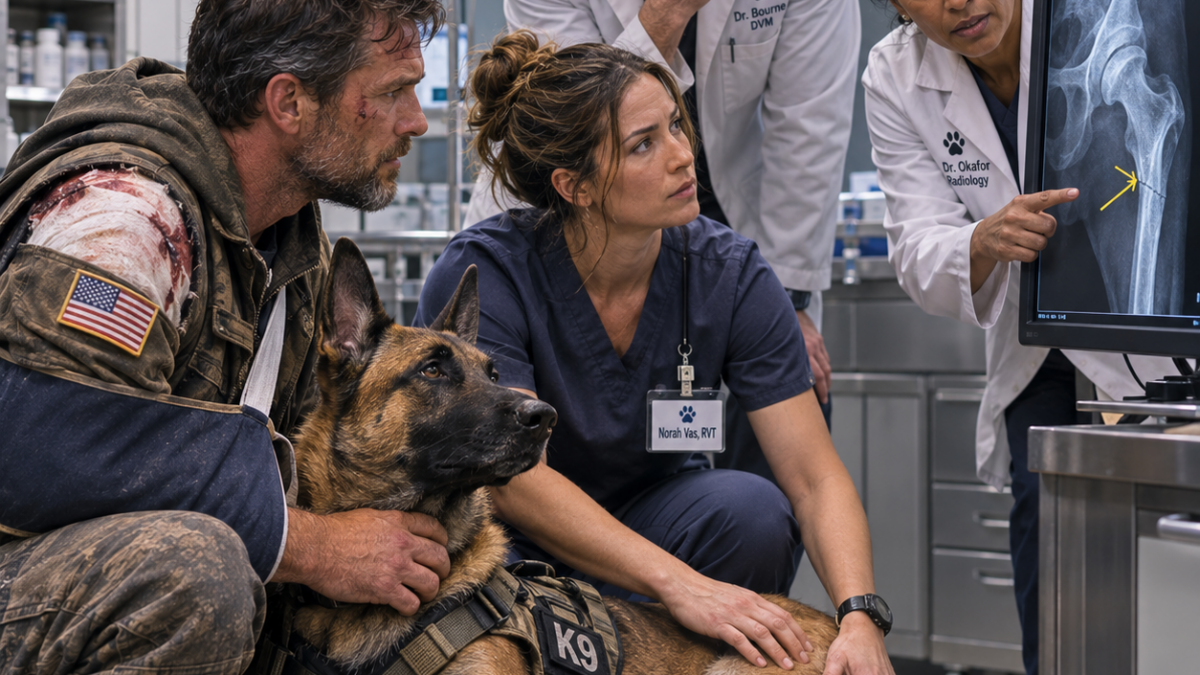
The Retired Military K9 Wouldn’t Let Anyone Near His Handler—Then the Quiet Vet Tech Found the Fracture Everyone Else Had Missed for Months.
When a retired military Belgian Malinois named Cota blocked an entire emergency team from reaching his bleeding handler, everyone in the hospital saw a dangerous dog—except the quiet veterinary technician they had spent three years dismissing as “just a nurse.”
Norah Vas was the only person who noticed that Cota was not merely guarding Dale Whitmer; he was shifting his weight around an old fracture that another contractor had cleared as nothing more than a soft-tissue strain.
But when the second opinion revealed months of untreated damage, Cota’s limp reopened a file Norah had buried eight years earlier—and led investigators toward nineteen retired working dogs, a federal contractor, and the same officer who had once destroyed her military career for asking the wrong questions.
The dog entered Ridgeline Veterinary Specialty Hospital before the man did.
Not by much.
Enough to make everyone in the emergency lobby misunderstand what they were seeing.
The automatic doors opened at 6:38 on a wet October morning outside Portland, Oregon, and a Belgian Malinois came through first.
Dark brindle coat.
Sixty-eight pounds.
Scar along the left shoulder.
Old military harness.
Lead stretched tight behind him.
At the other end was Dale Whitmer.
Forty-two.
Retired Army.
Blood soaking one sleeve of his jacket.
His left hand clamped over a deep cut across the opposite shoulder.
He looked like the person who needed emergency care.
He knew that.
“Ambulance is coming,” he said through clenched teeth.
Then pointed at the dog.
“Dog first.”
His knees nearly buckled.
Three veterinary technicians moved automatically.
Cota stepped between them and Dale.
Low growl.
No barking.
No snapping.
No frantic lunging.
Just a warning delivered by an animal who had spent enough years around frightened humans to understand that volume was not necessary when everyone already believed you.
The technicians stopped.
Everyone stopped.
Everyone except Norah Vas.
She had been standing beside the treatment corridor with a medication reconciliation sheet in one hand.
Thirty-four.
Certified veterinary technician.
Three years at Ridgeline.
Quiet.
Reliable.
Excellent with difficult patients.
Not management material.
PART2:
That was how Dr. Aldrich Bourne had once described her during a staffing discussion he assumed she had not overheard.
Norah had not corrected him.
She had learned years earlier that people who decided who looked like leadership were not always watching the work leadership required.
She set the chart on the counter.
“Give him space.”
Bourne turned from the triage station.
“Norah—”
“Please.”
Something in her tone stopped him.
Not authority.
Not rank.
Specificity.
Norah did not walk directly toward Cota.
She angled herself.
No eye contact.
No reaching.
No sugary voice.
No:
Good boy.
It’s okay.
Everything’s fine.
Because none of those statements were true.
Dale was bleeding.
PART3:
Paramedics had been called.
Strangers were advancing.
Hospital smells filled the room.
Disinfectant.
Wet coats.
Fear.
Cat urine from somewhere down the hall.
Cota had no reason to believe anybody deserved access.
Norah stopped six feet away.
Turned one shoulder.
Lowered herself into a squat.
Not closer.
Just smaller.
Cota watched her.
Growl steady.
Dale whispered:
“Cota.”
One ear moved.
Norah said:
“Good.”
One word.
Nothing more.
The dog smelled the air.
His head lowered an inch.
Then another.
Growl stopped.
Norah slowly offered the back of her hand.
Cota stepped forward.
One step.
Smelled her.
Then returned immediately to Dale.
Norah stood.
“That’s enough.”
Bourne looked at her.
“What is?”
“He told us he’ll allow proximity.”
“He sniffed you.”
“Yes.”
“That’s not the same thing.”
“No.”
She looked toward the entrance.
“It’s enough to move slowly.”
She asked for a gurney.
“Let Cota see everything.”
Ridgeline did not treat humans.
Paramedics arrived seven minutes later.
Dale refused to be loaded until someone promised the dog would remain within sight.
“You his owner?” Norah asked.
“Now.”
“Former handler?”
“Yes.”
“Retired together?”
Dale almost smiled despite the pain.
“Close enough.”
“Can you handle him?” he asked.
Norah looked at Cota.
“That depends on Cota.”
Dale’s expression changed.
Approval.
“Right answer.”
He left in the ambulance.
Cota remained.
The emergency had technically become less dramatic.
That was when Norah noticed the right hind leg.
Nothing obvious.
Cota could stand.
Walk.
Sit.
Turn.
Most people looking casually would have called him sound.
Norah watched longer.
He shortened the stance phase on the right rear.
When he sat, his pelvis shifted slightly left.
When he turned, his front end initiated first and his hindquarters followed a fraction later.
Hip extension was limited.
Tiny compensations.
Old.
Practiced.
Pain that had been incorporated into movement rather than announced by it.
Trace Olsen, senior technician, walked past.
“Owner said observation only.”
“I know.”
“What are you writing?”
“Gait asymmetry.”
Trace looked.
“He walked in.”
Norah continued documenting.
“That doesn’t mean he’s comfortable.”
Dr. Bourne arrived.
Tall.
Immaculate.
Board-certified emergency veterinarian.
Competent.
Fast.
Good in crisis.
Also deeply comfortable with hierarchy.
“What do we have?”
Norah gave him facts.
Former military working dog.
Recently retired.
Handler transported for shoulder laceration.
No known acute trauma to dog today.
Persistent right-hind compensation observed at walk, turn, sit.
Bourne looked at Cota from several feet away.
“Could be age.”
“How old?”
“Seven.”
Norah nodded.
“Too young to use age as an explanation without looking.”
Bourne’s eyes shifted toward her.
“I didn’t say I was using it as an explanation.”
“Good.”
Trace suddenly found something very interesting on a clipboard.
Bourne stepped closer.
Cota stiffened.
Norah saw the change.
“Stop there.”
Bourne looked annoyed.
“He requires an exam.”
“Yes.”
“We can muzzle him.”
“We can.”
“Then?”
“If this becomes urgent, we do what’s medically necessary.”
Bourne waited.
“But?”
“If the problem has existed for weeks or months, forcing a retired defensive working dog through an orthopedic exam while his bonded handler is at the human ER creates risk without adding enough benefit right now.”
“You’ve decided it’s chronic?”
“No.”
Norah’s voice remained flat.
“I observed compensation consistent with something chronic.”
Different sentence.
Important difference.
Bourne exhaled.
“Fine.”
He turned to Trace.
“Call Whitmer when the hospital releases him.”
Dale returned three hours later.
Six stitches.
Tetanus booster.
Arm in sling.
Angry at everyone involved in keeping him from returning faster.
Cota’s body changed when he saw him.
No wild jumping.
No frantic noise.
Relief.
He pressed against Dale’s good side.
Dale put one hand on his neck.
Norah asked:
“How long has he been favoring the rear leg?”
Dale looked at her.
“You saw that?”
“Yes.”
“Two months.”
Pause.
“Maybe longer.”
“Veterinary exam?”
“Transition contractor looked at him before retirement.”
“Who?”
“Ridgeback Canine Medical Services.”
Norah’s pen stopped.
Half a second.
Then moved again.
“What did they say?”
“Soft-tissue strain.”
“Imaging?”
“No.”
“Rest?”
“Six weeks.”
“Improvement?”
Dale shook his head.
Norah’s chest tightened.
Not because Ridgeback proved anything.
A contractor could miss an injury without conspiracy.
Clinicians made mistakes.
Records got lost.
Dogs hid pain.
Different veterinarians interpreted findings differently.
She had learned the danger of deciding what evidence meant before enough evidence existed.
So she asked:
“Would you like a complete orthopedic evaluation?”
“You think it’s a fracture?”
“I think persistent abnormal movement makes guessing less useful.”
Dale looked toward Bourne.
“Can we do it?”
Bourne hesitated.
Not evil.
Not dismissive exactly.
Schedule.
Cost.
Scope.
Ordinary clinical friction.
Dale noticed.
“I’m requesting it.”
That solved the question.
With Dale beside Cota’s head and Norah near his shoulder, the dog tolerated the physical examination.
Until hip extension.
Cota’s entire body hardened.
Head turned.
Breathing changed.
Not aggression.
Pain.
Radiographs followed.
Dr. Priya Okafor opened the images.
Veterinary radiologist.
She enlarged the right hip.
Then stopped speaking.
Norah watched her face.
“What?”
Priya pointed.
“Old fracture.”
Dale went still.
“Where?”
“Proximal femur.”
She magnified the image again.
“Significant remodeling.”
“How old?”
“I can’t date a bone injury to an exact day from this film.”
Priya leaned closer.
“But this did not happen last week.”
“Months?”
“Likely.”
“Longer?”
“Possibly.”
Dale stared toward the door.
Cota stood outside beside a technician.
Weight shifted away from the same leg.
Exactly as he had apparently shifted it through every day somebody told Dale he was recovering from a strain.
“They cleared him.”
Norah asked:
“Did Ridgeback radiograph?”
“No.”
“Full orthopedic examination?”
“Supposedly.”
Priya looked at the image.
“A complete orthopedic exam should have generated enough concern to image this.”
Bourne entered.
Saw the radiograph.
His expression changed.
“Okay.”
Norah looked at him.
That was sufficient.
She did not need:
You were right.
The image was right.
Dale asked:
“What happens?”
Priya answered:
“Orthopedic specialist.”
“Treatment depends on stability, degenerative changes, soft tissue, and how this healed.”
“Can you fix it?”
“Maybe.”
She looked directly at him.
“But nobody should promise anything before better imaging and specialist review.”
Dale crouched beside Cota when they returned to the treatment room.
“I’m sorry, buddy.”
Norah watched.
Then pulled a blank page from the chart.
At the top, she wrote:
RIDGEBACK CANINE MEDICAL SERVICES.
Eight years earlier, she had written another contractor name on another sheet of paper.
Seven dogs.
Seven readiness evaluations.
Discrepancies between what she observed after missions and what the files claimed had been present before those dogs deployed.
At the time, she had been Staff Sergeant Norah Vas.
Army animal care specialist.
68T.
Attached to a specialized veterinary support program.
Her report had eventually reached Lieutenant Colonel Garrett Voss.
He called her conclusions inexperienced.
Disruptive.
Dangerous to program continuity.
Four months later, Norah left the program.
Voluntary transfer.
That was what the paperwork said.
She had spent eight years refusing to call it anything else.
Now she looked at Cota’s old fracture.
Then at Ridgeback’s name.
And reminded herself:
Probability is not evidence.
Not yet.
The second opinion came from Dr. Marcus Teler.
Veterinary orthopedic surgeon in Portland.
He reviewed the films first.
Then drove to Ridgeline personally.
Not because Cota was famous.
Because the fracture interested him.
After examination, Marcus said:
“This is not a subtle miss.”
Dale’s jaw tightened.
Marcus raised a hand.
“That does not automatically mean fraud.”
Norah liked him instantly.
He continued:
“Inadequate exam.”
“Incomplete record.”
“Poor judgment.”
“Different examiner than the person signing.”
“All possible.”
He looked at Dale.
“We need the transition record before assigning motive.”
Good experts protected uncertainty.
Cota needed reconstructive orthopedic surgery.
Dale approved it.
Ridgeline scheduled the procedure.
Three days later, Cota went to surgery.
Norah did not operate.
She was not a surgeon.
She did not stand dramatically at the table and discover some secret everyone else had missed.
She did what she was credentialed to do.
Prepared recovery instructions.
Tracked medication.
Logged pain scores.
Monitored incision.
Recorded weight-bearing.
Helped Dale learn how to support Cota safely.
The work was enough without pretending to be something she was not.
Day three:
Toe-touching.
Day six:
Partial weight-bearing.
Week two:
Short supported walks.
No cinematic sprint down the corridor.
No suddenly healed dog because somebody finally cared.
Bone required time whether the patient had served six deployments or none.
Dale wanted answers about Ridgeback.
Marcus recommended a formal complaint through retired military working-dog oversight channels.
Dale filed it.
Norah submitted her contemporaneous intake notes through Ridgeline’s normal records process.
Nothing secret.
No stolen documents.
No private investigation.
Then Special Agent Carla Drent contacted Dale.
Defense Criminal Investigative Service.
After Dale consented, she contacted Ridgeline.
Carla met Norah in a consultation room.
Dark suit.
No unnecessary friendliness.
No attempt at intimidation.
“I’m not here because you diagnosed fraud.”
“Good.”
Norah sat across from her.
“I didn’t.”
“I’m here because your documentation may corroborate another complaint.”
Norah felt something shift.
“How many?”
Carla hesitated.
“Several.”
“Same contractor?”
“Yes.”
Norah looked through the small interior window.
Cota was resting.
Carla asked:
“Prior military working-dog experience?”
“Yes.”
“Veterinary?”
“Army animal care specialist.”
“68T?”
“Yes.”
“Assignments?”
“Several.”
“Later attached to a special-operations veterinary support program?”
Norah looked at her.
“You already know.”
“I verify.”
“Three years.”
“And then?”
“I left.”
Carla waited.
Norah had survived years by learning which sentences ended conversations.
That one usually did.
Carla did not let it.
“Why?”
Norah looked back at Cota.
“I reported discrepancies.”
“What kind?”
“Seven canine readiness evaluations.”
“Explain.”
“Clinical findings after missions did not match what had been documented beforehand.”
“What happened to the report?”
“Closed.”
“And you?”
“Transferred.”
“Voluntarily?”
There it was.
The word on the form.
Norah’s face went still.
“On paper.”
Carla did not push.
Not yet.
“Names?”
Norah almost said no.
Then realized how absurd that would be.
She had spent eight years refusing to speak one man’s name as if silence reduced the space he occupied.
“Yes.”
“Who?”
“Garrett Voss.”
Carla wrote it down.
No reaction.
That reassured Norah more than shock would have.
The investigation widened quietly.
Norah did not investigate it.
She went to work.
Cota learned how to use his repaired leg.
Bourne began reading her notes more carefully.
He did not transform overnight into a different man.
No emotional apology.
No declaration that Norah had been secretly brilliant all along.
One morning, he stopped beside her workstation.
“How do you distinguish guarded pain from working-dog behavior?”
Norah looked up.
“You don’t from one thing.”
“Meaning?”
“Clusters.”
She counted.
“Weight shift.”
“Range avoidance.”
“Movement sequence.”
“Turn pattern.”
“Behavior under distraction.”
Bourne listened.
“Working dogs can suppress obvious pain?”
“Many dogs can.”
“Especially trained ones?”
“Sometimes.”
She pointed toward Cota.
“The dog can hide the reaction.”
“His body still has to move around the injury.”
Bourne nodded.
Then:
“I should’ve looked harder when he arrived.”
Norah appreciated the sentence because it was specific.
Not apology theater.
“Yes.”
She returned to the chart.
“You should have.”
He accepted it.
Two weeks later, Carla called.
“We identified nineteen retired working dogs processed through Ridgeback during the last thirty months.”
Norah stopped walking.
“How many developed significant diagnoses after transition?”
“Fourteen.”
Her fingers tightened around the phone.
“What kind?”
“Orthopedic conditions.”
“Two infections.”
“One cardiac condition.”
“Several behavioral cases where untreated pain may have contributed.”
Norah closed her eyes.
“Who is reviewing clinically?”
“Independent veterinary consultants.”
“Good.”
Carla paused.
“We may need you to explain your observation methods.”
“Fine.”
“Not diagnose these dogs.”
“Better.”
Then Carla’s voice changed slightly.
“Norah.”
She rarely used her first name.
“What?”
“Ridgeback’s ownership is layered through two holding companies.”
Norah knew before the next sentence.
Not logically.
Emotionally.
She had been fighting the thought since the first time Dale said the contractor name.
“We identified the controlling shareholder.”
Norah sat down on a hallway bench.
“Garrett Voss.”
Silence.
Then:
“Yes.”
The hospital continued around her.
Phones.
Doors.
A technician laughing near pharmacy.
Ordinary life showing no respect for revelation.
Carla asked:
“You know him personally.”
“Yes.”
“He ran the program where you filed your old complaint.”
“Yes.”
“Did you know he entered private contracting?”
“No.”
“Did you know Ridgeback obtained its first military transition contract five years after you left?”
“No.”
“I need the old report.”
Norah laughed once.
No humor.
“It doesn’t exist.”
“How do you know?”
“I was told it had been reviewed and closed.”
Carla replied:
“That is not the same thing as destroyed.”
Norah became very still.
No.
It was not.
She called one person.
Lieutenant Colonel James Whitmore.
Retired.
Former supervisor.
Eight years earlier, he had been the only officer to tell her privately:
I don’t agree with how this is being handled.
He answered on the fourth ring.
“Norah?”
“You kept my number.”
“I keep everyone’s number.”
“That sounds unhealthy.”
“What happened?”
She told him.
Cota.
Ridgeback.
Garrett Voss.
Silence.
Then Whitmore said:
“I kept a copy.”
Norah stopped breathing.
“Of what?”
“Your report.”
“All eight pages.”
She stood so quickly the chair leg scraped.
“Why?”
“Because I thought what happened to you was wrong.”
Her anger arrived instantly.
“Why didn’t you use it?”
“I had no independent evidence.”
“You had my report.”
“I had allegations.”
“You believed me.”
“That is not enough for what I would have needed to prove.”
“Then why didn’t you call?”
Whitmore was silent.
Norah’s voice sharpened.
“Why?”
“Yes.”
“What?”
“I should have called.”
No explanation.
No defense.
That was harder to hate.
Whitmore continued:
“I can transfer it directly to investigators.”
“Not me.”
“Exactly.”
“Chain of custody.”
“Yes.”
Norah closed her eyes.
The report still existed.
Her handwriting.
Seven dogs.
Dates.
Clinical findings.
Names.
Everything she had spent years wondering if she had exaggerated.
At the bottom:
STAFF SERGEANT NORAH VAS
VETERINARY SERVICE SUPPORT.
Not invisible.
Not erased.
Preserved.
Carla called the next morning.
“We have it.”
“You read it?”
“Yes.”
“And?”
“The overlap is significant.”
Norah looked through the rehabilitation-room window.
Cota took six careful steps.
The fifth clean.
The sixth almost clean.
Carla continued:
“This is bigger than Ridgeback.”
Norah said:
“It always was.”
Garrett Voss did not arrive at the hospital to threaten her.
No dark SUV.
No confrontation in a parking garage.
His attorney sent a letter.
Much more realistic.
The letter attacked:
Norah’s credentials.
Her impartiality.
Her past dispute with Voss.
The reliability of any interpretation she offered investigators.
Norah read it twice.
Then called Carla.
“They’re right.”
“About what?”
“I’m not impartial about Voss.”
Carla answered:
“You are not our forensic veterinarian.”
Norah waited.
“You’re a fact witness.”
“Your observations of Cota are contemporaneous records.”
“Your previous report is historical evidence.”
“Independent clinicians are reviewing the medical conclusions.”
Norah exhaled.
“Good.”
“That separation protects the investigation.”
Exactly.
No single heroic expert.
No case dependent on one person.
Dr. Selena Marsh, an independent forensic veterinarian, reviewed nineteen known cases.
Seventeen required further scrutiny.
Eight appeared to involve conditions that should have produced detectable signs when Ridgeback cleared the animals.
Three likely should have been identified during ordinary physical examination even without imaging.
Cota was one.
Another was a German Shepherd named Bastion.
His retired handler was Diana Orel.
Bastion had died months after retirement from aggressive bone cancer.
Review suggested disease was likely already detectable when Ridgeback cleared him.
Nobody claimed earlier diagnosis guaranteed survival.
Cancer did not obey courtroom morality.
But Diana had lost something else.
Time.
Months in which she might have made different treatment choices.
Different quality-of-life decisions.
Different plans.
She told investigators:
“They told me he was healthy.”
“He wasn’t.”
“That matters even if the ending stays the same.”
Norah read that sentence in a summary.
It stayed.
Then investigators found the financial incentive.
Ridgeback’s contract paid primarily per completed transition examination.
More dogs processed.
More billable completions.
Imaging cost money.
Time.
Scheduling capacity.
Internal records showed some dogs moving through examination windows too short for the documentation claimed.
One veterinarian agreed to cooperate.
Dr. Garrett Pell.
He admitted certain forms had been pre-populated before the dog arrived.
Imaging was often skipped unless a handler insisted.
Low-risk findings were frequently documented as age-related or routine post-service strain because deeper workups could delay placement.
Sixty-three dogs had passed through the abbreviated process over several years.
Not sixty-three injured dogs.
That mattered.
Not every dog had been harmed.
Not every examination was false in every detail.
But enough significant conditions were missed for the pattern to become serious.
Carla called Norah before dawn.
“Pell says Voss approved the abbreviated protocol.”
Norah sat on the edge of her bed.
“Written?”
“Emails and financial records corroborate parts of his statement.”
“Parts?”
“Yes.”
“Good.”
Carla almost laughed.
“You may be the only witness who gets happier when I qualify evidence.”
“I’ve met lawyers.”
Garrett Voss was arrested later that morning on federal fraud and false-record charges.
Norah went to work.
Trace found her in Cota’s rehabilitation room.
“It’s on the news.”
“I know.”
“You’re not watching?”
“No.”
“Why?”
Norah adjusted the support harness under Cota’s abdomen.
“Because he still needs twelve minutes.”
That became her answer to nearly everything.
Reporters called.
No.
Veterans’ organizations called.
No.
Local television wanted the quiet nurse who exposed a military-dog scandal.
No.
Norah hated the phrase.
Quiet nurse defeats colonel.
That was not the story.
Government contractor accused of falsifying transition medical documentation affecting retired military working dogs.
That was the story.
If Norah became the headline, the dogs became scenery.
She refused.
Then Voss’s attorneys produced her old separation record.
VOLUNTARY TRANSFER.
INSUBORDINATE CONDUCT.
POOR FIT FOR SPECIALIZED PROGRAM.
PRIOR COMPLAINT:
UNSUBSTANTIATED.
It looked bad.
Carla showed her.
Norah stared.
“I signed this.”
“Why?”
“I was given a choice.”
“What choice?”
“Transfer voluntarily with my record intact.”
“Or?”
“Challenge the evaluation and risk formal proceedings.”
“Who gave you that choice?”
“Voss.”
“Witness?”
“Not to the private conversation.”
“Earlier meetings?”
“Two officers.”
Investigators located both.
One was Major Theodore Sark.
Retired.
Living in Bend.
He remembered the meetings.
More importantly, he had handwritten notes.
Voss had described Norah’s report as dangerous to program continuity.
He instructed staff that the matter needed to remain internal.
Whitmore’s preserved copy contained dates that matched Sark’s notes.
No single piece proved the entire story.
Together, they corroborated each other.
Carla explained it to Norah in a conference room.
“You weren’t imagining it.”
Norah looked at her.
“I know.”
Carla waited.
Norah corrected herself.
“I know now.”
That difference mattered.
Military authorities opened an administrative review of Norah’s old separation.
Not immediate reinstatement.
Not medals.
Not an apology ceremony.
Records.
Interviews.
Legal review.
Months.
As it should be.
Meanwhile, Cota improved.
Week five:
Consistent partial weight-bearing.
Week eight:
Controlled full weight-bearing.
Week ten:
Longer walks.
Week twelve:
Dale appeared carrying an old rubber ball.
Cota’s face transformed.
Ears.
Eyes.
Tail.
Whole dog.
Norah pointed at Dale.
“No running.”
Dale sighed.
“You destroy happiness.”
“Eight more minutes walking.”
Cota stared at the ball.
Dale looked at him.
“She outranks us now.”
Norah replied:
“Clinically.”
Their friendship became easy.
No romance.
No need for one.
Dale had family waiting in Idaho.
A sister.
Two nephews.
A small house he planned to buy now that both he and Cota were retired.
He told Norah:
“I thought retirement meant he finally didn’t have a job.”
“What does he do all day?”
“Follows me to the bathroom.”
“Excellent transition.”
“Judges neighbors.”
“Civilian leadership.”
Dale laughed.
Then became serious.
“If you hadn’t noticed his leg…”
Norah stopped him.
“Eventually someone might have.”
“Maybe.”
“Yes.”
“But you did.”
She nodded.
“Because I knew what I was looking for.”
That was the whole thing.
Not instinct.
Not magic.
Training.
Attention.
Experience.
The part nobody at Ridgeline knew yet was why Norah had become so good at seeing pain that had learned to hide.
Eight years earlier, she had been assigned to a joint military veterinary program supporting high-readiness working-dog units.
She was not a veterinarian.
That distinction mattered to her then and now.
She did not diagnose.
She observed.
Prepared.
Recorded.
Handled.
Assisted.
Followed orders.
And noticed things.
A dog returning from one mission with a slight front-limb loading change.
Another resisting mandibular pressure when the clearance exam called the mouth normal.
A third whose resting heart rate and recovery times changed across several evaluations even though readiness forms marked no concern.
Individually:
Small.
Explainable.
Collectively:
Pattern.
Norah built a report.
Eight pages.
Seven dogs.
Nothing sensational.
She did not write:
Fraud.
Cover-up.
Abuse.
She wrote:
Observed findings do not appear fully consistent with pre-deployment readiness documentation.
She recommended independent review.
Garrett Voss read it.
Lieutenant colonel.
Program director.
Polished.
Highly regarded.
He called her into his office.
“Do you understand what you’re alleging?”
“I’m not alleging motive.”
“You’re alleging our veterinarians signed inaccurate records.”
“I’m reporting discrepancies.”
“That distinction won’t survive outside this office.”
“Then review the cases.”
“We already review cases.”
“Independently.”
Voss’s face changed.
“Staff Sergeant.”
“Yes, sir.”
“You are an animal care specialist.”
“Yes, sir.”
“Not a veterinarian.”
“Yes, sir.”
“Not a program manager.”
“No, sir.”
“Then stay inside your lane.”
Norah remembered answering:
“My lane includes reporting what I observe.”
That sentence followed her for eight years.
The report disappeared into review.
She was removed from certain duties.
Then transferred.
On paper:
Voluntary.
In reality:
A warning.
Stop pushing or risk your career becoming the subject instead of the dogs.
She transferred.
Later left military service.
Civilian work.
More school.
Credentialing.
Ridgeline.
Three years in a hospital where Bourne called her reliable.
Quiet.
Not management material.
It should have felt smaller than what happened before.
Instead, some days it felt safe.
No generals.
No programs.
No reports capable of costing millions.
Just animals.
Owners.
Medication.
Recovery.
Until Cota walked through the automatic doors.
Dale knew none of that at first.
He only knew the veterinary technician who had spotted a fracture everyone else had called strain.
As Cota recovered, Dale asked:
“Were you always this irritating about gait?”
“Yes.”
“Military?”
“Yes.”
“What did you do?”
“Animal care.”
“With working dogs?”
“Some.”
He waited.
Norah did not elaborate.
Dale understood not to push.
That became another reason she liked him.
At week fourteen, Cota completed his first unassisted controlled walk down the rehabilitation corridor.
Dale held the leash loose.
Norah watched from the side.
Six steps.
Ten.
Fifteen.
No obvious compensation until the turn.
Norah lifted one finger.
“Slower.”
Dale slowed.
Cota turned.
Better.
Dale looked at her.
“That good?”
“Better.”
“Can you ever say good?”
“When it is.”
“Cruel.”
Cota looked toward Norah.
Then, unexpectedly, walked to her.
No command.
No lure.
He stopped in front of her.
Pressed his shoulder against her knee.
Dale went quiet.
Cota had tolerated Norah from the first morning.
Trusted her enough for handling.
But this was different.
Choice.
Norah lowered one hand.
Scratched lightly beneath his neck.
Dale smiled.
“He likes you.”
“He tolerates competent staff.”
“Same thing, apparently.”
Norah almost smiled.
Ridgeline staff noticed too.
Trace, who once said the dog had walked in fine, began asking Norah to review subtle mobility changes in difficult patients.
Not to diagnose.
To observe.
Bourne started asking:
“What are you seeing?”
Instead of:
“What are you writing?”
Those were small changes.
They mattered more than compliments.
Then the news cycle found her anyway.
A reporter appeared near the hospital entrance.
Norah walked past.
“Ms. Vas?”
No response.
“You were the first person to connect Ridgeback to the injured military dogs?”
Norah stopped.
Turned.
“No.”
The reporter looked surprised.
“Investigators identified the connection.”
“But your case started—”
“Cota’s complaint started with his handler.”
“You found the fracture.”
“The radiologist found it on imaging.”
“You noticed the gait.”
“Yes.”
“So you exposed—”
“No.”
She looked directly at the camera.
“I noticed a dog limping.”
Then walked inside.
That clip spread anyway.
People liked it.
The quiet nurse.
The overlooked technician.
The woman who had been right eight years earlier.
Norah hated how easily a complicated investigation became a revenge story.
One afternoon, Dale found her deleting interview requests.
“You could tell your side.”
“I already did.”
“To investigators.”
“That’s who needed it.”
“People are calling you ‘just a nurse.’”
Norah looked at him.
“I am a veterinary technician.”
“You know what I mean.”
“Yes.”
“Doesn’t it bother you?”
“It used to.”
“And now?”
Norah looked through the glass toward Cota.
“He doesn’t know my job title.”
Dale laughed.
“Convenient.”
“He knows whether I hurt him.”
“That’s probably a better evaluation system.”
“Usually.”
Months passed.
The federal case moved slowly.
Charges.
Motions.
Records.
Contract audits.
No dramatic courtroom ambush.
Norah was interviewed repeatedly.
Asked the same questions differently.
Her original report.
Cota’s intake.
The relationship with Voss.
Her credentials then.
Her credentials now.
What she knew.
What she inferred.
What she did not know.
The last category mattered most.
A prosecutor once asked:
“When you saw Ridgeback’s name in Cota’s transition history, did you immediately believe Voss was involved?”
Norah considered lying.
Not because she wanted to deceive.
Because the truthful answer sounded bad.
“Yes.”
“Why?”
“Prior history.”
“So you were biased.”
“Yes.”
The prosecutor paused.
Norah continued:
“That’s why I did not investigate it.”
She pointed toward the table.
“I wrote what I observed about the dog.”
“Others investigated the contractor.”
That answer stayed.
Independent experts protected the case from becoming Norah versus Voss.
Dr. Selena Marsh’s review stood on clinical evidence.
Financial auditors reviewed billing.
Investigators reviewed records.
Other handlers gave statements.
Veterinarians testified about what they had done.
Some had made mistakes without criminal intent.
Some were overworked.
Some followed flawed protocols.
One admitted falsification.
The story did not divide neatly into heroes and villains.
Except perhaps Cota.
He had committed no administrative errors.
His only crime was compensating well enough that people stopped looking.
The administrative review of Norah’s old military file finished nearly a year after Cota’s surgery.
She received a letter at home.
She left it unopened for six hours.
Then called Whitmore.
“You got yours?”
“Yes.”
“What does it say?”
“You read yours first.”
“I hate you.”
“That seems fair.”
Norah opened it.
The review found that aspects of the prior personnel action had been procedurally deficient.
Her original clinical concerns had not received adequate independent review.
Language describing her conduct as insubordinate was unsupported by the broader record.
The file would be corrected.
No reinstatement.
She had been out too long.
No imaginary restoration of the eight years between.
Just a correction.
Norah read it again.
Then sat down.
Whitmore stayed on the phone.
“You there?”
“Yes.”
“You okay?”
“No.”
That surprised her.
She had imagined vindication would feel clean.
It did not.
It felt like grief with paperwork attached.
Eight years of wondering.
Eight years of telling herself she had overreacted.
Eight years of building a civilian career around the part of herself no report could take.
Now the institution agreed something had gone wrong.
Too late to give the time back.
Still not meaningless.
Whitmore said:
“I’m sorry.”
Norah closed her eyes.
“For what?”
“Not calling.”
“You already said that.”
“I’m saying it again.”
“Why now?”
“Because I finally understand what silence cost you.”
Norah had no answer.
The federal case concluded later.
Not with every accusation proven.
Not every missed diagnosis converted into fraud.
The court separated negligent practice, poor process, and deliberate falsification.
That mattered.
Voss faced consequences tied to the records and financial conduct the government could prove.
Ridgeback lost its military transition contracts.
Contract oversight procedures changed.
Dogs processed through the abbreviated system were offered record reviews and follow-up clinical assessments.
Some were healthy.
Some had manageable chronic conditions.
Some owners received answers too late to change outcomes.
Diana Orel became one of the most vocal advocates for better transition examinations.
She once told Norah:
“I don’t need them to tell me Bastion would’ve lived.”
Norah nodded.
“I know.”
“I need them to understand I should’ve known he was sick.”
“Yes.”
“So I could choose differently.”
“Yes.”
That was the part people missed when they wanted miracle endings.
Medicine does not always save.
Information still matters.
It gives people choices.
Time.
Preparation.
Pain management.
A chance to say goodbye differently.
Cota’s ending was kinder.
At fifteen months after surgery, Dale bought the small house in Idaho.
Fenced yard.
Maple tree.
Detached garage.
His sister lived fifteen minutes away.
Two nephews who had been instructed approximately twenty times that retired military dogs were not jungle gyms.
Cota arrived in November.
First snow two weeks later.
Dale sent Norah a video.
Cota walked into the yard.
Stopped.
Lifted his nose.
Then ran.
Not fast.
Not reckless.
But ran.
Norah watched the video twice.
Then texted:
Too much lateral movement on turn.
Dale replied:
You are incapable of happiness.
She wrote:
Happy. Also correct.
A minute later:
He looks good.
Dale sent back:
There she is.
Ridgeline changed too.
Bourne did something Norah did not expect.
He nominated her for lead technician.
She stared at the application.
Then walked into his office.
“What is this?”
“A promotion.”
“I can read.”
“Good beginning.”
“You called me not management material.”
He looked embarrassed.
“I did.”
“Why?”
“I confused quiet with reluctance.”
Norah waited.
“And?”
“I confused disagreement with poor fit.”
Another pause.
“And?”
Bourne sighed.
“You’re enjoying this.”
“No.”
“Yes, you are.”
She almost smiled.
He continued:
“I was wrong.”
Norah looked at the form.
“Do you think I want management?”
Bourne blinked.
“I assumed—”
“Again?”
He leaned back.
“Fair.”
Norah thought for several days.
Then accepted.
Not because being promoted proved everybody wrong.
Because she wanted to change how technicians were used.
Observation mattered.
The person holding an animal during examination often saw things the person standing at the head of the room did not.
The person cleaning a kennel saw appetite changes.
The person walking the dog saw gait.
The person owners talked to after the veterinarian left heard details nobody had asked in the exam room.
Norah’s first staff meeting as lead technician was short.
She wrote one sentence on the board:
IF YOU NOTICE SOMETHING, DOCUMENT WHAT YOU SAW BEFORE YOU DECIDE WHAT IT MEANS.
Trace read it.
“That’s it?”
“For today.”
“No inspirational speech?”
“No.”
“Management really suits you.”
“Get out.”
He laughed.
One spring morning, nearly two years after Cota first entered Ridgeline, Dale returned.
No blood.
No sling.
No emergency.
Cota walked beside him.
Older.
Gray beginning around the muzzle.
Right rear leg working cleanly.
Not perfect.
Never completely.
But strong.
Norah came into the lobby.
Cota saw her.
Stopped.
Then walked straight toward her.
No growl.
No hesitation.
He pressed into her legs.
Dale smiled.
“Still remembers.”
Norah crouched.
“He remembers the hospital.”
“Sure.”
“And probably the person who kept making him walk eight more minutes.”
“Trauma.”
“Exactly.”
Dale handed her a folder.
“What’s this?”
“His transition file.”
Norah looked at him.
“Corrected copy.”
Inside was the original Ridgeback clearance.
Then amended records.
Orthopedic diagnosis.
Surgery.
Rehabilitation.
Final status.
Dale had written one line on the cover:
THE DOG WAS NEVER THE PROBLEM.
Norah stared.
“That’s dramatic.”
“I learned from television.”
“You’ve learned nothing.”
He laughed.
They walked outside.
Rain had stopped.
Cota stood between them.
Dale asked:
“You ever think about that first morning?”
“Sometimes.”
“When he wouldn’t let anyone near me?”
“Yes.”
“You walked right up.”
“No.”
Dale looked at her.
“You did.”
“I stopped six feet away.”
“That’s not what I mean.”
Norah understood.
Everyone else had seen aggression.
She had seen context.
Handler bleeding.
Unfamiliar room.
Dog protecting.
Then movement.
The leg.
The small things.
Nothing magical.
Just attention.
Dale said:
“They all kept calling you the quiet nurse.”
“They still do sometimes.”
“Bother you?”
Norah scratched Cota beneath the jaw.
“No.”
“Why?”
She looked at him.
“Because quiet doesn’t mean absent.”
Cota leaned harder against her.
Dale smiled.
“Apparently.”
The public version of the story never became fully accurate.
It never does.
Some articles claimed Norah uncovered a conspiracy from one limp.
Wrong.
Some said Cota had been abused.
Not supported.
Some said Voss personally examined every injured dog.
He had not.
Some called Norah a veterinarian.
She corrected that whenever she could.
Some called her a nurse.
Close enough for headlines.
Not quite right either.
The true story was less dramatic and more important.
A retired working dog came into an emergency hospital because his handler was injured.
A veterinary technician noticed an abnormal gait.
Imaging found an old fracture.
A specialist said the miss deserved review.
The handler filed a complaint.
Investigators found other complaints.
Independent clinicians reviewed cases.
Financial records revealed incentives.
A former veterinarian cooperated.
Historical documents resurfaced.
Witnesses corroborated parts of an old report.
A federal case followed.
Processes changed.
No single person did all of it.
No one should have.
That was Norah’s favorite part.
Systems fail dangerously when one person controls too much.
Systems also recover more reliably when no single person has to be a hero.
Years later, new technicians at Ridgeline heard the story during orientation.
Not the scandal.
The first morning.
An instructor would show video of a dog walking.
“Anything?”
Someone usually said:
“He looks fine.”
Then another:
“Maybe short right rear?”
They would slow the clip.
Pelvic shift.
Short stance.
Delayed hindquarter turn.
Then the instructor would ask:
“What does it mean?”
The correct answer:
“We don’t know yet.”
Norah insisted on that.
Observation before conclusion.
That principle had cost her once.
Later, it saved dogs.
Not every dog.
Not from everything.
But enough.
Cota lived another six years after retirement.
Dale sent occasional photographs.
Cota asleep beside the bathroom door.
Cota supervising snow removal.
Cota judging a deer through the fence.
Cota beside Dale’s nephews, both boys sitting carefully because they had finally learned the rules.
His final year became slower.
Arthritis.
Age.
Nothing mysterious.
Dale called Norah one evening.
“He’s having more bad days.”
Norah’s chest tightened.
“What does your vet say?”
“We’re managing.”
“Eating?”
“Yes.”
“Getting up?”
“Slowly.”
“Still interested in you?”
“He follows me to the bathroom.”
Norah smiled.
“Excellent clinical marker.”
Dale laughed.
Then silence.
“You know what I’m asking.”
“Yes.”
“When?”
Norah looked out the hospital window.
“You know I can’t decide that over the phone.”
“I know.”
“But?”
“Count what he still chooses.”
“Food?”
“Yes.”
“Outside?”
“Yes.”
“People?”
“Yes.”
“Comfort?”
“Yes.”
“And when those start disappearing?”
“Talk to your vet.”
Dale breathed.
“I hate this.”
“I know.”
Cota died at home months later with veterinary support.
Dale beside him.
No emergency.
No panic.
No strangers rushing.
Norah received a photograph afterward.
Cota younger.
Military harness.
Standing beside Dale.
On the back, Dale had written:
He finally stopped following me to the bathroom.
Norah laughed.
Then cried.
She placed the photograph in her desk.
Not because Cota belonged to her story.
Because he had changed it.
Eight years earlier, Norah had left military service believing that noticing something dangerous did not matter if the person noticing lacked enough rank.
Cota taught her otherwise.
Not because institutions suddenly became perfect.
Because evidence could outlast the person trying to bury it.
A note.
A gait observation.
An old report.
A handwritten meeting page.
A radiograph.
A billing record.
A handler who insisted on another exam.
Small things.
Individually easy to dismiss.
Together, enough to force another look.
And sometimes another look was the difference between:
He’s getting old.
And:
He has a fracture.
Between:
He’s behaving badly.
And:
He hurts.
Between:
The report was unsubstantiated.
And:
The report was never independently reviewed.
Between:
Just a nurse.
And:
The person in the room who happened to be watching what mattered.
Norah never liked being called the woman who saved Cota.
She had not.
Marcus repaired the leg.
Priya read the film.
Dale authorized the care.
Rehabilitation staff did weeks of work.
Cota’s body healed because biology, surgery, time, and disciplined care allowed it.
Norah’s role was smaller.
She noticed.
But sometimes noticing is where everything begins.
That was why, years later, when a young technician came to her office and said:
“I know the doctor already examined this dog, but something about the way she stands looks wrong…”
Norah did not ask:
“Are you sure?”
She asked:
“What are you seeing?”
The technician described it.
Norah listened.
Then they went together.
Not because every observation becomes a diagnosis.
Most do not.
Not because every concern hides a scandal.
Almost none do.
Because the dog cannot write the note.
Someone else has to notice first.
And on one wet October morning outside Portland, the person who noticed happened to be the quiet woman everyone had spent years calling “just a nurse.”








