The Rescue Took Finch From the Only Woman He Trusted—Then His Broken Silence Exposed Their Cruel Lie
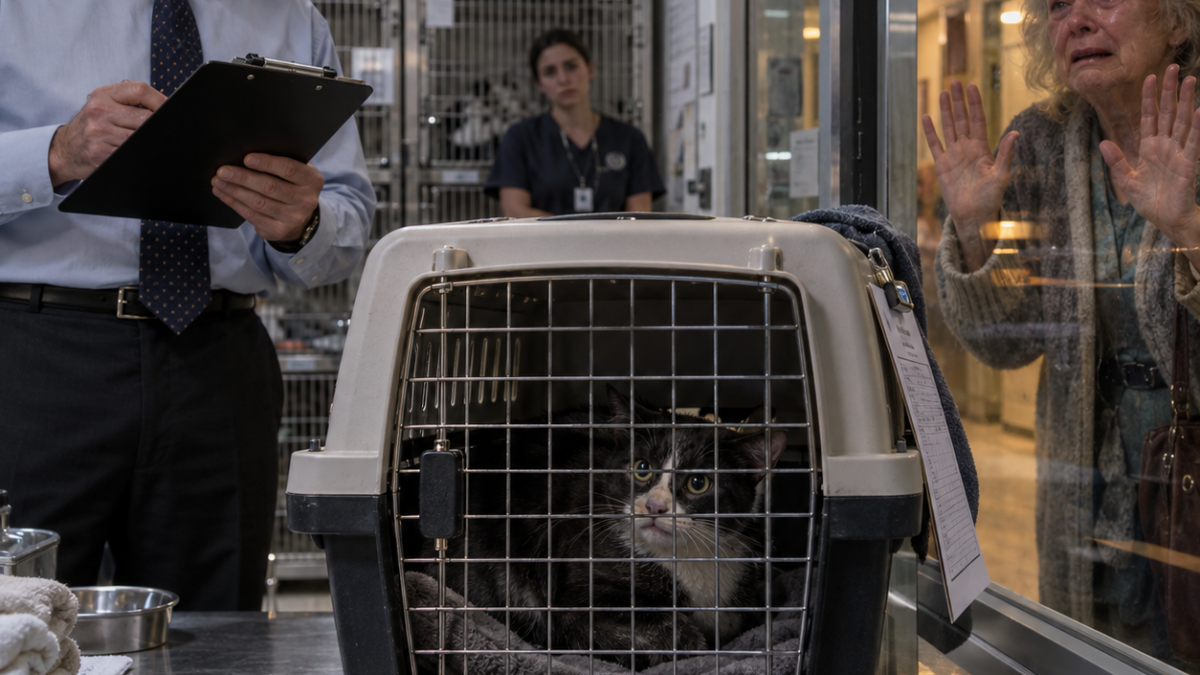
PART3:
When the carrier door opened, he stayed where he was.
The youngest child, Mason, dropped to his knees and pushed his face close.
“Come out, kitty.”
Finch’s body locked.
Mrs. Sterling laughed lightly.
“Let him come out when he’s ready.”
They waited ten minutes.
Humans are proud of waiting when they can still see the result they want.
Then the middle child reached inside with a feather wand and brushed it against Finch’s face.
Finch hissed.
Everyone gasped.
Vance smiled too quickly.
“Boundaries,” he said. “That’s good communication.”
No one heard the truth in that communication.
The next three weeks were not a rescue story.
They were a slow undoing.
Finch hid behind a heavy antique cabinet in the formal dining room because it was the only place where three sides of his body could touch something solid. Dust gathered in his fur. His bad ear ached. His stomach burned from hunger and fear. Food appeared across the room, but to reach it, he had to cross bright open floor while children ran through hallways and doors slammed like thunder.
He tried once at night.
The house had finally gone quiet. The children were asleep. The adults were upstairs. Finch crept from behind the cabinet, belly low, paws silent, eyes wide.
Halfway to the food bowl, the kitchen lights blazed on.
Mr. Sterling had come down for water.
He shouted, “Jesus!”
Finch bolted, struck a chair leg, knocked over a decorative vase, and wedged himself behind the cabinet so hard his ribs hurt.
The next morning, Mrs. Sterling told someone on the phone that “the rescue cat is still adjusting.”
By the fifth day, she sounded less cheerful.
By the eighth, impatient.
By the tenth, embarrassed.
The children did not mean to be cruel at first.
That was the complicated part.
They were loud, eager, fast, and badly guided. They had been promised a rescue cat. They imagined a grateful creature who would sleep on their beds and make them feel gentle. They did not understand that wanting to love something can still become harm if love refuses to learn what fear needs.
On the twelfth day, Mason crawled behind the cabinet and grabbed Finch by the tail.
Pain shot through Finch’s body.
He twisted.
Claws found skin.
Mason screamed.
The house erupted.
Hands.
Feet.
Voices.
Mrs. Sterling crying, “What happened?”
The girl shouting, “He attacked him!”
Mr. Sterling moving the cabinet while Finch scrambled, slipped, urinated on the rug, and fled beneath the formal dining table.
After that, they called him defective.
Not in front of visitors.
Not in the emails to the rescue agency.
In the house.
“That defective cat ruined the rug.”
“Don’t touch him. He’s defective.”
“Why did they give us a broken one?”
Finch stopped eating completely.
He stopped grooming.
He stopped sleeping in any way that counted as rest.
The formal dining room rug became his litter box because the hallway to the actual litter box was too bright, too open, too full of sudden movement. He scratched the expensive leather armchair not out of malice, but because panic had to leave his body somewhere.
At night, he dreamed of Opaline reading beside the sofa.
In the dream, he would crawl toward her voice.
Then the carrier latch would snap.
On the twenty-first day, Mrs. Sterling called Bright Hollow Rescue.
“I’m sorry,” she said, though she did not sound sorry for Finch. “This animal is not adoptable. He has traumatized my children, destroyed furniture, and refuses to use the litter box. We were misled.”
Misled.
She was right.
Just not in the way she meant.
Vance came in the agency van that afternoon.
Finch’s heart did something foolish when he heard the man’s voice.
Not because he wanted Vance.
Because he believed being returned meant going back.
Back to Opaline.
Back to the corduroy sofa.
Back to the lamp.
Back to the voice that never reached before waiting.
Even terror can carry hope when it is desperate enough.
Vance had to move the cabinet to get him.
This time, Finch did not fight.
The Sterling house had taught him something brutal.
Fighting made humans feel justified.
So he went still.
Vance wrapped him in a towel and placed him in the carrier. Finch’s body had become thin again. His fur smelled sour. His ear burned. His eyes hurt from too much light and too little sleep.
In the van, Vance did not speak.
The carrier rattled on the floor.
Finch waited for the turn toward Opaline’s road.
It never came.
They returned first to Bright Hollow headquarters. Finch knew the smell at once: disinfectant, paper, other animals, stress hidden under lavender air freshener near the lobby.
Vance placed the carrier on a cold metal table in the intake room.
Finch watched the door.
Any moment, he believed, Opaline would come.
Her wrinkled hands would reach for the latch.
She would say, “Oh, Finch.”
She would take him home.
He waited.
The fluorescent lights hummed.
A phone rang.
A dog barked down the hall.
Vance typed at a computer.
Finch waited.
Opaline never came.
Later, from whispers traded by volunteers near the cages, the truth surfaced.
Opaline had called the agency the moment she heard Finch had been returned.
She was furious.
The same woman who apologized to furniture when she bumped into it, the same woman who spoke softly to cracked mugs and dying plants, the woman who had read entire chapters in a whisper so Finch’s fear would not feel crowded, raised her voice for him.
She told Vance he had made a terrible mistake.
She told him he had prioritized a wealthy zip code over animal welfare.
She told him the Sterling placement ignored every foster note she had written.
She demanded to take Finch back immediately.
Because she raised her voice, Vance wrote a permanent note in Finch’s digital file.
Former foster displayed hostile, combative, and uncooperative conduct after placement decision. Do not release animal to this individual.
Hostile.
Combative.
Uncooperative.
Three words erased three months of patience.
Not the salmon pieces placed gently near the sofa.
Not the library books.
Not the nights Opaline lay frozen because Finch had finally dared to sleep near her feet.
Not the quiet home where his breathing had changed.
Just hostile.
Combative.
Uncooperative.
That was how some humans punished love when it refused to stay polite.
Vance could not admit he was wrong.
His ego could not bear an older woman in a trailer telling him his clipboard had failed a living creature.
So instead of sending Finch back to the only person who understood his silence, Vance followed protocol.
That was the word he used.
Protocol.
He authorized Finch’s immediate transfer to a long-term, high-capacity holding facility three towns over.
The van that carried Finch away smelled intensely of bleach and raw fear.
Other carriers were stacked behind him. Dogs barked somewhere near the front. One cat cried until her voice went hoarse, then fell silent in a way Finch understood too well.
He was eight years old.
Half his left ear was gone.
His spirit had folded back into the shape Opaline had spent three months teaching it to leave.
All because one adult cared more about authority than a beating heart.
Humans liked to pretend systems existed to save the helpless.
Sometimes they did.
Sometimes, though, systems existed to protect themselves from the truth.
The holding facility was called Haven Ridge Animal Care Center.
The sign had a painted paw print and the word COMPASSION in blue letters.
Inside, it was a warehouse with kindness painted on the door.
Rows of cages.
Stacked crates.
Metal tables.
Rubber gloves.
Drains in the floor.
Industrial fans.
A smell so sharp it burned Finch’s nose.
Bleach.
Fear.
Old urine hiding beneath chemical perfume.
A place could be clean and still feel cruel.
Humans did not always understand that.
They thought if the floor shined, the soul of the room must be good.
Animals knew better.
They knew the difference between a clean place and a safe place.
A young worker carried Finch inside.
Her hands were careful but rushed. She had dark hair pulled into a loose knot, tired eyes, and a strand of hair stuck to her cheek. Her name tag said MARA.
“Transfer from Bright Hollow?” she asked.
Vance was already looking at his phone.
“Yes,” he said. “Returned placement. Behavioral regression. High needs. No foster release without director approval.”
Mara looked down at the carrier.
Then at the paper clipped on top.
“Former foster requested return?”
Vance’s jaw tightened.
“She is no longer approved.”
“Why?”
“Hostile behavior.”
Two words.
That was all it took to erase Opaline in another building.
Mara paused just long enough for Vance to notice.
He lifted his eyes.
“Is there a problem?”
“No,” Mara said.
But animals read bodies better than words.
Her shoulders had changed.
She carried Finch past dogs barking so loudly that the sound seemed to strike the carrier walls. Finch pressed himself flat. His breathing vanished into shallow little pieces. Some cats reached through bars as they passed. Some stared at nothing. Some had already learned the same lesson Finch had.
Do not hope too loudly.
Mara placed Finch in a lower cage near the back, away from the loudest room.
There was a litter tray, a stainless-steel bowl, a folded towel, and a cardboard hide box.
It was more than Finch had in the alley.
Less than he had with Opaline.
Mara opened the carrier door.
Finch did not move.
“It’s okay, old man,” she whispered.
Old man.
He was only eight.
But fear ages an animal faster than time.
Mara waited.
Finch stayed frozen.
After a minute, she carefully unclipped the top half of the carrier instead of dragging him out.
That mattered.
It mattered more than she knew.
She gave Finch the choice to leave the bottom half when he was ready.
For a moment, the world became quiet enough for him to notice her breathing.
Then a dog barked suddenly from the next room, and Finch’s body snapped flat against the plastic.
Mara winced.
“Who sent you here?” she murmured.
Of course, she already knew.
Everyone knew people like Vance.
Every system had one.
The person who spoke in policies because policies did not tremble.
The person who said best practices when what he meant was I refuse to be questioned.
The person who could sleep at night because he had turned a living creature into a completed form.
That first night, Finch did not eat.
The second night, he did not drink.
By the third morning, Mara was worried enough to sit on the concrete floor outside his cage during her lunch break.
She unwrapped a sandwich and took small bites.
She did not stare at him.
She did not coo.
She did not tap the bars.
She just sat there facing slightly away, as if her presence were an offer instead of a demand.
That was the first human thing she did right.
After a while, she pulled a small paperback from the pocket of her hoodie.
The cover was bent. The pages were soft from being held too many times.
She began to read aloud.
Not brightly.
Not theatrically.
Quietly.
Low.
Rumbling.
Finch’s whole body went still.
For one terrible second, he thought Opaline had found him.
But it was not her voice.
It was not lavender and old paper.
It was not home.
Still, the sound slipped beneath the door of memory.
Finch blinked once.
Mara noticed.
She kept reading.
That was the second thing she did right.
She did not celebrate.
Humans ruined tiny miracles by making too much noise around them.
Mara simply turned the page and continued.
Later that afternoon, Vance called the facility.
Finch knew his voice before he saw him.
Some voices had footsteps.
Vance’s came through Mara’s phone, sharp and polished.
“Yes, the tuxedo,” he said. “Do not engage the former foster if she contacts you. All communication goes through me.”
Mara’s face changed.
“Is there a safety issue?”
“No,” Vance replied too quickly. “Just a compliance issue.”
Compliance.
Another word humans used when they wanted obedience to sound noble.
Mara looked toward Finch’s cage.
“What exactly happened?”
There was a pause.
Then Vance laughed lightly.
“She became emotional. Older fosters sometimes overattach. They forget they are temporary caregivers, not owners.”
Temporary.
That word landed in Finch’s body like a stone.
Was Opaline temporary?
Was he temporary?
Was love temporary because a man with a spreadsheet said so?
Mara did not argue on the phone.
That mattered too.
Not because she agreed.
Because she was smart enough to know some people did not listen when they felt challenged.
They only punished harder.
So she said, “Understood,” and ended the call.
Then she looked at Finch for a long time.
“I don’t think I do understand,” she whispered.
That evening, after the front office closed and most of the day staff left, Mara pulled Finch’s file up on the computer.
The screen cast blue light across her tired face.
Finch watched from his cage.
Animals noticed secrets.
They might not read words the way humans did, but they read the bodies of people reading them.
Mara leaned closer.
Then her shoulders slowly sank.
Page after page.
Intake notes.
Medical notes.
Foster notes.
Adoption notes.
Return notes.
And there, buried beneath clean language, was Opaline.
Cat shows significant improvement in low-stimulation foster environment.
Responds positively to quiet voice.
Seeks proximity at night.
Not suitable for high-activity household.
Outdoor access not recommended due to extreme fear response.
Those words existed.
They had always existed.
Vance had ignored them.
Not because he did not know.
Because knowing would have made his decision harder to defend.
Mara scrolled farther.
Then she found the permanent note.
Former foster displayed hostile, combative, and uncooperative conduct after placement decision. Do not release animal to this individual.
Mara sat back.
Her mouth tightened.
Then she opened the placement checklist for the Sterling family.
Large home.
Enclosed outdoor space.
Verified income.
Family stability.
References.
Everything was green.
Everything looked perfect.
That was the dangerous part.
On paper, cruelty often wore clean shoes.
On paper, a mansion beat a trailer.
On paper, money looked like safety.
On paper, quiet people disappeared.
Mara printed several pages.
She did not know Finch was watching the machine spit out the evidence of his heartbreak.
Or maybe she did.
The next morning, Opaline came.
Finch smelled her before he saw her.
Lavender.
Old paper.
Cheap hand lotion.
His body lifted before his mind caught up.
For the first time in days, he made a sound.
It was small.
Broken.
Barely a meow.
But every animal in that back room heard it.
Mara turned.
At the front desk, voices moved through the air.
Opaline’s voice shook.
Not with weakness.
With grief that had been forced to stand upright too long.
“I am not here to cause trouble,” she said. “I am here for the cat I fostered for three months. I was told he was transferred here.”
The receptionist sounded uncomfortable.
“I’m sorry, ma’am. We cannot discuss animals under restricted transfer status.”
“Restricted by whom?”
“I don’t have that information available.”
“You do,” Opaline said quietly. “You just aren’t allowed to say it.”
There are moments when silence becomes louder than shouting.
That was one of them.
Mara walked toward the front.
Finch could not see them from his cage, but he heard every word.
“Mrs. Vale?” Mara asked.
Opaline inhaled sharply.
“Yes.”
“I’m Mara. I work in animal care.”
“Is he here?”
Mara hesitated.
Rules stood on one side of her.
A beating heart stood on the other.
“Yes,” she said.
One word.
A door opening.
Opaline started crying.
Not loudly.
She was not the kind of woman who wanted attention for her pain.
She cried the way old wood cracks in winter.
Quietly.
Deep inside.
“Is he eating?” she asked.
Mara did not answer right away.
That was answer enough.
Opaline made a sound Finch had never heard from her before.
Not anger.
Not sadness.
Something worse.
Guilt.
As if she had failed him by not being powerful enough.
Humans did that.
They blamed themselves when systems were built to ignore them.
Mara lowered her voice.
“He responds to reading.”
“I know,” Opaline whispered. “He likes mysteries best. Not the violent ones. The old quiet kind.”
Mara’s voice softened.
“I figured that out.”
“Can I see him?”
A pause.
Then footsteps.
They came down the hallway.
Finch’s heart began to pound so hard his body trembled.
Mara appeared first.
Then Opaline.
She looked smaller than he remembered.
Her cardigan hung unevenly from her shoulders. Her gray hair had been pinned up in a hurry, loose strands falling around her face. Her eyes were red. Her hands trembled at her sides.
She looked like home after a storm.
The moment she saw Finch, she pressed both hands to her mouth.
“Oh, Finch,” she whispered.
Finch.
His name.
The Sterlings had called him the cat.
Vance had called him the tuxedo.
The file had called him behavioral regression.
But Opaline called him Finch.
He stepped out of the carrier bottom.
Slowly.
Stiffly.
His legs trembled.
Then he walked to the cage bars and pressed his face against them.
Opaline dropped to her knees on the concrete.
She did not care that the floor was dirty.
She did not care who was watching.
She slid two fingers through the bars.
Finch pressed his scarred cheek against them.
For the first time since the carrier latch snapped shut weeks earlier, he breathed all the way in.
Mara looked away.
Not because she was embarrassed.
Because some moments deserved privacy, even in public places.
Opaline stayed there for thirty-seven minutes.
Mara checked the wall clock three times.
Not impatiently.
Worriedly.
“I’m going to try,” Mara finally said.
Opaline looked up.
“Try what?”
“To get this reviewed.”
“They banned me.”
“I saw.”
“I raised my voice.”
“You were right to be upset.”
That sentence mattered.
People were always telling older women to be nice while something they loved was being taken from them.
They called it dignity when they really meant silence.
Mara did not tell Opaline to calm down.
She did not tell her to be grateful.
She did not tell her the system knew best.
She said the one thing nobody in authority had said yet.
You were right.
But right was not the same as powerful.
By noon, Vance knew Opaline had been there.
By one, he was in the building.
His shoes clicked down the hallway like little verdicts.
Mara stood near Finch’s cage with her arms folded.
Opaline was gone by then.
Vance had made sure of that.
“I gave clear instructions,” he said.
Mara kept her voice even.
“She came to ask about an animal she fostered.”
“She is not approved.”
“Because you labeled her hostile.”
“She was hostile.”
“She disagreed with you.”
His face tightened.
“There is a process.”
Mara nodded.
“There are also notes in the file stating this cat should not be placed in a high-activity home.”
“He needed a stable adoption.”
“He already had stability.”
“In a trailer.”
There it was.
The word he had been dressing up in professional language.
Trailer.
He said it like it was a disease.
Mara heard it too.
“So that’s the problem?” she asked.
“The problem is that we cannot let sentiment override objective standards.”
Objective.
Another beautiful word humans used to hide ugly judgment.
Was Opaline poor?
Yes.
Was her home small?
Yes.
Was her sofa worn?
Yes.
Did she understand Finch better than anyone else?
Yes.
But understanding did not fit neatly into a donor report.
You could not photograph patience beside a swimming pool.
You could not put “he finally slept through the night” on a fundraising banner as easily as “placed in estate home.”
And that was the argument people did not like having.
Because it made them uncomfortable.
Because it asked whether they really meant best home.
Or whether they meant home that looked best to people who never had to live there.
Vance looked down at Finch.
For one second, their eyes met.
There was no visible guilt in Vance’s face.
Nothing cracked.
Nothing softened.
Some people learned to step over suffering so often that eventually they stopped feeling the shape of it beneath their shoes.
“He will be evaluated for behavioral rehabilitation,” Vance said.
Mara’s face went pale.
“What does that mean?”
“It means we determine whether he is adoptable.”
“He was adoptable with Opaline.”
“He failed a placement.”
“You failed him.”
The hallway went silent.
Even the dogs seemed to pause.
Vance’s voice dropped.
“Be careful.”
Two words again.
This time, not in a file.
To her face.
Mara looked scared.
But she did not move.
That was courage, sometimes.
Not a grand speech.
Not a heroic rescue.
Just staying still when someone expected her to shrink.
“I am careful,” she said. “That’s why I read the notes.”
Vance left.
But people like Vance did not really leave.
They lingered in emails.
They lingered in warnings.
They lingered in whispered instructions to stay professional.
They lingered in every room where someone was trying to decide whether telling the truth was worth what it would cost.
That afternoon, Mara was called into the office.
From the kennel room, pieces of the conversation carried through the walls.
Chain of command.
Liability.
Donor confidence.
Emotional decision-making.
No one said Finch’s name.
That was the strangest part.
They were all arguing about him.
And no one said Finch.
By evening, Mara returned to the kennels with red eyes.
She sat on the floor outside his cage again.
For a long time, she said nothing.
Then she pulled out her paperback.
Her hands shook as she opened it.
“I might lose my job,” she whispered.
Finch blinked slowly.
That was the closest thing a cat like him could give to faith.
Mara read three pages.
Then her phone buzzed.
She looked at it once.
Twice.
Then she stood so quickly the book fell from her lap.
Another worker named Eli rushed in from the laundry room. He was young, broad-shouldered, and gentle in the way strong people became when they had decided not to scare anything weaker than themselves.
“What happened?” Eli asked.
Mara held up the phone.
“Opaline posted.”
That was when humans became loud.
Not in the building at first.
Online.
On kitchen tables.
On couches.
In break rooms.
In comment sections where strangers who had never met Finch suddenly became very sure about what love should look like.
Opaline had written one post.
No agency name.
No accusation she could not prove.
No dramatic threat.
Just her truth.
She wrote about a cat who had arrived too frightened to move.
A cat who slept beneath a sofa for a week.
A cat who learned to trust the sound of old books being read aloud.
A cat who was taken because her home was small.
A cat who was sent to a wealthy house despite clear notes saying he needed quiet.
A cat who was returned broken.
A cat she was not allowed to bring home because she had dared to object.
Then she ended with a line that traveled farther than she ever expected.
A large house is not the same thing as a safe home.
People shared it.
Then they argued.
Oh, how they argued.
Some said rules existed for a reason.
Some said small homes could be loving homes.
Some said money should matter because animals cost money.
Some said compassion mattered more than square footage.
Some said fosters got too attached.
Some said maybe fosters got attached because they were the ones doing the hardest part.
Some said Opaline sounded difficult.
Some said women always got called difficult when they refused to let someone hide behind procedure.
Some said rescues should have standards.
Some said standards without judgment were good, but standards without humility became cruelty.
The post spread through town by morning.
By afternoon, the agency phones would not stop ringing.
By evening, a local community page was full of people asking the same question.
Where is the cat now?
Not every comment was kind.
That was the part nobody liked to admit about viral stories.
Attention did not arrive alone.
It brought strangers.
It brought suspicion.
It brought people who wanted someone to hate more than they wanted something to change.
A few people attacked Opaline.
A few attacked Mara.
Some attacked the Sterlings, even though they had only been matched with an animal they were never prepared to understand.
That was wrong too.
The Sterlings were not villains in the way people liked villains.
They were careless.
They were impatient.
They wanted a charming rescue story, not a traumatized survivor.
They should have listened.
But they did not write the file.
They did not ignore the notes.
They did not ban Opaline.
The real problem was bigger than one family.
That was what made people uncomfortable.
It was easy to hate one person.
It was harder to question a whole culture of appearances.
A culture that said bigger meant better.
Richer meant safer.
Polished meant kinder.
Quiet poverty meant risk.
Small homes had to prove love twice.
Big homes were believed on sight.
By the third day, the board of Bright Hollow Rescue called an emergency meeting.
They did not call it that publicly.
Publicly, they called it “a routine review of placement procedures.”
Humans were funny that way.
They would rename a fire so nobody noticed the smoke.
Vance arrived at Haven Ridge that morning looking different.
Still polished.
Still expensive.
But something under his eyes had shifted.
Not remorse.
Pressure.
Pressure could look like conscience from far away.
He walked past Finch’s cage without looking at him.
Mara watched from the medication cart.
Vance stopped at the office door and turned.
“Do not speak to anyone outside this facility about internal matters,” he said.
Mara did not answer.
“That includes former volunteers.”
Still nothing.
Then he went inside.
An hour later, two board members arrived.
One wore a navy blazer and carried a folder. Her name was Helen Ross, and she smelled like rain, wool, and peppermint. The other was an older man named Mr. Alden, with kind eyes and a face that looked like it had forgotten how to smile under fluorescent lights.
They asked to see Finch.
Mara brought them to his cage.
Helen crouched a little, but not too close.
That was good.
Mr. Alden stood back.
That was better.
Some humans understood fear naturally.
Others only understood it after someone taught them.
Vance began talking.
“This animal presents significant behavioral challenges following a failed placement.”
Mara said quietly, “May I add context?”
Vance’s head turned sharply.
Helen looked at Mara.
“Please do.”
Mara held up the printed notes.
She spoke carefully.
No insults.
No drama.
Just the facts Vance had buried beneath his confidence.
“Prior foster notes documented severe fear response, improvement in a quiet environment, and a recommendation against placement in a high-activity household.”
She turned one page.
“The adoptive home had three young children and frequent household activity.”
Another page.
“The cat stopped eating, hid continuously, and eliminated outside the litter box after being repeatedly overwhelmed.”
Another page.
“The former foster requested return. She was denied based on a conduct note entered after she objected to the placement decision.”
Vance interrupted.
“She shouted at staff.”
Mara looked at him.
“Was anyone threatened?”
Vance hesitated.
“That is not the only standard.”
“Was anyone threatened?”
Mr. Alden looked at Vance.
Vance’s mouth tightened.
“No.”
“Did she damage property?”
“No.”
“Did she attempt to take the animal?”
“No.”
“Did she use abusive language?”
Vance’s silence changed the air.
Finally, he said, “She was disruptive.”
Disruptive.
There it was.
The word people used when the truth made the room uncomfortable.
Helen looked at Finch.
He sat in the back of the cage, half-hidden inside the cardboard box.
His eyes were open.
But his body was not there with them.
That was what trauma did.
It let the body remain while the spirit retreated to the only corner no one could reach.
Mr. Alden spoke softly.
“What is his name?”
Vance looked at the file.
“Animal ID 47-TX.”
Mara said, “Finch.”
The old man nodded.
“Then let’s call him Finch.”
For one small second, the whole building changed.
Not enough.
But something.
The board members left with copies of the file.
Vance followed them.
Mara stayed.
She sat on the floor and cried silently into the heel of her hand.
Eli came over and stood beside her.
“Did it help?” he asked.
“I don’t know,” Mara said.
That was the hardest answer.
Not yes.
Not no.
Just the thin, shaking bridge between both.
That night, Opaline did not come.
She had been told to wait.
Waiting was a special kind of suffering when someone you loved was behind a locked door.
In her mobile home, the lamp beside the sofa glowed yellow over an open library book she could not read. The little plate where she used to place Finch’s salmon sat empty on the floor. Twice, she looked toward the dark space beneath the sofa, expecting to see his eyes. Three times, she woke in the night because she thought she heard his paws on the linoleum.
The silence became so heavy it seemed to sit beside her like another person.
Some bonds were like strings tied in the dark.
No one could see them.
But when one heart pulled, the other ached.
On the fourth morning, a woman Finch had never seen entered the kennel room.
She was plain-faced, tired, and carried herself like someone used to apologizing for messes she did not make. Her name was Dana Whitcomb. She was the interim director.
Not Vance’s boss exactly.
Not his enemy either.
One of those humans caught between the machine and the truth.
She stood outside Finch’s cage with Mara.
“So this is Finch,” Dana said.
“Yes.”
“He won’t come out?”
“Not for us.”
“For the foster?”
Mara nodded.
Dana exhaled slowly.
“I watched the video.”
“What video?”
Mara’s voice changed.
Dana glanced down the hallway.
“Security footage from the day he was transferred out of Mrs. Vale’s care.”
Finch remembered that day in fragments.
The carrier.
The latch.
Opaline’s hands on her cardigan.
Vance’s shoes on the linoleum.
His own body pressed against plastic.
Dana’s face hardened.
“Why was he pulled from beneath the sofa?”
Mara’s eyes widened.
“He was pulled?”
“With a towel.”
The memory moved through Finch’s body.
Hands.
Fabric.
Air.
Claws catching nothing.
Heart trying to escape ribs.
Opaline crying, “Please, stop. Let him come out on his own.”
Vance saying, “We don’t have all day.”
There are moments of fear so deep they leave fingerprints inside the bones.
Finch had folded that one away.
Dana had unfolded it.
Mara turned from the cage.
For a moment, she looked as if she might be sick.
Dana closed her folder.
“I need Mrs. Vale contacted.”
Mara stared at her.
“Now?”
“Now.”
Hope was dangerous for animals like Finch.
It hurt more than hunger.
So when Mara came to his cage an hour later with a soft carrier, he did not let himself believe.
Not when she placed his fleece inside.
Not when she left the top open.
Not when she sat beside it and read two pages aloud.
Not even when Opaline’s smell came down the hallway again.
But then he heard her voice.
“Finch?”
The sound went through him like light through a cracked door.
He stepped out before anyone touched him.
That was the third thing they finally did right.
They waited.
Opaline knelt beside the carrier, not in front of it.
She knew not to block the opening.
“Hello, my brave little gentleman,” she whispered.
Finch walked to her.
Slowly at first.
Then faster.
His head pressed into her palm.
Her fingers shook against his whiskers.
“I’m here,” she said. “I’m here.”
Mara looked at Dana.
Dana nodded.
Opaline froze.
“What does that mean?”
Dana took a breath.
“It means the board has approved an emergency foster reinstatement pending final review.”
Opaline blinked.
“Foster?”
“For now.”
The word hurt her.
Finch could sense it in the way her shoulders tightened.
But she swallowed it because she was the kind of woman who would take half a door open if it meant he could pass through.
“Can I take him home?”
“Yes.”
Opaline’s face broke.
Not dramatically.
Quietly.
Like a cup cracking in warm water.
Mara handed her a packet of papers.
Dana added, “There will be a home visit.”
Opaline’s shoulders tensed again.
Dana continued quickly.
“Not by Mr. Vance.”
The room breathed.
That was the only way to describe it.
Even the cages seemed to breathe.
Opaline signed every page.
Her handwriting wobbled.
Mara placed Finch’s old fleece inside the soft carrier, then one of Opaline’s worn scarves.
Lavender.
Old paper.
Home.
Finch walked in by himself.
No towel.
No grabbing.
No forced dignity.
No gunshot latch.
When the zipper closed, it sounded like a whisper.
Opaline carried him through the front door.
Outside, the sun was too bright.
The world was too large.
Finch hid his face against her scarf.
“It’s all right,” she murmured. “We are going home.”
We.
Not you.
Not the animal.
We.
The drive back to the mobile home was quiet.
Not empty quiet.
Safe quiet.
Opaline’s old car rattled over the road. A paper grocery bag rustled on the passenger seat. A library book slid gently against the door.
At one red light, she reached over and placed her fingertips against the carrier.
Finch pressed his nose to them through the mesh.
Neither of them moved until the light changed.
When they reached the trailer, Opaline did not carry him straight inside like a trophy.
She set the carrier on the floor near the sofa.
Then she opened the door and stepped back.
“I made your corner again,” she said.
Finch smelled it immediately.
His fleece.
The cardboard scratching pad.
The little dish.
The old corduroy sofa.
The room was tiny.
The floor still peeled near the kitchen.
The window latch was still crooked.
The ceiling fan still clicked every fourth turn.
And it was the most beautiful place Finch had ever known.
Because beauty was not marble.
It was not a grand staircase.
It was not a room nobody was allowed to make messy.
Beauty was a woman who remembered sudden movements frightened him.
Beauty was a hand that waited.
Beauty was a voice that did not demand trust before earning it.
Finch stepped out.
One paw.
Then another.
Opaline sat on the floor.
She did not reach.
She just opened her book.
Her voice trembled on the first sentence.
By the third page, it steadied.
By the fifth, Finch was under the sofa.
By the tenth, he was asleep.
That night, he climbed onto the bed.
Opaline was lying on her side, pretending not to notice.
Humans thought animals did not know when they were pretending.
They knew.
Finch walked along the blanket.
His legs were thin.
His body ached.
But he made it to the foot of the bed.
He turned around three times.
Then he lay down.
Opaline covered her mouth with one hand.
A little sob escaped anyway.
“It’s all right,” she whispered. “You don’t have to forgive anyone tonight.”
That was the sentence that healed something in him.
Not completely.
Healing did not happen like humans wanted it to happen.
It did not arrive with music.
It did not pose for a photo.
It did not turn trauma into a charming story by the end of the week.
Healing was small.
A bite of food.
A full breath.
A night without shaking.
A paw placed on the blanket instead of beneath the sofa.
Sometimes healing began when someone finally stopped asking the wounded to be okay for everyone else’s comfort.
The next week was chaos outside Opaline’s door.
People drove by the trailer slowly.
Some left bags of cat food on the steps.
Some left notes.
Some wanted interviews.
Some wanted photos.
Opaline refused most of it.
“I will not turn his pain into a performance,” she told Mara on the phone.
But she did make one more post.
Again, no agency name.
No threats.
No personal attacks.
Just a photo of Finch’s empty cardboard box beside her sofa.
Not a photo of him.
A photo of the place she had saved for him.
Beneath it, she wrote:
He came home today. Please remember: rescue is not supposed to be about finding the home that looks best to donors. It is supposed to be about finding the home where the animal can finally stop being afraid.
That post traveled even farther.
And this time, the argument changed.
People began telling stories.
A woman wrote about being rejected for adoption because she rented instead of owned.
A retired man wrote that he was denied a senior dog because he was “too old,” even though he had cared for dying animals his whole life.
A young couple wrote that their apartment was considered too small, while a family with a huge yard returned the dog in ten days.
A disabled woman wrote that she was treated like a liability, not a caregiver.
A foster wrote that she had been praised for saving animals until she questioned one bad placement.
A shelter worker wrote, “We are drowning, but that does not give us the right to stop seeing individuals.”
That comment was shared thousands of times.
Because it said the hard thing.
Most people in rescue were not cruel.
Most were exhausted.
Underpaid.
Overwhelmed.
Asked to do impossible work with too little space and too many emergencies.
But exhaustion could not become an excuse to turn compassion into a checklist.
Good intentions did not erase harm.
A noble mission did not make every decision noble.
And caring about animals did not automatically mean listening to them.
That was the controversy.
Not whether rescues should have rules.
They should.
Not whether adopters should be screened.
They should.
Not whether animals deserved safe, stable homes.
They absolutely did.
The question was this:
Who got to define safe?
And why did humans so often confuse comfort with wealth?
Why did a quiet trailer need to defend itself?
Why did a big house get believed first?
Why was an older woman overattached when she fought for the animal she healed?
But a coordinator was professional when he ignored the animal’s documented needs?
People did not like that question.
Which meant it needed to be asked.
Two weeks after Finch returned, the Bright Hollow board held a public listening session.
Opaline did not want to go.
She said her knees hurt.
She said she did not own anything nice enough to wear.
She said people would stare.
Mara told her she did not have to.
Eli from Haven Ridge told her the same.
Dana sent an email saying participation was voluntary.
But the next morning, Opaline took her best cardigan from the closet.
It was the blue one with the missing button.
She brushed cat hair from the sleeves.
Then she looked at Finch sitting on the windowsill and said, “Well, Finch, I suppose dignity does not require a new sweater.”
She left him with the radio on low.
Not music.
Voices.
Finch liked voices better.
At the meeting, according to Mara, the room was full.
Not angry-mob full.
Concerned full.
People who had adopted.
People who had fostered.
People who had been rejected.
People who had worked in rescue and still believed in it enough to demand better.
Vance was there.
He sat at the front with his hands folded.
He did not look like a villain.
That bothered people.
Humans wanted villains to look obvious.
They wanted cruelty to have a sneer.
But the worst mistakes were often made by people who could explain them very calmly.
Opaline spoke for three minutes.
Only three.
Her voice shook at first.
Then it became steady.
She did not call Vance names.
She did not attack the agency.
She did not pretend money never mattered.
She simply told them what Finch had been when he arrived.
What he became.
What happened when the notes were ignored.
Then she said something that made the room completely still.
“You trusted the appearance of a home more than the behavior of the animal inside it.”
No one interrupted.
She continued.
“I am not asking you to lower your standards. I am asking you to make sure your standards measure love, patience, and suitability, not just income and square footage.”
Mr. Alden removed his glasses.
Mara said he wiped his eyes.
Vance stared at the table.
Maybe he felt something then.
Maybe he only felt cornered.
No one could know.
But even animals understood that fear and ego often shared a room.
After Opaline sat down, others spoke.
Some were fair.
Some were not.
Some wanted punishment.
Some wanted reform.
Some wanted every rule erased, which would have been foolish.
Some wanted every rule tightened, which would have been worse.
One woman stood and said her application for a senior dog had been denied because she lived in an apartment, even though she worked from home and had cared for dogs for thirty years.
One man said his wealthy neighbor had adopted three animals and returned every one.
A foster with red hair and a shaking voice said, “We are told not to get attached, but attachment is how we know what they need.”
The room broke open after that.
Stories came out.
Not neat stories.
Messy ones.
Stories of small homes full of care.
Stories of big homes full of neglect.
Stories of volunteers ignored because they were young.
Stories of older fosters dismissed because they were “too emotional.”
Stories of poor adopters treated like suspects and rich adopters treated like solutions.
Through it all, Vance sat still.
A polished man surrounded by the wreckage of his own vocabulary.
In the end, the board announced an independent review.
The words were careful.
The kind humans used when people were watching.
But changes followed.
Real ones.
Not perfect.
Not magical.
But real.
Placement guidelines would include behavioral fit over property size.
Former foster notes would require documented review before adoption approval.
Animals with trauma histories could not be placed in high-activity homes without a specific adjustment plan.
Bans on volunteers would require more than one person’s note.
Appeals would be allowed.
No single coordinator could permanently block a foster without review.
And every animal file would include a section called Known Comforts.
That was Mara’s idea.
Known Comforts.
For Finch, it said:
Quiet voice.
Low light.
Space under sofa.
Cooked salmon.
Soft mystery novels.
Lavender scarf.
No children.
No sudden lifting.
No outdoor access.
Opaline.
That last word almost did not make it in.
The director hesitated.
Mara insisted.
“She is a comfort,” Mara said.
And for once, the system wrote down the truth.
Vance resigned three weeks later.
Bright Hollow called it a personal decision.
People argued about that too.
Some said he deserved worse.
Some said everyone made mistakes.
Some said online outrage ruined lives.
Some said unchecked authority ruined lives first.
But whatever consequences Vance faced, Finch carried his own in his body.
He still flinched when a cabinet door slammed.
He still hid when an unfamiliar man entered the room.
He still could not sleep inside a carrier.
He still panicked when someone walked too quickly toward him.
That was what people forgot when they debated both sides.
For some, a mistake was a bad week.
For others, it became a nervous system.
Still, Opaline never taught Finch to hate Vance.
She would not say his name in anger.
Not because Vance deserved protection.
Because she did.
“I won’t let him live in this house with us,” she told Mara once.
Mara looked confused.
“He hasn’t been here.”
“I mean in my mind,” Opaline said. “In my voice. In the way I touch Finch. I won’t let what he did poison what I love.”
That may be the strongest kind of refusal.
Not revenge.
Not silence.
Refusal to become cruel because cruelty touched first.
Months passed.
Finch’s fur grew fuller.
Not glossy like the cats in adoption posters.
But thicker.
Warmer.
His.
The bare patch near his shoulder healed.
His ribs softened beneath weight.
His eyes lost the cloudy panic that had made even Mara speak gently around him.
He began sleeping on the arm of Opaline’s chair while she read.
Then beside her thigh.
Then, one rainy afternoon in November, on her lap.
The first time it happened, Opaline did not move for two hours.
Her tea went cold.
Her foot fell asleep.
A fly landed on the window and walked in circles.
She did not shift.
That was love.
Not the grand kind.
Not the kind people posted with music and captions.
The kind where a person’s leg hurt, but the cat was finally resting.
One afternoon, Mara visited.
Not for inspection.
For tea.
She had quit Haven Ridge and taken a job with a smaller foster network.
She looked less tired.
Still tired.
But less defeated.
Opaline made weak coffee because she always forgot Mara preferred tea.
Mara drank it anyway.
Finch sat beneath the table, close enough to hear.
“People still talk about him,” Mara said.
Opaline sighed.
“I wish they’d talk about the rules.”
“They do.”
“Not enough.”
“More than before.”
Opaline looked toward Finch.
“He was never supposed to be a symbol.”
“No,” Mara said. “He was supposed to be safe.”
That sentence settled between them.
Simple.
Final.
True.
Later, when Mara got up to leave, she crouched near the door.
She did not reach for Finch.
She had learned.
“Goodbye, Finch,” she said.
Finch walked to her.
Just two steps.
Then he touched his nose to her shoe.
Mara froze.
Opaline gasped softly.
Mara’s eyes filled.
“Thank you,” she whispered.
Humans said thank you for strange things.
A nose against a shoe.
A blink.
A cat choosing not to run.
They understood, in those moments, that trust from the wounded was not small.
It was a crown placed in shaking hands.
Winter came.
The trailer grew cold around the edges.
Opaline rolled towels against the door.
She wore two sweaters.
Finch slept under a blanket on her lap while she read.
Sometimes she worried about money.
Finch knew because she counted envelopes at the kitchen table and rubbed her forehead.
But his bowl was always filled before hers.
That made the truth complicated.
Love should not have to choose who eats first.
But Opaline would have chosen Finch every time.
This was where some people started arguing again.
They said, “See? Money matters.”
And they were right.
Money did matter.
Vet care mattered.
Food mattered.
Heat mattered.
Stability mattered.
But money was not the same as mercy.
Money was a tool.
Not a soul.
A person with little money might need support.
A person with much money might still lack patience.
The answer was not to hand animals to poverty without thought.
The answer was not to assume wealth equaled goodness.
The answer was to look harder.
Ask better questions.
Support homes that were loving but limited.
Stop treating poor people like they were guilty until proven worthy.
Stop treating rich people like they were safe until proven otherwise.
That was the part that made Finch’s story keep spreading.
Because people recognized it.
Not just in animal rescue.
In schools.
In hospitals.
In workplaces.
In family courts.
In every place where paperwork was easier to trust than people.
In every place where someone with the right vocabulary could make a cruel decision sound responsible.
In every place where a quiet person was ignored until she became angry, and then her anger was used to discredit the truth she was trying to tell.
Opaline did not want to become famous.
She wanted to sit in her chair, read library books, and feed salmon to a scarred cat.
But strangers kept writing to her.
Some asked how to help.
Some asked for advice.
Some sent stories of animals who had been misunderstood.
Some sent photos of cats in apartments, dogs with elderly owners, rabbits in tiny bedrooms, parrots beside hospital beds, all loved fiercely in spaces that would have looked unimpressive on a checklist.
Opaline answered many of them.
Slowly.
With two fingers.
She had never been good with computers.
Her replies were short.
Thank you for loving him.
She looks safe with you.
Small homes can hold big mercy.
That last line became another thing people shared.
Small homes can hold big mercy.
The world did not change after that.
Not completely.
Some animals were still placed badly.
Some fosters were still dismissed.
Some agencies still chose appearances over fit.
Some people still believed a yard mattered more than a nervous system.
But in one town, one agency changed its rules.
In one trailer, one old woman kept reading.
And in one scarred tuxedo cat, something that had gone dark began to glow again.
That was not nothing.
One evening, almost a year after Finch came home, Opaline received a letter.
Paper.
Real paper.
She liked that.
She sat at the kitchen table and opened it with a butter knife.
Finch sat beside the sugar bowl.
Opaline’s hands went still as she read.
Then she folded the letter and looked out the window for a long time.
It was from Vance.
No return address.
No dramatic confession.
No request for forgiveness.
Just four sentences.
He wrote that he had read the revised placement policy.
He wrote that he had reviewed Finch’s original file.
He wrote that he understood now that he had mistaken control for care.
And he wrote, “I am sorry I did not listen when the animal was already telling us the truth.”
Opaline read that sentence twice.
Then she placed the letter in a drawer.
Mara later asked if she would answer.
Opaline said no.
“Some apologies don’t need a reply,” she said. “They need a changed life.”
No one knew if Vance changed.
No one knew if he learned to see beyond forms.
No one knew if he ever heard the snap of a carrier latch in his sleep.
But an apology did not erase the carrier.
It did not erase the mansion.
It did not erase the warehouse.
It did not erase the days Finch thought Opaline had abandoned him.
But it marked the place where a human finally stopped defending the harm and began facing it.
That mattered.
Not as much as doing right the first time.
But more than pretending nothing happened.
On the anniversary of Finch’s return, Opaline made salmon.
Too much.
She always made too much when she was emotional.
She placed a tiny piece on a chipped saucer near the sofa.
Finch sniffed it.
Then he ate it.
Slowly.
With dignity.
Opaline laughed through her nose.
“You always were a gentleman,” she said.
Finch was not a gentleman.
He was an alley cat with a torn ear, a crooked tail, and a deep suspicion of shoes.
But with Opaline, he could become gentle.
That was what safety did.
It did not make a creature forget what happened.
It let him stop living as if it was still happening.
After dinner, Opaline opened a mystery novel.
Her voice was older now.
Thinner.
But still steady enough to build a room around.
Finch climbed into her lap before she reached the second page.
She stopped reading.
He looked up.
She looked down.
For a long moment, neither of them moved.
Then she said the thing every frightened creature in the world was waiting to hear.
“You were never difficult, Finch. You were just telling the truth in the only language you had.”
If humans remembered that, maybe fewer animals would be called broken.
Maybe fewer children would be called defiant.
Maybe fewer old women would be called hostile.
Maybe fewer poor homes would be called unsuitable.
Maybe fewer quiet souls would have to scream before anyone believed they were hurting.
Finch was not a symbol.
He was not a lesson.
He was not a success story for a brochure.
He was a cat who wanted to go home.
That should have been enough.
But because it had not been enough, his story had to say what he could not.
A mansion was not automatically a home.
A checklist was not automatically wisdom.
A polite professional was not automatically right.
A poor woman was not automatically unfit.
A frightened animal was not being dramatic.
A foster who knew the animal better than the file was not too attached.
Sometimes attachment was the evidence.
Sometimes the smallest house was the safest place.
Sometimes the person with the least power was the only one telling the truth.
And sometimes the most loving thing a system could do was admit it was wrong before the damage became permanent.
Finch still slept at the foot of Opaline’s bed.
The trailer still creaked.
The sofa was still worn.
The linoleum still peeled.
There was no enclosed garden.
No grand staircase.
No polished floors.
No impressive income statement.
But every night, the lamp glowed beside the chair.
The book opened.
The old voice began.
And a scarred cat with half an ear closed his eyes without fear.
When people said an animal deserved the best home, Finch’s story forced them to ask what they meant.
Did they mean the home that looked best from the outside?
Or the one where the animal was finally safe enough to sleep?
For Finch, the answer had never been complicated.
It was the trailer.
It was the worn sofa.
It was the chipped saucer.
It was Opaline’s trembling hand waiting on the floor until he chose to move closer.
It was the woman who did not demand that he become easy in order to be loved.
It was the only place where his silence was understood as pain instead of defiance.
The world almost took that from him because a man with a clipboard could not see past peeling linoleum.
But love did not always need a mansion.
Sometimes it only needed a small room, a patient voice, a soft place beneath a sofa, and one person willing to say, “No, you are reading this animal wrong.”
Opaline said no.
Mara listened.
The truth came out.
And because of that, other animals after Finch had their comforts written down before their fear was judged.
That was justice too.
Not perfect.
Not loud.
Not enough to undo every wrong.
But enough to change the next file.
Enough to make one worker pause before calling a trembling body difficult.
Enough to make one board member ask, “What does this animal need?”
Enough to make one poor foster understand that small did not mean unworthy.
Enough to let an old scarred cat come home.
And at night, when the trailer creaked softly in the wind and Opaline turned another page, Finch tucked his paws beneath his chest at the foot of her bed.
He heard her breathing.
He heard the clock.
He heard the safe old quiet of a house that never had much room on paper but somehow held his whole broken life with tenderness to spare.
The carrier was gone now.
The mansion was gone.
The warehouse was gone.
Vance’s voice was gone.
But Opaline’s voice remained.
Low.
Rumbling.
Patient.
Reading him back into the world one page at a time.
And when sleep finally came, Finch did not curl into a ball and pray to disappear.
He stretched out across the quilt.
He closed both eyes.
And he stayed.








