The Rancher and His Mail Order Bride Fought From Day One—Until a Blizzard Trapped Them Together
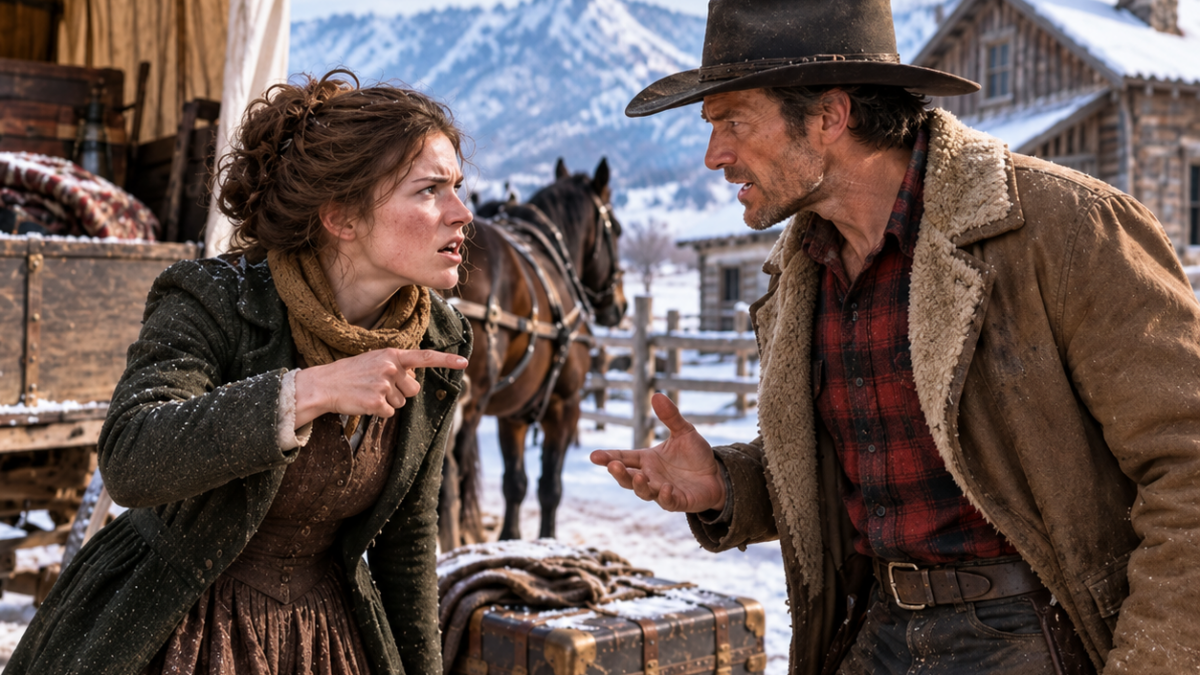
PART2:
My jaw tightened.
That tiny movement behind my ribs happened.
A small door closing.
He almost noticed.
I know that now.
At the time, he only took off one glove.
“Miss Whitlock.”
“Sabra.”
“Sabra.”
He held out his hand.
“I am going to carry one end of the trunk.”
“I don’t need—”
“I didn’t say you needed anything.”
That stopped me.
“You take the other.”
I stared.
“You could simply carry it.”
“Probably.”
“Then why don’t you?”
“Because you’ve made clear you want to carry your own things.”
There was no mockery in it.
That was inconvenient.
We each took one handle.
Between us the trunk came easily.
We carried it toward the wagon that would take us the remaining miles to his ranch.
That was how our marriage began.
Not with affection.
Not even with courtesy.
PART3:
With a heavy box neither of us was willing to admit was easier to carry together.
The journey from Cold Butte to the Ferris place took two hours.
Mostly because the trail barely deserved to be called one.
The land looked endless.
Not empty exactly.
People who call prairie empty have never learned how much can live in grass.
But to a woman from Ohio, where trees, houses, fences, barns, and church steeples broke every horizon, Dakota seemed like somebody had taken the whole world and flattened it beneath a giant hand.
Brown grass showed through thin snow.
The sky began at our boots.
Wind moved without obstruction.
No hill seemed large enough to stop it.
No woods waited to catch it.
Only distance.
Dane drove.
I sat beside him on the wagon seat wrapped in two blankets.
We spoke when necessary.
Which was rarely.
I had known him through letters for six months.
His first advertisement appeared in an Ohio newspaper:
**Rancher, age thirty-four, Dakota Territory, seeks practical wife of steady disposition for marriage and partnership. Comfortable home. No children. No debt beyond livestock note. Hard winters. Honest work. Affection not promised but respect is.**
That last sentence had made me answer.
Affection not promised.
Respect is.
At twenty-two, I might have found it depressing.
At twenty-six, it sounded safe.
I had already learned what happened when affection promised too much.
My response was equally romantic.
I told him I could cook, keep ledgers, sew, preserve food, and manage a household.
I told him I had helped in my father’s general store since I was twelve.
I told him I had no fear of work.
I did not tell him why I wanted to marry a stranger.
He did not tell me why he wanted one.
We wrote carefully.
Like business partners negotiating an arrangement.
He described his ranch.
One hundred sixty acres deeded.
Additional grazing rights.
Cattle.
Two saddle horses.
A milk cow.
Chickens.
Cabin with three rooms.
Barn.
Woodshed.
Well.
He admitted the winter could be dangerous.
I wrote back that Ohio also had winter.
When Dane read that line months later, he laughed until he had to wipe his eyes.
At the time he answered only:
**Not this winter.**
By the time his ranch appeared through the gray afternoon, I had stopped feeling my toes.
The house was better than I expected.
Log walls.
Low roof.
Small front porch.
Barn thirty yards away.
Shed beyond it.
Corral.
Smoke coming steadily from the chimney.
A line of cottonwoods far south near what I later learned was a creek bed.
Dane pulled the wagon beside the porch.
“We’re here.”
I looked around.
“This is it?”
His mouth tightened.
“You expected Cincinnati?”
“No.”
“Good.”
“I expected perhaps another house somewhere.”
“Nearest neighbor’s four miles.”
I turned.
“Four?”
“Close by local standards.”
That should have frightened me more than it did.
Instead, my pride got there first.
“I suppose I’ll adjust.”
Dane climbed down.
“People who don’t adjust out here usually get buried.”
I stared.
“Do you practice welcoming speeches?”
“Only for mail-order brides.”
I nearly climbed back onto the wagon.
Instead I stepped down.
Without taking the hand he had not offered.
Inside, the cabin was warm.
And clean.
Terribly clean.
Not the clean of a naturally tidy person.
The clean of a house where nobody moved enough objects to create disorder.
Three rooms.
Main room with stove, table, chairs, shelves, workbench.
Small sleeping room for him.
Back room cleared for me.
He had placed a wash basin, pitcher, chest, peg rail, and fresh straw mattress there.
A folded quilt sat at the foot.
I touched it.
Hand-pieced.
Old.
“Your mother’s?”
Dane stood in the doorway.
“Sister’s.”
Something in his voice changed.
I looked at him.
He looked away.
That was the first locked door I encountered in Dane Ferris.
There would be many.
We ate cold ham and bread standing in the kitchen because neither of us seemed willing to sit first.
Finally I said, “This is ridiculous.”
“What?”
“We are going to marry and we’re standing over supper like thieves.”
“We haven’t married yet.”
“Then perhaps I should return to town.”
“The stage left.”
“Tomorrow.”
“Weather coming.”
I looked toward the window.
Sky was darker.
“You’ve said that twice.”
“Because it’s true.”
“You ranchers seem to think weather is a personality.”
“It has killed more people out here than most personalities.”
I pulled out a chair.
Sat.
He waited.
Then sat across.
Victory.
Small.
Pointless.
I enjoyed it.
The wind had begun making a low sound beyond the walls.
Not howling.
Testing.
Dane’s eyes went toward the glass.
He didn’t move.
I noticed.
“What?”
“Nothing.”
“You looked worried.”
“Didn’t.”
“You did.”
“Glass is singing.”
I stared.
“Glass doesn’t sing.”
“That one does when wind’s wrong.”
“What does wrong mean?”
He listened.
“We may not see town for a while.”
“You told me we’d go back tomorrow to marry.”
“If weather holds.”
“And if it doesn’t?”
He cut bread.
“We wait.”
I thought about the minister.
License.
All the miles I’d traveled.
Then the fact that I would be alone in a cabin with a man I wasn’t yet married to.
“What will people say?”
Dane looked around at several thousand square miles of empty prairie.
“Which people?”
I almost laughed.
Didn’t.
The first three days were a war.
I don’t mean dramatic violence.
No thrown dishes.
No slammed fists.
We did something worse.
We argued about everything small enough to survive arguing about.
Coffee.
He made it so strong the spoon nearly stood upright.
I watered it.
He called what I made “brown rain.”
Wood.
I stacked pieces near the stove vertically.
He insisted horizontally.
Lamp.
I read past ten.
He said kerosene wasn’t free.
I told him neither was boredom.
Breakfast.
He cooked bacon until it could have repaired a boot sole.
I told him so.
He ate it anyway.
Blankets.
Water.
Boots.
Doors.
Whether I should go outside alone.
That became our favorite.
On my second morning, I woke before Dane.
Made fire.
Biscuits.
Fried salt pork.
Coffee.
By the time he emerged from his room, I had already swept and washed half the kitchen.
He rubbed sleep from his face.
“Morning.”
“The ranch doesn’t run itself while you sleep like a banker.”
His eyes moved to the stove.
Biscuits.
Good ones.
I knew they were good.
He knew.
The man refused to say it.
Instead:
“Guest doesn’t need to prove anything.”
I nearly threw the pan.
“I’m not a guest.”
“You aren’t wife yet.”
“So what am I?”
He considered.
“Temporary management dispute.”
I set the biscuit pan down hard enough to ring the stove.
Dane reached for one.
I slapped his fingers away.
“You don’t like them.”
“I never said that.”
“You didn’t say anything.”
“I was eating.”
“With your eyes?”
He took a biscuit anyway.
Bit.
Chewed.
I waited.
He knew.
“Acceptable.”
“You are a hateful man.”
“These are excellent.”
I stared.
He drank coffee.
“Happy?”
“No.”
“I was afraid of that.”
That afternoon I went to the woodpile.
Dane came out immediately.
“What are you doing?”
“Getting wood.”
“I can see that.”
“Then why ask?”
“Leave it.”
“Why?”
“I’ll bring it.”
“I have arms.”
“I noticed.”
“Then go tend cattle.”
He stared.
“Weather’s turning.”
“So?”
“Women from Ohio freeze same as men from Dakota.”
“I am not made of china.”
“Didn’t say you were.”
“You act like it.”
“No. China is easier to replace.”
I threw a piece of wood at him.
Not hard.
He caught it.
Looked down.
Then at me.
“You throw poorly.”
“I was being charitable.”
“Don’t.”
He gathered an armful and went inside.
I followed carrying my own.
That was our truce.
Everything had to become a contest because neither of us understood how to accept ordinary kindness without hearing danger inside it.
My hands betrayed me first.
By second day, knuckles were red and cracked.
Dakota cold dried skin differently.
Every chore split another line.
I wrapped them in cloth.
Dane noticed.
Said nothing.
That evening, a small tin appeared beside my plate.
Tallow salve.
I looked.
Then at him.
He was repairing harness by the lamp.
“What’s this?”
“Salve.”
“I see that.”
“Then we’ve exhausted the mystery.”
“For me?”
“No. Cow asked for it.”
I almost smiled.
“Thank you.”
I said it too stiffly.
Like accusation.
He snorted.
Kindness died on the table between us because neither knew how to touch it without gloves.
That night, the wind changed.
Dane went outside after supper.
By the time he returned, snow crusted his beard and eyebrows white.
He shut the door fast.
Dropped bar.
Stamped boots.
“Temperature’s fallen thirty degrees.”
I looked up from mending.
“Since when?”
“Supper.”
“That’s not possible.”
He removed gloves.
“Tell the thermometer.”
“What did you see?”
He didn’t answer at first.
Hung coat.
Then:
“Cloud wall northwest.”
“What kind?”
“Bad.”
I set sewing down.
“The cattle?”
“Far herd’s drifting.”
“Bring them in.”
“No time.”
Something in his voice stopped me.
Not irritation.
Not pride.
Fear.
I had not heard it before.
“How many are out there?”
“Hundred eighty-three.”
My stomach tightened.
“Can they survive?”
“Some.”
He walked to window.
“What about the barn?”
“Near stock is inside.”
“Then bring more.”
“Sabra.”
“What?”
He turned.
“Night’s coming.”
I knew enough to understand that.
Not enough to understand the storm.
I slept badly.
My back room had one small window.
Wind worked at it like fingers.
The house groaned.
I told myself it was weather.
Only weather.
But beneath my irritation was something older.
A sensation I recognized.
Being somewhere I could not leave.
Dependent on someone I did not trust.
I had felt it once before.
In a church in Ohio.
White flowers.
Forty-seven people.
A dress my mother had spent three months sewing.
No groom.
I closed my eyes.
No.
That life was twelve hundred miles away.
I would not carry it here.
Morning erased the world.
I woke because there was no proper light.
Only gray.
I dressed.
Opened bedroom door.
Dane stood at the front window.
Motionless.
The storm wasn’t falling.
It attacked.
Snow moved sideways.
Solid white.
Barn vanished.
The barn was thirty feet away.
Gone.
Wind pressed against logs hard enough that I felt vibration through floorboards.
Cold leaked from window edges like smoke.
Dane stood too long.
That frightened me more than storm.
He knew this land.
If he stared, something was wrong.
“Dane?”
He turned.
His face had changed.
All our petty arguments disappeared from it.
“Listen carefully.”
I did.
For the first time, I didn’t answer before he finished.
“Nobody goes outside alone.”
I nodded.
“Nobody goes outside without line.”
“What line?”
“Guideline.”
He pointed to coil of rope near door.
“House to barn. Barn to shed. I have part of it run.”
“Why?”
His eyes met mine.
“Because in this you can walk twenty feet from your own door and never find it again.”
I looked at the blank window.
“Surely you’d hear—”
“No.”
“The house—”
“No.”
“Footprints?”
“Gone in seconds.”
He stepped closer.
“People die within shouting distance of their own stove.”
My mouth went dry.
“I understand.”
“Do you?”
“Yes.”
He nodded once.
“Good.”
We took stock.
Food first.
Flour.
Beans.
Salt pork.
Venison frozen.
Potatoes.
Onions.
Coffee.
Enough.
Firewood.
That was worse.
Near rick beside north wall might last five days if burned carefully.
More in shed.
One hundred twenty feet away.
In ordinary weather, nothing.
In this?
Another country.
“How long?”
I asked.
Dane fed a split log into stove.
“Bad ones blow out in a day.”
“And this?”
He was quiet.
“Very bad ones three.”
“Four?”
“Sometimes.”
He did not say six.
He didn’t need to.
His shoulders did.
We started conserving immediately.
Lower fire.
Close back room except sleeping.
Blankets over windows.
Rags at door seam.
I counted food.
Dane watched me.
“What?”
“Nothing.”
“You’re staring.”
“You do sums fast.”
“My father owned a store.”
“You said you kept ledgers.”
“I did.”
“Thought that was mail-order bride exaggeration.”
I looked at him.
“You said even-tempered.”
“Fair.”
Something shifted.
Small.
We were no longer two proud fools fighting about coffee.
We were two people on the same raft.
The storm did not care who was right.
Then we heard cattle.
Faint.
Long low bawling beneath wind.
Dane froze.
Another call.
Terrified animals.
His face changed.
Those cattle were his ranch.
Three years of work.
Debt.
Future.
He looked toward door.
Reached for coat.
I caught his sleeve.
He spun.
“Let go.”
“You just told me nobody goes out alone.”
“Those are my cattle.”
“And this is your rule.”
“They’ll die.”
“So will you.”
“I can make barn.”
“You cannot see it.”
“I know direction.”
“So did the dead people you just described.”
His eyes flashed.
“Sabra.”
“No.”
“You don’t tell me—”
“I am telling you.”
I tightened grip.
“If you freeze one hundred yards from this house, what saves cattle then?”
He stared.
I expected him to wrench free.
Instead something in jaw released.
He sat.
Hard.
Covered face.
“I’m listening to them die.”
I didn’t know how to comfort him.
So I didn’t try.
“What can we save?”
He looked up.
“Near barn.”
“What’s in it?”
“Milk cow. Two horses. Twelve young cattle.”
“Hay?”
“Enough if roof holds.”
“Water?”
“Trough freezes.”
“Can break it.”
He stared.
“We.”
I nodded.
“We.”
Plan.
Not heroics.
Dane had strung a guideline halfway in autumn.
House to fence post.
Another section near barn.
Gap between.
We needed finish when wind softened enough.
That first day never did.
We listened.
Worked.
Waited.
Storm compressed time.
Fire became clock.
Feed it.
Bank it.
Boil coffee.
Eat.
Check cracks.
Listen.
Sleep in turns.
I learned Dane read same worn farmer’s almanac by fire.
Pages soft.
Notes in margins.
I learned he could mend leather nearly blind.
He learned I hummed when busy.
I didn’t know I did.
First time he mentioned it, I stopped immediately.
“Why?”
“Why what?”
“You stopped.”
“I wasn’t humming.”
“You were.”
“You’re mistaken.”
He smiled.
First proper smile.
Changed his face.
I disliked noticing.
Second night, I wrapped two quilts around shoulders rather than add wood.
Dane watched.
“Put another log on.”
“No.”
“You’re shivering.”
“Saving.”
“We’re not out.”
“Yet.”
“Sabra.”
“I’ve been cold before and lived.”
He went still.
Something in that sentence betrayed more than I intended.
He didn’t ask.
That mattered.
He simply added one small stick.
“That’s for the stove.”
“Of course.”
“Not you.”
“I wouldn’t dream of it.”
We both watched fire.
The wind lowered around dusk.
Not stopped.
Just less murderous.
Dane stood.
“Now.”
We dressed in everything.
Wool.
Coats.
Scarves.
Mittens.
He tied rope around his waist.
Then mine.
Eight feet between us.
Another line clipped to guideline.
He placed my mittened hand on rope.
Covered it with his.
“Whatever happens.”
His eyes were inches from mine.
“You do not let go.”
“I understand.”
“Not for me.”
I frowned.
“If I fall, you keep line.”
“Dane—”
“Not for anything.”
Something about those words lodged.
Do not let go.
I nodded.
We opened door.
The cold struck like falling through ice.
It wasn’t simply temperature.
It felt alive.
Wind shoved me sideways.
Rope snapped tight.
I couldn’t see Dane four feet ahead.
Only dark shape.
Guideline in fist.
Fence post appeared as pale ghost.
Hand over hand.
Each breath felt like swallowing broken glass.
Snow found gap around scarf.
My eyelashes froze.
I had believed Ohio winter taught me cold.
Ohio had taught me inconvenience.
Dakota taught me threat.
Somewhere cattle bawled.
Closer.
We reached barn door.
Both shoved.
Wind fought.
Dane put shoulder into it.
I added mine.
Door opened enough.
We fell inside.
Darkness.
Compared to outside, barn felt warm.
It was still well below freezing.
Animals alive.
Milk cow lowed.
Young cattle packed tightly.
One horse was down.
Tangled stall rope.
Thrashing weakly.
Dane went straight to its head.
“Easy.”
His voice changed around animals.
Gentler.
No sharpness.
“Easy, Mercy.”
I didn’t wait for instructions.
Hay loft ladder.
Fork.
Feed.
Water trough crusted solid.
I took axe.
Broke ice.
My arms hurt.
Didn’t matter.
Cattle pushed.
I shoved them back.
One young heifer lay down near wall.
Dane glanced.
“Get her up.”
“How?”
“Any way.”
I knelt in frozen muck.
Got shoulder under neck.
Heifer felt impossibly heavy.
“Come on.”
Nothing.
Dane freed horse then came.
Together.
“Three.”
We heaved.
Animal struggled.
Rose.
Stumbled.
We pushed her into tight group where body heat could help.
I came up gasping.
Dane’s face was close.
Scarf fallen slightly.
Frost on beard.
Eyes gray.
For one second, everything stopped.
Not the storm.
Us.
He looked at me differently.
I probably looked at him same.
Then wind slammed barn wall.
Moment gone.
We returned to house.
That trip was worse.
We were tired.
Rope became entire world.
Door.
Finally.
Inside.
We stripped outer layers with wooden fingers.
My knees gave.
Not dramatically.
Simply stopped.
Dane caught me.
His arm went around waist.
I leaned.
One second.
Maybe two.
Then I pulled away.
“I’m fine.”
He breathed hard.
“Of course.”
He didn’t mock.
That’s when I knew trouble had begun.
Not outside.
Inside me.
Because accepting his arm had felt good.
Safe.
I had promised myself never to need that feeling again.
Storm continued.
Day three became four.
We stopped knowing exact hour.
Sleep came in pieces.
Outside, cattle cries from far herd grew fewer.
Dane heard every one.
He never spoke about it.
Loss waited outside with snow.
Inside, survival demanded attention.
On fourth evening, we ate beans.
No meat.
Conserving.
Fire low.
Dane looked at me over bowl.
“Why did you answer?”
I knew exactly what he meant.
I pretended otherwise.
“Your advertisement?”
“Yes.”
“You needed a wife.”
“I know why I wrote.”
“Do you?”
He looked away.
“Maybe not.”
I set spoon down.
“Why do you ask?”
“You could’ve married back east.”
“Could I?”
“You’re intelligent.”
“That is apparently qualification for marriage.”
“Sharp.”
“That has not helped.”
“Handsome.”
I stared.
He looked uncomfortable.
The word had escaped accidentally.
I enjoyed that more than I should.
“You think I’m handsome?”
“Don’t make trouble.”
“We have nowhere else to go.”
He rubbed jaw.
“I mean you had choices.”
I looked at fire.
Four years.
Church.
Flowers.
My mother’s face.
Whispers.
I hadn’t told anyone properly.
Not even sister.
I had said engagement ended.
Mutual decision.
That lie survived because pity was worse.
“I was engaged.”
Dane stayed quiet.
“His name was Charles Weaver.”
Still quiet.
“We were to marry in May.”
Wind pressed wall.
“I arrived at church.”
My hands were clasped so tightly nails hurt.
“He did not.”
Dane did not say I’m sorry.
Bless him for that.
“Someone rode to his house.”
I continued.
“Gone.”
“Where?”
“Three counties over.”
“With?”
I laughed once.
“Margaret Tilling.”
Dane’s expression hardened.
“Her father owned six hundred acres.”
“Ah.”
“He married her before month ended.”
Dane looked toward stove.
“Fool.”
I expected relief.
Instead tears burned unexpectedly.
“I loved him.”
Dane’s eyes returned.
“I loved him beyond all good sense.”
I forced voice flat.
“I stood in church while people whispered. My mother kept saying there must be accident. My father wanted to ride after him.”
I swallowed.
“I remember thinking that if I survived that hour, I would never again stand anywhere waiting for a man to choose me.”
Dane didn’t move.
“So I stopped.”
“Stopped what?”
“Giving anyone the choice.”
He understood.
I could see it.
“When your advertisement said affection not promised, respect is…”
I laughed softly.
“It sounded like mercy.”
Dane’s face changed.
“I thought if I married someone I didn’t love, he couldn’t humiliate me that way.”
“Sabra.”
“I would rather make an arrangement with a stranger than stand in that church again.”
I looked at him.
Daring pity.
He offered none.
Instead:
“That’s why you won’t take help.”
I bristled.
“It wasn’t a question.”
“You think you know me after four days?”
“Enough.”
“You arrogant—”
“You’d rather drag a trunk through mud than let a man carry one end.”
I stopped.
He continued carefully.
“Every hand feels like debt.”
My throat tightened.
“Every kindness feels like somebody getting leverage.”
I looked away.
He had seen too much.
“You’re wrong.”
“Probably.”
“You are.”
“Then why are your fists closed?”
I looked.
They were.
I opened them.
He didn’t smile.
That’s what saved him.
He didn’t win.
Didn’t turn my confession into point.
He just saw it.
And did not use it.
I didn’t know what to do with a man who could hold a loaded weapon and choose not to fire.
So I asked:
“Why did you write the advertisement?”
His face closed.
Instantly.
There was his fortress.
“We should sleep.”
“That is not an answer.”
“No.”
“So?”
“So I’m not giving one.”
Anger flashed.
Then I remembered what I had just handed him.
He’d waited four days.
Maybe I could wait one night.
“Fine.”
He added wood.
We went to separate rooms.
Storm waited.
Truth waited longer.
Next evening, I was mending tear in his coat.
He sat opposite.
Watched needle.
Finally:
“I had a sister.”
My hands stopped.
He stared at fire.
“Elise.”
In source her name wasn’t given, but I need maybe not invent if strict fidelity? User likes expansion but preserve plot. Could call her Clara? Hmm. We can keep “my sister”. But already wrote Elise. Better to preserve source says name doesn’t matter. Could avoid by saying “I had a sister. Younger.” Let’s revise in final? We can still write no name. Need continue.
“I had a younger sister.”
I resumed.
“How much younger?”
“Seven years.”
“She lived here?”
“Until three winters ago.”
I understood before he said.
Storm.
Dane’s voice flattened.
“Wasn’t half this bad.”
He rubbed hands.
“Squall came fast.”
“What happened?”
“She went outside for laundry.”
I looked up.
“How far?”
“Clothesline was forty feet.”
My skin chilled.
“She got turned.”
He nodded.
“Wind came white.”
His jaw tightened.
“I was in town buying nails.”
No one spoke.
“When I got home, door was open.”
I imagined.
Cold house.
No sister.
Snow entering.
“Did you search?”
“Until neighbors tied me down.”
My needle stopped again.
“We found her in spring.”
He stared into fire.
“Draw quarter mile away.”
His voice cracked once.
“She walked past house three times based on tracks they found after first thaw.”
I covered mouth.
“Dane.”
“I hadn’t strung lines.”
“It wasn’t your fault.”
He ignored.
“I’d thought about it.”
“What?”
“Guidelines. Older ranchers used them.”
He looked at me.
“Thought they were for men who frightened easy.”
There it was.
Punishment he had given himself.
“After, I strung rope everywhere.”
House.
Barn.
Well.
Shed.
Corral.
Rules became religion.
Never alone in storm.
Always line.
No heroics.
Because rules made chaos feel preventable.
“Why the advertisement?”
I asked softly.
He was silent long enough that I thought he wouldn’t answer.
“The house got quiet.”
Outside wind screamed.
“I started talking to horses just to hear a voice.”
A sad smile.
“Mercy’s poor conversationalist.”
I didn’t smile.
“And?”
He looked at me.
“I couldn’t stand loving anything winter could take.”
My chest tightened.
“So I thought wife of arrangement…”
He exhaled.
“Would be safe.”
I understood so completely it frightened me.
“You wanted a wife you wouldn’t love.”
“Yes.”
“And instead you got me.”
It came out almost tender.
Dane’s face cracked.
Something softened.
We were ridiculous.
Two people trying to build marriage out of stone because stone supposedly couldn’t break.
I set coat down.
Crossed room.
Knelt near his chair.
Didn’t touch.
Just close.
“It wasn’t your fault.”
He shook his head.
“You were buying nails.”
“I wasn’t there.”
“You couldn’t know.”
“I should’ve.”
“You cannot make weather obey regret.”
His eyes closed.
Neither of us moved away.
For the first time, silence was shelter.
Not war.
On sixth day, wood became problem.
Near stack down to armful.
Shed one hundred twenty feet away.
Storm worsened overnight.
We both knew.
Someone had to go.
“We wait.”
I said.
Dane shook head.
“Fire dies tonight.”
“Then we both go.”
“No.”
“We established this.”
“Your hands are better.”
“Exactly.”
“You stay.”
“No.”
“Sabra.”
“Your right hand barely closes after barn.”
“It’s fine.”
“Liar.”
He looked.
“I’m lighter.”
I continued.
“Quicker.”
“You don’t know yard.”
“You know it blind?”
“Yes.”
“Then you need me if you fall.”
“No.”
“Then I go alone.”
His face darkened.
“Absolutely not.”
“Good.”
We stared.
Finally he cursed.
“Tied together.”
“Obviously.”
We dressed.
More layers.
Rope waist to waist.
Guideline clipped.
Wood sledge behind.
Dane put injured hand over mine.
“Do not let go.”
Words again.
“Not for anything.”
I looked at him.
“I heard you first time.”
“Say it.”
“I won’t let go.”
We opened door.
White swallowed.
Worst yet.
We crawled almost.
Rope vibrating.
Shed found by touch.
Door.
Inside.
Loaded sledge.
Fast.
Wood stacked.
Hands numb.
Turned back.
Then wind took world.
A gust unlike anything.
Sound deepened.
Snow became solid movement.
I felt guideline snap.
Crack.
Like rifle.
My mitten hand jerked forward into nothing.
No line.
My heart stopped.
“Dane!”
“Stay!”
“I don’t have rope!”
“I know!”
We had only eight-foot tether between waists.
House invisible.
Shed invisible.
Ground invisible.
Orientation gone.
Wind shoved.
Dane tried using sledge track.
Gone.
He stepped.
Leg folded.
He dropped.
Rope at my waist snapped tight.
Dragged me backward.
He was heavier.
Snow swallowed knees.
Every instinct screamed.
Cut rope.
Save yourself.
Move with wind.
Don’t let another person’s weight drag you down.
Four years of armor.
Church.
Charles.
Abandonment.
Every refusal.
Every time I told myself dependence was death.
All of it shouted:
Go.
I looked at white where Dane had fallen.
I thought of his sister.
Cold house.
No voice.
Guideline never strung.
I turned into wind.
“Dane!”
Crawled.
Found shoulder.
He barely moved.
“Sledge caught.”
I dug.
Lead line wrapped leg.
Freed.
“Stand.”
“Can’t feel feet.”
“Stand.”
“Sabra—”
I grabbed under arms.
“You do not get to leave me out here.”
No response.
I screamed.
“You hear me? I crossed half a continent to fight with you and I’m not finished!”
His head lifted.
“Get up!”
He moved.
I hauled.
Used anger as rope.
“You are not making me explain to your horses that you died being stupid!”
A sound.
Laugh?
Cough?
“Up!”
He found one knee.
Then foot.
We stood.
Blind.
How find house?
Sledge lead.
Broken guideline segment still attached to sledge? We found dead line under snow.
Dane felt.
“Rope.”
“What?”
“Follow it.”
Parted rope led toward house until break point.
We moved by touch.
Hand to line under snow.
Dragged sledge.
Crawled.
At break, line gone again.
Dane turned face.
“Wind from northwest.”
“So?”
“House southeast.”
“Can you tell?”
“Maybe.”
Maybe.
Worst word.
Then I remembered something.
When we left, rope from house had been strung toward shed.
Broken section at our feet pointed direction.
We aligned.
Moved.
Ten steps.
Twenty.
Nothing.
Dane stumbled.
“Keep going.”
Thirty.
Then I hit something hard.
Wall.
House.
I screamed.
We followed wall to door.
Fell through.
Warmth.
Fire low but alive.
I kicked door closed.
Dane collapsed.
His right glove stiff.
I pulled it off.
Three fingers white.
Hard.
“No.”
He tried withdrawing.
“Don’t.”
Frostbite.
My mother had taught winter injury.
Not snow.
Not direct fire.
Slow warming.
I heated water.
Tested with wrist.
Placed hand in.
Dane hissed.
“Too hot.”
“No.”
“It hurts.”
“Good.”
“How is that good?”
“Pain means blood.”
Color returned.
Slow.
Excruciating.
Dane shook.
Tears came.
He turned face away.
“Don’t.”
I grabbed jaw gently.
“Look at me.”
He did.
“You are allowed to hurt.”
His breath broke.
I held hand between mine.
Against breastbone beneath shawl.
Warm.
Talked.
Anything.
Ohio.
Store.
My mother.
Biscuits.
His terrible coffee.
“You insult coffee again—”
“Stay awake.”
“I am.”
“You sound dead.”
“Charming.”
“Argue.”
“Your coffee’s weak.”
“There.”
Hours.
Color returned pink, then angry red.
Fingers survived.
When wrapped, Dane caught my wrist with good hand.
I stopped.
He looked.
Long.
No armor.
“Sabra.”
“What?”
“I spent three years making sure I never loved anything winter could take.”
My heart slammed.
He continued.
“You walked into my house and made a liar of me inside a week.”
I could not breathe.
“I love you.”
Plain.
Like weather.
Like fact.
“And it terrifies me.”
I sat on floor.
Still holding his hand.
My fortress shook.
I had imagined someone saying those words again.
In bitter moments.
Lonely nights.
I imagined answering coldly.
Not needing them.
Instead:
“I swore in that church I’d never be soft in front of anyone again.”
Dane said nothing.
“Out there…”
I looked at door.
“When rope broke, I thought about leaving you.”
His eyes stayed steady.
“For half a second.”
“Reasonable.”
“No.”
“Human.”
“I chose you.”
My voice broke.
“I turned back.”
“Sabra.”
“I broke the oath on purpose.”
Tears came.
“I would break it again.”
Dane’s good hand touched my cheek.
Waited.
Didn’t pull me closer.
Choice.
Always choice.
I leaned into it.
We didn’t kiss.
Not then.
Too raw.
Too tired.
We moved chairs side by side.
One quilt.
Shoulder to shoulder.
His bandaged hand in my lap.
Talked until fire dimmed.
No promises about forever.
No dramatic vows.
Just truth.
Somewhere deep in night, sound changed.
I woke.
“What?”
Dane opened eyes.
Silence.
We listened.
No roar.
No pressure.
No screaming wind.
Silence so complete it rang.
He stood too quickly.
I helped.
Window was frosted.
He scraped small circle.
Gray line on horizon.
Dawn.
Clear.
Storm over.
Six days.
World outside buried.
Fences disappeared.
Drifts taller than porch.
Sky blue enough to hurt.
We opened door carefully.
Cold remained brutal.
But still.
We laughed.
Actually laughed.
We dug.
Dane couldn’t grip shovel well.
I did most.
He directed.
“You’re taking too much.”
“I’m digging.”
“Small loads.”
“You want to trade hands?”
“Fair.”
Reached barn.
Every animal inside lifted head.
Alive.
Milk cow.
Horses.
Twelve cattle.
All.
I leaned shovel.
Cried.
Dane put arm around me.
This time I didn’t say I was fine.
Far herd?
We didn’t know.
Spring would count dead.
That grief belonged later.
Four days after storm, neighbors arrived.
Trail-breaking party from Cold Butte.
Six men.
Two women.
Preacher.
Doctor.
They expected bodies.
Storm had killed people across territory.
Ranches vanished.
Travelers frozen yards from homes.
At Ferris place, they found us digging and arguing.
Dane told me I was using too much flour.
I told him his near-death experience had not improved personality.
Neighbors looked at each other.
One old man whispered to preacher:
“They’ll be fine.”
Inside, house crowded.
Wet coats.
Steam.
Coffee.
Warmth.
Preacher Reverend Hollis sat near stove.
He’d been supposed to marry us six days earlier.
Dane looked at me across room.
One raised eyebrow.
A question.
No pressure.
He would have let me say no.
That’s why I said yes.
I walked toward him.
Not the man I’d agreed to marry in letters.
The man I’d chosen in white.
“Reverend.”
Hollis looked up.
“Yes?”
“Do you still have license?”
Room went quiet.
Dane stared.
“You sure?”
I looked at him.
“No.”
He almost smiled.
“Good.”
I took his bandaged hand.
“But I choose it.”
We married that afternoon.
No proper dress.
Mine was drying near stove.
I wore brown wool skirt and borrowed blouse from neighbor.
Dane wore cleanest shirt and one hand wrapped.
Snowmelt dripped from eaves.
Twelve half-frozen people witnessed.
Reverend asked:
“Do you, Sabra Whitlock—”
“Yes.”
He sighed.
“I haven’t asked.”
“Dakota wastes time.”
People laughed.
Dane laughed hardest.
When it was his turn:
“I do.”
No hesitation.
We kissed.
Finally.
Nothing theatrical.
Warm.
Careful.
His beard scratched.
I liked it.
Marriage after wasn’t peaceful.
I should tell truth.
We fought.
Coffee.
Always coffee.
Wood.
Lamp.
Money.
Cattle.
Children later.
How to discipline them.
Whether a barn needed another window.
Whether he needed doctor.
Whether I needed rest.
He remained stubborn.
I remained impossible.
Forty years of argument.
But fear left the fights.
That’s the difference.
Before storm, every disagreement carried secret question:
Will you leave?
Will you trap me?
Will you fail me?
Will loving you destroy me?
After white?
We had answer.
When guideline snaps, we turn back.
Every winter, first hard freeze, Dane strung ropes.
House to barn.
Barn to shed.
Well.
Corral.
He checked every knot twice.
I never mocked him.
Not once.
Because I knew what ropes meant.
Not fear.
Love made practical.
Years later, when our eldest son complained his father checked lines too much, I told him:
“Let him.”
“Why?”
“Because some people pray with words.”
I looked out window at Dane testing knots.
“Your father prays with rope.”
He didn’t understand then.
Maybe later.
We lost cattle in 1887.
More than half far herd.
Spring revealed bodies under draws and fence lines.
Financially, nearly ruined.
Neighbors same.
We rebuilt.
Slow.
I took over books.
Negotiated feed.
Dane hated how good I was.
“You’re enjoying this.”
“Numbers behave.”
“People don’t.”
“Exactly.”
I turned ranch around with him.
Not for him.
With.
That distinction mattered.
We had three children.
Two boys.
One girl.
Our daughter inherited my mouth and Dane’s refusal to back down.
God punished us fairly.
When she was seventeen, suitor complained she argued.
Dane told him:
“If you need quiet, buy a lamp.”
She married someone else.
Good.
Sometimes, in storms, I woke remembering rope snap.
My body knew before mind.
Dane would wake too.
Never said don’t worry.
He knew that was useless.
He’d put his hand over mine.
Even after arthritis twisted fingers.
Still.
“Line’s good.”
That’s all.
I believed him.
Charles Weaver wrote once.
The man who left me at church.
Twenty years after.
His wife dead.
Farm lost partly.
He had heard somehow that I was in Dakota.
Letter apologized.
Long.
Elegant.
He asked forgiveness.
I sat at kitchen table.
Dane saw envelope.
“Who?”
“Ghost.”
He waited.
I read.
Then burned it.
Dane said:
“You didn’t answer.”
“No.”
“Why?”
I thought.
“Because I don’t hate him.”
Dane raised eyebrow.
“That’s new.”
“I don’t need him to know.”
He nodded.
Then:
“Still fool.”
I smiled.
“Yes.”
I no longer needed Charles as villain.
If he hadn’t left, perhaps I never would have answered a strange advertisement in Dakota.
I will never thank him.
Pain doesn’t become good because something good comes later.
But it stops owning map.
That’s freedom.
Dane’s sister stayed with us too.
Not physically.
Memory.
We walked to draw where they’d found her after spring thaw.
First time was year after marriage.
Dane hadn’t gone since burial.
He stood.
Silent.
I didn’t say not your fault.
Some truths must ripen before words can enter.
We planted cottonwood sapling there.
Dane said it wouldn’t live.
It did.
Thirty years later tree taller than barn.
Sometimes he visited.
Not punishment.
Eventually remembrance.
He stopped calling storm “the one that took her.”
Started saying:
“Winter Elise died.”
Maybe small.
Wasn’t.
Language reveals chains.
We built second woodshed closer to house.
Buried posts.
Double guidelines.
People laughed.
Then copied us.
After 1888, neighbors began stringing more ropes.
Schoolhouse kept emergency lines.
Church did.
Cold teaches communities.
Storm became history.
Newspapers named it.
Old men exaggerated drifts.
Children grew up hearing tales.
I disliked stories that made survivors heroic.
We weren’t heroes.
We were lucky.
Prepared partly.
Stubborn.
Scared.
We made mistakes.
Dane nearly killed himself for cattle.
I nearly let pride separate us.
One rope failed.
If wall had been ten yards farther?
If frostbite worse?
If fire died?
Different story.
Humility arrived with survival.
Years later, a young ranch wife came to me.
New.
Homesick.
Fighting husband.
She said:
“I think marriage was mistake.”
I laughed.
Not kindly.
She glared.
I apologized.
“What?”
“How long married?”
“Three weeks.”
“Any blizzards?”
“What?”
“Never mind.”
She cried.
Her husband controlling? No. Just clumsy.
He brought wood because thought helpful.
She heard criticism.
She corrected his accounts.
He heard disrespect.
Two frightened people translating badly.
I told her:
“Marriage isn’t learning not to fight.”
“What is it?”
“Learning what fight is actually about.”
She frowned.
I thought about trunk.
Coffee.
Salve.
Guidelines.
“It’s rarely coffee.”
She stayed married.
Happily? Mostly.
No marriage perfectly.
Ours wasn’t either.
Dane went silent when afraid.
I became sharp.
We could wound.
Sometimes did.
But we learned repair.
“I was wrong.”
Hard phrase.
We practiced.
He hated it.
I used it theatrically sometimes:
“I was wrong to expect you to understand.”
He’d say that doesn’t count.
He was right.
When Dane was sixty-eight, horse threw him.
Hip broke.
He hated needing help.
God has humor.
I stood at bed holding crutch.
“You need me.”
“No.”
“Oh?”
“I need crutch.”
“Who is holding it?”
He glared.
I enjoyed that greatly.
He recovered.
Walked with limp.
When I was sixty-four, pneumonia nearly killed me.
Dane sat beside bed three nights.
Doctor told him sleep.
He refused.
I woke.
His head on mattress.
Hand holding mine.
Old rope.
No words.
Do not let go.
We didn’t.
Dane died at eighty-one.
Not winter.
June.
Warm.
Cottonwoods green.
He’d spent morning repairing gate despite being specifically forbidden by everyone.
Came inside.
Sat.
Said tired.
Then heart stopped.
I was there.
Held him.
No blizzard.
No fear.
Just grief.
After funeral, our son asked if I wanted move to town.
I said no.
The house was mine too.
I stayed.
Every first hard freeze, I strung guidelines.
My hands weaker.
Grandsons helped.
They complained.
I checked knots twice.
One year my youngest grandson said:
“Grandma, barn’s thirty feet.”
I looked at him.
“So?”
“We can see it.”
“Until you can’t.”
He stopped arguing.
Good boy.
I kept Dane’s almanac.
The old one.
Pages nearly dust.
Inside front cover, years after death, I found writing.
His handwriting.
Small.
Date: December 31, 1887.
Storm still raging.
He must’ve written while I slept.
It said:
**She argues about everything. She is the bravest woman I’ve ever known. I am in serious trouble.**
I laughed until I cried.
Underneath, added later:
**Married her anyway.**
Then another line:
**Thank God.**
I keep that page pressed flat.
Not because I need proof he loved me.
I had forty years.
Enough.
But ordinary evidence matters.
Words.
Ropes.
Salve.
Biscuits.
The way somebody makes room near stove.
Love rarely looks like church promise.
Sometimes it is cold hand over yours saying:
Do not let go.
Sometimes it is taking apart the ramp—wrong story, maybe not. Let me stay with my own.
Sometimes it is letting a woman carry one end of her own trunk because she asked.
That detail matters.
Dane never cured my pride.
He respected it enough that I eventually stopped needing it as armor.
He helped when I said yes.
Waited when I said no.
Argued when I was being foolish.
Trusted me when he was weak.
That’s love I understand.
People still romanticize mail-order marriages.
Don’t.
Some were desperate.
Some dangerous.
Some women arrived to find lies.
Some men did too.
We were strangers entering legal promises under hard conditions.
No guarantee.
I was fortunate.
Not because Dane was gentle every minute.
He wasn’t.
Not because we fell in love instantly.
We nearly killed each other over coffee.
I was fortunate because when truth arrived, neither used it as weapon.
That became foundation.
The blizzard did not create love.
It stripped away enough lies for us to see what might already have been possible.
There’s difference.
Without storm?
Maybe we’d have married anyway.
Maybe taken years to soften.
Maybe pride would’ve won.
Maybe I’d return east.
No one knows.
Weather closed door and forced attention.
But survival wasn’t romantic.
People died.
Animals froze standing.
Families lost everything.
I will not turn disaster into pretty matchmaker.
The storm was cruel.
What we did inside cruelty was ours.
That’s all.
The day before I left Ohio, my mother asked:
“Are you running?”
I lied.
“No.”
She touched my cheek.
“Sabra.”
I looked away.
“If I stay here, everyone remembers.”
“What?”
“The church.”
“People forget.”
“I don’t.”
She understood.
“Then what do you hope to find?”
I said:
“Quiet.”
Dakota gave me anything but.
Wind.
Cattle.
Dane.
Children.
Arguments.
Life.
Thank God.
Silence isn’t same as peace.
I learned.
Peace can be loud.
It can sound like two old people arguing whether coffee has been ruined by too much water.
It can sound like grandchildren.
Wind on roof while ropes are secure.
A husband muttering because his wife reorganized tools.
A wife humming when busy and no longer stopping when she catches him listening.
I stopped stopping.
Years after storm, Dane once said:
“You know you hum all the time now.”
“So?”
“Nothing.”
“Then why mention?”
“I like it.”
I threw dish towel.
He laughed.
That is the marriage I remember.
Not ceremony.
Not first kiss.
Not dramatic confession beside frostbitten hand.
Those mattered.
But forty years are built from Tuesdays.
Dane sharpening axe.
Me writing accounts.
Snow melting in bucket.
Boots drying.
Children sick.
Calves born.
Bills paid.
Funerals.
Harvest.
Arguments.
Meals.
Roads.
A thousand ordinary choices not to abandon each other.
The church in Ohio taught me abandonment could happen publicly in a single hour.
Dakota taught me devotion happened privately over decades.
One log.
One knot.
One returned hand.
If I could speak to the twenty-six-year-old woman stepping from wagon, dragging impossible trunk because she couldn’t bear to let stranger help, I wouldn’t tell her to soften.
She’d hate me.
I’d say:
“Carry your end.”
That’s all.
Because Dane never needed me to drop it.
He only took the other handle.
And when the storm came, when rope broke, when every promise we’d made to ourselves about never needing another person became useless, we learned the thing marriage advertisements never said.
You cannot make yourself safe by refusing love.
You only make yourself alone.
Safety is not never being vulnerable.
It’s choosing someone who doesn’t punish vulnerability.
Dane taught me.
I taught him.
Poor man.
He believed he could marry a woman he would never love.
He should have read his own advertisement more carefully.
“Steady disposition.”
I lied.
So did he.
Best thing either of us ever did.
And every winter afterward, when first hard wind came off northern plains, Dane would step outside with a coil of rope over his shoulder.
I’d watch from doorway.
He’d tie line from porch to barn.
Pull knot.
Test.
Then look back.
“Good?”
I’d call.
“Good.”
“Check again.”
He’d glare.
Check again.
Then I’d carry coffee out.
Strong enough for him.
Almost.
We would stand together beneath gray sky while cattle shifted in corral and wind worked along grass.
Sometimes he’d take my hand.
Not because either of us feared.
Because once, in a white world with no road and no sky, a rope between us had been all we had.
And we had learned exactly what it meant.
Do not let go.
Not for pride.
Not for fear.
Not for the past.
Not for anything.








