The Puppy Begged a Navy SEAL to Save His Beaten Mother—What Happened Next Broke Hearts
PART3:
Southern California wilderness can look dry and harmless in daylight. At night, in a storm, it becomes a living trap. Chaparral tore at my sleeves. Mud grabbed my boots. Exposed roots slid beneath my soles. Low branches whipped my face. Twice the puppy tumbled over himself, scrambled up, and kept going.
He was exhausted.
That was obvious.
But whatever pulled him forward was stronger than exhaustion.
Every few yards, he looked back to make sure I was still there.
“I’m here,” I told him.
Again and again.
“I’m here. Keep going.”
The flashlight beam shook across pine trunks, wet stone, thorny scrub. My breathing settled into the controlled rhythm I used under stress. In through the nose. Out slow. Listen between the rain.
A quarter mile in, the trees opened into a clearing.
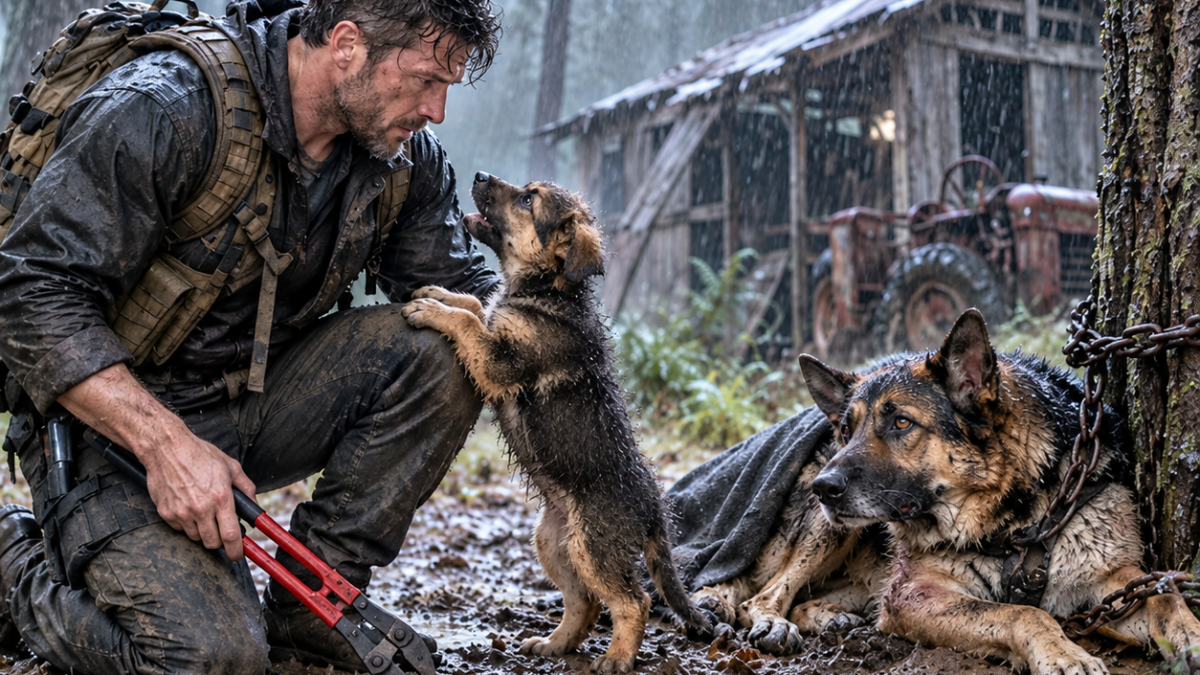
There was an old logging shed there, half-collapsed, tin roof buckled, one wall rotting inward. A rusted tractor sat beside it, tires sunk in mud. The place smelled wrong before I saw anything.
Wet rot.
Old oil.
Decay.
And beneath it, metallic and unmistakable.
Blood.
The puppy sprinted ahead and disappeared behind the tractor.
Then came the sound.
A low, broken wheeze.
I rounded the tractor.
And stopped.
I have seen cruelty.
That is the truth.
I have seen what bombs do.
What men do.
What fear does.
I have seen bodies torn open by things built only to tear bodies open.
Still, the sight beneath that oak tree put a cold fury in me that I had not felt in years.
A fully grown female German Shepherd lay in the mud, chained to the base of a massive oak.
Not tied.
Chained.
An industrial logging chain, thick enough to tow a truck, looped brutally around her neck and secured with a heavy rusted padlock. She was stretched sideways in the freezing mud, body trembling so hard it looked like seizure activity.
Her ribs pushed sharply against matted fur.
One eye was swollen shut.
Deep, jagged wounds marked her flanks and shoulders.
Her breathing came shallow and wet.
The puppy ran to her and pressed his nose against her muzzle, whimpering so pitifully that something inside my chest cracked.
The mother dog opened her good eye.
Slowly.
As if lifting that eyelid required more strength than she had left.
Then she dragged her tongue across her puppy’s head.
Comforting him.
Even there.
Even chained.
Even dying.
Comforting him.
I dropped to my knees in the mud.
“I’ve got you,” I whispered.
My voice shook.
That surprised me.
I had been calm under gunfire.
But I shook for her.
“You’re okay now. I’ve got you.”
The mother dog looked at me.
Not with fear.
Not even with hope.
With resignation.
That look hurt worse than a growl would have.
A growl would have meant fight.
That look said she had already accepted that rescue was for the puppy, not for her.
“No,” I said, as if she had spoken.
I opened my jump bag and assessed fast.
Severe exposure.
Shock.
Possible fractures.
Infection risk.
Dehydration.
Blood loss.
Airway clear but weak.
Chain cutting into the neck.
No way to move her without removing it.
I examined the lock.
Solid steel.
Old but thick.
My knife was useless.
I wrapped my hand around the chain and felt rage surge so hard my vision narrowed.
The puppy pressed against my knee.
I stripped off my tactical jacket and laid it carefully over the mother and pup, tucking the thermal blanket beneath the edges.
“I’ll be right back,” I told her.
Her good eye stayed on me.
“Do not quit. Do you hear me? I’m coming back.”
Then I ran.
The descent through the woods was reckless.
I knew it even while doing it.
Mud slid beneath my boots. Branches tore at my face. Twice I nearly went down hard enough to break something. I did not slow.
I reached the truck soaked, bleeding from one cheek, and breathing hard.
I threw open the toolbox mounted in the bed and grabbed my thirty-inch bolt cutters.
That was when I heard the engine.
A rough, loud, badly muffled roar cut through the rain.
Headlights swung across the shoulder.
A rusted Chevy pickup swerved off the highway and parked crookedly behind my truck, blocking the path to the woods.
The driver’s door groaned open.
A man stepped out.
Tall.
Thick around the middle.
Dirty flannel shirt.
Steel-toed boots.
Cheap whiskey and stale smoke reached me even through the rain.
In his right hand, he held a steel crowbar.
Not raised.
Not hidden.
Casual.
That told me everything about him.
“What the hell are you doing on my property?” he slurred.
I stood beside my truck with bolt cutters in one hand and rainwater running off my jaw.
“Your property?”
He sneered.
“Bradley Dawson. Remember the name.”
I did.
Not because he told me to.
Because people like him deserve records.
His eyes dropped to the bolt cutters.
“You better not be messing with my dogs up there. The bitch is useless now, but the pup’s worth a few hundred bucks.”
The words did something to me.
Something final.
There are moments when anger is loud.
This was not one.
This was cold.
Clean.
A door closing.
“Drop the crowbar,” I said.
My voice did not rise.
That should have warned him.
It didn’t.
Dawson laughed.
“Or what, tough guy? You’re trespassing.”
He stepped forward.
Rain hammered the road around us.
I had seconds.
If I spent those seconds arguing, the mother dog died under that tree.
If Dawson got past me, the puppy died too.
He lunged, swinging the crowbar in a wide, clumsy arc aimed at my ribs.
I stepped inside the swing.
Caught his wrist.
Redirected.
Drove my palm into his sternum hard enough to empty his lungs.
He folded.
Before he recovered, I rotated his trapped arm, took his balance, and put him face-first into the mud. The crowbar clattered across the pavement.
I planted one knee between his shoulder blades.
He thrashed.
I zip-tied his wrists with heavy-duty ties from my cargo pocket.
“You’re going to stay right here.”
He cursed into the mud.
I pulled my phone and dialed 911.
No signal for two seconds.
Then one bar.
Come on.
The call connected.
I gave the dispatcher the nearest mile marker, vehicle description, suspect restrained, injured animals in the woods, suspected felony animal cruelty, need sheriff and animal control, emergency veterinary transport if available.
Then I left the line open, grabbed the bolt cutters, and ran back into the trees.
The mother dog was barely breathing when I returned.
The puppy was under my jacket, pressed against her chest, trembling.
“I’m here,” I said.
I positioned the cutters around the padlock.
The first attempt slipped.
The second bit metal.
I leaned my full weight into it.
The lock snapped.
The chain fell away.
The skin beneath was raw, bruised, cut in deep places from pressure and movement.
The mother dog made a sound so low I felt it more than heard it.
“I know,” I whispered. “I know.”
I wrapped her in the jacket and thermal blanket, then slid my arms beneath her.
She was lighter than she should have been.
Bone and wet fur.
That made me angrier than anything.
She did not growl.
Did not resist.
As I lifted her, the puppy followed so close he bumped my boot every few steps.
The descent took longer carrying her.
Mud sucked at my legs. Rain blinded me. My arms burned. The dog’s head rested against my chest, her breath shallow through the fabric.
“Stay with me,” I told her.
Not gently.
Commanding now.
“Stay with me. Your pup did his job. You do yours.”
When I emerged from the woods, red and blue lights flashed through the storm.
A San Diego County sheriff’s cruiser sat behind Dawson’s truck.
Deputy Carter stood in the rain, one hand near his holster, until he saw me carrying the dog.
His face changed.
Dawson was still in the mud, yelling nonsense.
“He’s yours,” I said. “Aggravated animal cruelty, assault with a deadly weapon. I’m taking these dogs to the emergency clinic in Alpine.”
Deputy Carter looked at the mother dog.
Then the puppy.
Then the crowbar.
Then Dawson.
“Go,” he said.
I put the mother in the back seat on the blanket, tucked the puppy beside her, and drove.
I do not remember much of the drive except the sound of the puppy crying whenever his mother’s breathing changed.
The emergency veterinary clinic was bright enough to hurt.
White walls.
Sterile floor.
Warm air.
A world violently different from the mud and rain outside.
I carried the mother dog in with the puppy under one arm.
“Trauma,” I said.
The receptionist stood.
A vet tech ran forward.
Dr. Natalie Brooks appeared from the back, hair pulled into a messy bun, eyes immediately assessing.
“What happened?”
“Chained outside. Severe trauma. Exposure. Possible fractures. Malnutrition. Infection. Pup is cold but ambulatory.”
Dr. Brooks did not waste a word.
“Bay two. Now.”
They took the mother from me.
The puppy tried to follow.
I caught him gently.
He screamed.
Not barked.
Screamed.
“I know,” I said, holding him against my chest. “I know.”
He fought me for three seconds.
Then collapsed from exhaustion.
His tiny paw hooked around my thumb.
At the front desk, they asked about payment.
I handed over my credit card.
“Do whatever it takes.”
The receptionist hesitated.
I looked at her.
“Whatever it takes.”
Hours passed.
Dawn approached.
The storm outside weakened into a steady gray rain.
I sat in the waiting room covered in mud and blood, the puppy wrapped in a towel on my lap.
He slept so hard he twitched, paws jerking as if he was still running through the woods.
I watched him and thought of the way he had stood in the highway.
A baby.
Hungry.
Freezing.
Terrified.
And still he had left his mother long enough to find help.
That kind of courage should not be possible in something so small.
The swinging doors opened at 5:18 a.m.
Dr. Brooks came out.
Her scrubs were stained. Her face was tired.
But there was something like wonder in her eyes.
I stood.
“She’s stable,” she said.
The breath left my body.
“Stable?”
“It was close. Multiple fractured ribs. Severe malnutrition. Internal bruising. Infected lacerations. Neck trauma from the chain. She has a long road ahead.”
“But she’ll live?”
Dr. Brooks nodded.
“She’s incredibly strong.”
The puppy woke at my movement and lifted his head.
I looked down at him.
“Your mama made it.”
He licked my thumb once.
Dr. Brooks did not smile.
“There’s something else.”
My body tightened.
“When we cleaned her wounds and shaved areas for IV access, we found an identification mark.”
“What kind?”
“Not a regular breeder tattoo. Not local.”
She gestured toward the back.
“You need to see it.”
I carried the puppy into the recovery ward.
The mother dog lay on a heated pad, connected to fluids and monitors. Clean bandages covered parts of her body. Her breathing was shallow but steady.
The puppy whined.
Her good eye opened halfway.
Dr. Brooks gently folded back the dog’s left ear.
Inside, stamped in faded blue ink, was an alphanumeric code.
X-74.
My blood went cold.
No.
For a second, I thought exhaustion had made me misread it.
I stepped closer.
X-74.
I knew that sequence.
Not from paperwork.
From memory.
Dust.
Heat.
A training yard.
A laughing voice saying, “Careful, Hayes. She outranks you in usefulness.”
Dr. Brooks held up a tablet.
“We scanned her microchip. It traces back to Department of Defense records. Her registered name is Valkyrie.”
The room tilted.
Valkyrie.
The puppy shifted in my arms.
I could not breathe right.
Valkyrie was not a stray.
She was not some backyard dog unlucky enough to fall into the hands of a drunk with a chain.
She was a decorated explosive detection canine.
She had been the partner of my best friend.
Navy SEAL Liam Foster.
Two years earlier, Liam died in a valley in Afghanistan during an ambush that shredded the day into smoke and screaming. Valkyrie had survived the blast. She had stood guard over his body until medevac arrived, refusing to leave even when wounded herself.
I knew because I had read every report I could get my hands on.
I knew because I had sat with Liam’s parents at his funeral.
I knew because his mother, Ruth Foster, had gripped my hand so hard my fingers went numb and asked one question through tears.
“Will they send Valkyrie to us?”
I had told her yes.
Not because I handled the transport.
Because I believed it.
The paperwork said Valkyrie would be honorably retired and sent to the Foster ranch in Wyoming to live out her days in peace.
I had imagined her there sometimes.
Running fields.
Sleeping near the fireplace.
Lying beside Liam’s father on the porch.
The last living piece of my brother-in-arms being cared for by the people who loved him most.
Instead, she had been chained to an oak tree in Southern California, beaten, starved, bred, discarded, and left to die.
A sound came out of me.
Not words.
Dr. Brooks stepped back.
“Mr. Hayes?”
I reached for the edge of the counter.
“How did she get here?”
“We don’t know.”
I looked at Valkyrie.
Broken.
Bandaged.
Still alive.
Then at the puppy in my arms.
Her son.
The puppy who had forced a truck to stop in the rain.
I knew one thing then with perfect clarity.
Saving Valkyrie was only the beginning.
I walked back into the waiting room and called Wyatt Cross.
Wyatt had been naval intelligence before he became the kind of man governments pretend they do not need until they need him. He could find shipping records nobody admitted existed and track shell companies through layers of fraud while eating cereal at three in the morning.
He answered on the second ring.
“Hayes, it’s 0300. Unless the sky is falling, this better be good.”
“The sky fell, Wyatt.”
Silence.
His voice changed.
“What happened?”
“I need transport logs for a military working dog discharged twenty-four months ago. Name Valkyrie. ID X-74. She belonged to Liam.”
Another silence.
Longer.
“Liam’s dog?”
“Yes.”
“I thought she went to his parents.”
“So did I.”
I looked through the glass at the recovery ward.
“I just pulled her out of the Cleveland National Forest. Chained to a tree. Beaten half to death. She has a puppy.”
Wyatt swore once, softly.
“I need to know who handled her transport from Coronado to Wyoming.”
“You think someone intercepted her?”
“I know someone did.”
“Give me two hours.”
“Wyatt.”
“Yeah?”
“Don’t just find the paperwork. Find the person.”
His voice went cold.
“I will.”
While Wyatt worked, I stayed by Valkyrie.
The clinic staff tried to make me rest.
I refused.
The puppy slept against my side, waking only to whimper toward his mother. When Dr. Brooks allowed it, I brought him close enough for Valkyrie to smell him. She lifted her head half an inch.
The puppy pressed his nose to hers.
She closed her good eye.
I looked at Dr. Brooks.
“Does he have a name?”
She shook her head.
“Not from Dawson’s records, if there are any.”
I looked down at him.
He had done more under stress than many grown men ever have to do.
“Bravo,” I said.
The puppy blinked at me.
“Your name is Bravo.”
By sunrise, Wyatt called back.
“It’s worse than a mix-up.”
I stepped outside the clinic because I did not want the staff to hear my voice.
“Tell me.”
“Valkyrie’s transport was subcontracted to a civilian logistics firm called Apex Hauling. Shell corporation. Owner on paper is a ghost. Money trail connects to an illegal breeding and dog fighting syndicate operating along the West Coast.”
My grip tightened on the phone.
“They forged delivery signatures?”
“Yes. The Foster family never received her because she never reached Wyoming.”
I shut my eyes.
“They targeted her.”
“High-drive working breeds. Military castoffs. Police washouts. They intercept or acquire them, breed them, sell offspring, fight some, dump others. Valkyrie would have been valuable.”
I looked through the clinic window.
Inside, Bravo was asleep on a towel, one paw twitching.
“When she was too broken to produce, they gave her to Dawson.”
“That’s what it looks like.”
“Where?”
“Warehouse district near the shipyards. Dawson’s arrest history and recent pings connect him to a man named Nolan Voss. But Garrett—”
“No.”
“You don’t even know what I’m going to say.”
“Yes, I do.”
“This is organized crime. You hand this to law enforcement. You do not go in alone.”
“I’m not stupid.”
“You are furious. That’s worse.”
“They tortured a veteran.”
“I know.”
“They tortured Liam’s partner.”
“I know.”
“They’re holding more dogs.”
“I know that too.”
I opened my eyes.
“Then make the calls.”
Wyatt exhaled.
“If you go off the rails—”
“I won’t.”
“Garrett.”
“This time we do it clean. Authorities involved. Evidence preserved. Dogs alive. Criminals breathing. I want them in cages, Wyatt. Real ones.”
He was quiet for a moment.
Then he said, “I’ll set the table.”
By that afternoon, the situation had shifted beyond me.
Dawson cracked in holding when the sheriff’s department confronted him with federal interest, animal cruelty charges, assault, and trafficking connections. He gave up names faster than courage could pretend otherwise.
Wyatt forwarded everything through official channels.
Transport fraud.
Forged federal documents.
Animal trafficking.
Illegal breeding.
Suspected dog fighting.
Apex Hauling.
Nolan Voss.
Warehouse 42.
I called three men from my old unit.
Jenkins.
Miller.
Rojas.
Not to start a private war.
To make sure when the raid happened, the people executing it understood what kind of animals might be inside and how fast things could go wrong.
We worked as support under federal and local authority.
That mattered.
Maybe the younger version of me would have wanted revenge more than justice.
Maybe the angrier version would have gone through that warehouse like a storm with fists.
But Valkyrie did not need me arrested.
Bravo did not need another person vanishing from his life.
Liam’s parents did not need vengeance.
They needed the truth.
At 0200 hours, law enforcement hit Warehouse 42.
I was there as part of the animal recovery support team, wearing body armor and carrying medical gear instead of a rifle.
The warehouse sat near the shipyards, a flat industrial building behind fencing and rusted containers. Sodium lights buzzed overhead. The air smelled of salt, oil, and rot.
When the doors opened, the smell hit us first.
Ammonia.
Fear.
Filth.
Unwashed dogs.
Rows of kennels lined the interior, stacked in places, overcrowded, rusting. Dogs stared out from the dark. Scarred pit bulls. Dobermans with ribs showing. Shepherd mixes. Malinois. Some growled. Some cowered. Some did not lift their heads at all.
The kind of quiet that means hope has been punished out of a body.
Nolan Voss was arrested in the office.
So were three guards.
Weapons recovered.
Cash.
Forged transport documents.
Breeding records.
Photographs.
The evidence was worse than Wyatt predicted.
I did not go near Nolan until he was cuffed and seated under bright light beside an agent.
He looked smaller than I expected.
Men who build suffering often do.
I stood in front of him with mud still under my nails from the night before and Valkyrie’s blood probably still somewhere on my jacket despite the wash.
“You intercepted a military working dog named Valkyrie.”
He looked up.
“I don’t know—”
“Don’t.”
He swallowed.
“She was just inventory.”
For one second, the warehouse narrowed.
Inventory.
I thought of Liam’s mother waiting for the dog that never came.
I thought of Valkyrie standing guard over Liam’s body.
I thought of her chained in freezing mud while her puppy ran into traffic for help.
“She was a soldier,” I said.
My voice stayed quiet.
An agent stepped closer, maybe because he heard what was under it.
I stepped back.
Justice, not revenge.
I repeated it in my head until my hands unclenched.
Justice.
Not revenge.
For the next three hours, we got dogs out.
One by one.
Some had to be carried.
Some had to be coaxed.
Some fought the leash because every leash they knew had meant pain.
We opened kennels carefully, documented conditions, matched records, checked injuries, moved animals to heated transport, triaged the worst cases.
I worked beside animal control officers, veterinarians, deputies, federal agents, and volunteers who cried silently while carrying dogs that weighed half what they should.
There is a kind of rescue people imagine as heroic.
Music.
Sunrise.
A dog licking your face.
The reality is often urine, infection, paperwork, fear bites, and deciding which critical animal gets the first oxygen mask because you do not have enough hands.
But by dawn, every living dog in Warehouse 42 was outside.
That was enough.
Not victory.
Enough.
When I returned to the clinic, Bravo barked once from the recovery room.
A tiny, offended sound.
As if I had been late.
Dr. Brooks looked exhausted.
“Your son is demanding.”
“My what?”
She nodded toward the puppy.
“He screams when anyone else tries to hold him.”
I looked at Bravo.
He wagged so hard his whole back end moved.
“I did not agree to that chain of command.”
Dr. Brooks smiled.
“Tell him.”
Valkyrie was awake.
Not fully alert, but aware.
When I approached her kennel, her good eye followed me. Bravo wriggled in my arms, trying to reach her.
I crouched.
“We found them,” I told her.
Her ears shifted.
“All of them.”
It was ridiculous to speak to her as if she understood.
I did it anyway.
“I’m going to call Liam’s parents.”
That was harder than the warehouse.
Ruth Foster answered on the fourth ring.
“Garrett?”
Her voice was older.
Or maybe grief had made it feel that way.
“Mrs. Foster.”
“Is everything all right?”
No.
Nothing about this was all right.
“I need to tell you something about Valkyrie.”
Silence.
Then, very softly, “We never got her.”
My eyes closed.
“You knew?”
“We were told there had been a paperwork delay. Then a placement issue. Then that she was medically unfit to travel. Then no one would answer clearly. Tom called everyone he could. After a year, we thought…”
Her voice broke.
“We thought she had died somewhere, and nobody wanted to tell us.”
I gripped the phone.
“She’s alive.”
A sound came through the line.
Not a word.
“She’s injured, but alive. I found her last night.”
“Found her where?”
I looked through the glass at Valkyrie.
I could not tell a mother everything at once.
“In California. She was badly neglected. But she’s safe now.”
Ruth sobbed.
“Is she alone?”
“No. She has a puppy.”
“A puppy?”
“Yes.”
“Oh God.”
“I’m sorry.”
“No,” she said through tears. “No, Garrett, don’t you dare apologize. You found her.”
I told her the rest in pieces.
The investigation.
The fraud.
The warehouse.
Not the worst details.
Not yet.
Tom Foster came on the line, voice rough.
“Can we come?”
“Yes.”
“We’ll leave today.”
I looked at Valkyrie again.
“She might not be ready to travel.”
“We don’t need to take her,” Tom said. “We need her to know we came.”
The Fosters arrived two days later.
Ruth looked smaller than I remembered. Tom walked with a cane now. Grief ages some people visibly, but hope can age them too when it arrives too late to be easy.
At the clinic, Dr. Brooks prepared them carefully.
“She’s healing, but fragile. Move slowly. Let her choose contact.”
Ruth nodded, already crying.
When they entered the recovery ward, Valkyrie lifted her head.
Tom stopped at the doorway.
Ruth pressed both hands to her mouth.
“Val,” she whispered.
Valkyrie’s ears moved.
Her nose lifted.
Ruth took one step.
Then another.
Tom opened a canvas bag and pulled out something folded in tissue.
A green combat jacket.
Liam’s.
“I thought…” Tom’s voice failed. “I thought maybe she’d remember.”
He placed it on a chair near the recovery pad.
Valkyrie stared at it.
Then, with an effort that made Dr. Brooks step forward and stop herself, Valkyrie pushed up on trembling forelegs.
She sniffed the air.
Once.
Twice.
Then she dragged herself toward the jacket.
Ruth made a small broken sound.
Valkyrie pressed her nose into the fabric.
Inhaled.
Held still.
Then the old war dog, battered nearly beyond recognition, made a sound I will never forget.
Not a bark.
Not a whine.
A long, shuddering breath that seemed to come from somewhere deeper than her lungs.
She lowered her head onto Liam’s jacket and closed her eyes.
Tom turned away.
Ruth dropped to her knees beside the pad but did not touch until Valkyrie shifted toward her hand.
Only then did Ruth stroke the dog’s head.
“You came back,” she whispered.
I stood by the doorway with Bravo against my chest and felt something inside me finally give way.
I had not cried at the funeral.
Not properly.
I had stood in dress uniform while Liam’s name was read, while the flag was folded, while his mother shook, while his father looked like a man trying to survive being hollowed out.
I had not cried.
But I cried then.
Quietly.
No one mentioned it.
Good people know when not to look.
The investigation unfolded over weeks.
Apex Hauling collapsed under scrutiny. Nolan Voss named names. Documents led to arrests in three states. Transport procedures for retired working dogs were reviewed, audited, changed. That mattered to people in offices.
What mattered to me was the list of dogs recovered.
Forty-three alive.
Not all saved in the way people want saved to mean.
Some were too damaged, too sick, too far gone. But they died warm, named, touched by gentle hands instead of locked in the dark.
Many survived.
Rescues took them.
Specialized trainers evaluated them.
Veterinarians worked miracles and practical medicine in equal measure.
The story made news for a while.
Decorated war dog found alive after transport fraud.
Former SEAL helps uncover illegal dog trafficking ring.
Puppy leads rescuer to mother.
Reporters called.
I ignored most of them.
Ruth gave one interview because she wanted people to know Valkyrie had been more than a victim.
“She served,” she said, sitting beside Tom with Liam’s jacket folded in her lap. “She protected our son. Then people failed her. We owe these dogs better than ceremonies after the damage is done.”
I watched that interview from the cabin with Bravo asleep on my boot.
Valkyrie was still at the clinic then, recovering slowly.
She gained weight.
Lost infection.
Healed enough to stand.
Then walk.
Her limp remained.
So did scars.
Her left eye recovered better than expected, though the vision was limited. Her ribs knit slowly. The wounds along her flanks closed under new fur.
Dr. Brooks called her “the most stubborn patient I have ever treated.”
I said, “You should have met Liam.”
Ruth and Tom wanted to take Valkyrie home to Wyoming when she was medically cleared.
I wanted that too.
At least, I thought I did.
It was what should have happened two years earlier.
The ranch.
The fields.
Liam’s family.
Peace.
But Valkyrie had a vote.
That became obvious the day Dr. Brooks cleared a supervised visit at my cabin before transport planning.
I brought Valkyrie home for one weekend because the clinic wanted to see how she handled a quiet domestic environment outside medical care. Ruth and Tom came too. They stayed at a motel nearby, visiting during the day.
Bravo lost his mind with joy when Valkyrie stepped from the truck.
He tumbled around her legs, barking, licking her chin, falling over his own paws.
Valkyrie corrected him once with a low rumble.
He immediately behaved.
For three minutes.
The cabin was quiet.
Woodstove.
Old leather couch.
Pine outside the windows.
A porch facing the slope.
Valkyrie explored slowly, nose working.
She paused at the door to my bedroom.
I knew why before I opened it.
Liam’s footlocker sat at the base of my closet.
After the funeral, Tom had given it to me because Liam had left instructions that certain gear go to “the idiot who still owes me fifty bucks and thinks black coffee is a personality.”
That was Liam.
Even dead, he had to be annoying.
Inside were old patches, letters, field notebooks, a cracked watch, photographs, and a second jacket I had never unpacked.
I opened the locker.
Valkyrie stood behind me.
Bravo tried to climb in.
I picked him up with one hand.
“Respectfully, no.”
I pulled out the jacket.
Liam’s smell had faded for me.
Not for her.
Valkyrie approached cautiously.
Her nose twitched.
Then she pressed her snout deep into the worn fabric.
Her body trembled.
Not from fear.
Recognition.
She inhaled again and again, then lifted her head and looked at me.
For the first time since I found her, I felt like she saw who I was.
Not rescuer.
Not stranger.
Not handler.
Family.
She stepped forward and rested her heavy chin on my knee.
Then she sighed.
Long.
Shuddering.
Final in some quiet way.
Ruth was standing in the doorway.
I had not heard her.
“She knows,” Ruth whispered.
I looked at her.
Ruth wiped her face.
“She knows you were his brother.”
I could not answer.
That night, Valkyrie slept outside my bedroom door.
Bravo slept inside it, sprawled upside down like a fool.
The next morning, Tom and Ruth sat with me on the porch.
Valkyrie lay to my right, watching Bravo attack a pinecone. Ruth held a mug of coffee with both hands.
“We talked,” she said.
My stomach tightened.
“She should still go home with you,” I said immediately.
Ruth looked at Valkyrie.
“She is home.”
I shook my head.
“No. She was supposed to be with you.”
“Garrett.”
“I told you she’d come to you.”
“You told us what you believed.”
“I was wrong.”
“We all were.”
Tom leaned forward, both hands on his cane.
“Son, look at her.”
I did.
Valkyrie’s eyes tracked Bravo, then shifted to me, then the tree line.
Working.
Watching.
Settling.
“She trusts you,” Tom said. “She trusts this place. The pup trusts you. We’re old. Wyoming winters are hard. We can visit. We can help. But maybe the promise changed.”
Ruth touched Liam’s jacket folded beside her.
“I wanted her because she was Liam’s,” she said. “But Liam would want what she needs.”
Valkyrie thumped her tail once against the porch.
Ruth smiled through tears.
“And she seems to be giving orders.”
I looked away.
“I don’t know if I can do this.”
“Raise a puppy?” Tom asked.
“Any of it.”
Ruth’s voice softened.
“You already did the hard part.”
“No. The hard part is staying.”
Neither of them argued.
Because they knew.
War teaches men how to enter danger.
It does not always teach them how to stay in peace.
But Bravo stumbled up the steps with the pinecone in his mouth and dropped it on my boot like a mission completed.
Valkyrie watched him with a mother’s quiet, fierce pride.
And I understood, with a kind of dread and gratitude, that my disappearing days were over.
The cabin changed after that.
Not quickly.
Dogs do not heal on inspirational timelines.
Neither do men.
Valkyrie had nightmares.
She woke growling, body rigid, nose searching for threats that were not there. Sometimes she retreated to a corner and would not come out until I sat on the floor with my back turned and waited.
Bravo had separation panic.
If he could not see either Valkyrie or me, he screamed like the world was ending. He chewed two boots, one chair leg, and the corner of a baseboard. He peed on a rug I did not like anyway.
I had nightmares too.
Mine were quieter.
I would wake at 3:00 a.m. with my hand reaching for a rifle that was not beside the bed.
Sometimes Valkyrie was already there, standing in the doorway, watching.
Sometimes I found myself on the porch in bare feet, listening to wind in the pines and trying to convince my body that rain was only rain.
On those nights, Valkyrie came with me.
She never crowded.
She simply lay down nearby.
Bravo usually followed late, confused and sleepy, then climbed into my lap because he had no respect for dignity.
We became a strange little unit.
One retired SEAL.
One wounded war dog.
One puppy who believed every leaf might need investigating.
Dr. Brooks visited twice for follow-up care because she said Valkyrie traveled poorly and because, I suspected, she wanted to see Bravo.
“You know he’s going to be huge,” she said one afternoon as Bravo tried to carry a stick twice his length.
“I’ve noticed the paws.”
“He needs training.”
“He’s getting training.”
“He needs socialization.”
“He’s getting that too.”
“He needs structure.”
I looked at Bravo, who had fallen over while trying to bark and chew simultaneously.
“He needs a helmet.”
Dr. Brooks laughed.
Valkyrie healed slowly.
Her fur grew over some scars and around others.
She gained weight.
Her limp remained but strengthened.
Her good eye brightened.
Her damaged eye clouded slightly at the edge.
When she finally ran for the first time, it was only six steps.
Six uneven, awkward, glorious steps across the yard after Bravo.
Then she stopped, startled by her own body.
Bravo spun back, delighted.
I stood on the porch holding a tennis ball and forgot how to breathe.
Valkyrie looked at me.
Her tail moved once.
Not wagging wildly.
She was too dignified for that.
One thump.
Enough.
The tennis ball became Bravo’s religion.
I threw it every morning.
At first, Valkyrie only watched.
Then one day, she rose and trotted after him halfway.
Another day, she carried it back herself, dropping it at my feet as if reminding me she had been a professional long before her son was born.
“Good girl,” I said.
She leaned into my leg.
The first time she slept beside my bed instead of outside the door, I lay awake for an hour listening to her breathing.
Not because I was afraid.
Because I was grateful.
The legal case continued.
I testified.
So did Dr. Brooks.
So did Wyatt.
So did the sheriff’s department, federal agents, animal control officers, transport auditors, and eventually Tom and Ruth.
Dawson took a plea.
Nolan Voss tried not to.
The evidence buried him.
Photos.
Records.
Forged signatures.
Financial transfers.
Dogs recovered from the warehouse.
Valkyrie’s chain.
Her medical reports.
Her ID.
When Nolan’s attorney tried to refer to the dogs as “property involved in an unregulated breeding operation,” Ruth Foster stood and walked out of the courtroom.
I followed her.
In the hallway, she leaned against the wall, shaking.
“I can’t listen to that.”
“You don’t have to.”
“She guarded my boy when he died.”
“I know.”
“She was supposed to be loved.”
“I know.”
Ruth looked at me.
“You love her?”
The answer came easier than I expected.
“Yes.”
She nodded.
“Good.”
Nolan was convicted on multiple counts tied to fraud, trafficking, animal cruelty, and illegal weapons possession. His network did not vanish overnight, but it cracked open enough for others to follow.
People called it justice.
I accepted the word because I needed one.
But justice did not erase Valkyrie’s scars.
It did not give Liam back to his parents.
It did not return the years stolen from her.
It did not make Bravo forget the rain.
Justice is not repair.
It is only the world admitting harm happened and refusing to let the harm continue unchallenged.
That is something.
Not everything.
Something.
A year after the storm, I drove to Wyoming with Valkyrie and Bravo.
Ruth and Tom had visited us several times, but Valkyrie had never seen the ranch that should have been hers.
The trip took planning.
Frequent stops.
Medication.
A ramp for Valkyrie.
Bravo acting like every gas station was a new continent.
When we reached the Foster ranch, golden fields stretched under a blue sky so wide it made California mountains feel crowded. The house sat low and white against the land, porch swing moving in the wind.
Ruth stood outside before I parked.
Tom beside her.
Valkyrie lifted her head.
The truck stopped.
I opened the rear door.
“Easy.”
She stepped down slowly.
For a moment, she stood still, nose high.
The wind moved over her.
Wheat.
Dust.
Horses.
Old wood.
And something else.
Something tied to Liam in ways I could not understand.
Ruth did not call her.
Tom did not move.
They had learned.
Let her choose.
Valkyrie walked toward the porch.
Halfway there, she stopped.
Turned toward a fenced field.
Then moved that way instead.
We followed at a distance.
At the edge of the field stood a small memorial under a cottonwood tree.
A stone with Liam’s name.
A flag.
A weatherproof box where Ruth kept things: letters, patches, photographs, tokens from men who had served with him.
Valkyrie reached the stone.
Sniffed it.
Then lay down.
Bravo, for once in his life, became quiet.
He stood beside her, ears forward, as if he understood this was a place where even puppies should not be foolish.
Tom removed his hat.
Ruth covered her mouth.
I stood behind them and felt the old grief come, not as a blade this time, but as weather.
Still powerful.
Less sharp.
Valkyrie rested her head on her paws beneath Liam’s name.
She stayed there nearly an hour.
When she finally rose, she walked to Ruth and pressed her head against the woman’s hip.
Ruth wrapped both arms around her neck.
“My sweet girl,” she whispered.
Bravo leaned against Tom’s leg.
Tom looked down.
“Well,” he said roughly, “guess we got the granddog too.”
I laughed.
So did Ruth, through tears.
We stayed three days.
Valkyrie ran short stretches in the field.
Bravo chased grasshoppers and lost every battle.
At night, we sat on the porch while Tom told stories about Liam as a child. Most involved trouble.
Liam putting a frog in Ruth’s flour canister.
Liam taking apart the lawn mower to “improve speed.”
Liam bringing home injured animals and insisting they were tactical rescues.
I recognized him in every story.
The last morning, Ruth packed Liam’s jacket into a canvas bag and handed it to me.
“You keep it.”
I shook my head.
“No, it belongs here.”
“She sleeps better with it.”
“So do you.”
Ruth smiled sadly.
“I have enough of my boy in this house to break me and hold me together. She needs that piece.”
I took the bag.
“Thank you.”
“Garrett?”
“Yes, ma’am?”
“You brought her home.”
I looked at Valkyrie in the field, Bravo bouncing around her.
“Not the way I promised.”
“Promises change shape when the world breaks them,” Ruth said. “You kept the part that mattered.”
On the drive back to California, Valkyrie slept with her nose near the bag containing Liam’s jacket.
Bravo slept upside down.
I kept one hand on the wheel and the other resting near them whenever the road allowed.
Highway 94 looked different in daylight.
On clear days, the curve where I found Bravo seemed ordinary.
Just asphalt.
Shoulder.
Trees.
No sign of the night that changed everything.
But I never passed that bend without slowing.
Not because I was afraid.
Because that was where a puppy stood in the rain and refused to let the world ignore his mother.
Eventually, I put up a small trail marker near the safe pullout.
Nothing dramatic.
No names.
Just a flat stone with a metal plate engraved:
BRAVO’S BEND
For the ones who ask for help before hope is gone.
Dr. Brooks said it was sentimental.
I said she could stop bringing dog treats if she had complaints.
She kept bringing them.
Bravo grew into his paws.
Mostly.
He became big, energetic, clever, and convinced he was responsible for all cabin operations. He learned fast but remained deeply committed to chaos. Valkyrie trained him better than I did. A single look from her could stop him mid-bad decision.
He loved water.
Hated thunder.
Slept with one paw touching Valkyrie whenever he could.
As he matured, he began doing something that undid me every time.
When Valkyrie had bad dreams, Bravo woke and pressed his body against hers.
Not jumping.
Not licking.
Just pressure.
Warmth.
Presence.
The way she must have done for him in whatever terrible place he was born.
The son guarding the mother.
The mother letting him.
Healing moved in circles like that.
A local rescue later asked if I would help train difficult shepherds, the ones labeled too intense, too fearful, too much.
I said no at first.
Then Valkyrie sat beside me while I read the email, and Bravo dropped a tennis ball on my foot.
I took that as a command.
So I helped.
Not full-time.
Not as a business.
Just enough.
Dogs came to the cabin for assessment. Some stayed a day. Some weeks. A few found homes through Dr. Brooks’s network. Some needed specialized handlers. Some just needed someone to stop calling fear aggression and start calling it fear.
Valkyrie became the calm center.
She did not play with every dog.
She did not mother every dog.
But anxious dogs settled faster near her.
Maybe they recognized survival.
Maybe I was projecting.
Either way, it helped.
Bravo became the greeter once he learned greeting did not mean body-slamming guests.
We built a fenced training yard.
Then kennels.
Then a small heated recovery shed.
Wyatt helped with nonprofit paperwork because he said watching me try to read tax forms was “a threat to national morale.”
The Foster family funded the first expansion.
We named it Liam’s Watch.
A rehabilitation and placement program for retired working dogs, rescued shepherds, and high-drive breeds nobody knew what to do with.
At the entrance, we hung two photographs.
Liam in uniform with Valkyrie young and proud beside him.
Valkyrie years later on my porch, scarred and gray-muzzled, Bravo sitting beside her with one ear flopped sideways like the night I found him.
Underneath, Ruth chose the words.
Service does not end when the uniform is gone.
People liked that.
So did I.
Years passed.
Not many.
Enough.
Valkyrie aged faster than she should have because suffering taxes the body even after rescue.
Her limp deepened.
Her muzzle silvered.
Her damaged eye clouded more.
She still watched everything.
Still thumped her tail once when Bravo did something stupid.
Still slept near Liam’s jacket.
Still leaned into my leg on nights when rain hit the roof too hard.
One winter evening, long after the case was closed and the rescue program had become more than I ever intended to build, a storm rolled through the mountains.
Not as bad as that first night.
Bad enough.
Wind pushed rain against the windows. The pines bent and hissed. Thunder moved far off.
Bravo paced.
Valkyrie lay near the woodstove, head up, listening.
I sat on the floor beside her.
Her breathing had become rougher over the past month. Dr. Brooks had warned me that age and old trauma were catching up.
I hated her for being honest.
I respected her for it.
Valkyrie looked toward the door.
Bravo whined.
“You hear it too?” I asked.
Rain struck the cabin roof.
For a moment, I was back on Highway 94.
Headlights.
Yellow line.
Tiny soaked puppy.
Follow me.
Valkyrie placed her head on my knee.
The same way she had after smelling Liam’s jacket.
I rested my hand between her ears.
“You did good,” I said.
It was not enough.
Words never are.
But she closed her eye.
Bravo came over and pressed against her side.
We stayed like that until the thunder moved east.
Valkyrie lived through that winter.
And the next spring.
She saw Bravo become steady.
She saw the first three dogs from Liam’s Watch placed with families who understood them.
She saw Ruth and Tom visit one more time, bringing a blanket from the ranch and a framed photo of Liam as a teenager grinning beside a muddy dog that was not Valkyrie but might as well have been.
On Valkyrie’s last good day, the sun came out bright after a week of rain.
She walked to the porch without help.
Slowly.
But on her own.
Bravo carried a tennis ball and dropped it in front of her.
She looked at it.
Then at him.
Then at me.
Her tail thumped once.
I picked up the ball.
“You sure?”
Valkyrie’s ears lifted.
I threw it gently, not far.
Bravo ran after it.
Valkyrie took three steps.
Then stopped.
Watched her son bring it back.
That was enough.
That night, she slept with Liam’s jacket under her head and Bravo pressed along her back.
I slept on the floor beside them.
At dawn, her breathing changed.
I called Dr. Brooks.
Then Ruth and Tom.
They could not get there in time, but I put the phone on speaker.
Ruth talked to her.
Tom did too.
Dr. Brooks arrived and sat with us quietly.
No bright clinic lights.
No metal table.
No fear.
Just the cabin.
The woodstove.
Rain smell in the pines.
Bravo whining softly.
My hand on Valkyrie’s head.
Before the final injection, I bent close.
“You stayed with him,” I whispered. “You stayed with your son. You stayed with me. You can rest now.”
Her tail moved once.
A single, heavy thump.
Then she was gone.
Bravo pressed his nose to her ear and made a sound I had not heard since he was a puppy in the vet clinic.
I held him while Dr. Brooks cried openly and pretended not to.
We buried Valkyrie on the ridge above the cabin, where the morning light touches first.
Ruth and Tom came the next day.
They brought soil from Liam’s memorial under the cottonwood tree in Wyoming. We placed it beneath the stone.
Her marker reads:
VALKYRIE X-74
Soldier. Mother. Survivor.
She stood watch until love found her again.
Bravo lay on the grave for two hours after we finished.
I did not make him move.
Some grief must be allowed to choose its own shape.
Life at Liam’s Watch continued.
Dogs still needed help.
Forms still needed filing.
Bravo still needed exercise, structure, and occasional reminders that stealing sandwiches from volunteers was frowned upon.
I kept Liam’s jacket folded in the cabin, but sometimes I took it to Valkyrie’s ridge.
Not because she needed it.
Because I did.
People sometimes ask why I stayed in rescue work after everything.
They expect an answer about justice.
Or healing.
Or honoring Liam.
All of that is true.
But the simplest answer is this.
One night, a puppy stood in the middle of a highway during a storm and asked me to follow him.
I did.
That choice gave me Valkyrie.
It gave me Bravo.
It gave me the truth about what happened to Liam’s partner.
It gave me a mission after I thought missions were the thing that had emptied me.
It gave me a reason to stay.
That is what rescue does when it is real.
It does not just save the animal.
It drags the rescuer out of whatever road he was lost on too.
Every year, on the anniversary of that night, I drive Highway 94 with Bravo.
He is older now.
Still strong.
Still obsessed with tennis balls.
One ear still tips sideways sometimes, especially when he is tired, making him look like the soaked puppy who once stared at me through rain and demanded courage from a man who thought he had none left to give.
We stop at Bravo’s Bend.
I stand by the marker.
Bravo sniffs the brush, then sits beside me facing the tree line.
For a while, neither of us moves.
I think about the rain.
The chain.
The puppy’s bark.
Valkyrie’s good eye opening beneath my jacket.
Liam’s laughter.
Ruth’s hands on the phone.
Tom’s cane tapping the porch.
Dr. Brooks saying, “She’s stable.”
The warehouse dogs stepping into morning air.
The first tail thump on my porch.
The last one in my cabin.
Then I look at Bravo.
“You did good,” I tell him.
He always leans into my leg.
Maybe he remembers.
Maybe he doesn’t.
I do.
I remember enough for both of us.
And if there is anything I know now that I did not know before that night, it is this:
The world can be unbearably cruel.
But sometimes, in the middle of a storm, something small and terrified refuses to give up.
Sometimes a puppy runs into traffic because his mother is dying in the dark.
Sometimes a man stops.
Sometimes the road that was supposed to take him into isolation takes him instead toward the one mission that brings him home.
Bravo asked me to follow.
I followed.
And everything that still matters began there.








