The One-Eyed Stray Dragged a Little Girl’s Glove Through the Snow—But What Happened After He Saved Her Was Even Harder to Watch
PART3:
The cat looked offended by the concept.
“What do you call him?”
“Soldier.”
I looked at his scarred face.
“That fits.”
She smiled a little.
“My name’s Lily.”
“I know.”
Her eyebrows lifted.
“Your mom yells it from the porch sometimes.”
That embarrassed her.
“She doesn’t yell.”
“She projects.”
Lily smiled again.
Soldier finally ate the sandwich.
After that, I began noticing them.
Every afternoon around four-thirty, Lily came outside.
Sometimes with a book.
Sometimes food.
Sometimes nothing.
Soldier appeared from nowhere.
He never sat in her lap.
Never rubbed himself against her.
He positioned himself a few feet away, facing outward.
Watching the sidewalk.
Watching cars.
Watching everybody who came near her.
Like a bodyguard who had missed several meals.
I learned Lily’s mother’s name was Dana.
Dana worked nights at Pine Hollow Care Center, a nursing facility six miles outside town.
I knew because of the badge clipped to the old green coat she wore.
She moved quickly.
Always.
Out the door with a coffee cup.
Back in with groceries.
Down the steps carrying laundry.
Up the sidewalk with Lily’s backpack, her own work bag, and somebody’s prescription from the pharmacy.
There are people whose lives reveal themselves by what they’re carrying.
Dana always carried too much.
We spoke maybe four times before the storm.
“Cold one.”
“Sure is.”
“Package for you ended up at my place.”
“Thanks.”
“Your porch light’s out.”
“I know. Landlord says he’ll get to it.”
That kind of relationship.
No friendship.
No intimate history.
Just proximity.
Then Soldier disappeared.
The first day, I noticed because the tuna I left remained untouched.
The second day, Lily noticed.
She sat on the steps past dark.
Dana called her inside.
The third afternoon, snow started falling.
Not big beautiful flakes.
Dry little needles.
The kind wind throws sideways.
I saw Lily through my living room window.
Same pink coat.
Same steps.
No cat.
I almost went over.
Didn’t.
Told myself it wasn’t my business.
That phrase has probably caused more damage than most crimes.
It wasn’t my business.
Her mother had it handled.
The cat was a stray.
Kids get attached.
Life disappoints them.
Not my business.
That night the temperature dropped to twelve degrees.
Wind chill below zero.
Old houses popped and complained under the cold.
I heated canned soup.
Turned on the weather.
A woman in a bright studio dress told me not to travel unless absolutely necessary.
I remember thinking that was easy advice if you had groceries and nowhere you had to be.
At 8:43, I heard scratching at the back door.
Not knocking.
Not branches.
Scratching.
I opened it.
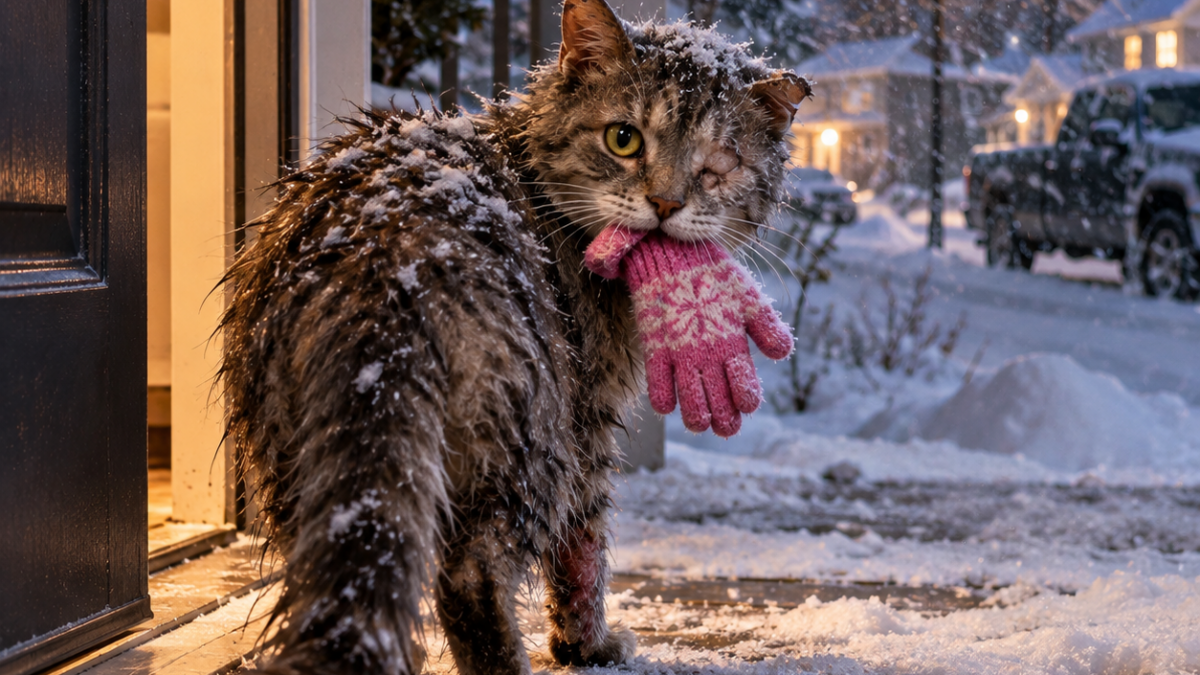
Soldier stood on my porch.
For half a second I was simply relieved.
Then I saw him.
His fur was soaked.
Snow clung to his whiskers.
One front paw was bleeding.
He shook so violently his legs looked unstable.
And hanging from his mouth was a pink glove.
A child’s glove.
I knew it immediately.
Lily’s.
Soldier dropped it at my feet.
“Where did you get this?”
He turned.
Started down the steps.
Stumbled.
Caught himself.
Looked back at me.
Everything inside me went cold.
“Lily?”
The cat made a sound.
Not a proper meow.
A short raw cry.
Then he moved.
I grabbed my coat.
Boots.
Flashlight.
Didn’t lock the door.
Soldier led me behind the houses.
Snow came nearly to the top of my boots in places.
The wind erased our tracks almost as fast as we made them.
“Slow down!”
He didn’t.
He squeezed through a broken section of fence behind the vacant lot.
I climbed over.
Nearly fell.
My flashlight shook across old weeds and drifts.
Then I heard something.
Small.
Weak.
I stopped.
“Lily?”
Nothing.
Then again.
A sound.
Not even crying anymore.
Breathing wrapped in fear.
I swung the light.
Pink.
Thirty feet away.
Lily was curled beside a fallen section of fence.
One hand bare.
The other tucked under her coat.
Her cheeks looked white.
Her lips blue.
“Oh, God.”
I ran.
She looked at me but didn’t seem to understand.
“Lily, hey. It’s me.”
Her mouth moved.
“Soldier.”
“He’s here.”
I dropped to my knees.
Soldier reached her first.
He pressed his body against her side.
Lily’s bare hand twitched toward him.
“You came back.”
Her voice was barely there.
I took off my scarf.
Wrapped her hand.
“Can you stand?”
She shook her head.
“That’s okay.”
I lifted her.
She was frighteningly light.
Soldier tried to follow.
His injured paw buckled.
I scooped him under one arm too.
He protested weakly.
“Save the attitude.”
I carried both of them home.
Dana wasn’t there.
That scared me more.
I kicked my door open.
Put Lily on the couch.
Blankets.
Dry towel.
Warm water.
Not hot.
I’d learned enough over the years to know you don’t throw freezing hands under hot water.
I called 911.
Then Dana.
No answer.
Again.
No answer.
Lily’s eyes fluttered.
“Stay awake.”
“I’m tired.”
“I know. Tell me about Soldier.”
She looked toward the floor.
He had collapsed on a towel by the radiator.
“He likes turkey.”
“What else?”
“He doesn’t like boys on bikes.”
“Smart cat.”
A tiny smile.
“Read me something.”
“What?”
“A book. What’s your favorite?”
“The Secret Garden.”
“Tell me about it.”
So she did.
Broken sentences.
A girl.
A locked garden.
Somebody sick.
Somebody lonely.
Then paramedics arrived.
Dana arrived almost at the same time.
She ran up the steps in green scrubs and an open coat.
I’ll never forget the sound she made when she saw the ambulance.
Not a scream.
A mother’s body realizing fear before her mind knows the facts.
“Lily!”
She tried to get through the doorway.
One of the paramedics stopped her.
“Ma’am—”
“That’s my daughter.”
“She’s conscious. We’re warming her.”
Dana saw Lily.
Collapsed beside the stretcher.
“I’m sorry.”
That was the first thing she said.
Not Are you okay?
Not What happened?
“I’m sorry.”
Again.
Again.
“I’m sorry.”
Lily reached for her.
Dana held her hand.
I stood against the wall with blood from Soldier’s paw drying on my sleeve.
Later, at the urgent care clinic, we learned Lily had mild hypothermia and frostnip on two fingers.
No permanent damage.
Lucky.
That word got used a lot.
Lucky Soldier found her.
Lucky I opened the door.
Lucky she hadn’t been outside another hour.
Lucky.
Nobody mentioned all the unlucky things that had put her there.
Dana cried in my kitchen after they came back.
It was nearly two in the morning.
Lily slept on my couch because Dana didn’t want to carry her through the snow again and my power was still on.
Soldier lay by the radiator.
I had cleaned his paw.
He tolerated it only because exhaustion had temporarily defeated hatred.
Dana sat at my table.
Both hands around coffee she wasn’t drinking.
“I don’t leave her alone.”
“I didn’t say you did.”
“I don’t.”
“I believe you.”
She stared at me.
The look said belief wasn’t enough.
She needed me to understand.
“I picked up a shift.”
“Okay.”
“Mrs. Harlan was supposed to keep her until ten.”
The neighbor one block over.
“Her grandson got sick. She texted me, but my phone died at work.”
Dana squeezed her eyes shut.
“Lily came home after school. She knew where the spare key was.”
“And she went looking for Soldier.”
Dana nodded.
“I’ve told her a hundred times not to go past the back lot.”
“She’s eight.”
“I know how old she is.”
Her voice sharpened.
Then collapsed.
“I’m sorry.”
“You don’t have to apologize to me.”
“Apparently that’s all I’ve done tonight.”
I pulled out the chair across from her.
“Why are you working that much?”
She laughed once.
Not because anything was funny.
“My rent went up two hundred and fifteen dollars.”
I said nothing.
“And Pine Hollow cut our weekend differential.”
Still nothing.
“And my car needed brakes.”
She looked toward Lily.
“Pick one.”
That was the first time I understood that Dana wasn’t careless.
She was cornered.
The next morning, somebody posted Soldier’s picture on the neighborhood Facebook page.
Nobody asked me.
Nobody asked Dana.
The photo was blurry.
Soldier sitting on my porch wrapped in an old blue towel, one eye narrowed, bandage on his paw.
The caption:
ONE-EYED STRAY SAVES LITTLE GIRL IN DEADLY SNOWSTORM.
By lunch, it had hundreds of reactions.
By dinner, thousands after a local page shared it.
The comments were exactly what you’d expect.
Hero.
Angel.
Miracle cat.
Give him a medal.
Animals are better than people.
Then the questions started.
Where were her parents?
Why was an eight-year-old outside alone?
Why did a stray cat have to save this child?
Someone needs to call CPS.
I read that one twice.
Then I closed the page.
Dana saw it anyway.
Of course she did.
That evening she showed up at my door still wearing scrubs.
“Did you tell them?”
“No.”
“You swear?”
“Dana.”
She looked ashamed.
“I don’t know who to trust right now.”
“I didn’t tell anybody.”
She sat on my porch step.
Soldier was inside behind the window.
“People think I left her.”
“People don’t know anything.”
“They don’t care.”
She showed me her phone.
Someone had taken a photo of her rental house.
Posted it.
THE HOME WHERE GIRL WAS LEFT ALONE DURING STORM.
Her address was visible.
“What the hell?”
She swiped.
A stranger had commented that the house looked “neglected.”
Another pointed out the broken porch light.
Another wrote:
If she can’t afford to properly care for a child, someone else should.
Dana’s jaw trembled.
“That light has been broken since October. I’ve texted the landlord four times.”
“Do you have the texts?”
She looked at me.
“Yes.”
“Keep them.”
“Why?”
“Because somebody is going to come asking questions.”
I hated that I was right.
Two days later, a county family services worker knocked on Dana’s door.
Her name was Ms. Reeves.
Dana called me while she was standing there.
“Can you come over?”
I went.
Ms. Reeves wasn’t cruel.
That’s important.
She looked tired too.
Mid-forties.
Glasses.
Waterproof boots.
Folder under one arm.
She sat at Dana’s kitchen table and explained that they’d received multiple reports.
“Multiple?” Dana repeated.
“Anonymous.”
“From Facebook?”
“I can’t identify reporters.”
“I’m not asking who. I’m asking if people saw a viral post and decided they know how I raise my daughter.”
Ms. Reeves paused.
“I understand you’re upset.”
“No, you understand I’m poor.”
“Dana.”
She turned toward me.
I shook my head gently.
Not because she was wrong.
Because anger could be used against her faster than poverty ever could.
Ms. Reeves interviewed Lily separately.
Asked about food.
School.
Home.
Whether she felt safe.
Whether Dana left her alone often.
Lily came out twenty minutes later looking small.
Soldier waited on the porch.
Dana wouldn’t let him inside because of the landlord’s pet rules.
Lily sat beside him.
He leaned against her hip.
Ms. Reeves watched through the window.
Her face softened.
Then she asked Dana for work schedules.
The neighbor’s information.
Phone records.
School attendance.
Medical follow-up.
Dana gave her everything.
Not because she had done something wrong.
Because once your life is being investigated, innocence becomes paperwork.
A week later, the case was closed.
No finding of neglect.
Ms. Reeves even told Dana, “You’re doing a difficult job with limited support.”
Dana almost cried.
But online?
Nobody posted THAT.
Nobody shared CLOSED CASE: TIRED MOM IS ACTUALLY HUMAN.
The hero-cat story kept moving.
A local online news outlet called me.
Then a radio station.
Then an animal rescue.
The rescue director, a woman named Beth, was sincere.
At least at first.
“We’d like to cover Soldier’s vet expenses.”
That caught my attention.
I’d already paid for antibiotics, X-rays, and a basic blood panel with grocery money I didn’t have.
“What’s the catch?”
“No catch.”
“There is always a catch.”
She laughed.
“We’d like to share updates.”
There it was.
“Pictures?”
“With permission.”
“Fundraising?”
“Possibly.”
“For him?”
“For other animals too. His story could inspire people.”
I looked at Soldier.
He was tearing apart the corner of a cardboard box.
“He seems inspirational.”
She laughed again.
Then came the phrase I hated.
“He could become a symbol.”
“No.”
Silence.
“What?”
“He doesn’t need to become anything.”
“We’re trying to help.”
“I know.”
“Visibility saves lives.”
“Sometimes.”
Beth became more careful.
“Is there a reason you’re uncomfortable?”
“He’s a cat.”
“Yes.”
“He doesn’t owe anybody content because he did something brave.”
She exhaled.
“We’re not exploiting him.”
“I didn’t say you were.”
“You implied it.”
“Then maybe think about why it sounded familiar.”
I declined.
I paid the vet bill myself.
That week I ate peanut butter three nights in a row.
Lily came over every afternoon.
Dana didn’t ask at first.
Then finally she said, “I hope you don’t mind.”
“I mind that she keeps beating me at checkers.”
Lily looked offended.
“I’m good.”
“You’re ruthless.”
Soldier spent most of those afternoons near her.
She read books.
Weather.
Sharks.
American presidents.
A book about tornados that made me uncomfortable given the season.
Soldier didn’t purr often.
He leaned.
That was his version.
Against Lily.
Against the radiator.
Against my leg when he thought I wasn’t paying attention.
One Thursday night, Dana sat on my porch after work.
“They’re still talking.”
I knew who she meant.
“They’ll get bored.”
“What if they don’t?”
“They will.”
“What if Lily sees it?”
“Keep her off Facebook.”
“She’s eight. She doesn’t have Facebook.”
“Then you’re halfway there.”
She laughed.
Then covered her face.
“They called me irresponsible at work.”
My stomach tightened.
“Who?”
“A CNA saw the story.”
“Did she say it to you?”
“Not directly.”
Those are often the cruelest comments.
Not direct enough to confront.
Clear enough to wound.
Dana wiped her eyes.
“The worst part isn’t that they think I’m a bad mother.”
“What is?”
She looked toward Soldier through my window.
“The worst part is that if he hadn’t almost died saving her, none of these people would’ve noticed Lily at all.”
That sat between us.
Snow melted off the gutter.
A truck passed.
“Nobody noticed her coat was too small.”
Dana’s voice was quiet.
“Nobody noticed my porch light.”
She laughed bitterly.
“They noticed fast when they could judge me.”
I looked at the cat.
“Maybe Soldier didn’t make people care.”
“What?”
“Maybe he just gave them permission to look.”
She stared at me.
Then cried.
Three nights later, the ice storm came.
The weather service had warned about it all day.
By six, tree branches shone like glass.
By eight, transformers began popping in the distance.
Blue flashes.
Then darkness.
Dana’s power failed at 8:17.
Mine stayed on.
At 8:40, someone knocked.
Dana stood there with Lily, two grocery bags, a backpack, and shame written across her face as if needing electricity was a character defect.
“Just tonight.”
“Come in.”
“I can pay you for—”
“Don’t insult me.”
Her mouth opened.
I pointed toward the living room.
“Air mattress is in the closet.”
Lily rushed to Soldier.
Dana caught her coat.
“Boots first.”
For the first hour, Lily thought losing power was an adventure.
We made grilled cheese.
Played cards.
The ice kept thickening.
Wind hit the house.
Soldier patrolled the hallway.
Front door.
Back door.
Window.
Repeat.
Around midnight, a tree limb cracked across the street.
We heard Mr. Kessler shouting.
I pulled on my boots.
Dana said, “Be careful.”
Outside, a heavy maple branch had fallen across his porch roof.
The roof held.
The front door didn’t open fully.
A neighbor and I helped Mr. Kessler through the side entrance.
He was eighty-one and furious about needing help.
“You’re going to break your hip out here,” I told him.
“That’s my hip.”
“Not yet.”
We got him inside.
I returned twenty minutes later.
Lily stood in the hallway.
Her face pale.
“Where’s Soldier?”
I looked toward the blanket.
Empty.
Back door.
Closed.
Then I saw the kitchen window.
Cracked.
I sometimes left it open an inch when cooking.
The wind had pushed it wider.
“Damn it.”
Lily grabbed her boots.
Dana caught her.
“No.”
“But—”
“No.”
“He’ll freeze.”
“I said no.”
“Mom!”
“You are not going outside.”
Lily’s whole body tightened.
“He always comes for everybody else!”
Silence.
Dana froze.
Lily’s eyes filled.
“So somebody has to go for him.”
I knelt.
“I will.”
“What if you don’t find him?”
“I will.”
“You don’t know that.”
“No.”
Honesty.
“I don’t.”
She started crying.
I zipped my coat.
“But I’m still going.”
Outside, the ice had turned the road dangerous.
I searched the alley.
Porches.
Dumpster.
Back fence where we’d found Lily.
Nothing.
“Soldier!”
The wind swallowed the name.
I went farther.
Two houses down.
Three.
My flashlight found paw prints, then lost them.
Then I heard it.
A furious yowl.
Again.
I followed.
The Wilcox house.
Family van at the curb.
Soldier crouched beneath it.
Yowling.
I pointed my flashlight through the window.
A little face appeared.
Mateo.
Six years old.
Inside the van.
Alone.
Crying.
“Jesus.”
I ran to the house.
Before I reached the porch, Mateo’s mother Maria came around the side gate.
Her hair was uncovered.
No gloves.
She was panicking.
“The doors locked.”
“What happened?”
“He got in while I was bringing water. It auto-locked.”
“Key?”
“Inside.”
“Spare?”
“Inside.”
“Phone?”
“Dead.”
Of course.
The entire neighborhood seemed to run on phones at three percent battery.
Mateo hit the glass.
Maria pressed both hands to it.
“Baby, I’m here.”
We needed to open the van.
I knocked on two doors.
Then three.
People came out.
Mr. Kessler arrived in pajama pants under a winter coat.
“You are eighty-one years old.”
“And?”
“Go home.”
“No.”
The woman from the duplex brought a wedge tool.
A teenage boy brought a long rod.
Ten minutes later, we got the lock.
Mateo fell into his mother’s arms.
Soldier crawled out from underneath the van.
Snow crusted his back.
His good eye looked at me with disgust.
Like I was late.
“You’ve got to stop this.”
I picked him up.
For once, he allowed it.
Then people started moving.
Not online.
On the street.
Someone brought soup to Mr. Kessler.
Another neighbor ran extension cords from the two houses that still had power.
Somebody found batteries.
A retired electrician checked breakers.
Dana made coffee.
Maria passed out blankets.
By one in the morning, my living room held eleven people.
Different ages.
Different backgrounds.
Half of us barely knew one another’s last names.
Soldier slept by the heater.
Lily sat beside him.
“You found somebody else,” she whispered.
His ear moved.
The next morning, the internet exploded again.
ONE-EYED HERO CAT SAVES SECOND CHILD.
That headline made me angrier than the first.
Not because it wasn’t true.
Because it was incomplete.
Soldier hadn’t opened the van.
People had.
Soldier had noticed.
Then humans had finally acted.
The distinction mattered.
A regional television producer called.
Then another rescue.
A pet food company emailed Beth, who somehow had my number despite our earlier conversation.
She called again.
“There could be a sponsorship.”
“No.”
“Just listen.”
“No.”
“They want to donate five thousand dollars to rescue work.”
“Great. Tell them to donate it.”
“They want Soldier involved.”
“He’s busy.”
“Doing what?”
I looked at him sleeping upside down on my couch.
“Public service.”
She laughed despite herself.
“You’re difficult.”
“So is he.”
Meanwhile, Dana received a letter from her landlord.
She brought it over.
NOTICE OF LEASE VIOLATION.
Unauthorized animal activity.
Repeated reports of stray animal presence.
Potential sanitation concerns.
I stared at it.
“You have got to be kidding.”
“There’s more.”
Another complaint cited “excessive traffic and disturbances” after the storm.
The neighbors bringing food.
The power outage.
Helping one another.
Apparently kindness had violated quiet enjoyment.
“Who owns the property?”
Dana named a company.
Miller Residential Holdings.
I knew the name.
They owned six rentals in the neighborhood.
“Call them.”
“I did.”
“What did they say?”
“The property manager said social media attention doesn’t override lease terms.”
“Soldier doesn’t live there.”
“He comes to the steps.”
“That’s not a tenant.”
Dana rubbed her forehead.
“I’m tired.”
“I know.”
“No, I mean tired.”
Her voice broke.
“I don’t want to fight one more person.”
Lily sat in the living room.
She couldn’t hear us.
Probably.
“I just want to work, pay rent, make dinner, get my kid through school.”
Dana’s eyes filled.
“Why does everything have to become evidence that I don’t deserve my own life?”
That was the moment I got involved beyond what was sensible.
The next morning, I called the city code office.
Not because I enjoy bureaucracy.
I don’t.
But I’d been looking at Dana’s broken porch light for four months.
The damaged rear fence.
Loose rail.
Water stain above the kitchen window.
The landlord wanted to talk about violations?
Fine.
Let’s talk.
A city inspector came two days later.
Dana nearly backed out.
“I don’t want retaliation.”
“They’re already threatening you.”
“What if they raise rent?”
“Document everything.”
“What if they don’t renew?”
That stopped me.
Because those fears weren’t imaginary.
People say “fight back” easily when someone else risks homelessness.
So we found help.
A legal aid clinic took her call.
An attorney named Priya Desai reviewed the lease.
The animal clause prohibited tenants from keeping pets without permission.
It said nothing about a stray animal walking onto exterior steps.
The attorney also noticed something else.
Dana’s complaints about the porch light and fence were documented months before the viral story.
“We can respond,” Priya said.
Dana looked at me.
I stayed quiet.
This was her choice.
Finally Dana said, “Respond.”
So they did.
A formal letter.
No drama.
No threats.
Just law.
Repair records.
Inspection request.
Written objection to the lease warning.
Miller Residential suddenly became less interested in Soldier.
Then the city inspector found four code issues.
Porch lighting.
Loose handrail.
Fence hazard.
Water intrusion.
That last one explained the mold smell near Lily’s bedroom window.
The landlord had twenty-one days to address them.
The neighborhood page found out.
Of course it did.
Someone posted the inspection notice.
Comments erupted.
GOOD FOR HER.
SLUMLORD.
Then others:
She brought this on herself.
Tenants these days expect everything.
Why doesn’t she move?
That one made me laugh out loud.
Move.
As if housing were an aisle at Target.
Don’t like this one?
Grab another.
Lily heard about the comments at school.
A boy asked whether her mother was being evicted.
She came to my house silent.
Dropped her backpack without its usual thud.
Soldier approached.
She sat on the rug.
He leaned into her.
“What happened?” I asked.
“Nothing.”
“That’s rarely true when somebody says it like that.”
She looked at Soldier.
“Tyler said my mom is a bad mom.”
“Who’s Tyler?”
“A boy who smells like pencils.”
I tried not to smile.
“Why does Pencil Boy think that?”
“His mom said if I got lost at night, my mom wasn’t watching me.”
There it was.
I sat in the chair.
“What did you tell him?”
She scratched Soldier’s head.
“I said bad moms don’t work twelve hours and still braid your hair before school.”
I looked away for a second.
Kids can say things so simple they expose how complicated adults have made the world.
“Sounds like a good answer.”
“Was it my fault?”
“No.”
“Was it Mom’s?”
I thought carefully.
“You made a bad decision.”
She nodded.
“You went looking for Soldier alone.”
Another nod.
“Your mom had a plan for you to be supervised. That plan broke. She didn’t know.”
“So nobody’s fault?”
“Sometimes things happen because several small things go wrong at once.”
She considered this.
“People like it better when it’s one person’s fault.”
“Yes.”
“Why?”
“Because then they can believe it won’t happen to them.”
She looked toward Soldier.
“People only like stories where somebody saves you fast.”
I said nothing.
She continued.
“They don’t like the part after.”
“What part?”
“When you still need stuff.”
That sentence stayed with me.
People love rescue.
Support is less exciting.
Rescue has sirens.
Photos.
Before and after.
Support is boring.
It’s rides to work.
Prescription pickups.
Childcare on Tuesdays.
Remembering somebody’s furnace still isn’t fixed after the headline disappears.
A rescue is a moment.
Support is a promise.
Three weeks after the storm, the school counselor contacted Dana.
Lily had been drawing Soldier.
In every picture, he stood between a child and something dark.
A blizzard.
A huge black dog.
Fire.
A monster.
One picture showed a crowd of faceless people holding phones.
Dana stared at that one for a long time.
The counselor recommended a few sessions.
Dana’s first reaction was fear.
“Will that go in some file?”
“Everything goes in a file,” I said.
“That’s not helpful.”
“Sorry.”
She spoke to Ms. Reeves, the family-services worker.
Surprisingly, Ms. Reeves helped.
Found a program funded through the county.
No accusation.
No investigation.
Just counseling.
Dana almost didn’t trust it.
Poverty teaches suspicion.
Help sometimes arrives tied to judgment.
But Lily went.
She liked the counselor.
Especially because there were colored pencils.
Slowly, the nightmares eased.
Meanwhile, Soldier improved.
The antibiotics worked.
His paw healed.
The vet estimated him between six and eight years old.
Old rib fracture.
Scar tissue around the missing eye.
Broken tooth.
Several old bite wounds.
“Any way to tell how he lost the eye?” I asked.
“No.”
“Animal?”
“Maybe.”
“Car?”
“Maybe.”
“Person?”
The vet paused.
“Maybe.”
I looked at him.
He looked back.
Whatever had happened, he had survived it.
And somehow, after all that, when Lily disappeared, his instinct had been to come get help.
That part bothered me in the best way.
Pain had not made him indifferent.
I wondered how many humans could say the same.
The landlord repairs finally happened.
Electrician replaced the porch light.
Contractor fixed the rail.
Fence repaired.
Window sealed.
Miller Residential sent a letter withdrawing the animal violation “after clarification of circumstances.”
No apology.
Organizations rarely apologize when passive grammar is available.
Dana framed the withdrawal letter.
Not really.
She stuck it on the refrigerator with a magnet shaped like a strawberry.
“Why keep it?” I asked.
“Because I won.”
“You got a letter.”
“I won.”
Fair enough.
Then came the fundraiser.
A woman named Angela from three blocks over started it.
Not for Soldier.
For Dana and Lily.
Winter coat.
Boots.
Utility balance.
Emergency childcare.
Groceries.
A small amount toward legal aid even though Priya’s clinic wasn’t charging her.
Dana hated the idea.
“I don’t want people thinking I’m begging.”
“You’re not.”
“They’ll say I am.”
“They say things when you breathe.”
“I can handle this myself.”
I looked at the duct tape on Lily’s boot.
Dana followed my eyes.
Her face hardened.
“Don’t.”
“I’m not judging.”
“I know what that look means.”
“No. You know what you fear it means.”
She went quiet.
That was too sharp.
“I’m sorry.”
She sat down.
“So what am I supposed to do?”
“Whatever lets you sleep.”
“That’s not an answer.”
“No.”
I looked toward Lily in the living room.
She was reading to Soldier.
“You once told me you’re tired of apologizing.”
Dana nodded.
“Maybe stop apologizing for needing help too.”
She cried.
Quietly.
Angry tears.
The next day she agreed.
The fundraiser reached its small goal in forty-eight hours.
Then something beautiful happened.
Mr. Kessler came over with an envelope.
Dana said, “I can’t.”
He shoved it into her hand.
“I’ve lived eighty-one years.”
“Mr. Kessler—”
“Long enough to know proud and drowning can happen at the same time.”
She stared.
He pointed at her.
“Don’t make me stand in the cold.”
She laughed.
Then hugged him.
He pretended not to like that.
Maria brought clothes.
The teacher delivered books.
Someone else dropped groceries.
The woman from the duplex created a meal calendar but called everything “extras.”
Extra soup.
Extra casserole.
Extra bread.
That wording mattered.
Help feels different when dignity gets to remain in the room.
Our block changed.
Not in some magical television way.
Nobody suddenly became wealthy.
The sidewalks still cracked.
Cars still broke.
Bills still came.
But people began noticing one another.
Mr. Kessler admitted he needed rides to the pharmacy.
Maria stopped trying to carry bottled water alone.
A teenager started shoveling Dana’s steps before school.
Someone created a phone tree for power outages.
Another neighbor organized backup childcare.
Nothing viral about any of it.
That was the point.
Then Beth from the rescue called again.
“I’m going to try once more.”
I groaned.
“Hear me out.”
“Fine.”
“No merchandise.”
“Good.”
“No sponsorship.”
“Better.”
“No photo shoots unless you’re comfortable.”
“I’m listening.”
She said the rescue had received donations because of Soldier’s story anyway.
People sent money without being asked.
She wanted to use part of it for an emergency fund for elderly and injured stray animals.
Then she surprised me.
“We’d like to name the fund after him.”
I looked at Soldier.
He was sleeping in a patch of sunlight.
“What would that involve?”
“Nothing for him.”
“No appearances?”
“No.”
“No coffee mugs with his face?”
She laughed.
“No.”
“What does the fund do?”
“Medical treatment for animals people might otherwise leave behind because they’re too damaged or expensive.”
That felt different.
I agreed.
A month later, they asked Dana, Lily, and me whether we’d participate in a local article.
My first answer was no.
Dana said yes.
I looked at her.
“Really?”
“With conditions.”
She had learned that word from Priya.
“No picture of Lily’s face.”
“Okay.”
“No school name.”
“Good.”
“No exact address.”
“Obviously.”
“And I get one sentence printed exactly.”
“What sentence?”
Dana looked at Soldier.
“Don’t wait for a miracle to notice somebody is struggling.”
That became the heart of the article.
The reporter was a young woman named Claire.
She came to my house because Soldier refused carriers and I refused forcing him into one for publicity.
She sat on my couch.
Notebook open.
Soldier stared at her.
“Does he always look like he hates people?”
“That’s affection.”
Claire smiled.
She interviewed Dana.
“What do you want readers to understand?”
Dana thought a long time.
“I made mistakes.”
Lily looked at her.
Dana continued.
“But struggling isn’t the same as not loving your child.”
Claire wrote.
“I think people saw the cat and understood bravery immediately.”
Dana looked toward Soldier.
“But they saw me working nights, missing sleep, stretching groceries, and called it irresponsibility.”
The room quieted.
“I’m not asking anybody to pity me.”
She swallowed.
“I just wish we’d learn to recognize courage before it looks heroic.”
Claire stopped writing for a second.
Then underlined something.
The article ran Sunday morning.
The headline wasn’t about a hero cat.
It read:
ONE STRAY’S COURAGE TAUGHT A NEIGHBORHOOD TO START LOOKING AT EACH OTHER.
For once, I didn’t hate it.
The comments were mostly kind.
Not all.
Never all.
Somebody wrote that Dana was making excuses.
Another said people were “rewarding bad decisions.”
I almost responded.
Then didn’t.
Dana didn’t either.
That was growth for both of us.
Instead, we went outside.
The snow was melting.
Soldier sat on the porch.
Lily beside him.
A package arrived that afternoon.
No return name.
Inside was a small metal tag.
One word stamped on it.
COURAGE.
Lily loved it.
“Put it on him.”
“He doesn’t wear a collar.”
“Why?”
“Because he acts like collars violate his constitutional rights.”
She laughed.
We hung it on the hook near the front door.
That seemed right.
Courage didn’t belong around Soldier’s neck.
It belonged where everybody could see it before walking outside.
Spring arrived reluctantly.
The snowbanks shrank.
Water ran beneath the curbs.
Kids returned to bicycles.
Soldier hated the bicycles.
Specifically, he hated one red bicycle ridden by Pencil Boy Tyler.
The first time Tyler came down the sidewalk, Soldier puffed up and hissed.
Lily laughed so hard she fell backward in the grass.
“Soldier!”
Tyler stopped.
“Your cat hates me.”
“He knows what you said.”
Cats can’t understand playground gossip.
I think.
Still, Tyler avoided our side of the sidewalk for a week.
Eventually Lily invited him over.
I was surprised.
“You sure?”
She shrugged.
“He apologized.”
Kids can sometimes do what adults spend decades avoiding.
Tyler brought Soldier turkey.
Peace treaty.
Accepted.
One afternoon, Dana got home early.
Three-thirty.
Sun still out.
She stood in my yard like she didn’t know what to do with daylight.
“Why aren’t you working?”
“I got promoted.”
I stared.
“What?”
“Shift coordinator.”
“That’s good.”
“Day shift.”
Her eyes filled.
“Mostly.”
Lily ran out of the house.
Dana hadn’t told her yet.
“Mom?”
Dana crouched.
“What would you say if I told you I might be home for dinner four nights a week?”
Lily froze.
“Like home home?”
“Like annoying-you-about-homework home.”
Lily screamed.
Actually screamed.
Then threw herself at her mother.
Soldier bolted under the porch.
“Great,” I said. “You terrified the hero.”
Dana laughed into Lily’s hair.
The promotion didn’t solve everything.
That would be a lie.
Rent still took too much.
Her car still needed repairs.
Money stayed tight.
But life became less impossible.
That’s an underrated miracle.
Not perfect.
Possible.
A few weeks later, Beth invited us to the rescue.
The Soldier Fund had already paid for surgery on a stray beagle and dental care for a seventeen-year-old cat whose owner had died.
Lily stood in front of the little sign.
SOLDIER EMERGENCY MEDICAL FUND.
“Does he know?”
“No.”
“Would he care?”
“Absolutely not.”
She smiled.
On the drive home she said, “I think that’s why he’s good.”
“Why?”
“He doesn’t know everybody thinks he’s good.”
That might have been true.
Summer came.
Soldier still spent afternoons at the front window.
Watching.
Guarding.
Sometimes he walked Lily home from my place.
He’d stop at her steps.
Sit until she went inside.
Then return.
People on the block noticed.
Mr. Kessler saluted him with his coffee cup.
Maria called him Captain.
The duplex woman called him “that judgmental little veteran.”
Soldier respected none of these titles.
Then in July, something happened that scared me more than the snowstorm.
He disappeared again.
No open window.
No storm.
Just gone.
Lily panicked immediately.
“We have to find him.”
This time Dana didn’t stop her.
“We’ll look together.”
There it was.
Together.
We searched for an hour.
Finally we found him beneath the old rose bushes near where I’d first seen him.
He was lying on his side.
Breathing hard.
The vet diagnosed an infection and severe dehydration.
Not catastrophic.
Treatable.
But seeing him on that table changed the atmosphere.
Soldier was mortal.
Of course we knew that.
Knowing isn’t the same as being reminded.
Lily sat beside the carrier afterward.
“Can he die?”
Dana closed her eyes.
I answered.
“Someday.”
“From this?”
“The vet doesn’t think so.”
“But someday.”
“Yes.”
She nodded.
Then whispered, “I hate someday.”
Dana pulled her close.
“I know.”
Soldier recovered.
Slowly.
For two weeks, he took antibiotics mixed into food and pretended not to notice I was tricking him.
Lily read to him every afternoon.
One evening she fell asleep on my couch.
Book open across her chest.
Soldier stood below her.
I expected him to go to the radiator.
Instead, he jumped onto the couch.
That alone was surprising.
He hated soft furniture unless he was actively destroying it.
He turned once.
Lay beside Lily.
Pressed his back against her arm.
Closed his eye.
I stood in the hallway staring.
Dana came up behind me.
“What?”
I pointed.
She covered her mouth.
“Don’t wake them.”
“I wasn’t going to.”
“You breathe loud.”
“I do not.”
“You absolutely do.”
We stood there watching.
Trust is quiet.
That’s why people miss it.
Heroism gets headlines.
Trust looks like a scarred animal sleeping with his vulnerable side touching a child.
Months earlier, Soldier wouldn’t let me stand within five feet while he ate.
Now he slept beside Lily.
That image mattered to me more than every viral post.
Autumn came.
Then another winter.
The anniversary of the storm arrived.
Claire contacted Dana.
“Follow-up story?”
Dana asked Lily.
Lily said no.
I was proud of her.
Not because publicity is wrong.
Because she understood she didn’t owe strangers endless access to the hardest night of her life.
That evening, we ate dinner at Dana’s.
Me.
Dana.
Lily.
Mr. Kessler.
Maria and Mateo.
Soldier occupied a chair nobody had officially given him.
We toasted.
Not to the rescue.
Not to surviving.
To boring things.
Electricity.
Working porch lights.
Spare keys.
Backup childcare.
Neighbors who answered phones.
Lily raised her cup of soda.
“To nobody getting lost.”
Everybody laughed.
Later, I walked home.
Soldier followed.
At my porch, Lily called from hers.
“Soldier!”
He stopped.
Looked back.
She waved.
“Good night!”
He looked at me.
Then her.
For years, or however long his life had been before us, Soldier probably understood home as wherever he could survive the night.
Now he had two porches.
Two doors.
More hands than he needed.
He came inside with me.
Spring returned again.
Life moved.
Mr. Kessler finally sold his car because everyone agreed that driving at eighty-two with cataracts was less “independent” and more “community hazard.”
He complained constantly about the ride schedule we made him.
Maria got a better job.
Dana started taking one online class at a time toward nursing.
Lily’s coat fit.
That detail probably shouldn’t make me emotional.
It does.
The pink coat was replaced with a navy one she chose herself.
The sleeves reached her wrists.
New boots too.
No tape.
One Saturday, Dana found the old pink glove in a drawer.
The one Soldier had dragged through the storm.
She brought it to my house.
“I can’t throw it away.”
“So don’t.”
“I don’t want Lily seeing it every day either.”
I looked at the hook where the COURAGE tag hung.
We placed the glove beside it.
Not as a shrine.
Just evidence.
Sometimes you need evidence that life used to be harder.
Especially once it gets easier.
A year after the rescue, Beth invited us to a small community event.
Not a gala.
Nothing fancy.
Coffee.
Folding chairs.
Adoptable cats.
The Soldier Fund had helped twenty-three animals.
I was stunned.
“They all happened because of him?”
Beth corrected me.
“Because people donated.”
Right.
Important distinction.
People had acted.
Before the event ended, Beth asked Dana to speak.
Dana almost refused.
Then Lily squeezed her hand.
Dana went to the microphone.
She looked terrified.
“I don’t give speeches.”
Nobody believed that because everybody says it right before giving one.
She looked at the crowd.
“A year ago, my daughter almost died in a snowstorm.”
The room quieted.
“A one-eyed stray found her.”
She looked toward Soldier’s photo on a poster.
“He did something extraordinary.”
Pause.
“But the hardest lesson came after.”
I watched Lily.
Dana continued.
“People loved the rescue. They loved him. They called him brave.”
Her voice trembled.
“Then some of those same people looked at my life and decided struggling meant failing.”
No anger.
That gave the words more weight.
“I was investigated. Shamed. Threatened by my landlord. My daughter heard adults call me a bad mother.”
She swallowed.
“I made mistakes that night. My daughter made one too. But what almost broke us wasn’t just the storm.”
She looked around.
“It was learning how quickly people prefer judgment to context.”
Nobody moved.
“Then my neighbors did something different.”
Mr. Kessler stared at the floor.
“They showed up.”
Dana smiled.
“Not once.”
Her eyes moved toward me.
“Again and again.”
She looked at Lily.
“That is the part I hope people remember.”
Then she said the sentence from the article.
“Don’t wait for a miracle to notice somebody is struggling.”
Applause started.
Dana lifted one hand.
“Wait.”
It stopped.
She took a breath.
“And don’t make struggling people perform their pain well enough to earn kindness.”
That landed.
Even Beth looked stunned.
Dana stepped away.
Lily ran to her.
They hugged.
I looked at Soldier’s photograph.
One eye.
Torn ear.
Unimpressed expression.
He would have hated the entire event.
That evening, back home, Lily asked me something.
“Why did Soldier pick me?”
We sat on my porch.
Soldier between us.
“I don’t know.”
“He had food other places.”
“Probably.”
“He could’ve stayed anywhere.”
“Probably.”
She stroked his head.
“I think he knew I was lonely.”
I looked at her.
“Maybe.”
She looked at the ruined side of Soldier’s face.
“Maybe he was lonely too.”
“Could be.”
“Maybe that’s how they find each other.”
I didn’t answer.
Because an eight-year-old had said it better than I could.
Maybe the scarred recognize one another.
Maybe loneliness has a language.
Maybe creatures who know what it is to be overlooked become better at noticing who else has disappeared.
Soldier grew older.
The fur around his mouth turned lighter.
He moved slower.
Still patrolled.
Still hated bicycles.
Still refused expensive treats while happily eating generic tuna.
One cold November morning, I found him sitting beside the front door.
He wasn’t sick.
Wasn’t upset.
Just sitting.
I opened it.
He walked onto the porch.
The air smelled like coming snow.
Lily was across the yard heading to school.
She was ten now.
Taller.
New backpack.
She spotted him.
“Soldier!”
He stood.
She ran over.
Dana called from behind her.
“You’re going to miss the bus.”
“One second!”
Lily crouched.
Soldier pressed his head into her hand.
Actually pressed it.
No pretending.
No distance.
Lily looked surprised.
Then smiled.
“I love you too.”
He closed his eye.
The bus honked.
“Coming!”
She stood.
Ran toward the sidewalk.
Halfway there, she turned.
“Watch the house!”
Soldier sat.
Facing the street.
Watching.
Guarding.
Same as always.
I stood beside him.
“You know she doesn’t need saving every day.”
His ear twitched.
“You’re allowed to retire.”
He stared at the road.
I smiled.
“Yeah. Didn’t think so.”
That winter was gentler.
No major storms.
Then in March, Soldier stopped eating.
Not completely.
Just enough that I noticed.
The vet ran tests.
Kidneys.
Not failure yet.
But decline.
I stood in the exam room with my hand on his back.
“How long?”
The vet hated that question.
Everybody does.
“Could be a year. Could be more. Could be less.”
“What do I do?”
“Keep him comfortable.”
I had heard those words before in other contexts.
They always mean love is about to become work.
Medication.
Special food.
More appointments.
Monitoring.
Lily came with me sometimes.
She learned to give him pills wrapped in something called a pill pocket.
Soldier somehow ate the treat and expelled the pill.
“How does he do that?”
“Spite.”
Dana laughed.
The decline was slow.
Which sounds merciful.
Sometimes it is.
Sometimes slow decline just gives grief more appointments.
Good days.
Bad days.
He still walked to Lily’s porch.
Then only halfway.
Eventually Lily came to him.
One afternoon she sat on my floor.
“Is he dying?”
I could have lied.
Adults love protecting children with lies that mostly protect adults.
“Yes.”
She started crying.
“Not today.”
“How do you know?”
“I don’t.”
That made her cry harder.
I sat beside her.
“Do you remember what you told me?”
“What?”
“About people liking stories where somebody saves you fast.”
She nodded.
“This is the part after.”
She looked at me.
“The support part?”
“Yeah.”
She wiped her face.
“So we stay.”
“We stay.”
And we did.
Dana.
Lily.
Me.
Sometimes Mateo.
Even Mr. Kessler, who claimed he didn’t like cats while bringing sliced turkey every Thursday.
Soldier’s world became smaller.
Window.
Blanket.
Water.
Us.
One April morning, the sun came through the glass and found him sleeping against Lily’s arm.
She had fallen asleep reading again.
Older now.
Longer legs.
Same habit.
I took a picture.
Didn’t post it.
Never did.
Some moments become smaller when strangers enter them.
By early May, Soldier struggled to stand.
The vet came to the house.
We knew.
Lily sat on the floor.
Dana beside her.
I placed the old blue towel underneath Soldier.
The one from the night he saved Lily.
We had somehow kept it all those years.
Faded.
Frayed.
Still his.
Lily touched his head.
“You found me.”
Soldier opened his eye.
She broke.
“You found me when nobody knew where I was.”
Dana wrapped an arm around her.
Lily continued.
“And you came back when Mateo needed help.”
Her voice shook.
“You took care of everybody.”
Soldier breathed slowly.
I knelt.
“You were a pain in the ass.”
Dana laughed through tears.
Lily looked at me.
“What?”
“He knows.”
The vet smiled sadly.
I scratched beneath Soldier’s chin.
“I’ve got it from here.”
His eye stayed on me.
“Okay?”
One slow blink.
Maybe reflex.
Maybe answer.
I’ll take it.
The vet administered the first medication.
Soldier relaxed.
Lily put the pink glove beside him.
Dana had brought it from the hook.
The little metal COURAGE tag rested on top.
Soldier’s breathing softened.
I thought about the dumpster.
The frozen cardboard.
How easy it would have been to walk past him.
I almost had.
I thought my life was too full of problems to make room for one more wounded thing.
Then that wounded thing taught me how much room a life can create.
Before the final medication, Lily leaned close.
“You can stop guarding now.”
That destroyed all of us.
The vet waited.
Then quietly did what needed doing.
Soldier left with Lily’s hand on his head.
My hand against his side.
Dana holding Lily.
Sunlight across the old towel.
No storm.
No fear.
No one missing.
For once, everybody who loved him knew exactly where he was.
Afterward, the house sounded wrong.
No claws.
No movement by the window.
No irritated growl when I opened tuna.
I found hair everywhere for months.
Under furniture.
On coats.
Once inside a toolbox.
I accused him out loud despite the obvious problem of him being dead.
Lily still came over.
At first she sat by the window without speaking.
Then one day she brought a small frame.
Inside was a picture she’d drawn.
Soldier standing in snow.
One eye bright.
Pink glove in his mouth.
Behind him were houses.
Every porch light on.
At the bottom she’d written:
HE DIDN’T SAVE A NEIGHBORHOOD BY HIMSELF.
HE JUST TAUGHT US TO NOTICE IT.
I framed that one.
The Soldier Fund continued.
Beth asked whether they should rename it.
“No.”
People donated every winter.
Not millions.
Nothing dramatic.
Enough.
Enough to pay vet bills.
Food.
Treatment.
Small mercies.
Dana finished her nursing program three years later.
I attended graduation.
So did Mr. Kessler.
He was eighty-five and complained about the folding chairs.
Lily was eleven.
Almost twelve.
After the ceremony, Dana found me near the parking lot.
“You know something?”
“Probably not.”
She smiled.
“I used to think that night was the worst thing that ever happened to us.”
I looked at her.
“And now?”
“It was.”
That surprised me.
She laughed.
“Bad things don’t have to secretly become good things.”
I nodded slowly.
“But good things can grow afterward.”
“Yeah.”
She looked at Lily.
“That they can.”
Dana eventually moved out of the rental.
Not because Miller forced her.
Because she could afford something better.
Small townhouse.
Better insulation.
Working lights.
A tiny yard.
When she handed over the old keys, she stood on the sidewalk for a long time.
“You okay?”
“I hated this place.”
I waited.
She smiled.
“I loved this place.”
“Both?”
“Both.”
That’s another thing Soldier taught us.
Two truths can live together.
Pain and gratitude.
Anger and forgiveness.
Fear and courage.
Scars and tenderness.
The last thing we removed from the house was the metal tag.
COURAGE.
Lily took it.
Years later, when she was fourteen, she showed me where she’d hung it.
On the inside of her bedroom door.
Not outside.
“For me,” she said.
“Why inside?”
“So I see it before I leave.”
I didn’t ask more.
I understood.
I still live on the same street.
The dumpsters are still there.
Roses finally died completely.
I replaced them.
Didn’t mean to become the kind of man who gardens.
Life humiliates you in strange ways.
Sometimes people ask about Soldier.
Less now.
Stories fade.
The internet moves on.
That’s fine.
He never needed to stay famous.
That’s another trap humans set.
We think being remembered by many is somehow more valuable than being loved deeply by a few.
Soldier was loved.
That’s enough.
Every first snow, Lily texts me.
Usually one sentence.
Thinking about him.
I answer the same way.
Me too.
People still tell the story wrong sometimes.
They say a heroic one-eyed cat saved a little girl.
That part is true.
But it isn’t the whole story.
They say Soldier dragged Lily’s glove through the snow and led me to her.
True.
They say he later alerted us when Mateo was trapped in the van.
Also true.
They say he became a neighborhood hero.
Sure.
But the bravest thing about Soldier wasn’t what he did in the snow.
It was what he did afterward.
He trusted.
After somebody took his eye.
After something broke his rib.
After winters alone.
After hunger.
After whatever hands had frightened him.
He still chose to come close.
Still noticed fear.
Still answered it.
Still became gentle without becoming weak.
That’s harder than heroics.
Anyone can be brave once.
Staying soft after you’ve been hurt?
That’s another kind of courage entirely.
And maybe that’s why I still think about the first day.
Me standing near the dumpster.
Soldier looking up at me.
One eye.
Torn ear.
Dirty fur.
Everything about him said problem.
I almost walked away.
I had bills.
Reduced hours.
A dying furnace.
My own worries.
I told myself I didn’t have room.
That’s what we say.
No room.
No time.
No money.
No energy.
Sometimes those things are true.
But sometimes they’re the language we use when caring feels inconvenient.
Soldier had less than I did.
Less food.
Less shelter.
One less eye.
And somehow, when Lily needed help, he didn’t stand there calculating whether he had enough.
He moved.
That doesn’t mean we have to save everybody.
Nobody can.
It doesn’t mean struggling people should destroy themselves trying to carry the entire world.
But I learned something from that scarred cat.
When evidence of somebody else’s pain arrives at your door, don’t waste too much time deciding whether their suffering is technically your responsibility.
Put your boots on.
Go look.
Maybe all they need is someone to notice.
Maybe they need a ride.
A meal.
A porch light.
An extra key.
An hour of childcare.
A hand without judgment attached.
Maybe they need somebody willing to stay after the dramatic part is over.
Because Lily was right.
People love stories where somebody saves you fast.
The harder love comes afterward.
It shows up Tuesday.
And Wednesday.
And next month.
It brings groceries.
Keeps appointments.
Answers the phone.
Repairs the fence.
Listens before judging.
And stays after everybody else has stopped watching.
Years have passed since the night Soldier came scratching at my door with that pink glove between his teeth.
I can still see him.
Snow on his whiskers.
Blood on his paw.
Body shaking.
One yellow eye demanding that I stop standing there.
He had no speech.
No plan.
No followers.
No audience.
Just a child somewhere in the dark and the stubborn belief that somebody ought to go get her.
Maybe that is courage.
Maybe that is love.
Or maybe, at their best, they’re the same thing.
That night, a wounded one-eyed cat dragged a little girl’s glove through the snow and taught me something I should have known long before he arrived.
A hero is not the one everybody applauds after the rescue.
A hero is the one who notices somebody is missing before the rest of us even realize we should be looking.








