The Old Rottweiler Carried a Dead Man’s Coat Into the Shelter—Then a Stranger Recognized It and Broke Down
PART3:
Bruno moved from intake to the adoption wing after his medical evaluation. Dr. Patel checked his joints, teeth, heart, ears, and bloodwork. He had arthritis in both hips, early kidney changes we would monitor, cataracts beginning in one eye, and teeth worn down from age.
But he was stable.
“He’s old,” Dr. Patel said gently.
I hated those words before the adopters ever said them.
“How old?”
“Ten, maybe closer to eleven.”
“For a Rottweiler?”
She gave me the look veterinarians give when they do not want to hurt you with math.
“For a Rottweiler, that’s senior.”
Bruno sat beside her exam table with the blue coat under one paw.
Dr. Patel looked down at him.
“He’s very sweet.”
“He is.”
“He’ll need the right home.”
That was another phrase shelter workers learn to fear.
The right home.
It sounds hopeful, but sometimes it means the animal will wait while everyone else leaves.
Still, Bruno made it easy to love him.
He never lunged at the kennel door. Never barked aggressively. Never threw himself against the bars when visitors walked past. He stood when someone stopped, walked forward with slow dignity, and looked at them with eyes that seemed to ask only one thing.
Could you be mine?
People liked him.
At first.
“Oh, he’s beautiful,” they would say.
“He’s so calm.”
“Look at that face.”
“What’s his name?”
“Bruno,” I’d answer.
“How old is he?”
And there it was.
The moment.
“About ten.”
Sometimes they tried not to react.
Most failed.
Their eyes would move to his gray muzzle, then to their children, then to each other. Some would ask, “Is that old for his breed?” already knowing the answer. Some would nod slowly, as if I had just told them something unfortunate about a used car.
“He’s wonderful,” they’d say.
Then came the word I learned to hate.
“But.”
But we were hoping for someone younger.
But we have kids, and it would be hard to explain if he didn’t live long.
But we just lost a dog, and we can’t go through that again soon.
But he looks like he belongs to somebody else.
That last one always hurt the most because it was true.
Bruno did belong to somebody else.
The problem was that somebody else was gone.
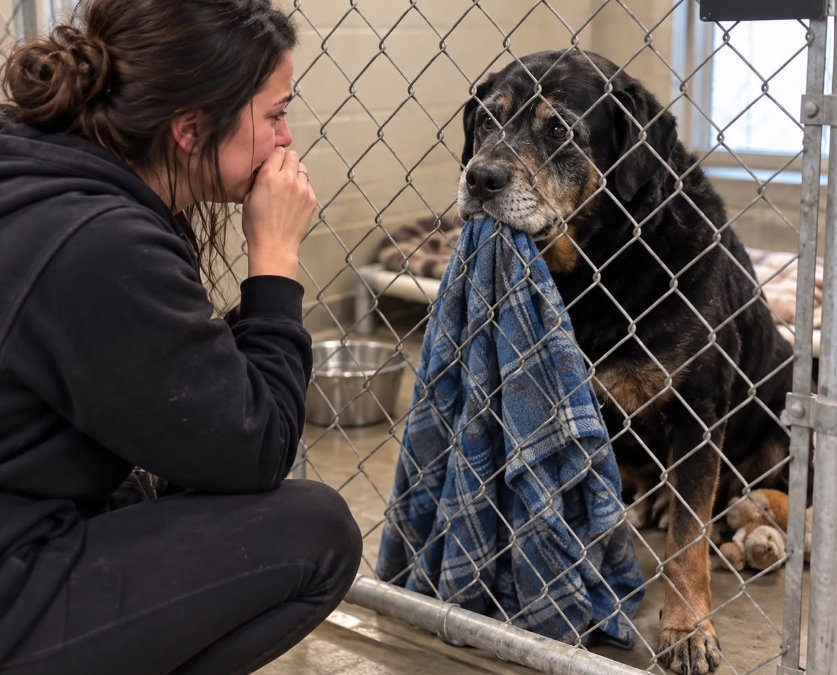
Every time visitors walked away, Bruno watched them until they turned the corner. Then he returned to the back of his kennel, circled once, and lowered his head onto the blue coat.
The coat became part of his body.
He carried it to the yard.
He carried it to the meet-and-greet room.
If we took him for walks, he would go only if one of us carried it beside him. If another dog passed too close to his kennel, Bruno would stand over it—not growling, not threatening, just making it clear that some things were not available to the world.
I began staying late with him.
At first I told myself it was because senior dogs needed extra socialization. Then because his arthritis meant slow evening walks helped his stiffness. Then because the paperwork could wait.
Eventually I stopped pretending.
I stayed because I could not stand the thought of him lying there alone with a coat full of fading scent and no idea why the man he loved had not come back.
On his fourth week with us, a family named the Bryants came to meet him.
They seemed perfect.
Middle-aged couple. No young children. Big fenced yard. Experience with large breeds. Their last dog had been a mastiff who lived to thirteen.
Bruno liked them immediately.
He stepped into the meet room carrying the coat, placed it beside his paws, and sat in front of Mrs. Bryant.
She laughed softly.
“Well, aren’t you handsome?”
Bruno leaned his head into her hand.
My chest lifted with hope.
Mr. Bryant knelt too.
“He’s a gentle old bear.”
“He really is,” I said.
They spent thirty minutes with him. Bruno even rolled onto one hip, relaxed enough to let them scratch his chest. Mrs. Bryant asked about his food. Mr. Bryant asked about his medication. They talked about orthopedic beds and ramps.
Then Mrs. Bryant looked at the coat.
“What’s the story with that?”
I told them.
Owner died. Bruno carried the coat from the house. He used it for comfort.
Mrs. Bryant’s face changed.
Not with disgust.
With fear.
“I don’t know if I can do that,” she said.
“Do what?”
“Take home a dog who’s still grieving someone else.”
Mr. Bryant squeezed her hand.
She looked at Bruno, tears gathering.
“Our last dog waited at the window for my husband every day. Even when he was just in the garage.” She tried to smile. “I keep thinking… if Bruno is waiting for someone who can’t come back…”
She couldn’t finish.
They left without applying.
I didn’t blame them.
That made it worse.
Bruno watched them go.
Then he picked up the coat and carried it back to kennel fourteen.
Month after month, the same thing happened.
Puppies left.
Young dogs left.
Difficult dogs left.
Dogs with medical needs left.
Dogs who arrived after Bruno left wearing new collars, jumping into cars, looking back once before beginning the next part of their lives.
Bruno stayed.
In December, someone donated a box of Christmas bandanas. I chose a green one for Bruno with tiny white snowflakes. He looked ridiculous and proud. I took his picture and posted it on the shelter’s page.
Meet Bruno! This gentle senior Rottweiler is looking for a quiet home, a soft bed, and someone who understands that old dogs still have so much love to give.
The post did well.
Hundreds of likes.
Dozens of comments.
What a sweet face!
Someone adopt this baby!
I wish I could!
My landlord doesn’t allow big dogs!
Senior dogs are the best!
No applications.
People loved Bruno from the safe distance of a screen.
He needed someone to love him close enough to open their door.
By late January, shelter management began discussing options.
Not euthanasia.
Maple Ridge did not euthanize for space, and Bruno was not suffering beyond what age naturally brought.
But the adoption wing was loud. Concrete floors were hard despite mats. Bruno’s arthritis worsened in cold weather. Our senior-animal pavilion had softer flooring, quieter rooms, heated beds, and staff trained for long-term hospice-style care.
It was a good place.
That was the problem.
It was a good place for dogs people had stopped trying to adopt.
Once a dog moved there, he rarely returned to the adoption floor. Visitors did not walk that row casually. Families came to the front wing and met the dogs whose faces appeared on cheerful kennel cards.
The senior pavilion was where we made old animals comfortable when hope became too expensive to keep on display.
Paul called me into his office on a Monday morning.
I already knew.
He had Bruno’s chart on his desk.
“No,” I said before he spoke.
Paul rubbed his forehead.
“Grace.”
“No.”
“You don’t know what I’m going to say.”
“I do.”
“Then you know I’m not doing this lightly.”
I sat down hard.
“He still has a chance.”
“He’s had four months.”
“That’s not long.”
“For a ten-year-old Rottweiler in a county shelter, it is.”
“Don’t say it like he’s inventory.”
Paul flinched.
“I’m not.”
I regretted the words immediately, but I was too angry to apologize.
“He’ll disappear back there,” I said.
“He’ll be more comfortable.”
“He’ll be unseen.”
“He is already being unseen,” Paul said, and his voice sharpened enough to stop me. “Every day people walk past him and choose younger dogs. Every day he lies on concrete with that coat while you convince yourself one more week will change the pattern.”
I stood.
“Maybe it will.”
Paul looked tired.
Maybe as tired as I felt.
“The transfer is scheduled for Thursday.”
“Paul.”
“Thursday,” he repeated gently. “You can help settle him in. You can visit every day. But I’m not leaving him in the adoption wing until his body suffers because our hearts can’t accept reality.”
I left his office furious.
Then I walked to Bruno’s kennel and found him asleep with his head on the coat.
His front paw rested over one sleeve.
As if protecting it.
As if even in sleep he knew the world took things away.
“I’m trying,” I whispered.
His ear twitched.
“I swear I’m trying.”
On Tuesday afternoon, the young woman arrived.
I remember almost everything about her because that is how life works sometimes. You do not know a moment is about to divide time into before and after, yet some part of you records the details anyway.
Her dark hair was pulled into a low ponytail. She wore jeans, a black sweater, and a tan coat too thin for the January wind. Her eyes were red around the edges, not from crying right then, but from someone who had been doing too much of it lately.
She came alone.
No excited children.
No spouse.
No list of preferred breeds.
Just a quiet woman standing at the front desk with both hands wrapped around the strap of her purse.
“I’d like to meet some dogs,” she said.
Our receptionist, Kelly, smiled.
“Any type you’re looking for?”
The woman shook her head.
“I don’t know.”
People say that often. Sometimes it means they are not serious. Sometimes it means they are looking for a feeling they don’t yet know how to name.
Kelly asked, “Small? Medium? Large?”
“I grew up with large dogs.”
“Energy level?”
The woman looked down.
“Maybe calmer.”
I had stepped into the lobby to drop off a medication sheet. Kelly glanced at me.
“Grace, could you walk her through?”
“Of course.”
I introduced myself.
She said her name was Clara.
Clara Bennett.
Not Whitaker.
Not then.
She followed me through the adoption hallway while dogs barked and bounced around us. She smiled at a hound mix, asked gentle questions about a shepherd, knelt for a pit bull who pressed his whole body against the kennel gate.
But nothing connected.
I could feel it.
She was kind, but distant. Present, but not fully there.
We passed kennel twelve.
Then thirteen.
Then we reached Bruno.
He was sitting in the back corner with the blue coat between his front paws.
When he saw me, he lifted his head.
“Hey, old man,” I said softly.
Bruno picked up the coat in his mouth and stood.
That was his greeting when he trusted someone.
He carried his grief to the front of the kennel like an offering.
Clara stopped walking.
Completely.
At first I thought she was afraid.
Rottweilers scared some people. Even gentle ones. Even old ones. People carried stories in their heads about certain breeds, and sometimes those stories mattered more to them than the dog standing in front of them.
But Clara wasn’t looking at Bruno’s teeth.
She was looking at the coat.
All the color left her face.
Her hand rose to her mouth.
Bruno stared back.
The coat slipped from his jaws.
His entire body went still.
I had seen Bruno respond to visitors before.
Interest.
Hope.
Resignation.
This was different.
His ears lifted.
His tail gave one uncertain movement.
Then another.
Clara whispered something I couldn’t hear.
Bruno stepped toward the kennel door.
One step.
Then another.
His nails clicked softly against the floor.
Clara began crying.
“Ma’am?” I said.
She didn’t answer.
I moved closer.
“Are you okay?”
She looked at me as if she had forgotten anyone else existed.
Then she pointed at Bruno with a trembling hand.
“I know this dog.”
My stomach tightened.
“What do you mean?”
Her tears fell faster.
She looked at the faded blue coat one more time.
Then at me.
“That coat belonged to my father.”
For a second, the barking around us seemed to fade.
Bruno pressed his nose through the kennel bars.
Clara sank to her knees.
“Bruno?”
The dog made a sound.
It was low and broken and so full of recognition that I felt it in my chest.
Clara reached toward him, then stopped herself, as if afraid touching him would make him disappear.
“Bruno,” she whispered again.
This time he pushed his whole head against her hands.
She sobbed.
Not politely.
Not quietly.
The kind of sob that comes from a place too old and deep for embarrassment.
I opened the kennel door.
Bruno moved past me slowly, not toward the hallway, not toward freedom, but straight into Clara.
She wrapped both arms around his neck and buried her face in his fur.
He leaned against her with so much weight she nearly fell backward.
The coat lay on the kennel floor between them.
Clara pulled back just enough to look at him.
“You’re alive.”
Bruno licked her chin once.
She laughed through tears.
“You’re so gray.”
His tail moved harder.
“You remember me?”
He pressed his head against her chest.
I stood there with one hand still on the kennel latch, unable to speak.
I had watched dozens of reunions before. Lost dogs reunited with frantic owners. Cats found after months. Military families coming back for animals we fostered temporarily.
This was not like those.
This was not simple joy.
This was recognition wrapped in grief.
A door opening into a room full of unanswered years.
I led them into the meet-and-greet room because Clara could not stand yet and Bruno refused to move unless she moved too. He carried the coat himself, then dropped it beside her chair.
Clara sat on the floor.
Bruno lowered himself slowly into her lap as if he were still the puppy he had once been.
He was far too big.
She did not care.
For several minutes, she cried into his neck while he breathed against her shoulder.
When she could finally speak, her voice shook.
“My father’s name was Henry Whitaker.”
I sat across from her.
“Yes. That was Bruno’s owner.”
Her eyes closed.
“Was?”
I swallowed.
“I’m so sorry.”
Clara’s hand tightened in Bruno’s fur.
“When?”
“October.”
She flinched like I had touched a wound.
“No.”
“I’m sorry.”
“No, I—” She shook her head, tears spilling again. “No one told me.”
I looked at her carefully.
“You didn’t know?”
She stared at the coat.
“I knew he was sick years ago. I tried to contact him. His brother told me Dad didn’t want to see me.”
A cold feeling moved through me.
“His brother?”
“Grant Whitaker.”
That was the name on Bruno’s surrender form.
Emergency estate contact.
Authorized release.
No family able to claim animal.
Clara wiped her face with the heel of her hand.
“I haven’t seen Bruno since he was a year old. Maybe younger. He used to sleep on my bed when Dad let him, which was never officially.” She laughed once, painfully. “Dad would say, ‘That dog is not sleeping upstairs,’ and then Bruno would be under my blanket by midnight.”
Bruno’s tail thumped.
“He remembers that,” I said.
Clara looked at me.
Then at the blue coat.
“That coat…” Her voice broke. “Dad wore it everywhere. Working in the garage. Mowing. Taking Bruno out. I used to patch the sleeves because he refused to buy a new one.”
She reached for the left cuff.
Her fingers trembled as she turned it over.
There, barely visible in darker blue thread, was a crooked line of stitching near the seam.
“I did this,” she whispered.
Her tears began again.
“I was twelve.”
I didn’t know what to say.
So I said the only true thing.
“He wouldn’t leave the house without it.”
Clara looked up.
“What?”
“When the volunteer picked him up, he found the coat and carried it with him. He wouldn’t get in the van without it.”
She pressed her hand over her mouth.
Bruno shifted, putting his head on her knee.
She bent over him.
“He kept it,” she whispered. “He kept Dad.”
That was when Paul appeared at the doorway.
He looked from me to Clara to Bruno.
“What’s going on?”
I stood.
“This is Clara. She knew Bruno.”
Paul’s eyes narrowed slightly, not unkindly, but carefully.
“Knew him how?”
Clara lifted her face.
“He was my father’s dog.”
Paul looked at me.
“The owner had no listed next of kin.”
“My uncle lied,” Clara said.
The room went still.
Paul stepped in slowly.
“Ms. Bennett, I’m sorry for your loss, but we’ll need documentation before we can discuss ownership or release.”
“I understand.”
Her voice was polite, but her hands shook.
“Do you have any identification connecting you to Henry Whitaker?”
“My last name is different. I took my mother’s name after my parents divorced.”
Paul nodded.
“Birth certificate?”
“At home.”
“Photographs?”
“Yes.”
“Any legal paperwork?”
“I don’t know.” She looked down at Bruno. “I didn’t even know my father died.”
Paul’s face softened then.
“I’m sorry.”
Clara nodded, but she did not look away from Bruno.
“What happens to him?”
The question cut through me.
Paul hesitated.
“He is currently available for adoption, but because of his age and needs—”
“He can come with me.”
Paul and I exchanged a look.
Clara saw it.
“What?”
“There may be complications,” I said gently.
“Because of my uncle?”
“Because he signed the surrender paperwork as estate representative.”
“I don’t care what he signed.”
“I understand.”
“No.” Her voice sharpened, not at me exactly, but at the world that had already taken too much. “You don’t. That dog slept outside my bedroom door after my mother left. He sat in Dad’s truck every morning. He—”
She stopped, breath catching.
Bruno pressed closer.
Clara lowered her voice.
“He was family before anyone called him property.”
I believed her immediately.
But belief is not paperwork.
That is one of the ugliest truths of rescue work.
Love can be obvious and still not enough to unlock a kennel.
Paul told Clara to bring documents the next morning. We would pause Bruno’s transfer. We would not release him, but we would not move him to the senior pavilion until we understood the situation.
After Clara left, Bruno stood at the front doors for nearly ten minutes, staring after her car.
The coat hung from his mouth.
I stood beside him.
“You knew her.”
His tail moved once.
“You were waiting for her too.”
That night, I opened Bruno’s file and read the surrender paperwork again.
Grant Whitaker.
Brother of deceased.
Stated owner left no surviving spouse, children, or willing relatives.
Requested immediate surrender due to property liquidation.
Property liquidation.
Two words so clean they almost hid the cruelty inside them.
Under “items surrendered with animal,” someone had written: old coat, no value.
No value.
I wanted to throw the file across the room.
Instead, I made copies.
The next morning, Clara arrived before we opened.
She stood outside in the cold holding a folder against her chest.
I let her in.
Bruno heard her voice from the adoption wing and began barking.
Not his usual quiet greeting.
A deep, joyful bark that echoed down the hallway and made three other dogs start up in confusion.
Clara laughed and cried at the same time.
“I missed that sound.”
In the meet room, she spread photographs across the floor.
There was Henry Whitaker younger and smiling, standing beside a red pickup with a Rottweiler puppy at his feet.
There was Clara at fifteen, braces on her teeth, kneeling in grass while a younger Bruno licked her face.
There was Henry wearing the blue coat, one arm around Clara, the other hand resting on Bruno’s head.
There were birthdays.
Backyard barbecues.
Christmas mornings.
A family that had existed before it broke.
Clara handed Paul her birth certificate.
Father: Henry James Whitaker.
Mother: Susan Bennett.
Paul looked through everything carefully.
“This establishes your relationship,” he said.
“So I can take him?”
“Not yet.”
Her face fell.
“But—”
“I’m not saying no. I’m saying we need to proceed carefully. Your uncle signed a legal surrender as estate representative. If there’s an estate dispute, we need to know whether Bruno is considered surrendered property or whether the surrender itself was fraudulent.”
“Fraudulent?”
“If he stated there were no surviving children while knowing you existed, that matters.”
Clara’s hands curled into fists.
“He knew.”
I asked softly, “What happened between you and your father?”
Clara looked at Bruno.
For a long moment, I thought she would not answer.
Then she said, “My parents divorced when I was sixteen. It was ugly. My mom moved us to Kansas City. Dad fought for visitation, but then the calls started getting weird. He’d miss one. I’d miss one. Mom said he was drinking again.”
“Was he?”
“No.” Her voice broke. “At least, not like she said.”
Bruno rested his chin on her knee.
“I was angry. Sixteen-year-old angry. I thought he chose his garage, this town, and Bruno over me. Then Mom got sick, and everything became hospitals and bills and trying to finish school. By the time I was twenty, I wanted to reach out. I called the old house. Disconnected. I found Grant online and called him.”
“What did he say?” I asked.
“That Dad had moved on. That he didn’t want drama. That if Dad wanted to hear from me, he knew where I was.”
She swallowed.
“I believed him because part of me was scared it was true.”
Paul looked grim.
“How long ago?”
“Four years.”
“And you never heard from Henry?”
“No.”
“Did you send letters?”
“Yes. Two. They came back. Return to sender.”
“Do you still have them?”
“At home somewhere.”
“Find them,” Paul said. “Anything matters.”
Clara looked at him.
“Are you saying Grant kept us apart?”
“I’m saying I don’t know.”
But I knew what Paul feared.
The same thing I did.
Grant had known exactly who Clara was.
And for some reason, he had made sure she stayed gone.
By noon, Grant Whitaker called the shelter.
I heard Paul answer from his office.
At first, his voice was professional.
Then it cooled.
“No, Mr. Whitaker, the dog has not been released.”
A pause.
“No, the coat has not been given away.”
Another pause.
My hand tightened around the medication cup I was filling.
Paul’s voice sharpened.
“Why are you asking specifically about the coat?”
I stepped closer to the office door.
Silence.
Then Paul said, “Mr. Whitaker, a woman named Clara Bennett came in today.”
The pause this time was longer.
Paul listened.
His face changed.
“No, I will not discuss her personal information with you.”
Another pause.
“The transfer has been delayed.”
Another.
“No, you cannot come remove property from the shelter.”
Another.
“Because the animal and the item surrendered with him are under our care pending review.”
Then Paul hung up.
He saw me standing there.
“He wants the coat.”
Every instinct in me went cold.
“Why?”
Paul looked toward the adoption wing.
“I think we need to find out.”
We did not take the coat from Bruno that day.
I couldn’t.
Whatever secrets it held, he had protected it for months. Pulling it away without cause felt like betrayal.
But that evening, while Clara sat with him in the meet room, something happened.
Bruno had relaxed more deeply than I had ever seen him. He lay with his body pressed against Clara’s side, the coat between them. Clara was telling me about Henry teaching her to change a tire when she noticed a tear in the coat lining.
“That’s new,” she said.
“Is it?”
“I don’t remember that.”
She touched the inside seam near the left breast pocket.
Bruno lifted his head.
“It’s okay,” she whispered. “Can I look?”
He watched her.
She slipped two fingers carefully into the torn lining and froze.
“What is it?” I asked.
“There’s something inside.”
My heart began pounding.
She pulled gently.
A folded piece of plastic slid from between the lining and the outer canvas.
Inside it was an envelope.
Old.
Flattened.
Protected from rain and time.
On the front, in shaky handwriting, were two words.
For Clara.
She stopped breathing.
I did too.
Bruno lowered his head back onto the coat, as if his job was finally done.
Clara’s fingers trembled so badly she couldn’t open it.
“Do you want me to call Paul?”
She nodded.
Paul came.
So did Kelly, because she had been standing near the hallway pretending not to cry.
We moved to Paul’s office.
Clara opened the envelope.
Inside was a letter, a small brass key, and a business card for an attorney named Linda Cho.
Clara unfolded the letter.
Her father’s handwriting slanted unevenly across the page.
Clara,
If this ever finds you, it means Bruno did his job better than I did mine.
I have written you so many letters that I don’t know anymore which ones reached you and which ones were sent back by people who should have helped us instead of standing between us. Maybe you hate me. Maybe you have every right to. But I need you to know I never stopped looking for a way back to you.
Grant says you don’t want contact. My heart does not believe him, but my body is weaker now and I am tired of fighting men who smile while they close doors.
There is a box at Miller’s Storage, unit 18. The key is here. Linda Cho has the documents. I signed everything while I still could.
If I am gone before I see you again, take Bruno if he is still here. He will know you. He always did.
The blue coat smells like me because I have worn it almost every day since you left. I used to think that was because I was stubborn. Now I think maybe I was hoping some part of me would stay long enough for you to find it.
I love you, sweetheart.
Dad.
Clara made a sound I had never heard from another person.
Not crying.
Not screaming.
Something beneath both.
She folded over the letter like it had physically struck her.
I moved toward her, then stopped, unsure whether touch would help or hurt.
Bruno solved it.
From the meet room down the hall, he began barking.
One bark.
Then another.
Deep.
Urgent.
Clara stood so quickly the chair scraped back.
She ran to him.
By the time I reached the doorway, she was on the floor with the letter clutched in one hand and both arms around his neck.
“He tried,” she sobbed into Bruno’s fur. “He tried to tell me.”
Bruno pressed his head against her shoulder.
“He tried,” she said again.
And all I could think was that this old dog had carried the only honest message left in that family past death, past greed, past paperwork, past every person who had decided he was too old to matter.
Grant came the next day.
He arrived in a black SUV wearing a wool coat, leather gloves, and the kind of expression men wear when they expect a room to arrange itself around their authority.
I had seen men like him before.
They spoke politely to people they considered useful and sharply to people they considered beneath them. They believed “legal” and “right” were interchangeable when it benefited them and completely separate when it didn’t.
He walked to the front desk and said, “I’m here for my brother’s dog and personal property.”
Kelly looked at me.
I stepped forward.
“Mr. Whitaker?”
“Yes.”
“I’m Grace Miller, senior adoption coordinator.”
“I spoke with Paul Dorsey.”
“He’s expecting you.”
Grant’s eyes moved past me toward the adoption hall.
“I don’t have much time.”
Of course not.
Men like him never have time when someone else’s grief is involved.
Paul met us in the small conference room. Clara arrived ten minutes later with her folder, her father’s letter, and a quiet fury that made her look taller than she had before.
Grant’s face changed when he saw her.
Not surprise.
Annoyance.
That told me everything.
“Clara,” he said.
“Uncle Grant.”
“I’m surprised to see you here.”
“I’m surprised you didn’t tell me my father died.”
He sighed as if she had brought up something inconvenient at dinner.
“I tried to contact you.”
“No, you didn’t.”
“I had old information.”
“You had my number.”
“I was dealing with a great deal.”
“So was Bruno,” she said.
For the first time, Grant looked irritated enough to drop the polished voice.
“That dog is not the issue.”
“He is to me.”
“The estate is complicated.”
“Because you made it complicated.”
Grant turned to Paul.
“Mr. Dorsey, I surrendered the dog legally. If Ms. Bennett wants to adopt him, that is your internal matter. But the coat is personal property of the estate and must be returned.”
Clara laughed once.
A sharp, disbelieving sound.
“Now you care about Dad’s personal property?”
Grant ignored her.
Paul folded his hands.
“Why do you want the coat?”
“It belonged to my brother.”
“You listed it as no value.”
“I was mistaken.”
Clara pulled the letter from her folder.
“Were you mistaken when you told my father I didn’t want to see him?”
Grant’s jaw tightened.
“I don’t know what you’re talking about.”
She held up the letter.
“He wrote it down.”
“I would question anything written near the end. Henry was confused.”
Clara’s face went white.
Not with fear.
With rage.
“My father rebuilt carburetors from memory until six months before he died. Don’t you dare make him sound like he didn’t know his own daughter.”
Grant leaned back.
“There is no need for drama.”
That was his mistake.
Men like Grant always mistake pain for drama when it belongs to someone else.
Clara stood.
“Drama was letting me think he didn’t want me. Drama was letting him die thinking I didn’t love him. Drama was surrendering his dog like old furniture and then coming here for a coat only because you realized he hid something in it.”
Grant’s eyes flickered.
Just once.
But enough.
Paul saw it.
So did I.
Grant turned cold.
“I advise this shelter not to involve itself in family disputes.”
Paul’s voice stayed calm.
“Maple Ridge will comply with legal requirements.”
“Good.”
“And we will not release any item connected to a possible fraud allegation without direction from counsel.”
Grant’s face hardened.
“You are making a serious mistake.”
Clara stepped closer to the table.
“No. You made one.”
Grant looked at her then.
Really looked.
And for the first time, I saw fear beneath the arrogance.
Not guilt.
Not remorse.
Fear of exposure.
The brass key opened Miller’s Storage, unit 18.
Clara went with an attorney two days later.
So did Deputy Karen Mills, the same deputy who often handled animal neglect cases for our county. By then, Paul had called her because the situation smelled like more than an adoption dispute.
Inside the unit, they found boxes stacked neatly and labeled in Henry Whitaker’s handwriting.
Clara – photos
Clara – school
Clara – letters returned
Clara – medical records
Bruno – veterinary
Garage documents
Estate – Linda Cho
Clara told me later she stood in that storage unit and cried before opening a single box.
Her father had kept everything.
Every report card.
Every birthday card she made him as a child.
A clay handprint from kindergarten.
Photos of her missing front teeth.
A pink bike helmet.
Letters he had written and never been able to send.
Letters she had sent that had been returned.
Some envelopes had handwriting that was not Henry’s.
Grant’s.
Return to sender.
No longer at this address.
The attorney, Linda Cho, still had the original updated will.
Henry had left the house, his garage property, and a modest life insurance policy to Clara. He had named Grant only as temporary executor because he believed Grant would help locate her.
He had also included a line that made me cry when Clara showed me.
My dog, Bruno, is to go to my daughter Clara if she is willing and able. If she cannot be found, he is to be placed through Maple Ridge Animal Shelter with all fees paid from my estate and instructions that his blue coat remain with him for comfort.
Henry had known.
Somehow, even before everything fell apart, he had known the coat mattered.
The will had never been filed.
Grant had begun liquidating the house under an older document that gave him temporary authority over assets if no direct heir was located.
No direct heir.
Clara existed.
He had just decided she was inconvenient.
The legal process that followed was not fast, but it was satisfying in the slow, grinding way truth can be satisfying when it finally gets teeth.
Grant was removed as executor.
The sale of Henry’s house was halted.
The old garage, which Grant had already tried to sell to a developer, was frozen pending probate review.
Clara received boxes of letters that proved her father had never stopped trying.
And Bruno?
Bruno stayed at the shelter while the lawyers untangled what should never have been tangled.
That was the hardest part.
Because once Clara knew, once Bruno knew, every night apart felt cruel.
She came every morning before work and every evening after. She sat in his kennel with him because he refused to settle for short visits. She brought him orthopedic treats, a new leash, and once, a cheeseburger she swore was “just a small one,” as if I had not worked with dogs long enough to smell beef from twenty feet away.
Bruno changed.
That was the thing everyone noticed.
He still loved the blue coat. He still slept with it. But he no longer slept like it was all he had. When Clara arrived, he stood faster. When she left, he watched the door, but he did not collapse into himself the way he had before.
Hope had returned to him.
So had worry.
One night, as Clara prepared to leave, Bruno picked up the coat and tried to follow her through the lobby.
He moved slowly, stiffly, but with purpose.
Clara stopped and knelt.
“I know,” she whispered. “I know, baby. Soon.”
He pushed the coat into her lap.
She pressed it to her chest.
The shelter was full of volunteers, visitors, staff.
Nobody spoke.
Finally she folded the coat and gave it back.
“I’m coming back tomorrow.”
Bruno held it in his mouth.
“I promise.”
He stared at her.
“I know promises probably don’t sound like much in this family anymore,” she whispered. “But mine means something.”
The next day, Grant made one final attempt to stop her.
He came during our Saturday adoption event.
The lobby was packed. Families, volunteers, children, donors, a local reporter covering senior pet adoptions. It was exactly the kind of room where a man like Grant would either behave or reveal himself.
He chose the second.
Clara had just arrived and was signing updated adoption intent paperwork when Grant walked in with a different attorney, one I had never seen.
His voice carried.
“This adoption cannot proceed.”
The room went quiet.
Paul stepped forward.
“Mr. Whitaker, this is not the place.”
“It is exactly the place if this shelter intends to hand over estate property based on forged sentimental nonsense.”
Clara froze.
Bruno, hearing her voice from down the hall, barked once.
Grant pointed toward the adoption wing.
“That dog belonged to my brother. My brother trusted me to manage his affairs.”
Clara turned around slowly.
“My father trusted you to find me.”
Grant’s face flushed.
The reporter lifted her camera.
Grant noticed too late.
He should have stopped there.
He didn’t.
“You were gone,” he snapped. “You stayed gone. You don’t get to appear now and pretend you were some devoted daughter because there’s property involved.”
The words hit Clara visibly.
For one second, I saw the sixteen-year-old girl beneath the grown woman. The daughter who had believed she had been unwanted. The child who had carried shame that did not belong to her.
Then Bruno appeared.
I had not opened his kennel.
Kelly had.
Later she would say, “I’m sorry, but he heard her crying.”
No one blamed her.
Bruno came down the hall carrying the blue coat.
Slow.
Stiff.
Majestic.
The entire lobby turned.
Grant stepped back.
Bruno ignored him.
He walked straight to Clara and placed the coat at her feet.
Then he stood between her and Grant.
Not growling.
Not lunging.
Just standing.
Old.
Gray.
Certain.
The reporter’s camera clicked.
Clara bent and picked up the coat.
Her voice shook, but it carried.
“This coat had my father’s letter inside it. This dog carried it out of the house because you tried to erase both of us. You called him property. You called me gone. But Bruno remembered what you wanted everyone else to forget.”
Grant’s attorney touched his arm, whispering urgently.
Grant’s face twisted.
“That animal doesn’t remember anything.”
Bruno turned his head toward him.
And growled.
One low sound.
Not wild.
Not uncontrolled.
A warning from a dog who had spent months being gentle with everyone.
Grant stopped speaking.
Nobody in that lobby moved.
Then Paul said quietly, “Mr. Whitaker, leave.”
Grant looked around and realized the room was no longer his.
The reporter was recording.
The donors were staring.
Families who had come to adopt puppies were watching a senior Rottweiler protect the daughter of the man he loved.
Grant left.
By evening, the story was everywhere locally.
Not because we posted it.
Because people had seen enough.
The headline the next morning read:
Senior Shelter Dog’s Coat Reveals Hidden Letter, Reunites Daughter With Late Father’s Wishes
Grant hated that.
I imagine he hated the photo more.
Bruno standing in front of Clara, the blue coat at her feet, eyes fixed on the man who had tried to take it.
Public humiliation does not undo private harm.
But sometimes it makes denial harder to maintain.
Three weeks later, Clara was legally approved to adopt Bruno.
The paperwork was signed in Paul’s office on a Thursday afternoon.
The same day Bruno would have been moved permanently to the senior pavilion.
I thought about that as Clara held the pen.
Two days.
That was how close we had been to removing him from the adoption wing.
Two days from making him comfortable and unseen.
Two days from Clara walking past an empty kennel.
Two days from the coat being tucked away in some quiet back room where no stranger would have recognized it.
Life turns on smaller hinges than we want to admit.
Clara signed her name.
Then she stopped.
“What?” I asked.
She looked at the adoption form.
Applicant name: Clara Bennett.
She took a breath.
Then she crossed out Bennett and wrote Whitaker beside it.
“My mother gave me her name after the divorce,” she said softly. “I’m not ashamed of it.”
She looked at Bruno.
“But I think I’m ready to carry his again too.”
Paul blinked hard and pretended to organize papers.
I cried openly because I had stopped pretending around Bruno weeks earlier.
When we brought him out, he carried the blue coat himself.
The whole staff gathered in the lobby.
Nina was there.
Kelly.
Dr. Patel.
Volunteers.
Even the kennel techs who acted tough until a senior dog left, then somehow always needed to “check the laundry” alone for a few minutes.
Clara knelt.
“Ready to go home?”
Bruno wagged his tail.
Not uncertainly.
Not once.
Fully.
His whole body shifted with it.
I clipped on his new leash.
Clara had chosen a blue one.
Of course she had.
She looked at me.
“I don’t know how to thank you.”
“Send pictures.”
“I mean it.”
“So do I.”
She hugged me then.
Hard.
When she pulled back, she said, “You kept the coat.”
“He did.”
“You let him.”
“He would’ve fired me otherwise.”
She laughed through tears.
Bruno leaned against my leg once before leaving.
Just once.
A farewell from a dog whose loyalty had never belonged to me, but who had allowed me to guard it for a while.
Then he walked through the glass doors beside Clara, carrying the coat.
The air outside was cold and bright.
He climbed into her back seat slowly, with help. She spread a thick orthopedic blanket for him, but he turned in a careful circle, placed the coat beneath his head, and lay down.
Clara closed the door.
Before she got into the driver’s seat, she looked back at the shelter.
At us.
At the place where Bruno had waited.
Then she mouthed, Thank you.
And drove away.
For the first time since he arrived, Bruno did not look back.
Clara took him to her apartment first, but only for a week.
Then probate gave her temporary access to Henry’s house.
She asked me to come with her the first time she brought Bruno there.
I told myself I was going to support her.
Really, I think I needed to see it too.
Henry’s house sat at the end of a quiet road under two old maple trees. White siding. Green shutters. A detached garage with peeling paint and a crooked sign that read Whitaker Auto Repair, though the business had been closed since Henry got sick.
The house looked tired.
Not abandoned exactly.
Interrupted.
Clara parked in the driveway and turned off the engine.
For several seconds, she didn’t move.
Bruno stood in the back seat, staring out.
“You okay?” I asked.
“No.”
The honesty of that answer told me she would be.
She opened Bruno’s door.
He stepped down slowly.
Then he lifted his head.
Everything changed.
His nose worked.
His ears rose.
His body, old and stiff minutes before, seemed to remember another version of itself.
He walked toward the porch.
Not fast.
But certain.
Clara followed, keys shaking in her hand.
The front door stuck. She pushed harder. It opened with a long, swollen creak.
The air inside smelled closed up.
Dust.
Wood.
Old paper.
A faint trace of motor oil from the garage.
And something else.
Home.
Bruno stepped inside.
He stood in the entryway.
Then he moved from room to room.
Living room.
Kitchen.
Hallway.
Bedroom door.
He did not race.
He did not bark.
He searched with the solemn discipline of a dog who had searched before and found only absence.
In the living room, he stopped beside an old recliner.
Clara covered her mouth.
“That was Dad’s chair.”
The chair was worn at the arms. A small table beside it held a lamp, an empty mug, and a pair of reading glasses.
Bruno lowered his head to the floor beside the chair.
Then, gently, he placed the blue coat there.
Clara began crying.
I stood in the doorway and gave her silence.
She sat on the floor beside Bruno.
“I thought he didn’t want me,” she whispered.
Bruno pressed against her side.
“I thought he let me go.”
She reached for the coat.
“He didn’t.”
No, I thought.
He hadn’t.
He had loved her badly, maybe imperfectly, maybe not loudly enough to overcome the people between them.
But he had loved her.
And Bruno had carried the proof.
Over the next months, Clara restored the house slowly.
She did not turn it into a museum.
That mattered.
At first, she wanted to keep everything exactly as it was. Henry’s boots by the back door. His coffee mug on the side table. His work gloves in the garage. The calendar still turned to the month he died.
Then one evening, she called me.
“Is it terrible if I move things?”
“No.”
“It feels like erasing him.”
“Or making room for yourself.”
She was quiet.
“Bruno keeps sleeping by Dad’s chair.”
“That makes sense.”
“I bought him a bed.”
“Did he use it?”
“No.”
“Also makes sense.”
She laughed.
Little by little, she changed things.
The house got fresh curtains. The kitchen got new paint. The garage stayed mostly the same, because Clara said she liked the smell of old tools and oil even though she knew nothing about cars.
Bruno got a bed beside Henry’s chair.
He used it only after Clara placed the blue coat on top.
His arthritis worsened that winter. Dr. Patel coordinated care with Clara’s vet. He took medication twice a day, ate prescription food with the enthusiasm of a dog who believed all food was a miracle, and accepted his ramp into the car only after Clara told him, “Dad would call you stubborn.”
That worked.
Apparently Henry still had authority.
Clara visited the shelter often.
At first with Bruno, then sometimes alone when the cold bothered his joints. She brought donations: towels, food, senior dog supplements, orthopedic beds.
Once, she brought a stack of envelopes.
“What are these?”
“My father’s letters.”
She had read them all.
Not at once.
She said reading them too quickly felt like trying to drink from a broken pipe.
Some were angry.
Some apologetic.
Some ordinary.
Clara, I fixed the back fence today. Bruno thinks he helped.
Clara, your birthday is next week. I don’t know whether this will reach you, but I bought the lemon cake anyway.
Clara, if you ever come home, the porch light still works. I leave it on too often and the electric bill proves it.
Grant had kept so many of them from her.
Some he returned.
Some he hid.
Some Henry never mailed, probably because sickness and betrayal had slowly made him doubt his own right to ask for forgiveness.
“He wasn’t perfect,” Clara told me one afternoon.
We were sitting outside the shelter while Bruno slept in the shade near her feet.
“No,” I said.
“He should have driven to Kansas City. He should have knocked on every door. He should have fought harder.”
I didn’t answer because she deserved the whole truth, not comfort too quick to be useful.
Then she touched the blue coat folded beside Bruno.
“But he didn’t stop loving me.”
“No.”
“And maybe that has to be enough for the part of him I still have.”
Bruno opened one eye.
Clara smiled sadly.
“You count too, old man.”
His tail thumped.
Grant eventually accepted a plea agreement related to estate fraud and concealment of documents. He avoided prison, which angered Clara at first. But he lost control of the estate. He lost the garage sale. He lost the house. He lost the image of grieving brother he had performed for neighbors while trying to sell Henry’s life piece by piece.
Most of all, he lost the ability to decide the story.
Clara told it herself at the probate hearing.
I went with her.
So did Paul.
So did Bruno.
The judge allowed it because Clara’s attorney argued that Bruno had been specifically named in the will and was relevant to the disposition of personal property.
Bruno slept through most of the hearing with the coat under his head.
When Clara spoke, she did not shout.
She did not exaggerate.
She simply told the truth.
“My father and I lost years because people between us benefited from our silence,” she said. “I can’t get those years back. I can’t ask him the questions I should have asked. I can’t hear his answers. But I can honor what he tried to protect.”
She looked down at Bruno.
“His dog. His home. His letters. And the truth that he did not leave me willingly.”
Grant stared at the table.
For once, he had nothing to say.
That felt like justice.
Not enough.
But real.
A year after Clara adopted Bruno, she invited the shelter staff to Henry’s house for what she called “a very unofficial birthday party.”
Nobody knew Bruno’s actual birthday.
So Clara chose the day he came home.
There were balloons on the porch, which Bruno found suspicious. There was a dog-safe cake from a bakery, which he found excellent. There were volunteers, staff, neighbors, and several shelter dogs who had been adopted by families we trusted.
Clara had hung photographs along a clothesline in the backyard.
Henry and young Bruno.
Clara and puppy Bruno.
Bruno at the shelter with his blue coat.
Bruno walking through Henry’s front door again.
Bruno asleep beside the old recliner.
At the end was a new photo.
Clara sitting on the porch steps, Bruno beside her, the blue coat draped across both of their laps.
Under it, Clara had written:
He brought my father home to me.
I stood in front of that photo for a long time.
Paul came to stand beside me.
“You were right,” he said.
I looked at him.
“About not moving him.”
He sighed.
“I hate when you are.”
“That must be hard for you, since it happens so often.”
He snorted.
Then his expression softened.
“We make decisions with what we know.”
“I know.”
“But sometimes we don’t know enough.”
I watched Clara laughing as Bruno tried to eat cake too fast.
“Sometimes the dog knows more than we do.”
Paul nodded.
“Apparently.”
Bruno lived two more years with Clara.
Two years.
For a young dog, that might sound short.
For Bruno, it was a lifetime returned.
He spent those years in the house he remembered, with the daughter he had recognized before any paperwork could prove her. He slept beside Henry’s chair. He supervised Clara while she learned how to fix small things around the house. He stood in the garage while she opened her father’s tool drawers one by one and cried over objects other people would have thrown away.
He became known in the neighborhood.
Children called him Mr. Bruno.
He tolerated this with dignity.
The mail carrier brought biscuits.
Clara pretended not to notice because Bruno was on a diet.
The mail carrier pretended to believe her.
Every October, on the anniversary of Henry’s death, Clara and Bruno sat on the porch with the blue coat between them. She read one of Henry’s letters aloud. Sometimes she cried. Sometimes she laughed. Sometimes she told Bruno stories from childhood, and he listened with the patience of a dog who had waited long enough to become part of every version of her life.
When Bruno’s body began to fail, Clara called me before she called anyone else.
Her voice was calm.
Too calm.
“Grace?”
I was in the laundry room at the shelter folding towels.
“What happened?”
“Dr. Patel says it’s time to start talking about comfort.”
I closed my eyes.
Bruno was thirteen by then.
Ancient for a Rottweiler.
Lucky, people would say.
Loved, I preferred.
“What do you need?”
“I don’t know.”
“Yes, you do.”
Silence.
Then a breath.
“Can you come over?”
“I’m leaving now.”
Bruno lay in the living room on his bed beside Henry’s chair. The blue coat was beneath his head, as always, though now another blanket lay over his body because he got cold more easily.
He lifted his eyes when I entered.
His tail moved once.
“Hey, old man.”
Clara sat beside him.
“He ate breakfast yesterday. Today he only wanted water.”
I knelt.
His breathing was steady but tired.
There is a difference.
Anyone who has loved an old animal learns it eventually.
The body does not always announce surrender loudly. Sometimes it simply begins setting things down.
Appetite.
Strength.
Interest.
The desire to follow you into the next room.
Bruno still looked at Clara with love.
But his body was tired of holding him there.
Dr. Patel came the next day.
She examined him gently while Clara held his head.
Afterward, we sat at the kitchen table.
The same kitchen where Henry had once eaten meals, written notes, maybe folded letters he was afraid would never reach his daughter.
Dr. Patel said, “We can adjust pain medication. Maybe get some more time.”
Clara stared at her hands.
“Good time?”
Dr. Patel was quiet.
“Some. Not much.”
Clara nodded.
She had learned enough grief to ask the right question.
“When?”
“Soon. Before pain makes the decision for him.”
Clara looked toward the living room.
Bruno was watching us.
The coat beneath his chin.
“I don’t want him to think I’m sending him away,” she whispered.
I reached across the table and touched her hand.
“He won’t.”
“How do you know?”
“Because this time, he’s not going anywhere without you.”
She broke then.
Not loudly.
But completely.
We chose Saturday.
Clara wanted two days.
Not to delay.
To say goodbye properly.
On Friday, she took Bruno for one last ride around the neighborhood. He lay across the back seat with the windows cracked just enough for the cold air to touch his nose. She drove past the old garage. Past the school she had attended as a child. Past the park where Henry used to throw a ball for Bruno until Bruno got bored and carried it under a bench.
Then she drove home.
That night, she slept on the living room floor beside him.
In the morning, I arrived with coffee I knew she would not drink.
Nina came.
Paul came.
Dr. Patel came with quiet hands and red eyes.
Clara had placed Henry’s photograph on the side table.
In it, he wore the blue coat.
Young Bruno sat beside him.
Clara sat on the floor with old Bruno’s head in her lap.
The actual coat was beneath them both.
“I don’t know what to say,” she whispered.
I sat beside her.
“You don’t have to know.”
“I lost Dad before I found him again.”
“I know.”
“And now Bruno.”
I looked at the old dog.
His eyes were half closed.
“But Bruno gave you back what he could.”
Clara nodded.
“He carried him home.”
Dr. Patel explained every step.
Clara listened.
When the first injection made Bruno relax, his breathing eased. Some tension left his face that I had not realized was still there.
Clara bent close.
“You did so good,” she whispered. “You kept it safe.”
His ear moved.
“You kept Dad safe. You kept me safe. You can rest now.”
Her voice broke.
“I’m here.”
Bruno opened his eyes one last time.
He looked at Clara.
Then at the coat.
Then back at her.
His tail moved once beneath the blanket.
That was all.
But it was enough.
He died with his head in the lap of the girl he had waited for, on the coat of the man he never stopped loving, in the house greed had tried to steal but loyalty had returned.
No kennel.
No concrete.
No transfer to the unseen wing.
No blue coat listed as no value.
Only home.
After he passed, Clara did not move for a long time.
Nobody made her.
Rain tapped softly against the windows, the same kind of rain that had fallen the night Bruno arrived at the shelter.
Eventually, she looked at me and said, “Do you think he knew?”
“That he was loved?”
She nodded.
I looked at Bruno, at the coat, at Henry’s photograph, at the room filled with all the things people had tried and failed to erase.
“Yes,” I said. “I think that’s why he could rest.”
Clara kept the blue coat.
She did not wash it.
She folded it carefully and placed it over the back of Henry’s chair.
Not hidden away.
Not sealed in plastic.
A living memory.
Sometimes, months later, when she passed the chair, she would touch the sleeve. Not because she thought the scent was still there. Time takes even that eventually.
But because love can remain in objects after scent fades.
Two months after Bruno died, Clara returned to Maple Ridge.
I was at the front desk when she walked in.
For one sharp second, I expected Bruno beside her.
Grief does that.
It makes the body search for what the mind knows is gone.
Clara saw my face and smiled sadly.
“I know.”
I came around the desk and hugged her.
She held on longer than usual.
Then she stepped back.
“I’m not here to adopt.”
“That’s okay.”
“I’m here to volunteer.”
I blinked.
“With the senior dogs.”
Of course.
The senior pavilion had never looked the same to me after Bruno.
It was still quieter. Softer. Better for old bones.
But I no longer let myself think of it as a place where hope disappeared.
Not after Bruno.
Clara started coming every Wednesday evening.
She sat with the oldest dogs first.
The ones visitors found hardest to choose.
A twelve-year-old beagle with cloudy eyes.
A gray-faced pit bull whose owner had gone into a nursing home.
A deaf shepherd mix who startled easily until Clara learned to tap the floor before approaching.
She brought patience to them.
Not pity.
That mattered.
Pity looks at old animals and sees only what they have lost.
Patience sits beside them long enough to discover what remains.
Six months later, Clara adopted again.
Not another Rottweiler.
Not a dog like Bruno.
A small elderly mutt named Walter with a crooked jaw, heart murmur, and a personality described by one volunteer as “opinionated furniture.”
Clara called me from the meet room.
“I said I wasn’t adopting.”
I looked at Walter asleep on her shoe.
“Rookie mistake.”
“He’s thirteen.”
“Bruno would approve.”
She smiled.
Then she looked toward the ceiling, as if speaking to both Bruno and Henry.
“Just so we’re clear, I’m blaming you two.”
Walter went home with her that week.
He lived fourteen months.
Good months.
Warm bed.
Soft food.
Short walks.
A woman who understood that old did not mean finished.
After Walter, Clara fostered senior dogs.
Then adopted another.
Then fostered two hospice cases.
Henry’s house became known quietly among local rescues as the place where old dogs went when they needed someone who would not be afraid of goodbye.
Clara once told me, “I used to think losing Bruno would empty the house again.”
“Did it?”
“Yes.” She smiled. “But then I realized Bruno had taught me what to fill it with.”
Years passed.
Maple Ridge changed.
Paul retired.
Kelly became manager.
I took over senior placement coordination because apparently life has a sense of humor and a long memory.
We started a program called Blue Coat Seniors.
It matched elderly animals with adopters and fosters willing to love them for whatever time remained. Clara donated the first funds from Henry’s estate. The logo was simple: the outline of an old dog resting on a folded coat.
At the launch event, Clara spoke.
She stood in the shelter lobby, near the very hallway where she had first seen Bruno. Her hair was shorter now. Her grief had changed shape. It no longer looked like an open wound, but like something she had learned to carry without hiding.
Behind her hung a framed photograph of Bruno.
Not young.
Not polished.
Old Bruno.
Gray muzzle.
Soft eyes.
Blue coat beneath his head.
Clara looked at the crowd.
“My father died before I could ask him whether he forgave me,” she said.
The room went silent.
“For years, I thought he stopped trying to reach me. He hadn’t. For months, I thought Bruno was just a senior dog waiting for adoption. He wasn’t. He was carrying the last bridge between two people who had been kept apart.”
She looked at me.
I cried before she even finished.
“Old animals are not almost gone,” Clara said. “They are full of everything that has happened to them. They remember homes. Voices. Routines. Love. Some of them come to shelters carrying toys, blankets, collars, coats. We call these things belongings, but sometimes they are more like testimony.”
Her voice trembled.
“Bruno’s coat testified when people lied.”
A few people lowered their heads.
“So this program is for the animals who arrive with histories we may never fully know. It is for the people brave enough to become part of the last chapter. And it is for everyone who has ever been told an old life is less valuable because it may be shorter.”
She smiled through tears.
“Bruno was old when I found him again. I wish I’d had more time. But I have never once wished I had loved him less.”
That sentence became the heart of Blue Coat Seniors.
We put it on the brochure.
Not the website at first. Clara thought that was too much.
Then adopters started asking for it.
Within a year, senior adoptions increased.
Not dramatically.
This was still real life.
Puppies were still easier.
Young dogs still left faster.
But something shifted.
People began asking to meet “the old ones.”
A retired couple adopted a blind spaniel named Martha and sent photos of her sleeping in sunbeams.
A widower adopted a twelve-year-old Lab because, he said, “We both move slowly.”
A college student fostered an elderly cat through finals and failed foster care so completely that the cat appeared in her graduation photos.
Every time an old animal left, we rang a small brass bell Clara had donated.
It hung beside Bruno’s photograph.
The sound was soft.
Clear.
Like a promise kept.
I still think about the day Bruno arrived with that coat in his mouth.
How easily we could have washed it.
Lost the scent.
Thrown away the evidence.
Called it no value.
I think about how close we came to moving him where Clara might never have seen him.
I think about all the lives that almost miss each other because systems move faster than stories can speak.
And I think about Bruno standing in the shelter lobby, old and gray, placing that blue coat at Clara’s feet while the man who tried to erase her watched his lies come apart.
People often ask whether I believe dogs remember.
I do.
Not the way we do, maybe.
Not with dates or explanations.
But with the body.
With scent.
With trust.
With the shape of footsteps in a hallway.
With the sound of a voice they loved when it returns after too many years.
Bruno remembered Clara.
He remembered Henry.
He remembered the coat mattered.
When everyone else reduced him to age, breed, medical notes, kennel space, adoption difficulty, and estate property, Bruno remembered love.
That was enough to save the truth.
The blue coat is still at Clara’s house.
The last time I saw it, it was folded across the back of Henry’s chair, softer now, more faded, one sleeve patched by a twelve-year-old girl who had once believed she would never lose her father.
Beside the chair was a framed photo of Bruno.
Under it, Clara had placed a small metal tag engraved with words from Henry’s letter.
He will know you. He always did.
I stood there reading those words while an ancient terrier Clara was fostering snored at my feet.
Clara came in carrying two mugs of coffee.
“You okay?”
I touched the edge of the coat.
“No.”
She smiled gently.
“Me neither.”
That was something Bruno taught us too.
Okay is not always the goal.
Sometimes remembered is enough.
Sometimes loved is enough.
Sometimes an ending can still be beautiful if nobody is left behind.
When I returned to the shelter that afternoon, a new dog had arrived.
An old shepherd mix.
Twelve, maybe thirteen.
Her owner had passed away.
She came with a faded plaid blanket, chewed at one corner, covered in hair and the smell of a home that no longer existed.
One of the newer volunteers held it uncertainly.
“Should I wash this?”
I looked down the hall at Bruno’s photograph.
Then I looked at the old shepherd, who was watching that blanket as if it contained the whole world.
“No,” I said. “Not yet.”
The volunteer nodded.
I folded it gently inside the kennel.
The shepherd lowered herself onto it, pressed her nose deep into the fabric, and closed her eyes.
I sat beside her for a while.
Outside, families moved through the adoption wing. Children laughed. Dogs barked. Phones rang. Life kept going with its usual noise and urgency.
But inside that kennel, an old dog slept with the last scent of the person she loved.
And because of Bruno, nobody called it no value.
Not anymore.








