The Old Cat Waited on My Porch for Four Days—Like His Heart Still Believed Someone Was Coming Back
PART3:
Not sitting.
Not sleeping.
Standing.
Facing my door.
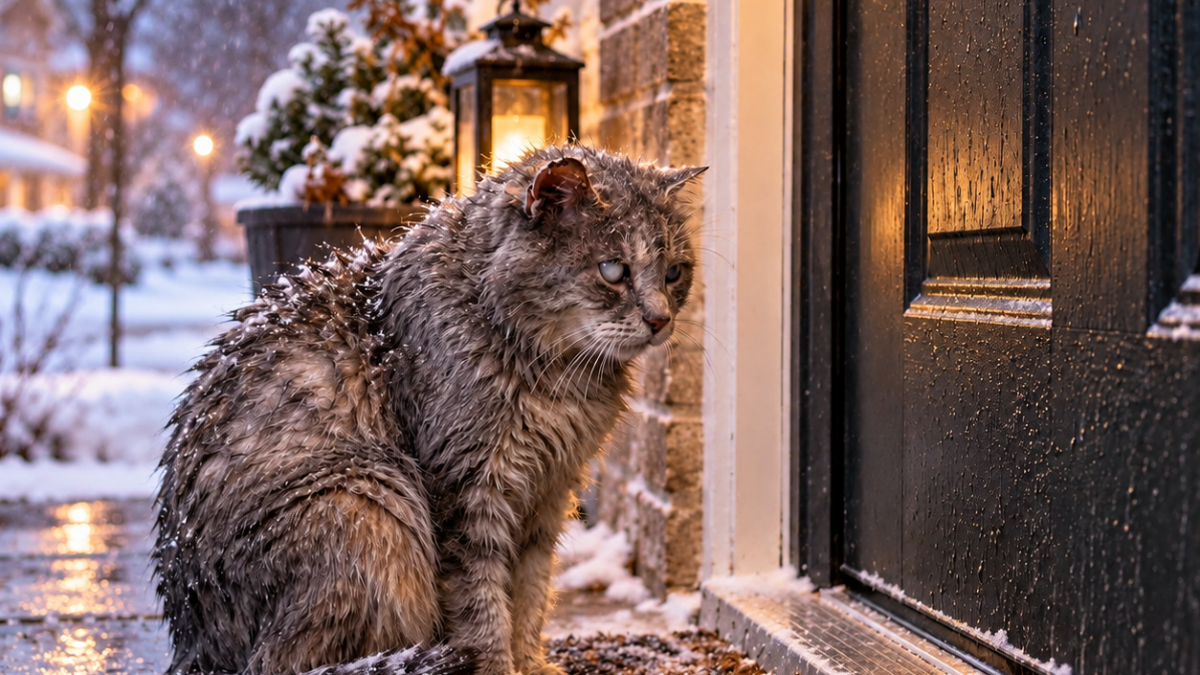
He was ash-gray, but his fur was so rough and uneven that patches looked silver and others looked nearly black.
One ear had an old nick in it.
His face was narrow.
His eyes were pale green, cloudy around the edges.
He looked ancient.
Not dignified ancient.
Used-up ancient.
Like the world had rubbed against him for too many years.
I stared at him.
He stared past me.
Into the house.
“No,” I said.
The cat didn’t move.
“I don’t know what you’re looking for, but it isn’t here.”
His left ear twitched.
I shifted my coffee to my other hand and clapped once.
He flinched so hard that guilt hit me immediately.
Then he wandered down the porch steps.
Three steps into the yard, he stopped.
He turned slowly in a circle.
Then another.
For a second, he seemed to forget why he had moved at all.
Something about it made me uncomfortable.
I looked away.
“Go home,” I muttered.
Then I went to work.
When I came back nine hours later, he was sitting on the same porch mat.
Same position.
Same stare.
“You’ve got to be kidding me.”
He looked up at me.
Then behind me.
Down the street.
Then back toward the door.
I stepped around him.
He didn’t try to come inside.
That was the odd thing.
He didn’t rub against my legs.
Didn’t meow for food.
Didn’t make any attempt to charm me.
He just stayed there.
Waiting.
The next morning he was gone.
I felt relief.
Then, as I backed my truck down the driveway, I saw him underneath the hedge.
He was watching the front door.
That evening, he was back on the mat.
The temperature was dropping, so I filled an old cereal bowl with water and put it outside.
“Don’t misunderstand this,” I told him.
He lowered his head to drink.
He drank slowly.
Painfully.
Like an old man climbing stairs.
“Water isn’t adoption.”
He ignored me.
The third day brought freezing rain.
I expected that to solve the problem.
Surely even a confused old cat possessed enough survival instinct to find a shed, crawl underneath somebody’s porch, or go wherever stray cats went when winter decided to become personal.
But when I came home, he was still there.
Soaked.
His fur clung to his ribs.
He stood inches from the door.
I parked and sat in my truck for almost a minute watching him through the windshield.
“Come on,” I whispered.
I don’t know whether I meant come on, cat, go somewhere, or come on, man, don’t get involved.
I got out.
He looked at me.
The rain had collected on his whiskers.
There was something stubborn in his expression.
Not demanding.
Not even hopeful exactly.
More like certainty.
As though he knew this was where he belonged and the only mystery was why nobody else understood it.
I went inside.
Then I came back with an old towel.
He backed away when I tried to touch him.
“Fine.”
I spread it underneath the small awning beside the door.
He watched.
I went inside again.
Ten minutes later, I looked through the window.
He was lying on the towel.
That was when he started bothering me.
Not physically.
He barely moved.
He bothered a place in me I’d spent almost a year trying not to look at.
There are certain kinds of waiting you recognize only after you’ve done them yourself.
Waiting for somebody to call.
Waiting for somebody to change their mind.
Waiting for a door to open because admitting it isn’t going to open means admitting a whole part of your life is over.
I knew that kind of waiting.
I’d done it at a kitchen table while my marriage went quiet.
I’d done it the first month after Laura moved my things into the spare room.
I’d done it with my phone in my hand three weeks after the divorce papers were signed, staring at her name and wondering whether there was still one sentence I could say that would undo everything.
There hadn’t been.
Still, I’d waited.
Now this miserable gray animal was doing the same thing on my porch.
On the fourth afternoon, I started asking questions.
The woman two houses down was unloading groceries from her SUV.
I’d seen her maybe twenty times and spoken to her twice.
“Excuse me,” I said.
She looked surprised.
“Yeah?”
“Do you know anything about an old gray cat?”
She stopped with a grocery bag against her hip.
“The one sitting on your porch?”
“That’s the one.”
Her expression changed.
Not much.
Just enough.
“Oh.”
“You know him?”
“I think so.”
She set the bag down inside her doorway.
“The people who rented your place before you had a gray cat. Old thing. Used to sit in that front window all day.”
I turned toward my house.
The cat was visible from there, a gray shape by the door.
“How long ago did they leave?”
“Last spring.”
I looked at her.
“Last spring?”
“Yeah. Kind of suddenly.”
“So this cat has been gone almost a year?”
She shrugged.
“I assumed he went with them.”
Apparently not.
“What were their names?”
She gave me the last name.
Carlson.
“Do you have their number?”
“No, but Diane across the street might. They exchanged Christmas cards or something.”
Within twenty minutes, Diane was standing in her doorway holding a little address book like we’d all fallen into 1997.
“Here,” she said, writing a phone number on the back of a grocery receipt. “I don’t know if it still works.”
“Thanks.”
She glanced toward the cat.
“That Sputnik?”
“What?”
“Sputnik. That’s what the kids called him.”
I looked back at the porch.
“That’s his name?”
“Unless there are two half-dead gray cats with one torn ear.”
Sputnik.
It was such a ridiculous name that I almost laughed.
I walked home with the receipt in my pocket.
The cat watched me approach.
“Sputnik,” I said.
His head came up.
There was no doubt.
“Oh, hell.”
I crouched down several feet from him.
“So you do have a name.”
His eyes stayed on me.
“That makes this more complicated.”
I went inside.
I remember believing the call would fix everything.
I thought I was about to give somebody good news.
Maybe the cat had slipped out during the move.
Maybe they’d searched.
Maybe he had traveled for months somehow and finally found his way back to the only address he remembered.
I imagined a family driving over that evening.
Kids crying.
Cat purring.
Everybody thanking me.
Simple.
Humane.
Finished.
A woman answered after four rings.
“Hello?”
“Hi. Sorry to bother you. Is this Mrs. Carlson?”
“Yes.”
“My name’s—well, I live in your old rental on Briarwood.”
Silence.
“Okay.”
“This is going to sound strange, but I think your cat is here.”
Another silence.
Longer.
Then she said, “Sputnik?”
There was something in her voice I couldn’t place.
Not surprise.
Not joy.
Fatigue.
“Yeah. Sputnik.”
“You’re sure?”
“Old gray cat. Torn ear. Looks like he’s about ninety years old.”
She exhaled.
“That’s him.”
I smiled automatically.
“Well, that’s good news then. He showed up four days ago. He’s been sitting outside the door. If you give me your address, I can—”
“You can keep him.”
I stopped.
“I’m sorry?”
“You can keep him.”
I actually pulled the phone away from my ear and looked at the screen.
“I don’t think you understand. Your cat came back.”
“I understand.”
“He’s been outside in freezing rain.”
Another sigh.
That sigh made something in me tighten.
“Sputnik was getting confused before we moved,” she said. “He wandered constantly. He peed outside the litter box sometimes. He would cry at night for no reason.”
“Okay.”
“We’re in an apartment now.”
“Okay.”
“And my husband works nights. Our son has asthma. It’s complicated.”
“I’m sure it is, but—”
“He’s very old.”
I looked toward the front door.
Through the narrow window, I could see Sputnik’s outline.
“I noticed.”
“He probably doesn’t have much time anyway.”
I didn’t answer.
She kept talking because people often keep talking when silence starts accusing them.
“The kids went through a lot with the move. It would just upset them more if we brought him back now and then he died.”
“So what exactly are you saying?”
“I’m saying we’re settled.”
“He isn’t.”
Silence.
“He came back to your old house.”
“I know.”
“No, I don’t think you do.”
Her voice hardened slightly.
“Look, we did everything we could.”
“Did you?”
The words came out before I could stop them.
She became quiet.
I rubbed my forehead.
“I’m not trying to start something. I just don’t understand. He’s sitting outside my door waiting for you.”
“Then take him to a shelter.”
I stared at the wall.
“What?”
“If you don’t want him, take him somewhere. We can’t take him.”
“You mean you won’t.”
“Excuse me?”
“You said can’t, but it sounds like won’t.”
“Do you have children?”
“No.”
“Then maybe you shouldn’t judge decisions you don’t understand.”
I should have let that go.
I didn’t.
“Maybe.”
My voice was calmer than I felt.
“But I understand an old cat sitting in sleet because he thinks his family is coming back.”
She breathed in sharply.
For half a second, I thought she might cry.
Instead she said, “He always was stubborn.”
Then she hung up.
I stood in my kitchen with my phone in my hand.
There are moments when anger arrives as heat.
This wasn’t like that.
This came cold.
Deep.
I looked through the door.
Sputnik had changed position.
He was sitting now.
Facing the road.
Watching headlights pass at the far end of the street.
I thought about all the things people abandon when those things become difficult.
Animals.
Parents.
Marriages.
Promises.
Sometimes we call it practicality.
Sometimes self-preservation.
Sometimes moving on.
Sometimes we probably even need to walk away.
But looking at that cat, I couldn’t find a clean word for what she had done.
I opened the door.
Cold air pushed past me.
Sputnik turned.
“All right,” I said.
He blinked.
“I’m going to make this clear. This is not because I like cats.”
He stared.
“I’m serious.”
He rose slowly.
“I don’t know anything about cats.”
He stepped toward the threshold.
“This could be temporary.”
One paw crossed into the house.
Then another.
He paused.
His nose moved.
He sniffed the hallway.
He looked toward the living room.
For just a second, something changed in his face.
Recognition.
Not of me.
Of the house.
He walked farther inside.
Slowly.
Carefully.
Like an old man entering a church he hadn’t visited in thirty years.
He stopped beside the wall.
Sniffed.
Then went toward the living room window.
His window.
The one Diane had said he used to sit in.
He stood beneath it but didn’t have the strength to jump.
Instead, he turned around, walked toward my recliner, circled once, and lowered himself beside it.
He released one long breath.
That was it.
No dramatic purring.
No grateful meow.
He just went to sleep.
I stood there looking at him.
“You’re a terrible negotiator,” I told him.
His ear twitched.
The next morning I bought cat food.
I had no idea what kind.
The aisle at the grocery store looked absurd.
Indoor.
Outdoor.
Hairball control.
Sensitive stomach.
Senior formula.
Weight management.
Grain-free.
Chicken pâté.
Ocean whitefish.
Things I wouldn’t order for myself were available to this half-dead animal in decorative cans.
A teenage employee noticed me staring.
“You need help?”
“I need food for a cat.”
He waited.
“That’s all the information I have.”
“How old?”
“Possibly Civil War.”
The kid smiled.
“Senior formula.”
I bought three kinds.
Also a litter box.
Litter.
Two bowls.
A cheap cat bed.
A scratching post, even though Sputnik looked too tired to scratch anything.
At checkout, the cashier scanned everything and said, “New cat?”
“No.”
She looked at the pile.
“Okay.”
“It’s temporary.”
“Sure.”
“I don’t like cats.”
She looked toward the senior cat food.
“Of course not.”
Sputnik ignored the cat bed.
He slept beside my recliner.
He ignored the scratching post.
He scratched nothing.
He accepted the food.
The litter box took him two tries.
The first night, at 2:13 in the morning, I woke to a sound in the hallway.
A thin, cracked cry.
I sat up.
Another cry.
I found him standing in the dark facing the bathroom wall.
“Sputnik?”
He looked around sharply.
For one terrifying second, he seemed not to know where he was.
Then he looked at me.
His shoulders lowered.
“You’re okay,” I said.
I don’t know why I whispered.
“You’re inside.”
He walked toward me.
Stopped against my ankle.
Stayed there.
I picked him up.
That was a mistake.
He hated it.
He twisted with surprising force and almost took my nose off.
“Fine! Fine!”
I set him down.
He glared at me.
“Message received.”
He followed me back to the bedroom.
Didn’t get on the bed.
Just slept outside the doorway.
The next day I made a veterinary appointment.
The clinic smelled like disinfectant and wet dog.
Sputnik sat in a borrowed carrier looking personally offended.
A golden retriever across the room tried to sniff him.
Sputnik produced a growl so deep I looked at the carrier in surprise.
“Apparently death has not affected your confidence.”
The vet was a woman in her fifties named Dr. Ramirez.
She handled him carefully.
“He’s thin.”
“I noticed.”
“Dehydrated too. Dental disease. Arthritis. Cataracts.”
“Anything good?”
She smiled.
“His heart sounds stronger than I expected.”
“That’ll do.”
She scanned him for a microchip.
The machine beeped.
Sputnik was registered.
To the Carlsons.
That bothered me.
“Can they take him back?”
Dr. Ramirez looked at me.
“Legally?”
“Yeah.”
“Possibly, if they wanted to create an issue. Microchip registration can be evidence of ownership, though it’s not always the only factor.”
“They told me to keep him.”
“Do you have that in writing?”
“No.”
“Text?”
“Phone call.”
She made a face.
“Get something documented.”
That night, I texted the number I’d called.
This is the man living at your old Briarwood address. Just confirming that you do not intend to reclaim Sputnik and told me I could keep him or take him to a shelter.
I stared at the screen.
Five minutes.
Ten.
Twenty.
Then the three dots appeared.
Yes. We can’t take him. Do whatever you think is best.
I saved the message.
Took screenshots.
Emailed them to myself.
I don’t know why.
Maybe because some part of me had already begun thinking in terms of protecting him.
Dr. Ramirez estimated Sputnik was around fifteen.
Maybe older.
He had early kidney disease.
Arthritis.
Cognitive decline.
“Basically dementia?” I asked.
“In simple terms, yes.”
I looked through the small window in the exam room.
Sputnik was sitting in the carrier glaring at a poster about fleas.
“Does he suffer?”
“Not necessarily. Confusion can be frightening, especially at night. Routine helps.”
“Anything else?”
“Warmth. Familiar places. Patience.”
I almost laughed.
“What?”
“Nothing.”
Patience.
That had never been my strength.
Laura used to tell me that.
She’d say, “You treat every problem like a broken sink. You either fix it or replace it.”
I’d hated hearing that.
Mostly because it was true.
Sputnik could not be fixed.
That may have been the first thing he taught me.
Some living things need care without improvement.
There is no victory.
No repair.
You just make today gentler than it would have been otherwise.
So we built a routine.
Breakfast at six.
Medicine at seven.
Window time after sunrise.
Nap by the heater.
Dinner at five-thirty.
At night, I left a lamp on in the hall because darkness confused him.
He still cried sometimes.
Every time, I answered.
“You’re home, buddy.”
The first time I said home, I stopped myself.
I looked around.
The rental had never felt like home to me.
It was the place I ended up.
There is a difference.
Home was the house Laura kept.
Home was the kitchen we’d remodeled.
Home was the mark on the wall where we’d measured my niece’s height every Thanksgiving.
This place was drywall and rent.
But Sputnik didn’t know that.
To him, this was the only address that made sense.
Slowly, I started seeing it through his eyes.
The radiator he liked.
The sunny square by the front window.
The creak in the third floorboard.
The smell of coffee.
The sound of my truck at 5:40 every evening.
He began waiting for that sound.
Not outside.
Inside.
I would open the door and find him sitting several feet away.
Never rushing.
Never dramatic.
Just there.
One evening, after a particularly bad day at work, I came home furious.
A project I’d spent three weeks fixing had been handed to somebody else for the presentation.
My supervisor called it “a team effort.”
I called it something different in my truck.
I walked into the house, dropped my keys too hard, and sat in the recliner.
Sputnik was by the heater.
He opened one eye.
“Don’t start.”
He closed it.
Five minutes later, he stood.
Walked across the room.
Pressed his bony shoulder against my ankle.
Then sat down.
That was all.
I laughed.
“You know, for an animal with cognitive decline, you read a room pretty well.”
He stayed there until my anger passed.
Weeks went by.
He gained two pounds.
His coat improved.
Dr. Ramirez said his kidney numbers were stable.
I bought a cushion for the window so he could climb up using a small wooden box as a step.
He spent hours watching the street.
At first that worried me.
I thought he was still waiting.
Maybe he was.
But over time, the quality of it changed.
He stopped staring at every passing car.
Stopped moving toward the door whenever footsteps crossed the sidewalk.
Sometimes he just watched birds.
Sometimes children.
Sometimes nothing.
I started calling him old man.
“Morning, old man.”
“Medicine, old man.”
“That’s my sandwich, old man.”
He stole turkey once.
I respected him more afterward.
By March, I owned a lint roller.
Then a second one.
One for the living room.
One in the truck.
This was apparently how civilizations collapsed.
Then came the Saturday when everything changed again.
It was cold but bright.
The kind of late-winter morning that lies to you through the window.
Sputnik was sleeping beneath the front window in a rectangle of sun.
I was rinsing his bowl when somebody knocked.
Careful.
Three taps.
Pause.
Two more.
I dried my hands.
Looked through the narrow glass beside the door.
A woman stood on my porch.
Two children beside her.
My stomach dropped.
I recognized her voice before she ever spoke.
The woman from the phone.
Mrs. Carlson.
The girl looked around twelve.
The boy maybe nine.
He held a faded blue blanket against his chest.
The girl held a photograph.
I opened the door halfway.
The woman looked at me.
“You live here?”
I almost laughed.
“That was established pretty early in this situation.”
She lowered her eyes.
“I’m sorry. I meant—you’re the one who called.”
“Yeah.”
The girl stepped forward.
“Is Sputnik here?”
Her voice shook.
I looked at the woman.
She looked away.
That was when I understood.
The children hadn’t known.
Behind me, I heard claws clicking.
Sputnik had woken up.
The girl’s entire face changed.
“Sputnik?”
He stopped.
His ears went forward.
She covered her mouth.
“Oh my God.”
The boy pushed around his mother.
“Where is he?”
I opened the door wider.
Sputnik stood about fifteen feet away.
He stared.
The girl dropped to her knees outside the threshold.
“Sputnik, baby.”
Her voice broke.
Something moved through his face.
Recognition maybe.
Memory.
Scent.
I don’t know.
I stepped aside.
“Come in.”
The mother hesitated.
The kids didn’t.
They entered like they’d been waiting months for permission.
The girl knelt on the rug.
The boy sat beside her.
Sputnik took one step.
Then another.
He looked at the girl.
Then at the boy.
Then at me.
The girl’s eyes filled.
“It’s us.”
She held out her fingers.
Sputnik approached.
Sniffed.
She started crying.
“I knew he’d remember me.”
He let her touch his cheek.
Once.
Twice.
The boy whispered, “Hey, space cat.”
Sputnik blinked.
I hadn’t heard that nickname before.
The boy laughed through his tears.
“He remembers.”
Maybe he did.
I hope he did.
But then Sputnik stepped away.
He crossed the rug.
Walked directly to me.
And leaned against my leg.
Nobody spoke.
It wasn’t a movie.
There was no swelling music.
No magical understanding.
Just an old animal choosing where he felt safe.
The girl’s hand remained extended for several seconds.
Then dropped.
The mother saw it.
Her expression tightened.
“He was ours,” she said.
I looked at her.
“Was.”
The word landed harder than I intended.
She crossed her arms.
“He’s still registered to us.”
So that’s why she had come prepared.
I felt my pulse kick.
“Interesting.”
“What is?”
“Three months ago, you told me to take him to a shelter.”
The girl’s head snapped toward her mother.
“What?”
Mrs. Carlson’s face changed.
“Not now.”
“What does he mean?”
“Honey—”
“You said he got lost.”
The boy turned toward her too.
His blue blanket slid into his lap.
“You said he ran away when we moved.”
The woman’s mouth opened.
Closed.
I felt the room tightening.
I wanted to stop.
These were children.
But I also thought about Sputnik in freezing rain.
I thought about four days on the porch.
The road.
The waiting.
“You told them he ran away?” I asked.
She looked at me with open anger now.
“This is a family matter.”
“It became my matter when he showed up half-starved.”
The girl stood.
“Mom.”
“Sweetheart, listen to me.”
“You told us you looked for him.”
“We did.”
“For how long?”
The woman swallowed.
The boy whispered, “Did you leave him?”
Nobody answered.
That silence was worse than a confession.
The girl backed away from her mother.
“You left him?”
“We were moving.”
“That isn’t an answer.”
“We couldn’t take him to the apartment.”
“You said pets were allowed.”
“Not like that.”
“Like what?”
The woman’s eyes filled.
“Old! Sick! Confused!”
The room went still.
Sputnik flinched at the raised voice.
I crouched automatically.
“Easy.”
He moved behind my ankle.
The girl stared at her mother.
“So because he was old?”
“No.”
“You just said—”
“I said it was complicated.”
“No, you always say things are complicated when you don’t want to tell us what you did.”
That one hit the woman visibly.
“Do not speak to me like that.”
“Then stop lying to me.”
“Enough.”
“No!”
The girl’s voice cracked.
“You made me think he got lost. I cried every night for two months.”
Her mother’s face folded.
“I was trying to protect you.”
“From what?”
“From watching him die!”
The girl stared.
Mrs. Carlson pressed both hands against her forehead.
Her voice dropped.
“You were already losing your school. Your friends. Your room. Your father and I were fighting constantly. Tyler was getting sick. We were living out of boxes. Sputnik was having accidents everywhere. He cried all night. He got outside twice.”
The boy looked down.
“I would’ve cleaned it.”
“I know.”
“I would’ve helped.”
“I know.”
“You didn’t ask.”
She started crying.
“I know.”
There are moments when a villain becomes a person right in front of you.
That doesn’t erase what they did.
Sometimes it makes it harder.
If she had been cruel in a simple way, I could have hated her cleanly.
But sitting on my sofa with her daughter staring at her like a stranger, she looked exhausted.
Ashamed.
Human.
“I thought he’d be better here,” she whispered.
I couldn’t let that pass.
“Alone?”
She looked at me.
“I thought somebody would find him.”
“That isn’t the same thing as making sure somebody did.”
“I know that now.”
“You knew it then.”
She closed her eyes.
The boy stood and walked toward Sputnik.
He didn’t pick him up.
Didn’t grab.
He laid the blue blanket down beside him.
“This was his.”
Sputnik sniffed the edge.
“Can he have it?”
I nodded.
“Sure.”
The boy looked at me.
“Can he stay here?”
His question cut through every adult argument in the room.
Can he stay where he’s safe?
That’s all he was asking.
Not who had legal ownership.
Not whose name was on a microchip.
Not who deserved forgiveness.
I looked at Sputnik.
Then at the boy.
“Yes.”
Mrs. Carlson opened her eyes.
“I wasn’t necessarily saying we were taking him today.”
“Then why are you here?”
She looked at her children.
“Our old neighbor told them.”
The girl wiped her face.
“Diane saw Mom at the grocery store.”
Mrs. Carlson nodded.
“They confronted me. I told them where he was.”
“You told us he might be here,” the girl corrected.
Another lie softened for easier handling.
The woman looked toward Sputnik.
“I thought maybe seeing him would help.”
“Help who?”
She didn’t answer.
The girl sat back down.
This time she didn’t reach toward the cat.
She just watched him.
“When he was little,” she said, “he used to sleep on my homework.”
The boy sniffed.
“He ate Christmas lights.”
“One Christmas light,” his sister said.
“Three.”
“One strand.”
“That’s worse.”
Despite everything, I laughed.
The girl laughed too.
Mrs. Carlson covered her face.
For several minutes, nobody tried to fix anything.
Maybe that was the first honest thing we did.
Eventually the woman lowered her hands.
“What do you want me to say?”
She asked it without anger.
Just defeat.
“I don’t know.”
I leaned against the wall.
“The truth would be a start.”
Her children watched her.
She stared at the floor.
Then finally she said it.
“We left him.”
The girl’s face crumpled.
Tyler hugged the blanket around his stomach.
Mrs. Carlson kept going.
“We left him because I was scared.”
I hadn’t expected that word.
She looked toward Sputnik.
“My father had dementia.”
The room changed again.
“He got sick when I was nineteen. Toward the end, he forgot my name. He wandered. He accused me of stealing from him. He bit a nurse because he thought she was trying to kill him.”
Her hands shook.
“When Sputnik started getting confused, I’d wake up to him crying and suddenly I was nineteen again. I smelled that nursing home. I heard my father calling me by my mother’s name. I knew what was coming.”
The girl whispered, “You never told us that.”
“No.”
“Why?”
“Because I didn’t want to give you my fear.”
She laughed once bitterly.
“Apparently I found another way to do it.”
The room stayed quiet.
“I kept telling myself we didn’t have enough money. Enough room. Enough energy. All of that was true.”
She looked at me.
“But none of it was the whole truth.”
“What was?”
“I didn’t want to watch something I loved disappear again.”
That was the first moment I understood her.
Not forgave.
Understood.
There’s a difference people confuse too often.
I knew what it meant to run from an ending.
I’d done it emotionally in my marriage.
Laura used to ask me to sit with problems that couldn’t be fixed immediately.
I would leave the room.
Go to the garage.
Work late.
Tell myself I was giving things space.
Really, I was avoiding helplessness.
Mrs. Carlson had done something far worse.
But I recognized the mechanism.
Fear dressed as practicality.
“I thought leaving him would spare us,” she said.
The girl stared at Sputnik.
“Who did it spare?”
Her mother had no answer.
Sputnik walked onto the blue blanket.
Turned twice.
Lay down.
Tyler smiled through tears.
“He remembers it.”
Maybe.
Or maybe it was soft.
Sometimes mercy doesn’t require certainty.
They stayed another fifteen minutes.
When they left, the girl paused at the door.
“Can I come see him again?”
I looked at her mother.
Then at Sputnik.
“Maybe.”
Her face dropped.
“Not because of you.”
I nodded toward Sputnik.
“He gets tired. And confused. I have to do what’s good for him.”
She nodded immediately.
“Okay.”
That answer mattered.
Mrs. Carlson stopped beside me.
“I’m sorry.”
“I believe you.”
Her eyes lifted.
“But that doesn’t make it disappear.”
“I know.”
They left quietly.
No slammed doors.
No threats.
No dramatic scene on the lawn.
Just three people walking down my porch steps carrying a truth heavier than the one they’d arrived with.
That night, Sputnik slept on Tyler’s blanket.
I sat in the recliner watching him.
I should have felt victorious.
Instead I felt sick.
The girl’s face stayed with me.
The betrayal in it.
People imagine justice feels clean.
Often it doesn’t.
Sometimes the truth punishes people who didn’t commit the crime.
The children hadn’t abandoned Sputnik.
They had simply inherited the consequences.
A week later, I found an envelope in my mailbox.
No stamp.
My address written in careful block letters.
Inside were three photographs.
Sputnik younger.
Fatter.
Eyes bright.
In one, he sat between the children on a couch.
In another, he wore a birthday hat and looked furious.
In the third, he sat in my front yard years earlier, staring at the camera like he owned the mortgage.
There was a note.
I didn’t know.
I’m sorry he waited.
Thank you for opening the door.
Then beneath that:
I’m still mad at Mom, but I think sometimes people stop being brave when things get sad.
I read that line five times.
A twelve-year-old had managed to explain something most adults spend their lives avoiding.
Sometimes people stop being brave when things get sad.
I put the note in my kitchen drawer.
The pictures went on the mantel.
Sputnik sniffed the birthday photograph and sneezed directly on it.
“Sentimental as ever.”
Two weeks later, Mrs. Carlson came alone.
I nearly didn’t open the door.
She stood with both hands visible, like approaching a suspicious dog.
“I’m not asking for him back.”
“Good opening.”
“I deserved that.”
I waited.
She held out a paper bag.
“His old toy.”
Inside was a red felt mouse attached to a frayed string.
One eye missing.
Tail mostly gone.
“He carried it everywhere,” she said. “He used to scream at it at three in the morning.”
I looked at Sputnik asleep by the heater.
“That sounds more annoying than the current version.”
“He was horrible.”
She smiled.
Then the smile vanished.
“I loved him.”
I didn’t respond.
“I know how stupid that sounds.”
“No.”
I looked at her.
“It sounds human. That’s the problem.”
She nodded slowly.
“I loved him and still failed him.”
“Both things can be true.”
Tears filled her eyes.
“I’ve spent my whole life thinking bad people do bad things and good people do good things.”
“Convenient system.”
“Very.”
She looked toward the floor.
“My daughter barely speaks to me.”
“That may take time.”
“Do you think she’ll forgive me?”
I almost said that wasn’t my business.
Instead I said, “Maybe stop asking what you have to do to be forgiven.”
She frowned.
“What should I ask?”
“What she needs from you while she’s angry.”
Her face shifted.
“That’s annoyingly wise.”
“Don’t spread it around.”
She laughed through her tears.
Then she looked toward Sputnik.
“If it gets bad…”
I knew what she meant.
“If the end comes, would you tell us?”
I folded my arms.
“He stays here.”
“Yes.”
“The kids can come if it’s good for him.”
“Yes.”
“Not because you need absolution.”
Her chin trembled.
“I know.”
I believed her.
That Sunday, the kids visited.
One hour.
That was my rule.
The girl brought a paperback and sat on the floor reading.
Apparently she’d done that when Sputnik was younger.
He settled beside her voice.
Tyler brought a feather toy.
For thirty seconds, Sputnik became someone else.
He crouched.
His pupils widened.
He swatted.
Missed.
Tried again.
Caught the feather.
Then looked so surprised that all four of us laughed.
Mrs. Carlson sat in a chair by the window.
She didn’t interfere.
Didn’t claim him.
When the hour ended, the girl kissed her fingers and touched Sputnik’s forehead.
Tyler put the felt mouse beside his blanket.
Mrs. Carlson looked at me.
I understood the question.
I nodded.
She knelt.
“I failed you,” she whispered.
Sputnik opened one cloudy eye.
Then closed it.
I don’t call that forgiveness.
Animals aren’t priests.
They don’t assign absolution.
They respond to warmth.
Safety.
Fear.
Hunger.
Habit.
Trust.
A gentle hand may be accepted without history being erased.
There was something beautiful about that.
And something terrifying.
After that, the children visited every other Sunday.
Never more than an hour.
They brought photos.
Stories.
Once, Tyler brought a drawing of Sputnik as an astronaut.
“Why astronaut?”
“His name is Sputnik.”
“Right.”
“You know Sputnik was a satellite?”
“I’m old, not stupid.”
He considered me.
“How old?”
“Go read to the cat.”
Spring arrived slowly.
The dirty snow disappeared.
The tree outside the window developed red buds.
Sputnik’s body softened into the season.
Then began to fail.
Not dramatically.
That would have been easier.
He just became less.
Less hungry.
Less steady.
Less interested in climbing onto the window cushion.
His world narrowed.
From the whole house to the living room.
From the living room to the heater.
From the heater to the blanket.
Dr. Ramirez adjusted his medication.
We changed food.
Fluids.
Supplements.
Every appointment ended with the same quiet phrase.
“Quality of life.”
I hated it.
The phrase sounded like an accounting term.
I wanted a number.
A test.
Something that would tell me exactly when love became selfish.
Instead she gave me questions.
Is he eating?
Can he rest?
Is he in pain?
Does he still seek comfort?
Are the good moments still winning?
I started keeping a notebook.
Good day.
Bad night.
Ate half breakfast.
Sat in window fifteen minutes.
Cried at 2 a.m.
Used litter box.
Purred while brushed.
The notebook became evidence for a trial with no judge.
One evening, I found him standing in the hallway.
He was crying.
Not the usual single confused sound.
Again.
Again.
Again.
I sat on the floor.
“Sputnik.”
He looked at me.
For once, he didn’t just lean against my ankle.
He climbed into my lap.
All the way.
Slowly.
Painfully.
He turned once.
Collapsed against my chest.
I froze.
In all those months, he had never done that.
He tolerated me.
Trusted me.
Slept beside me.
But he had never surrendered his full weight.
I could feel every rib.
Every breath.
I wrapped one arm around him.
“Okay.”
My voice broke.
“Okay, old man.”
We sat on the hallway floor for almost an hour.
I knew.
Bodies tell truths before minds accept them.
The next morning, I called work.
“I’m not coming in.”
My supervisor said, “Everything all right?”
I looked at Sputnik sleeping beside the heater.
“No.”
That was all.
Two days later, I took him to Dr. Ramirez.
She examined him longer than usual.
Then sat across from me.
“His kidneys are worse.”
“How much worse?”
“Significantly.”
“What do we do?”
“We can give fluids. Change medication. We can probably buy time.”
“How much?”
She didn’t answer immediately.
“Days. Weeks. Maybe more.”
“Good time?”
“That’s the question.”
I hated her for saying it.
Then hated myself because she was trying to help.
Sputnik sat on the table looking exhausted.
“If this were your cat?”
She looked at him.
Then me.
“I would take him home today.”
My throat closed.
“And then?”
“Watch him.”
“For what?”
“For when comfort stops winning.”
I nodded like a man receiving instructions.
Then I sat in my truck afterward and cried so hard I couldn’t turn the key.
That evening, I texted the girl.
He’s still here. He’s much more tired.
Her reply came immediately.
Can we visit tomorrow?
Yes.
Then another message.
Thank you for not making his last chapter lonely.
I put the phone down.
That sentence wrecked me.
His last chapter.
Not ownership.
Not records.
Not who loved him first.
Not who failed.
Not who deserved to feel better afterward.
Would his last chapter be lonely?
That was the only question left.
The next morning, Sputnik woke before dawn.
I heard his nails on the floor.
I opened my eyes.
He wasn’t beside the heater.
I found him at the front door.
Same place.
Same position as the first morning.
Standing on the mat.
Facing outward.
My chest seized.
“No.”
For a terrible second, I thought he had forgotten everything.
Me.
The months.
The warm room.
The blanket.
That his mind had carried him backward to the day he was still waiting for the Carlsons.
I knelt beside him.
“You waiting on somebody?”
He looked at me.
Then the door.
I opened it.
The morning was pale blue.
Cold but not cruel.
He stepped outside.
Slowly.
One paw.
Pause.
Another.
He sat on the porch mat.
The same mat.
The same place where he’d spent four freezing days staring down the road.
I sat beside him in my socks.
He did not look down the road.
That is what I remember most.
He looked at the yard.
The wet grass.
The azalea bush.
A robin hopping near the mailbox.
The first strip of sunlight appearing over the neighbor’s roof.
After a while, he leaned against my leg.
Then lowered his head onto my foot.
We sat there while morning arrived.
No cars he cared about.
No family expected.
No waiting.
After several minutes, Sputnik stood.
Turned around.
Walked back inside.
He wasn’t waiting anymore.
He had only wanted to see the porch.
By noon, he refused food.
By two, water.
At 2:40, he tried to stand and couldn’t.
I sat beside him.
“You don’t have to prove anything.”
His breathing was shallow.
I called Dr. Ramirez.
Then I called Mrs. Carlson.
She answered on the first ring.
“It’s time,” I said.
Silence.
Then a broken inhale.
“We’re coming.”
They arrived twenty minutes later.
The girl ran inside, then stopped herself before reaching Sputnik.
That restraint told me how much she’d learned.
She knelt slowly.
“Hey, baby.”
Tyler placed the blue blanket over Sputnik like a cape.
Mrs. Carlson sat in the chair by the window and cried silently.
The girl read from the same paperback.
Tyler told Sputnik he was still the meanest cat he’d ever known.
Sputnik opened his eyes once.
Looked toward Tyler.
Then the girl.
Then his old owner.
Then me.
I put my palm beneath his head.
He settled into it.
A little after four, Dr. Ramirez arrived.
She had offered to come to the house.
I hadn’t known vets did that.
I will be grateful for it until I die.
She explained everything.
Softly.
No rush.
We all stayed on the floor.
The first medication made him relax.
His breathing became easier.
The girl put one hand lightly against his back.
Tyler held the red felt mouse.
Mrs. Carlson asked, “Can I touch him?”
I looked at Sputnik.
Then nodded.
She placed two fingers against his paw.
“I’m sorry,” she whispered.
The girl looked at her mother.
Not with forgiveness.
Not yet.
But not with hatred either.
Something between them had shifted over those months.
Truth doesn’t always repair a relationship.
But lies guarantee it can’t heal.
Mrs. Carlson had stopped lying.
She’d attended counseling.
I knew because the girl once mentioned it casually.
She’d volunteered at a senior animal rescue twice a month.
Not to prove she was good.
At least I don’t think so.
Maybe initially.
But eventually the work changed her.
She cleaned cages.
Washed blankets.
Sat with old animals nobody wanted.
One Sunday she told me, “I used to think the saddest thing was loving something you were going to lose.”
I asked, “What do you think now?”
“The saddest thing is making it lose you first because you’re scared.”
That stayed with me.
Now she sat beside Sputnik.
Facing the ending she’d once run from.
Dr. Ramirez gave me time.
I rested my forehead against Sputnik’s.
“You did good, old man.”
His ear moved.
“You were a pain.”
Nothing.
“You ruined my furniture.”
His tail shifted once.
“That better not be disagreement.”
The girl laughed through tears.
I swallowed.
“You can go.”
Those were the hardest words I’d ever said.
Not because I believed he understood the language.
Because I understood it.
Love is not always holding.
Sometimes love is refusing to make someone stay for your sake.
When Dr. Ramirez gave the final medication, Sputnik’s breathing slowed.
Then slowed again.
His head remained in my hand.
The front window filled with late-afternoon gold.
The girl was reading softly.
Tyler was crying without sound.
Mrs. Carlson had one hand over her mouth.
And somewhere between one breath and the next, Sputnik stopped.
No drama.
No movement.
Just absence.
I waited for another breath.
It didn’t come.
Dr. Ramirez listened with her stethoscope.
Then placed her hand on my shoulder.
“He’s gone.”
The girl collapsed against her mother’s chest.
Mrs. Carlson wrapped both arms around her.
Tyler buried his face in the blue blanket.
I bent over Sputnik.
I cried into his fur.
I wasn’t embarrassed.
There was no dignity left to protect.
After the clinic collected him, the house became unbearable.
The water bowl.
Medicine.
The litter box.
Hair on the recliner.
The window cushion.
The red mouse under the table.
Small things.
That’s what shocked me.
A living creature can occupy an entire emotional universe and leave behind objects that fit inside a grocery bag.
I sat on the floor holding that stupid felt mouse.
I remembered the first night.
Me telling him water wasn’t adoption.
Temporary.
I don’t like cats.
Months later, the silence where his breathing used to be hurt so much I couldn’t stand up.
Three days after Sputnik died, Laura called.
My ex-wife.
We hadn’t spoken in months except about a tax document.
“I heard about your cat.”
I wiped my eyes.
“He wasn’t my cat.”
She laughed.
There was something comforting about hearing her laugh without resentment.
“Still doing that?”
“Doing what?”
“Pretending you don’t care about things until they’re already inside your chest.”
I almost got defensive.
Then stopped.
“Apparently.”
“I’m sorry.”
“Thanks.”
She paused.
“Sounds like he got lucky.”
I looked around the empty room.
“I think I did.”
After we hung up, I realized something.
For the first time since the divorce, I didn’t replay our conversation wondering what I should have said differently.
Sputnik had changed something in me.
Not dramatically.
He hadn’t fixed my marriage.
Hadn’t cured loneliness.
Hadn’t turned me into a saint.
He had simply forced me to stay present with something I couldn’t fix.
That is harder than it sounds.
A week later, I received three letters.
One from the girl.
One from Tyler.
One from their mother.
Tyler’s was mostly a drawing.
Sputnik had enormous whiskers, angry eyebrows, and what appeared to be laser beams coming out of his eyes.
Underneath, Tyler wrote:
HE WAS VERY OLD BUT STILL DANGEROUS.
I laughed until I cried.
The girl’s letter was longer.
She wrote about how angry she’d been.
How she still sometimes was.
How she had learned that loving somebody doesn’t mean pretending what they did was okay.
Then she wrote:
You didn’t make us hate Mom. You made her tell us the truth. I think that’s different.
At the bottom:
Thank you for letting Sputnik choose.
Mrs. Carlson’s letter took me longest to open.
No excuses.
No explanations.
Just accountability.
She wrote that she’d started volunteering permanently at the rescue.
That there was a seventeen-year-old black cat there nobody wanted because he needed medication twice a day and sometimes missed the litter box.
She had started fostering him.
His name was Walter.
I laughed at that.
Then I reached the final paragraph.
I thought love was measured by how much it hurt to lose Sputnik. You showed my children, and me, that love is measured by how well you stay when someone becomes hard to keep.
I sat with that sentence for a long time.
Eventually, I copied it onto a scrap of paper and put it in the kitchen drawer beside the girl’s first note.
But she was wrong about one part.
I didn’t teach them that.
Sputnik did.
Old.
Confused.
Inconvenient Sputnik.
The cat somebody thought was too sad to bring along.
The cat who returned to the only house he remembered and spent four freezing days waiting for people who had already moved on.
The cat who walked into my life without asking permission.
The cat who taught a divorced man who wanted no attachments that care is sometimes nothing more glamorous than getting up at two in the morning because somebody is scared.
Months passed.
Summer came.
I kept the window cushion.
For a while, I told myself I hadn’t gotten around to moving it.
That wasn’t true.
I liked seeing it.
In August, Mrs. Carlson texted me a picture.
Walter.
The old black foster cat.
He was asleep on her chest.
The message underneath said:
He screamed from 1:00 to 3:00 a.m. last night because he forgot where he was.
A second message came.
I stayed.
I stared at those two words.
I stayed.
There it was.
Not redemption.
Not a clean erasure.
You cannot undo abandonment by helping another animal.
Life isn’t mathematics.
One good act doesn’t cancel one bad one.
But people can become better than the worst thing they’ve done.
If they’re willing to look at it without flinching.
If they’re willing to change.
The girl eventually forgave her mother.
Not suddenly.
Not in some dramatic hug.
I watched it happen in pieces.
A shared joke.
A hand held at the vet.
The girl defending her mother’s rescue work when somebody at school mocked “crazy cat people.”
Trust returning one inch at a time.
Tyler seemed to forgive faster.
Children sometimes do.
Or maybe he just understood differently.
One evening in October, they invited me to a small fundraising event at the rescue.
I almost didn’t go.
Crowds aren’t my thing.
Emotional animal events definitely aren’t my thing.
Then I thought about Sputnik.
So I went.
The rescue occupied an old converted warehouse.
There were folding tables.
Coffee.
Homemade cookies.
Photos of adoptable animals.
Near the front was a board displaying pictures of elderly pets who had found homes.
Sputnik’s picture was there.
The one from my mantel.
The birthday hat.
Underneath:
SPUTNIK — PROOF THAT OLD DOES NOT MEAN DISPOSABLE.
I stood staring at it.
Mrs. Carlson approached.
“I hope that’s okay.”
My throat tightened.
“Yeah.”
The girl joined us.
“It was my idea.”
“Of course it was.”
She smiled.
A woman I didn’t know stopped beside the board.
“Beautiful cat.”
“He was horrible,” I said.
The girl laughed.
Mrs. Carlson laughed too.
For a moment, none of us were the people we’d been that winter.
We were just three people standing beside a photograph of an animal who had forced us to become more honest.
Near the end of the event, the rescue director thanked volunteers.
Mrs. Carlson was called forward.
She looked horrified.
The girl pushed her gently.
“Go.”
Mrs. Carlson stood in front of maybe sixty people.
She gripped the microphone with both hands.
“I wasn’t planning to speak.”
Everybody says that before speaking.
She looked toward Sputnik’s picture.
“I started volunteering here because I failed an animal.”
The room became quiet.
I watched the girl’s face.
Mrs. Carlson continued.
“I loved him for years. Then he got old. Confused. Difficult. And during the hardest period of my life, I convinced myself that leaving him behind was somehow kinder than watching him decline.”
Nobody moved.
“I lied to my children about it.”
The girl lowered her eyes.
“I told myself I was protecting them. I was protecting myself.”
Her voice trembled.
“Someone else found him. Someone who didn’t even want a cat.”
A few people laughed softly.
I stared at the floor.
“He gave Sputnik the ending I should have given him.”
She looked at me.
I shook my head slightly.
Don’t make me a hero.
She seemed to understand.
“Actually,” she said, “that’s not quite right.”
She looked back at the audience.
“Sputnik found the person he needed.”
Better.
“And I learned something I wish I hadn’t needed to learn this way.”
She paused.
“Love isn’t proved when caring is convenient.”
The room was completely silent.
“It’s proved when staying costs you something.”
She stepped away from the microphone.
No dramatic applause at first.
Then one person clapped.
Then another.
Soon the room joined.
Mrs. Carlson didn’t smile proudly.
She cried.
The girl walked forward and hugged her.
That was the closest thing to justice I ever saw.
Not humiliation.
Not punishment.
Accountability.
The truth spoken publicly by the person who once tried hardest to hide it.
A child hearing her mother say, without excuses, I failed.
A woman becoming someone who no longer ran from old age because it frightened her.
Sputnik never knew any of that.
Maybe that’s appropriate.
Animals shouldn’t have to become symbols to deserve kindness.
He deserved a warm room because he was cold.
Food because he was hungry.
Patience because he was confused.
Company because he was alone.
That should have been enough.
The following February, one year after he first appeared, I woke before sunrise.
For no reason, I walked to the front door.
The porch was covered in frost.
The mat had been replaced.
I opened the door.
Cold air came in.
For a second, I saw him there exactly as he’d been.
Thin.
Wet.
Stubborn.
Waiting.
Memory can be cruel that way.
Then it passed.
I stepped onto the porch.
Across the street, somebody started a car.
A dog barked.
The sky brightened.
I thought about the man I’d been when Sputnik arrived.
Divorced.
Angry.
Convinced needing nobody was the same thing as being strong.
I had been waiting too.
Not for Laura.
Not really.
I was waiting for life to stop hurting before I participated in it again.
Sputnik never gave me that option.
He needed breakfast whether I was sad.
Medicine whether I was tired.
A voice in the hallway whether I felt like being alone.
He had no interest in my emotional timetable.
Caring for him pulled me back into the world.
I still like clean counters.
I still prefer quiet rooms.
I still don’t call myself a cat person.
People laugh when I say that.
Especially because there is currently a cardboard carrier sitting in my hallway.
That part came later.
Six months after the fundraiser, the rescue director called.
“I have a problem.”
“No.”
“You haven’t heard the problem.”
“I know what kind of organization you run.”
She laughed.
“His name is Clarence.”
“Absolutely not.”
“He’s fourteen.”
“No.”
“One eye.”
“Stop.”
“Arthritis.”
“I’m hanging up.”
“His foster placement fell through.”
I closed my eyes.
“Why are you calling me?”
“Because he hates almost everybody.”
“That’s your sales pitch?”
“You have experience.”
“With being hated?”
“With stubborn old men.”
I looked toward Sputnik’s window cushion.
Still there.
“Temporary?”
“Of course.”
That was how Clarence arrived.
He is orange.
Loud.
Mean.
He hates my shoes.
He steals food.
He has absolutely no respect for personal boundaries.
Within two weeks, he took over Sputnik’s window.
The first time I saw him sleeping there in the afternoon sun, I had to leave the room.
Grief is strange.
It doesn’t always mind new love.
Sometimes it just needs reassurance that new love isn’t replacement.
Clarence isn’t Sputnik.
He never will be.
That’s the point.
Love doesn’t require vacancies.
One life doesn’t evict another from your heart.
I eventually framed Sputnik’s three photographs.
The birthday hat is still my favorite.
Tyler’s drawing hangs beside them.
So does the scrap of paper with Mrs. Carlson’s sentence.
Love is measured by how well you stay when someone becomes hard to keep.
I think about that more often than I’d like.
Because the lesson reaches farther than animals.
It reaches into marriages.
Parenthood.
Friendship.
Aging parents.
Illness.
Depression.
Fear.
Every place where human beings become inconvenient to one another.
There are relationships we must leave.
There are situations where staying becomes harmful.
But there are also times when we disguise discomfort as impossibility.
When we call abandonment “moving on.”
When we tell ourselves somebody won’t notice.
Won’t understand.
Won’t remember.
Sputnik remembered enough.
He remembered the house.
The door.
The road.
He remembered waiting.
But eventually, he learned something new.
The sound of my truck.
The heater.
My voice in the hallway.
The hand that opened the door.
He was only with me a few months.
That’s all.
A tiny fraction of his life.
Yet those months changed four people.
A bitter divorced man.
A frightened mother.
A betrayed girl.
A little boy with a blue blanket.
Maybe that’s what lives do.
They overlap.
They leave marks.
They teach things they never intended to teach.
Sputnik didn’t save me.
I don’t like saying animals save people because it makes them sound responsible for repairing us.
He wasn’t.
He was an old cat trying to be warm.
But needing him gave me a reason to become someone I respected again.
That’s different.
What did I give him?
A house.
Food.
Medicine.
A sunny window.
A blanket.
A ridiculous red mouse.
A hand underneath his head when breathing became hard.
Most importantly, an ending that was not lonely.
What did he give me?
A reason to come home.
A reason to stop treating attachment like weakness.
A reason to understand that sometimes strength looks very ordinary.
It looks like cleaning a mess without making somebody feel ashamed.
Repeating a name because a confused mind forgot where it was.
Sitting awake when you’d rather sleep.
Showing up.
Staying.
Opening the door.
The first time I saw Sputnik, he was waiting for people who had already decided they were done carrying him.
The last time he sat on that porch, he wasn’t waiting for anyone.
He looked at the sunrise.
Leaned against my leg.
Then walked back inside.
Home.
He had finally stopped waiting for the people who left.
And somewhere along the way, so had I.








