The Old Cat Stopped Eating After We Called Him Abandoned—Then I Found a Note Sewn Inside His Collar
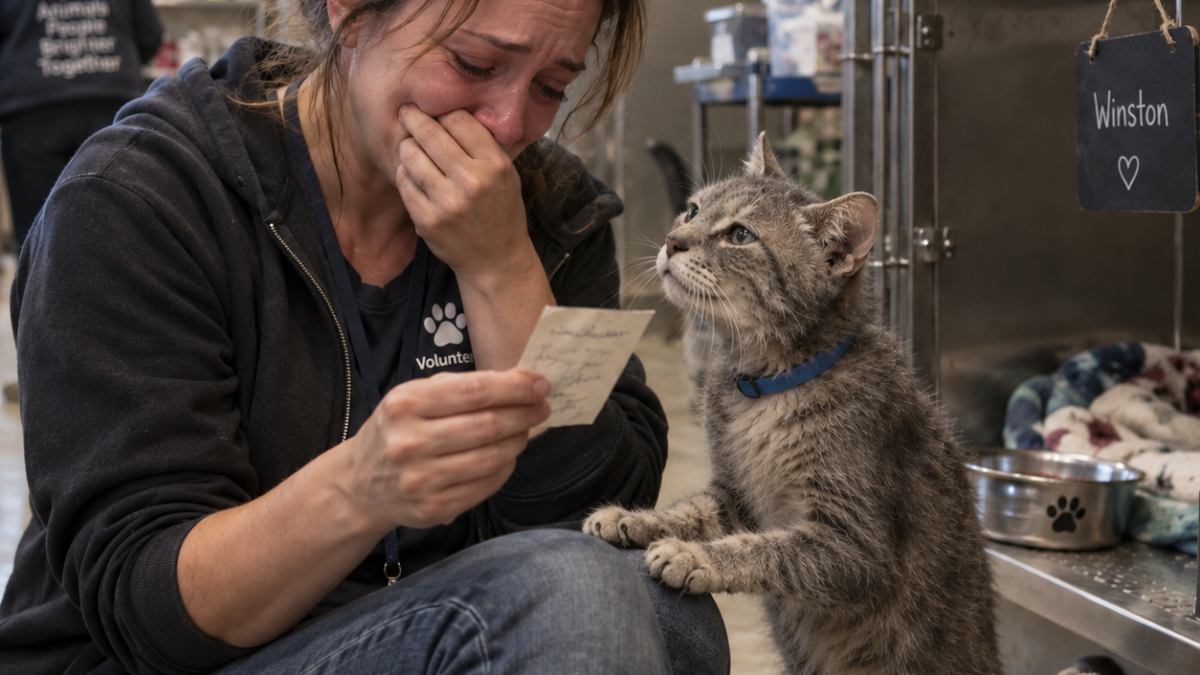
The Old Cat Stopped Eating After We Called Him Abandoned—Then I Found a Note Sewn Inside His Collar.
The old gray cat stopped eating the same day our shelter paperwork labeled him abandoned, but every time the front door opened, he lifted his head like the person who left him might still come back.
Three days later, I cut open a crooked seam inside his blue collar and found a dying man’s confession hidden where no one had thought to look.
And when I finally learned why Winston had been left beside a church, I stopped asking whether the cat could survive the loss and started asking why a human being had been forced to make that choice at all.
I had worked at shelters long enough to know the different shapes fear could take.
Some cats exploded.
They hissed, struck, screamed, threw themselves against kennel doors, and made it clear that if the world intended to hurt them again, they planned to hurt it first.
Some disappeared.
They squeezed themselves behind litter boxes, flattened beneath blankets, or pressed so tightly into corners that you could almost believe they were trying to become part of the wall.
Some froze.
Eyes huge.
Body rigid.
Breathing fast enough to frighten you.
Winston did none of those things.
He gave up.
That was what scared me.
We did not know his name then.
On the intake sheet, somebody had written:
Senior male.
Gray tabby.
Blue collar.
Found in carrier beside donation bins near St. Matthew’s Church.
No microchip.
No owner information.
No visible injuries.
The box for “reason surrendered” had been left empty.
By the time his paperwork reached me, somebody had typed one word into the computer.
ABANDONED.
I hated that word almost immediately.
Not because it was technically wrong.
Because of the way Winston reacted every time somebody entered the lobby.
The front door would open.
His head would rise.
His ears would point forward.
For half a second, that old cat became alert in a way nothing else could make him.
Food didn’t do it.
Treats didn’t.
The sound of another cat didn’t.
My voice didn’t.
Only the door.
Then he would realize the footsteps weren’t the ones he knew.
His ears would fall.
His chin would lower.
He would turn toward the wall again.
The first day, I told myself I was imagining things.
Shelter workers project sometimes.
We try not to.
We have to.
If you give a full human story to every animal that comes through the door, you will not last six months.
You learn to work with what you can prove.
Weight.
Temperature.
Hydration.
Vaccination history.
Behavior.
Appetite.
You learn to keep moving because there is always another kennel.
Another intake.
Another frightened animal.
Another phone call from somebody saying they have to surrender a pet by five o’clock because their landlord found out.
Another person crying because their mother died.
Another person angry because a dog chewed furniture.
Another litter of kittens in a cardboard box.
Another old animal nobody planned for.
You become efficient because efficiency is how you survive caring about too much.
But Winston made efficiency feel cruel.
He did not eat that first night.
Or the next morning.
I warmed wet food.
Nothing.
I tried tuna.
Nothing.
Chicken.
Nothing.
A squeeze treat every cat in the building would normally sell state secrets for.
Winston turned his face away.
PART2:
By the second evening, Mara from the front desk found me crouched outside his kennel.
“You’re doing the stare again.”
“What stare?”
“The one where you decide an animal has personally assigned you a mission.”
“I don’t do that.”
She folded her arms.
“You slept at the shelter during the ice storm because of a pregnant beagle.”
“The roads were dangerous.”
“You live eight minutes away.”
“Exactly. Dangerous eight minutes.”
Mara looked into Winston’s kennel.
He was curled in the rear corner with one paw across his nose.
“He still not eating?”
“No.”
“Vet?”
“Checked him this morning. Nothing acute. Mild dehydration. Arthritis. Dental wear. Old-man stuff.”
“How old?”
“Maybe thirteen. Fourteen.”
Mara watched him.
“He looks older.”
“Grief does that.”
She looked at me.
“You don’t know he’s grieving.”
“No.”
I didn’t.
Not yet.
But when the front door opened behind us and Winston’s head snapped up, Mara saw it too.
A man walked in carrying a box of donated blankets.
Winston stared through the kennel door.
The man crossed the lobby.
Winston waited.
Then the man walked away.
Winston lowered his head.
Mara’s face changed.
“Oh.”
“Yeah.”
She crouched beside me.
We stayed there in silence.
A shelter is rarely silent.
PART3:
Dogs bark.
Phones ring.
Machines hum.
Metal doors click.
Volunteers talk.
But grief can create its own quiet even inside noise.
By the third morning, Winston had barely taken water.
I opened his kennel.
“Hey, old man.”
No response.
“I’m going to touch you, okay?”
I always spoke before touching frightened animals.
Maybe they did not understand the words.
They understood warning.
I slid one hand under his chest.
The lack of resistance frightened me again.
He felt too light.
His fur made him look larger than he was.
Underneath it, I could feel every ridge of his spine.
His blue collar had twisted sideways.
I reached beneath his chin to straighten it.
That was when I noticed the seam.
There was stitching along the inside.
Uneven.
White thread against faded blue fabric.
Not manufactured.
Hand sewn.
I rubbed my thumb over it.
Winston finally looked at me.
Something tightened in my stomach.
“Mara?”
She leaned around the doorway.
“What?”
“Come here.”
She walked over.
I showed her.
“What is that?”
“I don’t know.”
“Tracker?”
“No.”
I carried Winston to a towel on the exam counter.
He lay there without protesting.
Mara brought me a seam ripper from the sewing kit we used to repair donated beds.
“Careful.”
“I know.”
The thread was clumsy.
Whoever had sewn it had not known what they were doing.
The stitches crossed.
Some were too tight.
Others loose.
I opened three.
Then four.
Something white appeared beneath the fabric.
Paper.
I stopped breathing.
Mara whispered, “No way.”
I opened another stitch.
A tiny folded note slid into my hand.
Winston raised his head.
I stared at that paper for several seconds.
There are moments when your body understands bad news before your mind does.
My fingers started shaking before I read the first word.
I unfolded it.
The handwriting was shaky but careful.
My name is Walter Haines.
I am eighty-one years old.
If you are reading this, then Winston has been found.
I looked at the cat.
“Winston.”
His ears moved.
Mara grabbed the edge of the counter.
“Oh my God.”
I continued.
He has slept beside me every night since my wife, June, died six years ago.
I am going into hospice care today.
They cannot take him.
I do not have children.
I have no close family who can keep him.
He is old and may seem unfriendly at first, but please understand that he has lost his home and will think he has lost me too.
Say his name softly before touching him.
He always trusted voices before hands.
Please help him forgive me.
I am not leaving him because I stopped loving him.
I am leaving him because I ran out of time.
For a while, I couldn’t see the bottom of the page.
Tears blurred everything.
Mara turned away and covered her mouth.
I read the last line again.
I ran out of time.
Not patience.
Not money.
Not love.
Time.
Winston watched me.
I lowered myself onto the floor beside the counter.
“Hey, Winston.”
His head tilted.
I tried again.
Soft.
Exactly as Walter had instructed.
“Hey, buddy.”
His ears rose.
“Walter told me your name.”
Winston stood.
Slowly.
His joints looked stiff.
He took one step toward the edge of the towel.
Then another.
I put my arms out without grabbing him.
He climbed down against me.
Not elegantly.
He was too old for elegant.
His front paws landed on my knee.
His back legs stayed on the counter for a second.
Then he let his weight come forward.
I sat on the floor.
Winston pressed his face into my sweater.
He didn’t purr.
He trembled.
I read the note aloud.
Every word.
When I got to Walter’s wife, Winston pushed harder against my chest.
When I got to hospice, he stopped moving.
When I read, “Please help him forgive me,” Mara left the room crying.
When I reached, “I ran out of time,” Winston crawled fully into my lap.
That was when my anger started.
Not at Walter.
Never at Walter.
At the fact that somebody had apparently looked at an eighty-one-year-old dying man, looked at the animal who had slept beside him for six years after his wife died, and reduced the relationship to a prohibited item.
No pets.
Rule.
Policy.
Next.
But anger doesn’t feed a grieving cat.
So I put it aside.
For the next two hours, I sat with Winston between my knees.
I moved his water closer.
Said his name.
Waited.
Eventually he took three laps.
Then stopped.
It wasn’t much.
It was everything.
By afternoon, the shelter veterinarian came through.
Dr. Alvarez read the note.
Her jaw tightened.
“Can we find Walter?”
“I don’t know.”
“Any hospital?”
“He says hospice. Could be facility. Home hospice. Hospital unit.”
“Carrier have anything?”
“Church location. That’s it.”
She examined Winston again.
“He has to eat.”
“I know.”
“I mean soon.”
“I know.”
She looked at me.
“You’re thinking about taking him home.”
“I didn’t say that.”
“You get the same face every time.”
“Apparently everyone has invented a face for me.”
“You fostered a three-legged Doberman while renting a second-floor apartment.”
“He needed stairs practice.”
“He needed a house.”
“He got one.”
Dr. Alvarez smiled despite herself.
“Take Winston home for the weekend if you want. Shelter might be the worst place for him right now.”
“Temporary.”
“Sure.”
Mara called from the doorway, “She means forever.”
“I can hear you.”
Winston came home with me that Friday.
I told myself foster.
Temporary.
Just until his appetite stabilized.
Just until we found Walter.
Just until something better happened.
The dangerous thing about love is that it often enters your life disguised as logistics.
Where should I put the bowl?
Will he use these stairs?
Should I move the litter box?
Does he like this blanket?
Then one day you realize you have reorganized your entire house around a creature you supposedly did not plan to keep.
The first night, Winston stayed beside the back door.
I put a rug there.
He lay on it facing the entrance.
Not me.
The door.
At eleven, I sat several feet away.
“Walter isn’t coming through that door.”
Winston did not move.
I immediately hated myself.
“That was cruel.”
His ear twitched.
“I’m sorry.”
I leaned against the wall.
“I don’t know where he is yet.”
Winston looked at me.
“But I’m going to find out.”
I don’t know why I promised.
Maybe because I had read the note.
Maybe because once somebody has trusted a stranger with their last request, ignoring it feels like theft.
“I’ll try.”
That was more honest.
Winston lowered his head.
The first week went slowly.
He ate only at night.
I would wake and find a little food gone.
I moved his water beside an old armchair because he seemed calmer there.
He began sitting under that chair around dusk.
Every time I entered the room, I said his name first.
“Winston.”
Then I moved.
He watched me constantly.
If I forgot and approached too quickly, he flinched.
Walter had known him.
That thought stayed with me.
Not just loved him.
Known him.
There is a difference.
Love can be loud.
Knowing is specific.
Say his name before you touch him.
He trusts voices before hands.
Those are the instructions of somebody who had paid attention for years.
One rainy Tuesday, I woke around two in the morning because my foot was warm.
Winston was sleeping against it.
Not curled into a defensive ball.
Stretched out.
His head rested against my ankle.
For the first time since I met him, his paw was not covering his nose.
He looked peaceful.
I stared into the dark for almost an hour.
Because there are victories that sound ridiculous until you understand the war.
A cat slept.
That was the victory.
The next morning, he followed me into the kitchen.
Not close.
Three feet behind.
But he followed.
He ate half his breakfast while I made coffee.
Then the pipes knocked inside the wall.
Winston lifted his head and stared toward the front door.
That hope again.
Immediate.
Painful.
I sat on the floor.
“Hey, Winston.”
He looked at me.
“Walter knows you love him.”
Did he?
I had no idea.
Worse, Walter might believe Winston had never been found.
He might imagine that carrier still sitting beside a church.
Rain getting in.
A frightened old cat crying.
He had sewn a note into the collar because he couldn’t guarantee anyone would know.
And suddenly the idea became unbearable.
Winston was doing the work of surviving Walter.
Walter might be dying while believing he had destroyed Winston.
I put my coffee down.
“I’m finding him.”
That afternoon, I drove back to the shelter.
Mara looked up from the desk.
“If you’re bringing him back, I quit.”
“He’s at my house.”
“Good.”
“I need his intake file.”
“Why?”
“I’m finding Walter.”
Mara stared.
Then sighed.
“Mission face.”
“Please.”
She pulled up the record.
Nothing useful.
A faded towel.
Half a bag of prescription senior food.
Carrier.
Blue collar.
On the carrier tag someone had written two letters.
W.H.
Walter Haines.
No number.
No address.
I asked every staff member who had been on shift the morning Winston arrived.
Most remembered nothing.
Then a volunteer named Jen stopped.
“I didn’t see the person, but Carl might have.”
“Who’s Carl?”
“The church groundskeeper. He called us after finding the carrier.”
Twenty minutes later, I was driving toward St. Matthew’s.
The church sat between an elementary school and an old cemetery.
Gray stone.
Tall windows.
A side parking lot half hidden by trees.
I found a man trimming shrubs near the parish office.
“Carl?”
He turned off the trimmer.
“Yeah?”
I introduced myself.
Explained Winston.
His face changed immediately.
“The gray cat.”
“You remember?”
“Hard not to.”
He leaned against the handle of the trimmer.
“There was an old guy.”
My pulse jumped.
“Walter?”
“Didn’t get his name.”
“What happened?”
Carl looked toward the parking lot.
“He parked over there.”
He pointed to a spot near a blue donation bin.
“Sat in the car maybe twenty minutes.”
“With Winston?”
“I think so.”
“Then?”
“He took the carrier out.”
Carl stopped.
“What?”
“He set it under the awning. Had a bag of food. Towel. Then he went back to the car.”
“Did he drive away?”
“No.”
Carl shook his head.
“That’s why I remember.”
He looked embarrassed.
“I thought he was dumping the cat.”
“So did we.”
“He sat in his car crying.”
Something inside my chest dropped.
Carl rubbed the back of his neck.
“I almost walked over. Didn’t want to embarrass him.”
“What happened?”
“He came back to the carrier.”
Carl’s voice softened.
“He knelt down and talked to the cat.”
“Could you hear?”
“Not most of it.”
“Anything?”
“One word.”
I waited.
“Winston.”
I gripped the edge of a concrete planter.
Carl continued.
“He kept saying it. Winston. Winston. Like he wanted the cat to remember his voice.”
I looked away.
“What happened to Walter?”
“A van came.”
“Ambulance?”
“No. Medical transport. White van.”
“Logo?”
“Small blue tree or something.”
“Do you remember the name?”
Carl thought.
“No. But the driver went inside the church office for directions.”
“Directions where?”
“A house nearby. Hospice place.”
The church secretary remembered.
Cedar House.
Five miles away.
I drove there immediately.
Cedar House looked less like a facility than a large private home.
Brick exterior.
Wide porch.
Maple trees.
A brass sign near the walkway.
Inside, the lighting was warm.
A woman at reception smiled.
“Can I help you?”
“I hope so.”
I placed Walter’s note on the desk.
“I work at an animal shelter.”
Her smile became cautious.
“I’m trying to find a man named Walter Haines.”
Privacy entered the room immediately.
You can feel it when professionals switch from human conversation to policy language.
“I’m sorry, I can’t confirm—”
“He had a gray cat named Winston.”
She stopped.
I pushed the note closer.
“Please.”
Her eyes moved across the paper.
Then she looked at me.
“Walter Haines?”
“Yes.”
Something in my knees weakened.
“He’s here?”
“I can’t discuss his condition.”
“But he’s here.”
She glanced toward a hallway.
“What is your relationship to him?”
“None.”
That answer sounded terrible.
I rushed on.
“I have his cat.”
The woman’s entire face changed.
“Winston?”
“Yes.”
“Oh my God.”
She put one hand over her mouth.
“You know him?”
“No. But Walter asks about him.”
Every morning, she explained quietly.
Every single morning.
Sometimes more than once.
“Did they find my cat?”
“Is Winston safe?”
“Did somebody get the note?”
I sat down without meaning to.
“He thinks Winston might be dead?”
“I think he believes anything is possible.”
“Can you tell him?”
“I’ll speak to the nurse.”
“No, I mean can I see him?”
Her expression closed again.
“I can’t authorize that.”
“I’m not asking to bring Winston yet. Just let me tell him.”
“He is very ill.”
“That’s why I’m here.”
“I understand.”
“Do you?”
I regretted the tone immediately.
She was not the person who wrote the rule.
I lowered my voice.
“Sorry.”
She looked tired.
“I do understand.”
“Then please tell him Winston was found.”
She hesitated.
“I can try.”
Try.
I hated the word.
Not her.
The word.
The way systems hide behind verbs with no guarantees.
Try.
Review.
Consider.
Escalate.
Meanwhile, human beings die.
“I need something else,” I said.
“What?”
“Can Walter see Winston?”
Her eyes dropped.
“I don’t think animals are permitted inside.”
“Even for hospice patients?”
“Generally, no.”
“Why?”
“Allergies. Infection control. Resident safety. Liability.”
“Could we meet outside?”
“He may not be able to go outside.”
“A private room?”
“I don’t make policy.”
There it was.
The sentence that protects everyone and helps no one.
I drove home furious.
Winston was in the armchair.
He opened his eyes when I came through the door.
I crouched beside him.
“Walter’s alive.”
He stared.
“I found him.”
Winston touched his nose to my wrist.
I swallowed.
“He’s been asking about you.”
Winston stood.
Walked to the front door.
Sat down.
I nearly broke.
For ten days, I called Cedar House.
Every day.
At first, I was polite.
Then very polite.
Then so polite it started sounding threatening.
I spoke to nurses.
Administrators.
An assistant director.
The director.
The answer changed in wording but not meaning.
No animal visits.
I offered veterinary records.
No.
Carrier only.
No.
Outdoor courtyard.
No.
Ten minutes.
No.
Five.
No.
A closed private room with Winston never touching the floor.
No.
“What exactly are you protecting Walter from?” I finally asked the director.
“That’s unfair.”
“Is it?”
“We have other residents.”
“I’m not asking to walk Winston through the dining room.”
“There are procedures.”
“Then create one.”
“You’re asking us to make an exception.”
“Yes.”
“We cannot create policy around one emotional situation.”
I went quiet.
“One emotional situation?”
“That’s not what I meant.”
“It’s exactly what you said.”
“I mean we have to consider the whole facility.”
“And Walter is part of the facility.”
She sighed.
“I know you care.”
I hated that phrase too.
I know you care.
It is often the polite beginning to telling someone their caring is about to be ignored.
“I’m not asking you to agree that cats are magical,” I said. “I’m asking you to let a dying man say goodbye to the animal that slept beside him every night after his wife died.”
She was quiet.
Then:
“I’m sorry.”
The call ended.
That evening Winston sat by my front door at six.
He did it every night.
Six o’clock.
Maybe that had been Walter’s routine.
Maybe Walter used to come home then.
Maybe dinner happened at six.
Maybe some part of Winston had trapped time there.
He sat.
Waited.
I sat beside him.
Neither of us moved.
My sister Claire came over later carrying soup.
She found us in the hallway.
“This is getting sad.”
“It started sad.”
“I mean you sitting with him at the door.”
“He does it every night.”
Claire set the soup down.
“You heard from the hospice?”
“They won’t let him visit.”
She sighed.
“You’ve tried.”
I looked at her.
“I mean it,” she said carefully. “You really tried.”
“That sounds like a sentence people use before quitting.”
Claire sat on the floor.
“Maybe you should.”
I stared.
She lifted her hands.
“Listen before you get mad.”
“I’m already mad.”
“Of course you are.”
She looked at Winston.
“He’s improving.”
“Slowly.”
“You found Walter. He knows the cat’s alive, right?”
“I don’t know if they told him.”
“You can’t control everything.”
“This isn’t everything.”
“I know.”
“No, you don’t.”
Claire’s face tightened.
“Don’t do that.”
“Do what?”
“Turn me into a bad person because I’m saying something you don’t want to hear.”
That stopped me.
She was right.
Claire continued.
“Walter is dying. Winston is old. Maybe seeing each other and then being separated again could hurt them more.”
“Or maybe not seeing each other is worse.”
“We don’t know.”
“Exactly. So why does policy automatically get to choose?”
She looked away.
I softened.
“I’m sorry.”
Claire exhaled.
“I hate this too.”
“Then help me.”
“With what?”
“I don’t know yet.”
Winston stood.
He walked toward Claire.
Sniffed her shoe.
Then leaned his side against her shin.
Claire froze.
“Oh.”
I smiled despite myself.
“Careful. You’ll get emotionally manipulated.”
She touched his back.
Winston stayed.
Claire’s eyes filled.
“Damn it.”
“Yep.”
She cried quietly.
Then wiped her face.
“I just hate that there’s nothing we can do.”
“There is.”
The idea came before I could stop it.
Claire looked suspicious.
“What?”
“Until now, I’ve been asking permission.”
“Oh no.”
“What?”
“That tone.”
“What tone?”
“The one that means I’m about to spend my weekend helping you create a public-relations incident.”
I smiled.
“Maybe.”
I wrote the post that night.
I did not name Cedar House.
I changed details that could identify Walter.
I did not post his full note.
I did not accuse anyone of hating animals.
I wrote only what I knew.
An eighty-one-year-old widower had entered hospice.
His senior cat had slept beside him every night since his wife died.
The cat had been left near a church because the man had no family able to take him.
A note had been sewn inside the collar.
The cat stopped eating.
The man had been asking about the cat.
The cat was safe.
The man was alive.
A final visit had been denied because of a blanket no-pet policy.
At the bottom, I wrote one question.
When did compassion become harder to approve than paperwork?
Then I attached a photograph of Winston.
No filters.
No cute costume.
He sat in my armchair wearing Walter’s faded blue collar.
Old.
Gray.
Cloudy-eyed.
Dignified.
I hit post.
Put the phone down.
Made tea.
When I checked again, the post had been shared two hundred times.
An hour later, more than a thousand.
By morning, I could barely keep up.
Stories poured in.
A woman whose father entered assisted living and cried for his beagle every night.
A nurse who secretly arranged window visits between a resident and her dog during restrictions.
A man whose mother forgot most names near the end but still remembered the sound of her cat purring.
A veteran who said his father’s terrier had been the only reason the man got out of bed after losing his wife.
Then came anger.
Some aimed at facilities.
Some at me.
“Rules exist for a reason.”
“What about allergies?”
“What about infection?”
“You’re emotionally manipulating people.”
“Animals are not human beings.”
“Hospice workers have enough to deal with.”
Some of those points were fair.
That made the conversation harder.
I did not want to turn workers into villains.
Real life is lazy when it has clean villains.
The receptionist at Cedar House had wanted to help.
The nurse had sounded upset.
Even the director did not strike me as heartless.
The problem was larger.
Everybody had a rule they did not feel empowered to bend.
And Walter was dying while authority moved in circles.
A reporter messaged me.
I almost ignored it.
Claire said, “Talk to her.”
“You’re the one who wanted me to let it go.”
“I’ve evolved.”
“In forty-eight hours?”
“Winston leaned on me.”
“Powerful lobbying.”
She pointed at me.
“Do not become unbearable about this.”
I spoke to the reporter.
No names.
No location.
No identifying information.
Issue only.
She wrote a restrained story about pet companionship in end-of-life care.
The article spread.
A radio show picked it up.
Then another outlet.
A nonprofit that worked with senior pet owners contacted me.
Hospice nurses started sharing their experiences.
Some defended restrictions.
Others argued for controlled exceptions.
A veterinarian offered to certify Winston’s health at no charge.
A therapy-animal group offered a portable enclosure.
People wanted solutions.
That was when the conversation became useful.
Cedar House called two days after the article.
The director.
Her voice was exhausted.
“We’ve received considerable community feedback.”
I almost laughed.
“You mean people are angry.”
“I mean we’re reassessing.”
“Is Walter still alive?”
A pause.
“Yes.”
“Is he still asking about Winston?”
Longer pause.
“Yes.”
That yes hurt more than I expected.
“How is he?”
“He has declined.”
My stomach dropped.
“How much?”
“I can’t discuss details.”
“Can he have the visit?”
“We are prepared to make a limited exception.”
I sat down.
“Say that again.”
“One supervised visit. Fifteen minutes. Private room. Current vaccination records. Winston remains in a carrier until inside. No contact with other residents. No shared spaces.”
“Yes.”
“I haven’t finished.”
“Whatever the rest is, yes.”
“Tomorrow afternoon.”
“Yes.”
“Two o’clock.”
“I’ll be there.”
After I hung up, I screamed.
Not elegantly.
Winston ran out of the room.
I found him under the dining table.
“Sorry.”
He glared.
“We won.”
His tail moved once.
“I’m assuming that means congratulations.”
The next morning, I brushed him.
He hated every second.
“You’re seeing Walter.”
His ears moved at the name.
I stopped brushing.
“Yeah.”
Again.
“Walter.”
Winston looked at me.
I started crying.
“Please let this matter.”
It did.
The drive to Cedar House took nineteen minutes.
Winston cried once.
A low, rusty sound.
At a red light, I reached through the carrier.
“Winston.”
He pressed his cheek into my fingers.
When we arrived, the receptionist from my first visit met me.
She looked relieved.
“You made it.”
“So did he?”
She nodded.
“He knows Winston is coming.”
I nearly cried right there.
They led me through a side entrance to a small private room.
A bed.
Recliner.
Two chairs.
Flowers beginning to wilt in a vase.
Walter was in the bed.
I had built an image of him from the note.
I imagined someone solid.
Broad hands.
A stubborn jaw.
The man in front of me looked almost transparent.
Paper-thin skin.
Gray hair.
Blue veins.
Cheeks hollow.
But when he saw the carrier, his entire body changed.
He pushed himself upward.
The nurse reached to help.
Walter barely noticed.
“Winston?”
His voice was almost nothing.
Inside the carrier, Winston froze.
Walter said it again.
Soft.
Exactly the way the note told me to.
“Winston.”
The cat stood.
I opened the carrier.
Winston did not rush out.
There was no movie moment.
No dramatic leap.
He stepped.
One paw.
Then another.
He paused.
Walter began crying.
“Oh, buddy.”
Winston’s head lifted.
Walter held out one hand.
“Come here.”
Winston made a sound.
I had never heard it.
Not a meow exactly.
More like a question breaking in half.
Then he crossed the room.
He put his front paws against Walter’s blanket.
Walter bent toward him.
Winston shoved his face beneath Walter’s hand.
The nurse turned away.
I covered my mouth.
Walter kept saying:
“I’m sorry.”
Again.
“I’m sorry, buddy.”
Again.
“I tried.”
Winston climbed.
His back legs slipped.
I stepped forward automatically.
Walter shook his head.
Barely.
“Let him.”
So I did.
Winston pulled himself into Walter’s lap.
Turned once.
Lay against the old man’s stomach.
Walter folded both arms around him.
Not tightly.
He probably did not have the strength.
But Winston settled as though those thin arms were walls he recognized.
The sound Walter made broke every person in that room.
Relief.
Pain.
Love.
All together.
For several minutes, nobody spoke.
Walter’s hand moved slowly over Winston’s back.
Winston pressed his nose against Walter’s wrist.
The cat who had not purred once in my home remained silent.
But his entire body had changed.
No tension.
No watching the door.
No waiting.
For those minutes, he was exactly where he thought he was supposed to be.
Walter finally looked at me.
“You found him.”
“Yes.”
“Church?”
“Yes.”
He closed his eyes.
“I hated leaving him.”
“I know.”
“I sat in the parking lot for twenty-seven minutes.”
I almost laughed through tears.
“The groundskeeper said a long time.”
Walter gave a tiny smile.
“I kept trying to drive away.”
His hand remained on Winston.
“Then I’d look at him.”
He swallowed.
“I told him June would kill me if I left him.”
“June was your wife?”
Walter nodded.
“Winston was hers first.”
He looked down.
“She brought him home without asking me.”
“That sounds familiar.”
“She said she found him behind the grocery store.”
His smile widened slightly.
“I said we didn’t need a cat.”
I scratched Winston behind one ear.
“How’d that go?”
Walter gave me the faintest laugh.
“Fourteen years badly.”
The nurse smiled.
Walter continued.
“June called him the gray supervisor. He watched everything. Laundry. Dishes. Yard work.”
Winston’s paw rested over Walter’s wrist.
“When she got sick, he stopped sleeping anywhere except beside her.”
Walter’s voice changed.
“Last night she was home, he stayed on her pillow.”
I sat beside the bed.
“She died here?”
“At home.”
His eyes filled.
“Six years ago.”
Winston lifted his head at Walter’s voice.
“After the funeral, I stopped eating.”
I looked at him.
“He did too?”
“Three days.”
Walter smiled.
“Then he got hungry before I did.”
A tear slipped down his cheek.
“So I got up because he yelled.”
His fingers moved through Winston’s fur.
“After that, every morning I had to feed him.”
He looked at me.
“People think an animal saves you by doing something dramatic.”
He shook his head.
“They save you because breakfast still has to happen.”
I will never forget that sentence.
Breakfast still has to happen.
The curtain still has to open.
The litter still needs cleaning.
Water still needs filling.
Another living thing still expects you tomorrow.
That can be enough.
Walter asked about the shelter.
I told him Winston had been frightened.
He winced.
“Did he eat?”
I hesitated.
Walter knew.
“He stopped.”
“Yes.”
He closed his eyes.
“I knew he would.”
“You did everything you could.”
“No.”
“You did.”
“I left him beside a church.”
“You left food.”
“I abandoned him.”
“No.”
His eyes opened.
“That’s what the paperwork said, isn’t it?”
I didn’t answer quickly enough.
Walter smiled sadly.
“I figured.”
“That form didn’t know the story.”
“But people see that word.”
“Yes.”
He looked down at Winston.
“I wanted somebody to find the note before they decided what kind of man I was.”
That line hurt.
“I found it.”
Walter’s hand shook.
“You read it to him?”
“All of it.”
“What did he do?”
“He climbed into my lap.”
Walter cried silently.
“I knew he’d come for his name.”
“Yes.”
“He always did.”
The nurse gently reminded us that Walter needed rest.
I looked at the clock.
We had been there almost thirty minutes.
Nobody had enforced fifteen.
That mattered.
Walter looked at me.
“Can I ask you something?”
“Anything.”
“What happens to Winston?”
The room seemed to shrink.
“I’ve been fostering him.”
“Do you want him?”
I looked at the gray cat curled against Walter.
“Yes.”
The answer surprised me only because I had never said it out loud.
Walter nodded.
“He expensive?”
I laughed.
“He’s old.”
“So yes.”
“Yes.”
“Bossy?”
“Extremely.”
“Yells around five?”
“Five-thirty.”
Walter looked offended.
“He’s getting lazy.”
I laughed harder.
Then Walter became serious.
“Will you keep him?”
There are questions that contain more trust than the person asking has any right to demand.
But Walter was not demanding.
He was offering the last thing he had.
“Yes.”
His eyes closed.
His shoulders dropped.
It was the first time I saw him look peaceful.
“Good.”
He touched Winston’s ear.
“He chooses carefully.”
“So do I.”
Walter asked me to take the note out of the collar after he died.
“Write today’s date on the back.”
“Okay.”
“Then sew it in again.”
“Why?”
He looked at Winston.
“So this isn’t the day the story says I left him.”
I couldn’t speak.
Walter continued.
“Make it the day I found him again.”
I nodded.
“I promise.”
Before we left, Walter bent toward Winston.
The cat pushed his forehead under Walter’s chin.
Walter whispered something.
Most of it was too quiet.
The last part I heard.
“You stay until it’s your turn, too. Not one day sooner.”
He kissed Winston’s head.
I carried Winston back to the carrier.
He resisted.
Of course he did.
Walter started crying again.
I hated every rule in the world at that moment.
But Winston eventually settled.
At the doorway, I turned.
Walter lifted one hand.
“Goodbye, buddy.”
Winston looked back.
Just once.
Then we left.
In the car, Winston did not cry.
He lay down.
Closed his eyes.
For the first time since I met him, he did not seem to be waiting for the door behind him to reopen.
Walter died three days later.
Cedar House called me in the morning.
The director herself.
Her voice sounded different.
No polished distance.
No policy shield.
“I wanted you to know he was peaceful.”
I sat on the edge of my bed.
Winston was beside my feet.
“He ate after the visit,” she said.
“What?”
“Half a bowl of soup.”
My eyes filled.
“He hadn’t done that in days.”
She paused.
“One of the night nurses said he slept with the easiest expression she’d seen since he arrived.”
I looked at Winston.
He was awake now.
Watching me.
The director’s voice broke.
“I think you were right.”
I closed my eyes.
“About what?”
“The visit.”
For ten days, I had wanted someone from Cedar House to admit that.
When it finally happened, I did not feel victorious.
I felt tired.
Sad.
Grateful.
“I wasn’t trying to prove you wrong.”
“I know.”
“I just wanted him to know Winston was okay.”
“He did.”
That was enough.
I hung up.
Then I carried Winston outside.
It was late afternoon.
Cool.
The sky gold around the edges.
I sat on my back steps with him against my chest.
“I have to tell you something.”
Winston looked toward the yard.
“Walter died.”
His ear moved.
“I’m sorry.”
He looked at me.
Then pressed his face beneath my chin.
I held him.
That night, Winston purred.
The sound was so faint at first I thought I imagined it.
Then again.
A rusty vibration against my leg.
I froze.
Winston was curled behind my knees.
Purring.
I covered my mouth with the pillow and cried into it so I would not disturb him.
The story might have ended there.
A reunion.
A death.
A rescued cat.
That would have been enough for most people.
But the public attention did not disappear.
My original post kept spreading.
People kept sharing their own stories.
And the more I read, the more I realized Walter was not unusual.
That was the worst part.
A daughter wrote that her mother had spent her final six months asking about the Chihuahua she was forced to rehome.
A man said his father agreed to enter assisted living only after being promised visits from his Labrador, then discovered the policy prohibited dogs inside.
A hospice nurse described bending rules so a resident could touch his horse one last time from a wheelchair near the parking lot.
A woman told me her grandmother had dementia and forgot family members but still smiled when she heard the bell on her cat’s collar.
The stories were endless.
Different names.
Same wound.
People love saying pets are family until family becomes inconvenient.
Housing.
Illness.
Money.
Age.
Death.
Then suddenly the language changes.
Animal.
Property.
Liability.
Restriction.
Sanitation.
Not essential.
I understand why rules exist.
I do.
Not every facility can safely permit every animal.
Some residents have severe allergies.
Some animals are unpredictable.
Some medical situations are fragile.
But between “every animal everywhere” and “absolutely none under any circumstances,” there is a huge space where compassion can think.
The problem is thinking takes effort.
Blanket rules do not.
Cedar House mailed me a letter several weeks after Walter died.
They were reviewing their visitation policy.
Vaccination requirements.
Private-room protocols.
Volunteer partnerships.
Risk screening.
Case-by-case approval.
Not perfection.
Not revolution.
A start.
I sat at my kitchen table reading that letter with Winston asleep in the armchair.
Then I took Walter’s collar.
Opened the stitches.
Pulled out the original note.
On the back, I wrote the date of their reunion.
Under it:
Walter saw Winston.
Winston heard Walter.
Neither one was abandoned.
Then I folded it.
Slid it back inside.
Sewed the collar closed.
My stitches were worse than Walter’s.
Crooked.
Uneven.
Winston watched from the table with the deeply judgmental expression of a cat whose personal archive was being handled by an amateur.
“Don’t start.”
He blinked.
“I’m doing my best.”
Another blink.
“Your father figure wasn’t exactly a seamstress either.”
Winston got up and walked away.
By winter, he owned my house.
Not officially.
Officially, I paid the mortgage.
In every meaningful sense, the property had transferred.
The heated blanket belonged to him.
The armchair belonged to him.
The sunny guest-room window belonged to him.
My bed belonged to him from approximately 11:00 p.m. until breakfast.
If I stood from the couch, my seat became his.
If I opened tuna, half became tax.
If I took too long getting dinner, he stood in the kitchen and yelled.
I had once worried he might never vocalize again.
Be careful what you wish for.
“Winston.”
“MRRAAOW.”
“You ate forty minutes ago.”
“MRRAAOW.”
“You are not starving.”
“MRRAAOW.”
“Walter spoiled you.”
At the name Walter, he sometimes stopped.
Just for a second.
Then he would look toward the door.
But the waiting had changed.
Before the reunion, every sound carried expectation.
Afterward, the door seemed more like memory.
I cannot prove that.
I do not need to.
Healing does not always mean forgetting who is missing.
Sometimes it means no longer believing they left because you were unwanted.
That difference changed Winston.
It changed me too.
I ended up speaking at a community event months later.
Senior animals.
Elder care.
End-of-life companionship.
I brought Winston.
He hated the carrier.
He hated the microphone feedback.
He hated a folding chair.
He tolerated people.
Barely.
Which made him an excellent spokesperson because he refused to become inspirational on command.
One elderly woman sat with him for a minute.
Her name was Ruth.
Seventy-six.
She had entered assisted living two years earlier.
She held Winston carefully.
Then began crying.
“My dog was too big.”
I sat beside her.
“What kind?”
“Golden retriever.”
“What happened?”
“My son took him.”
“That’s good.”
“He was safe.”
She stroked Winston’s back.
“He had a yard.”
Her hand stopped.
“But?”
Ruth looked at me.
“He died six months later.”
“I’m sorry.”
“My son said he was loved.”
“I’m sure he was.”
“He was.”
She wiped her eyes.
“That’s what made me feel guilty for being angry.”
I understood.
“They kept saying I should be grateful he had a good home.”
Winston pushed his head beneath Ruth’s hand.
She started crying harder.
“They didn’t understand that he was my home.”
That sentence stayed with me.
He was my home.
We think home is architecture.
A building.
An address.
Sometimes home has fur.
Sometimes home sleeps beside your feet.
Sometimes home needs a bowl filled at seven.
Sometimes home is the only witness left to the version of you that existed before everybody else died.
A year after Walter passed, Cedar House invited me back.
The director met me at the door.
“We started the program.”
“What program?”
She smiled.
“Limited companion-animal visits.”
I stared at her.
“You actually did it?”
“Case by case.”
“Still.”
“Vaccination records. Health screening. Private spaces.”
“Still.”
“Volunteer handler if family can’t manage the visit.”
I think I frightened her by hugging her.
“Sorry.”
She laughed.
“It’s okay.”
She looked at Winston’s carrier.
“Would he be willing to help?”
“Winston is willing to do absolutely nothing unless Winston personally approves it.”
“Perfect.”
Our first resident visit was a woman named Elaine.
Tiny.
Thin.
Arthritic hands.
Her own cat had gone to live with a niece when Elaine entered care.
Winston sat on the edge of the bed.
Elaine held out her hand.
He sniffed.
Then climbed slowly onto the blanket over her legs.
Elaine rested her fingertips against his back.
For almost a minute, she said nothing.
Her shoulders dropped.
Her breathing deepened.
Then she whispered:
“I forgot how warm they are.”
I had to turn away.
I forgot how warm they are.
Six words.
An entire country’s loneliness inside them.
Winston visited two more residents that winter.
He never became a therapy cat.
I need that understood.
He was not cheerful.
He did not enjoy strangers indiscriminately.
He had no interest in performing comfort because humans expected it.
But something happened when he encountered certain people.
Old hands.
Quiet voices.
A certain kind of stillness.
He would approach.
Sometimes sit beside them.
Sometimes let them touch his back.
Once, he crawled against a man’s hip and slept.
The man cried silently for half an hour.
Maybe Winston recognized grief.
Maybe I wanted to believe that.
Either way, people were warmer after he left.
That is enough.
His health declined gradually.
Age does not negotiate.
Arthritis.
Kidney numbers.
Weight.
The vocabulary of loving an elderly animal eventually becomes medical.
At one appointment, Dr. Alvarez asked, “How long have you had him now?”
I thought about it.
“Not long.”
She waited.
“And completely forever.”
She smiled.
“I know exactly what you mean.”
Winston yelled the whole drive home.
Loud.
Offended.
Alive.
I laughed.
At a red light, I touched his carrier.
“Walter would be proud of how annoying you are.”
Winston yowled again.
“I’ll take that as agreement.”
That Christmas, Claire hung a stocking for him.
“You mocked me for this.”
“I grew.”
“You bought him six toys.”
“Five.”
“That bag has six.”
“One is from Walter.”
I looked at her.
She shrugged.
“Spiritually.”
We both started crying.
Then laughing because crying over a cat toy labeled FROM WALTER felt absurd and perfect.
The dead do not remain only through sadness.
Sometimes they remain through jokes.
Habits.
Stories.
A collar nobody replaces.
A name said softly.
A rule changed because somebody once refused to accept it.
I never replaced Winston’s blue collar.
People asked why.
It was faded.
Worn.
A newer one would have been safer-looking.
Prettier.
But Walter’s hands had sewn that collar.
My hands had sewn it too.
Inside it was the story.
Not because Winston understood paper.
Because I did.
One evening, almost two years after Walter died, Winston sat beside me at sunset.
He was whiter around the mouth.
His jumps had become careful.
The window reflected orange light across his fur.
A car door closed outside.
Winston lifted his head.
For a second, I saw the shelter cat again.
The one who believed every opening door might return one man to him.
He listened.
Then lowered his head onto my leg.
No disappointment.
Just rest.
Some waiting is about return.
Some waiting eventually becomes remembrance.
That night, I touched the collar.
Felt the tiny folded note inside.
Walter’s words.
My handwriting.
Two imperfect seams.
I thought about the first intake form.
ABANDONED.
How wrong one word had been.
Not legally, maybe.
But humanly.
Walter had not discarded Winston.
Walter had used the last strength he had to leave a trail.
Food.
Towel.
Initials.
A note.
His cat’s name.
Instructions.
Please say it softly.
Please understand his grief.
Please help him forgive me.
He did not abandon Winston.
He entrusted him to the world.
And for a few terrible days, the world almost failed.
That is the part I keep returning to.
Not because I want people angry forever.
Because I want them alert.
Systems are built for averages.
Life arrives as exceptions.
A dying man.
An old cat.
A bond no form has a box for.
What happens next depends on whether somebody is willing to say:
This case is different.
Look again.
Not everything important can be standardized.
There are rules that protect people.
Keep those.
There are rules that protect convenience while pretending convenience is safety.
Question those.
There are situations where an exception would genuinely harm others.
Respect that.
There are situations where “we can’t” simply means nobody has bothered to imagine how.
Push there.
Winston taught me that.
Walter did too.
The last time I visited Cedar House without Winston, the director showed me something.
A binder.
COMPANION VISIT PROTOCOL.
I laughed.
“What?”
“This whole thing started with somebody telling me there was no procedure.”
She smiled.
“So now there is.”
Inside were forms.
Vaccination verification.
Private-room requirements.
Animal temperament screening.
Emergency contacts.
Cleaning procedures.
Family consent.
Detailed.
Boring.
Beautiful.
Paperwork had finally learned compassion.
I ran my fingers over the cover.
“Walter would have hated all these forms.”
“He probably would.”
“He’d ask why Winston needed permission.”
“He probably would.”
We laughed.
Then she grew serious.
“We had six visits last month.”
I looked at her.
“Six?”
“One dog. Four cats. A rabbit.”
“A rabbit?”
“Apparently the resident had raised rabbits for thirty years.”
She smiled.
“Her daughter brought one.”
“How’d it go?”
“She talked for forty minutes after barely speaking all week.”
I swallowed.
“Good.”
The director nodded.
“Good.”
Walter never lived to know what changed because of him.
That bothers me.
Then again, maybe not everything we change belongs to us.
Maybe sometimes our suffering becomes the argument that protects the next person.
That is not fair.
It should not require pain to expose cruelty.
But when pain has already happened, we can at least refuse to waste what it taught us.
Winston is sleeping near me tonight.
One paw covers his nose.
The first time I saw him do that, he was in the shelter.
Facing the wall.
Starving himself.
Shutting out a world he believed had taken everything.
Now he does it on a heated blanket.
His stomach is full.
His blue collar rests loosely around his neck.
If I stand, he will probably steal my chair.
If I open the refrigerator, one ear will lift.
If I say his name softly, both eyes will open.
“Winston.”
There.
He heard me.
Walter was right.
He always comes for his name.
I used to think the most important thing I did was find the hidden note.
It wasn’t.
The note was already there.
Walter did that.
The important thing was believing it mattered enough to follow.
The initials on the carrier.
The church.
The groundskeeper.
The transport van.
Cedar House.
The phone calls.
The refusals.
The public pressure.
The exception.
The reunion.
Every step began with the decision that one old man’s love for one old cat deserved to be treated like something real.
That should not have been controversial.
Maybe someday it won’t be.
Until then, I still tell their story.
Not because Walter needs strangers to praise him.
Not because Winston needs to be famous.
He would hate fame.
And not because every facility that limits pets is cruel.
That would be dishonest.
I tell it because words shape what we consider normal.
Abandoned.
Just a cat.
No exceptions.
Not essential.
Those words shape decisions.
So do other words.
Companion.
Family.
Grief.
Mercy.
Goodbye.
Walter spent his last days terrified that Winston would believe he had been thrown away.
Winston nearly starved while waiting for the voice that had disappeared.
A handwritten note changed that.
One visit changed it more.
When Walter heard that Winston was safe, he ate.
When Winston heard Walter’s voice, he stopped waiting at every door like the world owed him an explanation.
Three days later, one of them died.
The other kept going.
That is not a perfect ending.
Perfect endings are usually lies.
This one is better.
It is true to what love costs.
Walter died knowing Winston had a home.
Winston lived knowing Walter had not chosen to disappear.
Cedar House changed a policy.
Other residents received visits Walter had been denied until the very end.
And I got an elderly gray dictator who steals my blanket, screams for dinner before dinner, and carries a dead man’s handwriting against his throat.
Sometimes Winston sits in the window at sunset.
I sit nearby.
I do not distract him.
I do not decide that remembering Walter is unhealthy.
I let him look.
Then eventually he turns toward me.
That is enough.
Love does not demand that the next home erase the first.
It simply asks whether there is room for both.
There is.
There always was.
Walter gave Winston fourteen years of being known.
June gave him the beginning.
Winston gave Walter six years after June when mornings might otherwise have stopped mattering.
And then, when Walter ran out of time, a crooked seam carried his love farther than his body could.
I think about that often.
How small the seam was.
How easy it would have been to miss.
How different everything would have been if I had simply straightened the collar and moved on.
Tiny things.
A thread.
A note.
A name spoken softly.
Five more minutes instead of no.
A person deciding to ask again.
The world changes through tiny things more often than we admit.
Winston did not need me to fix him.
He needed me to understand that grief was not bad behavior.
Walter did not need judgment for leaving him beside a church.
He needed someone to recognize desperation underneath the act.
Cedar House did not need to be destroyed.
It needed to be challenged hard enough to imagine another way.
And I did not need to become some hero.
I just needed to stay uncomfortable long enough to keep going.
That is the lesson I trust.
Not that love defeats death.
It doesn’t.
Not that every goodbye can be repaired.
It can’t.
Not that rules are evil.
They aren’t.
The lesson is smaller.
When a rule and compassion collide, look carefully before assuming the rule deserves to win.
When somebody’s grief seems excessive, ask what that bond was carrying before you judge its weight.
When an old person says an animal is family, believe them enough to understand that separation may not feel like losing property.
It may feel like losing the last witness to an entire life.
And when you find a note hidden where nobody was supposed to look, read it.
Sometimes someone has placed everything they have left inside those words.
Winston just lifted his head.
I think the refrigerator compressor turned on.
Or maybe I said his name too loudly in my head.
He looks at me.
Cloudy eyes.
White muzzle.
Blue collar.
Home.
“Hey, Winston.”
His eyes close again.
Safe enough not to answer.
The first day I met him, he covered his face because he wanted the world to disappear.
Tonight, he covers his face because he is warm.
Fed.
Tired.
Loved.
And certain, finally, that when he wakes up, someone will still be here.
Walter asked me to help Winston forgive him.
I don’t think that was ever what Winston needed.
I think forgiveness was for Walter.
What Winston needed was understanding.
The goodbye was not abandonment.
The silence was not rejection.
The door did not close because love ended.
Walter simply ran out of time.
Winston eventually learned that.
So did I.
And somewhere in a quiet hospice room, because one dying man and one old gray cat forced enough people to look closely at what separation really costs, the next resident may not have to learn it the hard way.








