The NICU Baby Cried for 40 Minutes—Then the Biker With “NO MERCY” Tattooed on His Arm Whispered, “Put Him Here”
PART3:
Tiny hands that sometimes opened suddenly as if he were trying to catch something in the air.
No mother sitting beside him.
No father pacing.
No grandparents asking when they could hold him.
No stuffed animal taped with a family name.
No handwritten card.
No bag under the chair.
The chair was always empty.
We cared for him.
I want that understood.
No baby in our unit was simply abandoned to a machine.
We talked to him.
Changed him.
Fed him.
Held him when staffing and medical care allowed.
Adjusted blankets.
Watched his breathing.
Responded to every alarm.
But a neonatal intensive care unit is a strange place.
Tenderness lives there.
So does triage.
A nurse might be holding one crying infant when another monitor changes.
Another baby needs medication.
Another family needs an explanation.
A feeding runs late.
A physician arrives.
A line needs checking.
A parent has questions.
An admission comes through.
Hands are always needed somewhere else.
And babies are designed to want arms with an unreasonable consistency that hospitals cannot always provide.
That was Baby Boy Ellis’s problem.
Nothing catastrophic was wrong.
He simply hated being put down.
The second your chest disappeared beneath him, he knew.
He cried.
Not loudly at first.
A small, scratchy sound.
Then stronger.
Then exhausted.
One morning Mason was dropping off donations when he heard him.
The crying had gone on and off for close to half an hour.
I was charting while listening to it with that particular kind of guilt nurses know well.
I had already checked him.
Diaper dry.
Temperature normal.
Feeding completed.
Position appropriate.
Monitor fine.
Lights down.
Swaddled.
Pacifier offered.
I had held him for seven minutes.
Then another baby needed me.
The second I lowered him into his bed, his face crumpled.
His arms jerked.
And the crying resumed.
Mason stood behind the line where visitors had to wait.
“What’s wrong with him?”
I looked up.
“Nothing obvious.”
“He hurt?”
“Not that we can tell.”
“Hungry?”
“He’s been fed.”
Mason looked toward the incubator.
Baby Boy Ellis cried again.
Mason’s forehead creased.
“Then what does he need?”
There are moments when a simple question exposes the absurdity of a complicated environment.
I looked at the infant.
Then at the empty chair.
“Probably someone to hold him.”
Mason did not say anything.
Two days later, he called our volunteer office.
Karen Whitlow told me afterward.
Karen ran volunteer services with the kind of calm authority that made physicians sit straighter even though she had no medical degree.
She was fifty-three, wore glasses on a chain she claimed not to need, and could identify a person looking for emotional attention from forty feet away.
The phone rang.
“Riverside volunteer services.”
A rough male voice said, “How do I become one of those people who holds babies?”
Karen assumed he was joking.
“Excuse me?”
“The baby cuddlers.”
A pause.
“You mean a NICU cuddle volunteer?”
“Yes, ma’am.”
“What’s your name?”
“Mason Reeves.”
Karen remembered the biker fundraiser.
“Oh.”
Mason apparently heard something in the oh.
“If this is a bad idea, just say so.”
“No. I’m thinking.”
“I know what I look like.”
Karen later told me that sentence changed her entire response.
Not because she felt sorry for him.
Because he sounded tired of arriving after his appearance.
She said, “Mr. Reeves, cuddling infants requires background screening, vaccination records, health clearance, hospital orientation, NICU-specific training, confidentiality training, infection-control training, supervised sessions and availability that matches our needs.”
“Okay.”
“It takes weeks.”
“Okay.”
“You may not be assigned to the baby you’re thinking about.”
Silence.
Then:
“Okay.”
“You cannot take photographs.”
“Fine.”
“You cannot tell stories about individual infants publicly.”
“Fine.”
“You may not know why a child is here.”
“Fine.”
“You follow nurses immediately. If they tell you to put a baby down, you put the baby down.”
“Yes, ma’am.”
Karen asked the obvious question.
“Why do you want to do this?”
Mason could have said because he loved babies.
He didn’t.
Could have said because he wanted to give back.
He didn’t.
Could have said something polished about community service.
Instead he said:
“There’s a kid up there with nobody sitting in the chair.”
Karen stopped taking notes.
Mason continued.
“I’ve got time.”
That was how it began.
He hated training.
Not because he disagreed with it.
Because it humbled him.
Mason repaired motorcycles for a living.
At Reeves Custom Garage, he could diagnose a failing engine from the noise it made pulling into the parking lot.
He could remove parts half his apprentices could barely lift.
He could rebuild complicated machines from metal and oil.
Then we gave him a plastic infant doll and told him to support the neck.
He looked terrified.
The first time I supervised him, he held the training doll like a live explosive.
“Relax your shoulders,” I said.
“They are relaxed.”
“No, they’re approximately touching your ears.”
He lowered them.
“Better?”
“Somewhat.”
“What if I drop it?”
“It’s plastic.”
“I know.”
“Mason.”
“I’m practicing.”
I smiled.
“Good answer.”
He learned.
Slowly.
Seriously.
Handwashing.
Not quick handwashing.
Full procedure.
Jewelry removed.
Nails clean.
Sleeves appropriate.
No heavy scents.
No smoke exposure.
No fresh motorcycle grease.
He began keeping hospital clothes in his truck so he could change after working at the garage.
The first time he arrived with black residue still under one thumbnail, he noticed before I did.
He stared at it.
“Not good enough.”
“You can scrub it.”
“No.”
He left.
Came back forty minutes later after going home to clean up.
That was when I started trusting him.
Not because he wanted to help.
Because he was willing to lose the opportunity if he could not meet the standard.
People love to believe kindness is about intention.
In medicine, intention without discipline can hurt somebody.
Mason understood that.
Karen interviewed him formally.
She asked about the tattoo.
Not directly at first.
Her eyes flicked there.
Mason noticed.
“You can ask.”
Karen looked over her glasses.
“Do you have a history of violence we need to know about?”
Mason nodded.
“When I was younger.”
“Convictions?”
“One misdemeanor assault. Twenty-four years ago. Disclosed on the paperwork.”
Karen already knew.
Background check.
“Anything since?”
“No.”
“What happened?”
Mason rubbed his beard.
“Bar fight.”
“How serious?”
“Serious enough I stopped drinking for eight years afterward.”
Karen studied him.
“And the tattoo?”
He looked down.
“Same period.”
“NO MERCY.”
“Yeah.”
“Why?”
He took a long breath.
“My father believed boys needed to be made hard.”
Karen said nothing.
“He was good at it.”
Mason looked toward the window.
“I spent my twenties thinking the only way nobody could hurt me was if they believed I’d hurt them first.”
“And now?”
Mason gave a humorless smile.
“Now I’m forty-eight and asking permission to hold premature babies.”
Karen almost laughed.
He did too.
That became the beginning of his acceptance.
Not because the past didn’t matter.
It did.
But rehabilitation has to mean something or we are simply pretending change is possible while refusing to recognize it when it happens.
Mason completed everything.
Every screening.
Every class.
Every competency.
Every supervised shift.
His first real infant assignment was a stable baby whose parents had driven home to shower and sleep.
I positioned the baby in his arms.
Mason’s face turned so serious I nearly laughed.
“Breathe.”
“I am breathing.”
“Your face is turning red.”
He inhaled.
The baby sighed.
Mason froze.
“What was that?”
“A sigh.”
“Bad?”
“No.”
“Are you sure?”
“Yes.”
The infant relaxed.
Mason stared.
“That sound means good?”
“That sound means good.”
For forty minutes, he barely moved.
His arm went numb.
I knew because after I transferred the baby back, he shook his hand for two minutes.
“You could’ve told me.”
“Wasn’t important.”
“You need circulation.”
“The baby was sleeping.”
“This is not a hostage situation.”
He gave me a look.
“Tell that to the baby.”
Within weeks, he became one of the volunteers nurses requested.
Not because of the contrast.
Nobody cared about the tough biker visual after a while.
Hospitals destroy novelty quickly.
He became valuable because he followed directions.
He did not need attention.
He didn’t talk constantly.
He didn’t ask invasive questions.
He didn’t act disappointed if a baby was asleep and didn’t need him.
He did not believe volunteering entitled him to intimacy.
He came to serve the need that existed.
Not manufacture one so he could feel useful.
That difference is enormous.
And through all of it, the chair beside Baby Boy Ellis remained mostly empty.
Mason never asked again about his circumstances.
But he looked.
Every shift.
One glance.
Enough.
Then came the morning I finally said:
“He needs you today.”
Mason looked at me.
Baby Boy Ellis had been crying for nearly forty minutes.
Not continuously.
Long enough.
Exhausting little bursts.
He would settle for thirty seconds.
Then cry again.
Mason washed his hands.
Once.
Twice.
Then a third time.
“You know the second one counted.”
He stared at the sink.
“I got distracted thinking about whether I washed long enough.”
“So you restarted?”
“Yes.”
“You are going to remove your skin.”
“If you tell me to stop, I stop.”
“I’m telling you you’re clean.”
He dried his hands.
Removed his leather vest.
Folded it over a chair outside the unit.
His white T-shirt stretched over shoulders that seemed far too large for anything fragile.
As he rolled his sleeve slightly, NO MERCY appeared.
I looked at the tattoo.
It was involuntary.
Mason saw.
His voice dropped.
“I can cover it.”
I blinked.
“What?”
“The words.”
“With what?”
“I brought a clean long-sleeve shirt.”
“Why?”
He looked uncomfortable.
“In case it bothered somebody.”
“Mason, the baby cannot read.”
“I know.”
“Are you worried it bothers me?”
He shrugged.
“Just don’t want the wrong thing near him.”
Something tightened in my throat.
I realized then he was not ashamed because people judged him.
He was ashamed because he thought the words might contaminate a moment that deserved softness.
“They’re ink,” I said.
Mason looked at me.
“Your hands are clean.”
I pointed toward the rocking chair.
“Sit.”
He sat.
I lifted Baby Boy Ellis.
Tiny.
Warm.
Furious.
“Support here.”
“I remember.”
“I know. I’m reminding you because I’m the nurse.”
“Yes, ma’am.”
I placed the infant against his chest.
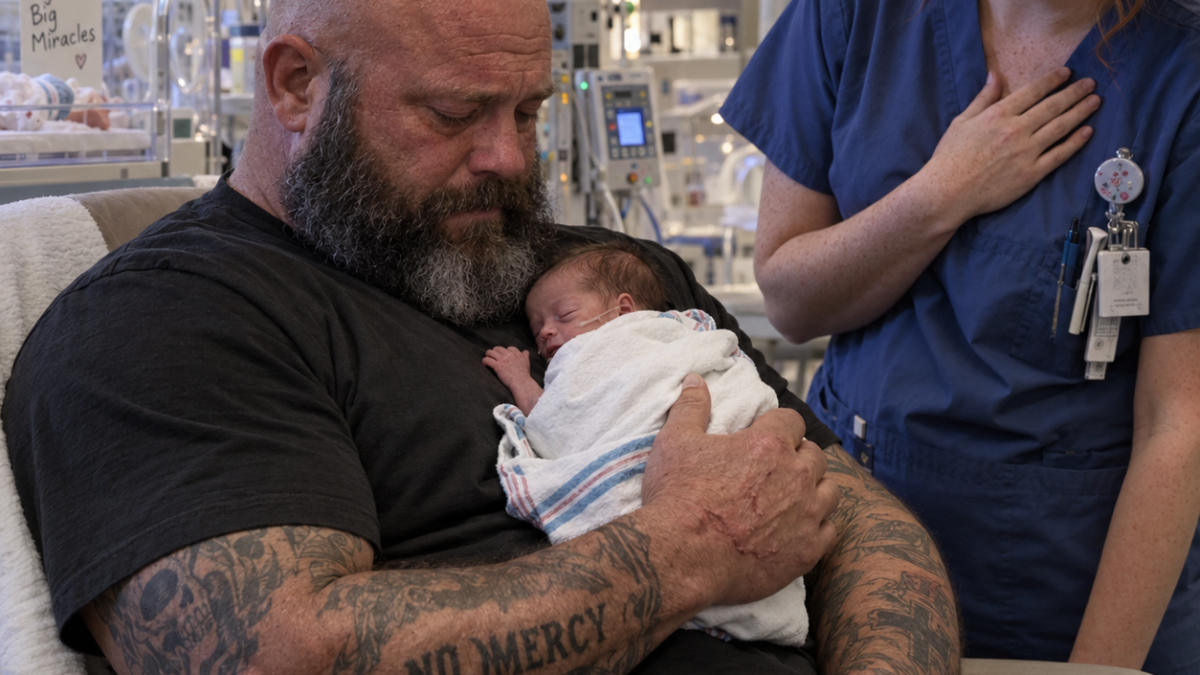
The visual contrast was almost ridiculous.
Mason’s palm covered most of the baby’s back.
A tiny red hand rested near his collarbone.
The baby’s head fit beneath Mason’s beard.
NO MERCY curved along the forearm supporting the blanket.
The baby cried.
Mason’s entire body stiffened.
“Relax.”
“He doesn’t like me.”
“He doesn’t know you.”
“That’s fair.”
“Mason.”
“I’m relaxing.”
The baby cried harder.
Mason looked worried.
“Want him back?”
“No.”
“You sure?”
“Yes.”
He began rocking.
Slow.
Barely an inch.
Forward.
Back.
Forward.
Back.
“Hey.”
The baby cried.
Mason lowered his voice.
“You’re all right.”
Another cry.
“I know.”
The little body tensed.
“I don’t like mornings either.”
I smiled despite myself.
The baby hiccupped.
Mason looked up.
“Progress?”
“Possibly.”
He kept rocking.
Five minutes.
Ten.
Fifteen.
I moved around the unit.
Charted.
Checked another infant.
Returned.
Baby Boy Ellis was still fussing.
Mason had not changed rhythm.
Twenty minutes.
“Need a break?”
“No.”
“You can tell me.”
“I’m good.”
Thirty minutes.
The baby’s crying softened.
Mason whispered things I could not always hear.
Not nonsense baby talk.
Simple sentences.
“Nothing you have to do.”
“You can be mad.”
“I’m still here.”
“Take your time.”
At forty minutes, the cry became a whimper.
At fifty, the baby turned his cheek against Mason’s shirt.
Mason stopped breathing.
I walked over.
“Keep breathing.”
“He did something.”
“He turned his head.”
“Is that okay?”
“Yes.”
“Why?”
“Because he’s getting comfortable.”
Mason looked down.
Baby Boy Ellis’s hand opened.
His fingers relaxed against Mason’s chest.
At about an hour, his entire body softened.
You can feel it when a newborn surrenders to sleep.
The shoulders.
The hands.
The face.
The breathing.
Fight leaves the body.
Mason looked at me.
His eyes were wet.
“He’s out?”
“He’s asleep.”
“For real?”
“For real.”
Mason nodded.
Then whispered:
“Good.”
I thought he would give him back.
He didn’t.
An hour became two.
At two hours, I asked, “You need the bathroom?”
“No.”
“Water?”
“I’m okay.”
“You’re lying.”
“I’ve made worse choices.”
I got him a water bottle with a straw.
Marcus Reed, another NICU nurse, held it up while Mason drank without moving the baby.
Marcus was forty-one, Black, bald, calm, and incapable of missing the obvious joke.
His eyes landed on the tattoo.
“Interesting branding for neonatal care.”
Mason looked down.
“Yeah.”
Marcus adjusted the edge of the blanket.
“Good thing the kid can’t read.”
“That’s what she said.”
I pointed at both men.
“No stand-up comedy near my incubators.”
“Yes, ma’am,” they said together.
Three hours.
Mason’s shoulder was starting to hurt.
I could see it.
“You need a break.”
“No.”
“That wasn’t a question.”
He looked down at the baby.
“He just got comfortable.”
“He’s been comfortable for two hours.”
“I know.”
“Then what are you worried about?”
Mason did not answer.
I watched his face.
Then I understood.
“You think he’ll wake up alone.”
His jaw tightened.
That was it.
“Mason.”
“He’s been alone enough.”
“He is not alone here.”
“I know.”
His eyes stayed on the sleeping newborn.
“I know you people take care of him.”
You people.
Medical staff.
Professionals.
The ones who belonged there.
“But?”
Mason looked embarrassed.
“No but.”
“There is.”
He sighed.
“Machines know when his heart changes.”
I waited.
“Nurses know when he needs medicine.”
His hand shifted slightly across the tiny back.
“I can know when he wants someone to stay.”
That was probably the first moment I stopped thinking of Mason as a volunteer who happened to look unusual.
He became Mason.
At hour four, Karen passed the doorway.
She stopped.
Mason’s boots were planted firmly on the floor.
Back stiff.
Head lowered.
A newborn rested against his chest.
His tattooed hand made a shelter around a body that barely seemed real.
Karen whispered to me:
“How long?”
“Four hours.”
“Does he need to leave?”
“He refuses.”
“Allowed?”
“For now.”
She watched him.
“He looks uncomfortable.”
“He is.”
“Why won’t he move?”
I answered:
“He’s afraid the baby will wake and nobody will be holding him.”
Karen went silent.
Then:
“Oh.”
People talk about tenderness as though it must look gentle from a distance.
Sometimes tenderness looks like a man whose spine is screaming because he has decided one sleeping infant will not wake to an empty chest if he can help it.
At five hours, I became less sentimental.
“Mason.”
“No.”
“I haven’t said anything yet.”
“You’ve got the nurse face.”
“What nurse face?”
“The one that means I’m about to lose an argument.”
“You need circulation.”
“I have another arm.”
“You have one spine.”
“It’s overrated.”
“Mason.”
He looked at me.
I pointed.
“Ten-minute break.”
The baby stirred at my voice.
Mason froze.
A tiny sound escaped the infant.
Immediately Mason whispered:
“Still here.”
The newborn settled.
Mason looked at me.
I surrendered.
“Fine.”
He almost smiled.
“Medical professionalism.”
“Don’t abuse my compassion.”
“Wouldn’t dream of it.”
Near hour six, Baby Boy Ellis made a soft squeaking sound.
Mason’s eyes widened.
I checked.
“He’s fine.”
“Sure?”
“Yes.”
Mason relaxed.
Then he looked at the tattoo beside the baby’s face.
For a long time.
His thumb moved unconsciously over one black letter.
He whispered so quietly I’m not sure he knew I could hear:
“This arm lied about me, didn’t it?”
I turned toward a monitor.
Not because I had work.
Because some confessions deserve the privacy of pretending nobody heard.
When the baby finally needed to return to bed for care, Mason did not resist.
That is another reason I trusted him.
Tenderness that cannot let go is not always tenderness.
Sometimes it is need wearing kindness’s clothes.
Mason understood boundaries.
I told him:
“Time.”
He nodded.
“Okay.”
No bargaining.
No “one more minute.”
No entitlement.
We transferred the baby together.
Slowly.
Support head.
Protect lines.
Blanket.
Position.
Check monitor.
Settle.
Baby Boy Ellis stayed asleep.
Mason stood over the incubator with empty arms.
He looked almost disoriented.
“You okay?”
“Yeah.”
“You don’t look okay.”
His eyes stayed on the baby.
“He slept?”
“For hours.”
“Good.”
The word cracked.
“He deserved a long sleep.”
Then he went into the hallway, put on his leather vest, and rode back to his motorcycle garage.
That could have been the entire story.
It would have made a nice inspirational anecdote.
Rough-looking biker holds tiny baby.
Tattoo versus tenderness.
People share it.
Cry for thirty seconds.
Move on.
But the part that mattered came afterward.
Mason returned Tuesday.
Then Thursday.
Then Tuesday.
He never assumed Baby Boy Ellis would be his assignment.
Some days he held him.
Some days another infant needed him more.
Once he showed up after driving forty minutes and we told him nobody needed a cuddle volunteer that morning.
“Okay.”
That was it.
No disappointment performed.
No asking whether he could “just visit” Baby Boy Ellis.
He went downstairs, bought coffee, and left.
The following shift, I asked:
“You weren’t upset?”
“About what?”
“Driving here for nothing.”
He looked genuinely confused.
“If nobody needed me, that’s good.”
I smiled.
“You know how rare that answer is?”
“Probably why you people need background checks.”
That was when I started asking questions about him.
Not Baby Boy Ellis.
Mason.
“You own a garage?”
“Yes.”
“Married?”
“No.”
“Kids?”
A pause.
“No.”
The pause was too long.
I did not press.
Two weeks later, the baby was asleep against him when Mason volunteered the answer.
“I had a daughter.”
I looked over.
Had.
The past tense landed heavily.
“She died?”
He nodded.
“How old?”
“Seventeen.”
My chest tightened.
“I’m sorry.”
“Car accident.”
He continued rocking.
“Eleven years ago.”
I had spent weeks interpreting the tattoo through his father, his youth, his mistakes.
Now another door opened.
“What was her name?”
“Kayla.”
The baby shifted.
Mason adjusted his hand.
“Blond hair. Mean softball swing. Thought my motorcycles were embarrassing until boys started thinking they were cool.”
I smiled.
“Sounds seventeen.”
“She hated this tattoo.”
His eyes moved to the words.
“Used to trace the letters with her finger when she was little and ask what they said.”
“What did you tell her?”
“That it meant Dad was tough.”
He laughed without humor.
“Terrible answer.”
“You were younger.”
“I was stupid.”
“Those aren’t always the same.”
He looked at me.
“You defend people too much.”
“I’m a nurse.”
“No, that’s not why.”
Maybe he was right.
“What happened after Kayla died?”
He went quiet.
I thought I had crossed a line.
Then:
“I stopped talking.”
His voice was flat.
“My friends came around.”
He rocked.
“My sister brought food.”
Rock.
“People called.”
Rock.
“I wanted all of them gone.”
“What about your club?”
“Caleb kept showing up.”
“Even when you told him not to?”
“Especially then.”
Mason smiled slightly.
“He’d sit in my garage and not say anything.”
“That sounds useful.”
“It was.”
He looked down at Baby Boy Ellis.
“Some days you don’t need somebody to fix it.”
I waited.
“You need someone who can tolerate that it can’t be fixed.”
That explained him more than the tattoos ever had.
He understood the assignment because grief had already trained him.
Not to cure.
Stay.
Not solve.
Stay.
Not make the crying stop immediately.
Stay.
Baby Boy Ellis gained weight.
Slowly.
His cheeks became rounder.
His cry grew stronger.
Mason claimed this was unfortunate.
“He was quieter before.”
“He was weak before.”
“I liked the weak volume.”
“You want him strong.”
“I do.”
Baby Boy Ellis began curling his fingers around Mason’s shirt.
One afternoon, his hand landed directly on the NO MERCY tattoo.
Tiny pale fingers against black letters.
I stared.
Mason noticed.
“What?”
“That.”
He looked down.
The baby’s fingers rested across the M.
Mason smiled.
“Poor judgment.”
I sat beside them.
“Tell me something.”
“Dangerous.”
“Why did you really keep the tattoo?”
His face changed.
“I haven’t exactly kept it on purpose.”
“You could cover it.”
“Most days I do.”
“You could remove it.”
“Expensive.”
“You own a custom motorcycle shop.”
“Exactly. Motorcycles are expensive.”
I laughed.
“Mason.”
He sighed.
“I went to a tattoo shop once.”
“Recently?”
“After I started volunteering.”
“What were you going to do?”
“Cover it.”
“With what?”
“No idea.”
He looked at the baby’s hand.
“Guy showed me designs.”
“And?”
“I left.”
“Why?”
Mason thought.
“Because pretending I was never that person felt dishonest.”
I understood.
“Do you regret it?”
“The tattoo?”
“Yes.”
“Yeah.”
Then:
“But I don’t regret surviving long enough to be embarrassed by it.”
That was Mason in one sentence.
Baby Boy Ellis remained in our unit for several more weeks.
The hospital social worker eventually told us a foster home had been identified.
Experienced couple.
Medical foster certification.
Stable.
Prepared.
Interested in permanency if that became possible through the legal process.
I was relieved.
Mason went silent when I told him.
“What?”
“He has a placement.”
“That’s good.”
“It is.”
“Very good.”
“Yes.”
He stared through the glass.
I knew that expression.
“You’re allowed to be sad.”
“I’m not.”
“Mason.”
“I’m relieved.”
“You can be two things.”
He looked at me.
“I know.”
He did.
That was the problem.
The day before discharge, I found Mason in the volunteer hallway forty minutes early.
“You know your shift starts at nine?”
“Traffic.”
“There was no traffic.”
“Prepared for traffic.”
“You live twenty minutes away.”
He glared.
I smiled.
“Come on.”
Baby Boy Ellis was fuller now.
Still tiny.
But less fragile-looking.
Mason sat in the same rocking chair.
I handed him the baby.
He said nothing for several minutes.
Then:
“They got a name yet?”
“Actually, yes.”
He looked up.
I had learned it through appropriate channels because discharge paperwork was being prepared.
“Samuel.”
Mason repeated it.
“Samuel.”
His voice softened.
“Good name.”
“You approve?”
“Strong.”
Samuel slept.
Mason touched one finger to the edge of the blanket.
“No pressure, though.”
I smiled.
“For what?”
“Name like Samuel. Sounds like he’s supposed to become a judge.”
“Maybe he’ll become a drummer.”
“Worse.”
He held Samuel for almost two hours.
Then the clock approached the end of the shift.
Mason knew.
I didn’t have to tell him.
He looked down.
“Hey, little man.”
Samuel stretched.
“You’re leaving.”
Mason swallowed.
“This is the part where everybody tells me that’s good.”
I sat quietly.
“It is good.”
“I know.”
He nodded.
“I know.”
His voice broke anyway.
He leaned his head closer.
“Listen.”
The baby obviously could not.
Mason spoke as though he could.
“You go do whatever babies do.”
His mouth twitched.
“Eat. Sleep. Make people tired.”
Samuel moved one hand.
“You don’t owe anybody for being here.”
I looked away.
Mason continued.
“You don’t have to be grateful somebody loves you.”
His beard trembled slightly.
“That’s their job.”
I had to blink hard.
“You hear me?”
Samuel slept.
Mason whispered:
“Go be loved loud.”
The last word fractured.
I walked toward the medication station.
Not because I had anything urgent to do.
Because goodbye deserves dignity.
Mason placed Samuel back when instructed.
No photograph.
No dramatic scene.
No request to meet the foster parents.
No demand for updates.
He kissed two fingers and touched them lightly to the blanket, not the baby.
Then he walked out.
Samuel left Riverside the next day.
Mason kept volunteering.
That surprised some people.
Not me.
By then I knew Baby Boy Ellis had started something, but he had not created Mason’s compassion.
He had only given it somewhere to go.
Every Tuesday and Thursday, Mason arrived.
Clean shirt.
No leather inside the unit.
Washed hands.
Quiet voice.
Sometimes the NO MERCY tattoo showed.
Nobody cared anymore.
New nurses occasionally noticed.
One whispered to me:
“Is that really appropriate?”
I said:
“Watch him for ten minutes.”
Ten minutes later, she understood.
The Iron Hollow Riders eventually discovered what he was doing.
Denise Carter found his hospital volunteer badge in his truck.
Denise was fifty-six, silver braids, heavy boots, and the only person I ever saw make Mason Reeves look like a misbehaving teenager.
She walked into his garage holding the badge.
“You cuddle babies?”
Mason nearly dropped a wrench.
“Where’d you get that?”
“Your truck.”
“Why were you in my truck?”
“Because your turn signal has been broken for three weeks and I was proving it’s the relay.”
“You don’t go through my stuff.”
“I did not go through your stuff. Your tiny baby badge fell out.”
She held it higher.
“Cuddle volunteer?”
Mason reached.
She moved it away.
“You cuddle babies?”
“Sometimes.”
Denise stared at him.
Mason looked miserable.
Finally she said:
“Good.”
Only good.
No joke.
No teasing.
She returned the badge.
Later, Mason told me that one word almost broke him.
Not because Denise was sentimental.
Because she wasn’t.
She did not transform his kindness into spectacle.
Good.
Continue.
That was enough.
The club began quietly supporting the volunteer program.
Unscented detergent.
Parking vouchers for parents.
Gas cards.
Meal cards.
Mason hated when he found out.
“You did not tell them to do this, did you?”
“No.”
“Karen?”
“No.”
“Then who?”
“Denise.”
He closed his eyes.
“Of course.”
I smiled.
“They wanted to put your picture on a flyer.”
His eyes opened in horror.
“I will quit.”
“Denise threatened them.”
“Good woman.”
“She told them, ‘He’s not a mascot. He’s a man holding babies.’”
Mason went quiet.
Then nodded.
“Good woman.”
Months after Samuel left, an envelope arrived for volunteer services.
Karen brought it upstairs.
Inside was a card addressed broadly to Riverside NICU staff and volunteers.
Samuel’s foster parents were moving toward adoption.
They thanked the physicians.
The nurses.
Respiratory staff.
Social workers.
Volunteers.
Near the bottom was one sentence.
Someone told us there was a volunteer who held Samuel during the weeks before we met him.
Please tell that person our son did not begin his life unloved.
Karen found Mason at his garage.
I went with her because she knew I would want to see him receive it.
The garage smelled like oil, rubber and coffee.
Mason was bent over a motorcycle engine.
Karen said:
“We have something for you.”
He wiped his hands.
“Hospital problem?”
“No.”
She handed him the card.
He read.
Stopped.
Read again.
Then again.
He sat on a metal stool.
His face had gone pale.
Ray, one of his mechanics, looked over.
“You good, boss?”
Mason shook his head.
“No.”
Ray started toward him.
Mason lifted one hand.
“I’m okay.”
He wasn’t.
His thumb moved over the paper.
He read the line again.
Our son did not begin his life unloved.
Mason’s eyes dropped to his forearm.
NO MERCY.
The same letters.
Same ink.
Same younger man’s declaration.
He rubbed his thumb across them.
“I used to think this meant nobody could touch me.”
Karen stood quietly.
I did too.
Mason looked at me.
“Turns out it just meant I hadn’t held the right thing yet.”
Nobody spoke.
Ray turned away and suddenly became extremely interested in organizing socket wrenches.
Men sometimes create tasks when tears threaten their reputation.
Mason framed that card.
Not publicly.
It stayed in his office at the garage.
No baby photograph.
No identifying information.
Just the sentence.
Our son did not begin his life unloved.
Years passed.
Mason stayed.
That is the part people usually leave out when they tell stories about transformation.
They focus on the moment.
Tattooed biker.
Tiny infant.
Crying stops.
Everyone discovers appearances are deceptive.
Fine.
But real change is not a photograph.
It is Tuesday.
Then Thursday.
Then next Tuesday.
For years.
Mason came.
He held infants whose mothers were recovering from emergency surgery.
Babies whose parents lived three counties away.
Babies whose fathers worked two jobs and could only visit at night.
Babies whose families were exhausted.
Babies whose situations we could not explain.
Babies whose parents loved them desperately but needed four hours of sleep.
Babies who had no regular visitors.
He did not rank them.
He never again asked:
“Does this baby have anybody?”
He learned the answer was irrelevant to his task.
The baby was there.
Mason was assigned.
That was enough.
He developed routines.
Never ate onions before a shift because he thought his breath might offend newborns.
Always carried an extra clean shirt.
Stopped using scented beard oil on hospital days.
Trimmed his nails meticulously.
Kept hand lotion in the truck because hospital soap cracked his knuckles.
The first time I saw the lotion, I nearly laughed.
He pointed at me.
“Say nothing.”
“I said nothing.”
“Your face did.”
“What brand?”
“Emily.”
“Lavender?”
“Unscented.”
“How rugged.”
“I will leave.”
“You would never.”
He grunted.
I was right.
New volunteers sometimes trained beside him.
Karen used him as an example.
He hated that.
One woman once said:
“I just want to love on babies.”
Mason looked at her.
Karen smiled because she knew what was coming.
Mason said:
“Then start by learning when they don’t want you touching them.”
The woman blinked.
He continued.
“You’re not here to get a feeling.”
He pointed toward the unit.
“You’re here because they need something.”
Karen later whispered to me:
“That’s going in orientation.”
Mason groaned.
“I’m quitting.”
He never quit.
He became gentler without becoming softer in the ways people expected.
Still rode his Harley.
Still swore in the garage.
Still scared teenagers who touched motorcycles without asking.
Still drank coffee black enough to remove paint.
Still wore heavy boots.
Still had scarred knuckles.
Still had NO MERCY on his arm.
But the tattoo changed.
Not physically.
Meaning changes depending on the life around it.
A sentence can lose authority over you.
One Tuesday, years after Samuel, a new nurse stopped in the hallway.
She was young.
First month.
She watched Mason receive a premature girl from me.
His tattoo was visible.
Her eyebrows rose.
Later she whispered:
“Is he safe?”
I remembered being her.
I said:
“Safer than most people who look safe.”
“That’s not really an answer.”
“Good.”
She stared.
I smiled.
“Check his credentials if you need. Ask Karen. Watch how he follows direction.”
She did.
By the end of the morning, she brought him water.
People should not be shamed for caution.
Especially around babies.
The lesson was never “trust intimidating strangers.”
That would be stupid.
The lesson was “judge safety using evidence, conduct, training and boundaries—not clothing.”
Mason would have insisted on that distinction.
He hated being treated as a surprise saint almost as much as he hated being treated as a criminal.
“I’m neither,” he told me once.
“What are you?”
“Tired.”
I laughed.
“No, seriously.”
He tightened the cap on a water bottle.
“Just a guy.”
“Who volunteers in the NICU twice a week.”
“Still a guy.”
“Who raised thousands of dollars.”
“The club did.”
“Who held Samuel for six hours.”
“He needed holding.”
“That answer is exactly the problem.”
“What problem?”
“You act like nothing you do is unusual.”
He shrugged.
“Shouldn’t be.”
That silenced me.
Shouldn’t be.
Maybe that was the real point.
Compassion becomes inspirational partly because we have lowered expectations.
A man sits for six hours with a baby and strangers call him extraordinary.
Mason thought the extraordinary thing was that the chair had been empty.
Years later, I asked whether he still thought about Samuel.
He was holding another infant at the time.
“Sometimes.”
“Wonder where he is?”
“Yep.”
“You ever wish you could know?”
Mason thought.
“Sure.”
“But?”
“Not mine to know.”
That answer was harder than it sounded.
People sometimes assume love creates a right to information.
It doesn’t.
Volunteer love especially has to understand its limits.
Mason cared about Samuel.
Deeply.
But Samuel’s life belonged to Samuel and the family raising him.
Mason did not need access to prove the love had been real.
That restraint may have been the purest thing about him.
Then, nearly seven years after Samuel left our hospital, something happened none of us expected.
A family signed up for a NICU volunteer appreciation event.
Parents whose child had once received care could attend if they wanted.
Most came to thank doctors and nurses.
Mason almost skipped it.
“These things have speeches.”
“Yes.”
“And name tags.”
“Yes.”
“And people will take photos.”
“Probably.”
“No.”
Karen told him:
“You are attending.”
“You’re not my mother.”
“No mother would have tolerated you this long.”
He came.
Black jeans.
Clean white shirt.
No vest.
Tattoo visible.
The lobby was crowded.
Children who had once fit inside our hands were running between tables.
Former preemies.
Toddlers.
Elementary-school kids.
One boy was seven.
Dark hair.
Fair skin.
Loud laugh.
His parents were speaking with Karen.
I did not know who they were until Karen’s face changed.
She found me across the room.
Her eyes went wide.
Then she looked toward Mason.
My heart started pounding.
“No.”
She nodded.
“Samuel?”
Another nod.
Samuel.
Not Baby Boy Ellis.
Samuel.
Seven years old.
Healthy.
Adopted.
Loved.
Standing twenty feet from Mason while arguing with his father about whether three cookies counted as lunch.
I wanted to tell Mason immediately.
Karen stopped me.
“Wait.”
“Why?”
“Parents decide.”
Of course.
Boundaries.
Always.
Karen spoke privately with Samuel’s parents.
They knew about the volunteer.
The card had been intentional.
They had eventually heard his first name.
Not much else.
Karen pointed discreetly toward Mason.
Samuel’s mother covered her mouth.
His father looked at the tattoo.
Then back at Mason.
They talked.
Finally they approached.
I stood nearby, trying not to stare.
“Mason?”
He turned.
“Yes?”
Samuel’s mother introduced herself.
Her voice shook.
“We adopted a child who was here about seven years ago.”
Mason was polite.
“That’s great.”
“His hospital name was Baby Boy Ellis.”
Everything stopped.
Not the room.
Mason.
His face emptied.
He looked toward the boy.
Then immediately back at the parents.
Not grabbing.
Not approaching.
Not claiming.
Samuel’s father extended his hand.
“I think you held our son.”
Mason stared at the hand.
Then shook it.
“Yes, sir.”
Samuel’s mother started crying.
“So you remember?”
Mason almost laughed.
“Yes, ma’am.”
“We sent the card.”
“I still have it.”
She cried harder.
Samuel noticed.
Children always notice adults crying eventually.
He walked over.
“Mom?”
She wiped her face.
“Sweetie, this is Mason.”
Samuel looked up.
Mason suddenly seemed more nervous than I had ever seen him.
More nervous than his first infant assignment.
More nervous than training.
The boy examined the tattoos.
“Are you a biker?”
Mason blinked.
“Yes.”
“Cool.”
That broke the tension.
Everybody laughed.
Samuel pointed at NO MERCY.
“What does that say?”
Mason froze.
I almost choked.
His mother looked mortified.
“You don’t have to—”
Mason crouched.
Not too close.
“It says ‘No Mercy.’”
Samuel frowned.
“What’s mercy?”
Mason looked at me.
I raised my eyebrows.
Your problem.
He looked back at Samuel.
“Being kind when you don’t have to be.”
Samuel studied the tattoo.
“Why would you have no kindness?”
The entire adult group became very still.
Mason smiled sadly.
“Because I was young and stupid.”
Samuel nodded with the ruthless acceptance of a seven-year-old.
“Dad says everyone is stupid when they’re young.”
His father sighed.
“Thank you, Samuel.”
Mason laughed.
Then Samuel’s mother knelt.
“Do you know why we wanted you to meet Mason?”
“No.”
“When you were a newborn, before Dad and I met you, Mason sometimes held you.”
Samuel looked at him.
“Why?”
“Because you cried a lot,” Mason said.
“I did?”
“So I’m told.”
Samuel looked delighted.
“Did I poop on you?”
Mason thought.
“No.”
“Too bad.”
His father muttered, “This was going so well.”
Everyone laughed again.
Then Samuel did something nobody planned.
He walked closer.
Held out his arms.
“Can I hug you?”
Mason did not move.
His eyes filled.
He looked at the parents.
Samuel’s mother nodded.
Mason opened his arms.
Samuel hugged him.
A seven-year-old boy.
Healthy.
Tall for his age.
No wires.
No hospital blanket.
No name card.
No empty chair.
Just a boy hugging a man who had once spent six hours terrified of waking him.
Mason placed one hand lightly across Samuel’s back.
The same hand.
Same tattoo.
Different story.
He closed his eyes.
I had seen him cry only a few times.
That day he did not hide it.
Samuel stepped back.
“Why are you crying?”
Mason wiped his face.
“Because I’m old.”
Samuel accepted this immediately.
“Grandpa cries too.”
“Smart man.”
Samuel ran back toward the cookies.
Mason stayed crouched for several seconds.
His mother touched his shoulder.
“Thank you.”
He shook his head.
“You don’t owe me that.”
“We know.”
Her voice was soft.
“That’s why we wanted to say it.”
Mason stood.
Samuel’s father said, “We always told him people cared for him before us.”
Mason looked toward the boy.
“Good.”
“We wanted him to know his life didn’t start the day we brought him home.”
That sentence almost destroyed me.
Because abandoned children—surrendered children, foster children, adopted children—are often spoken about as if love begins only once permanent family arrives.
But Samuel had been cared for before permanency.
By nurses.
Doctors.
Social workers.
Volunteers.
Not replacements for family.
Not owners of his story.
Witnesses.
People who made sure the waiting was not empty.
Samuel’s mother smiled.
“He didn’t begin unloved.”
Mason nodded.
“No, ma’am.”
He looked at Samuel.
“He sure didn’t.”
After the event, Mason sat alone outside near the motorcycle parking area.
I found him.
“You okay?”
“No.”
“Good no or bad no?”
He thought.
“Too much.”
I sat beside him.
“You waited seven years.”
“I wasn’t waiting.”
“Fine.”
He stared at his hands.
“His voice.”
“What?”
“Last time I heard him, he barely had one.”
That did it.
I cried.
“Emily.”
“What?”
“Now I’ve got to comfort you?”
“Yes.”
He sighed.
“This is inefficient.”
We sat quietly.
Eventually I asked:
“Does it change anything?”
“What?”
“Seeing him.”
Mason shook his head.
“No.”
I was surprised.
“Nothing?”
“He was already real.”
He looked toward the building.
“I didn’t need proof he turned out okay to make those six hours matter.”
There it was.
The mature version of love again.
No reward required.
No guaranteed ending.
Comfort matters while it is happening.
A baby who stops crying for an hour has received something meaningful even if you never learn what happened next.
A lonely patient who feels less afraid for ten minutes has received something meaningful even if the illness remains.
Kindness does not become pointless because it does not cure the whole problem.
Mason taught me that.
Samuel reminded him.
More years passed.
Mason’s beard went nearly white.
His knees worsened.
One hip began bothering him after long rides.
Eventually he sold the Harley he had owned for twenty-two years.
That was a terrible month.
“You can still be in the club.”
“Not the same.”
“You can get a trike.”
He looked offended.
“I would rather walk.”
Two years later he bought a trike.
I never let him forget it.
He kept volunteering.
Fewer hours.
His arms tired faster.
He finally admitted chairs could hurt him.
We shortened sessions.
Younger volunteers came.
Mason trained them informally.
“Don’t bounce the baby because you’re nervous.”
“Don’t talk constantly.”
“If the nurse says stop, stop.”
“Wash your hands again.”
“Support the head.”
“Put your phone away.”
“Stop making this about you.”
That last one became legendary.
Karen retired.
I eventually moved into a supervisory nursing role.
Marcus became nurse manager.
The NICU renovated.
New incubators.
New monitoring equipment.
New chairs.
Same need.
Arms.
Mason’s old photograph remained in a private staff archive.
Not public.
Never used for promotion without permission.
Sometimes during volunteer orientation, we told the story without baby details.
Not biker becomes saint.
That framing irritated me.
The lesson was better.
Safety does not have a costume.
Compassion needs training.
Service requires humility.
And sometimes the person who looks least like your assumption of gentleness has spent years learning it the hard way.
One morning, Mason arrived wearing a long sleeve.
I noticed immediately.
“You covering the tattoo?”
“No.”
“Cold?”
“No.”
“What happened?”
He rolled the sleeve up.
NO MERCY was still there.
But beneath it, fresh ink had been added.
Smaller letters.
Different style.
I leaned closer.
I read:
STAY ANYWAY.
I looked at him.
“Mason.”
He looked embarrassed.
“Bad?”
“No.”
“Too sentimental?”
“Extremely.”
“Damn.”
I touched the air above it without touching his arm.
“Why?”
He shrugged.
“Got tired of people thinking the sentence ended too early.”
My throat tightened.
NO MERCY.
STAY ANYWAY.
The young man.
The older man.
Same arm.
Fuller story.
“You finally covered it.”
“No.”
He looked at the old words.
“I answered it.”
That might be the most honest form of change I have ever seen.
You do not always erase the person you were.
Sometimes you spend the rest of your life writing a better sentence beside him.
Mason volunteered until he was sixty-three.
Fifteen years.
Hundreds of hours.
Dozens of infants.
Probably more.
He never counted.
The hospital did.
He refused to look.
“I don’t want a scoreboard.”
At his last official shift, the volunteer department wanted to give him a plaque.
He hated that.
Karen came back for it anyway.
Denise came.
Caleb.
Members of Iron Hollow.
Nurses.
Doctors.
Nobody brought media.
Mason had one rule.
“No press.”
We honored it.
The plaque said:
MASON REEVES
NICU CUDDLE VOLUNTEER
15 YEARS OF QUIET SERVICE
He read it.
“Quiet?”
Everyone laughed.
Denise shouted:
“They never heard your motorcycle.”
Mason pointed.
“No heckling during retirement.”
Then Marcus handed him a rocking chair.
Not hospital property.
The staff had purchased one.
Wooden.
Strong.
A small metal plate on the back read:
SOMEBODY CAME.
That phrase finally broke Mason.
He sat down.
Covered his face.
Nobody rushed him.
We had all learned from him by then.
Sometimes you do not fix crying.
You sit beside it.
After a while, Mason looked at me.
“You people are terrible.”
I laughed through tears.
“You trained us.”
He shook his head.
On his forearm:
NO MERCY.
STAY ANYWAY.
He ran his thumb over the old letters.
Then the new.
“I was such an idiot.”
“You were twenty-three.”
“That’s what I said.”
“Apparently everyone is stupid when they’re young.”
He stared.
Then remembered Samuel.
He laughed.
“Kid was right.”
Samuel was twenty-two the last time Mason heard from him.
Not directly at first.
His adoptive mother sent a letter to the volunteer office because Samuel had given permission.
He was studying nursing.
NICU nursing, maybe.
He had not decided.
Mason read that sentence several times.
“Don’t do this to me.”
I smiled.
“I did nothing.”
“He’s going into nursing?”
“Maybe.”
“Probably because his mother told him some ridiculous biker story.”
“Maybe he simply likes medicine.”
“Better.”
Years earlier, people might have turned Samuel into proof that Mason had changed him.
Mason refused that story.
Samuel had his own life.
His own parents.
His own choices.
Mason had held him.
That was all.
And not all.
Both could be true.
On one of Mason’s final hospital visits, he stood outside the NICU glass.
He no longer volunteered.
His hands shook slightly now.
Age.
Arthritis.
He watched a young cuddle volunteer holding a crying infant.
The volunteer was a college student.
Small woman.
Bright green hair.
Nose ring.
Several visible tattoos.
An older visitor passing in the hallway glanced at her and frowned.
Mason noticed.
Of course he did.
He smiled.
“What?”
I asked.
“Nothing.”
“You’re smiling.”
“Just thinking.”
“Dangerous.”
He nodded toward the young volunteer.
“People going to judge her.”
“Probably.”
“Good.”
I frowned.
“Good?”
“She’ll disappoint them.”
That was perfect.
He looked through the glass one more time.
The baby settled.
Mason nodded.
“See?”
“See what?”
“Doesn’t care about the hair.”
I smiled.
“No.”
“Baby knows.”
“Knows what?”
Mason looked at me like the answer was embarrassingly obvious.
“Whether the arms stay.”
That was Samuel’s lesson.
Mason’s lesson.
Mine.
The NICU’s.
Maybe everyone’s.
A baby does not know the mythology we build around appearances.
A newborn cannot be impressed by reputation.
Cannot be intimidated by tattoos.
Cannot flatter ego.
Cannot reward virtue.
A newborn responds to nervous systems.
Temperature.
Rhythm.
Breathing.
Pressure.
Voice.
Presence.
That is why Mason loved working with them.
Babies met him where behavior became more important than identity.
He could not talk his way into being gentle.
He had to be gentle.
Every minute.
He could not explain away the tattoo.
He had to let his hands contradict it.
Again.
Again.
Again.
For years.
Eventually, the contradiction stopped feeling like contradiction at all.
The tattoo became history.
The hands became truth.
When people ask me about Mason now, they often begin with the same detail.
“The biker with NO MERCY tattooed on him?”
Yes.
That biker.
But I wish people asked different questions.
Was he trained?
Yes.
Did he respect boundaries?
Completely.
Was he patient?
More than most.
Did he understand that volunteering was not ownership?
Always.
Did he show up even when nobody applauded?
For fifteen years.
Did he change every baby he held?
Probably not.
That is not why he did it.
Some babies slept.
Some kept crying.
Some hated being held that day.
Some needed medical quiet.
Some were too unstable.
Some parents preferred only family touching them.
Mason respected every answer.
Compassion is not doing what makes you feel compassionate.
It is doing what the person in front of you needs, even when the answer is nothing from you.
That was why he became good.
And Samuel?
Samuel grew up knowing that before his parents could reach him, people had cared.
Not one heroic biker.
An entire medical team.
Nurses.
Physicians.
Social workers.
Volunteers.
And, for six long hours on one morning, a man whose arm carried the words NO MERCY while his body practiced the exact opposite.
I still remember that morning clearly.
The crying.
My fatigue.
Mason waiting beyond the line.
His hands.
The hesitation I felt.
His immediate offer.
“I can cover it.”
He thought I was worried about the tattoo.
Maybe I was.
Not because I believed the words themselves could harm a baby.
Because appearances influence us even when we know better.
That is uncomfortable to admit.
I was an experienced nurse.
I knew his training history.
I knew the volunteer department had cleared him.
I had personally supervised him.
Still, for one second, I saw black letters before I saw the evidence of the man.
That second taught me something.
Bias rarely announces itself.
It arrives as caution that feels reasonable.
A pause.
A glance.
A quiet assumption.
The answer is not to stop being careful.
The answer is to become precise about what our caution is based on.
Mason’s size was not a risk.
His beard was not a risk.
His leather vest was not a risk.
His old tattoo was not a risk.
Dirty hands would have been.
Ignoring nursing instruction would have been.
Poor boundaries would have been.
An undisclosed violent history without evidence of rehabilitation might have required serious consideration.
But clothing and ink were not clinical data.
Behavior was.
And Mason’s behavior said safe.
Again and again.
I learned to trust that.
The baby did first.
Six hours after I placed Samuel against Mason’s chest, I had to wake Mason’s left hand because it had gone numb.
He shook it once.
I laughed.
“You lied to me.”
“About?”
“Your arm hurting.”
“Didn’t hurt.”
“You can’t feel your fingers.”
“Different issue.”
Samuel slept through the whole exchange.
Mason looked down at him.
The newborn’s cheek rested inches from NO MERCY.
His tiny fingers were open.
Relaxed.
No crying.
No fighting.
Just rest.
Mason whispered:
“You don’t have to fight today, little man.”
I heard it clearly that time.
Then:
“I’ve got all day.”
That sentence stayed with me longer than the tattoo.
Because maybe mercy is not always a grand act.
Maybe mercy is time.
Time you could have spent elsewhere.
Time with no guarantee of being remembered.
Time given to somebody who cannot thank you.
Time sitting still when your back hurts.
Time staying after the crying stops because you know it could start again.
People talk about love as feeling.
Hospitals teach you love is often scheduling.
Will someone be here?
For how long?
Who covers the next hour?
Who stays through the night?
Who comes Tuesday?
Who comes Thursday?
Mason’s gift was not that he looked tough and secretly had a soft heart.
That is too easy.
His gift was reliability.
He arrived.
He washed his hands.
He listened.
He sat.
He held.
He left when told.
Then came back.
Again.
Again.
Again.
Samuel never needed Mason to be a hero.
He needed a chest for six hours.
Mason had one.
Samuel needed warmth.
Mason had it.
Samuel needed someone with nowhere else more important to be.
Mason gave him that too.
Years later, Mason told me he finally understood his tattoo differently.
Not as a lie exactly.
As an unfinished thought.
“No mercy was what I thought strength meant.”
He looked at the newer words beneath it.
“Stay anyway is what strength costs.”
I asked:
“Would you tell twenty-three-year-old Mason that?”
“He wouldn’t listen.”
“Probably not.”
“I’d punch him.”
“That undermines the lesson.”
“He’d deserve it.”
Some things never change.
The last photograph I have of Mason is not from the NICU.
It is from his retirement gathering.
He is sitting in the wooden rocking chair.
White beard.
Older face.
Still enormous.
One hand resting on the armrest.
The tattoo visible.
NO MERCY.
Underneath:
STAY ANYWAY.
He looks embarrassed.
Everyone around him is smiling.
There is no infant in the photograph.
I like that.
Because his story was never meant to belong to one baby.
Samuel opened a door.
Mason walked through it for fifteen years.
That is different.
One dramatic act can happen by accident.
Character is what keeps happening after nobody is surprised anymore.
Mason kept happening.
Tuesday.
Thursday.
Tuesday.
Thursday.
Until another generation of nurses knew the sound of his boots in the hallway.
Until volunteers used his rules.
Until parents learned some stranger had held their child while they slept.
Until one adopted boy grew old enough to ask the tattooed man who once rocked him why the words on his arm were so wrong.
And until Mason could answer:
“Because people can change.”
Not with a speech.
With evidence.
Years of it.
That is why, when somebody tells me first impressions matter, I agree.
They do.
Then I add:
So do second impressions.
And third.
And the hundredth Tuesday morning when the same person shows up exactly as promised.
The newborn who cried for forty minutes did eventually stop.
Not because Mason looked beneath some magical tough exterior and discovered tenderness.
The tenderness was already there.
It had simply spent years buried under survival.
The baby did not uncover it.
He gave Mason permission to use it without shame.
And Mason, who had once tattooed NO MERCY across his own skin because he thought hardness could keep pain out, finally learned what every NICU baby understands before language:
Real strength is not being impossible to hurt.
Real strength is becoming safe enough for something fragile to sleep against you.
Samuel slept that morning.
The monitors steadied.
The unit moved around them.
Mason sat.
One enormous hand covering almost the baby’s entire back.
Scarred knuckles.
Old ink.
Clean skin.
No applause.
No camera.
No promise they would ever meet again.
Just a newborn breathing against a stranger’s chest.
And a man whispering the truest thing he knew:
“You don’t have to fight today.”
Then, after a pause:
“I’m still here.”
That was mercy.
Not the word.
The staying.








