The Navy SEAL Wouldn’t Let Anyone Touch His Dying K9—Then the Nurse Rolled Up Her Sleeve and He Recognized Her Dead Brother’s Tattoo
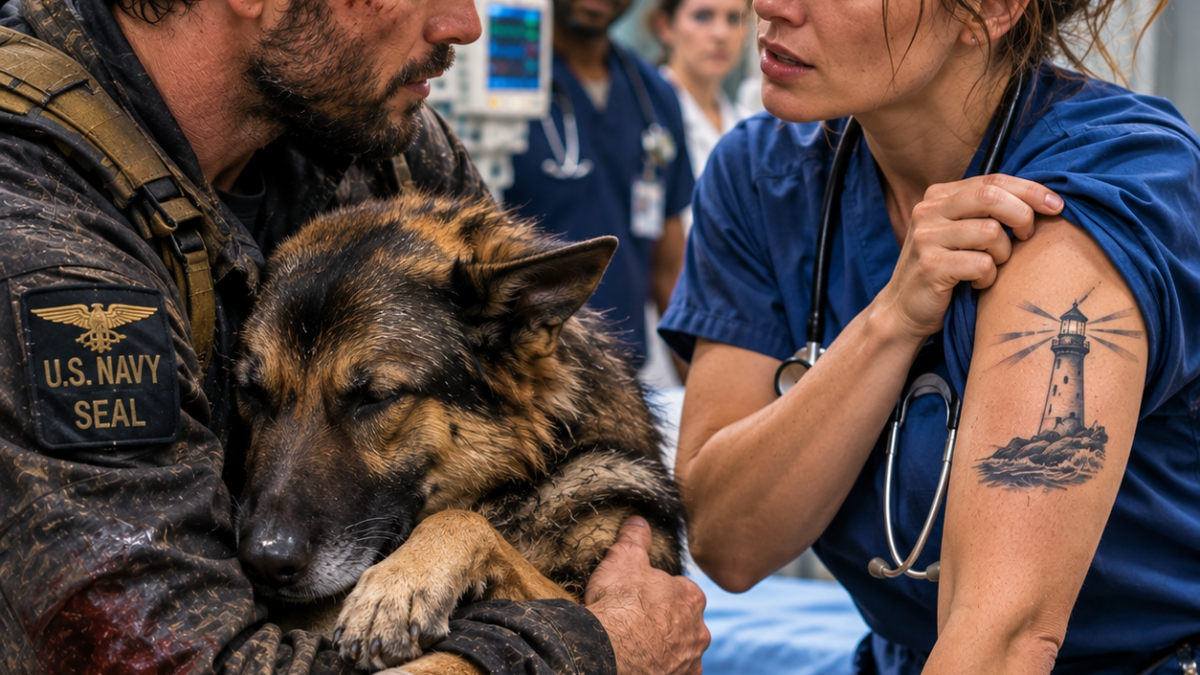
The Navy SEAL Wouldn’t Let Anyone Touch His Dying K9—Then the Nurse Rolled Up Her Sleeve and He Recognized Her Dead Brother’s Tattoo.
The Navy SEAL lieutenant came through the emergency entrance soaked in rain, bleeding through one sleeve, carrying a badly injured German Shepherd against his chest—and backed into the wall when hospital security tried to take the dog from him.
Nurse Danielle Price was the only person he seemed willing to listen to, until her sleeve slipped above her wrist and revealed a tiny lighthouse tattoo that made Luke Serrano go completely still.
Then he whispered the name of Danielle’s dead brother—and told her that five years earlier, Jonah had left behind something she had refused to hear.
The security officer took one careful step toward the German Shepherd.
Lieutenant Luke Serrano immediately backed against the emergency department wall.
“Don’t touch him.”
Nobody moved.
Rainwater ran from Luke’s dark jacket onto the polished floor of Harborpoint Naval Medical Center.
Blood had soaked through his left sleeve.
His right leg shook badly enough that he kept shifting his weight away from it.
Across both arms lay a large German Shepherd.
Black and tan.
Gray beginning around the muzzle.
Wet coat.
Blood along one rear leg.
Breathing fast.
Too fast.
Every breath came with a shallow sound that made the nurses nearest the entrance look toward one another.
Luke noticed.
His grip tightened.
The rifle hanging from his shoulder made everyone else more nervous.
Nurse Danielle Price raised one hand.
“Stop.”
The trauma team stopped.
The security officer stopped.
Luke did not.
His eyes kept moving.
Door.
Security.
Treatment bay.
Dog.
People behind the desk.
Back to dog.
“Give him room,” Danielle said.
She looked toward the charge nurse.
PART2:
“And call the veterinary emergency service. Tell them we have a working dog with trauma injuries and we need immediate transport support.”
Then she looked back at Luke.
“My name is Danielle.”
No response.
“Dani is fine.”
His eyes stayed on the dog.
“You’re bleeding.”
“He’s bleeding.”
“I can see that.”
“Then help him.”
“We are.”
“No one touches him.”
Danielle kept both hands visible.
She had been a nurse at Harborpoint for six years.
Before nursing school, she had been a Navy corpsman.
She had seen frightened people become angry.
Seen injured people become unreasonable.
Seen trained men become suddenly, painfully human when the thing they were trying to protect stopped being something they could protect alone.
Luke was not threatening anyone.
Not exactly.
PART3:
But he was armed.
Injured.
Terrified.
And holding a badly hurt dog as if releasing him might be the same thing as losing him.
Danielle spoke quietly.
“Lieutenant, security needs to secure your weapon.”
His jaw tightened.
“They aren’t taking him.”
“Those are separate things.”
“They take the rifle.”
“Yes.”
“They leave the dog.”
“Yes.”
His eyes flicked toward the security officer.
“How do I know?”
“Because I’m standing here telling you that.”
For the first time, he looked directly at Danielle.
Thirty-five, maybe.
Dark hair plastered to his forehead by rain.
Blood on his cheek that might not have been his.
He looked exhausted.
But focused.
Too focused.
The sort of focus Danielle had learned not to mistake for calm.
She glanced at the dog.
“What’s his name?”
Luke hesitated.
“Flint.”
“All right.”
She nodded.
“We’ll call him Flint.”
Something in Luke’s face changed.
Only slightly.
Flint shifted.
A thin sound escaped him.
Luke looked down so quickly it was almost violent.
“Easy.”
His voice changed completely.
Not lieutenant.
Not SEAL.
Not officer.
Just a man talking to his dog.
“Easy, buddy.”
Danielle took one slow step closer.
Not close enough to touch.
“Would it help if I stayed where Flint can see me while you talk to security?”
Luke looked up.
Then his gaze dropped to her wrist.
Danielle had pushed her sleeve back slightly when she raised her hand.
Below the cuff sat an old tattoo.
Small.
Faded.
A lighthouse.
Three short rays.
Crooked line beneath it.
Luke froze.
Danielle noticed immediately.
“What?”
He stared at the tattoo.
“Where did you get that?”
Her stomach tightened.
“My brother drew it.”
Luke’s face lost what little color remained.
“What was his name?”
Danielle knew before he spoke again that something terrible had just entered the room.
“Jonah Price.”
Luke opened his mouth.
Nothing came out.
Then:
“Jonah said you’d never forgive us.”
The sentence hit Danielle so hard that for one second she could not feel her feet.
The fluorescent lights above them seemed suddenly too bright.
Five years disappeared.
Then returned all at once.
Her hand moved instinctively toward the counter.
Luke saw it.
Before either could say another word, his injured leg buckled.
Security moved.
Danielle spoke first.
“Easy. Lower yourself.”
Luke dropped to one knee.
Still holding Flint.
The dog groaned.
Luke’s face twisted.
Danielle crouched several feet away.
“Luke.”
His eyes found hers.
“Whatever Jonah told you, we are not doing that conversation in the middle of an emergency entrance.”
He looked almost angry.
“I need—”
“No.”
She softened her voice.
“We help the two people in this hallway first.”
Luke looked down.
“One person.”
Danielle followed his gaze.
“One person and one very important dog.”
His eyes filled.
He looked away quickly.
That was enough.
The rifle was transferred to security under hospital procedure.
No struggle.
No dramatic disarming.
Luke watched every movement.
Then Danielle brought a padded trolley beside him.
“We need Flint on this.”
Luke said nothing.
“You can keep your hands under his head while we position him.”
“No straps around his chest until they know—”
“We’ll let the veterinary team decide.”
“He hates metal.”
“Okay.”
“And people reaching over him.”
“Good to know.”
He still did not release Flint.
Danielle did not say:
You have to trust us.
Trust was too large a demand.
Instead she said:
“I’ll tell you exactly where he’s going.”
“How do I know?”
“I’ll write it down.”
That made him look at her.
“You’ll have the name of the veterinary hospital.”
She took paper from the desk.
“The liaison.”
Wrote.
“The phone number.”
Wrote.
“Our emergency desk extension.”
Wrote.
“My name.”
She added it.
Then handed him the paper.
“You don’t have to remember anything right now.”
Luke read every line.
Twice.
Only then did his arms loosen.
A veterinary technician arrived from the emergency animal hospital three blocks away.
Marisol Vega.
Experienced.
Calm.
She introduced herself before touching Flint.
“What happened?”
Luke answered in fragments.
Training return.
Rain.
Vehicle collision.
Their transport vehicle rolled partially onto its side.
Flint had been secured in the rear compartment.
The impact damaged the restraint area.
Luke had gotten him out.
The other driver had gone by ambulance to another hospital.
Luke had refused transport.
“Why?” Danielle asked.
His answer came immediately.
“Nobody could tell me where Flint would go.”
So one of Luke’s teammates drove both of them to Harborpoint.
Not because Harborpoint treated dogs.
It did not.
Because it was the nearest place Luke trusted to keep him and Flint from disappearing into separate systems before someone explained what was happening.
Fear had made the route.
Not logic.
Marisol began the examination.
Luke watched.
“She’s touching his leg.”
Marisol looked up.
“I have to.”
“He doesn’t like—”
“Tell me what he tolerates.”
Luke swallowed.
“He’s better if he hears me.”
“Then talk to him.”
So Luke did.
Not commands.
No military voice.
No technical handling cues.
Just:
“Flint.”
“Easy, buddy.”
“I’m here.”
“Good.”
Again.
Again.
Flint’s eyes stayed partly open.
When transport was ready, Marisol explained every step.
Where.
Who.
Estimated first update.
Luke tried standing.
His injured leg failed again.
This time, he allowed hospital staff to catch him.
Danielle stayed beside Flint’s trolley until Marisol took over.
Luke watched the dog disappear through the entrance.
His expression went blank.
Then he nearly collapsed.
They moved him into a treatment bay.
Imaging.
Wound care.
Possible ligament injury.
Deep laceration.
No immediate life-threatening finding.
Another nurse took over after Danielle disclosed that she had a personal connection to someone Luke had mentioned.
That was correct.
Professional boundaries mattered.
She hated it.
At two in the morning, Danielle found Luke sitting upright in the treatment bay.
His injured arm had been cleaned and wrapped.
A brace supported his leg.
His phone was in his hand.
He was staring at it.
“Any news?”
He shook his head.
“Surgery.”
Danielle pulled a chair near the doorway.
“May I?”
Luke nodded.
She sat.
Neither spoke.
Finally:
“Jonah had the lighthouse too.”
Danielle looked up.
“What?”
“In his notebook.”
“I didn’t know.”
Luke’s mouth moved slightly.
“He said you stole his best artwork.”
“That sounds exactly like him.”
The smile disappeared almost immediately.
“I knew who you were when you said his name.”
“I gathered that.”
“I’m sorry about the entrance.”
“You were afraid.”
“That doesn’t excuse the rifle being in the room.”
“No.”
He accepted that.
No argument.
Danielle appreciated him more for it.
She looked down at the tattoo.
“My brother drew this when I was nineteen.”
Luke listened.
“Our father had just died.”
Her thumb moved over the lighthouse unconsciously.
“Jonah and I were sitting near the harbor.”
Jonah had always been the loud one.
Funny.
Impossible.
The boy who could break a window and convince their father it was an opportunity to inspect the frame.
Danielle had been the person quietly getting the broom.
By nineteen, Jonah was already serving.
She had told him she intended to enlist too.
“You’ll hate taking orders from idiots,” Jonah had said.
“You do it.”
“I provide useful resistance.”
She had laughed.
Then he drew the lighthouse on the back of a restaurant receipt.
Tiny tower.
Three rays.
Crooked line.
“What’s that?”
“A lighthouse.”
“I can see that.”
“Then my artistic ability survives.”
“Why a lighthouse?”
He shrugged.
“Somebody has to help people find the shore.”
Danielle tattooed it three years later.
Jonah spent months insulting the crooked wave.
“That was supposed to be water.”
“It is water.”
“It looks like a dying worm.”
“It’s your drawing.”
He had considered this.
“Excellent work, then.”
Five years ago, Jonah died.
Flint survived him.
Danielle knew Flint’s name.
That was perhaps the cruelest part.
Jonah talked about the dog constantly.
Flint hated metal bowls.
Loved tennis balls.
Could detect cheese from another county.
Once stole half a sandwich Jonah had spent ten minutes protecting from another teammate.
Danielle had never met him.
By the time Flint returned to the United States after Jonah’s death, she could not look at photographs without feeling accused by them.
Jonah’s teammates invited her to a private gathering.
She refused.
They offered to answer questions.
She sent an email.
She remembered every word:
I don’t want stories that turn his death into something necessary.
Some days that sentence still felt honest.
Other days it felt cruel.
Luke had been there.
She knew that now.
She looked at him.
“What did he mean?”
“Who?”
“Jonah.”
Luke understood.
“You said he thought I’d never forgive you.”
Luke rubbed his thumb along the phone.
“We talked once about what happens if somebody doesn’t come home.”
Her chest tightened.
“Why?”
“Paperwork.”
“Contacts.”
“Things people avoid.”
He paused.
“Things we think we’ll have time to explain later.”
“What did Jonah say?”
Luke looked at her.
“He said you wouldn’t want speeches.”
True.
“He said you’d hate people calling him a hero if they used the word to avoid telling you what actually happened.”
Also true.
“He said you’d want to know whether somebody made a mistake.”
Danielle swallowed.
“That’s true.”
“He said if something happened, we should answer whatever we could.”
“Then why didn’t you?”
Luke’s face changed.
Not defensiveness.
Pain.
“We tried.”
Danielle looked away.
Of course.
The invitation.
Calls.
Emails.
Her own message.
She closed her eyes.
“I couldn’t hear it then.”
Luke nodded.
“I know.”
“No.”
She looked at him.
“You probably don’t.”
He considered that.
“Probably not.”
That answer made her stay.
Most people rushed to say they understood grief.
Luke did not.
She asked:
“Why were you so afraid of Flint being taken?”
He stared at his phone.
“Because I handed him over once.”
“When?”
“After Jonah died.”
Danielle’s breath caught.
“Flint needed medical evaluation.”
Luke spoke carefully.
“Behavioral assessment.”
“That was reasonable.”
“It was.”
“But?”
“I was still overseas.”
He looked toward the empty doorway.
“They moved him from one person to another.”
“Different handlers.”
“Different facilities.”
“Everybody had a reason.”
He stopped.
“When I finally saw him again, he wouldn’t eat if somebody stood near the bowl.”
Danielle looked down.
“He recovered.”
Luke said it quickly.
“People helped him.”
“I’m not saying anyone abused him.”
“I know.”
“But you remember what he looked like.”
“Yes.”
“And tonight?”
“I put him in somebody else’s hands again.”
There it was.
Not control.
Memory.
Luke’s phone rang.
He answered so quickly he almost dropped it.
Danielle stood.
Gave him space.
Luke listened.
Asked:
“Internal bleeding?”
Then:
“Spine?”
Long pause.
His shoulders lowered.
“Okay.”
He ended the call.
Danielle waited.
“He made it through surgery.”
She released a breath.
“Good.”
“They don’t know what recovery looks like yet.”
“That’s normal.”
“He may never work again.”
Danielle looked at him.
“He doesn’t need to decide his career tonight.”
Luke nodded.
Then covered his face with his uninjured hand.
The lieutenant vanished.
The SEAL vanished.
The frightened man from the entrance vanished too.
For several seconds there was only somebody exhausted enough to stop performing strength.
Danielle stayed near the doorway.
No touch.
No speech.
When his breathing steadied, she left.
At sunrise, Danielle drove home.
Showered.
Made coffee.
Forgot about the coffee.
Overwatered the plant on her windowsill.
Then stood in front of her bedroom closet.
Bottom shelf.
Cardboard box.
She had not opened it in eighteen months.
She carried it into the living room.
Sat on the floor.
Opened the flaps.
Jonah.
A watch.
Two books.
Photograph of them at thirteen and seventeen.
Old military paperwork.
Notebook.
Danielle opened it.
Inside cover:
Lighthouse.
Three rays.
Crooked wave.
Beside it:
DANI STOLE THIS.
She laughed.
Then started crying before the laugh finished.
Five years of grief had not made grief smaller.
It had made it organized.
She knew which songs to skip.
Which drawer not to open.
Which stories about Jonah she could tolerate.
Which anniversaries required extra shifts.
Which family questions to answer with:
“I’m fine.”
Luke Serrano had walked into her emergency department carrying one of the things she had excluded from that organization.
Flint.
By afternoon, Danielle called the number Luke had given her.
“How’s Flint?”
“Stable.”
“Eating?”
“Not yet.”
“Have you?”
Pause.
“Yes.”
“What?”
Another pause.
“Something.”
“Excellent medical detail.”
Luke laughed weakly.
Danielle closed her eyes.
Jonah used to answer the same way.
She arranged a visit to the veterinary hospital the following day.
With permission.
No emotional ambush.
No assumption that Jonah’s sister had special rights over Flint.
Luke waited outside on a crutch.
Danielle looked at him.
“You could have waited inside.”
“I thought you might have trouble finding it.”
“I successfully located the parking lot.”
“Strong start.”
They went in.
Dr. Patrice Kim explained Flint’s injuries.
Surgery successful.
Further procedures possible.
Rehabilitation.
Pain management.
Time.
Nobody could responsibly predict full functional recovery yet.
Luke asked:
“When could he return to duty?”
Dr. Kim looked directly at him.
“My priority today is returning him to a life he enjoys.”
Luke lowered his eyes.
“All right.”
Flint rested in a quiet recovery bay.
Coat clipped in several places.
Bandaging.
Blanket.
Danielle stopped at the door.
She had imagined this moment differently.
Some part of her expected recognition.
Not from Flint exactly.
From herself.
Maybe something immediate.
Jonah’s dog.
Jonah’s life.
Jonah returning in some small way.
Nothing happened.
Flint was simply a wounded German Shepherd she had never met.
Recovering.
Tired.
Watching Luke.
That seemed important.
Luke approached when the technician permitted.
“Hey, buddy.”
Flint’s ears moved.
Tail tapped once.
Luke knelt awkwardly with the crutch.
“Hey.”
His voice broke.
Danielle looked away.
Eventually Luke asked:
“Want to come closer?”
Danielle hesitated.
Then approached slowly.
She offered her hand where Flint could smell without stretching.
Flint sniffed.
Paused.
Then turned back toward Luke.
Danielle smiled.
“He knows who matters.”
Luke looked up quickly.
“That isn’t—”
“It’s okay.”
And she meant it.
She was not Jonah.
Flint did not owe her recognition.
Did not owe her a cinematic moment because her brother had once loved him.
He had his own life.
His own attachments.
His own history after Jonah.
On the drive home, Danielle pulled into a parking lot.
Called Aaron Bell.
One of Jonah’s former teammates.
He answered on the third ring.
“Hello?”
“Aaron.”
Silence.
“Dani?”
“I met Luke.”
Another pause.
“How is he?”
“Hurt.”
“And Flint?”
“Hurt worse.”
“I heard.”
Danielle stared through the windshield.
Rain had stopped.
“I think I’m ready.”
Aaron did not immediately begin talking.
“Ready for what?”
“To ask.”
“What do you want to know?”
That mattered.
He did not decide what story she needed.
They met one week later.
Quiet room at a community center.
No uniforms.
No ceremony.
Luke came too.
Danielle brought Jonah’s notebook.
She sat across from both men.
For several minutes nobody spoke.
Then:
“Was he alone?”
Aaron answered.
“No.”
Her hands tightened.
“Did he know he was dying?”
Aaron looked down.
“We don’t know.”
The answer hurt.
She preferred it.
“What happened?”
They told her only what they personally remembered.
When they knew:
They said it.
When they did not:
They said that.
When their memories disagreed slightly, they did not polish the differences into a cleaner story.
There had been noise.
Confusion.
Shouted orders.
Multiple priorities.
Luke had been nearer Flint during part of it.
Aaron nearer Jonah.
People had tried to help.
Some things worked.
Others did not.
Jonah did not become a symbol in the telling.
He became Jonah.
Impatient.
Funny.
Annoyed.
Alive.
Human.
Once, Danielle raised a hand.
“Stop.”
They stopped immediately.
She left the room.
Cried in the hallway.
Washed her face.
Returned.
Nobody congratulated her for being strong.
Good.
She did not feel strong.
Afterward Aaron said:
“He talked about you constantly.”
“What did he say?”
“That you hated being called his little sister.”
“I did.”
“He thought it was funny.”
“Of course.”
Aaron smiled.
“He said you became better at taking care of people than he ever could.”
Danielle shook her head.
“He was good.”
Aaron answered simply:
“Yes.”
No competition.
No:
But you’re better.
No forced lesson.
Luke remained mostly quiet.
Danielle eventually looked toward him.
“Did Jonah ever give you anything?”
Luke looked surprised.
“Why?”
“He gave people terrible drawings.”
Luke smiled.
“A list.”
“A list?”
“Things Flint considered emergencies.”
Danielle laughed before she could stop herself.
“What was on it?”
Luke began counting.
“Empty food bowl.”
Aaron added:
“Closed door.”
Luke:
“Tennis ball under furniture.”
Aaron:
“Anybody eating cheese without consulting him.”
Danielle laughed harder.
So did Aaron.
Then Luke.
For several minutes, they remembered somebody who had once been alive instead of somebody who had died.
That difference mattered more than Danielle expected.
When the meeting ended, she hugged Aaron.
With Luke, she hesitated.
Five years of silence stood between them.
Not his fault.
Not entirely hers.
Just time filled with things nobody knew how to say.
She extended her hand.
Luke took it.
“Thank you.”
He nodded.
“For what?”
“For not giving me the version you thought would hurt less.”
Luke looked toward Jonah’s notebook.
“He specifically told us not to.”
“That also sounds like him.”
Flint’s rehabilitation lasted months.
The first weeks were difficult.
Luke attended nearly every appointment he could.
He had his own physical therapy.
His own restrictions.
His own argument with medical staff about how soon he could return to full activity.
Danielle occasionally checked in.
Not daily.
She did not turn Luke or Flint into replacements for Jonah.
That would have been another kind of avoidance.
Flint eventually began standing with assistance.
Then walking short supported distances.
Dr. Kim remained cautious.
Luke kept asking:
“Will he work again?”
Finally she answered:
“Why is that question so important to you?”
Luke looked toward Flint.
“Because he likes working.”
“Maybe.”
She nodded.
“But there’s another possibility.”
“What?”
“He may like being with you.”
Luke did not answer.
That sentence stayed with him.
Flint had spent years doing tasks.
Training.
Searches.
Structured work.
Luke had been measuring recovery by usefulness because that was the language both of them understood.
Maybe retirement was not failure.
Danielle recognized the problem.
Jonah had done something similar.
So had she.
After Jonah died, she filled her schedule.
Corpsman work.
Nursing school.
Hospital shifts.
Credentials.
Extra hours.
Useful.
Always useful.
Grief could not catch you if someone always needed medication.
Or a dressing change.
Or discharge instructions.
Except eventually it did.
Sometimes through a German Shepherd in an emergency hallway.
One afternoon, Danielle visited Luke’s house after Flint returned home.
She brought nothing.
Luke opened the door on one crutch.
“You didn’t bring cheese?”
“No.”
“Jonah would be disappointed.”
“I’m protecting your dog’s cardiovascular health.”
“Coward.”
Flint lay on a large orthopedic bed near the living-room window.
He raised his head when Danielle entered.
She waited.
Flint sniffed.
Then lowered his head again.
Progress, apparently.
Danielle sat on the floor several feet away.
Luke asked:
“You ever regret getting the tattoo?”
“No.”
“Even the dying worm?”
“It’s water.”
“That is not what Jonah said.”
“Jonah had no credibility as an artist.”
Flint’s tail tapped once.
Danielle looked at him.
“Did he just agree with me?”
“No.”
“He clearly did.”
They sat quietly.
Eventually Danielle said:
“I was angry at all of you.”
Luke nodded.
“I know.”
“I thought if I heard the story, somebody would try to make me proud.”
Luke looked at her.
“I wasn’t proud.”
She turned.
“Of Jonah?”
“No.”
Luke chose his words carefully.
“I was proud of him as a person.”
Pause.
“But that day?”
He looked down.
“I was angry.”
Danielle waited.
“Scared.”
Another pause.
“Confused.”
He rubbed the side of his crutch.
“I hated that everybody outside our team wanted the story to mean something immediately.”
Danielle felt tears behind her eyes.
“That’s what I was afraid of.”
“I know now.”
“People kept saying sacrifice.”
Luke nodded.
“I hated that word.”
“So did I.”
They sat with that.
No solution.
No reconciliation speech.
Just agreement.
Months later, Flint was formally retired.
Luke received the decision quietly.
Danielle was there when he told her.
“How’d you take it?”
“Badly.”
“Flint?”
“Fine.”
She laughed.
Luke looked offended.
“He slept through the entire conversation.”
“Sounds emotionally resilient.”
“He has betrayed the institution.”
Flint’s rehabilitation continued for comfort rather than return to duty.
Short walks.
Strengthening.
Medication.
Swimming.
Rest.
A life organized around what he could enjoy rather than what he could provide.
Luke struggled with that longer than Flint did.
Danielle suspected the lesson was meant for both of them.
One evening Luke texted her a photograph.
Flint asleep on the couch.
Completely unauthorized.
Caption:
EMERGENCY: DOG HAS DISCOVERED FURNITURE.
Danielle replied:
Jonah warned us.
Luke:
SECOND EMERGENCY: CHEESE UNATTENDED.
Danielle stared at the phone.
Then smiled.
The lighthouse tattoo stopped feeling like a wound every time she noticed it.
Not immediately.
Some days still hurt.
Jonah remained dead.
Nothing about meeting Luke altered that.
Nothing Flint did healed her.
Dogs did not carry messages between the living and the dead.
Tattoo recognition did not restore five lost years.
But Danielle began opening the box more often.
She read the notebook.
Called Aaron again.
Then another teammate.
Asked different questions.
Some answers comforted her.
Some did not.
Some produced stories about Jonah that made her laugh so hard she had to sit down.
One involved a missing boot.
Another involved Flint stealing cheese during a briefing.
Another proved Jonah had apparently spent three months insisting he could learn guitar without actually practicing guitar.
Danielle had not known any of those things.
Grief had frozen her brother at the moment she lost him.
The stories returned movement.
Flaws.
Bad jokes.
Annoying habits.
Life.
About eight months after the accident, Danielle met Luke and Flint near the harbor.
Flint walked slowly.
Slight limp.
No working harness.
Just an ordinary collar.
Luke carried a tennis ball.
“You know he’s going to lose that in the water.”
“He has excellent retrieval instincts.”
“His handler has questionable judgment.”
They reached the bench where Jonah had drawn the lighthouse years earlier.
Danielle stopped.
Luke noticed.
“This place?”
“Yes.”
He sat.
Flint lowered himself beside the bench.
Danielle pulled Jonah’s notebook from her bag.
Opened the cover.
Lighthouse.
DANI STOLE THIS.
Luke laughed.
“He really wrote it.”
“You thought I invented it?”
“He described you as legally dangerous.”
“That’s fair.”
She traced the crooked line.
Luke was quiet.
Then:
“There’s something I never told you.”
Danielle’s hand stopped.
“What?”
“The sentence in the hospital.”
“What sentence?”
“About forgiveness.”
She looked at him.
Luke continued.
“Jonah didn’t say you would never forgive us because he thought we’d done something wrong.”
Danielle waited.
“He said if something happened to him, you might never forgive us for surviving long enough to come home.”
Her throat tightened.
Luke stared toward the water.
“He was joking when he said it.”
Pause.
“Mostly.”
Danielle’s eyes burned.
“He knew me too well.”
Luke nodded.
“He loved you.”
She looked at him.
“I know.”
For five years, she had not been able to say that without the words feeling like a conclusion.
This time they did not.
Flint nudged Luke’s hand.
The tennis ball dropped.
Rolled beneath the bench.
Flint looked at it.
Then Luke.
Then Danielle.
Luke sighed.
“Emergency.”
Danielle laughed.
She bent down.
Retrieved the ball.
Held it out.
Flint took it carefully from her hand.
No recognition.
No miracle.
Just trust earned slowly enough to be real.
Luke watched.
Danielle rolled down her sleeve.
The lighthouse disappeared beneath the fabric.
Not because she needed to hide it.
Because it no longer had to explain everything.
The night Luke Serrano carried Flint into Harborpoint, everyone thought the emergency was obvious.
An injured Navy officer.
A dying K9.
A rifle.
A frightened man refusing help.
Then Danielle rolled up her sleeve.
A tiny lighthouse exposed an older emergency that had been waiting five years for someone to acknowledge it.
Luke had been afraid that handing Flint to strangers meant losing the last living connection to Jonah.
Danielle had been afraid that hearing Jonah’s teammates would turn her brother’s death into a story designed to make everyone else feel better.
Both had mistaken avoidance for protection.
Neither was entirely wrong.
Neither was entirely right.
Flint survived surgery.
Luke recovered from his injuries.
The dog never returned to operational work.
That turned out not to be tragedy.
Danielle eventually learned that Jonah had not left behind one perfect final message.
He left something messier.
A notebook.
Terrible drawings.
Friends with incomplete memories.
A dog who loved cheese.
Questions with some answers.
Questions with none.
And people who had waited five years because she had once asked them to.
The lighthouse had always meant:
Somebody has to help people find the shore.
Danielle spent years believing that meant rescuing other people.
Luke thought it meant refusing to let Flint out of his arms.
Jonah probably meant neither so seriously.
He had drawn it on a restaurant receipt to make his grieving sister laugh.
Maybe that was enough.
Years after his death, the drawing still did something useful.
It made one injured man stop.
It made one nurse ask another question.
And it finally brought three people—and one retired German Shepherd—into the same room long enough to talk about Jonah as though he had once been alive.
Not a hero.
Not a sacrifice.
Not a lesson.
Jonah.
That was the story Danielle had refused for five years.
And when she finally heard it, she discovered forgiveness had never been the thing waiting on the other side.
It was simply the shore.








