The Navy SEAL Brought Home a K9 Who Was Afraid to Rest—Then His Puppy Did Something No Trainer Had Tried
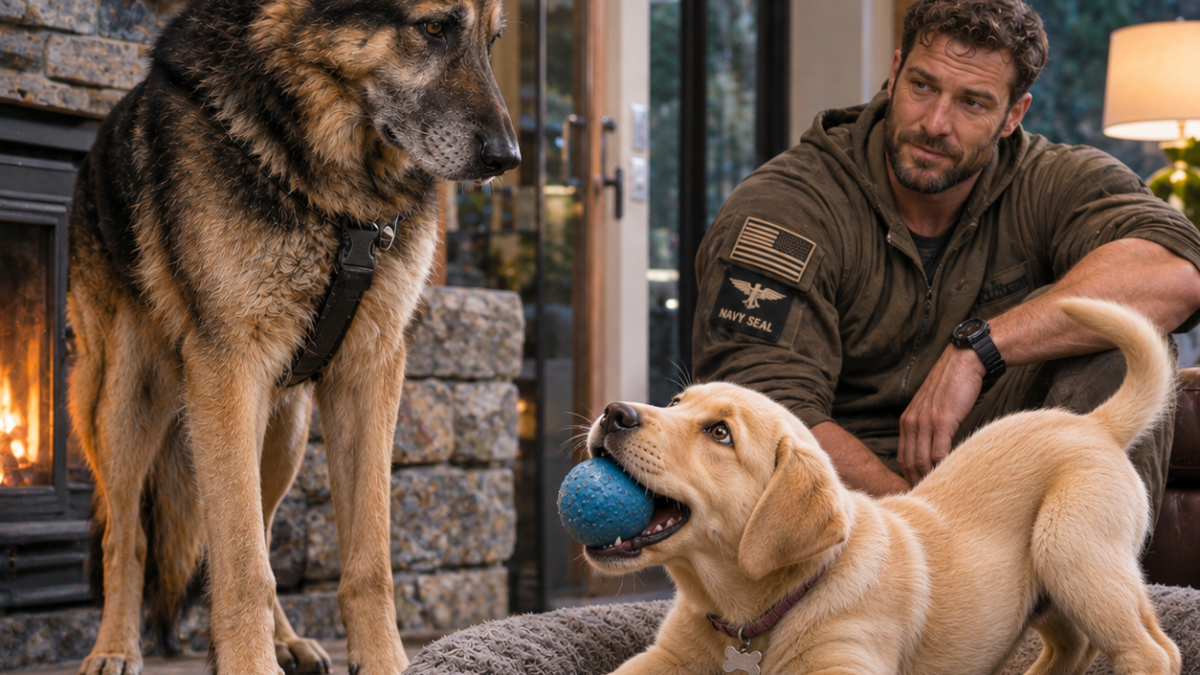
The Navy SEAL Brought Home a K9 Who Was Afraid to Rest—Then His Puppy Did Something No Trainer Had Tried
For nine years, Nero had been taught that every open door, every sudden sound, and every movement in the dark might mean his next job had begun—so even after retirement, the German Shepherd refused to sleep unless the entire house was silent.
Caleb Ross tried commands, orthopedic beds, structured training, calming routines, and everything his experience with working dogs told him should help, but every attempt only gave Nero another task to perform.
Then Caleb’s chaotic seven-month-old puppy stopped trying to make Nero relax, dropped a blue rubber ring between them after a frightening noise, and did something no trainer had thought to prescribe: absolutely nothing.
The first time Sergeant Caleb Ross saw Nero, the German Shepherd had been standing in the same corner of Kennel 18 for almost forty minutes.
Not barking.
Not pacing.
Not scratching at the gate.
Standing.
Perfectly still except for his eyes.
Those eyes followed everything.
A volunteer entering the hall.
A mop bucket rolling past.
A kennel latch snapping shut three doors away.
A pickup stopping outside.
A man laughing near reception.
Every sound registered.
Every movement mattered.
Caleb stood beyond the kennel door with his hands relaxed at his sides.
He had learned a long time ago not to stare directly at a working dog that was already carrying too much tension.
“How long does he do this?”
Amanda Price glanced down at the shelter notes.
“Most of the day.”
“And at night?”
“Staff says he eventually lies down after the building gets quiet.”
“When?”
“Usually after midnight.”
“How long does he sleep?”
“Two hours. Maybe three.”
Caleb looked back at Nero.
Nine years old.
Large black-and-tan German Shepherd.
Gray just beginning to spread across the muzzle.
Muscular once.
PART2:
Still powerful, but leaner now.
His left rear leg had a slight stiffness after he shifted weight.
One ear stayed slightly more forward than the other.
Former police K9.
Retired.
Returned twice.
That was why Caleb had been called.
Not as an adopter.
He had made that extremely clear.
Amanda had asked him to evaluate whether the dog could safely transition into a foster home experienced with working breeds.
Caleb had handled a working dog himself for years.
His old partner Rex had retired with him.
Rex had died two years earlier.
Caleb had not replaced him.
Did not intend to.
There were certain absences people learned to walk around rather than fill.
Rex was one of them.
Amanda said:
“He’s never bitten anyone here.”
“I know.”
“No growling at staff.”
“I read the file.”
“No resource guarding.”
“I know.”
“He just…”
She looked through the glass.
“…makes people nervous.”
Caleb understood why.
PART3:
Nero did not behave like a frightened shelter dog.
He behaved like a dog waiting for somebody to issue instructions.
Someone had taught him that vigilance mattered.
Probably rewarded it.
Depending on the work, maybe depended on it.
The problem was that nobody had ever clearly explained retirement to him.
First foster family lasted eleven days.
Their report:
Paces windows at night.
Checks doors repeatedly.
Will not sleep alone.
Second family lasted nineteen days.
Their report:
Anxious whenever separated from people.
Stands outside bedroom.
Wakes at small noises.
Cannot settle.
Neither family said Nero was dangerous.
That almost made placement more complicated.
Fear was easy to explain.
Aggression was easy to classify.
Nero’s problem lived in a stranger place.
He behaved as though somewhere inside him, the shift had never ended.
Amanda said:
“You don’t have to do this.”
“I’m evaluating.”
“You’ve been standing there twenty minutes.”
“That’s evaluation.”
“You also have Scout.”
Caleb closed his eyes briefly.
There was the other problem.
Scout.
Seven months old.
Officially a yellow Labrador.
Unofficially a weather system.
Caleb had not chosen him.
His younger sister Amy accepted a nursing contract overseas and called two weeks before departure.
“Can Scout stay with you for three months?”
Caleb had asked:
“What’s a Scout?”
Three months became six.
Amy’s contract extended.
Scout became Caleb’s problem.
Then companion.
Then furniture destroyer.
Scout believed every person was his best friend.
Every animal wanted to play.
Every door existed to be opened.
Every object below shoulder height belonged in his mouth.
Putting that puppy beside an overstimulated retired K9 was not Caleb’s idea of responsible rehabilitation.
He said:
“Two weeks.”
Amanda’s mouth moved.
Not quite a smile.
“Foster.”
“Of course.”
“Not adoption.”
“I didn’t say adoption.”
“You were thinking it.”
“I’m thinking you’re easy to manipulate.”
Amanda finally smiled.
“Probably.”
The first meeting happened in Caleb’s fenced backyard outside Bend, Oregon.
Neutral enough.
Open space.
Leashes.
Distance.
Scout came out first.
Saw Nero.
His entire body bent sideways from wagging.
Nero entered through the opposite gate.
Stopped.
Scout strained forward.
Nero froze harder.
Shoulders tightened.
Caleb shortened Scout’s leash.
“Easy.”
Scout sat.
For approximately half a second.
Then stood.
Nero stared at him.
Caleb could not prove what that expression meant.
But if disappointment existed in canine form, Nero appeared to have mastered it.
Scout had brought his blue rubber ring outside.
He dropped it.
The ring rolled halfway between them.
Scout waited.
Nero did not move.
Scout stared.
Still nothing.
Then, surprisingly, Scout picked the ring up again and wandered away.
Caleb noticed.
He had expected Scout to push.
Play bow.
Bark.
Charge back.
Instead the puppy seemed to accept:
Fine.
Old guy doesn’t want it.
That was the first useful thing Scout did.
Inside the house, Nero inspected everything.
Front entrance.
Back door.
Kitchen window.
Guest room.
Garage door.
Hallway.
Caleb let him.
No leash tension.
No commands unless needed.
Nero completed one circuit.
Then another.
Finally positioned himself where the hallway met the living room.
From there he could see:
Front door.
Most of the kitchen.
Stairs.
Back entrance reflection in the glass.
Caleb had placed a thick orthopedic bed beside the fireplace.
Nero ignored it.
Scout immediately climbed onto it.
Rolled onto his back.
Fell asleep.
Naturally.
That night, Caleb woke at 2:13.
Nails moving across hardwood.
Nero checked the front door.
Paused.
Walked to kitchen.
Back entrance.
Hallway.
Returned to original position.
At 2:47:
again.
At 3:22:
again.
At 4:06:
again.
Caleb lay awake listening.
He had heard that sound before.
Rex used to do something similar after difficult deployments.
Not this persistently.
But close enough to make Caleb’s chest tighten.
By sunrise, Scout was upside down on the couch with one paw hanging over his face.
Nero stood beside the front window.
Caleb poured coffee.
“You know nobody hired you.”
Nero’s ears moved.
Nothing else.
That afternoon Caleb called Nero’s former handler.
Retired Deputy Frank Mallory answered.
Caleb introduced himself.
Said Nero’s name.
Frank became quiet.
“How is he?”
Caleb looked toward the hallway.
“Working.”
Long pause.
Then:
“Yeah.”
“That’s what I thought.”
Frank exhaled.
“That’s the problem.”
Caleb waited.
Frank had worked Nero for most of his career.
Patrol.
Building searches.
Tracking.
Night shifts.
Suspect searches.
Article searches.
Backup calls.
Then the county had entered a staffing shortage.
Longer shifts.
More overnight call-outs.
Fewer experienced handlers.
Nero sometimes stayed with Frank at the station between calls rather than going fully off duty.
“He started sleeping light.”
Frank said.
“Then lighter.”
“What did you do?”
“Nothing at first.”
“Then?”
“I was proud of it.”
That answer mattered.
Frank continued.
“He could be asleep under my desk and be standing before the radio call finished.”
Caleb understood.
“That became reinforced.”
“Yeah.”
“Movement meant work.”
“Doors meant work.”
“Radios.”
“Engines.”
“People getting dressed.”
Frank sighed.
“Everything.”
Then Frank had been injured.
Retirement came abruptly.
No gradual transition.
No reduced workload.
One month Nero was working.
The next month Frank was home with a damaged knee and a back injury that ended field duty.
“I thought he’d love retirement.”
“What happened?”
“He didn’t know how.”
Frank bought a dog bed.
Told Nero:
“Place.”
Nero obeyed.
Would lie there.
Eyes open.
Muscles ready.
Frank corrected him for getting up.
Sent him back.
Corrected pacing.
Repeated “settle.”
The dog performed every instruction.
Never actually relaxed.
Caleb closed his eyes.
“You made rest another job.”
Frank was silent.
Then:
“Yeah.”
His wife became ill later that year.
Appointments.
Hospital visits.
Chaos.
Nero moved temporarily to Frank’s brother.
Then a family friend.
Then another home.
Too many changes.
Too quickly.
Caleb asked:
“What does he like?”
Frank answered immediately.
“Work.”
“What else?”
Silence.
“Frank.”
“I don’t know.”
“You had him eight years.”
“I know.”
“Food?”
“Anything.”
“Toys?”
“Never cared much.”
“Swimming?”
“No.”
“Other dogs?”
“Usually neutral.”
“What does he do for fun?”
Frank’s answer came quietly.
“That’s what scares me.”
Caleb hung up fifteen minutes later.
Nero stood in the hallway.
Scout appeared carrying the blue rubber ring.
He walked toward Nero.
Stopped six feet away.
Dropped the toy.
Then lay down.
Nero stared at the ring.
Scout rested his chin on his paws.
Nothing.
After maybe a minute, Nero approached.
Sniffed.
Turned.
Went back to the hallway.
Scout got up.
Collected his toy.
Left.
No breakthrough.
Caleb was relieved.
He had seen too many people turn working dogs into redemption stories.
One magical interaction.
One heroic moment.
One person who “understood” them.
Real dogs were less convenient.
The first month taught Caleb that he was making a mistake.
Not a dangerous one.
A familiar one.
He was trying too hard.
Every morning:
Structured walk.
Breakfast puzzle.
Short obedience.
Rest period.
Afternoon sniffing walk.
Mat work.
Controlled social exposure.
Evening decompression.
The schedule looked excellent on paper.
Nero performed beautifully.
Sit.
Down.
Stay.
Recall.
Place.
Leave it.
Heel.
Food search.
Everything.
Then training ended.
Nero returned to the hallway.
Guarding.
Watching.
Waiting.
One afternoon Dr. Lauren Hayes came to evaluate his arthritis.
She had worked with retired service dogs before.
Nero tolerated the examination.
Mild-to-moderate hip arthritis.
No acute injury.
Medication plan.
Weight monitoring.
Short walks.
No excessive jumping.
Lauren watched Caleb afterward.
“Place.”
Nero went directly to the orthopedic bed.
Lay down.
Eyes open.
Front legs positioned beneath him.
Head high.
Lauren watched for thirty seconds.
Then asked:
“Is he resting?”
“He’s lying down.”
“That wasn’t the question.”
Caleb looked again.
Nero’s ears followed every sound.
Body ready to rise.
Lauren sat at the kitchen table.
“You’ve made the bed another command.”
Caleb rubbed the back of his neck.
“Frank did the same thing.”
“And?”
“I thought I was doing it better.”
“Maybe technically.”
“That’s not comforting.”
She smiled.
“It wasn’t supposed to be.”
“What do you want me to do?”
“Less.”
“Less training?”
“Probably.”
“That sounds irresponsible.”
“It sounds boring.”
“Those aren’t the same thing.”
Lauren looked toward Scout.
The Labrador was asleep in a strip of sunlight.
One rear foot twitching.
“What does Scout do all day?”
“Commits misdemeanors.”
“Besides that.”
“Sleeps.”
“Plays.”
“Steals socks.”
“Watches birds.”
“Gets bored.”
She nodded.
“Maybe Nero needs exposure to being useless.”
Caleb stared at her.
“You’re prescribing uselessness?”
“I’m prescribing a life in which nothing happens sometimes.”
The following week felt wrong to Caleb.
Regular food.
Medication.
Short walks.
Basic household rules.
Necessary obedience.
Otherwise:
Nothing.
No rehabilitation blocks.
No formal settle practice.
No carefully staged decompression exercises.
Scout considered this the finest medical plan ever created.
He carried socks through hallways.
Slept beneath kitchen chairs.
Dropped toys near Nero.
Sometimes forgot about him entirely when squirrels appeared outside.
Nero continued standing.
But something subtle shifted.
Scout stopped trying to recruit him.
He would lie six feet away.
Then ten.
Then walk off.
The puppy’s lack of concern seemed to change the emotional temperature of the room.
One evening Caleb pulled a metal baking sheet from a cabinet.
It slipped.
Hit the tile.
CRASH.
Nero recoiled.
Instantly.
Body lowered.
Weight forward.
Eyes scanning.
Breathing fast.
Caleb froze.
He knew better than to rush in and grab him.
Scout came charging from the living room.
Caleb almost intercepted him.
The puppy stopped on his own.
Looked at Nero.
Looked at Caleb.
Then turned.
Picked up the blue rubber ring.
Carried it halfway across the kitchen.
Dropped it.
Lay down.
Nothing else.
Nero’s chest rose quickly.
Scout waited.
Caleb waited.
Thirty seconds.
Nero’s eyes moved.
Scout.
Ring.
Caleb.
Door.
Back to Scout.
The puppy’s tail tapped the floor once.
Nero took one step.
Then another.
Touched the ring with his nose.
Scout’s tail moved again.
Nero nudged it.
The toy rolled.
Scout exploded after it.
Retrieved.
Returned.
Dropped it farther away.
Nero did not follow.
Scout did not care.
He carried it off.
That was all.
But something had happened.
Not because Scout comforted him.
Not because he hugged him.
Not because the puppy understood trauma.
Scout did something much simpler.
He treated the frightening event as temporary.
Noise.
Then toy.
Then ordinary life.
Caleb began noticing the pattern.
Delivery van outside?
Nero stiffened.
Scout found his ring.
Ladder coming down from garage storage?
Nero watched.
Scout carried the ring into the hallway.
A neighbor slammed a car door?
Scout looked outside.
Decided it was boring.
Went back to chewing.
Sometimes he brought the ring.
Sometimes a tennis ball.
Once a sock.
Nero began looking toward him.
Not always.
But sooner.
Caleb mentioned it to Lauren.
She said:
“Social referencing.”
“I know what it is.”
“Then stop sounding surprised.”
“It’s untrained.”
“Exactly.”
Nero was reading Scout.
If Scout was relaxed, maybe the environment did not require a response.
The puppy became information.
Not therapy.
Not a cure.
Information.
If the fool who panicked because a leaf moved outside was currently asleep, perhaps there was no emergency.
Weeks passed.
One afternoon Caleb came downstairs and stopped.
Nero was sleeping.
Daylight.
Not lying down on command.
Sleeping.
Hallway floor.
Head flat.
Eyes closed.
Scout nearby on his back.
Caleb stood absolutely still.
Did not photograph it.
Did not whisper praise.
Did not touch Nero.
He walked away.
The following week it happened again.
Then one morning Nero was on the orthopedic bed.
Scout was sleeping in the hallway.
Caleb almost laughed.
Somehow they had swapped jobs.
He said nothing.
Next morning Nero used the bed again.
Then stopped for three days.
Then returned.
Progress did not move in straight lines.
By early spring, Nero still checked doors.
Still woke at unusual noises.
Still preferred positions where he could see entrances.
But he slept.
Sometimes for an hour.
Sometimes longer.
One afternoon Scout dropped the blue ring directly onto Nero’s front leg.
Nero opened one eye.
Scout waited.
Nero pushed the ring away with his nose.
Scout retrieved it.
Repeated.
Third time, Nero grabbed the ring.
Scout froze.
Caleb froze.
Nero held it.
No tugging.
No play bow.
Just held it for maybe two seconds.
Then released.
Scout celebrated as though he had won the lottery.
Caleb laughed.
Nero watched him.
For the first time, his expression looked almost annoyed in an ordinary way.
That felt enormous.
In May, Caleb took both dogs to a retired working-dog support gathering at a community center outside Bend.
Not therapy.
Not performance.
Just handlers, veterans, retired public-safety workers, and former working dogs sharing space.
Nero handled it well.
Scout handled it too enthusiastically.
He attempted to introduce himself to approximately everyone.
A retired firefighter named Harold Benson sat near a window.
Seventy-six.
Gray sweater.
Walking cane.
Quiet.
Nero chose the floor near his chair.
Harold did not touch him.
Perfect.
Next week:
same.
Harold read.
Nero slept.
Scout bothered everybody else.
Over several visits, it became a routine.
Harold once told Caleb:
“I like that one.”
“Nero?”
“He doesn’t require conversation.”
“That is one of his strengths.”
Harold smiled.
His daughter sometimes picked him up.
Caleb learned Harold had early-stage cognitive impairment.
Usually mild.
Names.
Dates.
Occasional confusion in unfamiliar environments.
Family monitored him closely.
Then one Saturday afternoon Harold disappeared.
His daughter arrived.
His phone sat on a chair.
Walking cane missing.
Nobody remembered seeing him leave.
A side door opened toward a riverside path.
Rain had begun.
Search response activated immediately.
Staff checked rooms.
Parking lot.
Bathrooms.
Nearby businesses.
Law enforcement contacted.
Search volunteers organized.
Caleb looked at Nero.
And hated the thought that came into his mind.
Tracking.
Nero still knew it.
The old dog had spent years doing it.
For six months Caleb had been trying to teach him he did not have to solve every problem.
Now a man Nero knew was missing.
Search coordinator Melissa Grant approached.
“Can Nero trail?”
“Yes.”
“Reliably?”
“Historically.”
“Current?”
“No certification.”
“Physical condition?”
“Arthritis.”
Melissa nodded.
“Then maybe not.”
Caleb looked toward the trail.
Rain increasing.
Harold was seventy-six.
No phone.
Potentially confused.
He looked at Nero again.
That was when he realized the important question was not:
Can he work?
It was:
Should he?
Lauren had allowed short controlled physical activity.
No long searches.
No hard terrain.
No prolonged strain.
Caleb said:
“One attempt.”
Melissa waited.
“Twenty minutes maximum.”
“Okay.”
“If his gait changes, we stop.”
“Okay.”
“If he shows stress, we stop.”
“Agreed.”
“His track is information. Not a guarantee.”
Melissa nodded.
“Exactly.”
Harold’s jacket provided scent.
Caleb brought out Nero’s old working harness.
The moment it came into view, the German Shepherd changed.
Not fear.
Not frantic excitement.
Recognition.
Caleb felt something twist in his chest.
Harness on.
Scent presented.
Nero’s nose dropped.
The hallway dog disappeared.
For a few minutes the working K9 returned.
Focused.
Precise.
He pulled through the parking lot.
Past a bench.
Onto the paved riverside trail.
Caleb followed.
Melissa behind.
Light rain.
At a footbridge, Nero lost scent.
Circled.
Returned.
Found something.
Pulled left.
Twelve minutes.
Caleb watched his rear legs.
Fourteen.
Nero’s stride shortened.
Fifteen.
Still pulling.
Caleb told himself:
Harold might be close.
Sixteen.
Nero stumbled.
Tiny.
Barely anything.
But Caleb saw it.
He stopped.
“That’s it.”
Melissa looked at him.
“We have a direction.”
“Yes.”
“He’s still pulling.”
“Yes.”
“So—”
“No.”
Caleb unclipped the tracking line from working configuration.
Removed the harness.
Nero immediately tried to move back toward the trail.
Caleb blocked gently.
“Done.”
For a horrible second it felt wrong.
They had a missing man.
A dog willing to continue.
Caleb was choosing to stop.
Melissa radioed the direction Nero had indicated.
Human teams advanced.
Minutes later, another team located a fresh shoe impression near a muddy access trail.
It matched Harold’s likely footwear.
Twenty-eight minutes after Nero stopped, searchers found Harold beneath a highway overpass.
Cold.
Confused.
Wet.
Uninjured.
Nero did not find him.
He did not need to.
He had given one useful direction.
People finished the work.
Back at the community center, Harold’s daughter ran toward Caleb.
Hugged him.
Then moved toward Nero.
Caleb raised one hand.
“Give him space.”
She stopped immediately.
“Sorry.”
“You’re fine.”
Nero lay on a blanket.
Scout beside him.
The Labrador placed the blue ring between them.
Nero did not touch it.
Caleb realized how tired he was.
Lauren examined Nero later that afternoon.
No acute injury.
Hips irritated.
Restricted activity for several days.
Caleb sat beside the table.
“I pushed him too far.”
Lauren shook her head.
“You stopped.”
“After he stumbled.”
“You noticed.”
“I should have stopped before.”
“Maybe.”
That irritated him.
“Maybe?”
“You had information.”
“You set limits.”
“You monitored him.”
“And?”
“You stopped before the dog made the decision for you.”
Caleb looked at Nero.
Lauren continued:
“That matters.”
A week later Harold visited Caleb’s house.
He brought a wooden plaque.
Caleb groaned.
“No awards.”
“Not for you.”
Harold placed it beside Nero’s bed.
Three words carved into the wood:
OFF DUTY HERE.
Caleb laughed.
Nero sniffed it.
Walked away.
Scout immediately tried chewing one corner.
Harold slapped his knee.
“That one’s defective.”
“No warranty.”
The plaque stayed.
Months passed.
Nero’s life became smaller.
That was not sad.
That was success.
Morning walk.
Breakfast.
Sometimes sunbeam.
Sometimes bed.
Scout.
Caleb.
Occasional support-group visits.
Medication.
No expectation to prove anything.
Nero stopped following Caleb into every room.
At first, Caleb did not notice.
Then one evening he carried laundry upstairs.
Halfway up, he realized:
Nero was not behind him.
Caleb looked down.
Scout was asleep in the living room.
Nero was on his bed.
Head down.
Caleb continued upstairs.
When he came back ten minutes later, Nero had not moved.
That felt bigger than the tracking story.
Nobody filmed it.
Nobody applauded.
An old working dog had decided that a human leaving his sight did not require action.
That was all.
One stormy evening, thunder shook the windows.
Nero stood.
Scout looked up.
Found the blue ring.
Carried it toward him.
But this time Nero did not need it.
He looked at Scout.
Then walked to the orthopedic bed.
Turned twice.
Lay down.
Scout stood with the ring in his mouth.
Confused.
Caleb smiled.
“Congratulations.”
Scout looked at him.
“You’ve been replaced.”
The Labrador walked over.
Dropped the ring against Nero’s paws anyway.
Nero sighed.
Scout lay beside the bed.
For several minutes neither moved.
Then Nero lowered his head.
Actually slept.
Thunder outside.
Door unsecured by his body.
Windows unwatched.
No command.
No “place.”
No “settle.”
No one asking him to do anything.
Caleb sat at the kitchen table and finally understood what had changed.
He had spent months believing he needed to teach Nero to rest.
Frank had tried that.
Caleb had tried it differently.
Both had failed for the same reason.
Teaching was still work.
Nero already knew how to follow commands.
He knew how to perform calm.
What he did not know was that calm could exist without performance.
Scout had never taught him a command.
Scout never corrected the pacing.
Never praised the bed.
Never demanded eye contact.
Never asked Nero to trust him.
The puppy simply lived.
Noise happened.
Scout played.
Cars arrived.
Scout slept.
Caleb moved a ladder.
Scout found a toy.
Thunder came.
Scout remained a ridiculous puppy.
Over time Nero began using him as proof.
If Scout was not worried, perhaps Nero did not have to be.
One afternoon Frank Mallory finally visited.
He had delayed for months.
Caleb understood why.
The former handler stepped from his truck slowly.
Bad knee.
Older than Caleb remembered from photographs.
Nero saw him through the window.
Stood.
Caleb’s heart tightened.
Frank entered.
Nero approached.
Sniffed.
Then his tail moved.
Once.
Twice.
Frank dropped to one knee despite the pain.
“Hey, partner.”
Nero pushed his head against Frank’s chest.
Frank closed his eyes.
Caleb looked away.
Gave them privacy.
After several minutes, Frank sat on the couch.
Nero stood beside him.
Then looked toward the hallway.
Caleb expected the old pattern.
Instead Nero walked to the orthopedic bed.
Lay down.
Frank stared.
“He sleeps there?”
“Sometimes.”
“During the day?”
“Yeah.”
Frank’s face changed.
“How?”
Caleb looked at Scout.
The Labrador was upside down near the fireplace.
“I stopped making him.”
Frank swallowed.
“That simple?”
“No.”
“Of course.”
Scout woke.
Found the blue ring.
Dropped it beside Nero.
Frank watched.
“What’s that?”
Caleb explained.
Not as miracle.
Not as formal training.
Just what he had noticed.
The noises.
The toy.
Scout becoming a reference point.
Frank watched Nero.
Then said quietly:
“I spent his whole career teaching him to look at me for what happened next.”
Caleb nodded.
Frank looked toward Scout.
“Now he looks at that idiot.”
Scout sneezed.
Caleb laughed.
“Apparently.”
Frank’s eyes filled.
“I thought retirement meant removing the work.”
“Maybe.”
“I never showed him what came after.”
Neither man spoke for a while.
Before leaving, Frank walked to Nero’s bed.
Did not command.
Did not call him.
Simply placed one hand on the old dog’s shoulder.
“Good boy.”
Nero opened an eye.
Then closed it.
Frank smiled.
“That might be the first time he ignored me.”
Caleb said:
“Progress.”
The next winter brought snow.
Scout turned one.
Still stole socks.
Still carried the blue ring everywhere.
Nero turned ten.
His muzzle became grayer.
Hips slower.
Caleb shortened walks.
Added rugs to slick floors.
Built a small ramp for the back steps.
One morning he woke at 5:30.
House silent.
He walked downstairs.
Scout slept near the fireplace.
Nero was on the orthopedic bed.
Not near the front door.
Not facing the hall.
His back was actually turned toward the entrance.
Caleb stopped.
Of all the things Nero had done—
Patrol work.
Tracks.
Searches.
Helping point volunteers toward Harold.
That might have been the bravest.
He had turned his back on the door.
Caleb made coffee.
Did not wake him.
Later Scout stretched.
Walked to the bed.
The blue ring hanging from his mouth.
He dropped it.
Nero opened one eye.
Scout waited.
Nero pushed the ring away.
Scout brought it back.
Nero pushed again.
Third time, Scout squeezed himself onto the edge of the orthopedic bed.
There was not enough room.
Scout did not care.
Nero lifted his head in annoyance.
Scout curled against him.
For a moment the old German Shepherd remained upright.
Alert.
Then his head slowly lowered across the puppy’s shoulders.
Caleb watched from the kitchen.
No command.
No training session.
No rehabilitation plan.
No camera.
Nero slept.
Scout slept beneath him.
The blue ring remained between their front paws.
Caleb thought about the first night.
2:13.
2:47.
3:22.
Nails across hardwood.
Door.
Window.
Hallway.
Again.
Again.
Again.
A dog who believed rest was dangerous because the next job could begin at any second.
Caleb had spent months looking for the right technique.
The right command.
The right schedule.
The right professional answer.
In the end, Scout had offered Nero something much simpler.
A life in which not every sound mattered.
A life where a metal pan could crash and nobody needed him.
A life where a delivery truck could stop outside and the world continued.
A life where somebody else could watch the hallway.
Or nobody could.
A life where the blue ring sometimes mattered more than the front door.
Nero had been trained to search buildings.
Track people.
Respond to danger.
Protect a handler.
Those skills had once made him valuable.
But retirement required a completely different lesson.
He had to learn that his value did not disappear when the work did.
Scout never knew any of that.
He was just a puppy.
A loud, inconvenient, sock-stealing puppy who happened to be very good at forgetting yesterday.
Maybe that was why Nero watched him.
Scout never asked:
What if something happens?
He simply assumed that if something happened, they would deal with it then.
Until then:
Toy.
Sunbeam.
Nap.
Nero slowly borrowed that philosophy.
Not perfectly.
Some nights he still woke and checked the door.
Some noises still brought him upright.
Some situations still pulled the old working dog back to the surface.
Caleb stopped judging those moments.
Healing did not require Nero to become a different dog.
It only required his world to become large enough to include rest.
The wooden plaque beside the bed eventually collected scratches.
OFF DUTY HERE.
Scout had chewed one corner badly enough that the word HERE looked slightly crooked.
Harold thought that improved it.
Caleb agreed.
Because by then nobody needed the sign.
Nero knew.
One rainy evening almost a year after Caleb first saw him standing in the shelter, the former K9 slept through the sound of a car pulling into the driveway.
Scout raised his head.
Listened.
Then went back to sleep.
Nero did not move at all.
Caleb stood in the kitchen holding a coffee mug.
He smiled.
The German Shepherd who once refused to sit because he thought every second might become another assignment was finally sleeping with his back to the door.
And the puppy who helped him get there had never once told him to rest.
He had simply shown Nero, over and over, that sometimes nothing was happening.
And nothing was exactly where an old working dog was finally allowed to be.








