The Navy K9 Failed Every Drill for 3 Months—Then a Waitress Whistled Once and He Obeyed the Cue Nobody Knew Existed
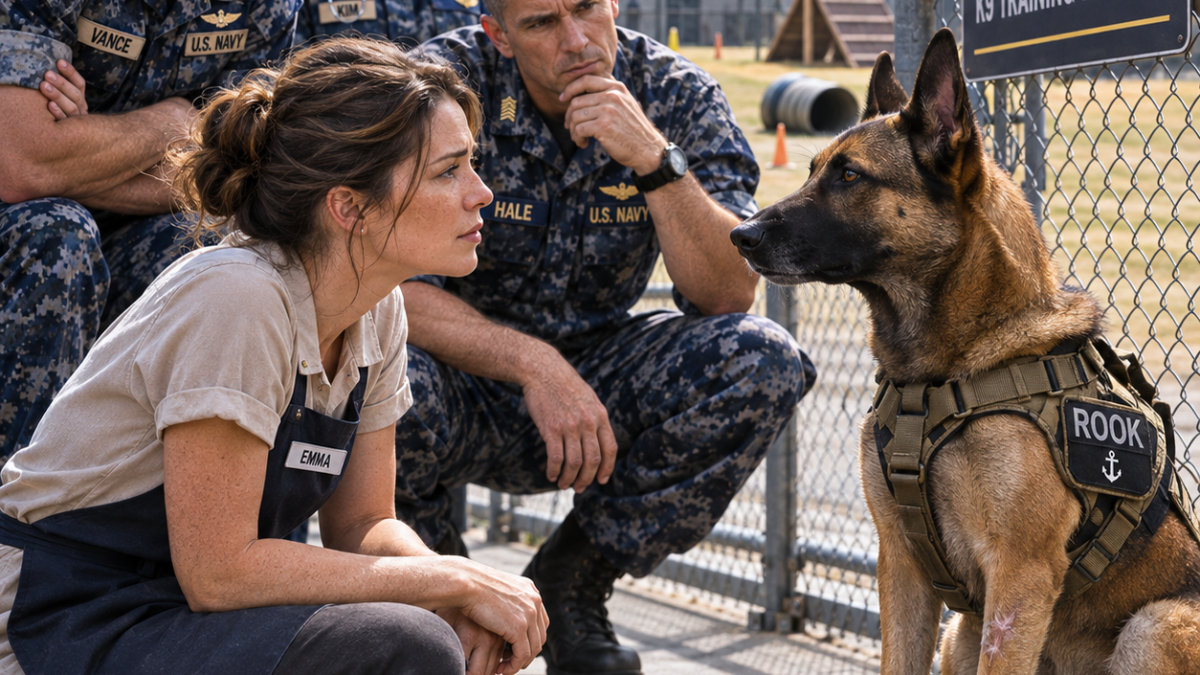
PART2:
She had never been Rook’s registered handler.
Never been his trainer of record.
Never owned him.
She had been Noah’s team medic.
That mattered emotionally.
Administratively, it meant almost nothing.
So she stopped asking.
Officially.
Then she took a breakfast job across from a canine compound.
And listened.
On the eighty-third morning, Petty Officer Lucas Vance sat at the counter with two handlers.
Emma had seen him dozens of times.
Quiet.
Mid-thirties.
Good manners.
Black coffee.
Eggs over medium.
He looked tired that morning.
The younger sailor beside him was complaining about a dog.
“He failed the recall again.”
Vance shook his head.
“He’s not stupid.”
“He acts stupid.”
“He’s overloaded.”
“He’s been overloaded for three months.”
The third handler said:
PART3:
“Maybe Rook just washed.”
Emma’s hand stopped.
Coffee continued flowing.
Dark liquid reached the rim of Vance’s mug.
Then spilled into the saucer.
“Ma’am?”
Emma set the pot down.
“What did you say?”
Vance looked confused.
“About what?”
“The dog.”
“Rook?”
Her fingers went cold.
She had imagined hearing the name hundreds of times.
In some versions, she dropped whatever she was holding.
In others, she ran outside.
Reality was quieter.
She removed her food-service gloves.
“Where did he come from?”
Vance glanced toward the other handlers.
“Transfer.”
“From where?”
“Why?”
“Because I know him.”
The younger handler laughed.
Not cruelly.
Just reflexively.
“Everybody knows every Malinois once they’ve seen one.”
Emma looked at him.
“Does he have a white crescent scar under his right front leg?”
The laughter stopped.
Vance answered:
“Yes.”
“Small?”
“Yes.”
“Almost hidden when he stands?”
“Yes.”
Emma swallowed.
“When he sleeps, does he prefer his back against a wall?”
Nobody answered.
“When he’s overloaded, he doesn’t spin.”
Vance’s expression changed.
“He doesn’t bark.”
The younger handler put his fork down.
Emma continued:
“He freezes.”
Vance stared at her.
“Head slightly left.”
“Yes.”
“Weight forward.”
“Yes.”
“Like he’s waiting for somebody else to finish something.”
Vance’s voice dropped.
“How do you know that?”
Emma turned toward the window.
Across the road, part of the canine compound was visible behind chain-link fencing.
“Because I was there when he learned it.”
Five minutes later, Emma’s supervisor was running the register.
Emma did not storm across the restricted compound.
She did not call Rook’s name through the fence.
She did not use the whistle that had been sitting in the back of her mind for twenty-eight months.
She went to security.
Showed identification.
Asked for the canine operations officer.
Commander Patrick Hale arrived twelve minutes later.
His expression suggested that being pulled away from his work because a canteen employee claimed to know a military dog was not the morning he had planned.
“Ms. Lawson?”
“Yes.”
“You requested me?”
“Yes.”
“What is this about?”
“My name is Emma Lawson.”
“I know.”
“I’m a former Navy hospital corpsman.”
That changed his attention slightly.
“I served with Petty Officer First Class Noah Bennett.”
Now it changed completely.
Hale knew the name.
Noah Bennett had died during an overseas deployment twenty-eight months earlier.
Some details remained protected.
His death did not.
Emma continued.
“Rook was his dog.”
Hale looked at the canteen uniform under her jacket.
Then at her.
“You were Rook’s handler?”
“No.”
“Trainer?”
“No.”
“Veterinary technician?”
“No.”
“Then what was your relationship to him?”
“I was the team medic.”
“That doesn’t make the dog yours.”
“I didn’t say it did.”
Hale studied her.
The irritation faded another degree.
“What do you want?”
“To see him.”
“No.”
Emma nodded.
“Okay.”
Hale had clearly expected an argument.
She continued:
“Then have somebody cleared verify what I’m telling you.”
“What exactly are you telling me?”
“That the dog you’ve been evaluating may not be trained for the work you’re grading him against.”
Hale’s expression hardened.
“You know that from breakfast conversation?”
“I know it from his behavior.”
“You haven’t seen him.”
“I heard enough.”
“Not good enough.”
“I agree.”
That answer stopped him again.
Emma said:
“So verify it.”
Thirty minutes later, she stood outside the training fence.
Outside.
Not on the range.
Rook was forty yards away with Lucas Vance.
Emma had spent years remembering him young.
Fast.
Dark-faced.
Almost arrogant in the way good Malinois could look when they knew the answer before the person holding the leash did.
The dog in front of her was seven now.
Still muscular.
Still alert.
But thinner than she remembered.
A pale scar crossed his flank.
That one was new.
Vance gave a recall.
“Rook, here.”
Nothing.
Second cue.
Nothing.
Rook stood in the center of the yard.
Still.
Head slightly left.
Weight forward.
Emma closed her eyes.
Noah used to call it the statue.
Not because Rook had stopped thinking.
Because he had shifted into a different task.
Hale stood beside her.
“That’s what he does.”
“How long?”
“Since transfer.”
“What are you evaluating?”
“Patrol requalification.”
Emma looked at him.
“Detection?”
“Yes.”
“Handler transition?”
“Yes.”
“Apprehension?”
“Yes.”
“Bite work?”
“Yes.”
Emma almost laughed.
Not because it was funny.
Because the explanation was suddenly sitting in plain sight.
“Who told you he was a patrol dog?”
“Transfer packet.”
“Original training annex?”
“Restricted annex missing.”
“Then you don’t have his training profile.”
“We have competencies.”
“Competency isn’t mission history.”
Hale’s tone cooled.
“Ms. Lawson.”
“Commander.”
She pointed toward Rook.
“You may be grading him against tasks he was never fully qualified to perform.”
“His file says patrol.”
“His file might say he had patrol exposure.”
“That’s speculation.”
“Yes.”
Hale looked surprised.
Emma continued:
“So get the old record.”
“What do you know he did?”
“Explosive detection first.”
Hale waited.
“Off-leash area search.”
Another pause.
“Team movement.”
Then:
“Casualty access conditioning.”
Hale frowned.
“Explain that.”
“If Noah went down, Rook had a tendency to position over him.”
“Protective behavior?”
“Yes.”
“Controlled?”
“Eventually.”
Vance had walked closer.
Emma almost smiled.
“The first time I tried treating Noah during training, Rook decided medicine was an unauthorized activity.”
Vance asked:
“What did you do?”
“Noah and I built an access cue.”
“What cue?”
Emma lifted two fingers.
Then stopped.
Her throat tightened.
Hale noticed.
“You don’t have to demonstrate anything.”
She lowered her hand.
“It wasn’t a hand signal.”
“What was it?”
“A whistle.”
“How?”
“Two short.”
She paused.
“One long.”
Vance asked:
“What did it mean?”
“That I was authorized to enter Noah’s space if he was down.”
Vance’s face changed.
Emma saw it immediately.
“What?”
He looked at Hale.
Then back at her.
“We’ve been doing casualty drills.”
Emma stared.
“What kind?”
“Handler moving. Simulated blast. Handler goes down.”
“What does Rook do?”
“Moves over the handler.”
Her stomach tightened.
“Faces outward?”
“Yes.”
“Doesn’t disengage?”
“Yes.”
“Then what?”
“We recall.”
“And?”
“He doesn’t move.”
“And you mark it failure.”
Vance looked away.
“Yes.”
Emma said nothing.
He heard the implication himself.
Hale asked:
“Can the whistle establish this is the same dog?”
“No.”
Immediate.
“Why not?”
“Dogs can respond to novel sound.”
“Recognition would mean something.”
“It would be evidence.”
“Not proof?”
“No.”
“What is proof?”
“Microchip.”
She counted with her fingers.
“Old veterinary file.”
“Original training video.”
“Handler notes.”
“Records created before I walked over here.”
Hale folded his arms.
“You’ve thought about this.”
“For two years.”
The words came out flatter than she intended.
Hale studied her.
“After Bennett died?”
“Rook disappeared into reassignment.”
“You made inquiries?”
“Seven.”
“And after seven?”
“I stopped.”
Hale looked across the road toward the canteen.
“You took a job where working-dog handlers ate breakfast.”
Emma’s jaw tightened.
“That’s not the same answer.”
“No.”
She met his gaze.
“It’s the honest one.”
Vance asked quietly:
“You’ve been waiting to hear his name?”
Emma looked toward Rook.
“Every morning.”
Nobody spoke.
Then Hale said:
“We’re not using the whistle.”
Emma looked at him.
“Good.”
Vance frowned.
“Why?”
Hale answered:
“If she’s right, we don’t turn a reunion into an experiment.”
Then:
“If she’s wrong, we don’t teach ourselves to see what we want.”
Emma nodded.
For the first time, she trusted him.
Not completely.
A little.
Rook’s behavioral-removal packet was suspended for seventy-two hours.
Not cancelled.
Historical records requested.
Microchip verification ordered.
Veterinary behavioral service notified.
Emma returned to the canteen.
Put her apron back on.
At 12:17, Vance sat at her counter.
Emma poured coffee.
He did not drink it.
“You knew Bennett well?”
“Yes.”
“Were you there when he died?”
Emma stopped moving.
Vance immediately said:
“You don’t have to answer that.”
She stared at the coffee pot.
“Yes.”
He waited.
“I was there.”
Rook had been there too.
Noah went down after an explosion.
Emma reached him.
Rook blocked her.
Not because he had become aggressive.
Because chaos had triggered training.
Two short whistles.
One long.
Rook moved.
Emma entered.
Worked on Noah for eleven minutes.
Eleven minutes later, everything that could be done had been done.
Nothing changed the outcome.
Rook remained beside them.
Watching.
Waiting.
Afterward, he refused to leave the evacuation point.
Another handler eventually led him away.
Emma never saw him again.
Until that morning.
Vance asked:
“Did he watch Bennett die?”
“Yes.”
He looked down.
“Then maybe we’re not only dealing with paperwork.”
“No.”
Emma slid his coffee closer.
“You’re dealing with a dog.”
“What does that mean?”
“Training matters.”
She looked through the window.
“History matters.”
Then:
“And what happened to him matters.”
Vance nodded.
“We’ve been calling him broken.”
Emma looked at him.
“No.”
He waited.
“You’ve been saying you don’t understand him.”
She returned to the register.
“Those aren’t the same thing.”
Major Priya Shah arrived the following afternoon from the military working-dog veterinary service.
She did not care about Emma’s story.
Emma liked her immediately.
Priya read everything.
Behavior logs.
Weight changes.
Medication.
Training scores.
Videos.
Medical reports.
Then she asked to watch Rook without Emma present.
For two hours, she observed Vance.
Obedience.
Environmental exposure.
Detection.
No staged casualty.
No bite work.
No gunfire.
Rook was inconsistent.
But not random.
He completed a vehicle search cleanly.
Ignored a patrol bark command.
Followed explosive odor forty yards.
Then disengaged when a decoy appeared.
A metal panel crashed behind him.
Rook startled.
Recovered in six seconds.
Priya wrote something.
Vance asked:
“Gun shy?”
“Maybe.”
“How bad?”
“That isn’t a diagnosis.”
She looked at him.
“Startle is normal.”
Then:
“Recovery tells me more.”
Afterward she brought Emma into a review room.
Three casualty exercise videos.
The first started.
Vance walking.
Simulated blast.
Vance falls.
Rook moves immediately.
Positions over him.
Faces outward.
Instructor calls him away.
Nothing.
Second command.
Nothing.
Leash pressure.
Rook stiffens.
Third command.
Electronic collar stimulation.
Emma went white.
“Turn it off.”
Priya paused.
Vance looked ashamed.
“That was within approved protocol.”
“I know.”
Emma’s voice was controlled.
“That doesn’t make it the right protocol for him.”
Vance nodded.
“I know now.”
Priya asked:
“What did Rook’s old team do when Noah went down?”
“Nothing like this.”
“What did he expect?”
“To stay.”
“Until?”
“Noah released him.”
Emma counted.
“A recognized handler assumed control.”
Then:
“Or I used the medical access whistle.”
Priya leaned back.
“If that conditioning remained intact…”
Vance finished:
“We punished him for maintaining it.”
Silence.
“Jesus.”
Priya looked at him.
“Maybe.”
Then she pointed toward the screen.
“But do not run ahead of the evidence.”
Vance frowned.
“What else could it be?”
“Historical learned behavior.”
She counted.
“Trauma-related perseveration after handler loss.”
“Stress.”
“Possibly several things together.”
“Does that matter?”
“A great deal.”
Priya looked at Emma.
“If this is only mismatched training language, retraining may be straightforward.”
Then:
“If repeated casualty scenarios are reconnecting him to a traumatic event and worsening his welfare…”
Emma understood before she finished.
“You’d retire him.”
“I might.”
“Even if his detection still works?”
“Yes.”
“Why?”
Priya’s expression remained unchanged.
“Capability and suitability are different questions.”
That sentence hurt Emma more than she expected.
For more than two years she had imagined finding Rook.
In her imagination, finding him always meant fixing something.
Returning him to himself.
Maybe returning him to work.
Maybe proving everyone wrong.
Priya was saying something harder.
Sometimes saving a working dog meant letting him stop working.
The first historical record arrived that evening.
Microchip:
Match.
MWD Rook N472.
Primary handler:
PO1 Noah Bennett.
Medical history contained scars Emma remembered.
Vaccinations.
Shoulder strain.
Noise exposure following Noah’s fatal mission.
Then a behavioral note.
Heightened vigilance.
Reduced food intake.
Repeated kennel scanning.
Recommendation:
Decompression before reassignment.
Emma read it twice.
Vance asked:
“Was that done?”
The transfer history answered.
Three weeks after Noah died:
Temporary kennel.
Six weeks:
Another facility.
Eleven weeks:
New-handler adaptation.
Four months:
Reassigned.
Then two additional transfers over the following eighteen months.
Not abuse.
Not cruelty.
Movement.
Different kennels.
Different voices.
Different cue styles.
Different schedules.
Different expectations.
No stable person long enough for anything to become normal.
Priya tapped the timeline.
“That matters.”
Hale frowned.
“Dogs transfer handlers.”
“Yes.”
“Successfully.”
“Many do.”
“Then why is movement automatically significant here?”
“It isn’t.”
Priya pointed at Rook’s records.
“‘Many dogs adapt’ is not evidence this dog adapted.”
Another file arrived.
Training classification.
Rook had carried a broad dual-purpose coding entry.
Underneath:
Primary operational specialty: explosive odor detection / off-leash area search.
Patrol/apprehension:
Maintenance familiarization only.
Not full patrol qualification.
Vance stared at the screen.
“We built half his evaluation around apprehension.”
Hale’s anger appeared.
Not at Vance.
At the process.
“How does familiarization become qualified?”
The logistics chief found the answer.
Old database:
Multiple levels.
Exposure.
Familiarization.
Maintenance.
Qualification.
New transfer interface:
PATROL?
YES / NO.
If the old file showed any patrol entry at all:
YES.
No one forged the record.
No one secretly altered the dog’s history.
Software flattened it.
Then humans trusted the software.
Hale stopped the requalification program.
An instructor asked:
“Pending evaluation designed by Lawson?”
“No.”
Hale looked at Emma.
“Ms. Lawson provides historical information.”
Then Priya.
“Veterinary behavior owns welfare recommendations.”
Then Vance.
“Vance handles.”
Then himself.
“I authorize.”
Reeves, the younger sailor who had laughed in the canteen, raised one hand.
“What are we trying to prove?”
Emma looked at him.
Good question.
Priya answered:
“Nothing.”
Reeves frowned.
“We have to decide whether he’s fit.”
“Yes.”
“That means proving something.”
“No.”
She leaned against the table.
“If our goal is proving Emma right, we’ll create a demonstration that confirms her story.”
Then:
“If our goal is proving the facility right, we’ll repeat the tests he fails.”
She pointed toward the kennel building.
“Our job is to find out what that dog can safely and reliably do now.”
Nobody argued.
The next morning, Rook received no dramatic challenge.
Warehouse.
Eight rooms.
Two explosive training aids.
No decoy bite.
No handler-down scenario.
No gunfire.
Vance entered with him.
Emma watched behind glass.
At first Rook moved slowly.
Sniffed the threshold.
Paused.
Then something changed.
His head lowered.
His stride became purposeful.
He cleared the first room.
Then the second.
Third.
At Room Four, he stopped at a metal cabinet.
Sat.
Vance looked at the evaluator.
Correct.
Second hide:
Buried in stacked shipping material.
Rook searched.
One minute.
Two.
Nearly three.
Then stopped.
Sat.
Two for two.
Vance exhaled.
“Good boy.”
Rook accepted the reward.
Then immediately returned to work.
Emma’s eyes filled.
Priya noticed.
“Recognition?”
Emma shook her head.
“Relief.”
“What’s the difference?”
“He doesn’t need me for this.”
Priya smiled slightly.
That was healthy.
Environmental evaluation followed.
Stairs.
Dark rooms.
Vehicles.
Controlled noise.
Rook startled once.
Recovered.
No shutdown.
Handler transition.
Vance passed him to an experienced handler.
Rook became tense.
But functioned.
Information.
Not perfect.
Not catastrophic.
Then Priya asked:
“Do we repeat casualty behavior?”
Emma answered immediately:
“No.”
Hale looked surprised.
“That is the behavior your explanation depends on.”
“No.”
Emma shook her head.
“You already have three videos.”
“We haven’t verified the whistle.”
“That’s for us.”
“Not him?”
“Exactly.”
Hale studied her.
“Then how do we verify your story?”
“Records.”
“Video if any exists.”
“People.”
“And if nothing exists?”
Emma looked through the glass.
“Then don’t believe me.”
Vance stared.
“You spent two years looking for this dog.”
“Yes.”
“And you’d accept us calling your story unproven?”
“Yes.”
“Why?”
“Because I’m not putting him back into the worst moment of his life so I can win an argument.”
Nobody spoke.
Hale nodded once.
“Fair.”
Eight days later, the archive footage arrived.
Fourteen old training clips from a decommissioned unit’s records.
Vehicles.
Search lanes.
Medical drills.
Rook younger.
No gray around the muzzle.
No flank scar.
Noah’s voice occasionally somewhere off camera.
The first time Emma heard him laugh, she stopped breathing.
Vance looked at her.
“You okay?”
“No.”
“Stop?”
“No.”
They continued.
Clip Eleven.
Training casualty.
Noah on the ground.
Rook beside him.
A younger Emma entered the frame carrying a medic bag.
Rook stepped between them.
Emma stopped.
Two short whistles.
One long.
Rook immediately moved.
Emma knelt beside Noah.
Rook repositioned on the opposite side.
Watching outward.
Hale froze the video.
Nobody cheered.
Nobody needed to.
There was the answer.
Timestamp.
Rook’s identification.
Noah.
Emma.
The cue.
Ordinary training.
Nothing mystical.
Reeves whispered:
“Damn.”
Then Noah’s voice came through the old recording.
“You take forever.”
Young Emma replied:
“Keep bleeding and see how motivated I get.”
Noah laughed.
Present-day Emma lowered her head.
Vance paused the footage.
“No more?”
She shook her head.
“No.”
Hale approved the minimum correction needed for Rook’s profile.
No operational mythology.
No unnecessary mission details.
The revised file stated:
Primary specialty:
Explosive detection / off-leash search.
Historical secondary behavior:
Casualty-area position.
Designated medic-access cue.
Not suitable for standard patrol/apprehension scoring without individualized review.
Behavioral-removal packet:
Withdrawn.
But Priya refused to let the correction become a new form of pressure.
“We know what he was.”
She looked at Rook.
“Now we find out what he is.”
Three weeks.
Vance only.
Detection work.
No patrol conversion.
No casualty simulations.
Veterinary monitoring.
Predictable routine.
Rest.
Rook improved.
Not like a movie.
Not in a straight line.
Day Four:
Excellent search.
Day Five:
A helicopter passed low.
Rook refused food afterward.
Day Seven:
Normal.
Day Nine:
Vance tripped over a barrier.
Not planned.
He fell.
Rook reacted instantly.
Moved over him.
Faced outward.
Emma watched from thirty yards away.
Every nerve in her body wanted to whistle.
Two short.
One long.
She did not.
Vance stayed still.
Did not command.
Did not correct.
Slowly sat up.
Touched Rook’s shoulder.
Then gave a new release cue they had been building.
Rook hesitated.
Two seconds.
Stepped away.
Priya wrote:
Recovered without correction.
Not cured.
Not erased.
Progress.
Day Fifteen:
Detection exercise with another handler present.
Successful.
Day Twenty:
Loud training noise.
Startle.
Recovery.
Continued work.
Vance became hopeful.
Emma became careful.
“He can work.”
“Yes.”
“So we keep him.”
Emma looked at him.
“Doing what?”
“Detection.”
“For how long?”
“He’s seven.”
“That wasn’t what I asked.”
Vance frowned.
Emma continued:
“If there were no money invested, no training history, no uniform, no sunk cost…”
She looked toward Rook.
“…would you choose this life for him today?”
“That’s not fair.”
“Why?”
“We don’t know what dogs choose.”
“Exactly.”
“Then what are we supposed to use?”
“Welfare.”
Vance rubbed his jaw.
“What does Priya say?”
Priya’s answer came the next morning.
“Limited duty is medically possible.”
Hale asked:
“Operational?”
“Conditional.”
“Retirement?”
“Also reasonable.”
“Recommendation?”
Priya looked at Vance.
Emma.
Then Rook.
“Trial low-stress detection work if there is a real operational need.”
“No patrol.”
“No forced handler rotation.”
“No repeated casualty scenarios.”
“If shutdown frequency increases…”
She paused.
“Stop.”
Vance became Rook’s official handler.
Emma did not.
She expected to understand that intellectually.
She did.
Emotionally was harder.
Rook recognized her.
He became visibly animated when she visited.
But Emma had never been certified as a working-dog handler.
She had been a corpsman.
History did not magically create qualifications.
She visited only with permission.
Vance asked for her observations.
Not commands.
Not authority.
Advice.
That boundary mattered.
Rook worked another four months.
Airport cargo sweeps.
Training warehouses.
Vehicle searches.
Nothing glamorous.
He performed well.
Very well, some days.
Then one afternoon, Vance slipped on wet concrete.
He hit the floor hard enough to curse.
Rook moved over him.
Froze.
Vance used the release cue.
Rook complied.
Then refused to work for the rest of the day.
The next morning:
No breakfast.
Priya examined him.
No physical cause.
By evening:
Eating again.
Vance sat beside Emma outside the kennel.
“I think I know.”
“What?”
“He can do the job.”
Emma nodded.
“Yes.”
“But every time I fall…”
She looked at him.
“You become Noah.”
Vance closed his eyes.
Neither liked saying it.
Emma looked through the kennel door.
“Then stop making him prove he can survive remembering it.”
Vance rubbed both hands over his face.
“That means retirement.”
“Maybe.”
“I’ve only had him four months.”
“You don’t need four years to care what happens to him.”
He looked at her.
“You want him.”
Emma’s eyes filled.
“Yes.”
“Is that influencing you?”
“No.”
Immediate.
“If Priya tells me work is better for him, I stay out of the way.”
Vance watched her.
Believed her.
Six weeks later, the retirement board approved Rook.
Not because he failed.
Not because he was broken.
Not because he could no longer detect explosives.
Because residual stress linked to operational conditions made continued duty difficult to justify when retirement was a reasonable welfare option.
The original paperwork had nearly removed him as a failed dog.
The final record read:
Honorable retirement following specialized-service history review and behavioral welfare assessment.
Emma applied to adopt him.
So did Vance.
That surprised her.
“Seriously?”
Vance shrugged.
“He’s been sleeping next to my desk for six months.”
“That is compelling evidence.”
Priya interviewed them separately.
Then together.
Housing.
Work hours.
Travel.
Veterinary cost.
Other animals.
Emergency plans.
Emma lived in a small rental with a fenced courtyard.
Worked mornings.
Home early afternoon.
No deployments.
Vance lived alone.
His schedule changed.
Deployments remained possible.
Priya eventually recommended Emma.
Before she finished explaining, Vance nodded.
“I know.”
Emma looked at him.
“You okay?”
“No.”
He smiled.
“But I know.”
Two weeks later, Emma signed the papers.
There was no ceremony.
No applause.
No formation.
No music.
Rook climbed into the rear seat of her ten-year-old Subaru.
Vance carried his bed.
Reeves brought a bag of food.
Hale carried a folder.
“What’s this?”
“Everything we can legally release.”
Medical history.
Corrected training profile.
Retirement records.
And one still image from the archived video.
Noah lying on the training ground.
Emma kneeling beside him.
Rook standing guard.
Emma closed the folder.
“Thank you.”
Hale shook his head.
“No.”
He looked toward the dog.
“We should have known what animal arrived before we decided what he was failing.”
Emma drove away.
At the first stoplight, she looked into the mirror.
Rook was standing.
Watching traffic.
Then he sat.
Emma’s throat tightened.
She turned onto the coastal road.
For nearly twenty minutes she said nothing.
Rook watched the windows.
Then lay down.
His body pressed against the seatback.
Same habit.
Back to a wall.
Emma smiled.
“Still doing that.”
Rook’s ears moved.
At home, he did not walk confidently through the front door.
He stopped.
Sniffed.
Emma waited.
No leash pressure.
No cheerful pleading.
Nothing.
Rook entered when he was ready.
The apartment was small.
Living room.
Kitchen.
Bedroom.
Tiny courtyard.
Emma had bought a dog bed.
He ignored it.
Instead he lay against the wall near the front door.
That first night he slept there.
Second night too.
Third night, halfway down the hall.
Emma never called him into her bedroom.
A week later she woke at 3:14 a.m.
Rook was lying outside her door.
Head on his paws.
Watching.
She sat on the floor.
“Can’t sleep?”
His ears shifted.
Emma remembered a night overseas.
Noah sitting against a concrete wall.
Rook beside him.
Emma cleaning blood from her hands after treating another sailor.
Noah had looked at her.
“You know he likes you.”
Emma answered:
“He tolerates me.”
“No.”
“He likes you because you don’t talk to him like he’s a baby.”
“You talk to him like he owes you rent.”
“He does.”
Noah laughed.
Rook looked between them.
Alive.
Young.
Routine.
The memory hit harder now than it had in years.
Emma put her hand on the floor.
Rook moved closer.
No whistle.
No command.
His chin settled across her wrist.
Emma closed her eyes.
“You weren’t a failure.”
Rook breathed slowly.
“You just kept doing what we taught you.”
Over the next month, he learned civilian life.
Garbage trucks were suspicious.
Skateboards were unforgivable.
Delivery drivers were observed closely.
The vacuum cleaner was beneath his dignity.
The couch was supposedly prohibited.
That lasted nine days.
Emma came home one afternoon and found Rook fully stretched across it.
He opened one eye.
She stared.
He did not move.
“Noah would be very proud.”
Tail moved once.
“Traitor.”
A month later, Vance visited.
Rook heard his truck before Emma did.
He stood.
Ears high.
When Vance came through the courtyard gate, Rook moved toward him so fast Emma nearly worried.
Then stopped.
Waited.
Vance crouched.
“Hey, buddy.”
Rook pressed into him.
Vance buried his face briefly in the dog’s neck.
Emma looked away.
They drank coffee outside.
Vance asked:
“Does he still freeze?”
“Sometimes.”
“What triggers it?”
“People falling.”
“Loud blast sounds?”
“Not much.”
“Helicopters?”
“Depends.”
“Eating?”
“Good.”
Vance nodded.
Then:
“You still carry the whistle?”
Emma touched the small metal whistle hanging inside her shirt.
“Yes.”
“Have you used it?”
“No.”
“Not once?”
“No.”
Vance smiled.
“Why?”
“He doesn’t need medical access anymore.”
That answer mattered.
The whistle had never been a magic recall.
It had a narrow meaning.
Noah is down.
Emma may enter.
Move aside.
Changing that meaning for sentimental reasons would have been selfish.
Rook remembered.
Emma did too.
Neither needed to recreate it.
Several months later, Major Priya Shah invited Emma to a training review.
Emma almost refused.
She was not military anymore.
Not a handler.
But Hale wanted her there as historical subject-matter support.
Vance was teaching part of the session.
Reeves attended too.
On the screen:
TRANSFER RECORD ≠ COMPLETE TRAINING HISTORY.
Hale addressed a room of handlers.
“This dog was almost removed from service for failing tasks his original records did not support scoring him against.”
He clicked.
Old coding.
New coding.
PATROL FAMILIARIZATION.
Then:
PATROL = YES.
“That error was not malicious.”
He said.
“It was worse in another way.”
The room waited.
“It looked normal.”
Another slide:
BEHAVIOR IS DATA.
Not:
DISOBEDIENCE = FAILURE.
Vance played a casualty drill video.
Rook positioning over the fallen handler.
He stopped before the correction.
“What are you seeing?”
One sailor answered:
“Guarding.”
“Maybe.”
Another:
“Failure to recall.”
“Maybe.”
A third:
“Conditioned casualty behavior.”
Vance nodded.
“Maybe.”
He looked around.
“The point is not guessing faster.”
He advanced the slide.
“The point is asking what history we have before deciding what the behavior means.”
Emma sat in the back.
Rook was home asleep on her couch.
Probably illegally.
Priya sat beside her.
“You look uncomfortable.”
“I am.”
“Why?”
“I don’t like being part of the lesson.”
“You aren’t.”
Emma looked at her.
Priya gestured toward the screen.
“The process is.”
That helped.
After the session, Reeves approached.
The young handler who had laughed when Emma first said she knew Rook looked older somehow.
Maybe only more thoughtful.
“I owe you an apology.”
“You already apologized.”
“No.”
He shook his head.
“I apologized for laughing.”
“What’s left?”
“I assumed your attachment made you unreliable.”
Emma considered that.
“It could have.”
“That’s what I told myself.”
“It was a reasonable thing to consider.”
“But then you were the one who refused the casualty test.”
Emma nodded.
“You had more reason than anybody to want that whistle to work.”
“Yes.”
“And you still said don’t do it.”
“Yes.”
Reeves looked toward the training yard.
“That changed how I think about proof.”
Emma smiled faintly.
“Good.”
He expected more.
She gave him nothing.
That was enough.
Rook’s first year of retirement was not perfect.
During a neighborhood construction project, a steel plate dropped onto pavement.
The sound echoed like an explosion.
Rook hit the floor.
Emma did too.
Old reflex.
For several seconds neither moved.
Then she looked at him.
He looked at her.
Emma laughed first.
“Okay.”
Rook stood.
Shook.
Walked to her.
Another time, Emma slipped while carrying groceries.
Rook moved over her instantly.
She froze.
Not afraid of him.
Afraid of what she represented in that moment.
Noah.
She did not whistle.
Did not push him.
She slowly sat up.
“Rook.”
His eyes remained outward.
“Hey.”
One ear turned.
Emma touched his shoulder.
“You’re done.”
That was not Noah’s cue.
Not the old operational release.
Just words.
Rook looked back.
Then stepped aside.
Emma sat on the kitchen floor with oranges rolling beneath the table.
She started crying.
Then laughing.
Rook licked the side of her face once.
She pushed him away.
“That was disgusting.”
Tail wag.
She understood what Priya meant.
Progress was not erasure.
Rook still carried Noah.
He always would.
Emma did too.
Healing did not mean forgetting which person used to stand in the empty space.
It meant that the empty space stopped controlling every decision.
Two years after adoption, Noah Bennett’s mother visited San Diego.
Her name was Patricia.
Emma had met her at the funeral.
Neither had known what to say.
Now Patricia stood outside Emma’s courtyard gate.
Rook saw her.
Stopped.
Nose working.
Patricia whispered:
“Does he remember me?”
Emma answered carefully.
“He remembers something.”
Patricia stepped inside.
No reaching.
No rushing.
Rook approached.
Sniffed her coat.
Then pressed his head against her hip.
Patricia covered her mouth.
“Oh.”
Emma looked away.
Patricia knelt slowly.
Rook stayed.
She touched the side of his neck.
“Hi, baby.”
Emma’s eyes filled.
Noah had hated when people called Rook baby.
Patricia knew that.
She laughed through tears.
“Noah would yell at me.”
Emma finally smiled.
“He absolutely would.”
They sat in the courtyard.
Rook between them.
Patricia asked about the whistle.
Emma explained.
“Two short?”
“Yes.”
“One long?”
“Yes.”
“And he moved?”
“Every time.”
“Because Noah was hurt?”
“Because I needed access.”
Patricia looked at the dog.
“That was what happened the day Noah died?”
Emma nodded.
Silence.
Then Patricia asked something Emma had never expected.
“Did Rook think he failed him?”
Emma looked at her.
Dogs did not build moral narratives the way humans did.
She knew better than to romanticize.
“I don’t know.”
Patricia nodded.
Fair.
Emma continued:
“But I know he kept doing the last job he understood.”
“What job?”
“Stay with Noah.”
Patricia cried.
Emma did too.
Rook rested his head across Patricia’s knee.
The Navy had called his freezing behavior a failure for twelve weeks.
In another context, it was loyalty expressed through training.
That distinction mattered.
But Emma resisted the opposite mistake too.
Not every failure was secretly heroism.
Not every refusal meant misunderstood brilliance.
Sometimes dogs simply could not perform.
Sometimes training broke down.
Sometimes behavior changed.
Sometimes retirement was appropriate.
Rook’s story mattered precisely because the answer came from evidence.
His old classification.
Archived footage.
Veterinary review.
Transfer history.
Observed behavior.
Not a sentimental claim from a waitress.
Not a miraculous whistle.
The whistle only opened the question.
The records answered it.
Commander Hale understood that.
A year later, he required incoming dogs with incomplete records to receive history reconciliation before full requalification.
Not an elaborate new program.
Just a procedural check.
Original specialty.
Qualification level.
Known handler cues.
Medical flags.
Transfer sequence.
Nothing dramatic.
Priya approved.
Vance joked that the policy should be called the Rook Rule.
Hale refused.
“Absolutely not.”
“Why?”
“Because then people remember a dog instead of the mistake.”
Emma heard about that later.
She approved.
One winter morning, Emma was pouring coffee when a young handler came into the canteen.
Different dog.
Different team.
He sat at the counter looking exhausted.
Emma filled his mug.
“Bad morning?”
“Dog bombed a drill.”
She paused.
“Which drill?”
“Vehicle search.”
“What does he normally do?”
The handler shrugged.
“Usually good.”
“What changed?”
He looked at her.
“You always ask this many questions?”
“Occupational hazard.”
“You’re a waitress.”
“Also true.”
He drank his coffee.
Then said:
“There was construction beside the lot.”
Emma nodded.
“Could matter.”
“Could be nothing.”
“Yes.”
The handler studied her.
“You worked dogs?”
“No.”
That answer remained technically true.
Emma smiled.
“I worked around people who did.”
Across the road, the training compound was visible through the window.
For years she had stared at it hoping to see Rook.
Now she rarely looked.
She did not need to.
He was usually asleep when she returned home.
Sometimes on the dog bed.
Often on the couch.
Always, somehow, occupying more space than his body required.
Vance remained part of their lives.
He visited when he could.
Sometimes Rook slept between them while they talked about Noah.
Sometimes nobody mentioned Noah at all.
That was progress too.
One afternoon, Vance brought a copy of Rook’s final corrected file.
Emma already had one.
“This has an extra page.”
“What?”
“Read the last note.”
She opened it.
A short administrative remark.
No drama.
No emotional language.
Historical records recovered during suitability review demonstrated that prior performance concerns were significantly affected by task mismatch, transfer-history loss, and stress-associated casualty behavior.
The last sentence read:
Future assessments should distinguish inability to perform from behavior resulting from prior mission-specific conditioning.
Emma closed the file.
“That’s good.”
“I thought you’d like it.”
“I do.”
Vance looked toward Rook.
“He failed everything when I got him.”
“No.”
Vance laughed.
“You’re going to correct that forever?”
“Yes.”
“He failed the drills.”
“Yes.”
“So technically—”
“The drills failed to measure him correctly.”
Vance smiled.
“Fine.”
Emma looked at the dog.
“He was telling you exactly what he knew.”
“We were asking the wrong question.”
“Yes.”
That sentence followed Vance through the rest of his career.
Years later, when he became an instructor, he repeated it constantly.
A young sailor once complained:
“This dog keeps giving me the wrong answer.”
Vance responded:
“Maybe.”
Then:
“Or you keep asking the wrong question.”
The sailor rolled his eyes.
Vance smiled.
He had done the same once.
Rook aged.
Gray appeared around the muzzle.
His speed decreased.
He still loved odor games Emma hid around the courtyard.
A cardboard box.
Old backpack.
Towel.
She never used explosives, obviously.
Just safe scent games recommended for retired working dogs.
Rook searched.
Found.
Sat.
Waited.
The first time he did it, Emma laughed.
“Show-off.”
His ears went forward.
He still had it.
Not operationally.
Not professionally.
But the joy of using his nose remained.
That was the part of working life worth keeping.
Everything else could stay behind the fence.
On the anniversary of Noah’s death, Emma never performed a ritual.
She did not make Rook visit a memorial.
Did not play old recordings.
Did not recreate the whistle.
Some years she drove to the ocean.
Some years she worked.
Some years Patricia called.
One year, Vance came over with tacos.
They ate in silence.
Rook slept under the table.
At 8:40, Vance said:
“You ever wonder what Bennett would think?”
“About what?”
“All of this.”
Emma looked at Rook.
“He’d complain about the couch.”
Vance laughed.
“He would.”
“He’d say the dog was getting soft.”
“Definitely.”
“Then he’d secretly feed him steak.”
“Absolutely.”
They were quiet.
Vance finally said:
“He’d be glad we stopped.”
Emma looked at him.
“Working him?”
“Yes.”
She thought for a long time.
“Maybe.”
“You don’t think so?”
“I think Noah’s dead, and we shouldn’t make him agree with us because it’s comforting.”
Vance nodded.
Then smiled.
“That sounded exactly like something Priya would say.”
“That’s insulting.”
“No, it isn’t.”
Rook lifted his head.
Looked between them.
Then went back to sleep.
The most famous part of his story eventually became the whistle.
Of course it did.
People liked the idea.
Dog fails for months.
Waitress appears.
One whistle.
Everything changes.
Simple.
Clean.
Memorable.
Emma hated that version.
Because nothing changed after one whistle.
The whistle did not fix Rook.
It did not cure trauma.
It did not make him patrol qualified.
It did not prove Emma’s story.
It did not erase the twenty-eight months of transfers.
It did not make him ready to work.
It did not make Emma his rightful owner.
What it did was smaller.
And more important.
It created doubt.
For twelve weeks, the institution had one explanation:
Rook was failing.
The whistle introduced another possibility:
Maybe the evaluation did not understand what it was seeing.
That question opened the records.
The records revealed the classification problem.
The training videos showed the casualty cue.
The veterinary assessment clarified his stress response.
The new search tests proved detection capability remained.
The later falls showed the trauma-linked behavior persisted.
Then the welfare review made the decision.
No miracle.
A process corrected.
Emma preferred that story.
Because miracles are difficult to reproduce.
Good questions are not.
Years after Rook left the Navy, Emma still kept the little whistle.
Not around her neck anymore.
In a drawer.
Beside Noah’s old photograph.
One evening, while cleaning, she found it.
Rook was asleep nearby.
Older now.
She held the whistle.
Two short.
One long.
She could have done it.
Just once.
To see if he remembered.
Her hand tightened around it.
Then she placed it back in the drawer.
Closed it.
Rook opened one eye.
Emma smiled.
“No.”
His tail thumped.
“You don’t work for me either.”
Another thump.
She sat beside him.
Rook lifted his head and placed it on her leg.
The dog Navy handlers had once believed could not learn a new handler transition had learned something much larger.
A house.
A routine.
A woman who came home every afternoon.
Vance’s occasional truck.
Patricia’s visits.
The couch.
The courtyard.
No helmets.
No casualty drills.
No handler collapsing to the floor while people shouted for him to leave.
For the first time since Noah died, nobody needed Rook to prove anything.
And that, more than the whistle, was what finally allowed him to stop failing.
Because Rook had never been a useless dog.
He had been an explosive-detection specialist evaluated like a patrol animal.
A casualty-conditioned partner punished for refusing to abandon a fallen handler.
A grieving working dog moved through kennel after kennel before any person became permanent.
And a dog whose old file had been reduced by a computer system until “familiarization” became “qualified.”
Emma Lawson did not save him by being special.
She saved him by remembering what everyone else’s paperwork had forgotten.
Then she was willing to let the records prove her right—or prove her wrong.
On Rook’s final day at the compound, Commander Hale had stood beside Emma’s Subaru while Vance loaded the dog bed.
Hale looked at the Malinois sitting in the back seat.
Then at Emma.
“You know what bothers me most?”
“What?”
“We had the dog.”
“Yes.”
“We had three months of observations.”
“Yes.”
“We had experienced handlers.”
“Yes.”
“And we still didn’t know what animal had arrived.”
Emma nodded.
Hale looked toward the training yard.
“That’s a process failure.”
“Yes.”
He offered his hand.
Emma shook it.
Then Rook made a small sound from the car.
Not a bark.
Not a whine.
An impatient breath.
Emma looked at him.
“You ready?”
Rook stared.
She closed the door.
And for the first time in more than two years, Emma did not need to listen for his name.
She already knew exactly where he was.








