The Most Aggressive Feral Cat in the County Wouldn’t Let Anyone Near Him—Then They Found Him Curled Around the Only Kitten Left Alive.
PART3:
He bent that one too.
Not enough to get out immediately.
But enough that Tom found the trap tipped sideways with blood on the wire and Rourke gone.
We stopped using standard traps.
Our third attempt happened two years later.
That was mine.
My name is Rachel Monroe.
I had volunteered with High Desert County Animal Rescue for almost nine years by then.
I had trapped hundreds of feral cats.
Some terrified.
Some aggressive.
Some so wild that they would throw themselves against cage doors until you covered them with a towel and left them alone.
I thought I knew what I was doing.
That sentence should tell you something.
We used a reinforced drop trap.
Remote trigger.
Long gloves.
Two volunteers.
Everything careful.
Rourke went under it around 2:00 in the morning.
We dropped the trap.
He exploded.
That is the only word.
He hit the mesh so hard the entire frame jumped.
Once.
Twice.
Then repeatedly.
We covered it.
Usually darkness calms frightened cats.
Rourke became more frantic.
I tried transferring him into the transport cage.
I made one mistake.
One tiny gap.
His paw came through.
Four claws caught the side of my hand.
I jerked backward.
That widened the gap.
Rourke hit it.
The transfer door shifted.
For maybe two seconds, his head and one front leg came through.
I still remember his face.
Not angry.
Terrified.
That distinction took me years to understand.
At the time, all I saw were teeth.
I shoved the panel closed.
His claw raked my hand.
Blood immediately filled my glove.
We abandoned the attempt.
Rourke escaped fifteen minutes later when we deliberately released him rather than risk him seriously injuring himself.
Urgent care stitched me up at four in the morning.
The nurse asked:
“What happened?”
“Cat.”
She looked at my hand.
“What kind of cat?”
“Domestic.”
She stared.
I said:
“Technically.”
After that, we stopped trying.
Not forever.
That was what we told ourselves.
We just needed a better plan.
A safer trap.
Maybe sedation.
Maybe a specialist.
But rescue organizations always have another emergency.
Another litter.
Another injured stray.
Another dog abandoned at a campground.
Rourke seemed capable of taking care of himself.
So he dropped lower on the list.
Then lower.
Eventually he became part of the landscape.
We vaccinated other barn cats.
Neutered kittens.
Moved colonies.
Rourke remained.
Tom put food out for him.
He would eat only after people moved away.
Nobody touched him.
Nobody got within five feet.
If cornered, he hissed.
If approached too fast, he charged just enough to make people reconsider.
He did not want affection.
He wanted distance.
For almost six years, everybody respected that.
Then Clover arrived.
We called her Clover later.
At the time, she was simply a little calico who started appearing around the south barn in late summer.
Small.
Maybe a year old.
Probably less.
White chest.
Orange patches.
Black over one ear.
Thin enough that her hips showed.
Unlike Rourke, she was not completely feral.
She would stay within twenty feet while Tom filled food bowls.
Sometimes ten.
Once she sniffed his boot.
Then ran away.
Tom thought somebody might have dumped her.
That happens more often in rural places than people like to believe.
Drive far enough beyond town.
Find a barn.
Tell yourself the cat will survive.
Sometimes they do.
Sometimes they do not.
By late August, Clover’s belly was obvious.
Pregnant.
Tom called me.
“Rachel.”
“What?”
“That little calico’s gonna pop.”
“How pregnant?”
“Very.”
“Helpful.”
“She looks like she swallowed a softball.”
I came out the next afternoon.
Clover was beneath the old hay wagon.
The wagon had not moved in years.
One wheel broken.
Boards rotting.
Enough space beneath it for a cat to hide comfortably.
She would not let me approach.
But she ate while I sat twenty feet away.
Definitely pregnant.
Young.
Too young.
I told Tom:
“When she delivers, call me.”
“You want to trap her?”
“If she’ll let us.”
“And the kittens?”
“We’ll foster them.”
Tom looked toward the grain barn.
Rourke was sitting in the shade near the wall.
Watching.
“You gonna catch him too?”
“No.”
“Smartest thing you’ve ever said.”
I gave him a look.
Rourke watched us both.
At some point during the first week of September 2023, Clover went into labor.
Nobody saw it.
Tom found her the following afternoon.
He called me at 2:17.
I remember because I still have the call log.
His voice sounded wrong.
“Rachel.”
“What happened?”
“The calico.”
I stood from my desk.
“Did she have them?”
“Yes.”
“How many?”
“Five.”
Then silence.
“Tom?”
“She’s dead.”
My stomach dropped.
“What about the kittens?”
“Four are here.”
“Alive?”
Another silence.
“No.”
I closed my eyes.
“How long?”
“Don’t know.”
“Where’s the fifth?”
“I can’t find it.”
“I’m coming.”
The drive took thirty-eight minutes.
I made it in thirty-two.
When I reached the barn, Tom was standing beside the hay wagon.
Hat in both hands.
He had covered Clover with an old towel.
Four kittens lay beside her.
Tiny.
Newborn.
Their ears still folded close.
Umbilical cords dry but recent.
They looked almost impossibly small.
One calico.
Two black-and-white.
One orange.
Cold.
All gone.
I checked anyway.
Rescue teaches you to check even when you know.
Nothing.
Tom said:
“There were five.”
“You sure?”
“I counted.”
“When?”
“This morning from a distance.”
“You saw five moving?”
“Yes.”
“Could the mother have moved one?”
He shook his head.
“She couldn’t have walked far.”
We searched.
Under the wagon.
Inside old feed buckets.
Behind lumber.
Through tall grass.
We listened.
Nothing.
Newborn kittens cannot regulate body temperature.
Without their mother, hours matter.
One kitten alone in a barn overnight had almost no chance.
Tom said:
“Maybe something took it.”
I knew what he meant.
Hawk.
Owl.
Raccoon.
Fox.
Even another cat.
I hated that possibility.
We continued.
Ten minutes.
Twenty.
Then Tom stopped.
“Rachel.”
His voice was barely above a whisper.
I looked toward him.
He was staring at the grain barn.
“What?”
He pointed.
“Don’t move fast.”
That sentence usually means snake.
I froze.
Tom walked slowly toward the open doorway.
I followed.
The grain barn smelled like dust, grain, old wood, and mice.
Sunlight came through gaps in the siding.
Stacks of empty feed sacks sat against one wall.
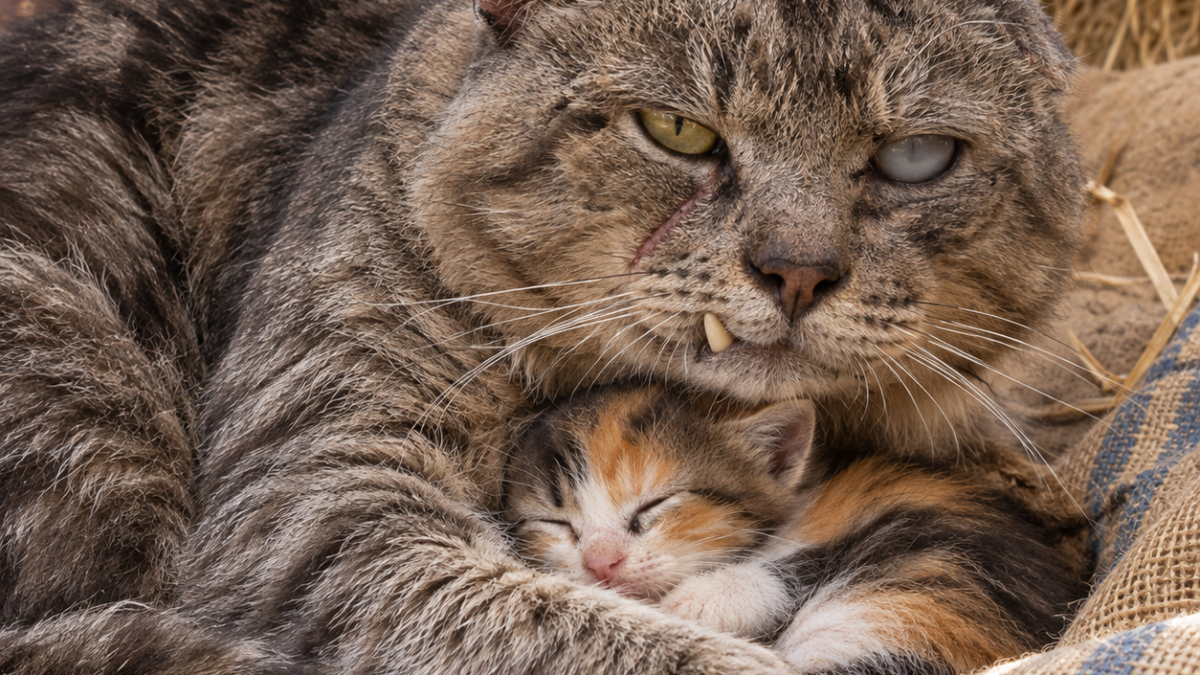
And there, maybe thirty feet from where Clover had died, was Rourke.
I stopped breathing.
He lay on his side.
His back toward us.
Massive gray body curled slightly.
Head lowered.
At first, I could not understand what Tom was pointing at.
Then something beneath Rourke’s jaw moved.
Tiny.
Calico.
A newborn kitten.
Alive.
I whispered:
“Oh my God.”
Rourke lifted his head.
His good eye locked onto me.
Every memory from urgent care returned instantly.
The hiss.
Claws.
Blood.
I expected him to rise.
Instead, he stayed where he was.
The kitten shifted against his chest.
Rourke looked down.
Then lowered his enormous scarred head over her.
Almost completely covering her.
I crouched slowly.
Four feet away.
Closer than I had ever willingly been to him without a barrier between us.
He watched.
No hiss.
No growl.
No flattened ears.
Nothing.
I could see the kitten breathing.
Her sides moving rapidly.
I could also see something else.
Her fur was clean.
Newborn kittens come from birth wet.
Covered in fluids.
The mother usually cleans them.
Clover had died.
But this kitten was clean.
Someone had groomed her.
Rourke’s chest fur around her was slightly damp.
I looked at Tom.
“He cleaned her.”
Tom whispered:
“No way.”
“He did.”
I moved six inches closer.
Rourke’s good eye followed me.
Still no reaction.
The kitten squeaked.
A thin sound.
Rourke immediately lowered his nose.
Licked her head.
Once.
Then again.
I felt tears come into my eyes before I understood why.
This animal had ripped open my hand.
Bent traps.
Fought anything that cornered him.
Had spent six years making it very clear that nothing touched him.
And now he was grooming a kitten smaller than one of his paws.
Tom whispered:
“How’d she get over here?”
I looked toward the hay wagon.
Thirty feet.
For a newborn kitten?
Impossible alone.
“She didn’t.”
Tom stared at Rourke.
“He carried her?”
“I think so.”
We would never know exactly what happened.
Maybe Rourke heard the kittens crying.
Maybe he approached after Clover died.
Maybe four were already gone.
Maybe the fifth moved.
Maybe some instinct, older than anything we could explain, told him to pick her up.
But the physical evidence was hard to argue with.
The kitten had not crawled thirty feet over dirt and gravel by herself.
She was warm.
Clean.
Alive.
And tucked beneath Rourke.
Later Dr. Melissa Hart examined her and estimated that, given her hydration and temperature, Rourke had probably been keeping her warm for at least twelve hours.
Twelve hours.
I sat on that barn floor for nearly thirty minutes.
Rourke never moved away.
Eventually I reached slowly toward the kitten.
He lifted his head.
I stopped.
“Okay.”
His eyes stayed on my hand.
I withdrew.
The kitten needed formula.
Veterinary care.
Heat.
She could not survive on Rourke alone.
Male cats do not produce milk.
I knew we had to take her.
The question was how.
I stood.
Rourke’s head followed me.
“Tom.”
“Yeah?”
“Call the shelter.”
“What do I say?”
I looked at Rourke.
“Tell them I need the biggest carrier we’ve got.”
The volunteer who brought it was Melanie Carter.
The same woman who had helped during the trapping attempt when I was injured.
She got out of the shelter van wearing thick gloves.
“Where is he?”
“Barn.”
“And kitten?”
“With him.”
She thought I meant nearby.
Then she saw them.
“Oh.”
Exactly.
We placed the open carrier beside Rourke.
He watched.
No aggression.
I prepared formula.
The kitten cried.
Rourke immediately shifted closer.
“I’m going to pick her up.”
Melanie said:
“You sure?”
“No.”
I slid a towel beneath my hands.
Reached.
Rourke watched.
His ears did not flatten.
I lifted the kitten.
For one second his body tensed.
“Easy.”
I placed her inside the carrier on a warm fleece pad.
She squeaked.
Rourke stood.
Every muscle in my body braced.
He stepped forward.
Sniffed the carrier entrance.
Then walked inside.
Just walked in.
No trap.
No food.
No force.
The same cat who had nearly destroyed reinforced cages voluntarily entered a carrier.
Because the kitten was inside.
He circled once.
Lay down around her.
Melanie stared at me.
“You’re kidding.”
“I wish I had a better explanation.”
She closed the door.
Rourke did not attack it.
He did not throw himself against the bars.
He simply lowered his scarred face beside the kitten.
And stayed.
The kitten went to the veterinary clinic first.
We named her Minnie.
Not because the name was profound.
Because she was tiny.
Minnie weighed 3.4 ounces.
Cold but stable.
Slightly dehydrated.
Otherwise alive.
Dr. Hart warmed her gradually.
Tube-fed her at first because she was too weak to nurse properly from a bottle.
Rourke remained in a large kennel beside her incubator.
He hated the clinic.
That part did not change.
Any person approaching his enclosure received a warning stare.
If somebody moved too quickly, he hissed.
But he never lost control.
Not while Minnie was there.
When she cried, he stood.
When the incubator door opened, he watched.
When staff returned her to him between feedings, he immediately groomed her.
Dr. Hart said:
“I’ve seen males tolerate kittens.”
She looked through the kennel door.
“I’ve never seen this.”
Rourke became Minnie’s heater.
Her cleaner.
Her bed.
We still had to feed her every two hours.
But whenever possible, she stayed against him.
When she was four days old, she learned to crawl deeper beneath his neck.
At one week, she slept between his front legs.
At two weeks, her eyes opened.
The first living face she saw clearly may have been Rourke’s.
Scarred lip.
Cloudy eye.
Half an ear.
The face everyone else feared.
Minnie loved it.
We moved both cats into foster care with me after ten days.
Yes.
Me.
The woman he had sent to urgent care.
My husband thought I had lost my mind.
“You’re bringing that cat here?”
“Yes.”
“The one with your blood history?”
“Yes.”
“With a newborn?”
“Yes.”
He stared.
“I want that in writing.”
We converted the spare bathroom.
Large dog crate left open inside.
Blankets.
Low litter tray for Rourke.
Feeding station.
Heating pad beneath half the kitten area.
Rourke walked out of the carrier.
Inspected everything.
Then returned to Minnie.
He did not attack me.
But he did not forgive me either.
If I reached toward him, his eyes hardened.
If I moved too close, he shifted between me and Minnie.
That became the rule.
I could handle Minnie.
Carefully.
Briefly.
Rourke supervised.
The first several weeks were exhausting.
Bottle every two hours.
Then every three.
Stimulate her to eliminate.
Weigh her.
Track every fraction of an ounce.
Rourke did everything else.
Cleaning.
Warmth.
Security.
When Minnie developed a little milk rash near her chin, Rourke groomed it.
When she cried after a feeding, he pulled her against his chest.
When she learned to wobble on four legs, he walked behind her.
It looked ridiculous.
This huge battered tom following a kitten the size of a potato.
At four weeks, Minnie discovered his tail.
Rourke regretted everything.
She attacked it relentlessly.
He would flick it away.
She would chase.
He would move it.
She would pounce.
One morning I found her hanging from it with all four paws while Rourke stared at me with an expression I can only describe as:
This was a mistake.
I laughed.
It was the first time I laughed around him.
His ears twitched.
Minnie climbed onto his back.
He allowed it.
She chewed the damaged half of his ear.
He allowed that too.
She stuck a paw inside his food bowl while he was eating.
Rourke stepped away.
That was when I noticed the feeding behavior.
Minnie was transitioning to wet food.
I put down two bowls.
One for her.
One for Rourke.
Rourke walked over.
Sniffed his food.
Then sat.
He waited.
Minnie waddled to her bowl.
Ate.
Messily.
Stepped in it.
Walked through his bowl.
Returned to hers.
Rourke watched.
Only when she walked away did he lower his head and eat.
I thought coincidence.
Next meal?
Same thing.
Next day?
Same.
Rourke always ate after Minnie.
Every time.
A seventeen-pound feral tom who had spent his life competing for food would sit beside a full bowl and wait for a five-week-old kitten to finish first.
That changed something in me.
I started sitting on the bathroom floor during meals.
Far enough away that he remained comfortable.
At first Rourke ignored me.
Then he began staying relaxed.
Two weeks later, he ate while I was in the room.
A week after that, he slept while I was in the room.
People underestimate how large those things are with a truly feral cat.
Trust is not always letting someone pet you.
Sometimes trust is closing your eyes.
Rourke started closing his.
Minnie grew.
Fast.
Six weeks.
Eight.
Ten.
She became fearless.
Too fearless.
Because she had never learned that the world could be dangerous.
Why would she?
Her entire life had contained food, warmth, humans bringing bottles, and a giant scarred guardian who placed his body between her and anything unfamiliar.
At nine weeks she began climbing onto Rourke’s head.
Not metaphorically.
She would scramble up his shoulder and sit between his ears.
One ear and a half, technically.
Rourke tolerated it.
At ten weeks she discovered wrestling.
She would crouch.
Wiggle.
Launch herself at his face.
Rourke could have flattened her with one paw.
Instead, he would roll dramatically onto his side.
Minnie would attack his neck.
Rourke would gently pin her.
Release.
Let her attack again.
She won every time.
At least according to her.
Then came the veterinary appointment.
Minnie needed vaccines and a full examination away from the foster room.
I thought it would be simple.
I put her into a small carrier.
Rourke immediately stood.
“It’s okay.”
He followed me to the bathroom door.
I stepped out.
Closed it.
The plan was to keep him inside while I took Minnie down the hall for ten minutes.
I had barely reached the living room when I heard:
BANG.
Then scratching.
Then another impact.
My husband looked at me.
“That sounds bad.”
“It is.”
Before I could return, the bathroom door opened.
Not because Rourke had learned door handles.
He had pulled hard enough at the bottom corner to split part of the old wooden trim and create enough movement for the latch to slip.
He came down the hallway.
Fast.
I froze.
Minnie cried from inside the carrier.
Rourke stopped.
Walked directly to it.
Sat down.
No attack.
No aggression toward me.
He simply positioned himself beside her.
I looked at the damaged door.
Then at him.
“Seriously?”
Rourke stared.
I called Dr. Hart.
“We have a problem.”
“What?”
“Rourke doesn’t approve of separation.”
“How strongly?”
“I need a new doorframe.”
She laughed for nearly thirty seconds.
We took them together.
From that day forward, we stopped separating them unless medically necessary.
Eleven weeks after rescue, Minnie was ready for adoption.
Normally kittens leave foster care easily.
Healthy.
Social.
Young.
Everybody wants them.
Rourke was different.
Older.
Feral history.
Scarred.
Cloudy eye.
Missing ear.
Limited tolerance for touch.
The shelter director suggested something I hated.
“We could place Minnie and return Rourke to the barn.”
I stared at her.
“No.”
“Rachel.”
“No.”
“Rourke may never become a house cat.”
“Then whoever adopts Minnie gets a weird roommate.”
“She’d be easier to place alone.”
“I know.”
“Rourke might prefer the barn.”
I looked through the foster-room doorway.
Minnie was asleep beneath his chin.
“No.”
The director sighed.
“You’re attached.”
“Yes.”
“To the cat who hospitalized you.”
“Technically urgent care.”
“That doesn’t help.”
I folded my arms.
“They stay together.”
“What if nobody wants both?”
“Then they stay with me.”
My husband, from the kitchen, called:
“Apparently this is how I learn things.”
The shelter listed them as a bonded pair.
The post went up in early December.
Minnie:
Eleven-week-old calico.
Playful.
Social.
Fearless.
Rourke:
Approximately twelve or thirteen.
Former feral barn cat.
Requires experienced adopter.
Not guaranteed to become physically affectionate.
Must remain with Minnie.
No young children.
Quiet home preferred.
The photographs told the story better.
Minnie asleep on Rourke.
Minnie biting his ear.
Rourke grooming her.
Rourke sitting beside her food bowl.
Applications arrived.
Many wanted Minnie.
Not Rourke.
One woman wrote:
Can I adopt kitten only? I already have cats.
No.
Another:
Would you consider separating if Rourke can return to the barn?
No.
Then came Robert and Elaine Mason.
Both retired.
Robert had been a high-school biology teacher.
Elaine worked thirty-four years as a veterinary receptionist.
They lived on six quiet acres thirty minutes away.
No children at home.
One old dog who ignored cats.
They did not ask whether Rourke could be left behind.
Their first question was:
“What does he need?”
I liked them immediately.
They visited.
Rourke hid behind a chair.
Minnie climbed directly into Elaine’s lap.
Robert sat on the floor.
Did not reach toward Rourke.
Did not stare.
Just sat.
After twenty minutes, Rourke came out.
Slowly.
Walked around Robert.
Sniffed his shoe.
Then sat beside Minnie.
Robert whispered:
“Hello, old man.”
Rourke stared.
Robert smiled.
“That seems fair.”
They stayed an hour.
Before leaving, Elaine asked:
“If he never lets us pet him, is that okay?”
“Yes.”
She nodded.
“We don’t need him to perform gratitude.”
That sentence decided it for me.
December 2023.
Adoption day.
I cried.
I hated myself for crying because foster volunteers are supposed to celebrate successful placements.
Still cried.
Minnie went into the large carrier first.
Rourke walked inside behind her.
Same as the first day.
Only now nobody needed gloves.
Before I closed the door, I looked at him.
“You know you owe me eight stitches.”
Rourke blinked.
“Just saying.”
Minnie attacked his tail.
He turned toward her.
I closed the carrier.
The Masons drove away.
My spare bathroom felt enormous.
Robert sent photographs that first evening.
Minnie asleep on the couch.
Rourke underneath the coffee table.
Second day:
Rourke looking out a window.
Third:
Minnie stealing his bed.
One week:
Rourke lying on the rug while Robert sat nearby reading.
One month later:
Elaine sent a video.
Her hand rested on the floor.
Rourke approached.
Sniffed.
Then rubbed one cheek against one finger.
I watched it six times.
He had chosen contact.
Not trapped.
Not restrained.
Chosen.
Elaine never pushed farther.
Over time, he allowed occasional scratches beneath the chin.
Only Elaine at first.
Then Robert.
Nobody picked him up.
Nobody needed to.
He had spent enough of his life having choices taken away.
By spring, Rourke had developed arthritis.
Not surprising.
Years of fights.
Old injuries.
Hard winters.
The veterinarian estimated he was probably thirteen.
Maybe older.
He received joint medication.
A heated bed.
Low steps onto the sofa.
Minnie ignored all of them and continued using Rourke as furniture.
At ten months old she was still half his size.
She would charge across the living room.
Launch herself at him.
Rourke would roll over.
Minnie would pin his face.
Then parade away believing she had defeated the most feared barn cat in central Oregon.
Robert once wrote:
He has never won a wrestling match.
I replied:
He lets her win.
Robert:
Obviously.
I still visit occasionally.
The first time I entered the Masons’ house after the adoption, I wondered whether Rourke would remember me.
He did.
I know because he immediately left the room.
Fair.
Ten minutes later he returned.
He sat near the doorway.
Watched me.
Minnie came running.
Climbed into my lap.
Rourke stayed.
That was enough.
I showed Elaine the scar on my hand.
“That’s from him?”
“Yes.”
She looked toward Rourke.
He was washing Minnie’s face.
“Hard to imagine.”
“No.”
I watched him.
“It isn’t.”
Elaine looked confused.
I said:
“He wasn’t vicious because he enjoyed hurting people.”
“He was scared.”
“Exactly.”
That took me years to understand.
We had described Rourke as aggressive.
Dangerous.
Impossible.
And behaviorally, those descriptions were not entirely wrong.
He could hurt you.
He had hurt me.
But they were incomplete.
Aggression was what we saw.
Fear was what created it.
For six years, Rourke survived because distance kept him alive.
People tried to trap him.
Other cats fought him.
Coyotes hunted near his territory.
Winters froze water bowls.
Food disappeared.
Everything he learned probably said the same thing:
Trust is dangerous.
Then one night, beneath an abandoned hay wagon, something smaller and more helpless than him cried.
We will never know why he responded.
Maybe he was the father.
People asked that frequently.
Possibly.
We never tested.
It would explain genetics.
It would not fully explain behavior.
Male cats do not universally care for their kittens.
Many have no parental role at all.
Maybe Rourke had lived near Clover long enough to recognize her scent.
Maybe the kitten’s cries triggered something basic.
Maybe warmth attracted him.
Maybe he carried Minnie almost accidentally and then stayed.
Science can offer possibilities.
Behavior can be interpreted.
But there is a point where explanation becomes guesswork.
I know what I saw.
Clover died.
Four kittens died beside her.
One disappeared.
That kitten crossed thirty feet without the ability to walk meaningfully.
She was found warm.
Clean.
Pressed against Rourke.
And he refused to leave her.
Everything after that made the first moment harder to dismiss.
Entering the carrier voluntarily.
Grooming her.
Waiting while she ate.
Breaking out to reach her.
Sleeping around her.
Allowing her to bite his damaged ear.
Following her into a new home.
That was not one accidental night.
That was eleven weeks of choice.
Then months.
Then years.
The last time I visited, Rourke was slower.
Getting up took effort.
His back legs were stiff.
The cloudy eye had worsened.
His exposed canine still gave him the same intimidating expression.
Half an ear.
Scarred nose.
Huge head.
He looked like every bad thing that had ever happened to a barn cat had written itself across his face.
Minnie came around the corner.
Full speed.
Hit him sideways.
Rourke toppled dramatically onto the carpet.
She pounced.
Bit his neck.
Kicked with her back paws.
Robert said:
“That’s enough, Minnie.”
Rourke could have stopped her.
Instead, he rolled onto his back.
Minnie planted both front paws on his chest.
Victorious.
Rourke looked toward us.
Elaine laughed.
“He lets her do anything.”
Minnie jumped away.
Rourke slowly stood.
Walked to her.
Licked the top of her head.
Then they settled beside each other in the sunlight.
Minnie curled beneath his neck.
Exactly where she had slept as a newborn.
I sat on the floor several feet away.
Rourke looked at me.
His good eye softer now.
I held out my hand.
No expectation.
No attempt to move closer.
He stared.
Then stood.
Walked toward me.
Slowly.
He stopped beside my fingers.
Sniffed.
I did not move.
Then he pushed the scarred side of his face against my hand.
Once.
One second.
Maybe two.
Then he returned to Minnie.
I started crying.
Elaine pretended not to notice.
Robert absolutely noticed.
“He finally forgave you.”
I shook my head.
“I don’t think that’s what happened.”
“What then?”
I looked at Rourke.
“He finally decided I wasn’t going to hurt him.”
That felt more important.
Forgiveness is a human word.
Trust may be simpler.
You are safe.
That is all.
Maybe that is what Minnie gave him too.
Not a lesson in fatherhood.
Not redemption.
Safety.
For the first time in six years, another living thing needed him more than it threatened him.
She could not trap him.
Chase him.
Fight him.
Demand anything.
She weighed three ounces.
Her eyes were closed.
She had nothing to offer.
Except trust she did not even understand she was giving.
And Rourke answered it.
The animal who trusted nobody became the one creature a newborn kitten could trust completely.
People like to call stories like this miracles.
I hesitate.
Miracle suggests something outside nature.
What Rourke did may have been entirely natural.
Instinct.
Scent.
Hormones.
Social behavior we do not understand well enough.
But knowing there might be a biological explanation does not make it less beautiful.
A sunrise has an explanation.
So does music vibrating through air.
So does the feeling of grief inside the brain.
Explanation doesn’t erase wonder.
Rourke does not know people tell his story.
He does not know he became the cat who changed the way I think about ferals.
He certainly does not know that my scar from him became one of my favorite scars.
Every time I see it, I remember the animal I thought I understood.
Violent.
Impossible.
Dangerous.
Then I remember walking into that grain barn.
Rourke on the feed sacks.
Newborn kitten beneath his jaw.
His cloudy eye fixed on me.
My body expecting an attack.
Nothing.
He simply lowered his head over Minnie again.
Protecting her from me.
From the barn.
From everything.
He had spent six years telling the world:
Stay away from me.
Then one tiny life appeared.
And somehow his rule changed.
Stay away from her.
Nobody taught him that.
Nobody rewarded him.
Nobody trained him.
Nobody was watching when he carried her.
There was no audience.
No camera.
No human praise.
Just a dying barn.
A dead mother.
Five kittens.
Four already gone.
And one still breathing.
Something inside the most feared cat in the county decided that one was not going to die alone.
That is all I can say with certainty.
Maybe some things do not need a better explanation.
Maybe sometimes we should simply be grateful we were there to witness them.








