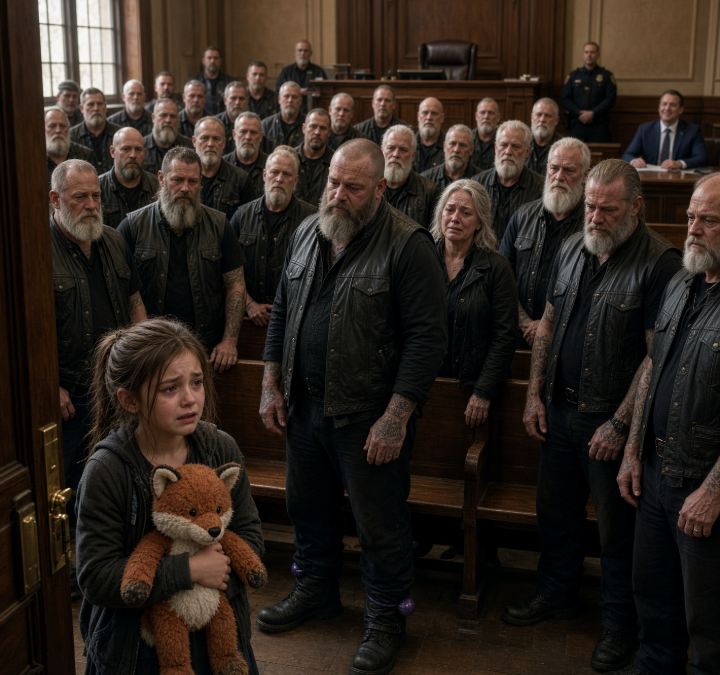
The Man Who Terrified a Ten-Year-Old Smiled in Court—Then 35 Bikers Turned Their Chairs
PART3:
“Then it’s a cold door.”
“Doors aren’t cold.”
“This one is.”
She crawled closer, took the crayon, and corrected the hinges.
Then she added a small figure behind the door and a much larger figure sitting outside it.
Bear studied the picture.
“Which one am I?”
“The ugly one.”
He rubbed his beard. “That doesn’t narrow it down.”
Emily laughed.
It was a small sound, but Sarah covered her mouth and began to cry because it was the first time she had heard her daughter laugh in six weeks.
Bear did not react as though he had achieved something miraculous. He simply looked at the drawing again.
“Where does the ugly one sit?”
“Outside.”
“Facing in or facing out?”
“Out. He watches the road.”
Bear nodded. “Good plan.”
Before he left, he asked Emily whether she wanted him near the front door, in the driveway, or at the end of the street during his next visit.
“The porch,” she said.
So Bear sat on the porch.
Every Wednesday evening, he arrived at six and left at eight. He wore the same charcoal work shirt, faded jeans, and black boots that smelled faintly of motor oil from Kane’s Custom Cycles.
At first, Emily remained inside.
Bear stayed outside.
They communicated by sliding index cards beneath the door.
Do you have a dog? Emily wrote.
No.
Why?
Dogs judge my beard.
That is not true.
You haven’t met all dogs.
Another week, she asked:
Are you scared of anything?
Bear stared at that card for so long that rainwater began crawling beneath the porch rail.
Finally, he wrote:
Yes.
A new card appeared.
What?
He wrote four words.
Not believing someone soon enough.
The door opened three inches.
Bear did not explain.
Emily did not ask him to.
On some Wednesdays, Redbird came with him. She was forty-eight, with silver beginning to show in her dark hair and a red scarf she wore around her neck in every season. She managed a grocery store in Murfreesboro and had raised two sons by herself.
On other evenings, Anchor brought a chessboard.
Anchor was a retired Nashville firefighter, a broad-shouldered Black man with a voice gentle enough to quiet frightened animals. He deliberately lost games to Emily until she became offended.
“You moved your queen there on purpose,” she accused him one evening.
“I would never insult the ancient game of chess.”
“You let me win.”
“You’re ten. Maybe you’re a genius.”
“You forgot your bishop could move backward.”
Anchor examined the board. “Bishops are unpredictable.”
“That doesn’t even make sense.”
She demanded a rematch.
He beat her in eleven moves.
Emily stared at the board, then smiled.
“Again.”
Porch came less often because he worked nights repairing hospital elevators. He had served as an Army medic and wore a steel prosthetic below his right knee. He rarely spoke unless Emily asked him a direct question.
One evening, she pointed at his leg.
“Did it hurt?”
“Yes.”
“Does it still?”
“Sometimes.”
“What do you do?”
“Tell somebody.”
She stared at him.
“What if they’re tired of hearing it?”
“Then I tell somebody better.”
Emily remembered that answer.
The riders never asked about the case. They never asked what Raymond had done or why Emily was afraid. They never told Sarah that everything would be fine.
Instead, Bear repaired a loose porch rail after asking permission.
Anchor replaced a burned-out light.
Redbird taught Emily a grounding exercise for checking doors: touch the lock once, say “locked,” then step away instead of returning five times.
The predictability mattered more than protection.
Raymond had made Emily believe every adult action carried a hidden price. A gift meant obligation. Kindness meant silence. A closed door meant no one would hear her.
The riders asked before sitting in her chair.
They asked before moving her toys.
They asked before taking a photograph, and when she said no, they put the phone away without argument.
Choice returned to her in pieces so small most adults would have overlooked them.
That was how the wooden beads began.
The first came after Emily completed a forensic interview with Detective Marcus Harmon and a child-interview specialist.
She had been inside the interview room for nearly two hours. Bear waited across the street because only legal guardians and professionals were permitted in the building. When Emily emerged, she did not speak.
She walked to him and placed a purple wooden bead in his palm.
“What’s this?” he asked.
“You waited.”
“I said I would.”
“People say things.”
Bear closed his fingers around the bead. “That they do.”
He tied it to his left boot.
After a medical appointment, Emily gave Redbird a blue bead for waiting in the lobby without asking questions. Anchor received a green one after attending a school safety meeting. Porch earned yellow after he sat beneath a tree during a panic attack and counted passing red cars with her until she could breathe normally again.
Other chapter members asked whether they could have beads.
Emily refused.
“They didn’t earn faces yet,” she said.
No one argued.
The chapter supported Bear and his assigned partners from a distance. Members covered shifts at the motorcycle shop. They answered calls after difficult appointments. They attended special training about trauma, confidentiality, and courtroom behavior.
Silence was harder for them than riding.
Many were mechanics, firefighters, veterans, nurses, custodians, and construction workers. They were people accustomed to seeing a broken thing and reaching for a tool.
At one meeting, Porch held up a bent motorcycle bracket.
“This tells you where it hurts,” he said. “A child doesn’t.”
Bear tightened a vise around a piece of steel. “A child doesn’t owe us that.”
The room became quiet.
Bear spoke rarely, but when he did, people listened.
By then, I had met him several times. I still did not trust the arrangement completely.
My job required suspicion.
A well-intentioned adult could damage a case by asking a leading question. A careless statement could become cross-examination material. A dramatic public display could make a jury believe the prosecution was trying to create emotion in place of evidence.
I watched Bear closely.
He never asked Emily for details.
He never called Raymond a monster.
He did not even tell Emily that he believed her.
At first, that bothered me.
Then Dr. Price explained.
“Bear doesn’t want her to feel responsible for maintaining his belief,” she said. “Children sometimes think they must tell a story perfectly or adults will abandon them. He is giving her support without making disclosure the price.”
The official investigation continued separately.
Emily’s first disclosure had happened at school.
Her fifth-grade counselor, Maria Vega, noticed that Emily had stopped entering classrooms when the door was closed. During an art exercise, Emily drew a house with one black window and wrote beneath it, If I tell, Mom will lose everything.
Maria did not interrogate her. She followed mandatory-reporting protocol and asked only whether Emily felt safe going home.
Emily said, “If he’s there, no.”
Raymond was Sarah’s fiancé.
He had moved into their house eighteen months earlier after presenting himself as the kind of man who fixed what other people neglected. He repaired a leaking roof, paid an overdue electric bill, and helped Sarah negotiate a better work schedule at the dental office where she was employed.
He attended parent-teacher conferences.
He remembered birthdays.
He volunteered at a youth baseball league and brought casseroles when a neighbor had surgery.
Sarah trusted him.
That became the sharpest weapon used against her.
When Detective Harmon first interviewed Sarah, she denied seeing warning signs. Then guilt flooded in, and she began turning ordinary memories into accusations against herself.
“I should have known when she stopped wearing pajamas,” Sarah told me. “I should have known when she asked for a lock. I thought it was a phase.”
“You know now,” I said.
“That’s not the same.”
“No. But it matters.”
Raymond denied everything.
He claimed Sarah invented the accusation after discovering he had maintained contact with a former girlfriend. His attorney produced affectionate text messages Sarah had sent him weeks before Emily disclosed.
The implication was cruel and effective: if Sarah had loved him recently, how could she suddenly believe he was dangerous?
Trauma rarely arrived in a clean timeline.
Sarah had not suspected him until her daughter spoke.
Once Emily disclosed, Sarah asked Raymond to leave. She changed the locks, called police, and took her daughter to the hospital despite Raymond standing in the driveway telling her she was destroying all three of their lives.
“You’ll regret this when she admits she lied,” he had said.
Sarah had looked at Emily in the passenger seat.
Then she drove away.
Raymond later told investigators Sarah had manipulated Emily to avoid repaying money he had invested in the house.
His family repeated the accusation online.
They did not use Emily’s name, but Nashville was not large enough for anonymity to survive gossip. Posts appeared describing “a bitter woman coaching her unstable child.” Someone left a printed screenshot beneath Sarah’s windshield wiper at work.
Emily saw it before Sarah could remove it.
“What does unstable mean?” she asked.
Sarah told her it meant someone was confused.
“Am I confused?”
“No.”
“But I forgot which day.”
“You didn’t forget what mattered.”
The defense focused on those differences.
In her first interview, Emily said one incident happened on a Tuesday. Later, she said Wednesday. She initially described a lamp as green, then corrected herself and said the shade was blue when the light was off.
Raymond’s attorney argued that changing details suggested coaching.
Detective Harmon investigated every discrepancy.
The home alarm records showed Raymond had entered the house on both nights under discussion. His employer’s time sheets contradicted his claim that he had worked late all week. A neighbor’s doorbell camera showed his truck returning before sunset on the Wednesday he swore he had remained across town.
None of those facts proved everything alone.
Together, they weakened his story.
The strongest corroboration came from a locked storage cabinet in the garage.
Emily described an envelope hidden beneath a removable shelf, something Raymond had shown her while warning that he kept “proof” her mother owed him money. Police obtained a warrant and found the envelope exactly where Emily described it.
Inside were copies of Sarah’s financial records, photographs taken without her knowledge, and a handwritten list of private family arguments.
Raymond had documented vulnerabilities the way another man might inventory tools.
The discovery exposed his obsession with control, but it did not eliminate the need for Emily’s testimony. The most serious charges rested on what had occurred when no other witness was present.
That meant Raymond understood something terrible.
If he could frighten Emily into silence, he might still walk away.
Two months before trial, the dark pickup passed the Carter house.
Bear was sitting on the porch.
Emily saw the truck through the window and ran toward the linen closet.
Bear did not chase the vehicle. He did not step into the road.
He photographed the license plate from the porch and sent it to Detective Harmon.
The truck belonged to a contractor who said he had taken a wrong turn while driving a client to a job estimate.
The client was Raymond.
No one could prove the route was intentional. The driver’s GPS supported his claim that he had missed a turn, and Raymond never left the passenger seat.
No bond violation was filed.
Legally, the incident ended there.
For Emily, it did not.
She began checking the windows again.
Sarah found wet footprints beneath the bedroom window one morning. Detective Harmon determined they likely belonged to a utility worker who had inspected the meter, but facts had stopped calming Emily’s body.
That was when I saw the difference between danger and fear.
Danger could be measured by distance, orders, evidence, and patrols.
Fear lived in the space after the danger had left.
Bear sat on the porch that Wednesday through a thunderstorm.
Emily opened the door and placed a towel beside him.
“You can come inside,” she said.
“You sure?”
“No.”
Bear nodded. “Porch is good.”
She left the door open six inches.
They listened to the rain together.
Three weeks before trial, the prosecution arranged a courtroom orientation. The jury was absent, Raymond was not there, and Judge Ward allowed Emily to enter through the side door.
The goal was simple: let her see where everyone would sit.
Emily walked toward the witness chair.
I showed her the judge’s bench, the prosecutor’s table, the court reporter, and the jury box. I explained that she could ask for water and tell the judge if she did not understand a question.
Then she saw the defense table.
It was empty.
Her body reacted anyway.
She dropped to the floor beside the witness box and covered her head.
Dr. Price knelt several feet away.
“Emily, can you tell me where you are?”
Emily rocked forward and backward.
“I can’t see him and talk.”
“He isn’t here.”
“I can’t see him and talk.”
Sarah began crying behind the rail.
Bear had been required to wait in the hallway. Through the open door, he heard Emily repeating the sentence.
I looked at the empty courtroom and felt my confidence collapse.
If she could not remain in the room with an empty chair, how could she testify with Raymond sitting twenty feet away?
That evening, Emily drew Courtroom 6B in black crayon.
The witness chair was a purple square.
The defense table was a dark rectangle.
Between them, she drew rows of circles with faces inside.
Bear counted them twice.
“Thirty-five,” he said.
Emily nodded.
“Why thirty-five?”
“Nine leave holes.”
By then she had met nine riders at supervised picnics and approved family events. She knew their road names and remembered where each person had sat.
But nine bodies could not fill every space in her drawing.
“Do you want thirty-five people in the hallway?” Bear asked.
“In the room.”
“Court might say no.”
“Will you ask?”
“Yes.”
“Will everybody fit?”
Bear studied the drawing.
At first, he thought she meant the chairs.
Then he understood.
She meant her courage.
Bear took the picture to the chapter meeting.
He placed it in the center of a scarred wooden table at Kane’s Custom Cycles.
Thirty-four riders raised their hands.
Bear made thirty-five.
The decision created arguments immediately.
Some members wanted to arrive wearing full colors and line the courthouse steps. One suggested contacting reporters so the public would understand the organization’s mission. Another wanted the riders to face Raymond when he entered.
Bear rejected every suggestion.
“This is not our day,” he said.
Mack Donnelly, one of the chapter’s longest-serving members, folded his arms. He had a white mustache, a crooked nose, and a flaming-skull tattoo covering his forearm.
“If we hide our patches, people think we’re ashamed.”
Bear removed his leather vest and placed it on the table.
“If a piece of leather matters more than the kid, stay home.”
Mack’s face hardened.
For several seconds, no one moved.
Then he looked at Emily’s drawing.
He removed his vest and folded it beside Bear’s.
“I’ll be there.”
The others did the same.
Thirty-five unpainted beads sat near the garage door. Emily had agreed to paint them only after each rider promised to follow the courtroom rules.
She chose different colors because, she explained, “Safe doesn’t look only one way.”
Trial morning began in heavy rain.
The riders gathered beneath the awning outside Kane’s Custom Cycles at 5:45 a.m. Water poured from the roof in silver ropes. Bear checked every name against the list sent to courthouse security.
Thirty-five riders.
No prospects.
No guests.
No weapons.
No tools in saddlebags.
No signs, banners, cameras, or interviews.
“If she doesn’t testify, we stay quiet,” Bear told them. “If the judge tells us to leave, we leave. If the defense insults us, we say nothing. If Raymond looks at us, we do not look back.”
Mack raised a hand.
“What if he smiles?”
Bear’s eyes settled on him.
“Then he smiles.”
They left at 6:31.
Their engines started one at a time before merging into a deep synchronized rumble. Bear led on an old black Harley-Davidson Road King. Redbird rode behind him. Anchor and Porch held the rear.
They did not escort Emily’s car.
They did not circle her neighborhood.
They reached the courthouse early and shut down every motorcycle before she arrived.
That distinction would matter.
At 7:15, Raymond’s attorney filed an emergency objection.
He argued that the riders’ presence would prejudice the jury by portraying Raymond as dangerous before deliberations began. He attached screenshots from social media posts calling the organization “a biker gang” and warning that members were known for intimidation.
Judge Ward called both attorneys into chambers.
I attended as Emily’s victim advocate. Dr. Price joined by phone. Bear waited outside under guard, his hands visible on his knees.
The defense attorney, Thomas Kessler, was not a cruel man. He was doing a difficult job aggressively, as the Constitution required. Beneath his insulting description of the riders was a legitimate concern.
A courtroom could not become a rally.
The prosecutor argued that the gallery was open to the public and that observers could not be excluded solely because of tattoos, motorcycles, or clothing. The riders had agreed to conceal identifying patches and remain neutral.
Dr. Price explained the clinical purpose.
“These people are familiar support anchors,” she said. “They are not present to communicate an opinion to the jury. Emily associates their faces with specific experiences in which adults respected her boundaries.”
Judge Ward looked at Emily’s drawing.
“Would fewer riders work?”
Dr. Price paused.
“Thirty-five is not a clinical number,” she said. “It is Emily’s number. I cannot guarantee the arrangement will work, but taking the decision away from her today may confirm her belief that adults control every important part of her life.”
Judge Ward asked that Bear be brought inside.
He entered without his vest.
“Can your people follow every instruction I give?” she asked.
“Yes, ma’am.”
“What happens if I allow ten?”
Bear looked at the drawing on her desk.
“We accept your ruling.”
“That was not my question.”
His jaw shifted beneath his beard.
“The child asked for thirty-five.”
“And if I remove half of them during testimony?”
“We leave if you tell us to leave.”
Judge Ward leaned back.
“I do not want a wall, Mr. Kane.”
Bear looked at her.
“With respect, Your Honor, she does.”
“I mean I will not permit a spectacle intended to hide the accused or influence the jury.”
“Understood.”
“I need thirty-five adults, not thirty-five bikers with something to prove.”
Bear nodded once.
“That’s what we brought.”
Judge Ward approved the riders under strict conditions. They would enter before the jury. Their patches would remain covered or removed. They would occupy assigned seats, show no reaction to testimony, communicate with no witness, and leave immediately if instructed.
The plan nearly failed at 7:54.
Emily entered the courthouse lobby and saw the motorcycles through the rain-streaked windows.
Sarah had told her Bear, Redbird, Anchor, and Porch would be present. No one had promised the entire chapter because we did not know whether the judge would allow it.
Emily stopped beside the metal detector.
Thirty-five unfamiliar shapes filled the lobby.
I asked security to clear a path.
Before anyone moved, Emily saw the beads.
Purple, red, blue, green, and yellow.
One hung from every boot, belt loop, zipper, or wrist.
She began counting.
The riders stayed still as she walked down the line.
Some were enormous men with gray beards and broken noses. Three were women in weathered jackets. One had a burn scar across half his face. Another used a cane. A former Marine had lost two fingers. One rider worked as a school custodian. Another drove a city bus. One managed a grocery store. Another repaired air-conditioning systems.
They looked frightening until Emily reached them.
Then they looked nervous.
She stopped in front of Mack.
His vest was folded under one arm, and a purple bead hung from his boot.
“What’s your name?” she asked.
“Mack.”
Emily frowned.
“That’s not a safe name.”
Mack glanced desperately at Bear.
Bear gave him no help.
Emily studied Mack’s flaming-skull tattoo, crooked nose, and white mustache.
“You’re Teapot.”
A sound nearly escaped Anchor.
Mack swallowed his pride in front of thirty-four riders, two deputies, and a line of courthouse employees.
“Yes, ma’am.”
Emily moved to the next person.
By the time she finished, the riders had names such as Window, Lamp, Kitchen, Morning, Blanket, Pancake, and Chair.
Ordinary things.
Safe things.
Security searched every rider carefully. Belt buckles filled gray plastic trays. Chain wallets rattled. Boots squeaked against the polished floor.
Other courthouse visitors moved away.
A woman pulled her young son behind her.
Bear noticed.
He always noticed.
No rider defended himself.
Inside Courtroom 6B, Kessler renewed his objection after Mack rolled up his sleeve and exposed the flaming-skull tattoo.
“This display is organized intimidation,” he said.
Mack quietly rolled the sleeve down.
Judge Ward sent the jury back into the hallway and addressed Kessler.
“No person in that gallery has approached your client. No person has spoken to your client. If you possess evidence of intimidation, present it. Their appearance is not evidence.”
Raymond leaned toward Kessler and whispered.
Kessler’s expression changed.
“We request that Mr. Kane be excluded specifically.”
“On what basis?”
“My client recognizes him. Mr. Pierce believes this man followed him and conducted surveillance outside his residence.”
Bear’s head lifted.
Sarah went pale.
If Bear had violated the organization’s boundaries, the entire arrangement could collapse. Worse, the defense could argue that Emily’s supporters had influenced or threatened Raymond.
A deputy separated Bear from the group.
He did not resist.
Judge Ward questioned him outside the jury’s presence.
“Have you ever followed Mr. Pierce?”
“No, ma’am.”
“Have you been near his residence?”
“No.”
“Have you ever been within sight of him?”
Bear hesitated.
The courtroom changed.
“Yes.”
Sarah covered her mouth.
Bear explained the dark pickup that had slowed near Emily’s mailbox. He had photographed the license plate while remaining seated on the porch. He had sent it directly to Detective Harmon.
“You did not follow the vehicle?”
“No.”
“You did not enter the street?”
“No.”
“You did not communicate with the driver or passenger?”
“No.”
Detective Harmon produced the incident report and time-stamped photograph.
Bear had followed every rule.
Raymond recognized him because Bear had been sitting exactly where Emily asked him to sit.
On the porch.
Judge Ward allowed Bear to remain.
The jury returned without being told about the dispute.
At 9:38, Emily entered the courtroom.
That was when Raymond smiled.
That was when the stuffed fox fell.
That was when thirty-five riders rose and sat again at the judge’s order.
Emily saw the beads and picked up her fox, but her breathing did not slow.
Click.
Raymond pressed his pen.
Click.
He pressed it again.
Emily covered both ears.
Bear leaned forward less than an inch.
The bailiff watched him.
He froze.
Judge Ward called an immediate recess before the jury could witness Emily’s panic. Deputies escorted the jurors out. Kessler asked the court to consider whether Emily was unavailable to testify and whether portions of her previous forensic interview should be excluded as hearsay.
The prosecutor requested fifteen minutes.
We took Emily to the witness waiting room.
She crawled beneath a table.
Exactly as she had during Bear’s first visit.
Sarah sat against the hallway wall and twisted a tissue until it tore apart in her hands.
“I did this,” she whispered. “I told her she could testify.”
“She chose to try,” I said.
“She’s ten.”
Bear sat outside the closed door.
“That’s why the choice matters,” he said quietly.
Sarah looked at him.
“What if she can’t?”
“Then she can’t.”
“What if he walks free?”
Bear’s eyes remained on the floor.
“That isn’t hers to carry.”
Inside the room, Dr. Price helped Emily identify five things she could see, four things she could touch, three things she could hear, two things she could smell, and one thing she knew to be true.
Time passed.
At the twelve-minute mark, I told Bear we might need to proceed using Emily’s recorded interview and accept the evidentiary limitations.
He nodded.
He did not give a speech about courage. He did not ask to enter.
Instead, he reached beneath his shirt and pulled out a narrow strip of paper.
The paper was old and soft at the folds. Clear tape covered one torn corner. A child had written six uneven words in faded ink.
I told you. Please believe me now.
I had assumed the note came from Emily.
The handwriting was not hers.
Bear saw me reading it.
“My daughter,” he said.
That was how I learned about Leah Kane.
Leah had been eleven when she told Bear that her mother’s boyfriend was entering her bedroom at night.
Bear was thirty-two then, newly sober and desperate to prove he was no longer the unreliable man everyone remembered. Leah’s mother’s boyfriend owned a clean house, coached youth baseball, attended church, and knew exactly how to use Bear’s past against him.
Leah’s account changed in small details.
At first, she said it happened after midnight. Later, she said the hallway clock showed eleven-thirty. She could not remember whether the television downstairs had been on.
Traumatized children often disclose in fragments.
Bear did not know that then.
Or perhaps he did not want to know.
Believing Leah would have meant risking the stable home he thought she needed. It would have meant entering another custody battle as an ex-con with a history of alcohol abuse. It would have meant admitting that the respectable man looked safer only because Bear wanted him to be safe.
Bear demanded proof from an eleven-year-old.
Then he drove her back to that house.
Three weeks later, Leah ran away. She left the note inside Bear’s toolbox.
I told you. Please believe me now.
Police found her at a bus station. Another child disclosed abuse by the same man shortly afterward. Physical evidence supported both accounts, and he was eventually convicted.
Leah survived.
Survival did not restore the father she had needed on the first night.
Bear attended therapy and addiction meetings. He apologized without asking her to forgive him. He accepted supervised visits when she wanted them and distance when she did not.
Years later, he heard a Bikers Against Child Abuse member speak at a recovery meeting.
He joined, but he never told himself the work erased what he had done.
The note stayed over his heart because regret had to remain specific.
“Does Emily know?” I asked.
“No.”
“Why bring it here?”
Bear folded it along its oldest crease.
“So I remember whose fear matters.”
Something moved beneath the waiting-room table.
A sheet of paper slid across the floor.
Dr. Price picked it up.
Emily had drawn a purple square surrounded by thirty-five circles.
Bear asked for a pencil.
On the back, he drew the same crooked door from their first meeting. Outside it, he drew one large figure sitting with both hands on his knees.
He slid the drawing beneath the door.
Emily wrote beneath the figure:
Mountain can’t come in.
Bear replied:
Court rule.
The paper returned.
Then move the mountain.
Bear looked at me.
I understood.
We returned to Judge Ward with a revised request.
The riders had been seated behind the witness box, where they would be visible if Emily turned around. That required her to look away from the questions and search for them.
We asked permission to move them into her forward line of sight.
Kessler objected immediately.
“You are asking to construct a physical barrier between the witness and my client.”
Dr. Price presented the drawing.
“She is asking to see safe faces before she sees the defendant.”
“The witness must identify the accused.”
“She already has in recorded interviews. She will still be physically capable of seeing him.”
Judge Ward walked into the witness box herself.
She examined the angles.
From the chair, Raymond remained visible between two seats.
“Not enough,” I said.
Kessler stared at me. “You admit you’re attempting to hide my client.”
“I am attempting to help a child remain oriented to the present.”
Judge Ward raised one hand.
She moved Bear’s chair six inches to the left. Redbird sat behind him. Anchor moved beside her. The tallest riders occupied the second row.
From the jury box, Raymond remained completely visible.
From Emily’s chair, only the shoulder of his navy suit could be seen unless she leaned sideways.
The arrangement did not prevent confrontation. It reduced involuntary visual exposure.
Kessler maintained his objection.
Judge Ward overruled it.
Then she addressed Bear.
“Your people cannot become witnesses with their faces.”
He understood.
No nodding.
No encouragement.
No tears.
No anger.
No reaction to testimony.
They had to give Emily thirty-five faces while showing her nothing that could influence an answer.
The chairs moved.
Boots crossed the floor.
Mack sat at the aisle and rolled down both sleeves. Porch positioned his prosthetic beneath the bench so the metal joint would not click. Redbird removed her silver earrings because they caught the light. Anchor tucked his hands beneath his thighs to prevent them from closing into fists.
Bear sat in the center.
Before Emily returned, he placed Leah’s note beneath his shirt.
Raymond watched him.
Bear never looked back.
Emily entered for the second time.
She found the beads first.
Then she found the faces.
She climbed into the witness chair and pressed the stuffed fox against her ribs.
The clerk administered the oath.
“Do you promise to tell the truth?”
“Yes.”
The answer was so quiet the court reporter asked her to repeat it.
Emily swallowed.
“Yes.”
The prosecutor began with easy questions.
Her name.
Her age.
Her school.
Her favorite subject.
“Science,” Emily said.
“Do you have any pets?”
“A goldfish.”
“What’s his name?”
“Tuesday.”
“Why Tuesday?”
“Because I got him on Friday.”
A few jurors smiled.
Emily did not.
The prosecutor asked about the stuffed fox.
“His name is Oliver.”
“What happened to his ear?”
“He got caught in a door.”
“Did you fix him?”
“I tried.”
The prosecutor paused.
“Emily, do you know the man sitting beside Mr. Kessler?”
Emily’s eyes moved toward the defense table.
Bear’s face filled the space.
Behind him were Redbird, Anchor, Porch, Teapot, Window, Lamp, Kitchen, Morning, and twenty-six others who had agreed to remain perfectly still.
“Yes,” Emily said.
“How do you know him?”
“He lived with us.”
“What did you call him?”
“Ray.”
Raymond’s pen remained motionless.
The prosecutor asked the first question about the abuse.
Emily’s fingers tightened around Oliver’s fabric neck.
She looked at Bear.
Bear did not nod.
He did not smile.
He simply remained.
Emily answered.
Not all at once.
Not in perfect order.
She stopped twice and asked for water. She corrected herself about whether the hallway light had been on. When the prosecutor asked what month it happened, Emily said she did not know.
“Do you remember what season it was?” the prosecutor asked.
“Cold.”
“How do you remember?”
“My socks were wet from snow.”
Nashville had received a rare snowfall that January. Weather records supported her memory.
Emily described the first incident without graphic detail. She explained where she had been, who was home, what Raymond said would happen if she told, and why she believed him.
“What did he say would happen to your mother?” the prosecutor asked.
“He said she would lose the house.”
“Did you believe him?”
“Yes.”
“Why?”
“Because he kept all the bills.”
Sarah lowered her head.
Raymond had insisted on managing the household finances after paying off her overdue electricity bill. He called it helping. Emily had watched her mother ask him for passwords to her own accounts.
“What did you think would happen to you?” the prosecutor asked.
“I thought we’d live in the car.”
“Did anyone tell you that?”
“He did.”
The prosecutor showed Emily a photograph of the garage cabinet.
“Do you recognize this?”
“Yes.”
“What is it?”
“Ray’s cabinet.”
“Were you allowed to open it?”
“No.”
“Then how did you know about the envelope under the shelf?”
Emily stared at the picture.
“He showed me.”
“Why?”
“He said he had proof Mom owed him and nobody would believe us.”
Kessler objected to the final phrase as hearsay.
Judge Ward allowed it only to explain Emily’s state of mind.
The prosecutor moved on.
For thirty-eight minutes, Emily spoke in pieces.
Each time fear pulled her eyes toward the defense table, the riders’ faces caught her gaze first.
She found Redbird’s scarf.
Anchor’s shoulders.
Porch’s yellow bead.
Teapot’s carefully hidden tattoo.
Then she continued.
At one point, the prosecutor displayed a floor plan and asked Emily to identify her bedroom.
Emily pointed to the wrong room.
Kessler wrote something quickly.
Emily saw him.
“No,” she said.
The prosecutor stopped.
“No what?”
“That’s the bathroom. I did it wrong.”
“You can change your answer.”
Emily pointed again, this time to the smaller room at the end of the hall.
“That one.”
“Does changing an answer mean you lied?”
Emily looked frightened.
“I don’t know.”
The prosecutor placed the floor plan on the table.
“It means you corrected a mistake.”
Emily stared at her.
“Am I allowed?”
“Yes.”
That single exchange mattered more than any dramatic speech could have.
Raymond had taught Emily that mistakes made truth disappear.
The prosecutor showed her it was possible to be imperfect and still be believed.
During the first recess, Emily remained in the witness chair until the jury left.
Then she whispered, “Did I ruin it?”
Sarah started forward, but Judge Ward had not released the witness.
Bear’s hands pressed harder against his knees.
I asked permission for him to answer.
Kessler objected.
Judge Ward considered the request.
“One sentence,” she said.
Bear’s voice was rough.
“You told it your way.”
Emily looked down at Oliver.
“Was it enough?”
Bear shook his head once.
“That part isn’t yours to carry.”
Judge Ward ended the exchange.
When the jury returned, Kessler began cross-examination.
He approached slowly and kept his voice controlled.
“Emily, you spoke with several adults about these events, correct?”
“Yes.”
“Your mother?”
“Yes.”
“Dr. Price?”
“Yes.”
“Detective Harmon?”
“Yes.”
“The prosecutor?”
“Yes.”
“And members of this motorcycle organization?”
Emily looked at Bear.
“No.”
Kessler paused.
“You never spoke with them?”
“I talk to them.”
“About what happened?”
“No.”
“Did Mr. Kane ask you what Mr. Pierce did?”
“No.”
“Did Ms. Delgado?”
“No.”
“Did anyone in that group tell you what to say today?”
“No.”
“Did Mr. Kane tell you that he believed you?”
Emily thought carefully.
“No.”
That answer surprised nearly everyone except Bear.
“Never?”
“He said I don’t have to tell him.”
Kessler glanced at his notes.
Emily continued before he asked another question.
“He said the truth doesn’t get bigger because a biker carries it.”
Bear closed his eyes for one second.
The bailiff stepped forward.
Judge Ward watched him sharply.
Bear opened his eyes and flattened both hands against his knees.
Kessler held up transcripts from Emily’s interviews.
“You first said the lamp in your room was green, correct?”
“Yes.”
“Later, you said it was blue.”
“Yes.”
“So one answer was wrong.”
“The shade is blue.”
“Why did you say green?”
“It looks green when the light is on.”
Kessler placed a photograph on the evidence screen.
The lamp had a blue glass shade. When illuminated by a yellow bulb, it appeared green.
Several jurors leaned forward.
Kessler moved quickly.
“You also changed the day from Tuesday to Wednesday.”
“I didn’t know what day.”
“You told Detective Harmon it was Tuesday.”
“I said I thought it was.”
“You understand Tuesday and Wednesday are different days?”
“Yes.”
“Which day was it?”
Emily’s breathing changed.
Bear saw it before I did.
Her thumb began scraping the loose thread on Oliver’s ear.
Kessler waited.
The silence grew heavier.
Emily looked at Porch.
He did not gesture.
She looked at the yellow bead tied to his boot.
“I don’t know,” she said.
“You don’t know?”
“No.”
“Then how can you be certain about anything else?”
The prosecutor objected.
Judge Ward sustained it.
Kessler rephrased.
“Is it possible your memory about Mr. Pierce is also mistaken?”
Emily looked down.
Raymond shifted at the defense table.
His pen clicked once.
Emily’s eyes moved toward the sound.
Bear’s face blocked her first view.
For several seconds, she said nothing.
Then she raised her head.
“I forget days,” she said. “I don’t forget him telling me Mom would lose the house.”
Kessler’s expression did not change, but his next page turned too quickly.
He asked whether Sarah had been angry with Raymond before the accusation.
“I don’t know.”
“Did you hear them arguing?”
“Yes.”
“Did your mother ever say she wanted Mr. Pierce gone?”
“After I told her.”
“Before that?”
“No.”
“Did your mother tell you he was a bad man?”
“No.”
“Did Dr. Price tell you?”
“No.”
“Did the bikers?”
“No.”
“Do you hate him?”
Emily’s grip on Oliver loosened.
“No.”
“Are you angry with him?”
“I don’t know.”
“Then why are you here?”
Kessler intended the question to expose uncertainty.
Instead, it gave Emily the first answer that belonged entirely to her.
She looked at the jury.
“Because I want it to stop being my secret.”
No one moved.
The court reporter’s keys resumed first.
Kessler returned to the courtroom drawing.
He placed the page with thirty-five circles on the evidence screen.
“You planned where these people would sit, didn’t you?”
“I drew faces.”
“You wanted them between you and Mr. Pierce.”
“Yes.”
“Because they told you he was dangerous?”
“No.”
“Because they frightened you into believing you needed protection?”
“No.”
“Then why are they here?”
Emily looked across the rows.
“When I see Ray, I feel like I’m back there.”
Kessler waited.
“When I see them, I know I’m here.”
He lowered the drawing.
For the first time that morning, Raymond’s expression lost its calm.
Kessler asked whether Emily understood that an accusation could send someone to prison.
The prosecutor objected before she could answer.
Judge Ward sustained it and instructed the jury to disregard the question.
But Emily had heard it.
Her face drained of color.
Raymond had warned her that speaking would destroy everyone. Now an adult in a suit had placed the weight of prison beside her name.
She began shaking.
Judge Ward called a recess.
The jury left.
Sarah stood, but Emily looked at Bear.
“Did I hurt him?”
Bear could not answer without permission.
Judge Ward saw the question on his face.
She nodded.
Bear leaned forward.
“You told the truth.”
“That wasn’t my question.”
Bear took a breath.
“What happens because of the truth belongs to the adults who made the choices.”
Emily stared at him.
“Not me?”
“Not you.”
During the recess, sweat loosened the medical tape holding Leah’s note beneath Bear’s shirt. One corner appeared above his collar.
Emily noticed.
“What’s that?”
Bear covered it with one hand.
“A reminder.”
“Of me?”
“No.”
“Who?”
The jury was absent, but Kessler remained in the room. Every answer carried legal risk.
Bear looked at Judge Ward.
She gave no permission this time.
He lowered his hand.
“Someone I should’ve believed faster.”
Emily studied his face.
“Did you learn?”
Bear swallowed.
“Still learning.”
Judge Ward ended the recess.
Emily completed cross-examination.
On redirect, the prosecutor asked one final question.
“Has anyone in that gallery told you Mr. Pierce is guilty?”
“No.”
“Why did you ask them to come?”
Emily touched Oliver’s torn ear.
“Because they know how to stay.”
The prosecutor sat down.
Judge Ward excused the witness.
Emily climbed from the chair and walked toward the side door.
Halfway there, she stopped.
The courtroom tightened.
She turned toward the defense table.
Then, for the first time that morning, she deliberately leaned far enough to see around Bear’s shoulder.
Bear did not move to block her.
That choice mattered.
The bikers had not come to erase Raymond or choose what Emily could see. They had come so seeing him would become her decision.
Raymond met her eyes.
His smile was gone.
Emily looked at him for two seconds.
Then she stepped back behind Bear’s shoulder.
“Okay,” she whispered.
She walked out.
The riders remained seated until Judge Ward dismissed them. No one followed Emily. No one celebrated. No one looked at Raymond.
Only after the door closed did Bear release the breath he had been holding.
The prosecution rested that afternoon.
The defense presented its case the following morning.
Raymond’s sister testified that Sarah had threatened to “take everything” from him during an argument. Under cross-examination, she admitted she had not heard the entire conversation. Sarah had been demanding access to her own bank accounts.
Raymond’s employer testified that work schedules were occasionally inaccurate, but payroll records and vehicle logs still placed Raymond near the Carter house on one of the nights he claimed to be across town.
A family friend described Emily as imaginative.
The prosecutor asked whether imagination allowed a child to identify an envelope hidden beneath a removable garage shelf.
The witness had no answer.
Raymond did not testify.
The bikers stayed at Kane’s Custom Cycles because Emily had not requested them for the rest of the trial.
That absence proved what Bear had told the chapter from the beginning.
It was not their day.
Mack paced between motorcycles. Redbird organized tools that did not need organizing. Anchor made coffee so strong no one could finish it. Porch sat on an overturned milk crate and watched Bear clean the same spark plug six times.
At 3:18 p.m., I called Bear.
“The jury is back.”
Thirty-five engines started.
They reached the courthouse in twenty-two minutes but did not enter. Judge Ward had warned that their presence around the verdict might create an appearance of celebration or threat.
They parked in a public lot across the street and shut off their motorcycles.
Inside Courtroom 6B, the jury foreperson stood.
Raymond rose beside his attorney.
Sarah gripped the wooden rail in front of her.
I stood at her side.
The verdict was guilty on the principal charges.
Sarah folded forward as though someone had cut a wire holding her upright.
Raymond showed no reaction until the deputy touched his arm.
Then he looked toward the empty gallery where the bikers had sat.
For the first time, he appeared afraid.
Emily was not in the courtroom.
Judge Ward and Dr. Price agreed she should not be made responsible for watching the result. She waited in a conference room two floors below, coloring Oliver’s torn ear with a purple marker.
I delivered the news.
Emily stared at the fox.
“Does guilty mean they believed me?”
“It means the jury believed the evidence proved the charges.”
She considered that carefully.
Then she asked, “Do I have to say it again?”
“No.”
Her shoulders lowered.
That was her celebration.
Not cheering.
Not revenge.
The knowledge that she did not have to enter that room and tell her secret again.
Outside, the rain had stopped. The pavement reflected the courthouse windows. Thirty-five riders stood beside their silent motorcycles while Sarah and Emily crossed the street.
Mack removed his sunglasses.
Redbird covered her mouth.
Anchor turned away.
Bear remained near his Road King, leaving Emily space to decide how close she wanted to come.
She walked directly to him.
Then she handed him a folded note.
Bear opened it.
The handwriting was uneven.
You believed me before I proved it.
His scarred fingers began to tremble.
The paper slipped, but he caught it before it touched the wet pavement.
Emily noticed the older note beneath his shirt.
“Now you have two reminders,” she said.
Bear could not speak.
He lowered himself onto one knee and pressed both notes against his chest.
The story could have ended there.
Most people believed it did.
A local reporter photographed the motorcycles and published a story about “a biker gang forming a human shield around a child witness.” The image traveled faster than the facts.
One version claimed the riders surrounded Raymond outside the courthouse.
Another said Bear threatened him during testimony.
A television commentator praised the “fearless bikers who forced a predator to confess,” even though Raymond had never confessed and the riders had never approached him.
Bear refused every interview.
“This is her story,” he told reporters. “She doesn’t owe anybody a second telling.”
The chapter requested that photographs showing Emily’s face be removed. They corrected the claim that they wore outlaw colors in front of the jury. They credited Judge Ward, Dr. Price, Detective Harmon, the prosecution team, the school counselor, and Sarah.
Then they returned to work.
Bear placed Emily’s note beside Leah’s inside a narrow waterproof pouch.
For the first time in twenty-seven years, the older note was not alone.
Three weeks after the verdict, a woman arrived at Kane’s Custom Cycles shortly before closing.
She was forty, with dark hair pulled into a loose knot and Bear’s gray eyes. She wore hospital scrubs beneath a canvas jacket.
Bear saw her through the shop window.
The wrench fell from his hand.
Six mechanics quietly found reasons to leave.
Leah Kane stood in the doorway.
She had found the courthouse photograph online. It showed Bear kneeling beside Emily, whose face had been blurred. The caption described thirty-five protective faces.
Bear wiped his hands on a rag.
“You need something fixed?”
It was the wrong question.
It was the only question he could manage.
Leah looked at the motorcycles, the purple bead on his boot, and Emily’s courtroom drawing pinned inside his open tool cabinet.
“I saw what you did.”
Bear waited.
“Did you tell her about me?”
“No.”
“Did you tell reporters?”
“No.”
“The chapter?”
“Only what the training director needed to know.”
Leah nodded.
For years, she had feared Bear might turn her childhood into his redemption story. She did not want strangers praising him because of what she had survived.
“What did you tell the girl when she was scared?” Leah asked.
“Nothing about you.”
“That’s not what I asked.”
Bear looked at the old toolbox where Leah had left her note.
“I sat outside.”
Leah’s mouth tightened.
“You’re good at that now.”
The words struck him.
He accepted them.
“Yes.”
She walked farther into the garage. Thirty-five unused wooden beads sat on the workbench. Emily wanted the chapter to save them for another child.
Leah picked up one of the beads.
“I used to think you didn’t believe me because I told it badly.”
Bear’s breathing changed.
“No.”
“You said I changed details.”
“You were a kid.”
“You said serious accusations needed proof.”
“I was wrong.”
“Why?”
Bear could have blamed alcohol.
He could have blamed the custody battle, his criminal record, Leah’s mother, or the respected man who manipulated everyone around him.
He did not.
“Believing you would’ve cost me the life I thought I’d fixed,” he said. “So I made you pay instead.”
Leah stared at him.
It was the first apology that did not ask her to comfort him.
“I’m not here to forgive everything.”
“I know.”
“One courtroom doesn’t change my childhood.”
“I know.”
“You helping other children doesn’t make what happened to me useful.”
“I know.”
She turned the bead between her fingers.
“And I’m not joining your organization.”
Bear almost smiled.
“I know.”
Leah picked up a purple marker from the workbench.
“But that girl shouldn’t have to carry what you did to me.”
“No.”
She colored the bead slowly. Purple ink stained her thumb.
“When is the next family picnic?”
Bear lifted his eyes.
“Saturday.”
“I might come.”
“That’s enough.”
Leah placed the finished bead beside his hand and walked toward the door.
Then she stopped.
“Dad.”
Bear had waited years to hear that word without knowing whether he deserved to answer.
“Yeah?”
“Thirty-five faces was a good idea.”
“It was hers.”
Leah looked at the courtroom drawing.
“Then tell her she had a good idea.”
She left before he could say anything else.
Bear sat on the workbench after the door closed. He unfolded both notes and placed them beside the new purple bead.
One note marked the moment he failed.
The other marked the choice to stay.
The bead erased neither.
Sentencing occurred eleven weeks later.
Emily did not attend. She submitted a written statement through the prosecutor and spent that morning at school taking a spelling test.
Ordinary life had become what she wanted most.
The thirty-five bikers did not fill the courtroom.
Bear attended alone.
He sat in the last row wearing his charcoal shirt, clean jeans, and the purple bead tied to his boot. His vest remained folded inside his saddlebag.
Before announcing the sentence, Judge Ward spoke about Raymond’s pattern of control, his threats, his attempt to weaponize Sarah’s finances, and the lasting harm caused by forcing a child to carry an adult’s secret.
Raymond received a long prison sentence.
When deputies led him away, he looked toward Bear.
Bear did not return the look.
He was reading Emily’s note.
After court, Judge Ward found him standing on the steps.
“Mr. Kane.”
Bear turned.
“You followed every condition.”
“Yes, ma’am.”
“That could not have been easy.”
“No, ma’am.”
She looked at the small folded paper in his hands.
“The public version says you hid the defendant from her.”
“We didn’t.”
“I know.”
“She looked when she chose.”
Judge Ward nodded.
“That distinction may be the whole story.”
Before Bear reached his motorcycle, a courthouse custodian called after him. Emily had left something in the witness waiting room during trial week.
It was Oliver, the stuffed fox.
Sarah had assumed he was lost, but Emily no longer wanted him returned.
She asked that Bear keep him for the next child who needed to enter a difficult room.
Oliver rode inside Bear’s saddlebag.
At the next chapter meeting, Emily arrived with Sarah, Dr. Price, and Leah.
No one announced who Leah was. She sat near the rear wall in ordinary jeans and a canvas jacket.
Emily placed thirty-five unpainted wooden beads on the table.
“Those were for me,” she said. “These are for whoever comes next.”
Mack—still Teapot to her—raised one thick hand.
“What color?”
“They choose.”
“What if they don’t want a bead?”
“Then don’t give them one.”
Bear glanced toward Leah.
She gave him the smallest nod.
Over the following year, the chapter supported several children through professional referrals and strict boundaries. The riders waited outside therapy offices, attended school meetings, helped families replace broken locks, and answered late-night calls when ordinary house noises became impossible to ignore.
No other child requested thirty-five riders.
One asked for two.
Another wanted Redbird and no one else.
A thirteen-year-old boy asked Bear to park across the street where he could see the motorcycle but would not have to speak.
Bear followed every instruction exactly.
Emily returned to school full-time.
Healing did not move in a straight line.
She still checked the windows during storms. She avoided navy suits for months. The click of a retractable pen once sent her beneath a desk during math class.
But she learned to name what was happening.
“I’m in school,” she would say. “That was then. This is now.”
Sarah attended counseling too.
She stopped asking Emily to reassure her that she had been a good mother. She learned that guilt could become another burden placed on a child if the adult demanded forgiveness too soon.
Instead, she said, “I’m sorry I didn’t see it. I see you now.”
Some days Emily accepted the words.
Some days she walked away.
Sarah allowed both.
A year after the testimony, thirty-five motorcycles returned to Nashville before sunrise.
The riders did not approach the courthouse steps. They parked in the same public lot across the street and switched off their engines together.
Emily arrived carrying a cardboard box.
Inside were thirty-five photographs, one for each rider. Beneath every face, she had written the safe name she had chosen on trial morning.
Mountain.
Redbird.
Anchor.
Porch.
Teapot.
Window.
Lamp.
Kitchen.
Morning.
Home.
Bear’s photograph had no word beneath it.
He turned the card over.
Emily had written a sentence on the back.
A wall is not something that hides me; it is something that stays while I speak.
Bear read it twice.
Leah stood beside him.
“She writes better notes than I did,” she said.
Bear looked at his daughter.
“Both worked.”
Across the street, the courthouse windows caught the rising sun. Commuters passed without knowing why thirty-five intimidating men and women stood silently beside cold motorcycles.
Emily walked down the row and touched every colored bead.
At the final bike, she climbed onto Bear’s parked Road King while he steadied it from the ground. Her feet could not reach the boards.
“Can I start it?” she asked.
Sarah said no.
Bear wisely said nothing.
Emily laughed.
The sound traveled across the parking lot, lighter than any engine.
Later, the riders prepared to leave.
Bear waited until Emily and Sarah were safely inside their car. Then he turned the key and started the Road King.
The old V-twin caught with a deep rumble.
Thirty-four motorcycles followed him toward the river, their exhaust rolling between the buildings before dissolving into morning traffic.
Bear’s leather vest carried no photograph of Emily and no patch claiming credit for what she had done.
Only two folded notes rested over his heart.
One from the daughter he failed.
One from the girl he believed.
The purple bead tapped softly against his boot as Courtroom 6B disappeared in his mirror.
Thirty-five faces had stayed.
One child had spoken.
And the man who once smiled at her fear had finally learned that silence belonged to him now.








