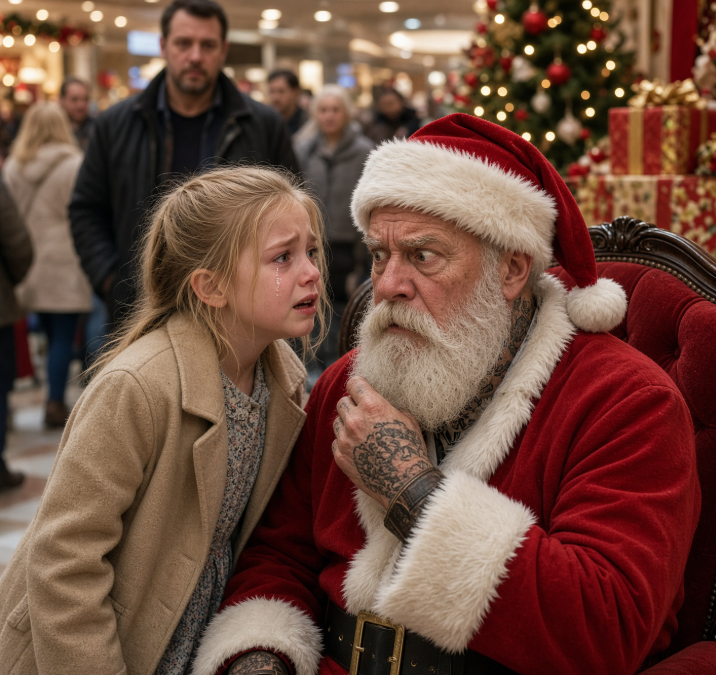
The little girl climbed onto Santa’s lap with a smile painted on her face and terror buried in her eyes.
PART3:
In bars.
On streets.
In back rooms.
Across poker tables.
Outside courthouses.
Men about to swing. Men about to run. Men about to lie. Men about to cry. Men who think they are predators. Men who know they are prey.
Rodney Ward was not impatient.
He was terrified.
“Make it quick, Celia,” he hissed, shoving her toward me. “We have to be at the docks by nine. Don’t waste my time.”
The docks.
That word slid into my mind and stayed there.
Celia climbed onto my lap.
She weighed almost nothing.
That was the first thing I noticed.
The second was the bruise.
A faint yellow mark along her left cheekbone, partly hidden by messy blonde hair.
The third was her eyes.
Kids look at Santa in all kinds of ways.
Excited.
Suspicious.
Shy.
Greedy.
Overwhelmed.
Celia looked at me the way people look at a locked door while something terrible is coming down the hallway behind them.
“Well, hello there, little one,” I rumbled, softening my voice as much as a man like me can. “What would you like for Christmas this year?”
The camera light blinked.
The elf smiled automatically.
Rodney stood ten feet away, thumbs moving on that burner phone.
Celia did not look at the camera.
She did not look at the fake presents.
She gripped the white fur trim of my sleeve with both tiny hands and leaned close enough that her breath touched the fake beard.
She smelled like stale cigarette smoke and unwashed hair.
Then she whispered seven words that turned the whole world cold.
“Daddy’s selling me for one hundred fifty thousand dollars.”
For a moment, the mall vanished.
No music.
No crowd.
No lights.
Only that child’s hands clutching my sleeve.
I kept smiling.
That took everything I had.
I had to keep the Santa face on because Rodney was watching. If I reacted wrong, if I snapped my head up, if I stood too fast, if he realized what she had told me, he might drag her out of there before I could do anything.
I leaned closer.
“What did you say, sweetheart?”
My voice had changed.
Not Santa now.
Bear.
Celia’s eyes filled.
“He owes money,” she whispered. “Bad men. He said he’s trading me tonight at the old shipyards.”
My fingers twitched inside the white gloves.
A dark, living rage opened behind my ribs.
“Please,” she breathed. “Don’t let him take me to the men.”
Rodney suddenly looked up.
“Okay, that’s enough.”
He crossed the little display area and grabbed Celia by the upper arm.
She winced.
I rose.
The fake belly shifted. The throne creaked behind me. Rodney looked up and seemed to understand for the first time that the Santa in front of him was much larger than a mall employee should be.
“She didn’t get her candy cane,” I said.
It was the only thing I could say without breaking him in front of fifty families.
“Keep it,” Rodney spat.
He pulled Celia away.
She looked back over her shoulder.
I have seen men beg for their lives with less fear in their eyes.
That look stayed with me.
It still does.
I did not chase them.
Every instinct in my body told me to.
Every reasonable part of me knew I could not.
A mall Santa sprinting after a father and child through a crowded shopping center would cause panic. Mall security would stumble in. Someone would call local police. Rodney would see uniforms, see strangers closing in, and desperate men with leverage do desperate things.
This needed speed.
But it also needed precision.
It needed the club.
The second Rodney and Celia disappeared through the glass doors, I ripped off the white gloves and pulled my phone from the hidden pocket inside the Santa suit.
Dutch answered on the second ring.
“Bear, tell me you didn’t punch a reindeer.”
“I need a plate run,” I said. “Now.”
Silence.
Dutch knew my voice.
“What happened?”
“Little girl just told me her father is selling her tonight to cover a hundred fifty grand debt. Old shipyards. Nine o’clock. Father’s name Rodney Ward. Gray Honda Accord. Plate Delta Tango Seven Nine Two.”
The playfulness left Dutch like a switch had been cut.
“How old?”
“Seven. Maybe eight.”
Another silence.
Colder this time.
“Get to the clubhouse.”
“I’m still in the suit.”
“Then move, Santa.”
I hung up.
The teenage elf stared at me as I tore off the red jacket.
Underneath it, the fake holiday magic ended fast.
Tattooed arms.
Black shirt.
Leather vest.
Death head patch.
The kid’s mouth fell open.
“Tell your boss,” I said, “Santa had an emergency.”
Then I walked out of Starlight Pavilion Mall with the crushed candy cane still in my pocket.
The clubhouse sat in an old brick building near the edge of the industrial district, where the city forgot to pave properly and nobody complained because nobody wanted officials looking too closely.
By the time I arrived, the inner circle was already around the table.
Dutch at the head, calm and dangerous.
Smitty to his right, thin, sharp-eyed, already hunched over a rugged laptop.
Iron Mike and Jax across from him, two men built like doors with criminal records and more loyalty than most church committees.
There were others nearby, waiting without speaking.
I threw Rodney’s plate number onto the table.
Smitty typed.
Dutch looked at me.
“Tell it exactly.”
So I did.
Every word.
The thin coat.
The bruise.
The docks.
The debt.
The way Rodney yanked her arm.
The way Celia whispered because she knew no one else was listening.
When I finished, no one spoke for several seconds.
Then Jax muttered, “A hundred fifty grand isn’t neighborhood bookie money.”
“No,” Smitty said, still typing. “It isn’t.”
His screen filled with records, addresses, debt traces, messages, names that made the room colder.
“Rodney Ward,” Smitty said. “Thirty-eight. Former mid-level accountant for a logistics company downtown. Fired six months ago. Financial irregularities. Wife died three years back. Daughter is Celia Ward.”
I stared at the screen.
The photograph attached to one record showed Celia with longer hair, a gap-toothed smile, and a pink backpack.
A normal child.
Or she had been once.
Smitty kept going.
“Ward has been bleeding money for two years. Offshore gambling. Private poker rooms. Loans. House foreclosed last month. He borrowed heavy from Desmond Hayes.”
“The Razor?” Dutch asked.
Smitty nodded. “Desmond doesn’t carry that kind of risk alone. He kicks up to the Petrovic crew.”
Iron Mike’s face hardened.
Nobody at that table needed an explanation.
The Petrovics were not street-corner idiots.
They were organized. Quiet. Border-connected. The kind of men who did not threaten children for theater. They used people as currency and made them disappear.
I felt my hands curl.
“If she reaches them,” I said, “she’s gone.”
Dutch stood.
The chair scraped against the concrete floor.
“What time?”
I looked at the wall clock.
“Eight fifteen.”
Dutch’s eyes moved around the table.
“We have forty-five minutes.”
Jax said, “Old shipyards are two miles of rust, docks, containers, and dead cameras.”
Smitty shook his head. “Not all dead.”
Everyone looked at him.
He smiled without humor. “City traffic feeds around Pier Forty-Seven still run through the municipal grid. I can get eyes near the access road.”
Dutch nodded once.
“Do it.”
I started toward my locker.
Dutch’s voice stopped me.
“Bear.”
I turned.
“We do this clean.”
I knew what he meant.
Not soft.
Clean.
A rescue, not a war story.
Evidence preserved. Child alive. Police brought in at the right moment. No cowboy stupidity that put Celia in more danger just to satisfy our rage.
I nodded.
“We bring her back,” I said.
Dutch held my eyes.
“Yes,” he said. “We bring her back.”
Within minutes, the clubhouse changed from meeting room to machine.
Men moved with purpose. Jackets. Comms. First-aid bags. Flashlights. Body armor beneath leather. Not bravado. Preparation.
Some people think men like us live for violence.
That is not true.
Violence is loud, stupid, and expensive.
But when predators gather around a child, there are moments when the threat of violence becomes the language they understand fastest.
I strapped on my vest and checked my phone.
No new information from the mall.
No call saying Rodney had been stopped.
No miracle.
That meant we were still the closest thing Celia had to one.
Outside, the December wind cut through the lot.
I swung onto my Harley.
The engine roared to life beneath me, deep enough to rattle my bones.
Behind me, ten more engines woke.
Dutch’s voice came through the comms.
“Smitty?”
“I’ve got three black SUVs near Pier Forty-Seven,” Smitty said from the van. “Escalades. No plates visible. They’re setting up near the old loading cranes.”
“Rodney?”
“Not there yet. But there’s only one road in.”
Dutch’s voice lowered.
“Then we get there first.”
We rode into the dark.
The old shipyards had been dying for years.
The city kept promising redevelopment. Investors kept showing renderings of glass apartments and waterfront restaurants. Nothing changed. The place remained a maze of broken asphalt, rusted cranes, empty warehouses, chain-link fences, abandoned trailers, and shipping containers stacked like tombstones.
Wind came off the river hard and wet.
We killed our engines a quarter mile out and coasted in where we could.
The sudden silence felt unnatural after the thunder of the bikes.
Smitty fed us positions through the comms.
Three SUVs.
Six men outside.
Possibly more inside.
One central figure.
Armed security.
No sign of Celia yet.
I moved through the shadows between containers, every nerve awake. My knees complained. My back complained. My hands did not. They were steady.
I thought of Celia on my lap.
Those little fingers gripping the white fur.
Please don’t let him take me.
Ahead, white headlights cut through the darkness.
I reached the edge of a red shipping container and looked around it.
Pier Forty-Seven opened before me.
The river beyond was black and restless. The concrete pad near the loading cranes glowed in harsh light from the SUVs. Several men stood in tactical jackets, not careless, not drunk, not amateurs.
In the center stood a large man in a wool overcoat, smoking a cigar like the cold could not touch him.
Goran Petrovic.
I knew him by reputation.
That was enough.
A gray Honda Accord rolled slowly into the light.
My stomach tightened.
The car stopped.
For several long seconds, nothing happened.
Then the driver’s door opened.
Rodney Ward stepped out with both hands raised, shaking so badly I could see it from the containers.
Goran’s voice carried on the wind.
“You are late.”
“I came,” Rodney said. “I came. I have her.”
“You have my property?”
Rodney flinched at the word.
He walked to the back passenger door and opened it.
“Come on, Celia.”
His voice cracked.
A small figure in a faded pink coat climbed out.
She looked even smaller there.
Headlights behind her.
Rusted cranes above.
Armed men around her.
Her hands clutched the hem of her coat.
She was not crying anymore.
That was somehow worse.
Goran smiled and snapped his fingers.
One of his men stepped forward with a briefcase. He opened it just enough for Rodney to see stacks of cash.
“Your debt is settled,” Goran said. “Once the collateral is transferred.”
Rodney stared at the money.
He did not look at his daughter.
Not once.
I felt something inside me go completely still.
Goran extended one gloved hand toward Celia.
“Come here, little bird.”
Celia took one step backward until her back touched the Honda.
I spoke into the comm.
“Now.”
The pier went dark.
Smitty killed the grid clean.
Floodlights died.
Crane beacons vanished.
The world turned black except for the harsh glare of headlights and the sudden confusion of men who had believed they owned the night.
Then the engines started.
All around them.
A dozen Harleys roared from the dark like thunder rolling through steel.
Men shouted.
Weapons lifted.
Laser sights found chests.
Dutch’s voice boomed through a portable speaker.
“Drop your weapons. Hands where we can see them.”
The Petrovic men froze for half a second.
That was all we needed.
Jax disabled the lead SUV’s engine with one shot, not toward flesh, but metal. Steam burst from under the hood. Coolant sprayed across the concrete. The left flank disappeared in white vapor.
One of the guards tried to raise his weapon.
Iron Mike’s voice cut through the dark.
“Bad choice.”
The guard looked down and saw red dots painting his vest.
The weapon hit the ground.
Then another.
Then another.
Goran reached inside his coat.
I came out from cover fast.
“Don’t.”
He turned toward me.
Maybe he saw the Santa from the mall.
Maybe he saw the biker.
Maybe he saw something worse.
He did not stop.
I fired one less-lethal round into his chest from close range.
It hit hard enough to throw him backward onto the hood of the nearest Escalade, knocking the air out of him and whatever confidence he had brought to the pier.
He groaned and folded.
Dutch’s men moved in.
Dropped weapons kicked away.
Hands zip-tied.
Phones collected.
Cash left untouched.
Everything preserved for the cops.
The whole thing lasted less than a minute.
But Celia was still by the Honda.
Hands over her ears.
Eyes squeezed shut.
Trembling so hard she looked like she might break apart.
Rodney was on the ground, not protecting her, not reaching for her, not even looking at her. He had crawled halfway beneath his own car the moment noise started, sobbing into the concrete.
I slung my weapon behind me and walked slowly toward the little girl.
Not fast.
Not looming.
Slow.
I dropped to one knee several feet away, ignoring the cold wet concrete soaking through my jeans.
I did not speak at first.
People think rescue is grabbing someone and running.
Sometimes it is.
But sometimes rescue is making yourself small enough not to become another threat.
Celia opened her eyes.
She saw the leather vest.
The beard.
The tattoos.
The men in the dark.
Her face filled with fear all over again.
I reached into my pocket.
The candy cane was slightly crushed from the ride.
I held it out on my open palm.
“You forgot this, sweetheart.”
Her eyes moved to the candy cane.
Then to my face.
I softened my voice into the same low rumble I had used beneath the fake beard.
Celia blinked.
“Santa?”
I smiled.
“Yeah, kiddo. It’s me.”
Her lips trembled.
“I told you,” I said. “I got your list. I just had to bring some of my elves.”
For one second, she stared.
Then she ran into my arms.
She hit my chest with the full force of a child who had been holding terror inside too long. Her little arms wrapped around my neck, and the first sound she made was not a word.
It was a sob.
Deep.
Ragged.
Too heavy for a seven-year-old body.
I wrapped both arms around her and turned slightly so she could not see the tied men, the cash, or her father shaking on the ground.
“I’ve got you,” I murmured. “Nobody is taking you anywhere. You’re safe now.”
She clung tighter.
A few yards away, Rodney lifted his head.
“Thank you,” he cried. “Oh my God, thank you. You saved us. I didn’t want to do it. They forced me.”
Dutch walked over and stood above him.
“We didn’t save us,” Dutch said. “We saved her.”
Rodney sobbed.
“She’s my daughter.”
Dutch’s voice dropped.
“Then you should have acted like her father.”
Rodney reached toward Celia.
She buried her face deeper into my vest.
I looked at Dutch.
He understood.
“Keep him there,” Dutch ordered.
Jax stepped between Rodney and us.
Rodney lowered his hand.
“What are you going to do to me?” he whimpered.
Dutch pulled out a burner phone.
“Me? Nothing. Despite what people think, we’re not here to give you the ending you deserve.”
He looked toward the tied Petrovic men.
“I have a friend in Special Victims. Detective Miller. He is going to be very interested in a briefcase full of cash, armed men at a shipyard, and a father trying to sell his child to clear a gambling debt.”
Rodney started crying harder.
I did not care.
Celia was shaking against me, and that was the only thing in the world that mattered.
Dutch came closer.
“Bear. Cops are ten minutes out. We ghost.”
“I’m staying.”
His eyes narrowed.
“I’m not handing her to uniforms she doesn’t know,” I said. “She asked me. I stay until Miller gets here.”
Dutch studied me for one long second.
Then nodded.
“Understood.”
He looked to the others.
“Leave the cash. Leave the weapons. Leave the trash tied up. Cops can have the glory.”
Within minutes, the engines faded into the night.
Dutch and the others vanished into the industrial dark the way they had come.
I stayed on the pier with Celia in my arms, Rodney on the ground, the Petrovic men bound and cursing, and cold wind coming off the river.
Celia whispered, “Are they gone?”
“The bad men?”
She nodded against my shoulder.
“They’re not going anywhere.”
“My dad?”
I looked at Rodney.
He had curled in on himself, staring at the concrete as if he had only just understood what he had tried to do.
“He can’t hurt you right now.”
She went quiet.
Then, in the smallest voice I had ever heard, she asked, “Was I bad?”
The question nearly took me apart.
“No,” I said immediately. “No, Celia. You were brave.”
“I told.”
“You told the right person.”
“I was scared.”
“Brave doesn’t mean you weren’t scared.” I held her carefully. “Brave means you were scared and you still asked for help.”
Her fingers tightened in my vest.
“My mom said Santa watches.”
I swallowed.
“Your mom was smart.”
“She died.”
“I’m sorry.”
“Daddy says she left us.”
I looked at Rodney.
For a moment, the old violent part of me rose so fast I almost stood.
Then Celia shifted in my arms, and the feeling became something better.
Control.
“She didn’t leave you by choice,” I said. “Some people are taken by sickness. That is not the same as leaving.”
Celia did not answer.
Maybe she understood.
Maybe she just needed someone to say it.
Police lights appeared in the distance.
Red and blue washed over the warehouses.
Detective Miller arrived first, unmarked SUV skidding to a stop near the pier entrance. Behind him came patrol cars, Special Victims, tactical officers, ambulances, and people who would write the official version of what happened.
Miller stepped out wearing a heavy coat over his badge and the tired expression of a man who had seen enough of the world to believe evil without needing much explanation.
He saw me sitting on the tailgate of his SUV with Celia wrapped in a thermal blanket someone had handed me.
He looked at the tied men.
The cash.
The weapons.
Rodney.
Then back at me.
“Aureliano.”
“Miller.”
“You know you’re technically trespassing on city property?”
“Write me a ticket.”
He shook his head. “You always bring me complicated Christmas gifts.”
“This one came wrapped.”
His face softened when he looked at Celia.
“Hi, sweetheart. I’m Detective Miller. I’m here to help.”
Celia pressed closer to me.
Miller noticed and did not step closer.
Good man.
“We have an emergency foster placement ready,” he told me quietly. “CPS is on the way. Good family. Safe house first, then longer-term placement once the court signs off.”
“She doesn’t go in a holding room.”
“No.”
“She doesn’t sit alone under fluorescent lights while adults argue.”
“No.”
“She eats. Sleeps. Gets clean clothes. Gets a doctor.”
Miller gave me a tired half-smile.
“You want to do my job too?”
“For her? Yes.”
“I know.” He looked back at Celia. “We’re going to do this right.”
A CPS worker arrived fifteen minutes later.
Her name was Angela, and she was smart enough not to rush a child who had just been pulled from the edge of a nightmare. She crouched several feet away, introduced herself, and asked Celia if she liked hot chocolate.
Celia looked at me first.
I nodded.
“She’s safe?”
Angela heard the question beneath the question.
“She’ll be with me the whole way,” Angela said. “Then with a foster mom who already has pajamas and soup waiting.”
Celia whispered, “Can Santa come?”
Angela looked at Miller.
Miller looked at me.
I looked at Celia.
“I can ride behind you,” I said. “Not in the car, but behind. You’ll see my bike lights.”
Her face eased a fraction.
“And I’ll visit,” I added.
“Promise?”
I held up the crushed candy cane.
“Santa rules. Promises matter.”
That got the smallest smile.
When Angela gently helped her into the car, Celia held the candy cane like a lifeline.
Before the door closed, she looked back.
“Santa?”
“Yeah, kiddo?”
“Are you really Santa?”
I glanced down at my leather vest, tattooed hands, wet boots, and the helmet hanging from my fingers.
Then I said, “Only part-time.”
She smiled.
The door closed.
I followed the CPS vehicle through the sleeping city, my Harley’s headlight steady in the rearview mirror. At every red light, Celia turned around to check.
I stayed there.
Again.
Again.
Again.
Until the car pulled into the driveway of a quiet house with warm porch lights and Christmas wreaths in the windows.
Angela walked Celia inside.
I stayed by the curb.
A woman opened the door and immediately wrapped a blanket around Celia’s shoulders. Not too tight. Not possessive. Just warm.
Celia turned before stepping inside.
I lifted one hand.
She lifted the candy cane.
Then she disappeared into the house.
For the first time that night, I let myself breathe.
The legal case moved fast after that.
Rodney Ward tried every excuse available to a coward.
He owed dangerous men.
He had been pressured.
He panicked.
He never meant for anyone to get hurt.
He was going to get Celia back later.
He loved his daughter.
Detective Miller told me some of it over coffee two days after the rescue.
I listened until he got to the part about Rodney saying he loved her.
Then I stood.
Miller pointed at me.
“Sit down.”
“I need air.”
“You need not to violate bail conditions that don’t even apply to you.”
“I’m fine.”
“You are standing like a man deciding whether jail has decent plumbing.”
I sat back down.
Miller slid a file across the table.
“Celia is safe. Focus there.”
So I did.
Celia had been placed with an emergency foster couple named Mark and Denise Holloway. Both in their late fifties. No biological children at home. Experience with trauma cases. Quiet house. Big kitchen. Two cats that wanted nothing to do with children but tolerated them from a distance.
Celia did not sleep much the first nights.
She hid food under her pillow.
She startled when doors closed.
She asked repeatedly whether anyone knew where she was.
But she was safe.
Safe is not the same as healed.
It is where healing can begin.
I visited three days later.
Not as Santa.
Angela thought the suit might confuse things. I agreed. So I came as myself. Jeans. Boots. Black hoodie. No vest. No club patch. Nothing that could turn a foster home into a circus.
Celia was sitting at the kitchen table coloring when I arrived.
She stared at me.
For a second, I thought she did not recognize me without the beard.
Then she said, “Part-time Santa.”
I laughed.
“That’s me.”
She looked at my hands.
“You have tattoos.”
“A few.”
“Santa has tattoos?”
“Only the good ones.”
She considered that.
Then pushed a green crayon toward me.
“Color the tree.”
So I sat at a kitchen table with a seven-year-old girl and colored a Christmas tree badly for forty minutes.
Denise brought cookies.
Celia ate one slowly.
She did not hide it.
That felt like progress.
After that, I visited when the case worker allowed.
Never alone.
Never without approval.
Never as some savior in a leather vest trying to make the story about me.
I had seen too many men help once and then expect worship forever.
Celia did not need another man making himself the center of her life.
She needed safe adults who kept showing up without demanding anything back.
So I showed up.
With coloring books.
With a stuffed reindeer.
With books.
With a winter coat that was not too thin.
With a small pink helmet when Denise said Celia had asked whether motorcycles were scary.
The first time she saw the helmet, her eyes widened.
“I can ride?”
“Not today,” I said. “And not fast. And only if Denise says yes.”
Denise said, “Absolutely not.”
Celia sighed.
I shrugged.
“Boss has spoken.”
Months passed.
Rodney pled guilty after the evidence became too heavy to crawl out from under. The Petrovic men went down harder. There were federal charges, trafficking charges, weapons charges, financial crimes, names connected to names, raids connected to evidence from the pier.
Miller told me the case did real damage to the Petrovic operation.
That mattered.
But not as much as the day Celia laughed without looking surprised by the sound.
It happened in April.
I was at the Holloways’ house helping Mark fix a loose porch railing. Celia sat on the steps with a juice box, watching me pretend to know what I was doing.
“You’re bad at that,” she said.
I looked at the screwdriver in my hand.
“I am excellent.”
“It’s crooked.”
“It has character.”
“Denise says character means broken but old.”
Mark coughed to hide a laugh.
I pointed the screwdriver at him. “Traitor.”
Celia giggled.
Not politely.
Not nervously.
A real laugh.
Small, bright, sudden.
The kind children make when their bodies forget fear for a second.
I looked away fast.
Mark did too.
Some moments are too holy to stare at directly.
That summer, Celia moved from emergency placement into long-term foster care with the Holloways.
By winter, they began discussing adoption.
Celia told me herself at the kitchen table, very serious, with cookie crumbs on her sweatshirt.
“Denise says I can choose if I want their last name.”
“That’s a big choice.”
“I know.”
“What do you think?”
She looked toward the living room, where Mark was pretending not to listen.
“I think I want it.”
Mark made a sound like he had been punched softly in the chest.
Denise walked into the pantry and stayed there too long.
I nodded.
“Holloway is a good name.”
“Better than Ward?”
I chose my words carefully.
“Names don’t decide whether someone is good. People do.”
She thought about that.
“Can I still remember my mom?”
My throat tightened.
“You can remember everyone you need to remember.”
“Even if I get a new family?”
“Especially then.”
The adoption finalized the following spring.
I went to the courthouse because Celia asked.
So did Dutch.
So did half the charter, though they waited outside because twenty bikers in a family courtroom felt like too much even for us.
Celia wore a blue dress and white cardigan. Her hair had been brushed into two neat braids. She held Denise’s hand on one side and Mark’s on the other.
When the judge asked if she understood what adoption meant, Celia nodded.
“It means they stay,” she said.
The courtroom went silent.
The judge took off her glasses.
“Yes,” she said softly. “That is one way to say it.”
Afterward, outside on the courthouse steps, Dutch handed Celia a wrapped box.
Mark looked mildly terrified.
“What is that?”
Dutch said, “Relax. It’s legal.”
Celia opened it.
Inside was a small leather keychain shaped like a motorcycle with her initials stamped into it.
C.H.
Celia Holloway.
She ran her thumb over the letters.
“Does this mean I’m in the club?”
Dutch looked at me.
I looked at Dutch.
Then Dutch crouched very seriously.
“No,” he said. “It means the club is in yours.”
Celia smiled like that made perfect sense.
Years passed.
Children grow in ways adults do not notice until one day the coat fits differently, the voice changes, the questions deepen, and the small hand that once gripped your sleeve no longer needs to hold on quite so tightly.
Celia grew.
Slowly.
Safely.
Not without scars.
There were nightmares. Court hearings. Therapy sessions. Hard anniversaries. Days when she missed her mother so badly she got angry at everyone alive. Days when she asked questions about Rodney that no child should have to ask about a parent.
Mark and Denise stayed.
Angela stayed through the transition until the case closed.
Detective Miller checked in from time to time.
I stayed too, in the only way I knew how.
I taught Celia how to check tire pressure when she was twelve. How to throw a decent punch when she was thirteen, after her therapist and Denise agreed confidence might do her good. How to tell the difference between a man who is protective and a man who is controlling. That lesson took longer.
When she was sixteen, she asked me if I hated Rodney.
We were sitting outside an ice cream shop, her with mint chocolate chip, me with black coffee because my doctor said I needed fewer sweets and my doctor was a joyless man.
“Do you?” she asked.
I watched traffic move down the street.
“I did.”
“And now?”
“Now I think hate keeps people in the room after they’re gone.”
She looked at her cone.
“I hate him sometimes.”
“You’re allowed.”
“Denise says feelings aren’t crimes.”
“Denise is smart.”
“Do you think he loved me?”
That question cut deeper than the rest.
I could have lied.
I did not.
“I think he loved what you were supposed to be,” I said. “His daughter. His family. His second chance. But real love has responsibilities attached. He chose himself when you needed him to choose you.”
Celia was quiet for a long time.
Then she said, “Mark chooses me.”
“Every day.”
“Denise too.”
“Every day.”
“You?”
I looked at her.
“Kid, I rode through half the city dressed like a criminal Santa because you whispered one sentence.”
She smiled.
“That’s not an answer.”
“Yes, it is.”
She leaned her shoulder against mine.
I let her.
When Celia turned eighteen, she received a scholarship to study social work.
Nobody was surprised.
Mark cried anyway.
Denise pretended she was not crying while alphabetizing dorm supplies.
Dutch gave Celia a toolbox for college.
She said, “Most girls get luggage.”
Dutch said, “Most girls can’t fix their own sink.”
She took the toolbox.
I gave her something smaller.
The crushed candy cane wrapper.
Not the candy. That had been long gone. But I had kept the wrapper, folded in a small envelope, from the night at the pier.
Celia held it for a long time.
“You kept this?”
“Santa keeps records.”
She looked at me with eyes no longer hollow, no longer terrified, but still carrying a history she had learned to live with.
“I don’t remember everything from that night,” she said.
“Good.”
“I remember your voice.”
I nodded.
“And I remember thinking Santa was real, but not how people said.”
I did not trust myself to answer.
She hugged me.
Not like the pier.
Not desperate.
Not shaking.
Just a young woman hugging an old biker who had once been in the right chair at the right terrible moment.
“Thank you for believing me,” she whispered.
That was what finally broke me.
Not the guns.
Not the shipyard.
Not Rodney crying on the concrete.
That sentence.
Because children tell the truth in a hundred ways before adults believe them.
Celia had been yanked by the arm, bruised, underfed, terrified, and dragged to a mall Santa because her father needed to keep up appearances before delivering her to monsters.
She had found one narrow opening.
One stranger.
One whisper.
And someone believed her.
That should not be rare.
But too often, it is.
I hugged her back carefully.
“Always,” I said.
Now, every December, Starlight Pavilion Mall still puts up the same fake Santa Village.
The red throne has been replaced.
The elf staff changes every year.
The speakers still play the same terrible songs.
And sometimes, when the toy drive comes around, Dutch asks if I will wear the suit again.
I always tell him no.
Then I do it anyway.
The beard still itches.
The padding still makes me sweat.
The toddlers still scream.
The parents still take too long with photos.
But I sit there.
I ask every child what they want for Christmas.
And I listen.
Really listen.
Because years ago, a little girl in a faded pink coat climbed onto my lap and whispered a sentence that no child should ever have to say.
Her father thought he was handing her over to darkness.
He did not know Santa had brothers.
He did not know leather and chrome could move faster than police paperwork.
He did not know the man in the red suit had spent his whole life becoming the kind of person monsters should fear.
But Celia knew enough to whisper.
That was her miracle.
The rest of us just caught up.
And if anyone asks me now what Christmas magic looks like, I do not talk about reindeer, chimneys, or the North Pole.
I think of a cold pier, a crushed candy cane, a child’s arms around my neck, and one shaking voice finally saying the word that let me breathe again.
“Santa.”
Not because I was magic.
Because for one night, I was there.
And for one little girl, that was enough.








