The Landlord Tried to Evict My Old Bakery—He Didn’t Know Who Drank Coffee There Every Morning
PART3:
For every birthday cake, every unpaid coffee tab, every widow who came in because she could not bear breakfast alone, every kid who pressed fingerprints on my pastry case, every morning I opened that door when my body hurt and my heart hurt worse.
“No,” I said.
Morgan’s expression hardened.
“You should think carefully.”
“I did.”
“That corner is worth considerably more than sentiment.”
“To you.”
His jaw tightened.
“Mrs. Miller, sentiment does not stop progress.”
“No,” I said. “But a legally binding lease does.”
That was the first time I saw real anger in him.
He recovered quickly, but not fast enough.
He took back his card, straightened his cuff, and looked around my bakery one more time.
“This area is changing,” he said. “Businesses either adapt or disappear.”
I picked up a tray of cherry turnovers.
“Then I suppose we’ll see which one I do.”
He left without buying anything.
The bell above the door jingled behind him.
I remember thinking Carl would have called him a polished snake.
Carl was good with phrases.
A decade earlier, when the doctors told us his heart would not last much longer, Carl spent three months doing what he called “leaving things tidy.”
He updated our papers. Fixed the roof. Labeled every breaker in the basement. Wrote recipes in a notebook even though I knew them all by memory.
Most importantly, he found a sharp local attorney and renewed the bakery lease under terms so strong even that attorney smiled while explaining them.
“Your husband,” the attorney told me, “did not trust developers.”
“No,” I said. “He trusted bread.”
“That too.”
Carl died on a rainy Thursday morning with my hand in his and the ovens already running downstairs.
I never remarried.
I never moved.
I kept baking.
That was my grief and my survival.
People think grief is always crying in dark rooms.
Sometimes grief gets up at four-thirty, ties an apron, and feeds people because stopping would feel more like dying than death did.
By the time Morgan Harrison came for my bakery, Miller’s Oven was not making me rich. It paid the taxes, kept the lights on, covered ingredients, and let me continue the only work I truly loved.
Feeding people.
Some of those people frightened everyone else on the block.
They never frightened me.
Every Tuesday morning at exactly six o’clock, the bell above my door jingled and the Hells Angels walked in.
The first time they came, five years earlier, half the customers froze.
Four huge men in denim, boots, and leather cuts filled my doorway. Tattoos covered their hands and necks. Their vests carried patches that made most people suddenly remember somewhere else they needed to be.
The man in front was Arthur Henderson, though everyone called him Arty.
President of the local charter.
Broad shoulders, gray in his beard, jagged scar down his jaw, eyes that could go warm or winter-cold depending on who stood in front of him.
Behind him was Big Jim Lawson, six-foot-five and built like a refrigerator with opinions.
Then Ghost, quiet and pale-eyed.
And Tommy, who smelled faintly of motor oil no matter how recently he had showered.
People expected me to be nervous.
I poured coffee.
“Morning,” I said. “You boys eating or just decorating my doorway?”
Arty blinked.
Then smiled.
“Eating, ma’am.”
“Good. Sit down before you scare my muffins flat.”
He laughed so hard Big Jim had to slap his back.
They became regulars.
I learned their orders.
Arty took black coffee and bear claws. Big Jim liked cherry turnovers and pretended he bought extra “for later,” though later usually meant four minutes. Ghost always ordered plain toast with butter and left ten-dollar tips on three-dollar checks. Tommy liked anything with pecans.
They were polite to me.
Always.
Not performatively. Not in that fake way men behave when they want credit for manners.
Real respect.
One young prospect once tried to sneak a loaf of bread while the others were distracted.
I saw him.
He was maybe twenty-one, all swagger and no sense.
I came around the counter and cracked him across the back of the head with my rolling pin.
Not hard enough to injure him.
Hard enough to educate him.
“You pay for it or sweep floors,” I said.
The bakery went dead silent.
The prospect stared at me.
Then at Arty.
Arty leaned back in his chair and smiled.
“You heard Miss Bee.”
The boy paid for the bread and swept the floors anyway.
After that, I was theirs.
Not officially.
No one said it out loud.
But I knew.
The neighborhood knew.
If someone came in drunk and loud, Big Jim only had to turn his head. If a teenager tried to bother me, Ghost would appear beside him so silently the boy nearly swallowed his tongue. If my delivery driver got stuck in the snow, Tommy fixed the van before the tow company answered the phone.
I fed them.
They watched over me.
Family can look strange from the outside.
Inside, it is very simple.
You show up.
The real trouble began the Tuesday after Morgan’s visit.
It was six in the morning. The Angels were at their usual table. Arty had his coffee. Big Jim was halfway through his second bear claw. The ovens were full, and the bakery smelled like brown sugar and toasted pecans.
The bell jingled.
A man in a sharp gray suit walked in.
Not Morgan.
Younger. Slicker. Meaner around the mouth.
He carried a leather briefcase and wore the expression of someone already offended by the existence of everything around him.
He marched past the line straight to my counter.
“Beatrice Miller?”
“Bee is fine, sweetheart. What can I get you?”
He dropped a thick envelope on the counter.
“I represent Harrison Capital. We are offering a one-time buyout of twenty thousand dollars if you vacate within fourteen days.”
My hands went cold.
The spoon I was holding slipped and hit the floor.
The bakery got quiet.
Very quiet.
“I already told Mr. Harrison,” I said. “I’m not leaving.”
The man smiled.
His name, I later learned, was Greg Donovan.
Corporate fixer.
Legal bully.
Professional parasite in Italian shoes.
“You should listen carefully, Mrs. Miller. If you refuse, we will begin aggressive eviction proceedings based on structural code violations we are prepared to find.”
“Prepared to find?”
His smile widened.
“You’re an elderly woman running a struggling business in an aging building. These things happen.”
“I have three years left on my lease.”
“You have a lease. We have attorneys.”
I gripped the edge of the counter.
Greg leaned over my pastry case, close enough that his breath fogged the glass.
“You don’t have the money to fight us. We can bury you in motions, inspections, fees, and delays until you lose this bakery and your pension. Take the check.”
I saw Carl’s face then.
Not as he looked at the end, thin and tired.
As he had looked years before, standing on a ladder, painting Miller’s Oven above the door.
I lifted my chin.
“No.”
Greg’s expression hardened.
“Listen to me, old lady—”
A hand landed on his shoulder.
A very large hand.
Greg stopped speaking.
The grip did not look violent.
It looked final.
Big Jim stood behind him, full patch on his back, bear claw crumbs in his beard, eyes flat as stone.
“The lady said no,” Jim rumbled.
Greg tried to pull away.
He could not.
“This is a legal business matter,” he snapped, though his voice had climbed. “Take your little biker cosplay club outside before I call the police.”
Wrong words.
The air shifted.
Arty set his coffee down.
Slowly.
Too slowly.
He stood.
The leather of his cut creaked as he walked toward the counter.
He stopped inches from Greg’s face.
“You’re going to pick up that envelope,” Arty said softly. “You’re going to apologize to Miss Bee for raising your voice. Then you’re going to walk out that door and tell whoever sent you that Miller’s Oven is closed for negotiations.”
Greg looked at the four men around him.
For the first time since he walked in, he understood that law school had not prepared him for every room.
His hand shook as he grabbed the envelope.
“Sorry,” he muttered.
“To her,” Arty said.
Greg looked at me.
“I’m sorry.”
“Apology accepted,” I said, though it was not.
He practically ran out the door.
The bell jingled wildly behind him.
I let out a breath.
My knees felt weak.
“Thank you, boys.”
Arty looked at me.
His face softened.
“You all right, Miss Bee?”
“No,” I admitted. “Those men have millions of dollars. They won’t stop.”
Arty’s smile returned.
Not kind this time.
“Neither will we.”
Greg Donovan returned to Morgan Harrison’s penthouse office sweating through his expensive suit.
I was not there, of course, but I heard enough later to imagine it.
Morgan did not like being embarrassed.
Men like him can tolerate cruelty. They can tolerate risk. They can tolerate a little bad press if the money is right.
What they cannot tolerate is being made to feel small.
Greg told him about the Angels.
Morgan dismissed them.
Street trash.
Aging bikers.
A bad movie from the eighties.
Men like Morgan always think money is the highest form of power because money is the only power they have ever had to respect.
He did not understand loyalty.
He did not understand territory.
He did not understand that fear works differently on men who have already lived through things worse than lawsuits.
So Morgan started what Arty later called “the squeeze.”
On Wednesday, I arrived to find the water shut off at the main valve.
The utility company claimed the property manager requested emergency pipe repairs.
There were no pipe repairs.
Without water, I could not bake properly. I lost an entire day of sales.
Arty and the boys brought bottled water so I could make coffee, but I could not produce enough bread, could not wash equipment properly, could not run the bakery the way health regulations required.
On Thursday, a city health inspector arrived after an anonymous complaint.
He was young, nervous, and trying not to look at the Angels in the back booth.
He spent three hours tearing through my kitchen, opening cabinets, measuring cracks in tile, photographing pipes, and writing violations for issues that had existed for twenty years without ever affecting food safety.
By the end, he handed me fines totaling more than I could pay.
“Sorry,” he whispered when nobody else could hear.
I looked at him.
“No, you’re not.”
He left quickly.
On Friday, a rusted dumpster appeared directly in front of my door.
Not near it.
In front of it.
Blocking the entrance completely.
It smelled like rotting drywall, wet insulation, and chemical solvent.
Customers could not get in.
The delivery truck could not unload.
I stood on the sidewalk staring at it, wearing my apron and holding a tray of fresh rolls nobody could buy.
That was when I first started to break.
Not because of the dumpster.
Because I finally understood Morgan’s plan.
He did not need to win in court.
He only needed to make my life impossible faster than I could fight back.
By Friday afternoon, I sat at the counter with my face in my hands and cried.
I hated crying in front of customers.
The bakery was mostly empty by then.
The Angels were still at the back table.
They had moved the dumpster away themselves, but that only solved the problem for one day.
Arty sat beside me.
He did not tell me not to cry.
That is something I appreciated.
People are always trying to stop tears because tears make them uncomfortable. Arty just placed one heavy hand on my back and waited.
Finally, he asked, “Who owns the building?”
“Harrison Capital.”
“The man?”
“Morgan Harrison.”
“He’s doing all this?”
“Yes.”
I wiped my face with a napkin.
“He’s destroying me, Arty. I think I have to sign. I can’t fight a billionaire.”
Arty’s jaw tightened.
“Don’t sign a damn thing.”
“You don’t understand.”
“I understand plenty.”
“No, you don’t. This is not a bar fight. This is paperwork. Lawyers. Inspectors. Courts. Fees. They can ruin me without laying a hand on me.”
Arty looked around my bakery.
At the cases.
The old sign.
The coffee mugs.
The ovens humming behind us.
Then he looked back at me.
“Miss Bee, the world has more than one kind of fight.”
That night, Morgan crossed a line he did not understand.
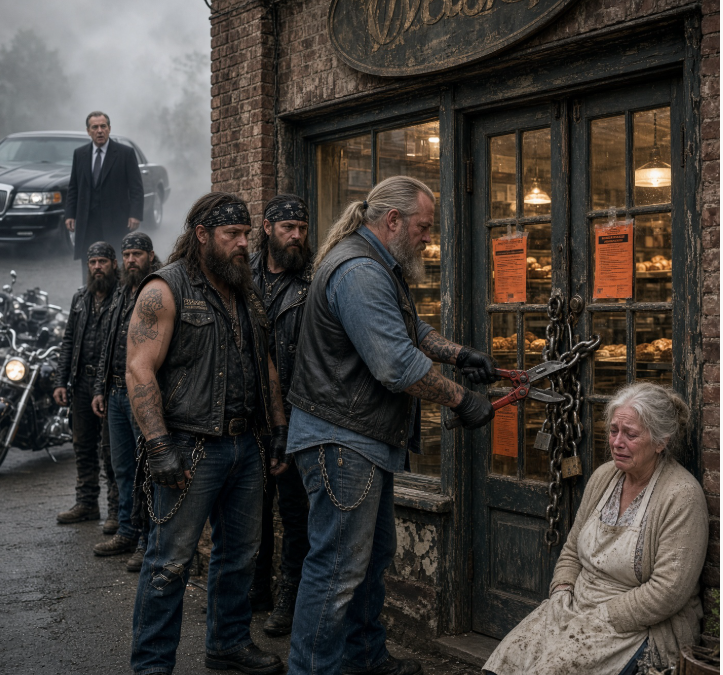
At two in the morning, his private security crew and a locksmith came to Fourth Street. They drilled out my deadbolts, installed industrial padlocks, wrapped chains through the handles, and plastered orange condemned signs across my front windows.
Illegal.
Of course it was illegal.
But illegal does not mean impossible.
Morgan knew that by the time a judge ordered him to let me back in, I would have lost inventory, customers, money, and maybe my will to continue.
He thought a locked door was just another pressure tactic.
To me, it was Carl’s ghost sealed behind steel.
I arrived at five-thirty Saturday morning.
The bakery was still dark.
The chains were thick as a man’s wrist.
Bright orange signs covered the glass.
NO TRESPASSING.
CONDEMNED.
UNSAFE STRUCTURE.
My keys slipped from my hand and hit the pavement.
For a moment, I could not cry.
The hurt was too large for tears.
I just sat down on the curb in the freezing morning mist and stared at the door my husband had painted, now chained like a crime scene.
At six o’clock, engines roared down Fourth Street.
Six Harleys pulled up to the curb.
Arty kicked down his stand and removed his helmet.
Big Jim, Ghost, Tommy, and two others dismounted behind him.
Nobody spoke at first.
Arty looked at me sitting on the curb.
Then at the chains.
Then at the orange signs.
I watched something settle over his face.
Big Jim walked to the door.
He studied the chain.
Then returned to his saddlebag, pulled out a massive pair of bolt cutters, and came back.
“Jim,” I whispered.
Snap.
The padlock broke like a dry twig.
He pulled the chain loose and threw it into the street.
Ghost peeled the condemnation signs from the glass one by one, crumpling them in his fist.
Arty offered me his hand.
“Your door is open, Miss Bee.”
“They’ll call the police,” I said. “They’ll arrest you. They’ll arrest me.”
“The police don’t care about landlord-tenant disputes,” Arty said, smiling without warmth. “Civil matter.”
I blinked.
He had thrown Morgan’s own words back into the world.
“Go inside,” Arty said. “Make the coffee. Bake the bread. We’ll handle the maintenance from here.”
“Arty—”
“Go bake.”
I stood on shaking legs.
Inside, the bakery smelled stale from one night closed.
That made me angry.
More than the chain.
More than the signs.
My bakery should never smell dead.
I turned on the lights.
Started the ovens.
Washed my hands.
Measured flour.
Outside, Arty turned to Big Jim.
“Find out where Morgan Harrison lives. Where he eats. Where he parks that fancy car. Where his money sits.”
Jim nodded.
“Already on it.”
I should have been frightened.
I was.
But I was also tired of being the only one afraid.
The war that followed did not look the way people might imagine.
There were no wild shootouts.
No burning buildings.
No dramatic punches thrown in parking lots.
Arty was too smart for that.
“Beating a man like Morgan just gives him police reports and sympathy,” he told me later. “You don’t hit the suit. You take away the places where the suit feels safe.”
Morgan Harrison lived behind money.
So the Angels attacked comfort.
The first public crack happened at an exclusive French restaurant downtown.
Morgan was hosting lunch with William Kensington, a representative for the investors backing his fifty-million-dollar development. The deal depended on confidence. Calm. Safety. The appearance that Morgan had everything under control.
At one-fifteen, fifteen Harleys parked illegally outside the restaurant, blocking Morgan’s Porsche and William’s town car.
Fifteen Angels walked into the pristine dining room.
They did not shout.
Did not threaten.
Did not touch anyone.
Arty simply handed the hostess a thick wad of cash and said, “We’ll take the open tables.”
For an hour, they ate steak, drank water, and stared at Morgan.
Just stared.
Unblinking.
Quiet.
Patient.
The police were called.
Two patrolmen arrived, saw fifteen men peacefully eating lunch, and decided they had urgent business somewhere else.
William Kensington left before dessert.
According to Tommy, he told Morgan, “Call me when you have control of your project.”
Arty raised his water glass as he passed.
That was Tuesday.
On Wednesday evening, Greg Donovan found Big Jim sitting on his front porch.
Jim was peeling an apple with a hunting knife.
Not waving it.
Not pointing it.
Just peeling an apple.
“Evening, Greg,” Jim said.
Greg nearly dropped his briefcase.
“If you touch me, you’ll go to federal prison.”
Jim took a bite of apple.
“Nobody’s touching you. Beautiful neighborhood you got here. Quiet. Lots of kids riding bikes.”
Greg said nothing.
“Be a shame if a hundred straight-pipe Harleys started enjoying this street every night at three in the morning. Be a shame if your neighbors learned you harass old ladies for a living.”
Greg quit ten minutes later.
He texted Morgan:
I’m done. Do not contact me again.
By Thursday, the Angels found another lever.
Morgan had used a corrupt inspector against me.
Tommy had a brother-in-law at the zoning and planning commission.
Suddenly, real inspections appeared at three of Harrison Capital’s major construction sites.
Not fake violations.
Real ones.
Improper scaffolding.
Exposed wiring.
Unauthorized dumping.
Unsafe supports.
Stop-work orders shut down millions of dollars in projects.
Every idle day cost Morgan more than I made in a year.
He called the police captain, furious.
I heard later what the captain said.
“Arrest them for what? Eating lunch? Sitting on a porch? Reporting unsafe construction sites? Sounds like a civil matter, Morgan.”
Civil matter.
It became my favorite phrase.
By Friday, Morgan was seeing leather cuts everywhere.
Outside his gym.
Across from his office.
Near the parking garage.
At the country club entrance.
Never doing anything illegal.
Just existing.
Watching.
Waiting.
The world he had built on intimidation suddenly began intimidating him back.
But the final lesson came Sunday morning.
Morgan lived in a gated community called the Palisades, behind security guards, biometric gates, cameras, and fences designed to keep ordinary life far away from wealthy people.
At seven in the morning, he walked out carrying golf clubs and found a small pink bakery box sitting perfectly centered on the hood of his locked Porsche.
No alarms triggered.
No gate record.
No broken camera.
Just the box.
Inside was one cherry turnover.
Under it was a legal document.
A ninety-nine-year lease for the corner property on Fourth Street, granting exclusive tenancy to Beatrice Miller.
Rent: one dollar per month.
No redevelopment.
No eviction.
No alteration without tenant consent.
At the bottom was a sticky note with a badly drawn winged death head and two words.
Sign it.
Morgan signed.
Not because he became a better man.
Men like Morgan do not become better that quickly.
He signed because for the first time in his life, the cost of cruelty exceeded the profit.
An hour later, his matte black Porsche pulled up outside Miller’s Oven.
The bakery was full.
I had just taken cinnamon rolls from the oven.
A dozen Harleys stood outside in perfect formation.
Big Jim and Ghost flanked the door.
Morgan stepped out wearing a gray sweater instead of a suit.
He looked smaller without the armor.
Older.
Tired.
Jim did not move at first.
Morgan swallowed.
“I’m just here to drop off paperwork.”
After a long moment, Jim stepped aside.
The bell jingled when Morgan entered.
The bakery went silent.
Arty sat in his usual back corner with black coffee in front of him.
He did not speak.
Morgan walked to my counter.
I could smell expensive cologne under fear.
He reached into his jacket and pulled out the lease.
Signed.
Notarized.
Legal.
He laid it flat on the pastry case.
“You have the building for as long as you want it, Miss Miller,” he said quietly. “The fines have been withdrawn. The water company has been instructed not to interrupt service again.”
I stared at the paper.
Ninety-nine years.
One dollar a month.
My hands began to tremble.
“Why?” I asked.
Morgan’s eyes flicked toward Arty.
Then back to me.
“Some things aren’t worth the cost of doing business.”
He turned and walked out.
The bell jingled behind him.
For a moment, nobody moved.
Then I looked down at Carl’s bakery, protected on paper in a way even he would have admired.
A tear dropped onto the legal document.
Arty lifted his coffee.
“Everything all right, Miss Bee?”
I wiped my face with my apron.
Then I smiled.
Really smiled.
“Everything is just fine, Arty.”
Big Jim leaned through the doorway.
“Does that mean bear claws?”
I laughed.
“In fact, I think it’s time to take them out of the oven.”
“Music to my ears,” he said.
The high-rise never went up on my corner.
The big investor pulled funding. Harrison Capital sold most of the block to another developer, one with enough common sense to understand that not every old thing should be scraped away because new money has arrived.
The neighborhood still changed.
Of course it did.
I am old, not delusional.
More lofts came. More expensive coffee shops. More people who used words like “artisanal” while buying bread I had been making since before they were born.
But Miller’s Oven remained.
A faded brick storefront between glass and steel.
A stubborn little piece of soul on Fourth Street.
Years passed.
My hands got slower.
My knees got worse.
Trevor, the deconstructed bear claw boy, became a regular and eventually helped me build an online ordering page, though I still do not trust anything that requires three passwords to sell a muffin.
Arty kept coming every Tuesday.
Big Jim still ordered too much and claimed it was for later.
Ghost remained quiet.
Tommy fixed my mixer twice and refused payment both times, so I sent him home with pecan rolls until he stopped arguing.
People sometimes ask if I am afraid of having Hells Angels in my bakery.
I tell them the truth.
I am afraid of many things.
Medical bills.
Slippery sidewalks.
Ovens that stop heating during Christmas week.
Young people who think margarine and butter are interchangeable.
But those men?
No.
They are not saints.
I know that.
I am not naïve.
They have histories I do not ask about and rules I probably do not want explained in detail.
But I also know this.
When powerful men tried to erase me, the respectable people looked away.
The inspectors took fees.
The lawyers wrote threats.
The police called it civil.
The investors smelled profit.
And the men everyone feared sat at my counter, drank my coffee, and said:
Not her.
Not this place.
Not while we’re here.
That counts for something.
More than something.
Family is not always clean-looking.
Sometimes family wears leather, parks crooked, and eats six bear claws before sunrise.
Sometimes family scares the wolves away because it knows exactly how wolves think.
On my seventy-fifth birthday, the boys threw me a party.
I told them not to.
They ignored me.
There were balloons tied to Harleys, which looked ridiculous. Arty brought flowers. Big Jim brought a cake from another bakery, and I told him that was grounds for exile.
“It’s your birthday,” he said. “You shouldn’t bake your own cake.”
“It better be good.”
“It’s not.”
I tasted it.
He was right.
We ate it anyway.
At the party, Arty handed me a framed copy of the ninety-nine-year lease.
I stared at it.
“One dollar a month,” he said. “Best rent in the city.”
“Carl would have loved this.”
Arty’s face softened.
“He sounds like a smart man.”
“He was.”
“You miss him?”
“Every day.”
Arty nodded.
“My old lady’s been gone fifteen years.”
I looked at him.
He had never told me that.
“Does it get easier?” I asked.
He thought about it.
“No. But it gets more familiar.”
That was the truest answer anyone had ever given me.
I hung the framed lease behind the counter, right below Carl’s old photograph.
Customers asked about it sometimes.
I told them it was a long story.
A few heard it.
Most did not need to.
They only needed to see the bakery still standing.
That was the story.
That is still the story.
If you walk down Fourth Street on a cold morning, when the city is half-awake and the new loft windows glow blue above the sidewalk, you will smell Miller’s Oven before you see it.
Butter.
Yeast.
Brown sugar.
Toasted pecans.
Coffee.
The sign is still faded.
The neon still does not work.
I could fix it, but I won’t.
Some things deserve to remain stubborn.
At six o’clock on Tuesdays, the bell still jingles.
The men who walk in still make newcomers nervous.
Heavy boots.
Leather cuts.
Death head patches.
Road dust.
Scars.
Tattoos.
They take the back table.
I pour the coffee.
“Morning, Arty,” I say.
“Morning, Miss Bee,” he answers. “You got those bear claws today?”
And I always say the same thing.
“Fresh out of the oven for you and the boys.”
Because greed can buy buildings.
It can hire lawyers.
It can shut off water, fake violations, chain doors, and frighten people who think they are alone.
But greed has one fatal weakness.
It does not understand loyalty.
Morgan Harrison looked at my bakery and saw a corner lot.
The Hells Angels looked at it and saw me.
That is why he lost.
And that is why Miller’s Oven still stands.








