The K9 Wouldn’t Let Anyone Touch the Unconscious SEAL—Then One Quiet Nurse Rolled Up Her Sleeve, and the Dog Froze.
PART3:
Five years of gunshot wounds, crushed ribs, overdoses, highway collisions, fishing accidents, industrial burns, and families who screamed at her because screaming felt easier than fear.
She had developed a reputation.
Dependable.
Quiet.
Fast.
Never emotional.
Never late.
Never interested in being noticed.
People knew she drank coffee without sugar.
Knew she hated birthday celebrations at work.
Knew she never joined hospital softball games.
Knew she would volunteer for the hardest overnight assignments without complaining.
They did not know why she wore long sleeves under her scrubs even in July.
They did not know why she never talked about the years before nursing school.
They did not know why helicopters made her leave the room if she heard them unexpectedly.
And they had never seen her forearms.
Not once.
Her sleeves were always pulled to the wrist.
Always.
Ten minutes earlier, four Navy men had come through the ambulance entrance carrying Mason between them while Atlas ran beside the group.
According to the front desk clerk, Mason had walked in on his own.
Barely.
He had entered upright, one hand against his side.
He had refused a wheelchair.
Then stopped beside reception.
He asked one question.
The clerk had only heard one word.
Doc.
Then Mason swayed.
Atlas barked.
And Senior Chief Mason Trent collapsed like somebody had cut his strings.
Now Monica Tavares, the charge nurse, stood near Iris.
She had been watching her friend almost as closely as she watched the dog.
“Iris.”
No answer.
“Iris, you okay?”
Iris’s eyes remained on Atlas.
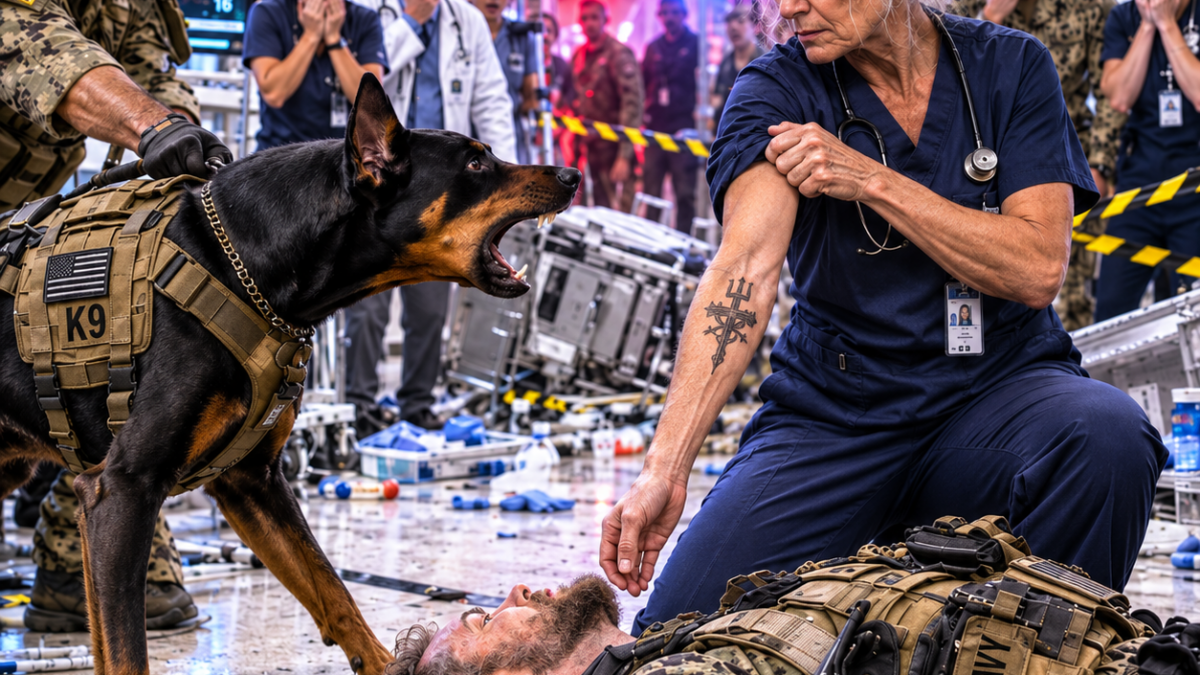
There was a small notch in the dog’s left ear.
Old.
Cleanly healed.
She recognized it.
She recognized the way his front legs held tension while the back remained ready to pivot.
She recognized how he divided his attention.
One eye on threat.
One ear on his person.
His nose repeatedly moving toward Mason’s left side.
That behavior belonged to a different place.
A place Iris had spent eight years refusing to revisit.
A dry riverbed.
Burning diesel.
Dust turning red beneath her knees.
A younger version of herself wearing body armor instead of navy scrubs.
A K9 lying across a wounded corpsman.
A helicopter forty seconds from leaving.
She had known Atlas when he was younger.
Not for long.
Seven days.
Seven days that had divided her life into before and after.
Iris’s fingers closed around the gloves.
“I know that dog.”
Monica looked at her sharply.
“What?”
Iris realized she had spoken aloud.
She shook her head.
“Nothing.”
“That did not sound like nothing.”
At the other side of the trauma bay, security arrived carrying a catchpole and a locked medical case.
Inside the case was a sedative dart system.
Lieutenant Commander Wesley Alcott stepped directly into their path.
Nobody had introduced him, but rank did not require introduction.
He was forty-seven, lean, dark-skinned, and wearing Navy camouflage beneath a rain-spotted field jacket.
His left hand was wrapped around a phone.
His right lifted calmly.
“Nobody sedates the dog.”
The senior security officer frowned.
“Sir, that animal is preventing emergency care.”
“He is doing exactly what he was trained to do.”
Dr. Albright turned.
“And what exactly is that?”
“Protect the senior chief when he cannot protect himself.”
“He is protecting him from physicians.”
“Yes.”
Albright stared.
“That is insane.”
Alcott’s expression did not change.
“To you.”
Doyle swallowed.
“Commander.”
Alcott looked at him.
Doyle lowered his voice.
“He’s never locked me out before.”
That mattered.
Iris could see it in Alcott’s face.
Atlas knew Doyle.
Trusted him.
Yet even Doyle was not allowed near Mason.
Albright pointed toward the monitor.
“This man’s vitals are stable.”
Doyle shook his head.
“No, sir.”
Albright’s head snapped toward him.
“Petty Officer, I have been a trauma physician for twenty-seven years.”
“Yes, sir.”
“Heart rate seventy-two. Saturation ninety-eight. Respiratory rate sixteen.”
“He walked in gray.”
“Operators push themselves.”
“He was pressing his left side.”
“I can see that.”
“He said he felt cold.”
The room shifted subtly.
Iris felt something crawl up her spine.
Cold.
Mason was sweating.
Cold sensation in a warm room.
Possible shock.
Albright said, “We need to examine him, which we cannot do while your dog thinks he owns the hospital.”
Atlas growled louder when Albright stepped forward.
Albright stopped.
“Somebody solve this.”
Iris took one step away from the supply cart.
Monica grabbed her sleeve.
“Absolutely not.”
Iris looked down at her hand.
Monica whispered, “That dog will tear your arm off.”
“No.”
“What do you mean, no?”
“He won’t.”
“How could you possibly know that?”
Iris did not answer.
Because the true answer required eight years.
Atlas looked directly at her.
His growl changed.
Not stopped.
Changed.
Higher for one second.
Then lower.
His ears tipped forward.
Iris’s heart began pounding.
There.
Recognition?
No.
Impossible.
Atlas had seen dozens of medics.
Hundreds of people.
One week eight years earlier could not survive in a dog’s memory.
Could it?
A resident beside Dr. Albright whispered, “Why is he staring at her?”
Nobody answered.
Atlas turned his head toward Mason.
He pressed his nose against the man’s left flank.
Held it there.
Then looked back at Iris.
Again.
Left flank.
Iris.
Left flank.
Her mouth went dry.
She knew that signal.
Not because Atlas had been trained to diagnose internal hemorrhage.
Because dogs who work alongside humans learn patterns.
Learn distress.
Learn when the person beneath them smells wrong.
Acts wrong.
Feels wrong.
And she had seen Atlas do almost the same thing eight years earlier beside another wounded man.
“His breathing isn’t sixteen.”
Monica looked at the monitor.
“It says sixteen.”
“Watch his chest.”
They did.
Shallow.
Fast.
The monitor had interpreted movement poorly.
Iris counted.
Twenty-seven.
Maybe twenty-eight.
His neck was damp.
She could see the carotid pulse.
Too sharp.
Too quick.
“Monitor’s wrong.”
Dr. Albright heard her.
“Excuse me?”
Iris stepped closer to the yellow tape security had placed on the floor.
“His respiratory rate is wrong.”
Albright glanced at the screen.
“The monitor—”
“Is undercounting.”
His expression hardened.
“Callahan, do not start improvising from across the room.”
Iris stopped.
Five years working under Albright had taught her his greatest strength and greatest weakness came from the same place.
Confidence.
He was exceptionally good.
Everyone knew it.
Including him.
He trusted data because data had saved people for almost three decades.
But confidence could become a wall.
And Iris had once watched perfectly respectable numbers lie while a man bled to death.
She looked at Mason’s abdomen.
The way his right forearm had fallen across the left side.
The rigidity visible even beneath clothing.
Something old was awake inside her now.
Something she had spent eight years burying beneath nursing schedules and neutral voices.
Field medicine.
Not textbook medicine.
The ugly kind.
The kind learned where monitors fail.
Where transport is delayed.
Where bodies compensate until they suddenly cannot.
She heard rotors in her memory.
“His body’s hiding it.”
Albright exhaled sharply.
“What?”
“He’s compensating.”
“Based on what examination?”
“I don’t have one.”
“Exactly.”
Atlas whined.
Low.
Urgent.
Alcott looked at Iris.
Not at the dog.
At her.
His face changed.
Slowly.
Recognition was entering it.
“Callahan,” he said.
Iris looked at him.
“Have we met?”
Her stomach dropped.
“No.”
Alcott stared at her sleeves.
Then at her face.
He took one step toward the tape.
“What is your first name?”
Dr. Albright’s patience snapped.
“Commander, this is not a reunion. I have an unconscious patient.”
Alcott ignored him.
“Your first name.”
Iris’s voice barely came out.
“Iris.”
Doyle looked up.
Alcott went completely still.
Atlas whined again.
Alcott said, “Doc Iris?”
The room vanished.
Eight years.
Gone.
Dust.
Blood.
A dying man smiling at her.
Don’t get sentimental, Doc.
She stumbled backward.
Monica caught her elbow.
“Iris?”
Alcott’s eyes filled with something dangerously close to disbelief.
“I thought you were dead.”
Iris stared at him.
“You knew me?”
“No.”
His voice cracked.
“But I knew about you.”
Dr. Albright said, “What the hell is happening?”
Nobody answered him.
Doyle looked between Iris and Alcott.
“Commander?”
Alcott slowly reached into the collar of his uniform and pulled out a chain.
A small metal disk hung there.
Not dog tags.
Something else.
A round black emblem.
At its center was a trident wrapped with a winged medical staff.
Iris felt the blood leave her face.
Harrow.
She had not seen that emblem outside nightmares in eight years.
Alcott said softly, “The senior chief told us if he ever went down near Port Alder, we were supposed to find the medic with the Harrow mark.”
Monica looked at Iris.
“What mark?”
Iris said nothing.
Albright frowned.
“Harrow?”
Alcott nodded.
“Harrow Medical Detachment.”
The young residents looked confused.
They should have.
Harrow had never existed publicly in the way normal units existed.
It had been an experimental joint medical support detachment assigned to special operations teams in unstable environments where formal evacuation infrastructure was unreliable.
Small.
Temporary.
Highly specialized.
Then one mission went wrong.
Two men died.
Records were sealed.
Personnel were reassigned.
The name disappeared.
Almost.
Alcott continued.
“The senior chief has spent eight years looking for one corpsman.”
The word hit Iris harder than anything else.
Corpsman.
Not nurse.
Not Ms. Callahan.
Not the safe civilian identity she had built.
Corpsman.
Monica stared.
“You were Navy?”
Iris shook her head.
“Attached.”
“What does that mean?”
“Not now.”
Albright pointed toward Mason.
“I agree. Not now.”
For once Iris appreciated him.
Alcott said, “The senior chief told Doyle something in the transport vehicle.”
Doyle nodded.
“He said if Atlas locked us out, nobody should force the dog.”
Albright laughed in disbelief.
“That is not a medical directive.”
“No,” Doyle said. “It was a survival directive.”
Iris looked at him.
“What else did he say?”
Doyle hesitated.
“He said find the medic who wears the mark.”
Monica’s hand remained around Iris’s wrist.
Iris could feel her own pulse beneath the fabric.
The tattoo was there.
It had always been there.
Faded black ink on the inside of her left forearm.
A trident.
Winged serpent staff.
Two words beneath it.
HARROW MEDICAL.
Danny Quinn had drawn the first version on a field notebook with a dull pencil.
Then every member of the detachment had joked that the emblem looked ridiculous.
Only Iris had been foolish enough to tattoo it.
Danny told her she would regret it.
He had been right.
After the riverbed, Iris began covering it.
At first because people asked questions.
Later because she could not stand seeing it herself.
Eight years of long sleeves.
Eight years of hiding the part of her body where another life remained written.
Atlas stared at that sleeve.
The room became impossibly quiet.
Alcott whispered, “Show him.”
Iris shook her head.
“No.”
“Doc—”
“Don’t call me that.”
Alcott stopped.
The words came sharper than she intended.
“I am not her anymore.”
Atlas whined.
Iris closed her eyes.
Monica’s voice softened.
“Iris.”
“No.”
“You don’t have to tell us anything.”
Good.
That almost made her break.
Because Monica was not asking for the story.
She was giving her control.
Iris opened her eyes.
Mason’s monitor changed.
72 became 83.
Then 89.
Blood pressure 108 systolic.
Still acceptable.
Except the trend.
Atlas stood.
His growl returned.
He pressed his nose into Mason’s side harder.
Mason made a faint sound.
Barely conscious.
Pain.
Iris stepped across the tape.
Monica whispered, “Iris.”
She did not stop.
Albright’s voice cut across the room.
“Callahan, step back.”
“No.”
It was the first time in five years she had openly refused him.
His face changed.
“Security.”
Two guards moved.
Alcott stepped between them and Iris.
“Touch her and I remove you myself.”
The older guard frowned.
“This is a hospital.”
“And that is my operator dying on your floor.”
Albright snapped, “His heart rate is eighty-nine.”
Iris looked at him.
“Then stop treating eighty-nine and look at Mason.”
That silenced everyone.
Not because of what she said.
Because she used his name.
Senior Chief Mason Trent.
Not patient.
Not the senior chief.
Mason.
Atlas’s ears lifted.
Iris crouched.
Three feet from him.
The wet tile soaked through her scrub pants.
She held her hands low.
“Atlas.”
His head snapped toward her.
Doyle’s mouth opened.
“How do you know his name?”
Iris ignored him.
“Easy.”
Atlas growled.
But he did not move forward.
She breathed slowly.
The old field voice came naturally.
Not soft.
Not loud.
Flat.
Certain.
“Guard.”
Atlas’s ears tipped forward.
“Easy guard.”
Alcott whispered, “Jesus.”
Iris looked at Doyle.
“Loosen the chain.”
He shook his head immediately.
“No, ma’am.”
“One link.”
“He’ll reach you.”
“I know.”
“No offense, but—”
“Petty Officer.”
Her voice changed.
Doyle straightened without thinking.
“One link.”
He looked at Alcott.
The commander nodded.
Doyle loosened.
Atlas stepped forward.
Monica gasped.
Iris did not move.
One step.
Another.
The dog’s nose worked furiously.
He smelled her shoe.
Knee.
Hand.
Then stopped at the sleeve.
His entire body trembled.
Iris reached for the cuff.
For eight years, pulling her sleeves down had been part of dressing.
Like fastening armor.
She had done it before job interviews.
Before birthdays.
Before dates she never enjoyed.
Before every shift at Seabrook.
Her fingers shook now as she rolled the left sleeve upward.
Wrist.
Forearm.
Ink appeared.
Faded.
Distorted slightly by time.
The trident.
The serpent staff.
HARROW MEDICAL.
Someone behind her whispered, “Oh my God.”
Alcott stopped breathing.
Dr. Albright stared.
Monica covered her mouth.
Atlas’s growl stopped.
Not gradually.
Instantly.
His lips lowered.
His ears flattened.
The tension went out of his shoulders.
And the enormous working dog made a sound that did not belong in a trauma bay.
A broken whine.
He walked toward Iris.
One slow step.
Then another.
Doyle let the chain fall loose.
Atlas pressed his forehead against Iris’s bare forearm directly over the tattoo.
Iris’s entire body shook.
She closed her eyes.
Eight years of distance vanished in a second.
Her hand landed behind his ear.
The notch.
She remembered the injury.
Danny cutting barbed wire from around Atlas’s head in a drainage canal.
The dog bleeding.
Danny laughing.
Look at that, Doc. Now he’s ugly like the rest of us.
A tear slid down Iris’s face.
“Hey, old boy.”
Atlas leaned harder.
“I’m here.”
Another tear.
“I’m sorry.”
Alcott knelt beside her.
His own eyes were wet.
“Doc.”
Iris opened her eyes.
“Where’s Danny?”
Alcott’s expression broke.
The question had escaped before she could stop it.
She already knew.
Of course she knew.
Danny Quinn had died in that riverbed.
She had watched his blood soak into dirt.
She had heard him order her onto the helicopter with Mason Trent.
She had obeyed.
Then spent eight years hating herself for it.
Alcott whispered, “Danny’s gone.”
“I know.”
She looked down.
“I know exactly where I left him.”
“No.”
Alcott shook his head.
“That is not what Mason came here to tell you.”
Iris looked at him.
“What?”
Atlas pulled away from her.
He turned toward Mason.
Pressed his nose into the left flank again.
Then looked at Iris.
The message could not have been clearer.
Later.
Save him now.
Something inside her clicked into place.
Iris crawled forward.
Atlas allowed it.
That alone shocked everyone.
She put two fingers against Mason’s carotid.
Fast.
Thin.
Not eighty-nine anymore.
She checked his wrist.
Weak.
Her hand moved toward the left side.
Atlas watched.
Did not growl.
Iris lifted the bottom of the vest slightly.
Pressed gently into the abdomen.
Rigid.
Boardlike.
Mason groaned.
Iris’s voice changed.
“Internal bleed.”
Albright stepped closer.
“Based on one palpation?”
“FAST scan.”
“Callahan—”
“Now.”
He stared.
“You are a nurse.”
“And he is compensating.”
“You have no evidence—”
“His pulse is thready. Skin cool. Abdomen rigid. Respirations near thirty. Left-sided guarding before collapse.”
Albright looked toward the monitor.
Heart rate 96.
Blood pressure 102/66.
Still not catastrophic.
Iris said, “Those numbers are the last polite thing his body is going to do.”
Albright’s jaw clenched.
She continued.
“When the pressure drops, it’ll fall all at once.”
“You cannot know that.”
“I have seen it before.”
Mason’s left side.
Retained fragment.
A line from an eight-year-old field note suddenly returned in perfect detail.
Retained fragment, left upper quadrant. Stable for transport.
Her stomach twisted.
No.
It could not still be there.
Could it?
Iris looked at Albright.
“Bedside ultrasound.”
He stared.
Pride fought medicine in his face.
Then another voice spoke.
Monica.
“Preston.”
Albright glanced at her.
She rarely used his first name during a case.
“Thirty seconds.”
He exhaled.
Then turned.
“Bring the ultrasound.”
The room moved.
Finally.
A technician named Brandon Ellis pushed the unit forward.
Atlas watched him.
Iris held one hand toward the dog.
“Easy.”
Atlas stayed.
The probe touched Mason’s abdomen.
Gray images moved across the screen.
Albright adjusted.
Left upper quadrant.
For ten seconds, nothing obvious.
Then darkness appeared where darkness did not belong.
Fluid.
More.
Albright’s face changed.
“Free fluid.”
Nobody spoke.
He moved the probe.
More.
A lot.
Iris whispered, “Look near the spleen.”
He did.
Something bright flashed.
Metallic artifact.
Albright frowned.
“What is that?”
Iris knew.
“Fragment.”
“From what?”
“A mission eight years ago.”
Albright looked at her.
“There is no fragment in his medical history.”
“There wouldn’t be.”
“Why?”
“Because the record stopped at a riverbed.”
Mason’s monitor alarmed.
Heart rate jumped.
Blood pressure dropped.
94/58.
Then 82/50.
Everyone stared.
Albright looked at Iris.
She did not feel vindicated.
Only afraid.
“Here it comes.”
Seventy-four over forty-two.
Atlas barked once.
The entire trauma bay exploded into motion.
“Massive transfusion protocol,” Iris said.
Albright looked at her.
Then did something no one expected.
He nodded.
“Do it.”
Monica ran.
“Two large-bore IVs.”
“Already one in.”
“Get another.”
“Warm the blood.”
“Call OR.”
“Nandakumar’s in surgery.”
“How long?”
“Fifteen minutes.”
“He does not have fifteen.”
Iris cut the vest.
Atlas allowed her.
Doyle stood nearby staring at the nurse as if he had walked into the wrong hospital.
Blood arrived.
Iris pressed down against Mason’s left flank with both hands.
Not enough to stop internal bleeding.
Enough to help.
Enough to buy seconds.
Sometimes medicine is seconds.
Albright stood at Mason’s head.
“Pressure?”
“Sixty-eight systolic.”
“Push blood.”
The first unit ran.
Atlas dropped beside Iris.
His chin rested against her boot.
The gesture hit her so hard she almost lost focus.
Danny’s dog.
Mason’s dog now.
Still carrying ghosts better than she had.
Alcott crouched near her.
“Doc.”
“Not now.”
“Mason came here for you.”
“Commander, not now.”
“He may not get another chance.”
“Then help keep him alive.”
Alcott swallowed.
“I am.”
He lifted the phone in his hand.
“There is something you need to hear.”
Iris ignored him.
Pressure.
Blood.
Monitor.
Mason.
The body beneath her hands felt too familiar.
The riverbed returned.
Eight years earlier.
Afghanistan.
Late afternoon.
Harrow Medical had been attached to a joint team tasked with extracting an intelligence asset from a village near a dry river channel.
The operation was supposed to last forty minutes.
It lasted five hours.
Their vehicle was hit first.
Then small-arms fire.
Then a second explosion.
Iris had been twenty-five.
Not yet Iris Callahan, trauma nurse.
Hospital Corpsman Iris Callahan.
“Doc” to everyone.
She remembered Mason younger.
Thirty-three.
Blood on his uniform.
Still joking.
She remembered Danny Quinn twenty-nine and loud enough to irritate entire platoons.
Danny had been the team medic senior to her.
Her closest friend.
Her teacher.
The man who taught her to stop apologizing before painful procedures.
The man who drew the Harrow emblem.
The man Atlas loved first.
The riverbed had been burning.
Two critical casualties.
Mason with a penetrating injury in the left flank.
Danny with catastrophic abdominal trauma.
One helicopter.
One stretcher.
Severe incoming fire.
The aircraft commander shouted they could take one.
Only one.
Iris refused to choose.
Danny chose for her.
Take Mason.
No.
Take him.
Danny—
Doc, look at me.
She looked.
Danny smiled.
The kind of smile men use when they have already accepted something everyone else is still fighting.
Atlas was lying across him.
Danny’s hand rested in the dog’s fur.
Mason survives if you move now.
You can still—
No.
Take him.
I’m not leaving you.
Danny grabbed the front of her vest.
His grip was weak.
That scared her more than the blood.
Iris.
Go.
She shook her head.
That is an order.
Danny had outranked her in that moment.
Not technically by much.
Enough.
She went.
She helped load Mason.
The helicopter lifted.
Through the open door she saw Danny shrinking beneath them.
Atlas beside him.
Smoke swallowing the riverbed.
That became the last image.
Iris never returned to Harrow.
She was hospitalized afterward with smoke inhalation and a shoulder injury.
Then transferred.
Then told an internal review was underway.
She heard rumors.
Questions about triage.
Questions about why Danny was left.
Questions about whether she panicked.
Nobody officially accused her.
That almost made it worse.
Before the review ended, Iris requested separation.
Changed her phone.
Moved twice.
Started nursing school.
Disappeared.
She thought if nobody said the words, they were all thinking them.
You chose wrong.
Danny died because you left him.
For eight years, she carried that sentence without anyone ever actually giving it to her.
Alcott’s voice cut through the trauma room.
“Mason got the riverbed recording unsealed last month.”
Iris’s hands remained pressed against Mason.
“What?”
“The final radio call.”
“There was no final call.”
“Yes.”
Her breath caught.
“No.”
“After the helicopter lifted, Danny keyed his radio.”
Iris shook her head.
“Don’t.”
Alcott’s voice broke.
“He said your name.”
“Stop.”
“Iris.”
Nobody called her Iris there.
Not Albright.
Not Monica.
Not this commander.
But he did now.
“You need to hear him.”
Mason’s blood pressure fell again.
Iris pressed harder.
“Not until he’s alive.”
Alcott nodded.
“All right.”
Then he leaned closer.
“But know this much. Danny never blamed you.”
The sentence hit so deeply that Iris almost lost her breath.
She kept working.
Albright looked at her.
“You okay?”
She laughed once.
Wrong question.
“Keep the blood running.”
He obeyed.
That surprised her.
The senior attending physician who had dismissed her five minutes earlier now followed instructions without ego.
That mattered.
Monica returned.
“OR says Dr. Nandakumar is finishing closure.”
“How long?”
“Ten.”
Iris shook her head.
“Too long.”
The doors opened.
A woman entered wearing surgical scrubs spotted with someone else’s blood.
Dr. Priya Nandakumar.
Chief of emergency surgery.
She had apparently left another case the instant she heard “unstable Navy operator with intraperitoneal hemorrhage.”
“Talk.”
Iris did.
“Forty-one-year-old male, collapse, initially compensated, rapid decompensation, free fluid left upper quadrant, likely splenic injury, possible retained metallic fragment from prior penetrating trauma.”
Nandakumar looked at Albright.
“Confirmed?”
“Yes.”
“Pressure?”
“Seventy over forty on blood.”
“Move.”
The surgical team flooded in.
Atlas rose.
For one horrifying second, Iris thought the dog would block them.
She placed her hand on his neck.
“Atlas.”
He looked at her.
“Let them.”
The gurney rolled.
Atlas stepped aside.
Everyone noticed.
He trusted her judgment.
Mason disappeared through the operating room doors.
The hallway went silent.
Iris stood there with blood on both hands.
Her sleeves remained rolled above the elbows.
The tattoo exposed.
She suddenly realized half the staff was looking at her.
Not with fear.
Not exactly.
Shock.
Questions.
Monica sat beside her on the bench.
“Water.”
“I’m fine.”
“You’re shaking.”
“I’m cold.”
“It’s seventy-two degrees.”
“I know.”
Monica pressed the cup into her hands.
Dr. Albright came out of Trauma One.
He looked older.
Not dramatically.
Just tired.
Human.
He stopped in front of Iris.
“Nurse Callahan.”
She looked up.
“I owe you an apology.”
Nobody moved.
A few residents pretended they were not listening.
Albright continued.
“I trusted a monitor more than a patient.”
“You corrected.”
“I argued first.”
“So?”
“So ten minutes mattered.”
Iris looked toward the operating room doors.
“Yes.”
He swallowed.
“I also spoke to you as though experience belongs only to physicians.”
That apology was harder.
She looked at him.
“You didn’t know.”
“That is not a defense for not asking.”
Silence.
Then Iris said, “You listened when it mattered.”
Albright nodded.
He glanced at the tattoo.
“I assume there is a story.”
“There is.”
“You don’t owe it to me.”
That surprised her too.
He walked away.
The staff slowly returned to work.
But something had changed.
People who had worked beside Iris for years now knew there had been an entire life hidden beneath those sleeves.
Monica remained.
“You were a corpsman.”
“Yes.”
“Special operations?”
“Attached.”
“You never told me.”
“I never told anyone.”
“Five years.”
“Yes.”
Monica looked hurt.
Not angry.
That was worse.
“I thought we were friends.”
“We are.”
“Then why didn’t you trust me?”
Iris stared at the cup.
“Because if I told you, you would ask what happened.”
“I would have.”
“And if I told you what happened…”
She could not finish.
Monica softened.
“You thought I’d see you differently.”
“Yes.”
Monica looked toward the OR.
“I do.”
Iris’s chest tightened.
Then Monica touched her shoulder.
“I think you’re even more stubborn than I knew.”
Iris laughed unexpectedly.
A broken sound.
Monica smiled.
“And apparently terrible at asking for help.”
“That part you knew.”
“Yes.”
Two hours later, Nandakumar came through the surgical doors.
Her mask hung loose at her neck.
Atlas was lying at Iris’s feet.
Doyle and Alcott stood when the surgeon appeared.
Iris could not.
Her knees had stopped cooperating.
Nandakumar looked directly at her.
“He’s alive.”
Every person exhaled.
Iris covered her mouth.
“Splenic injury complicated by migration around an old metallic fragment. Dense scar tissue. Active hemorrhage.”
“How much blood?”
“Too much.”
“Prognosis?”
“Better now than two hours ago.”
Iris nodded.
Nandakumar continued.
“Another ten minutes and we would be having a very different conversation.”
Atlas’s tail thumped once.
The surgeon looked at him.
“That animal diagnosed him faster than half the building.”
Albright, standing farther down the hall, said, “Including me.”
Nandakumar glanced over.
“You’re admitting that out loud?”
“Apparently I’ve had a difficult evening.”
Somebody laughed.
Small.
Necessary.
Iris finally stood.
“Can I see him?”
“Not yet.”
“When?”
“Morning if he’s stable.”
Alcott approached her after the surgeon left.
He still carried his phone.
“You should hear it.”
Iris looked at the device.
Danny’s voice lived inside it.
Eight years.
She had imagined his last words thousands of times.
Sometimes he screamed.
Sometimes he cursed her.
Sometimes he called her name.
None of those memories were real.
They were inventions created by guilt.
“Not here.”
Alcott nodded.
They went into an empty family consultation room.
Atlas followed.
Doyle waited outside.
Monica came too, then paused at the doorway.
“I can leave.”
Iris looked at her.
For eight years, every painful thing had happened in private.
Maybe that was part of the problem.
“Stay.”
Monica sat.
Alcott placed the phone on the table.
“This was recovered from encrypted comms archives.”
Iris stared at the screen.
“Why did Mason fight for it?”
“Because he remembered Danny transmitting after liftoff.”
“I was told nothing came through.”
“It did. The channel was buried with the Harrow investigation.”
“Why?”
“Classification. Politics. Confusion. Pick one.”
“Eight years?”
Alcott looked ashamed.
“Mason spent most of those eight years fighting bureaucracy.”
Iris laughed bitterly.
“And looking for me?”
“Yes.”
“Why?”
“Because Danny asked him to.”
Her eyes closed.
Alcott pressed play.
Static.
Wind.
Gunfire in the distance.
Then Danny Quinn.
Older speakers made him sound far away.
But it was him.
No doubt.
Calm.
Breathing hard.
“Harrow Actual, this is Quinn.”
Static.
“Bird is clear. Trent is aboard.”
Pause.
“If Doc Callahan gets this…”
Iris stopped breathing.
Danny continued.
“Tell her she made the right call.”
Her hand went to her mouth.
“Tell her I gave the order.”
Static.
Atlas lifted his head.
Danny’s breathing grew weaker.
“She’s going to carry it anyway because that’s what she does.”
A faint laugh.
Even dying.
Still Danny.
“Tell her not to.”
Iris bent forward.
Monica put an arm around her.
The recording continued.
“Tell her one man going home is not betrayal.”
A longer pause.
“Tell Trent he owes me whiskey.”
Another crackle.
“And somebody feed my damn dog.”
Atlas whined.
Iris broke.
Not the quiet tears from Trauma One.
This was eight years.
She cried into both hands.
Her shoulders shook.
Monica held her.
Alcott stared at the table with tears running down his face.
Atlas climbed partly beneath the table and rested his head on Iris’s knee.
The recording ended in static.
No dramatic final breath.
No speech.
Just silence.
Iris listened again.
Then again.
The third time she stopped before the final static.
She whispered, “He knew.”
Alcott nodded.
“He knew you.”
“I left him.”
“He sent you.”
“I should have found a way.”
“There wasn’t one.”
“You don’t know that.”
“Mason does.”
Her eyes lifted.
“What?”
“He remembers.”
“He was unconscious.”
“Not yet.”
Iris stared.
Alcott continued.
“He heard the argument. Heard Danny order you onto the bird. Mason tried to refuse evacuation.”
Iris remembered.
A hand grabbing her vest while she loaded him.
Mason mumbling something.
She had thought he was delirious.
“He told you to take Danny.”
“Yes.”
“He has hated himself for that too.”
The idea stunned her.
Two survivors.
Eight years.
Each believing they had stolen life from the other.
“He crossed the country to tell me this?”
“Yes.”
“Why now?”
“Because his medical retirement was approved.”
Iris looked at him.
“What happened?”
Alcott hesitated.
“Mason has been slowing down.”
“Meaning?”
“Old injuries. New ones. He hid more than he should.”
“Of course.”
“He knew this trip might be his last chance before Atlas retired and the team scattered.”
“So he came here.”
“He located a nursing license attached to your Social Security record.”
Iris looked almost offended.
“You searched federal records?”
“Mason is persistent.”
“That’s illegal.”
“Probably.”
Despite herself, she laughed.
It turned into another sob.
By dawn, Mason Trent was awake.
Pale.
Weak.
Angry about the breathing exercises.
Exactly the kind of patient Iris expected.
Atlas occupied the foot of the bed like an armed security system.
When Iris entered, his tail struck the mattress twice.
Mason turned his head.
His eyes focused slowly.
Then he smiled.
“Doc.”
Iris stopped at the doorway.
Eight years of guilt stood between them.
Then she walked in.
“Senior Chief.”
“I got a little careless.”
“You nearly died.”
“Technicality.”
“Your spleen disagrees.”
He tried to laugh.
Immediately regretted it.
“Don’t make me laugh.”
“I didn’t.”
“You always had that face.”
“What face?”
“The one that says you’re deciding whether homicide would violate hospital policy.”
Iris’s eyes filled.
Mason saw.
His humor disappeared.
“Hey.”
She looked away.
“No.”
“Doc.”
“Don’t.”
“I came here because—”
“I heard him.”
Mason went still.
“Alcott played it?”
“Yes.”
His eyes closed.
“Good.”
“I didn’t know.”
“I know.”
“I thought…”
Her voice failed.
Mason waited.
She tried again.
“I thought everybody blamed me.”
His eyes opened.
“For Danny?”
“Yes.”
“Jesus.”
“I left before the review.”
“Why?”
“Because I was twenty-five and stupid and ashamed and nobody would tell me anything.”
Mason looked toward Atlas.
Then back at her.
“Danny saved my life.”
“Yes.”
“You saved my life.”
Iris shook her head.
“He chose.”
“Exactly.”
She looked at him.
Mason spoke slowly.
“He chose.”
The words landed differently this time.
Not accusation.
Not excuse.
Truth.
“He looked at me in that riverbed and told me I was going home.”
Mason swallowed.
“I told him to stop talking.”
A faint smile.
“He told me I was too ugly to die because the paperwork would be confusing.”
Iris laughed through tears.
“That sounds like him.”
“He told you to take me.”
“Yes.”
“He made the choice because he knew both of us would spend the rest of our lives trying to steal responsibility for it.”
Iris sat beside the bed.
Mason looked at her tattoo.
“You still have it.”
“I tried to get it removed once.”
“What stopped you?”
“Pain.”
He smiled.
“Coward.”
“Almost let you bleed out last night.”
“Fair.”
Silence.
Then Mason’s expression became serious.
“I looked for you.”
“I know.”
“Every year.”
“Why?”
“Because Danny made me promise.”
Iris looked down.
“What exactly did he say?”
Mason’s eyes shifted toward Atlas.
“Before the helicopter landed, he told me you would blame yourself.”
“He was right.”
“He said, ‘Find her when you can. Tell her I chose.’”
Iris closed her eyes.
Mason continued.
“I thought you were still military. Then records disappeared.”
“I left.”
“I found that out eventually.”
“Why didn’t you stop?”
“Because promises don’t expire because paperwork gets irritating.”
Atlas thumped his tail.
Mason looked at the dog.
“And because this idiot would lose his mind every time we showed him your old photograph.”
Iris stared.
“My photograph?”
“Danny kept one in Atlas’s gear pouch.”
“What?”
Mason smiled.
“Team picture.”
Iris remembered it.
Harrow team outside a temporary aid station.
Everyone filthy.
Danny in sunglasses.
Atlas sitting between them.
Iris standing with her sleeves rolled up.
Tattoo visible.
Mason said, “Atlas remembered the mark.”
Her eyes moved to the dog.
That explained more than she wanted it to.
Recognition.
Scent might change.
Faces age.
But visual patterns.
Body language.
Commands.
Memory builds differently in animals.
Atlas stood and walked toward her.
He sat at her feet.
Iris put a hand on his head.
Mason watched.
“He picked you before I did.”
“What does that mean?”
“My retirement paperwork includes him.”
“You’re retiring Atlas?”
“He’s ten.”
“He doesn’t act ten.”
“Neither do I.”
“You almost died yesterday.”
“Rude.”
She almost smiled.
Mason continued.
“He needs a home.”
Iris looked at him.
“No.”
“I haven’t asked yet.”
“I know where this is going.”
“He trusts you.”
“He trusts you.”
“My apartment won’t take military K9s.”
“You live in an apartment?”
“Condo.”
“Worse.”
“I have plants.”
“Congratulations.”
“Mason.”
“He needs somewhere quiet.”
“I work twelve-hour shifts.”
“He sleeps twelve hours.”
“No, he doesn’t.”
“He could learn.”
“I have no yard.”
“There’s a park two blocks from your building.”
Her eyes narrowed.
“You searched my house?”
“Public records.”
“You’re terrifying.”
“Former SEAL.”
“Same thing.”
Atlas placed one paw on her shoe.
Mason smiled.
“That looks legally binding.”
Iris looked down.
“No.”
Atlas leaned his shoulder against her shin.
“No.”
Tail thump.
“This is manipulation.”
Mason closed his eyes.
“Welcome to my life.”
The story should have ended there.
It almost did.
Mason survived.
Iris learned Danny had absolved her.
Atlas accepted her.
Dr. Albright apologized.
Simple.
Emotional.
Clean.
Real life rarely stays clean.
Two days later, Iris walked into work and realized everyone knew.
Not everything.
Enough.
Someone had taken a photograph of her kneeling beside Atlas with the Harrow tattoo visible.
No patient identifiers.
No Mason.
But her.
The image had circulated through staff messages.
Then local social media.
QUIET SEABROOK NURSE CALMS NAVY K9 WITH SECRET UNIT TATTOO.
Iris wanted to disappear.
Again.
She entered the break room.
Conversations stopped.
A young respiratory therapist said, “That’s her.”
Monica snapped, “She has a name.”
Iris turned around.
Went straight to administration.
The hospital chief nursing officer, Elaine Porter, asked her to sit.
Iris remained standing.
“Who took the picture?”
“We’re investigating.”
“Who posted it?”
“We believe a contractor.”
“Remove it.”
“We requested removal.”
“It’s everywhere.”
“I know.”
Iris’s hands shook.
Elaine noticed.
“Iris, you’re not in trouble.”
“I didn’t say I was.”
“You look like you expect to be.”
She did.
Because visibility had always meant danger.
Questions.
Review boards.
Judgment.
People looking at the tattoo.
Elaine folded her hands.
“The Navy has also contacted us.”
Iris’s stomach tightened.
“Why?”
“They want to formally recognize your actions.”
“No.”
“I figured.”
“No interviews.”
“Understood.”
“No ceremony.”
“Understood.”
“No biography.”
“Understood.”
Elaine smiled slightly.
“You’re very consistent.”
Iris looked toward the window.
“The hospital wants to commend you too.”
“For doing my job?”
“For recognizing a critical condition before decompensation.”
“Dr. Albright ordered the scan.”
“After you challenged him.”
“He listened.”
Elaine studied her.
“You keep giving everyone else the honorable part.”
Iris did not answer.
The public attention grew anyway.
The story of Harrow resurfaced.
Not classified details.
Broad ones.
News outlets wanted to know how an ordinary trauma nurse had military medical experience nobody knew about.
One headline called her THE GHOST CORPSMAN.
She hated that most.
Mason, recovering on the surgical floor, found it hilarious.
“You’re famous.”
“I will disconnect your Wi-Fi.”
“You wouldn’t.”
“I absolutely would.”
“You’re supposed to respect patients.”
“You are testing the definition.”
Atlas lay beside Mason’s bed.
Hospital administration had made an exception after the surgical chief threatened to personally argue with anyone who objected.
Mason looked at Iris.
“You’re hiding again.”
“I’m working.”
“Long sleeves.”
She glanced down.
She had pulled them back over the tattoo.
He noticed.
Of course.
“Mason.”
“I crossed the country to find that tattoo.”
“That sounds like your problem.”
“Danny died making sure you didn’t carry shame.”
“Do not use Danny to win arguments.”
His expression changed.
“You’re right.”
Iris stopped.
Most people defended themselves.
Mason simply accepted correction.
He continued.
“I’m sorry.”
She sat.
“I don’t know what to do with people knowing.”
“Nothing.”
“They ask.”
“Don’t answer.”
“They look at me differently.”
“So?”
“I don’t want to be the war nurse.”
“You aren’t.”
“I don’t want to be heroic.”
“You aren’t.”
She glared.
Mason smiled.
“You’re difficult. Heroes are easier.”
That got her.
A laugh escaped.
Then Mason became serious.
“You know what Danny actually wanted?”
“What?”
“For us to keep living without turning him into the center of every room.”
Iris looked at Atlas.
“Seems unfair.”
“Dead people are demanding.”
She nodded.
“True.”
On Mason’s sixth hospital day, an investigator from Naval Criminal Investigative Service arrived.
Not because of Harrow.
Because the retained fragment raised another question.
The fragment had moved.
But why had Mason never disclosed it on more recent medical evaluations?
The answer exposed something Iris did not expect.
Mason had concealed increasing pain for months.
He had also concealed two collapse episodes.
Why?
Because Atlas was scheduled for reassignment if Mason lost operational status.
“You risked dying to keep your dog?”
Iris stood in his hospital room furious.
Mason looked embarrassed.
“I had reasons.”
“That is not a reason.”
“Atlas doesn’t transfer well.”
“So you lie to military physicians?”
“I omitted.”
“You lied.”
“Omitted aggressively.”
“You collapsed twice?”
“Once.”
“The report says twice.”
“The second was more of a prolonged sit.”
Iris stared.
“You are unbelievable.”
Atlas lowered his head.
Iris pointed at the dog.
“Do not defend him.”
Atlas sighed.
Mason said, “I was going to retire after finding you.”
“So instead of admitting the symptoms, you waited until you nearly bled out in my hospital.”
“When you say it that way—”
“There is no other way.”
She paced.
Mason watched.
“You care.”
“I am your nurse.”
“You’re not assigned to me anymore.”
She stopped.
He smiled.
“Still care.”
She wanted to deny it.
Couldn’t.
Mason’s expression softened.
“I didn’t want Atlas transferred to another handler for six months before retirement.”
“Why?”
“He stopped eating after Danny.”
Iris looked at the dog.
Mason continued.
“Wouldn’t work. Wouldn’t sleep. They nearly washed him from the program.”
“What happened?”
“I took him.”
“You?”
“Danny’s team needed somebody.”
“And Atlas accepted you?”
“Eventually.”
“How long?”
“Thirty-one days.”
Iris almost smiled.
“Specific.”
“I still have the scar from day twelve.”
“He bit you?”
“No. Head-butted me into a wall.”
That sounded more like Atlas.
Mason looked at him.
“We rebuilt together.”
Iris understood then.
Atlas was not simply his working dog.
He was the last living link between Mason and the man both of them had survived.
Retiring him into an unknown placement felt impossible.
That was why Mason concealed symptoms.
Wrong.
Reckless.
Human.
“You should have asked for help.”
Mason laughed.
“You?”
Iris’s face hardened.
“Fair.”
He looked toward the window.
“I thought I had to keep him.”
Iris understood that sentence too well.
Keep the dog.
Keep the memory.
Keep the promise.
Keep moving.
Because if you stop, everything catches you.
Two weeks after the collapse, Mason was discharged.
His field career ended officially.
Medical retirement was mandatory.
He accepted it badly.
Atlas’s retirement paperwork moved with his.
The Navy offered approved placement options.
Mason had one problem.
His post-retirement rehabilitation program required six months at a facility that did not accept former working dogs in residence.
Atlas could stay with another handler temporarily.
Mason hated that.
Atlas hated it more.
The first test separation lasted two hours.
Atlas paced.
Refused water.
Sat by the door.
When Mason returned, the dog pressed his entire body against him and would not move.
That was when Mason asked Iris.
Not in the hospital.
Not dramatically.
He waited until they were outside Seabrook on a quiet afternoon.
Atlas sat between them.
Mason held the lead.
“I need a favor.”
“No.”
“You don’t know what it is.”
“You own that face.”
“What face?”
“The favor face.”
He smiled.
“Six months.”
Iris stopped.
“No.”
“Atlas.”
“No.”
“Listen.”
“I live alone.”
“That is generally how fostering works.”
“I have never owned a dog.”
“You don’t own Atlas. Atlas owns whatever room he enters.”
“That is not helping.”
“He knows you.”
“He knew Danny.”
“He knows you.”
Iris looked at the dog.
Atlas looked back.
Mason continued.
“I’ll pay everything.”
“That’s not the problem.”
“What is?”
She did not know.
Fear.
Attachment.
Responsibility.
Losing another living thing connected to Danny.
Maybe all of it.
“I don’t want to fail him.”
Mason’s face softened.
“You won’t.”
“You cannot know that.”
“No.”
He nodded toward Atlas.
“But he can.”
Atlas walked forward.
Sat against Iris’s left leg.
Exactly where he had sat eight years earlier during one overnight watch at Harrow.
Iris looked down.
“This dog fights dirty.”
“He learned from SEALs.”
She took the leash.
“Six months.”
Mason smiled.
“Six.”
“You visit.”
“Obviously.”
“You cover food.”
“Yes.”
“Veterinary.”
“Yes.”
“If he destroys my couch—”
“He won’t.”
Atlas later destroyed part of her couch.
Not dramatically.
One corner.
Mason denied responsibility.
Iris sent him photographs.
He replied:
Operator error.
She responded:
Your discharge paperwork can still be lost.
Atlas moved into Iris’s condo.
The first night neither slept.
Atlas patrolled every room.
Checked the front door.
Returned to Iris.
Checked again.
At 3:17 a.m., Iris woke from a nightmare.
Riverbed.
Danny.
Helicopter.
She sat upright.
Atlas was already beside the bed.
Not barking.
Not touching.
Watching.
Iris put one hand on his head.
“I know.”
Atlas rested his chin on the mattress.
“You’re not him.”
Tail thump.
“You know that, right?”
Another.
She laughed softly.
“Good.”
For the first time in years, Iris slept with her bedroom door open.
Life did not transform overnight.
Trauma never obeys story structure.
Some mornings Iris still covered the tattoo.
Some days she did not.
The first day she wore short sleeves to work, nobody said anything.
Monica had apparently threatened everyone.
At lunch, a young resident named Evan Park sat across from her.
He had been in Trauma One the night Mason collapsed.
He looked nervous.
“What?”
He swallowed.
“I wanted to apologize.”
“For?”
“I thought you were being reckless.”
“You should have.”
He blinked.
“What?”
“From your perspective, a nurse walked toward an aggressive K9 during a medical emergency.”
“That’s not—”
“It was reckless without context.”
He considered.
“Then why apologize?”
“Because you underestimated me?”
He looked embarrassed.
“Yes.”
Iris smiled faintly.
“Do better next time.”
“I will.”
That was enough.
Dr. Albright changed too.
Not dramatically.
He remained arrogant.
Brilliant people rarely surrender arrogance completely.
But he began asking nurses for observations before dismissing abnormal behavior.
During one trauma a month later, a young nurse said a patient “looked wrong” despite stable numbers.
Albright ordered additional imaging.
They found a slow internal bleed.
Afterward, he passed Iris in the hall.
Neither spoke.
He simply touched two fingers to his forehead.
Acknowledgment.
That mattered.
Mason entered rehabilitation.
Physical therapy.
Medical evaluations.
Paperwork.
Psychological assessments he complained about constantly.
Iris visited once.
He was furious because a therapist had told him to discuss identity after operational retirement.
“What did you say?”
“That I identify as annoyed.”
Iris laughed.
“You are exactly why therapists drink.”
“I asked him if ‘senior chief’ counts as a personality.”
“What did he say?”
“No.”
“Smart man.”
Mason looked toward her.
“How’s Atlas?”
“Manipulative.”
“Healthy.”
“Stole chicken.”
“Healthy.”
“Destroyed my couch.”
“Environmental enrichment.”
“I hate you.”
“You’re welcome.”
Then Mason’s smile faded.
“How are you?”
“Fine.”
“No.”
Iris stared.
“Don’t.”
“Eight years looking for you gives me one follow-up question.”
“No, it doesn’t.”
He waited.
She exhaled.
“Better.”
“Meaning?”
“I sleep more.”
“Atlas?”
“Probably.”
“Tattoo?”
She looked at her bare forearm.
“I stopped covering it all the time.”
Mason nodded.
“Danny would be obnoxious about that.”
“Yes.”
They sat quietly.
Then Iris said, “I started therapy.”
Mason looked at her.
That was harder to say than she expected.
He nodded once.
“Good.”
“No joke?”
“No.”
“Are you ill?”
“I know when to shut up.”
“Apparently not often.”
He smiled.
“I’m proud of you, Doc.”
She looked away.
“Don’t call me that.”
“Why?”
“Because I might start liking it.”
Six months passed.
Atlas became part of her life.
Not a symbol.
Not Danny’s ghost.
A dog.
A very large, very opinionated dog.
He hated vacuum cleaners.
Loved ice cubes.
Refused cheap treats.
Slept beside the bathroom door whenever Iris showered.
Carried one of her shoes into the living room every morning without chewing it.
She never understood why.
He learned her hospital schedule.
On days she worked nights, he waited near the door at 6:40 p.m.
On mornings she came home after bad cases, he did not demand walks immediately.
He lay near her until she moved.
The first time she realized he could tell the difference, she cried.
Again.
Atlas was becoming inconveniently effective at that.
Mason completed rehabilitation in early spring.
His beard had more gray.
His left side carried another scar.
He moved slower.
But he lived.
That counted.
He came to Iris’s condo the week after discharge.
Atlas heard him through the door.
The dog exploded.
Barking.
Scratching.
Tail slamming into furniture.
Iris opened the door.
Atlas launched into Mason hard enough to nearly knock him over.
Mason dropped to his knees.
“Hey, idiot.”
Atlas whined.
Licked his face.
Pressed against him.
Iris stood nearby smiling.
This was the moment.
She had always known.
Six months.
Temporary.
Mason looked up.
Atlas stood between them.
Then something unexpected happened.
Mason removed the dog’s old working collar.
He held it.
Atlas looked at him.
Mason’s hand shook.
Iris understood before he spoke.
“I can’t take him.”
Her smile disappeared.
“What?”
“He needs stability.”
“You’re stable.”
“Debatable.”
“Mason.”
“I’m moving twice this year. Medical follow-ups. Consulting work. Family in Colorado.”
“Atlas will adapt.”
“He already did.”
Mason looked at her.
“With you.”
Iris shook her head.
“No.”
“You love him.”
“That is irrelevant.”
“It is the only relevant thing.”
“He is your dog.”
“He was Danny’s.”
The room went quiet.
Mason continued.
“Then mine.”
He looked at Atlas.
“Now maybe he gets to choose.”
Iris’s eyes filled.
“Do not do this.”
“I’m not abandoning him.”
“I know.”
“I’m asking you.”
“That’s worse.”
Mason smiled sadly.
“Probably.”
He put the working collar on the table.
Atlas walked toward Iris.
Sat beside her left leg.
Of course.
Mason laughed through tears.
“Traitor.”
Atlas’s tail thumped.
Iris knelt.
Held his face.
“You sure?”
Atlas licked her chin.
She looked at Mason.
“He is not replacing Danny.”
“I know.”
“He is not replacing you.”
“I know.”
“He is his own dog.”
Mason nodded.
“That is exactly why he belongs here.”
Iris accepted.
Not easily.
Not without crying.
But she did.
Atlas retired officially two weeks later.
His ceremony was small because Mason knew Iris hated attention.
Four teammates.
Alcott.
Doyle.
Iris.
Atlas.
A folded Navy K9 banner.
One plaque.
No press.
Mason read the citation.
Search operations.
Explosive detection support.
Combat service.
Lives saved.
Then he stopped reading official language.
“Atlas served two handlers who loved him.”
His voice shook.
“Petty Officer Danny Quinn and Senior Chief Mason Trent.”
He looked toward Iris.
“And he trusted one medic both men trusted with their lives.”
Iris lowered her eyes.
Mason continued.
“His final assignment is simple.”
Atlas’s ears lifted.
“Go home.”
Mason unclipped the ceremonial lead.
Atlas walked directly to Iris.
Sat.
Everyone laughed.
Iris cried.
Naturally.
That night, she hung the Harrow tattoo photograph nowhere.
There was no need.
She no longer needed artifacts to prove the past happened.
The past had changed shape.
Danny was still dead.
Nothing repaired that.
Mason carried scars.
Atlas aged.
Iris still woke from nightmares sometimes.
Healing was not a clean ending.
It was a different relationship with the same facts.
Two years later, Iris became trauma education coordinator at Seabrook.
Not because she wanted promotion.
Because Monica nominated her without permission.
Iris threatened revenge.
Monica accepted the risk.
As part of training new nurses, Iris taught one rule that was not officially written anywhere.
“Look at the patient before the monitor.”
Residents teased her.
Until they saw how serious she was.
“Numbers are tools,” she said. “Not truth. If the body and the screen disagree, investigate.”
Sometimes someone asked where she learned that.
At first she answered vaguely.
Then, gradually, she stopped hiding.
“Field medicine.”
“What unit?”
“Harrow.”
The first time she said it without panic, she went into the medication room afterward and cried for three minutes.
Progress is embarrassing like that.
Mason visited occasionally.
He eventually began teaching leadership courses for veterans transitioning into civilian careers.
Iris mocked him mercilessly.
“You? Emotional transition?”
“I’m very emotionally transitioned.”
“You argued with a grocery-store cashier over military discounts.”
“She started it.”
“You were buying toothpaste.”
“Principle.”
Atlas aged.
His black muzzle grayed.
He developed arthritis.
Then hearing loss in one ear.
The notch in the left ear remained.
Iris learned the strange mathematics of loving an old working dog.
Every slowing movement became precious.
Every missed jump became frightening.
Every normal veterinary test felt like a victory.
At thirteen, Atlas stopped climbing stairs easily.
Iris moved to a first-floor townhouse with a small yard.
She told everyone the move was because rent was better.
Nobody believed her.
At fourteen, his kidneys began failing.
Slowly.
Manageably.
Then less manageably.
Mason came more often.
Sometimes the three of them sat outside.
Mason in one chair.
Iris in another.
Atlas between them.
Nobody needed to talk about Danny.
He was already there.
Not as a wound.
As history.
On Atlas’s final morning, rain moved softly across Port Alder.
Iris woke at 4:50.
Atlas had not moved from his bed.
She knew.
Before touching him.
Before calling the veterinarian.
She knew.
The dog who had once launched himself across a trauma bay could barely lift his head.
Iris sat beside him.
“Hey, old boy.”
Atlas’s eyes opened.
Tail moved once.
“You’re tired.”
Another small movement.
She called Mason.
He arrived twenty minutes later.
No shower.
No coffee.
Just drove.
He knelt beside Atlas.
For a while, nobody spoke.
Then Mason put one hand on the dog’s back.
“You did enough.”
Iris looked at him.
Those words.
Danny’s recording.
Tell her not to carry it.
One man going home is not betrayal.
Atlas breathed slowly.
The veterinarian arrived.
Quiet.
Kind.
Explained options nobody needed explained.
Mason looked at Iris.
“He picked you.”
She shook her head.
“No.”
“What?”
“He picked all of us.”
Mason’s face folded.
He cried.
Iris placed one hand beneath Atlas’s jaw.
The other rested over the old Harrow tattoo.
She had not covered it in years.
“Danny would be proud of you.”
Atlas blinked.
“Probably complain about your diet.”
Tail movement.
Mason laughed.
“Definitely.”
The first medication relaxed him.
His head grew heavier in Iris’s lap.
Mason kept one hand on his shoulder.
Iris whispered, “You don’t have to guard anybody.”
Atlas’s eyes remained on her.
“Mason’s okay.”
Mason cried harder.
“I’m okay.”
That one almost failed.
Iris swallowed.
Then made it true.
“I will be.”
Atlas exhaled.
The veterinarian gave the final medication.
One breath.
Another.
Stillness.
Iris bent over him.
For several minutes, the room held only rain.
No alarms.
No gunfire.
No monitor.
No helicopter.
Just rain.
Later, Mason asked what she wanted to do with Atlas’s working collar.
Iris thought about it.
Then hung it beside her front door.
Not like a shrine.
Like a reminder.
Years before, Atlas had blocked an entire trauma team because he refused to let anyone near a dying man until he saw the one mark he trusted.
People remembered the spectacle.
The growling dog.
The unconscious SEAL.
The hidden tattoo.
The dramatic reveal.
But that was not what Iris remembered most.
She remembered the moment after.
When Atlas lowered his head.
When a room full of people stopped trying to overpower fear and instead listened to it.
That was the real lesson.
Mason had spent eight years looking for Iris because Danny had given him a promise.
Atlas had recognized a symbol because someone he loved taught him what safety looked like.
Dr. Albright had been wrong because he trusted clean numbers over messy evidence.
And Iris had hidden because shame had convinced her that silence was safer than truth.
They had all been guarding something.
Atlas guarded Mason.
Mason guarded Danny’s final words.
Iris guarded her guilt.
Albright guarded his certainty.
And one by one, each of them had to let go.
Years later, new nurses at Seabrook sometimes noticed the faded tattoo on Iris Callahan’s forearm.
They asked.
Not often.
But sometimes.
“What does Harrow Medical mean?”
Iris no longer pulled her sleeve down.
She looked at the ink.
Then usually smiled.
“It means I used to believe saving one person meant failing someone else.”
The younger nurses rarely understood immediately.
That was okay.
They would.
Life teaches eventually.
Sometimes cruelly.
Sometimes gently.
If they asked more, Iris told them about Danny Quinn.
Not how he died first.
How he lived.
How loud he laughed.
How terrible his coffee was.
How he once spent twenty minutes arguing with Atlas over a stolen protein bar.
How he drew the ugliest unit emblem in military history.
Only later did she tell them about the riverbed.
That mattered.
For years, Iris had reduced Danny to the moment she left him.
Just as she had reduced herself to the choice she made.
But a life is bigger than its worst minute.
So is a person.
So is grief.
Senior Chief Mason Trent survived because a dog refused to trust the room.
Because Iris noticed what the monitor missed.
Because an arrogant doctor eventually chose listening over pride.
Because a dead corpsman had left one final message behind.
And because eight years after Iris ran from the woman she had once been, that woman was still there when someone needed her.
Not gone.
Not disgraced.
Not broken beyond use.
Waiting.
The tattoo had never been a mark of failure.
It was proof that she had belonged to people who trusted her under impossible conditions.
Danny had trusted her enough to order her away.
Mason trusted her enough to cross a country searching.
Atlas trusted her enough to lower his teeth.
And eventually, after years of being the one person she could not forgive, Iris Callahan finally learned to trust herself.
She carried the one she could.
The others carried her.
And this time, she let them.








