The K9 Her Father Left Behind Stopped Her Wedding—and Exposed the Groom’s Secret Before the Vows
PART3:
She had promised herself she would not let grief steal everything.
Trevor looked up toward the house and smiled.
Axel stepped in front of the bedroom door.
Lauren frowned.
“Axel?”
He did not move.
Downstairs, the front door opened. Trevor had a key. Lauren had given it to him months earlier because he was always helping with repairs, bringing groceries, stopping by when storms knocked branches loose in the yard.
“Lauren?” Trevor called from below. “You ready?”
“In a minute,” she called back.
She reached for the doorknob.
Axel shifted, blocking her again.
At first, Lauren thought he was being clingy. He had been unsettled since midnight, when she had woken to him barking outside Raymond’s old study. She had found him planted in front of the locked door, rigid, staring at the hallway shadows as if someone had passed through them. Lauren had checked the windows. Nothing was open. No drawers were disturbed. The old wooden chest inside the study still stood against the wall, locked, covered by the folded quilt Raymond had kept over it.
She had assumed Axel heard an animal outside.
A raccoon. A stray cat. A branch scraping the siding.
Now she was less sure.
“Sweetheart,” she whispered to the dog, “we have to go.”
Axel stared at the doorway.
His tail did not wag.
Trevor appeared at the top of the stairs and stopped when he saw them.
“There’s my bride,” he said softly.
Lauren turned, and for one second the sight of him steadied her. He had been part of her life for nearly three years. He had stood in this house through grief and silence. He had helped her choose flowers, met with the caterer, tolerated her changing the seating chart six times because she could not decide whether her father’s old colleagues should sit near the family pew or the aisle.
He looked at Axel and smiled with the kind of patience people use when they are trying not to show irritation.
“And there’s my guard at the gate.”
Lauren tried to smile. “He’s been strange all morning.”
Trevor came closer, one hand extended toward Axel’s head.
“Come on, old friend. I’m not taking her far.”
Axel did not accept his touch.
Instead, he lowered his nose to Trevor’s shoes.
Trevor laughed under his breath. “What, did I step in something?”
Axel smelled the right shoe first. Then the left. Slow, careful, deliberate. His body lowered slightly, not in fear but in focus. The fur along his shoulders lifted.
Lauren’s smile faded.
Axel had known Trevor for years.
He had accepted food from him, slept near him on winter evenings, followed him across the yard while Trevor repaired the fence. He had never reacted to him like this.
“Axel,” Lauren said, unease curling through her chest.
The dog backed away from Trevor and pressed his body against her dress.
Protective.
Not jealous.
Not confused.
Protective.
Trevor’s expression tightened for the smallest moment before he smoothed it away.
“He probably smells the site mud. I stopped by the west build yesterday. Whole place is a swamp.”
Lauren wanted that explanation to be enough.
She really did.
Trevor owned Langford Construction, a respected local company that renovated old homes and commercial buildings around Walla Walla. He always had dust on his shoes, paint on his sleeves, sawdust in his truck. A smear of mud or oil meant nothing.
But Axel was staring at him as if that smear carried a confession.
“Maybe,” Lauren said.
Trevor checked his watch. “We should go. The photographer’s probably already pacing holes in the church carpet.”
Lauren nodded.
She bent toward Axel and stroked the silver fur between his ears.
“You’re coming with me,” she whispered. “I’m not leaving you behind.”
At those words, Axel’s eyes softened for one heartbeat.
Then Trevor stepped closer again, and the old dog turned back into stone.
The drive to the church took eleven minutes.
Lauren sat in the back of the car beside Axel because he refused to settle anywhere else. Her bridesmaid, Melissa, rode up front and chatted too quickly about flowers, lipstick, and how the rain had held off after all. Lauren answered when expected, but her mind kept circling back to the study, the barking, Trevor’s shoes, Axel’s refusal to let him touch her.
Beside her, Axel sat upright despite the stiffness in his hips.
His head stayed turned toward the rear window.
Trevor’s sedan followed behind them.
“Poor guy,” Melissa said, glancing back. “He knows today is a big change.”
Lauren rested her hand on Axel’s shoulder.
“Maybe.”
But even as she said it, she remembered something Samuel Keating had once told her.
Samuel had served with Raymond for more than thirty years. He had been Raymond’s closest friend, the kind of man who came every Sunday after the funeral with coffee, a toolbox, or no excuse at all. He had helped train Axel in the early years and still referred to him as “partner,” even though the dog had been retired for over two years.
Once, months after Raymond died, Lauren had asked Samuel whether Axel understood grief.
Samuel had looked at the dog lying by the fireplace.
“Dogs don’t understand loss the way we do,” he said. “They don’t build stories around it. They don’t torture themselves with what they should’ve done. But they know absence. They know scent. They know when the person they were built around doesn’t come home.”
Lauren had cried then.
Samuel had added, “And a trained K9 knows more than most people give him credit for. Raymond used to say Axel could hear a lie in a heartbeat.”
At the time, Lauren had thought it was just something grieving friends said to make each other smile.
Now, watching Axel watch Trevor’s car, she wasn’t smiling.
The church stood downtown, old brick warmed by stained-glass windows and ivy that had gone brown with late autumn. White flowers framed the entrance. Guests in dark coats climbed the steps beneath a pale sky. Somewhere inside, the organist was practicing the first soft lines of the processional.
Lauren’s stomach fluttered.
This was supposed to be the happiest moment of her life.
The thought came with such pressure that she almost resented it.
People said that about weddings all the time, as if happiness could be demanded by flowers and music. But Lauren had learned that happiness was quieter than that. It was coffee with her father on cold mornings. It was Axel’s warm body beside the couch. It was laughing unexpectedly after months of grief because Trevor had tried to fix the porch light and shocked himself on the wiring, then claimed the house was “testing his commitment.”
She wanted this wedding to be happy.
But wanting could not make her body stop listening to Axel.
Inside the church, Raymond’s old colleagues gathered around her with warm hands and wet eyes. Men and women who had once looked larger than life in uniform now stood in suits and dresses, softened by age and memory.
“Lauren,” one retired officer said, kissing her cheek. “Your dad would’ve been so proud.”
Another placed his hand gently on Axel’s collar.
“Look at you, old man. Wearing the badge again.”
Axel accepted the attention calmly, but his eyes kept moving. Doorways. Windows. Trevor. The aisle. Trevor again.
Samuel Keating approached last.
He was sixty-nine, broad-shouldered, with gray hair and a face lined by weather, grief, and a lifetime of seeing people on their worst days. He carried himself with quiet authority, not the loud kind men perform, but the kind earned from decades of staying calm when everyone else could not.
He looked first at Lauren, then at Axel.
“Rough morning?” he asked.
Lauren swallowed. “He’s been strange.”
Samuel crouched beside Axel and reached into his coat pocket. Axel’s ears flicked.
“Nine years on the force,” Samuel said, offering a biscuit, “and you still remember who carries the good stuff.”
Axel took the treat carefully.
Lauren almost relaxed.
Then Trevor entered the gathering room.
Axel stopped chewing.
Samuel noticed.
So did Lauren.
Trevor came toward her wearing the smile that had carried him through business meetings, grieving neighbors, and every tense conversation about the wedding budget. He kissed Lauren lightly on the cheek.
“Almost time.”
Then he looked down at Axel.
“Have you forgiven me yet?”
He reached again.
Axel turned his head away.
The room seemed to quiet around that small refusal.
Trevor’s hand hovered in the air.
Lauren stared.
Samuel’s gaze dropped to Trevor’s shoes. Along the edge of the left sole was a faint dark smear, almost black, crusted into the seam where leather met rubber.
“It’s just construction mud,” Trevor said, though no one had asked.
Samuel stood slowly.
Lauren looked at him. “What?”
Samuel did not accuse. He had spent too many years as a police captain to throw suspicion into a crowded room without cause.
Instead, he said carefully, “Axel was outside Raymond’s study last night?”
Lauren nodded.
“Barking.”
“And now he’s reacting to Trevor’s shoes.”
Trevor gave a short laugh. “You’re kidding.”
Samuel’s face did not change.
“I may be wrong,” he said. “But he smelled something last night. I think he just found the same scent again.”
Trevor’s smile hardened.
“You think I broke into Lauren’s father’s study?”
Lauren flinched at how sharply he said it.
Samuel held his gaze. “I didn’t say that.”
“No, you just implied it in a room full of people.”
“Trevor,” Lauren said softly.
He turned to her immediately, expression shifting into hurt. “Lauren, come on. It’s your wedding day. You’re not going to let an old dog and a retired cop turn this into one of your father’s investigations, are you?”
One of your father’s investigations.
The words landed wrong.
Raymond had been careful. Patient. Fair. He had never treated suspicion like entertainment. He had taught Lauren that truth mattered most when it was inconvenient.
Before she could answer, a church volunteer appeared in the doorway holding a cream-colored envelope.
“Lauren?” she said uncertainly. “A man just dropped this off. He left before I could ask anything.”
Lauren looked at the envelope.
Across the front, written in black ink, were the words:
For Raymond Prescott’s daughter.
Cold moved through her.
Not Lauren.
Not bride.
Raymond Prescott’s daughter.
Axel stepped forward before Lauren could touch it.
A low sound rose from his chest.
The volunteer froze.
Samuel’s face changed.
“Set it on the table,” he said.
The woman placed the envelope beside a vase of white roses and withdrew her hand as if it might bite.
Trevor exhaled. “This is ridiculous. Someone is trying to upset her.”
“Maybe,” Samuel said.
Detective Rebecca Sloan arrived moments later, drawn by the tension near the doorway. She was forty-six, composed, and sharp-eyed, one of Raymond’s former mentees and now one of the best detectives in the department. Lauren had invited her as family, not security, but Rebecca’s entire posture shifted when she saw Axel standing between Lauren and the envelope.
“What happened?”
Samuel explained.
Rebecca read the writing, then looked at Lauren.
“Were you expecting anything from your father’s department? An attorney? Insurance?”
Lauren shook her head.
Trevor folded his arms. “Can this wait? We’re minutes from the ceremony.”
Rebecca did not look at him.
“It was delivered directly to the church on her wedding day and addressed through her dead father,” she said. “That gives it urgency whether we like it or not.”
Trevor’s jaw tightened.
Rebecca pulled a pair of thin gloves from the emergency kit in her purse. Lauren watched as she lifted the envelope, turned it over, checked it carefully, then opened one corner.
“I’m only going to see enough to make sure there’s no immediate danger,” Rebecca said.
Lauren’s pulse beat in her throat.
Rebecca slid out the top page just far enough for Lauren to see a printed address.
Her address.
Below it was the name of Trevor’s construction company.
Langford Construction Group.
Trevor leaned closer.
“That could be anything,” he said quickly. “Old estimate. Repair plan. We’ve done work at Lauren’s house.”
Rebecca’s eyes moved to him.
“Did you send documents here?”
“No.”
“Did anyone from your company?”
“No.”
“Then let’s not decide what it is before we read it.”
Trevor’s face reddened.
Lauren suddenly remembered the past several months.
Trevor asking whether they should move up the wedding.
Trevor saying there was no reason to wait when they had already waited through grief.
Trevor gently suggesting they could refinance the house after marriage to make improvements.
Trevor mentioning that old homes became burdens if people clung to them for sentimental reasons.
At the time, none of it had seemed sinister.
It had seemed practical.
Now practicality looked different with Axel’s body pressed against her legs.
Rebecca slid the page back into the envelope.
“I’ll hold onto this until after the ceremony,” she said, though her tone suggested she had no intention of forgetting it.
Trevor relaxed too visibly.
“Good,” he said. “That’s best.”
Lauren looked at him.
The man she loved was standing three feet away, and for the first time, she felt as if she were seeing him through glass.
Samuel stepped closer, perhaps sensing that she was beginning to unravel.
“Lauren,” he said gently, “there’s something your father told me years ago.”
She turned toward him because she needed anything that was not Trevor’s face, not that envelope, not Axel’s warning.
“When Axel was young, Raymond trained him to slow his pace. Not for tracking. Not for patrol. Just walking. Slow, steady, right at his left side.”
Lauren blinked through sudden tears.
“I remember that.”
“You asked him why once. You were home from college. He told you some nonsense about obedience.”
A laugh broke softly from her. “He said Axel walked like he was late for his own promotion.”
Samuel smiled faintly.
“Later, I asked him the real reason. He told me Axel already knew how to chase danger. What he needed to learn was how to stay beside someone who needed time.”
Lauren’s throat tightened.
Samuel looked at the old dog.
“Then he said, ‘Maybe one day, he’ll have to take my place and walk my girl down the aisle.’”
The room blurred.
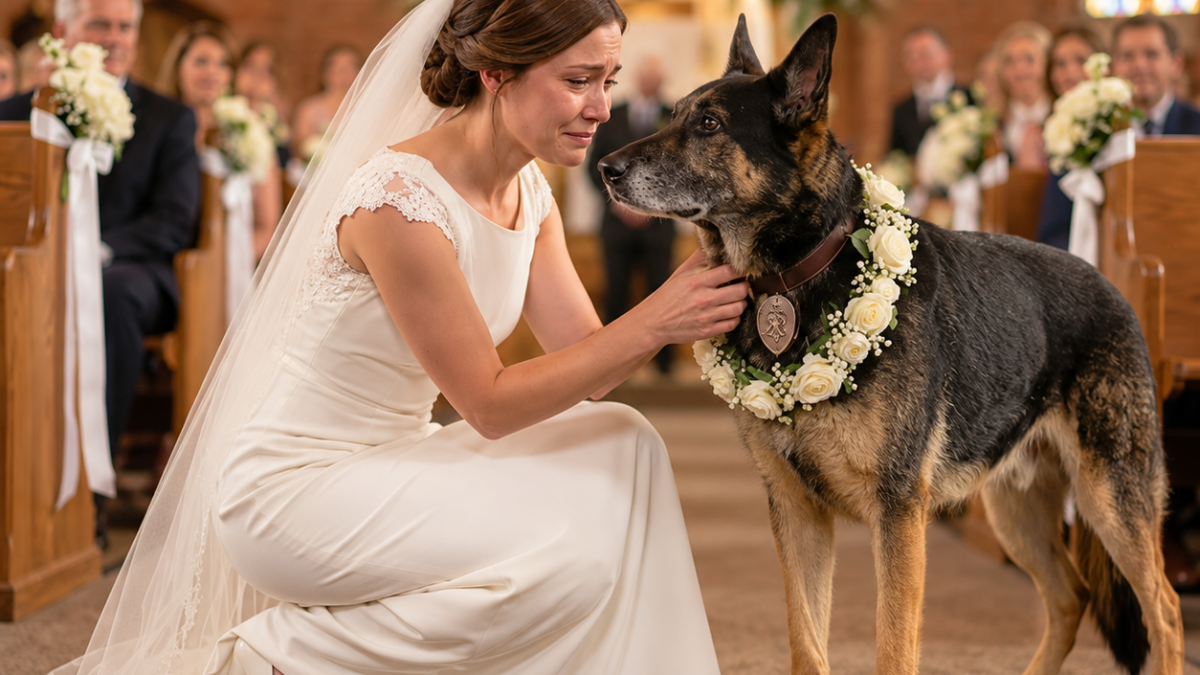
Lauren looked down at Axel. His silvered muzzle. The badge on his collar. The stiff legs still holding him upright because he thought she needed him.
“You really were supposed to do this,” she whispered.
Axel looked up at her, and for one brief, fragile second, she felt her father in the room so clearly she almost turned expecting to see him.
A bridesmaid appeared.
“They’re ready.”
The words rolled through the room like a bell.
Ready.
Guests seated. Flowers in place. Photographer waiting. Organ beginning. Trevor watching. Envelope hidden in Rebecca’s hands. Axel trembling beneath his own loyalty.
Lauren drew a careful breath.
“Okay,” she said.
The sanctuary doors opened.
Everyone rose.
The sound was soft but powerful—the rustle of more than a hundred people standing to honor her. The organ played low and warm. Sunlight passed through stained glass and spilled colors across the aisle. White flowers lined the pews. At the front, Trevor stood before the altar, hands folded, face composed.
And in the first row, an empty chair held Raymond’s photograph.
Lauren nearly stopped right there.
But Axel took one step.
Slow.
Measured.
Exactly where Raymond had taught him to walk.
Lauren matched him.
Every step down the aisle felt like walking through memory.
She remembered her father carrying her on his shoulders at the county fair. Teaching her how to check tire pressure. Sitting in the back row of the library when she gave her first reading program to a group of kindergarteners, clapping like she had won an election. She remembered his voice saying, “Never marry a man because he makes loneliness quieter. Marry him because truth feels safe in his hands.”
She had forgotten that.
Or maybe she had avoided remembering it.
Halfway down the aisle, Axel stopped.
Lauren took one more step before the leash tightened gently.
She looked down.
“Axel?”
The dog stood rigid, paws planted on the polished floor. His ears pointed toward Trevor. His eyes never left the altar.
The organ continued for several seconds before the musician faltered. The melody slowed, then died.
Whispers moved through the pews.
Lauren bent toward him, cheeks burning.
“Come on, boy.”
Axel did not move.
Trevor’s smile weakened.
“Lauren?”
“Just give me a second,” she said, though her voice came out thinner than she intended.
Axel stepped sideways.
Then he moved directly in front of her.
His aging body blocked the aisle.
Not just paused.
Blocked.
A few guests shifted. Someone near the back whispered that the dog was confused. Someone else said weddings overwhelmed animals.
Lauren’s heart pounded.
“Axel,” she said, using the clear command tone Raymond had taught her. “Move.”
Axel turned his head toward her.
There was no defiance in his eyes.
There was urgency.
And beneath it, sorrow.
As if he knew this would hurt her and had decided hurting her now was better than letting her walk forward blind.
Trevor stepped down from the altar.
“Maybe I should come to you.”
Axel’s chest expanded.
A low growl filled the aisle.
Not loud.
That made it worse.
Lauren had heard Axel bark at delivery trucks, squirrels, thunder, and once at a Halloween decoration shaped like a skeleton. This was different. This was the sound Raymond’s partners had once trusted in dark alleys and abandoned buildings.
Samuel rose from his seat.
“Trevor,” he said calmly, “stay where you are.”
Trevor looked offended. “You think I’m a threat?”
“I think Axel believes something is wrong.”
“He’s an old dog in a crowded church.”
“He was an old dog ten minutes ago,” Samuel replied. “He wasn’t doing this then.”
Trevor’s face tightened.
“Lauren, call him off.”
Call him off.
The phrase struck her sharply.
Not calm him.
Not help him.
Call him off.
As if Axel were attacking him by standing still.
Lauren crouched as much as her gown allowed and placed both hands on Axel’s shoulders. Beneath her palms, he trembled. His rear leg shook with the effort of holding position.
“Axel, please,” she whispered.
The sanctuary was so quiet now that people in the front pews could hear every word.
“I already lost Dad. Don’t make me lose this too.”
Axel looked at her.
For one heartbeat, she thought he might step aside.
Instead, he leaned his body against her knees and pushed her backward one careful step.
Gasps moved through the room.
Lauren stared at him.
He was not trying to stop the wedding because he was afraid of losing her.
He was trying to move her away from Trevor.
Trevor came down another step.
“That’s enough.”
Axel turned.
The growl deepened.
Samuel stepped into the aisle.
Rebecca moved along the side wall, still holding the envelope.
Trevor’s eyes flicked toward her, and for the first time, Lauren saw real fear in his face.
Not embarrassment.
Fear.
That fear did what nothing else had done.
It made Lauren stop defending him in her mind.
“Trevor,” she said slowly, “what is in that envelope?”
He looked at her. “I don’t know.”
Axel surged forward.
He did not attack.
He caught the edge of Trevor’s coat between his teeth and pulled.
“Let go!” Trevor snapped, grabbing at the fabric.
The movement twisted the coat open.
A small brass key slipped from the inside pocket.
It struck the church floor with a clear metallic sound.
For a moment, no one breathed.
Lauren stared at it.
She knew that key.
The worn round head. The scratch near the base. The slight bend from when Raymond had once dropped it in the driveway and accidentally backed over it with his truck.
It opened the locked wooden chest inside Raymond’s study.
The key Lauren had searched for three days earlier and assumed she had misplaced.
Her bouquet slipped in her hand.
A few white petals fell beside the key.
Trevor’s face drained of color.
Axel released the coat immediately and stepped backward until his body touched Lauren’s gown. He remained between her and Trevor, panting now, old legs shaking, eyes locked on the groom.
Lauren’s voice came out almost too quiet to hear.
“Why do you have my father’s key?”
Trevor opened his mouth.
Nothing came out.
Samuel bent, picked up the key, and held it in his palm. His expression was no longer uncertain. It was the face of a man who had just watched a loyal partner finish an investigation no human had wanted to begin.
Rebecca reached Lauren and placed the cream envelope on the edge of a pew.
“You need to see this.”
Trevor shook his head. “Not here.”
Rebecca’s eyes sharpened.
“You had the key to Raymond Prescott’s document chest in your wedding coat.”
His jaw clenched.
“This stopped being private when Axel found it.”
Lauren looked at Trevor, waiting for him to say something that would put the world back together.
Some explanation. Some emergency. Some misunderstanding.
Maybe he had taken the key to surprise her with something from her father’s chest. A letter. A photograph. Maybe Raymond had left something for her wedding day, and Trevor had been trying to give it to her.
She clung to that impossible hope for one more second.
Then Rebecca opened the envelope.
Inside were loan documents.
Property records.
Copies of Lauren’s identification.
A legal description of the Prescott house.
And an application using the property as collateral for a business loan under Langford Construction Group.
Lauren’s full name appeared beside the word owner.
At the bottom of the page was a signature meant to look like hers.
It failed.
Not because it was ugly.
Because Lauren knew her own hand.
The first letter was too sharp. The final stroke leaned wrong. The spacing was careful in the way forged things are careful, trying so hard to imitate life that they forget life is never that neat.
“That is not my signature,” she said.
Trevor took one step toward her.
Axel growled.
Trevor stopped.
Rebecca turned another page.
“These documents require deed information from your father’s chest,” she said. “And they were prepared months ago.”
Months.
The word struck Lauren harder than the key.
Not a panic.
Not one desperate mistake the night before the wedding.
Months.
Trevor’s shoulders sagged.
“My company is in trouble,” he said.
The guests remained frozen, witnesses trapped between ceremony and crime.
Trevor looked around as if realizing he would have to confess publicly or let the silence condemn him.
“Two major projects collapsed,” he continued. “A client refused final payment. Another job went over budget. I borrowed to cover payroll. Then I borrowed again. The bank wouldn’t extend more credit.”
Lauren listened, numb.
She knew pieces of this. The stress. The late calls. Trevor rubbing his forehead at the kitchen table, saying business ownership was never as glamorous as people thought. She had asked if he needed help, and he had kissed her hand and said, “Marry me. That’s all the help I need.”
She had thought it was romantic.
Now she saw the trap hidden inside the tenderness.
“You forged my name,” she said.
“I was going to tell you.”
“When?”
His eyes filled. “After the wedding.”
A soft, horrified murmur passed through the church.
Lauren’s hands went cold.
“After I was legally tied to you.”
“After you understood what was at stake.”
“My house was at stake.”
“Our future was at stake,” he said, voice cracking. “Lauren, I was trying to save what we were building.”
She looked toward the front row.
Raymond’s photograph stared back from the empty chair.
Her father had spent his life teaching her that love without truth was just control wearing perfume.
Trevor stepped closer again, careful this time not to provoke Axel.
“I know it looks terrible,” he said. “I know. But you have to understand. If the company failed, people lost jobs. Families suffered. Everything I built disappeared. I panicked.”
Rebecca’s voice cut in.
“The application is dated three months ago.”
Trevor went still.
Lauren turned back to him.
Three months ago, Trevor had asked if they could move the wedding from spring to late autumn.
Three months ago, he had started talking about refinancing the house.
Three months ago, he had begun telling her that marriage meant sharing burdens, sharing decisions, sharing everything.
“You planned this,” she whispered.
“I was trying to find another way.”
“But you didn’t.”
He said nothing.
Rebecca held up the page.
“The final approval would have required Lauren to appear in person at the bank.”
Lauren understood then.
The aisle. The vows. The kiss. The photographs. The congratulations. The exhausted drive away from the church.
Then Trevor, gentle and urgent, telling her there was one more errand.
One signature.
One document related to house repairs.
A newly married wife, still wearing white, feeling responsible for the man everyone had just watched her promise to love.
“You were going to take me there after the ceremony,” she said.
Trevor’s silence answered first.
Then he whispered, “I thought once we were married, you would listen.”
“No,” Lauren said, her voice shaking. “You thought once we were married, I would feel trapped.”
“That’s not fair.”
“Fair?” She laughed once, and the sound was broken. “You broke into my father’s study the night before our wedding. You stole his key. You copied my private documents. You forged my signature. And you stood at the altar waiting for me to promise my life to you.”
“I love you,” Trevor said.
The words fell between them like something dead.
Lauren looked at him for a long moment.
She remembered every meal he had brought after Raymond died. Every repair. Every quiet evening. Every time she had mistaken his presence for safety.
“Was any of it real?”
“All of it,” he said immediately.
But Axel shifted in front of her, and Lauren saw the truth more clearly.
Maybe Trevor had loved her in the way selfish people love what rescues them.
Maybe he had enjoyed being needed.
Maybe he had liked the gratitude in her eyes when he fixed what was broken.
Maybe he had wanted her, the house, Raymond’s legacy, the public respect of marrying a beloved officer’s daughter, and the financial escape she represented.
Maybe some part of it had felt real to him.
But he had still chosen to use her.
And love that turns a person into an exit plan is not love.
“You weren’t afraid of losing me,” Lauren said quietly. “You were afraid of losing what I could save.”
Trevor shook his head, tears spilling now.
“No.”
“It’s written on those pages.”
Axel’s legs trembled harder.
Lauren placed one hand on his back.
The old dog had disobeyed her in front of everyone. He had let her beg him. He had endured her heartbreak and confusion because stepping aside would have been easier for him but dangerous for her.
She reached up with her free hand and removed her veil.
The comb caught in her hair for a painful second before coming loose.
Lauren folded the veil over her arm and placed it on the nearest pew.
The movement was quiet.
But the entire church understood.
“This wedding is over,” she said.
Trevor’s face collapsed.
“Lauren, please.”
“No.”
“You don’t have to decide right now.”
She looked at the forged signature.
“You decided for me three months ago.”
She placed her bouquet beside the veil.
No one applauded.
No one moved.
The silence was not awkward anymore. It was reverent. The kind of silence people give a woman who has just chosen truth at the exact moment it costs her the future she wanted most.
Then a chair scraped near the back.
An older man rose from the last pew.
Lauren had noticed him earlier only vaguely as one of Trevor’s business guests. He was in his early sixties, tall and narrow, wearing a dark overcoat despite the warmth inside the church. His hair was silver, his face clean-shaven, his eyes pale and watchful.
Trevor saw him and went rigid.
“Gordon,” he whispered.
The man stepped into the aisle with calm confidence.
“Trevor,” he said. “This has become unnecessarily public.”
Rebecca stiffened.
Samuel’s hand moved slightly, old instincts waking.
The man’s gaze landed on the envelope.
“I’ll take those papers.”
Rebecca held them closer.
“No, you won’t.”
The man smiled faintly. “Detective Sloan, isn’t it? You’re not here on duty.”
“I’m still a detective.”
“Then you should know those documents concern a private financial agreement.”
“They contain a forged signature.”
“They contain collateral for a debt that remains unpaid.”
Lauren looked at Trevor.
“What is he talking about?”
Trevor’s shame had turned into fear.
Gordon answered instead.
“Your fiancé owes me a great deal of money.”
Trevor snapped, “Stop.”
Gordon ignored him.
“He made certain promises. Your property was supposed to secure his repayment. Today.”
Lauren felt Axel rise beside her again.
He had just sat, exhausted, but now he forced his old body upright. His breathing was rough. His rear legs trembled so badly Lauren almost reached to hold him back.
Gordon looked at the dog with mild contempt.
“Still playing hero?”
Something cold passed through Lauren.
“You knew about this?”
Gordon’s eyes returned to her.
“Miss Prescott, sentimental outrage will not alter financial reality. Your father’s house is valuable. Your fiancé used what he had access to.”
“My fiancé did not own it.”
“No,” Gordon said. “But he was about to have influence over the owner.”
The cruelty of that word—owner—hit Lauren like a slap.
Not bride.
Not woman.
Not daughter.
Owner.
That was all she had been to him.
A signature. A deed. A way out.
Gordon stepped toward Rebecca.
“Give me the envelope.”
Samuel moved into the aisle.
“You should sit down.”
“You should move.”
Samuel did not.
Behind him, three retired officers rose from their pews. Then two more.
The church shifted from shocked gathering to line of defense.
Gordon noticed.
For the first time, his calm expression cracked.
Trevor moved toward him, voice low and urgent.
“Leave. It’s done.”
Gordon turned on him.
“It is done when I say it is done. You embarrassed yourself because a dog pulled a key out of your pocket.”
Axel growled.
Gordon looked at him, then at Lauren.
“Raymond Prescott is dead,” he said. “There is no one left to protect you.”
The words struck her so brutally that she forgot the church, the guests, the documents.
For one second, she was back in the hospital room, holding her father’s cooling hand, feeling the universe remove the one person she had believed could stand between her and anything.
Axel moved before anyone else.
Old, trembling, exhausted Axel.
He launched forward with a speed that seemed to come not from his body but from every day Raymond had trained him, every command he had obeyed, every promise he had carried.
Gordon’s hand moved inside his coat.
Samuel shouted, “Hands!”
A small folding knife flashed.
Axel hit Gordon’s wrist before the blade could rise.
The knife flew from his hand and skidded beneath a pew.
Gordon stumbled, cursing. Axel drove into him with his shoulder, forcing him down to one knee. Samuel caught one arm. Rebecca caught the other. The retired officers surged forward, and within seconds Gordon was pinned against the aisle floor, his face twisted with fury, Rebecca snapping restraints around his wrists.
The entire confrontation lasted less than ten seconds.
But it ended the life Lauren thought she had been walking toward.
Axel stepped back.
His front legs held.
His rear legs did not.
He swayed once, then sank heavily to the floor.
“Axel!”
Lauren dropped beside him, gown spilling across the aisle. She wrapped both arms around his neck and pulled his head against her chest.
His breathing came hard and fast.
“Stay with me,” she whispered, panic tearing through her. “Please. Please, stay with me.”
Axel leaned into her.
His eyes were open.
Tired, but open.
Sirens sounded outside.
Guests began to breathe again. Some cried openly. Others stood frozen, staring at Lauren and the dog wearing Raymond’s badge.
Samuel came to her after making sure Gordon could not move.
He knelt, old knees cracking, and placed one hand on Axel’s back.
“Good boy,” he whispered, voice breaking. “Good boy, partner.”
Lauren pressed her forehead to Axel’s silver fur.
“You kept his promise,” she sobbed.
Axel’s eyes shifted.
Lauren followed his gaze.
At the front of the church, Raymond’s photograph still rested on the empty chair, framed by white flowers and morning light.
Axel looked at it for several seconds.
Then he closed his eyes and rested fully against Lauren.
Not gone.
Not yet.
Just tired.
As if after two years of guarding her grief, he had finally heard the command completed.
The weeks after the canceled wedding were quieter than people expect after public humiliation.
There were no dramatic confrontations on Lauren’s porch. No screaming matches in the street. No satisfying moment where Trevor came crawling back and she slammed the door in his face while thunder rolled overhead.
Real pain did not arrange itself like that.
It came in small, ordinary humiliations.
Returning wedding gifts.
Canceling the honeymoon reservation.
Opening the closet and seeing Trevor’s jacket still hanging there because he had left it at her house the week before.
Finding his favorite coffee mug in the dishwasher.
Deleting photographs from her phone, then retrieving them, then deleting them again.
Answering kind messages from people who wanted to help but did not know that every “Are you okay?” made her feel required to perform survival before she had actually survived.
Trevor was arrested, then released pending hearings. His company collapsed almost immediately once the truth spread. Employees Lauren had known by name lost jobs, which became another weight she had to fight not to carry. Some people blamed Trevor. Some blamed Gordon. A few, cruel or foolish enough to say it aloud, blamed Lauren for not “handling things quietly.”
She stopped going to the grocery store on Saturdays because too many people turned to look.
She took leave from the elementary school library for two weeks, then returned because the children did not look at her with pity. They simply asked why her eyes were tired, why she was wearing the same sweater as Tuesday, and whether Axel was still allowed to visit for reading day.
Axel recovered slowly.
The vet found no major injury from the church struggle, but the strain had worsened his arthritis. Lauren put rugs across every slick floor in the house. She built a low ramp beside the back porch. She moved his bed into her bedroom because he no longer managed the stairs easily.
Every night, he slept where he could see the door.
Lauren told him he didn’t have to do that anymore.
He ignored her.
The first time Samuel came after the wedding, Lauren was sitting at the kitchen table surrounded by documents Rebecca had helped her organize. Police reports. Forgery affidavits. Bank correspondence. Statements from Marilyn Voss, Trevor’s former bookkeeper, who had delivered the envelope to the church after discovering the fraud and realizing Lauren might marry before anyone warned her.
Marilyn had been terrified of Gordon Pike.
She had left town for a week, then driven back on the morning of the wedding because, in her words, “Raymond Prescott would have haunted me if I let his daughter walk into that blind.”
Lauren had cried when Rebecca told her that.
Now Samuel sat across from her with coffee neither of them drank.
“I feel stupid,” Lauren said.
Samuel looked up.
“You trusted someone who showed up when you were grieving.”
“I should have seen it.”
“Maybe.”
She flinched.
Most people rushed to say, “No, no, of course not.”
Samuel never lied to comfort her.
He continued gently. “Maybe there were things you didn’t want to see. That’s not the same as stupidity. That’s loneliness. That’s grief. That’s wanting the man bringing soup to be as kind as the soup made him look.”
Lauren stared at the table.
“I wanted a family again.”
Samuel’s face softened.
“I know.”
“I thought marrying him would make the house feel less empty.”
“And did it?”
She gave a broken laugh.
“I didn’t get that far.”
“No,” Samuel said. “But answer anyway.”
Lauren looked toward the hallway, where Axel slept with his head on his paws.
Trevor had filled rooms with activity. Repairs. Plans. Phone calls. Wedding magazines. Furniture catalogs. Ideas for turning Raymond’s study into a guest room someday.
That had upset her at the time, though she had pretended it didn’t.
“He made the house louder,” she said slowly. “Not less empty.”
Samuel nodded.
They sat in silence for a while.
Then he said, “A wedding that ends before the vows is not a failed marriage. It is a life saved in time.”
Lauren closed her eyes.
The words entered a place in her that had been locked since the church.
A life saved in time.
That night, she stood outside Raymond’s study.
The lock had been repaired. The chest sat beneath the window. The room smelled faintly of leather, paper, and the cedar blocks her father had used in drawers. His old desk still held a mug full of pens, most of them dry. A framed photo of Lauren at age nine sat beside a picture of Raymond and Axel after a police awards ceremony, both looking embarrassed by attention.
Lauren had avoided the room after the wedding because Trevor’s betrayal had touched it. He had entered the most sacred space in the house and turned her father’s papers into tools.
Now she opened the chest.
Inside were the dull but important pieces of a life: deed, birth certificates, insurance policies, tax records, old letters, military documents from Raymond’s father, her mother’s death certificate, Lauren’s adoption papers from when Raymond formally adopted her after marrying her mother.
At the bottom, beneath a folder of yellowed newspaper clippings, she found an envelope she had never seen.
For Lauren, when she needs reminding.
Her hands began to shake.
She sat on the floor before opening it.
The letter inside was in Raymond’s handwriting.
Sweetheart,
If you found this while I’m still alive, put it back and pretend you didn’t snoop. If you found it after, then I guess I don’t get to boss you around anymore, which you’ll probably enjoy.
I don’t know when you’ll need this. Maybe when you lose me. Maybe when you fall in love. Maybe when the house feels too big. Maybe when you forget who you are because somebody else sounds very sure about who they need you to be.
So here it is.
You do not owe anyone your peace because they helped you through pain.
You do not owe anyone your home because they stood beside you in grief.
You do not owe anyone your yes because they waited a long time to ask.
Love is not proven by how badly someone needs you. Sometimes need is just hunger wearing a nice shirt.
A good man will never make you smaller so his life can fit around you. He will not rush your healing, borrow your name, decide your future in rooms where you are not present, or call pressure devotion.
And if someday I’m not there to say it out loud, I hope you hear me anyway.
Take your time.
Tell the truth.
Trust the part of you that goes quiet when something is wrong.
And if Axel is still around, listen to him too. That dog has better judgment than half the men I worked with.
I love you more than any badge, any house, any old family name, any pride I ever carried.
You were never my duty.
You were my joy.
Dad
Lauren pressed the letter to her chest and sobbed until Axel dragged himself into the study and lowered his old body beside her.
She wrapped one arm around him.
“He knew,” she whispered.
Axel sighed, heavy and tired, as if Raymond knowing everything was the least surprising thing in the world.
After that, Lauren began healing differently.
Not quickly.
Not beautifully.
But truthfully.
She stopped trying to make the house look untouched. She cleaned Raymond’s study, not to erase him, but to let air back into the room. She boxed police paperwork that belonged in storage. She framed the letter and kept it on the desk where she could read one line whenever shame tried to return.
You do not owe anyone your peace because they helped you through pain.
She returned fully to the library. She let the children ask about Axel. She even brought him in one Friday afternoon for a reading circle, where he slept beside a shelf of picture books while eighteen first graders took turns reading to him in whispers.
One little boy with a missing front tooth leaned close to Lauren and asked, “Is he a hero dog?”
Lauren looked at Axel.
His badge had been retired again, replaced with a soft blue collar that did not weigh on his neck.
“Yes,” she said. “But mostly he’s family.”
Meanwhile, the investigation widened.
Gordon Pike had operated for years as a private lender to desperate business owners, wrapping predatory loans in polite contracts and social respectability. Trevor was not his only victim, but he had become one of his accomplices when fear turned into fraud. Rebecca and the department uncovered pressure tactics, hidden fees, forged guarantees, and several suspicious property transfers involving people who had trusted Gordon because he wore suits and sponsored charity auctions.
Marilyn Voss testified.
So did Trevor.
Not because he became noble, but because his attorney understood that Gordon was the larger predator and Trevor’s best chance was cooperation.
Lauren attended one preliminary hearing.
Only one.
She sat behind Rebecca and Samuel, Axel lying at her feet because the court had made special allowance for the retired K9 whose role in exposing the scheme had become local news. Trevor looked back once before the proceedings began.
His face crumpled when he saw her.
Lauren felt grief, anger, pity, and nothing at all.
All at once.
Afterward, in the courthouse hallway, Trevor approached under his attorney’s watchful eye.
“Lauren,” he said.
Samuel stiffened beside her.
Lauren raised one hand slightly, telling him not to interfere.
Trevor stopped several feet away.
He looked thinner. Older. The charm had been stripped from him, leaving a man who had mistaken desperation for permission.
“I’m sorry,” he said.
Lauren waited.
“For all of it,” he added. “For the documents. For the lies. For using your grief. I told myself I was saving us, but I think… I think I just couldn’t stand being seen as a failure.”
Lauren looked at him.
There had been a time when his tears would have pulled her toward him. She would have comforted him before deciding whether he deserved comfort. She would have softened her own pain to make space for his.
Not anymore.
“I hope you become someone who never does this to another person,” she said.
His eyes filled. “Do you forgive me?”
The old Lauren might have answered too fast.
The lonely Lauren might have said yes just to end the discomfort.
But the woman Axel had stopped in the aisle took a breath.
“No,” she said quietly. “Not today.”
Trevor nodded as if he had expected it and still hoped against it.
Lauren continued, “Maybe someday I’ll be free of carrying anger. But forgiveness is not another thing you get to ask me to give so you can feel less guilty.”
He lowered his head.
Axel stood slowly.
Not growling. Not lunging.
Just standing beside her.
Trevor stepped back.
This time, Axel did not need to block him.
Lauren walked out of the courthouse into cold sunlight with her hand resting on the old dog’s neck.
Months passed.
Winter softened into spring.
Lauren began noticing things that had nothing to do with betrayal.
The first crocuses near the porch.
The way morning light entered the kitchen earlier each day.
The sound of Axel dreaming, paws twitching faintly as if chasing something in a field his body could no longer run through.
One Saturday, Samuel came over to repair the sagging door of the old storage barn behind the house. The barn had once held Raymond’s tools, training equipment, and boxes of retired police records. Beyond it was a fenced yard, overgrown but sturdy, where Raymond had trained Axel after retirement to stay active.
Lauren stood in the doorway watching dust move through sunlight.
“This place needs work,” Samuel said.
Lauren looked at the empty space.
For the first time in a long time, emptiness looked less like loss and more like possibility.
“I’ve been thinking,” she said.
Samuel glanced at her.
“That usually means I’m about to be given a task.”
She smiled.
“You know all those retired K9s whose handlers pass away or get sick?”
His expression changed.
“And the handlers who don’t know what to do when the dog gets old?”
Samuel leaned one shoulder against the doorframe.
“Lauren.”
“I’m not saying I know how yet.”
“But you’re saying.”
She looked at Axel, who had wandered to the sunny patch near the fence and was sniffing a post with grave importance.
“After Dad died, I thought Axel was all I had left of him. But maybe he wasn’t just something Dad left for me.” Her voice trembled. “Maybe he was showing me what to do next.”
Samuel said nothing for a moment.
Then he looked around the barn and nodded.
“Your father would have pretended this was too much work.”
Lauren smiled through tears.
“Then he would have done all of it himself.”
“Exactly.”
They started small.
Two old K9s needed temporary care that summer.
Ranger, a ten-year-old Belgian Malinois whose handler had entered assisted living after a stroke.
Molly, an eleven-year-old German Shepherd recovering from surgery while her family moved into a house without stairs.
Lauren offered the barn and yard.
Samuel repaired the fence. Rebecca helped with permits. Raymond’s former colleagues donated crates, orthopedic beds, feeding stations, old training mats, and more blankets than any six dogs could reasonably need.
At first, Lauren refused to call it anything official.
“It’s just temporary,” she said.
But the dogs kept coming.
Not many. Never more than she could safely manage. But enough that the barn filled with life.
Old dogs with cloudy eyes.
Stiff hips.
Missing teeth.
Stories nobody had written down.
Handlers who came to visit and cried into their dogs’ fur.
Widows who could not bear to surrender the last living partner their husbands had loved.
Departments with tight budgets and aging K9s they wanted to honor but did not know how to support after retirement.
Axel became the quiet center of it all.
He no longer chased. No longer trained. No longer climbed stairs without help.
But he greeted every dog with the dignity of an old captain inspecting new arrivals. He showed them where the water bowls were. He claimed the best sunny spot but tolerated sharing it with Molly. He corrected Ranger with one sharp look when the younger dog got too pushy near Lauren.
And with people, Axel had a gift Lauren had not noticed before.
He recognized grief.
Not dramatically. Not magically.
He simply moved toward it.
Whenever an old officer sat alone on the porch bench pretending not to cry, Axel would rise slowly, cross the yard, and rest his head on their knee.
Whenever a widow brought her husband’s retired dog and stood frozen at the gate, Axel would stand beside Lauren until the woman stepped inside.
Whenever Lauren herself sat in the barn after everyone left, overwhelmed by the strange ache of building something beautiful from the wreckage of a wedding day, Axel would lie down beside her, close enough that she could feel him breathing.
The Raymond Prescott K9 Legacy House became official the following year.
Samuel made the sign by hand.
Lauren cried when he installed it above the barn doors.
Not because it hurt.
Because it didn’t.
For the first time, her father’s name did not feel like something trapped in the past.
It felt like a light left on for others.
The town came around slowly.
Some people had always been kind. Others had been curious first, compassionate later. A few who had whispered after the canceled wedding arrived months afterward with donations and awkward apologies hidden inside bags of dog food.
Lauren accepted the dog food.
The apologies took longer.
She learned that healing did not require pretending people had not hurt her. It required deciding which hurts deserved access to her future.
On the one-year anniversary of the wedding that never happened, Lauren did not stay in bed.
She woke early, made coffee, and took Axel outside.
The maple tree beside the porch had turned gold. Frost silvered the grass. The barn lights glowed warmly in the dim morning. Inside, four retired K9s slept on thick beds while Molly snored loudly enough to challenge machinery.
Lauren wore a cream-colored dress—not bridal, not formal, just soft and simple because she had decided the day would not own white forever.
By noon, friends arrived.
Not for a memorial.
Not for a pity gathering.
For the first open house at the Legacy House.
There were casseroles, coffee, old photographs, children reading to retired dogs, former officers telling stories that grew slightly more heroic with every retelling, and Samuel pretending not to cry when Rebecca unveiled a framed photo of Raymond and Axel beside the barn entrance.
Lauren stood beneath the sign watching people move through the yard.
For years, she had thought family was something she had lost.
Then something she had almost married into.
Now she saw it everywhere.
In Samuel tightening a loose gate latch without being asked.
In Rebecca teaching a shy child how to let an old dog smell her hand first.
In Marilyn Voss, who had come quietly and left an envelope containing a donation and a note: For the man who taught us truth still matters.
In the retired officers who touched Raymond’s photograph as they passed.
In Axel lying near the gate, silver muzzle resting on his paws, eyes steady.
Near the end of the afternoon, a small car stopped outside the fence.
An elderly woman stepped out holding the leash of an aging black Labrador.
The woman hesitated at the gate.
Lauren walked over.
“Hi,” she said gently.
The woman’s eyes were red. “My name is Eleanor Whitman. This is Duke. My husband handled him for eight years.”
Duke stood close to her leg, gray around the face, body thick with age.
“My husband died in February,” Eleanor continued. “I don’t want to give Duke up. I promised I wouldn’t. But he’s getting hard for me to lift, and I fell last week trying to help him into the car.” Her voice broke with shame. “Someone told me you might… know what to do.”
Lauren looked at Duke.
Then at Eleanor.
She remembered standing in her father’s study, believing needing help meant failing someone you loved.
“You are not giving him up,” Lauren said. “You are letting more people help you keep your promise.”
Eleanor’s face crumpled.
Lauren opened the gate.
Axel rose beside her.
His rear legs shook, and for a second Lauren almost told him to stay. But he gathered himself, stepped forward, and walked slowly to Duke.
The two old dogs smelled each other.
Duke wagged once.
Axel looked at Eleanor, then turned and walked back through the gate as if to say, Come on then.
Lauren laughed through tears.
Eleanor entered.
So did Duke.
And as Lauren watched them cross into the yard, she understood something so simple it felt holy.
One year earlier, Axel had blocked her path because danger waited ahead.
Now he walked beside her because healing did.
He no longer needed to stand between her and a false future. He had helped her survive long enough to build a real one.
That evening, after everyone left, Lauren sat on the porch steps with Axel’s head in her lap.
The sky turned lavender over Walla Walla. The barn glowed behind them. Somewhere inside, Ranger barked once in his sleep. Samuel’s truck disappeared down the road. The house behind Lauren was no longer silent in the same way. It held memory, yes. But not only memory.
It held purpose.
Lauren stroked Axel’s ears.
“You know,” she whispered, “I thought Dad left you behind so I wouldn’t be alone.”
Axel sighed.
“But maybe he left me with you so I’d learn how to stand again.”
The old dog opened one eye.
Lauren smiled.
“I know. Too sentimental.”
His eye closed.
She looked toward the barn sign, Raymond’s name carved into the wood.
For so long, she had thought the wedding day was the day she lost everything all over again. Her fiancé. Her future. Her dignity in front of half the town. The illusion that grief had finally delivered her safely into love.
But that was not the truth.
The truth was that she had been saved before the vows.
Saved from a marriage built on forged signatures and borrowed tenderness.
Saved from handing her father’s home to a man who saw her loneliness as leverage.
Saved by an old dog with aching legs, a silver muzzle, and a promise he had carried longer than anyone understood.
Lauren looked down at Axel.
“You kept your promise,” she whispered.
This time, the words did not break her.
They healed something.
Axel rested his paw on the hem of her dress.
Not the wedding gown.
That gown was packed away now, not as a shrine to humiliation but as proof that she had walked away before the vows became chains.
This was just a simple cream dress with dog hair on the skirt and dust at the hem.
It was better.
Inside the house, Raymond’s letter sat framed on the desk.
In the barn, old dogs slept safely.
At the gate, Eleanor had left a small bouquet of wildflowers with a note that said, Thank you for helping us keep loving him.
And beside Lauren, Axel breathed slowly, each breath a reminder that love did not always arrive as romance, did not always stand at an altar, did not always say the right words in front of witnesses.
Sometimes love had tired paws.
Sometimes love wore an old badge.
Sometimes love growled in the aisle when everyone else was smiling.
Sometimes love broke your heart for a moment so your life could be spared.
Lauren tilted her face toward the darkening sky.
For the first time in two years, she did not speak to her father because she felt lost.
She spoke because she felt found.
“You were right, Dad,” she whispered. “He knew where to stand.”
Axel’s tail moved once against the porch step.
Slow.
Gentle.
Certain.
And Lauren Prescott, who had once believed family was something death had taken and betrayal had almost stolen, finally understood that the truest promises do not end when a heartbeat does.
They stay.
They guard.
They wait at the door, walk beside you when your knees shake, block the aisle when danger smiles like love, and lead you—one trembling, faithful step at a time—toward the life you were meant to build after the one you thought you wanted falls apart.








