The house next door had been vacant for more than a month when a faint, desperate cry coming from its basement window woke me at 2 a.m.
The house next door had been vacant for more than a month when a faint, desperate cry coming from its basement window woke me at 2 a.m.
The house next door had been empty for six weeks when a faint cry from its basement woke me at two in the morning, and for several terrifying seconds I was convinced someone had abandoned a baby inside.
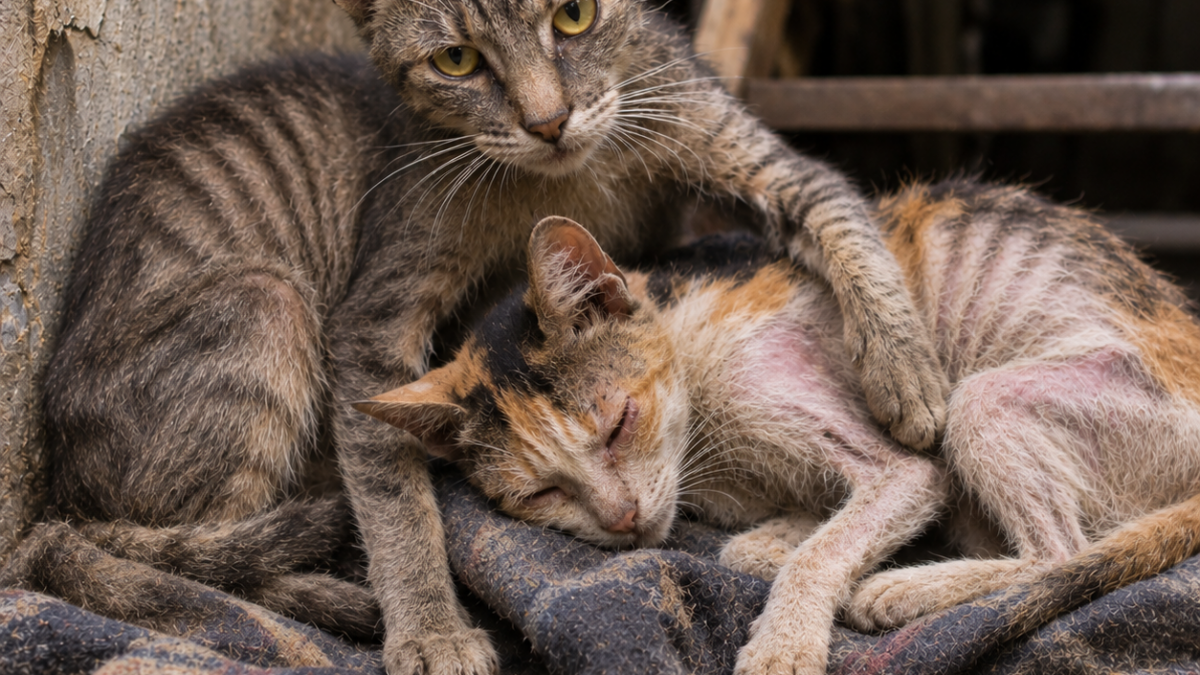
What I found instead were two starving cats trapped behind a dirty window—a gray male still strong enough to reach the food and a dying calico who could no longer stand—and then I watched him push the first meal he’d seen in days toward her without taking a single bite himself.
Three weeks later, a rescue group called to tell me wonderful families wanted to adopt them separately, but when I looked across my living room and saw Ben washing Jacky’s scarred ear while she slept with one paw pressed against his chest, I realized those two cats had already survived one abandonment together—and I wasn’t going to make them survive another.
I woke at 2:07 in the morning because I thought I heard a baby crying.
Not screaming.
That would have been easier.
A scream tells you where the emergency is.
This sound was barely there.
Thin.
Broken.
Almost swallowed by the hum of the box fan beside my bed.
I opened my eyes and stared at the ceiling.
For several seconds I wasn’t even sure I’d heard anything.
My house was quiet.
The refrigerator hummed downstairs.
A car passed somewhere beyond the end of the street.
The maple branches outside my bedroom window scraped lightly against the siding.
I closed my eyes again.
Then it came a second time.
A tiny, desperate cry.
I sat upright.
My heart started pounding before my mind caught up.
I live in a small neighborhood just outside Columbus, Ohio.
Nothing especially dramatic happens there.
People mow their lawns.
Wave from driveways.
Complain about property taxes.
Borrow snow shovels and forget to return them until spring.
Most of us know one another’s names, but not necessarily one another’s lives.
The house beside mine had been vacant for more than a month.
The Morrison family had lived there for about three years.
At least, I thought their name was Morrison.
We weren’t close.
We exchanged waves.
A few conversations near the mailbox.
Once I helped the husband carry a broken patio table to the curb.
Then something changed.
PART2:
A moving truck appeared on a Wednesday.
Boxes.
Mattresses.
Plastic storage bins.
The old couch dragged to the curb.
They were gone by Friday.
A notice appeared on the front door several days later.
PROPERTY SECURED.
AUTHORIZED PERSONNEL ONLY.
I assumed foreclosure.
Maybe repossession.
Maybe eviction.
I didn’t ask.
It wasn’t my business.
For six weeks, nobody entered except a man who mowed the front lawn once.
Then even that stopped.
Grass grew.
Mail filled the box.
Curtains remained shut.
The place became one of those empty houses that slowly disappears from your awareness even though you see it every day.
Until that night.
PART3:
I turned off the fan.
Listened.
Silence.
Then:
“Mrrraow.”
So faint I almost imagined it.
I exhaled.
Not a baby.
A cat.
Then scratching.
Slow.
Scratch.
Pause.
Scratch.
I got out of bed.
Put on sweatpants and shoes.
Grabbed my phone and flashlight.
The reasonable thing would have been to wait until morning.
The reasonable thing would also have been to stay inside because it was two in the morning and there was an abandoned house next door.
But once you hear something asking for help, sleep becomes difficult.
I stepped outside.
The October air was cold.
My porch light threw a pale circle across the yard.
The vacant house stood completely dark.
No vehicle.
No movement.
I stayed on my property.
Walked along the narrow strip between our houses.
The sound came again.
Closer now.
Basement.
There were three small basement windows near ground level.
The first showed nothing.
The second was covered by an old blind.
The third had dusty glass but no curtain.
I crouched.
Shined the flashlight.
Two yellow eyes appeared.
I nearly fell backward.
The eyes belonged to a gray cat standing on the inside window ledge.
He was so thin the bones around his shoulders seemed too large for the rest of him.
His fur looked greasy and dull.
One ear had a tiny tear.
His face was narrow from starvation.
But his eyes were bright.
Alert.
Fixed on me.
“Hey.”
My breath fogged the glass.
“Where did you come from?”
He opened his mouth.
That awful cry came out again.
Then he looked behind him.
I moved the light.
That was when I saw the second cat.
Calico.
Mostly white with orange and black patches.
She was lying on what looked like an old blue sweatshirt near the wall.
She didn’t rise.
Didn’t even fully lift her head.
Her body was curled tightly.
Too tightly.
Ribs visible.
Hip bones prominent.
An empty water bowl sat perhaps two feet away.
And on the opposite side of the basement—
a torn bag of dry cat food.
Food had spilled onto the floor.
Not much.
Maybe a handful.
But it might as well have been across an ocean.
A closed interior door or some barrier separated the cats from it.
I couldn’t make out exactly how.
The gray cat followed my flashlight.
Then looked back at the calico.
“Oh my God.”
I stood.
Looked at the house.
Front door locked.
Back door locked.
Notice still taped to the front.
I called the non-emergency police number.
Explained.
The dispatcher told me they could send an officer to verify but couldn’t authorize entry into a secured vacant property unless there was an immediate public-safety issue.
Animal services would be appropriate.
At 2:34 in the morning, their emergency line went to voicemail.
I left a message.
Then went back to the window.
The gray cat was still there.
I crouched.
“I’m trying.”
He stared.
“I know that’s not useful.”
He meowed.
The calico didn’t move.
I stayed almost forty minutes.
Eventually I returned home because there was literally nothing else I could legally do in the dark.
I didn’t sleep.
At 7:02 a.m., I called animal services again.
A woman answered.
Her name was Melissa.
She sounded exhausted before I finished my first sentence.
“I have two cats trapped in the basement of the vacant house next door.”
“Are you the property owner?”
“No.”
“Can you access the house?”
“No.”
“Are the animals visibly injured?”
“Starving.”
Pause.
“One might be dying.”
Her tone changed.
She took the address.
My number.
Property information.
Then gave me a case number.
I asked:
“When can someone come?”
She hesitated.
“We’re dealing with multiple abandonment calls right now.”
“Today?”
“I can’t promise.”
“Tomorrow?”
“I can’t promise.”
My hand tightened around the phone.
“How long?”
“Possibly several days.”
“Several days?”
“I know.”
She sounded genuinely miserable.
“We have two officers covering this entire section today.”
I looked through my kitchen window toward the basement.
“One cat can barely raise her head.”
“I understand.”
“No, I don’t think you do.”
Then I regretted saying it.
Because she did understand.
She was just the person receiving emergencies faster than her department could answer them.
She lowered her voice.
“I’ve marked it urgent.”
“What do I do until then?”
“Do not enter the property.”
“Can I feed them through the window?”
“If you can do it without trespassing or damaging anything, I can’t tell you not to provide water.”
That was enough.
I hung up.
Called three rescue organizations.
Two went to voicemail.
One woman answered while apparently driving.
She said every foster home was full but promised to post the situation in a volunteer group.
Then I called the property-management number printed on the foreclosure notice.
Automated system.
I entered the property ID.
Waited.
Finally left a message.
Then I called Greenfield Animal Hospital, about ten minutes away.
Receptionist listened.
“Can you bring the cats here?”
“I can’t get into the house.”
“Then we can’t examine them.”
“I know.”
She paused.
“I’ll tell Dr. Lane.”
At 11:46, someone knocked on my front door.
Ruth Mercer stood there.
Ruth lived across the street.
Seventy-four.
Widowed.
Retired elementary school librarian.
The kind of woman who kept her garbage cans cleaner than most people’s kitchens.
She didn’t gossip.
Didn’t linger.
Didn’t become involved unnecessarily.
She was holding a small bag of cat food.
“I heard them.”
That was all she said.
“When?”
“Last night.”
“Why didn’t you call me?”
“I saw your flashlight.”
Apparently the entire neighborhood knew more than I thought.
Ruth lifted the bag.
“I thought this might help.”
We went outside.
In daylight, we could see the basement better.
The window had a narrow ventilation opening beside it.
Old metal frame.
No screen on one corner.
Maybe two inches of space.
Enough.
We found a shallow plastic lid.
Filled it with water.
Taped it to a yardstick.
Slowly slid it through the gap.
The gray cat came immediately.
I expected him to drink.
Instead he sniffed.
Looked at us.
Then turned.
He walked toward the calico.
Touched her with his nose.
She lifted her head.
Only then did he return to the water.
He drank.
Two laps.
Stopped.
Went back to her.
Nudged her.
She crawled.
Slowly.
Toward the dish.
Ruth whispered:
“Look at him.”
We prepared wet food.
Same method.
A paper plate balanced carefully.
The gray cat approached.
He hadn’t eaten properly in God knew how long.
He lowered his nose.
I saw his mouth open.
Then he looked over his shoulder.
The calico remained lying down.
The gray cat placed one paw against the edge of the plate.
Pushed.
It moved an inch.
He pushed again.
Toward her.
I stared.
“No.”
Another push.
The calico finally dragged herself closer.
She ate.
The gray cat sat beside her.
Watching.
Not eating.
Ruth put one hand over her mouth.
Then turned away.
I called him Ben.
I don’t know why.
Maybe he looked like a Ben.
Maybe naming him made him less like “the starving cat trapped next door.”
The calico became Jacky.
Ruth spelled it with a y.
I asked why.
“She looks like a Jacky with a y.”
I didn’t argue.
That afternoon we returned.
More water.
Food.
Ben ate only after Jacky stopped.
Same that evening.
Same the following morning.
Every time.
Jacky first.
Ben second.
He wasn’t simply letting her approach first.
He brought the food to her.
On the second day, we managed to roll an old towel through the ventilation gap.
Ben investigated it.
Then pulled it toward Jacky with his teeth.
Ruth watched.
“That little gentleman.”
“He’s starving too.”
“I know.”
“Why doesn’t he eat?”
Ruth looked through the glass.
“Because she needs it more.”
I wanted to say animals didn’t think like that.
That we were assigning human motives.
Then Ben moved the wet food plate toward Jacky again.
I kept my mouth shut.
Neighbors started noticing us.
A man two houses down brought canned cat food.
Someone left bottled water on my porch.
A teenage girl named Emily appeared with disposable bowls.
She whispered through the window to Ben for twenty minutes.
He eventually sat directly opposite her.
By the third morning, Jacky didn’t come to the food.
Ben screamed.
That is the only word I have.
He stood on the basement window ledge and cried so loudly I heard him from my kitchen.
I ran outside.
Jacky was lying on her side.
Ben kept going from her to the window.
Back to her.
Window.
Her.
He pawed at the glass.
I called Greenfield Animal Hospital.
“I need Dr. Lane.”
“He’s in appointments.”
“Tell him it’s the cats in the basement.”
Two minutes later, Dr. Samuel Lane came on.
I explained.
He asked:
“Is the calico responsive?”
“Barely.”
“Breathing?”
“Yes.”
“Gums?”
“I can’t reach her.”
“Can you see breathing effort?”
“Slow.”
Pause.
“I’m coming after my noon appointments.”
“Dr. Lane—”
“I’ll move what I can.”
He arrived at 2:17 in an old dark-green Subaru.
Sixty-two.
Silver hair.
Wire-frame glasses.
He wore a brown jacket over scrubs.
He crouched at the window.
Watched for less than a minute.
Then stood.
“We can’t wait.”
He called animal services himself.
Veterinarian calling changed things.
He called the property manager.
No answer.
Then again.
Finally reached somebody.
There followed forty minutes of phone calls.
Property company.
Local representative.
Animal services.
Police verification.
Legal authorization.
At 5:08 p.m., a property manager named Dennis arrived carrying keys.
Animal services arrived twelve minutes later.
Melissa was one of the officers.
The same woman I’d spoken to.
She looked at me.
“I’m sorry it took this long.”
I felt embarrassed for being angry earlier.
“No. I’m sorry.”
She shook her head.
“You were supposed to be angry.”
Then she looked at the house.
“Let’s get them.”
Dennis unlocked the front door.
The smell hit immediately.
Stale air.
Mildew.
Dust.
Something rotten.
The electricity had been shut off.
We weren’t allowed inside.
Dr. Lane went with Melissa and another officer.
Ruth and I waited outside.
I heard movement.
Then:
“Got one.”
A carrier came through the door.
Jacky.
She lay on a blanket.
Eyes half open.
Barely moving.
Then we heard something downstairs.
A terrible scream.
Ben.
Melissa appeared carrying a second carrier.
Inside, Ben threw himself against one side.
Not trying to attack.
Trying to get past her.
“He’s panicking.”
Dr. Lane came out behind.
“Put them together.”
Melissa placed the carriers side by side.
Ben immediately pressed against the bars nearest Jacky.
Jacky moved.
Slowly.
One paw reached through.
Ben shoved his face against it.
Silence.
Complete.
Ruth began crying.
So did I.
I sat down on the curb.
My legs literally stopped working.
Nobody laughed.
Dr. Lane crouched beside the carriers.
“Come on, kids.”
He looked at me.
“We’re going.”
At the clinic, the truth was worse than we thought.
Jacky weighed five pounds, four ounces.
She should have been around nine.
Ben weighed seven pounds.
He should have been eleven or twelve.
Both dehydrated.
Both anemic.
Jacky’s liver values were concerning.
Her blood sugar dangerously low.
She had pressure sores along one hip from lying in the same place.
Ben’s paw pads were torn.
Two nails broken.
Likely from scratching at doors.
He had also lost more muscle than appeared obvious beneath his gray coat.
Dr. Lane examined him.
Then looked at the food records we had kept.
Ruth had actually written them down.
Of course she had.
“Jacky ate approximately this much?”
“Yes.”
“Ben?”
“Maybe half.”
Dr. Lane looked at him.
Then Jacky.
“He kept her alive.”
I swallowed.
“Can you actually know that?”
“No.”
He was careful.
“We can’t know what happened every day.”
He looked at Jacky’s condition.
“But based on their weights and the way you’ve seen him behave, I think she had access to food she would not have reached without him.”
“How?”
“We found several empty food packets near where she was lying.”
Melissa had photographs.
Ben apparently tore into whatever he could find.
Dragged wrappers.
Pieces of bag.
A container.
Even a loaf of stale bread left in a lower cabinet.
Somehow he’d moved food toward Jacky’s corner.
There were scratch marks everywhere.
Basement door.
Window frame.
Cabinet.
He had tried every exit.
Dr. Lane said:
“If you hadn’t heard him…”
He didn’t finish.
He didn’t need to.
“How long for Jacky?”
“Without intervention?”
I nodded.
“Maybe another day.”
Ruth turned away.
“Ben?”
“Longer.”
Pause.
“But not much.”
The clinic hospitalized both.
Separate kennels initially.
That lasted eight minutes.
Ben screamed.
Jacky’s heart rate climbed.
Dr. Lane stared at them.
Then:
“Fine.”
They moved them into the largest recovery enclosure together.
Ben walked directly to Jacky.
Circled once.
Collapsed beside her.
Jacky put her tail over one of his paws.
Both slept.
No crying.
I stayed until almost midnight.
Ruth stayed until nine.
She claimed she needed to go home because she’d left a lamp on.
I suspected she simply didn’t want anyone to see how much she was crying.
Dr. Lane told me something before I left.
“People think bonded animals are cute.”
He looked through the kennel door.
“Sometimes it’s more serious than that.”
“What do you mean?”
“Sometimes another animal becomes the thing that tells them the world is still safe.”
I looked at Ben.
“So if they were separated…”
“I wouldn’t recommend it.”
That sentence would matter later.
The property investigation was simpler than I expected.
The former owners had left during foreclosure.
Records showed two cats listed on an old veterinary invoice.
Benjamin.
Jacqueline.
Ben and Jacky.
Our names had been accidentally close.
The realization made my stomach twist.
They already had names.
A history.
People.
Animal services tried contacting the former owners.
Disconnected numbers.
Mail returned.
Eventually they reached a relative.
What happened was complicated.
There had been a job loss.
Debt.
Separation.
Foreclosure.
The family apparently believed someone else had taken the cats.
One spouse thought the other had arranged placement.
The other claimed a relative was supposed to pick them up.
Nobody did.
The cats remained inside.
For six weeks.
I wanted somebody obvious to hate.
I really did.
Anger is easier when it has an address.
But the facts seemed less cinematic.
A family collapsed.
People stopped speaking clearly.
Everyone assumed somebody else had handled the animals.
Then doors locked.
A property company secured the house.
No one knew two cats were still in the basement.
That didn’t excuse it.
It didn’t make the suffering smaller.
But it changed what I carried.
Neglect does not always begin with someone deciding to be cruel.
Sometimes it begins with one person saying:
“I thought you did it.”
And another answering:
“I thought you did.”
Ben and Jacky paid for that misunderstanding with six weeks of hunger.
The former owners surrendered them legally.
No one contested custody.
I visited every day.
The first week was difficult.
Jacky didn’t want to eat.
Ben did.
But he still waited.
The clinic placed two bowls side by side.
Ben sniffed his.
Then looked at Jacky.
If she didn’t approach, neither did he.
Dr. Lane finally said:
“Put her bowl down first.”
We did.
Jacky ate.
Ben watched.
Then ate.
Every single meal.
Jacky first.
Ben second.
On day six, Jacky stood unassisted for almost thirty seconds.
I clapped.
She looked offended.
Ben walked under her chin and rubbed against her.
She collapsed against him.
He didn’t move.
On day ten, he started grooming her.
Mostly the ears.
Jacky closed her eyes.
Dr. Lane watched from the doorway.
“He wasn’t just feeding her.”
“What?”
“Look.”
Jacky had begun gaining weight.
She could walk.
There was plenty of room in the kennel.
Yet she slept pressed against Ben.
Always touching.
Tail.
Back.
Paw.
Something.
When a technician removed Ben briefly for bloodwork, Jacky became frantic.
Pacing.
Calling.
She refused food.
Ben returned.
She settled instantly.
Dr. Lane said:
“They are profoundly bonded.”
I asked:
“Because of the basement?”
“Maybe before.”
“Can trauma make it stronger?”
“Absolutely.”
He looked at them.
“They went through prolonged deprivation together. We don’t know what their relationship was beforehand.”
Then Ben licked Jacky’s ear.
“I suspect close.”
Three weeks after rescue, Dr. Lane cleared them to leave the hospital.
Not adoptable yet.
Foster.
The rescue coordinator asked:
“Could you take them temporarily?”
I said:
“How temporary?”
“Two weeks maybe.”
“That’s all?”
“Maybe three.”
Ruth stood beside me.
She made a sound.
I looked at her.
“What?”
“Nothing.”
“You have an opinion.”
“Always.”
“Say it.”
She looked at Ben and Jacky.
Then me.
“Buy litter.”
That was how they entered my house.
Temporary.
I told myself that repeatedly.
I bought two inexpensive bowls.
A small litter box.
Basic cat bed.
Cheap scratching post.
That seemed reasonable.
By day four, the bowls had been replaced with ceramic ones because Ben kept pushing the lightweight bowl toward Jacky.
The small litter box became two larger boxes.
The cat bed became three.
The cheap scratching post somehow transformed into a six-foot cat tree ordered online at midnight.
I had become exactly the person I used to make fun of.
Ruth came over.
Looked at the cat tree.
“Temporary?”
“Don’t.”
She smiled.
The first evening was quiet.
Ben explored first.
Of course.
Every room.
Every doorway.
Behind furniture.
Under table.
Windows.
Then he returned to Jacky.
Only after that did he relax.
Jacky stayed near the living-room couch.
She watched me constantly.
Didn’t run.
Didn’t approach.
Just watched.
I sat on the couch.
Television off.
Didn’t want noise.
Ben jumped up.
My entire body stiffened.
He sniffed my knee.
Turned in a circle.
Then lowered his head onto my leg.
I stopped breathing.
Jacky climbed up next.
She curled against Ben.
Tail touching his back.
I stayed like that for more than an hour.
My foot went numb.
I refused to move.
There are inconveniences that feel like privilege.
That was one.
My home had been quiet for years.
I had divorced eight years earlier.
No children.
I worked.
Came home.
Read.
Watched television.
Went to bed.
I had convinced myself I liked silence.
Then suddenly there were paws running across the hallway at three in the morning.
A bowl scraping across the kitchen.
Ben yelling because the bathroom door had been closed for approximately twelve seconds.
Jacky sitting on my clean laundry as though she’d paid the mortgage.
My house became ridiculous.
And alive.
They improved.
Jacky’s coat became shiny.
Weight returned.
Ben’s face softened as muscle filled in.
His constant vigilance faded.
At first, every time I opened the front door, he ran to Jacky.
Every time.
Door opens.
Find Jacky.
Confirm.
Then investigate.
After a month, sometimes he stayed on the couch.
That tiny change made me happier than it should have.
He was learning that doors didn’t always mean disappearance.
Jacky’s behavior changed too.
The first week, she wouldn’t sleep unless Ben was touching her.
If he moved, she woke.
Followed.
By the fourth week, she occasionally slept alone on the windowsill.
Not long.
Ten minutes.
Then twenty.
The first time Ben was in the kitchen while Jacky slept in another room, I texted Dr. Lane a photograph.
His response:
THIS IS WHAT RECOVERY LOOKS LIKE.
Not forgetting.
Not separating.
Being able to trust that the other one still exists even when they can’t see each other.
I thought about that for days.
Then the rescue called.
I was at work.
“Nancy?”
“Yes.”
“We have good news.”
The phrase immediately made me nervous.
“A family has been approved for Jacky.”
I stopped cleaning the examination table.
“Oh.”
“Really wonderful family.”
“Okay.”
“Quiet household. Older couple. Excellent references.”
I looked through the glass door.
Ben and Jacky were at home.
The coordinator continued:
“And another applicant is very interested in Ben.”
My stomach dropped.
“Different family?”
“Yes.”
“Separate?”
Pause.
“We don’t normally require bonded placement unless it’s documented medically.”
I said nothing.
“Both homes are excellent.”
“I’m sure.”
“We know you’re fostering, so we wanted to let you know before scheduling meet-and-greets.”
I stared at the mop bucket.
“When?”
“Possibly this weekend.”
I don’t remember the rest of the conversation clearly.
I drove home thinking:
This is what fostering means.
You save them.
You let them go.
That’s the point.
I had known that.
The rescue had been clear.
Temporary.
I opened the front door.
No cats in sight.
Then I heard movement.
Living room.
Jacky lay across the couch.
Ben sat beside her.
He was grooming the back of her head.
Slowly.
Carefully.
Jacky’s eyes were closed.
One paw rested across Ben’s chest.
I stood there holding my keys.
Ben looked at me.
Then returned to washing Jacky’s ear.
I imagined someone carrying one away.
The carrier shutting.
The door closing.
Ben searching every room.
Jacky calling.
Maybe they’d adjust.
Cats are resilient.
Maybe they’d be fine.
The potential adopters were probably wonderful.
That wasn’t the question.
The question was:
Why should they have to be resilient again?
They had already done that.
Six weeks underground.
No water except what they found.
No reliable food.
No human voice.
Locked door.
Dark basement.
Ben tearing open whatever he could.
Dragging food toward Jacky.
Giving her the first bites.
Sleeping beside her.
Calling through a window until someone heard him.
Then rescue.
Hospital.
Recovery.
Every frightening new place survived because the other one remained.
I called the coordinator.
She answered.
“Hi, Nancy.”
“No.”
Pause.
“Sorry?”
“I don’t think they’re available.”
Another pause.
Then she laughed softly.
“Are you adopting them?”
I looked at the couch.
Ben had stopped grooming Jacky.
Both were watching me.
“Yes.”
“Both?”
“Both.”
“I thought so.”
“You did?”
“Ruth called us two weeks ago.”
I stared.
“What?”
“She asked what paperwork you’d need when you finally stopped lying to yourself.”
I closed my eyes.
“Of course she did.”
The coordinator laughed.
“I’ll send the forms.”
I hung up.
Walked across the room.
Sat beside them.
Ben stepped onto my lap.
Jacky stayed against him.
I whispered:
“Apparently you live here.”
Ben purred.
Jacky yawned.
No gratitude.
Typical.
The adoption became official twelve days later.
Ruth attended the signing as if it were a wedding.
She brought a small gift bag.
Inside were two engraved tags.
BEN.
JACKY.
On the back:
HOME.
I cried.
Ruth pretended not to notice.
For the first year, certain things remained.
Ben never began a meal before Jacky.
Never.
We eventually stopped trying to change him.
Food went down.
Jacky took a bite.
Then Ben ate.
That was their rule.
Jacky still slept touching him most nights.
Sometimes only one paw.
Sometimes tail.
Sometimes their backs pressed together.
During thunderstorms, Ben positioned himself between Jacky and the nearest window.
When strangers visited, he inspected them first.
Jacky waited.
If Ben relaxed, Jacky emerged.
He remained her advance team.
She remained his reason for checking.
Then something unexpected happened.
Jacky began protecting Ben too.
He developed a dental infection about eighteen months after adoption.
Had to spend one day at Dr. Lane’s clinic.
When I brought him home, groggy from anesthesia, Jacky ran toward him.
Sniffed him.
Then hissed at me.
Me.
The person feeding her for eighteen months.
Dr. Lane had warned me he would smell unfamiliar after the clinic.
Jacky apparently concluded I had returned an impostor.
She stayed beside Ben for six hours.
Didn’t leave.
Wouldn’t eat.
That evening, as the clinic smell faded, she finally began grooming him.
Ben looked exhausted.
I said:
“How does it feel?”
He stared.
“Yeah.”
I smiled.
“Now you know.”
Life became ordinary.
The best possible ending.
Ben gained weight.
Too much.
Dr. Lane eventually said:
“We’ve moved from starvation recovery to portion control.”
Ben considered this betrayal.
Jacky became obsessed with sunbeams.
Every afternoon she followed them across the living-room floor.
Ben loved cardboard boxes.
That felt cruelly ironic at first.
Then I realized boxes didn’t mean the same thing to him anymore.
Now boxes meant deliveries.
Warm house.
Something new to sit in.
Maybe reclaiming something ordinary is its own kind of victory.
He climbed into every package before I had finished removing the contents.
I once received a pair of boots and spent twenty minutes searching for one because Ben was sleeping on it inside the box.
Jacky watched from the couch.
Completely unhelpful.
Ruth visited often.
Ben adored her.
Jacky tolerated her.
Ruth always brought treats despite my repeated requests not to.
“They were starving.”
“Three years ago.”
“They remember.”
“Ben weighs fourteen pounds.”
“He carries it well.”
One afternoon, Ruth sat in my living room watching them.
She said:
“Funny.”
“What?”
“The house.”
“What about it?”
“It sounds different now.”
I knew immediately.
Before Ben and Jacky, my house had been silent.
Not peaceful.
Silent.
I’d confused the two.
Now there were paws.
Purring.
Bowls.
Occasional crashes.
A cat yelling from the hallway because a closet had been closed.
Life makes noise.
That is different from chaos.
Years passed.
The vacant house next door was eventually renovated.
A young couple bought it.
Painted the shutters.
Replaced windows.
Planted hydrangeas.
Their first summer there, the husband asked:
“Did anything interesting happen with the previous place?”
I looked toward the basement window.
The old glass was gone.
New bright window.
Finished basement now.
I said:
“Two cats lived there.”
He smiled.
“Oh?”
I didn’t tell the whole story.
Not then.
Some stories feel too heavy to hand someone casually over a fence.
But I looked at that basement every day.
Sometimes I still saw Ben’s yellow eyes behind the glass.
Waiting.
One January, Ruth fell.
Ice.
Broken hip.
She went to rehabilitation for six weeks.
I visited.
On the third visit, she said:
“How are the cats?”
“Fine.”
“That’s not enough information.”
I showed photographs.
Jacky asleep on Ben.
Ben upside down on the couch.
Ruth smiled.
“Good.”
Then she became quiet.
“What?”
“Nothing.”
“Ruth.”
She looked toward the window.
“Funny how easy it is to become the person everyone decides is okay because you’re technically being cared for.”
I understood.
Rehab staff were good.
She wasn’t complaining.
She was lonely.
So I started visiting more.
I brought books.
Soup.
And eventually, after permission, Ben.
He hated the carrier.
Ruth loved the visit.
Ben sat on her blanket and purred.
She cried.
“Look at you.”
Ben head-butted her hand.
“You saved Jacky.”
She looked at me.
“And you saved him.”
“No.”
She shook her head.
“He called.”
“You listened.”
That distinction stayed with me.
Ben had done everything he could.
Scratched.
Cried.
Pushed food.
Waited.
But survival eventually required somebody outside the basement to stop.
Ruth and I happened to be there.
People like rescue stories because we like imagining one dramatic moment changes everything.
Sometimes it does.
Mostly rescue is boring.
Phone calls.
Paperwork.
Waiting for permission.
Food every three hours.
Cleaning.
Medication.
Appointments.
Not entering private property when every instinct says break the window.
Getting angry at overloaded agencies.
Then realizing the person on the phone is overwhelmed too.
Recovery is even less dramatic.
Eating.
Sleeping.
Gaining six ounces.
Using the litter box.
Learning the door opens and someone comes back.
Learning a bowl will be filled again tomorrow.
Learning another animal can disappear into another room without disappearing from your life.
Ben and Jacky taught me that trust is built through repetition.
Nothing magical.
Dinner arrives.
Again.
Morning comes.
Again.
I leave for work.
I return.
Again.
Nobody locks them underground.
Again.
Eventually the nervous system begins believing what the calendar has been proving.
You are safe.
You are still safe.
You are still safe.
Jacky died first.
She was fourteen, according to the veterinarian’s best estimate.
Kidney disease.
Slow at first.
Then not.
The final month was difficult.
Medication.
Fluids.
Special food.
Ben knew.
Of course he knew.
He stopped sleeping anywhere except beside her.
When Jacky no longer wanted food, Ben stopped waiting for her to eat.
Instead, he would sit beside the bowl and look at me.
Then her.
He seemed confused by the broken rule.
I began putting a tiny amount of food on a plate for Jacky even when I knew she wouldn’t eat.
Ben would wait.
Jacky sometimes licked it.
Then Ben ate.
One evening she didn’t.
Ben waited nearly forty minutes.
I finally sat on the floor.
“Buddy.”
He looked at me.
“She can’t.”
He walked toward Jacky.
Lay beside her.
That night I knew.
Dr. Lane had retired by then, but his daughter, Dr. Emily Lane, ran the practice.
She came to our house.
Jacky lay on the same couch where I’d first realized I couldn’t let them be separated.
Ben lay beside her.
Emily explained the process.
I cried before she finished.
When the medication was ready, I wondered whether Ben should be removed.
Emily shook her head.
“If he’s calm, let him stay.”
I held Jacky.
Ben pressed against her side.
She was tiny again.
Not starving tiny.
Old tiny.
Different.
I whispered:
“You don’t have to be scared.”
Her tail moved.
Touched Ben.
That was the last thing she did.
The medication went in.
Her breathing slowed.
Ben kept his nose against her shoulder.
Then Jacky stopped breathing.
Ben remained there.
Minutes.
Then he stood.
Sniffed her face.
Walked around her once.
Returned.
Lay down.
He didn’t cry.
Not then.
That night he did.
The same sound that had woken me years earlier.
Thin.
Searching.
He walked the hallway.
Room to room.
Calling.
I sat on the floor.
“She’s not here.”
Call.
“I know.”
Call.
I cried harder than I had all day.
He eventually came to me.
For the first time in all the years I’d known him, Ben slept without touching Jacky.
He slept against my chest instead.
His grief changed him.
He ate.
But for weeks he paused before every meal.
Waited.
Looked toward the hallway.
Then slowly ate.
The first time he ate immediately, I cried again.
Grief makes ordinary things enormous.
Ben lived two more years.
He became slower.
Rounder.
More demanding.
He developed a habit of sleeping on my pillow.
Specifically my side.
I would move him.
He would return.
Our negotiations failed nightly.
Ruth died during that period.
Eighty-one.
Stroke.
Her niece called me.
At the funeral, I placed one photograph inside her memorial book.
Ruth kneeling beside the basement window.
Ben’s eyes behind the glass.
She had hated photographs of herself.
She would have complained.
I did it anyway.
Ben died at sixteen or seventeen.
Cancer.
Quick.
Mercifully quick.
His final day, I carried him to the living-room window.
Sunlight.
He’d always liked watching birds.
I placed Jacky’s old collar beside him.
I had kept it in a drawer.
Ben sniffed.
Then rested his chin on it.
I sat next to him.
For years, I wondered whether animals remember events the way humans do.
Did Ben remember the basement?
The empty bowl?
The six weeks?
Did he remember pushing food toward Jacky?
Did Jacky remember waiting for him to find something?
I still don’t know.
But I know what their bodies remembered.
They remembered each other.
That was visible every day.
Dr. Emily came.
Ben died in my lap.
Jacky’s collar beneath one paw.
Afterward, I had their ashes placed together.
One small wooden box.
BEN & JACKY.
Underneath I had the engraver add:
TOGETHER.
Nothing more.
I still live in the same house.
I’m older.
My knees are worse.
The young couple next door has two children now.
They have a dog who barks at delivery trucks as though civilization depends on it.
The basement where Ben and Jacky nearly died is a family room.
Big television.
Bright walls.
Children’s toys.
Sometimes when their basement lights are on, I can see through the new window from my yard.
It doesn’t bother me.
Actually, I like it.
That dark place became ordinary again.
Good.
I eventually adopted another cat.
Only one.
A black female named Hazel who treats every object I own as hers.
She’s nothing like Ben.
Nothing like Jacky.
She doesn’t need to be.
Love isn’t replacing one animal with another.
It’s discovering the heart somehow makes more rooms.
I keep Ben and Jacky’s box on a shelf.
Near it are the two engraved tags Ruth gave me.
BEN — HOME.
JACKY — HOME.
Sometimes visitors ask about them.
I tell the story.
Usually they become angry at the former owners.
I understand.
I was angry too.
But over the years, the lesson changed for me.
The lesson wasn’t simply:
Bad people abandon pets.
Sometimes they do.
But sometimes life collapses.
Jobs disappear.
Marriages end.
Homes are lost.
People panic.
Communication fails.
Someone thinks someone else handled the animal.
And an animal gets left behind.
Intent doesn’t feed a cat.
Intent doesn’t unlock a basement.
Responsibility still matters.
That is why having a pet means planning for the days when life stops behaving.
Who takes them if you are hospitalized?
Who has the key?
Who knows they’re inside?
Who is responsible if you move suddenly?
Not “someone.”
A name.
A phone number.
A plan.
Animals don’t understand mortgages.
Foreclosure notices.
Evictions.
Divorce.
Bankruptcy.
Moving companies.
Property managers.
They understand routines.
The bowl appears.
The door opens.
Your footsteps return.
And then one day they don’t.
Ben and Jacky spent six weeks waiting for footsteps that never came.
Eventually, Ben stopped waiting quietly.
He cried.
Scratched.
Knocked against that basement window until a stranger next door woke up.
I almost rolled over.
That’s the detail I never forget.
I could have turned the fan back on.
Could have decided it was an outdoor cat.
Could have told myself I’d check in the morning.
Could have said:
Not my house.
Not my responsibility.
Not my problem.
Instead, I listened again.
That didn’t make me heroic.
It made me available.
Sometimes that is enough.
Ben was doing the heroic part.
He was starving and still pushed food toward Jacky.
He was trapped and still stayed beside her.
When rescuers finally separated their carriers, he screamed until he could see her again.
And after everything humans had failed to do for them, both cats somehow decided to trust me.
That is the part that still humbles me.
Not their survival.
Their trust.
They had every reason to believe doors close and people disappear.
Instead, little by little, they learned that my door opened again.
My footsteps returned.
Their bowls stayed full.
Their names were spoken kindly.
They learned home one ordinary day at a time.
And when a rescue coordinator finally offered them two excellent homes, all I had to do was look at the couch.
Ben grooming Jacky’s ear.
Jacky’s paw across his chest.
They had already chosen.
Not me.
Each other.
My only job was not to break what had kept them alive.
So I said no.
I adopted both.
And for the years they had left, nobody ever locked a door between them again.








